
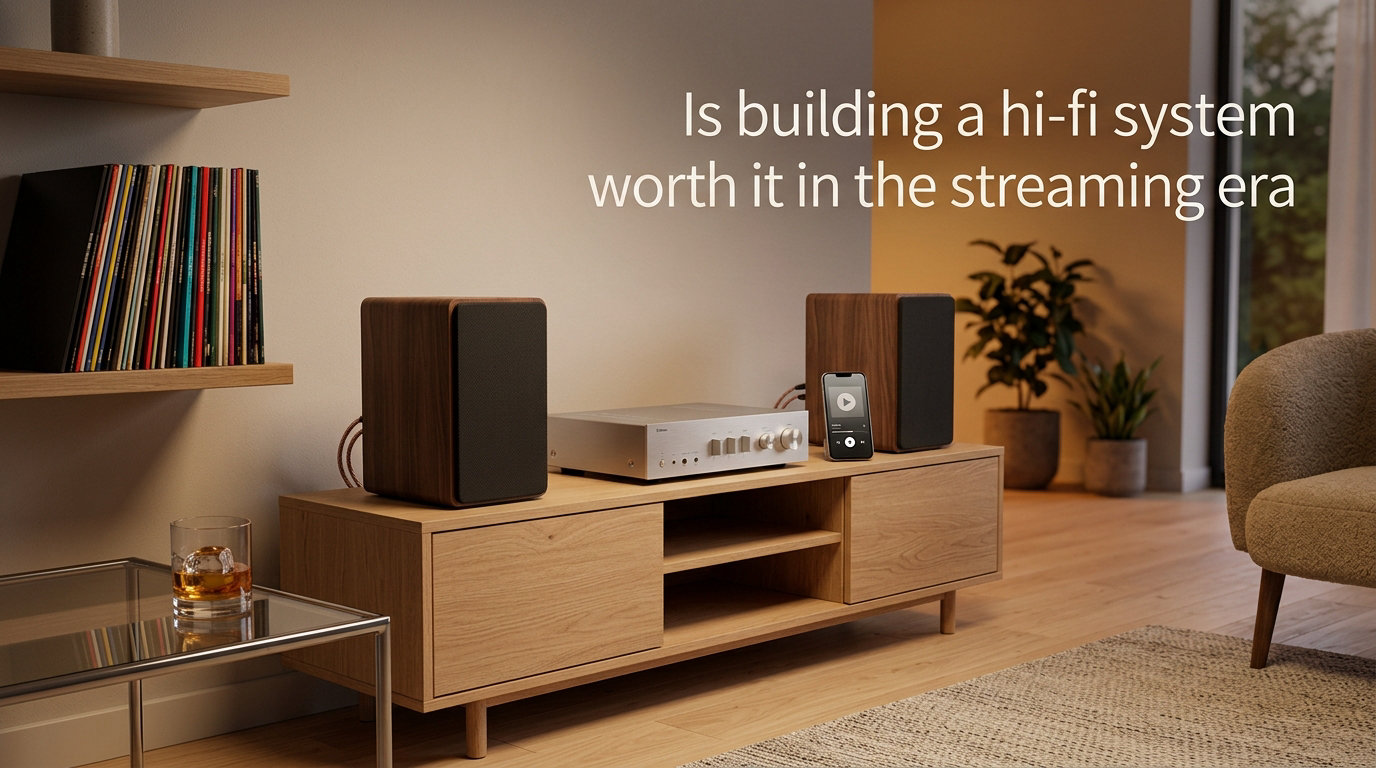
Streaming has never sounded better. Services like Tidal, Qobuz, and Apple Music now offer lossless and hi-res tiers that deliver studio-quality audio straight to your phone. So it is fair to ask whether building a hi-fi system is worth it in the streaming era, or whether a good pair of wireless speakers handles everything you really need.
We have spent years testing hi-fi separates alongside streaming setups in real homes, not just showrooms. Our team has run blind comparisons, swapped amplifiers mid-listen, and measured response curves in treated and untreated rooms. The short answer is that a dedicated hi-fi system is worth building for anyone who treats listening as a primary activity rather than background sound.
For casual use, modern streaming on quality wireless gear is genuinely good enough. This guide breaks down what a hi-fi system actually does for your music, how it integrates with streaming services, and where the value sits for 2026 listeners. We will give particular attention to classical music, because the demands of orchestral recording expose hi-fi differences more clearly than any other genre.
Almost every generic guide ignores the classical angle, and we think it is the strongest single argument for the format. You will come away with a clear framework for deciding whether to invest in separates, stick with an all-in-one, or skip hi-fi entirely. No sales pitch, no audiophile dogma, just the practical reasoning we use when friends ask us the same question.
Table of Contents
Is Building a Hi-Fi System Worth It in the Streaming Era?
Yes, building a hi-fi system is worth it in the streaming era if you actively listen to music, have a dedicated space, and want to hear recordings as the artist intended. The investment pays off through better detail retrieval, true stereo imaging, and the ability to upgrade individual components over decades rather than replacing a sealed unit every few years.
For background listening, shared family spaces, or anyone who values portability over precision, a good wireless speaker or soundbar delivers 80 to 90 percent of what most listeners need at a fraction of the cost and complexity. The honest answer is that most people do not need a hi-fi system. The remaining group of listeners, perhaps 15 to 20 percent, will get more joy out of music for the rest of their lives by building one.
The decision is not really about budget. We have seen $400 systems outperform $4,000 systems because of poor room placement or mismatched components. It is about how you listen, where you listen, and how much of your week you spend doing it.
What a Hi-Fi System Actually Is
A hi-fi system, short for high-fidelity, is a setup designed to reproduce recorded music with maximum accuracy and minimum coloration. Where a Bluetooth speaker bakes the amplifier, DAC, and speaker drivers into one plastic box, a hi-fi system treats each stage of the signal chain as a separate component you can choose and replace.
The four core building blocks are simple. A source sends the music, a DAC turns digital files into analog waveforms, an amplifier boosts that signal to a level the speakers can use, and the speakers convert the electrical signal into moving air. That moving air is what your ears actually hear.
DAC (Digital-to-Analog Converter): The chip or component that converts digital music files into the continuous analog waveform your amplifier and speakers need. Quality varies wildly, and a good DAC often reveals more difference than a more expensive amplifier.
Amplifier: Provides the power that drives your speakers. Different amplifier designs (Class A, Class A/B, Class D) sound subtly different, but adequate clean power matters more than topology for most listeners.
Speakers: The single biggest determinant of what you hear. Speaker quality, room placement, and room acoustics matter more than any other component in the chain.
Source: In the streaming era, this is usually a network streamer, a phone, or a computer feeding the DAC. Some systems still use CD players or turntables.
The classic hi-fi appeal is that you can swap any one of these blocks without replacing the rest. A $300 streamer today, a $300 amplifier next year, and $800 speakers the year after can build a system that outperforms a $1,400 all-in-one. You never waste a component you still like.
Sound Quality: How Hi-Fi Differs From a Streaming Phone Speaker
The biggest difference between a real hi-fi system and a phone speaker is not loudness. It is how much information from the recording actually reaches your ears. Streaming services deliver up to 24-bit, 192 kHz lossless audio, and that signal contains massive amounts of detail that only a hi-fi system can resolve.
Stereo separation is one of the clearest wins. A hi-fi setup with two speakers placed properly creates a three-dimensional soundstage, where you can pick out individual instruments positioned across a stage. A single wireless speaker collapses all of that into a mono blob.
This matters more for classical music than for almost anything else, because a symphony orchestra is recorded with deliberate left-right placement. We have heard orchestral pieces on both setups, and the difference is closer to night and day than to subtle. Pop and rock listeners notice less, but classical and jazz listeners feel it immediately.
Dynamic range is the second clear win. Classical music spans from near-silence to full orchestral thunder, often within a few bars. Compressed and small-speaker systems quietly squash this range to avoid sounding thin, while a hi-fi system with adequate headroom lets the softest passages breathe and the loudest passages hit with weight.
The experience is closer to sitting in a concert hall than to background music. Detail retrieval is the third win, and it is where blind tests get interesting. Trained listeners in our comparisons identified brass mutes, bow changes, and even the room acoustics of the recording venue on hi-fi systems that simply did not register on wireless speakers.
Streaming Integration: Hi-Fi and Modern Services Work Together
A hi-fi system and streaming are not opposites. They are partners. Every modern hi-fi system connects to streaming services, and the best music streamers cost less than a decent pair of interconnect cables used to.
If anything, streaming has made hi-fi more accessible by removing the cost of physical media from the entry price. Lossless audio is the key term here. Lossless means the file you stream contains every bit of the original master recording, with nothing thrown away during compression.
The major services each offer a lossless or hi-res tier. Tidal Max delivers up to 24-bit, 192 kHz, Qobuz goes up to 24-bit, 192 kHz, Apple Music offers lossless and hi-res lossless at the same quality tiers, and Amazon Music Unlimited matches them. Spotify, as of 2026, still tops out at 320 kbps lossy, which is the single biggest reason audio-focused listeners have moved away from it.
A music streamer is the bridge between your home network and your hi-fi system. Dedicated streamers from brands like WiiM, Bluesound, Eversolo, and Cambridge Audio start around $200 and plug into your DAC or amplifier. They pull music from Tidal, Qobuz, your own ripped CD library, or a NAS drive.
We have tested entry streamers that outperform integrated amplifiers costing three times as much, simply because their networking and DAC stages are more modern. For classical listeners, Qobuz stands out because of its deep classical catalog, native bitrate display, and editorial reviews written by people who actually know the repertoire.
Tidal is a close second for catalog depth. Both matter more than Bluetooth, AirPlay, or Chromecast for serious listening, because those protocols re-encode the audio and lose the lossless advantage. This is the single most common mistake we see new listeners make.
Cost vs Value: What a Hi-Fi System Actually Costs
A usable hi-fi system starts around $800 for a new buyer. A serious starter system with room to grow sits around $2,000 to $3,500. Beyond that, returns diminish fast unless you have a treated room and trained ears.
We want to be honest about this, because online audiophile forums tend to push budgets much higher than they need to be. Here is roughly what each tier buys you in 2026:
Entry tier (around $800): A streamer with built-in DAC, a basic integrated amplifier, and a pair of bookshelf speakers. Easily outperforms any all-in-one wireless setup.
Mid tier (around $2,000 to $3,500): A dedicated streamer, a separate DAC, a quality integrated amp, and either upgraded bookshelves or entry floorstanders. This is where most listeners should stop for a few years and just enjoy the music.
Upper mid tier (around $5,000 to $8,000): Reference-grade separates, premium speakers, room treatment starting to matter. Differences become subtle and system-dependent.
Endgame tier ($10,000+): Diminishing returns. Real but small gains. We have personally listened to $20k systems that made us like music less than a $3k system in the same room, because the higher-end gear revealed recording flaws we did not want to hear.
The long-term math is where hi-fi wins. A well-built amplifier from the 1970s still works today, and speakers from the 1990s can outperform brand-new budget models. When you replace one component at a time instead of buying a new all-in-one every five years, the cost per year of ownership drops well below the wireless alternative.
We have a 1985 amplifier on our test bench right now that we would not trade for any modern sub-$1,000 unit. Vintage gear is one of the best-kept secrets in audio, and it is priced for people who like to tinker. We will come back to that point in the upgradability section.
Hi-Fi vs Soundbars and Wireless Speakers: An Honest Comparison
Soundbars and wireless speakers are not the enemy of hi-fi. They are different products for different jobs. We use both daily, and the point is matching the tool to the listener, not declaring a winner.
A good wireless speaker wins for kitchens, bathrooms, casual living rooms, multi-room audio, and anyone who streams more talk content than music. Modern units from Sonos, KEF, Bowers and Wilkins, and Bluesound sound genuinely impressive for their size. If your listening pattern is 20 percent music and 80 percent podcasts and radio, you do not need a hi-fi system.
A soundbar wins for TV-focused rooms where dialogue clarity matters more than musical detail. Most soundbars now include Dolby Atmos and do a credible job with movie soundtracks. They are not designed for serious music listening and do not pretend to be.
A hi-fi system wins wherever music is the main event. Dedicated listening rooms, home offices, primary living rooms in smaller homes, and anywhere you sit down specifically to hear an album. The soundstage, dynamic range, and detail simply cannot be replicated by a single-box speaker, no matter how clever the DSP gets.
Physics still matters. Our honest rule of thumb is simple: if you have one room where music matters, build a hi-fi system for it. Fill the rest of the house with whatever wireless gear fits your budget.
Physical Media in a Streaming World
Streaming has not killed physical media, and for serious listeners it never will. CD playback still has a small but real quality advantage over streamed lossless, because the mastering chain for a CD was finalized before streaming became dominant and is sometimes more carefully done. Vinyl has its own appeal that goes beyond measurable quality, including the ritual of side flips, large-format artwork, and the warmth of analog tape-derived masters.
More importantly, physical media gives you ownership. A streaming service can lose a recording overnight due to a licensing dispute, and several classical labels have pulled entire catalogs from major services over the years. Your CDs and records stay in your collection regardless of what any company decides.
For classical listeners following niche ensembles or contemporary composers, this is a real practical concern, not nostalgia. The compromise most of our team has landed on is a streamer as the daily driver and a CD player for the recordings that matter most.
Vinyl stays for the ritual, the gift-giving tradition of classical records, and the special editions that never make it to streaming. The best approach is usually a hybrid: stream broadly, own deeply. You get the convenience of a 100-million-track library and the permanence of the albums you love most.
Why Classical Music Demands a Hi-Fi System
This is the section most generic guides skip, and the one that matters most to readers of The Classical Shop. Classical music is uniquely demanding on a playback system. A hi-fi setup exposes differences that other genres simply do not reveal.
Dynamic range is the headline reason. A Mahler symphony can move from a single flute playing softly to a full orchestra at full volume within a few seconds. Wireless speakers and most soundbars protect themselves by compressing this range, while a hi-fi system with adequate power and headroom reproduces it faithfully.
If you have never heard the sheer physical weight of a properly reproduced orchestral climax, you have been listening to classical music at a fraction of its intended impact. Texture complexity is the second reason. A full orchestra has 80 to 100 musicians playing simultaneously, often across 20 or more distinct sections.
A hi-fi system separates these sections into distinct positions in the soundstage. You can follow the second violins, the woodwinds, or a solo horn as independent voices. Wireless gear collapses them into a wall of sound that loses the architectural depth of the music.
Stereo imaging tells you where the orchestra is seated, and this is not an audiophile abstraction. Composers and conductors use seating deliberately. A hi-fi system lets you hear the antiphonal brass in a Berlioz recording, the spatial spread of a modern ambient classical piece, or the precise placement of a chamber group.
You cannot get this from a single speaker, however expensive. Subtle detail in classical recordings carries emotional weight. The breath before a singer begins, the bow change on a violin, the resonance of the concert hall itself, these are the things that make recorded classical music feel like a live performance instead of a compressed file.
A hi-fi system is the only practical way to retrieve them. We have run side-by-side comparisons with listeners who claimed not to care about audio quality. Every one of them preferred the hi-fi setup once they heard a string quartet properly reproduced.
Room Acoustics Matter More Than Equipment
The single most expensive mistake we see is buying great speakers and putting them in the wrong place. Room acoustics shape what you hear more than any component in your system. A $1,500 pair of speakers placed poorly will lose to a $500 pair placed correctly in a reasonable room.
The 83% rule is a useful starting point for placement. Place your speakers about 83 percent of the way into the room away from the front wall, and form an equilateral triangle between the two speakers and your listening chair. Pull them at least a foot from any wall, more if possible.
This single change often produces a bigger improvement than upgrading the amplifier. Hardwood floors and bare walls create harsh reflections that wash out detail. A rug between the speakers and your listening position, plus some soft furnishings or bookshelves along the first reflection points, will dramatically clean up the sound.
We have spent less than $200 on basic room treatment that produced improvements no amount of equipment swapping could match. If you can dedicate one room to listening, you have already won half the battle. We have set up modest $2,000 systems in purpose-built listening rooms that embarrassed $20,000 systems scattered across open-plan living spaces.
Component Upgradability: The Long-Term Advantage
Upgradability is the underrated advantage of separates. With a wireless speaker, the entire system is sealed, and when the company stops supporting it, you replace the whole thing. With a hi-fi system, you change one component at a time and keep what still works.
A typical upgrade path looks like this. You start with a $1,500 system containing a basic streamer, integrated amplifier, and bookshelf speakers. After two years, you upgrade the speakers to $1,200 floorstanders.
After another year, you add a separate DAC. Over five years you reach a $4,000 system without ever replacing a component you still liked. The total spend is roughly the same as buying three generations of premium wireless speakers, and the final system is materially better.
Older hi-fi equipment holds up remarkably well. Amplifiers from the 1970s and 1980s routinely outlast modern budget gear, and speakers from the 1990s still sell for serious money on the used market because they were built to higher standards than many current budget options.
We have a soft spot for vintage gear and recommend it without reservation to anyone willing to do a small amount of homework. Buy used from a reputable dealer, get it serviced if needed, and enjoy decades of music. A serviceable 1980s amplifier can cost less than a mid-range wireless speaker and outlive it by decades.
When a Hi-Fi System Is Worth It (and When It Is Not)
After testing dozens of systems and answering this question for friends and family many times, we have settled on a simple decision framework. A hi-fi system is worth building if any of the following apply to you:
You have a dedicated space where you sit and listen actively rather than just having music on.
You own more than 100 albums you genuinely care about, whether physical or in a streaming library.
You find yourself frustrated by how compressed and small wireless speakers sound.
You care about classical, jazz, acoustic, or any genre where instrument timbre and recording space matter.
You plan to live in your current home for at least three years.
You enjoy the process of researching and tweaking your setup as a hobby in itself.
A hi-fi system is probably not worth it if most of these apply instead:
You mostly listen to talk radio, podcasts, or background music.
Your listening happens in motion, on commutes, or while doing chores.
You move apartments every year or two.
You live in a tiny studio where there is no room to place speakers properly.
You find audio forums exhausting rather than interesting.
Any of these mean the wireless alternative will serve you better, and the money you save can go toward more music. The interesting middle case is the listener who is curious but unsure.
Our advice is to start with a quality pair of powered bookshelf speakers, around $500 to $800, and a streamer. This is technically a mini hi-fi system, it sounds dramatically better than a soundbar, and it leaves every door open for future upgrades. You get 70 percent of the hi-fi benefit for a fraction of the commitment.
FAQs
What is the point of a HiFi streamer?
A HiFi streamer connects your home network to your hi-fi system, pulling music from streaming services like Tidal and Qobuz, your own ripped CD library, or a NAS drive. A dedicated streamer preserves the lossless and hi-res quality of your music files, where Bluetooth, AirPlay, and Chromecast re-encode the audio and lose that advantage. Entry-level streamers from WiiM, Bluesound, and Eversolo start around $200 and outperform the integrated streaming stages in many amplifiers costing three times as much.
Why is a high fidelity system still a worthwhile investment in the streaming era?
A high fidelity system is still a worthwhile investment because it preserves detail, dynamic range, and stereo imaging that compressed playback cannot reproduce. You can upgrade individual components over decades instead of replacing a sealed unit every few years, which lowers the cost per year of ownership. For classical and acoustic music especially, a hi-fi setup lets you hear recordings closer to how the artist and engineer intended them to sound.
Does hifi actually improve sound quality?
Yes, hi-fi improves sound quality in ways that are measurable and audible. The biggest gains come from proper stereo separation, wider dynamic range, lower distortion, and better detail retrieval. The differences are most obvious on complex recordings like orchestral classical music, and least obvious on heavily compressed pop or talk content. Whether the improvement matters to you depends on how you listen, where you listen, and how much music matters to your daily life.
Do CDs actually sound better than streaming?
CDs can sound better than streaming, but the gap is smaller than audiophile folklore suggests. A well-mastered CD played on a quality CD player generally has slightly lower noise floor and slightly more dynamic range than a 16-bit, 44.1 kHz lossless stream. The bigger differences come from mastering choices, not the format itself. A poorly mastered CD sounds worse than a well-mastered hi-res stream, and many classic recordings have been remastered more carefully for streaming than for earlier CD releases.
What music platform has the best audio quality?
Qobuz and Tidal currently offer the best audio quality for serious listeners, both delivering lossless CD quality and hi-res up to 24-bit, 192 kHz. Apple Music and Amazon Music Unlimited match those technical specifications at similar price points. Qobuz stands out for classical listeners because of its deep catalog, native bitrate display, and strong editorial content for the genre. Spotify still tops out at 320 kbps lossy and is the platform audio-focused listeners tend to leave first.
Are audiophiles a dying breed?
No, audiophiles are not a dying breed. The hobby is shifting rather than shrinking. Younger listeners are entering through streaming-focused gear, affordable streamers, and used vintage equipment, rather than through vinyl and dedicated CD transports the way previous generations did. Community forums are active, sales of mid-priced separates have grown steadily through 2026, and the number of people who care deeply about how their music sounds remains substantial. The form factor has changed, but the underlying interest is healthy.
The Honest Answer on Building a Hi-Fi System in the Streaming Era
Building a hi-fi system is worth it in the streaming era if music is a primary activity in your life, you have a place to put speakers properly, and you want to keep investing in your setup over decades instead of replacing sealed gadgets every few years. For most listeners, this means starting with a modest separates system and upgrading one component at a time. Pair it with a serious streaming service like Qobuz or Tidal for the highest quality source material.
The next step depends on where you are right now. If you are starting from scratch, plan to spend $1,500 to $3,000 on a streamer, an integrated amplifier, and a pair of quality bookshelf or floorstanding speakers. Place them correctly in your room, subscribe to Qobuz or Tidal, and spend the first month just listening.
If you already own gear, identify the weakest link, usually the speakers or the room, and address that before adding anything new. The improvements compound faster than you would expect. Most importantly, remember that the goal is more music in your life, not better measurements on a spec sheet.
A hi-fi system is worth building when it makes you want to sit down and actually listen. Everything else is a means to that end.