
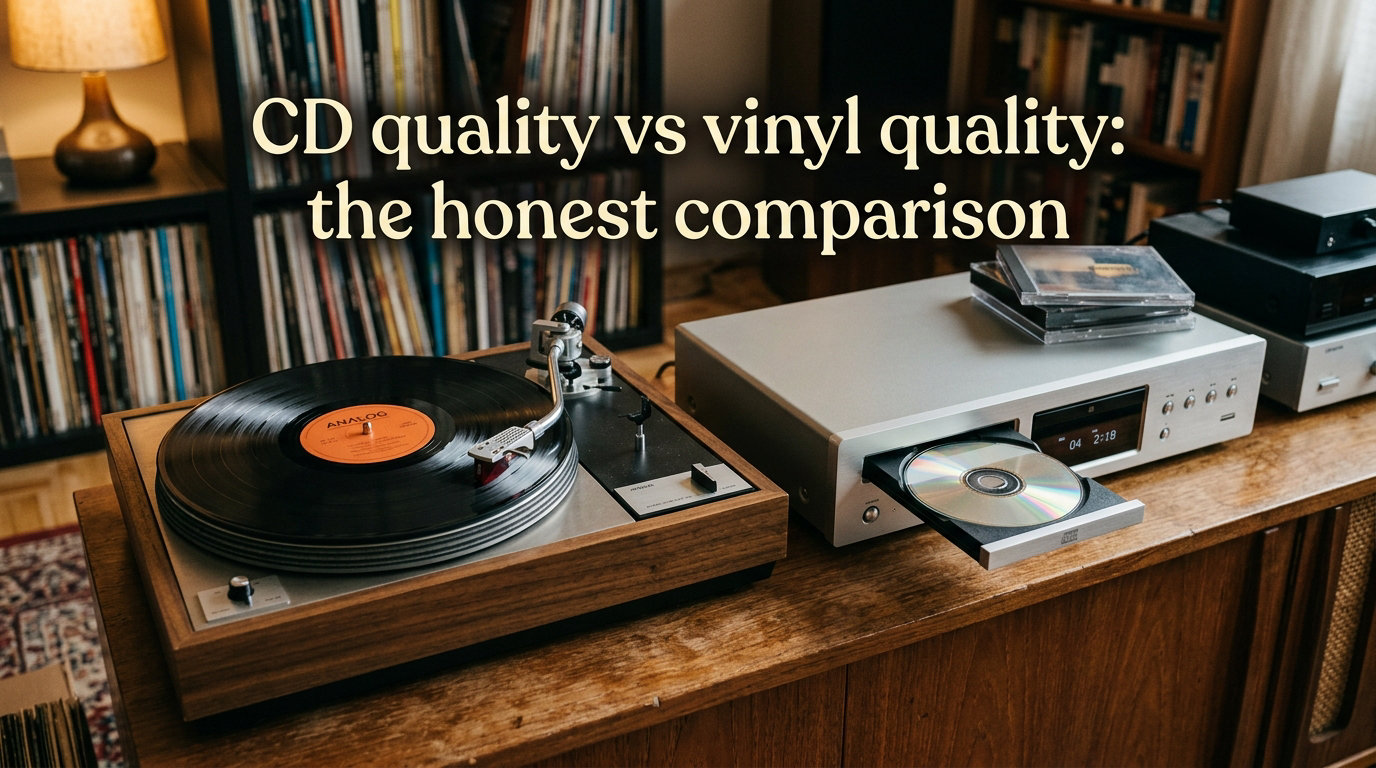
I have spent more hours than I care to admit arguing about CD quality vs vinyl quality with people who are far smarter than me. Some of them are mastering engineers. Others are collectors with turntables that cost more than my first car. The debate never gets boring, and it never fully resolves, because the answer depends on what you actually mean by “better.”
Here is the honest truth up front: if we measure strictly, CD wins on almost every technical axis. If we listen subjectively, the verdict flips depending on the recording, the mastering, and the equipment. And if we include the experience of listening itself, vinyl often pulls ahead for reasons that have nothing to do with frequency response.
This guide is for the person who is tired of tribal answers. You will get the measurements, the explanations behind the measurements, the exceptions, and a real recommendation at the end. I am writing from the perspective of someone who owns a healthy collection of both formats and has done careful A/B tests in a treated listening room, not just on a forum.
If you want a deeper dive into how digital vs physical format considerations play out in the classical repertoire specifically, our piece on the best recordings of Tchaikovsky’s 1812 Overture walks through a real example of how format choice changes what you hear.
Table of Contents
The Honest 30-Second Answer
CD quality vs vinyl quality, measured purely, goes to CD by a wide margin. A CD delivers roughly 96 dB of dynamic range, near-perfect channel separation, and silent backgrounds. Vinyl typically manages 55 to 70 dB of dynamic range, audible surface noise, and noticeable channel bleed near the bass frequencies.
But the same album often sounds more engaging on vinyl, and that is not just nostalgia. The reasons are mastering (vinyl usually gets a less compressed cut), harmonic distortion that flatters the midrange, and a listening ritual that forces you to actually pay attention.
If you want the one-sentence verdict: CD is technically superior, vinyl is often subjectively superior, and mastering quality matters more than either format.
What CD Quality vs Vinyl Quality Actually Means
Before we compare, we have to define what each format is doing. The CD quality vs vinyl quality debate gets muddy because people compare the wrong things.
CD Quality: The Redbook Standard
CD quality, often called Redbook after the original specification document, is digital audio sampled at 44.1 kHz with 16-bit depth. That means the analog waveform is measured 44,100 times per second, and each measurement is stored as a number with 65,536 possible values.
The math works out to a theoretical dynamic range of about 96 dB and a frequency response that is flat from 20 Hz up to about 20 kHz. For the vast majority of human listeners, that covers everything we can perceive.
CDs store this data as pits and lands on an optical disc, read by a laser. There is no physical contact during playback, which means no wear from normal use.
Vinyl Quality: A Continuous Analog Groove
Vinyl quality is analog audio stored as a physical modulation cut into a spiral groove. A stylus traces the groove, and its microscopic movements are converted back into an electrical signal by a cartridge.
There is no sampling and no quantization. The signal is theoretically continuous, which is the source of the famous “analog” claim. In practice, the groove is limited by cutter head capability, vinyl compound properties, and playback stylus shape.
Vinyl also requires equalization. The RIAA curve boosts bass and cuts treble during cutting to keep groove widths manageable, then reverses the process on playback. This adds another layer where quality can vary.
CD Quality vs Vinyl Quality: The Technical Comparison
This is where the numbers tell a clear story. Let us walk through the actual specifications side by side.
Dynamic Range: CD 96 dB vs Vinyl 55 to 70 dB
Dynamic range is the gap between the quietest sound a format can reproduce above its noise floor and the loudest sound it can handle before distortion. This is the single most important spec for classical music, where pianissimos and fortissimos can sit 60 dB apart.
CDs deliver about 96 dB of dynamic range. A well-pressed vinyl record delivers 55 to 70 dB, with the very best pressings occasionally touching 75 dB under ideal conditions.
That is roughly a 26 dB advantage for CD, which translates to about a 20-times-larger gap between the softest and loudest sounds. For classical repertoire with wide dynamic swings, this matters enormously.
Frequency Response: A Closer Race Than You Think
Both formats can cover the audible band of 20 Hz to 20 kHz, but they do it very differently. CDs are ruler-flat across the entire range because of how the digital filter works.
Vinyl can reach 20 Hz at the low end, though deep bass has to be summed to mono below about 80 Hz to keep the stylus from being thrown out of the groove. High frequencies roll off beyond 15 to 18 kHz on most pressings, with audiophile pressings occasionally reaching 25 kHz.
In real listening, the audible difference in frequency response is small. The bigger differences come from harmonic content and noise floor, not raw frequency extension.
Signal-to-Noise Ratio and Stereo Separation
CD offers a signal-to-noise ratio of around 96 dB and stereo channel separation of more than 90 dB across the entire frequency range. You hear dead silence between notes and pinpoint stereo imaging.
Vinyl typically sits at 55 to 70 dB signal-to-noise ratio and offers around 25 to 35 dB of channel separation at most. Bass frequencies on vinyl are mixed to mono precisely because limited separation causes problems below about 150 Hz.
This is why CDs sound “cleaner” in direct comparison. There is no surface noise, no rumble, no interchannel bleed.
Wow, Flutter, and Speed Stability
CDs read data into a buffer, so speed stability is essentially perfect. Wow and flutter measure below 0.001 percent.
Vinyl wow and flutter depend entirely on turntable quality. A good direct-drive or belt-drive deck hits 0.05 to 0.1 percent, which is inaudible for most music but audible on sustained piano tones.
Why Vinyl Sounds Warmer (And Whether It Is Real)
The “warmth” question is the heart of the CD quality vs vinyl quality debate. Vinyl does sound warmer to most listeners in blind tests, and there are real acoustic reasons for it.
First, vinyl introduces second-order harmonic distortion. This is the same kind of distortion that tube amplifiers add, and it is pleasing to the human ear because it reinforces the fundamental pitch rather than clashing with it. Strings, vocals, and brass all gain a perceived richness.
Second, vinyl naturally rolls off the highest frequencies. The very top end where digital harshness lives, between 12 and 18 kHz, is gently attenuated on vinyl. This removes some of the harshness that CDs reproduce faithfully but recordings do not always earn.
Third, vinyl adds low-level ambience cues from the groove itself. The continuous analog signal carries tiny details that some listeners describe as “air” or “presence,” even though measurements suggest they should not be there.
Is some of it psychological? Almost certainly. But the harmonic distortion and high-frequency roll-off are measurable and real, and they flatter the midrange of most recordings. Calling vinyl warmth “imaginary” is incorrect. Calling it “accurate” is also incorrect. It is pleasant distortion, and there is nothing wrong with preferring it.
The Mastering Factor: Why the Same Recording Sounds Different
If there is one secret in the CD quality vs vinyl quality debate that most articles skip, this is it. The mastering for vinyl is often different from the mastering for CD, and that difference explains more of what you hear than the format itself.
The Loudness War and CD Compression
Since the late 1990s, CDs have been caught in the loudness war. Mastering engineers apply heavy dynamic compression to make CDs sound louder at the same volume setting, which makes tracks stand out on radio and streaming.
The result is squashed dynamics, distorted peaks, and a fatiguing sound. Many classic albums reissued on CD in the 2000s sound dramatically worse than the original vinyl pressings, not because CD is worse, but because the mastering was.
Vinyl Forces Better Mastering
Vinyl has physical limits that protect it from the worst of the loudness war. You cannot cut a heavily compressed, bass-heavy master into a groove without the needle jumping out. You also cannot have deep bass in stereo without eating groove space and reducing playing time.
So mastering engineers create a separate, more dynamic cut for vinyl. They roll off sub-bass, restore some of the dynamics squashed out of the CD master, and shape the high end to fit the format. The result often sounds more open, more punchy, and more musical.
This is why audiophiles sometimes prefer vinyl. It is not the format. It is the mastering that the format forced. A well-mastered CD beats a badly-mastered vinyl every time, and a well-mastered vinyl beats a badly-mastered CD every time.
The RIAA Curve and What It Actually Does
The RIAA equalization curve is a brilliant engineering compromise. Bass is cut by about 20 dB during cutting, then boosted back by the same amount on playback. Treble is boosted during cutting and cut on playback.
This lets records carry deep bass without eating groove width and reduces surface noise because the treble cut on playback also cuts hiss. It is one of the reasons vinyl can sound so quiet and smooth with good equipment.
The Listening Experience: Why Measurements Do Not Tell the Whole Story
Measurements favor CD. Listening tests do not always agree. Forum after forum, including r/audiophile and r/Cd_collectors, reports the same pattern: blind A/B tests produce mixed results, and the format the listener expected to win does not always win.
Part of this is the ritual. Vinyl forces you to pick an album, pull it from the sleeve, clean it, drop the needle, and listen to a full side without skipping. That level of attention changes how the brain processes sound.
CDs and streaming encourage shuffle and background listening. You hear more detail when you are actively listening, regardless of format.
Part of it is expectation bias. Listeners who expect vinyl to sound warm often perceive warmth, even when the source is identical. Listeners who expect CD to sound harsh sometimes report harshness even on material that is not harsh.
The honest takeaway from the blind test literature is this: when recordings are level-matched and mastering is identical, most listeners cannot reliably distinguish high-quality vinyl from CD. When mastering differs, listeners prefer whichever master they prefer, regardless of format.
CD Quality vs Vinyl Quality for Classical Music
Classical music is where the format debate gets sharpest. The repertoire demands wide dynamic range, long playing times, silent backgrounds, and precise imaging. These are exactly the areas where CD excels and vinyl struggles.
Why CD Is Usually the Better Choice for Classical
Classical recordings regularly exceed 70 dB of dynamic range. A Mahler symphony or a Tchaikovsky overture can move from a whispering string section to a full orchestral climax in seconds. Vinyl cannot fully reproduce that swing.
Surface noise is also a serious problem for classical vinyl. Quiet passages sit just above the noise floor, which means you hear tick, pop, and rumble during the most delicate moments. CDs are silent between notes.
Long playing times are another issue. Symphonies of 25 minutes or longer require either multiple vinyl sides or compressed groove spacing, which reduces quality. CDs hold 80 minutes uninterrupted.
Where Vinyl Still Wins for Classical
Vintage classical pressings from the golden age of stereo, roughly 1958 to 1970, often sound extraordinary. Labels like Decca, RCA Living Stereo, and Mercury Living Presence cut their masters directly to lacquer with minimal processing.
Many of these recordings have never been properly transferred to CD, or were transferred with heavy noise reduction that strips away ambience. Original pressings or high-quality audiophile reissues can outperform the CD version.
The warmth of vinyl also flatters strings and brass in a way that some listeners find more realistic than the clinical clarity of CD. If your taste runs to late-Romantic orchestral music, vinyl can deliver an involving midrange that digital does not always match.
Practical Advice for Classical Collectors
If you are building a classical collection, I would default to CD for new releases and modern reissues. The dynamic range advantage is too important to give up.
I would choose vinyl for golden-age recordings, audiophile reissues from labels like Speakers Corner and Analogue Productions, and chamber music where surface noise is less of an issue. Skip cheap modern pressings pressed from digital files, which give you the worst of both formats.
How Your Equipment Changes the Verdict
The CD quality vs vinyl quality verdict depends heavily on what you play them through. A 200 dollar CD player sounds fine. A 200 dollar turntable usually sounds poor.
Vinyl is unforgiving of cheap equipment. The cartridge, the phono stage, the tonearm, the turntable isolation, and the stylus shape all matter. To match a mid-priced CD player, you typically need to spend at least double on the analog side.
CD playback is more forgiving. Even a budget CD player or a 100 dollar DAC sounds surprisingly close to high-end gear because the digital conversion is already very good.
If you have a fixed budget, my honest advice is to spend more on your analog chain than your digital chain. A 500 dollar turntable and a 200 dollar CD player will outperform a 200 dollar turntable and a 500 dollar CD player every time.
For phono stages, avoid the cheap built-in stages on budget receivers. A standalone phono preamp in the 200 to 400 dollar range will transform what you hear from vinyl.
Practical Considerations: Cost, Longevity, and Storage
Sound is not the only factor in the CD quality vs vinyl quality decision. The practical realities matter, and they often tilt the decision more than specs do.
Longevity and Wear
CDs, when properly cared for, last indefinitely. The laser reads the disc without physical contact, so playback does not degrade the medium. The main failure modes are disc rot from manufacturing defects and scratches from rough handling.
Vinyl wears out with every play. Even with a clean stylus and a properly weighted tonearm, each playback removes a microscopic amount of vinyl from the groove. Records played frequently for decades develop audible wear.
For collectors, this means CDs are a better long-term archive and vinyl is a better short-term ritual. Both have a place in a serious collection.
Cost Per Album
New CDs typically cost less than new vinyl. The same album often retails for 12 to 18 dollars on CD and 25 to 40 dollars on vinyl. Audiophile vinyl pressings can run 50 dollars or more.
Used CDs are also dramatically cheaper than used vinyl. Bargain bins are full of dollar CDs in excellent condition. Used vinyl in good shape has become expensive because of collector demand.
If cost is a factor, CD gives you access to far more music per dollar. If you are willing to spend for the experience, vinyl rewards the investment.
Storage and Maintenance
CDs take up minimal shelf space. A standard bookshelf can hold hundreds. Vinyl demands serious real estate, with proper vertical storage, climate control, and room to flip through sleeves.
Vinyl also requires ongoing maintenance. Records need carbon-fiber brushing before each play, periodic wet cleaning, anti-static treatment, and stylus cleaning. CDs need occasional wiping with a microfiber cloth.
If you live in a small apartment or you do not enjoy the maintenance ritual, CD is the more practical choice. If you have space and you enjoy the routine, vinyl becomes part of the pleasure.
Building a Hybrid Collection
The smartest move for most listeners is a hybrid collection. Use CDs for classical music, modern jazz, and any album where dynamic range matters. Use vinyl for vintage pressings, audiophile reissues, and albums you want to spend real time with.
This is what most serious collectors I know actually do. The CD quality vs vinyl quality debate is not a zero-sum game. Both formats have strengths worth exploiting.
FAQs
Does vinyl have better sound quality than CD?
No, not on objective measurements. CDs deliver higher dynamic range (96 dB vs 55 to 70 dB for vinyl), better signal-to-noise ratio, and near-perfect stereo separation. However, vinyl often sounds more engaging because of harmonic distortion, high-frequency roll-off, and the fact that vinyl usually receives a more dynamic master. The format itself is not better, but the listening experience frequently is.
Do audiophiles prefer vinyl or CD?
Audiophile preference is split. Objectivist audiophiles who value measurements tend to prefer CD or high-resolution digital. Subjectivist audiophiles who value emotional engagement often prefer vinyl, especially for vintage pressings and audiophile reissues. Many serious listeners own both formats and choose based on the recording and the listening session.
Is vinyl worth it compared to CD?
Vinyl is worth it if you value the listening ritual, large-format artwork, and the more dynamic mastering that vinyl often receives. It is not worth it if you prioritize maximum sound quality per dollar, silent backgrounds, or storage efficiency. New vinyl costs roughly twice as much as new CD, so the decision depends on whether the experience justifies the premium for you.
Is CD quality better than high quality?
CD quality (16-bit, 44.1 kHz Redbook) is more than enough for almost all listeners and most music. High-resolution audio (24-bit, 96 kHz or higher) offers theoretical advantages in dynamic range and frequency extension, but controlled blind tests rarely show audible differences for human listeners. CD quality already exceeds the limits of human hearing in both dimensions.
Do CDs offer better sound quality than vinyl?
Yes, on technical measurements. CDs offer roughly 26 dB more dynamic range than vinyl, near-silent backgrounds, better channel separation, and no surface noise or wear from playback. If the same master is used for both formats and playback is level-matched, most listeners cannot reliably distinguish them in blind tests. When mastering differs, the format with the better master wins, regardless of whether it is CD or vinyl.
Why are CDs no longer popular?
CDs lost popularity mainly because of streaming, not because of vinyl. Streaming offers unmatched convenience and access to nearly every recording ever made. Vinyl survived because it offers something streaming cannot: physical ownership, large artwork, and an intentional listening ritual. CDs sit awkwardly between the two, offering neither the convenience of streaming nor the tactile experience of vinyl, which is why sales declined even as vinyl sales grew.
CD Quality vs Vinyl Quality: The Final Honest Verdict
CD quality vs vinyl quality is not really a contest between two formats. It is a contest between two philosophies of listening. CD gives you the most accurate version of the recording, with measurements that win every time. Vinyl gives you a more involving version, with mastering that often wins the subjective test.
If you want to hear exactly what the engineer heard in the studio, choose CD. If you want to be drawn into the music and forget you are listening to a recording, choose vinyl. For most music lovers I know, the answer is to own both, choose by album, and stop pretending there is a single right answer.
The CD quality vs vinyl quality debate will keep running as long as people care about how music feels. Use the measurements as your starting point, then trust your own ears. The best format is the one that makes you listen more.