
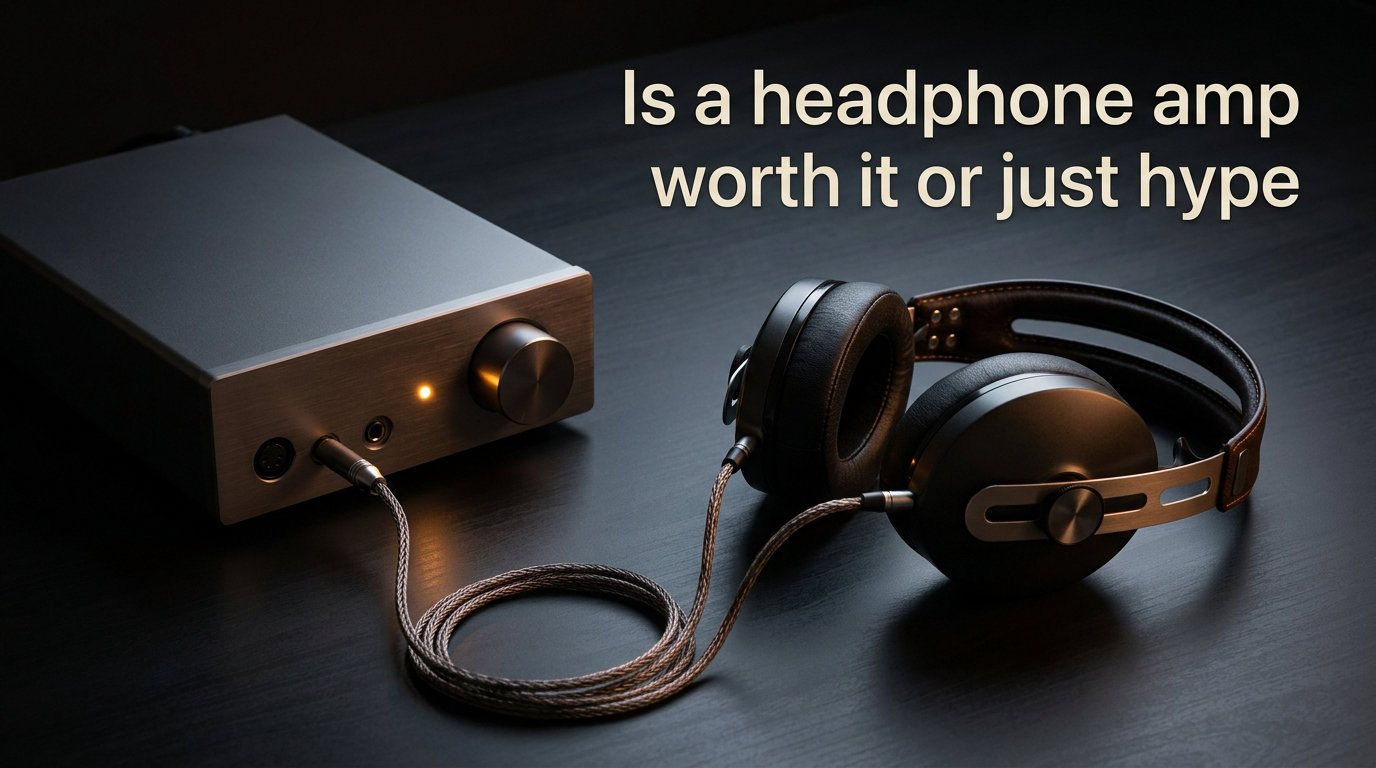
The question of whether a headphone amp is worth it divides audiophiles, casual listeners, and forum regulars alike. Some swear an external amplifier transformed their listening experience overnight, while others insist the difference is pure placebo. After testing headphones across a wide impedance range and comparing built-in versus dedicated amplification, I can tell you the honest answer: it depends entirely on what you are driving.
If you listen to classical music with demanding headphones, that answer leans much more strongly toward yes. Classical recordings carry enormous dynamic range, and underpowered headphones flatten the dramatic contrast between a whisper-soft pianissimo and a full orchestral fortissimo. This guide breaks down exactly when an amp helps, when it is marketing fluff, and how to tell the difference for your own setup.
We will cover what headphone amps actually do, the impedance question in plain language, and why classical listeners in particular benefit from proper amplification more than most.
Table of Contents
What Is a Headphone Amp?
A headphone amp is a dedicated device that boosts the audio signal from your source to a level that can properly drive your headphones. Think of it as a compact power station sitting between your music player and your ears.
Your phone, laptop, and most consumer devices already contain a tiny amplifier built in. The catch is that these built-in amps prioritize battery efficiency and compactness over raw power or audio fidelity. They handle earbuds and most consumer headphones fine, but they struggle when asked to drive demanding audiophile-grade headphones.
An external headphone amp delivers cleaner voltage and more current than your device can produce on its own. This matters most with high-impedance headphones or low-sensitivity designs that need substantial power to perform as their engineers intended. Without sufficient power, even excellent headphones sound thin, lifeless, and unable to reach comfortable listening volumes.
How Headphone Amps Actually Work
Headphone amps work by taking a weak audio signal and increasing its power through two main channels: voltage and current. High-impedance headphones, typically 250 ohms and above, need more voltage to reach adequate volume. Low-impedance but low-sensitivity headphones, including most planar magnetic designs, need more current to control the driver properly.
The amp’s job is to deliver both without distortion. A quality amplifier provides what audio engineers call a high damping factor, meaning it keeps tight control over the headphone driver’s movement. When the driver stops and starts precisely on cue, you hear cleaner transients, better bass control, and improved clarity across the frequency range.
Underpowered headphones, by contrast, suffer from a flabby low end and congested midrange. The driver cannot move as fast or as precisely as the music demands, so everything sounds compressed and vague. This is where the legitimate claims about an amp improving sound come from, rather than imagined placebo effects.
Impedance Explained Simply (For Beginners)
Impedance, measured in ohms, describes how much electrical resistance your headphones present to an amplifier. Lower numbers mean easier to drive, and higher numbers mean harder to drive. That is the short version, and for most readers it is all you need to remember.
Headphones generally fall into three impedance ranges. Low-impedance models from 16 to 32 ohms include most earbuds, in-ear monitors, and consumer over-ear headphones, and they work fine from any phone or laptop. Medium-impedance models from 32 to about 100 ohms cover many popular audiophile headphones and may benefit from amplification depending on your source. High-impedance models at 150 ohms and above, commonly 250 or 300 ohms, almost always need a dedicated amp to sound their best.
Two other specs matter alongside impedance. Sensitivity, measured in decibels per milliwatt, tells you how loud the headphones get from a given amount of power. A high-impedance but high-sensitivity headphone may still play loud from a phone, just not as cleanly. The combination of high impedance and low sensitivity is what truly demands external amplification.
When You Actually Need a Headphone Amp
You need a headphone amp when your headphones demand more power than your source can cleanly provide. The clearest cases involve high-impedance headphones at 250 ohms and up, planar magnetic designs, and any headphone rated low in sensitivity. If your current source cannot get loud enough without distortion or sounds thin and lifeless, an amp is the fix.
Popular headphones that benefit from amplification as of 2026 include the Sennheiser HD 600 and HD 650 series at 300 ohms, the Beyerdynamic DT 880 and DT 990 in their 250-ohm variants, and most planar magnetic models from Audeze and Hifiman. These are exactly the headphones classical music listeners tend to favor for their natural timbre and wide soundstage.
As a rough spending guide, if your headphones cost more than $200 and carry a high-impedance or planar magnetic designation, budget for an amp. The headphones themselves remain the most important part of your chain, but a quality amp lets them perform as designed rather than being held back by an underpowered source.
Signs Your Headphones Need More Power
Several clear warning signs indicate your headphones are starving for power. If you notice any of the following, an amp is likely worth it for your setup.
Maximum volume feels inadequate even at full output from your phone or laptop
Bass sounds loose, bloated, or lacking impact compared to how the headphones are described
The soundstage feels narrow and claustrophobic rather than open and spacious
Quiet passages in classical recordings become hard to hear without cranking the volume
You hear distortion or clipping when the music gets loud and complex
None of these symptoms mean your headphones are bad. They mean your source cannot deliver what the headphones need. A well-matched amp addresses every one of them directly.
When You Don’t Need a Headphone Amp
You do not need an external amp if your headphones are easy to drive. Most earbuds, in-ear monitors, and consumer over-ear headphones fall into this category, along with virtually all active noise-canceling models.
Active noise-canceling headphones already contain a built-in amplifier as part of their signal processing chain. Adding an external amp to these can actually degrade sound quality, since you are double-amplifying the signal and potentially introducing noise.
Low-impedance headphones from 16 to 32 ohms with high sensitivity ratings are designed to run from portable sources. If your headphones sound great from your phone or laptop, reach comfortable volume with headroom to spare, and deliver clean bass and clear dynamics, an external amp will not improve anything audible. Spend that money on better headphones or higher-quality recordings instead.
The Classical Music Angle: Why Amps Matter More Here
Classical music places unique demands on headphones and amplification that popular music simply does not. A typical pop track is mastered to sit near maximum volume throughout, with the dynamic range compressed to a narrow band. A symphony, concerto, or chamber work spans an enormous range from near-silence to thunderous tutti passages.
This wide dynamic range is where underpowered headphones fail most visibly. The soft passages need clarity and detail at low volume, while the climactic moments need effortless power without compression. An amp that delivers clean headroom lets you hear the full dramatic arc of a Mahler symphony or a Beethoven piano sonata exactly as the performers and engineers intended.
Specific orchestral moments reveal the difference sharply. The hushed opening of Strauss’s Also sprach Zarathustra should feel intimate and suspenseful. The full-orchestra sunrise that follows should hit with physical impact. Underpowered headphones compress both extremes, turning a thrilling contrast into a flat, muted experience. This is the real, audible case for amplification when your repertoire centers on classical and orchestral works.
Chamber music and solo piano benefit too. The sustained decay of a single piano note in a quiet hall demands a background so silent that any source noise becomes intrusive. A quality amp with a clean, low-noise floor lets those delicate decays hang in the air undisturbed, which is something cheap built-in outputs routinely fail to deliver.
Tube vs Solid State for Classical Listening
Once you have decided an amp is worth it, you will encounter a second debate: tube versus solid state. For classical listening specifically, each has distinct character worth understanding before you spend.
Solid-state amps deliver clean, accurate, fast sound with tight bass control. They add essentially nothing to the signal, which many listeners prefer for hearing recordings exactly as engineered. Brands like Schiit and Topping dominate this category at accessible prices, and for most classical listeners a solid-state amp is the sensible default choice.
Tube amps introduce what enthusiasts call warmth, a subtle even-order harmonic coloration that many find pleasing with acoustic instruments. Strings can sound sweeter, woodwinds more liquid, and the overall presentation more relaxed and forgiving. The trade-off is slightly less technical precision and the ongoing cost of replacing vacuum tubes over time.
For classical music, I would suggest starting with solid state unless you already know you prefer the tube sound. Transparency serves orchestral recordings well, and modern solid-state amps at modest prices measure cleanly enough that the difference between them and far more expensive models is often inaudible in blind listening tests.
Myth vs Reality: Does an Amp Really Make a Difference?
Let me address the hype question directly. The claim that any headphone benefits from an expensive amp is myth. The claim that amps never make an audible difference is also myth. The reality sits firmly in between and depends entirely on your headphones.
Forum regulars on r/headphones and r/audiophile consistently report that with modern efficient headphones, amps make minimal audible difference. Blind tests often fail to distinguish between decent mid-range amps when driving easy loads. This is real and worth taking seriously before spending hundreds of dollars on amplification you may not need.
But the same communities report clear, measurable benefits with high-impedance headphones, planar magnetic designs, and demanding classical recordings where dynamic range matters. The improvement is not imagined. It shows up in driver control measurements, frequency response flatness, and distortion reduction when the headphones genuinely need the power.
The honest verdict on whether a headphone amp is worth it: yes when your headphones need it, and no when they do not. Spend on headphones first, then add amplification proportionate to what those headphones demand. A $300 pair of high-impedance headphones deserves a modest amp. A $50 pair of earbuds does not.
How to Test If Your Setup Needs an Amp
You do not need to guess. A few simple tests tell you whether your current source is adequate or your headphones are starving for power.
First, try the volume test. Play a well-recorded classical track at your normal listening level and note where your volume control sits. If you are above 80 percent of maximum on your phone or laptop, your headphones likely need more power. Comfortable listening at 40 to 60 percent means your source is sufficient.
Second, try the dynamics test. Listen to a piece with extreme dynamic contrast, like the fourth movement of Beethoven’s Ninth Symphony or the opening of Stravinsky’s Rite of Spring. If the quiet sections feel muffled or the loud passages sound congested and harsh, your source cannot deliver the transient peaks the music demands.
Third, try the A-B comparison. If possible, plug your headphones into a dedicated amp at a local audio shop or a friend’s setup. Listen to the same familiar passage on both sources. If you hear a clear improvement in bass control, soundstage width, or dynamic ease, an amp is worth the investment for your specific headphones.
Finally, check the specs. Look up your headphone’s impedance and sensitivity ratings online. Anything above 80 ohms or rated below 100 dB per milliwatt in sensitivity deserves serious consideration for external amplification, especially if you listen at moderate volumes and value hearing every detail.
FAQs
Is it worth getting an amp for headphones?
Yes, if you own high-impedance headphones at 250 ohms or above, planar magnetic models, or headphones that sound thin and cannot reach comfortable volume from your current source. For easy-to-drive earbuds and consumer headphones, an amp adds no audible benefit and is not worth the cost.
What are the benefits of using a headphone amp?
Proper amplification delivers cleaner bass control, wider dynamic range, improved clarity, adequate volume headroom, and tighter driver control. These benefits are most noticeable with demanding headphones playing music with wide dynamic range, such as classical and orchestral recordings.
Does an amp really make a difference?
With high-impedance and planar magnetic headphones, yes, the difference is measurable and audible. With easy-to-drive headphones, blind tests show minimal to no perceptible difference. The improvement depends entirely on whether your headphones need more power than your source provides.
Is a DAC really necessary?
A DAC converts digital audio to analog and is necessary in any digital audio chain, but a separate external DAC only matters if your source’s built-in DAC is poor quality or introduces audible noise. Modern phones and computers have competent DACs, so a dedicated DAC is a lower priority than a proper headphone amp.
The Honest Verdict
So, is a headphone amp worth it? The answer is yes for demanding headphones and classical music listening, and no for easy-to-drive consumer models. Match your amplification to what your headphones actually need rather than chasing specs or marketing claims.
If you own high-impedance headphones, planar magnetic designs, or find your current source cannot do justice to the dynamic range of orchestral recordings, a quality amp is one of the best investments you can make. If your headphones sound great from your phone, save the money for better recordings or your next headphone upgrade instead.
Your ears, not marketing copy, are the final judge. Use the tests above, trust what you hear, and let the music guide your decision.