
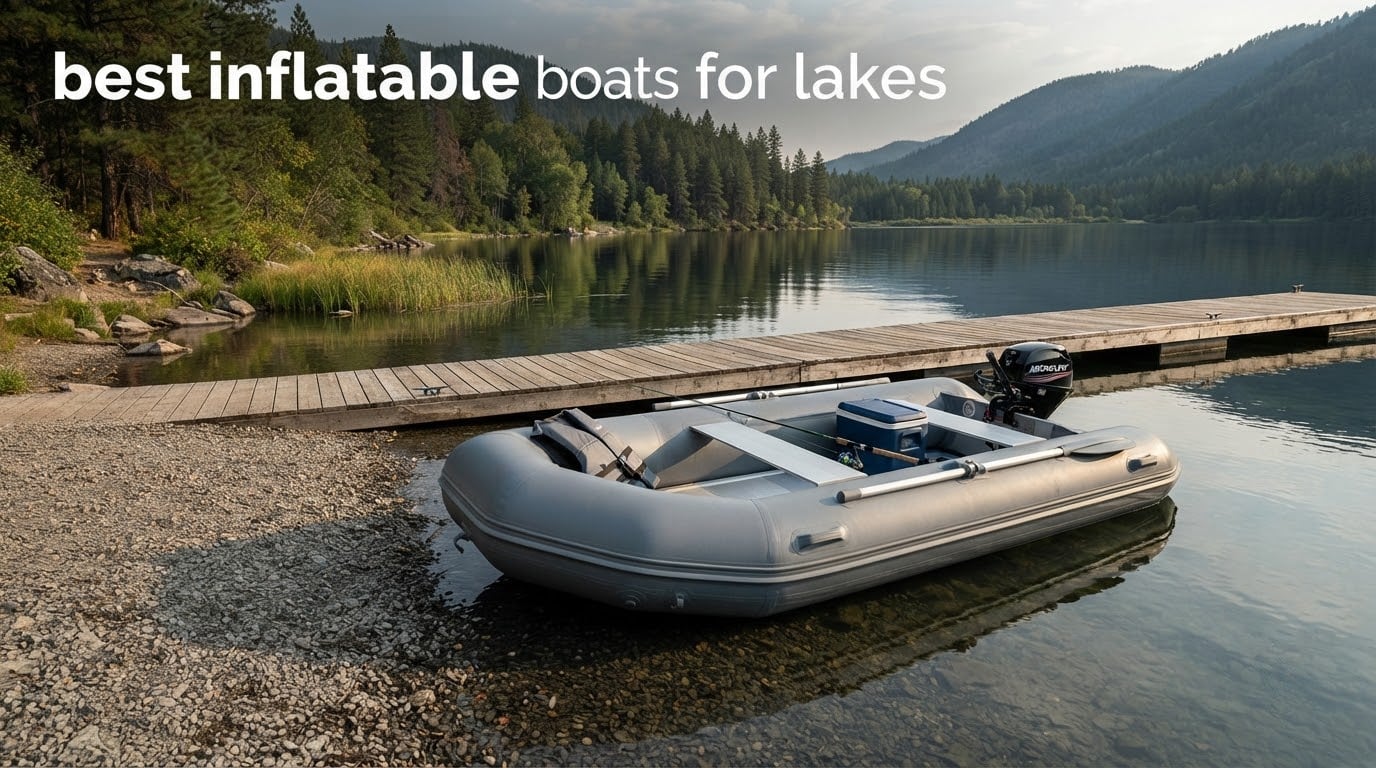
A lake-suitable inflatable boat is a soft-hulled, air-chamber craft with a flat-water, self-bailing hull, at least three independent air chambers, a printed load rating, and USCG or NMMA certification, built to be paddled or lightly motored on sheltered inland water. That is the whole standard. Anything that misses one of those five points is a pool toy or a coastal craft, not a lake boat.
That definition matters because the best inflatable boats for lakes solve a problem no other small craft does so cheaply: storage. A 12 foot dinghy deflates into two duffel bags that live on a garage shelf, launches in ten minutes at a gravel ramp and costs a fraction of a rigid boat plus trailer. For anyone without a dock, a trailer plate or a second vehicle, that is the whole reason to buy one.
We went through twelve of the most-reviewed inflatable boats in their class, read the owner complaints as carefully as the spec sheets, and picked a winner for each kind of lake day. The category has one honest weakness we will keep coming back to: wind. A r/Kayaking owner describing a 10.8 foot inflatable on Lake Erie called it “lame unless there is very little wind, which is a total crapshoot.” Buoyancy is not the limiting factor on a big lake. Air is.
Everything below is aimed at a specific job: family afternoons, fishing from a soft platform, carrying two anglers, or ferrying people and gear from a bigger boat to a swim platform. If you also plan to run music on the water, our guide to the best Bluetooth speakers for boat and marine use covers the parts that survive spray and mounting on a tube.
Table of Contents
Top 3 Best Inflatable Boats for Lakes Right Now (October 2026)

Intex Excursion 5
- 12 ft hull for five adults
- 1320 lb load rating
- SuperStrong PVC with Boston valves
- Rod holders and gear pouch

Intex Seahawk 4
- Three air chambers
- I-beam inflatable floor
- 1050 lb capacity
- Packs to sleeping-bag size

Bestway Hydro-Force 3
- Lightest pack weight here at 30.6 lb
- Complete kit with bag pump and oars
- Inflata-Shield puncture-resistant fabric
- Three adults at 794 lb
The Excursion takes the top slot because it does the most for the least, and because more than 5,000 owners have now stress-tested it in every kind of water. The Seahawk is the smarter buy for an angler who will add a small trolling motor, since its three chambers and I-beam floor hold shape better under a motor mount. The Bestway Hydro-Force is the budget entry point, and the only boat here one person can genuinely carry from the car to the ramp on their own.
12 Best Inflatable Boats for Lakes in 2026
| Product | Specifications | Action |
|---|---|---|
| Intex Excursion 5 |
|
Check Latest Price |
| Intex Seahawk 4 |
|
Check Latest Price |
| Bestway Hydro-Force 3-Person |
|
Check Latest Price |
 Intex Mariner 3 Intex Mariner 3 |
|
Check Latest Price |
 Newport 10 ft 6 in Newport 10 ft 6 in |
|
Check Latest Price |
 CO-Z Inflatable Dinghy CO-Z Inflatable Dinghy |
|
Check Latest Price |
 BRIS 10.8 ft BRIS 10.8 ft |
|
Check Latest Price |
 BRIS 12 ft BRIS 12 ft |
|
Check Latest Price |
 Killer Whale 10.8 ft Killer Whale 10.8 ft |
|
Check Latest Price |
 BEYOND MARINA 10 ft USCG Dinghy BEYOND MARINA 10 ft USCG Dinghy |
|
Check Latest Price |
 BRIS 9.8 ft BSA300 BRIS 9.8 ft BSA300 |
|
Check Latest Price |
 Swordfish 10.8 ft Swordfish 10.8 ft |
|
Check Latest Price |
Two things stand out in that table. First, every boat here is PVC, so the hull fabric barely separates them and floor construction does most of the work instead. Second, the load ratings look generous because they include every pound of gear you will ever load into the boat, not just people.
1. Intex Excursion 5: Best Overall Inflatable Boat for Lakes
INTEX Excursion 5-Person Inflatable Fishing Boat River Raft Set with Oars
12 ft x 5 ft 6 in inflated
5 adults
1320 lb load rating
55.6 lb packed
Pros
- Spacious for two adults plus kids
- Bow and stern gear storage with D-rings
- Quick 10-15 minute inflate and pack down
- Includes pump oars rod holders and repair patch
Cons
- Soft hull makes long rowing inefficient
- Short oars and weak oar mounts
- Included repair adhesive is weak
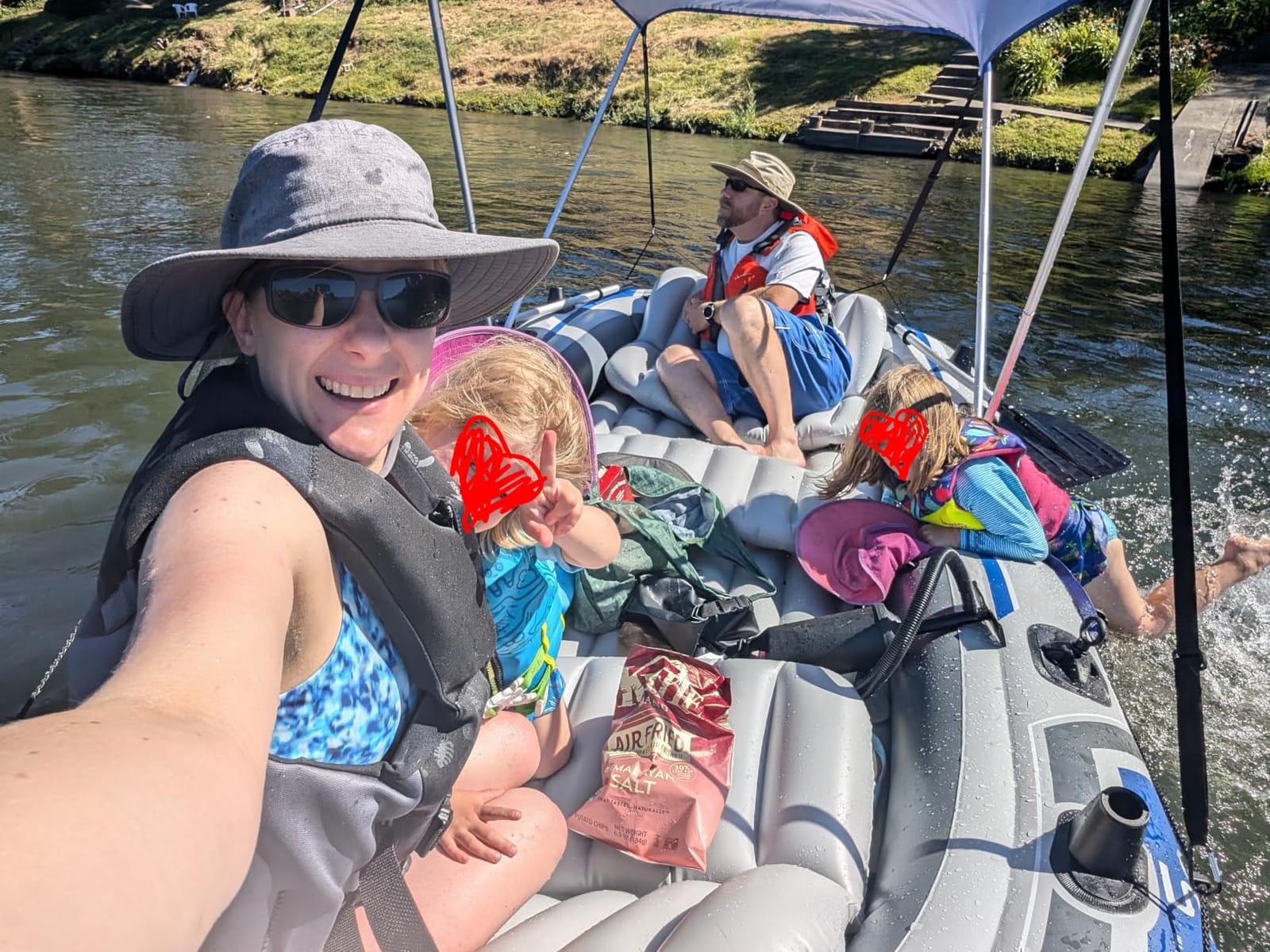
The Excursion 5 is the boat we keep coming back to because the space it gives you is disproportionate to its footprint in a garage. Twelve feet of hull, a five-person rating and 1320 pounds of total load capacity is enough room for two adults, two kids, a cooler, a tackle box and a dog, all sitting high enough out of the water to feel stable rather than tentative.
Owners consistently point at the same two things: it is quick to set up, and it stays afloat high in the water even when the gear load is heavy. Inflate, deflate and pack-down lands around 10 to 15 minutes with the included high-output pump, which means a spontaneous lake afternoon is realistic rather than aspirational.
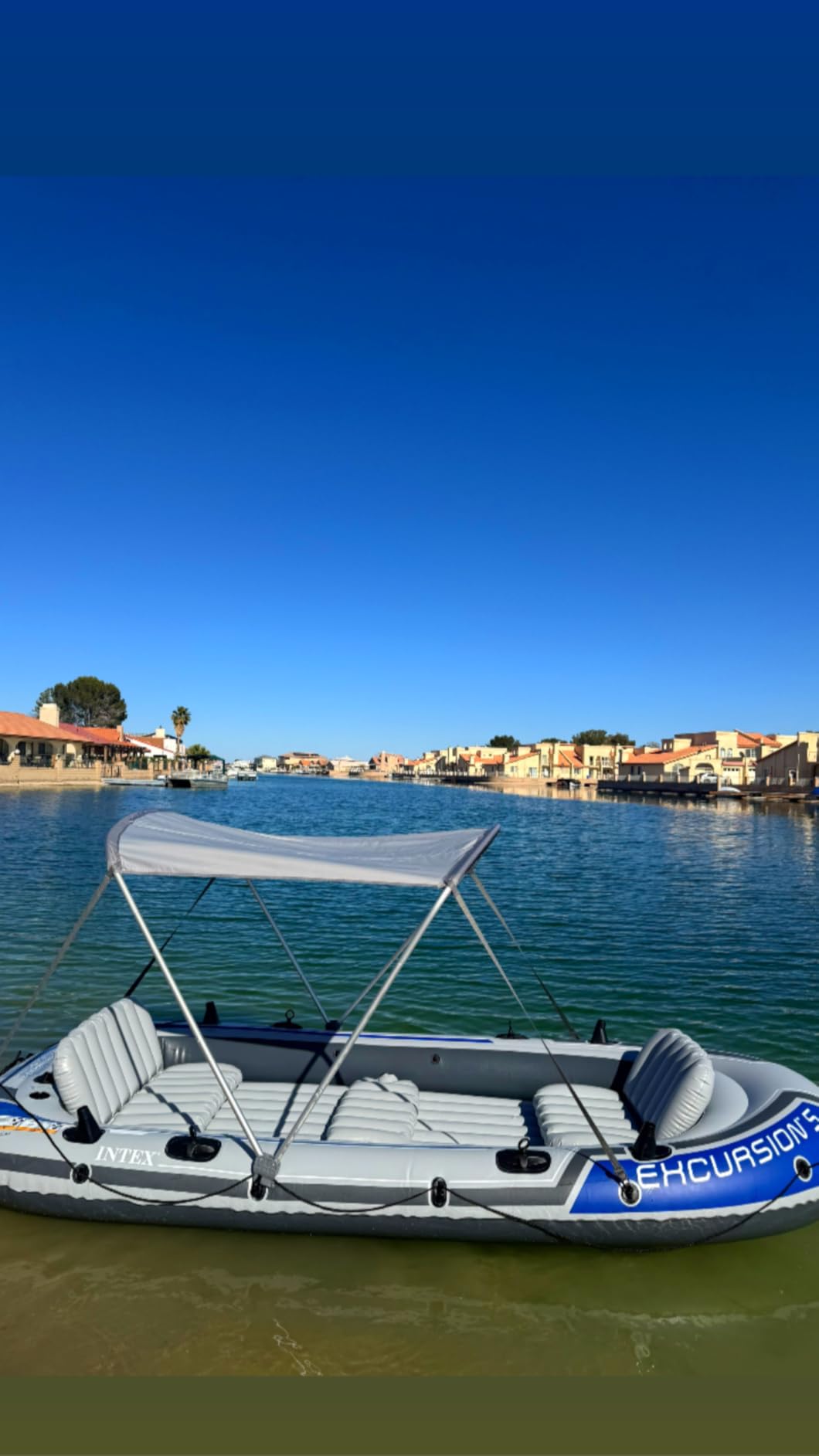
The build is SuperStrong enhanced molecular formulation PVC with welded seams, and the review pattern suggests it tolerates rocky shorelines and beach launching without complaint. Two Boston valves on the main hull chambers speed up both inflation and the deflation you have to do before the drive home.
The one weakness everyone reports is rowing. A low-pressure soft hull flexes with every stroke, which wastes energy and slows the boat down, and the 54 inch oars in the kit are short for a craft this long. Plenty of owners add a small trolling motor and stop thinking about it. If you intend to cover real distance under oars alone, this is not the boat for you.
Who the Excursion 5 suits
Families and couples who want a floating base for a lake day: swimming, snorkeling, a cooler, a dog and a change of clothes. The gear pouch, the bow and stern storage and the stainless D-rings mean the boat is a platform rather than a seat, and the high freeboard means a splash does not soak everyone on board.
It also suits first-time inflatable buyers, because 5,500 reviews mean almost any early defect will already have been found and either fixed in the design or documented as a known quirk. The detachable rod holders are a bonus if the afternoon turns into fishing.
Who should skip the Excursion 5
Skip it if distance is the point. The hull is soft, the oars are short and the row efficiency is poor compared with a rigid dinghy of similar length, so long crossings take real work. It is also 55 pounds plus a pump and gear, so a single person carrying it solo down a steep launch ramp is a struggle.
Also skip it if you plan to stand up and cast. A soft low-pressure floor will not support a standing angler reliably, and the rod holders are described as flimsy, so do not hang an expensive rod on them. For casting, buy a boat with an aluminum floor.
2. Intex Seahawk 4: Best Value Inflatable Fishing Boat for Lakes
INTEX Seahawk 4-Person Inflatable Fishing Boat Set with Oars and Pump
11.5 ft x 4 ft 9 in inflated
4 adults
1050 lb load rating
45.6 lb packed
Pros
- Three air chambers with inner aux chamber
- I-beam floor adds real rigidity
- Reported 10-12 year durability
- Folds to sleeping-bag size
Cons
- Supplied oars are short and inefficient
- Pool-float style floor valve is awkward
- No carry bag in the kit
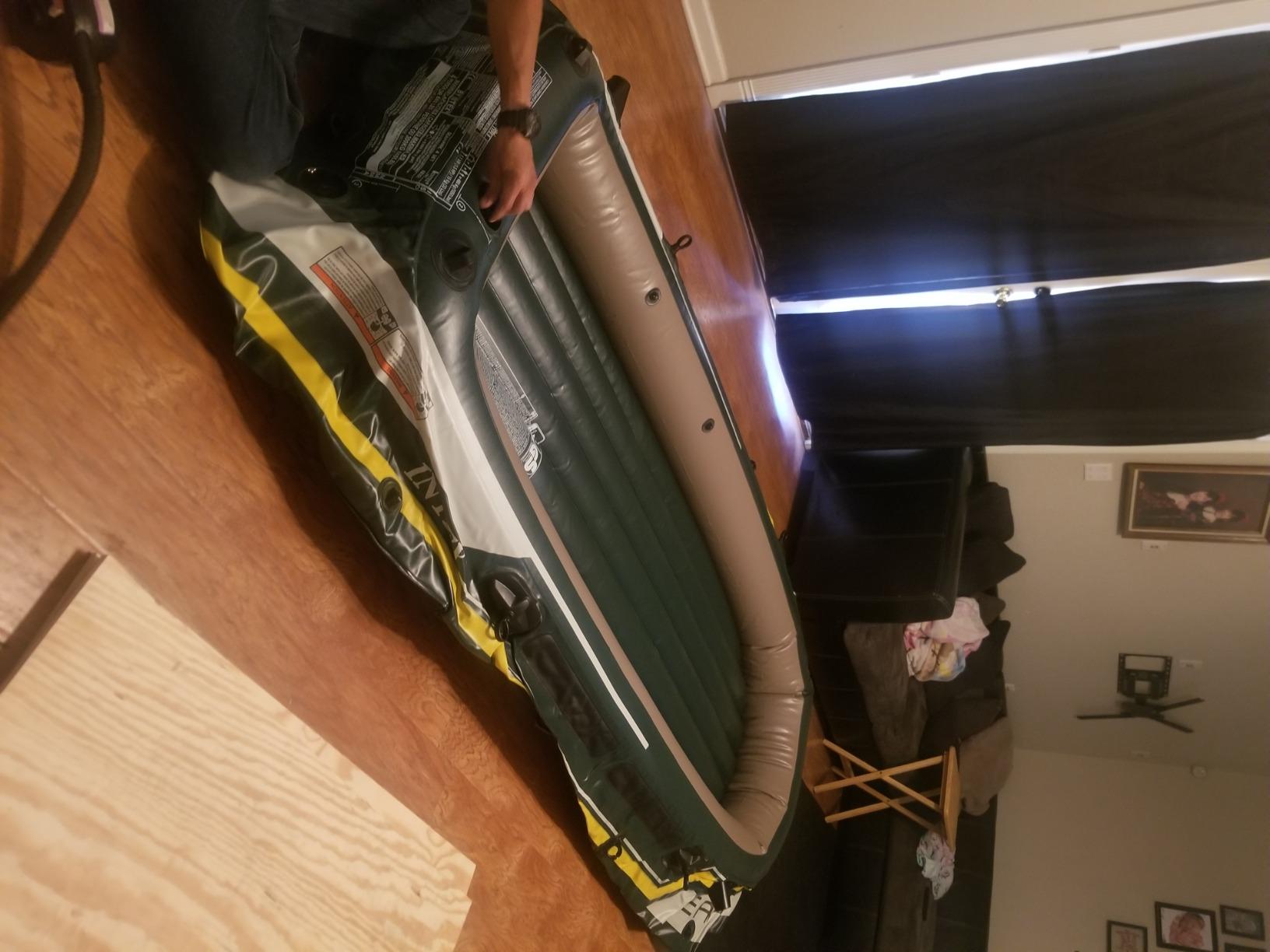
The Seahawk 4 is the value pick of the whole list, and the reason is a feature most budget rafts skip: three air chambers, including an inner auxiliary chamber inside the main hull. That redundancy is what lets you get back to shore on one chamber if something finds your tube with a hook or a gaff.
The inflatable I-beam floor is the other differentiator. It is not as stiff as aluminum, but it holds its shape far better than a flat inflatable floor, which makes the boat noticeably more comfortable for a full day of angling and gives it a much better foundation for a trolling motor bracket.
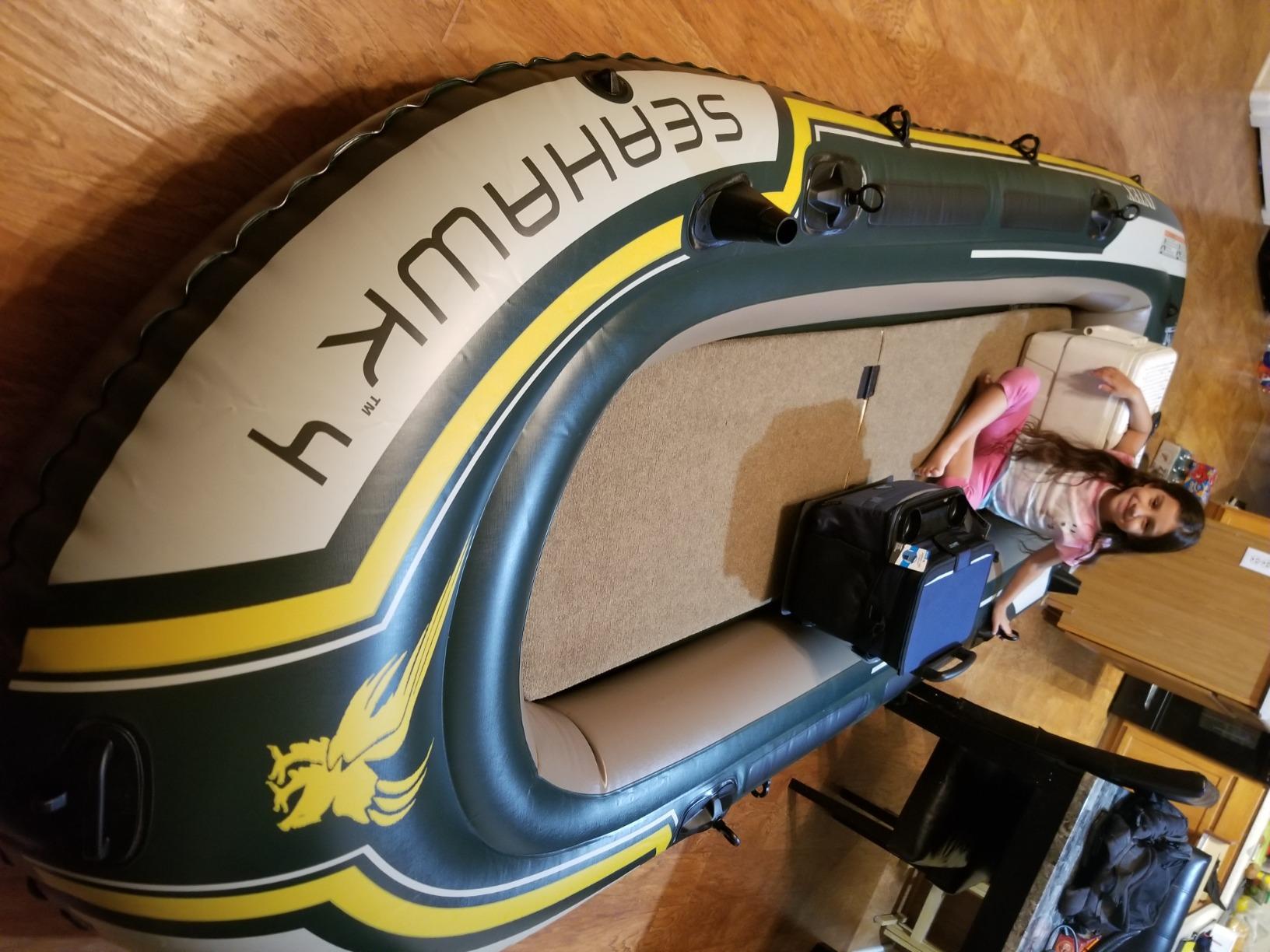
Longevity is the quiet story here. Owners report this specific model lasting 10 to 12 years without punctures, which is at the top of what we saw in the category. The one caveat forum owners raise is universal to PVC: store it dry or it will fail, and UV exposure and unknown hours are what kill used ones.
What you trade away is convenience in the small details. The floor uses a pool-float style valve that is genuinely awkward to deflate by hand, there is no carry bag in the kit so you will improvise one, and the included repair patches arrive without adhesive. Buy a proper adhesive tube before your first trip, not after.
Who the Seahawk 4 suits
An angler working a lake alone or in pairs who wants a boat that stores in a closet and survives a decade of sun. The I-beam floor, the rod holders and the compact 45.6 pound pack weight make it easy to load in a car on a Friday and be on the water by Saturday morning.
It also suits anyone who adds a small electric trolling motor. Owners do this constantly, and the chamber layout and floor construction hold up better under motor weight than a flat-floor raft does. The same owners recommend it as the boat to buy if you are moving up from a cheap pool-style raft.
Who should skip the Seahawk 4
Skip it if you need to stand. An I-beam inflatable floor is stable for seated anglers and for reaching across the boat, but it is not a platform for casting while upright. Anyone who fishes standing should spend the money on an aluminum or plywood floor model instead.
Skip it if you dislike hunting for a carry bag. It is not in the box, and at 45 pounds the difference between a bag and a tarp matters more than it sounds. The collapsible oar compression fittings are also described as prone to cracking, so check them before a long trip.
3. Bestway Hydro-Force 3-Person: Best Budget Inflatable Raft for a Lake
Hydro-Force Voyager X3 Inflatable Raft Set 9’8″
9 ft 8 in inflated
3 adults
794 lb load rating
30.6 lb packed
Pros
- Lightest boat here at about 30 lb
- Complete kit with bag pump and oars
- Inflata-Shield fabric resists puncture
- Built-in rod holders and grab rope
Cons
- Soft floor gives little tracking
- Rated for about three adults
- Basic oarlocks and short oars
At roughly 30 pounds packed, the Hydro-Force is the one in this roundup a single person can genuinely carry from a car to a launch ramp without recruiting help. For anyone with a shoulder that does not want a 55 pound duffel every Saturday, that is a real feature and not a compromise.
The kit is unusually complete for the class: boat, 57 inch oars with clasps, a hand pump, a gear pouch, a carry bag and a repair patch all in the box. Inflata-Shield fabric is specified to resist punctures, limit stretching and improve grip on wet tube surfaces when you climb aboard.
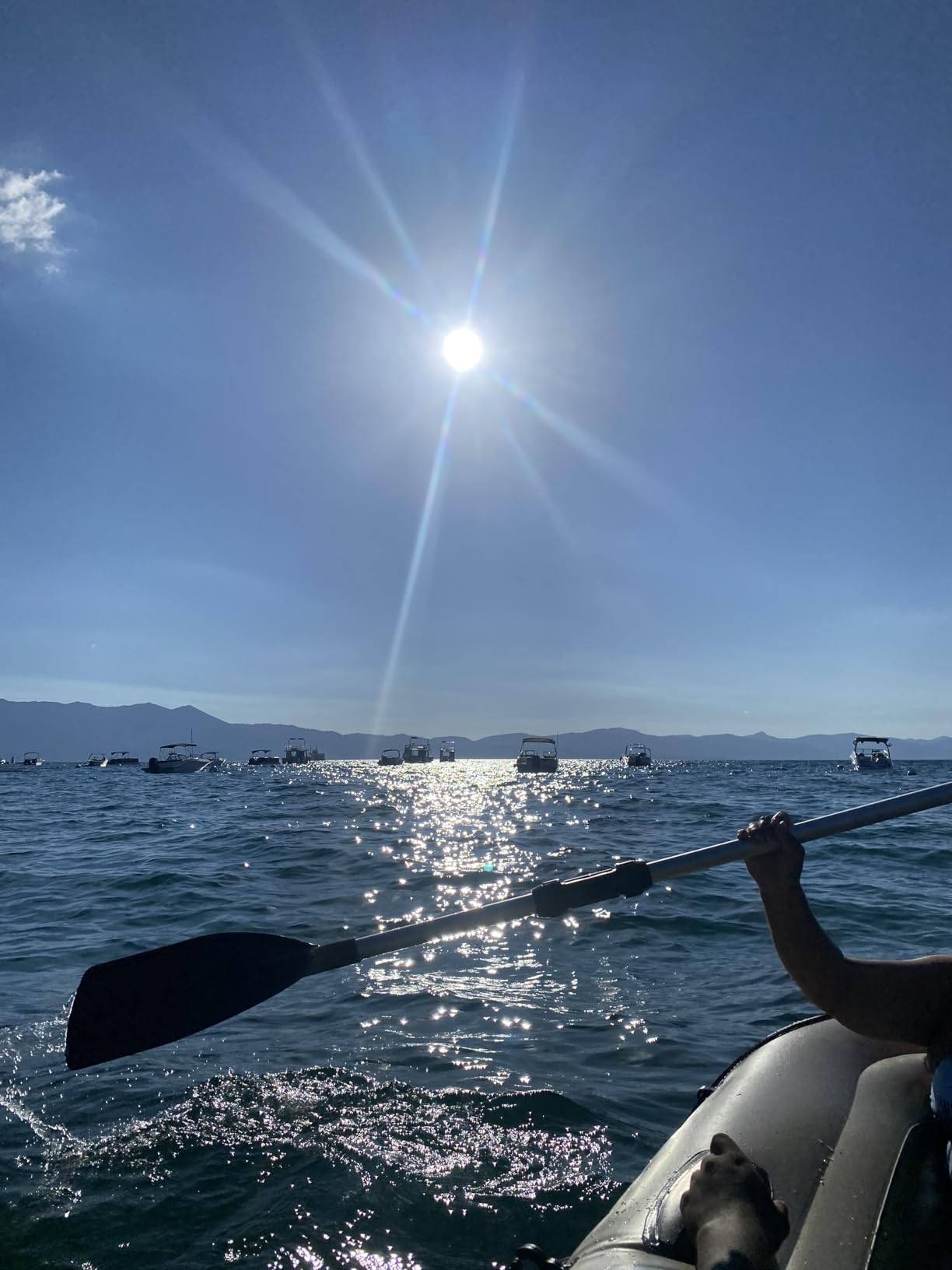
This is a pond-to-lake raft, and it is honest about that. Three adults is the working number, the floor is fully inflatable and therefore soft, and the oarlocks are basic. Owners describe it as well suited to relaxed paddling, swimming platforms and short trips across a calm inlet, and poorly suited to covering distance.
At 4.1 stars across 496 reviews, satisfaction is centred on the package and the price, not on performance. That is exactly what you want from a weekend raft, and exactly what you do not want from a fishing platform.
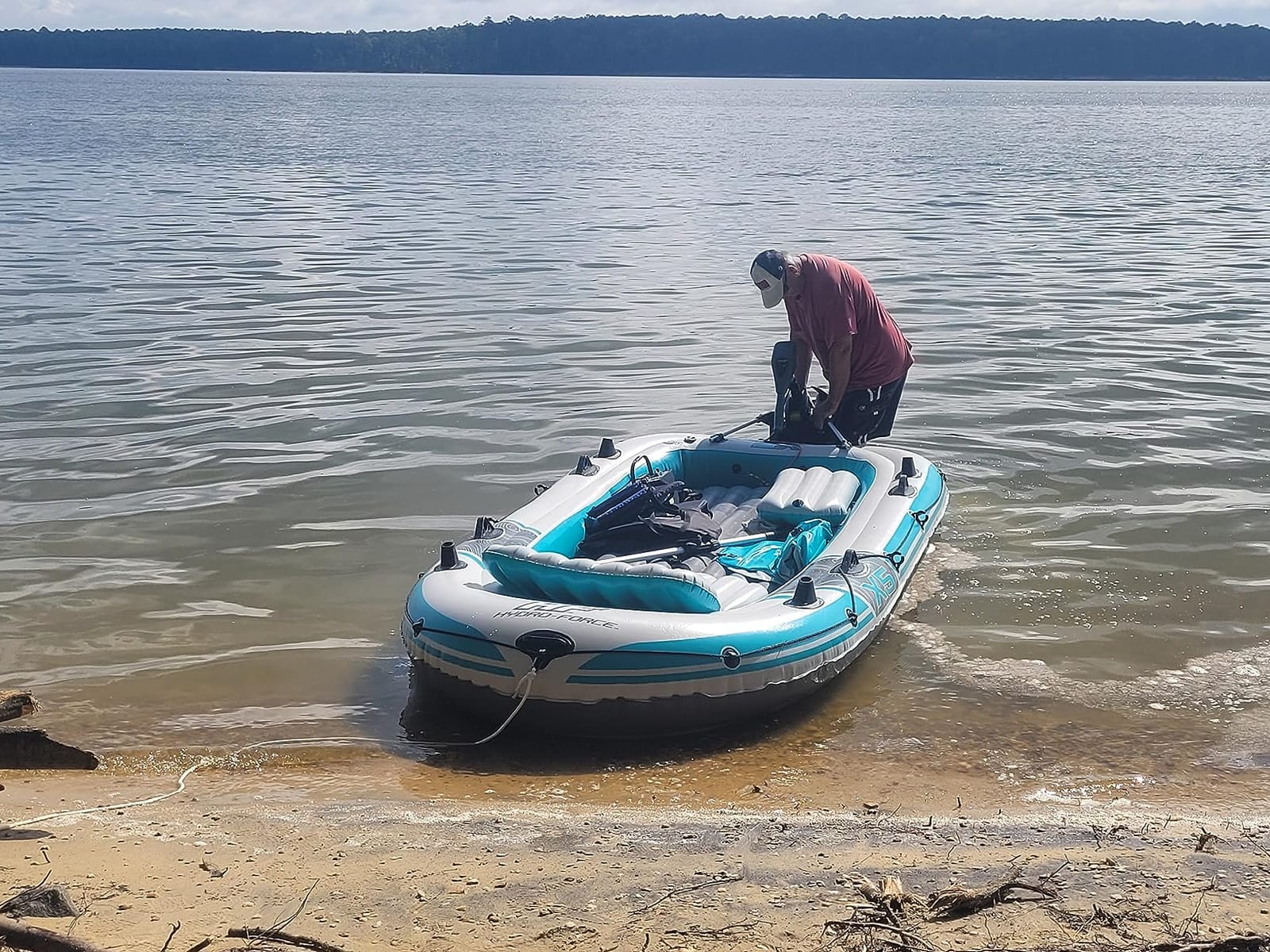
Who the Hydro-Force suits
Small families on a small lake, couples, and anyone who wants a floating sofa for a swim platform or a sandbar lunch rather than a vessel for crossing open water. The built-in rod holders mean it doubles as a casual fishing raft for a kid or a beginner.
It is also the boat to buy for a rental cabin, a lakeside campground or a grandmother who will use it alone. Carry weight is the number that decides those purchases, and this one is the lowest in the group.
Who should skip the Hydro-Force
Skip it if more than three people need to ride, or if the load includes a battery bank, a cooler full of drinks and a casting net. The 794 pound rating sounds generous but it is shared between occupants and every pound of gear, and the soft floor exaggerates the sag once it is loaded high.
Skip it for long crossings. With a soft hull, short oars and basic oarlocks, moving this boat a mile against a breeze is slow work, and an inflatable that will not track straight is a boat you will point at the shore and hope for.
4. Intex Mariner 3: Best Inflatable Boat for a Rocky Lake Shore
INTEX Mariner 3-Person Inflatable Fishing Boat Set with Oars and Pump
9 ft 9 in x 4 ft 2 in
3 adults
880 lb load rating
69.7 lb packed
Pros
- Three-ply laminate SuperTough PVC
- Triple air chambers with aux chamber
- Wear-resistant keel and heavy grab handles
- Motor mount fitting included
Cons
- Heavy at nearly 70 lb
- Three-adult ceiling is small
- Hand pump inflation takes real effort
The Mariner is the Intex answer to the durability question. Its three-ply laminate SuperTough PVC, wear-resistant keel and triple chamber layout are the parts of the boat that take abuse, and owners consistently single them out as a step up from cheaper entry-level rafts in the same size class.
Forum owners comparing models within the same brand tend to point here too, recommending the Mariner over the cheaper boats on build quality rather than on any feature. For a lake with gravel bars, rock shelves and a launch ramp that drags, that difference is the whole argument.
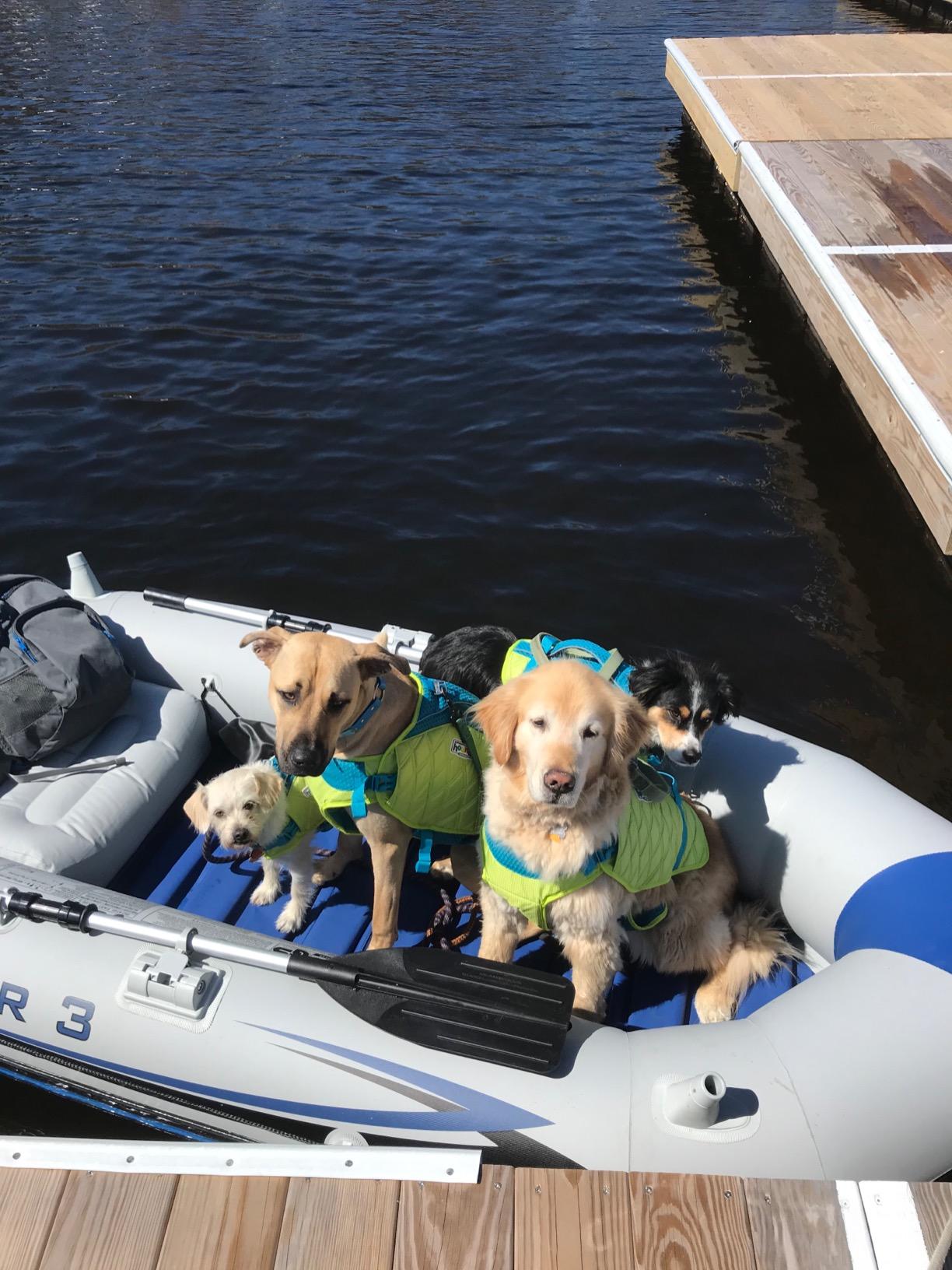
It also holds shape and rigidity at higher inflation pressures than a basic raft, which is why the manufacturer fits a motor mount and welded-on oar holders. The included kit is generous: two 54 inch oars, two rod holders, a high-output pump and a repair patch kit.
The catch is weight. At nearly 70 pounds it is one of the heavier budget boats here, and it is the heaviest relative to its capacity. Inflating three chambers by hand with the supplied pump is also a genuine workout, which is the strongest practical argument for buying a small electric pump alongside it.
Who the Mariner 3 suits
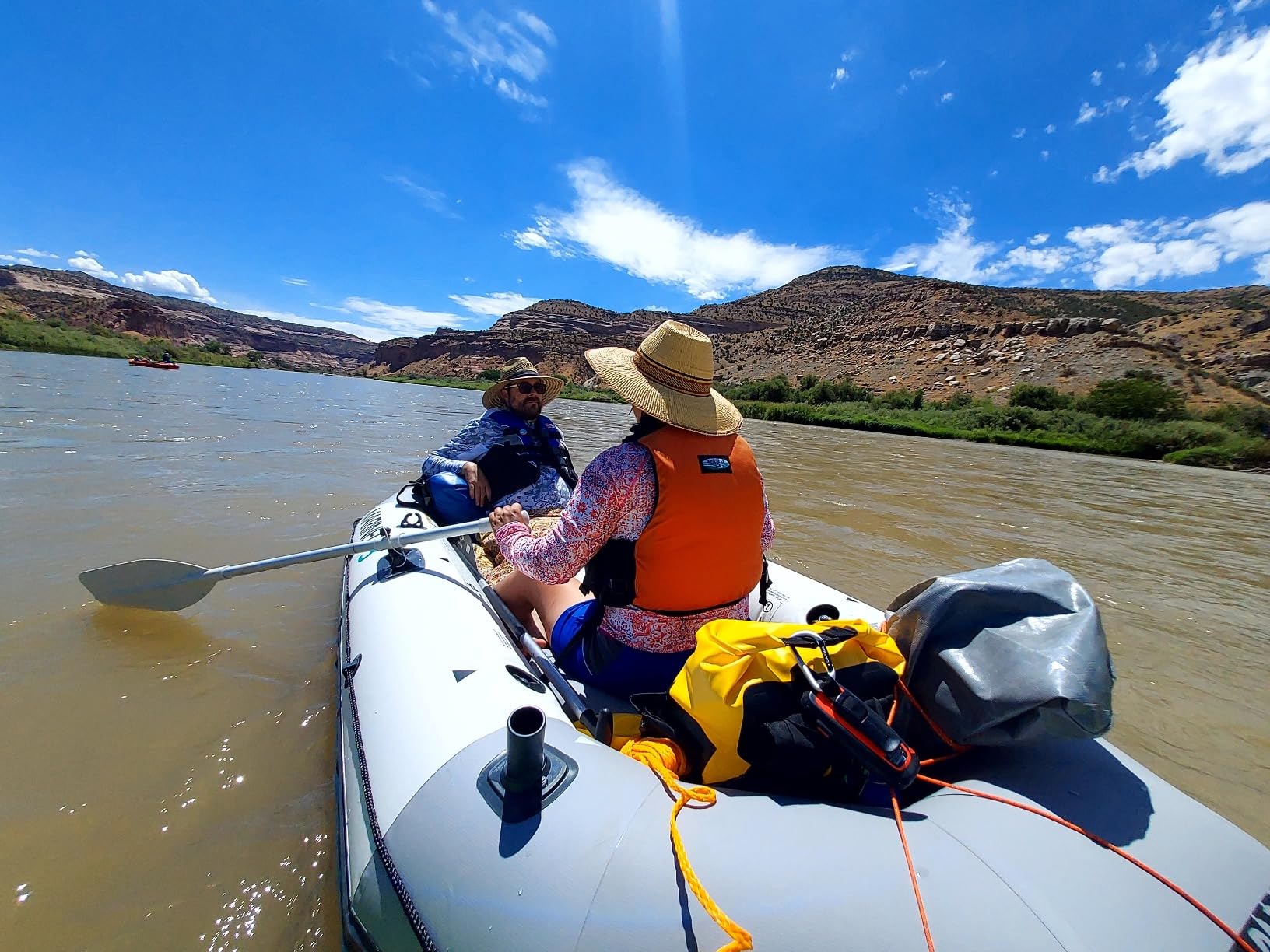
Owners on lakes with abrasive shorelines, shallow rocky water and beach launches, who want more hull durability than a basic raft and do not need a rigid floor. Three adults is the honest working capacity, and for a couple plus a child that is a comfortable, well-built boat.
It suits people who already own a motor mount or plan to add one. That fitting is included, which makes it one of the cheaper ways to get a small motor on a lake boat legally and structurally supported.
Who should skip the Mariner 3
Skip it if more than three adults need to ride. The interior is compact at just under 10 feet, and the load rating of 880 pounds is consumed quickly once a battery, cooler and tackle are aboard.
Skip it if you carry the boat alone. Nearly 70 pounds plus oars and pump is a two-person load, and the pumping time on three chambers is the other place solo owners give up. A lighter raft like the Hydro-Force fits that situation far better.
5. Newport 10 ft 6 in: Most Versatile for a Motor-Ready Lake Dinghy
Newport 10ft 6in Newport Model Inflatable Dinghy Boat Transom Sport Tender – 5 Person – 15HP USCG Rated, White/Gray
10 ft 6 in with 18 in tubes
5 persons
1248 lb load
15HP rated
Pros
- Aluminum-framed plywood floor for standing
- 18 in tubes sit at normal seat height
- Takes a 15HP outboard and planes well
- About 20 minutes from trunk to water
Cons
- Around 140 lb so two people are needed
- Floor assembly is fiddly
- White hull shows dirt fast
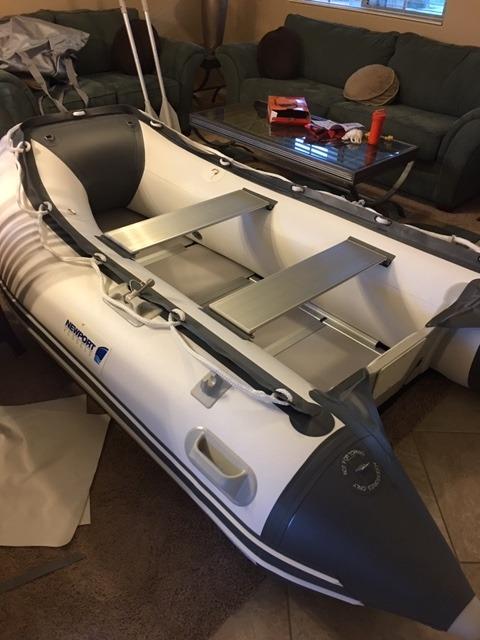
The Newport is the only boat in this roundup that stops being a raft and starts being a small boat. The 24mm aluminum-framed marine plywood floor lets you stand, move around and cast, which changes what kind of day you can have on it compared with every soft-floor model above.
The 18 inch tubes raise the seating position to something close to a normal chair height. On a long fishing session, that is the difference between a comfortable afternoon and a numb one, and owners describe it in exactly those terms.
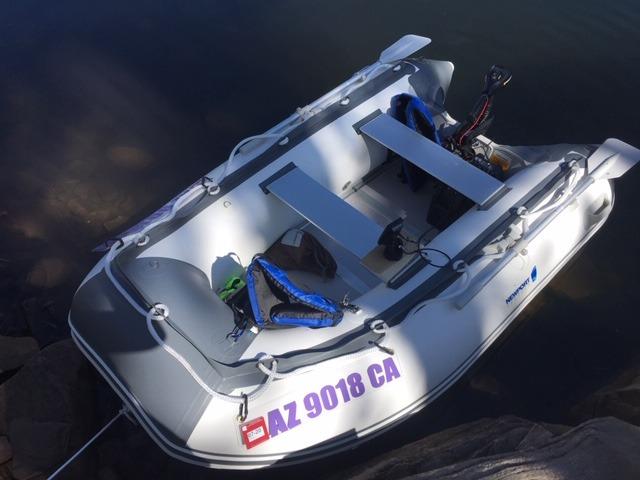
It is also a real motor boat. Four chambers including a keel, a high-pressure inflatable keel and a V-hull mean it tracks in a way soft rafts never will, and it is rated for a 15HP outboard with a 1,248 pound load. Around 20 minutes from trunk to water including the floor is quick for a rigid-floor dinghy.
Weight is the honest trade-off at roughly 140 pounds, and the floor rails are fiddly the first time. The packaging is also rough on the plywood panels, so owners routinely report arriving with gouged floor sections that need sanding before assembly. If you run audio on board, our notes on marine speakers for a boat sound system cover what mounts safely to a tube or transom.
Who the Newport suits
Anglers who stand to cast, and owners of a larger boat who need a tender that will actually take a person and a cooler across to the dock. The USCG rating, 3.6 PSI recommended tube pressure and 15HP capability mean it can be registered, launched and driven like any other small powerboat.
It also suits anyone who finds a soft inflatable uncomfortable. A rigid floor does not flex, does not sag under a battery bank and gives you a flat surface for a cooler, a tackle tray or a camera.
Who should skip the Newport
Skip it if you have to carry it alone. Around 140 pounds means a second person or a cart, and the same goes for the aluminum floor panels once they are out of the bag. Owners also report that the white hull shows every scuff and needs regular cleaning to look presentable.
Skip it if storage space is genuinely tight and you want a boat that lives in a car boot. This one needs a car boot and a folding trolley, not a shelf. A small minority of owners also report an air leak on arrival that the distributor handled poorly, so inspect all chambers before the warranty window matters.
6. CO-Z 7.5 ft Inflatable Dinghy: Best for Two Anglers
CO-Z 7.5 ft Inflatable Dinghy Boat for 2 Adults, 660lb PVC Raft with Oars
7.5 ft x 4 ft 4 in
2 adults
660 lb load rating
54.6 lb packed
Pros
- Aluminum floorboard and seat
- not just an air floor
- Three independent air chambers
- Reinforced transom takes a 5 hp motor
Cons
- Only two adults and 660 lb
- Foot pump inflation is slow
- Basic oars for long distances
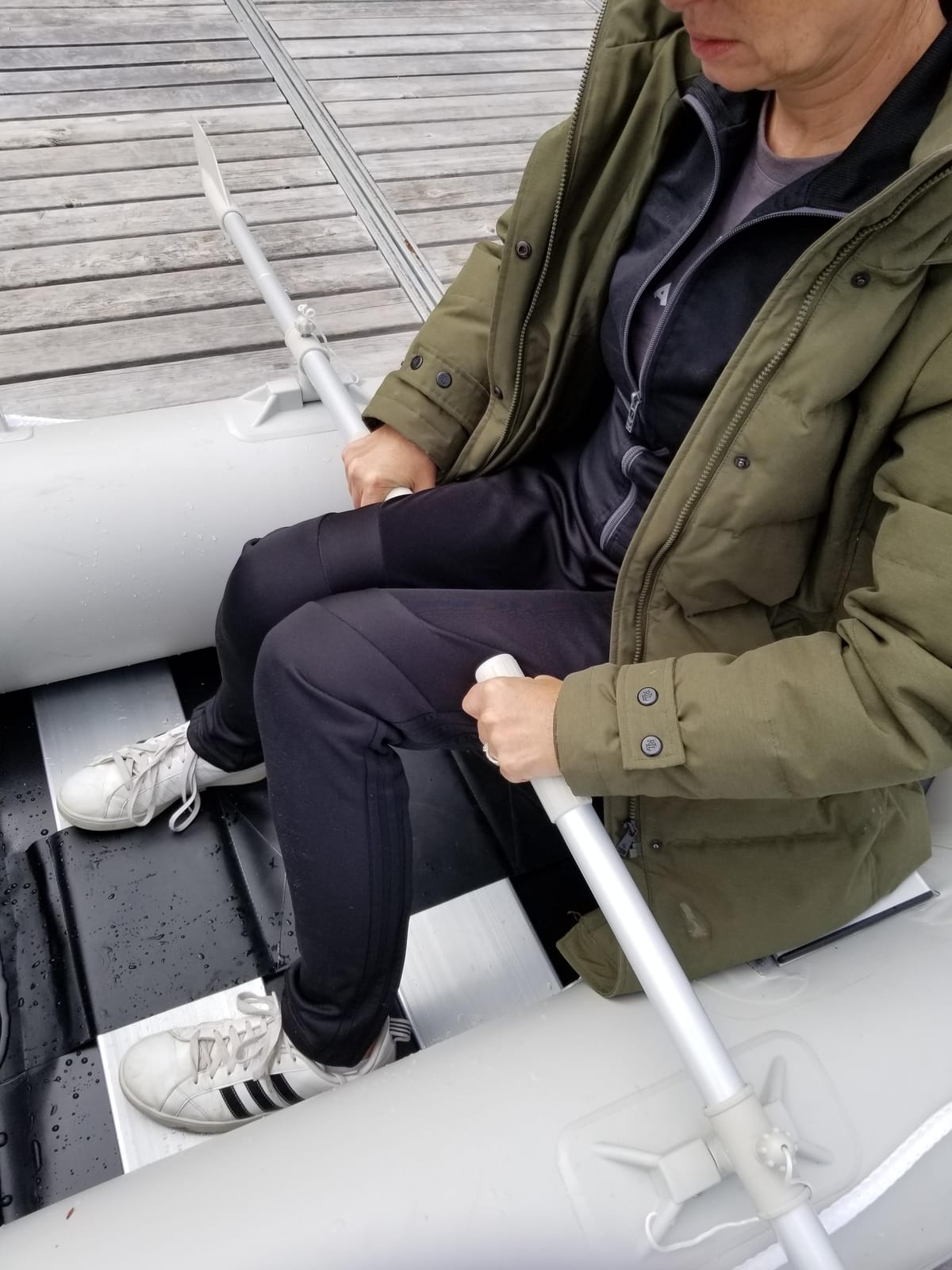
The CO-Z is the smallest genuine dinghy here, and that is the point. At 7.5 feet with a corrosion-resistant aluminum floorboard and seat, it is a two-person boat that behaves like a boat: a V-shaped hull, a reinforced transom and three independent chambers.
For two people fishing a specific shoreline, that is a genuinely good package. A rigid floor for casting comfort, a transom rated to 5 hp for a small electric or trolling motor, and a hull that will pull rather than drift when you want to hold a position.
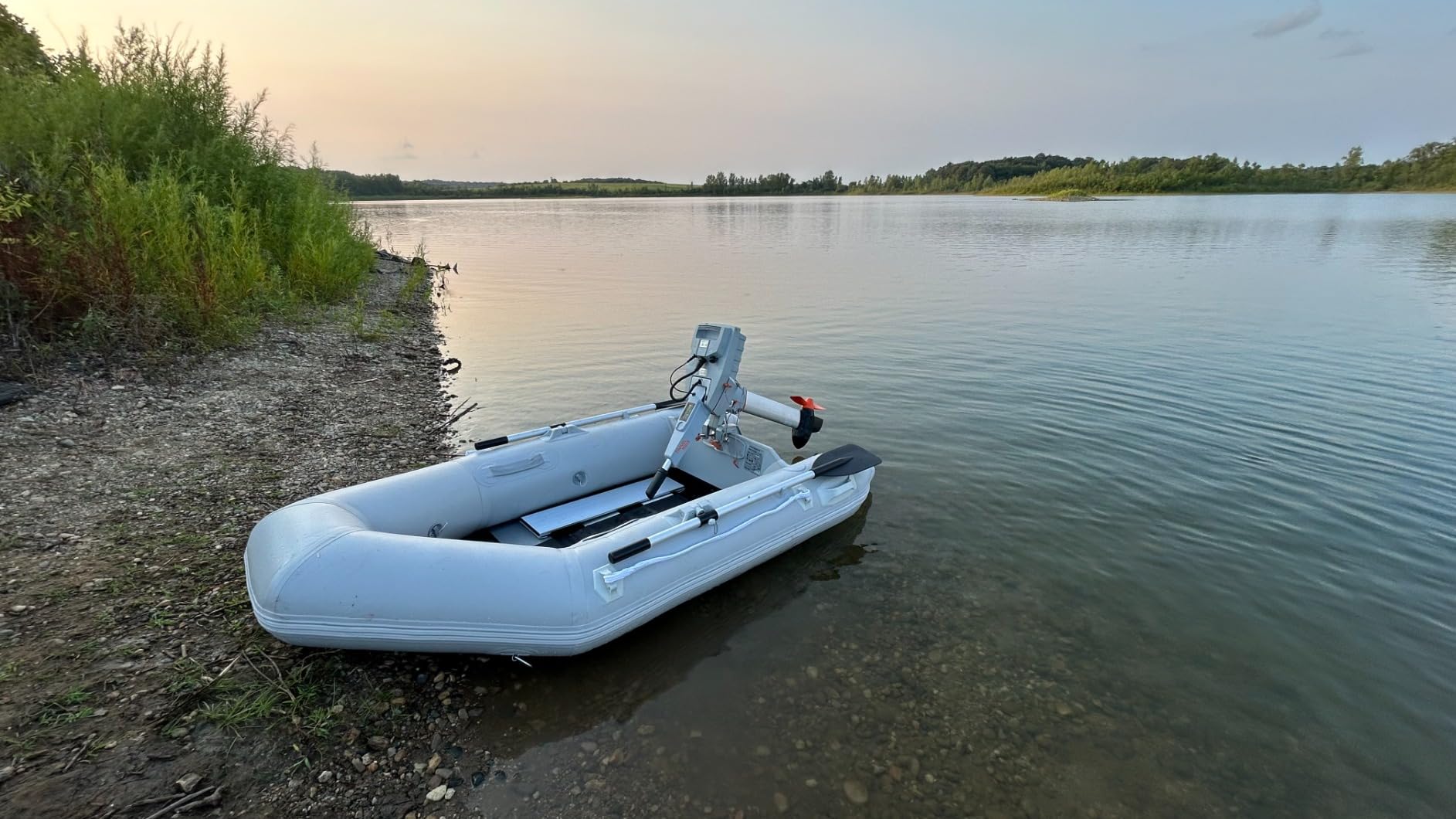
The build is 1000D PVC with quadruple-overlap seams, and the V-hull plus anti-collision strips add rollover protection and some insurance against rocky edges. The kit includes aluminum oars, a foot pump, a carry bag and a repair kit.
Two things slow you down. The foot pump takes a while to inflate the hull and the rigid floor together, and the 660 pound rating is shared between two adults and every piece of gear, so a heavy cooler eats into it quickly. Owners also note the PVC and transom need care around rocks and sharp points.
Who the CO-Z suits
Exactly two people. A couple fishing together, a parent and an older child, or two anglers who want to work one spot on a lake rather than range across it. The V-hull tracks well and the transom means a motor is a practical option rather than an afterthought.
It suits buyers who want a rigid floor without the weight of a 140 pound plywood boat. The aluminum floorboard gives most of the stiffness at 54.6 pounds.
Who should skip the CO-Z
Skip it for any group larger than two, and skip it if you want to bring a dog, a full tackle collection and a sizeable battery. There is no bench seating to speak of beyond the small seat, and the interior space is genuinely compact at 91 inches long.
Skip it if launch day speed matters more than day-trip cost. Inflating a hull and a rigid floor with a foot pump is a longer process than a pure raft, and if you plan to be on the water often, budget for a pump with real output.
7. BRIS 10.8 ft: Best Inflatable for Outboard Power
BRIS 10.8 ft Inflatable Boat Inflatable Rafting Fishing Dinghy Tender Pontoon Boat
10.8 ft hull
4 adults
1213 lb load
55 kg packed
Pros
- Sectional aluminum floor
- stiffer than most rivals
- Tracks straight and planes easily
- Three-year manufacturer warranty
Cons
- About 55 kg so carrying needs help
- Assembly instructions are poor
- Some seam air loss reported after a year
The BRIS 10.8 is the boat in this roundup that owners most often compare favourably to pricier branded dinghies, and the reason is the floor. A sectional aluminum floor gives it a rigidity that most inflatable dinghies in its class simply do not have, and that stiffness is what lets an outboard actually push it.
It runs with outboards from 2.5 hp up to 9.8 hp, tracks straight and planes easily, and the deep V-keel with rub-strake holds direction in chop and wakes. For a lake with boat traffic near your favourite fishing spot, that is a meaningful advantage over a soft raft.
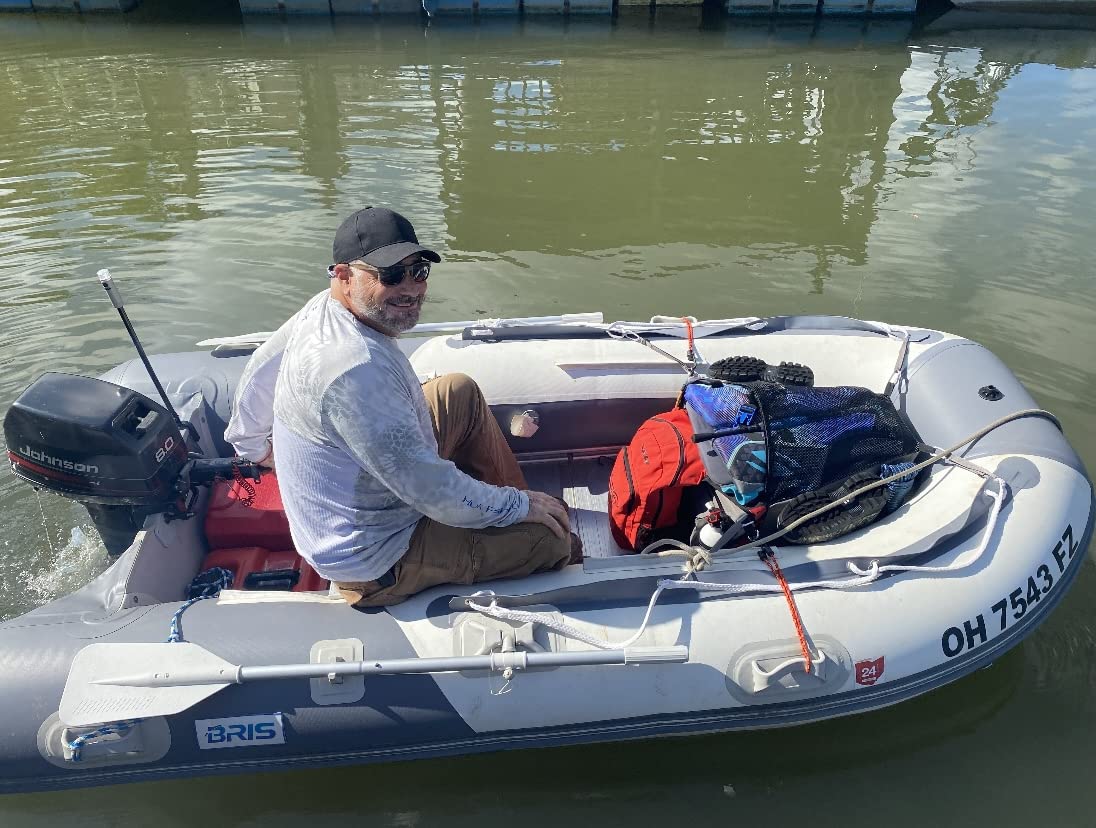
Construction is 1100 denier 0.9mm PVC with polyester support and heat-welded seams, most with quadruple overlap, specified to hold up in fresh water, salt water and extreme humidity. The marine plywood transom comes with triangular splash guards, and there is an all-around rubber strike to protect the tubes.
Be clear-eyed about the weight at 55 kg. Owners report needing three people to carry it down a beach, and the floor rails are a tight fit for anyone assembling it for the first time. A minority also report seams beginning to open or slow air loss after a year or two, so check pressure before every trip.
Who the BRIS 10.8 suits
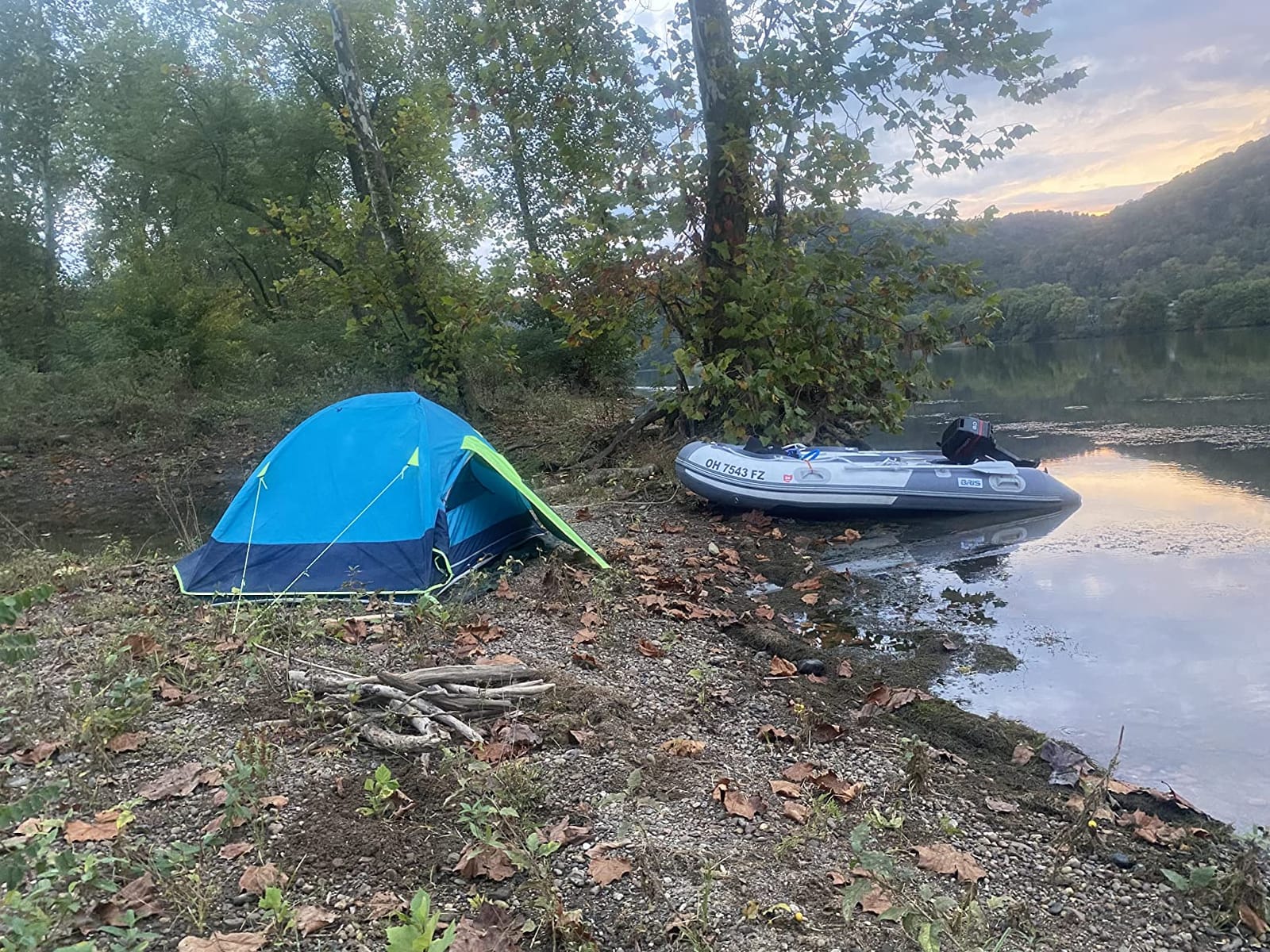
It suits buyers who want the feel and function of a motor dinghy without moving up to a wooden or plywood-hulled boat. The aluminum floor, the transom and the deep V make it work for cruising a larger lake, for reaching a fishing spot quickly, and for towing as a tender.
It also suits buyers who care about support. The three-year manufacturer warranty starts on delivery, and the seller is reported as responsive when owners ask about spare seats and replacement parts.
Who should skip the BRIS 10.8
Skip it if you have to launch it alone or carry it far. The weight is the single most common complaint in the reviews, and it is not solved by a carry bag. Plan on a two-person carry or a hand cart.
Skip it if assembly is going to happen in the dark at a ramp. The instructions are described as poor and the floor rails fit tightly, so read the panel orientation before you inflate anything. A few owners also report the aluminum floor panels and side rails wear through over a long service life.
8. BRIS 12 ft: Best Inflatable Boat for Larger Lake Groups
BRIS 12ft Inflatable Boat Inflatable Raft Sport Rescue Diving Boat Fishing Dinghy Tender Pontoon
12 ft x 5 ft 6 in
5 adults
1322 lb load rating
132 lb packed
Pros
- Double-layer tube bottoms add abrasion protection
- Stays rigid when inflated and planes well
- Very stable with people moving around
- Collapses into a pickup bed with gear
Cons
- About 132 lb so launch needs two people
- Side rails are hard to install
- Fabric tears on thin shell and grit
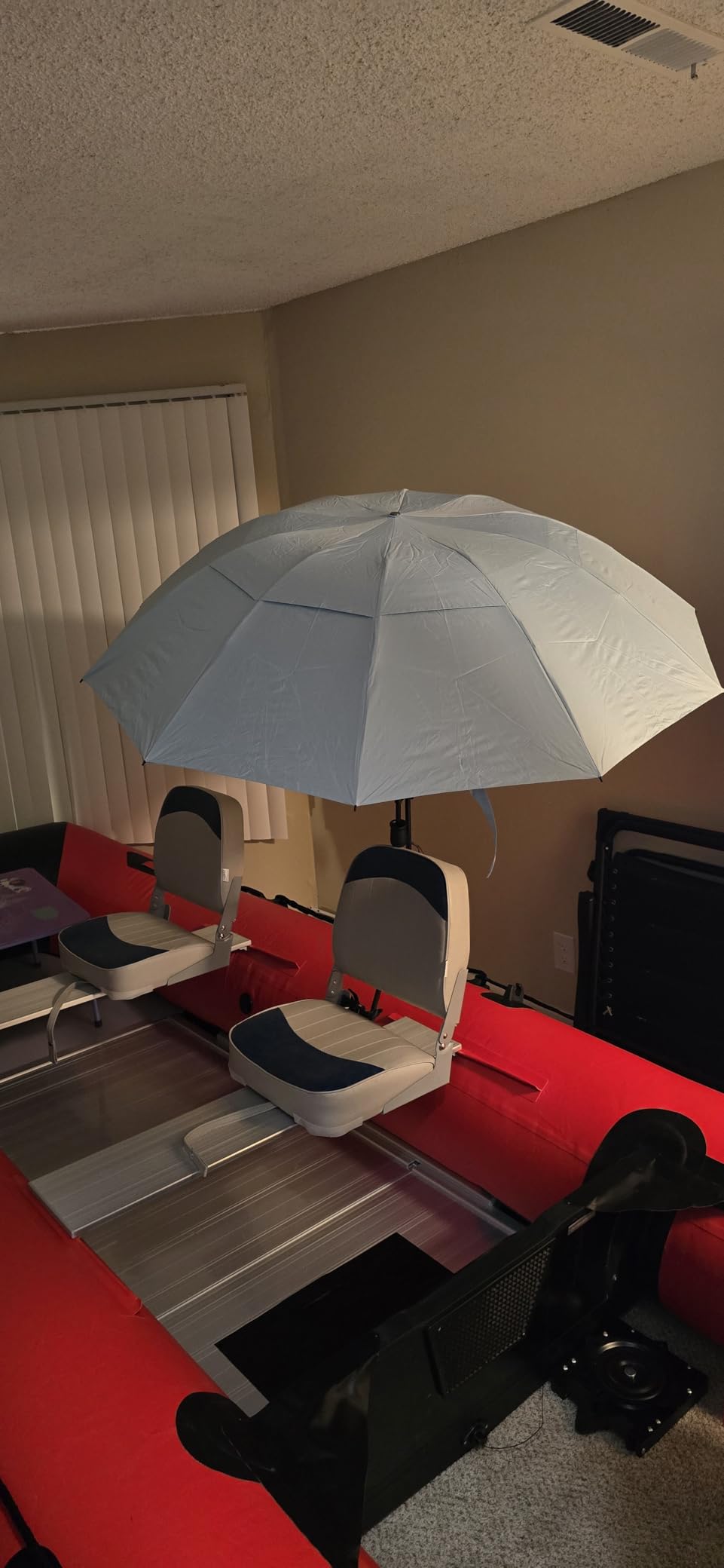
At 12 feet with a five-person rating and 1,322 pounds of load capacity, the BRIS 12 is the longest inflatable in the group and the one to look at if your lake days involve a whole crew rather than a pair. The interior is genuinely usable at that length, with two bench seats on sliders and a full-length floor.
The double-layer tube bottoms are the detail worth knowing about. They add roughly 1.8mm of material protection at the bottom of the tubes, which is exactly where sandbars, gravel ramps and oyster shell do their damage on a boat that spends its life beached at the end of a day.
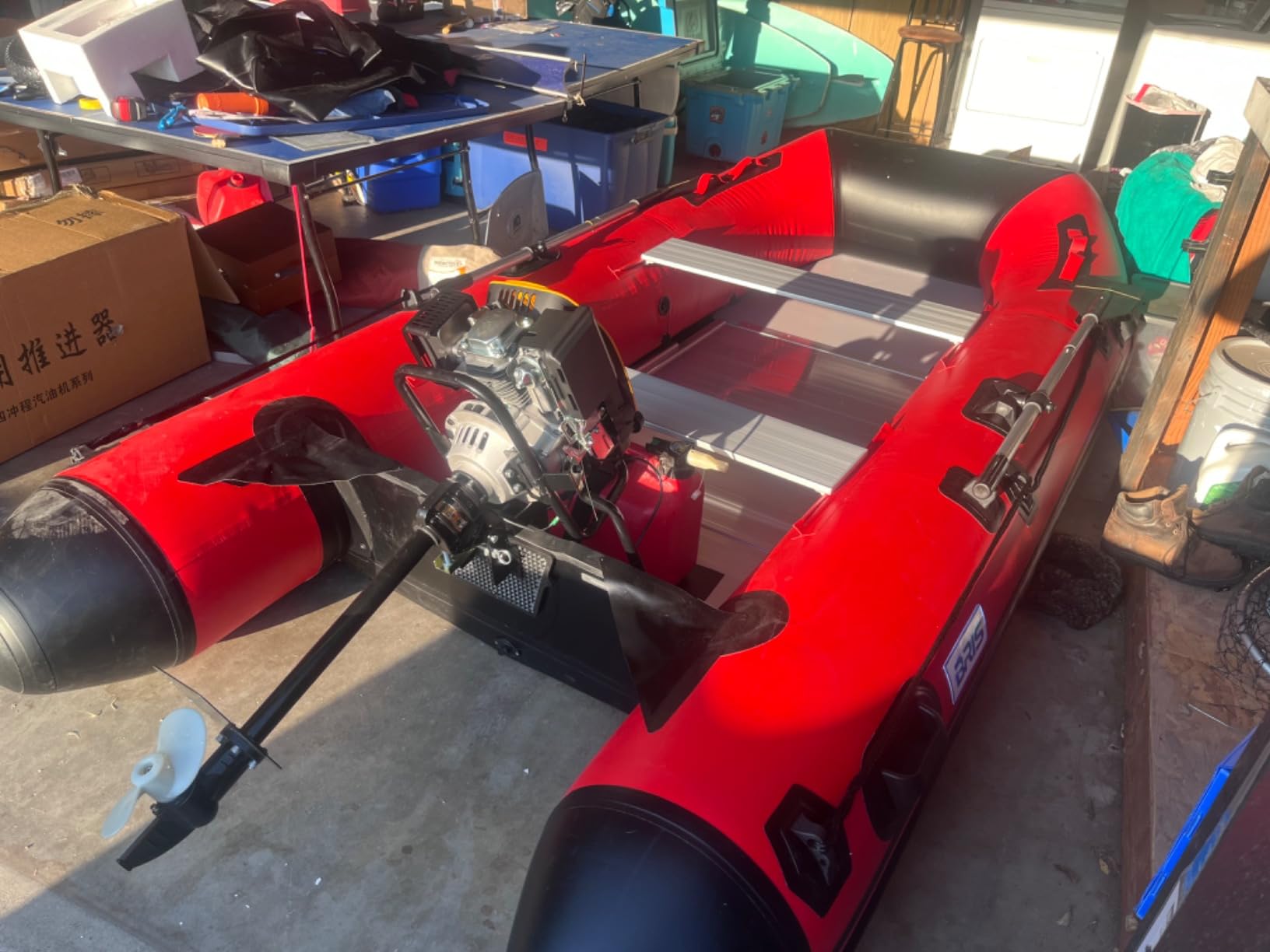
Owners like that it holds a steady plane under an 18 hp motor, and they report it staying stable with two people standing and moving around, which is unusual for a boat this size. Three individual chambers, a one-way drain valve with plug, a built-in oarlock and a deep V-keel with rub-strake complete the package.
It also packs well. Owners report it collapsing into a pickup bed with all the gear, which is the practical advantage over a rigid boat of the same capacity. The negatives are the 132 pound weight, floor side bars that are difficult to install, and thin fabric that can crack or tear on sharp shell.
Who the BRIS 12 suits
Groups of four or five who need a boat that can hold people and gear without feeling cramped, particularly if you put a motor on the transom and cover real distance. The stability under people standing and moving is the feature that separates it from the family rafts at the top of this list.
It suits owners with a pickup or a van rather than a sedan, and anyone who wants one boat for fishing, snorkeling and a swim platform instead of two craft.
Who should skip the BRIS 12
Skip it if the interior space has to work for five adults with a full gear load. Owners report it feeling tighter than the rating suggests once everyone is aboard with coolers and tackle, so four is a more comfortable working number.
Skip it on a lake with a soft, shell-covered bottom, because thin fabric and a heavy hull meeting oyster shell is a bad combination. A minority of owners also report seam air loss, and one received a bench seat six inches too short for the sliders, so inspect the kit on arrival.
9. Killer Whale 10.8 ft: Best Rigid-Floor Inflatable for Serious Fishing
Inflatable Sport Boats Killer Whale 10.8′ Inflatable Dinghy | Aluminum Floor Dinghy with Durable Heat-Welded PVC | 5 Person Inflatable Dinghy | 15HP Motor Ready
10.8 ft x 5 ft 4 in
5 persons
1268 lb load
80 lb packed
Pros
- Aluminum floor with rails gives a rigid-hull feel
- Highest average rating in this group
- Three-year no-seam-blowout warranty
- About 10 minutes to inflate with foot pump
Cons
- Most expensive boat in the roundup
- Only one bench seat included
- Supplied oars are of little use alone
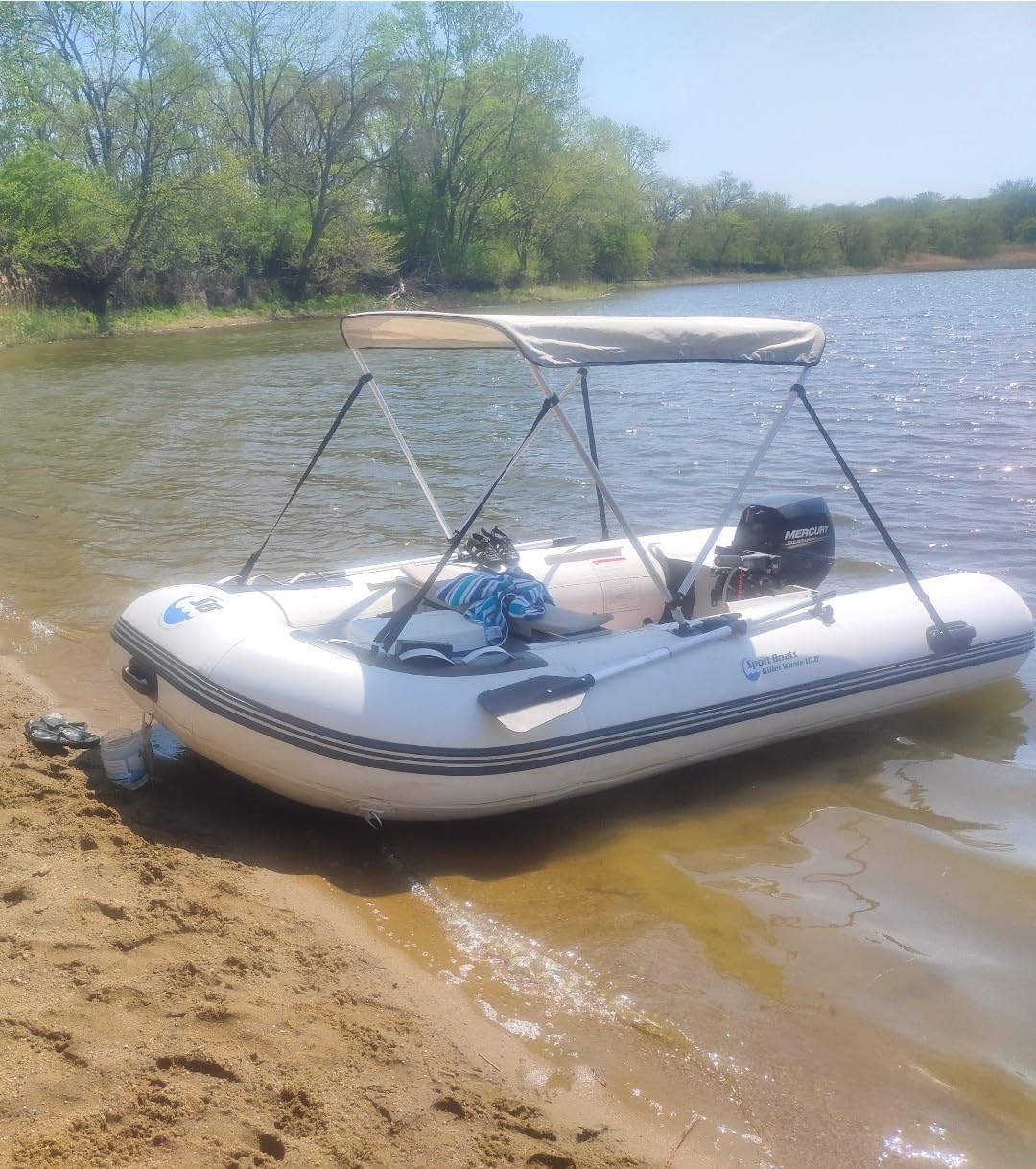
The Killer Whale carries the highest average rating of the twelve boats we reviewed, on a much smaller review base than the Intex models, so treat that as a signal rather than a verdict. What the rating reflects is consistent: owners describe a rigid aluminum floor with side rails that gives a RIB-like ride.
Construction is heat-welded PVC with a reinforced 0.9mm 1100 denier rip-resistant layer, plus a high-pressure drop-stitch air floor under the aluminum. The combination holds its shape under a standing angler, which is the specific capability that separates the top of this list from the bottom.
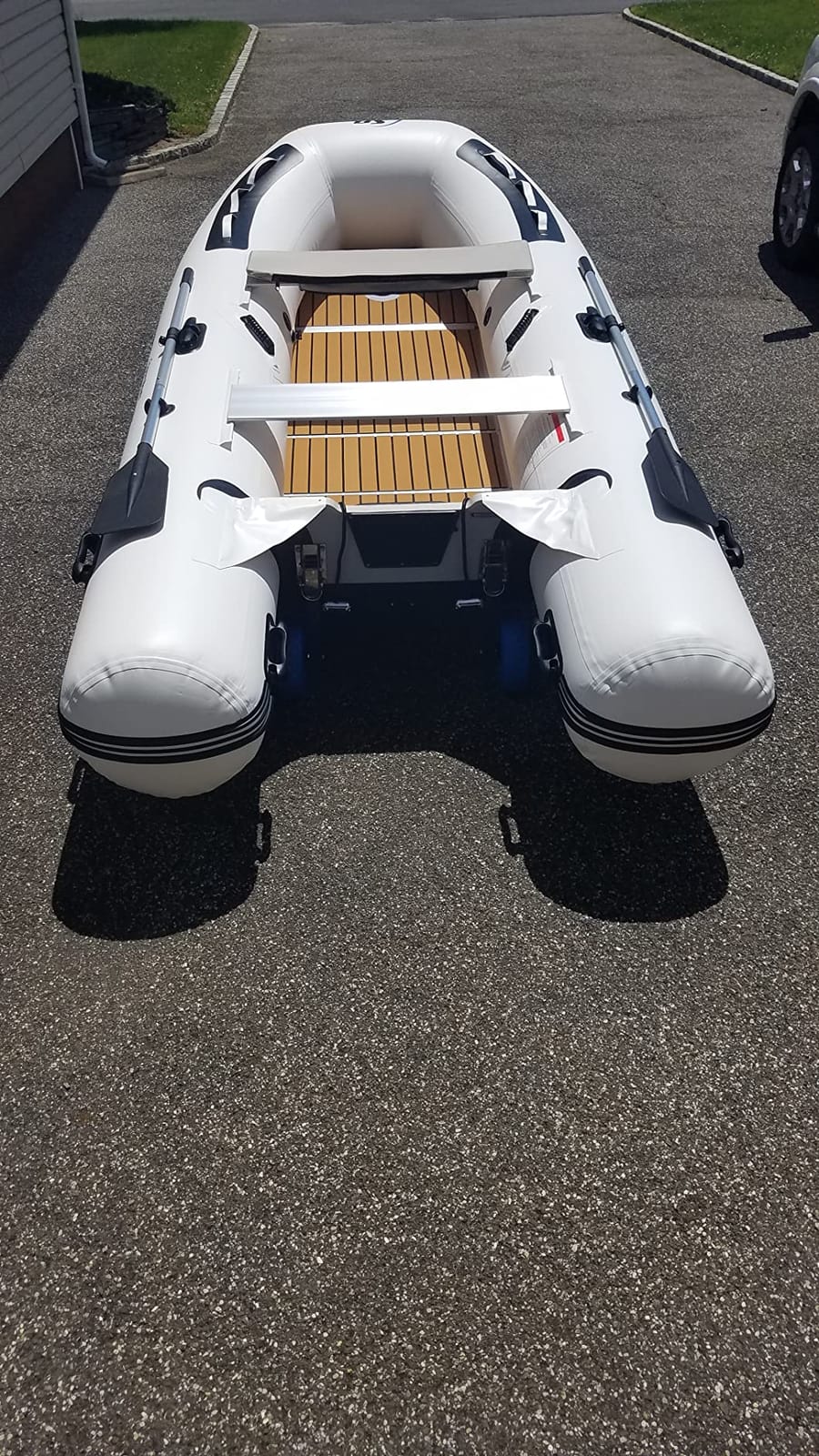
Two other things stand out. The three-year no-seam-blowout warranty is the longest explicit seam warranty in this group, and the boat is USCG approved with certification paperwork in the box, so registration paperwork is handled from day one.
At about 10 minutes to inflate with the included high-pressure PSI foot pump and roughly 80 pounds packed, it is also the most practical premium boat here. It takes up to a 15HP two-stroke or four-stroke motor, though owners note the supplied oars are barely useful beyond short trips.
Who the Killer Whale suits
Anglers who stand to fish, who want the stability of a rigid-hull boat, and who will keep the boat for years rather than seasons. Owners who have had theirs for multiple seasons point to the welded seams and the warranty as the reasons it has stayed trouble-free.
It also suits anyone who wants registration handled cleanly. The USCG approval and certification of origin ship in the box, which removes one of the most tedious parts of owning a small powered craft on a regulated lake.
Who should skip the Killer Whale
Skip it on price sensitivity. It is the most expensive boat we looked at, and the gap between it and a soft-floor raft is real money for a boat you may use a dozen times a season.
Skip it if you plan to load five adults. Only one aluminum bench seat is included, so a full-capacity outing means buying extra seating, and the basic oars mean a motor is close to mandatory for the boat to be genuinely useful.
10. BEYOND MARINA 10 ft USCG Dinghy: Best for Clean Registration
10FT USCG Approved Inflatable Dinghy Boat, 3-4 Person Aluminum Floor Dinghy
10 ft x 5 ft
3 persons
1105 lb load
137 lb packed
Pros
- Hull ID number and certificate of origin included
- Solid four-piece aluminum floor
- Handles a 15HP outboard
- Setup in under 10 minutes once learned
Cons
- Heaviest dinghy for its size at 137 lb
- Foot pump fittings can arrive loose
- Floor panels have rough mitered edges
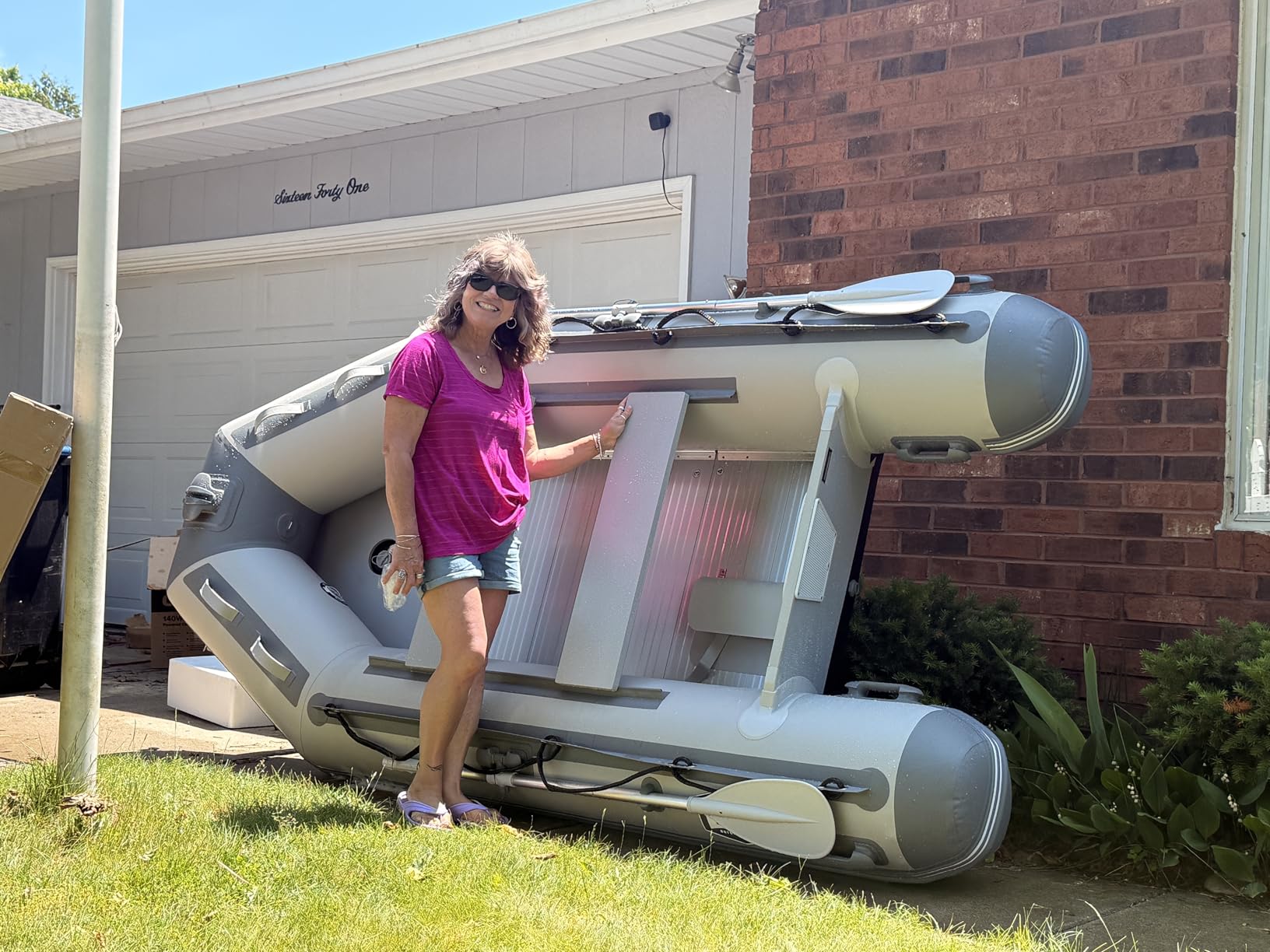
Most state registration questions come down to paperwork, and this boat answers that before you ever ask. It ships with a Hull Identification Number and a Manufacturer’s Certificate of Origin, which is exactly what a registration office asks for when you walk in with an inflatable.
The engineering is solid underneath. Sixteen and a half inch side tubes inflated to 3.3 to 3.6 PSI with the keel at 4.4 to 4.6 PSI give a properly firm hull, the four-piece aluminum floor installs without drama once you know the technique, and the 15.75 inch transom takes short-shaft outboards up to 15HP.
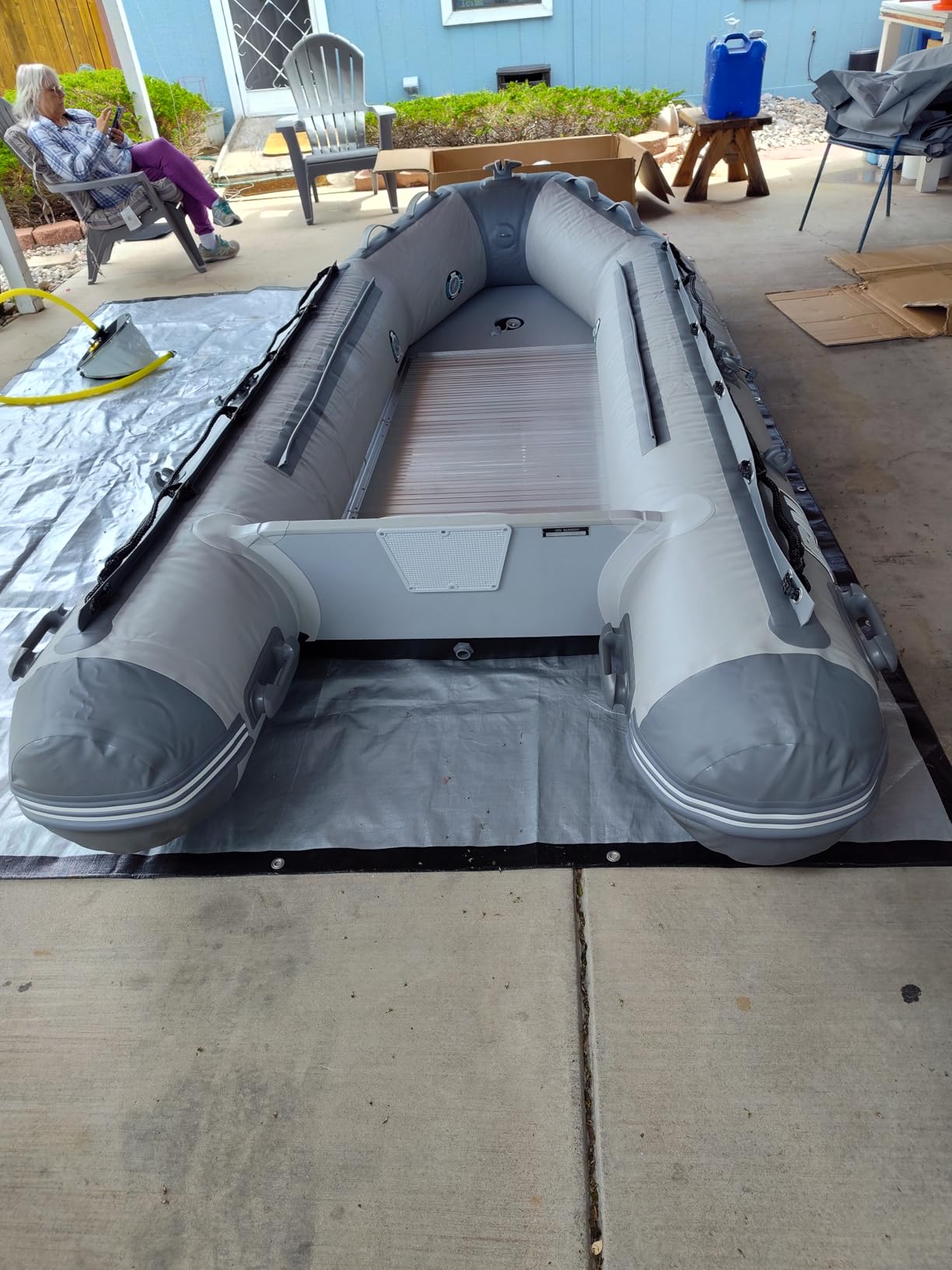
It is also well equipped for the water. Bow cleat, side grab ropes, tow rings, a fuel tank tie-down and adjustable fore-and-aft bench seats cover the list of things you look for on a boat that will be launched and recovered repeatedly, and owners report responsive customer service that passes issues to engineering.
The factory finish is where it slips. Owners report foot pump fittings and hardware arriving inadequately glued, floor panels with rough mitered edges that should be sanded before use, and instructions that appear out of date relative to the panel layout. At 137 pounds it is one of the two heaviest boats in this roundup, so a dolly or trailer earns its keep.
Who the BEYOND MARINA 10 ft suits
Anyone on a lake with registration or safety-equipment rules they need to satisfy, and anyone who wants a motor-ready dinghy with a certificate already in the box. The explicit PSI figures for the tubes and the keel are also the clearest in this roundup if you like to inflate to a number rather than by feel.
It suits owners who launch from a dock or trailer with a dolly, since carrying 137 pounds any distance alone is not realistic.
Who should skip the BEYOND MARINA 10 ft
Skip it if you hand-carry your boat. At 137 pounds with four floor panels and two benches, this is a two-person or cart job, and it needs more carrying space than the shorter rafts in this roundup.
Skip it if you are fussy about factory assembly. The loose pump fittings, the unsanded floor edges and the dated instructions are all fixable in an afternoon, but they are not things you want to discover at a ramp. Check all chambers on arrival, since one owner received a dinghy with a leaking keel chamber.
11. BRIS 9.8 ft BSA300: Best Compact Inflatable Yacht Tender
BRIS 9.8 ft Inflatable Boat Inflatable Dinghy Boat Yacht Tender Fishing Raft
9.8 ft dinghy
4 adults
1102 lb load
50 kg packed
Pros
- Heavy 1100 denier PVC with welded seams
- Sectional aluminum floor for a firm platform
- Marine plywood transom with splash guards
- Three-year warranty plus spare parts
Cons
- About 50 kg to carry solo
- Two-star reviews sit at 8% of ratings
- Only two bench seats for a four-person rating
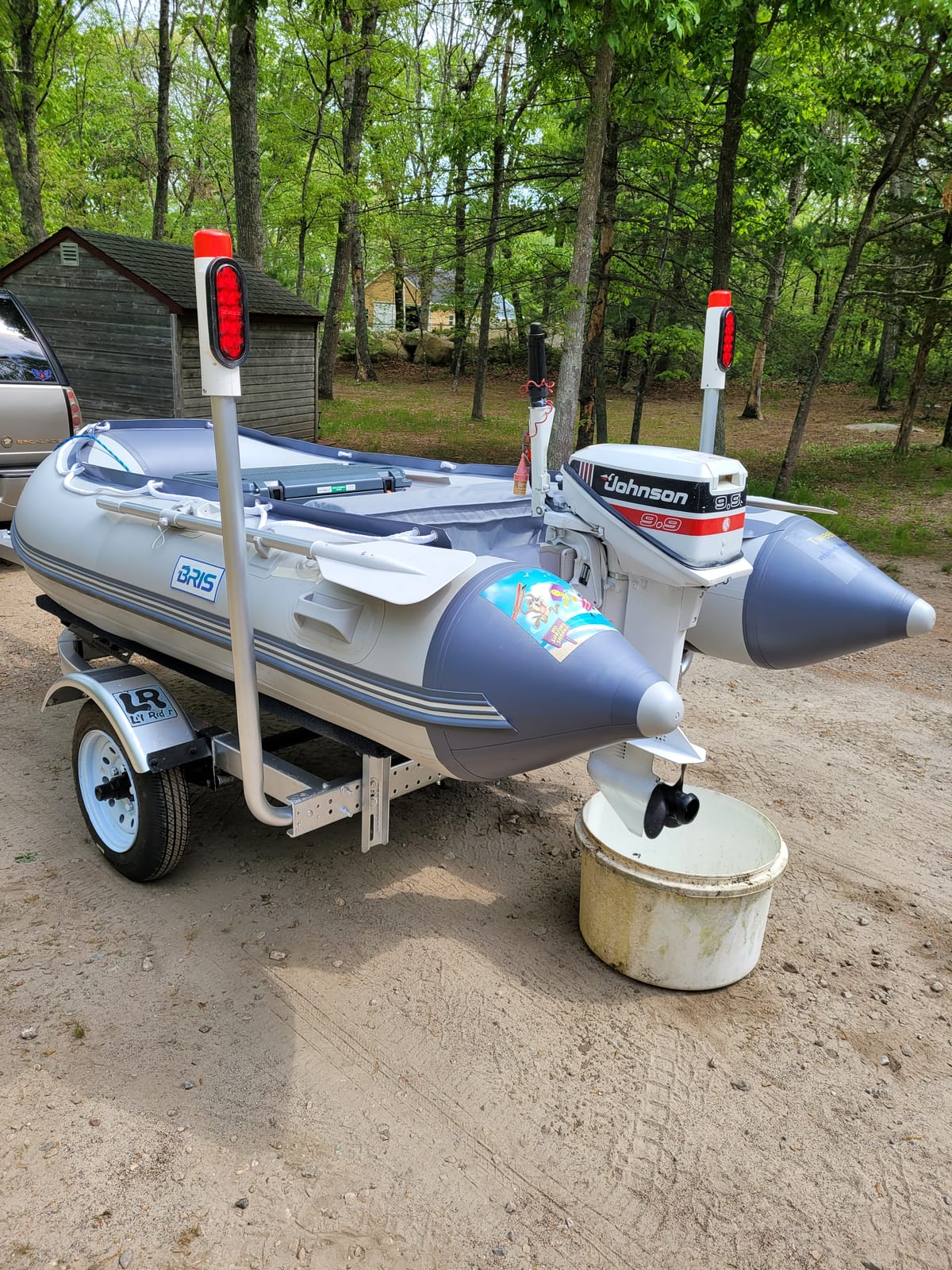
As a tender, the BRIS 9.8 does the specific job well. It is short enough to stow in a forepeak or a cockpit locker, and the sectional aluminum floor and marine plywood transom mean it can take a person, a bag of provisions and a line back to the parent boat without flexing or sagging.
The build follows the same recipe as the larger BRIS models: 1100 denier 0.9mm PVC with polyester support, heat-welded seams with quadruple overlap, separate internal air chambers, an all-around rubber strike and a deep V-keel with rub-strake for easy planing.
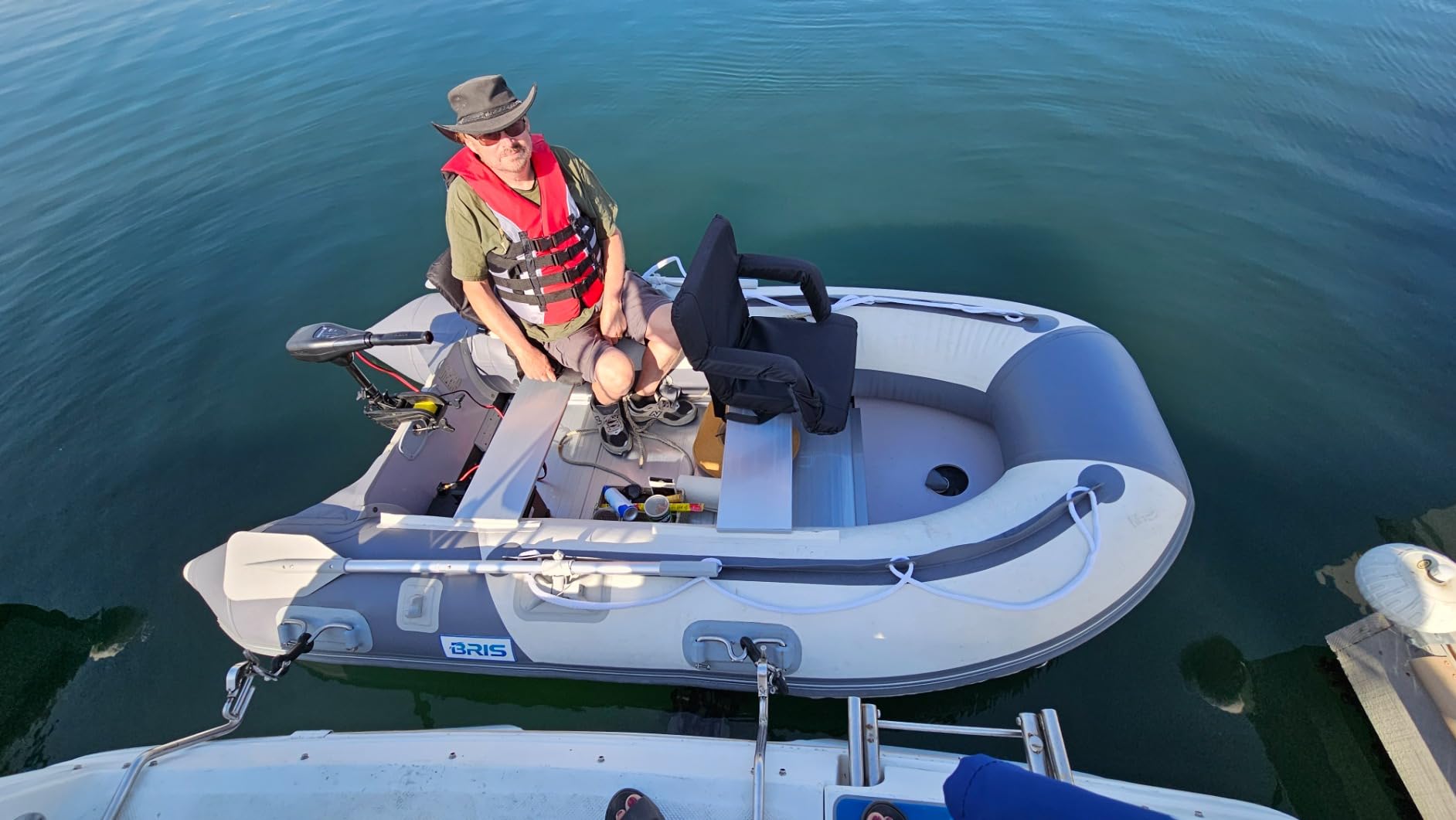
Where it separates itself is aftercare. The three-year manufacturer warranty begins on delivery, and spare parts are stated as available for three years, which is a meaningful commitment for a boat that lives in a locker and gets used hard in salt and sun.
The 4.3 average across 75 reviews sits slightly below the leaders, and the distribution shows why. Two-star ratings account for 8% of the total, which points to some dissatisfaction with durability or sizing. For a tender, that is acceptable, because a tender is a convenience craft and most owners keep a second means of getting back to the big boat.
Who the BRIS 9.8 BSA300 suits
Sailboat and powerboat owners who need a tender they can stow and deploy quickly, and who will use it on protected water close to their mooring rather than on an exposed crossing. The aluminum floor makes it far easier to load a person with a disability or a pile of supplies than a soft-floor raft would be.
It also suits buyers who want parts support over a long horizon, since the spare parts commitment runs three years from delivery.
Who should skip the BRIS 9.8 BSA300
Skip it if you plan to run four adults regularly. Two bench seats are included for a four-person rating, and the interior is short at 9.8 feet, so a full load is cramped rather than comfortable.
Skip it if you will carry it solo a long way. At 50 kg it is a two-person job, and the foot pump setup has a learning curve that owners mention. Plan the stowage and the carry distance before you commit.
12. Swordfish 10.8 ft: Best Inflatable Dinghy With a Decked Floor
Inflatable Sport Boats Swordfish 10.8′ Inflatable Dinghy | Air Floor with EVA Teak Decking | 5 Person Sport Boat | 15HP Motor Ready
10.8 ft x 5 ft 4 in
5 persons
1268 lb load
80 lb packed
Pros
- EVA teak-style air deck floor
- Rugged 1100 denier welded PVC
- USCG approved with certification
- 15HP motor compatible
Cons
- Only one bench seat for a 5-person rating
- 3-star reviews sit at 17% of ratings
- Air floor is softer than a hard shell
The Swordfish is the same 10.8 foot platform as the Killer Whale with one deliberate change: an EVA teak-style air-deck floor instead of an aluminum one. That material is a soft foam surface, so it is warmer to sit on in early morning fishing and grippier under wet feet, at the cost of some rigidity.
For a boat that will mostly be used seated, with a family aboard and swimming off the side, that trade is usually the right one. The rest of the package is well specified: reinforced 1100 denier heat-welded PVC, a 1,268 pound load rating for five people, and 15HP motor compatibility across two-stroke and four-stroke engines.
It is also USCG approved with the manufacturer certification of origin and registration documents in the box, and the adjustable sliding seat, extended rear pontoons and hanging bag for the seat cushion make the interior more usable than the rating alone suggests.
The 4.1 average across 30 reviews is tied for the lowest score in this roundup, and the distribution is split: 17% three-star and 9% one-star, with owners citing a softer ride than expected under load and the single included bench seat. It is also among the most expensive boats we looked at, so the value case rests entirely on the floor material being what you want.
Who the Swordfish suits
Boats that double as swim and beach platforms, where a warm EVA surface matters more than a hard deck, and family days on a protected lake where everyone is sitting rather than standing. The extended rear pontoons add usable interior space at the stern, which is where swimmers and gear usually end up.
It suits buyers who want a motor-ready, USCG-approved dinghy with registration documents in the box and a ten-minute inflation time using the supplied PSI foot pump.
Who should skip the Swordfish
Skip it if you plan to stand and fish, or if you need a genuinely rigid platform. The air deck is more forgiving than aluminum but noticeably softer, and several owners report it feeling less stable under load than they expected from a boat at this price.
Skip it for a full five-person load, since only one bench seat is included. And given the 4.1 average and the one-star share of ratings, buy it only if the deck material is the specific reason you are choosing it, because the aluminum-floored model in this roundup carries a higher average rating.
How to Choose an Inflatable Boat for a Lake
The single most useful decision you can make is matching the hull to the water rather than to the marketing. A soft low-pressure raft is genuinely good on a sheltered lake, a river inlet or a reservoir bay, and genuinely bad on open water in a breeze, and no amount of added features changes that. Everything else in this guide is a detail inside that decision.
Match the hull to the water, not the marketing
Read the tube diameter and the recommended inflation pressure. Soft tubes inflated to low pressure flex when you row, which makes long crossings slow and tiring and leaves the boat without a straight line. Stiffer tubes plus a rigid floor or a high-pressure keel hold a line in a crosswind, which is the difference between a boat you can point somewhere and one you can only hope arrives.
Then look at the keel. A V-keel or a defined rocker holds direction and planes more easily than a flat bottom. On a lake with boat traffic and wake, keel design is what keeps the boat from being shoved sideways every time a wake passes.
Size the load rating to gear, not people
Every rating on these boats, from 660 pounds to 1,322 pounds, is the total weight of occupants, gear, battery, motor and cooler combined. Work out what you will actually load before you pick a length, and then leave at least a quarter of the rating as headroom.
A useful rule: two adults with a trolling motor, a battery bank, a cooler and a tackle bag is already most of a mid-size boat’s rating. If your math comes out above 80% loaded, step up a size rather than a brand.
Floor construction decides more than the tubes do
There are four floor types, and they map onto price and purpose more than any other feature. An all-inflatable floor is cheapest and lightest but softest, and is fine for a swim platform. An inflatable I-beam floor is a big step up in comfort and is the minimum we would consider for a fishing boat.
A high-pressure drop-stitch air floor approaches rigid-hull stiffness without the weight. A sectional aluminum floor or an aluminum-framed plywood floor is the stiffest option and is the only real answer if you intend to stand and cast, and it is also what allows a motor to push the boat properly. Of the twelve boats here, seven use an aluminum or aluminum-framed floor and one more uses an I-beam inflatable floor.
PVC, Hypalon and polyurethane in plain terms
All twelve boats in this roundup use PVC, and that is now normal. If you encounter a listing for a new boat in Hypalon, treat it carefully: that fabric is now rare on new consumer craft, and most such boats are used or long-discontinued stock. Owners of premium river craft still cite ten-year warranties and a decade of puncture-free use as the durability benchmark that PVC rarely matches.
PVC is lighter, cheaper and easier to find replacement parts for, and welded PVC seams are now genuinely strong. The real cost is repair. Forum consensus is that nothing bonds to PVC the way it bonds to older rubber-coated fabrics, so a patch is a compromise rather than a fix, and UV exposure and damp storage do more damage than punctures. Buy a proper adhesive and a patch kit with your boat, and store it dry.
Wind, chop and the honest limitation
An inflatable boat has a very large exposed surface area and no keel to bite into the water, so wind pushes it far more than a rigid hull of the same length. On a big open lake this is the dominant factor in every owner report we read, and it is the reason experienced users on r/fishingboats limit themselves to calm conditions with little or no wind.
The practical rule: use a soft raft on water you could cross in a canoe in an hour. If your lake regularly produces whitecaps inside the swimming area, you want a rigid floor, a deep V-keel and a motor, and you should be honest that a dinghy is still not the right craft for a fetch of open water. If you plan to add sound, our marine stereo picks for a pontoon are worth reading before you pick a mounting spot that a wave can reach.
Motor and trolling motor compatibility rules
Only fit a motor to a boat the manufacturer says accepts one. Capacity ratings in pounds do not translate into safe horsepower, and attaching a motor to a boat without a transom changes the handling completely. Among these twelve, the models with a documented transom accept from 5 hp on the CO-Z up to 15 hp on the Newport, Killer Whale and Swordfish, and the BRIS 12 is described as holding a plane under 18 hp.
For a trolling motor, the requirements are simpler: a flat mounting surface, a rigid or semi-rigid floor, and a battery you can actually carry. That combination points to the Seahawk 4, the Excursion 5, the Mariner 3 with its included motor mount fitting, or any of the aluminum-floored dinghies.
Which brand should you buy?
There is no single best brand, and the honest answer is that Intex dominates on volume, price and consistency, with the Excursion 5 and Seahawk 4 carrying the largest review counts in this roundup by a wide margin. BRIS and the Inflatable Sport Boats brands build the more rigid, motor-ready dinghies, with longer warranty terms and heavier floors, at noticeably higher cost.
What actually differentiates brands in this category is support and parts, not fabric. Sellers that answer questions about replacement seats, spare valves and warranty paperwork earn their reputation; sellers that do not turn a 40 pound repair into a write-off. Newport and BRIS both score well on that, and that is worth more to a lake owner than any specification on a spec sheet.
Safety, Certification and Boat Rules on Lakes
An inflatable boat is not life-saving equipment. It floats, it will not sink outright when a chamber fails, and that is the extent of the promise. Everyone on board should wear a properly fitted personal flotation device, and for children the law and common sense both require one worn rather than carried.
Three labels appear in this category and they are not interchangeable. USCG approved means the boat carries a Hull Identification Number and a manufacturer’s certificate of origin and meets a flotation standard. NMMA certified means it meets the American National Marine Manufacturers Association boat standard. CE marking is the European conformity mark and tells you nothing about US registration.
On registration, most states require registration for any powered watercraft, and several exempt non-motorized craft while still requiring a safety equipment list to be carried. Rules vary by state and by lake, so check your state boating authority and your lake’s own posted requirements before launch. Being able to show a certificate of origin is exactly what makes that conversation short, which is why the two boats in this roundup that ship with it are worth a look even if registration is not your main concern.
Care, Storage, Lifespan and Patching a Leak
Inflatable boats last a long time when they are stored correctly, and fail early when they are not. The single rule is dry. Long-term PVC owners report many years of service when a boat is deflated, clean and dry, and early failure when it is packed damp. In humid climates, leave the valves open and the boat unfolded.
Find a slow leak with a soapy-water bath
Do not spend a season guessing. Inflate the boat, mix dish soap and water in a spray bottle, and run it over every seam, the valve threads, the D-ring patches, the keel and the underside of the floor. Bubbles mark the leak. Check the valves first, since a valve that is not seated properly mimics a puncture and costs nothing to fix.
Patch a PVC leak step by step
Deflate the chamber and mark the puncture from the outside. Roughen the area lightly, wipe it with the cleaning solvent from a proper PVC repair kit, and let it dry fully. Apply the PVC-compatible adhesive generously and let it become tacky, not wet. Press the patch down firmly from the centre outwards, then let it cure for the full time stated on the kit rather than an improvised guess.
Expect a patch to be a compromise. Hypalon-style fabrics bond well; PVC does not, which is the single most common thread in owner discussions about repairs. For a seam that is opening rather than a small hole, replacing the boat is usually the more sensible answer than a fourth attempt at glue.
Store it dry or lose it
Rinse with fresh water after every outing, especially after salt or algae water, then dry completely before deflating. Roll rather than fold along a crease, keep it out of direct sun between seasons, and store it loosely in a large bag rather than compressed in a tight space in a hot car.
Avoid leaving a boat inflated in a garage, because constant pressure and temperature swings stress seams and valves. If you keep it inflated on a lake dock for the season, check pressure every few days, because a small loss of air is what turns a boat that was fine at the ramp into a boat that will not hold a motor load.
How long an inflatable boat lasts
A well-made PVC inflatable used on a lake and stored dry commonly reaches the ten-year range, and owners of the models in this roundup report service lives from 10 to 12 years. Ten years is also the warranty length most often cited in the premium river craft category, which is the benchmark to measure a new purchase against.
Age alone is not the number that matters, though. UV exposure, hours in the sun, damp storage and repair history wear a boat out well before the fabric gives up. When buying used, check that it holds pressure overnight, inspect seams and the underside for repairs, and ask how many seasons it has been in the sun. Unknown hours are a reason to walk away.
Frequently Asked Questions
Can I use an inflatable raft in a lake?
Yes, and on sheltered inland water it is an excellent choice. A lake-suitable inflatable has a self-bailing hull, three or more air chambers, a printed load rating and USCG or NMMA certification. The condition that matters is shelter: on a large open lake, wind pushes a soft inflatable far more than a rigid hull, so calm water is the real requirement, not fresh water.
Which brand of inflatable boat is considered the best?
There is no single best brand, because the brands specialise in different jobs. Intex leads on volume, price and consistency, and its Excursion 5 and Seahawk 4 carry the largest review counts in this category. BRIS and Inflatable Sport Boats build heavier, motor-ready dinghies with aluminum floors and longer warranties. Judge support and parts availability as heavily as the spec sheet.
What is the average lifespan of an inflatable boat?
A good PVC inflatable used on a lake and stored dry commonly reaches ten years, and owners of the models in this roundup report service lives of 10 to 12 years. Storage conditions dominate: boats packed damp or stored in direct sun fail far earlier than their fabric suggests. Ten years is also the warranty length most often cited by premium river craft makers.
Is PVC good for inflatable boats, and which is better, PVC or Hypalon?
PVC is good enough for most lake use and is now what almost every new inflatable boat is built from. Welded PVC seams are strong, the fabric is light and parts are easy to source. Hypalon bonds far better when damaged, which is its real advantage, but it is now rare on new consumer craft. Choose PVC for a lake boat and keep a proper PVC repair kit with it.
What is the best glue for repairing an inflatable boat?
Use a two-part polyurethane or vinyl/PVC adhesive sold in a proper inflatable repair kit, never general household superglue. Clean and lightly roughen the area, let the solvent evaporate completely, apply the adhesive, wait until it turns tacky, press the patch from the centre out and allow the full stated cure time. Buy the kit before you need it, since included patches often arrive without glue.
How much wind can an inflatable boat handle?
Less than most buyers expect, because an inflatable has a large exposed surface and no keel to hold a line. A soft low-pressure raft is comfortable in a light breeze and genuinely awkward in anything stronger, which is why experienced owners on fishing forums restrict themselves to calm water with little or no wind. In a crosswind, add a rigid floor, a deep V-keel and a motor before you add distance.
Do inflatable boats need to be registered?
Usually, yes, if they carry a motor. Most states require registration for any powered watercraft and several also require a safety equipment list to be carried on board. Rules differ by state and often by lake, so check your state boating authority and the lake’s posted requirements. A boat shipped with a Hull Identification Number and a certificate of origin makes that process much faster.
What inflatable boat do Navy Seals use?
Military and dive teams use combat inflatable rafts, built to rigid-hull standards from heavy rubber-coated fabric with multiple chambers and high inflation pressure. They are purpose-built craft for carrying people, equipment and vehicles at sea, and they are not the same product as a lake dinghy. For a lake, what transfers is the principle rather than the equipment: redundancy of chambers, strong seams and a firm floor.
Which Inflatable Boat for Lakes Should You Buy?
Choose by the water you actually have. On a sheltered lake or a reservoir bay, a soft raft is the correct answer, and the Intex Excursion 5 is the one we would buy first because it carries the largest review count in the category and gives a family the most usable space. If you will be out for hours on a fishing seat, the Seahawk 4 adds a three-chamber layout and an I-beam floor that will take a trolling motor better.
If you fish standing, carry heavy gear, or need a motor to reach the far side of the lake, stop reading soft-floor specifications and look at the floor. The Newport 10 ft 6 in gives you an aluminum-framed plywood deck and a 15HP rating at 323 reviews, and the Killer Whale 10.8 ft adds a three-year no-seam-blowout warranty for buyers who want the highest average rating in the group. For a tender, the BRIS 9.8 BSA300 is the compact option, and the BEYOND MARINA 10 ft is the one that arrives with its registration paperwork already in the box.
Whichever one you pick, do a soapy-water check of every chamber before the first launch, inflate to the pressure the manufacturer states rather than to the limit of the fabric, and confirm the load including motor, battery and gear stays comfortably under the printed rating. Buy the repair kit in the same order. That is the whole difference between an inflatable that lasts a decade and one that ends a season early.