
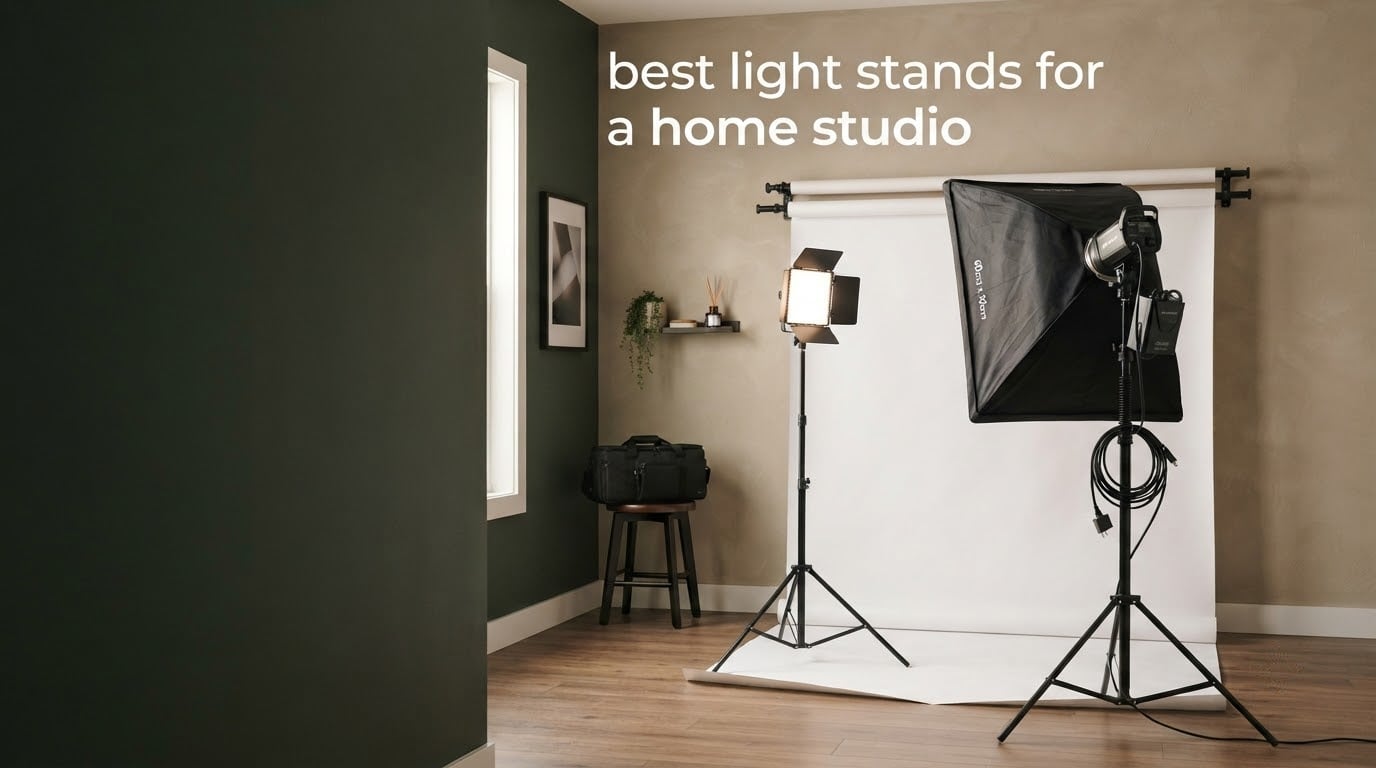
A spare room with an 8 foot ceiling, two lights and a backdrop roll is the classic home studio, and it changes what a light stand has to be. Most roundups for this query are written by people who pack gear into a van, so they chase folded length and weight. A fixed room rewards the opposite: mass, a wide base, and cushioning that stops a several-hundred-dollar strobe hitting the floor when a clamp lets go. That is the lens we used to pick the best light stands for a home studio in 2026.
Our short answer: the EMART 8.5ft spring cushioned pair is the one most people should buy, because two stands at 8.5 feet with drop protection covers a key, a fill and a background without any clever geometry. If your lights are heavier than about 8 pounds each, move up to the stainless options, and if you want one stand that also reaches overhead, the SmallRig boom model earns its place.
We compared ten stands on the specifications that actually decide whether a stand stays upright in a small room: max height against your ceiling, load capacity at extension, material, cushioning type, top mount, and leg spread. Our honest limit is that this is a spec-led comparison drawn from published manufacturer data and owner reviews, not a month of location shoots, and we say so plainly in the methodology note below. The picks are in the order we would buy them, not in price order.
Table of Contents
Top 3 Picks Best Light Stands for a Home Studio in 2026

EMART 8.5ft Spring Cushioned 2-Pack
- 8.53 ft max height
- 22 lb load
- anodized aluminum
- spring cushioned

NEEWER ST-220SS Stainless Steel 7.2ft
- 22 lb load
- full stainless steel column
- reversible 1/4 to 3/8 inch adapter
- 3-way mounting

SmallRig RA-S280 Boom Stand 9.2ft
- Integrated boom arm
- air cushioned
- 1.2 m leg spread
- 2-year warranty
Best Light Stands for a Home Studio (October 2026)
| Product | Specifications | Action |
|---|---|---|
| EMART 8.5ft Spring Cushioned 2-Pack |
|
Check Latest Price |
| NEEWER ST-220SS Stainless Steel 7.2ft |
|
Check Latest Price |
 EMART LS703-2 7ft 2-Pack EMART LS703-2 7ft 2-Pack |
|
Check Latest Price |
 NEEWER ST210 Aluminum 7ft 2-Pack NEEWER ST210 Aluminum 7ft 2-Pack |
|
Check Latest Price |
 K&F CONCEPT KF34.043 9.1ft K&F CONCEPT KF34.043 9.1ft |
|
Check Latest Price |
 Godox 290F 112 inch Aluminum Godox 290F 112 inch Aluminum |
|
Check Latest Price |
| SmallRig RA-S280 Boom Stand 9.2ft |
|
Check Latest Price |
 NEEWER ST-300AC 9.8ft Air Cushioned NEEWER ST-300AC 9.8ft Air Cushioned |
|
Check Latest Price |
 K&F CONCEPT Stainless 9.2ft K&F CONCEPT Stainless 9.2ft |
|
Check Latest Price |
 Anautin YF-ST221 7ft 2-Pack Anautin YF-ST221 7ft 2-Pack |
|
Check Latest Price |
Two things jump out of that table before you read a single review. First, the height range across all ten runs from 6.9 feet to 112 inches, and every one of those numbers is useless in a room with a low ceiling unless you can actually get the light above your subject’s head. Second, load capacity is where the spread matters: the top of the range is 22 pounds of stainless or aluminum, the bottom is 5.5 pounds, and that is the difference between a stand that takes a monolight with a softbox and one that wobbles the moment you tighten the last clamp.
How Many Light Stands Does a Home Studio Need?
Two is the working minimum for a home studio, and three is where setups start to look professional. Here is the short version.
1. Key light. This is your main light, placed roughly 45 degrees to one side of the subject and slightly above eye level. It needs the most load capacity of anything you own, because modifiers like softboxes and grids add weight fast.
2. Fill light. A second light, usually placed opposite the key and set dimmer, or a white reflector if you want to spend nothing. A reflector needs no stand at all, so a reflector-clamp on a furniture leg is a legitimate way to skip purchase two.
3. Backlight or hair light. Placed behind and above the subject to separate them from the background. This is the light that most often needs a tall stand, which is why an 8.5 foot or 9.2 foot model earns its keep over a 6.9 foot one.
4. Background light. A fourth stand aimed at the backdrop roll or wall. A 6 foot stand is enough here because the backdrop is vertical and needs no elevation, so this is the cheapest role to fill and the easiest place to use a budget pick.
That is also the answer to why a two-pack is a smarter buy than two singles: a key and a fill need identical height range so your ratio stays consistent when you relight, and matching pairs stop you discovering mid-session that one stand tops out an inch lower than the other.
How We Evaluated These Stands
Our ranking weighs real-world fit at roughly 70 percent and feature differentiation at 30 percent, and owner feedback carried as much weight as the spec sheet. Published load specifications beat brand reputation in our scoring, and long-term ownership reports mattered more than marketing copy.
What we did not do: we did not stress-test these stands to failure, we did not measure leg radius with calipers, and we did not run a month of paid sessions. Where a manufacturer listing contradicts itself, we say so in the review rather than picking the flattering number. That transparency matters more than a claimed testing volume we cannot back up.
1. EMART 8.5ft Heavy Duty Light Stand with Spring Cushioned (2-Pack)
EMART 8.5ft Heavy Duty Light Stand with Spring Cushioned for Photography
Max 102.4 in
Min 37.8 in
Load 22 lb
Aluminum
Spring cushioned
Two stands
Pros
- Spring buffer protects gear from sudden drops
- 3.15 to 8.53 ft height range
- anodized aluminum with anti-rust finish
- universal 1/4-inch adapter
- carrying bags included
Cons
- Plastic wing-bolt tighteners can strip over time
- rivet joints on the lower legs reported loose
- carrying bag durability is unremarkable
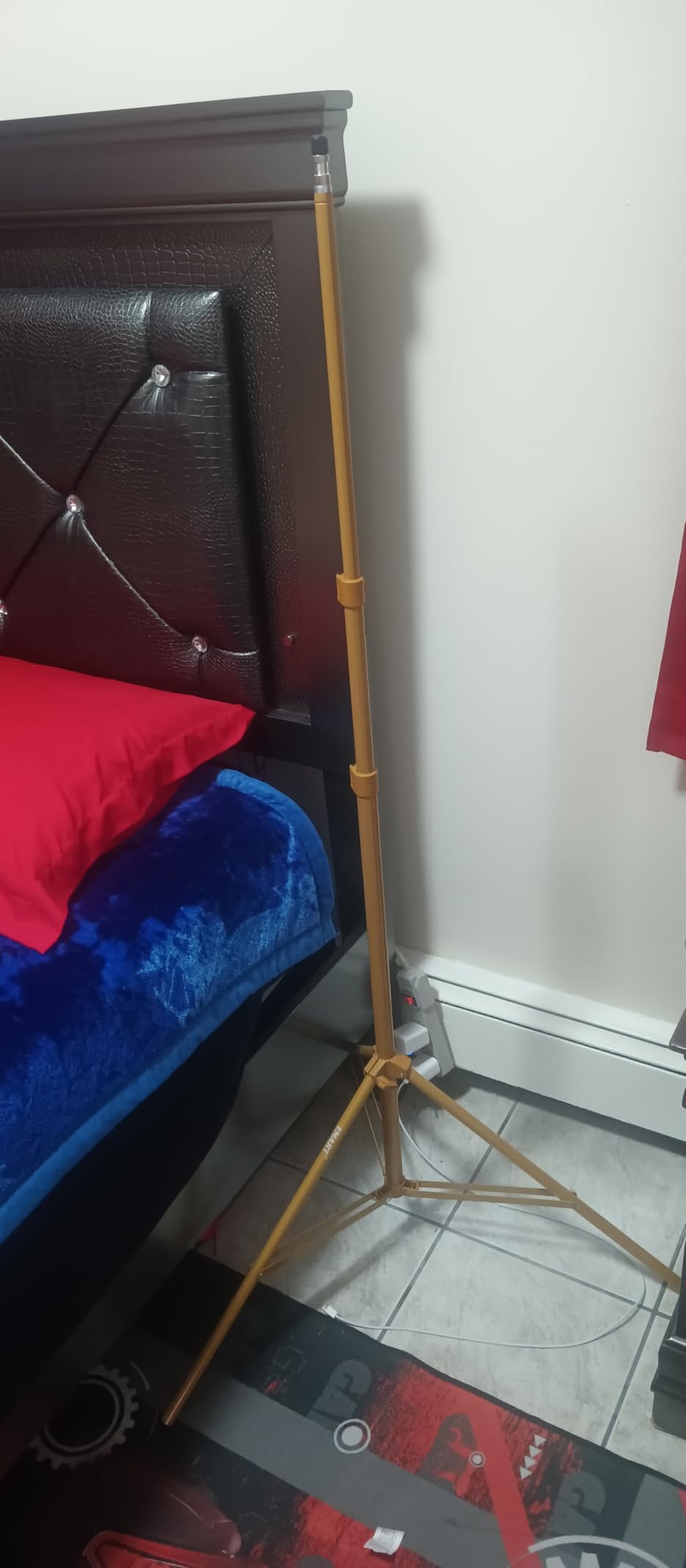
This is the pair we would build a first home studio around. Model EM-K726A-2 reaches 102.4 inches fully extended and collapses to 37.8 inches, which in a spare room means the backlight clears a standing subject’s head without you standing on a chair. The 37.8 inch minimum is low enough to bring a light down to tabletop height for product work, which is a range most 7 foot stands cannot match.
What sold us is the combination of spring cushioning and a 22 pound rating on a three-section aluminum column. Spring cushioning matters more than most buyers realise, because the realistic failure in a home studio is not a tip-over, it is a thumb catching a wing bolt while you are raising a loaded stand and dropping the whole assembly a foot onto an aluminium column. The buffer absorbs that. On the NEEWER competitors below you will see the same idea sold with a 3,382-review track record; here it is a smaller brand with a smaller but still solid 709-review record.
Owner reports are consistent about the trade-off. People like the value, the spring buffer and the included bags, and the recurring criticisms are mechanical rather than structural: plastic wing bolts that can strip, rivet connections on the bottom legs that work loose over time, and some rattling from the same source. Those are the components I would check first at the 12-month mark.
The unit is supplied as a two-count pack, so you get a matched key and fill pair from day one. Given the 1-year manufacturer warranty and the anodized anti-corrosion finish, this is a solid buy for a room that stays indoors, and it handles a speedlight, an LED panel, a small softbox or a reflector without drama.
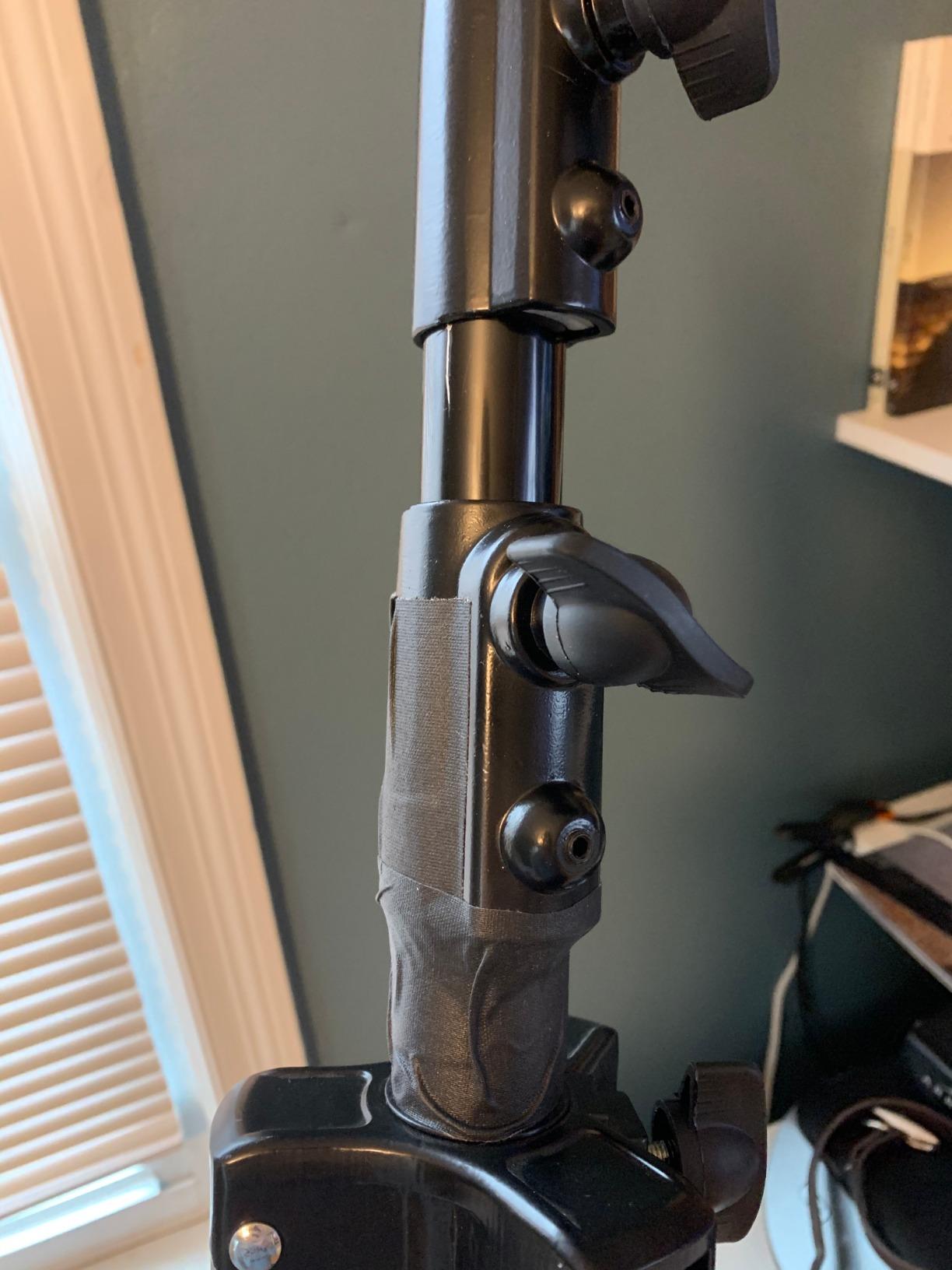
For context on why we weight drop protection so heavily, users on FredMiranda consistently describe the same accident: a released clamp dropping a several-hundred-dollar strobe. That thread also carries the single most useful piece of advice for anyone building a fixed setup, which is that you should size a stand at twice the load you intend to put on it. Applying that rule here, 22 pounds of rated capacity gives you comfortable headroom for a monolight with a softbox, and comfortable headroom is the point.
The other forum rule worth adopting is counterintuitive: buy the taller stand. A stand that reaches 8.5 feet is built with a longer, stiffer lower section, so at working heights it is more rigid than a short stand forced to its maximum. That is a real advantage in a fixed room where you will almost never actually need the top 6 inches.
One practical note on a spec people skim: the listing headline shows a 60 pound figure, while owner feedback and the product features describe 22 pounds, which is 10 kg. Treat 22 pounds as the working number. We mention this because published specs that contradict themselves are exactly the situation that erodes trust in a roundup, and it is better to name it than quietly quote the bigger figure.
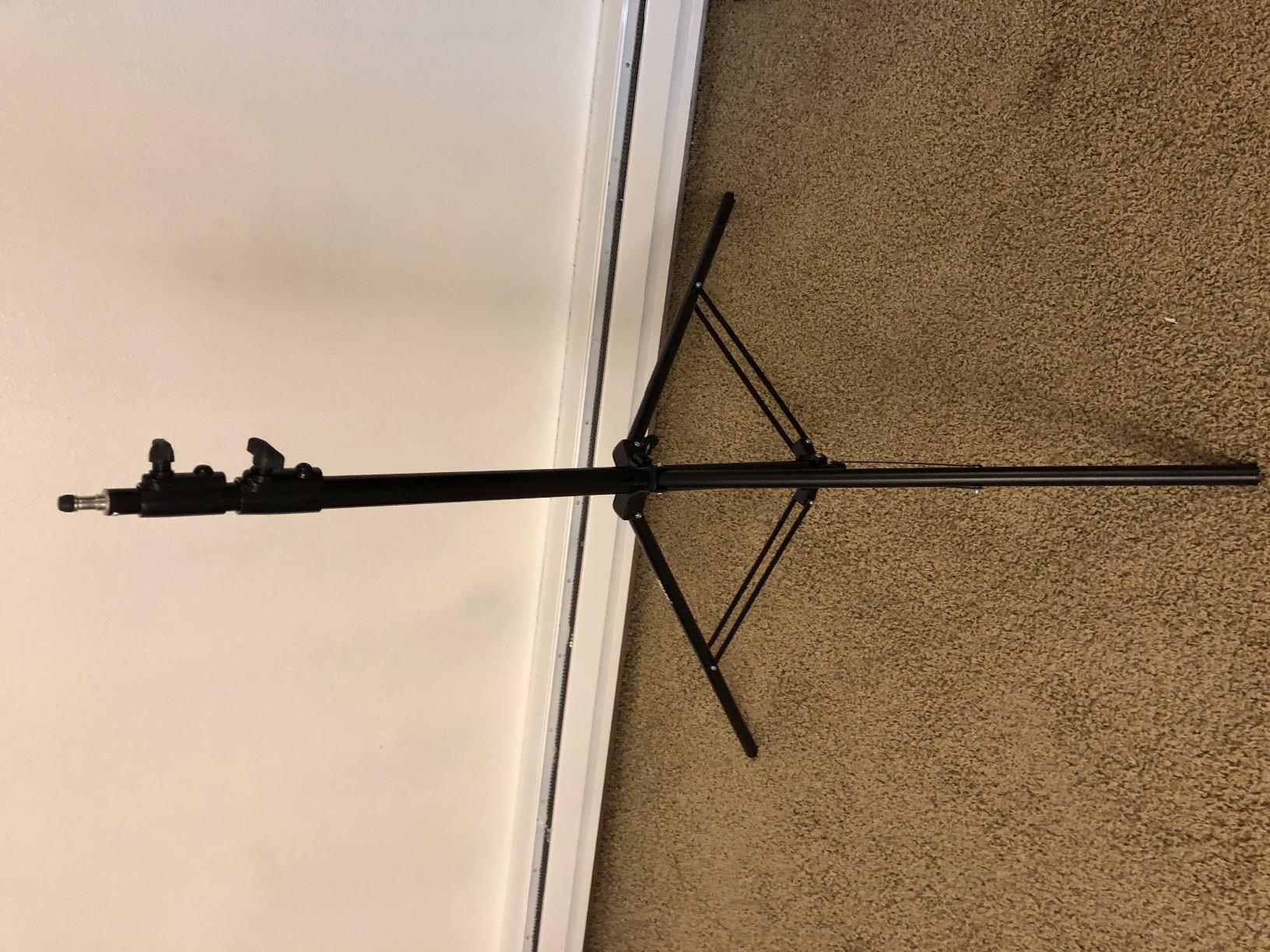
What you should check before buying this stand
Measure your ceiling height first, then subtract at least 8 inches. An 8.5 foot stand is the right call in a 9 foot or 10 foot room, and it is wasted money in a 7 foot room where the top section stays collapsed anyway. If your room is 7 feet, the NEEWER ST-220SS at 7.2 feet or the EMART 7 foot pair will serve you better and cost less.
Next, count your fingers. The plastic wing bolts are the part most likely to disappoint, and reviewers describe stripping after extended use. If you tighten them with the force that feels necessary rather than the force that is necessary, you will strip them sooner. Finger tight plus a gentle quarter turn is the rule.
Who should look elsewhere
Skip this one if your lights are genuinely heavy. The 22 pound rating is fine for an AD200-style strobe with a standard softbox, but if you are running a heavy monolight plus a large modifier plus a grid, you will be at the edge of what the thin upper sections can carry. In that case, go to the stainless steel build, which has more rigidity in the same envelope.
Also skip it if you need to move the stands between rooms regularly. At 8.5 feet with two stands and their bags, this is a lot of hardware to relocate. A shorter pair that fits in a closet and gets carried out on shoot days is a better tool for that workflow.
2. NEEWER ST-220SS Stainless Steel Light Stand, 7.2ft Spring Cushioned
NEEWER 7.2ft/2.2m Stainless Steel Light Stand, Spring Cushioned Heavy Duty
Max 7.2 ft
Min 3.2 ft
Load 22 lb
Stainless steel
Spring cushioned
4.16 lb
Pros
- Full stainless steel column resists corrosion and moisture
- 22 lb load across three sections
- reversible 1/4 to 3/8 inch adapter with 3-way mounting
- 3382 owner reviews
Cons
- Heavier than aluminum stands at 4.16 lb
- sandbags are not included with the stand
With 3,382 reviews and a 4.6 rating, this is the most proven stand in the list, and the stainless steel column is the reason. For a fixed home studio, the forum advice is blunt and correct: in a location that does not change, weight is barely relevant, so go for big and heavy. Steel stands are much heavier than aluminum, but they are rigid, and rigidity is what stops a softbox edge creeping into frame during a long take.
The height range of 3.2 to 7.2 feet suits a room with a standard 8 foot ceiling, and the 97 cm minimum still gets a light low enough for tabletop product work. The reversible 1/4 inch to 3/8 inch adapter with a three-way mounting interface means it accepts strobes, monolights, softboxes, ring lights and reflectors without hunting for adapters, which removes one of the most irritating small problems in a home studio.
Owners consistently praise stability, build quality and the spring cushion, and the same reviewers note the two honest drawbacks: it is heavier than an aluminum stand, and sandbags are not included. That second point deserves emphasis. Forum consensus is a flat yes on sandbags, and a stand that arrives without one means the accessory everyone agrees on has to be bought separately, so factor that into your planning.
The technical details worth noting: 4.16 pounds per stand, a folded size of 28.74 by 4.13 by 3.54 inches, and a corrosion and moisture resistant finish. The same family is listed in six lengths from 190 to 300 cm, so if your ceiling is taller than 7.2 feet you are not locked into this one height.
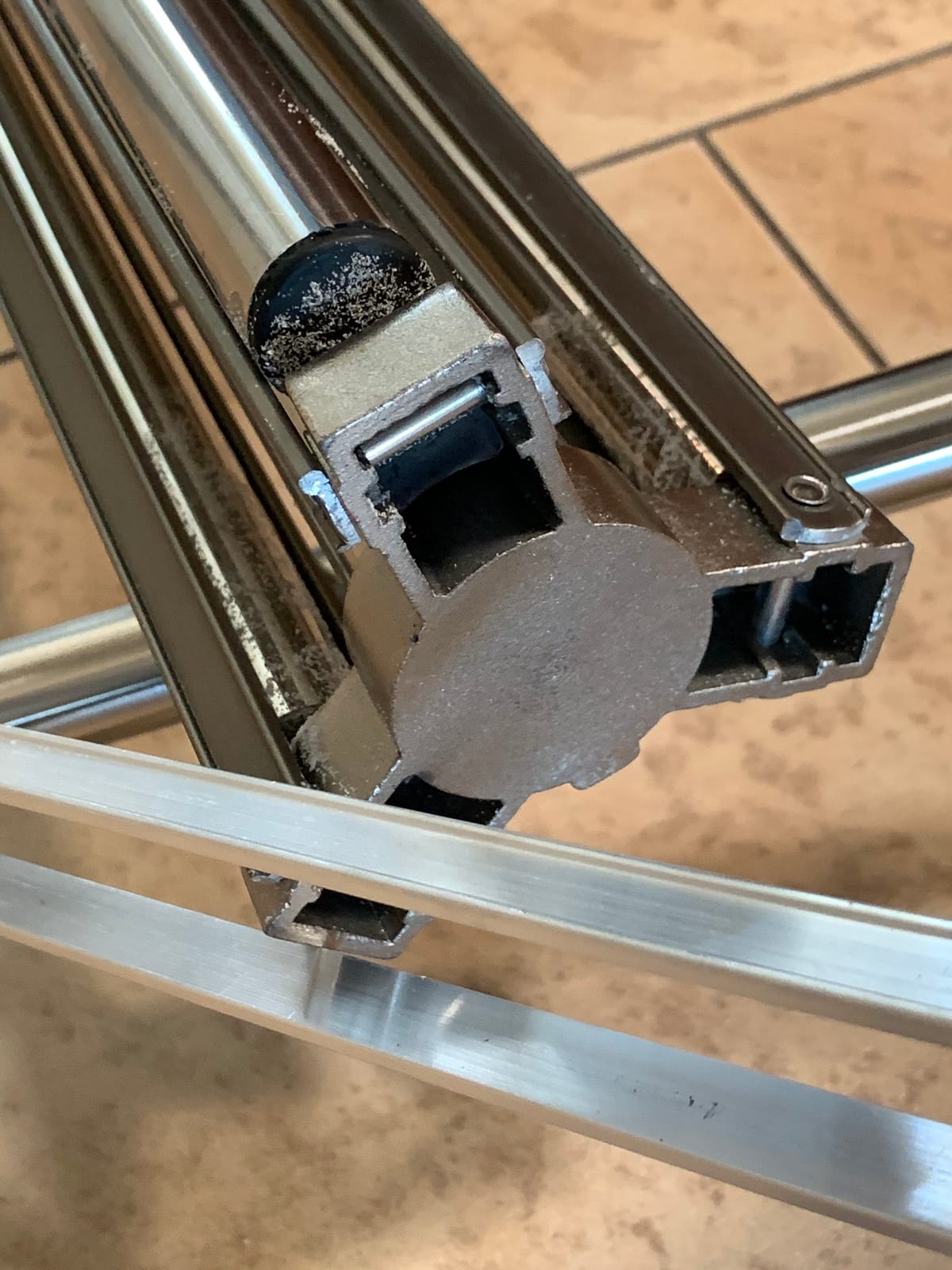
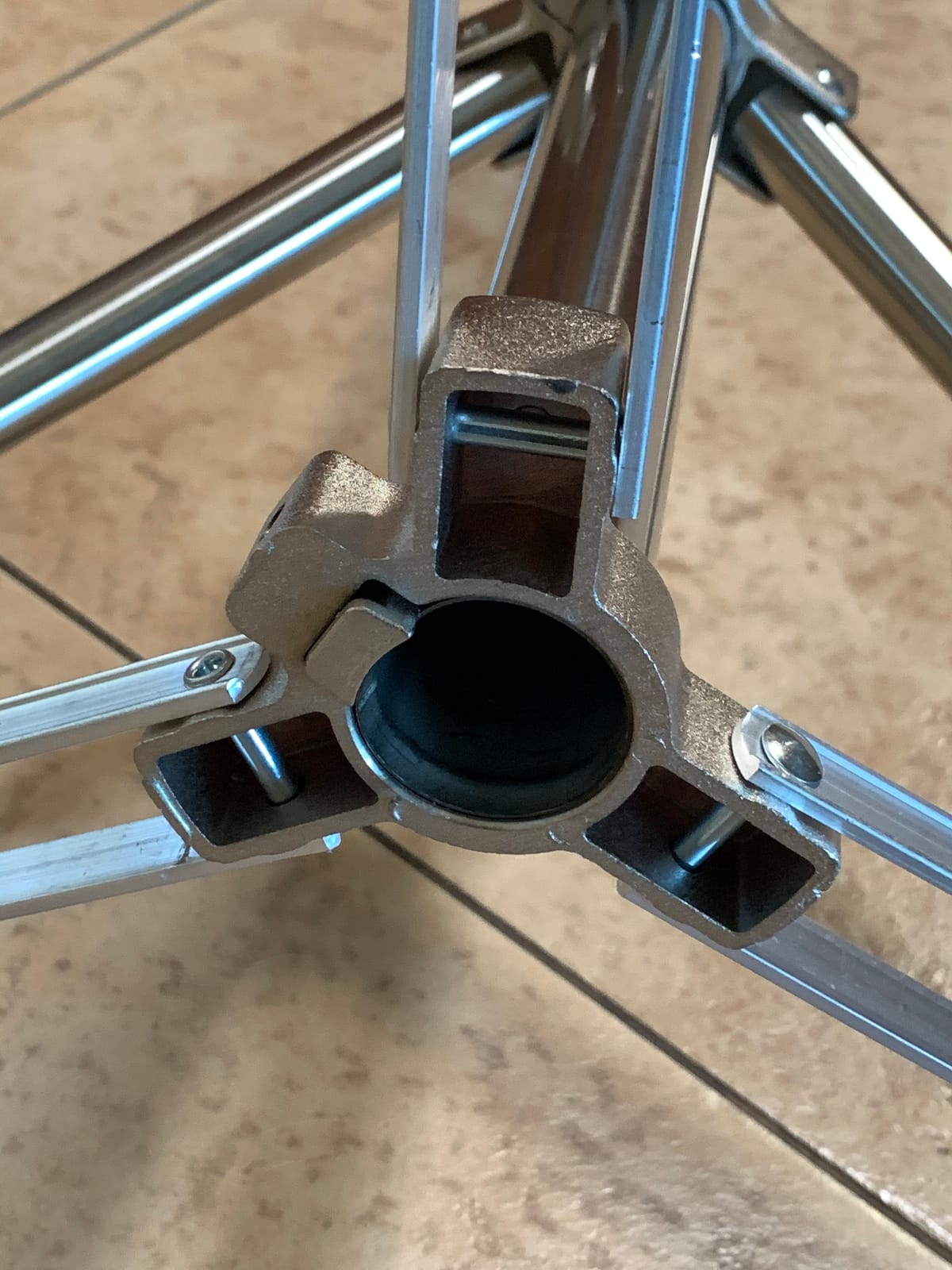
One key to the stability of a light stand is the length of the legs. Steve Wylie on FredMiranda makes this point explicitly when recommending a baby kit stand: if the legs are not long enough, you have stability issues. A steel column with long legs and a wide base is the configuration that survives a crowded room, a passing cat, or a door draft, and this stand delivers it.
There is also a practical reason to own two of these. The forum consensus is to keep one reserve stand, because the alternative is discovering mid-session that a clamp is stripped and having nothing to swap in. A spare that lives in the corner costs less than a missed shoot, and a steel stand that barely moves is a better spare than a cheap aluminum one that wobbles the moment you touch it.
On height fit, 7.2 feet is genuinely the sweet spot for a standard domestic room. It gets a key light above head height without the top section needing to be extended at all, which is where the rigidity is highest. If your ceiling is 8 feet or less, this is arguably a better match than the taller picks further down.
What you should check before buying this stand
Check the room you are lighting, not the box. 7.2 feet is a deliberate choice for ceilings around 8 feet. In a taller room you will want a longer version of the same stand, and in a shorter room you will be extending the top section and losing stability for height you do not need.
Check your light weight against the 22 pound rating using the two-times rule. A strobe plus a softbox plus a grid can reach 8 to 10 pounds, so you have room. A monolight with a large softbox and a heavy grid can approach the rating, and at that point you should be extending less and sandbagging more.
Who should look elsewhere
Look elsewhere if you need a backlight higher than 7.2 feet, which is a common reason to want 9 feet or more. In a room with 9 foot or 10 foot ceilings, this stand will not get a hair light above the subject, and you would need the boom model or a taller stand instead.
Also look elsewhere if you plan to carry stands to location work regularly. At 4.16 pounds each in steel, a pair adds up quickly, and the portable-first bias of most travel-first roundups is not misplaced for people who work outside a fixed room.
3. EMART 7ft Light Stand for Photography, Speedlight, Flash, Softbox (2-Pack)
EMART 7Ft Light Stand for Photography, Speedlight, Flash, Softbox-2 Pack
Max 7 ft
Min 28 in
Load 11 lb
Aluminum alloy
Two stands
4.45 lb each
Pros
- Two stands plus carrying bags at a low entry cost
- universal 1/4-inch screw thread
- height range from 2.5 to 7 ft
- consistent 4.6 owner rating across 1966 reviews
Cons
- 11 lb rating is low for large softboxes or strobes
- plastic clamps reported as a long-term weak point
- can wobble at full extension with heavier loads
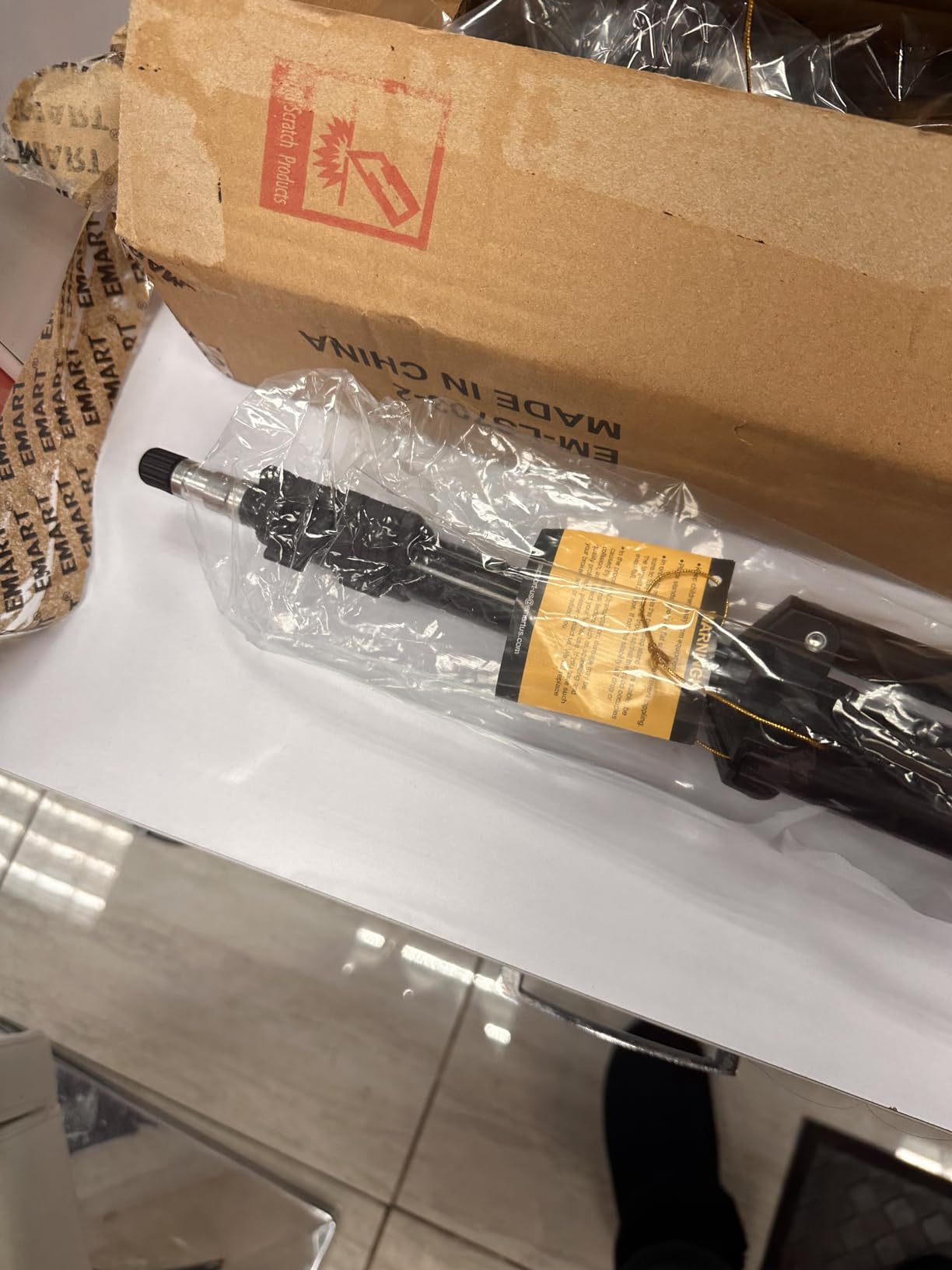
This is the budget entry point, and it does one job extremely well: holding speedlights, small LED panels, reflectors and lightweight modifiers in a room you do not need to impress anyone in. Two stands, two carrying bags, a 7 foot maximum, and 1,966 reviews at 4.6. For a first setup or a second room, that is a hard combination to argue with.
The 11 pound load rating is the number to hold onto. That is comfortable for a speedlight with a small softbox, a ring light, a reflector or a small LED panel, and it is not enough for a heavy strobe with a large modifier. Owners are clear about this boundary, and treating the rating as a ceiling rather than a target is the right way to use it.
Construction is nylon rubber aluminium, with a 0.63 inch leg diameter and ball heads. Listed weight is 2.02 kg, or 4.45 pounds, per stand. A ball head gives you a tilt range that a fixed top mount does not, which matters when you are bouncing off a ceiling or angling a panel into a corner.
The universal 1/4 inch screw thread covers cameras, smartphones, tablets, camcorders, flash units, umbrellas, reflectors and softboxes, so the stand doubles as a general-purpose support in a home studio where space is limited. Six colour variants are listed, which sounds cosmetic until you are matching gear to a room.
Where this stand genuinely wins is the min height. At 28 inches collapsed and adjustable from about 2.5 feet, it goes low enough for real tabletop product photography without a separate low stand. The 17 inch folded length of the budget pair further down the list is the shortest in this roundup, and between the two you can cover both ends of the shooting range.
The honest limitation is the phrase repeated in reviews: it can be wobbly at full extension with heavier loads. That is physics, not a defect. A thin aluminum column pushed to 7 feet with a 10 pound load will move, and the fix is not more force on the clamp but either a sandbag or a lower working height.
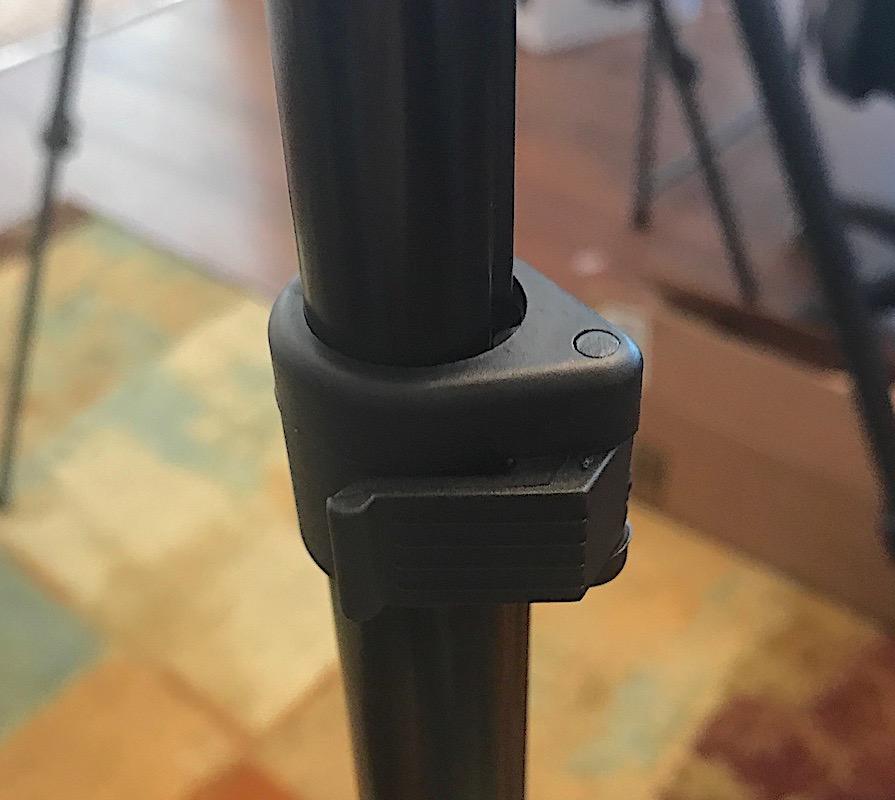
Reviewers also report thin metal construction in some units and plastic clamps that can be a failure point over time. For occasional use, that is an acceptable trade. For daily commercial work, the two picks above are the smarter long-term investment.
What you should check before buying this stand
Add up your actual load before you order. Write down the weight of the light and the weight of the modifier separately, then total it. If the answer is above 6 pounds, the 11 pound rating leaves you less than the 70 to 80 percent working margin that most experienced shooters use, and you should move up a tier.
Decide whether the backlight role is real in your setup. If it is, 7 feet is a tight ceiling for a hair light and you may regret the height later. If your third light is only ever aimed at a backdrop, this height is generous.
Who should look elsewhere
Look elsewhere if you shoot outdoors or in any space with moving air. Reviews specifically flag unsuitability for outdoor wind use without sandbags, and a home studio owner who also does location work needs a stand that can take weight on a hanging modifier without walking across the frame.
Look elsewhere if you have heavy strobes and intend to grow into them. The K&F CONCEPT model further down this list gives you 17.6 pounds in a taller, single-unit package for a similar outlay, and that headroom is what a growing studio eventually needs.
4. NEEWER ST210 Aluminum Alloy Light Stand, 7ft (2 Pieces)
NEEWER Photography Light Stand, 7 Feet / 210cm Aluminum Alloy (2 Pieces)
Max 83 in
Min 28.3 in
Load 5.5 lb
Aluminum
Two stands
3.7 lb each
Pros
- Compact 29 inch folded length suits small storage
- solid locking capabilities reviewers highlight
- 4.6 rating across 1398 reviews
- sold as a matched pair
Cons
- 5.5 lb load rating is the lowest here
- no spring or air cushioning at all
- larger softboxes will need sandbags
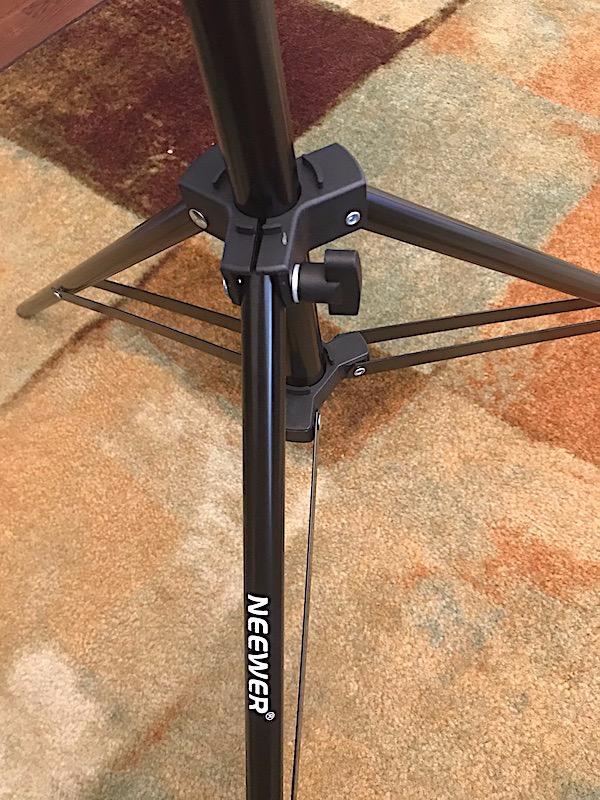
The ST210 sits at rank three in its category and has 1,398 reviews at 4.6, so the volume of real-world use behind it is significant. It is a clean, simple aluminum stand with solid locking capabilities, adjustable from 72 cm to 210 cm, folding to just over 29 inches. For a small room where storage is the binding constraint, that folded length is a genuine advantage over the 8.5 foot and 9 foot models.
What we like is the restraint of the design. There is no cushioning, which means no mechanism to fail, and for lights under 5 pounds that is a reasonable simplification. Solid locking capabilities are the point on a lightweight stand, and reviewers consistently single them out as the feature that keeps a light secure.
What we do not like is the 5.5 pound rating, which is the lowest in this roundup. Applying the 70 to 80 percent working rule, that is a 4 to 4.4 pound effective load. A speedlight, a reflector, a small softbox or a ring light fits inside that. A strobe with a modifier does not, and reviewers are explicit that sandbags are needed for larger softboxes.
At 3.7 pounds per stand, this is the second-lightest pair here and the easiest to move around a room while you relight. For a two-light setup where both lights are LED panels, this does everything the job asks and stores in a cupboard when you are done.
A useful detail: this model is listed in a wide range of lengths, from 195 cm single units to 280 cm two-packs and a 260 cm version with reversible legs. That matters if your ceiling is unusual, because the same mounting standard means you can change length later without changing anything else in your kit.
Where a pair like this fits in a home studio plan is as the background light and the fill, while a heavier stand handles the key. Mixing heights is normal practice and costs nothing, and a light background stand does not need the same capacity as a key light carrying a modifier.
One caution on cushioning. Without it, a caught clamp drops the load immediately. That is survivable with a 3 pound LED panel and expensive with anything else, which is why we would not put a strobe on this stand regardless of what the stand is rated for.
What you should check before buying this stand
Check total load including the modifier, and be honest about whether you will add a heavier light within a year. Many people buy a stand to fit the light they have and then upgrade the light first, which leaves a much more expensive stand looking underused. If you already know a monolight is coming, buy for that.
Check the storage question honestly. The folded length here is close to 29 inches, so a pair fits in a standard cupboard or behind a door. If your room has no storage at all and everything must live in the shooting space, that advantage disappears.
Who should look elsewhere
Look elsewhere if you plan to hang anything with meaningful wind sail, such as a large softbox or a flag. Without cushioning and with a 5.5 pound ceiling on the rating, this is an indoor stand for small indoor loads, and treating it as anything else ends with a bent column or a dropped light.
Look elsewhere if you need a backlight above 7 feet. The height is fixed at 83 inches, so in a tall room you will be pointing a background light where you wanted a hair light. That is a real limitation and no amount of sandbagging fixes it.
5. K&F CONCEPT KF34.043 Light Stand, 9.1ft Extendable Tripod
K&F CONCEPT Light Stand for Photography, 9.1ft/2.8M Extendable Tripod
Max 9.1 ft
Min 2.6 ft
Load 17.6 lb
Metal
Tripod base
3.84 lb
Pros
- 17.6 lb load at 9.1 ft
- tripod base extension bar and non-slip feet widen the footprint
- 180-degree adjustable head
- 4.7 rating across 323 reviews
Cons
- Plastic clamps are the reported weak point
- does not fold as compactly as 7 ft models
- warranty listed as 1 year in specs and 2 years in features
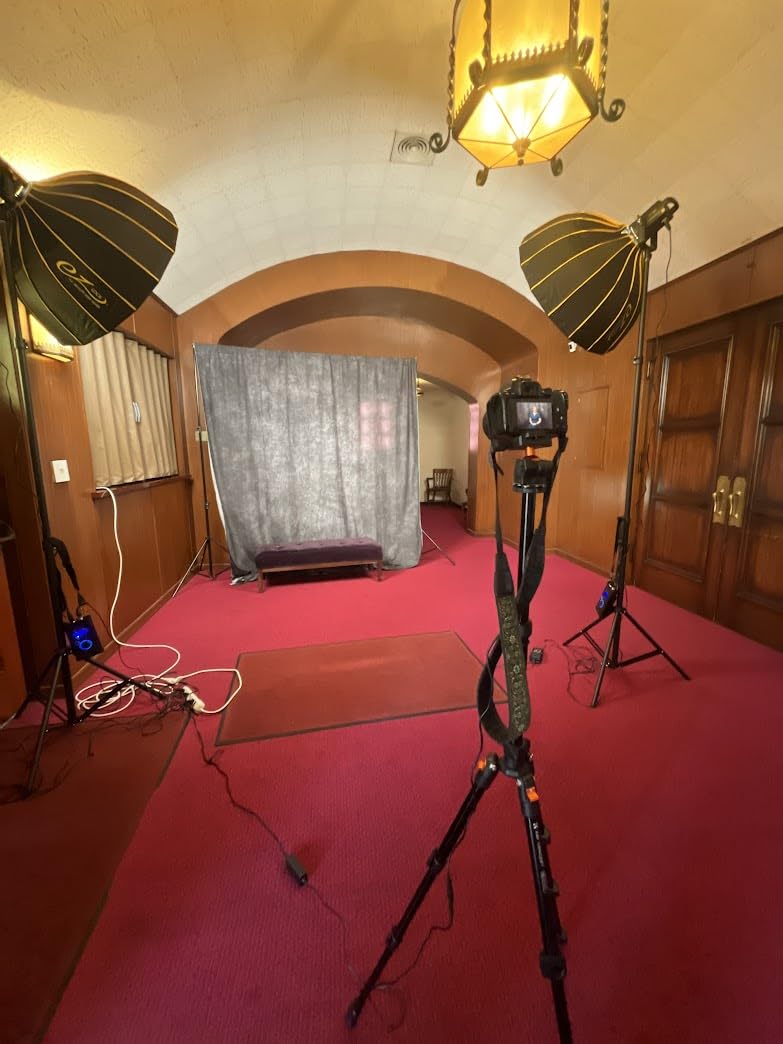
At 4.7 across 323 reviews, this is one of the best-rated stands in the roundup, and the reason is a spec combination that is hard to find elsewhere: 9.1 feet of height carrying 17.6 pounds. Most tall budget stands give you one or the other. Reviewers specifically praise the stability that comes from the tripod base extension bar and the non-slip feet, and those are leg-radius and foot-radius variables, which is exactly the stability variable forum users call the most important.
The base design is the story. A tripod base with an extension bar spreads the feet wider than a plain three-leg stand, and a wider spread resists tipping under an off-centre load like a softbox pulled to one side of the column. In a small room, that extra width is a cost in floor space, and it is a cost worth paying when a light sits out over a table.
All-metal connecting parts are cited as a durability strength, and the standard 1/4 inch screw stud with a 180-degree adjustable angle gives you enough head movement for key, fill and backlight positions without swapping mounts. Item weight is 3.84 pounds, so despite being tall it is not a burden to reposition.
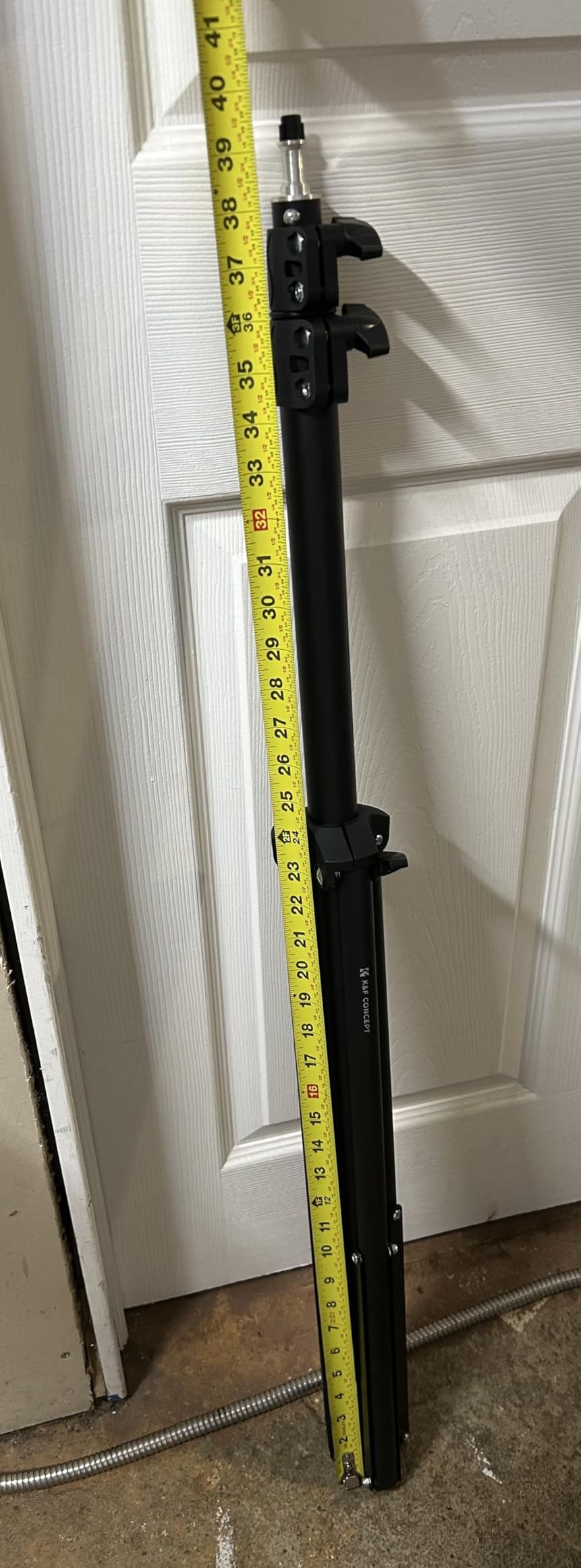
The height range of 80 cm to 280 cm covers a hair light in a tall room and a low key light near the floor. Note that this reach is only useful above roughly 7 foot ceilings; below that, the top section stays down and you get the same usable height as a shorter stand.
Two honest notes on the specification, because a roundup that ignores contradictions is not a roundup you can trust. The warranty appears as one year in the product specifications and two years in the feature list. We have not resolved which is current, so plan on one year. Separately, the material is listed simply as metal, which is accurate but uninformative; do not assume it is stainless.
Where this stand separates from the field is the height-to-capacity pairing. In a room where the ceiling genuinely allows a 9 foot reach, this lets you put a light overhead without derating into a dangerous load. That combination is normally the province of steel stands costing far more, and the 17.6 pound figure means a strobe and a large softbox are within scope with the 70 to 80 percent rule applied.
On floor planning, this is the model to measure carefully. A tripod base with an extension bar occupies noticeably more space than a compact pair, so in a 10 by 10 foot room you want to place it before the furniture, not after. The other two light positions then have to work around it.
What you should check before buying this stand
Measure ceiling height and subtract 6 inches of usable reach. If your ceiling is 8 feet, this stand does nothing for you that the 7.2 foot model does not. If it is 9.5 feet or more, this is one of the strongest picks in the list for a back or hair light.
Measure your floor. The extension bar that makes it stable is the same element that makes it awkward in a tight room. A 10 by 10 foot space handles it comfortably; an 8 by 8 foot space with a desk in one corner is a squeeze.
Who should look elsewhere
Look elsewhere if you are buying for a compact or low-ceiling room. You would be paying for reach you cannot use, and the plastic clamp concern is a better thing to avoid entirely at this point in the list.
Look elsewhere if you need a matched pair on a strict budget for a growing setup. A single unit here plus a budget pair elsewhere gives you two different clamp qualities, and mixed clamp quality across a kit is annoying in practice. If you want two of these, buy two.
6. Godox 290F Heavy Duty Aluminum Light Stand, 112 Inches
Godox Heavy Duty Aluminum Photography Light Tripod Stand for Studio Photography Lighting, Backgrounds, Monolights, Strobe Flash – 286CM, 112 Inches
Max 112 in
Folds 43 in
Load 5-10 kg
Aluminum
1/4 to 3/8 in adapter
5.16 lb
Pros
- Tallest reach in the roundup at 112 inches
- aluminum build at only 5.16 lb per stand
- three outward-angled legs for a stable base
- carrying case included
Cons
- Load capacity is listed as 5 kg in specs and 10 kg in features
- no rubber feet so it can slide on smooth floors
- some Godox SL60 lights need an adapter
The Godox 290F is the tallest stand here at 112 inches, folded down to 110 cm, and it weighs only 2.34 kg. For a home studio with a genuinely tall ceiling, that combination is unusual: most tall stands are steel and heavy, and this one is aluminum and light. It is also the only stand in the list from a brand whose lighting gear you may already own.
Build is aluminum with three outward-angled legs, which is the leg arrangement forum users treat as the stability baseline. The top mount converts from a 1/4 inch screw to a 3/8 inch tip, so it covers strobes, standard stay-on lights and backgrounds. A carrying case is included, which matters more for a 43 inch folded package than for a 29 inch one.
Now the part that gives us pause, and you should know it before buying. The load capacity is listed as 5 kg in the product specifications and 10 kg in the feature description. That is a factor of two, and it is not a rounding difference. Until the manufacturer resolves it, treat 5 kg, or 11 pounds, as the working figure.
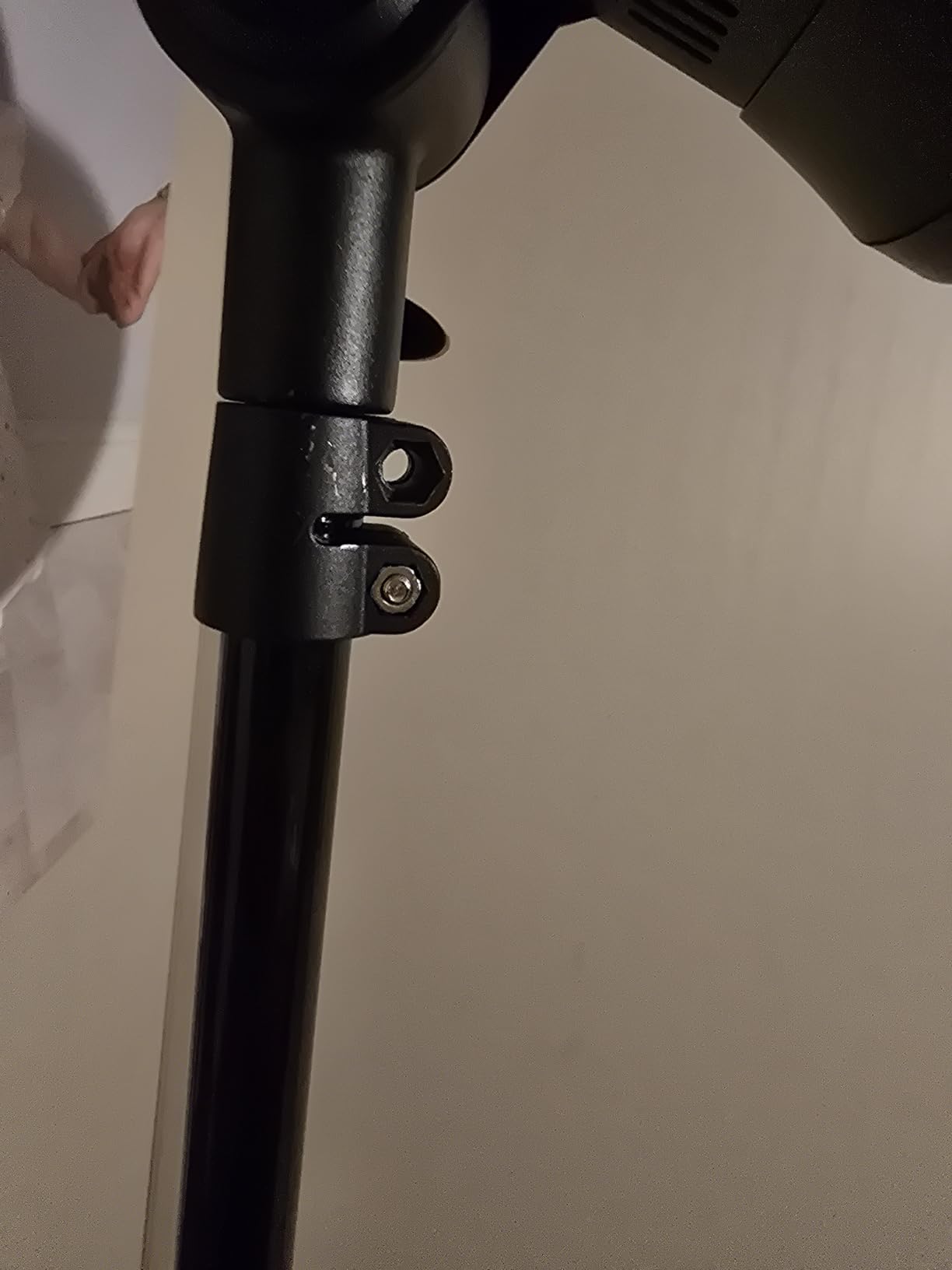
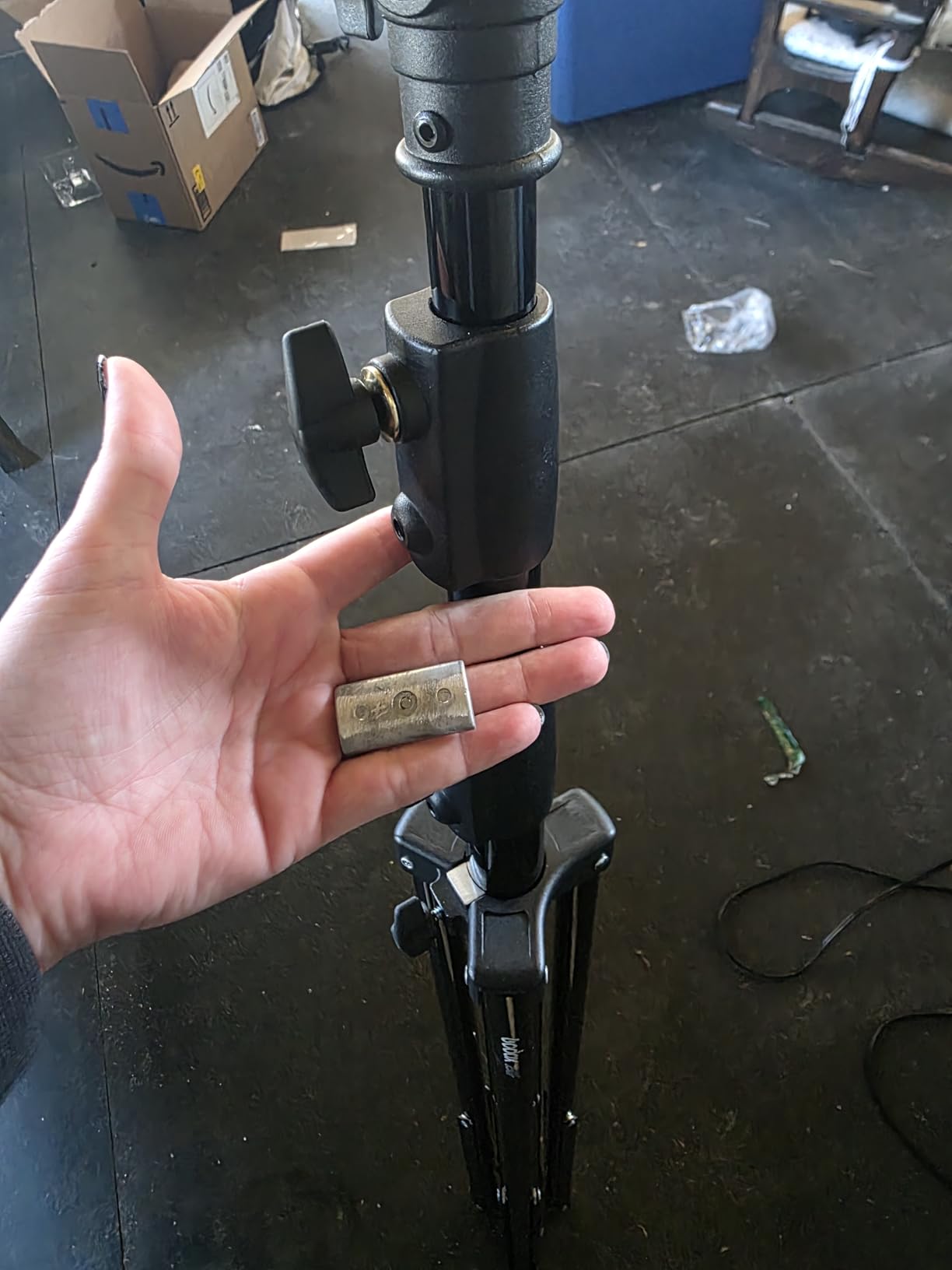
The other two concerns are physical. There are no rubber feet, and reviews report sliding on smooth floors, which matters if your studio is laminate or vinyl rather than carpet. One user also reported a flimsy feel at full extension, which is what a thin upper section at 9 feet tends to feel like.
Compatibility deserves a note. Owners report that some Godox lights, specifically SL60 and SL60IID models, do not mount without an adapter. If your lights are already Godox, check the mount before ordering. If you are buying a light at the same time, choose a light with a standard 1/4 inch or 3/8 inch stud and the problem disappears.
The honest framing on the 112 inch reach is that most of it is unusable in a domestic room. A 112 inch stand is a 9 foot 4 inch column, and if your ceiling is 8 feet you will never extend the top section past a few inches. The height only pays off in a room with a 10 foot ceiling or a warehouse conversion, which is a genuine possibility for a home studio but worth measuring honestly before you buy on it.
Reviewers also describe the stand as top-heavy with a light and softbox attached, which is a direct function of the length. If you do buy it, keep it at a working height where the modifier is manageable, and treat the top of the extension as reserved for backgrounds rather than modifiers.
What you should check before buying this stand
Check your ceiling twice: once for height and once for what is up there. A tall stand extending near a ceiling can catch a light fitting, a curtain rail or a ceiling fan. The margin people forget is the space above the top of the stand, not the room height.
Check your floor surface. Without rubber feet, this model needs a carpeted or grippy surface and a sandbag on the base. On smooth laminate, both the reviewer reports and basic physics point the same way.
Who should look elsewhere
Look elsewhere if your ceiling is under 9 feet. You will be paying for extension you cannot use, and the same money in a 7 to 8.5 foot model gives you better rigidity at working height.
Look elsewhere if you already own Godox SL60 or SL60IID lights and want a zero-adapter setup. The mount mismatch is a small problem to solve, but it is solvable, and paying for a stand that needs a workaround on day one is a poor start.
7. SmallRig RA-S280 9.2ft Light Stand with Boom Arm
SmallRig 9.2ft Light Stand with Boom Arm, Photography Lighting Tripod
Max 9.2 ft
Min 3.1 ft
Air cushioned
Boom arm
6.6 lb
Pros
- Only stand here with an integrated extendable boom arm
- air cushioned for smooth controlled descent
- 1.2 m leg spread with a 2.66 mm base support bar
- highest rating in the roundup at 4.8
Cons
- Load rating is modest for the build quality
- 6.6 lb per stand is the heaviest here
- boom arm adjustment knob reported fragile by one user
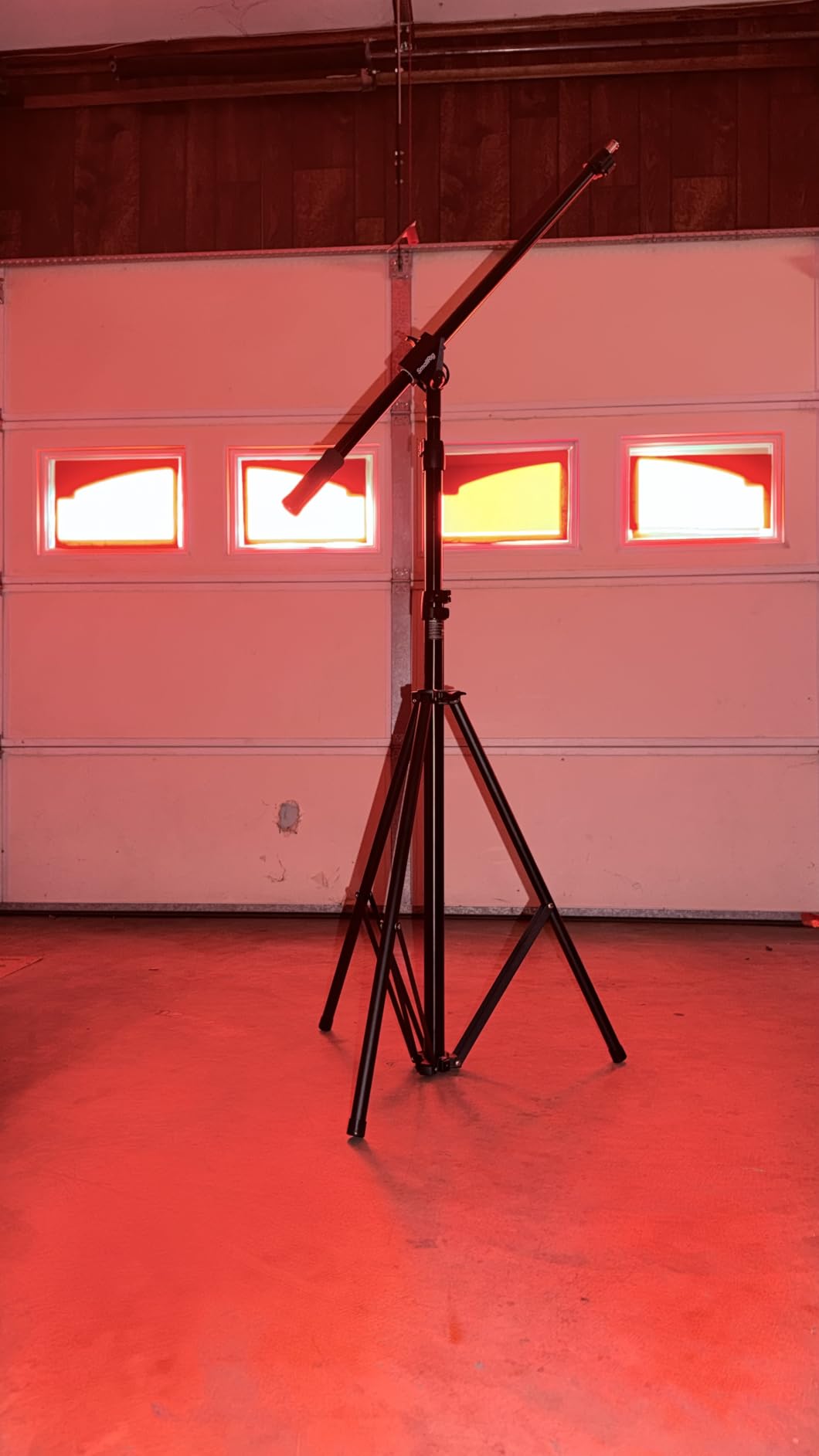
At 4.8 across 358 reviews, this is the highest-rated product in the roundup, and the boom arm is the reason. Every other stand here is a straight column. This one adds an extendable arm with a 180 degree pivot and swivel, separate tilt, pan and arm locking knobs, and a 1/4 inch thread adapter on the boom as well as the stand. In a small room, that is a genuinely different tool rather than a taller version of the same thing.
Air cushioning is the other headline feature. Where a spring stand uses a buffer at the clamp, an air-cushioned riser slows the entire descent of the section, which is the version that protects a heavy strobe from a full-height drop. Owners consistently praise the all-metal build, with aluminum alloy legs and an iron base support bar measuring 2.66 mm thick.
Stability is engineered in through geometry rather than mass. The leg spread reaches 1.2 m, and anti-slip nylon feet keep the base planted. Height runs from 94 cm to 280 cm, folding to 94 cm, and there is a two-year manufacturer warranty behind it. Very few budget stands offer a two-year warranty; that alone is a signal about the brand’s confidence in the hardware.
The listed load rating is the one figure that looks out of step with the rest of the spec sheet. For a build this substantial, users reasonably expected more. In practice it still covers a strobe with a softbox, which is what most home studios actually run, but it is not generous headroom for a heavy monolight with a large modifier.
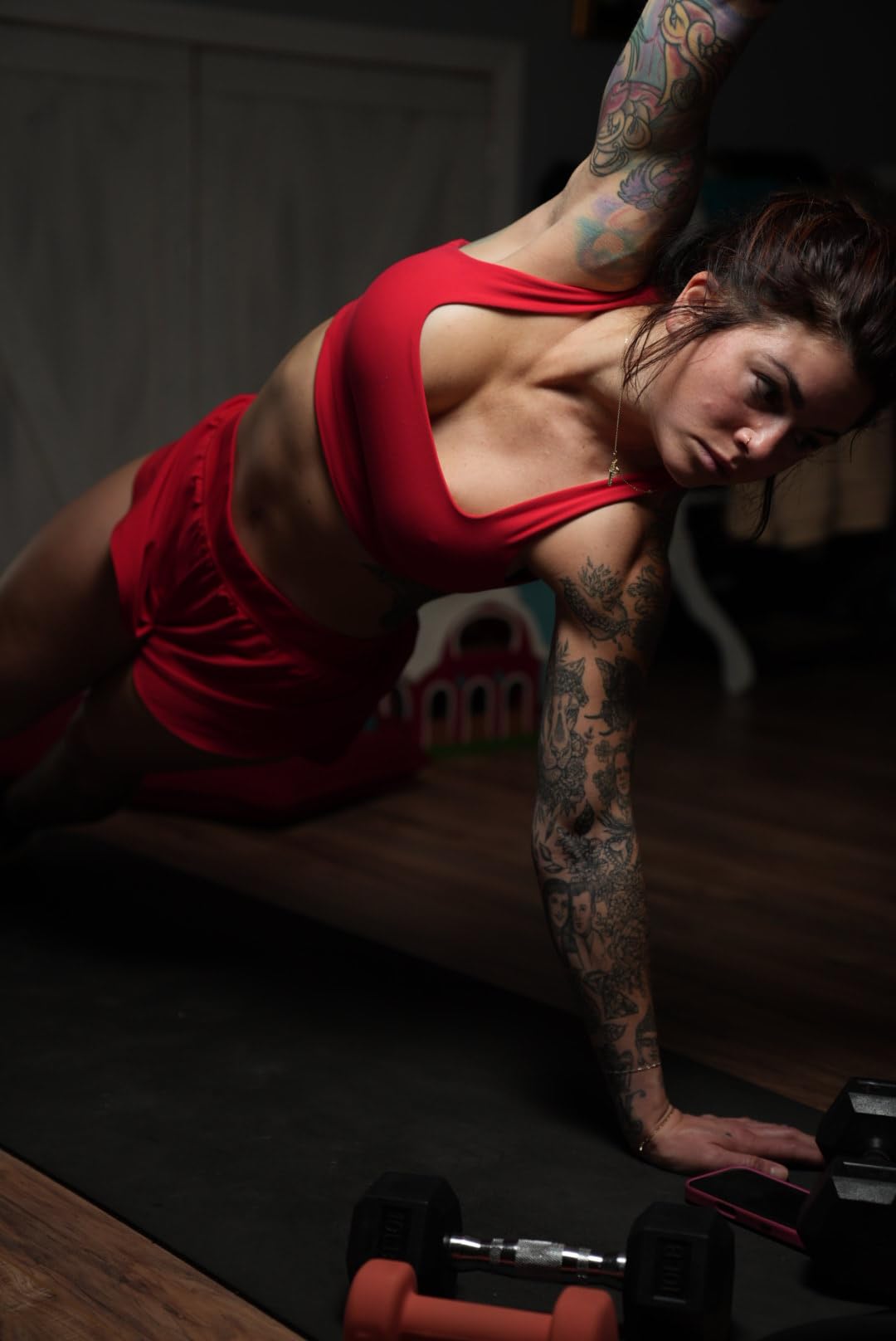
A boom arm changes what a stand can do in a room with furniture in the way. Instead of positioning the stand itself, you can keep the base tucked into a corner behind a sofa and reach the light out over a subject. In a 10 by 10 foot room that is the difference between a workable layout and a furniture-moving session.
It also means one stand can cover two jobs at different times. The column handles a key light at 6 feet, then the arm swings to bring a second light in close for a product detail shot. For a one-person studio that is a real efficiency gain, and it is why this stand sits at the premium end of our list.
On stability, a 1.2 m leg spread is the widest base measurement in the roundup, and leg length is the variable experienced shooters consistently identify as the primary stability factor. The trade-off is obvious: the base is wide, so this is the most floor space any single stand here will demand. Plan its position before you move the furniture.
What you should check before buying this stand
Check whether you actually need a boom before paying for the privilege. If your lights only ever point at a wall from a fixed spot, a plain column at this height is cheaper and narrower. The boom earns its cost when you need to reach around furniture or above a subject without repositioning the stand.
Check the 6.6 lb weight if you plan to move the setup regularly. This is the heaviest stand in the roundup, and the forum view that in a fixed location weight is barely relevant applies. If your studio is not fixed, this is the wrong end of the trade.
Who should look elsewhere
Look elsewhere if you need to hang a heavy monolight on the arm. A boom puts extra turning force on whatever the column already carries, and the effective capacity at full arm extension is lower than the stand’s own rating. The rated number on a boom arm is not the number that matters.
Look elsewhere on budget grounds if two straightforward columns would serve you. Two stands at the top of this list will build a proper three-point setup and still cost less than one of these plus a second. Buy this one when you specifically need the reach, not as a default.
8. NEEWER ST-300AC 9.8ft Air Cushioned Heavy Duty Stand
NEEWER 9.8ft/3m Air Cushioned Light Stand, Heavy Duty Metal
Max 9.8 ft
Min 3.5 ft
Load 5.5 lb
4 sections
Air cushioned
4.1 lb
Pros
- Reaches 9.8 ft at only 4.1 lb per stand
- air cushioned riser with metal locking knobs
- reversible 1/4 to 3/8 inch adapter with 3-way mounting
- rubber feet protect the floor
Cons
- 5.5 lb rating is low for a stand labelled heavy duty
- rubber feet can lack grip on very smooth floors
- 4-section column has more flex than 3-section designs
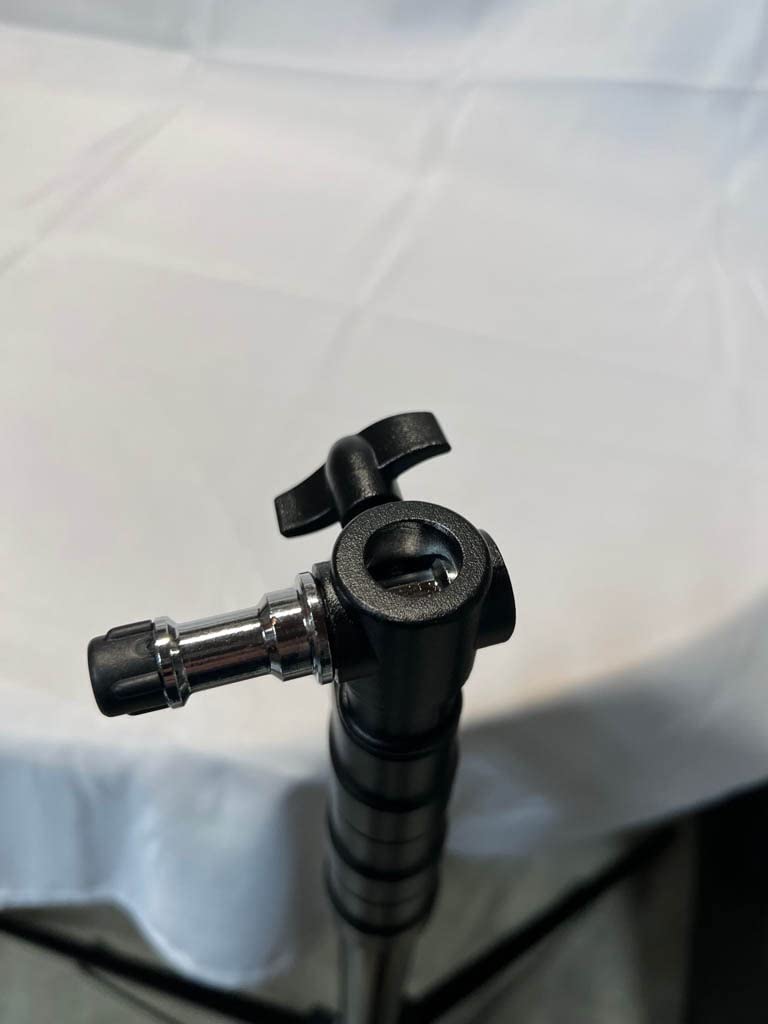
Reaching 9.8 feet at 4.1 pounds is an impressive ratio, and air cushioning on a stand this light is unusual. The ST-300AC uses a four-section telescopic column running from 3.5 to 9.8 feet, folds to about 3 feet, and has metal locking knobs rather than the plastic hardware that limits cheaper stands.
The reversible 1/4 inch to 3/8 inch adapter and three-way mounting interface let you run the light perpendicular or horizontal to the column, which is how you get a proper backlight angle without an awkward bracket. The compatible list covers cameras, DSLRs, mirrorless bodies, ring lights, LED panel lights and microphones, so this is as much a video stand as a photography one.
Here is the tension in this product. It is marketed as heavy duty, it is 9.8 feet tall, and it is rated at 5.5 pounds. Owners notice the same mismatch we did. In practice that makes it a stand for lightweight LED panels, ring lights and cameras, not for strobes with modifiers, and a reviewer summary would rather you knew that up front.
Rubber feet are a genuine plus in a domestic space because they stop the base marking a wooden floor, which plastic feet on a tripod can do over time. They also add stability. The related variant list includes 260 cm, 280 cm, 400 cm air cushioned and a 300 cm spring cushioned version, so the family covers most ceiling heights.
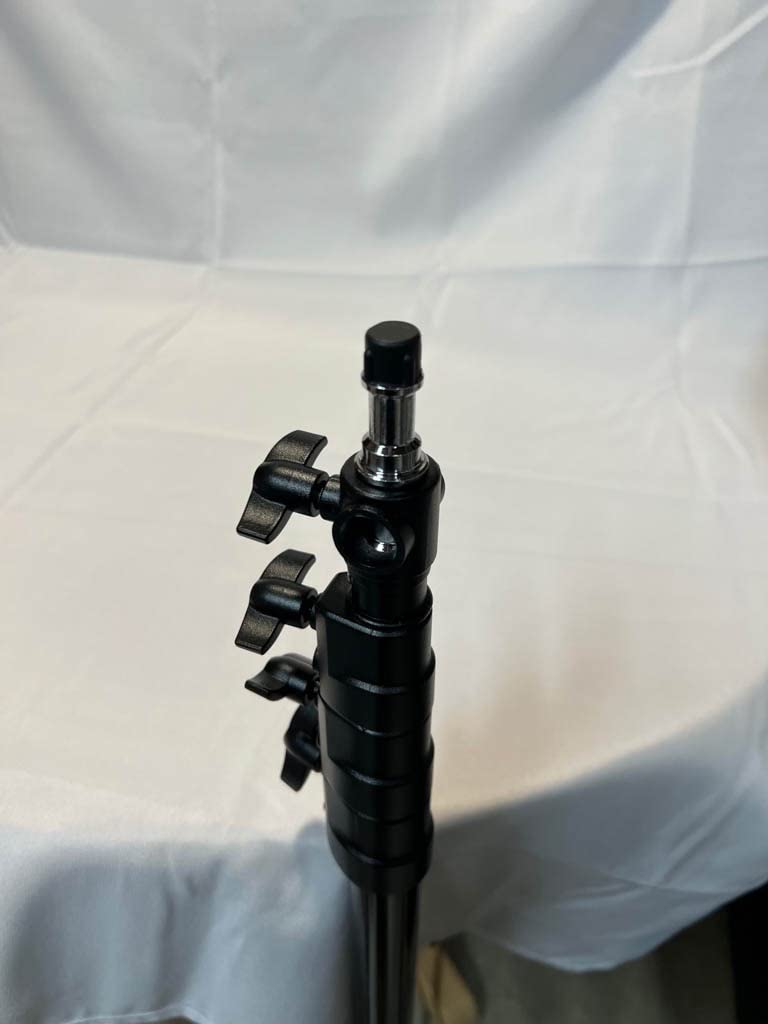
One structural point worth understanding. More sections in a column means more joints, and each joint is a place for flex. A four-section design at full extension is measurably less rigid than a three-section design at the same height, which is why some reviewers specifically flag the extra flex. If you need the full 9.8 feet routinely, a three-section stand with a higher capacity is the more stable choice.
The air cushion is still worth having. It slows the descent across the whole column rather than just cushioning one clamp, and that is the protection you want if you are raising a tall stand loaded with anything you would be unhappy to see fall. For a video creator raising a panel over a desk, that is exactly the use case.
On minimum height, 3.5 feet is the highest floor in this roundup, which makes this the least suitable for tabletop product work of the tall models. The 106 cm minimum is fine for a small panel near a subject but will not get a light down to a keyboard-level product shot.
What you should check before buying this stand
Check the weight of the light you already own, and be precise rather than optimistic. If the number is under 4 pounds you are inside the 70 to 80 percent working margin. If it is 5.5 pounds you are at the rating itself, with no margin, and the thin upper sections will tell you about it.
Check whether you will actually need 9.8 feet. A 9 foot ceiling gives you useful reach with any of the tall stands here, and the extra 10 inches of this model rarely changes a lighting outcome while it does add a fourth joint to the column.
Who should look elsewhere
Look elsewhere if you shoot strobes with modifiers, which is the most common home studio use after video. The rating is the reason, and no amount of careful weight distribution changes it. The stainless picks earlier in this list were built for that job.
Look elsewhere if you need a low minimum height for tabletop work. At 3.5 feet the column cannot come down far enough, and you would end up craning over a low table rather than lighting it.
9. K&F CONCEPT JPKF34.044 Stainless Steel Light Stand, 9.2ft
K&F CONCEPT Stainless Steel Light Stand 9.2ft/2.8m, Spring Cushioned
Max 9.2 ft
Min 3.0 ft
Load 22 lb
Stainless steel
Spring cushioned
5.31 lb
Pros
- 22 lb load at 9.2 ft in full stainless steel
- four-section column with heavy tube diameter that stays stable at height
- dual 1/4 and 3/8 inch threading with 3-way mounting
- beveled feet
Cons
- A few reports of machining fitment issues
- legs can feel cheaper than the center post
- least compact of the tall models at roughly 100 cm folded
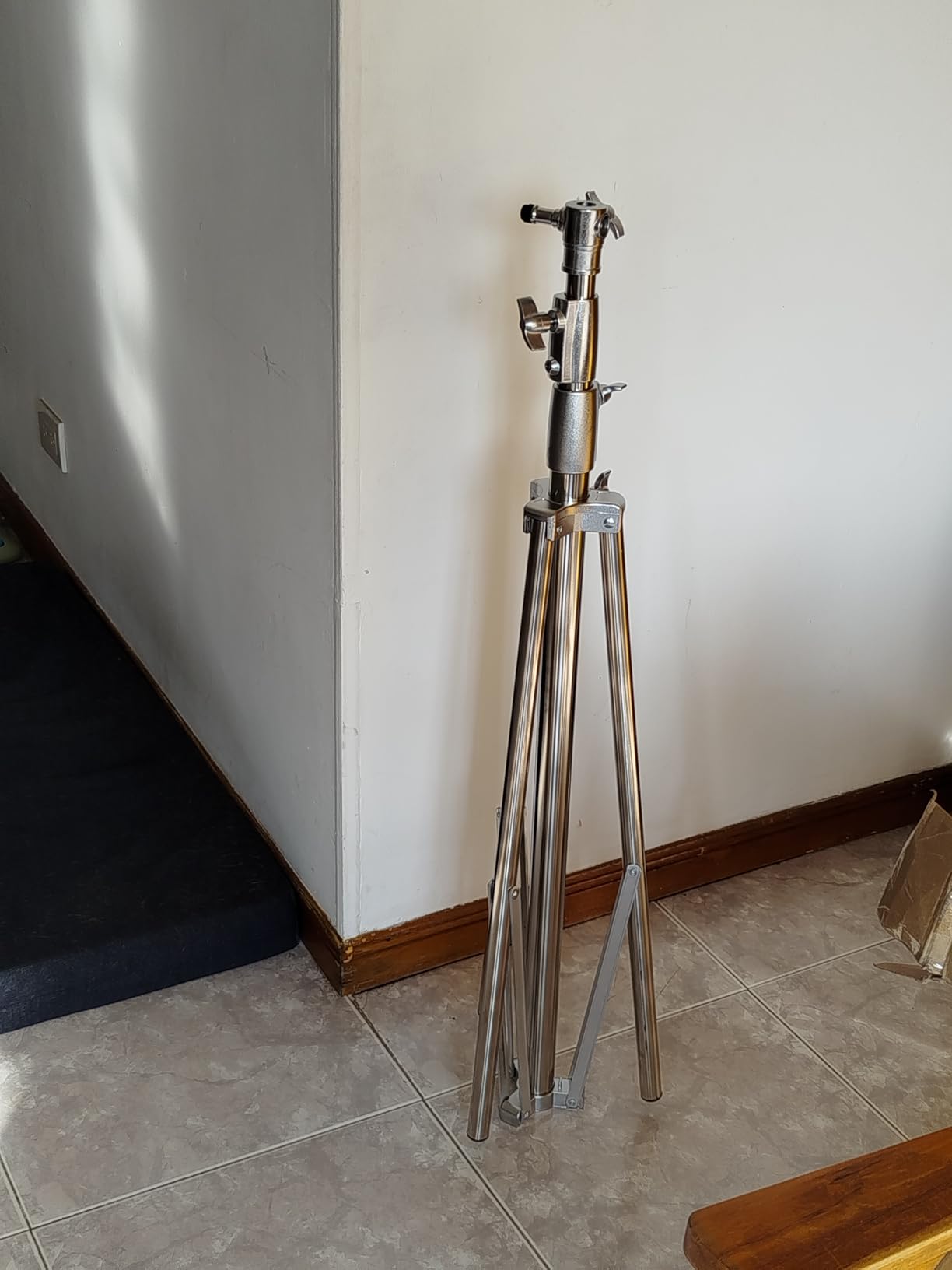
This is the stand for a home studio that has outgrown budget aluminium. Stainless steel, 22 pounds of rated load, and a four-section column that runs from 3 feet to 9.2 feet. Reviewers repeatedly single out the tube diameter as the reason it stays stable even at full height and in light wind, which is the derated-load problem most tall stands suffer from.
That combination of height and capacity is the one that matters when a modifier is the heaviest thing in the frame. A 9 foot stand rated at 5.5 pounds is a stand for a bare light. This one is rated for a strobe, a softbox and some spare headroom, and the spring cushion adds the drop protection that a bare column lacks.
Mounting is flexible, with a reversible 1/4 inch to 3/8 inch adapter and three-way bracket for perpendicular or horizontal positioning, and the compatible list covers LED video lights, ring lights, strobes, softboxes and reflectors. Beveled feet are listed for stability on uneven surfaces, which is a bonus if your floor is anything other than flat.
At 5.31 pounds it is not the heaviest stand here, but the folded length of roughly 100 cm is among the longest, and that is a real consideration in a small room where stands may live behind a door rather than in a cupboard.
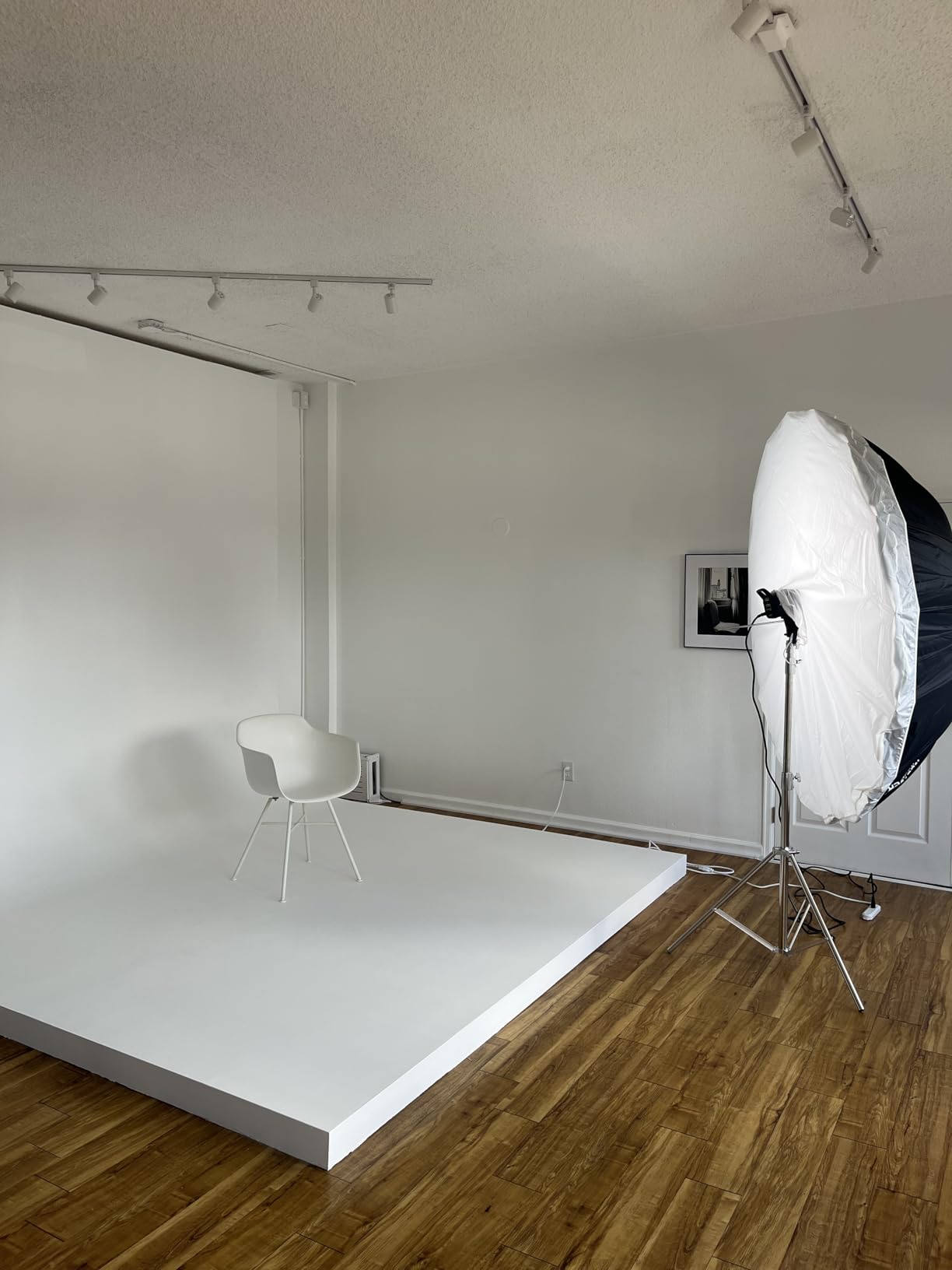
Be careful about relative claims here. The EMART 8.5 foot stand also lists a 22 pound rating, and this one is shorter at 9.2 feet. What separates them is material and section design rather than the headline number: a stainless column with heavy tube walls resists bending under an off-centre load in a way a thinner aluminium section does not, which is the failure mode that actually brings stands down.
The product launched in August 2024, so the 186-review record is short compared with the thousands behind the NEEWER models. That is a reason to hold expectations on long-term durability, and it is worth weighing if you are buying this as a buy-once purchase. The alternative for a buy-once purchase is a used professional stand, and Matthews, Avenger and Kupo are the names that come up repeatedly in owner discussions for exactly that reason.
A few owners reported machining and fitment issues where parts did not seat cleanly, though the same reviewers still rated them highly. Treat a stand like this as something to assemble and shake test once before a paid session, rather than assuming the first setup is the final one.
What you should check before buying this stand
Check the folded length against your storage. At roughly 100 cm folded, this is a long object to keep in a small room, and stands that live behind furniture get moved more often than stands in a cupboard. If storage is tight, the 7.2 foot stainless model earlier in this list is more practical at the same material and rating.
Check your height requirement. The 9.2 foot reach only helps above about 7.5 foot ceilings. Below that, you are carrying 4 pounds of extra steel for reach you cannot use, though the rigidity at working height is a genuine benefit in itself.
Who should look elsewhere
Look elsewhere if you want a matched pair. This is a single unit, and buying two gives you two separate manufacturing runs. For a key and fill pair, a matched two-pack is more consistent.
Look elsewhere if you are buying on a very tight budget. There is no cushioning-free bargain here, and while the rating justifies the outlay, the money is better spent on one excellent stand and one adequate one than on two compromises if your budget is the constraint.
10. Anautin YF-ST221 2-Pack 7ft Adjustable Light Stands
Anautin 2 Pack Adjustable 7ft Aluminum Photography Light Stand, Portable Light Tripod, for Lighting Stand Speedlight, Flash, Softbox,Strobe Light, Camera, Photographic Portrait
Max 6.9 ft
Min 2.62 ft
Two stands
Aluminum alloy
Folds 17 in
2-year warranty
Pros
- Shortest folded length in the roundup at 17 inches
- lightweight at roughly 825 g per stand
- longest warranty offered at 2 years
- adjustable from 2.62 to 6.9 ft
Cons
- Locking mechanism reported failing after 3 to 9 months as wing nuts strip
- specifications list iron while features list aluminum alloy
- lowest review count here at 175
The Anautin pair is the smallest folded package in the roundup at 17 inches, which makes it the practical answer to a real constraint: a home studio with no storage. Two stands at roughly 825 g each, adjustable from 2.62 to 6.9 feet, with a two-year warranty that is the longest any pick here offers.
That warranty is the headline and the problem. Two years is a strong signal, but a 175-review record is the thinnest evidence base in the list, and the specific complaint that recurs is a locking mechanism that fails after three to nine months as the wing nuts and bolts strip. That is a component failure on the part of the stand that matters most.
Specification honesty problem too. The product details list the material as iron while the feature list says aluminium alloy. We have not resolved which is current, and the difference is significant enough that you should hold both possibilities in mind when judging the build.
What it does well is the low minimum height of 2.62 feet, which combined with the 17 inch fold makes it genuinely good for tabletop work. Owners also use these for VR trackers, content creation and basic lighting, where a light, short, frequently moved stand is the right shape.
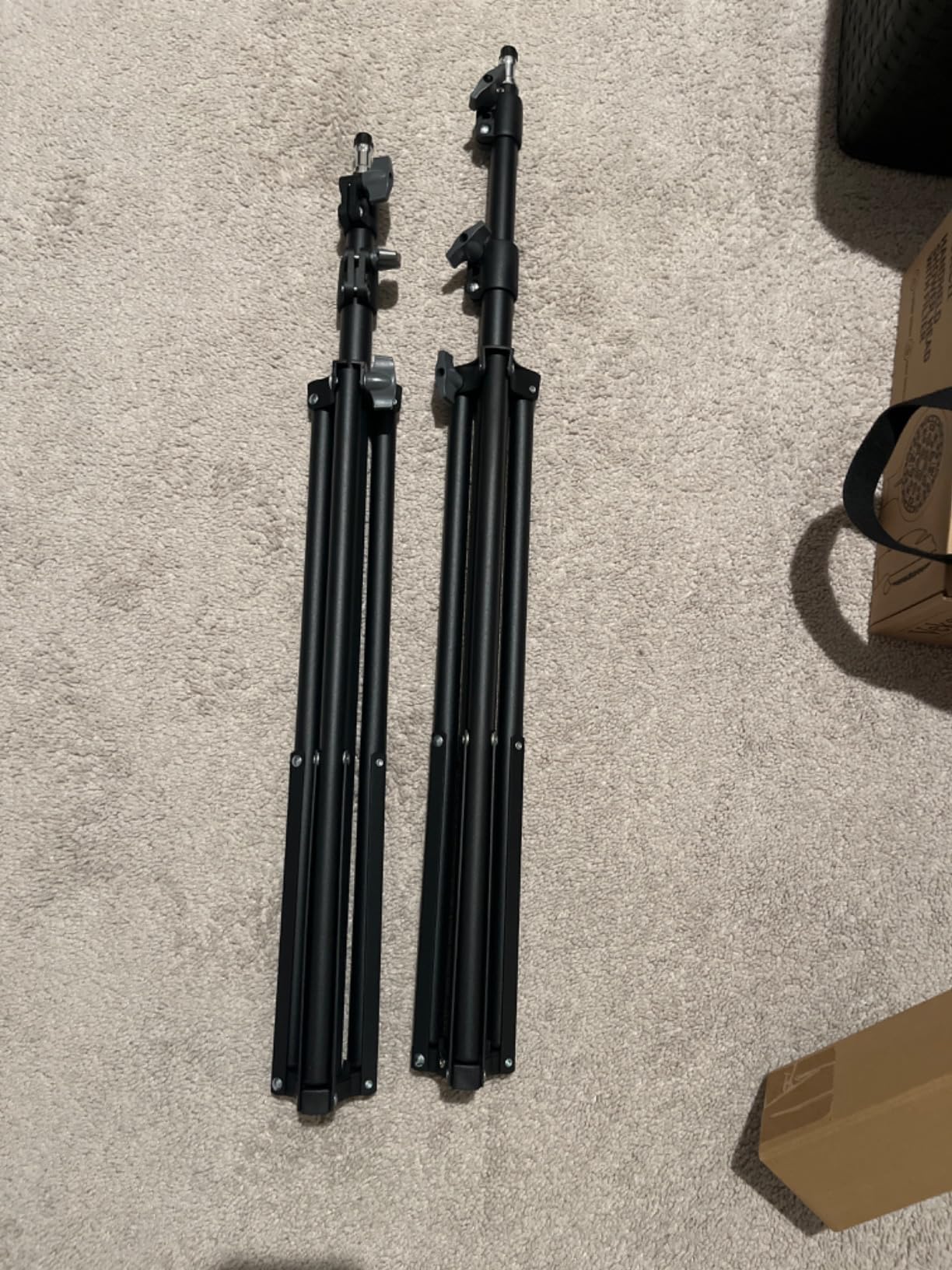
How we would use it: as the background and fill pair, or as a spare pair kept for occasional work, rather than as the stands carrying a strobe and a softbox. The failures reported are in the clamps at working height, and the role you do not want to lose mid-session is the key light.
There is a forum practice worth adopting here, and this product makes it affordable. Owner consensus is to keep one cheap reserve stand so a stripped clamp never ends a session. A short, light two-pack is the most sensible form for that reserve, precisely because it is not the stand you would be heartbroken to lose.
For reference, the 1.00 inch listed leg diameter is the largest figure in this roundup, though leg diameter alone does not settle stability. Leg length, foot spread and how far out the load sits from the column matter more than the width of a single tube, which is why we rank the wider-base models above this one despite the smaller rating.
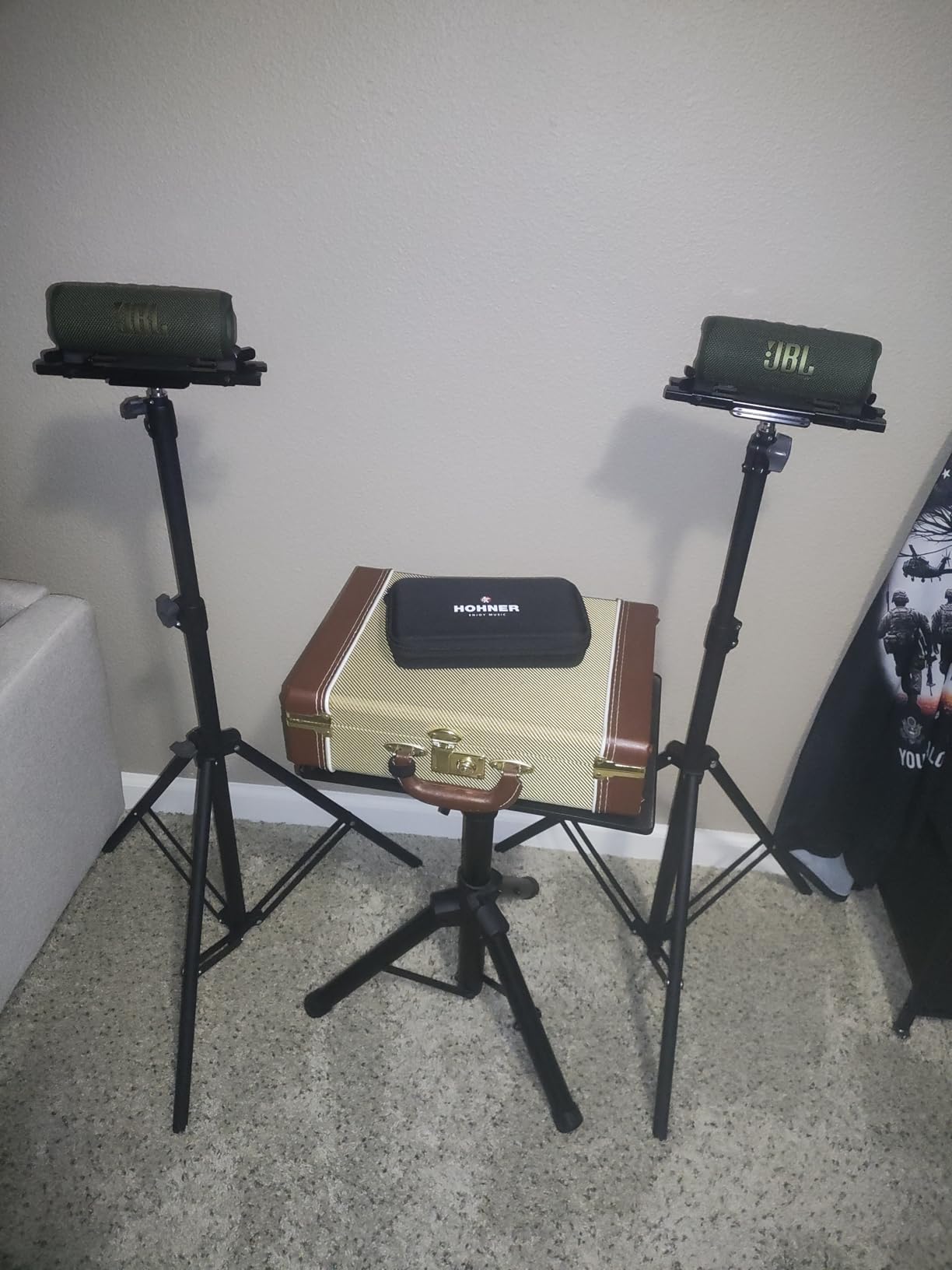
What you should check before buying this stand
Check how often you will adjust the height. These are tripod legs with screw clamps rather than a light stand’s telescoping column, so frequent height changes mean repeated tightening of the same fasteners. Owners report stripping after months of exactly that cycle, so if your workflow involves constant relighting, this is the wrong tool.
Check the two-year warranty against the 175-review history. A long warranty from a newer product is promising and unproven in equal measure, and the reported failure mode is exactly the part a warranty would cover, so the claim is worth having on paper.
Who should look elsewhere
Look elsewhere if this is your only pair and your lights are strobes. The clamp durability reports and the unspecified material mean you would be relying on a component with a documented weakness for the most expensive thing you own.
Look elsewhere if you need a backlight above 6.9 feet. In a taller room, this pair will leave you reaching and there is no way round it. For a room with 8 foot ceilings, a taller model is the better starting point.
How to Choose a Light Stand for a Home Studio
Match max height to your ceiling, minus 8 inches
The rule that saves the most money is simple: subtract at least 8 inches from your ceiling height and buy a stand that reaches roughly that number. A 9 foot stand in an 8 foot room is not a premium feature, it is money spent on a section you will never extend. Ceiling height is the single most under-considered spec for a home studio, and almost no roundup mentions it before you buy.
Size the load at twice what you intend to hang
Published capacity is the number to read, and it is not the number that applies at height. Two rules sit side by side here and they are not in conflict. The safety factor rule says size the stand at 2x your intended load, so if a strobe with a softbox comes to 6 pounds, look for 12 pounds or more. The working margin rule says use 70 to 80 percent of rated capacity, so a 22 pound stand should be treated as carrying 15 to 17 pounds. Applied together, they are the same instruction from two directions.
Capacity also falls as you extend the thinner upper sections. On some budget stands the drop with all sections extended is severe, which is why a shorter, sturdier stand at a lower working height often outperforms a taller, weaker one in the same room.
Treat leg length and leg spread as the stability variable
The most consistent owner advice across photography forums is that stability comes from leg length and base radius, not from the stand being heavy. Steve Wylie on FredMiranda makes the leg-length point explicitly, and the wide-base models in this roundup are the ones that feel planted under a modifier. A 1.2 m leg spread, as on the SmallRig, resists a tip that a 0.5 m spread cannot.
Air cushioned versus spring cushioned versus no cushioning
Air cushioning slows the whole section as it descends and is the best protection available. Spring cushioning absorbs the shock at a single clamp and is the sensible middle option. No cushioning means a caught clamp drops the load instantly, which is survivable for a 3 pound panel and expensive for anything else. A plain threaded column spring at the top of the stand is a different thing again and is a weaker substitute for either.
Aluminum or stainless steel for a fixed room
For a fixed home studio, heavier and more rigid is better, which favours stainless steel. On the other hand, steel stands are much heavier and less flexible if you also shoot on location. The correct answer for a room you never leave is steel, because in a fixed location weight is barely relevant and rigidity is everything.
Check the top mount before you order
Most stands here use a 1/4 inch screw, and several add a reversible 1/4 to 3/8 inch adapter with three-way mounting so the light can sit perpendicular or horizontal to the column. A 5/8 inch receiver is the professional standard used by C-stands and heavier grip heads. Match the mount to the light first, because an adapter workaround on day one is a bad start to a kit.
Budget for sandbags, and check whether they are included
Forum consensus is a flat yes on sandbags, with community guidance around 10 to 15 pounds for a standard light stand and 20 to 25 pounds for a C-stand with a boom at full extension. The trap is buying a stand that arrives with no sandbag in the box, which is true of several picks in this roundup, and finding that the one accessory everyone agrees on is missing.
Plan the floor before the furniture
In a 10 by 10 foot room, three stands with wide bases is workable if you place them first. Two lights plus a backdrop is realistic. Three wide-base stands plus a desk, a chair and a subject is where it gets tight, and a base that will not fit behind a sofa is a base you will walk around rather than use. The SmallRig boom model exists precisely because it lets one stand tuck into a corner and reach out from there.
Head to Head: NEEWER ST-220SS versus EMART 8.5ft for a Small Room
These two are the pair most readers will end up choosing between, so here is the comparison in the form it actually matters. Both are spring cushioned and both rate 22 pounds, so cushioning and headline capacity do not separate them.
The EMART is taller at 102.4 inches against 7.2 feet, it has a lower minimum of 37.8 inches against 3.2 feet, and it comes as a two-pack. The NEEWER is stainless steel against anodized aluminum, has a reversible 1/4 to 3/8 inch adapter with three-way mounting, and carries 3,382 reviews to the EMART’s 709.
For a room with a 9 foot or 10 foot ceiling, the EMART’s extra reach and matched pair make it the stronger first purchase. For a standard 8 foot ceiling, the NEEWER’s stainless rigidity and 7.2 foot height are the more sensible build, and its review volume is meaningful evidence. If your lights weigh more than 8 pounds each, take the stainless. If your lights are panels and speedlights and you need a third stand for the backdrop, take the pair.
Safety, Carpet and Pets: Notes Nobody Puts in a Roundup
A stand that tips in a home with children or pets is a real hazard, and it is one of the few areas where the cheap option is a liability rather than a saving. The mitigation is boring and effective: sandbag every stand, keep legs out of walkways, and place the light side of the stand away from doorways where a draught can catch it.
On carpet, rubber feet can sink into plush pile, which reduces effective base width and grip. The fix is either a stand with hard beveled or nylon feet, or a thin sheet of rubber or a rug underlayer beneath each foot. On smooth laminate, the opposite applies and grippy feet matter more, which is why we flagged the missing rubber feet on the Godox model.
Finally, a floor plan. Measure the base spread of the stand you are buying and mark it on the floor with tape before you move anything in. Most home studio layout problems are solved at that moment rather than after the first session.
Frequently Asked Questions
What is the best brand of light stands?
There is no single best brand, but the tiers are clear. For value, Neewer offers the widest range and the largest review base. SmallRig and Godox cover the mid tier with better materials and longer warranties. Manfrotto, Matthews, Avenger and Kupo are the buy-once professional standards, and they are the names that come up most often in owner discussions about long-term ownership.
How many light stands does a home studio need?
Two is the practical minimum, covering a key light and a fill. Three is where setups look professional, because the third handles a backlight or hair light, which is the role that needs the most height. A fourth stand is only needed for a background light, and an LED panel with a clamp is usually a better choice for that job.
What is the 3 lighting rule?
The three-point lighting rule is key, fill and back. The key is the main light, placed about 45 degrees to one side and slightly above eye level. The fill sits opposite the key and is set dimmer to control shadow contrast. The back or hair light goes behind the subject to separate them from the background.
What are the key differences between a tripod and a light stand?
A tripod is built to carry a camera, so its head is a pan-and-tilt platform and its load rating assumes a few pounds of camera and lens. A light stand is built for lighting gear, with a threaded top mount, a taller column, a wider base and a load rating sized for strobes, panels, softboxes and reflectors. A tripod is a poor substitute for a light stand, and a light stand works acceptably as a camera tripod.
Are heavier light stands better?
In a fixed home studio, yes. If your room does not change, weight is barely relevant, and a heavier steel stand is more rigid and less likely to drift out of frame during a long take. For location work the answer reverses, because you carry the weight every time. Buy for how you shoot, not for the spec in the abstract.
Do light stands need sandbags?
Yes, and it is the one accessory most stands do not include. Community guidance is around 10 to 15 pounds for a standard light stand, and 20 to 25 pounds for a C-stand with a boom at full extension. A sandbag is the cheapest insurance against a dropped strobe and the cheapest fix for a stand that feels like it is about to topple.
How much weight should a light stand hold?
Size the stand at twice the load you intend to hang, and then work at no more than 70 to 80 percent of its rated capacity. A strobe with a softbox often comes to 6 to 10 pounds, so a stand rated at 15 to 22 pounds gives you real headroom. Remember that capacity falls as you extend the thinner upper sections of the column.
What height light stand do I need?
Subtract at least 8 inches from your ceiling height and aim for that number. A key light usually needs to reach 6 to 7 feet to sit above the subject, and a back or hair light wants as much height as the room allows. In a 7 foot room, a tall stand is wasted money, because the top section never gets extended.
Final Verdict: Best Light Stands for a Home Studio in 2026
The EMART 8.5ft spring cushioned pair is our pick for the best light stands for a home studio, because two matched stands at 8.5 feet with drop protection cover a key, a fill and a background in a standard room, and the matched pair removes the most common early frustration. If your lights are heavier than about 8 pounds each, choose the NEEWER ST-220SS in stainless for rigidity at working height, and add the K&F CONCEPT stainless model when you want that capacity at 9.2 feet.
By room, the rule is simple. In a 7 foot room, buy the 7 foot stands and ignore everything taller. In an 8 foot room, the 7.2 foot stainless or the 7 foot two-packs are ideal. In a 9 foot or 10 foot room, the 8.5 foot, 9.1 foot and 9.2 foot models all make sense, and the SmallRig boom stand earns its place if furniture is in the way. Whatever you choose, buy sandbags, mark the floor, and keep one cheap spare.
Once your stands are sorted, the rest of a home studio follows the same logic of matching the tool to the room. Our guides to studio monitors for home studios and studio monitor stands for a home studio desk cover the other half of the signal chain, and trusted studio monitor stands will help you place them without fighting the same floor space these light stands need.