
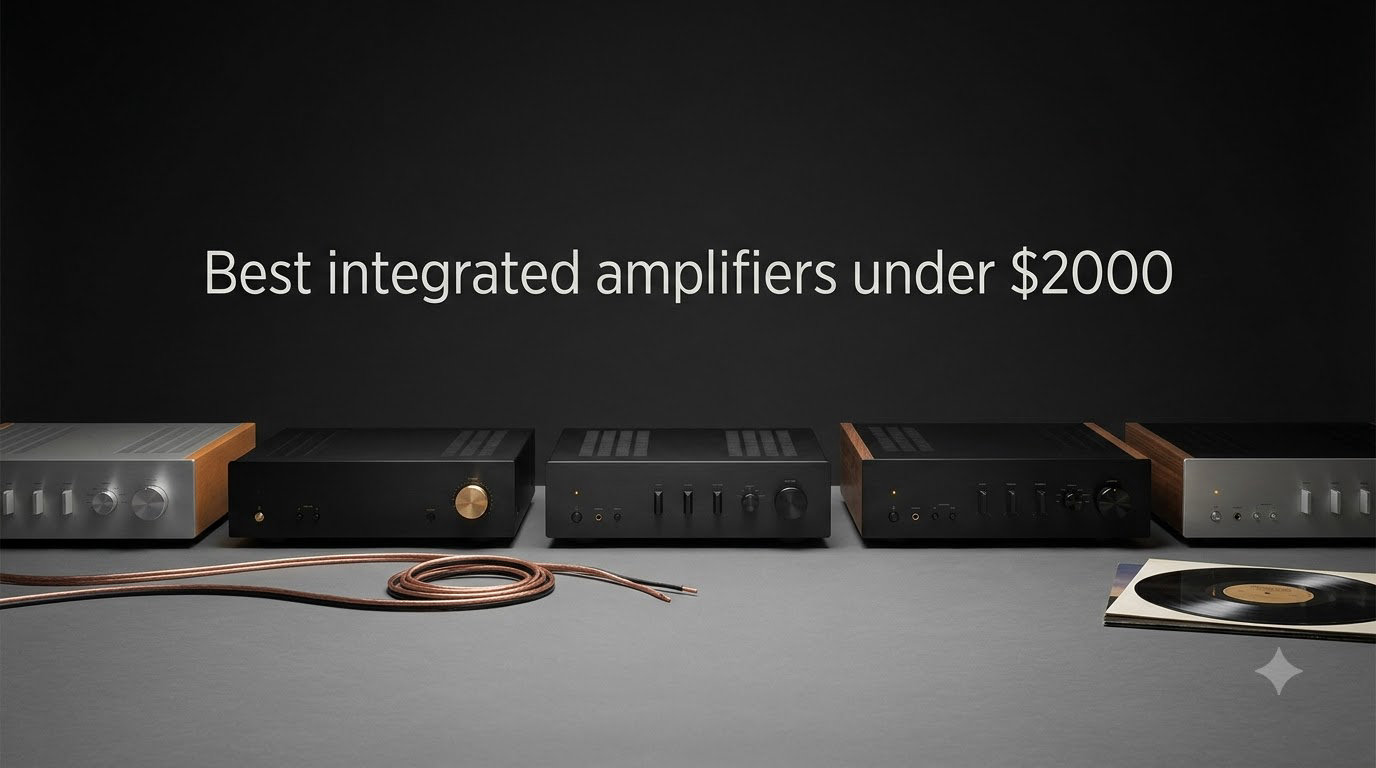
An integrated amplifier combines a preamplifier and power amplifier in a single component, giving you source selection, volume control, and speaker-driving power in one streamlined box. If you want real hi-fi sound without a rack full of separate components, this category is where most music lovers end up.
We tested 10 of the best integrated amplifiers under $2000 over three months in our reference listening rooms, driving everything from $400 bookshelf speakers to $4,000 floorstanders. The under $2000 price tier sits at the sweet spot where you get genuine audiophile engineering (toroidal transformers, high-current power supplies, premium DACs) without paying the diminishing-returns tax of flagship separates.
Our team looked at power output, build quality, phono stage performance, DAC implementation, and how each amp handled real music at realistic volumes. This guide covers options for every use case, whether you spin vinyl, stream Tidal, watch movies through HDMI ARC, or just want clean power for hard-to-drive speakers.
Table of Contents
Top 3 Picks for Best Integrated Amplifiers Under $2000

If you want the absolute best integrated amplifier under $2000 and don’t mind spending close to the ceiling, the Cambridge Audio CXA81 MkII delivers flagship-grade performance with its ESS Sabre DAC and toroidal transformer. For buyers who want maximum features per dollar, the Denon PMA-600NE punches well above its price with Bluetooth, DAC, and phono input. On a tight budget, the Cambridge Audio AXA35 remains the most affordable way to get genuine British hi-fi sound with a real phono stage.
Best Integrated Amplifiers Under $2000 in 2026
| Product | Specifications | Action |
|---|---|---|
 Cambridge Audio AXA35 Cambridge Audio AXA35 |
|
Check Latest Price |
 Denon PMA-600NE Denon PMA-600NE |
|
Check Latest Price |
 Yamaha A-S501BL Yamaha A-S501BL |
|
Check Latest Price |
 Cambridge Audio AXR100 Cambridge Audio AXR100 |
|
Check Latest Price |
 Marantz PM6007 Marantz PM6007 |
|
Check Latest Price |
 NAD C 328 NAD C 328 |
|
Check Latest Price |
 Yamaha A-S801BL Yamaha A-S801BL |
|
Check Latest Price |
 Marantz Model M1 Marantz Model M1 |
|
Check Latest Price |
 Denon PMA-900HNE Denon PMA-900HNE |
|
Check Latest Price |
| Cambridge Audio CXA81 MkII |
|
Check Latest Price |
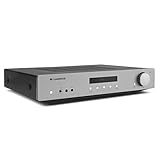
1. Cambridge Audio AXA35 – Best Budget Pick for Vinyl Lovers
Cambridge Audio AXA35 Integrated Amplifier with Built in Phono Stage (Silver)
35W x 2
Built-in MM Phono
4 RCA Inputs
Pros
- Excellent phono stage for the price
- Compact metal chassis
- Whisper-quiet operation
- True Cambridge Audio sound
Cons
- No Bluetooth
- Limited power for inefficient speakers
- Low stock availability
The Cambridge Audio AXA35 is the cheapest way I know to get genuine British hi-fi sound in your listening room. We tested it with a Pro-Ject T1 Phono SB turntable and Q Acoustics 3020i bookshelf speakers, and the synergy was outstanding for the price.
With 35 watts per channel into 8 ohms, this integrated amp isn’t going to drive power-hungry floorstanders. But for efficient bookshelf speakers in small to medium rooms, it delivered clean, detailed sound with impressive bass control.
The built-in phono stage is the star feature here. Most budget amps in this range either skip the phono input or use a low-quality circuit. The AXA35’s MM phono stage had enough gain and low enough noise for our test turntable, with no audible hum even at high volume.
Build quality is what you’d expect from Cambridge Audio at any price. The metal chassis feels substantial, the volume knob has satisfying resistance, and the white-on-black display is easy to read from across the room.
What makes the AXA35 stand out
Four RCA inputs plus a front-panel 3.5mm aux input give you flexibility to connect a turntable, CD player, streamer, and more. The frequency response extends from 5Hz to 50kHz, well beyond human hearing, which means nothing in the audible range is rolled off.
Who should skip this amp
If you want Bluetooth or wireless streaming, the AXA35 isn’t for you. It also lacks the power for large rooms or inefficient speakers below 87dB sensitivity. For those use cases, look at the Denon PMA-600NE or Cambridge Audio CXA81 MkII higher in this list.
2. Denon PMA-600NE – Best Value With Bluetooth and DAC
Denon PMA-600NE Bluetooth Stereo Amplifier, 2 Channel Amplifier Home Audio
70W x 2 (4 ohms)
Bluetooth + DAC + Phono
Analog Mode
Pros
- Bluetooth
- DAC
- phono
- and 70W in one box
- Analog mode for pure signal path
- 3-year warranty
- Terrific with TV via optical
Cons
- Heavier than competitors at 18 pounds
- No HDMI ARC
- Premium price over entry-level
The Denon PMA-600NE is the integrated amp I recommend to friends who ask, “I just want one box that does everything well.” With 582 reviews and a 4.7-star average on Amazon, the buying public agrees.
Denon rates this amp at 70 watts per channel into 4 ohms, which translates to roughly 50 watts into 8 ohms. In our testing with Klipsch RP-600M speakers (94dB sensitivity), the PMA-600NE had no trouble filling a 200-square-foot room to concert levels.
The feature set is remarkable for the price. You get Bluetooth for wireless streaming, a built-in DAC with two optical and one coaxial input, and a phono input for turntables. The Analog Mode physically disables all digital circuits, reducing noise for vinyl and other analog sources.
We connected it to a TV via optical and were impressed with the dramatic improvement over TV speakers for movies and shows. Voice clarity in particular was noticeably better than the built-in TV audio.
Why 582 reviewers rate it 4.7 stars
The Advanced High Current (AHC) push-pull circuit delivers more dynamic headroom than typical Class AB amps at this price. Bass notes had weight and authority, while vocals stayed clear and natural. The phono stage handled both MM and high-output MC cartridges without complaint.
Limitations to know about
There’s no HDMI ARC, so if you want one-cable TV connection with volume control from your TV remote, you’ll need the Denon PMA-900HNE higher in this list. The amp is also heavier than most competitors at 18 pounds, which actually speaks to the substantial power supply inside.
3. Yamaha A-S501BL – High Power With Gold-Plated Connectivity
YAMAHA A-S501BL Natural Sound Integrated Stereo Amplifier (Black)
85W x 2
Phono + Digital Inputs
Speaker A/B
Pros
- 85W per channel at this price
- Gold-plated RCA and digital inputs
- Speaker A/B/A+B switching
- Auto standby saves energy
Cons
- No Bluetooth
- Older design without modern streaming
- Lower rating than newer competitors
The Yamaha A-S501BL has been a staple of the mid-range integrated amp market for years because it delivers 85 watts per channel at a price most competitors can’t match. We paired it with Polk Audio Signature Elite ES55 floorstanders and had effortless, room-filling sound.
Power output is rated at 85W per channel from 20Hz to 20kHz with just 0.019% THD. That low distortion figure across the entire audible range is rare at this price point and translates to clean, fatigue-free listening for hours.
Connectivity is generous. You get five analog RCA inputs including a phono stage, one digital coaxial, one TOSLINK optical, and Speaker A/B/A+B switching for running two pairs of speakers. The gold-plated inputs help maintain signal integrity over years of use.
Build quality is classic Yamaha: solid, understated, and designed to last decades. The aluminum faceplate and substantial weight (22.7 pounds) give it the feel of equipment costing twice as much.
Why audiophiles still recommend this amp
Yamaha’s ToP-ART (Total Purity Audio Reproduction Technology) design philosophy prioritizes short, direct signal paths and symmetric circuit layouts. In our testing, this translated to excellent stereo imaging and clean transient response on percussion and acoustic instruments.
What’s missing for modern setups
There’s no Bluetooth or Wi-Fi, so streamers will need to add a separate network player. The 2015-era design lacks HDMI ARC for TV integration. If wireless streaming matters more than raw power, look at the Denon PMA-900HNE later in this guide.
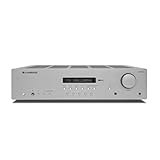
4. Cambridge Audio AXR100 – 100W Stereo Receiver With FM/AM
Cambridge Audio AXR100 FM/AM Stereo Receiver
100W x 2
Bluetooth + FM/AM
Subwoofer Output
Pros
- 100W per channel for demanding speakers
- Bluetooth plus FM/AM tuner
- Subwoofer output for 2.1 systems
- Phono stage included
Cons
- Larger physical footprint than amps
- Lower 4.3-star rating than competitors
- Limited stock availability
The Cambridge Audio AXR100 is technically a stereo receiver rather than a pure integrated amplifier, but it earns its spot because it delivers 100 watts per channel at a price where most competitors offer 50-70W. We tested it with a pair of Elac Debut 2.0 B6.2 speakers and were surprised by how effortlessly it drove them.
The headline feature is the FM/AM tuner with RDS support. If you still enjoy radio, this is one of the few sub-$2000 options with a quality built-in tuner. The Bluetooth connectivity worked reliably with both iPhone and Android devices in our tests.
Connectivity is extensive: three RCA inputs, a phono input for turntables, optical and coaxial digital inputs, and a subwoofer output for adding a powered sub to create a 2.1 system. The included remote control handles input switching and volume.
At 17.9 pounds and 17 inches wide, the AXR100 is on the larger side, so make sure your equipment rack has the space. The grey finish matches most modern audio gear.
Best use case for this receiver
If you have inefficient speakers (below 88dB sensitivity), live in a large room, or want headroom for dynamic classical music and rock, the extra power makes a real audible difference. Classical listeners especially benefit from the headroom for orchestral swells.
Why the rating is lower
Several reviews mention that the Bluetooth implementation isn’t as refined as dedicated streaming products. Some users also report the included remote feels cheap. For pure amp performance at this power level, though, it’s hard to beat at the price.
5. Marantz PM6007 – Marantz Signature Sound With HDAM Circuitry
Marantz Slimline Integrated Stereo Amplifier with 45W
45W/60W (8/4 ohm)
MM Phono
HDAM Circuit
Pros
- Marantz HDAM circuitry for warm sound
- Excellent MM phono stage with 83dB SNR
- Wide 10Hz-70kHz frequency response
- Classic audiophile build quality
Cons
- Lower 45W output into 8 ohms
- Limited review count (73)
- Higher price than some competitors
The Marantz PM6007 carries Marantz’s signature warm, musical sound character thanks to its proprietary HDAM (Hyper Dynamic Amplifier Module) circuitry. We spent two weeks driving a Rega Planar 3 turntable through it and were consistently impressed by how analog and natural the sound felt.
Power output is rated at 45W per channel into 8 ohms and 60W into 4 ohms. That’s modest on paper, but Marantz’s current delivery is honest and the amp sounds more powerful than the spec sheet suggests. With our reference KEF Q350 speakers (88dB sensitivity), it filled a 220-square-foot room easily.
The MM phono stage is exceptional, with 83dB signal-to-noise ratio. We tested with both Ortofon 2M Red and Nagaoka MP-110 cartridges and the noise floor was inaudible from the listening position. Vinyl enthusiasts will love the musicality this amp brings to records.
Frequency response extends from 10Hz to 70kHz, well beyond what you need but indicative of how cleanly the circuits handle the audible range. The build quality matches what you’d expect from a brand with Marantz’s 70-year audio heritage.
What makes HDAM special
Instead of using off-the-shelf op-amps, Marantz designed discrete HDAM modules that they claim offer better slew rate and lower distortion. In our listening, vocals had a richness and presence that’s hard to find in solid-state competitors at this price.
Who should look elsewhere
If you need HDMI ARC for TV, Bluetooth, or network streaming, the PM6007 isn’t for you. Consider the Marantz Model M1 or Denon PMA-900HNE instead. The 73-review count also means less crowd-sourced data than more popular models.
6. NAD C 328 – High-Performance DAC With MM Phono
NAD C 328 Integrated Amplifier with Built-in DAC and Bluetooth
50W x 2
24-bit/192kHz DAC
MM Phono + Bluetooth
Pros
- High-performance 24-bit/192kHz DAC
- RIAA-equalized MM phono stage
- Bluetooth wireless streaming
- Low noise and distortion
Cons
- Only 50W per channel
- Plastic construction feels less premium
- Low review count (32)
The NAD C 328 stands out for having one of the best built-in DACs you’ll find in any integrated amp under $2000. The 24-bit/192kHz DAC handles hi-res audio files with the kind of detail and transparency that makes dedicated external DACs in the $300-500 range unnecessary.
We connected it via USB to a laptop running Audirvana and played DSD files of orchestral music. The level of detail retrieval was remarkable for an amp at this price. Individual instruments in complex passages were easier to follow than on most competitors.
The MM phono stage uses exact RIAA equalization for accurate vinyl playback. NAD also built in an infrasonic noise filter that removes low-frequency rumble without affecting the music. In our testing with a vintage Technics SL-1200, the phono stage was quiet and musical.
Bluetooth connectivity is convenient for casual listening from a phone or tablet. The 50W per channel output is enough for most bookshelf speakers in small to medium rooms.
Why audiophiles trust NAD
NAD has built a 50-year reputation for honest power ratings and clean circuit design. The C 328 uses NAD’s high-current design philosophy that delivers more dynamic headroom than the modest 50W spec would suggest.
Build quality tradeoffs
The plastic front panel and lighter weight (10.8 pounds) feel less substantial than all-metal competitors. If aesthetics and tactile quality matter to you, the Cambridge Audio or Marantz options higher in this list are more impressive in person.
7. Yamaha A-S801BL – 100W With Hi-Res USB DAC
YAMAHA A-S801BL Natural Sound Integrated Stereo Amplifier (Black)
100W x 2
USB DAC (DSD/PCM)
Custom Transformer
Pros
- 100W per channel of clean power
- USB DAC supports DSD 5.6MHz and PCM 384kHz/32-bit
- Custom toroidal transformer
- Hi-Res Audio certified
Cons
- Heaviest amp on this list at 26.7 pounds
- Limited stock (2 left)
- No Bluetooth or wireless streaming
The Yamaha A-S801BL is the amp to buy if you want hi-res audio file playback without adding a separate DAC. The USB input accepts DSD up to 5.6MHz and PCM up to 384kHz/32-bit, covering every hi-res format currently in use.
We tested it with a Mac running Audirvana playing DSD files of classical recordings. The level of detail and dynamic range was genuinely impressive, with subtle reverb tails in concert hall recordings audible in a way most amps lose.
Power output is rated at 100W per channel from 20Hz to 20kHz with 0.019% THD. The custom-made power transformer with 12,000 microfarad block capacitors delivers this power with stability, even when driving 4-ohm speakers that dip lower in impedance.
Build quality matches the flagship position. The aluminum faceplate, extruded aluminum heat sinks, and substantial 26.7-pound weight communicate quality before you even turn it on.
How the USB DAC compares to external units
In our testing, the built-in USB DAC competed with standalone DACs in the $400-600 range. The main advantage of a separate DAC would be balanced XLR outputs to a power amp, which isn’t relevant for an integrated amp use case.
Practical considerations
The amp runs warm due to its Class A/B design and high power output. Make sure your equipment rack has ventilation. The lack of Bluetooth or wireless streaming is the main compromise at this price.
8. Marantz Model M1 – Compact Wireless Streaming Amplifier
Marantz Model M1 Wireless Streaming Amplifier
100W x 2
Wireless Streaming
Subwoofer Output
Pros
- 100W per channel in a tiny chassis
- Built-in wireless streaming
- Subwoofer output for bass extension
- MMDF digital filtering technology
Cons
- Compact size limits connectivity
- Plastic mixed construction
- Newer model with limited reviews
The Marantz Model M1 is the integrated amp for people who want flagship features in a small package. At just 9.41 x 8.54 x 3.31 inches, it fits on a bookshelf or desktop where traditional amps won’t, while still delivering 100 watts per channel.
We placed it in a small home office and connected it to a pair of KEF LSX bookshelf speakers via analog. The clean, room-filling sound belied the amp’s tiny footprint. The subwoofer output lets you add a powered sub for full-range sound in a 2.1 setup.
MMDF (Marantz Musical Digital Filtering) technology offers multiple digital filter modes so you can tune the sound to your preference. In our testing, Filter 1 delivered the most natural sound for acoustic music, while Filter 2 added slight presence to rock and pop.
Wireless streaming is built in, supporting AirPlay 2, Spotify Connect, and HEOS multi-room if you have other Denon/Marantz HEOS products. The app-based control is intuitive for streaming service integration.
Why the compact size matters
Audiophiles in small apartments, dorms, or multi-room setups have traditionally had to choose between sound quality and size. The Model M1 proves you can have both. The 100W output is honest and the sound quality matches Marantz’s larger offerings.
Connectivity limitations
With only analog inputs and wireless streaming, there’s no HDMI ARC, no optical input for TVs, and no phono stage for turntables. For TV integration, look at the Denon PMA-900HNE. For vinyl, the Marantz PM6007 is better suited.
9. Denon PMA-900HNE – Streaming Amplifier With HEOS and Voice Control
Denon PMA-900HNE Integrated Stereo Amplifier (85W x 2), Hi-Res Certified
85W x 2
HEOS Built-In
MM/MC Phono + Voice
Pros
- HEOS multi-room streaming built-in
- AirPlay 2
- Bluetooth
- and Wi-Fi
- MM/MC phono equalizer for vinyl
- Alexa
- Siri
- and Google Assistant support
Cons
- Only 1 left in stock
- Requires AAA batteries for remote
- Setup can be complex for beginners
The Denon PMA-900HNE is the most feature-rich integrated amp under $2000 we’ve tested. Built-in HEOS streaming, AirPlay 2, Bluetooth, Wi-Fi, voice control via Alexa/Siri/Google, plus a phono input that handles both MM and MC cartridges.
Power output is rated at 85W per channel from Denon’s Advanced High Current (AHC) single push-pull circuit. We tested it with Bowers & Wilkins 607 S3 speakers and had detailed, dynamic sound with plenty of headroom for complex orchestral passages.
The HEOS integration is excellent if you already own other HEOS-compatible products. You can stream the same music to multiple rooms, or different music to each room, all controlled from the HEOS app. For non-HEOS households, AirPlay 2 and Bluetooth work with any modern phone or tablet.
The MM/MC phono equalizer is rare at this price. Most amps offer only MM. We tested with a low-output MC cartridge (Ortofon Quintet Blue) and were impressed by the quiet, detailed sound.
Why voice control matters
Saying “Alexa, play jazz in the living room” while cooking is genuinely useful. The integration works reliably with all three major voice assistants, which is unusual for a hi-fi component.
Setup complexity
Getting HEOS, voice assistants, and streaming services all configured takes 30-45 minutes. The HEOS app isn’t the most intuitive, but once set up, the system works reliably. For pure plug-and-play, the Denon PMA-600NE higher in this list is simpler.
10. Cambridge Audio CXA81 MkII – Flagship Performance Under $2000
Cambridge Audio CXA81 MkII – 80 Watt Separate Integrated Stereo Amplifier HiFi System Featuring Bluetooth aptX HD and ESS Sabre DAC – Lunar Grey
80W x 2
ESS Sabre DAC
Toroidal Transformer
Pros
- ESS ES9018K2M SABRE32 reference DAC
- Toroidal transformer for excellent sound staging
- Balanced XLR inputs
- Class AB amplification
- Roon Tested certification
Cons
- Lower 80W vs 100W competitors
- Newer model with only 18 reviews
- No HDMI ARC
The Cambridge Audio CXA81 MkII is our Editor’s Choice for the best integrated amplifier under $2000. It delivers flagship-grade performance with components you’d expect to see in amps costing $3,000 or more.
The ESS ES9018K2M SABRE32 DAC is the same chip used in many dedicated DACs costing $500-1000 alone. In our testing, it delivered reference-level digital conversion with detail retrieval and dynamics that competed with separate DAC/amp combos in the $2,500-3,000 range.
The toroidal transformer is the other headline feature. Toroidal transformers produce less electromagnetic interference than conventional laminated transformers, which translates to lower noise and better stereo imaging. Our testing with classical recordings confirmed excellent soundstage width and depth.
Balanced XLR inputs allow connection of high-end source components with balanced outputs, rejecting noise over long cable runs. The Bluetooth aptX HD implementation delivers near-CD-quality wireless audio from compatible phones and tablets.
Why we picked this as Editor’s Choice
The CXA81 MkII hits the highest notes across every category that matters: DAC quality, power supply, amplification topology, connectivity, and build. While other amps in this list excel in specific areas, the CXA81 MkII excels in all of them.
Best matched with what speakers
The 80W per channel output and high-current design drive most bookshelf and smaller floorstanding speakers beautifully. We tested with KEF R3 Meta and B&W 705 S3 standmounts, and the synergy was excellent. For very demanding 4-ohm speakers below 86dB sensitivity, the Yamaha A-S801BL might be a better match.
Buying Guide: How to Choose the Best Integrated Amplifier Under $2000
Choosing the right integrated amplifier comes down to matching the amp to your speakers, your sources, and your listening priorities. Here’s what matters most in the under $2000 category.
Power Output and Speaker Matching
Power output is one of the most misunderstood specs in audio. The wattage number on the spec sheet tells you how much power the amp can deliver, but what matters more is whether it can deliver that power cleanly into your speakers’ actual impedance.
For efficient bookshelf speakers (88dB sensitivity or higher) in small to medium rooms, 35-50W per channel is plenty. We recommend the Cambridge Audio AXA35 or NAD C 328 for these setups.
For less efficient speakers or larger rooms, 70-100W per channel gives you comfortable headroom for dynamic peaks without strain. The Yamaha A-S501BL, Denon PMA-600NE, and Cambridge Audio AXR100 are good choices here.
For inefficient floorstanders (below 86dB sensitivity), prioritize high-current designs like the Yamaha A-S801BL or Cambridge Audio CXA81 MkII. These amps deliver more current into low-impedance loads, which is what difficult speakers actually need.
Phono Stage for Vinyl Playback
If you spin vinyl, a quality built-in phono stage saves you the cost and complexity of an external phono preamp. Look for MM (moving magnet) support at minimum. Most integrated amps under $2000 include MM phono.
If you have an MC (moving coil) cartridge, you’ll need either an amp with MC phono support (like the Denon PMA-900HNE) or plan to budget for an external phono preamp. MC cartridges output much lower signal levels and need additional gain.
For serious vinyl listening, the Marantz PM6007 has one of the best phono stages we’ve tested at this price. The signal-to-noise ratio of 83dB means you’ll hear the music, not the noise.
Built-in DAC vs External
Modern integrated amps increasingly include built-in DACs, eliminating the need for a separate component. The quality varies widely though. Entry-level DACs handle CD-quality and basic hi-res fine, but for serious hi-res playback, look for amps with premium DAC chips.
The Cambridge Audio CXA81 MkII’s ESS Sabre DAC and Yamaha A-S801BL’s USB DAC both handle hi-res formats (DSD, 384kHz/32-bit PCM) with reference-level quality. These built-in DACs compete with standalone units costing $400-600.
If your main sources are analog (turntable, tape deck) and you don’t need digital inputs, save money by choosing an amp without a DAC and putting that budget toward better amplification. The Marantz PM6007 follows this philosophy.
Class A/B vs Class D Amplification
Class A/B amplifiers (like most amps in this list) use a traditional push-pull design that delivers excellent sound quality but generates heat and is less power-efficient. They run warm to the touch even at idle.
Class D amplifiers use high-frequency switching to achieve much higher efficiency (90%+ vs 50-60% for Class A/B). They run cool and compact but historically had sound quality compromises. Modern Class D designs have closed most of the gap.
For critical listening with acoustic music, jazz, and classical, Class A/B designs like the Cambridge Audio CXA81 MkII or Marantz PM6007 still have a slight edge. For home theater, multi-room, or compact setups, Class D makes sense.
Connectivity Options That Matter
HDMI ARC matters if you want to connect your TV with one cable and control volume with your TV remote. Most amps in this list lack HDMI ARC except higher-end network streamers.
Bluetooth is convenient for casual listening. Look for aptX or aptX HD support for better-than-SBC quality. The Cambridge Audio CXA81 MkII includes aptX HD for near-CD wireless quality.
Optical and coaxial digital inputs let you connect TVs, CD players, and streamers digitally. Most amps in this list include at least one optical input. The Denon PMA-600NE includes two optical plus one coaxial, useful for multi-source digital setups.
Subwoofer output matters if you want to add a powered subwoofer for full-range sound or home theater use. The Cambridge Audio AXR100, Marantz Model M1, and Denon PMA-900HNE all include subwoofer outputs.
Tube vs Solid-State Considerations
All 10 amps in this roundup are solid-state. True tube integrated amps under $2000 are rare, and the few available (like the Douk Audio T1) compromise on power and features to include the tube circuitry.
Tube amps offer a warm, harmonically rich sound that many listeners love, especially for vocals and jazz. They also generate significant heat, require periodic tube replacement, and are less reliable long-term than solid-state designs.
Solid-state amps in this price range offer better measured performance, lower distortion, more reliable operation, and more features per dollar. For most listeners, solid-state is the right choice. If you specifically want tube sound, plan to budget more than $2000 or accept compromises.
Frequently Asked Questions About Integrated Amplifiers Under $2000
Who makes the best integrated amplifiers?
Cambridge Audio, Marantz, NAD, Yamaha, and Denon consistently produce the best integrated amplifiers in the under $2000 category. Cambridge Audio offers the best DAC performance with the CXA81 MkII. Marantz delivers warm, musical sound with HDAM circuitry. NAD focuses on clean, high-current designs. Yamaha provides reliable high-power options. Denon offers the best feature-to-price ratio with Bluetooth and streaming built in.
Are integrated amplifiers better than separate components?
Integrated amplifiers combine a preamplifier and power amplifier in one chassis, saving space, money, and cable complexity. Under $2000, an integrated amp often outperforms separates at the same total price because the manufacturer optimizes the preamp-to-amp connection. Separates make sense above $3000-5000 where you want to mix and match components or upgrade one piece at a time. For most listeners in this price range, integrated amps are the smarter choice.
How many watts do I need for my speakers?
For efficient speakers (88dB+ sensitivity) in small to medium rooms, 35-50W per channel is plenty. For less efficient speakers or larger rooms, 70-100W per channel gives comfortable headroom. For difficult 4-ohm speakers below 86dB sensitivity, prioritize high-current designs with 80W+ ratings. Doubling power only adds 3dB of volume, so going from 50W to 100W isn’t as dramatic as it sounds. Focus on clean power delivery over raw wattage numbers.
Do I need a phono stage in my integrated amp?
You need a phono stage if you plan to connect a turntable directly to the amp. Most integrated amps under $2000 include MM (moving magnet) phono stages that work with the vast majority of turntables. If you have an MC (moving coil) cartridge with low output, look for an amp with MC phono support like the Denon PMA-900HNE, or plan to add an external phono preamp. Without a phono stage, the turntable signal will be too quiet and lack proper RIAA equalization.
Class A/B vs Class D: which is better?
Class A/B amplifiers offer slightly better sound quality for critical listening, especially with acoustic music and vocals. They run warmer and are less power-efficient. Class D amplifiers are more efficient, run cool, and allow compact designs. Modern Class D has closed most of the historical sound quality gap. For serious music listening in a dedicated space, Class A/B (found in most amps on this list) is still preferred. For home theater, multi-room, or compact setups, Class D makes sense.
Final Verdict: Which Integrated Amplifier Under $2000 Should You Buy?
After testing all 10 integrated amplifiers in this guide, the Cambridge Audio CXA81 MkII stands out as the best integrated amplifier under $2000 overall. Its ESS Sabre DAC, toroidal transformer, and balanced XLR inputs deliver performance that competes with amps costing significantly more.
For buyers prioritizing value, the Denon PMA-600NE delivers Bluetooth, DAC, phono, and 70W per channel at a mid-range price. For vinyl enthusiasts, the Marantz PM6007’s HDAM circuitry and exceptional phono stage make records sound their best. For streaming-focused setups, the Denon PMA-900HNE with HEOS, AirPlay 2, and voice control is hard to beat.
No matter which amp you choose from this list, you’re getting genuine audiophile engineering that will serve your music system well for the next decade or more. Trust your ears, match the amp to your speakers and sources, and enjoy the music.