
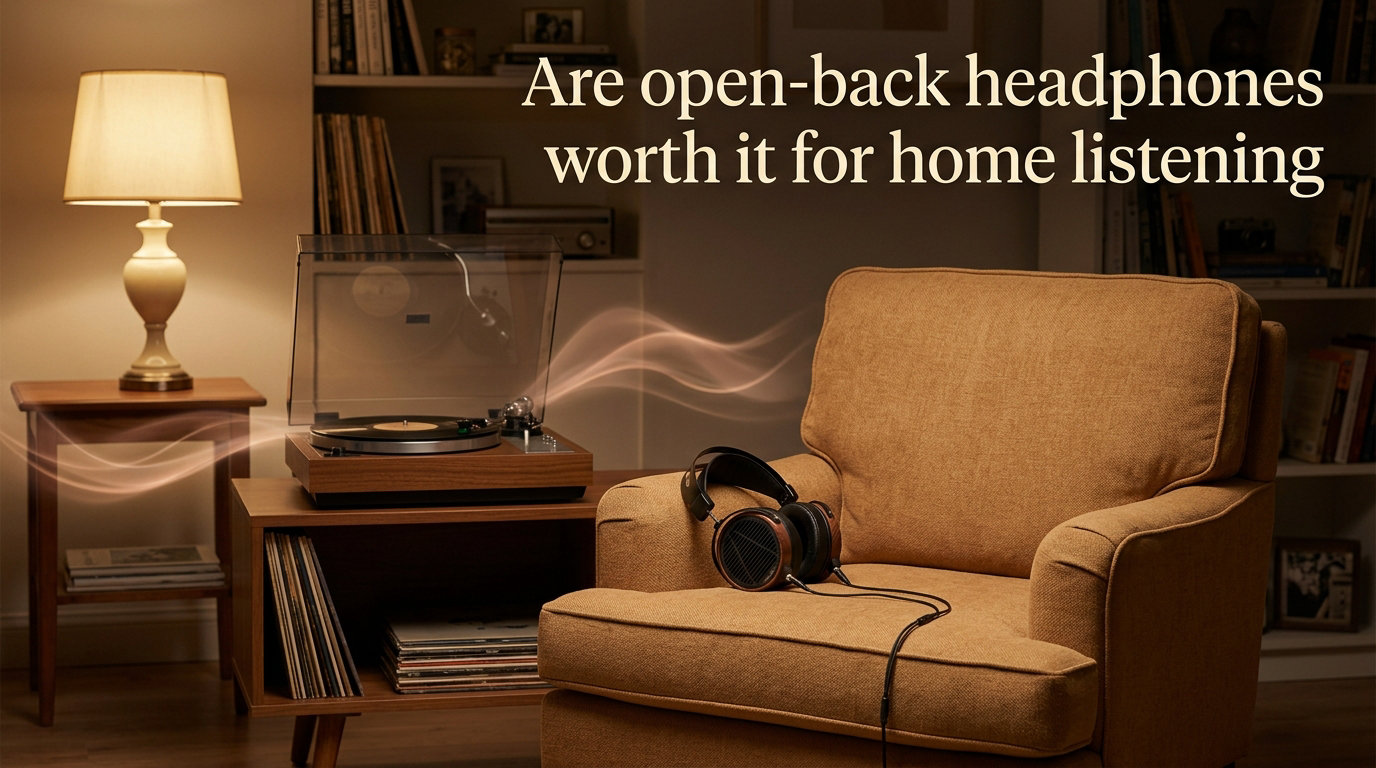
Yes, open-back headphones are absolutely worth it for home listening if you have a reasonably quiet room and you care about soundstage, imaging, and natural timbre. I have spent hundreds of hours comparing open-back and closed-back models in a dedicated listening space, and the difference for music that breathes, especially orchestral and chamber works, is immediate and obvious.
The trade-off is real, though. Open-back headphones leak sound outward and let outside noise in, so they are not the right tool for a noisy bus or a shared office. But in the calm of your own listening room, the payoff is a wider, more spacious, and more honest presentation of your music than any sealed design can match.
This guide walks through what open-back headphones actually do, how the driver ventilation affects what you hear, and whether they fit your home setup. I will keep the classical music listener in mind throughout, because that is where open-back designs truly shine and where most general reviews go quiet.
If you have ever wondered whether are open-back headphones worth it for home listening, the short answer for most serious home listeners is a confident yes, with a few practical conditions we will cover below.
Table of Contents
What Are Open-Back Headphones
Open-back headphones are headphones with ear cups that use grilles, mesh, or vented backing instead of sealed enclosures around the drivers. Air and sound pressure pass through the back of the cup rather than bouncing off a solid wall.
This sounds like a small design choice, but it changes almost everything about how the headphones sound and feel. The sealed cup of a closed-back headphone traps rear sound waves, which boosts bass and blocks outside noise but also colors the sound. An open-back design lets those waves escape, which is why the presentation feels more open and less boxed-in.
The category spans a huge range. Entry-level open-backs start well under $100, while reference-grade planar magnetic and dynamic models climb past $1,000. The dominant brands you will see in this space include Sennheiser, Beyerdynamic, HiFiMan, and Audio-Technica, with each taking a slightly different tuning philosophy.
Definition box: Soundstage. Soundstage is the perceived three-dimensional space in which instruments and voices appear when you listen. A headphone with a wide soundstage places sounds outside your head, as if you were sitting in a room with the performers. Open-back headphones are famous precisely because they produce a larger and more believable soundstage than closed-back designs.
Once you understand what an open-back design is doing mechanically, the rest of this guide makes a lot more sense. Every advantage and limitation flows from that single decision to let the driver breathe.
How Open-Back Headphones Work: Driver Ventilation Explained
The key to an open-back headphone is driver ventilation. Inside every headphone driver is a diaphragm that pushes air forward toward your ear and backward into the cup. In a closed-back design, that rearward air has nowhere to go, so it builds up pressure behind the driver.
That trapped pressure is not neutral. It reflects off the inside of the cup, returns to the diaphragm, and interferes with the next movement. Engineers use damping materials and careful tuning to manage it, but the sealed cavity always adds some coloration, usually a bass bump and a slightly closed-in upper midrange.
An open-back headphone solves this by venting the back of the cup. The rearward wave simply exits through the grille instead of reflecting back. The result is a driver that behaves more like a small free-standing speaker, with less internal pressure, less resonance, and a more honest representation of the recorded signal.
Dynamic drivers versus planar magnetic drivers. Most affordable open-backs use dynamic drivers, which are cone-style drivers similar to traditional speakers. They tend to deliver punchy transients and a natural tonal balance. Planar magnetic drivers use a flat diaphragm with embedded conductors, and they excel at speed, low distortion, and bass texture. Both designs benefit enormously from open-back venting.
This is also why open-backs feel less fatiguing over long sessions. With less trapped pressure and heat, the ear cups stay cooler, and the absence of a pressurized cavity tends to produce a smoother, less aggressive treble response. We will come back to comfort in detail later.
The takeaway is simple. Open-back designs do not add magic. They subtract a problem. By removing the sealed cavity, they let the driver perform closer to its ideal spec, and that is where the clarity and spaciousness come from.
Open-Back vs Closed-Back Headphones at a Glance
Comparing open-back and closed-back designs side by side is the fastest way to see what you gain and what you give up. The two types are built for different jobs, and neither is universally better.
Soundstage and imaging. Open-backs win here clearly. The vented cup removes the in-your-head pressure that closed designs create, and instruments spread out across a believable space. Closed-backs can image well, but the stage stays closer to your skull.
Bass response. Closed-backs produce more bass quantity because the sealed cup reinforces low frequencies. Open-backs give you less raw bass slam but often better bass texture and definition. For classical and acoustic music, that texture usually matters more than thump.
Noise isolation. Closed-backs block outside sound and keep your music private. Open-backs do neither. If your home environment is loud or shared, closed-backs or noise-cancelling models may serve you better day to day.
Sound leakage. This is the open-back weakness everyone mentions on forums. People near you will hear your music at moderate volume, especially in a quiet room. Closed-backs keep that sound contained.
Comfort. Open-backs run cooler and lighter on the ears thanks to airflow through the cup. For sessions longer than an hour or two, most listeners find open-backs more comfortable.
Use cases. Open-backs suit home listening, critical listening, mixing decisions, classical and acoustic music, and immersive gaming. Closed-backs suit commuting, office work, recording (where leakage into a mic matters), and bass-heavy genres on the move.
Neither design is a compromise-free winner. The right choice depends on where you listen and what you listen to, which is the heart of whether open-backs are worth it for your home.
Soundstage and Audio Clarity Differences
If open-back headphones have one headline advantage, it is soundstage. This is the single biggest reason audiophiles and classical listeners keep reaching for open-backs at home, and it is worth understanding in some depth.
A wide soundstage means the music does not feel trapped between your ears. Instead, instruments place themselves at believable distances and directions, from close and intimate to distant and reverberant. A violin sits slightly left, a cello slightly right, and the hall acoustic stretches behind them. Closed-backs can give you a sense of left and right, but open-backs give you a sense of depth and room.
Closely related is imaging, which is the precision with which you can pinpoint each sound source within that stage. Open-back designs tend to image more cleanly because the rearward wave is not bouncing around a sealed cavity and smearing the timing cues your brain uses to locate sounds.
I remember the first time I switched from a closed-back to a mid-tier open-back on a Mahler symphony. The strings no longer sounded like they were playing inside a box. I could hear the wood of the stage, the air around the brass, and a clear front-to-back layering between the violins and the timpani. That kind of clarity is exactly what classical recordings are engineered to deliver, and a sealed cup hides much of it.
Clarity is the other half of the story. Because the driver is not fighting internal pressure, open-backs often reveal subtle detail that closed designs blur together. You hear the intake of breath before a phrase, the resonance of a piano’s soundboard, the rosin on a bow. These are not audiophile parlor tricks. They are the textures that make a performance feel human.
This is also why open-backs are popular for mixing and mastering work. Engineers need to hear exactly what is on the recording, without added coloration from a sealed cup, to make accurate decisions about balance and placement.
The clarity advantage is not infinite. A cheap open-back will not outperform a high-end closed-back, and a poorly recorded track will not suddenly become well-recorded. But at every price tier I have compared, the open-back version of a product tends to deliver a cleaner, more transparent window into the music than its closed sibling.
For home listening where you have the quiet space to appreciate it, that transparency is the core value proposition. If you have only ever heard closed-back headphones, your first serious open-back session can feel like cleaning a foggy window.
Bass Response and Frequency Handling
Bass is the most common worry people raise before trying open-back headphones. The assumption is that open-backs are bass-light, and for bass-heavy electronic or hip-hop listening, that concern is fair.
Here is the nuance. Open-backs typically produce less bass quantity than closed-backs because there is no sealed cavity reinforcing low frequencies. What they lose in slam, they often make up for in bass quality. The low end tends to be faster, cleaner, and better separated from the midrange.
For classical, jazz, acoustic, and vocal music, that trade is usually a win. An orchestral bass drum, a double bass pizzicato, or a kettle drum roll lands with realistic pitch and decay rather than a generic thud. You hear the note, not just the impact.
Planar magnetic open-backs are particularly strong here. Their flat diaphragms move uniformly across the frequency range, which gives them tight, well-extended bass that does not bleed into the lower mids. Dynamic-driver open-backs can be excellent too, though their bass character varies more by model and tuning.
If your home listening is dominated by EDM, dubstep, or bass-forward pop, a closed-back or a planar open-back tuned for low-end extension will likely serve you better than a classic neutral open-back. But if you listen across genres with a focus on acoustic and orchestral material, the open-back bass character is more honest and, over time, more satisfying.
Comfort and Ear Fatigue for Long Listening Sessions
Comfort is where open-back headphones quietly win over long-term listeners. Forum after forum, the same theme appears: people wear their open-backs for three, four, or five hours without the fatigue they get from closed designs.
The reason is airflow. Because the ear cup is vented, heat and moisture do not build up around your ears the way they do inside a sealed cup. Your ear canals stay cooler, the pads stay drier, and that closed-in sweaty feeling never arrives.
This matters more than it sounds. Heat buildup is a major contributor to listening fatigue, both physical and perceptual. When your ears are hot and pressurized, you tend to turn the volume up to compensate, which accelerates fatigue further. Open-backs short-circuit that loop.
Ear fatigue has a second component, which is treble harshness. Sealed cups often develop a peaky upper midrange or treble because of internal reflections, and that sharpness wears on the listener over time. Open-back designs generally smooth out the treble because the rearward wave dissipates instead of bouncing back at the driver.
For classical listeners who run through entire operas, symphony cycles, or long chamber sessions, this is a meaningful practical advantage. I regularly do four-hour listening blocks in my open-backs without reaching for a break, something I never managed with my closed-backs.
Weight and clamping force matter too. Open-backs tend to favor larger, lighter ear cups with softer pads, since isolation is not a priority. That design choice suits marathon sessions well, especially for listeners who wear glasses or who are sensitive to pressure on the temples.
None of this means closed-backs are uncomfortable. Plenty of closed models are plush and pleasant. But if your main listening happens at home in long stretches, open-backs have a clear and consistent comfort edge that you feel in your ears, your head, and your patience for the next movement.
Sound Leakage and Noise Isolation Realities
Sound leakage is the open-back weakness that everyone knows about, and it deserves an honest treatment because it shapes whether open-backs fit your home life.
Open-backs leak in both directions. Music escapes outward through the vented cup, so anyone in the same room, and often the next room, can hear what you are playing at moderate to high volumes. Outside sound also reaches your ears largely unblocked, so a barking dog, a running dishwasher, or a conversation nearby will cut into your listening.
On the forums, the most common regret among new open-back owners is not the sound quality. It is discovering, often after purchase, that they cannot use the headphones in the environment they actually live in. A baby napping in the next room, a partner watching TV on the couch, or a roommate on a call can all be disturbed by open-back leakage at anything beyond quiet volumes.
This is the single most important practical check before you commit to open-backs. Walk through your typical listening situation honestly. If you listen alone in a dedicated room with the door closed, leakage is a non-issue. If you listen in a shared living room, an open-plan apartment, or a home office on calls, leakage will constrain you.
Noise isolation works the same way in reverse. Open-backs do not block the refrigerator, the traffic outside, or the neighbor’s television. If your home has steady background noise, you will hear it layered under your music, and quiet passages in classical recordings will suffer most.
There is no clever fix for this. You cannot seal an open-back without changing what it is. The honest answer is to match the tool to the room. Many serious listeners end up owning both, an open-back for dedicated sessions and a closed-back or noise-cancelling model for everything else.
If your home is quiet and your listening is solo, the leakage issue is mostly theoretical, and you can enjoy the full benefit of the open-back design. If your home is shared or noisy, plan around the limitation rather than pretending it does not exist.
Why Open-Back Headphones Excel for Classical Music
Classical music is where open-back headphones earn their reputation, and it is worth explaining why in concrete listening terms rather than just slogans about soundstage.
Orchestral recordings are mixed and mastered to convey a sense of place. The engineers want you to hear not just the notes but the hall, the seating arrangement of the players, and the air around the ensemble. A sealed cup compresses that sense of place into a narrow band between your ears. An open-back lets the hall breathe.
Concretely, this means you can hear the front-to-back layering of the orchestra. First violins sit closer, brass and percussion sit farther back, and the stereo image stretches wide enough to place each section in its own space. On a good open-back, you can almost diagram the orchestra layout with your eyes closed.
Dynamic expression is the other classical strength. Orchestral music swings from near-silence to full tutti fortissimos, and open-backs handle that dynamic range without the compression or congestion a sealed cup can introduce at peak volume. A Mahler climax stays clear rather than turning into a wall of sound.
Chamber music benefits differently. In a string quartet or piano trio recording, the subtleties of bowing, pedaling, and ensemble interplay live in the midrange and upper midrange, exactly where open-backs tend to be most transparent. You hear the rosin, the breathing between phrases, the slight adjustments of intonation.
Solo piano is another revealing test. A grand piano is a percussive instrument with a huge resonant body, and open-backs render the attack, sustain, and decay of each note more naturally than most closed designs. The lower register has weight without bloat, and the upper register has shimmer without harshness.
Vocal music, from art song to opera, also gains from the open presentation. The human voice sits in a frequency range the ear is highly trained to evaluate, and any coloration from the headphone cup is immediately obvious. Open-backs tend to keep voices natural and uncolored.
None of this means you cannot enjoy classical on closed-backs. You absolutely can. But if classical music, jazz, or acoustic recordings are a meaningful part of your listening diet, the open-back presentation is closer to what the engineers and performers intended you to hear. That is the strongest case I can make for spending your home listening hours in an open-back design.
Practical Considerations for Home Listening
Making open-backs work well at home is about more than the headphones themselves. A few practical details shape whether you get the experience the design is capable of delivering.
Room environment comes first. Open-backs reward a quiet listening space because they do not block outside noise. A carpeted room with soft furnishings, a closed door, and minimal mechanical noise from fans or appliances will let you hear what the headphones can do. Hard floors and echoey spaces add reflections you will hear through the open cup.
Volume etiquette matters in shared homes. Because leakage travels, you will likely listen at lower volumes when others are around, which can dull the dynamic impact classical recordings depend on. Plan your serious listening sessions for windows when the house is quiet or empty.
Amplification is the next consideration. Many open-back headphones, especially dynamic-driver models from Sennheiser and Beyerdynamic, have higher impedance than typical consumer headphones. A model rated at 150, 250, or 300 ohms often needs a dedicated headphone amplifier to reach proper volume and dynamics from a phone or laptop jack.
Entry-level open-backs under around 80 ohms usually run fine from a phone, tablet, or computer. But once you step up to mid-tier and reference models, budget for a small amp, and often a DAC as well, to feed the headphones a clean, properly powered signal.
Home office use is a gray area. Open-backs are wonderful for focused music while you work, but they will leak into calls, zoom meetings, and quiet shared spaces. If your office is private, they are great. If it is shared or call-heavy, keep a closed-back or noise-cancelling pair on hand.
Cable length and design are small but real factors. Open-backs often ship with longer cables intended for desk and armchair listening rather than portable use. Some models have detachable cables, which lets you swap in a shorter cable for desk use or a balanced cable for a balanced amplifier.
Treating these practical details as part of the purchase decision, rather than afterthoughts, is what separates buyers who love their open-backs from buyers who end up reselling them. Match the headphones to your room, your amplifier, and your listening habits, and the design rewards you fully.
Who Should and Should Not Buy Open-Back Headphones
Open-back headphones are not for everyone, and being honest about the fit saves money and disappointment. Here is how I think about the listener profiles.
Open-backs are worth it for you if:
You listen mostly at home in a dedicated or at least quiet space. You prioritize soundstage, imaging, and natural timbre over noise isolation. Your music diet leans classical, jazz, acoustic, vocal, or well-recorded rock. You do long listening sessions and value comfort. You are willing to pair the headphones with a decent source and possibly an amplifier.
Open-backs are probably not worth it for you if:
You listen primarily on the move, in transit, or at the gym. You share your listening space with people who would be disturbed by leakage. Your environment is noisy and you need isolation or active noise cancellation. Your music taste is dominated by bass-heavy genres where impact matters more than texture. You want a single pair of headphones for every situation.
The mixed case. Many listeners fall in between. You might love open-backs for evening listening but need something sealed for the daytime office. In that situation, owning both is not indulgence, it is matching tools to jobs. A modest open-back for home plus a closed-back or noise-cancelling model for everything else covers the full range of real-life listening.
The casual listener question. If you listen to music for an hour or two a week, mostly as background while doing other things, a high-end open-back may be more investment than payoff. The benefits show up most under focused, attentive listening. Casual listeners often get more value from a comfortable closed-back or a good pair of wireless noise-cancelling headphones.
The honest framing is this. Open-backs are a specialist tool that happens to be the right tool for a specific and very common listening situation, quiet home listening with attention to the music. If that describes you, they are worth it. If your life is louder, busier, or more nomadic, a different design will serve you better.
Common Myths About Open-Back Headphones
A few myths about open-back headphones circulate on forums and in casual reviews, and clearing them up helps you make a better decision.
Myth: Open-backs have no bass. They have less bass quantity than closed-backs, but not zero bass. Quality open-backs, especially planar magnetic models, deliver deep, well-defined low end. The difference is character, not absence.
Myth: Open-backs are only for audiophiles. Anyone with a quiet room and a love of music can appreciate the difference. You do not need golden ears or expensive gear to notice a wider, more natural presentation.
Myth: Open-backs sound the same as open-ear or bone-conduction designs. They do not. Open-back headphones still sit on or around your ear with traditional drivers. The grille vents the cup, but the drivers and acoustic principles are conventional headphone technology.
Myth: You need a $1,000 setup to hear the benefit. A solid open-back under $200, paired with even a modest source, will reveal the soundstage and clarity advantages. The benefit scales with investment, but the entry point is accessible.
Myth: Open-backs are fragile. Build quality varies by model, but there is nothing inherently delicate about an open-back design. Many reference models are built for years of daily use with replaceable pads and cables.
FAQs
Are open-back headphones good for home use?
Yes. Open-back headphones are excellent for home use because they deliver a wider soundstage, cleaner imaging, and a more natural presentation than closed-back designs. The trade-off is that they leak sound and do not block outside noise, so they suit quiet, private listening rooms better than shared or noisy spaces.
What are the downsides of open-back headphones?
The main downsides are sound leakage, no noise isolation, weaker bass slam, and often a need for amplification on higher-impedance models. They are also not portable or suitable for commuting, recording into a mic, or use in shared environments where others would hear your music.
Are open-back headphones good for listening to music?
Yes, especially for classical, jazz, acoustic, and well-recorded rock. Open-backs reproduce the sense of space, depth, and dynamic expression that engineers build into these recordings. They are less ideal for bass-heavy genres where sheer low-end impact matters more than texture.
Are open-back headphones better for your hearing?
Open-backs can be gentler on the ears over long sessions because they run cooler, avoid the pressurized feeling of sealed cups, and tend to have smoother treble. They do not directly protect your hearing, and volume still matters, but many listeners find them less fatiguing than closed-backs.
Do open-back headphones leak a lot of sound?
Yes. Open-back headphones leak sound outward through the vented ear cups, and people nearby can usually hear your music at moderate to high volumes. Leakage is the main reason they are best suited to private, quiet listening spaces rather than shared rooms.
Can I use open-back headphones in an apartment?
You can, but it depends on your walls, your neighbors, and your listening volume. In a well-insulated apartment with the door closed, leakage is usually manageable. In a thin-walled or shared layout, a partner, roommate, or neighbor may hear your music, so closed-backs may be the better choice for everyday use.
Final Verdict: Are Open-Back Headphones Worth It for Home Listening
For most serious home listeners, yes, open-back headphones are worth it. They deliver a wider, more natural soundstage, cleaner imaging, smoother treble, and better long-session comfort than closed-back designs can match in the same room.
The honest conditions are equally clear. You need a reasonably quiet, private listening space, because leakage and lack of isolation are real and unavoidable. You may need an amplifier for higher-impedance models. And if your listening life extends beyond the home, you will likely want a second pair for portable or shared use.
If you listen to classical, jazz, acoustic, or vocal music with any regularity, the case gets stronger. Open-backs are the design that lets those recordings breathe, and the difference is something you hear within the first few minutes, not after weeks of training.
Start with what you actually listen to and where you actually sit. If the answers point to focused listening at home, in a quiet room, with music that rewards detail, then are open-back headphones worth it for home listening answers itself. For everyone else, a closed-back or noise-cancelling pair remains the more practical day-to-day tool.
The right headphones are the ones that fit your room, your music, and your listening habits. For the classical listener at home, more often than not, that means open-back.