
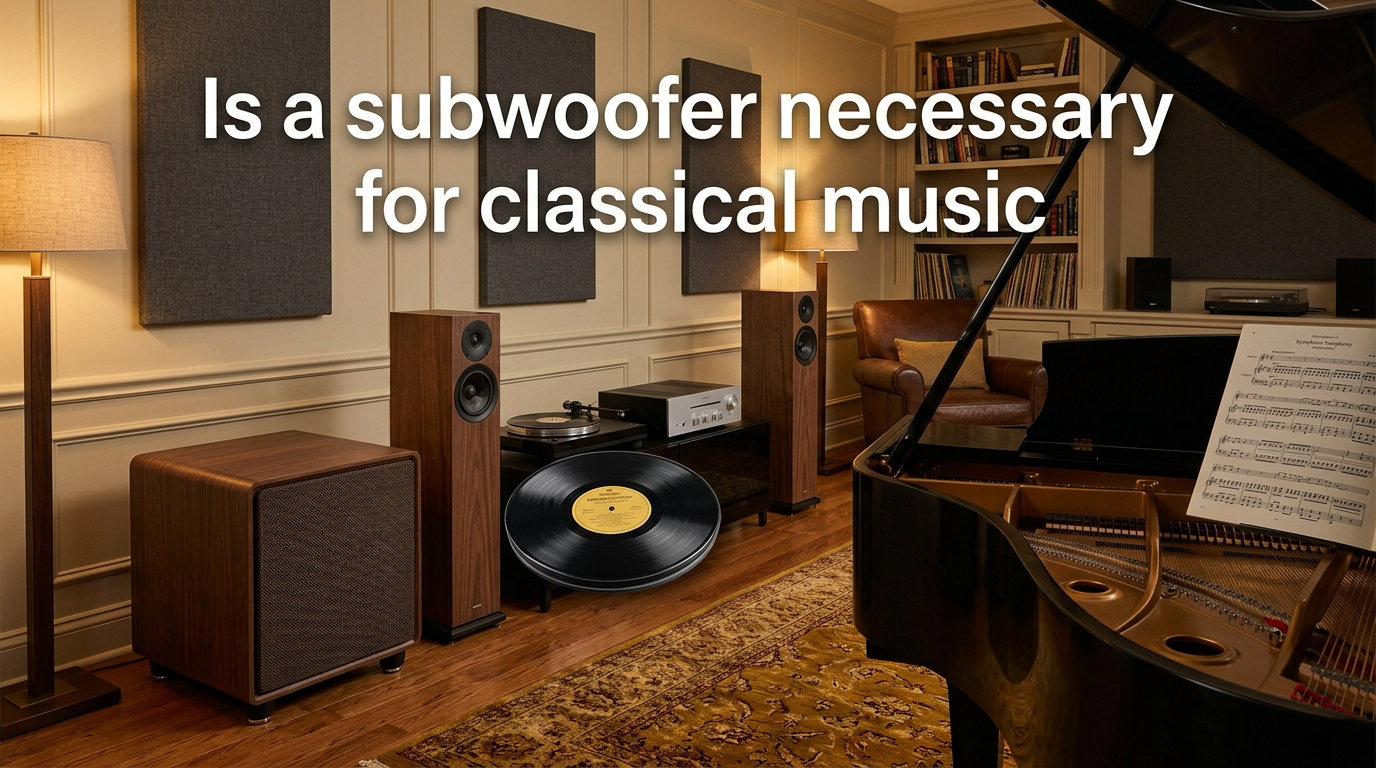
Whether a subwoofer is necessary for classical music depends on three things: the speakers you already own, the repertoire you play most often, and the room you listen in. The short answer is no, it is not strictly necessary for most classical listening, because well-designed floor-standing speakers and larger bookshelf models already reproduce the bulk of what an orchestra actually plays. A subwoofer becomes genuinely valuable when you listen to organ music, want a more accurate sense of the physical scale of an orchestra, or use smaller speakers that roll off above 50Hz.
I have spent years auditioning stereo setups with and without subs across chamber music, symphonic works, and solo recitals. The conclusion I keep arriving at is that the question “is a subwoofer necessary for classical music” is the wrong question. The better question is whether your current system is leaving audible information on the table, and that depends on real frequency data rather than marketing claims.
This guide breaks down what a subwoofer actually does, what frequencies classical instruments genuinely produce, when adding a sub makes an audible difference, and when you can confidently skip it. I will also cover practical setup tips for the cases where a subwoofer does earn its place.
Table of Contents
What a Subwoofer Actually Does
A subwoofer is a dedicated loudspeaker designed to reproduce the lowest frequencies in the audio band, typically from around 20Hz up to 200Hz. The exact range varies by model, but the defining trait is that it handles frequencies below what your main speakers can reproduce cleanly.
The key concept to understand is the crossover frequency. This is the point where bass duties are handed off from your main speakers to the subwoofer, usually somewhere between 40Hz and 80Hz for music. Below that frequency, the subwoofer takes over. Above it, your stereo speakers keep working as normal. A well-set crossover makes the transition seamless rather than drawing attention to itself.
Many modern subwoofers also include a high-pass filter, which is just as important. This feature cuts the lowest frequencies from your main speakers so they no longer try to reproduce content they cannot handle. The result is lower distortion, more headroom, and cleaner midrange from your existing speakers. Even if you cannot hear the subwoofer working, you may well hear your main speakers improving.
It helps to distinguish a subwoofer from a regular woofer. A woofer is the bass driver inside a floor-standing or bookshelf speaker, usually handling 50Hz to 1kHz. A subwoofer is a separate enclosure dedicated entirely to the bottom octave or two, with its own amplifier in active designs. That separation is what allows a sub to move enough air to reproduce the deepest organ pedal notes at realistic volume.
What Frequencies Classical Music Actually Contains
The frequency content of classical music is one of the most misunderstood topics in audio. Many people assume classical music has no real bass, while others believe a subwoofer is essential for every recording. Neither is accurate. The truth sits firmly in between, and the data is more interesting than either extreme suggests.
Let us walk through the lowest notes produced by common classical instruments. The double bass reaches down to about 41Hz on its open E string, and a five-string contrabass or bass trombone can go lower. The cello bottoms out near 65Hz with its open C string. The piano extends to roughly 27Hz at the lowest A, though that fundamental is felt more than heard. The pipe organ is in a category of its own, with a 32-foot stop producing a fundamental at 16Hz, well below what any normal speaker can reproduce.
Most of the energy in a classical recording, however, sits well above 50Hz. Violins, flutes, oboes, the human voice in choral works, and even the upper harmonics of lower instruments all live in the midrange and treble. A solo Bach partita or a Mozart string quartet contains very little content that would exercise a subwoofer at all.
Orchestral music is where things get interesting. A full symphony orchestra has tremendous dynamic range and produces significant energy in the lower midrange and bass during tutti passages. Recordings of Mahler, Bruckner, and Strauss benefit from a system that can reproduce the weight and scale of the full ensemble without compressing or distorting. The double bass section, timpani, and bass drum all contribute energy in the 30 to 80Hz range that smaller speakers simply cannot deliver at realistic levels.
Then there is organ music, which is the strongest case for a subwoofer in the classical repertoire. Works by Bach, Widor, Saint-Saens, and Messiaen regularly include pedal notes that descend to 32Hz and below. Without a subwoofer, you are not hearing the lowest octave of these pieces at all, only the harmonics that hint at it. Many listeners describe the difference as moving from hearing the music to feeling it.
The honest summary is that classical music does use bass, often more than people expect, but the deepest frequencies are concentrated in specific instruments and specific repertoire. A subwoofer is not needed for every recording, but for the recordings where it matters, the difference is substantial.
When a Subwoofer Genuinely Helps Classical Music
There are specific situations where adding a subwoofer to a classical music system produces a clearly audible improvement. These are not abstract audiophile claims but practical scenarios I have heard firsthand.
The first and most obvious case is organ music. If you regularly listen to Bach’s organ works, Widor’s symphonies for organ, or Saint-Saens’ Symphony No. 3, a subwoofer is the only way to reproduce the pedal division at anything close to what you would hear in a cathedral. The lowest stops on a large pipe organ reach frequencies that no stereo speaker can deliver, and the absence of that foundation changes the character of the music entirely.
The second case is soundstage expansion. This is the benefit Dynaudio and other speaker manufacturers highlight, and it is real. A well-integrated subwoofer does not just add bass; it increases the apparent size of the acoustic space and gives a more defined picture of the physical scale of the instruments. An orchestra recorded in a concert hall suddenly has more of the hall around it. The sense of depth and three-dimensionality improves because the lowest frequencies carry spatial cues that main speakers alone may flatten.
The third case is system relief. If you are using bookshelf speakers with 5-inch or 6-inch woofers, they are working hard to reproduce frequencies at the edge of their range. Adding a subwoofer with a high-pass filter lets those speakers focus on the midrange where they perform best. The result is often cleaner, more relaxed sound across the entire spectrum, not just in the bass. Many listeners who add a sub for organ music discover their chamber music sounds better too, simply because their main speakers are no longer straining.
The fourth case is large listening rooms. Bass wavelengths are long, with a 40Hz wave measuring around 28 feet. In a large room, smaller speakers struggle to pressurize the space and the low end becomes thin. A subwoofer with adequate output can restore the bass weight that the room otherwise absorbs. In small rooms, the opposite is true, which is why room size matters so much in this decision.
The fifth case is dynamic realism. Classical music has the widest dynamic range of any genre. The distance between a pianissimo string passage and a fortissimo orchestral climax can exceed 70 decibels. A subwoofer with headroom reproduces the bottom end of those climaxes without compression, which preserves the emotional impact composers intended.
When You Probably Do Not Need a Subwoofer
Equally important is knowing when a subwoofer is unnecessary or even counterproductive. Not every classical listener benefits from adding one, and for some it actively degrades the listening experience.
If you own well-designed floor-standing speakers with quality bass extension, a subwoofer is often redundant. Many modern tower speakers reach into the low 30s with low distortion and good integration. Adding a sub to a system like this rarely improves things and can introduce integration headaches that outweigh any benefit.
If your listening is dominated by solo instruments, chamber music, harpsichord, or vocal works, a subwoofer adds almost nothing. A Bach cello suite, a Mozart violin sonata, or a Schubert lieder recital contains very little content below 60Hz. In these cases, the subwoofer sits idle, and the money spent on it would be better invested in better main speakers, room treatment, or source components.
If you listen nearfield in a small room, the calculus changes completely. Nearfield listening, where you sit close to the speakers, reduces the influence of room acoustics and lets even modest bookshelf speakers deliver satisfying bass. Many users on audio forums report that nearfield setups eliminate the need for a subwoofer entirely, even with smaller speakers.
If your room is acoustically problematic, a subwoofer can make things worse rather than better. Small rooms with parallel walls create standing waves that produce uneven bass response, with some notes booming and others disappearing entirely. Dropping a subwoofer into an untreated room often exaggerates these problems. CNET’s argument that speaker quality matters more than subwoofer addition has merit in this context.
Finally, some classical listeners simply prefer the sound of their speakers alone. A well-designed stereo pair produces a coherent, focused soundstage that a subwoofer can sometimes disrupt if not integrated carefully. There is no shame in preferring the natural presentation of a good two-channel system, and many experienced listeners do exactly that.
How to Integrate a Subwoofer With Classical Music
If you have decided a subwoofer is worth adding, proper integration is what separates a satisfying upgrade from a frustrating one. Poor integration is the single most common reason classical listeners end up removing their subwoofers.
The first step is setting the crossover frequency correctly. For classical music, lower is almost always better. A crossover between 40Hz and 60Hz lets your main speakers handle the upper bass and lower midrange, where they typically perform best, while the subwoofer handles only the deepest content. Setting the crossover too high, above 80Hz, makes the subwoofer localizable and destroys the seamless presentation classical music demands.
The second step is placement. The common advice to stick a subwoofer in the corner is wrong for music, even if it works for home theater impact. Corner placement maximizes output but produces the boomiest, least accurate bass. For classical music, experiment with placement along the front wall, roughly a quarter to a third of the way in from the corners. The goal is smooth frequency response, not maximum volume.
The third step is calibration. The subwoofer should match the output level of your main speakers, not exceed it. An SPL meter, or even a calibrated smartphone app, lets you set the gain so the sub blends in rather than calling attention to itself. When the integration is right, you should not be able to tell where the subwoofer is located by listening. If you can hear the sub as a separate source, the gain is too high or the crossover is set incorrectly.
The fourth step is enabling the high-pass filter on your main speakers if your subwoofer or preamp supports it. Cutting the lowest frequencies from your main speakers lets them play with lower distortion and more clarity. This is the step most listeners skip, and it is often the one that delivers the biggest subjective improvement.
The fifth step is patience. Bass response in a room changes dramatically with small movements of the subwoofer and the listening position. Take time to experiment. The payoff is a system that reproduces the full weight and scale of orchestral and organ music without compromising the clarity that makes classical listening rewarding.
FAQs
Do you really need a subwoofer for music?
Most music does not strictly require a subwoofer, but classical listeners who play organ works, large orchestral repertoire, or use smaller bookshelf speakers often hear a clear benefit. Floor-standing speakers with good bass extension handle most classical content without one.
Does classical music use bass?
Yes. The double bass reaches about 41Hz, the cello around 65Hz, and a pipe organ can produce fundamentals as low as 16Hz. Most of the energy in classical recordings sits above 50Hz, but organ music and full orchestral tuttis contain significant low-frequency content that smaller speakers cannot reproduce.
What is the best sound system for classical music?
The best system for classical music is one with low distortion, wide dynamic range, accurate midrange, and bass extension that fits your room. Floor-standing speakers with quality woofers often suffice. Bookshelf speakers paired with a well-integrated subwoofer can match or exceed them at lower cost.
Can bookshelf speakers work for classical without a subwoofer?
Yes, especially in small to medium rooms and for nearfield listening. Bookshelf speakers with 5-inch or larger woofers typically reach 50Hz, which covers most chamber and orchestral music. A subwoofer is only needed if you listen to organ repertoire or want the deepest orchestral weight at realistic volume.
The Bottom Line
So is a subwoofer necessary for classical music? For most listeners and most repertoire, no. Quality floor-standing speakers and capable bookshelf models reproduce the overwhelming majority of what classical recordings contain. A subwoofer becomes worth considering when organ music is a regular part of your listening, when you want a more accurate sense of orchestral scale, when your main speakers roll off above 50Hz, or when you listen in a large room that absorbs bass.
The decision ultimately comes down to honest assessment of your speakers, your room, and your listening habits. If those three align toward needing deeper bass, a well-integrated subwoofer transforms organ and orchestral music. If they do not, the same money spent elsewhere will deliver more musical satisfaction.