
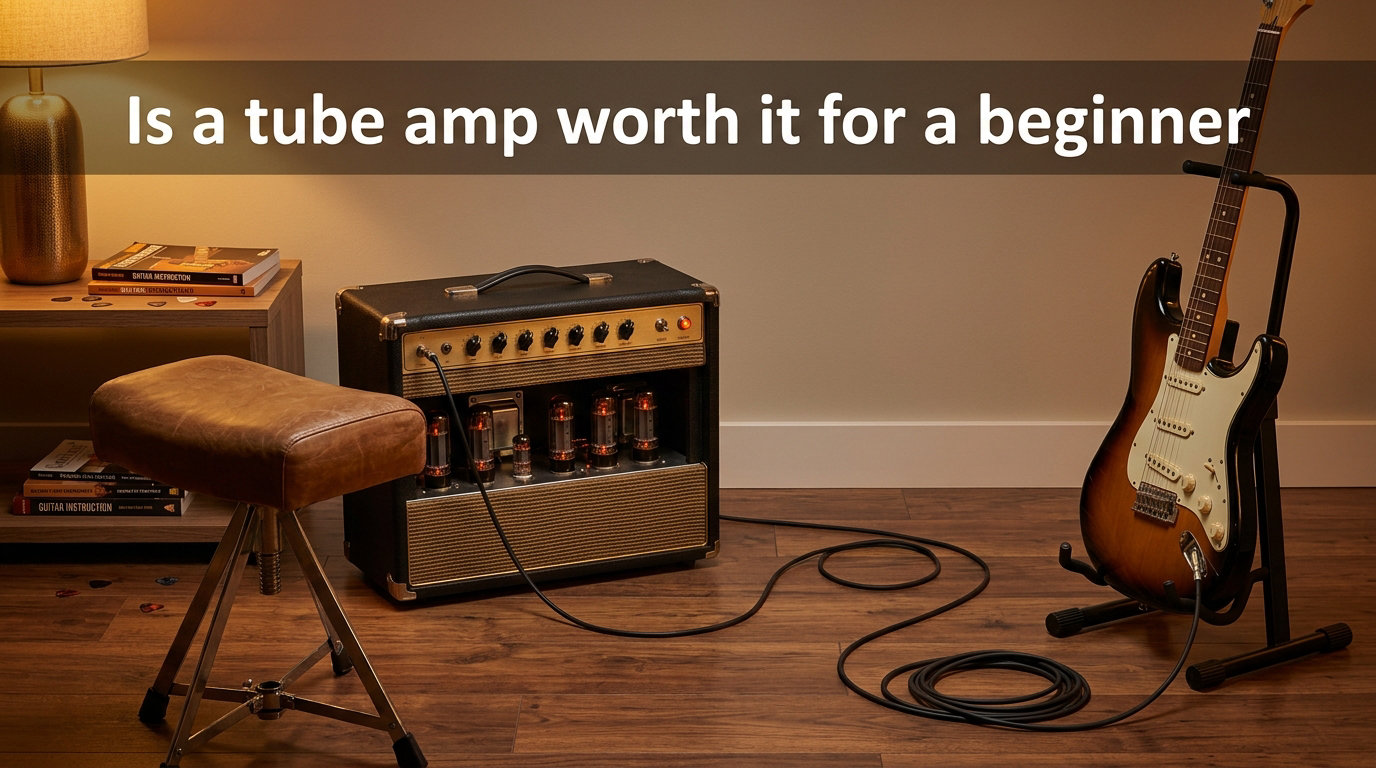
So you are staring at a wall of amps, or maybe scrolling through endless forum threads, and the same question keeps coming up: is a tube amp worth it for a beginner? It is one of the most asked questions in guitar forums for 2026, and the answers you find online tend to swing between two extremes. One camp insists tubes are the only “real” amplifiers. The other says modeling amps and solid-state options have closed the gap and you should save your money.
I have spent years watching beginners wrestle with this exact decision, and the truth sits somewhere in the middle. A tube amp can absolutely be worth it for the right beginner, but for many new players it adds cost, maintenance, and frustration that slows down the learning process. In this guide I will walk you through what a tube amp actually is, how it sounds different, what it costs to own one, and whether it fits your situation.
By the end you will have a clear, honest answer to whether a tube amp is worth it for a beginner in your specific case, plus practical advice for your first practice setup.
Table of Contents
What Is a Tube Amp? A Beginner-Friendly Definition
A tube amp, also called a valve amp, is an amplifier that uses vacuum tubes to boost the electrical signal from your guitar. Those glass bulbs glowing inside the chassis are the vacuum tubes, and they do the actual amplification work instead of the silicon transistors found in solid-state amps. This design goes back decades and is still used in many of the most revered amplifiers ever built.
The vacuum tube has three main parts: a filament that heats up, a cathode that releases electrons when heated, and a plate that collects them. Your guitar signal controls the flow of those electrons, and the tube multiplies that tiny signal into something powerful enough to drive a speaker. It sounds simple, but the way tubes behave near their limits is what gives them their famous character.
For a beginner, the practical takeaway is this: tube amps are an older, more hands-on technology that produces a sound many players describe as warmer, livelier, and more responsive than a solid-state amp at the same price. They also need more care, run hotter, and usually cost more for the same wattage.
How Tube Amps Create Their Signature Sound
The reason players fall in love with tube amps comes down to how the tubes distort the signal as they approach their maximum output. Unlike solid-state circuits, which sound harsh and brittle when pushed to their limit, tubes produce what engineers call even-order harmonic distortion. Our ears tend to hear those even harmonics as musical, warm, and pleasing.
When you dig into a note hard, a tube amp compresses the signal slightly and adds growl. When you play softly, the amp cleans up. Players call this touch sensitivity, and it is the single most common reason cited for preferring tubes. Your hands feel directly connected to the sound in a way that is hard to describe until you experience it.
Tube amps also exhibit something called sag. The power supply reacts a fraction of a second slower than your pick attack, creating a spongy, compressed feel that many blues and rock players love. Push the amp harder and you hit breakup, the point where the clean tone transitions into natural overdrive. This entire dynamic range, from sparkling clean to roaring distortion, is controlled with your volume knob and pick attack, not a footswitch.
Tube vs Solid State: The Key Differences
Tube amps and solid-state amps do the same job, but they get there through very different engineering, and those differences matter a lot for a beginner deciding where to spend their money. The table below breaks down how the two compare across the categories that actually affect your daily playing.
| Factor | Tube Amp | Solid-State / Modeling Amp |
|---|---|---|
| Sound character | Warm, touch-sensitive, natural breakup | Clean and consistent, sometimes described as lifeless |
| Price for comparable wattage | Higher | Lower |
| Best tone at | Higher volumes | Any volume, including headphone levels |
| Maintenance | Tube replacement, occasional biasing | Essentially none |
| Weight | Heavier due to transformers | Lighter overall |
| Versatility | Usually one or two great sounds | Hundreds of amp models and effects |
| Reliability | Tubes wear out and can fail | Very reliable, long lifespan |
| Headphone jack | Rare | Common, often with speaker emulation |
Notice the pattern. Tube amps win on feel, character, and emotional connection. Solid-state and modeling amps win on convenience, cost, versatility, and quiet practice. Neither is objectively better, which is exactly why this question is so personal.
Modern modeling amps have closed the gap dramatically in the last few years. Products like the Boss Katana, Yamaha THR series, and Positive Grid Spark give beginners dozens of convincing amp models, built-in effects, headphone jacks, and quiet practice at a fraction of what a similar tube amp would cost. For someone learning at home in 2026, that combination is hard to beat.
The catch is that even the best modeling amp still feels slightly different under your fingers. Players who have spent time with both often describe tubes as having a three-dimensional quality that modeling has not fully replicated. Whether you would notice that difference as a beginner is another question entirely.
Pros and Cons of Tube Amps for Beginners
Tube amps have real strengths and real trade-offs, and a beginner should walk in with both eyes open. Here is an honest breakdown.
Pros of Starting on a Tube Amp
The biggest advantage is inspiration. A tube amp that sounds great makes you want to pick up the guitar, and that motivation matters more than any spec sheet. Players who start on tubes often credit the sound for keeping them practicing through the difficult early months.
Tube amps also teach you dynamics. Because they respond to your touch, you learn to control your volume and tone with your hands instead of pedals. That skill transfers to every other amp you will ever play.
If you play rock, blues, classic country, or jazz, a tube amp nails the tones those genres are built around. You are learning on the same type of gear your heroes used, which is a genuine advantage for tone development.
Tube amps also hold their value well. A well-made tube amp from a respected builder can last decades and sell for close to what you paid if you decide to move on.
Cons of Starting on a Tube Amp
The biggest drawback is cost, both upfront and ongoing. A tube amp in the same wattage range as a $200 solid-state amp often runs $400 to $800, and you will eventually need to replace tubes that cost $20 to $60 each.
Tube amps need volume to sound their best. That warm, touch-sensitive magic kicks in when the amp is working, which often means louder than your neighbors, roommates, or sleeping children will tolerate. Practicing at bedroom levels on a tube amp can be frustrating and unsatisfying.
Maintenance is real. Tubes wear out, microphonics develop, and occasional biasing is required on some designs. If something goes wrong, you usually need a technician, which means downtime and repair bills.
Most beginner tube amps also lack modern features like headphone jacks, built-in effects, USB recording, and Bluetooth. You give up a lot of convenience for the sake of tone.
Is a Tube Amp Worth It for a Beginner? The Honest Answer
Here is the direct answer: a tube amp is worth it for a beginner who has space to play at moderate volume, leans toward rock, blues, or jazz, and is willing to spend more upfront and accept some maintenance. For everyone else, a solid-state or modeling amp is usually the smarter first amp.
Your living situation matters more than any tone debate. If you live in an apartment with thin walls, share walls with neighbors, or practice mostly late at night with headphones, a tube amp will fight you every step of the way. You will spend money on an amp you cannot fully enjoy, and that is exactly the kind of experience that pushes beginners to quit.
On the other hand, if you have a basement, garage, or dedicated practice room where you can crank the volume without complaint, a small tube amp in the 5 to 15 watt range can be magical. Models like a Vox AC4, Fender Blues Junior, or a budget option like the Monoprice Stage Right 15W are commonly recommended in forums as great first tube amps because they sound good at manageable volumes.
Your goals matter too. If you dream of playing classic rock, blues leads, or smooth jazz, the touch response and natural breakup of a tube amp will teach your hands skills that translate directly to the genres you love. If you want to play modern metal, djent, or electronic-tinged styles, you are better served by a high-gain solid-state or modeling amp with the effects and tonal precision those genres demand.
Your budget matters most of all. If buying a tube amp means skipping lessons, settling for a worse guitar, or stressing about the cost, it is not worth it. A $200 modeling amp paired with a good teacher will take you further than an $800 tube amp you cannot afford to repair.
Maintenance and Cost Realities of Owning a Tube Amp
Tube amps are not plug-and-play forever. The tubes themselves have a lifespan measured in years of regular use, and replacing a set of preamp and power tubes typically runs $50 to $150 including labor. Some designs also need biasing when you swap power tubes, which adds another $40 to $80 if you use a technician.
Tube amps run hot and should not be moved immediately after a long session. They are heavier than equivalent solid-state amps because of their output transformers, which means a 15-watt tube combo can weigh as much as a 50-watt solid-state head.
Common sense care extends the life of your tubes and amp. Let the amp cool before moving it, use a surge protector, keep it covered when not in use, and avoid running it without a speaker connected. Following those rules, most beginner tube amps will give you years of reliable service.
FAQ: Tube Amps for Beginners
Are tube amps good for beginners?
Tube amps can be good for beginners who have space to play at moderate volume and want a warm, touch-responsive tone, especially for rock, blues, or jazz. For beginners practicing quietly with headphones or on a tight budget, a solid-state or modeling amp is usually a better fit.
Do you really need a tube amp?
No, you do not need a tube amp to learn guitar or to sound good. Modern modeling and solid-state amps cover most tones convincingly. You only need a tube amp if you specifically want the dynamic feel and natural breakup that tubes provide.
What are the disadvantages of tube amps?
The main disadvantages are higher upfront cost, ongoing tube replacement costs, the need to play at higher volumes for the best tone, added weight, heat, and the lack of modern features like headphone jacks and built-in effects on many models.
Is a 20W tube amp enough to gig?
Yes, a 20-watt tube amp is usually enough to gig in small to mid-size venues, and it can even keep up with a drummer in many situations. Tube watts are louder than solid-state watts, so a 20W tube amp often feels comparable to a 50W or higher solid-state amp.
Conclusion: Making the Right Call for Your First Amp
Deciding whether a tube amp is worth it for a beginner comes down to three honest questions. Can you play at the volume tubes need to sound their best? Does the music you want to make benefit from tube tone? And can you afford the higher upfront cost plus occasional maintenance without stress?
If you answered yes to all three, a small, well-reviewed tube amp in the 5 to 15 watt range is a fantastic first amplifier that will inspire you for years. If you answered no to any of them, a modern modeling amp like a Boss Katana, Yamaha THR, or Positive Grid Spark will give you more sounds, quieter practice, and lower cost while you figure out what you really want.
There is no wrong answer here, only the answer that fits your room, your music, and your budget. Pick the amp that makes you want to play, and you have already made the right choice.