
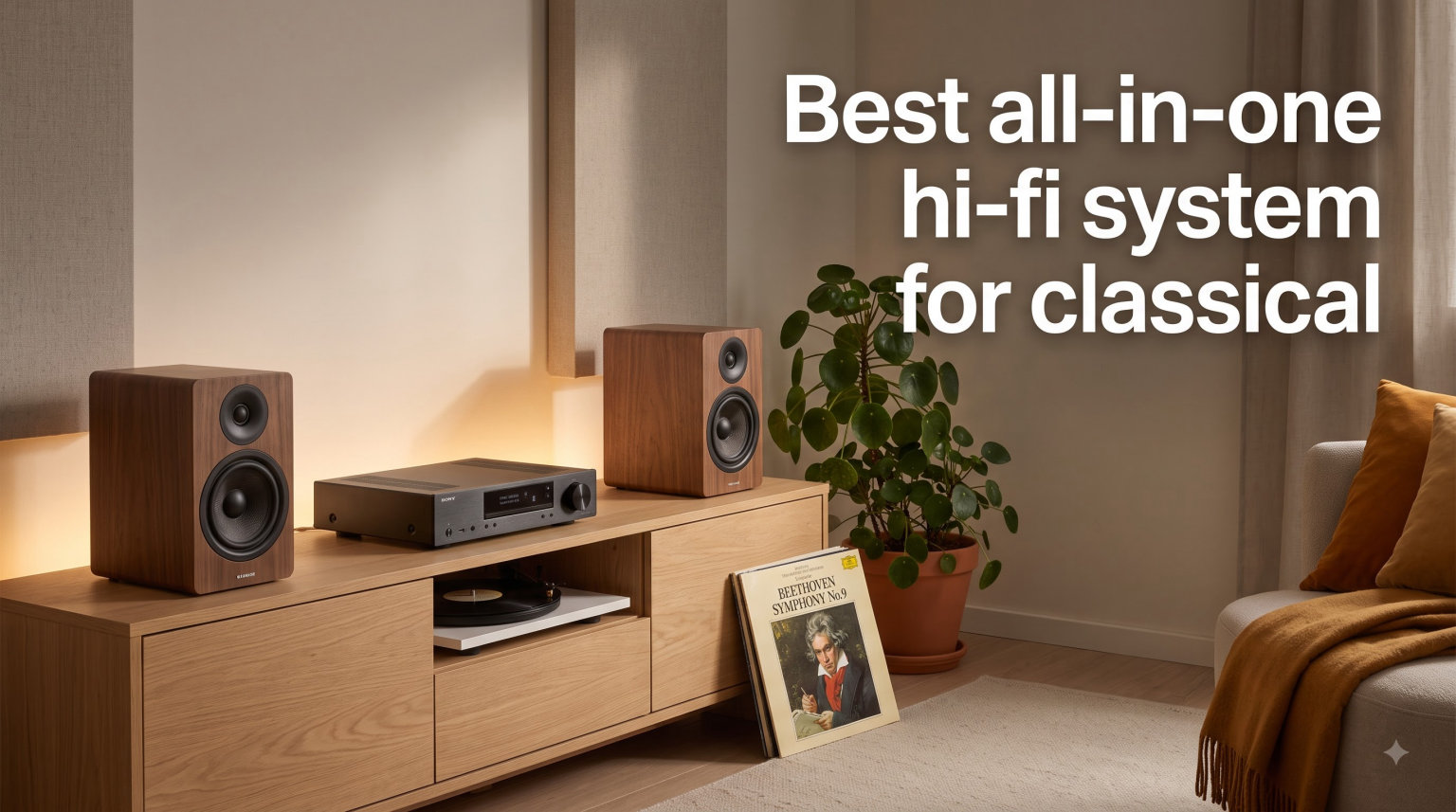
Finding the best all-in-one hi-fi system for classical music can feel overwhelming when every brand claims “audiophile” performance. I have spent years comparing integrated systems against separate components for orchestral works, chamber pieces, and solo piano recordings, and the differences are not subtle. Classical music exposes weaknesses in midrange accuracy, dynamic range, and soundstage that pop and rock playback hides easily.
This guide walks through what makes classical reproduction unique, which technical specifications actually matter, and how to choose a single-box system that genuinely serves the music. Whether you primarily stream Mahler’s symphonies or spin vinyl pressings of string quartets, the right all-in-one system can deliver a concert-hall experience without a rack of separate components.
Table of Contents
Why Classical Music Demands Specific Audio Qualities
Classical music covers a wider dynamic range than almost any other genre. A single orchestral movement can move from a hushed pianissimo solo flute to a full fortissimo brass section within seconds, and lesser systems compress those extremes into a narrow, fatiguing wall of sound.
The genre also relies heavily on tonal accuracy in the midrange. The natural timbre of a Stradivarius violin, the resonance of a Steinway piano, and the breath of an opera singer all live between roughly 200 Hz and 4 kHz. If a speaker colors that region, the instruments stop sounding real.
Soundstage matters more for classical than for most modern genres. A well-recorded symphony places individual sections across a wide arc, with distinct spatial cues for violin, viola, cello, and bass. Bookshelf speakers and floor-standing designs that image precisely give you the sense of sitting in row F of a concert hall rather than hearing a flat stereo mix.
On the audiophile subreddit, classical listeners consistently complain about consumer speakers with bloated, “insane” bass that drowns out cellos and basses. They want tight, controlled low frequencies that let you hear the bow on the string, not generic thump.
The Dynamic Range Challenge
Dynamic range measures the gap between the quietest and loudest passages a system can reproduce cleanly. Classical recordings routinely span 100 dB or more between the softest whisper of a triangle and the full force of a timpani strike.
An all-in-one system with a weak amplifier will either clip during loud passages or squash the quiet ones below the noise floor. Both failures ruin the music.
Why Transparency Beats Excitement
Many consumer and lifestyle speakers are tuned to sound “exciting,” with boosted bass and treble that flatter pop and electronic music. Classical listeners almost universally prefer transparency, meaning the system adds nothing to the recording and reveals what the engineer captured.
When I audition systems for classical, I look for a flat, neutral frequency response and low coloration. If I close my eyes and believe a cello is in the room, the system has done its job.
Key Technical Specifications to Evaluate
Specifications on the back of the box rarely tell the full story, but a few numbers matter more than others when judging an all-in-one hi-fi system for classical reproduction.
Frequency Response
Frequency response describes the range of tones a system can reproduce, usually stated as something like “40 Hz to 20 kHz, plus or minus 3 dB.” For classical, look for a response that extends below 50 Hz on the low end (so you feel the weight of double basses and bass drum) and reaches at least 20 kHz on the high end (so violins retain their airy overtones).
The plus-or-minus tolerance is critical. A system rated “40 Hz to 20 kHz” with no tolerance may roll off the extremes sharply. Aim for plus or minus 3 dB or better across the audible band.
Dynamic Range and Signal-to-Noise Ratio
Dynamic range is the difference between the loudest clean output and the noise floor of the system. A signal-to-noise ratio above 100 dB lets you hear the quietest hall ambience and the softest piano pedaling without hiss.
For classical, this spec matters more than raw wattage. A 50-watt system with a 110 dB signal-to-noise ratio will outperform a 200-watt system that hisses during silences.
Total Harmonic Distortion (THD)
THD measures how much unwanted harmonic content the amplifier and speakers add to the signal. Below 0.1 percent THD at normal listening levels is a sensible target for classical. Anything above 1 percent will start to color string timbre and piano tone.
Impedance and Sensitivity
Speaker impedance, measured in ohms, tells you how hard the amplifier has to work. Most all-in-one systems use built-in amplification matched to their speakers, so impedance mismatches are rare. Sensitivity, measured in dB per watt per meter, tells you how loud the system will play with a given input. Above 85 dB/W/m is good for typical living rooms.
The DAC Built Into Modern Systems
Every modern all-in-one system includes a DAC (digital-to-analog converter) for streaming, CD, and digital inputs. Look for support for high-resolution formats up to 24-bit/192 kHz and native DSD playback if you own SACDs or high-res downloads.
A high-quality DAC preserves the micro-details in classical recordings: the scrape of a bow, the breath before a phrase, the resonance of a concert hall’s wooden stage.
All-in-One vs Component Systems for Classical
There is a long-running debate in audiophile circles about whether separate components always beat all-in-one systems. For classical listeners, the honest answer is that either approach can deliver excellent results, but they serve different priorities.
An all-in-one system packages a streamer, DAC, amplifier, and speakers in one or two boxes. The best modern examples deliver genuinely high-end performance with the convenience of a single power cord and a single remote. For someone who wants to play a recording of Beethoven’s late quartets without fussing over cable choices, the all-in-one path is compelling.
A component system pairs a dedicated streamer, a separate DAC, a stereo amplifier, and a pair of bookshelf or floor-standing speakers. Each piece can be upgraded independently, and the ceiling for ultimate sound quality is higher. The trade-off is cost, space, and complexity.
| Factor | All-in-One System | Component System |
|---|---|---|
| Setup complexity | Minimal, single power cord | Multiple boxes, cables, mains |
| Footprint | Compact, often one shelf | Requires dedicated rack or stands |
| Upgrade path | Replace whole unit to upgrade | Swap DAC, amp, or speakers individually |
| Ultimate ceiling | Very good to excellent | Excellent to reference |
| Best for classical | Chamber, smaller orchestral, opera | Large orchestral, full symphony with dynamics |
| Typical price entry | Around $500 to $1,500 | Around $2,000 and up |
For most classical listeners, a well-chosen all-in-one system in the $1,000 to $3,000 range will reproduce chamber music, solo piano, and orchestral works with stunning realism. If you regularly listen to large Romantic symphonies at concert levels in a big room, separates give you more headroom.
Trusted Audio Brands for Classical Reproduction
A handful of brands appear again and again in classical setups recommended by audiophiles and reviewers. Their reputations come from decades of building speakers and electronics that prioritize the qualities classical music demands.
KEF is widely cited for coaxial Uni-Q drivers that deliver exceptional imaging and a coherent soundstage, perfect for orchestral placement. The LS50 Meta and LSX II are frequent recommendations.
Naim Audio, a British brand, builds integrated amplifiers and all-in-one systems with a house sound that emphasizes rhythmic drive and midrange presence. The Uniti line covers most classical use cases from streaming to CD.
Rega Research focuses on turntables and amplifiers with a transparent, low-coloration character that suits classical especially well. Their Apollo CD player and Brio amplifier are classics.
Cambridge Audio offers strong value in the all-in-one category with the Evo series, which combines streaming, DAC, and amplification in a compact chassis. Yamaha and Technics deliver rock-solid CD/receiver systems that have served classical listeners for decades. Ruark builds beautifully finished lifestyle systems that punch above their size.
Quick Picks by Use Case
- KEF LSX II — Compact, accurate midrange, excellent imaging for chamber music and small ensembles.
- Cambridge Audio Evo 75 — Versatile streaming amp with enough power for moderate orchestral playback.
- Naim Uniti Atom — Refined British sound with serious dynamic capability for symphonic works.
- Yamaha MCR-N870 — Traditional CD/receiver system that handles classical basics with warmth and reliability.
- Ruark R410 — Premium build with a smooth, wide soundstage that flatters opera and choral recordings.
Buying Criteria: How to Choose the Best System
Choosing the best all-in-one hi-fi system for classical comes down to matching the system’s strengths to your room, your listening habits, and the kinds of recordings you play most.
Step 1: Match the System to Your Room Size
A small bookshelf system in a 12-by-15-foot room will image beautifully for chamber music and solo piano. A compact pair will struggle to fill a 25-by-30-foot living room with a full orchestra at realistic levels.
Measure your room and listen at the volume you actually use. A system that sounds strained at your normal listening level is the wrong system, no matter how good it measures on a test bench.
Step 2: Choose Your Sources First
Decide what you will feed the system. If you stream from Qobuz or Tidal, prioritize a streamer with native hi-res support. If you own a large CD collection, a built-in CD/SACD player simplifies the system. If you collect vinyl, look for a built-in phono stage that handles moving-magnet cartridges.
Many listeners combine all three, and the best modern all-in-ones accommodate every source with minimal fuss.
Step 3: Evaluate Connectivity and Multi-Room
Wi-Fi streaming with AirPlay 2, Chromecast, and Spotify Connect covers most listeners. Multi-room support lets you extend the system to other rooms later without replacing what you own.
HDMI ARC is useful if you want to play classical Blu-ray concerts or opera films through the same system without a separate home theater.
Step 4: Set a Realistic Budget
Under $1,000 you can find solid systems for chamber music and casual orchestral listening. From $1,000 to $3,000 you reach the sweet spot where most audiophiles settle for serious classical reproduction. Above $5,000 you enter separates territory where all-in-one options thin out.
Step 5: Listen Before You Buy
Specifications tell you part of the story, but ears tell the rest. Take a familiar recording, ideally something with a full orchestra, a solo piano, and a quiet passage, and listen critically. Can you pick out individual sections? Do cymbals decay naturally? Does the piano pedal work ring out?
Bring your own recordings if possible. A dealer who objects is the wrong dealer.
Common Mistakes to Avoid
Most classical listeners share a few common regrets after upgrading their systems. Avoiding these mistakes saves time, money, and frustration.
Do not chase watts. A 100-watt amplifier into low-sensitivity speakers will sound worse than a 50-watt amplifier driving speakers well-matched to the room.
Do not ignore speaker placement. Putting bookshelf speakers flat against a wall or in corners adds boomy bass that masks cellos and basses. Pull them out into the room, angle them toward the listening position, and use proper stands.
Do not assume Bluetooth is enough. Bluetooth is convenient but compresses the signal. For serious classical listening, Wi-Fi streaming with lossless or hi-res codecs preserves the recording’s full fidelity.
Do not buy a lifestyle speaker tuned for party use and expect it to reproduce a string quartet accurately. If the marketing emphasizes bass, it is not built for classical.
Do not skip room treatment. A thick rug, a few soft furnishings, and careful speaker placement do more for classical clarity than a more expensive amplifier.
Frequently Asked Questions
What is the best sound system for classical music?
The best sound system for classical music delivers wide dynamic range, accurate midrange reproduction, and a precise soundstage. Look for a system with flat frequency response, low total harmonic distortion, and a signal-to-noise ratio above 100 dB so quiet passages remain detailed.
What is the best all-in-one sound system?
The best all-in-one sound system combines a high-quality DAC, a clean integrated amplifier, and matched speakers in a single unit. Leading options include the Naim Uniti Atom, Cambridge Audio Evo series, KEF LSX II, and Ruark R410, each suited to different room sizes and listening priorities.
What audio brands do audiophiles trust the most?
Audiophiles consistently trust KEF for imaging and coherence, Naim for rhythmic drive and refinement, Rega for transparency and low coloration, Cambridge Audio for value, and Yamaha and Technics for reliable, well-engineered CD-based systems.
What is the best sound system for opera?
The best sound system for opera reproduces the human voice naturally with accurate timbre and clear diction. Look for a system with strong midrange presence, low coloration between 200 Hz and 4 kHz, and a wide soundstage that places singers convincingly across the front of the room.
Conclusion
Choosing the best all-in-one hi-fi system for classical music is less about chasing flagship specifications and more about matching the system to your room, your sources, and your listening priorities. Focus on midrange accuracy, dynamic range, and a coherent soundstage, and the rest falls into place.
Start with a clear budget, audition familiar recordings, and trust your ears. With the right all-in-one system, your home can become the concert hall you have been looking for.