
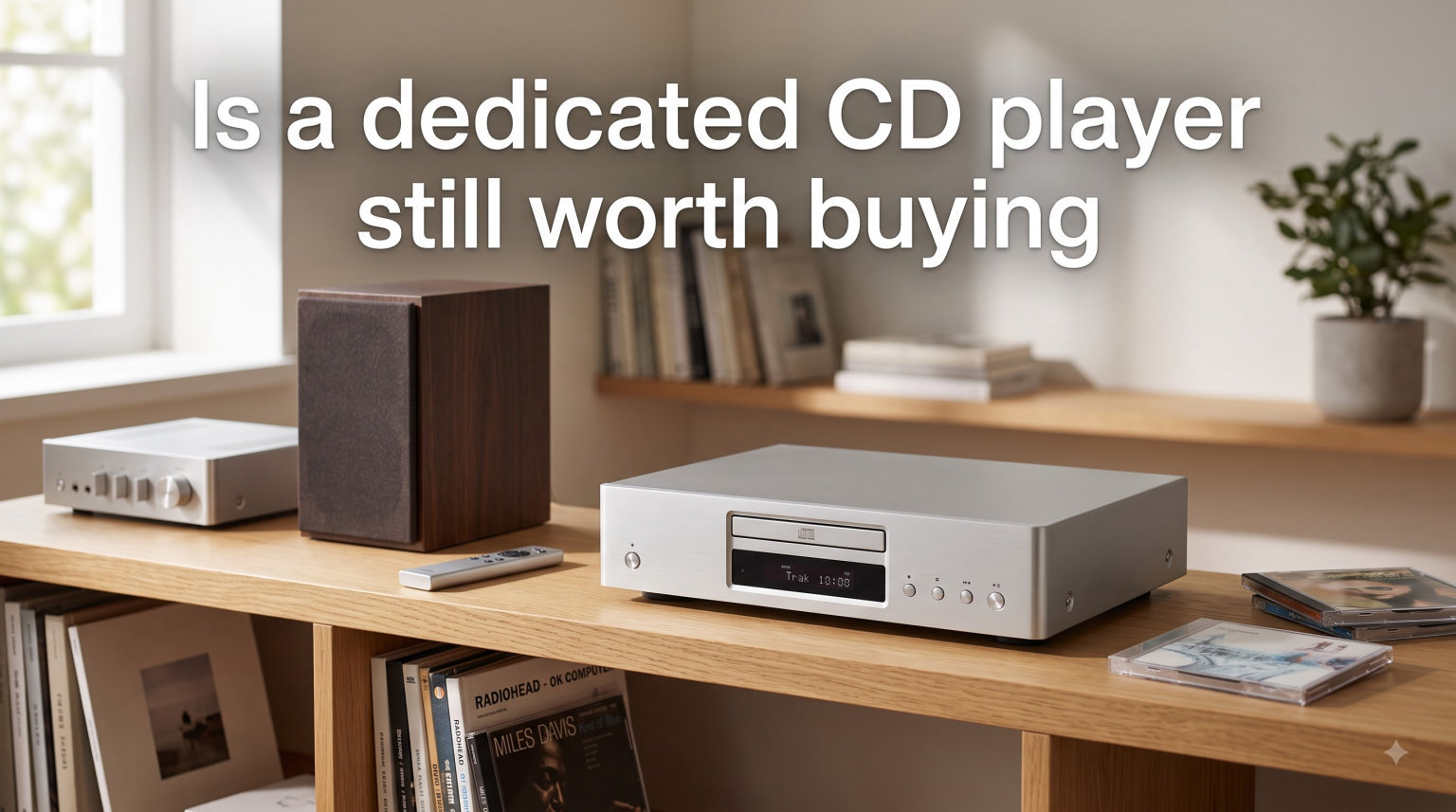
Yes, a dedicated CD player is still worth buying in 2026, especially if you listen to classical music. A dedicated player delivers uncompressed lossless audio, superior digital-to-analog conversion, and a transport mechanism built specifically for reading audio discs, none of which a streaming dongle or a repurposed DVD player can fully match.
For classical music listeners, the case is even stronger. Orchestral recordings carry enormous dynamic range, from a whispered pianissimo to a full fortissimo tutti, and that range is exactly where compression artifacts and weak DACs become audible. A well-built dedicated CD player preserves every detail of a Mahler symphony or a Bach passion in ways that even high-bitrate streaming struggles to replicate consistently.
In this guide, I will walk you through the real-world differences between CD playback and streaming, why the DAC inside your player matters more than the disc format itself, and how to decide whether a dedicated CD player deserves a place in your listening room. I will also address the questions classical collectors ask most often about lifespan, reliability, and value.
Table of Contents
Is a Dedicated CD Player Still Worth Buying?
A dedicated CD player remains worth buying for anyone who owns a physical disc collection, values uncompressed audio, or wants a purpose-built component in their hi-fi system. The format has not faded. In fact, CD sales have been climbing for several consecutive years, with Discogs reporting renewed interest and labels like Deutsche Grammophon and Hyperion continuing to press new releases.
The question is not whether CDs sound good. They do, and they always have. The Red Book standard that defines the CD format specifies 16-bit depth at a 44.1 kHz sampling rate, which captures the full range of human hearing with room to spare. The real question is whether a dedicated player extracts that quality better than the alternatives sitting in your living room right now.
Streaming services like Spotify and Apple Music use lossy compression, typically capping at 320 kbps or 256 kbps. Even CD-quality streaming from Qobuz and Tidal depends on a stable network connection, a capable streamer, and a DAC chain that may or may not match what a purpose-built CD player delivers. A dedicated player removes those variables entirely. You put in the disc, press play, and hear exactly what the mastering engineer intended.
For classical listeners, that consistency matters. You do not want a buffer hiccup during the climax of a Beethoven symphony, and you do not want a streaming tier change to silently downgrade your audio quality. A CD player hands you full control over the listening experience.
Why Classical Music Benefits Most From CD Quality
Classical recordings demand more from your audio system than almost any other genre, and a dedicated CD player handles those demands better than any streaming workaround. The reason comes down to dynamic range, the difference between the quietest and loudest moments in a recording.
A typical pop recording is mastered with heavy compression to keep the volume consistently loud, often squeezing the dynamic range down to 8 or 10 dB. A classical orchestra, by contrast, can easily span 50 to 70 dB of dynamic range across a single movement. A Mahler symphony might drop to near-silence in one bar and erupt into a full brass-and-percussion wall of sound in the next. That is exactly the scenario where lossy compression and inferior DACs reveal their weaknesses.
Here is what happens at the extremes. In the quietest passages, lossy codecs like AAC and Ogg Vorbis sometimes introduce a subtle noise floor or pre-echo, a faint ghost of sound that appears a fraction of a second before the actual note. You may not notice it on a pop track, but in a hushed string section of a Schubert quintet, it becomes audible to trained ears. In the loudest passages, transient peaks from timpani strikes or brass fanfares can be softened or smeared by compression, robbing the music of its visceral impact.
A dedicated CD player reading a Red Book disc avoids both problems. The 16-bit depth provides a theoretical dynamic range of 96 dB, far exceeding what any streaming codec delivers. The uncompressed PCM stream preserves transient spikes exactly as recorded, and a quality DAC converts them cleanly without the artifacts that plague cheaper converters.
This is not audiophile mythology. Blind listening tests and measurement data consistently show that listeners with good equipment can distinguish uncompressed CD audio from high-bitrate compressed audio, particularly on material with wide dynamic range. Classical music is the genre where that difference is most apparent.
There is also an ownership argument that resonates with classical collectors. When you buy a CD of a Karajan recording or a Pollini recital, you own it permanently. Labels can pull titles from streaming platforms, and they do. Your CD sits on the shelf, ready to play exactly as you first heard it, for as long as the disc lasts.
CD vs Streaming: What You Actually Hear
Let me break down the technical comparison between CD playback and streaming in plain terms, because the marketing around streaming quality can be confusing.
A standard CD stores audio as uncompressed PCM data at 16-bit, 44.1 kHz resolution. That translates to a bitrate of 1,411 kbps. Every second of music on a CD contains the full, untouched data captured during mastering. Nothing is thrown away.
Spotify Premium tops out at 320 kbps using the Ogg Vorbis codec. Apple Music peaks at 256 kbps with AAC. Both formats achieve those small file sizes by discarding audio data that the codec determines is inaudible or redundant. In practice, this means removing subtle high-frequency detail, softening transient attacks, and reducing the precision of quiet passages. The result is music that sounds good but not identical to the original.
Even lossless streaming does not fully close the gap for the most demanding listeners. Tidal and Qobuz both offer CD-quality tiers at 1,411 kbps FLAC, which is mathematically identical to CD data. But that data still has to travel through your router, your streamer, and your DAC before it reaches your amplifier. Each link in that chain introduces potential variables, from network jitter to DAC quality differences, that can affect the final sound.
A dedicated CD player eliminates every one of those variables. The laser reads the disc, the transport delivers the data with precise timing, and the internal DAC converts it to analog in one clean, controlled stage. There is no network dependency, no codec decoding, and no question about what bit depth or sample rate you are actually receiving.
For everyday background listening, streaming is genuinely convenient and most people will not hear a difference. But for active, focused listening to a favorite recording, particularly a classical work with intricate detail, the CD player delivers a level of certainty and quality that streaming cannot fully guarantee.
The DAC Explained: Why Dedicated Players Win
The digital-to-analog converter, or DAC, is the single most important component in any digital audio chain. It takes the ones and zeros stored on your CD and transforms them into the analog electrical signal that your amplifier and speakers ultimately reproduce. Every digital audio source, from your phone to a CD player to a streaming endpoint, contains a DAC. But not all DACs are created equal.
A dedicated CD player houses a DAC that was designed for one job: converting Red Book PCM data at 44.1 kHz. The engineers who built it optimized the power supply, the output stage, and the clocking circuitry specifically for that single task. The result is lower jitter (timing errors in the digital signal), cleaner analog output, and better preservation of low-level detail.
Contrast that with a DVD or BluRay player. These devices contain DACs too, but those DACs are engineered to handle video soundtracks, surround sound formats, and multiple sample rates. The audio circuitry shares space and power with video processing hardware, which generates electrical noise that can interfere with sensitive analog output stages. Many forum users on r/BudgetAudiophile report that BluRay players routed through a TV DAC simply do not match the sound quality of even a modest dedicated CD player.
Then there is jitter, the timing accuracy of the digital signal. Jitter causes subtle distortion that manifests as a slight harshness or smearing in the high frequencies. Cymbals, violins, and soprano voices are where jitter artifacts become most noticeable. Quality CD players invest in precision clock circuits and vibration-isolated transports specifically to minimize jitter, something that multi-format players rarely prioritize.
What about using an external DAC with a cheap CD transport? This is a valid approach, and many audiophiles do exactly this. A CD transport reads the disc and outputs the raw digital signal via coaxial or optical S/PDIF to an external DAC of your choosing. This gives you flexibility to upgrade your DAC independently. However, a well-designed integrated CD player often matches or beats this arrangement because the internal DAC and transport are engineered to work together as a matched pair, with synchronized clocking and optimized impedance matching.
The bottom line is that DAC quality is the reason a dedicated CD player sounds better, not some mystical property of the disc format itself. And dedicated players, by definition, invest more of their design budget in that DAC than any multi-purpose device can afford to.
What Makes a CD Player Dedicated
The word dedicated does a lot of work in this discussion, so let me clarify what separates a true dedicated CD player from the alternatives in your home.
A dedicated CD player is built for one purpose: reading audio CDs and converting that data to the highest quality analog signal possible. Every design decision, from the transport mechanism to the power supply to the output stage, serves that single goal. There is no video circuitry, no surround sound processing, and no compromise in the signal path.
The transport mechanism is where you see the biggest difference. A dedicated player uses a precision laser pickup assembly mounted on a rigid, vibration-damped chassis. The spindle motor is selected for low wow and flutter (speed variations that cause pitch instability). The disc clamp holds the CD flat and true so the laser tracks the data spiral accurately. These details matter because any physical instability in how the disc is read translates directly into errors in the digital data stream.
A DVD player uses similar technology, but cost pressures mean the transport is often a generic unit designed for acceptable rather than exceptional performance. Loading times tend to be slower, the mechanisms feel less substantial, and the laser tracking is optimized for the higher data density of video discs rather than the finer demands of audio precision.
The chassis itself matters too. A dedicated CD player typically features a heavy metal case with internal shielding to block electromagnetic interference, plus mechanical isolation feet that prevent vibrations from your speakers or turntable from reaching the laser assembly. Budget multi-format players usually cut corners here, using lighter plastic or thin metal construction that offers less protection against resonance.
None of this means a DVD player sounds bad. For casual listening, the differences may be subtle or inaudible. But if you have invested in quality amplification and speakers, a dedicated player ensures that every component in your chain operates at the same standard.
Key Features to Look for in 2026
If you are shopping for a dedicated CD player, here are the features that genuinely affect sound quality and long-term satisfaction. I have ordered them roughly by importance.
A Quality Internal DAC
Look for players that specify their DAC chip and output stage design. Reputable brands like Marantz, Cambridge Audio, and Rotel publish this information because it is a selling point. A well-implemented DAC with a clean analog output stage will outperform a flashy spec sheet every time.
Gapless Playback
Gapless playback is non-negotiable for classical music. Many symphonies, operas, and song cycles are recorded with movements that flow directly into one another without a break. A player that inserts even a fraction of a second of silence between tracks ruins the musical continuity. Confirm that any player you consider supports true gapless playback, not just short gaps between tracks. This feature is where budget players often cut corners and where dedicated players typically shine.
Balanced XLR Outputs
If your amplifier or preamp accepts balanced XLR inputs, look for a CD player that offers balanced output. Balanced connections reject noise and interference over long cable runs and can deliver a slightly lower noise floor. This is more common on mid-range and premium players but worth seeking out if your system supports it.
Build Quality and Vibration Control
Pick up the player if you can. A heavier chassis generally indicates better vibration damping and a more rigid platform for the transport mechanism. Look for metal construction, quality feet, and a substantial disc clamp. These physical details correlate strongly with sound quality because they reduce mechanical errors in the reading process.
Format Compatibility
At minimum, any player should handle standard Red Book CDs and CD-R discs flawlessly. If you collect SACDs (Super Audio CDs), look for a player that supports that format, as many classical labels released hybrid SACD titles with high-resolution layers. HDCD decoding is another bonus feature that improves playback of discs encoded with that process, though HDCD titles are relatively rare.
Remote Control and Usability
Do not overlook the practical experience of using the player daily. A good remote, intuitive track navigation, and a clear display make listening more enjoyable. These seem like minor details, but you will interact with them every time you play a disc.
When You Should and Should Not Buy a Dedicated CD Player
A dedicated CD player is not the right purchase for everyone. Here is an honest framework to help you decide.
Buy one if you fit any of these profiles
You own a meaningful CD collection, especially classical discs, and you want to hear them at their full potential. Streaming can supplement your listening, but nothing replaces playing the actual disc you own on a player built for the task.
You listen actively and critically. If you sit down with the lights low and focus on the music, the differences between a dedicated player and streaming become real and rewarding. Background listeners may never notice them.
You value ownership and permanence. Labels pull titles from streaming services, formats change, and subscriptions lapse. A CD on your shelf is yours forever, playable on any compatible player, transferable to any future format you choose to rip it to.
Your system is good enough to reveal the difference. If you have invested in quality amplification and speakers, a dedicated CD player completes the chain. Feeding a fine stereo with a compromised source is like putting budget tires on a sports car.
Skip it if any of these apply
You listen exclusively through earbuds or a Bluetooth speaker. The limitations of those devices will mask any source quality differences, and a dedicated player would be wasted on them.
You have no physical CD collection and no intention of building one. Streaming genuinely serves casual listeners well, and there is no point buying hardware for a format you do not use.
Your budget is extremely tight and your system is entry-level. In that scenario, your money may be better spent upgrading speakers or amplification first, where the audible improvements are larger and more immediate. You can always add a CD player later.
CD Player Lifespan and Reliability
One of the most common questions I hear is how long a CD player actually lasts. The honest answer is that it depends heavily on build quality, usage patterns, and the specific components inside.
A well-built dedicated CD player from a reputable manufacturer typically lasts 10 to 15 years of regular use before something needs attention. The most common failure point is the laser pickup assembly, which is a wear item that eventually degrades. Some premium brands still offer replacement laser modules, which extends the practical lifespan considerably. Budget players, unfortunately, often use proprietary mechanisms for which spare parts become unavailable within a few years.
The transport mechanism is the second most common failure area. Belt-driven mechanisms can have their belts replaced cheaply. Direct-drive mechanisms tend to last longer but are harder to service when they do fail. Heavy, well-damped transports generally survive longer than lightweight plastic ones because they experience less mechanical stress.
The second-hand market is a major advantage here. Brands like Rotel, Marantz, and Cambridge Audio have established reputations for longevity, and well-maintained used units from these manufacturers routinely sell for a fraction of their original price on the used market. Forum users on r/BudgetAudiophile frequently report buying excellent Rotel models for around $100 and enjoying them for years. If you are willing to shop used, you can acquire a player that originally cost $1,000 or more for the price of a budget new unit.
For maximum longevity, look for brands that are known for parts availability and serviceability. Marantz, Cambridge Audio, Audiolab, and Rotel are frequently cited by the audiophile community as reliable choices that stand the test of time. Avoid obscure brands with no service network, no matter how appealing the price seems.
FAQs
Is it worth buying CDs in 2026?
Yes, CDs are worth buying in 2026 if you value uncompressed audio quality and permanent ownership of your music. CD sales have been rising for several years, labels continue to press new releases, and the format delivers full 16-bit, 44.1 kHz lossless audio that no lossy streaming service can match. For classical music collectors especially, CDs remain the most reliable way to hear recordings at their intended quality.
Is it still worth having a CD player?
Yes, a CD player is still worth having if you own physical discs or want the best possible audio quality from your collection. A dedicated CD player delivers uncompressed lossless audio, superior DAC performance, and gapless playback that streaming cannot fully guarantee. It is especially worthwhile for classical music, where wide dynamic range reveals the limitations of compressed formats.
What is the average lifespan of a CD player?
A well-built dedicated CD player from a reputable brand typically lasts 10 to 15 years of regular use. The laser pickup assembly is the most common failure point, and premium brands often offer replacement parts that extend the practical lifespan further. Budget players with proprietary mechanisms may last only 5 to 8 years before parts become unavailable.
Who makes the most reliable CD player?
Marantz, Cambridge Audio, Rotel, and Audiolab are widely regarded as the most reliable CD player manufacturers based on community feedback and long-term ownership reports. These brands are known for quality transport mechanisms, serviceable components, and parts availability. Rotel in particular is frequently recommended as an excellent value on the second-hand market, with used models lasting decades when well maintained.
Are CD players becoming obsolete?
No, CD players are not becoming obsolete. CD sales have been increasing for several consecutive years, major labels continue to release new titles on the format, and manufacturers like Marantz and Cambridge Audio continue to produce new dedicated models. While streaming dominates casual listening, dedicated CD players remain relevant for audiophiles, classical music collectors, and anyone who values uncompressed audio quality and permanent music ownership.
Is it worth getting a high end CD player?
A high-end CD player is worth it if you have a quality stereo system and listen actively to well-recorded music, particularly classical. Premium players offer better DAC implementation, superior transport mechanisms, balanced outputs, and tighter jitter performance, all of which produce audible improvements on capable equipment. If your system is entry-level or you listen casually, a mid-range player from a reputable brand offers excellent value without the premium price tag.
Final Verdict: Is a Dedicated CD Player Still Worth Buying?
For classical music listeners, the answer is a confident yes. No other format or playback method combines the uncompressed audio quality, the precise DAC performance, and the permanent ownership that a dedicated CD player provides. Classical recordings, with their enormous dynamic range and intricate detail, are precisely the material that exposes the limitations of compressed streaming and multi-purpose players.
If you own CDs and care about hearing them at their best, a dedicated player is not a nostalgic indulgence. It is a practical, lasting investment in your listening experience. Brands like Marantz, Cambridge Audio, and Rotel offer excellent options at every price point, including a thriving second-hand market where quality players change hands for remarkably little money.
Start with your collection and your system. If you have discs worth hearing and equipment capable of revealing the difference, a dedicated CD player earns its place in your listening room and rewards you every time you press play.