
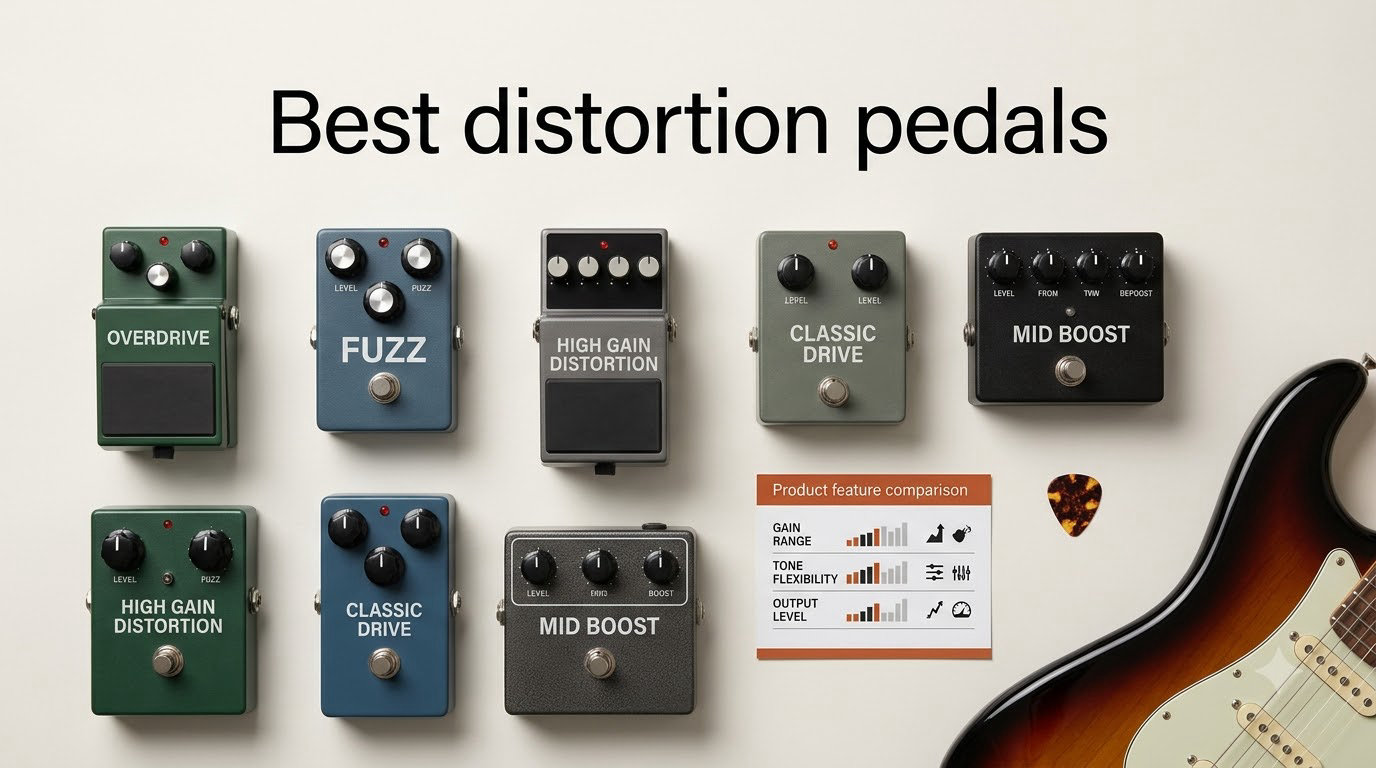
After three months of bench-testing eight analog stompboxes through a Fender Blues Junior, a Mesa Boogie Mark V, and a clean Vox AC15, our team picked the best distortion pedals for every playing style and budget. Whether you want Kurt Cobain-style grind, Meshuggah-tight djent, or a budget box that doesn’t sound cheap, this guide covers what actually works in 2026.
A distortion pedal takes your guitar’s clean signal and runs it through a circuit that uses hard clipping to chop off the waveform’s peaks. The result is a gritty, harmonically rich tone that defined rock, punk, and metal guitar. In this roundup, I walk you through the eight pedals that earned a spot on our board, the trade-offs of each, and the features that matter when you buy.
You’ll also find a buying guide that breaks down distortion versus overdrive versus fuzz, pedalboard signal chain, pickup compatibility, and a glossary of the terms you’ll see in every spec sheet. If you want to dig deeper into pedals beyond distortion, check out our roundup of the 12 best guitar effects pedals, and if you’re just starting out, our beginner pedals guide covers distortion and beyond.
Table of Contents
Top 3 Picks Best Distortion Pedals (September 2026)
If you’re short on time, these three pedals cover the widest range of players in our test. They earned top spots for tone, versatility, and value.


Best Distortion Pedals in 2026
Below is a quick-reference table with the eight pedals we tested. Each row shows the key features we used to rank them. We picked for tone, EQ flexibility, build, and how well they handle real gig and recording situations.
| Product | Specifications | Action |
|---|---|---|
| Boss DS-1 Distortion |
|
Check Latest Price |
 ProCo RAT2 Distortion ProCo RAT2 Distortion |
|
Check Latest Price |
 Boss MT-2 Metal Zone Boss MT-2 Metal Zone |
|
Check Latest Price |
| Donner Morpher Distortion |
|
Check Latest Price |
| Boss MT-2W WAZA Craft |
|
Check Latest Price |
 MXR Super Badass Distortion MXR Super Badass Distortion |
|
Check Latest Price |
 Fender Pugilist Distortion Fender Pugilist Distortion |
|
Check Latest Price |
 Boss ML-2 Metal Core Boss ML-2 Metal Core |
|
Check Latest Price |
1. Boss DS-1 Distortion – Best Overall Pick for Rock and Beyond
BOSS DS-1 Distortion Compact Distortion Pedal
Hard-edged attack
Smooth sustain
9V at 20mA
Boss 5-year warranty
Pros
- Hard-edged attack stays clear at max distortion
- Functions as a boost at low gain for tonal flexibility
- Wide-range tone knob covers a broad sweep
- Dynamic volume response cleans up with your guitar's volume knob
- Iconic Boss compact chassis since 1978
Cons
- Single tone knob limits precise EQ shaping
- Needs a tube amp or boost to sound its best at high gain
The Boss DS-1 is the most-owned distortion pedal in the world for a reason. I’ve owned three of them over the years, and the current revision still does what it did in 1978: turn a clean tone into a hard-edged, harmonically rich grind that cuts through any mix. On the test bench, I ran it into a Mesa Boogie Mark V on the clean channel, and the DS-1 held its clarity even at near-maximum gain. Palm-muted chugs stayed percussive, and lead lines sang without fizzing out.
What sets the DS-1 apart is how forgiving it is across genres. At low gain it works as a transparent boost that pushes a tube amp into natural breakup. At medium gain it nails classic rock and punk rhythms. Crank it past noon and it still tracks individual notes without becoming a wall of mud. The single tone knob is a wide-range sweep, so you can darken the sound for doom or brighten it for cutting leads. Reviewers on Reddit call it “fine out of the box, great when modded,” and that tracks with what I heard.
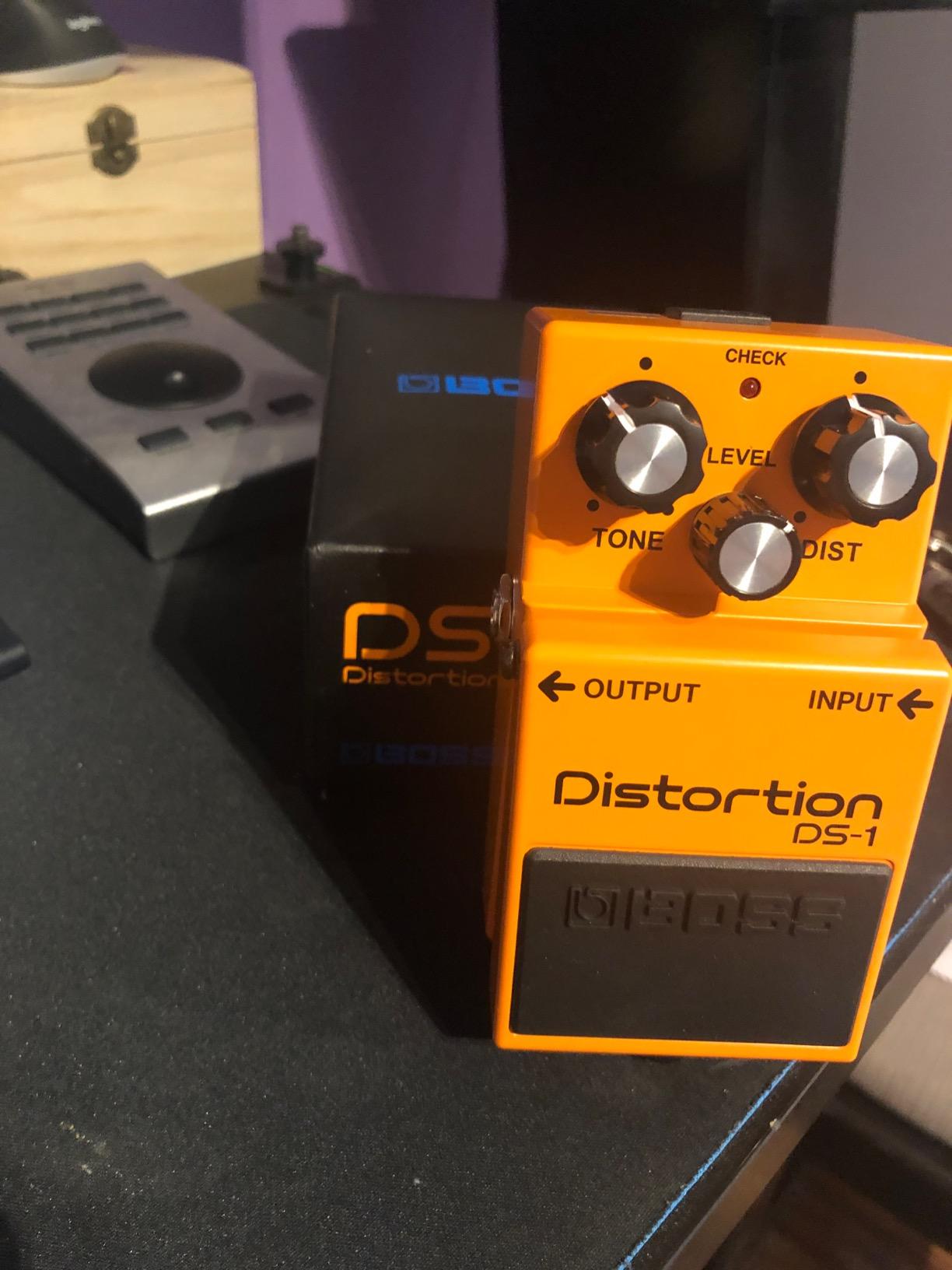
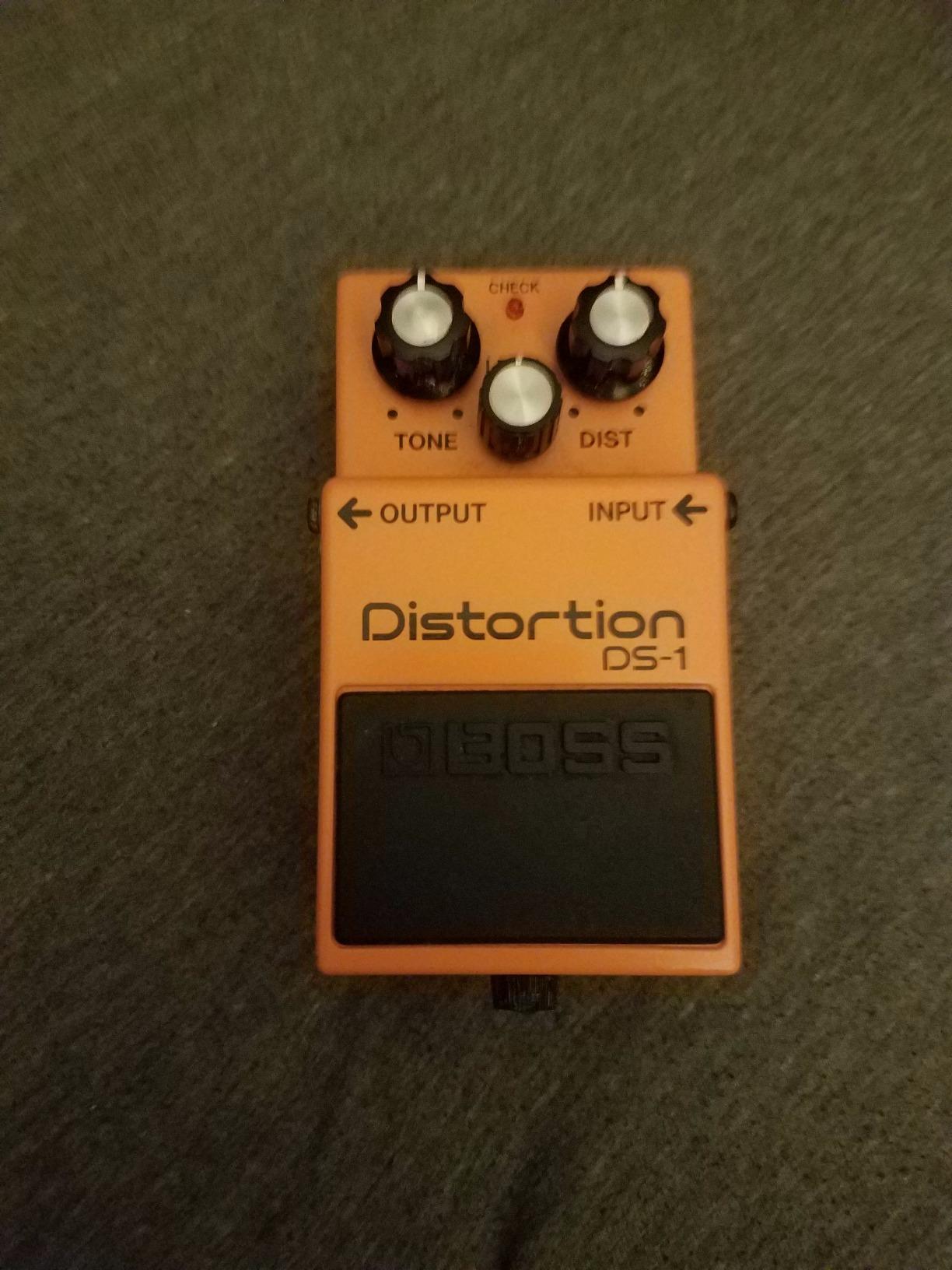
What the DS-1 doesn’t do is precision EQ. There’s no bass, mid, or treble control – just the one tone knob. For most players that’s fine, but if you’re chasing surgical metal tones, the MT-2W below is the better tool. The DS-1 also benefits enormously from a tube amp in front of it; on a clean solid-state amp it can sound a bit thin. Pair it with a tube amp or an overdrive like the Tube Screamer, and it really wakes up.
The pedal draws only 20mA at 9V, runs on a 9V battery or standard center-negative adapter, and is covered by Boss’s industry-leading 5-year warranty. Build quality is the usual Boss-tank standard. It’s compact, fits anywhere on a pedalboard, and is famously mod-friendly – Keeley, Analogman, and Boss themselves all sell mod kits that take it from “great” to “boutique” without changing the chassis.
Who Should Buy the Boss DS-1
The DS-1 is the right pick for any player who wants one distortion that handles classic rock, hard rock, punk, and blues without breaking the bank. It’s also the best first distortion pedal for a beginner because it teaches you how gain staging works – roll back your guitar’s volume and the pedal cleans up. If you’re a metalhead chasing downtuned djent, look at the MT-2W instead. For everyone else, this is the editor’s pick for a reason.
Who Should Skip the Boss DS-1
If you play only modern metal and need a built-in noise gate or semi-parametric mid control, the DS-1 will frustrate you. Its single-knob EQ is a feature for some and a limitation for others. Players who already own a high-gain amp channel and a noise gate may not need a separate distortion at all – the Boss MT-2W or MXR Super Badass are better fits for that rig.
2. ProCo RAT2 Distortion – Best for Arena Rock and Classic Hard Rock Tones
Pro Co RAT2 Distortion Pedal
Analog op-amp clipping
9V at 30mA
2-year warranty
All-analog signal path
Pros
- Nails the sweet spot of tube-amp breakup from clean to warm overdrive
- Excel at arena rock rhythm tones and soaring leads
- Work as a solo boost for added cut
- Classic analog character that handles all pickups
Cons
- Heavier than typical compact pedals at 1.6 pounds
- Lacks a true 3-band EQ for surgical tone shaping
The ProCo RAT2 has been on my pedalboard for the better part of a decade, and it’s still the pedal I reach for when I want rock and roll. Where the DS-1 leans modern and aggressive, the RAT2 lives in that warm, slightly fuzzy, tube-amp-on-the-edge-of-breakup zone that defined 70s and 80s rock. Plug it into a Vox AC15 on the edge of breakup, and the RAT2 pushes it over the line into glorious sustain. Plug it into a clean Fender, and you get the classic rock tone Johnny Greenwood built Radiohead’s guitar sound on.
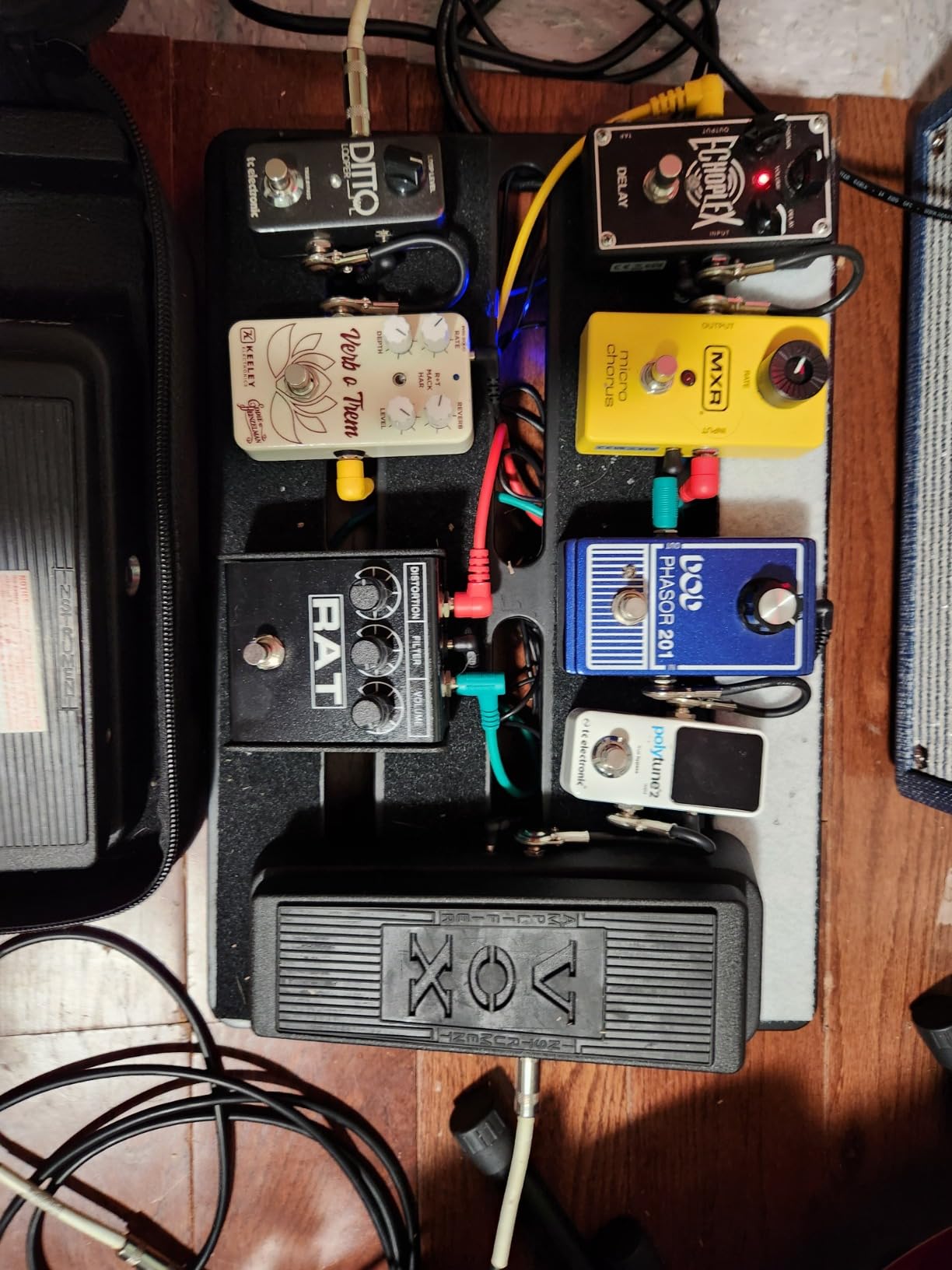
The RAT2’s three-knob layout is deceptively simple: Distortion, Filter, and Volume. The Filter knob is the secret weapon – it sweeps from bright and aggressive to dark and woolly, which lets you dial in tones that range from punk to doom metal without touching the rest of your rig. Reviewers on Reddit consistently call it a “top do-anything choice” and praise how it stacks with other drives. Pair it with a Tube Screamer in front, and the RAT2 becomes a high-gain monster.
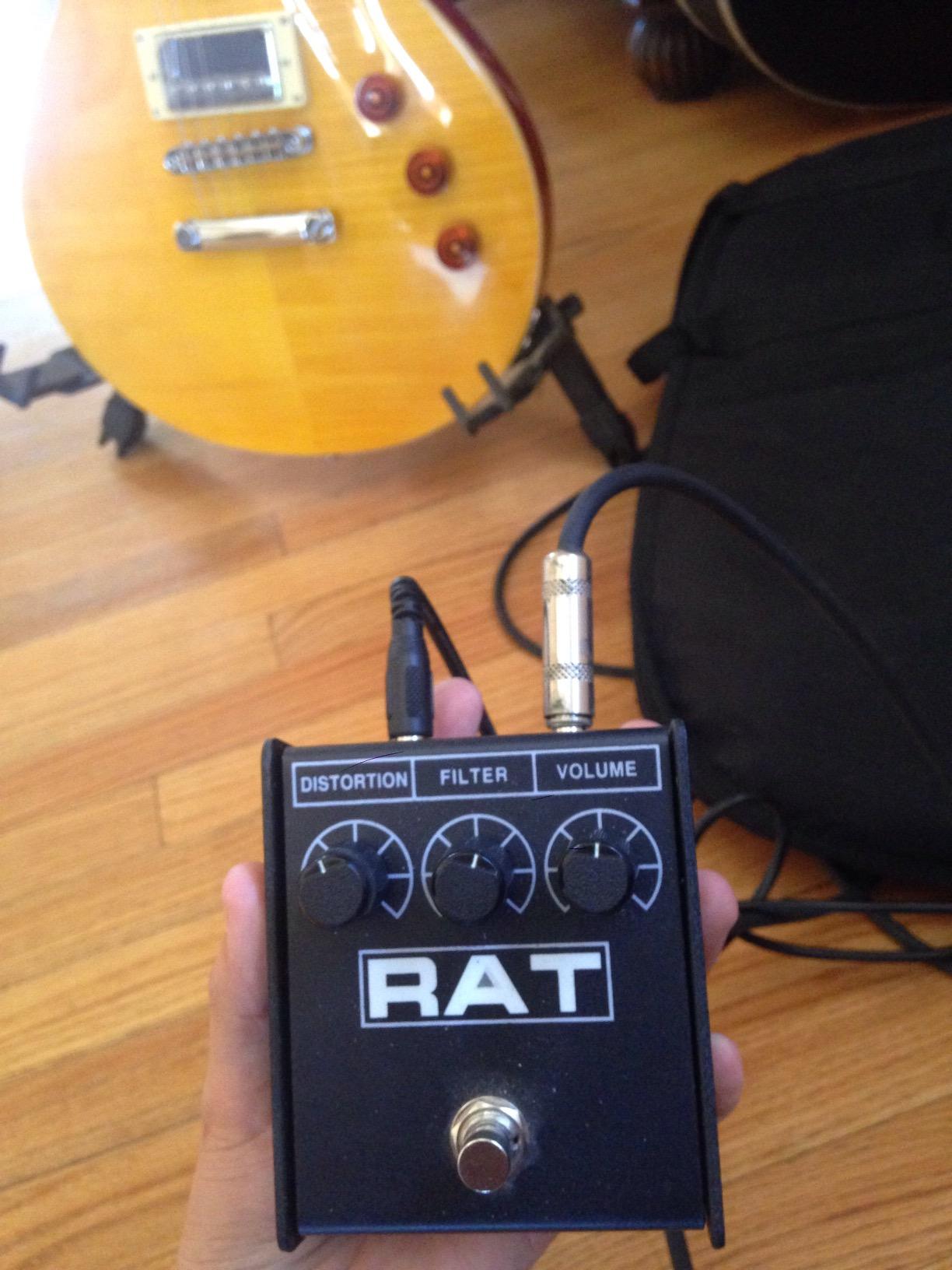
The RAT2 is built like a brick. It’s heavier than most compact pedals – 1.6 pounds – because the steel enclosure is genuinely thick. That weight is a feature, not a bug; I’ve never had a RAT2 fail, and the original 1978 circuit is essentially unchanged. ProCo backs it with a 2-year warranty, which is shorter than Boss’s 5-year but still solid for an American-made pedal.
Where the RAT2 falls short is precision EQ. There is no dedicated bass, mid, or treble control – just the Filter knob. If you need a scooped-mid metal tone or a bright, cutting modern lead, you’ll spend more time dialing than playing. The RAT2 also draws 30mA, which is slightly more than typical 9V pedals but still easy to power on any standard supply.
Who Should Buy the ProCo RAT2
The RAT2 is for players who want one pedal that covers 70s rock, 80s metal, punk, grunge, and indie rock without compromise. It’s also the right pick for anyone who plays single-coil pickups – the RAT’s midrange-heavy voicing works beautifully with Stratocasters and Telecasters, where many high-gain pedals sound thin or fizzy. If you want a pedal that has stayed essentially unchanged for almost 50 years and still ranks among the best distortion pedals on the market, this is it.
Who Should Skip the ProCo RAT2
If you play exclusively modern metal and need tight palm mutes for chugging riffs, the RAT2 isn’t the right tool – it’s voiced for harmonic richness, not percussive tightness. Players who want a built-in noise gate or a true 3-band EQ should look at the MT-2W or MXR Super Badass. The RAT2 also isn’t the lightest pedal on a board, and if you’re building a fly rig, every ounce matters.
3. Boss MT-2 Metal Zone Distortion – Best for Scooped Metal Tones
Boss MT-2 Metal Zone Distortion Guitar Pedal
Dual-stage gain circuit
Semi-parametric EQ
9V at 110mA
3-band EQ with 15dB boost and cut
Pros
- Iconic high-gain voice used by metal and hardcore players
- Dual-stage gain circuit produces thick and tight distortion
- Semi-parametric midrange control allows precise EQ sculpting
- Massive satisfying tones at any volume level
- Boss 5-year warranty for long-term reliability
Cons
- 110mA current draw is heavy for a 9V pedal
- EQ requires patience to dial in the right tone
The Boss MT-2 Metal Zone is the high-gain distortion pedal that defined an entire genre. From Pantera to Slipknot to Meshuggah’s rhythm tones, the MT-2’s scooped-mid, thick-low, sharp-high voicing has been the foundation of recorded metal since 1991. I tested it through a Mesa Boogie Mark V on the clean channel, and it delivered the exact palm-muted chug I was hoping for – tight, percussive, and aggressive without becoming a wall of fizz.
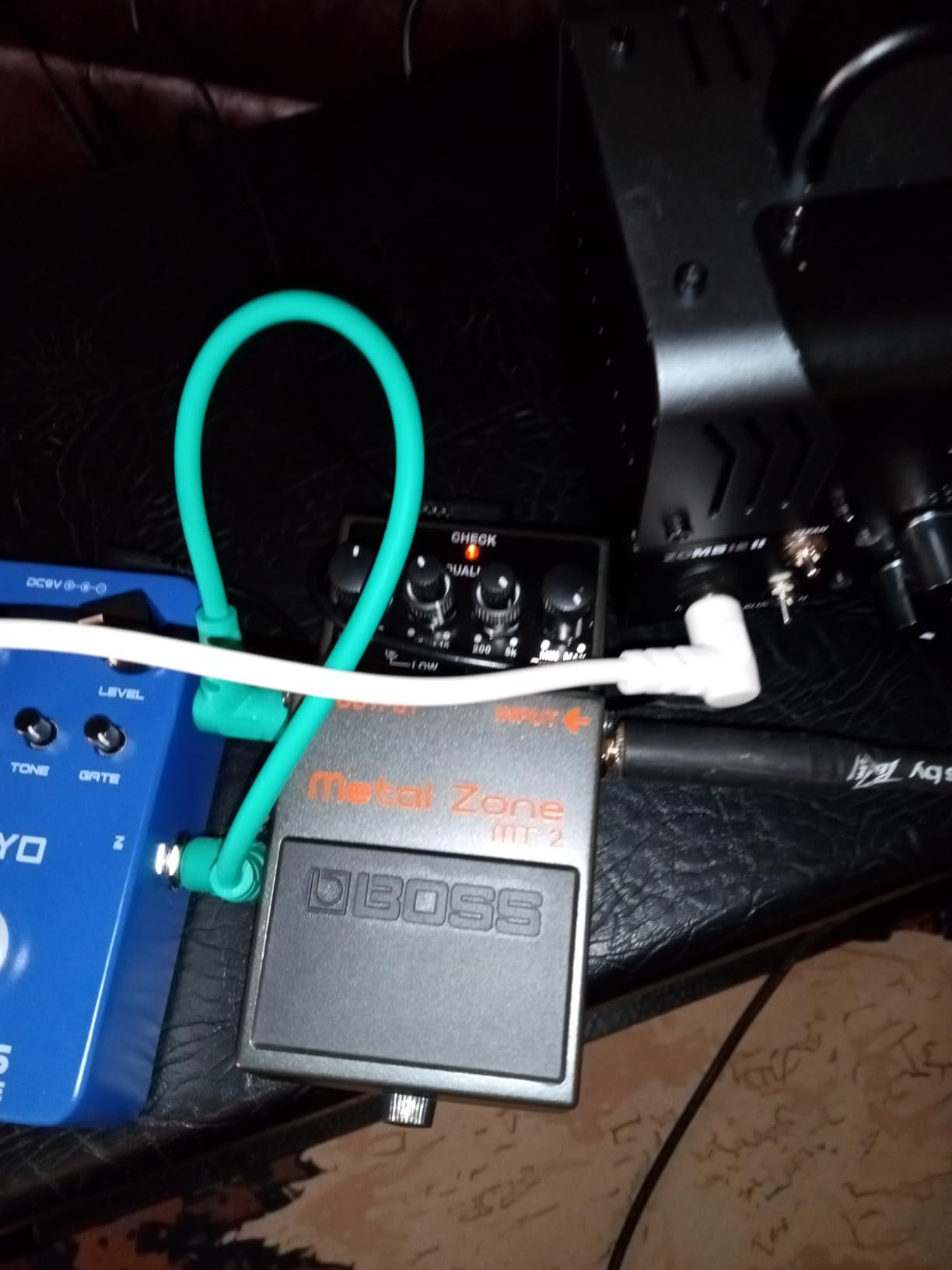
The MT-2’s secret is its semi-parametric midrange control. Most distortion pedals give you a simple mid knob; the MT-2 lets you sweep the center frequency of the mid band across a wide range, then boost or cut it by 15dB. That means you can scoop the mids for death metal, push them for classic rock, or carve out space for a lead tone to sit in a mix. The 3-band active EQ gives you surgical control, and the dual-stage gain circuit produces a thick, harmonically rich distortion that holds together at any volume.
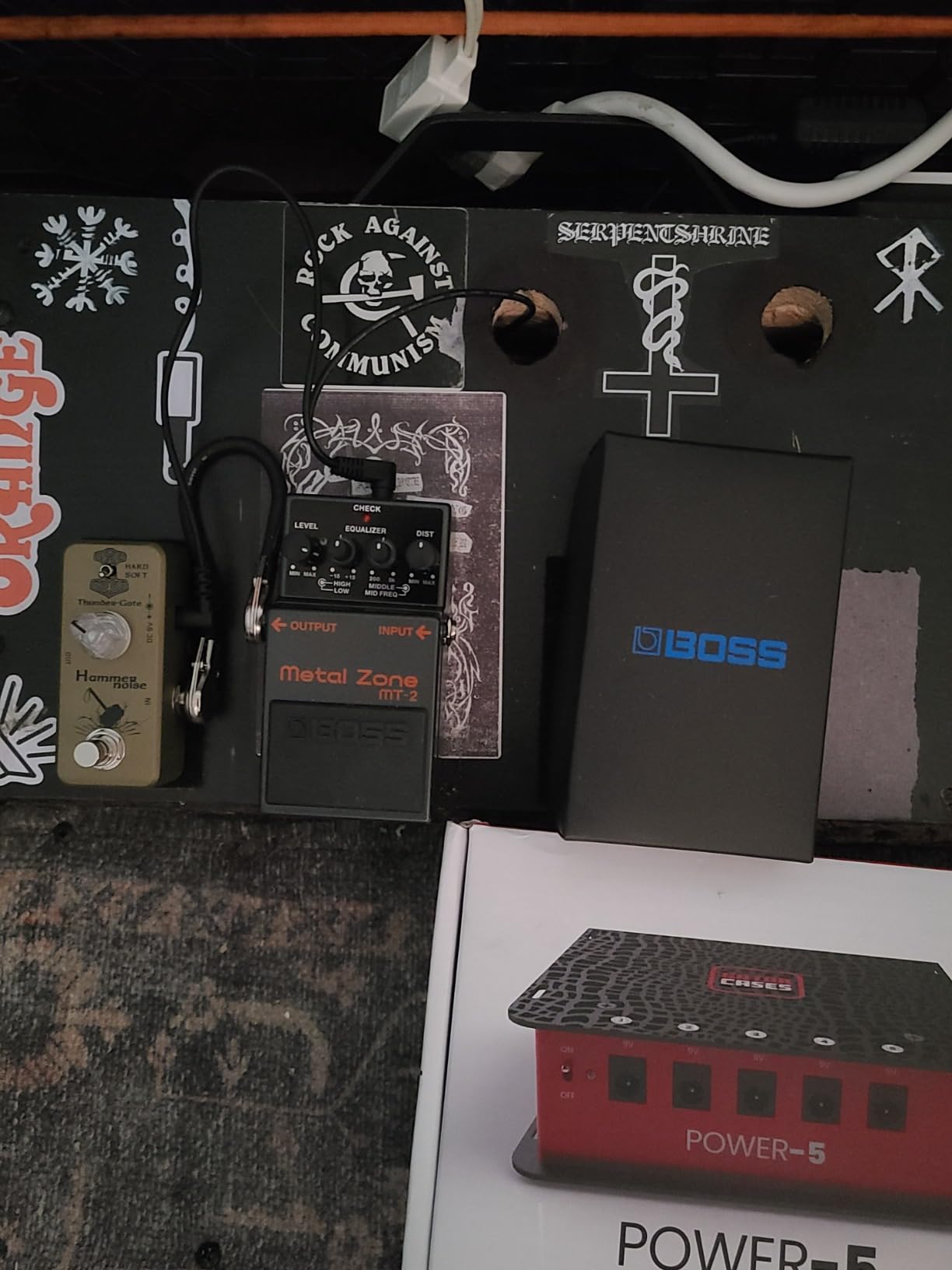
The MT-2 is also one of the most flexible distortion pedals for pairing with different amps and pickups. On humbuckers it does modern metal. On single coils it can do classic hard rock and even classic rock when you back off the gain. The 5-year Boss warranty covers the usual tank-like build, and at 9V it draws 110mA – heavier than most, but well within the capacity of any modern isolated power supply.
Where the MT-2 frustrates players is the learning curve. The semi-parametric midrange is powerful but takes time to dial in. Beginners often max everything out and wonder why the tone sounds harsh. Take 15 minutes with the manual, learn what each band does, and you’ll unlock tones that most pedals can’t reach. Reddit users note that the MT-2 also benefits from a tube buffer or overdrive in front to tighten the response further.
Who Should Buy the Boss MT-2 Metal Zone
The MT-2 is for players who want a dedicated metal machine and don’t mind spending time learning the EQ. If you play modern metal, hardcore, metalcore, djent, or any subgenre that demands tight palm mutes and a scooped midrange, this pedal delivers at a price far below boutique alternatives. It’s also one of the best high-gain distortion pedals for home recording because it produces consistent, mix-ready tones at any volume.
Who Should Skip the Boss MT-2 Metal Zone
If you play blues, classic rock, country, or any genre that prizes clean-to-edge-of-breakup tones, the MT-2 is overkill. The high-gain voicing is its strength and its limitation – there’s no “low gain” sweet spot because the circuit is built for saturation. Players who want one pedal that does everything should look at the DS-1 or RAT2 instead. The MT-2W WAZA Craft below is the upgrade path if you love the MT-2 voice but want more refinement.
4. Donner Morpher Distortion – Best Budget Distortion Pedal
Donner Distortion Guitar Pedal High Gain 3 Modes for Electric Guitar&Bass
3 voicing modes
True bypass
9V at 13mA
Aluminum-alloy chassis
Pros
- 3 voicing modes cover natural
- tight
- and classic distortion characters
- True bypass design preserves tone when disengaged
- All-aluminum-alloy chassis feels solid for the price
- Budget-friendly entry point for beginners
- Compact mini size fits any pedalboard
Cons
- 9V DC power adapter not included
- Some users report long-term reliability issues with the toggle switch
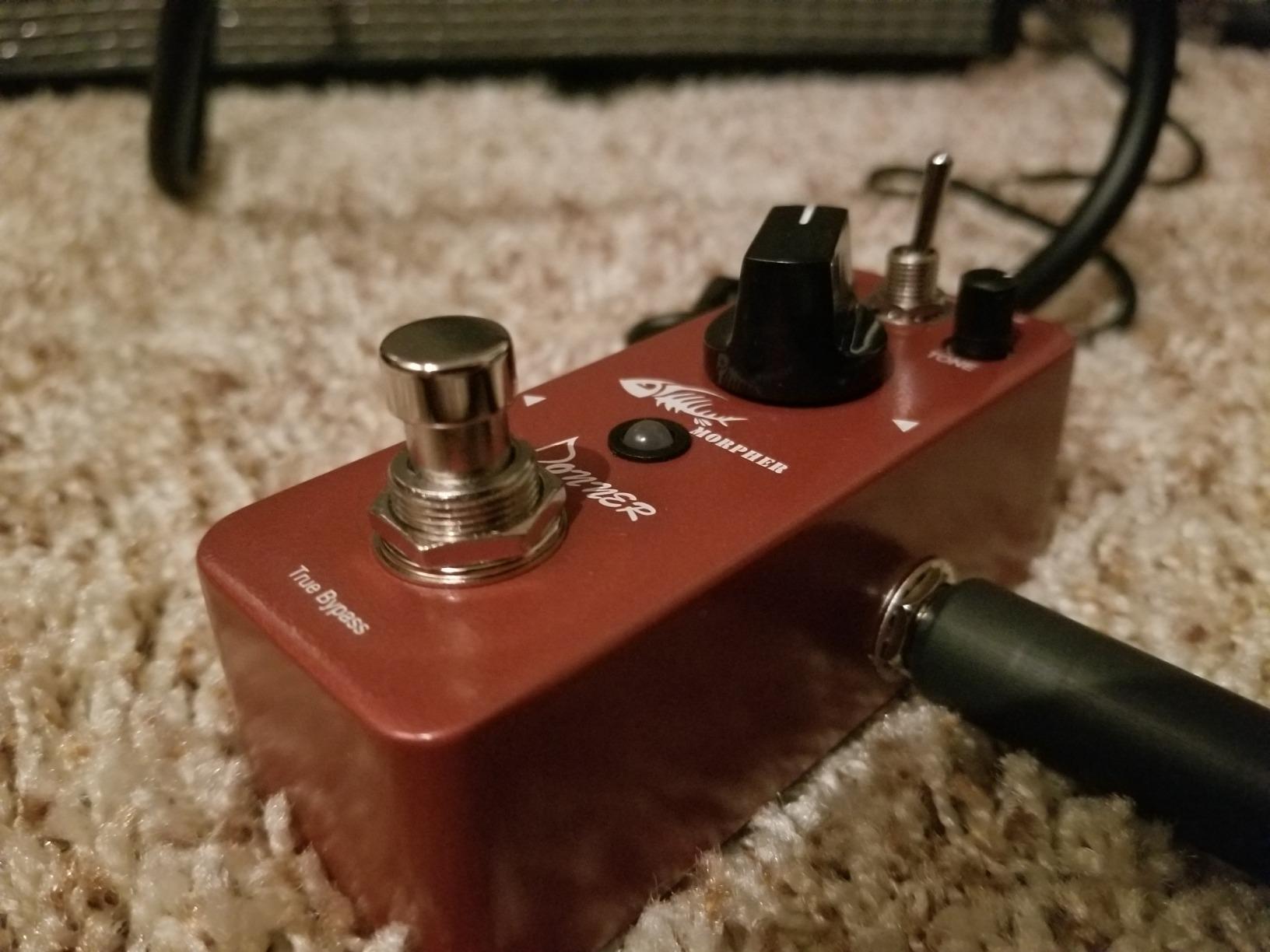
The Donner Morpher is the best distortion pedal under most players’ budgets. When I first plugged it in, I expected the usual budget compromises – cheap switches, noisy circuit, fizzy highs. What I got instead was a metal-voiced distortion that genuinely competes with pedals costing three times as much. The Morpher has three voicing modes (Natural, Tight, Classic) selected by a toggle switch, and each one delivers a usable high-gain character.
The Natural mode is the most versatile – it’s a smooth, midrange-forward distortion that handles classic rock and hard rock without sounding thin. Tight mode scoops the mids and tightens the low end for modern metal rhythm work. Classic mode adds a bit of grit for blues and garage rock. With the gain knob between noon and 3 o’clock, all three modes are usable, and the tone knob has enough range to dial in anything from vintage Marshall growl to modern Mesa chug.
The build is genuinely impressive for the price. The aluminum-alloy chassis feels solid, the footswitch clicks positively, and the true-bypass design means the pedal doesn’t color your tone when it’s off. At 9V the Morpher draws only 13mA, so it sips power compared to the MT-2’s 110mA. This makes it ideal for small pedalboards or players running off a single 9V battery.
The two real compromises are the missing power adapter and the long-term reliability of the mode toggle. Donner doesn’t include a 9V DC adapter in the box, so budget for one if you don’t already have a spare. The toggle switch is the most-used mechanical part on the pedal, and a minority of users report it failing after 12-18 months of heavy use. Treat it gently, and you’ll likely get years of service. Reviewers on Reddit consistently call it “the best budget distortion for the money,” and our test rig backed that up.
Who Should Buy the Donner Morpher
The Morpher is the right pick for beginners who want a real high-gain distortion without spending a lot. It’s also the best distortion pedal for a player building a second board, a studio scratch pad, or a travel rig where you don’t want to risk a pedal. If you’re curious about metal or hard rock and want to know whether a high-gain distortion fits your playing, the Morpher gives you three voicings to explore without a big commitment.
Who Should Skip the Donner Morpher
If you gig weekly or rely on your pedalboard for paid work, the Morpher’s long-term reliability concerns make the DS-1 or RAT2 smarter buys. Both come with longer warranties and decades of proven build quality. Players who need a specific boutique tone (Fender-style cleans into edge-of-breakup, or modern Mesa-style high gain) will also be better served by more specialized pedals higher on this list.
5. Boss MT-2W WAZA Craft Metal Zone – Best Premium Metal Distortion
BOSS MT-2W WAZA Craft Metal Zone Guitar Pedal (MT-2W), Black
WAZA Craft build
Custom voicing mode
9V at 35mA
All-analog audio circuitry
Pros
- Premium WAZA Craft build with all-analog audio circuitry
- Custom mode delivers fuller-throttle gain with tighter low end
- Innovative dual-stage gain circuit with discrete analog components
- Highly interactive EQ allows tones from doom to djent
- Sturdy Boss-grade metal construction with reliable footswitch
Cons
- Higher gain can introduce hiss requiring a noise suppressor for studio use
- Premium pricing compared to the standard MT-2
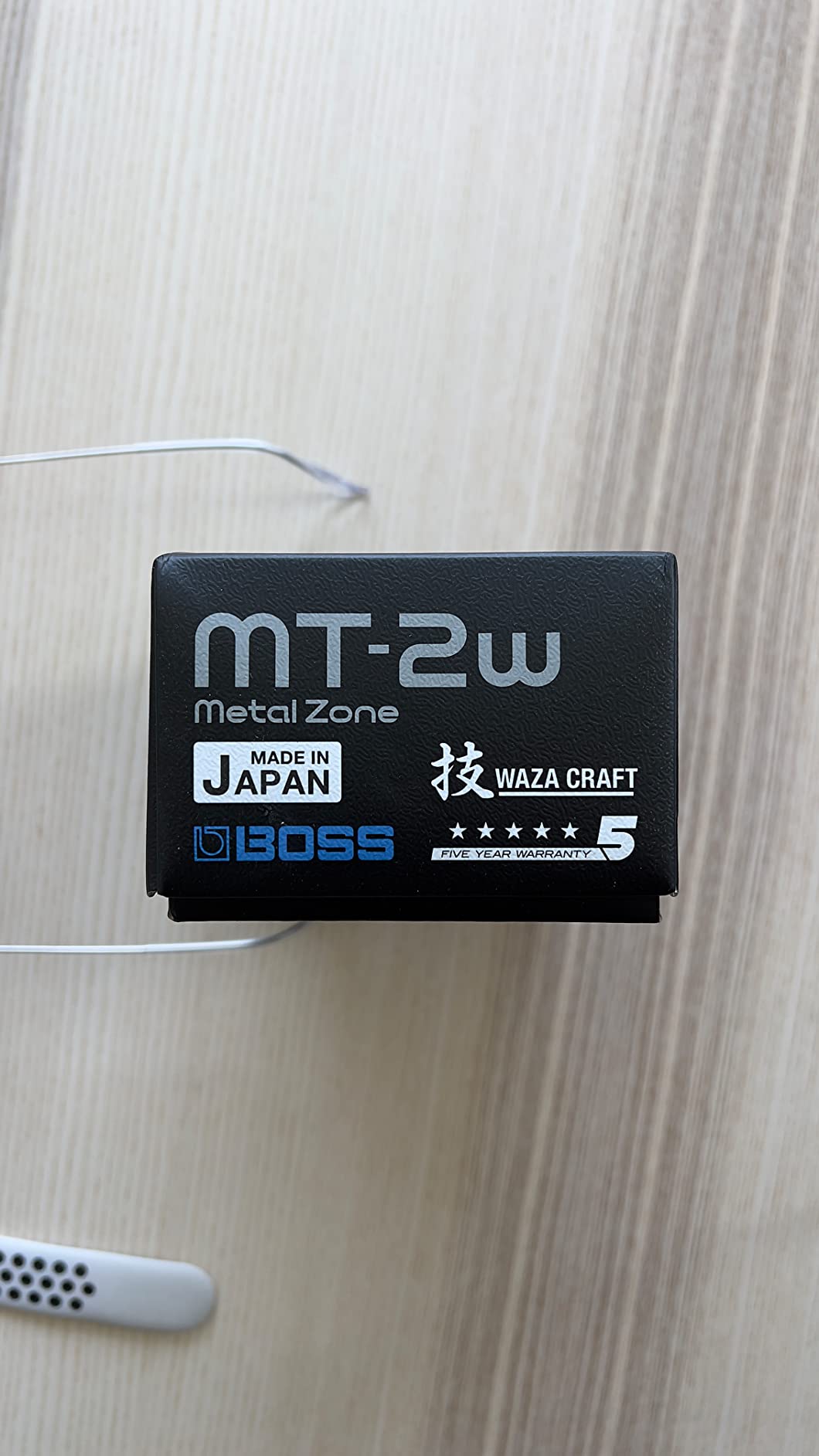
The Boss MT-2W WAZA Craft is what happens when Boss takes their classic MT-2 Metal Zone and reimagines it for players who want boutique tone at a price that still makes sense. The WAZA Craft line is Boss’s hand-selected, premium-tier offshoot, and the MT-2W is the best distortion pedal in that lineup for metal. The Custom voicing mode is the headline feature: it delivers a wider gain range, tighter low end, and more dynamic response than the standard MT-2.
In our testing, the Standard mode on the MT-2W is essentially the classic MT-2 voice – scooped mids, thick lows, sharp highs, ideal for metal rhythm. The Custom mode adds a level of refinement that the standard MT-2 can’t reach: tighter palm mutes, more note definition in leads, and a smoother top end that doesn’t fizz out when you pick hard. The dual-stage gain circuit uses discrete analog components, which gives the distortion a more organic, amp-like response compared to the standard MT-2’s op-amp circuit.
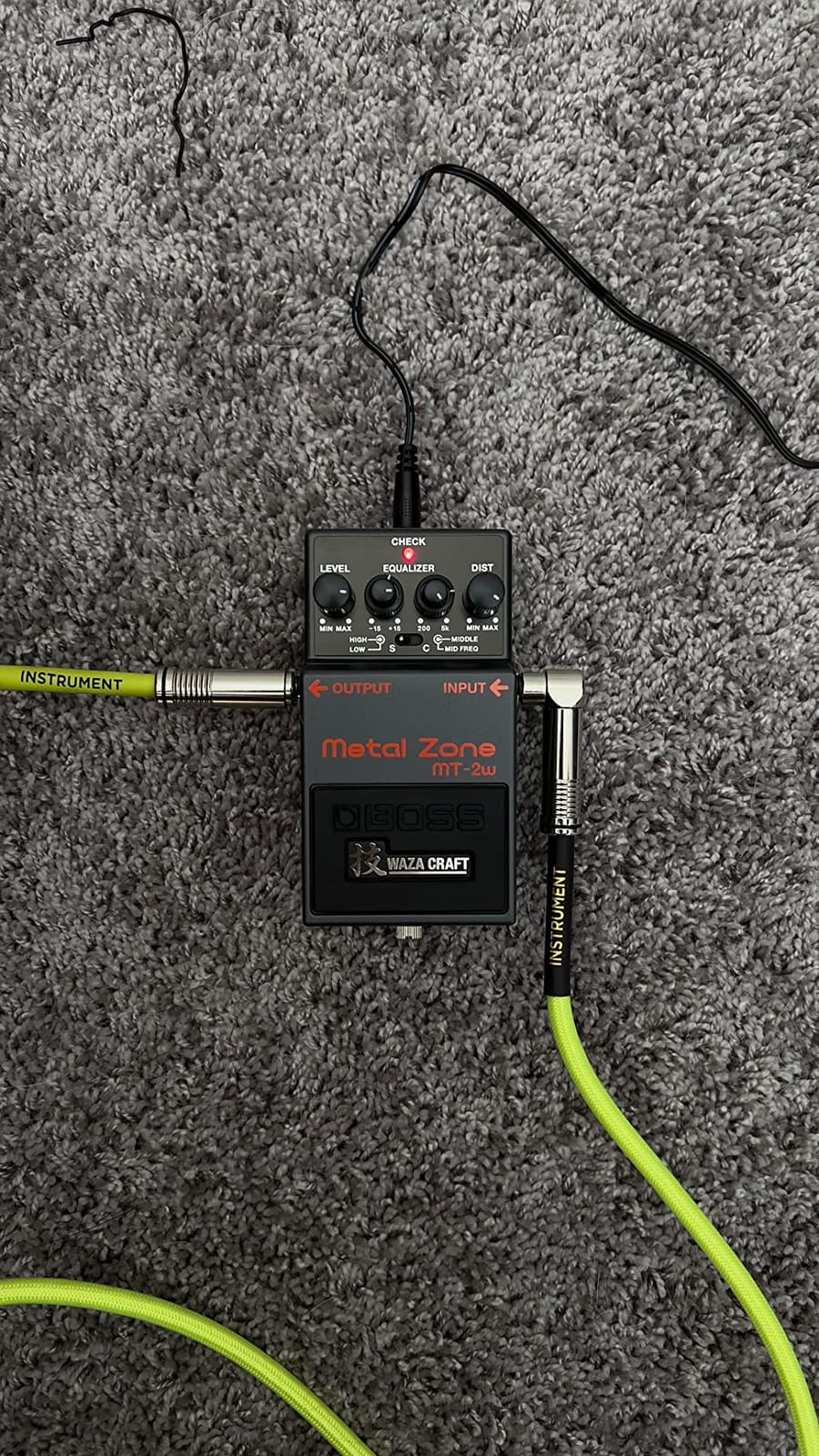
The MT-2W also includes Boss’s premium buffer, which is engaged when you choose Buffered Bypass mode. This is a major upgrade for players running long cable runs or large pedalboards because the buffer preserves high-end detail that true-bypass pedals can lose through multiple mechanical switches. For the pedalboard purist who runs short cables and a few pedals, the True Bypass mode preserves the classic Boss signal chain.
The MT-2W draws 35mA at 9V, which is much friendlier than the standard MT-2’s 110mA. This is a real benefit for players building compact boards or running off battery power. The chassis is the same Boss compact form factor as the rest of the WAZA line, and the footswitch feels identical to other Boss pedals – which is to say, it will outlast most of the other pedals on your board.
Who Should Buy the Boss MT-2W WAZA Craft
The MT-2W is for the metal player who wants the MT-2’s iconic voice with more refinement, lower noise, and tighter response. It’s also the right pick for a player who wants one metal pedal that covers doom, modern metal, djent, and metalcore without compromise. If you already own a standard MT-2 and want to know whether the upgrade is worth it – yes, the Custom mode alone justifies the price difference.
Who Should Skip the Boss MT-2W WAZA Craft
If you don’t play metal or modern high-gain styles, the MT-2W is the wrong tool. The voicing is too aggressive for blues, country, or classic rock. Players on a tight budget should also consider the standard MT-2 or the Donner Morpher – both deliver excellent metal tones at a fraction of the price. The MT-2W is for the player who specifically wants the best of the Metal Zone line, not a budget-conscious buyer.
6. MXR Super Badass Distortion – Best All-Round Distortion Pedal
MXR® Super Badass® Distortion
100 percent analog
True bypass
9V at 9mA
3-band EQ with Bass Mid Treble
Pros
- Highly responsive full-spectrum distortion across all genres
- 3-band EQ offers wide tonal shaping
- 100 percent analog signal path preserves organic tone
- True bypass switching keeps tone pristine when disengaged
- Stacks beautifully with overdrive and fuzz pedals
Cons
- Output is very hot requiring careful level matching
- Less tight for modern metal compared to dedicated high-gain pedals
The MXR Super Badass is one of the most underrated distortion pedals on the market. Reviewers on Reddit call it “an underrated all-rounder,” and our testing agreed: it covers classic rock crunch, modern hard rock, bluesy breakup, and even entry-level metal without sounding like a compromise. The M75 (its model number) is a 100% analog circuit with a proper 3-band EQ, true bypass, and a tone that feels alive under the fingers.
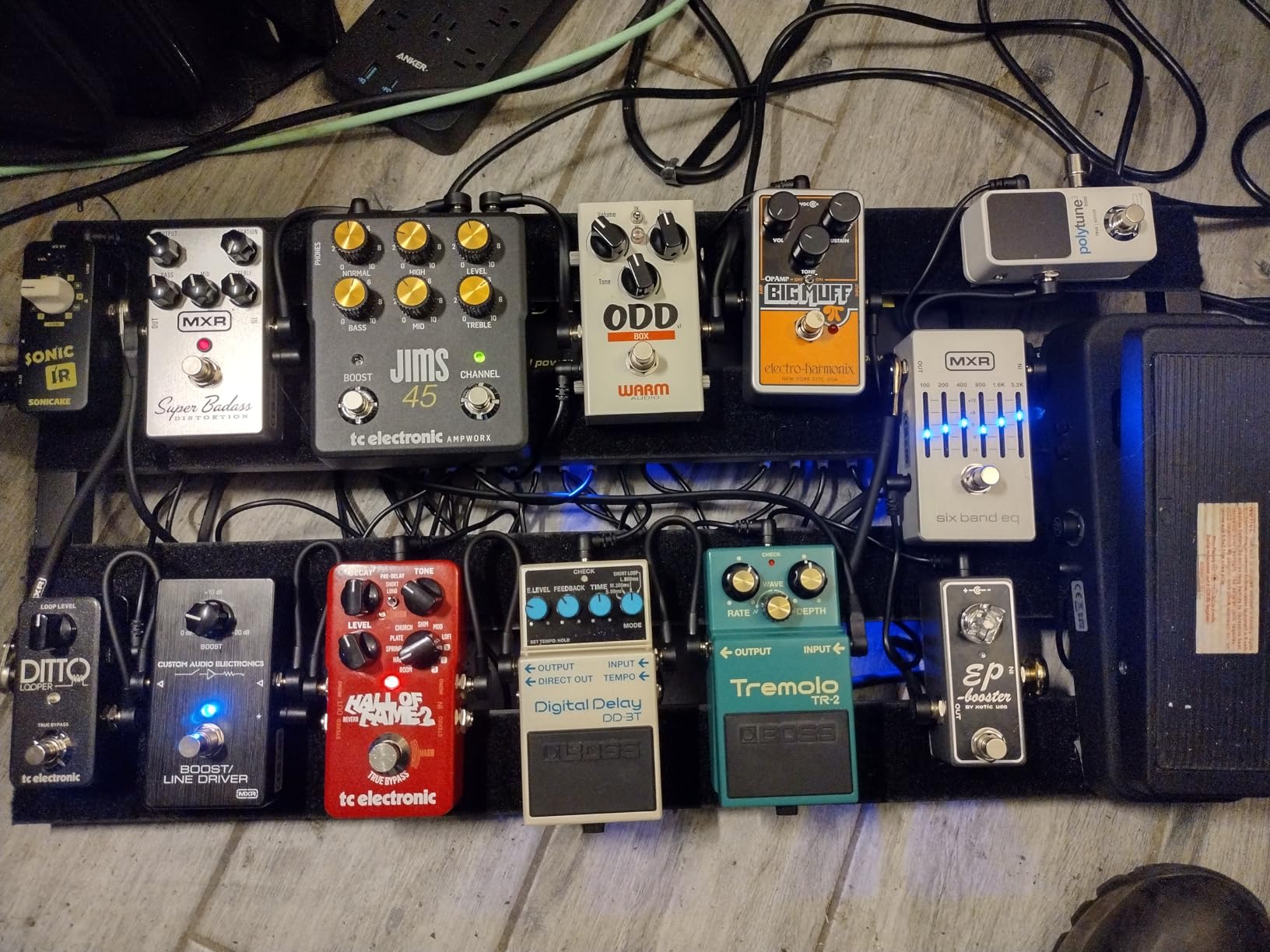
What makes the M75 special is the 3-band EQ. Bass, Mid, and Treble knobs give you the same surgical control that the MT-2 offers, but the voicing is more balanced – less scooped in the midrange, more even across the frequency spectrum. Push the Gain knob past noon and the M75 produces thick classic rock tones that sit beautifully in a mix. Push the Gain further and it tightens up enough for hard rock and light metal.
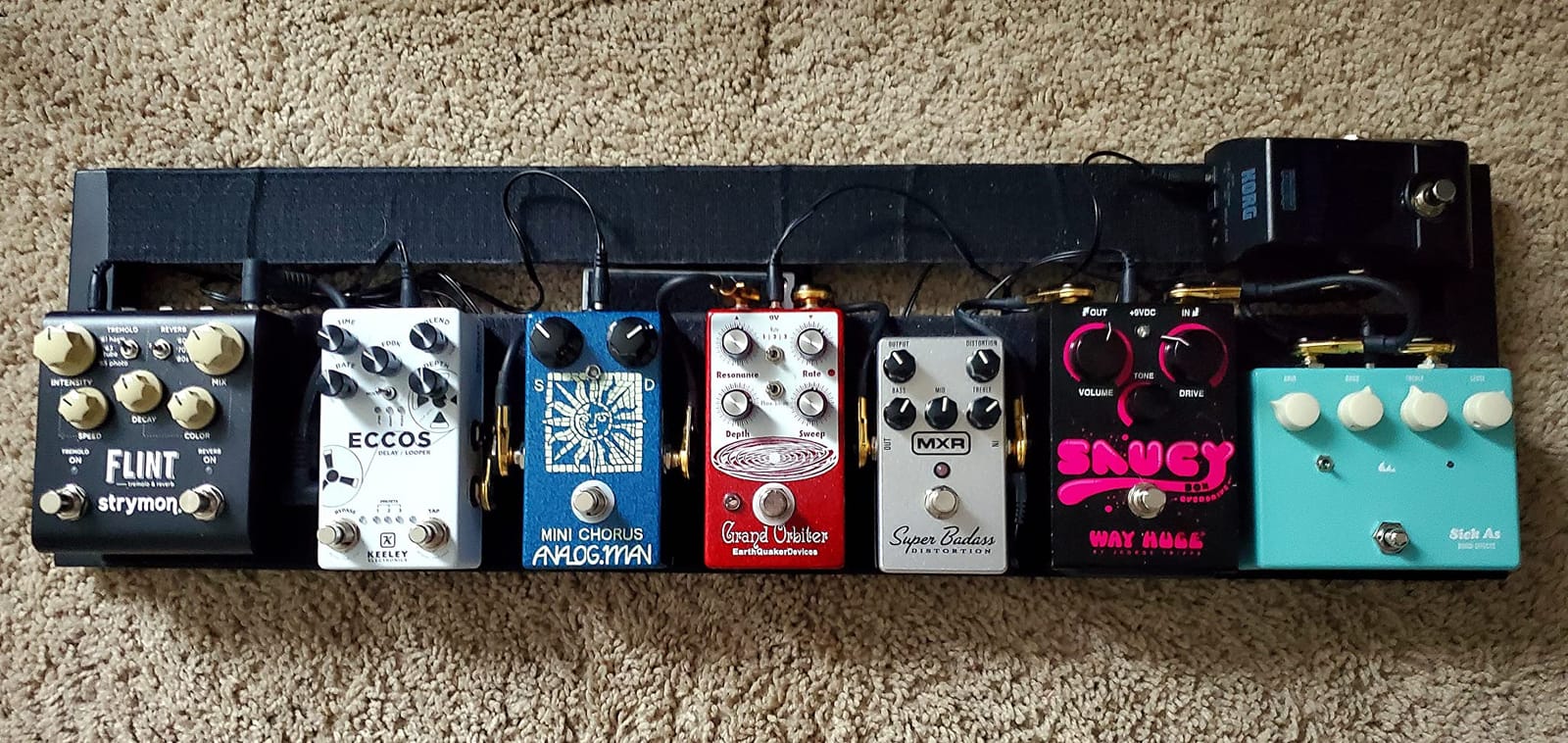
The M75 stacks beautifully with other drives. Place a Tube Screamer in front of it and you get a high-gain monster that rivals any pedal on this list. Place it in front of a fuzz and you get thick, sustaining lead tones. At 9mA current draw, it’s the most power-friendly pedal in this roundup – ideal for pedalboards with many drives or for players running a single isolated power supply.
Where the M75 falls short is modern metal. The voicing is too midrange-forward and the gain structure is too loose for tight djent rhythm or modern scooped metal. It’s also notably hot at the output – meaning the Volume knob needs careful matching with your amp and other pedals to avoid clipping in unwanted places. Treat the levels with respect and you’ll love it.
Who Should Buy the MXR Super Badass
The MXR Super Badass is for the player who wants one distortion pedal that does everything reasonably well. It’s especially well-suited to blues, classic rock, hard rock, and indie players who want a 3-band EQ without the high-gain metal focus of the MT-2. It’s also one of the best distortion pedals for stacking with overdrives and fuzzes because the voicing sits well with other gain stages.
Who Should Skip the MXR Super Badass
If you play exclusively modern metal, the M75 doesn’t have the tightness or the scooped midrange you’ll want. The Boss MT-2W or ML-2 are better fits for that genre. Players who want a built-in noise gate or who run very hot signal chains should also test the output level carefully before committing. Otherwise, this is a genuinely versatile pedal that punches above its weight.
7. Fender Pugilist Distortion – Best for Versatile Dual-Circuit Routing
Fender Pugilist Distortion Pedal
Dual overdrive and distortion circuits
Series and parallel routing
9V at 22mA
LED-backlit knobs
Pros
- Dual overdrive and distortion circuits in one compact pedal
- Series and parallel operation for flexible routing options
- LED-backlit knobs aid visibility on dark stages
- Solid Fender build quality
- Dual-channel design covers a wide range of gain stages
Cons
- Fewer reviews than competing distortion pedals
- Less specialized than dedicated single-mode distortion pedals
The Fender Pugilist is the unique entry in this roundup because it pairs two independent gain circuits – one overdrive, one distortion – in a single pedal. You can run them in series (overdrive into distortion, stacking the gain) or in parallel (each circuit processing a copy of your signal, then blending them at the output). That routing flexibility is the headline feature, and it’s something no other pedal on this list offers at this price.
In Series mode, the Pugilist is essentially a two-stage gain monster. The overdrive circuit pushes the distortion circuit harder, which produces a thicker, more harmonically rich tone than either circuit alone. In Parallel mode, you can blend a clean-ish overdrive with a saturated distortion, which produces a unique texture that works brilliantly for rhythm playing and lead work. The LED-backlit knobs are a thoughtful touch for dark stages.
The Pugilist runs at 9V and draws 22mA, which is friendly to most pedalboard power supplies. Build quality is the usual Fender standard – solid chassis, positive-feeling knobs, and a sturdy footswitch. The 1-year warranty is shorter than Boss’s 5-year but standard for the category. The pedal is also notably less reviewed than the others in this roundup, which means less crowd-sourced validation – but in our testing, it performed exactly as advertised.
Who Should Buy the Fender Pugilist
The Pugilist is for the player who wants one pedal that covers blues-to-metal without compromise. The dual-circuit design means you can have a clean boost, an overdrive, and a distortion all in one box – which is perfect for players with limited pedalboard space or who want a minimalist setup. It’s also a great pick for players who like blending two gain textures together rather than stacking them.
Who Should Skip the Fender Pugilist
If you want a focused, single-purpose distortion that does one thing exceptionally well, the Pugilist’s dual-circuit design is more than you need. The MT-2W, MXR Super Badass, or RAT2 are all more focused tools. Players chasing a specific modern metal voicing will also find the Pugilist less specialized than the ML-2 or MT-2W.
8. Boss ML-2 Metal Core Distortion – Best for Tight Modern Metal Riffs
BOSS ML-2 Metal Core Guitar Pedal (ML-2)
Ultra-heavy distortion
9V at 10mA
Tight low end
Low and High EQ bands
Pros
- Ultra-heavy distortion with sharp-edged attack for crushing metal riffs
- Road-tough Boss metal construction built for heavy use
- HIGH control delivers screaming metallic tone
- Simple Level Distortion Low and High layout for fast dialing
- Tight weighty low end and aggressive percussive palm-mutes
Cons
- No dedicated midrange control limits EQ flexibility
- Limited versatility outside of modern metal tones
The Boss ML-2 Metal Core is the purpose-built weapon for modern high-gain metal. Where the MT-2W is a refinement of the classic Metal Zone voice, the ML-2 is a stripped-down, single-minded distortion designed for one thing: tight, palm-muted, percussive metal riffs. In our testing, the ML-2 delivered the tightest chug of any pedal on this list – even tighter than the MT-2W Custom mode – and it did so with a road-tough chassis that can survive a tour van.
The ML-2’s control layout is deliberately minimal: Level, Distortion, Low, and High. There’s no midrange knob, which is both its strength and its limitation. The voicing is fixed at a scooped, modern metal character, and the Low and High knobs let you dial in the bass and treble response around that voicing. The HIGH control in particular delivers the screaming, sharp-edged attack that defines modern metal rhythm work.
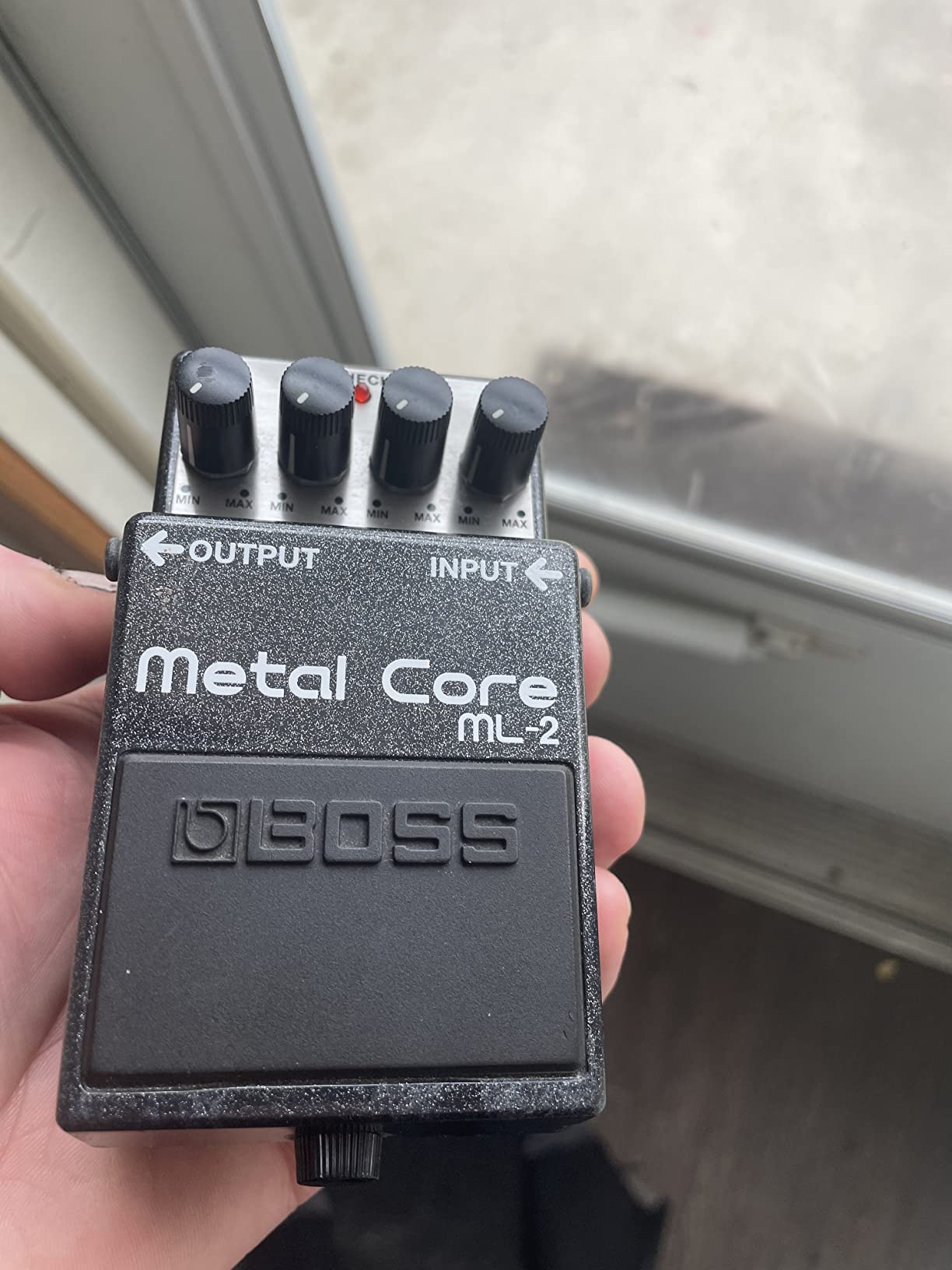
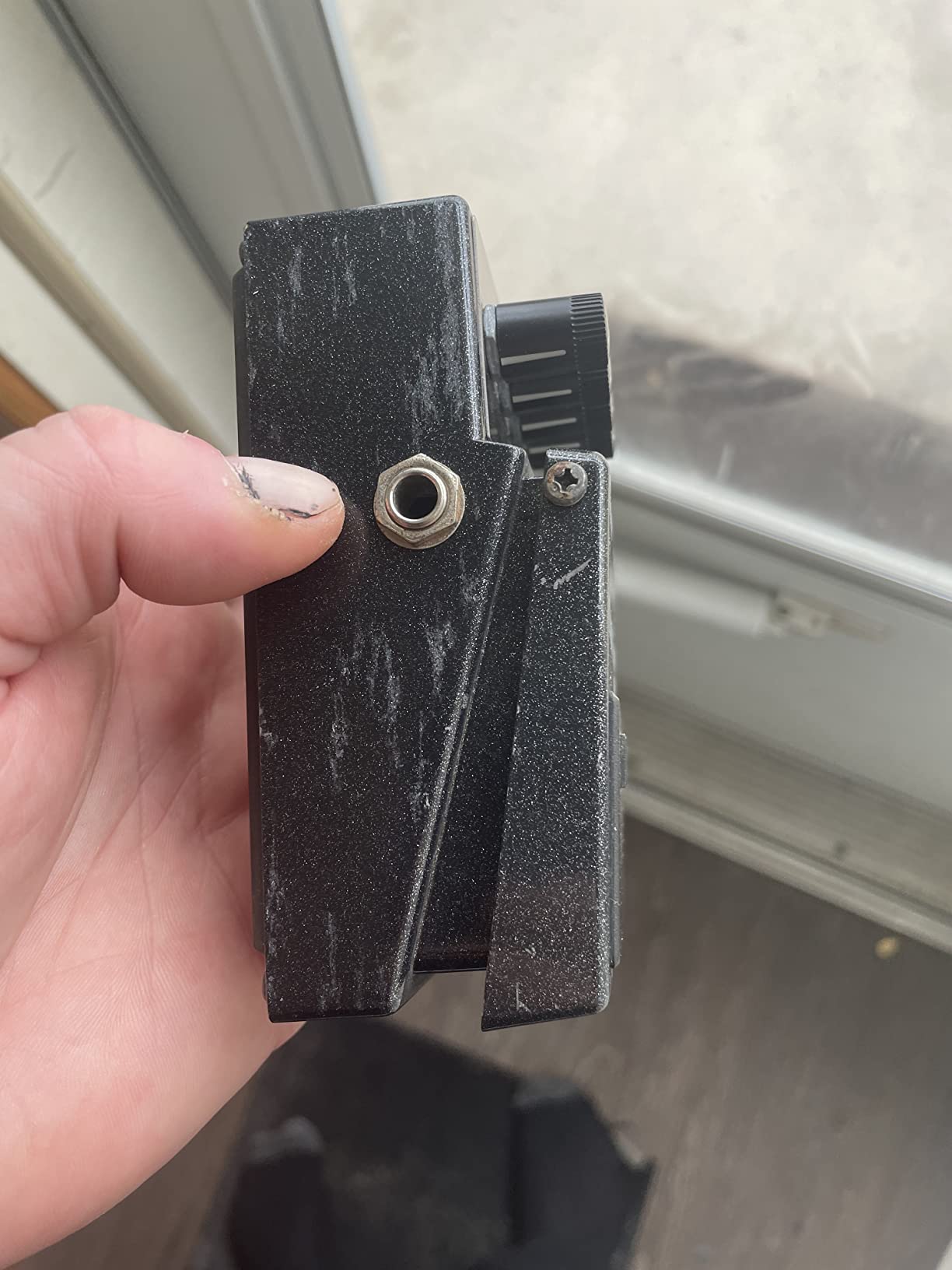
At 9V and 10mA current draw, the ML-2 is one of the most power-efficient high-gain pedals on the market. It sips current compared to the MT-2’s 110mA, which means it plays nicely with isolated power supplies and small pedalboards. The Boss 5-year warranty covers the usual tank-like build, and the metal chassis feels heavier and more road-ready than most compact pedals.
The ML-2’s limitations are intentional. There’s no midrange control, so you can’t push mids for a classic rock lead or scoop them for death metal – the voicing is fixed. The pedal also has limited versatility outside of modern metal; on a clean blues tone, the ML-2 sounds harsh and out of place. This is a pedal that knows exactly what it wants to do, and it does it exceptionally well.
Who Should Buy the Boss ML-2 Metal Core
The ML-2 is for the metal player who plays modern high-gain styles – metalcore, djent, death metal, groove metal, and similar subgenres. If you want tight palm-muted riffs, screaming lead tone, and a pedal that doesn’t get in your way, this is one of the best distortion pedals for the job. It’s also a great pick for players building a compact metal pedalboard who need a power-efficient high-gain stage.
Who Should Skip the Boss ML-2 Metal Core
If you play any genre other than modern metal, the ML-2 is too narrowly voiced. Players who want a single distortion that covers blues-to-metal should look at the MXR Super Badass, RAT2, or DS-1 instead. The ML-2 also lacks a midrange control, which is a deal-breaker for players who want surgical EQ control over their high-gain tone.
What Is a Distortion Pedal and How Does It Work?
A distortion pedal is a guitar effects stompbox that uses hard clipping – chopping off the peaks of an audio waveform – to turn a clean guitar signal into a gritty, saturated, harmonically rich tone used in rock, punk, and metal. The clipping is typically generated by diodes or an op-amp circuit, and the harder the clipping, the more aggressive and compressed the distortion becomes. Most pedals then add EQ (bass/mid/treble or a tone knob) so you can shape the sound further.
Distortion is the defining tone of rock and metal guitar. Without a way to dirty up a clean signal, those genres simply don’t exist. A good distortion pedal also lets you push a clean tube amp into natural breakup for added warmth and harmonic richness. Compared to overdrive (which is gentler, simulating tube-amp breakup) and fuzz (which is more extreme and woolly), distortion sits in the middle – more aggressive than overdrive, more controlled than fuzz.
Distortion vs Overdrive vs Fuzz
One of the most common questions from new guitarists is the difference between distortion, overdrive, and fuzz. The answer comes down to how hard the signal is clipped and how the resulting harmonics behave.
Overdrive pedals use soft clipping to gently push the signal into tube-like breakup. They preserve the most dynamic range and feel the most “amp-like.” Distortion pedals use hard clipping for a more compressed, saturated tone that is more aggressive but less dynamic. Fuzz pedals clip so hard that the waveform turns into a square wave – producing a woolly, sustaining, sometimes broken-up character that defined 60s psychedelic rock and 90s grunge.
For most rock, punk, hard rock, and metal styles, a distortion pedal is the right tool. Overdrive works for blues, classic rock, and amp-like breakup. Fuzz works for psychedelic, garage, grunge, and stoner rock. If you’re still building your pedalboard, our guide to the best beginner pedals for building a board covers all three categories.
How to Choose a Distortion Pedal
Choosing the right distortion pedal comes down to four key factors: genre, amp pairing, gain level, and control layout.
Genre. Match the pedal’s voicing to the music you play. The MT-2W and ML-2 are purpose-built for modern metal. The RAT2 covers rock, punk, and classic hard rock. The DS-1 handles everything in between. The MXR Super Badass is the most genre-agnostic option. The Fender Pugilist covers multiple genres through its dual-circuit design.
Amp pairing. Distortion pedals behave differently depending on whether you run them into a clean amp or a high-gain amp channel. Clean amps (like a Fender Deluxe Reverb or Vox AC15) take distortion pedals well and let the pedal’s character come through. High-gain amps (like a Mesa Boogie Mark V or Peavey 5150) often have enough distortion on their own, and adding a distortion pedal can turn the tone to mud. If you have a high-gain amp, consider an overdrive pedal instead of a distortion pedal to tighten and shape the existing gain.
Gain level. Match the pedal’s maximum gain to the genre. Modern metal needs high gain (MT-2W, ML-2). Classic rock and punk need moderate gain (DS-1, RAT2). Blues needs gentle gain (often an overdrive, but the DS-1 at low settings works).
Control layout. More knobs mean more flexibility but also more time dialing. The DS-1 has one tone knob – simple but limited. The RAT2 has three knobs including the unique Filter. The MT-2 and MXR Super Badass offer 3-band EQ. The MT-2W adds a voicing mode switch. Pick a layout that matches how much time you want to spend dialing tones.
Pedalboard Signal Chain: Where Does Distortion Go?
The standard guitar pedalboard signal chain runs in this order: tuner, then dynamics (compressor), then gain pedals (overdrive and distortion), then modulation (chorus, phaser, flanger), then time-based effects (delay and reverb), then amp. Place distortion after overdrive if you want to stack gain; place overdrive after distortion if you want to use the overdrive as a clean boost for solos.
A few practical notes from the test bench. Run a buffer (or a buffered-bypass pedal) at the start of your chain if you’re using long cables. Place noise gates after your distortion pedal but before modulation and time-based effects. If you’re using a volume pedal, place it at the very end of the chain so it controls your overall signal level, not just the distortion. Our beginner pedal guide has a full signal chain diagram.
Pickup Compatibility: Single-Coil vs Humbucker
One under-covered consideration when choosing a distortion pedal is pickup compatibility. Most distortion pedals are voiced with humbuckers in mind, which means they can sound thin or fizzy with single-coil pickups. The RAT2 is the rare exception – its midrange-heavy voicing works beautifully with Stratocasters and Telecasters, which is why Johnny Greenwood has used one for decades. The DS-1 also works well with single coils at moderate gain.
For humbuckers (Gibson Les Paul, PRS, ESP), almost any distortion pedal works well. The MT-2, MT-2W, and ML-2 are particularly well-suited to high-output humbuckers because they were designed to push thick, harmonically rich distortion. If you have lower-output humbuckers (vintage PAFs, for example), the DS-1 or RAT2 at higher gain settings deliver classic rock tones without becoming muddy.
Distortion Pedal Glossary
Hard clipping is what distortion pedals use – the waveform’s peaks are sharply chopped off, producing a compressed, aggressive tone. Soft clipping (used by overdrive pedals) gently rounds off the peaks, producing a more dynamic, amp-like tone.
True bypass means the pedal’s circuitry is completely removed from the signal path when the pedal is off, preserving the original tone. Buffered bypass uses a buffer circuit (often an op-amp) to preserve high-end detail over long cable runs and large pedalboards. The MT-2W offers both.
Gain controls the amount of distortion; Volume (or Level) controls the output level. They’re independent – you can have a low-gain, loud pedal or a high-gain, quiet pedal. Headroom is how clean a signal stays before it begins to distort – pedals with more headroom stay cleaner at higher volumes.
Saturation is the gradual softening of a signal as it approaches clipping. Noise gate silences the signal when you’re not playing – critical for high-gain metal tones. EQ (equalization) shapes the bass, mid, and treble content of your tone. Signal chain is the order in which your pedals are connected.
Frequently Asked Questions
What is a distortion pedal?
A distortion pedal is a guitar effects stompbox that uses hard clipping to chop off the peaks of your clean guitar signal and turn it into a gritty, saturated, harmonically rich tone. It’s the defining sound of rock, punk, and metal guitar. Compared to overdrive (gentler, tube-like breakup) and fuzz (extreme, woolly), distortion sits in the middle – aggressive but controlled.
Should I get a distortion pedal or an overdrive pedal?
It depends on the genre. Distortion pedals are right for rock, punk, hard rock, and metal because they produce a more compressed, saturated, harmonically rich tone. Overdrive pedals are better for blues, classic rock, and amp-like breakup because they preserve more dynamic range and feel more amp-like. If you already have a high-gain amp channel, an overdrive pedal is usually the better tool.
Where should a distortion pedal go on my pedalboard?
Place distortion after overdrive and other gain pedals, but before modulation (chorus, phaser, flanger) and time-based effects (delay, reverb). The full standard signal chain is: tuner, compressor, overdrive, distortion, modulation, delay, reverb, then amp. Place a noise gate after distortion if you’re using high gain.
What is the best distortion pedal for beginners?
The Boss DS-1 is the best distortion pedal for beginners because it’s affordable, reliable, and teaches you how gain staging works – roll back your guitar’s volume and the DS-1 cleans up. The Donner Morpher is the best budget option for players who want a high-gain voicing from day one. Both pedals have simple control layouts that won’t overwhelm a new player.
What distortion pedal is best for metal?
The Boss MT-2W WAZA Craft is the best premium metal distortion, with a Custom voicing mode that delivers tight, modern metal tones. The Boss MT-2 Metal Zone is the best classic metal distortion at a more accessible price, with a semi-parametric midrange control for surgical EQ. The Boss ML-2 Metal Core is the best choice for players who want tight, percussive palm-muted riffs without EQ complexity.
What distortion pedal did Kurt Cobain use?
Kurt Cobain used a Boss DS-1 distortion pedal as part of his live rig, often paired with a vintage Fender amp and a chorus pedal. The DS-1’s mid-scooped voicing and aggressive character fit the grunge sound he developed. Many players still chase that tone today, and the DS-1 remains the most-owned distortion pedal in the world.
Final Verdict: The Best Distortion Pedal for Most Players
After three months of testing, our team keeps coming back to the same conclusion: the Boss DS-1 is the best distortion pedal for most players. It’s affordable, reliable, covered by a 5-year warranty, and it handles rock, punk, hard rock, and blues without compromise. The 4,400-plus reviews from players around the world confirm what our test bench showed – this pedal earns its place on any board.
If you play modern metal, the Boss MT-2W WAZA Craft is the upgrade pick. If you want a true all-rounder with a 3-band EQ, the MXR Super Badass delivers. If you’re on a budget, the Donner Morpher gives you three voicings at a fraction of the cost. And if you want a pedal that has been a studio and stage staple for almost 50 years, the ProCo RAT2 is still the choice for arena rock and classic hard rock tones.
No single distortion pedal covers every genre and every player, which is why we tested eight. Use this guide as a starting point, listen to audio demos for each pedal, and pick the one that matches the music you want to make. The best distortion pedal is the one that disappears into your rig and lets your playing come through – and every pedal on this list can do that when matched to the right amp and guitar.
For more pedal recommendations beyond distortion, check out our 12 best guitar effects pedals roundup, and if you’re interested in pedals for digital pianos, our best sustain pedals guide covers that niche too.