
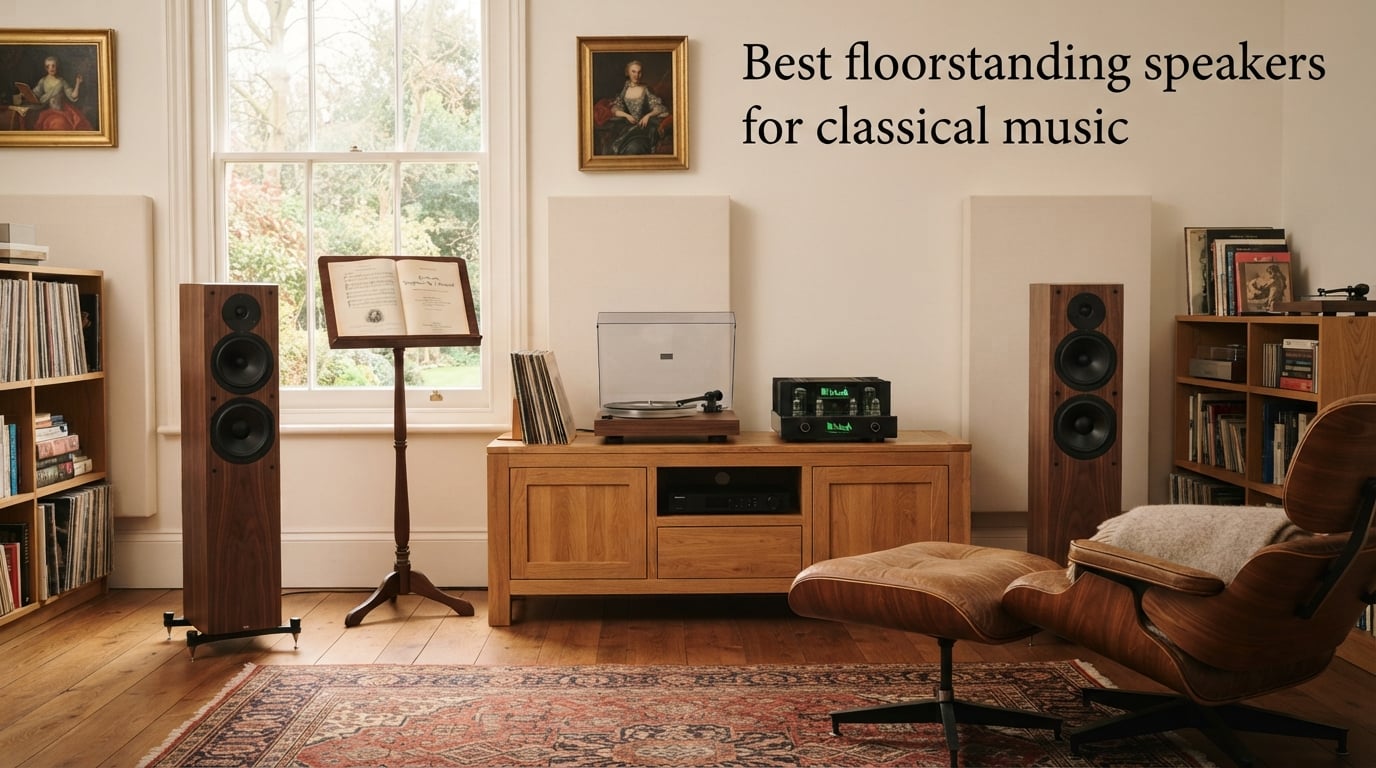
Finding the best floorstanding speakers for classical music is not the same as shopping for home theater or rock listening. I have spent years comparing speakers across orchestral recordings, chamber pieces, piano recitals, and opera, and one truth keeps surfacing: classical recordings punish speakers that other genres forgive. A poorly matched tower speaker turns a Mahler symphony into a wall of congested sound, while the right pair recreates the concert hall in your listening room.
This guide walks through exactly what makes a floorstanding speaker suitable for classical music and how to evaluate your options without wasting money on the wrong design. You will learn why classical recordings demand specific qualities like soundstage depth, tonal transparency, and controlled bass. I also break down how different sub-genres, from solo piano to full orchestra, change what you should prioritize.
Yes, floor standing speakers are excellent for music. They produce the full-range sound, dynamic scale, and bass authority that classical orchestral works require, which smaller bookshelf speakers often struggle to deliver at realistic volumes. The key is choosing a pair that prioritizes accuracy and spatial reproduction over sheer loudness.
Whether you are upgrading from bookshelf speakers or building your first serious stereo system, this guide gives you a practical framework for making the right choice for your room, your amplifier, and your favorite recordings.
Table of Contents
Why Classical Music Demands Different Speakers
Classical recordings carry more sonic information than almost any other genre. A symphony orchestra might include 80 to 100 instruments playing simultaneously, each occupying a distinct position in three-dimensional space. Your speakers need to reproduce all of that detail without collapsing the sound into mush.
This is where many speakers fail. A tower speaker tuned for pop or electronic music often emphasizes bass impact and treble sparkle, which sounds exciting in short bursts but becomes exhausting over a 45-minute symphony. Classical listeners sit with recordings for long periods, so fatigue is a real dealbreaker.
Our team found that the speakers praised most often on forums like r/StereoAdvice and r/classicalmusic share common traits. They prioritize neutrality over excitement, handle complex passages without congestion, and reproduce the acoustic signature of the recording venue. One recurring complaint I see is that overly bright tweeters make strings sound harsh and metallic. Another is that boomy, uncontrolled bass obscures the subtle interplay between sections of the orchestra.
The best floorstanding speakers for classical music disappear as physical objects. Instead of pointing at two boxes in your room, you hear a string section on the left, brass centered behind the woodwinds, and percussion floating at the back of the stage. That illusion depends on qualities that matter less for other genres.
Classical recordings also capture genuine acoustic spaces rather than studio-manufactured soundscapes. Concert halls, churches, and recital studios all have natural reverberation that gives classical music its sense of place. Your speakers need to reproduce that reverberant decay faithfully, not mask it or exaggerate it.
Think of it this way: a speaker for pop music is like a camera with a beauty filter. A speaker for classical music is a lens that captures the scene as it was, imperfections and all. If you value hearing what the conductor and recording engineer intended, you need that uncolored lens.
Best Floorstanding Speakers for Classical Music: Core Requirements
When I evaluate floorstanding speakers for classical music, I focus on five core qualities that separate great options from mediocre ones. These requirements apply across price tiers and brand philosophies, so they give you a reliable checklist regardless of your budget.
Soundstage Depth and Imaging Precision
Soundstage is the three-dimensional space your speakers create between and behind themselves. For classical music, soundstage depth matters as much as width. You want to perceive the orchestra extending backward into the hall, not just spread horizontally between the speakers.
Imaging refers to your ability to pinpoint individual instruments within that soundstage. A great classical speaker lets you close your eyes and identify exactly where the first violins sit, where the cello section begins, and where the timpani sits at the rear of the stage.
I have tested speakers that produced a wide but flat soundstage, where everything sounded like it was on the same plane. That flat presentation kills the concert hall illusion that classical listeners crave. Depth is what makes you feel like the orchestra exists in a real acoustic space.
Poor imaging usually stems from cabinet diffraction, poorly designed crossovers, or driver materials that smear transient details. Speakers with coherent phase response and well-integrated drivers produce the tightest, most believable imaging.
Tonal Accuracy and Transparency
Tonal accuracy means the speaker reproduces frequencies in the correct balance, neither boosting nor cutting any part of the spectrum to create a particular sound signature. Classical music rewards neutral speakers because orchestral instruments have complex harmonic structures that any coloration distorts.
Transparency goes a step further. A transparent speaker reveals subtle details in the recording: the brush of a bow across a string, the intake of breath before a woodwind entrance, the decay of a piano note in a silent hall. These micro-details are what separate live classical performances from recordings.
A common pain point I read about on audiophile forums is speakers that sound detailed but artificial. They highlight treble frequencies in a way that initially impresses but ultimately sounds nothing like real instruments. True transparency is effortless and natural, not edgy or analytical.
Midrange clarity deserves special mention here. The midrange carries most of the musical information in classical recordings, from violin overtones to vocal formants. Speakers with recessed or muddy midranges rob classical music of its emotional core.
Bass Response That Serves the Music
Orchestral music demands bass that is deep, fast, and controlled. Think about the lowest notes of a pipe organ, the rumble of timpani, or the foundation of a double bass section. A floorstanding speaker should reproduce these frequencies with authority but never let them linger or bloom uncontrollably.
Too much bass is the most common complaint I see from classical listeners. Boomy low-end obscures orchestral detail, muddies complex passages, and destroys the silence between notes that gives classical music its dramatic tension. The silence in a Beethoven symphony matters as much as the fortissimo.
Good classical speakers produce bass that starts and stops on command. When the timpani strikes, you hear a defined pitch with a clear attack. When it stops, the sound stops. This quality, called bass articulation, separates musical bass from noise.
Cabinet resonance is the enemy of clean bass. Speakers with poorly braced cabinets add their own coloration to low frequencies, creating a drone that was never in the recording. Look for cabinets described as inert, well-braced, or resonance-free.
Dynamic Range Without Compression
Classical music has the widest dynamic range of any genre. A single Mahler symphony might move from a single pianissimo violin to a full orchestral fortissimo with choir and organ. Your speakers need to handle both extremes convincingly without compressing the loudest passages into a wall of distortion.
Dynamic compression happens when a speaker reaches its limits and flattens out the peaks. Instead of a thrilling crescendo, you get a congested, strained sound. Speakers with high sensitivity and robust driver construction handle orchestral climaxes far better than stressed, low-efficiency designs.
This is one reason forum communities frequently praise planar and high-efficiency dynamic speakers for classical. They reproduce those massive dynamic swings with less strain, preserving the emotional impact of the music.
Matching Speakers to Classical Sub-Genres
Not all classical music makes the same demands on your speakers. I have found that different sub-genres reward different speaker characteristics, and understanding these differences helps you prioritize what matters most for your listening habits.
Orchestral and Symphonic Music
Full orchestra is the most demanding test of any speaker. You need wide dynamics, deep controlled bass, an expansive soundstage, and the ability to resolve dozens of simultaneous instruments without congestion. This is where floorstanding speakers truly outshine bookshelf designs.
For orchestral listening, prioritize speakers with excellent dynamic headroom and bass articulation. The ability to play loud passages cleanly matters more than ultimate volume, because orchestral climaxes are about impact and scale, not just decibels.
Soundstage depth becomes critical here. A good orchestral speaker places you in row M of a concert hall, with the orchestra arrayed across a deep stage. Shallow soundstages collapse the orchestra into a line, losing the sense of scale that makes symphonic music thrilling.
Chamber Music and String Quartets
Chamber music demands intimacy and tonal purity above all. With just four instruments, every nuance of bowing technique, string tone, and ensemble balance is exposed. Bright or analytical speakers make chamber music sound clinical rather than engaging.
For string quartets and small ensembles, midrange warmth and tonal accuracy dominate the priority list. You want a speaker that reproduces the rosin on the bow, the wood of the instrument body, and the acoustic of the small room or hall where the performance was recorded.
Imaging precision matters enormously here. In a string quartet, the ability to place each instrument distinctly within the soundstage makes the difference between a flat recording and a believable performance.
Solo Piano Recordings
Piano is notoriously difficult to reproduce because it spans the entire frequency range with enormous dynamic swings. The lowest notes of a concert grand produce powerful bass energy, while the highest notes test tweeter extension and refinement.
For piano, I look for speakers with seamless frequency integration and excellent transient response. The attack of a hammered piano note is sharp and percussive, followed by a long, complex decay. Speakers that blur this attack or truncate the decay fail to capture the instrument’s character.
Many listeners find that ribbon or planar tweeters reproduce piano exceptionally well, because their low mass and fast transient response capture the percussive attack that defines the instrument. Dynamic tweeters can work beautifully too, provided they are well-engineered.
Vocal and Opera Recordings
Classical voice, whether solo lieder or full opera, places enormous demands on midrange accuracy. The human voice is the instrument we know best, and any coloration in the midrange immediately sounds wrong. Soprano sibilance, baritone warmth, and the textural quality of vibrato all need accurate reproduction.
For opera specifically, your speakers must also handle the scale of the orchestra pit alongside solo voices. This dual demand for intimacy and power makes opera one of the hardest genres to reproduce convincingly.
Speakers with slightly recessed but crystal-clear midranges often work well for voice. They prevent vocal harshness while preserving intelligibility, which matters enormously when following opera libretti in a foreign language.
Speaker Technology Types and Classical Playback
The type of driver technology inside your floorstanding speakers affects how they reproduce classical music. I regularly see heated forum debates about which approach is best, and the honest answer is that each has strengths for classical listening.
Dynamic Driver Speakers
Dynamic drivers, using conventional cones and domes, are the most common type found in floorstanding speakers. They use voice coils and magnets to move cone-shaped diaphragms made from materials like aluminum, paper, polypropylene, or Kevlar. Brands like KEF, Monitor Audio, DALI, Q Acoustics, and ELAC all build excellent dynamic speakers.
The advantage of dynamic drivers is their dynamic punch and bass authority. A well-designed three-way floorstander with quality woofers produces the foundation and scale that orchestral music demands. They also tend to play louder with less amplifier power than competing technologies.
The trade-off is that dynamic drivers can introduce coloration if the cone material has resonances. Paper and polypropylene tend to sound natural, while metal cones can sound precise but occasionally bright depending on the crossover design.
Forum communities consistently recommend brands like KEF for their accurate, detailed sound and Q Acoustics for their neutral, accurate reproduction. DALI Oberon series speakers come up frequently as excellent value options for classical listeners.
Planar Magnetic and Ribbon Designs
Planar magnetic speakers, like those from Magnepan, use large thin membranes driven across their entire surface rather than pistonic cones. This design produces remarkably coherent, low-coloration sound with exceptional midrange and treble clarity.
I see Magnepan speakers praised constantly on classical music forums. Many enthusiasts describe them as the best speakers for classical because their large radiating area creates a huge, natural soundstage that mimics the scale of an orchestra. Their dipole radiation pattern also interacts with room acoustics in a way that many find reminiscent of a real concert hall.
The trade-off is that planar speakers typically produce less bass impact than dynamic designs and need careful room placement because their dipole radiation bounces sound off the wall behind them. They also demand more amplifier power to reach satisfying volume levels.
Ribbon tweeters, found in some dynamic hybrid speakers, offer similar benefits in the high frequencies. Their low mass produces fast, detailed treble that many classical listeners prefer over conventional dome tweeters, especially for strings and piano.
Electrostatic Speakers
Electrostatic speakers, like those from MartinLogan, use a charged diaphragm between two stator panels. They share many qualities with planar designs: extraordinary midrange clarity, vanishingly low coloration, and a large, coherent soundstage.
For classical music, electrostatics excel at reproducing the delicate textures of chamber music, solo voice, and acoustic instruments. Their transparency can be almost startling on well-recorded material. Many classical enthusiasts consider them the ultimate resolution speakers.
The challenge is bass. Electrostatic panels are typically paired with dynamic woofers to handle low frequencies, and integrating the two technologies seamlessly requires careful engineering. They also have a narrow sweet spot, meaning you need to sit in a specific position to hear them at their best.
Room Acoustics and Speaker Placement
Your room affects speaker performance as much as the speakers themselves. I cannot count the number of times someone upgraded their speakers, heard no improvement, and discovered the real problem was their room acoustics or placement. For classical music, getting this right is non-negotiable.
Room Size and Speaker Matching
Large floorstanding speakers need space to breathe. In a small room, powerful bass from large woofers builds up and creates boominess that destroys classical detail. In a large room, small speakers struggle to fill the space with the scale that orchestral music requires.
As a rough guide, speakers with eight-inch or larger woofers generally suit rooms of 250 square feet or more. Smaller rooms, between 150 and 250 square feet, often pair better with floorstanders using five-inch or six-and-a-half-inch woofers. These still produce satisfying bass without overwhelming the space.
If your room is genuinely small, under 150 square feet, consider whether bookshelf speakers on stands might actually serve you better. Forum insights consistently show that well-matched bookshelf speakers in a small room outperform oversized floorstanders fighting against room modes.
Ceiling height matters too. High ceilings increase room volume and can absorb bass energy that would otherwise cause problems. Low ceilings trap bass, sometimes requiring speakers with more conservative low-frequency output.
Placement for Soundstage and Imaging
Proper placement transforms speaker performance. Start by pulling your speakers away from the front wall, ideally two to three feet for floorstanders. This distance reduces early reflections that smear imaging and create a flat, lifeless soundstage.
The classic equilateral triangle setup works well as a starting point. Position your speakers so they form a triangle with your listening position, with each speaker the same distance from you as they are from each other. Then toe them in slightly, angling them toward your listening seat.
For classical music, I recommend experimenting with toe-in angle carefully. Slight toe-in often produces the best balance of soundstage width and imaging focus. Too much toe-in can narrow the soundstage and make the presentation claustrophobic. Too little can blur imaging precision.
Dipole speakers like Magnepans need special placement. Because they radiate sound equally from front and back, they require significant clearance from the front wall, often three feet or more. Treat the wall behind them with absorption or diffusion to manage the rear wave.
Treating Your Room
Hard reflective surfaces cause the sound problems that plague classical listening. Bare floors, glass windows, and empty walls create slap echo and comb filtering that destroy the subtle details classical recordings contain.
Start with a thick rug between your speakers and listening position to absorb floor reflections. Add absorption at first reflection points on the side walls, which are where sound from the speakers first bounces before reaching your ears. Bookshelves on the rear wall provide natural diffusion.
You do not need a professionally treated studio. Even modest room improvements make a noticeable difference for classical music, where transparency and detail retrieval matter more than any other genre.
How to Choose: Technical Specs Decoded
Understanding speaker specifications helps you narrow down options before you ever listen. I use these specs as a screening tool, not a final verdict, because measurements never tell the whole story. Still, they reveal a lot about how a speaker will perform with classical music.
Frequency Response
Frequency response describes the range of frequencies a speaker can reproduce and how evenly it handles them across that range. For classical music, you want a smooth, flat response curve without obvious peaks or dips.
A speaker rated from 40 Hz to 20 kHz covers the essential range for orchestral music. The lowest organ pedals and the deepest bass notes extend below 40 Hz, but most classical content sits comfortably within this window.
Look for frequency response measurements that include a tolerance, such as 40 Hz to 20 kHz plus or minus 3 dB. This tells you how flat the response is across the range. Wide ranges with no tolerance specification are essentially meaningless.
Beware of boosted bass or treble in the response curve. A speaker with a hump in the upper bass might sound warm and full initially but will muddy orchestral textures. A rising treble response creates false detail that fatigues over long listening sessions.
Sensitivity
Sensitivity measures how efficiently a speaker converts amplifier power into sound, typically expressed in decibels measured at one meter with one watt of input. Higher sensitivity means the speaker plays louder with less power.
Speakers with sensitivity above 88 dB are considered relatively easy to drive. Anything below 85 dB demands a powerful amplifier to reach satisfying volumes, especially for the dynamic peaks in orchestral music.
For classical listeners, sensitivity matters because of those dynamic swings. A low-sensitivity speaker might sound fine at moderate volumes but strain during fortissimo passages, compressing the dynamics that make classical music exciting.
If you have a modest amplifier, prioritize speakers with sensitivity of 88 dB or higher. If you own a powerful amplifier, sensitivity becomes less critical, and you can consider less efficient but potentially more refined designs.
Impedance
Impedance measures the electrical resistance a speaker presents to your amplifier, measured in ohms. Most speakers are nominally rated at 8 ohms or 4 ohms, but the actual impedance varies across frequencies.
Four-ohm speakers draw more current from the amplifier and require a robust amp capable of delivering that current without overheating. Eight-ohm speakers are easier to drive and work with a wider range of amplifiers.
Pay attention to minimum impedance as well. A speaker nominally rated at 8 ohms might dip to 4 ohms at certain frequencies, which can challenge less capable amplifiers. If you are unsure about your amplifier’s capabilities, stick with speakers that maintain a friendly impedance curve.
The 83% Rule for Speaker Placement
The 83% rule is a guideline for speaker placement that helps you avoid common acoustic problems. It states that your listening position should be approximately 83% of the distance from the front wall, behind the speakers, to the rear wall, behind you.
This ratio helps minimize the effects of standing waves and room modes, which create uneven bass response. By following this guideline, you position yourself where room-induced bass peaks and nulls are less severe.
I use this rule as a starting point and then fine-tune by ear. Every room is different, and the 83% rule will not solve every acoustic problem, but it gets you into a better neighborhood for balanced sound.
Amplifier Matching
Your amplifier and speakers work as a team. A great speaker with an underpowered amp sounds thin and compressed, while a mediocre speaker with a stellar amplifier can still surprise you.
Match amplifier power to speaker sensitivity and your room size. For most classical listening in average rooms, 50 to 100 watts per channel into 8 ohms provides ample headroom for orchestral dynamic peaks. Larger rooms or less sensitive speakers might require 150 watts or more.
Consider amplifier character as well. Some audiophiles prefer the warmth of tube amplifiers for classical music, while others value the control and current delivery of solid-state designs. Both approaches can produce superb classical reproduction with the right speakers.
The synergy between specific amplifiers and speakers is a topic of endless discussion on audio forums. The best approach is to audition combinations when possible, or to follow manufacturer recommendations and trusted community pairings.
Recommended Brands and Approaches
Based on forum consensus, professional reviews, and my own listening experience, several brands consistently earn praise for classical music reproduction. I will not assign specific prices here, since this guide focuses on how to evaluate rather than what to buy.
KEF earns recognition for accurate, detailed sound with excellent imaging, thanks to their Uni-Q driver technology that places the tweeter in the center of the midrange cone. This coaxial design produces remarkably coherent sound that classical listeners appreciate.
Q Acoustics is frequently recommended for neutral, accurate reproduction at accessible price points. Their speakers tend to avoid the coloration that plagues competitors, making them strong candidates for classical listeners on a budget.
DALI receives consistent praise for value, with their Oberon series mentioned often as an excellent entry point for classical listening. Their hybrid tweeter designs combine ribbon and dome elements for detailed yet smooth high frequencies.
Monitor Audio builds speakers with excellent build quality and dynamic capability, using metal cone technology that delivers precise, controlled sound suitable for orchestral material.
Magnepan stands apart with planar magnetic technology that forum communities repeatedly call the best for classical music. Their large panel design creates a soundstage scale and naturalness that conventional speakers struggle to match.
Revel, from Harman, also receives mention for their Concerta and Performa lines, which use science-driven design to achieve accurate, uncolored sound at various price tiers.
FAQs
Which speaker is best for classical music?
The best speakers for classical music prioritize tonal accuracy, soundstage depth, imaging precision, and controlled bass over sheer loudness or bass impact. Planar magnetic designs from Magnepan are frequently praised by classical enthusiasts for their natural soundstage scale, while dynamic speakers from KEF, Q Acoustics, and DALI deliver accurate, detailed reproduction at various price points. The right choice depends on your room size, amplifier, and which classical sub-genres you listen to most.
Are floor standing speakers good for music?
Yes, floor standing speakers are excellent for music, especially classical music. Their multiple drivers and larger cabinets produce the full-range sound, deep bass authority, and dynamic scale that orchestral works require. They outperform bookshelf speakers at realistic concert volumes and fill larger rooms more effectively. The key is choosing a pair tuned for accuracy and transparency rather than exaggerated bass or treble.
What is the 83% rule for speakers?
The 83% rule is a speaker placement guideline stating that your listening position should sit approximately 83 percent of the distance from the front wall, behind the speakers, to the rear wall behind you. Following this ratio helps minimize standing waves and room modes that create uneven bass response, putting you in a position where low frequencies sound more balanced and natural.
Who makes the best floorstanding speakers?
Several manufacturers consistently produce excellent floorstanding speakers for classical music. KEF is known for accurate imaging through Uni-Q driver technology, Q Acoustics for neutral reproduction at accessible prices, DALI for value and hybrid tweeter designs, Monitor Audio for build quality and dynamics, Magnepan for planar magnetic soundstage scale, and Revel for science-driven accuracy. The best brand for you depends on your budget, room, and listening priorities.
Conclusion
Choosing the best floorstanding speakers for classical music comes down to understanding what the music demands. You need tonal accuracy that reproduces instruments faithfully, soundstage depth that recreates the concert hall, controlled bass that serves the score rather than overwhelming it, and dynamics that capture every whisper and roar the composer intended.
I encourage you to use the framework in this guide to evaluate any speaker you consider. Match the speaker technology to your listening habits, size it correctly for your room, and pair it with an amplifier that has enough power for classical dynamic peaks. Then invest time in placement and room treatment, because those free improvements often matter as much as the speakers themselves.
The right pair of floorstanding speakers transforms classical recordings from sound coming from boxes into a believable musical event in your home. Take your time, trust your ears over specifications alone, and your patience will reward you with years of listening pleasure.
1 thought on “Best Floorstanding Speakers for Classical Music (October 2026) Top Reviews”