
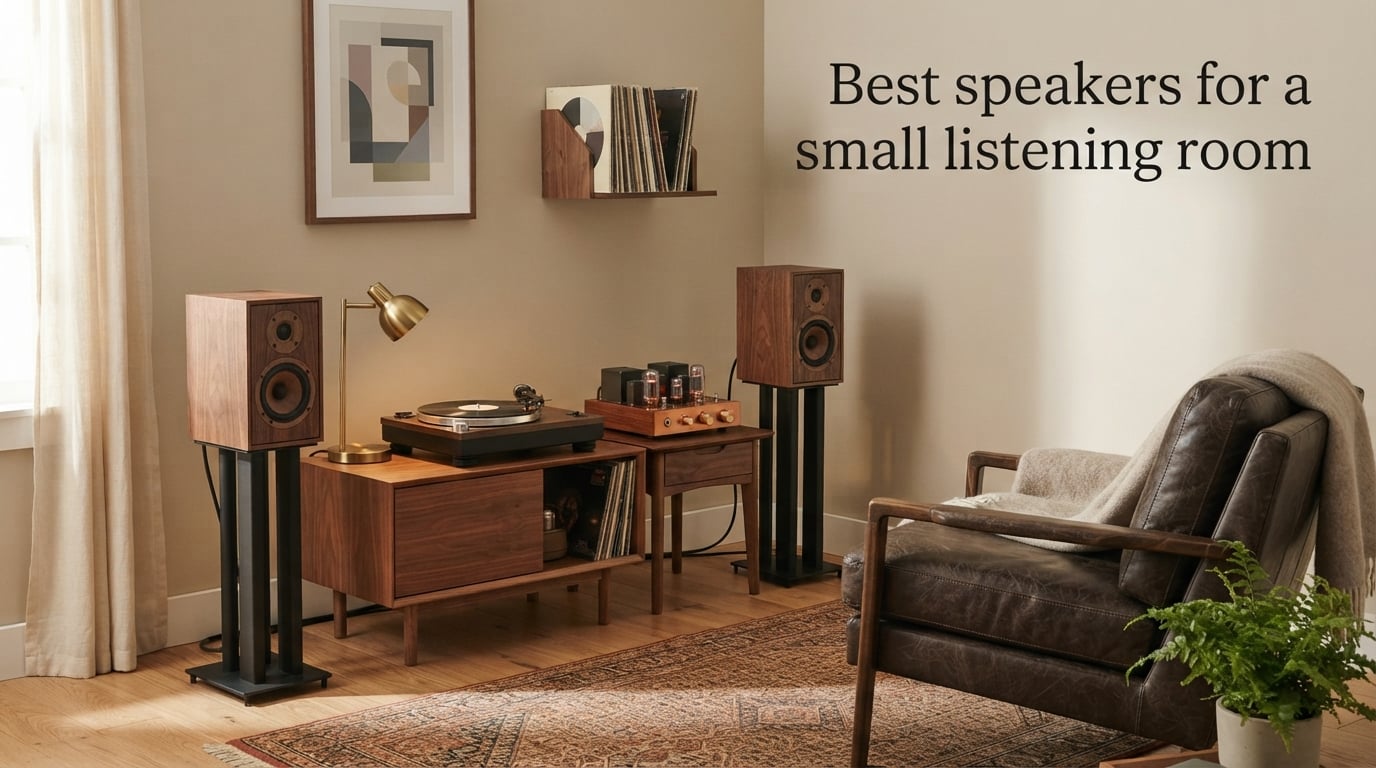
If you are hunting for the best speakers for a small listening room, you have probably hit a wall of conflicting advice. Half the internet tells you to buy floorstanders and the other half insists you will drown your room in boomy bass. I have spent years setting up audio in bedrooms, studies, and apartments that measure under 150 square feet. The truth is, small rooms are not a compromise. They are arguably the best environment for hi-fi listening when you match the right speakers to the space.
Most guides skip the acoustic science entirely and jump straight to product lists. That approach leaves you buying speakers that look great on paper but sound muddy in your actual room. I want to fix that. In this guide I walk through why small rooms behave the way they do, what specifications actually matter at close listening distances, and how to apply the 83% rule and the 38% room rule that almost no other guide explains properly.
I also address something I rarely see covered anywhere else: how classical music listening changes the equation in a small space. Orchestral recordings have enormous dynamic range and complex imaging, and the wrong speaker in a tiny room will compress a Mahler symphony into a flat wall of sound. Whether you are building a near-field desktop setup, a bedroom vinyl station, or a dedicated study listening nook, this guide gives you the framework to choose speakers that turn your small room into a genuine sweet spot.
Table of Contents
Why Small Rooms Are Ideal for HiFi
Small listening rooms are often treated as the poor cousin of dedicated listening spaces. I want to flip that assumption on its head. The physics of sound actually work in your favour when the listening distance is short and the room volume is modest.
At close range, the direct sound from your speakers arrives at your ears far louder than any reflected sound bouncing off the walls. This means the speakers’ inherent tonal balance dominates what you hear, rather than the room’s acoustic signature. In a large untreated room, those reflections smear the soundstage and muddy the imaging. In a small room, they matter less.
Lower listening distances also mean you do not need to push huge power through your speakers to reach satisfying volume. A modest amplifier driving efficient bookshelf speakers can hit 83dB at your listening position without breaking a sweat. Less amplifier strain means lower distortion, which means cleaner transients and better dynamics. For classical music in particular, where a whispered pianissimo can sit 40dB below a full orchestral fortissimo, that low-distortion headroom is everything.
There is one trade-off to acknowledge honestly. Small rooms reinforce bass frequencies through a phenomenon called room gain, where low frequencies build up because the wavelength is longer than the room dimensions. This is why a large woofer in a small room produces bloated, one-note bass. The solution is not to give up on small rooms. The solution is to choose speakers with controlled low-frequency output and place them correctly. The rest of this guide shows you exactly how to do that.
Bookshelf vs Floorstanding Speakers for Small Spaces
The single biggest decision in a small room is speaker type. My recommendation, shared by almost every experienced small-room listener I have spoken with, is to choose bookshelf or standmount speakers over floorstanders. Here is why that advice holds up across budget categories.
Bookshelf speakers are designed around controlled bass output. A typical small-room standmount uses a 5 to 6 inch woofer tuned to roll off cleanly somewhere between 45 and 55Hz. That controlled roll-off works with your room rather than fighting it. You avoid the boom that a pair of 8 inch floorstanders would create in a 12 by 10 foot space.
Smaller cabinets also image better at close range. Because the drivers are physically closer together, the acoustic centre is more coherent, which translates to tighter instrument placement across the soundstage. When I listen to a string quartet recording on well-placed bookshelf speakers at a 6 foot distance, I can pinpoint each player. The same recording on floorstanders in that room tends to blur the inner voices.
Floorstanding speakers are not impossible in small rooms, but they need careful management. They offer deeper bass extension and higher output without the need for a subwoofer. If your room has hard floors, generous ceiling height, and you can pull the speakers at least 2 feet from the front wall, a slim front-ported floorstander can work. I have heard KEF and Dali towers sound wonderful in a 14 by 12 foot room when treated with respect.
The risk with floorstanders in tight spaces is that the room modes excite the bass in unpredictable ways. You end up with one note that dominates everything and a low end you cannot tame without acoustic treatment. For most small-room setups I would start with quality bookshelf speakers and add a sealed subwoofer later if you want more bottom end. That two-step approach gives you control that a floorstander simply cannot match in a confined space.
Active vs Passive Speakers Explained
The active versus passive speaker debate matters more in small rooms than anywhere else. I have set up both types in spaces as small as 9 square metres, and the trade-offs are sharp. Here is how to decide which path suits your room.
Passive speakers are the traditional route. You buy the speakers and a separate amplifier, and the amplifier powers the speakers through speaker cable. The advantage is flexibility. You can swap the amplifier, upgrade one component at a time, and fine-tune the system to your taste. The disadvantage is space. An amplifier, source component, and cables take up real estate that a small room may not have.
Active speakers have an amplifier built into each cabinet. Every driver gets its own dedicated amplifier channel, and the crossover is handled electronically before amplification rather than passively after. This design is more efficient and often sounds cleaner because the crossover does not waste power. The big wins for small rooms are simplicity and footprint. A pair of active bookshelf speakers plus a streamer can fit on a desk or shelf with no separate amplifier box.
For desktop and near-field setups, I almost always recommend active speakers. Pairings like the Vanatoo Transparent Zero Plus, the iLoud Micro Monitor, or the Adam D3V are mentioned repeatedly in forum threads for good reason. They deliver room-corrected, amplifier-matched sound in a footprint that disappears into a study or bedroom.
For a dedicated listening chair in a small room, passive speakers paired with a quality compact integrated amplifier still hold appeal. You get the upgrade path and the satisfaction of component matching. Just be honest with yourself about the cabinet and cable space you actually have. The worst outcome is a beautiful passive system squeezed onto a cluttered shelf where you cannot route cables cleanly.
Sensitivity and Power Requirements
Sensitivity is the specification that tells you how loud a speaker will play for a given amount of amplifier power. It is measured in decibels at 1 watt, 1 metre, typically written as something like 86dB/W/m. This number matters enormously in a small room, and it matters in the opposite direction than most people assume.
In a small room you sit close to the speakers, often between 1 and 2 metres away. Each halving of distance adds roughly 6dB of perceived loudness. So a speaker rated at 86dB/W/m produces about 92dB at half a metre with one watt. That means even modest amplifiers, including the small Class D chips inside active speakers, can drive an 86dB speaker to satisfying levels in a near-field setup.
The practical takeaway is that you do not need high sensitivity in a small room. Speakers in the 84 to 89dB range work beautifully because you are not pushing them to fill a large volume. This opens up your options to many refined, low-sensitivity designs that sound wonderful but would struggle in a big room.
Where you do want headroom is dynamic range. Classical recordings in particular demand that your amplifier deliver clean peaks 20dB above the average level without clipping. A 30 to 50 watt amplifier is more than enough for an 88dB bookshelf speaker at 1.5 metres. Where people run into trouble is using a 15 watt budget amplifier on a complex orchestral passage. The peaks clip, the treble hardens, and the magic of the music evaporates. Match your amplifier honestly to your listening habits.
Impedance matters here too. A speaker rated at 4 ohms draws twice the current of an 8 ohm speaker at the same voltage. Small budget amplifiers can struggle with low impedance dips. Check that your amplifier is rated for 4 ohm loads if your chosen speaker dips below 6 ohms, which many modern bookshelf designs do.
The 83% Rule for Optimal Listening
The 83% rule is one of the most useful yet least explained concepts in small-room hi-fi. I am going to fix that gap here because understanding this single principle will change how you set up your speakers.
The 83% rule states that for satisfying long-term listening, your average sound pressure level at the listening position should sit around 83dB, with peaks extending perhaps 20dB above that. This is roughly the level at which a live orchestral performance lands at a good seat in a concert hall. Pushing a small-room system much louder than an average of 83dB tends to trigger a phenomenon called the Fletcher-Munson curve shift, where your hearing becomes less sensitive to bass and treble, and the music starts to sound harsh and fatiguing.
Why does this matter for speaker choice? Because a speaker that can hit 103dB peaks cleanly at your listening distance is a speaker that will let orchestral music breathe. A speaker that compresses or distorts at those peaks will flatten the dynamics and rob the performance of its emotional impact.
The 83% rule also tells you when you are over-speakering your room. If your speakers comfortably reach 110dB and you are listening at 75dB average, you have spent money on headroom you will never use. That is not inherently wrong, but in a small room you are better off investing that budget in refinement, imaging, and tonal accuracy than in raw output capability.
To apply the rule practically, set your system up so that a typical listening session sits at around 80 to 85dB at your seat, with the ability to reach peaks of 100dB or more without strain. A free sound level meter app on your phone will get you close enough. From there, your speakers will deliver the dynamic punch of a live performance without the listener fatigue that ruins extended sessions.
Room Acoustics Basics – The 38% Rule
No competitor I found covers the 38% room acoustics rule, which is surprising because it is the single most effective placement principle for getting a clear soundstage in any rectangular room. Once you understand it, you will never place a listening chair against a back wall again.
The 38% rule comes from studio designer Wes Lachot’s research into room modes and standing waves. In a rectangular room, the listening position that gives you the flattest, most even bass response sits roughly 38% of the room’s length into the room, measured from either the front or back wall. So in a 12 foot long room, that is about 4.5 feet from the front wall, or about 4.5 feet from the back wall.
The reasoning is mathematical. Room modes, the resonant frequencies your room naturally reinforces, create peaks and nulls at predictable points along each axis. The back wall in particular creates a massive bass boost because all the low-frequency energy reflects directly back at you. Sitting at 38% of the room length puts you in a zone where the major room modes are most balanced.
In a small room this matters even more because the modes are clustered closer together in the bass region. A 10 foot long room has its lowest axial mode at around 56Hz, right in the middle of the bass guitar and cello register. Get your listening position wrong and that note will either vanish or dominate everything.
I have moved my listening chair in 6 inch increments in three different small rooms and heard the bass response change dramatically each time. Once you find the 38% sweet spot, the low end tightens, the midrange opens up, and the imaging locks into place. Try it before you buy any acoustic treatment. The chair move is free.
Near-Field vs Far-Field Listening
The distinction between near-field and far-field listening is something forum threads consistently ask about and rarely get a clear answer to. For small-room setups, this is the decision that should come before speaker selection.
Near-field listening means you sit close enough to the speakers that the direct sound dominates over room reflections. Typically this is a listening distance of 1 to 1.5 metres, often at a desk or on a dedicated near-field stand. The speakers’ inherent tonal balance and imaging dominate your experience. Room treatment matters less because the room contributes less.
Far-field listening is the traditional hi-fi setup. You sit 2.5 to 4 metres from the speakers in a dedicated listening chair. The room plays a much larger role in what you hear. Reflections from the side walls, floor, and ceiling all colour the sound. This setup demands more attention to placement and acoustic treatment but rewards you with a bigger, more enveloping soundstage.
Small rooms blur this distinction because you rarely have enough space for true far-field listening. Most small-room setups end up in a near-field or midfield zone, sitting 1.5 to 2.5 metres from the speakers. This is not a compromise. It is genuinely the best of both worlds. You get most of the direct-sound advantage of near-field listening with a bit more room involvement for soundstage depth.
If your space forces you into near-field listening, embrace it. Choose speakers designed for close placement, often called monitors. Look for designs with controlled directivity so off-axis reflections stay tame. The Adam D3V, iLoud Micro Monitor, and Vanatoo Transparent Zero Plus that forum users repeatedly recommend are all purpose-built for this exact scenario.
If you can sit 2 metres or more from your speakers, you have entered midfield territory and can choose from a wider range of bookshelf speakers. Just remember that as distance increases, your room’s contribution increases, and the 38% rule becomes more important.
Classical Music Setup Considerations
Classical music is the most demanding genre for any speaker, and small rooms change the demands in specific ways. I listen primarily to orchestral and chamber music, and I have learned that the priorities shift when your goal is replicating the sound of a concert hall rather than thumping out a bass line.
The first priority is dynamic range. Orchestral recordings can swing 40dB or more between the quietest pianissimo and the loudest fortissimo. Your speakers and amplifier need to handle those peaks cleanly without compression. This is where the 83% rule connects directly to genre. A speaker that compresses at 95dB will crush the climax of a Beethoven symphony into a flat, harsh wall. Choose speakers rated for clean output above 100dB peaks at your listening distance.
The second priority is imaging and soundstage depth. Classical recordings, especially those from labels like BIS, Hyperion, and Chandos, are engineered to convey the physical layout of the orchestra. You should be able to hear the violins on the left, the cellos on the right, and the woodwinds behind. Bookshelf speakers excel at this when placed correctly, because their coherent acoustic centre preserves the phase relationships that create depth.
The third priority is treble refinement. Strings, especially in the upper register of violins, expose harsh treble instantly. Speakers with hard dome tweeters pushed too hot will make massed strings sound gritty. Soft dome tweeters, ribbon tweeters, and AMT designs tend to be more forgiving on sustained high-frequency content. I have yet to hear a small-room setup that flatters violins with a bright metal dome tweeter.
Avoid ported speakers tuned for exaggerated bass impact. Orchestral bass is about pitch and texture, not weight. A sealed or front-ported design with controlled low end will let you hear the fundamental of a double bass or timpani without smearing it into the room. Rear-ported speakers in a small room tend to excite the front wall and create a boom that has nothing to do with the music.
Top Speaker Recommendations by Budget
Forum threads and retailer guides converge on a consistent set of recommendations for small rooms. I have grouped the most frequently praised options by budget tier so you can shortlist quickly.
Under 300 for a pair, the Wharfedale Diamond series comes up repeatedly. Users running them in 9 to 12 square metre rooms report clean, warm sound that suits small spaces. The Q Acoustics 3020i is another consistent favourite, with a forgiving tonal balance that works well close to walls. For active desktop options, the iLoud Micro Monitor and Presonus Eris deliver near-field performance that punches well above the price.
In the 500 to 1000 range, the Dali Oberon 1 and the KEF LS50 Meta (when discounted) are widely praised. The Philharmonic ceramic mini and Wharfedale Evo 4.1 are specifically recommended by small-room owners under 1000. For active listeners, the Vanatoo Transparent Zero Plus and Adam D3V offer room correction and amplifier matching built in, removing the guesswork from a compact setup.
Above 1000, the Dutch and Dutch 8c gets mentioned specifically for small rooms because it is engineered for close-to-wall placement with built-in room correction. The KEF LS50 Wireless II brings streaming, DAC, and amplification into a single, beautifully finished cabinet. These higher-end options justify their price by solving the placement and room interaction problems that small rooms create.
Whatever tier you choose, prioritise controlled bass over extension, smooth treble over sparkle, and a sensitivity rating matched to your listening distance. A 300 pair placed at the 38% point will outperform a 2000 pair shoved into the corners of a poorly treated small room.
Placement Tips for Small Rooms
Speaker placement is the single most important thing you control in a small room, and it costs nothing. I have heard more improvement from moving speakers 6 inches than from buying a new amplifier. Here are the five placement principles I apply in every small-room setup.
Step 1, follow the 38% rule for your listening position first. Before you touch the speakers, walk your listening chair forward and back in 6 inch increments while playing a track with a strong bass line. Find the position where the bass sounds most even, not loudest. That is your 38% sweet spot. Build the rest of the setup around it.
Step 2, pull the speakers away from the front wall. Rear-ported speakers need at least 30cm of clearance, ideally 50cm, to prevent the port energy from bouncing straight back into the midrange. Front-ported and sealed speakers are more forgiving but still benefit from 20cm of breathing room. I know wall space is precious in a small room. This is the one compromise you should not make.
Step 3, set the toe-in angle for your listening distance. Near-field setups usually benefit from speakers aimed directly at your ears, sometimes even crossed slightly in front of you. Midfield setups often sound better with the speakers aimed straight ahead or just slightly toed in. Experiment. The difference between 0 and 15 degrees of toe-in is the difference between a wide diffuse soundstage and a laser-focused image.
Step 4, match the tweeter height to your ear height. The tweeter should sit at or slightly above ear level when you are in your listening position. If your speakers are on a desk and pointing up at you, the treble will be off-axis and dull. If they are on tall stands pointing down, the imaging collapses. Stands matter. Budget for a proper pair.
Step 5, symmetrise the side walls. The distance from each speaker to its nearest side wall should be equal. Asymmetric placement causes one channel to arrive slightly later than the other, collapsing the stereo image and shifting the soundstage off-centre. Measure twice, place once.
Amplifier Pairing Guide
Picking the right amplifier for your small-room speakers is less about raw watts and more about matching the amplifier’s character to your speakers and your music. Here is the framework I use.
For passive bookshelf speakers in a small room, 30 to 60 watts per channel into 8 ohms is more than enough. Focus on an amplifier with a clean, low-distortion output and a power supply that can deliver short-term peaks well above its rated power. Class AB integrated amplifiers from brands like Cambridge Audio, NAD, and Yamaha have served small-room listeners for decades and remain the safe default.
Class D amplifiers have closed the gap dramatically and now dominate the compact and budget categories. They run cool, fit in tiny enclosures, and pair beautifully with efficient speakers. Look for Class D designs from established brands that publish honest distortion measurements. The cheap Class D modules in some budget gear can sound thin and fatiguing on sustained classical strings.
If you are running a near-field active setup, the amplifier is already chosen for you. Your job is matching the source. A quality DAC, whether standalone or built into a streamer, matters more than people realise. Poor digital sources inject noise that hardens the treble and flattens the soundstage. Streamers from Bluesound, WiiM, and Eversolo pair well with active monitors and give you app-controlled volume, input switching, and streaming services.
For vinyl setups, budget for a phono stage that matches your cartridge. Small rooms often host turntables on shared surfaces, so pay attention to isolation. A turntable picking up vibrations from a speaker on the same shelf will turn a Beethoven piano sonata into a feedback loop. Decouple the turntable physically from the speakers, even if it means a separate wall shelf.
Common Mistakes to Avoid
After helping people set up small-room systems for years, I see the same mistakes repeat themselves. None of them require expensive fixes. All of them undermine the listening experience.
The most common mistake is buying speakers that are too big for the room. Large woofers in small rooms produce bloated, uncontrolled bass because the room modes amplify the low frequencies in unpredictable ways. If your room is under 150 square feet, default to a 5 inch woofer or smaller. You can always add a sealed subwoofer later for extension. You cannot easily remove bass once it is blooming through your room.
The second mistake is placing speakers in corners. Corners are the worst possible location because they reinforce bass even further and create a smeared, muddy soundstage. Pull the speakers at least 30cm from the back wall and keep them well clear of the corners. The visual cost of losing that shelf space is paid back ten times over in sound quality.
The third mistake is ignoring the listening position. People spend hours choosing speakers and zero minutes choosing where to sit. The 38% rule tells you that your chair position matters as much as your speaker position. Treat your listening spot as part of the system, not an afterthought.
The fourth mistake is over-treating the room. Acoustic panels are useful, but a small room stuffed with foam becomes lifeless and dry. Start with placement and listening position, address first reflection points with one panel per side, and only add more treatment if the room still sounds problematic. Less is more.
The fifth mistake is chasing specifications over sound. Sensitivity, frequency response, and power handling all matter, but a speaker that measures well on paper can still sound wrong in your room. Trust your ears. Listen before you buy when possible, and buy from retailers with generous return policies.
FAQs
What speakers are best for a Small room?
Bookshelf or standmount speakers with 5 to 6 inch woofers are the best choice for a small room because they produce controlled bass that works with the room rather than fighting it. Front-ported or sealed designs from brands like Wharfedale, Q Acoustics, Dali, and KEF are widely recommended for rooms under 150 square feet.
What is the 83% rule for speakers?
The 83% rule recommends listening at an average sound pressure level of around 83dB at your listening position, with peaks extending roughly 20dB above that. This mirrors the dynamics of a live orchestral performance and avoids the listener fatigue that comes from pushing a small-room system louder than it can play cleanly.
Which sound system is best for a Small room?
For most small rooms, a pair of bookshelf speakers paired with a 30 to 60 watt integrated amplifier and a quality source is the best system. Active bookshelf speakers with built-in amplification are ideal for desktop and near-field setups because they save space and remove amplifier matching guesswork.
What is the 38% rule room acoustics?
The 38% rule, derived from studio designer Wes Lachot’s research, states that the listening position producing the flattest bass response in a rectangular room sits roughly 38% of the room length from either the front or back wall. In a 12 foot room that is about 4.5 feet from the front wall.
Conclusion
Choosing the best speakers for a small listening room is not about working around a limitation. It is about exploiting an advantage. Small rooms reward precise placement, controlled bass, and disciplined component matching in ways large rooms cannot. Apply the 83% rule for listening level, place your chair at the 38% point, choose speakers with controlled low-frequency output, and your small space will reward you with imaging and dynamics that bigger rooms envy. The sweet spot is waiting in your room already. You just need to find it.