
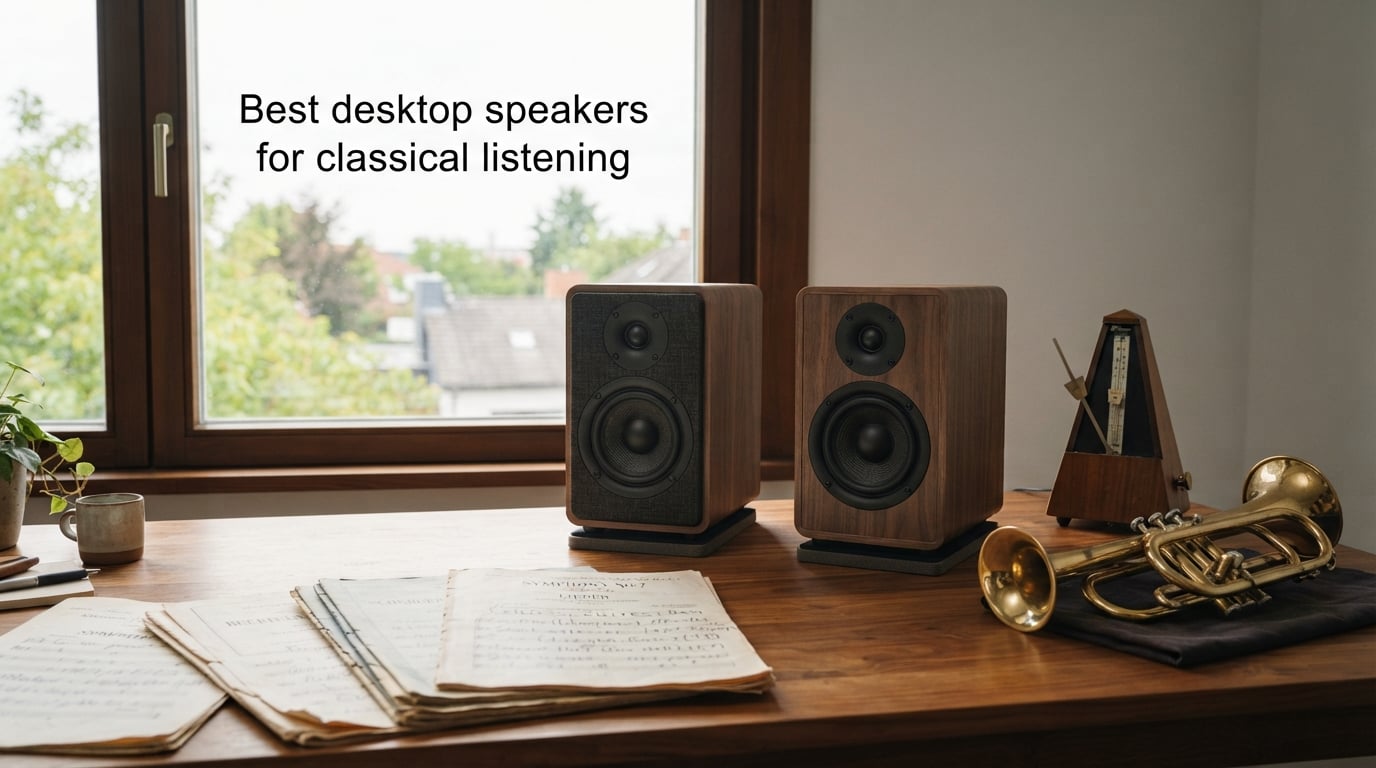
When I first switched from a pair of mass-market computer speakers to a properly engineered pair designed for accuracy, the change in how Bach sounded stopped me mid-track. The harpsichord’s brittle attack was no longer smeared. The reverberant tail of the recording hall finally had somewhere to go.
That moment is what this guide is about. If you listen to classical music at your desk – whether it’s solo piano, full orchestral Romantic warhorses, or intimate string quartets – you already know the genre asks more from your speakers than almost any other. Finding the best desktop speakers for classical listening is less about chasing specifications and more about matching your gear to the unique demands of the repertoire.
In this guide I’ll walk you through what makes classical music so demanding on a speaker system, the technical criteria that actually matter for this genre, how to choose between active and passive designs, where to place your speakers on a desk, how to connect them to the rest of your audio chain, and what realistic performance looks like at each budget tier. No paid placements, no brand shouting – just what I’ve learned from years of writing about hi-fi and from listening sessions with our team.
Table of Contents
Why Classical Music Demands Better Speakers
Classical recordings are unusual because they preserve something pop and rock rarely do: the acoustic signature of the room itself. When you listen to a properly miked symphony, you hear the orchestra, the players’ timing, and the cathedral or concert hall wrapped around them.
That means your speakers need to do three things simultaneously – resolve fine detail (the breath of a flutist, the rosin on a bow), reproduce a wide dynamic range (a Mahler symphony can shift from a whisper to a thunderclap without compression), and place instruments in a believable three-dimensional space. Cheap speakers tend to flatten one or more of these dimensions.
Bass gets exaggerated to sound “impressive” in a big-box store. Treble gets shelved up to fake detail. The result, as one frustrated listener on Reddit’s r/classicalmusic put it, is that “the bass is insane and just sounds ridiculous” on consumer gear marketed with loud low-end claims.
The genre also exposes coloration faster than almost any other. Pop mixes are often heavily processed, so a speaker’s personality can hide behind the production. A solo Steinway recording cannot hide. If your speakers add warmth where the piano should be glass-clear, or compress a soft pianissimo into inaudibility, you will hear it immediately.
Finally, classical music has the largest dynamic range of any common genre. A full orchestra can hit 120 dB at the back of the hall. The quietest passage in a Bruckner symphony might fall below 30 dB. Speakers that work for compressed pop can struggle with that 90 dB swing because their drivers and amplifiers cannot move enough air cleanly at the bottom end of the range.
There is also the matter of how classical recordings are made. Most classical sessions use relatively simple stereo microphone techniques – often a pair of condenser mics placed a few feet apart in the hall. There is little or no overdubbing, no layered compression, no surgical editing of dynamics. What goes on the recording is what came out of the room. That honesty is exactly why the playback system matters so much.
What Makes Speakers Good for Classical Music
A speaker that handles classical well tends to share a handful of traits, even across wildly different price points. Here’s what our team looks for when evaluating desktop speakers for this repertoire.
Neutral Frequency Response
The single most important quality for classical reproduction is a neutral, accurate frequency response. That means the speaker doesn’t artificially boost bass or treble to make music sound exciting. A flat response lets you hear the recording as the producer and engineer intended.
Manufacturers publish frequency response curves – look for one that stays within plus or minus 3 dB from roughly 50 Hz to 15 kHz or beyond. Numbers like “40 Hz – 20 kHz” with no tolerance figure are marketing language and should be treated skeptically.
Independent measurements from publications and reviewers can fill in the gaps when a manufacturer does not publish curves. When you see one measurement from a trusted source, treat it as more reliable than any advertising copy.
Midrange Clarity
Most of the information in classical music – voices, violins, woodwinds, the body of a piano – lives in the midrange. If the midrange is muddy or recessed, the music loses its sense of presence.
Look for speakers with dedicated midrange drivers in larger designs, or well-engineered two-way designs where the woofer and tweeter hand off smoothly around 2-3 kHz. This crossover region is where most coloration is introduced, and where cheap speakers cut corners.
Treble Refinement Without Harshness
Strings, cymbals, and the air around a recording all live in the high frequencies. Treble needs to extend smoothly without sounding edgy or harsh. A good classical speaker will reproduce the shimmer of a violin’s upper register without making you wince.
Silk dome and metal dome tweeters both work well when properly implemented. The material matters less than the engineering around it. Look for reviews that mention smooth, extended treble rather than “bright” or “detailed,” which can be code for uneven response.
Soundstage and Imaging
Soundstage is the sense of width and depth in the music. Imaging is the precision with which instruments are placed within that stage. Classical recordings are made to be experienced in three dimensions, and good speakers preserve that.
For desktop listening, this is partly a function of speaker design and partly a function of placement. A speaker with good directivity (an even dispersion of sound across different angles) tends to image better because the sound reaching your ears is consistent regardless of small movements.
Dynamic Range and Headroom
Speakers with high dynamic range can go from soft to loud without strain. Sensitivity ratings (measured in dB at 1 watt / 1 meter) tell you how efficiently a speaker converts amplifier power into volume. Above 87 dB is generally good for desktop use.
Total harmonic distortion (THD) below 0.5% at normal listening levels means the speaker is adding very little of its own sound to the music. Anything above 1% at moderate volumes will start to smear quiet classical passages.
Cabinet Construction and Resonance Control
The box the drivers live in matters as much as the drivers themselves. Thin, poorly braced cabinets resonate at certain frequencies, coloring everything you hear. Heavier, internally braced cabinets made from MDF or better materials let the drivers do their job without interference.
Pick up a speaker if you can. Heft is not always a sign of quality, but a speaker that feels hollow and rings when you knock on it almost always colors the bass and lower midrange.
Active vs Passive Speakers for Desktop Classical
One of the first decisions you’ll make is whether to buy active (powered) speakers with amplifiers built in, or passive speakers that need a separate amplifier. Each has real trade-offs for a desktop setup.
Active speakers simplify your system enormously. The amplifiers are matched to the drivers by the manufacturer, so you avoid the trial-and-error of pairing. For desktop near-field listening – where you’ll sit within three feet of the speakers – active designs are often the most sensible choice because the amplifier is engineered for that exact use case.
Many active designs also offer built-in digital signal processing (DSP) that can correct for the small cabinet size or desktop placement issues. This kind of tuning is difficult to replicate with separate components.
Passive speakers give you flexibility. You can upgrade the amplifier, swap in a different DAC, and tune the system over time. Many audiophiles prefer this approach because it lets them grow the system in stages. The trade-off is complexity: you need space for an amp, more cables, and some knowledge of impedance matching.
For most readers of The Classical Shop, I’d suggest starting with active speakers and adding an external DAC if you outgrow the built-in electronics. The simplicity pays off in day-to-day use, especially when the speakers sit on a desk that already holds a computer, monitors, and too many cables.
If you already own a quality amplifier from a separate hi-fi setup, passive desktop speakers might make more financial sense – you can reuse the gear you already trust.
Desktop Speaker Placement and Room Interaction
Placement matters more for classical music than for almost any other genre. The good news is that a desktop setup gives you a lot of control. Here are the rules our team follows when we evaluate speakers in our listening room.
The Near-Field Triangle
Set up your speakers and your head in an equilateral triangle. If you sit two feet from each speaker, the speakers should be two feet apart from each other. This is called near-field monitoring, and it’s how recording engineers work for a reason: it minimizes room reflections and gives you a clean stereo image.
For classical listening, this approach pays off massively. You hear the recording, not your office. The closer you sit, the less the room contributes to the sound you hear.
Toe-In Angle
Angle the speakers so they point roughly at your ears. Aiming them straight forward often sounds washed out because the high frequencies don’t reach your ears directly. Many listeners start with the speakers pointed right at the listening position and then adjust outward a few degrees until the soundstage opens up without losing focus.
A small change of five degrees can shift the balance between spaciousness and image precision. Experiment.
Distance From the Wall
Speakers placed directly against a wall get reinforced bass that colors the sound. Rear-ported designs especially need at least 6 to 12 inches of clearance from the wall to breathe. Front-ported or sealed designs are more forgiving in tight spaces.
If your desk pushes against a wall, look for sealed-box designs. They’re a better fit for the constrained geometry of a desktop.
Isolation From the Desk
Speakers vibrate. Desks resonate. The result is muddy, boomy bass that masks detail. Put your speakers on isolation pads, foam stands, or dedicated desktop stands.
This is one of the cheapest upgrades you can make, and it disproportionately improves classical listening because it tightens up the low-frequency response where cellos, basses, and timpani live.
Desk Surface Materials
Glass desks look great but ring like bells when speakers sit on them. Solid wood or MDF desks absorb vibration better. If you’re stuck with a glass or hollow desk, doubling up on isolation is essential – sorbothane pads, weighted stands, or foam wedges all help.
Be especially careful about placing speakers near the desk’s edge, where the surface can flex and color the low frequencies.
Connecting Speakers to Your Existing Hi-Fi Gear
Many readers already own a DAC, a stereo amplifier, or a streamer. The good news is that most modern desktop speakers can play nicely with this equipment – you just need to understand the connection options.
USB DAC Input
Many active speakers include a USB input that lets them receive digital audio directly from your computer. Internally, the speakers convert that digital signal to analog using their own DAC. This bypasses your computer’s often-mediocre sound card and is usually the cleanest path from a desktop computer to your speakers.
Optical and Coaxial Digital
If you already own an outboard DAC, you can run its analog outputs into the speaker’s analog inputs, or use the DAC’s digital output into speakers that accept optical or coaxial inputs. Optical has the advantage of being electrically isolated – no ground loops, no buzzing.
Analog RCA and XLR
For purist setups, balanced XLR connections reject noise over long cable runs, which matters if your amplifier sits far from the speakers. RCA is fine for short desktop runs but more susceptible to interference.
Bluetooth and aptX
Bluetooth is convenient but lossy by default. If you use Bluetooth, look for codecs like aptX HD or LDAC, which preserve more of the original signal. For critical listening of classical music, wired connections remain the gold standard.
Subwoofer Output
If you listen to organ music, large Romantic symphonies, or piano works with strong left-hand passages, a small subwoofer can fill in the lowest octave that most desktop speakers cannot reproduce. Many active speakers include a subwoofer output for exactly this purpose.
For desktop use, look for a small sealed subwoofer that can sit under the desk. Big ported cabinets in a small room tend to boom rather than articulate.
Headphone Output for Late Sessions
Some active speakers include a front-panel headphone jack that mutes the speakers when you plug in. If you live with others and want to listen late into the night, this convenience is worth checking for.
Budget Tiers: What to Expect at Each Price
Speaker pricing follows a curve of diminishing returns, but classical music’s demands mean the curve starts higher than for casual listening. Here’s what realistic performance looks like at each tier in 2026.
Under $200
Entry-level desktop speakers in this range can deliver surprisingly good results, especially small two-way designs from brands with strong engineering heritage. Expect honest midrange, controlled treble, and limited bass extension. They’ll handle chamber music and solo piano well.
Full orchestral works will sound somewhat compressed at the frequency extremes, and dynamic swings will be smaller than the recording suggests. That’s a fair trade-off at the price point.
Avoid anything that markets itself primarily as a gaming or bass-heavy speaker. The tuning will fight classical music at every turn.
$200 to $500
This is where the hobby gets serious for desktop listeners. Speakers in this range often use higher-quality drivers, better cabinets, and more refined crossovers. You’ll hear deeper into the recording and dynamic contrasts become more believable.
Active designs dominate this segment because the integrated amplifier is matched to the drivers. Brands that audiophile communities frequently recommend for classical listening in this range tend to emphasize neutral tuning over flashy features.
This is the sweet spot for most listeners. You can spend more and hear improvements, but they become incremental rather than transformative.
$500 to $1,000
At this level you’re approaching the sound of dedicated hi-fi speakers in a small form factor. Imaging becomes more precise, the soundstage opens up, and instruments occupy more believable positions in space.
Piano tone improves noticeably, and full orchestral works start to feel like performances rather than recordings. You’ll also notice better low-level resolution – the quiet decay of a guitar string, the breath between phrases, the silence of the hall behind a string quartet.
Above $1,000
Premium desktop speakers in this range can rival floor-standing systems in many respects. Resolution, dynamic range, and tonal accuracy all reach levels where the speakers essentially disappear, leaving only the music. Our team has heard pairs in this range that genuinely do justice to Mahler’s symphonies at near-field listening levels.
That said, room treatment and placement matter more than ever at this tier. The speakers reveal everything, including flaws in the recording and the room itself.
Listening Tests: How to Evaluate Speakers for Classical
When our team evaluates desktop speakers for classical listening, we use a small set of reference recordings that stress different aspects of performance. These are the same kinds of tracks we use to write any review on the site.
Solo piano is the toughest test of midrange neutrality. Try a recording of Chopin ballades or Beethoven’s late sonatas. If the piano sounds boxy, colored, or hard, walk away.
Chamber music tests imaging. A string quartet should place four distinct players in a believable arc in front of you. If they all blur into one sound, the imaging is weak.
Full orchestral works test dynamic range. Try a Mahler symphony or a large Bruckner work. A retired symphony musician on the audiophile forums once wrote that he was looking for speakers that could handle Mahler “without rattling after 40 years” of listening. That kind of dynamic honesty matters.
Opera and choral works test midrange texture and soundstage depth. Voices should sound like real singers in real spaces, not processed sounds.
Use recordings you know intimately. The goal is not to be impressed – it’s to notice when something sounds wrong. Familiarity is your most honest measuring tool.
A Brief Glossary of Speaker Terms for Classical Listeners
Here are a handful of terms that come up constantly when reading about speakers for classical music. Knowing them helps you cut through marketing claims.
Frequency response is the range of frequencies a speaker can reproduce, measured in Hertz. The wider and flatter, the more accurate.
Impedance, measured in ohms, is how much the speaker resists the amplifier’s output. Most home speakers are between 4 and 8 ohms. Lower impedance demands more from the amplifier.
Sensitivity, measured in decibels, is how loud the speaker plays with one watt of power at one meter. Higher numbers mean the speaker is easier to drive.
Crossover is the circuit that splits the audio signal between woofer and tweeter. A well-designed crossover is invisible; a poorly designed one introduces harshness and coloration.
Near-field listening means sitting close enough to the speakers that direct sound dominates over reflected room sound. Most desktop setups are near-field by definition.
FAQ: Best Desktop Speakers for Classical Listening
Which speaker is best for classical music?
The best speakers for classical music share four traits: a neutral frequency response, a clear uncolored midrange, accurate soundstage and imaging, and enough dynamic range to handle the soft-to-loud swings in symphonic works. Bookshelf and near-field monitors designed for accuracy typically outperform consumer speakers marketed with boosted bass or treble. Match the speaker’s tuning to the recording, not to the marketing copy.
What is the 83% rule for speakers?
The 83% rule is a guideline for placing speakers in a rectangular room. It suggests positioning the listening spot so that it sits about 83% of the way along the room’s length, away from the rear wall. This placement tends to avoid the worst bass nulls and standing waves, giving smoother low-frequency response. For desktop setups where you cannot move the chair, the rule helps you understand why some rooms sound better than others even with identical gear.
What speakers do audiophiles use?
Audiophiles tend to favor speakers from brands known for measurement-driven engineering and neutral tunings. Common choices include KEF LS50 Meta, ELAC Debut and Uni-Fi lines, Q Acoustics 3000 and 5000 series, Monitor Audio Silver and Gold lines, DALI Oberon and Spektor, and active monitors from Genelec and Neumann for near-field listening. Long-term owners frequently report 10 to 20 years of service from these designs when paired with proper amplification.
What are the best sounding desktop speakers?
The best sounding desktop speakers for music reproduction prioritize accuracy over features. Active near-field monitors with built-in amplifiers and digital inputs offer the cleanest signal path from a computer. Look for designs with a flat frequency response, low distortion, and good imaging. Sealed-cabinet designs work better close to walls, while bass-reflex designs need breathing room behind them. Proper placement and isolation usually improve sound more than upgrading to the next model up.
Final Thoughts on Building a Classical Listening Desktop
The best desktop speakers for classical listening are the ones that disappear and let the music speak. Focus on accuracy, not features. Get the placement right – the equilateral triangle, the toe-in, the wall clearance, the isolation pads.
Match your active or passive choice to how you actually listen, and use the cleanest signal path your setup allows. Spend the time on the basics before chasing the next upgrade.
Most of all, listen to the recordings you love. A speaker that flatters your favorite Mahler symphony but mangles your Bach cantatas is not the right speaker. The right one sounds right on everything, because it colors nothing. When you find that, you’ll know – and you’ll never go back to consumer gear again.
Here at The Classical Shop, we believe the equipment should serve the music, not the other way around. Whatever speakers you choose, take the time to listen critically, place them with care, and let the music do what it has always done best: transport you.