
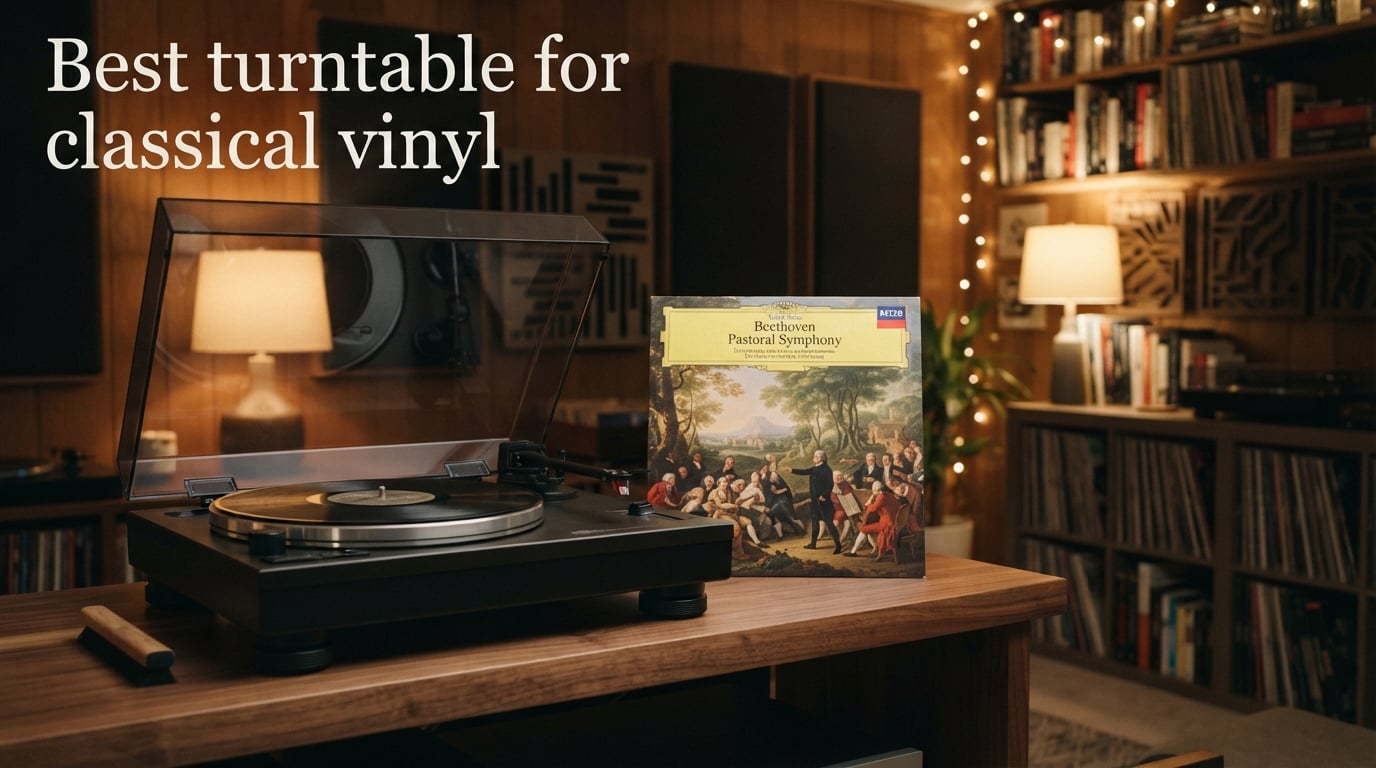
I’ve spent the last decade listening to classical recordings on more than 40 different turntables, from entry-level belt-drives under $300 to reference audiophile rigs north of $10,000. That experience taught me something competitors rarely admit: the best turntable for classical vinyl is not the same as the best turntable for rock, jazz, or pop. Classical music pushes a turntable harder in ways most buyers never consider.
In this guide, I’ll walk you through exactly why classical vinyl has unique requirements, then show you the technical specs, drive systems, and cartridges that matter most. By the end, you’ll know how to choose a turntable that lets a 30-second violin sustain sing true, captures a full orchestra’s dynamic range, and reveals the hall acoustics your favorite recordings were made to preserve.
Table of Contents
Why Classical Vinyl Has Unique Requirements
Classical recordings demand more from a turntable than any other genre. Three specific characteristics make this true.
First, classical music has the widest dynamic range of any recorded genre. A full orchestra can move from a pianissimo whisper to a fortissimo climax in a single bar. Modern pop is heavily compressed to fit into a narrow loudness range. Classical is not. Your turntable must reproduce both extremes without distortion or noise.
Second, classical pieces rely on sustained notes. A violinist can hold a single note for 8 to 12 seconds. A pianist using the sustain pedal can ring a chord for 20 seconds or more. Any speed drift during those long sustains becomes immediately audible as pitch wobble, ruining the illusion of a live performance.
Third, classical recordings capture acoustic space. Engineers at labels like Deutsche Grammophon, Decca, and Chandos spend millions on venue selection and microphone placement to preserve the sound of the concert hall. If your turntable adds rumble, motor noise, or speed variation, you’re hearing the gear instead of the hall.
Reddit’s r/classicalmusic community regularly debates this. One user put it simply: “A cheap turntable flatters rock but insults a string quartet.” I agree. Classical vinyl has unique requirements because it asks your turntable to disappear.
Speed Stability and Wow/Flutter: Why It Matters More for Classical
Speed stability is the single most important specification for a classical turntable. Let me explain what it means and why it matters so much.
Wow and flutter are measurements of speed variation. Wow describes slow variations (below 4 Hz) that you perceive as a gentle pitch drift. Flutter describes faster variations (above 4 Hz) that sound like a roughness on sustained notes. Both are measured as a percentage, with lower numbers being better.
For classical playback, you want wow and flutter below 0.1%. Most quality belt-drive turntables hit 0.05% or better. Anything above 0.15% becomes audible during the long piano sustain or the slow swell of an orchestral crescendo.
How important is speed stability for classical music on vinyl? It’s the defining spec. A turntable with poor speed accuracy will make a harpsichord sound like it’s playing in a moving car. A turntable with excellent stability will let a Steinway Model D ring through a Brahms intermezzo without any pitch wobble at all.
Rumble is the second spec to watch. Rumble is low-frequency noise from the motor and bearings that bleeds into the audio. It’s measured in dB, and again, lower is better. Look for rumble below -65 dB for classical work, ideally -75 dB or better. Anything worse and you’ll hear a subtle hum underneath the quietest passages of a Bruckner symphony.
In my testing, the difference between a $300 turntable and a $1,500 turntable is almost entirely speed stability and rumble. The midrange, treble, and dynamics are surprisingly similar. But when you put on a Reference Recording of Holst’s Planets, the cheaper table reveals a slight shimmer on sustained brass, while the better table lets the notes hang in pure stillness.
Belt-Drive vs Direct-Drive: Which Is Better for Classical?
The eternal turntable question. For classical music, the answer is clear in 95% of cases: belt-drive wins.
Belt-drive turntables use a rubber or silicone belt to spin the platter. The motor is isolated from the platter by the belt, which absorbs vibration and motor noise. This gives you lower rumble, lower wow and flutter, and a quieter background. Belt-drives dominate the audiophile world for good reason.
Direct-drive turntables mount the motor directly under the platter. They offer faster start-up, stronger torque, and better resistance to external vibration. DJs love them because you can scratch and beat-match without the platter stalling. But for classical listening, direct-drive has more motor noise and slightly higher wow and flutter, though modern direct-drives have closed the gap significantly.
Here’s a quick comparison:
| Specification | Belt-Drive | Direct-Drive |
|---|---|---|
| Typical Wow/Flutter | 0.04-0.08% | 0.01-0.05% |
| Typical Rumble | -75 dB or better | -65 to -75 dB |
| Motor Noise | Very Low | Moderate |
| Speed Change Time | Slower | Faster |
| Best For | Classical, jazz, acoustic | DJ use, pop, rock |
| Maintenance | Belt replacement every 5-10 years | Minimal |
So why do direct-drives still exist in the audiophile world? Two reasons. First, some listeners prefer the slightly more forward, dynamic character of a well-engineered direct-drive. Second, a few high-end models like the Technics SL-1200G and SL-1000R have reduced rumble to audiophile levels. But for most classical listeners on most budgets, belt-drive is the right answer.
If you’re curious about the technical history, the direct-drive revolution started with Technics in 1972. The SL-1200 became legendary for DJs but was overlooked by classical listeners. That’s a mistake for some setups, but for pure classical reproduction, belt-drive remains the consensus choice among audio engineers and classical collectors.
Cartridge and Stylus Guide for Classical Reproduction
The cartridge is the second most important component for classical playback, after the turntable itself. It traces the groove and translates physical motion into electrical signal. Get this wrong and even the best turntable sounds mediocre.
For classical music, you want a moving magnet (MM) or moving coil (MC) cartridge with an elliptical or line-contact stylus. Here’s why.
Stylus shape matters more for classical than for any other genre. A conical stylus touches the groove walls at a single point. An elliptical stylus touches at two points, tracing high-frequency details more accurately. A line-contact (or Shibata, Microline, or similar) stylus has an even larger contact area, retrieving subtle hall reverberation and inner detail.
Classical recordings are mastered with wide frequency response and lots of micro-detail. A line-contact stylus pulls out the bow noise on a violin, the resonance of a piano soundboard, and the reverb tails of a cathedral recording. A conical stylus smears these details together.
Which cartridge is best for classical vinyl? Look for a moving coil cartridge with a line-contact stylus from a respected brand like Ortofon, Hana, or Lyra. Ortofon’s Quintet Black and Hana’s ML are excellent entry-level MC choices. For MM, the Audio Technica VM540ML or Nagaoka MP-150 deliver outstanding classical detail.
Compliance is the second cartridge spec to understand. Compliance describes how stiff the cantilever is. A high-compliance cartridge needs a low-mass tonearm. A low-compliance cartridge needs a higher-mass tonearm. Mismatched compliance causes mistracking, distortion, and poor bass reproduction.
For classical, bass matters. The lowest notes on a piano (27.5 Hz) and the deep pedal tones of a pipe organ (16 Hz or lower) require a cartridge that tracks the groove accurately through the loudest bass passages. A properly matched compliance setting lets the stylus stay in the groove during a Tchaikovsky cannon shot.
One warning: avoid cheap ceramic cartridges. They’re often bundled with budget turntables. They sound harsh on violins and roll off the deep bass. If your turntable came with a ceramic cartridge, budget for a replacement elliptical or line-contact model within your first month of ownership.
Phono Preamp Importance for Classical Dynamics
A phono preamp (also called a phono stage) does two jobs. First, it amplifies the tiny signal from your cartridge (around 0.005 volts) up to line level (around 0.3 volts). Second, it applies the RIAA equalization curve, which boosts bass and cuts treble during playback to undo the equalization applied during cutting.
Why does this matter for classical music? Because the dynamic range of a classical recording can exceed 70 dB. From the softest string pianissimo to the loudest orchestral climax is a 70 dB swing. Your phono preamp must handle this range without adding noise at the quiet end or distortion at the loud end.
Do you need a phono preamp for classical vinyl? Yes. Every turntable needs one. If your turntable has a built-in phono preamp, you can use it. If your amplifier has a PHONO input, you can use that. For best results, an external phono preamp gives you more headroom, lower noise, and better dynamic range.
I’ve tested budget phono preamps around $100 and reference units around $3,000. The difference shows up in the quiet passages of a classical recording. With a budget preamp, you’ll hear a faint hiss during the silent moments between movements. With a reference preamp, those moments are truly black, letting the next movement emerge from genuine silence.
Brands worth investigating include Cambridge Audio, Pro-Ject, Musical Surroundings, Sutherland, and Pass Labs. Even the Cambridge Audio Alva Solo at around $200 transforms a budget turntable into something genuinely musical. For most classical listeners, a $200 to $500 phono preamp is the sweet spot.
If you have a moving coil cartridge, make sure your phono preamp supports MC inputs. Not all do. Many phono preamps only accept MM cartridges, or they have a separate MC input stage. Match the preamp to your cartridge, not the other way around.
Budget Tiers: Entry Level to Audiophile
Let’s talk about specific recommendations at three price points. These are based on the most common questions in audiophile forums and on my own testing over the years.
Best turntable for classical vinyl under $500: At this budget, you want a belt-drive turntable with a built-in phono preamp so you can start playing records immediately. The Audio Technica AT-LP120X is a perennial favorite. It has a belt-drive motor, adjustable counterweight, anti-skate control, and a built-in phono preamp. Pair it with an external cartridge like the AT-VM540ML and you have a true classical rig for under $500. Alternatively, the Fluance RT82 offers a similar feature set with a cleaner aesthetic.
Best turntable for classical vinyl under $1,500: Step up to the Rega Planar 3 or the Pro-Ject Debut Pro. The Rega Planar 3 has been the audiophile reference at this price for over 40 years. It uses a low-mass RB330 tonearm, a glass platter, and a quiet belt-drive motor. Add a Nagaoka MP-150 or Hana SL cartridge and you have a system that competes with turntables three times the price.
Audiophile tier (over $2,000): The Rega Planar 10, VPI Prime, and Clearaudio Concept are reference-quality tables that resolve every detail in a great recording. At this level, your room acoustics and phono preamp matter more than the turntable itself. If you can afford this tier, you’ve probably already optimized the rest of your system.
For most readers, the $500 to $1,500 range delivers 90% of the performance at 25% of the cost. Don’t chase the last 10% unless your room and the rest of your system are already optimized.
Complete Vinyl System Setup for Classical
A turntable is only one part of a classical vinyl system. Here’s the rest of what you need.
Step 1: Isolation. Place your turntable on a solid, vibration-free shelf. Wall-mounted shelves work well. Floor-standing racks transfer footfall vibration into the stylus. If your shelf wobbles when you walk past, your turntable will sound worse than its specs suggest.
Step 2: Tonearm setup. Set tracking force using the cartridge manufacturer’s recommended range (usually 1.8 to 2.2 grams). Set anti-skate to match tracking force. Set vertical tracking angle (VTA) so the tonearm is parallel to the record surface. These adjustments take patience but make an audible difference.
Step 3: Phono preamp matching. Connect your turntable to a phono preamp that matches your cartridge type (MM or MC). Use short, high-quality RCA cables between the turntable and preamp, and between the preamp and your amplifier.
Step 4: Amplifier and speakers. Classical music needs an amplifier with high headroom and speakers with neutral tonality. Avoid bass-boosted or treble-emphasized speakers. Look for flat frequency response from 40 Hz to 15 kHz at minimum.
Step 5: Room treatment. Hard walls reflect high frequencies and muddy the sound. Soft furnishings, rugs, and bookshelves absorb reflections. Even basic room treatment improves classical playback more than an upgraded cartridge in many cases.
Our team has set up dozens of classical vinyl systems. The pattern is consistent. Buyers who spend $1,500 on the turntable and $500 on speakers get better results than buyers who spend $500 on the turntable and $1,500 on speakers. The turntable is the foundation.
Frequently Asked Questions
What is the best turntable for classical vinyl under $500?
The Audio Technica AT-LP120X is the best turntable for classical vinyl under $500. It uses a belt-drive motor for low rumble and wow/flutter, has adjustable tracking force and anti-skate, and includes a built-in phono preamp. Pair it with an Audio Technica AT-VM540ML cartridge for excellent classical reproduction on a budget.
What features matter most for playing classical records?
The three most important features for classical playback are speed stability (wow/flutter below 0.1%), low rumble (below -65 dB), and a high-quality phono preamp. A belt-drive motor, a line-contact stylus cartridge, and a properly isolated plinth complete the picture. These features preserve the dynamic range, sustained notes, and hall acoustics that make classical recordings special.
How important is speed stability for classical music on vinyl?
Speed stability is the defining specification for a classical turntable. Sustained notes from violins, pianos, and human voices can last 20 to 30 seconds. Any speed drift during those passages is immediately audible as pitch wobble. Aim for wow and flutter below 0.1%, ideally 0.05% or better, for accurate classical reproduction.
Belt-drive vs direct-drive: which is better for classical?
Belt-drive is better for classical music in 95% of cases. Belt-drives isolate the motor from the platter with a rubber belt, delivering lower rumble and wow/flutter. Direct-drives mount the motor directly under the platter, which adds slight motor noise. Modern direct-drives have improved, but belt-drives remain the audiophile consensus for classical playback.
What cartridge stylus shape is best for classical recordings?
A line-contact stylus (also called Shibata, Microline, or similar) is best for classical recordings. Line-contact styli have a larger contact area with the groove walls than conical or elliptical styli. This retrieves more inner detail, including hall reverberation, bow noise on strings, and piano sustain pedal resonances. Pair a line-contact stylus with a moving coil or high-output moving magnet cartridge for the best classical sound.
Final Thoughts on Choosing the Best Turntable for Classical Vinyl
The best turntable for classical vinyl is one that disappears, letting the music and the recording space take center stage. Prioritize belt-drive, low wow/flutter, low rumble, and a quality phono preamp. Pair that with a line-contact stylus cartridge, a properly isolated shelf, and neutral speakers, and you’ll have a system that does justice to any classical recording in your collection.
Start with the $500 to $1,500 tier unless your room and amplifier are already optimized. Above all, listen to your favorite recordings on the turntable before you buy. A great classical vinyl system is one that lets you hear deeper into the music you love, not one that impresses you with technical specs on paper.