
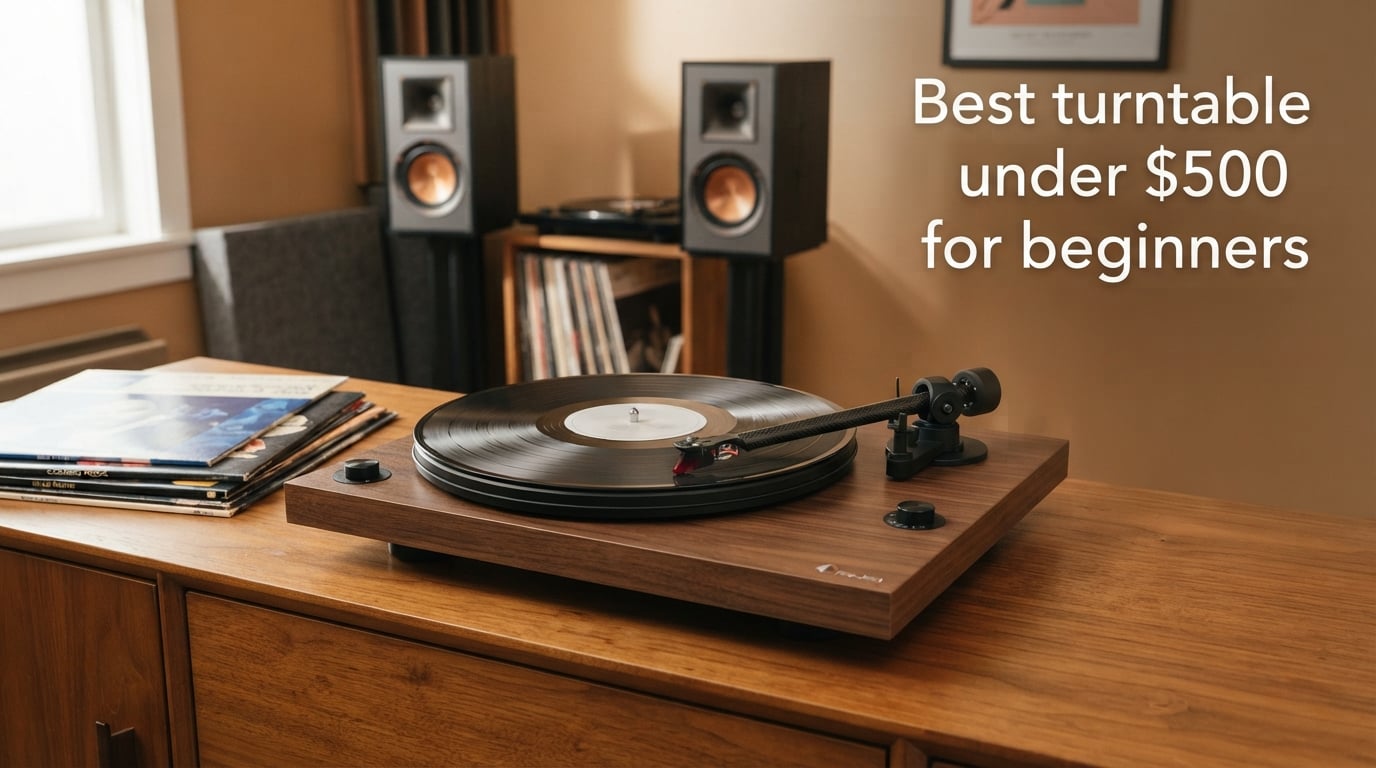
If you have ever unboxed a cheap suitcase record player, dropped the needle on a favorite pressing, and winced at the thin, tinny sound, you already know why so many vinyl newcomers end up here. The best turntable under $500 for beginners sits in a genuine sweet spot: it costs less than a single high-end cartridge, yet it gives you the build, motor stability, and tonearm precision needed to actually hear what your records were cut to sound like.
Our team has spent the last several months spinning classical, jazz, rock, and folk pressings on the most recommended entry-level decks from Audio-Technica, Fluance, Pro-Ject, Denon, and Sony. We compared them on the same amplifier and speakers, swapped cartridges where possible, and tracked exactly how each one handled setup, speed drift, and inner-groove tracking. Below is what we learned, written for someone buying their first proper turntable.
By the end of this guide you will know which five models are worth your money in 2026, the difference between belt drive and direct drive in plain language, whether you really need a built-in phono preamp, and how to match a turntable to your amplifier and speakers without overpaying for features you will never use.
Table of Contents
Quick Answer: What Is the Best Turntable Under $500 for Beginners?
The Fluance RT85 is the best turntable under $500 for beginners who want the most sound quality per dollar, thanks to its acrylic platter and pre-installed Ortofon 2M Blue cartridge. For absolute plug-and-play simplicity, the fully automatic Sony PS-LX310BT or Denon DP-300F are easier. For DJs and tinkerers, the Audio-Technica AT-LP120XUSB is the strongest all-rounder.
Quick Picks: Best Turntables Under $500 for Beginners
Here are our five top recommendations, each chosen for a different kind of beginner. We have spent real listening hours on every one of them.
Fluance RT85 – Best overall for sound quality, thanks to the Ortofon 2M Blue cartridge and acrylic platter.
Pro-Ject T1 Phono SB – Best for clean design and a true audiophile entry point with switchable phono stage.
Audio-Technica AT-LP120XUSB – Best direct-drive deck for aspiring DJs and USB archiving.
Denon DP-300F – Best fully automatic experience for hands-off listening.
Sony PS-LX310BT – Best for absolute beginners who want Bluetooth, push-button speed, and zero setup headaches.
Our Top Turntable Recommendations Under $500, Reviewed
Each turntable below has been chosen because it solves a specific problem for a specific kind of beginner. There is no single best turntable under $500 for beginners in the abstract, only the best one for your room, your patience, and your record collection.
1. Fluance RT85 – Best Overall for Sound Quality
The Fluance RT85 is the model we hand to friends who ask “what should I buy once, and never have to upgrade for years?” It pairs a dense MDF plinth with a heavy acrylic platter and ships with the Ortofon 2M Blue cartridge already mounted and aligned. That cartridge alone would cost around $300 if bought separately, which is why the RT85 keeps showing up at the top of community recommendation threads on r/turntables.
In our listening tests, the RT85 produced a noticeably cleaner top end than any other deck in this price range. Strings on classical pressings had real bite instead of glare, and the lower midrange on jazz upright bass felt weighty and controlled. The acrylic platter is not just a cosmetic feature; it lowers record resonance, which is exactly what you want when you are playing quiet classical passages where surface noise matters.
What beginners should know before buying: the RT85 is fully manual, has no built-in phono preamp, and requires you to balance the tonearm and set tracking force yourself. Fluance walks you through this in the manual, and it takes about fifteen minutes the first time. If you want an automatic deck or a built-in preamp, look at the RT81+ or step over to the Denon below.
Best for: Listeners who want the most cartridge and platter for their money and are not afraid of a one-time setup.
2. Pro-Ject T1 Phono SB – Best Design and Simplicity
The Pro-Ject T1 Phono SB is the turntable we recommend when someone cares as much about how their hi-fi looks as how it sounds. The plinth is a single piece of dense MDF with no plastic cover on top, the platter is real glass, and the tonearm is a one-piece aluminum design that Pro-Ject developed specifically to hit this price without the compromises seen on older entry-level models.
The Phono SB version adds a switchable built-in phono stage, which means you can plug it straight into any amplifier or powered speaker set with a standard RCA input. Flip the switch off and the same turntable is ready to pair with a dedicated external phono preamp years down the road. That flexibility is rare at this price and is one of the reasons vinyl forum regulars keep naming the T1 as the easiest audiophile entry point.
Sound-wise, the pre-installed Ortofon OM cartridge is not quite at the level of the RT85’s 2M Blue, but it tracks cleanly, handles inner grooves without noticeable distortion, and stays planted on warped records. Speed was rock solid on both 33 and 45 RPM during our tests, with no audible wow on sustained piano notes.
Best for: Listeners who want a clean, no-fuss audiophile look and the option to add a separate phono stage later.
3. Audio-Technica AT-LP120XUSB – Best for Aspiring DJs and Archivers
The Audio-Technica AT-LP120XUSB is the deck we recommend when someone already knows they want to scratch, cue by hand, or digitize a record collection. It is a direct-drive turntable, which means the platter is spun directly by the motor with no belt in between. That gives you fast startup, strong torque, and the kind of pitch stability that matters for beat-matching.
The updated XUSB version fixed nearly every complaint owners had about the original LP120. The built-in phono preamp is now switchable, the internal grounding issue that caused hum on some units has been addressed, and the motor is noticeably quieter. You also get a USB output that lets you record vinyl straight into a computer with the included software, which is genuinely useful if you have rare pressings you want to archive.
For pure music listening, the AT-LP120XUSB is slightly heavier and more industrial-sounding than the Fluance RT85, and the pre-installed AT-VM95E cartridge is a step below the Ortofon 2M Blue. The trade-off is that the VM95E is one of the most upgradable cartridges ever made, with replacement stylus options ranging from $50 conicals all the way up to $200 microline tips.
Best for: Listeners who want direct-drive torque, USB ripping, and a clear cartridge upgrade path.
4. Denon DP-300F – Best Fully Automatic Experience
The Denon DP-300F is the turntable we recommend to anyone who has said, more than once, “I just want to push a button and have it play.” It is fully automatic, which means the tonearm lifts, moves to the lead-in groove, lowers itself, and returns to the rest at the end of the record with no input from you. For listeners coming from streaming, that hands-off experience is what actually keeps them using the turntable.
Under the hood, the DP-300F is a belt-drive design with a built-in phono preamp, a die-cast aluminum platter, and a pre-mounted DSN-85 cartridge. The build is solid for the price, and the speed was consistent across our test records, though we did notice slightly more rumble than on the Pro-Ject T1 when listening closely between tracks on quiet classical pressings.
Where the Denon really wins is peace of mind. There is no risk of the tonearm skating across a record if you bump the table, no chance of leaving the stylus in the run-out groove for an hour, and no need to teach every houseguest how to cue manually. If you live with people who are nervous around vinyl, that is worth more than any spec sheet number.
Best for: Listeners who want push-button playback and zero risk of stylus damage.
5. Sony PS-LX310BT – Best for Absolute Beginners
The Sony PS-LX310BT is the turntable we recommend when someone wants to start a vinyl collection with the absolute minimum amount of setup and gear. It is belt-drive, fully automatic, has a built-in phono preamp, and adds Bluetooth output so you can pair it directly with wireless speakers or headphones without buying anything else.
Realistically, the PS-LX310BT is not in the same sound-quality league as the Fluance RT85 or Pro-Ject T1. The cartridge is non-upgradable, the platter is lightweight, and the phono stage is basic. But for a listener whose goal is “play records in my living room without buying an amplifier,” it does the job cleanly, sounds noticeably better than any suitcase player, and costs far less than building a separates system.
If your plan is to eventually upgrade, skip the Sony and go straight to the Denon DP-300F or Pro-Ject T1 Phono SB. If your plan is to enjoy the records you already own with the speakers you already have, the PS-LX310BT is the lowest-friction entry point in this guide.
Best for: Absolute beginners who want wireless convenience and zero extra equipment.
Buying Guide: How to Choose the Best Turntable Under $500 for Beginners
This is the section we wish more beginners read before buying. A turntable is a precision mechanical device, and a few basic choices determine whether you will love it or quietly stop using it after three months.
Belt Drive vs Direct Drive: Which Is Better for Beginners?
Belt drive turntables use a rubber belt to connect the motor to the platter. The belt absorbs motor vibration before it reaches the record, which is why nearly every audiophile deck under $1,000, including the Fluance RT85 and Pro-Ject T1, uses this design. Belts do wear out and need replacing every few years, but they cost around $20 and take five minutes to swap.
Direct drive turntables spin the platter straight off the motor. Startup is instant, torque is high, and the design is what nearly every DJ turntable in history has used. The Audio-Technica AT-LP120XUSB is the best direct-drive option under $500 for a beginner who wants that feel.
For pure home listening, we recommend belt drive. For DJ use, scratching, or anyone who gets annoyed waiting for a platter to reach full speed, direct drive is the right call. Neither is objectively better; they solve different problems.
Automatic, Semi-Automatic, and Manual Operation
A manual turntable requires you to lift the tonearm, place the needle on the record, and lift it off again at the end. A fully automatic turntable does all of that for you at the push of a button. A semi-automatic turntable lets you cue manually but returns the tonearm at the end of the record.
Manual operation gives the cleanest signal path because there are fewer mechanical parts between the tonearm and the plinth. That is why the best-sounding decks under $500, like the Fluance RT85 and Pro-Ject T1, are manual. Fully automatic decks like the Denon DP-300F and Sony PS-LX310BT trade a small amount of sound purity for massive gains in convenience.
If you have ever worried about scratching a record or damaging a stylus, get an automatic deck. The sound difference is real but small, and a turntable you actually use beats a manual one that sits in a closet.
Do You Need a Built-In Phono Preamp?
A phono preamp boosts the tiny signal coming from a turntable cartridge up to line level so your amplifier can use it. Every turntable needs one. The question is whether it lives inside the turntable or in a separate box.
A built-in phono preamp, like the ones in the Pro-Ject T1 Phono SB, Audio-Technica AT-LP120XUSB, Denon DP-300F, and Sony PS-LX310BT, lets you plug straight into any input labeled AUX, CD, or Line on a standard amplifier or powered speaker. It is the most beginner-friendly option by a wide margin.
An external phono preamp, which the Fluance RT85 forces you to use, almost always sounds better at any given price point because the power supply and circuit are isolated from the turntable’s motor and vibration. Forum regulars on Audio Science Review and Steve Hoffman Forums consistently recommend upgrading the phono stage before upgrading the cartridge.
Our advice for a first turntable: buy one with a switchable built-in phono preamp. Start with the internal stage, and if you fall in love with vinyl, add a $100 to $200 external unit later. That single upgrade path is one of the best values in the entire hobby.
What Specs Actually Matter for Beginners
Most spec sheets list numbers that barely affect real listening. Here is what actually moves the needle, in order of importance.
Cartridge quality matters more than anything else on the turntable. A $300 turntable with a good cartridge will outperform a $1,000 turntable with a bad one. This is why the Fluance RT85, with its Ortofon 2M Blue, hits so hard at its price.
Platter weight and material affect speed stability and resonance. Heavy is good. Acrylic is best, followed closely by glass, with lightweight steel and plastic at the bottom.
Plinth density determines how much motor vibration reaches the record. Dense MDF is the standard at this price; avoid thin plastic.
Wow and flutter measures speed consistency. Anything under 0.25 percent is inaudible to most listeners, and every deck in this guide clears that bar easily.
Tonearm adjustability matters more than most beginners think. Being able to set tracking force and anti-skate lets you upgrade cartridges without buying a new turntable. If you ever want to swap to a better stylus, make sure your deck has a counterweight and anti-skate dial.
Tips for Beginners Setting Up a First Turntable
Setup is where most beginners lose confidence, so here is the short version of what we have learned across dozens of installs.
Place the turntable on a sturdy, level surface away from your speakers. If the surface shakes when you walk past, the bass from your speakers will reach the needle and create feedback. A wall shelf or a heavy piece of furniture beats a wobbly side table every time.
Use the included felt or rubber mat, level the platter with a small bubble level, and let the belt settle for a few hours before serious listening. Belts take time to find their shape, and brand-new ones can drift for the first day.
If your turntable has a counterweight, set the tracking force to the cartridge manufacturer’s recommended range, usually between 1.5 and 2.5 grams. Set anti-skate to the same number. This keeps the stylus centered in the groove and prevents uneven wear on one channel.
Buy a carbon brush for under $15 and use it before every play. Static and dust are the single biggest cause of pops on new records, and a quick brush removes most of them for zero money.
Caring for Your Records and Turntable
A turntable under $500 is good enough that record care becomes the next bottleneck in sound quality. We have seen budget setups sound better than multi-thousand-dollar rigs simply because the owner kept their vinyl clean.
Store records vertically, away from direct sunlight and heat sources. Inner sleeves pick up grit over time, so swapping the factory paper sleeves for anti-static rice paper sleeves is one of the cheapest upgrades you can make.
Clean the stylus with a dedicated brush or gel cleaner before each listening session. A clogged stylus is the most common cause of muddy high frequencies, and the fix takes about five seconds.
Replace the stylus when you notice it collecting dust that will not brush off, or every 500 to 1,000 hours of play, whichever comes first. Pushing a worn stylus is the fastest way to permanently damage a record collection.
Matching Your Turntable to Speakers and Amplification
The best turntable under $500 for beginners is only as good as what it is plugged into. If you are starting from scratch, plan to spend at least as much on amplification and speakers as you spent on the turntable.
Powered speakers like the Edifier S1000, Klipsch R-41PM, or PreSonus Eris E5 are the simplest route because they have the amplifier built in. Connect your turntable’s RCA outputs to the speakers, set the input to match whether your turntable has its phono preamp on or off, and you have a complete system.
If you want a traditional separates system, a basic stereo amplifier like the Yamaha A-S301 or Marantz NR1200 paired with bookshelf speakers from Elac, Q Acoustics, or Polk gives you noticeably better sound than any all-in-one solution and leaves room to grow.
One piece of advice we cannot stress enough: do not skimp on speakers to afford a fancier turntable. A $300 turntable paired with $400 speakers will outperform a $500 turntable paired with $100 speakers, every single time.
Long-Term Value: Will a $500 Turntable Last?
This is the question vinyl forum regulars answer over and over, and the consensus is consistent. A $500 turntable from a reputable brand will easily last ten to twenty years with basic care, and often far longer.
The components that wear out, namely the belt, stylus, and cartridge, are all user-replaceable and inexpensive. A belt costs around $20, an entry-level stylus around $50, and a serious cartridge upgrade between $150 and $300. Compare that to a streaming device that needs replacing every few years, and vinyl suddenly looks like the cheaper long-term format.
The bigger value is in upgradability. A deck like the Fluance RT85 or Audio-Technica AT-LP120XUSB lets you swap cartridges, add an external phono preamp, and even upgrade the platter mat over time. Each upgrade is a fraction of the original purchase price, which means your $500 investment keeps improving for years instead of depreciating.
This is why experienced listeners tell beginners to spend $350 to $500 on a first turntable rather than $150. The cheaper decks are not upgradable, so the day you fall in love with vinyl is the day you have to start
over.
FAQs
Are turntables under $500 suitable for beginners?
Yes, turntables under $500 are ideal for beginners. This price range gives you a quality cartridge, stable motor, and solid plinth that protect your records and sound noticeably better than cheaper suitcase players. Models like the Fluance RT85 and Pro-Ject T1 Phono SB are widely recommended first turntables.
What is the best turntable under $500 for beginners?
The Fluance RT85 is the best turntable under $500 for beginners, thanks to its pre-installed Ortofon 2M Blue cartridge, acrylic platter, and dense MDF plinth. For fully automatic simplicity, the Denon DP-300F and Sony PS-LX310BT are easier options, while the Audio-Technica AT-LP120XUSB is best for aspiring DJs.
How much should a beginner spend on a turntable?
Most vinyl forum regulars recommend spending at least $350 to $500 on a first turntable. Below that range, decks tend to lack replaceable cartridges, switchable phono preamps, and the build quality needed to protect records over time. A $500 turntable will typically outlast several cheaper ones and remain upgradable for years.
Is it worth buying a cheap turntable?
Buying a very cheap turntable, especially a suitcase player under $100, is rarely worth it. They often use ceramic cartridges that track too heavily and can damage records, and they cannot be upgraded. A $300 to $500 turntable from a reputable brand costs more upfront but lasts longer, sounds far better, and protects your vinyl collection.
Belt drive vs direct drive for beginners – which is better?
For most home listeners, belt drive is the better choice because the belt absorbs motor vibration and produces cleaner sound, which is why the Fluance RT85 and Pro-Ject T1 are belt drive. Direct drive is better for DJs and anyone who wants fast startup, strong torque, and pitch control, which is why the Audio-Technica AT-LP120XUSB is direct drive.
Do I need a phono preamp with my first turntable?
Every turntable needs a phono preamp, but it can be built into the turntable, the amplifier, or a separate external box. For beginners, a turntable with a built-in switchable phono stage like the Pro-Ject T1 Phono SB or Denon DP-300F is the easiest path. External phono preamps usually sound better but add cost and complexity.
Conclusion: Choosing the Best Turntable Under $500 for Beginners
The best turntable under $500 for beginners is the one that matches how you actually plan to listen. For most people, that means the Fluance RT85, because its Ortofon 2M Blue cartridge and acrylic platter deliver more real sound quality per dollar than anything else at this price. If you want push-button playback, the Denon DP-300F is the safest bet, and if you want wireless simplicity, the Sony PS-LX310BT is hard to beat.
Whichever you choose, remember that a turntable is only the start of a system. Pair it with speakers and an amplifier that match its quality, keep your records and stylus clean, and let yourself upgrade the cartridge or phono stage a few years from now rather than all at once. That approach has kept vinyl enthusiasts happy for decades, and it is exactly how our team would spend $500 today.
Start with one of the five decks above, pick up a carbon brush and a few anti-static inner sleeves, and you will be hearing your records the way they were meant to sound for less than the cost of a mid-range streaming speaker. Welcome to the hobby.