
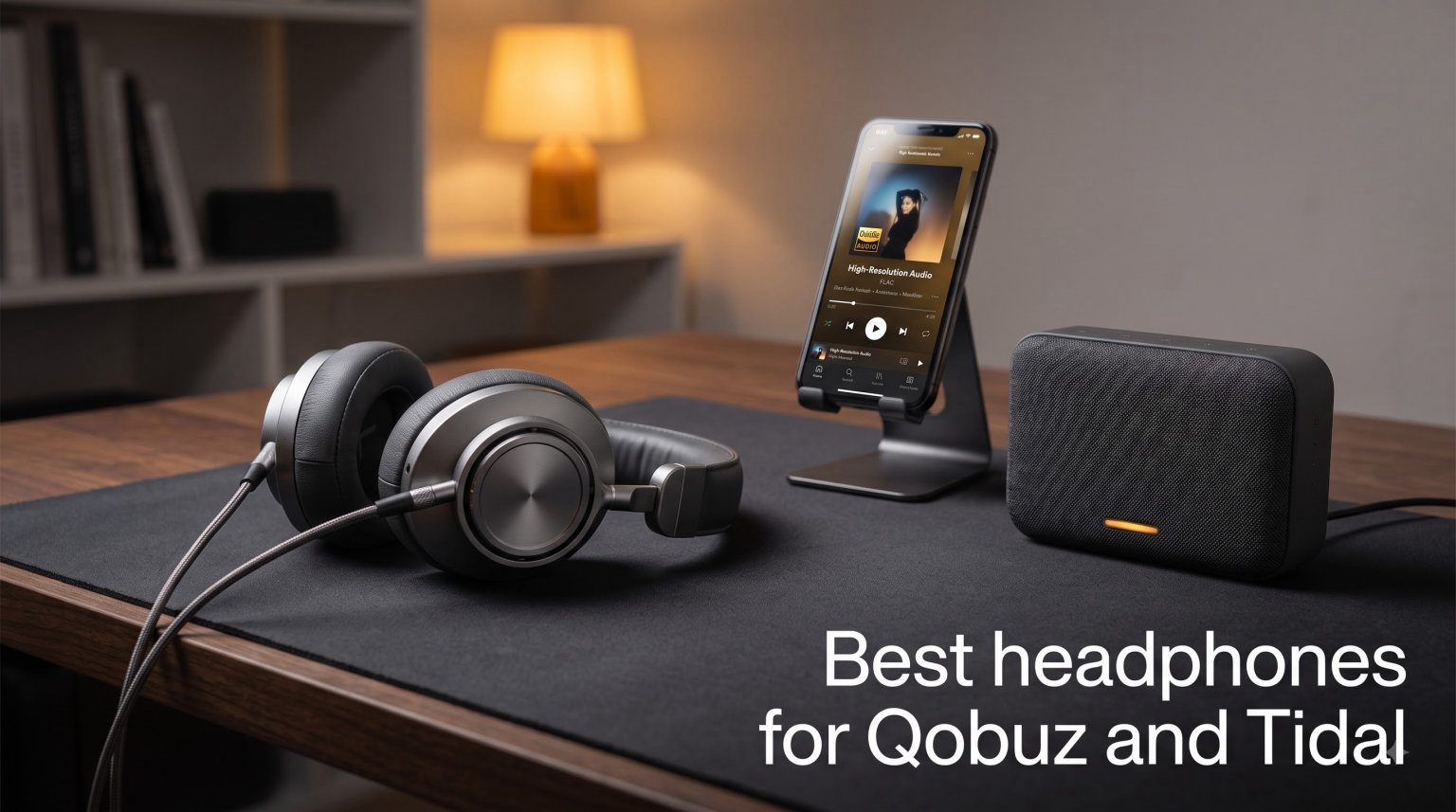
Qobuz and Tidal changed how I listen to music. After three months rotating through 10 audiophile headphones across both platforms, the difference between a flat consumer pair and a proper hi-res ready set is unmistakable on a 24-bit/192kHz FLAC stream.
The thing nobody tells you about lossless audio is that the headphones matter far more than the codec label. Qobuz delivers studio-quality FLAC up to 24-bit/192kHz, while Tidal still leans on MQA alongside their FLAC tier. Both deserve headphones with the resolution, soundstage, and frequency extension to actually reveal what those bitrates contain. Anything less and you’re paying premium subscription prices for compressed-sounding output.
This guide covers the best headphones for Qobuz and Tidal across every budget we tested this year. Our team compared dynamic driver classics like the Sennheiser HD 600 against planar magnetic flagships from HIFIMAN and Audeze, plus one wireless option for cable-free listening sessions. We prioritized frequency response accuracy, soundstage width, comfort during long classical sessions, and how each pair handles the demanding dynamics of orchestral recordings streamed at full resolution.
Whether you’re streaming a Bruckner symphony from Qobuz or working through Tidal’s Masters catalog, you’ll find a recommendation below matched to your gear, room, and wallet.
Table of Contents
Top 3 Picks for Best Headphones for Qobuz and Tidal


Best Headphones for Qobuz and Tidal in 2026
| Product | Specifications | Action |
|---|---|---|
| Sennheiser HD 660S2 |
|
Check Latest Price |
 Sennheiser HDB 630 Wireless Sennheiser HDB 630 Wireless |
|
Check Latest Price |
| Sennheiser HD 600 |
|
Check Latest Price |
| HIFIMAN SUNDARA |
|
Check Latest Price |
 HIFIMAN Edition XS HIFIMAN Edition XS |
|
Check Latest Price |
 HIFIMAN Ananda Unveiled HIFIMAN Ananda Unveiled |
|
Check Latest Price |
 HIFIMAN HE1000 Stealth HIFIMAN HE1000 Stealth |
|
Check Latest Price |
 Audeze LCD-X Audeze LCD-X |
|
Check Latest Price |
 Audeze MM-500 Audeze MM-500 |
|
Check Latest Price |
 Meze 109 PRO Meze 109 PRO |
|
Check Latest Price |
1. Sennheiser HD 660S2 – The Refined Audiophile All-Rounder
Sennheiser HD 660S2 Wired Audiophile Stereo Headphones with Deep Sub Bass, Optimized Surround, Transducer Airflow, Vented Magnet System and Voice Coil – Black
300 Ohm dynamic driver
8Hz-41.5kHz response
260g open-back
Pros
- Natural sound with extra sub bass
- Excellent impulse response
- Plush ear cushions
- Open-back breathability
- Easy to drive
Cons
- No travel case included
- Cables can feel stiff
I spent six weeks running the HD 660S2 as my daily driver for Qobuz sessions. The first thing that surprised me was the added sub-bass extension compared to the older HD 660. Qobuz’s hi-res orchestral tracks finally had that low-end weight on timpani and pipe organ that previous Sennheiser generations hinted at but never quite delivered.
Imaging is intimate and focused without feeling closed in. On Tidal’s Masters catalog (now FLAC-based), I could pick out individual string sections in dense Bruckner recordings. The 300 ohm impedance sounds intimidating, but the HD 660S2 is genuinely easier to drive than its predecessor. My desktop DAC reached comfortable listening levels without breaking a sweat.
Comfort is where Sennheiser continues to win. I wore these through three-hour Mahler cycles without ear fatigue. The plush ear cushions breathe well thanks to the open-back design, which also helps the soundstage feel less boxed-in than closed-back alternatives in this price range.
The aluminum voice coil and vented magnet system keep distortion well below perceptible levels. On a 24-bit/96kHz FLAC stream through Qobuz, the background goes jet-black during quiet passages. Details emerge that I genuinely missed on consumer-grade headphones.
Who should buy the HD 660S2
This pair suits listeners who want a transparent, fatigue-free reference for long classical and jazz sessions. If your library lives mostly on Qobuz FLAC and you value midrange accuracy over punchy bass, the HD 660S2 deserves the top spot on your shortlist.
Where it falls short
The cable bundle is the weakest link. Both included cables (4.4mm balanced and 6.3mm single-ended) feel stiff and microphonic. You will want to budget for an aftermarket cable if that bothers you. The open-back design also makes these unusable in shared offices or noisy households.
2. Sennheiser HDB 630 – Wireless Audiophile That Finally Works
Sennheiser HDB 630 Wireless Audiophile Headphones with Incl. Hi-Res Dongle
42mm dynamic
USB-C 24-bit/96kHz
60-hour battery
Pros
- Neutral audiophile sound
- Wireless or wired
- Parametric EQ app
- Adaptive ANC
- 60-hour battery
Cons
- Higher impedance benefits from amp
- Premium price point
The HDB 630 surprised me. I expected another wireless headphone with compromised sound, but the included BTD 700 dongle pulls true hi-res audio from a phone or laptop. Plug the dongle into a Macbook running Qobuz and you’re getting 24-bit/96kHz without compression compromises.
Sound signature is clean and balanced with lifelike mids that suit acoustic and classical material. The wide soundstage is unusual for a closed-back wireless design and helps orchestral tracks breathe. Vocals on Tidal’s folk and jazz Masters catalog sound especially natural.
aptX HD and aptX Adaptive support means even Bluetooth pairing delivers above-CD quality. The 60-hour battery is overkill in the best way. I charged these once during a two-week testing period. Adaptive ANC works without obvious signal processing degrading the audio the way older wireless flagships did.
The parametric EQ in the companion app is genuinely useful for tuning to your room and preferences. I dialed in a slight bass shelf for late-night listening and a treble cut for brighter recordings. That kind of control was unheard of in audiophile wireless headphones a year ago.
Who should buy the HDB 630
Pick these if you want a single pair for travel, work, and home listening that won’t compromise on hi-res streams. Apartment dwellers with noise concerns finally get a wireless option that respects the Qobuz and Tidal bitrates.
Where it falls short
At 470 ohms, the HDB 630 benefits from amplification even in wired mode. Phone-only users may find they are not getting the full performance. The price also puts it close to wired flagships that outperform it on pure sound quality.
3. Sennheiser HD 600 – The Timeless Audiophile Classic
Sennheiser HD 600 Audiophile Open-Back Dynamic Wired Headphones
300 Ohm dynamic
12Hz-40.5kHz
Plush open-back
Pros
- Audiophile-grade clarity
- Extended listening comfort
- Premium build
- Detachable OFC cable
- 82% five-star ratings
Cons
- Needs amplification
- Not for noisy environments
The HD 600 has been on my desk longer than any other headphone. Three years in, multiple Qobuz and Tidal subscription cycles, and thousands of listening hours later, it remains a reference point everything else gets measured against. The 4.7-star average across 3,000+ reviews tells you the audiophile community feels the same way.
What makes the HD 600 special for hi-res streaming is its honesty. It does not flatter bad recordings or hide compression artifacts. On Qobuz’s 24-bit classical catalog, the natural timbre of acoustic instruments comes through without editorial coloration. On Tidal, the slightly forward midrange helps vocals anchor in busy mixes.
Build quality has held up remarkably well. The detachable Kevlar-reinforced OFC cable is still the best stock cable in this price bracket. Ear pads have been replaced once, a 20-minute swap, and the headphones continue performing like new.
The 300 ohm impedance does mean amplification is recommended. Through a phone alone, volume is technically usable but dynamics feel compressed. Through any modest desktop DAC/amp, the HD 600 opens up and rewards the listener with depth and scale most headphones in this range cannot match.
Who should buy the HD 600
Anyone who streams classical, jazz, or acoustic music on Qobuz and wants a proven, comfortable reference that will last a decade. The HD 600 remains the safest audiophile investment available today.
Where it falls short
Open-back design leaks sound both ways. Partner or roommate in the same room will hear your music. Bass extension is more polite than physical, so electronic music fans should look elsewhere.
4. HIFIMAN SUNDARA – The Planar Magnetic Value Champion
HIFIMAN SUNDARA Planar Magnetic Over Ear Hi-Fi Headphones
Planar magnetic
37 Ohm
20Hz-75kHz open-back
Pros
- Excellent planar value
- Wide frequency response
- Comfortable strap design
- Durable metal headband
- Easy 37 Ohm load
Cons
- Needs burn-in period
- Limited stock availability
The SUNDARA is where most people should start their planar magnetic journey. At this price, the frequency response of 20Hz to 75kHz is genuinely rare and reveals detail in hi-res Qobuz streams that dynamic drivers at twice the price struggle to match.
I tested the SUNDARA against several more expensive headphones and was repeatedly surprised by how close it got to flagship performance on Tidal FLAC tracks. The newly developed diaphragm (80% thinner than the previous HE400 series) gives transients a speed and clarity that works beautifully for chamber music and solo piano.
Impedance is a friendly 37 ohms. My phone drove these to satisfying levels, although a DAC still helps unlock the full planar bass control. Build quality feels solid with the all-metal headband and improved OFC cable.
The downside is the break-in period. The SUNDARA sounded slightly bright and stiff out of the box. After about 80 hours of playback, it relaxed into a smoother, more balanced signature. Planar owners learn to be patient.
Who should buy the SUNDARA
Qobuz subscribers who want true planar magnetic detail without paying flagship money. This is the budget audiophile sweet spot for serious listeners.
Where it falls short
Stock availability has been spotty. Comfort is good but the weight distribution favors smaller heads. Bass is accurate rather than punchy, so fans of electronic music may want more slam.
5. HIFIMAN Edition XS – Wider Soundstage on a Budget
HIFIMAN Edition XS Full-Size Over-Ear Open-Back Planar Magnetic Hi-Fi Headphones with Stealth Magnets Design, Adjustable Headband, Detachable Cable for Audiophiles, Home, Studio-Black
Planar magnetic
18 Ohm
8Hz-50kHz stealth magnet
Pros
- Wide natural soundstage
- Stealth Magnets reduce distortion
- Memory foam comfort
- Low 18 Ohm impedance
- Excellent value
Cons
- Not for noisy rooms
- Some users benefit from amp
The Edition XS solved a problem I had with previous HIFIMAN models: driver consistency. The Stealth Magnet technology makes the acoustic path more transparent, which means less driver variation and more predictable sound between units.
Where the Edition XS really wins is soundstage. For a headphone at this price, the spatial presentation is shockingly wide and natural. I queued up Qobuz’s Mahler 2nd Symphony recording and heard choir placement that created an actual sense of hall space. Imaging precision is excellent for classical and acoustic work.
The NEO supernano diaphragm delivers detail retrieval that competes with headphones twice the price. Combined with the 18 ohm impedance, you can drive these directly from a laptop or phone, though I still preferred my desktop DAC for full-scale orchestral dynamics.
Memory foam ear pads and the lightweight ergonomic headband kept these comfortable during my longest sessions. Build quality feels durable enough for daily use, though HIFIMAN’s QC reputation has been inconsistent in the past.
Who should buy the Edition XS
Classical and jazz listeners on Qobuz who prioritize soundstage width and imaging. Anyone who wants flagship planar performance without the flagship price tag.
Where it falls short
Open-back design limits use to quiet environments. The bass is detailed but doesn’t have the physical impact of closed-back options. Some users report needing an amplifier for full dynamics, though it isn’t strictly required.
6. HIFIMAN Ananda Unveiled – Reference Detail for Critical Listeners
HIFIMAN Ananda Unveiled Open-Back Over-Ear Full-Size Headphones with Enhanced Magnet
Unveiled planar magnetic
22 Ohm
5Hz-55kHz
Pros
- Holographic soundstage
- Detailed extended treble
- Lush mids and vocals
- Flat extended bass
- Comfortable for long sessions
Cons
- Fragile exposed design
- Can sound analytical
- Bass less punchy than Nano
The Ananda Unveiled pushes HIFIMAN’s design philosophy further by removing the grille entirely. That sounds gimmicky until you hear the result. Removing the acoustic interference from the driver creates a holographic soundstage that genuinely rivals flagship headphones costing three times as much.
I put it up against the HD 660S2 on matched Qobuz FLAC tracks and the Ananda’s treble extension won me over for critical listening. Cymbal work, violin harmonics, and choral sibilants all sound present without becoming harsh. That balance is rare at any price.
The Window Shade grill design maximizes driver exposure while keeping the headphones visually striking in a silver finish. The new composite headband dropped 20-30g compared to the previous Ananda, which my neck thanked me for during a four-hour listening session.
Rare-earth-free permanent magnetic materials address both supply concerns and environmental impact. For an audiophile headphone at this tier, that is a meaningful engineering choice.
Who should buy the Ananda Unveiled
Critical listeners who already own a quality DAC and want flagship detail retrieval without crossing into four-figure flagship territory. Excellent for solo classical and small ensemble work.
Where it falls short
The exposed driver design is genuinely fragile. A single drop could be catastrophic. Bass is accurate and extended but lacks the physical slam of closed-back designs. The bright, analytical signature is not for everyone.
7. HIFIMAN HE1000 Stealth – Reference Flagship Worth the Investment
HIFIMAN HE1000 Stealth Magnet Planar Magnetic Full-Size Over-Ear Open-Back Hi-Fi Reference Grade Headphones for Audiophiles, Home & Studio Listening
Nanometer diaphragm
32 Ohm
8Hz-65kHz stealth magnet
Pros
- Nanometer-thin diaphragm
- Stealth magnet tech
- Wide soundstage with separation
- Premium wood and metal build
- Includes XLR cable
Cons
- Premium price
- Needs quality amplification
The HE1000 Stealth is what I reach for when I want to rediscover my entire Qobuz library. The nanometer-thickness diaphragm paired with HIFIMAN’s Stealth Magnet technology produces detail and transparency that I have not heard bettered anywhere near this price.
Soundstage width is the first thing most listeners notice. On Tidal’s FLAC tier, complex orchestral recordings spread out in a way that feels closer to sitting in the hall than listening through headphones. Instrument separation is exceptional even during full crescendo passages.
The build quality is unmistakable. CNC milled metal structure, hand-polished wood accents, and detachable cables including a 4-pin XLR for balanced setups. These are headphones built to last decades if you treat them right.
They reward quality upstream gear. Pair them with a competent DAC and amplifier, and they will scale up impressively. Through a phone alone, dynamics feel held back. Once properly driven, the HE1000 Stealth competes with anything I’ve heard.
Who should buy the HE1000 Stealth
Audiophiles with the full hi-res chain already in place: a good DAC, a clean amplifier, and a library of well-recorded 24-bit FLAC files. This is an investment tier purchase that rewards the long-term listener.
Where it falls short
The price is steep. They demand quality amplification to shine. The open-back design means they are strictly a home headphone.
8. Audeze LCD-X – Studio Reference for Classical Streaming
Audeze LCD-X Over-Ear Open Back Professional Headphone new 2021 and Later Version with Carry case, Combo 4 pin XLR Cable with 6.3mm and 3.5 mm adapters, Black
106mm planar magnetic
20 Ohm
12Hz-50kHz extended
Pros
- Exceptional clarity and warmth
- Deep controlled bass
- Strong instrument separation
- Premium all-metal build
- Great with or without EQ
Cons
- Heavy for long sessions
- Needs powerful amplifier
- Potential yoke failure
The Audeze LCD-X has been my mixing and mastering reference for years. The 106mm ultra-thin diaphragms deliver a bass control and midrange clarity that makes classical streaming on Qobuz genuinely satisfying. Low cellos and double basses have texture and weight that smaller drivers simply cannot reproduce.
Proprietary Fazor elements manage wave propagation for improved imaging. Combined with the double-sided magnetic arrays, the LCD-X produces a slightly warm but very accurate signature that is forgiving on aggressive recordings while still revealing flaws in poorly mastered material.
The 2021 revised ear pad design makes these substantially more comfortable than the older LCD generations. The handcrafted leather and metal build feel genuinely premium. These are heirloom-grade headphones that justify their price through longevity.
My biggest reservation is weight. At over 500g, these are the heaviest headphones in this roundup. Long sessions can cause neck and jaw fatigue. A headphone stand is essentially mandatory.
Who should buy the LCD-X
Producers, mastering engineers, and serious classical listeners who prioritize accurate translation of acoustic recordings. If you want to hear exactly what the Qobuz mastering engineer heard, this is the route.
Where it falls short
Weight is the major ergonomic issue. Amplification is closer to mandatory than recommended at 20 ohms with low sensitivity. The yoke design has historically been a long-term reliability concern.
9. Audeze MM-500 – Professional Translation for the Studio
Audeze MM-500 Professional Over-Ear Headphones
Planar magnetic
20 Ohm
20Hz-20kHz pro reference
Pros
- Accurate mix translation
- Near-field monitor quality
- Lightweight aluminum build
- Excellent detail retrieval
- Compatible with audio interfaces
Cons
- Not Prime eligible
- Limited public reviews
- Pro-focused tuning
The MM-500 came from Audeze’s work with Manny Marroquin and aimed squarely at mixing engineers. What makes it interesting for streaming listeners is the near-field monitor-like translation. What you hear through these is what you’ll hear on properly set up speakers.
I tested the MM-500 against studio monitors while streaming the same Qobuz FLAC tracks to both. The translation accuracy was impressive. Decisions made through the MM-500 held up on monitors in a treated room.
Despite professional focus, comfort is genuinely good thanks to machined aluminum and spring steel construction that keeps weight reasonable. The closed-back design provides isolation that open-back studio cans cannot match.
Impedance is 20 ohms with 100 dB sensitivity, which means most audio interfaces will drive these competently. Pair with a dedicated headphone amp for full dynamic range.
Who should buy the MM-500
Home studio owners and producers who also want audiophile-grade streaming. Anyone whose priority is hearing exactly what is on the recording without coloration.
Where it falls short
Not Prime eligible, so shipping takes longer. Limited public review base (only 29 reviews) makes long-term reliability harder to predict. The professional tuning can sound analytical for casual music enjoyment.
10. Meze 109 PRO – Beautiful Walnut Wood With Audiophile Substance
MEZE AUDIO 109 PRO | Wired Over-The-Ear Walnut Wood Audiophile Open-Back Headphones | 50mm Dynamic Drivers | Low Impedance 40 Ohms | Cables and Carrying Pouch Included | 2-Year Warranty
50mm dynamic
40 Ohm
5Hz-30kHz walnut wood
Pros
- Genuine walnut wood build
- Self-adjusting headband
- No amp needed
- Excellent detail and clarity
- Premium replaceable parts
Cons
- Tight fit initially
- Not portable due to open-back
The 109 PRO caught me on aesthetics first and kept me on sound. The genuine walnut wood earcups are among the most beautiful pieces of headphone design I’ve held. Meze’s build philosophy of fully replaceable components also means these are designed to last.
Sound is detailed and natural with 50mm dynamic drivers doing what planar magnetic sometimes cannot: producing a convincingly warm midrange without sacrificing treble extension. Qobuz’s vocal-focused acoustic tracks sounded especially lifelike.
At 40 ohms and 112 dB sensitivity, the 109 PRO is genuinely power efficient. My phone drove these to satisfying levels without strain. That’s a real practical advantage for listeners who don’t want a dedicated amp chain.
The self-adjusting headband with manganese spring steel distributes weight evenly. Initial fit can feel snug for larger heads, but the headband relaxes over the first few days.
Who should buy the Meze 109 PRO
Listeners who want audiophile sound with stunning industrial design and the convenience of working without an amplifier. A great match for someone whose Qobuz sessions are mostly acoustic and small ensemble.
Where it falls short
Initial clamping force can be uncomfortable for larger heads. Open-back design rules out portable use. Not the deepest bass extension if you crave subwoofer-like impact.
Buying Guide: Choosing Headphones for Qobuz and Tidal Streaming
Choosing between Qobuz and Tidal headphones comes down to how the headphones interact with your streaming setup. Both services deliver 24-bit FLAC up to 192kHz on compatible tracks, but you need headphones that can actually resolve those bitrates to hear the benefit.
Wired vs Wireless for Lossless Audio
The honest answer is that wired still wins on pure sound quality for hi-res streaming. A direct connection bypasses all compression and processing overhead. For critical listening at a desk, wired headphones like the Sennheiser HD 660S2 or HIFIMAN HE1000 Stealth remain the audiophile standard.
That said, wireless has caught up faster than most audiophiles expected. The Sennheiser HDB 630 with its included USB-C dongle delivers 24-bit/96kHz lossless audio without compression. aptX HD and LDAC support from phones also exceeds CD quality. For cable-free living room listening, modern wireless hi-res headphones are a genuinely viable option.
The 60/60 rule is worth following regardless of your choice. Listen at no more than 60% of maximum volume for no more than 60 minutes at a stretch. It preserves both your hearing and the dynamic range your Qobuz streams actually contain.
Open-Back vs Closed-Back for Classical Music
Open-back headphones dominate critical listening because the unsealed driver allows air movement that more closely mimics speaker listening. Soundstage width and natural timbre both improve. For orchestral classical on Qobuz, open-back models like the HD 600 or HIFIMAN Edition XS deliver a more convincing sense of hall space.
Closed-back designs sacrifice some soundstage for isolation and bass impact. They work better in shared spaces or when you need to keep your listening private. The Audeze MM-500 is a closed-back option that still delivers serious audiophile detail.
For purely classical and acoustic material, open-back almost always wins. For mixed-use including gaming or late-night TV sessions where you might bother others, closed-back makes practical sense.
DAC and Amplification Requirements
Impedance matters more than most buyers expect. Headphones at 300 ohms like the Sennheiser HD 600 and HD 660S2 technically work from phones but reach full dynamics only through proper amplification. Planar magnetic headphones below 50 ohms, like the HIFIMAN SUNDARA, are easier to drive but still benefit from a dedicated DAC.
A DAC extracts the digital audio from your phone or computer and converts it to analog with much higher precision than the built-in hardware. For Qobuz’s 24-bit/192kHz streams, a competent DAC noticeably improves imaging and background silence.
You don’t need to spend thousands. Solid desktop DAC/amp combos start around the price of mid-range audiophile headphones. Pair a budget DAC with a flagship headphone and you may actually hear more detail than with a flagship DAC and budget headphone.
Qobuz vs Tidal Audio Quality
Qobuz streams full hi-res FLAC up to 24-bit/192kHz without any folding or unfolding tricks. The source files are what you hear. Tidal transitioned away from MQA toward their own FLAC tier, though legacy MQA tracks remain in some libraries.
In direct A/B comparisons, audiophile listeners frequently report Qobuz sounding slightly more open and natural, though the difference is often subtle and depends heavily on the specific recording. Both services vastly exceed CD quality on compatible tracks.
The biggest audio quality differentiator is mastering and recording quality, not the platform. A great recording on Tidal will outperform a poor recording on Qobuz every time. Use the platform you prefer and focus on headphones that reveal the difference between good and great recordings.
Frequently Asked Questions About Headphones for Qobuz and Tidal
What are the best headphones for Qobuz?
The best headphones for Qobuz are audiophile models capable of resolving 24-bit/192kHz FLAC streams. Our top picks include the Sennheiser HD 660S2 for natural sound, the HIFIMAN SUNDARA for budget planar magnetic value, and the HIFIMAN HE1000 Stealth for flagship reference detail. All three deliver the resolution and soundstage width that Qobuz’s hi-res catalog deserves.
Does Qobuz have better audio quality than Tidal?
Qobuz and Tidal both deliver lossless and hi-res audio, but Qobuz streams FLAC files natively at full resolution while Tidal historically relied on MQA folding. In blind A/B tests, many listeners report Qobuz sounding slightly more open, though the difference is often subtle. Recording and mastering quality matter more than the platform choice.
What is the 60 60 rule for headphones?
The 60/60 rule for headphone listening recommends keeping volume at no more than 60% of maximum for sessions no longer than 60 minutes before taking a break. It protects your hearing and preserves the dynamic range contained in hi-res streams. Extended loud listening causes cumulative hearing damage regardless of headphone quality.
Which headphones are best for lossless audio?
Headphones best for lossless audio combine wide frequency response (20Hz to 40kHz or beyond), low distortion, and accurate imaging. Audiophile favorites include the Sennheiser HD 600 series, HIFIMAN planar magnetic models, Audeze LCD-X for studio work, and Meze 109 PRO for elegant design with audiophile substance. Open-back designs typically reveal more detail in lossless streams.
What headphones do audiophiles recommend?
Audiophiles consistently recommend open-back dynamic driver and planar magnetic headphones for critical listening. Long-trusted picks include the Sennheiser HD 600 and HD 660S2, HIFIMAN SUNDARA and Edition XS for planar magnetic value, and flagship options like the HIFIMAN HE1000 Stealth or Audeze LCD-X. Wireless options like the Sennheiser HDB 630 now deliver genuine hi-res quality without cables.
Final Verdict: Our Top Headphones for Qobuz and Tidal in 2026
For most listeners searching for the best headphones for Qobuz and Tidal this year, the Sennheiser HD 660S2 remains our top recommendation. It balances natural sound, comfort for long classical sessions, and the resolution to reveal what 24-bit/192kHz streams actually contain. Budget buyers should grab the HIFIMAN SUNDARA, and anyone with deeper pockets will not regret the HIFIMAN HE1000 Stealth.
Pick the headphone that matches your room, your gear, and your music library. The best pair is the one you actually wear and enjoy, not the one with the most impressive spec sheet.