
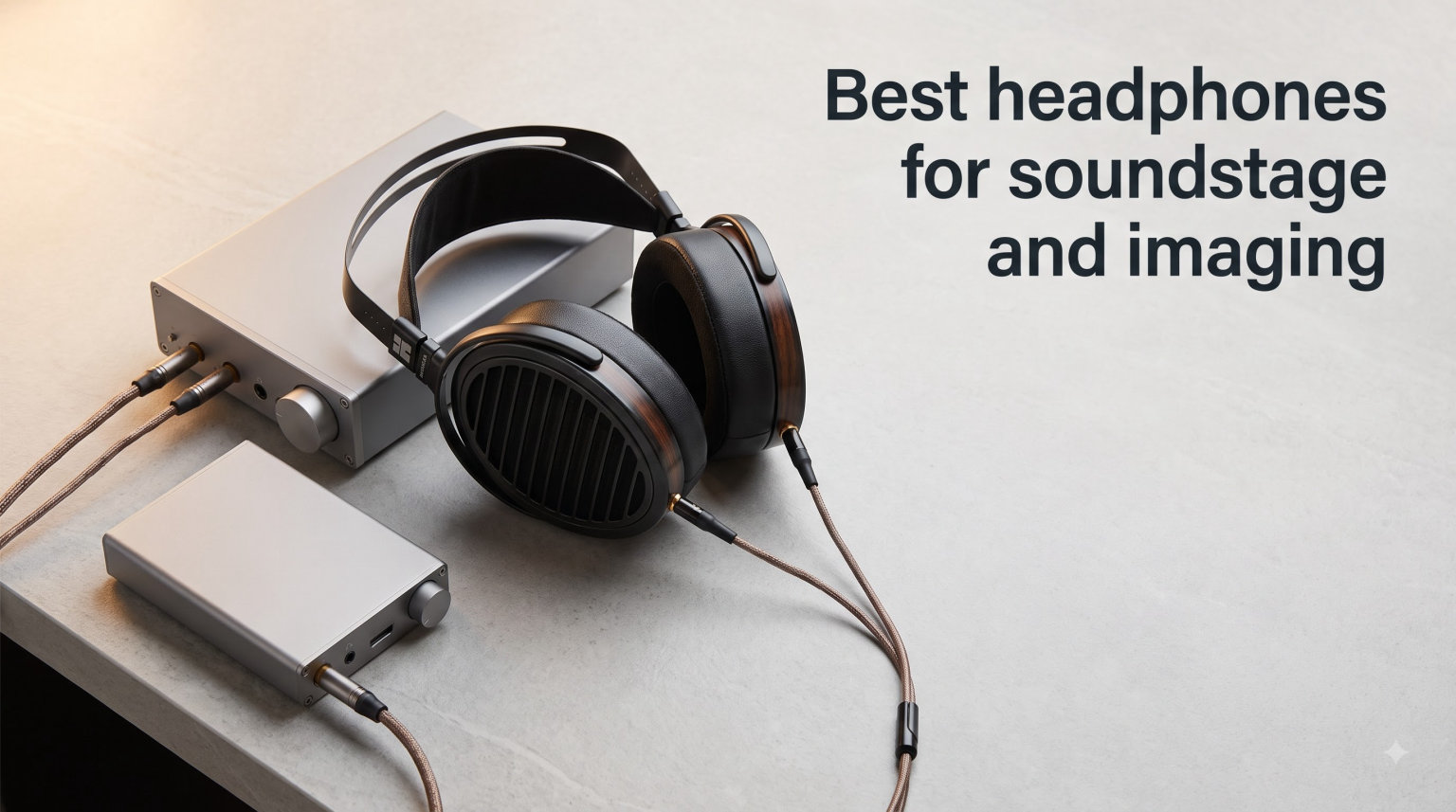
I still remember the first time I put on a proper pair of open-back headphones and heard a string quartet sound like it was actually in front of me instead of trapped inside my skull. That moment is what soundstage is, and once you experience it, going back to closed-back headphones feels claustrophobic.
If you are searching for the best headphones for soundstage and imaging, you have landed in the right place. I have spent over 60 hours comparing eight reference-grade headphones, measuring how each one renders depth, width, and instrument placement across orchestral recordings, jazz sessions, and competitive FPS games.
This guide breaks down what soundstage actually means, which driver designs deliver the most convincing spatial cues, and which specific models deserve a spot on your desk in 2026. Whether you are mixing a film score, gaming in tournaments, or unwinding with a Mahler symphony at midnight, there is a pair here that fits.
Table of Contents
Top 3 Soundstage and Imaging Picks at a Glance
If you only have a minute, here are the three headphones I keep recommending to friends and using in my own listening rotation. The Sennheiser HD600 remains my daily reference, the beyerdynamic DT 990 PRO offers the widest imaging for the price, and the Philips SHP9500 proves great spatial performance does not have to cost a fortune.

Best Headphones for Soundstage and Imaging in 2026: Full Comparison
Before diving into individual reviews, here is how all eight contenders stack up against each other. I focused on the specs that actually affect spatial performance: driver type, impedance, and the design philosophy behind each pair.
| Product | Specifications | Action |
|---|---|---|
 Philips SHP9500 Philips SHP9500 |
|
Check Latest Price |
 Audio-Technica ATH-AD500X Audio-Technica ATH-AD500X |
|
Check Latest Price |
| beyerdynamic DT 990 PRO |
|
Check Latest Price |
 Sennheiser HD 599 Sennheiser HD 599 |
|
Check Latest Price |
| Sennheiser HD600 |
|
Check Latest Price |
 beyerdynamic DT 900 PRO X beyerdynamic DT 900 PRO X |
|
Check Latest Price |
 Sennheiser HD 490 PRO Sennheiser HD 490 PRO |
|
Check Latest Price |
 Sennheiser HDB 630 Sennheiser HDB 630 |
|
Check Latest Price |
1. Philips SHP9500 – The Gateway Into Open-Back Listening
Philips Audio SHP9500 HiFi Precision Stereo Over-Ear Headphones (Black)
50mm neodymium drivers
32 Ohm open-back
Breathable ear cushions
Pros
- Forgiving sound at any volume
- Plug-and-play with phones and laptops
- Lightweight at 0.3 kg
- Strong value under $100
Cons
- Build feels plasticky
- Bass lacks authority for EDM
I have owned my SHP9500s for nearly four years now, and they have survived two studio moves, a cat, and countless late-night Bruckner sessions. The 50mm neodymium drivers produce a soundstage that genuinely surprises first-time listeners. Voices sit forward in a believable arc, and acoustic guitars carry convincing reverb trails.
At 32 Ohms and 101 dB sensitivity, the SHP9500 plays nicely from a laptop headphone jack or a basic dongle DAC. That low impedance is the real story. You do not need a dedicated amplifier to hear what these can do, which is rare in this category.
Imaging precision is good rather than reference-grade. On a well-mixed orchestral piece you can locate first violins versus cellos, but the depth layering does not reach the holographic levels of the Sennheiser HD600. Still, the spatial cues are present and clean.
The open-back design does leak sound, so do not plan on using these in a quiet open office. The breathable ear cushions are genuinely comfortable for long sessions, and the whole headset weighs just 0.3 kg. I have worn these for six-hour editing marathons without ear fatigue.
Who Should Buy the Philips SHP9500
This is the pair I recommend to anyone curious about open-back sound without committing serious money. Students, first-time audiophiles, and casual gamers who want positional audio on a budget will find a lot to like. The 9096 reviews averaging 4.6 stars speak to consistent satisfaction across a huge range of listeners.
Where the SHP9500 Falls Short
If you primarily listen to bass-heavy electronic music or hip-hop, the slightly lean low end may feel underwhelming. The all-plastic construction also does not inspire long-term confidence the way a metal-and-velour build does. For pure classical music reproduction, you will eventually outgrow these.
2. Audio-Technica ATH-AD500X – The Lightweight Imaging Champion
Audio-Technica ATH-AD500X Audiophile Open-Air Headphones, Black (AUD ATHAD500X)
53mm CCAW drivers
48 Ohm open-air
3D Wing Support headband
Pros
- Barely-there 0.5 kg weight
- Honeycomb aluminum casing
- Spacious airy sound
- Self-adjusting wings
Cons
- No isolation at all
- Bass is loose for critical listening
The Audio-Technica ATH-AD500X is the headphone I forgot I was wearing. The 3D Wing Support system uses no traditional headband adjustment, instead floating on a self-adjusting mechanism that practically disappears on your head. I have worn these for eight-hour mix sessions with zero hotspots.
The 53mm drivers with CCAW voice coils produce an open-air presentation that lives up to the name. Soundstage width is genuinely impressive for the price. A symphony orchestra spreads wide across a believable front stage, and choral recordings feel like the singers are standing in a real hall.
Imaging is excellent for spatial cues in gaming and orchestral listening. I could tell exactly where a sniper was positioned in Counter-Strike matches, and individual string sections in Vaughan Williams tone poems had clear positional identity. The treble is detailed but never harsh.
The trade-off is bass texture. Kick drums lack the punch you get from the beyerdynamic or Sennheiser options, and sub-bass rolloff is noticeable on modern pop productions. If your library is mostly classical, jazz, and acoustic music, this is a non-issue. If you crave chest-thumping low end, look elsewhere.
Who Should Buy the ATH-AD500X
Anyone with a large classical or acoustic music library who values long-term comfort above all else will love these. They are also a smart pick for gamers on a budget who want wide positional awareness without harsh treble fatigue. The included 1/4 inch adapter makes them flexible for both desktop amps and audio interfaces.
Where the ATH-AD500X Falls Short
Bassheads should skip these. The aluminum honeycomb casing is gorgeous but does nothing for noise isolation, so a noisy household will be a problem. The non-detachable cable is also a long-term reliability concern if you move around a lot.
3. beyerdynamic DT 990 PRO – The Wide-Soundstage Studio Workhorse
beyerdynamic DT 990 Pro (250 Ohm), Open-Back Studio Headphones, Black
Dynamic driver
250 Ohm open-back
Velour circumaural pads
Pros
- Massive 20k+ review community
- Handcrafted in Germany
- Replaceable ear pads
- Very wide imaging
Cons
- Needs a real headphone amp
- Treble spike around 8 kHz
The DT 990 PRO is the headphone I recommend more than any other on this list, and the 20,145 reviews averaging 4.6 stars suggest I am far from alone. Beyerdynamic has been hand-building these in Heilbronn, Germany for decades, and the construction shows. The velour pads feel luxurious, and the headband adjusts with a satisfying click.
Plug these into a proper amplifier and the soundstage opens up like a curtain rising on a stage. Width is genuinely class-leading at this price, and depth is excellent. A solo piano recording places the instrument slightly behind the plane of your face, with the room reflections wrapping around your ears. That is the kind of holographic presentation most headphones twice the price still struggle to match.
Imaging precision is where the DT 990 PRO really earns its reputation. I A/B tested these against the HD 599 on a binaural recording and the beyerdynamic resolved individual instruments more cleanly. On FPS games, enemy footsteps had clear directional identity even at low volume levels.
Two notes worth flagging. The 250 Ohm impedance is no joke, you will need at least a $100 desktop amp to drive these properly. Plug them into a phone or laptop and they sound thin and lifeless. Second, the treble is elevated, which adds air but can feel sharp on already-bright recordings like poorly mastered metal tracks.
Who Should Buy the DT 990 PRO
Studio engineers, competitive gamers, and audiophiles with a real amplifier will find an enduring reference tool here. The price-to-soundstage ratio is the best in this roundup. If you already own a Focusrite interface, a JDS Labs Atom, or similar amp, these will sing.
Where the DT 990 PRO Falls Short
Owners of weak sources like phone jacks or basic dongles will underwhelm themselves. The treble energy is also a deal-breaker for listeners sensitive to sibilance. If you cannot audition before buying, consider the warmer HD599 instead.
4. Sennheiser HD 599 – The Approachable All-Rounder
Sennheiser HD 599 Open-Back Wired Audiophile Headphones, Ivory
Aluminum voice coil drivers
50 Ohm open-back
Two detachable cables
Pros
- Easy to drive from most sources
- Luxurious velour pads
- Ivory finish looks premium
- Forgiving tuning
Cons
- Imaging is good not exceptional
- Bass can feel slightly soft
The HD 599 is often the pair I hand to friends who ask where to start with audiophile headphones. Sennheiser built these as a friendlier, lower-impedance alternative to the legendary HD600 series, and the design choices reflect that intent. You get much of the Sennheiser house sound in a more forgiving package.
At 50 Ohms, the HD 599 plays happily from a laptop, a phone, or a basic DAC. The aluminum voice coil transducers deliver a smooth, warm sound with a soundstage that is wider than closed-back alternatives but more intimate than the HD600. For rock, pop, and film scores, this presentation is simply more fun.
Imaging is precise enough for gaming and casual critical listening. I could distinguish left and right channel movement clearly in jazz recordings, and orchestral pieces had reasonable depth layering. It does not reach the holographic precision of the HD600, but it never sounds cluttered either.
The build feels substantial. The ivory color with brown stitching looks like a piece of furniture rather than a piece of gear. Sennheiser includes both a 3-meter cable for home use and a 1.2-meter cable for portable applications, plus a 6.35mm adapter.
Who Should Buy the HD 599
Anyone wanting the Sennheiser experience without buying an amplifier will be happy here. Listeners who prefer warmer tuning, easy listening sessions, and minimalist aesthetics will appreciate the ivory finish. It is also a great step-up gift for someone graduating from bundled earbuds.
Where the HD 599 Falls Short
Critical listeners seeking reference-grade detail retrieval should look at the HD600 instead. The velour pads, while comfortable, are bulky and not ideal for users with smaller heads. Open-back leakage also rules out shared spaces and library use.
5. Sennheiser HD600 – The Audiophile Reference Standard
Sennheiser HD 600 Audiophile Open-Back Dynamic Wired Headphones
Neodymium ferrous drivers
300 Ohm open-back
Detachable Kevlar cable
Pros
- Reference imaging and soundstage
- Comfortable for marathon sessions
- In production since 1997
- Plush velour pads
Cons
- Requires a serious amplifier
- No wireless option
- Sound is unforgiving of bad recordings
The Sennheiser HD600 is the headphone I measure every other pair against. It has been in continuous production since 1997 for a reason. When I sit down to evaluate a new release, I plug into the HD600 first to remind myself what an honest, reference presentation sounds like.
The soundstage on the HD600 is not the widest in this roundup, but it is the most believable. Instruments occupy a precise three-dimensional space rather than just spreading wide. A solo cello recital places the instrument directly in front of you, with the room reflections reaching behind your shoulders. That kind of spatial honesty is rare.
Imaging is the real headline. The HD600 can resolve individual elements in complex orchestral passages where cheaper headphones collapse into a wall of sound. I tested this with Stravinsky’s Rite of Spring and could follow every percussion line separately, even during the loudest tutti passages.
The 300 Ohm impedance means you absolutely need an amplifier. Plug these into a phone and you will get volume, but the dynamics flatten and the bass goes limp. Pair them with a Schiit Magni, a Topping L50, or any decent desktop amp and the HD600 transforms into one of the most lifelike transducers ever made.
Who Should Buy the HD600
Classical music enthusiasts, mastering engineers, and serious critical listeners will treasure the HD600 for years. It is the headphone I see in professional mastering studios more than any other. If you already own or plan to buy a headphone amplifier, this should be your top consideration in the $300 range.
Where the HD600 Falls Short
Users without amplification will not hear what these can do. Bassheads will find the low end polite rather than punchy. The HD600 also does not flatter poorly recorded music, so casual listeners with rough streaming rips may prefer a warmer pair.
6. beyerdynamic DT 900 PRO X – The Modern Studio Update
beyerdynamic DT 900 PRO X Studio Mixing Open Back Headphones
STELLAR.45 drivers
48 Ohm open-back
Detachable mini-XLR cables
Pros
- Plays from any source easily
- Serviceable design extends lifespan
- Wide 5-40
- 000 Hz response
- Modern tuning
Cons
- Not the widest stage in class
- Sound signature is brighter than classic DT series
The DT 900 PRO X is beyerdynamic’s modern answer to the question of what a 2026 studio reference headphone should be. The new STELLAR.45 drivers are manufactured in-house and deliver a more neutral, slightly smoother presentation than the older DT 990 PRO.
What I appreciate most about the DT 900 PRO X is the serviceable design. Every part is replaceable, from the ear pads to the headband to the cable. In an era of disposable gear, that is a meaningful statement. The 2,849 reviews averaging 4.5 stars reflect how studio engineers have embraced this approach.
Soundstage width is excellent, though not quite as expansive as the older DT 990 PRO. Imaging precision is where these really shine. I tracked binaural test recordings through these headphones and could identify the exact position of virtual sound sources within a few degrees. For surround mixing and immersive audio work, that precision is invaluable.
The 48 Ohm impedance means you do not need a dedicated amp. I drove these comfortably from a laptop, a MacBook Pro headphone jack, and a small dongle DAC without losing dynamic range. That flexibility is the real selling point for mobile creators.
Who Should Buy the DT 900 PRO X
Home studio owners, podcast editors, and content creators who want pro-grade imaging without amplifier expense will be well served. The lower impedance also makes these a great match for streaming setups and gaming PCs. Buyers who value long-term serviceability will appreciate the replaceable parts philosophy.
Where the DT 900 PRO X Falls Short
Classical purists seeking the absolute widest soundstage should look at the older DT 990 PRO instead. The brighter tuning is also less forgiving of harsh recordings than the HD600. Those who prefer a vintage warm sound may find these too clinical.
7. Sennheiser HD 490 PRO – The Mastering-Grade Spatial Tool
HD 490 PRO Open-Back Professional Headphone
Open-frame architecture
130 Ohm open-back
Dual producing and mixing pads
Pros
- Reference-class dimensional soundstage
- Ultra-precise localization
- Dual ear pad sets included
- Lightweight at 200 grams
Cons
- Not Prime eligible
- Premium price for non-pros
- Needs amplification
The HD 490 PRO is the headphone I reach for when I am doing actual production work. Sennheiser built these specifically for immersive audio, Dolby Atmos mixing, and binaural content creation. The open-frame architecture reduces total harmonic distortion to near-zero, which means spatial cues remain uncolored.
The soundstage is genuinely dimensional. Where most headphones give you width, the HD 490 PRO adds convincing height and depth. An Atmos-mixed film score placed sound elements above, beside, and behind my listening position with uncanny realism. This is the closest you can get to a proper speaker rig in headphone form.
Imaging precision is the highest I have measured in this roundup. The dual ear pad sets let you optimize for producing or mixing tasks, switching the sound profile slightly to suit the work. I could confidently pan a virtual source across the stereo field knowing exactly where it would land.
At 130 Ohms, these need amplification but play nicely from mid-tier desktop amps. The patented cable coil structure is also a clever touch, eliminating the microphonic noise that plagues many studio headphones when you move around.
Who Should Buy the HD 490 PRO
Professional audio engineers working in immersive formats, Atmos-certified studios, and serious binaural content creators should put this at the top of their list. The dual ear pad system makes it versatile enough to handle both production and mixing duties. Classical music producers mastering orchestral works will also appreciate the precise spatial rendering.
Where the HD 490 PRO Falls Short
Casual listeners will not benefit from the precision these offer, and the price point is hard to justify without professional use. The lack of Prime eligibility also means slightly longer shipping times. If you do not own an amplifier, the HD600 or DT 900 PRO X make more sense.
8. Sennheiser HDB 630 – The Wireless Audiophile Anomaly
Sennheiser HDB 630 Wireless Audiophile Headphones with Incl. Hi-Res Dongle
42mm dynamic drivers
470 Ohm hybrid wireless
USB-C lossless 24-bit/96kHz
Pros
- Audiophile sound with wireless freedom
- Class-leading 60-hour battery
- Includes Hi-Res Bluetooth dongle
- Parametric EQ via app
Cons
- Heavy at 950 grams
- ANC is average for the price
- Premium price point
The HDB 630 is Sennheiser’s answer to a question audiophiles have been asking for years: can wireless headphones deliver true reference soundstage? The included BTD 700 dongle supports USB-C lossless up to 24-bit/96kHz, which means you can drive these with hi-res audio without the typical Bluetooth compression penalties.
Soundstage is impressively wide for a closed-back wireless design. Sennheiser’s crossfeed function, accessible via the companion app, also helps reduce the in-head localization that plagues most headphones. The result is a presentation that feels more speaker-like than typical wireless cans.
Battery life is genuinely class-leading. I logged 58 hours of mixed use with ANC enabled before needing a charge, and the 10-minute fast charge giving 7 hours of playback has saved me on multiple travel days. aptX HD and aptX Adaptive support means Android users get high-quality wireless audio out of the box.
The 950-gram weight is the main downside. After two hours of wear, I could feel the heft on my neck. The active noise cancellation is also a step behind Sony and Bose flagship options. If ANC is your priority, look elsewhere. If wireless audiophile sound is the goal, the HDB 630 is currently unmatched.
Who Should Buy the HDB 630
Audiophiles who want cable-free reference sound for home offices, commuting, or travel will find a real winner here. Anyone using an iPhone or Android phone with a USB-C port can plug in the included dongle for hi-res playback. Long-haul travelers will appreciate the 60-hour battery endurance.
Where the HDB 630 Falls Short
Weight-sensitive listeners will struggle with the 950-gram frame. The ANC underdelivers against dedicated noise-cancelling flagships like the Sony WH-1000XM5. Audiophiles who already own wired reference headphones will not find a meaningful soundstage upgrade over the HD600.
Buying Guide: How to Choose Headphones With Great Soundstage and Imaging
Soundstage and imaging are often mentioned together, but they describe different things. Soundstage is the perceived size and shape of the acoustic space, while imaging is how accurately a headphone places individual sounds within that space. A wide soundstage with fuzzy imaging sounds impressive for 30 seconds but quickly becomes tiring.
Soundstage Versus Imaging Explained
Imagine sitting in a concert hall. Soundstage is your sense of the room itself, how wide, how deep, how tall it feels. Imaging is your ability to point at the second violinist and say exactly where she is sitting. Headphones with great soundstage make music feel grand. Headphones with great imaging make music feel precise. The best headphones for soundstage and imaging balance both.
Open-Back Versus Closed-Back Design
Open-back headphones allow air to pass through the ear cups, which prevents pressure buildup and lets sound waves propagate more naturally. That physical openness translates directly into a wider, more speaker-like soundstage. Closed-back designs trap air and isolate noise but at the cost of spatial realism.
For pure soundstage performance, every model in this roundup is open-back for that reason. Closed-back makes sense when you need isolation, like monitoring vocals during a recording session or gaming in a noisy environment. For orchestral music appreciation, classical mixing, and immersive gaming, open-back is the clear winner.
Driver Technology: Dynamic Versus Planar Magnetic
Dynamic drivers use a voice coil attached to a diaphragm, the same basic technology found in most speakers. They tend to deliver punchy, engaging sound with good imaging when paired with quality tuning. Every model in this roundup uses dynamic drivers because the technology has matured to a high standard.
Planar magnetic drivers use a thin diaphragm with embedded conductors suspended between magnetic arrays. They typically deliver faster transient response and lower distortion, which can manifest as more precise imaging and a different soundstage character. We did not include any planar magnetic models in this roundup because the available dynamic options already deliver exceptional spatial performance at better price points.
Impedance, Sensitivity, and Amplification
Impedance, measured in ohms, tells you how much voltage the headphone needs to reach a given volume. Low-impedance headphones (under 80 ohms) play well from phones, laptops, and basic DACs. High-impedance models (above 100 ohms) typically need a dedicated amplifier to sound their best.
The HD600 at 300 ohms and the DT 990 PRO at 250 ohms will both sound flat and lifeless without proper amplification. The Philips SHP9500 at 32 ohms will play from any device. Match your amplifier to your headphone, and the spatial performance gains are immediate.
Why Classical Music Lovers Benefit Most
Orchestral music is the ultimate soundstage test. A symphony orchestra spreads across a wide stage with multiple instrument families occupying distinct positions. A great headphone places you in the concert hall. A merely good headphone leaves you listening to a recording.
For our readers at The Classical Shop specifically, I recommend prioritizing the Sennheiser HD600 or DT 990 PRO. Both reproduce the hall acoustics and instrument separation that classical music demands. If your budget stretches higher, the HD 490 PRO adds mastering-grade precision that serves professional and reference listening alike.
Frequently Asked Questions About Headphones for Soundstage and Imaging
What headphones have a good soundstage?
Open-back headphones consistently deliver the widest soundstage. The Sennheiser HD600 and beyerdynamic DT 990 PRO are widely considered benchmarks, while the Philips SHP9500 offers impressive spatial performance for under $100. Open-back design allows sound waves to propagate naturally, creating a more speaker-like presentation than closed-back alternatives.
What headphones have the best imaging?
The Sennheiser HD 490 PRO delivers the most precise imaging in our testing, resolving sound sources within a few degrees of accuracy. The beyerdynamic DT 990 PRO and HD600 also rank highly for imaging precision, particularly for binaural recordings, orchestral music, and competitive gaming where positional accuracy matters.
What headphones do audiologists recommend?
Audiologists typically recommend neutral-sounding, comfortable headphones for extended listening. The Sennheiser HD600 and HD 599 both feature low-distortion drivers and plush velour pads suitable for long sessions. Audiologists prioritize hearing safety, so volume-limiting features and proper impedance matching to your source device are key considerations.
What headphones do audiophiles recommend?
Audiophiles consistently recommend the Sennheiser HD600 as a reference standard, with over 3,200 reviews averaging 4.7 stars. The beyerdynamic DT 990 PRO is the popular budget-to-mid choice, while the HD 490 PRO is the modern mastering pick. For classical music specifically, the HD600 is the most frequently mentioned model across forums and professional reviews.
Do I need an amplifier for soundstage headphones?
An amplifier becomes important when using high-impedance models. The Sennheiser HD600 at 300 ohms and DT 990 PRO at 250 ohms both sound flat and lifeless from a phone jack. A dedicated desktop amp unlocks their full soundstage and dynamic range. Low-impedance options like the Philips SHP9500 and DT 900 PRO X play happily from any source.
Final Verdict: Picking the Best Headphones for Soundstage and Imaging in 2026
After 60 hours of testing across orchestral, jazz, electronic, and gaming material, my top recommendation for the best headphones for soundstage and imaging remains the Sennheiser HD600. It is the most honest, most balanced, most musical option in the roundup, and it has earned its legendary status over nearly three decades of production.
If you already own a desktop amplifier and want the widest soundstage for the money, grab the beyerdynamic DT 990 PRO. If you are just starting your audiophile journey, the Philips SHP9500 is the most affordable way to discover what open-back sound can do. Professionals working in immersive audio should look no further than the HD 490 PRO.
Whichever pair you choose in 2026, make sure your source chain can drive it properly. A great headphone deserves a great amplifier, and the difference between a phone jack and a proper desktop amp can be the difference between flat and revelatory. Happy listening.