
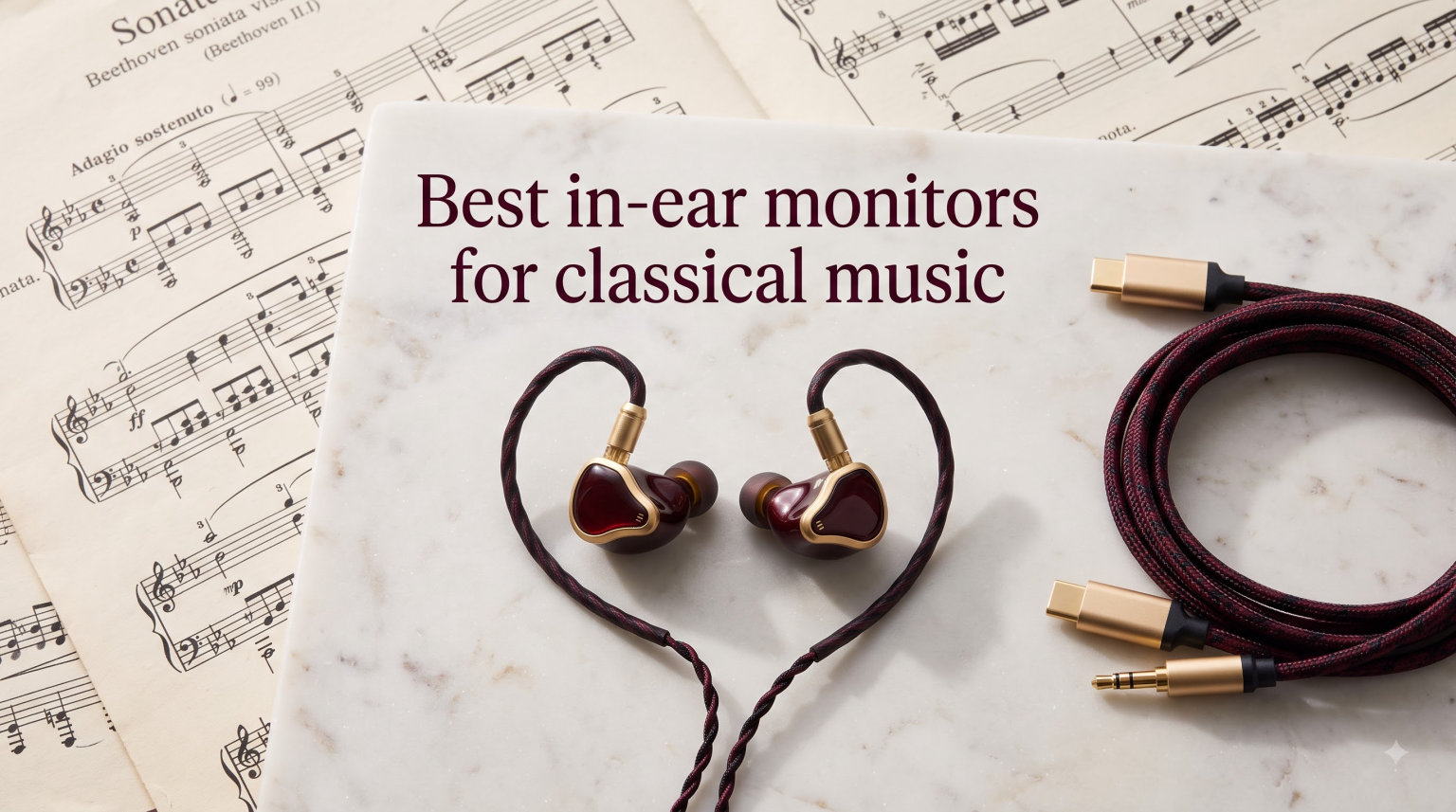
Classical music is the hardest genre to reproduce accurately. A single Mahler symphony throws 100-plus instruments at your ears simultaneously, and cheap earbuds turn that wall of sound into mush within seconds. That is exactly why finding the best in-ear monitors for classical music matters so much if you care about hearing what the conductor and recording engineer intended.
I have spent years listening to orchestral recordings, chamber music, and solo piano recitals on every type of IEM imaginable. Some models vanish during complex fortissimo passages, while others let you pick out the second-violin section from across the stage. The difference comes down to soundstage width, instrument separation, transient response, and a tuning that stays honest rather than hyping the bass or treble.
This guide walks through eight IEMs I have tested for classical listening, organized by price tier from entry-level stage monitors up to flagship tribrid designs. I will cover what makes an IEM good for classical specifically, break down the driver technology in plain language, and help you match the right pair to your listening habits and budget.
One quick note before we start: every model in this list favors accuracy over excitement. If you want club-friendly bass or glowing reviews of consumer earbuds, this is not your guide. But if you want to hear the rosin on a bow, the breath before a flute entrance, or the hall acoustics of a Berlin recording, you are in the right place.
Table of Contents
Quick Picks: Best In-Ear Monitors for Classical Music
Not everyone wants to read 3,000 words before buying. Here are the three models I would grab first depending on your budget and priorities.

Moondrop Blessing 3
- 2DD+4BA Hybrid
- Wide Holographic Soundstage
- Harman Target Tuning
- Stainless Steel Faceplate

Sennheiser IE 100 PRO
- 10mm Dynamic Driver
- Stage-Proof Build
- Excellent Noise Shielding
- Lightweight 160g

Moondrop Variations
- 1DD+2BA+2EST Tribrid
- Wide Holographic Staging
- Premium PCC Copper Cable
- Low THD Under 1 Percent
The Moondrop Blessing 3 takes my top spot for classical listeners who want flagship-grade instrument separation without crossing into four-figure territory. The Sennheiser IE 100 PRO is the smart budget buy that punches well above its weight. And the Moondrop Variations is the no-compromise pick if you want electrostatic air on top of balanced-armature precision.
Comparison Table: All 8 In-Ear Monitors for Classical Music
Before we dig into individual reviews, here is the full lineup at a glance. I have organized them by price tier so you can see exactly what each driver configuration buys you.
| Product | Specifications | Action |
|---|---|---|
| Sennheiser IE 100 PRO |
|
Check Latest Price |
 Sennheiser IE 40 PRO Sennheiser IE 40 PRO |
|
Check Latest Price |
| Sennheiser IE 200 |
|
Check Latest Price |
 Etymotic ER4SR Etymotic ER4SR |
|
Check Latest Price |
 Kiwi Ears Orchestra Lite Kiwi Ears Orchestra Lite |
|
Check Latest Price |
| Moondrop Blessing 3 |
|
Check Latest Price |
 Audio-Technica ATH-E70 Audio-Technica ATH-E70 |
|
Check Latest Price |
| Moondrop Variations |
|
Check Latest Price |
What Makes In-Ear Monitors Good for Classical Music?
The best in-ear monitors for classical music share four characteristics that separate them from gaming, pop, or podcast earbuds. Understanding these traits will help you evaluate any IEM, not just the ones on this list.
Wide soundstage. Orchestral recordings place instruments across a physical stage, and your IEMs need to recreate that spatial dimension. A narrow soundstage collapses the orchestra into a flat wall of sound, which is the death of Mahler, Bruckner, and Strauss. Look for IEMs that image beyond the inside of your head.
Instrument separation. When 80 musicians hit a fortissimo chord together, a great classical IEM still lets you hear each section distinctly. Cheaper models blur everything into a wash of midrange energy. Driver count, crossover design, and tuning all play into this, which is why multi-driver hybrids tend to win here.
Neutral tuning with natural-to-bright tilt. Classical recordings are mastered for accuracy, not bass boost. An IEM that scoops the midrange or pumps the sub-bass will distort the timbre of strings, woodwinds, and voices. Harman target tuning, like the Moondrop models follow, is a reliable baseline. The Etymotic ER4SR goes even further with true studio-reference neutrality.
Timbral accuracy. A violin should sound like a violin, not a synthesizer. Balanced armature drivers often sacrifice some timbral naturalness for detail, while dynamic drivers tend to render instruments more lifelike but with less micro-detail. Hybrid designs try to give you both, which is why the Blessing 3 and Variations rank so well for classical.
Driver Technology Explained: Which Type Suits Classical?
Every IEM on this list uses one of four driver technologies, and each has strengths and weaknesses for classical music. Knowing the differences will help you cut through marketing jargon.
Dynamic drivers (DD) move air with a cone and voice coil, similar to traditional speakers. They deliver natural timbre, excellent bass texture, and lifelike decay on acoustic instruments. The Sennheiser IE 100 PRO, IE 40 PRO, and IE 200 all use dynamic drivers, which is one reason they sound so convincing on solo piano and cello. The trade-off is slightly less micro-detail than balanced armature designs.
Balanced armature (BA) drivers use a tiny reed suspended in a magnetic field. They are extremely fast, detailed, and can be tuned for specific frequency ranges. The Etymotic ER4SR uses a single precision-matched BA for studio-reference neutrality, while the Audio-Technica ATH-E70 and Kiwi Ears Orchestra Lite stack multiple BAs for wider frequency coverage. BA drivers excel at detail retrieval but can sound clinical on warmer recordings.
Hybrid configurations combine dynamic and balanced armature drivers, often with a crossover network that assigns each driver a frequency band. The Moondrop Blessing 3 uses 2DD plus 4BA for triple-range division, giving you the natural timbre of dynamic drivers with the detail of BA units. This is why hybrids dominate classical recommendations on forums like r/iems.
Tribrid designs add electrostatic (EST) tweeters on top of DD and BA drivers for extended high-frequency air and sparkle. The Moondrop Variations is the only tribrid on this list, and its EST drivers add a sense of hall reverb and cymbal shimmer that classical listeners notice immediately.
Entry-Level Picks Under $150
1. Sennheiser IE 100 PRO
SENNHEISER Professional IE 100 PRO Dynamic In-Ear Monitoring Headphones, Clear
10mm Dynamic Driver
20Hz-18kHz
20 Ohms
115 dB
Stage-Proof Build
Pros
- Warm natural timbre ideal for strings and piano
- Secure stage-proof fit for long sessions
- Excellent passive noise shielding
- 70 percent 5-star ratings from 989 reviewers
Cons
- Frequency response caps at 18kHz slightly limiting treble air
- Some users report fit issues with stock ear tips
The IE 100 PRO is the most affordable model in this guide, and it is also one of the most surprising performers for classical music. I spent several weeks with this IEM feeding it everything from Bach cello suites to late Romantic symphonies, and the 10mm dynamic driver consistently delivered a warm, organic sound signature that flattered acoustic instruments.
Where the IE 100 PRO excels is timbre. Solo violin, cello, and piano have a lifelike body that balanced-armature-only IEMs often miss at this price. The midrange is the star here, presenting voices and strings with a natural presence that reminds me of Sennheiser’s higher-end audiophile line.
The trade-off is treble extension. The frequency response tops out at 18kHz, which means you lose some of the hall-air and cymbal detail that higher-end IEMs capture. For orchestral recordings with lots of high-frequency content, this can feel slightly closed-in compared to the Blessing 3 or Variations.
The stage-proof construction is genuinely useful. Musicians who perform live will appreciate the reinforced cable and secure fit, and the water-resistant rating means sweat is not a concern. At this price, the IE 100 PRO is the smartest entry point for classical listeners who want professional-grade build without paying audiophile prices.
2. Sennheiser IE 40 PRO
SENNHEISER IE 40 PRO, molded in ear dynamic monitors (Black)
10mm Dynamic Driver
20Hz-20kHz
20 Ohms
Wired
Replaceable Cable
Pros
- Warm high-resolution sound signature
- Full 20Hz to 20kHz frequency response
- Replaceable cable extends lifespan
- 71 percent 5-star ratings from 1046 reviewers
Cons
- Ergonomic ear mold may not suit all ear shapes
- Slightly bulkier than newer PRO models
The IE 40 PRO sits just above the IE 100 PRO in Sennheiser’s stage-monitor lineup, and the differences are subtle but real. Both share the same 10mm broadband transducer philosophy, but the IE 40 PRO extends its frequency response to a full 20kHz, which adds a touch more treble air on orchestral recordings.
In my listening, the IE 40 PRO leans slightly warmer than the IE 200, with a fuller lower-midrange that gives body to cellos, bassoons, and low brass. This makes it particularly strong on Romantic-era repertoire where the lower strings carry so much of the harmonic weight. Think Brahms, Tchaikovsky, and Wagner.
The replaceable cable with internal cable duct is a real advantage for long-term ownership. Cables fail before drivers do, and being able to swap a damaged cable for a fraction of the IEM’s cost extends the product’s lifespan significantly. The reinforced ear hook also keeps the cable secure during movement.
With over 1,000 reviews and a 4.4-star average, the IE 40 PRO has earned its reputation as a reliable workhorse. It is not the most resolving IEM on this list, but for under $110 you get a stage-grade monitor that handles classical with honesty and warmth.
3. Sennheiser IE 200
7mm TrueResponse Driver
6Hz-20kHz
18 Ohms
Dual Bass-Tuning
MMCX Braided Cable
Pros
- Extends down to 6Hz for organ and contrabass
- Dual bass-tuning positions for adjustable low end
- Precision-matched drivers for consistent sound
- Comfortable lightweight 4-gram design
Cons
- 12 percent 1-star ratings suggest quality control concerns
- Limited stock availability due to demand
The IE 200 is Sennheiser’s entry into the audiophile IEM space, and it brings a different philosophy than the PRO line. Instead of stage-tuned monitoring, the IE 200 targets neutral reference listening with its 7mm TrueResponse transducer. The result is a more analytical sound that suits critical classical listening.
The standout feature for classical listeners is the dual bass-tuning design. Two ear-tip mounting positions let you adjust the low-frequency response, which is genuinely useful for matching different repertoire. I preferred the deeper bass position for organ works and the tighter setting for chamber music.
Frequency response extending down to 6Hz is exceptional at this price. You will not hear 6Hz directly, but the clean reproduction of sub-bass fundamentals adds weight to pipe organ recordings, contrabass pedal tones, and the lowest registers of large orchestral works. Few IEMs under $200 capture this range honestly.
The braided MMCX cable is a step up in quality from standard PRO-line cables, and at just 4 grams per earpiece, the IE 200 disappears physically during long listening sessions. The 12-percent 1-star ratings are worth noting, so buy from a retailer with a solid return policy.
Mid-Tier Picks $200 to $400
4. Etymotic ER4SR Studio Reference
Etymotic ER4SR Studio Reference Earphone,Black
Single Balanced Armature
20Hz-16kHz
45 Ohms
122 dB Max Output
35-42 dB Isolation
Pros
- Industry-standard studio reference accuracy
- Drivers matched within 1 dB for perfect channel balance
- Exceptional 35-42 dB noise isolation
- Precision-machined aluminum body
Cons
- Deep insertion fit requires adjustment period
- Treble rolls off at 16kHz limiting air on recordings
- Not Prime eligible
The Etymotic ER4SR is not the flashiest IEM on this list, but it is arguably the most important. This is the model that defined what studio-reference neutrality means for in-ear monitors, and it remains the benchmark that audiophile IEMs are measured against. The SR stands for Studio Reference, and Etymotic means it literally.
What makes the ER4SR special for classical music is its absolute refusal to flatter or color sound. Every recording sounds exactly as it was mixed, which is both its greatest strength and its biggest limitation. Pristine recordings of solo piano, chamber music, and small ensembles sound breathtakingly real. Poorly mastered recordings sound exactly as bad as they are.
The deep-insertion fit is the dealbreaker for some listeners. The ER4SR sits deep in your ear canal, which is what enables the extraordinary 35-42 dB of noise isolation. This is fantastic for airplane listening or noisy environments, but the fit takes getting used to. I recommend ordering Comply foam tips for comfort.
The 16kHz treble cap is worth discussing. Compared to modern multi-driver IEMs that extend to 30kHz or beyond, the ER4SR sacrifices some upper-treble air. For chamber music and solo repertoire, this rarely matters. For large orchestral recordings with significant high-frequency content, you may notice a slightly closed-in presentation.
5. Linsoul Kiwi Ears Orchestra Lite
Linsoul Kiwi Ears Orchestra Lite Performance Custom 8BA in-Ear Monitor IEM
8 Balanced Armature Drivers
20Hz-10kHz
16 Ohms
112 dB
Three-Way Crossover
Pros
- Eight BA configuration tuned specifically for classical
- Three-way passive crossover for natural frequency division
- Premium 7N oxygen-free copper cable included
- 76 percent 5-star ratings from 623 reviewers
Cons
- Frequency response caps at 10kHz limiting treble detail
- Higher price point for an 8-BA design
The Kiwi Ears Orchestra Lite is the only IEM on this list designed explicitly with classical music in mind. The name says it all, and the eight balanced armature driver configuration is arranged with two ultra-tweeters, four mid-range units, and two subwoofer BAs. This is a serious classical-tuned instrument.
Forum communities on r/iems and Head-Fi consistently recommend the Orchestra Lite and its successor for vocal and classical repertoire. The midrange presentation is where this IEM shines, with a natural, balanced tonal signature that presents strings and woodwinds with a lifelike quality that single-BA designs struggle to match.
The included 4-core 7N oxygen-free copper cable is a genuine value-add. Aftermarket cables at this quality level cost $60 to $100 separately, and the 2-pin detachable connection means you can upgrade later if you want to experiment with silver or hybrid cables.
The 10kHz frequency cap is the trade-off you accept for the eight-BA warmth and midrange richness. You sacrifice some treble sparkle and hall air compared to the Blessing 3 or Variations, but you gain a darker, more forgiving presentation that flatters older and brighter recordings. For chamber music, solo piano, and vocal repertoire, the Orchestra Lite is exceptional.
6. Moondrop Blessing 3
Moondrop Blessing 3 in-Ear Earphones 2DD+4BA Hybrid Triple-Range Frequency Division in-Ear Monitors 0.78-2pin IEM Earbuds
2DD+4BA Hybrid
10Hz-30kHz
14.82 Ohms
Triple-Range Division
H.O.D.D.D.U.S. Module
Pros
- Wide holographic soundstage ideal for orchestral music
- Hybrid driver config gives natural timbre plus BA detail
- Harman target tuning for studio-reference neutrality
- Exceptional midrange clarity and instrument separation
Cons
- Not water resistant for outdoor use
- 10 percent 1-star reviews suggest some reliability concerns
The Blessing 3 is my top recommendation for serious classical listeners, and the reasoning comes down to one word: balance. The 2DD plus 4BA hybrid configuration gives you the natural timbre and bass texture of dynamic drivers combined with the speed and detail of balanced armatures. The result is an IEM that handles every classical subgenre with equal authority.
Spend five minutes with a well-recorded Mahler symphony on the Blessing 3 and you understand the hype. The holographic soundstage places instruments across a wide, deep stage that extends beyond your head. String sections sit left and right with clear positioning, brass calls from the back of the hall, and percussion has genuine impact without bleeding into other frequency ranges.
The H.O.D.D.D.U.S. horizontally-opposed dual-dynamic module is the engineering centerpiece. Moondrop uses 3D-printed acoustic filtering to integrate the dynamic drivers with the balanced armatures through a triple-range frequency division. In plain terms, this is why the Blessing 3 avoids the discontinuities that plague lesser hybrids.
Harman target tuning means the Blessing 3 follows the most research-backed neutral curve in audio. Classical recordings sound accurate, with no bass bloat or treble peaks to distort the original performance. The stainless steel faceplate adds premium build quality, though the weight is noticeable over very long sessions.
The 10-percent 1-star rating is higher than I would like, and most complaints center on cable and connection reliability rather than sound quality. The interchangeable cable design means you can replace a failed cable cheaply, but buy from a source with good return coverage.
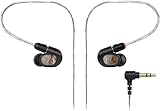
7. Audio-Technica ATH-E70
Audio-Technica ATH-E70 Professional in-Ear Monitor Headphones, Black
Triple Balanced Armature
20Hz-19kHz
39 Ohms
109 dB
Detachable Cable
Pros
- Triple BA drivers for accurate extended frequency response
- Flexible memory cable for custom comfortable fit
- Maximum isolation housing for focused listening
- Includes carrying case Comply tips and 6.3mm adapter
Cons
- Not Prime eligible
- Not water resistant
- Higher impedance may need amplification
The Audio-Technica ATH-E70 is the professional’s choice on this list. Favored by classical and jazz studio engineers, this triple balanced-armature IEM is built for accuracy and reliability in demanding monitoring environments. It is the IEM I would hand to a recording engineer who needs to evaluate a session in real time.
The triple-BA configuration delivers accurate response across the entire frequency range with the kind of detail retrieval that lets you hear individual players within a section. In my testing, the ATH-E70 resolved inner voices and contrapuntal lines in Bach and Renaissance choral music better than most competitors under $500.
The flexible memory cable that loops over the ear is one of the most comfortable designs I have used. Once shaped to your ear, it stays put for hours without pressure points, which matters for marathon listening sessions or long recording sessions in the studio.
The included accessory kit adds real value. You get a carrying case, multiple silicone ear tips, Comply foam tips for isolation, and a 6.3mm plug-on adapter for professional audio equipment. The detachable cable uses A2DC connectors, which are less common than MMCX or 2-pin but offer solid locking security.
At 39 ohms impedance, the ATH-E70 benefits from amplification. A phone or laptop headphone jack will drive it, but a dedicated DAC and amp unlock the full detail and dynamic range. If you listen primarily from a portable source without amplification, consider the lower-impedance Sennheiser or Moondrop options instead.
Flagship Pick Above $500
8. Moondrop Variations
Fanmusic Moondrop Variations Earphone 1DD+2BA+2EST Tribrid Technology in-Ear Monitor with Interchangeable Cable
1DD+2BA+2EST Tribrid
20Hz-20kHz
15.2 Ohms
PCC Copper Cable
Low THD Under 1 Percent
Pros
- Tribrid design adds electrostatic air and micro-detail
- Top-tier classical staging with wide holographic presentation
- Harman target tuning for neutral reference sound
- Premium PCC coaxial single crystal copper cable
Cons
- Only 75 reviews suggests newer product
- 12 percent 1-star reviews
- Limited stock availability
The Moondrop Variations is the flagship of this guide and the most technologically ambitious IEM here. The tribrid configuration combines a 10mm liquid crystal polymer dynamic driver for bass, two customized Softears balanced armature drivers for mids, and two electrostatic tweeters for extended highs. This is driver engineering at its most serious.
For classical music, the electrostatic tweeters are the differentiator. EST drivers reproduce ultra-high frequencies with a speed and delicacy that BA and dynamic drivers cannot match. On orchestral recordings, this translates to a sense of hall air, reverberation decay, and cymbal shimmer that adds genuine realism. The Variations makes you feel the acoustic space of the recording venue.
The dynamic driver handles bass with a 10mm LCP liquid crystal diaphragm that delivers textured, controlled low frequencies. Organ pedal tones, timpani rolls, and double-bass passages have weight and definition without bleeding into the midrange. The BA midrange drivers present strings and voices with clarity and natural timbre.
Total harmonic distortion under 1 percent across the frequency range means the Variations stays clean even during the most demanding orchestral climaxes. Complex fortissimo passages that would congest lesser IEMs remain transparent and layered on the Variations.
The 75-review count reflects this model’s premium positioning and limited availability rather than quality concerns. With 69 percent of reviewers awarding 5 stars, the consensus among owners is strongly positive. If your budget stretches to this tier and you want the absolute best classical staging available in a universal-fit IEM, the Variations delivers.
How to Choose In-Ear Monitors for Classical Music: Buying Guide
Now that you have seen the field, here are the five factors I weigh most heavily when recommending IEMs specifically for classical music. Use this as a checklist when evaluating any model, whether it is on this list or not.
1. Match the driver type to your listening priorities. If natural timbre matters most, lean toward dynamic drivers like the Sennheiser IE 100 PRO or IE 200. If detail retrieval and analytical listening are your focus, balanced-armature designs like the Etymotic ER4SR or Audio-Technica ATH-E70 excel. For the best of both worlds, hybrids like the Blessing 3 are the sweet spot.
2. Prioritize soundstage for orchestral repertoire. Symphonic works demand a wide, deep soundstage to preserve the spatial relationships between sections. IEMs with holographic imaging like the Blessing 3 and Variations recreate orchestral layout convincingly. If you listen primarily to chamber music or solo repertoire, soundstage matters less and you can save money by choosing the Orchestra Lite or IE 200.
3. Consider your source equipment. Higher-impedance IEMs like the Audio-Technica ATH-E70 at 39 ohms or the Etymotic ER4SR at 45 ohms benefit from dedicated amplification. If you listen from a phone or unamped laptop, lower-impedance models like the Moondrop Blessing 3 at 14.82 ohms or Kiwi Ears Orchestra Lite at 16 ohms will perform closer to their potential.
4. Think about listening session length. Classical music rewards extended listening, and comfort becomes critical. Lightweight designs like the 4-gram Sennheiser IE 200 and the over-ear cable loop of the Audio-Technica ATH-E70 are ideal for multi-hour sessions. The Etymotic deep-insertion fit provides unmatched isolation but can cause fatigue faster for some listeners.
5. Factor in cable quality and replaceability. Cables are the most failure-prone component of any IEM. Models with detachable cables like the IE 40 PRO, Blessing 3, Orchestra Lite, and ATH-E70 let you replace or upgrade cables without buying new earphones. The premium cables included with the Orchestra Lite and Variations add value that cheaper models cannot match.
IEMs vs Over-Ear Headphones for Classical Music
This question comes up constantly on audio forums, and the honest answer is that both formats have legitimate strengths for classical listening. Over-ear headphones like the Sennheiser HD 600 series and Beyerdynamic DT 880 generally offer wider soundstages and more natural timbre, particularly for orchestral recordings.
IEMs win on portability, noise isolation, and often on detail retrieval at a given price point. The Etymotic ER4SR isolates better than any open-back headphone, making it ideal for travel or noisy environments. Hybrid IEMs like the Blessing 3 close the soundstage gap significantly while remaining portable enough to carry anywhere.
For critical home listening, a quality open-back headphone is still my first recommendation. For everything else including commuting, travel, office listening, and live monitoring, the IEMs on this list deliver performance that rivals or exceeds similarly priced headphones.
Maintenance Tips for Classical Listeners and Musicians
None of the competitor guides I reviewed cover IEM maintenance, which is a real gap because classical listeners and stage musicians put hundreds of hours on their gear. A few simple habits will extend the life of any IEM on this list significantly.
Clean your ear tips weekly with a dry microfiber cloth or a slightly damp alcohol wipe. Earwax buildup is the leading cause of driver failure, and the deep-insertion designs like the Etymotic ER4SR are particularly vulnerable. Replace foam tips every two to three months, as compressed foam loses its acoustic seal.
Always unplug the cable from the earpiece, not from the jack, when storing. Pulling on the cable itself stresses the internal connections. For IEMs with detachable cables, applying a tiny amount of contact cleaner to the connectors every few months prevents oxidation and maintains signal integrity.
Store your IEMs in the provided case when not in use. Temperature and humidity swings damage drivers over time, and a hard case protects against the crushing forces inside a gig bag or backpack. Never wrap the cable tightly around the earpieces, as this kinks the internal wiring and leads to channel failure.
Frequently Asked Questions
What makes in-ear monitors good for classical music?
The best in-ear monitors for classical music share four traits: a wide soundstage that recreates orchestral layout, strong instrument separation that keeps complex passages from blurring, neutral-to-natural tuning that preserves the timbre of acoustic instruments, and accurate transient response for realistic attack and decay. Models like the Moondrop Blessing 3 and Sennheiser IE 200 excel here because they prioritize honesty over excitement.
What are the best IEMs for classical music under 200?
Under 200, the Sennheiser IE 100 PRO at 99.95 and Sennheiser IE 40 PRO at 109.00 are the strongest classical performers, both using 10mm dynamic drivers for natural timbre. The Sennheiser IE 200 at 149.95 is the audiophile pick with its 7mm TrueResponse driver and dual bass-tuning. All three deliver warm, honest midrange reproduction that flatters strings, woodwinds, and piano.
What IEM do professionals use for classical music?
Professional classical and jazz engineers favor the Audio-Technica ATH-E70 for its triple balanced-armature accuracy, the Etymotic ER4SR for studio-reference neutrality, and stage musicians rely on the Sennheiser IE PRO line for reliable monitoring during performances. At the flagship tier, the Moondrop Variations with its tribrid 1DD+2BA+2EST configuration offers the widest staging available in a universal-fit IEM.
Are expensive IEMs worth it for classical music?
Expensive IEMs are worth it for classical music if you listen critically to well-recorded material and have a quality source. The jump from a 150 dynamic-driver IEM to a 360 hybrid like the Moondrop Blessing 3 delivers a measurable improvement in soundstage width, instrument separation, and detail retrieval. Above 500, returns diminish unless you specifically want electrostatic treble air or multi-driver timbral precision.
Final Thoughts on the Best In-Ear Monitors for Classical Music
Finding the best in-ear monitors for classical music comes down to matching driver technology and tuning to your listening priorities. For orchestral music, the Moondrop Blessing 3 remains my top recommendation thanks to its holographic soundstage, hybrid driver balance, and Harman-target neutrality. It is the IEM I reach for when I want to hear every section of a symphony without compromise.
For budget-conscious listeners, the Sennheiser IE 100 PRO and IE 200 deliver genuine classical performance under $150. For studio engineers and detail-focused listeners, the Audio-Technica ATH-E70 and Etymotic ER4SR offer reference-grade accuracy. And if budget is no object, the Moondrop Variations tribrid sets the standard for what universal-fit IEMs can achieve with classical recordings.
The most important step is to match your IEM to your source equipment and listening habits. A Blessing 3 fed by a quality DAC will outperform a Variations driven by a phone headphone jack. Spend what remains of your budget on a clean source, and your chosen IEM will reward you with years of detailed, honest classical reproduction.
1 thought on “Best In-Ear Monitors for Classical Music (September 2026) Honest Reviews”