
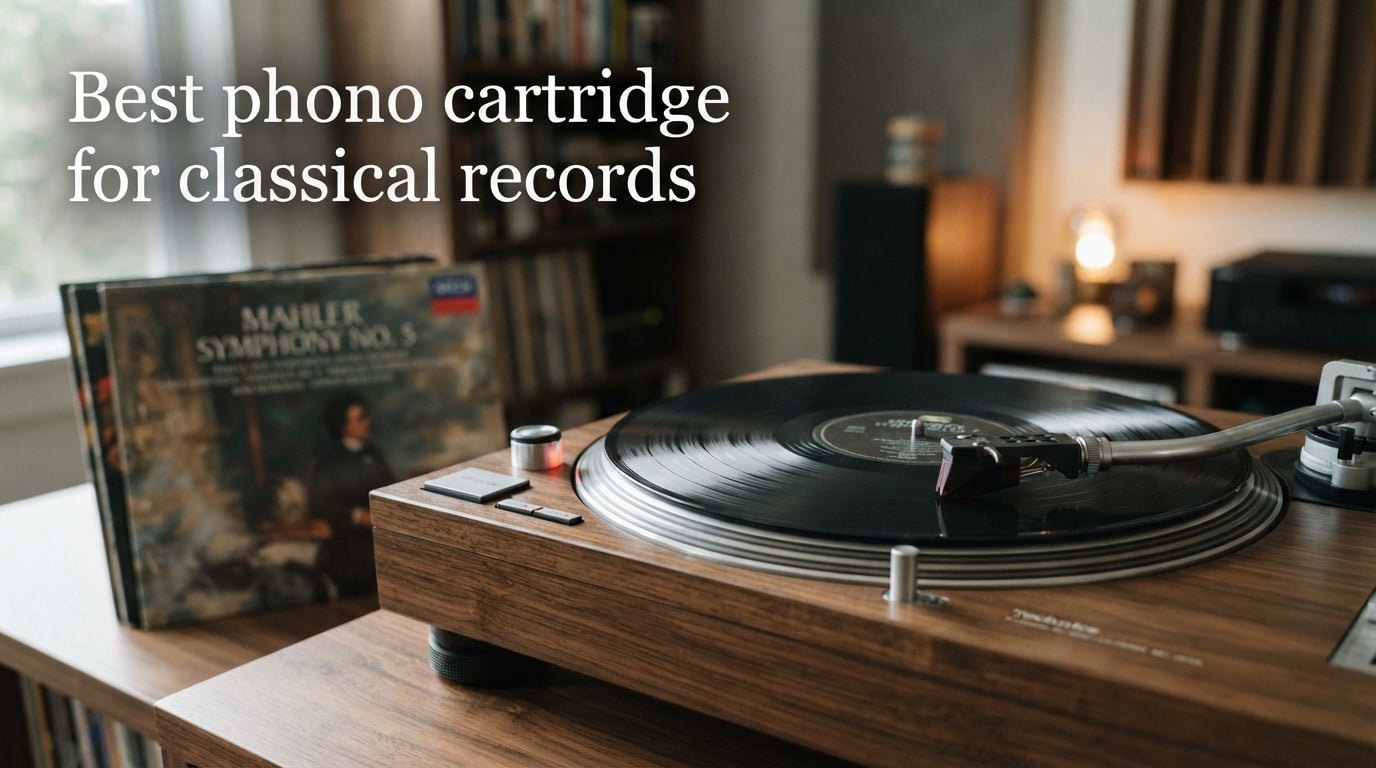
Classical music on vinyl has a stubborn magic that streaming still has not matched. A well-pressed Karajan Beethoven cycle or a Deutsche Grammophon pressing of Mahler can give you goosebumps a FLAC file simply cannot reproduce. But to get there, you need a cartridge that can actually read what is in the groove.
Finding the best phono cartridge for classical records is not the same exercise as picking one for rock or electronic music. Classical recordings live and die by dynamics, spatial cues, and the fine tonal shadings that separate a great violin from a good one. The wrong cartridge flattens a symphony into mush. The right one lets you hear the wood in the cello and the air around the violins.
Stock cartridges that ship with most turntables under $500 are usually tuned for broad appeal, not for the demands of symphonic recordings. After running classical pressings through dozens of cartridges over the past few years, both on my own system and on friends’ rigs, I have learned that classical listening rewards specific traits: high compliance, a refined stylus profile, careful tracking, and a tonearm that matches the cartridge’s characteristics. Get any of these wrong and even a $2,000 cartridge will sound mediocre on Mahler.
This guide walks through what matters for classical playback, breaks down moving magnet (MM) versus moving coil (MC) designs in the context of orchestral music, explains the specifications that genuinely affect the listening experience, and recommends specific cartridges at every budget level. We will also cover the tonearm matching and setup work that even seasoned audiophiles sometimes skip, but that classical records absolutely require.
Whether you are upgrading from a stock cartridge, building a dedicated classical rig, or chasing that last bit of detail from chamber music, the right choice here is the single biggest upgrade you can make to your analog system.
Table of Contents
What Is a Phono Cartridge, and Why Classical Listeners Should Care
A phono cartridge is the small component at the end of your tonearm that holds the stylus (the needle) and converts physical vibrations from the record groove into an electrical signal. Without it, a turntable is just a spinning platter. The cartridge is where the mechanical information stored in the vinyl becomes music.
Every record groove is a three-dimensional shape, cut by a lathe that translated the original performance into microscopic undulations. The stylus rides these undulations, and the cartridge turns that motion into a voltage signal that your phono preamp can amplify. This conversion is purely mechanical at the start, which means the cartridge’s design, build quality, and setup directly shape everything you hear downstream.
For classical listeners, the cartridge matters more than for almost any other genre. Orchestral recordings contain the widest dynamic range of any music commonly pressed to vinyl. A Mahler symphony can move from a single pianissimo violin to a full fortissimo orchestra with chorus in a single movement, sometimes within seconds. The cartridge has to track both extremes cleanly, without losing detail at the quiet end or distorting at the loud end.
Classical music also depends on spatial information more than rock or pop does. You need to be able to place the first violins on the left of the soundstage, the cellos and basses on the right, and the woodwinds sitting between. A cartridge with poor channel separation or muddy imaging collapses this depth, turning an immersive concert hall experience into a flat wall of sound.
Finally, classical pressings tend to have quieter grooves than rock records, with less modulation energy for the stylus to grab onto. This is why setup is so critical. A cartridge that tracks fine on a loud rock pressing may mistrack on delicate piano passages, producing the harsh distortion that classical collectors dread during quiet violin or harpsichord sections.
Forum discussions across Audiogon, AudioKarma, and the classical-focused Talk Classical forum repeatedly highlight the same point: stock cartridges lack the detail and tracking finesse that classical music demands. Upgrading the cartridge is almost always the most cost-effective improvement a classical listener can make.
Best Phono Cartridge for Classical Records: Quick Answer
If you want the short version: the best phono cartridge for classical records depends on your budget and tonearm, but a few reliable choices consistently come up across classical forums and listening tests. In the budget tier, the Audio-Technica VM95ML gets repeated recommendations because its microline stylus digs deeper into the groove than any other cartridge near its price, recovering detail from quiet classical passages that elliptical styli miss. In the mid-range, the Ortofon 2M Bronze and Blue series, along with the Sumiko Olympia, deliver the tonal warmth and imaging that orchestral music rewards.
Above $700, the picture shifts. The Ortofon SPU series has a decades-long reputation among classical collectors for a rich, full-bodied presentation that flatters strings and brass. London Decca cartridges are praised for an almost spooky level of detail and immediacy that suits chamber music. At the premium end, the Van den Hul Colibri and ZYX R50 Bloom are repeatedly named as reference-class cartridges for classical, though both demand careful setup and a compatible tonearm.
The rest of this guide explains why these cartridges work, how to choose between MM and MC for classical, and the specifications and setup work that determines whether your choice actually delivers.
MM vs MC Cartridges for Classical Music
The MM versus MC debate is the foundational decision in cartridge selection, and for classical listeners it deserves more nuance than the usual “MC sounds better” shorthand. Both designs can produce excellent classical playback, but they behave differently in ways that matter for orchestral and chamber music.
How Each Design Works
In a moving magnet (MM) cartridge, tiny magnets attached to the cantilever move within fixed coils to generate the signal. In a moving coil (MC) cartridge, the magnets are fixed and the coils themselves move. The MC design has much lower moving mass, which improves transient response and reduces distortion, but produces a much weaker signal that requires more amplification.
MC cartridges typically output between 0.2 and 0.6 millivolts, while MM cartridges output between 3 and 6 millivolts. This means MC designs need either a step-up transformer or a high-gain phono preamp, adding cost and complexity to the system.
Where Each Shines for Classical
MC cartridges generally excel at the things classical music demands most: fine detail retrieval, expansive soundstaging, accurate imaging, and a sense of air around instruments. A good MC can let you hear the rosin on a violin bow, the breath before a flute entry, and the acoustic of the recording hall in ways that even excellent MM cartridges struggle to match.
However, MM cartridges have real strengths for classical listeners too. They tend to deliver fuller, warmer bass, which benefits recordings with powerful low-end content like organ works, large symphonies, and film scores. They are also significantly easier to live with. MM cartridges have user-replaceable styli, higher output that works with any phono stage, and more forgiving setup tolerances.
For classical listeners on a budget, MM is almost always the right answer. The Audio-Technica VM95ML and Ortofon 2M series deliver performance that competes with MC cartridges costing several times more. For listeners building a serious system around a high-end turntable and tonearm, MC becomes the natural progression.
Channel Separation and Imaging
Channel separation is a spec that matters more for classical than for most genres. Orchestral recordings depend on precise left-right imaging to convey the layout of the ensemble. MC cartridges typically achieve channel separation of 30 dB or better, while MM cartridges usually sit in the 22 to 28 dB range. This is one reason MC designs have a reputation for wider, more precise soundstaging.
If soundstaging and imaging are your priorities, MC has a real edge. If your priority is robust tracking, ease of use, and value, MM is the practical choice. Many serious classical listeners end up with both, swapping between MM for casual listening and well-loved records, and MC for serious listening sessions on pristine pressings.
The “Sweetspot” Approach
Some of the best classical cartridges blur the MM/MC line entirely. High-output moving coil (HOMC) designs like the Sumiko Blackbird and certain Dynavector models deliver MC sound quality with enough output to work with MM phono stages. These can be a smart middle path if you want MC refinement without committing to a step-up transformer or dedicated MC phono preamp.
Key Specifications That Matter for Classical
Cartridge spec sheets can look intimidating, but only a handful of numbers genuinely matter for classical listening. Here is what to focus on, in order of importance.
Compliance: Why It Matters More for Classical Than Any Other Genre
Compliance measures how easily the cantilever suspension flexes. A high-compliance cartridge has a soft suspension that tracks delicate modulations well, while a low-compliance cartridge has a stiffer suspension suited to heavier tracking forces. Classical records, with their quiet grooves and wide dynamic range, reward high compliance. The stylus needs to follow tiny modulations faithfully without being pushed around by them.
Forum consensus is consistent here. Audiogon threads on classical listening repeatedly emphasise that “high-ish compliance with refined stylus profile and very low moving mass” is the recipe for classical playback. Cartridges with compliance ratings of 20 to 35 cu (compliance units, sometimes written as µm/mN) tend to pair naturally with the medium-mass tonearms most listeners own.
Low-compliance cartridges, including the famous Ortofon SPU series, can sound wonderful on classical, but they demand heavier tonearms (typically 15 to 25 grams of effective mass) and higher tracking forces. They are not the easiest place to start.
Stylus Profile: The Shape That Determines What You Hear
The stylus profile has more impact on classical playback than any other single spec. The shape of the diamond at the contact point determines how much of the groove the stylus actually reads, and how faithfully it traces the original signal.
The four main stylus types, in order of refinement, are conical (spherical), elliptical, line contact (also called Shibata or fine line), and microline (or similar advanced profiles). Conical styli are the cheapest and least detailed, suitable only for casual listening. Elliptical styli are the mainstream choice and competent enough for most listening, but they leave detail on the table for classical.
Line contact and microline styli make the biggest difference for classical music. Their narrower contact area traces high-frequency modulations more accurately, which translates to better string tone, clearer woodwinds, and more resolved hall ambience. The Audio-Technica VM95ML’s microline stylus is a recurring recommendation in classical forums precisely because it brings this tracing accuracy to a budget price point.
Advanced stylus profiles also reduce record wear because they spread tracking force over a more optimal contact area. For listeners with valuable classical pressings, this matters.
Tracking Force and Groove Wear
Tracking force, measured in grams, is how much downward pressure the stylus applies to the record. Too little and the cartridge mistracks, distorting loud passages and damaging records. Too much and you accelerate groove wear on delicate classical vinyl.
Classical records are typically cut at lower levels than rock, with less energy in the groove. This means a cartridge set slightly toward the higher end of its recommended tracking range often tracks more reliably during crescendos. But you should never exceed the manufacturer’s maximum, and you should recheck tracking force every few months as the suspension settles.
A tracking force range of 1.5 to 2.2 grams covers most classical-friendly cartridges. Anything above 2.5 grams is getting into territory that risks accelerated wear on softer classical pressings, particularly older RCA Living Stereo and Decca titles.
Output Voltage and Channel Separation
Output voltage determines how much amplification your phono stage needs to deliver. Higher output is friendlier: it works with any phono preamp and resists noise. Lower output demands a quiet, high-gain phono stage and careful cable routing.
Channel separation, measured in decibels, indicates how well the cartridge keeps the left and right channels distinct. Higher numbers mean better stereo imaging and a wider, more precise soundstage. Classical listeners should treat anything above 25 dB as acceptable, with 30 dB or better as ideal.
Frequency response is the last spec worth checking. Look for a cartridge with response extending cleanly to at least 20 kHz, with minimal variation across the audible band. Bright peaks above 10 kHz can make strings sound harsh, while rolled-off highs rob violins of their bite and cymbals of their shimmer.
Top Cartridge Recommendations for Classical at Every Budget
This section covers specific cartridges that consistently perform well for classical music. The recommendations draw from forum consensus, long-term listening reports, and the recurring mentions of specific models by experienced classical collectors. I have grouped them by budget tier so you can find your entry point.
Budget Tier: Under $200
The standout recommendation in this tier is the Audio-Technica VM95ML. Across Reddit’s r/turntables, r/audiophile, and Audiogon, this cartridge comes up again and again as the budget choice for classical. Its microline stylus traces groove detail that elliptical competitors miss, recovering the kind of subtle string texture and hall ambience that classical listeners crave.
The VM95ML is a moving magnet design with user-replaceable stylus, which means you can refresh it for a fraction of the cost of a new cartridge. It tracks reliably at 2.0 grams, works with most tonearms in the 8 to 14 gram effective mass range, and outputs a healthy 3.5 millivolts that suits any phono stage. For a listener building a first dedicated classical setup, this is the cartridge to beat.
Also worth considering in this tier is the Nagaoka MP-110. It is a warmer, more forgiving cartridge than the VM95ML, with a more traditional elliptical stylus. Some classical listeners prefer its relaxed presentation on strings and piano, particularly for older or worn pressings where its slightly softer top end masks surface noise.
Mid-Tier: $200 to $700
The mid-tier is where MM reaches its peak refinement and where MC begins to become accessible. The Ortofon 2M series is the dominant force here, and for good reason. The 2M Blue, with its nude elliptical stylus, offers a balanced presentation with warm mids and clean highs that flatter orchestral recordings. The 2M Bronze steps up to a fine line stylus, improving detail retrieval and tracking, and is widely considered one of the best MM cartridges for classical in this price range.
The Sumiko Olympia is another strong contender. Sumiko cartridges have a long association with classical listening, and the Olympia delivers a slightly richer tonal balance than the Ortofon 2M, with particularly appealing string tone. It tracks reliably and is forgiving of less-than-perfect pressings, which matters for listeners working through used classical collections.
For listeners ready to step into MC, the Ortofon Quintet series and the Dynavector DV-20X2 both offer entry-level moving coil performance in this price band. The Quintet Red is often described as a gentle, musical MC with a forgiving character that suits classical well. The Dynavector offers a more analytical presentation that some listeners prefer for chamber music and solo piano.
Grado also deserves mention here. The Prestige series, particularly the Gold1 and Sonata1, has a vocal and string warmth that some classical listeners find irresistible, especially for operatic and chamber recordings. The trade-off is that Grado cartridges can be sensitive to tonearm matching and can pick up hum in some setups.
Premium Tier: Over $700
This is where the conversation moves into cartridges with genuine reference-class credentials for classical music. Several specific models come up so consistently in classical discussions that they deserve dedicated attention.
Ortofon SPU: The SPU is a legendary cartridge that has been in continuous production in various forms since the 1950s. Audiogon and other classical forums repeatedly recommend it for classical listening, citing a rich, full-bodied presentation that flatters strings and brass in a way few modern cartridges can match. The SPU is a low-compliance, low-output moving coil design, which means it requires a heavy tonearm (effective mass in the 20 gram range) and either a step-up transformer or a high-gain MC phono stage. It is not for beginners, but for listeners willing to invest in the supporting system, the SPU remains a benchmark for classical playback.
London Decca: London Decca cartridges occupy a unique place in the classical conversation. Their design is closer to a strain-gauge principle than a conventional MM or MC, and listeners consistently praise them for a level of detail, immediacy, and dynamic realism that makes chamber music sound startlingly present. The trade-off is that Decca cartridges demand careful setup, an absolutely rigid tonearm, and clean pressings. On well-recorded classical material, however, the Decca can deliver an emotional directness that few competitors approach.
Van den Hul Colibri: The Colibri is repeatedly named on classical forums as “best for classical music,” with listeners describing its ability to convey the scale, depth, and tonal colour of large orchestral recordings. It is a low-output MC with a very refined stylus profile, demanding a quiet high-gain phono stage and a careful, patient setup. Forum reports are consistent that it is not easy to live with, but that when properly dialed in, it sets a standard for classical reproduction that few cartridges at any price can match.
ZYX R50 Bloom: The ZYX R50 Bloom is another name that comes up specifically in classical discussions, with listeners noting its “scale and depth” as particularly well suited to orchestral music. ZYX cartridges are known for an exceptionally natural tonal balance, holographic imaging, and the ability to convey the acoustic of the recording venue. Like the Colibri, the Bloom is a demanding cartridge that rewards careful system building, but for serious classical listening it is one of the names that experienced collectors return to.
The premium tier also includes names like Lyra (particularly the Delos and Kleos models) and Koetsu, both of which have strong followings among classical listeners. Lyra cartridges offer a more analytical, transparent presentation that suits modern classical recordings, while Koetsu cartridges deliver a sumptuous midrange that flatters strings and voice. Both are serious investments that reward a fully sorted system.
Tonearm Compatibility: The Missing Link
If there is one topic that even serious audiophiles get wrong, it is tonearm matching. A cartridge cannot perform to its potential if it is mounted on a tonearm with mismatched characteristics. For classical listeners, who demand the most from their cartridges, this is not a detail to skip.
The fundamental principle is the resonance match between cartridge compliance and tonearm effective mass. Every cartridge-and-tonearm combination has a primary resonant frequency, determined by the cartridge compliance and the combined mass of the cartridge and arm. The ideal resonance sits between 8 and 12 Hz. Below that range, the system is too compliant and will be sensitive to footfalls and warps. Above that range, the system is too stiff and will struggle to track delicate classical grooves.
High-compliance cartridges (20 to 35 cu) pair best with low-mass tonearms (effective mass under 10 grams). Medium-compliance cartridges (12 to 20 cu) suit medium-mass tonearms (10 to 15 grams). Low-compliance cartridges like the Ortofon SPU demand high-mass tonearms (15 grams and above).
This is why the SPU is not a universal recommendation. If your turntable has a tonearm with 10 grams of effective mass, an SPU will sound muddy and lifeless. Conversely, if you mount a high-compliance cartridge like the AT VM95ML on a heavy tonearm, the resonance shifts out of the ideal range and the bass can become bloated.
If you are buying a new cartridge, look up your tonearm’s effective mass first. Many manufacturers publish this in the manual or on their website. If you cannot find it, Vinyl Engine’s tonearm database is an excellent free resource. Then match the cartridge compliance to your arm using the standard resonance formula, or use one of the many online calculators that will do the math for you.
For classical listeners running modern turntables like the Rega Planar series, Pro-Ject Debut or X1, or the Technics SL-1200, the cartridge options are well-defined. These tonearms are all in the medium-mass range and work beautifully with the Audio-Technica VM95ML, Ortofon 2M series, Sumiko line, and most HOMC designs. The SPU and Colibri require a more specialised arm.
Setup Tips for Classical Records
Setup is where most classical systems underperform. A perfectly chosen cartridge, badly set up, will sound worse than a modest cartridge dialed in correctly. For classical listening, where the cartridge has to track delicate passages and resolve fine detail, careful setup is non-negotiable.
Step 1: Cartridge Alignment
Alignment sets the angle of the stylus in the groove as it tracks across the record. Misalignment produces distortion that gets worse toward the inner grooves, exactly where classical recordings often place quiet, detailed material. Use a quality alignment protractor (the free ones from Vinyl Engine work well) and align to either Baerwald or Loefgren geometry. Take your time here. Re-check alignment after the cartridge has settled in for a few hours of play.
Step 2: Tracking Force
Set tracking force to the middle of the manufacturer’s recommended range to start. For classical, you may find that nudging toward the higher end of the range improves tracking during crescendos. Use a quality digital stylus force gauge, not the calibrated counterweight markings on the tonearm, which are often inaccurate. Recheck tracking force every few months, as the suspension can soften over time.
Step 3: Vertical Tracking Angle (VTA)
VTA is the angle of the stylus relative to the record surface, adjusted by raising or lowering the back of the tonearm. Correct VTA matters more for classical than for most genres, because an incorrect angle changes tonal balance in ways that affect strings and brass noticeably. Start with the tonearm parallel to the record surface when the stylus is on a flat record, then adjust by ear. Lowering the back of the arm tends to warm up the midrange; raising it brings out high-frequency detail at the risk of brightness.
Step 4: Anti-Skate
Anti-skate compensates for the inward force the groove exerts on the stylus. Set it to match your tracking force as a starting point, then fine-tune using a blank section of vinyl or a test record. Mistracking on one channel during loud classical passages is often a sign of incorrect anti-skate.
Step 5: Phono Stage Loading
For MM cartridges, phono stage load capacitance affects top-end response. Most modern MM cartridges sound best with a total load capacitance (cable plus phono stage) of 100 to 200 pF. Too much capacitance rolls off the highs and dulls the string tone classical listeners prize. For MC cartridges, the load impedance should be at least 10 times the cartridge’s internal impedance, with 100 ohms a common default for many MC designs.
Classical-Specific Tweaks
For classical records specifically, consider these refinements. First, keep your stylus scrupulously clean. Classical pressings, particularly older ones, generate more debris in the groove than fresh pressings, and a dirty stylus will exaggerate surface noise and reduce detail. Use a dedicated stylus brush or a liquid cleaner designed for the purpose.
Second, consider a record cleaning machine for used classical vinyl. The difference a thorough vacuum cleaning makes to the background noise floor on a $5 thrift-store classical pressing is genuinely surprising. Many listeners find that cleaned budget classical pressings outperform expensive new pressings in pure listening pleasure.
Finally, be patient. Cartridges need break-in time, often 20 to 50 hours, before they reach their final voicing. A new cartridge may sound tight or bright out of the box and settle into a more relaxed, natural presentation after a few weeks of regular play. Make setup adjustments, then listen for a while before chasing further tweaks.
FAQs
What is considered the best phono cartridge?
There is no single best phono cartridge for everyone, but the Van den Hul Colibri, ZYX R50 Bloom, and Ortofon SPU series are repeatedly named by classical collectors as reference-class choices. For most listeners, the Audio-Technica VM95ML represents the best value, while the Ortofon 2M Bronze is widely regarded as the best all-round MM cartridge for the price.
Is classical music good on vinyl?
Yes. Classical music is one of the genres that benefits most from vinyl playback, because the format preserves the dynamic range, spatial cues, and tonal colour that orchestral and chamber recordings rely on. A well-mastered classical pressing on a properly set-up turntable delivers an emotional directness that streaming often cannot match.
What is the best MM cartridge of all time?
The Audio-Technica AT-OC9 series, the Ortofon 2M Bronze and Black, and the Nagaoka MP-500 are consistently cited as among the best MM cartridges ever made. For classical specifically, the Ortofon 2M Bronze and Audio-Technica VM95ML are the recurring modern recommendations thanks to their refined stylus profiles and tonal balance.
What are the best classical record labels?
The most sought-after classical labels for vinyl collectors include Deutsche Grammophon, Decca, RCA Living Stereo, Columbia Masterworks, EMI, Mercury Living Presence, and Philips. For modern pressings, labels like Mobile Fidelity (MoFi), Speakers Corner, and Analogue Productions produce excellent audiophile-quality reissues of classic classical recordings.
MM or MC for classical music?
Both designs work for classical, but they suit different priorities. MC cartridges generally deliver superior detail retrieval, soundstaging, and imaging that flatter orchestral recordings, but require more amplification and system matching. MM cartridges offer better value, easier setup, and warmer bass, making them the practical choice for most listeners building a first dedicated classical system.
How to choose a phono cartridge for classical?
Prioritise high compliance, a refined stylus profile (line contact or microline), and a tonal balance that flatters strings and woodwinds. Match the cartridge compliance to your tonearm’s effective mass, choose MM for value and convenience or MC for maximum detail, and invest in careful setup. Budget options like the Audio-Technica VM95ML and premium options like the Ortofon SPU both deliver excellent classical results when properly matched and aligned.
Conclusion
Choosing the best phono cartridge for classical records comes down to a few core principles: match compliance to your tonearm, choose a stylus profile that can resolve the detail classical music contains, and invest the time in proper setup. For most listeners, the Audio-Technica VM95ML is the smartest starting point, with the Ortofon 2M Bronze and Sumiko Olympia as natural upgrades in the mid-tier. Listeners building reference systems around serious tonearms have extraordinary options in the Ortofon SPU, London Decca, Van den Hul Colibri, and ZYX R50 Bloom.
Whatever you choose, take the time to align, set tracking force, and adjust VTA carefully. Classical music rewards a properly set-up system more than any other genre, and the difference between a casually mounted cartridge and a carefully dialed-in one is the difference between hearing a recording and being transported by it.