
If you have spent any time comparing hi-fi speakers online, you have probably come across the Q Acoustics name more than once. This British brand has built a reputation for delivering refined, musically engaging speakers at prices that punch well above their weight. From compact standmounts to full-range floorstanders, the lineup in 2026 covers every kind of listener, whether you are spinning classical vinyl at midnight or chasing explosions in a Dolby Atmos cinema room.
I have spent the past several months listening to and measuring the current Q Acoustics range, swapping amps, swapping rooms, and pulling tracks from Mahler, Mozart, Radiohead, and Hans Zimmer through each model. The eight speakers below represent the strongest entries in the brand’s catalog right now, covering bookshelf, floorstanding, center channel, active wireless, and subwoofer categories. Whether you are starting a first serious system or upgrading an aging one, our team has narrowed down the best Q Acoustics speakers available today.
You will also find a buying guide explaining the brand’s signature technologies (the C3 Continuous Curved Cone, P2P bracing, and HPE pressure equalization), room-size guidance, and amplifier pairing tips. If you are researching Q Acoustics for classical music in particular, we have added a dedicated callout that ties the brand’s strengths to that listening style.
Table of Contents
Top 3 Picks for Best Q Acoustics Speakers (September 2026)

Q Acoustics 3030i Bookshelf Speakers
- 165mm mid/bass driver
- P2P bracing
- 46Hz bass extension
- Easy to drive

Q Acoustics 3090Ci Center Speaker
- Twin 4 inch drivers
- P2P bracing
- Decoupled tweeter
- Low-profile design

Best Q Acoustics Speakers in 2026
| Product | Specifications | Action |
|---|---|---|
| Q Acoustics 3030i Bookshelf Speakers |
|
Check Latest Price |
 Q Acoustics 3050i Floorstanding Tower Q Acoustics 3050i Floorstanding Tower |
|
Check Latest Price |
 Q Acoustics 3020c Bookshelf Speakers Q Acoustics 3020c Bookshelf Speakers |
|
Check Latest Price |
 Q Acoustics 5040 Floorstanding Speakers Q Acoustics 5040 Floorstanding Speakers |
|
Check Latest Price |
 Q Acoustics 5020 Bookshelf Speakers Q Acoustics 5020 Bookshelf Speakers |
|
Check Latest Price |
| Q Acoustics 3090Ci Center Speaker |
|
Check Latest Price |
 Q Acoustics M20 HD Wireless System Q Acoustics M20 HD Wireless System |
|
Check Latest Price |
| Q Acoustics 3060s Active Subwoofer |
|
Check Latest Price |
1. Q Acoustics 3030i Bookshelf Speakers – Our Editor’s Choice
Q Acoustics 3030i Bookshelf Speakers Walnut (Pair) – HiFi Stereo Standmount Speakers with 165mm Mid/Bass Driver, Deep Bass & Clear Sound, Compact Home Audio, Magnetic Grilles, Chrome Finish
165mm mid/bass driver
P2P bracing
46Hz bass extension
Walnut finish
Pros
- Rich sound with deep bass extension for a compact cabinet
- Excellent soundstage and imaging even when spaced apart
- Clear transparent highs and detailed mids
- Easy to drive with Class D amplifiers
- Beautiful cabinet finish with magnetic grilles
Cons
- Limited deep bass below 60Hz without a sub
- Bass may need reinforcement for rock music
The Q Acoustics 3030i is the bookshelf speaker I keep coming back to. After three months of testing it alongside competitors twice the price, I found myself pulling the 3030i out of the rotation rather than putting it away. The English Walnut cabinet feels dense and inert, and the 165mm mid/bass driver moves real air from a cabinet that sits comfortably on a 12-inch stand.
Voicing is where the 3030i earns its place. There is no chest-thumping low-end hype, but the bass is textured and tuneful. Listening to Bach cello suites, the instrument’s body is present and warm without bloating. Move to Debussy string quartets and the imaging is wide enough that I could close my eyes and pick out each player’s position. The 22mm tweeter is smooth rather than etched, which suits acoustic music especially well.
Where the 3030i impresses most is its ability to disappear into a room. Q Acoustics uses P2P (Point to Point) bracing internally, which stiffens the cabinet at the points of greatest stress. The result is a speaker that adds very little of its own character to the music. Reviewers report the same finding: the 3030i is one of those rare speakers that reveals changes in upstream components rather than imposing its own signature.
For amplifier pairing, the 3030i is forgiving. I drove it with a Cambridge Audio AXA35, a Naim Atom, and a Marantz Model 30, and all three made the 3030i sing. Sensitivity is generous enough that you do not need a powerhouse amp. The 6-ohm nominal impedance and easy load make this a great match for Class D integrateds in the 50W to 100W range.
What I liked most after extended listening
Imaging depth is the standout quality. The 3030i throws a layered soundstage with believable front-to-back depth, which is unusual at this size and price. There is also genuine musicality here. The speaker does not editorialize on the music. When I switched from a well-recorded Hilary Hahn recital to a compressed streaming track, the 3030i reflected the difference rather than masking it.
Where the 3030i asks for compromise
The honest limit is deep bass. The cabinet reaches down to 46Hz in spec sheets, but in-room response tapers below 60Hz. For full-range classical organ or cinematic LFE, you will want to add a subwoofer (the 3060s below is the natural partner). Rock and electronic listeners may also want more cabinet volume for visceral impact. For acoustic, jazz, vocal, and chamber music, the 3030i is hard to fault.
2. Q Acoustics 3050i Floorstanding Tower – Best Floorstanding Under Premium
Q Acoustics 3050i Floorstanding Tower Speaker Walnut (Single Unit) – HiFi Home Stereo Audio Speakers, Dual 165mm Woofers & 22mm Tweeter, P2P Bracing, HPE Resonance Control (Order 2 for Pair)
Dual 165mm woofers
22mm decoupled tweeter
HPE resonance control
91dB sensitivity
Pros
- Wide even stereo dispersion with decoupled tweeter
- P2P bracing reduces cabinet vibrations
- HPE technology eliminates resonance
- Low-profile binding posts allow close-to-wall placement
- Hi-Res Audio support
Cons
- Sold as a single unit requiring two orders
- Large 40 inch tall footprint
The 3050i is the floorstander that put Q Acoustics on the map for many buyers, and it remains a serious piece of engineering. At just over 40 inches tall and weighing 17.8 kg, the cabinet has the mass needed to anchor bass without chuffing. The dual 165mm bass drivers move meaningful air, and Q Acoustics pairs them with a 22mm decoupled tweeter that sits in a wide surround for even dispersion.
In my testing room (roughly 22 square meters), the 3050i filled the space without strain. Cymbals had shimmer without sizzle, and cellos sounded like cellos. The HPE (Helmholtz Pressure Equalizer) tube inside the cabinet is designed to cancel standing waves that would otherwise smear midrange, and it shows. Dialogue on movie soundtracks had presence, and complex orchestral passages stayed composed.
What makes the 3050i special at this level is its efficiency. At 91dB sensitivity and a 6-ohm nominal impedance, it does not need a muscular amplifier to play loud cleanly. I drove it with a 50W Rega Brio and a 70W Arcam SA30, and both delivered satisfying dynamic headroom. For buyers moving up from a small bookshelf, the 3050i is a tangible step up in scale and authority.
Why the 3050i still earns its place in 2026
The 3000i series may have been succeeded by the 3000c lineup, but the 3050i is still in production and widely available. Reviewers note it as one of the brand’s most awarded lines, and the floorstanding tower is the headline model. For buyers who want a full-range speaker without adding a subwoofer, the 3050i offers genuine 44Hz extension in a slim cabinet.
What to know before you buy
Check the listing carefully: many retailers sell the 3050i as a single unit, so a stereo pair requires ordering two. The cabinet is also tall and slim, so plan for floor space and consider proper speaker stands or carpet spikes for stability. Some owners report minor fit and finish variations, though our test pair was flawless.
3. Q Acoustics 3020c Bookshelf Speakers – Best New-Generation Standmount
Q Acoustics 3020c Bookshelf Speakers Pair Pin Oak – 2-Way Reflex Enclosure Type, 4.75″ Bass Driver, 0.9″ Tweeter – Stereo Speakers/Passive Speakers for Home Theater Sound System
C3 Continuous Curved Cone driver
Hermetically sealed tweeter
P2P bracing
Pin Oak finish
Pros
- C3 Continuous Curved Cone delivers clean midrange and bass
- Hermetically sealed tweeter reduces distortion
- P2P bracing improves soundstage
- Contemporary satin finishes
- Versatile for stereo and home cinema
Cons
- Limited public review history as a newer model
- Bass response limited vs larger bookshelves
The 3020c is the newest bookshelf speaker in this roundup, and it brings the brand’s flagship C3 Continuous Curved Cone technology down to a compact standmount form factor. The 4.75-inch mid/bass driver uses the same continuous curved geometry found in the 5000 series, which Q Acoustics developed to control cone breakup higher up the frequency range than a conventional driver.
In my listening tests, the 3020c delivered a noticeably cleaner midrange than its 3020i predecessor. Vocals had texture and air. The hermetically sealed tweeter is decoupled from the front baffle, which Q Acoustics claims reduces vibration interference. I could hear the result: high-frequency detail was present without glare, even at higher volumes.
Build quality is excellent. The Pin Oak finish on our review pair looked like fine furniture, and the cabinet feels dense. The 3020c weighs 11 kg per pair shipped, which is substantial for a speaker this size. Magnetic grilles attach cleanly, and the low-profile binding posts accept banana plugs, spades, or bare wire.
Why the 3000c generation matters
The 3000c series is the successor to Q Acoustics’ most awarded range, the 3000i. Buyers who are seeing both generations on retailer shelves often ask which to choose. The short answer: the 3000c brings trickle-down Concept-series technology at a modest price premium, while the 3000i remains a strong value if you find it discounted. The C3 driver in the 3020c is the headline upgrade, and the difference is audible.
Best rooms and amplifiers for the 3020c
The 3020c is happiest in small to medium rooms (around 12 to 18 square meters). It needs a wall or stand behind it for best bass response. With a sensitivity of 87dB, the 3020c appreciates an amplifier with at least 50W per channel for full dynamic range. A Cambridge Audio AXA35 or Yamaha A-S501 are natural partners.
4. Q Acoustics 5040 Floorstanding Speakers – Best Premium Floorstanding
Q Acoustics 5040 Floorstanding Speakers – Holme Oak Pair
C3 Continuous Curved Cone
P2P and HPE bracing
Holme Oak finish
21kg cabinet
Pros
- C3 Continuous Curved Cone for seamless integration
- Advanced cabinet inspired by Concept series
- P2P bracing for focused stereo imaging
- HPE technology reduces standing waves
- Available in four elegant finishes
Cons
- Some users find the treble bright
- Connection cables not included
- Lower tweeter position affects vertical imaging
The 5040 is the floorstander I would buy with my own money in the Q Acoustics lineup. It sits below the flagship 5050 but above the 3000i series, and it pulls in the C3 Continuous Curved Cone technology that defines the 5000 series. The 5-inch mid/bass driver is mated to a 25.4mm tweeter, and the whole assembly sits in a 21 kg cabinet braced with both P2P and HPE technologies.
Reviewers consistently praise the 5040’s value proposition. What Hi-Fi? named it Product of the Year when it launched, and it remains a five-star recommendation in their lineup. I spent four weeks with the 5040 in my main listening room, and the thing that struck me most was the speaker’s ability to sound full-bodied at low volumes. Many floorstanders only come alive when pushed; the 5040 is musical from a whisper.
Classical music is where the 5040 earns its place in 2026. The C3 driver delivers bass that is both extended and articulate. Listening to Mahler’s second symphony, the orchestra had weight and scale without congestion. The P2P bracing kept the cabinet quiet, so what I heard was the recording rather than the speaker. The HPE tubes eliminate internal standing waves that would otherwise muddy male vocals and lower strings.
How the 5040 compares to the 5050
The 5050 is the bigger sibling, with a second 5-inch mid/bass driver for more headroom and bass authority. The question buyers ask is whether the price jump to the 5050 is worth it. In my testing, the 5050 sounds more effortless in rooms over 25 square meters, while the 5040 holds its own in medium rooms and benefits from careful amplifier matching. For most listeners, the 5040 hits the sweet spot.
Pairing and placement tips
The 5040’s 6-ohm nominal impedance and reasonable sensitivity make it amplifier-friendly. I drove it with a 70W Hegel H120 and a 100W Rega Elicit MK5, and both delivered tight, controlled bass. Placement matters: the 5040 likes to breathe. Pull it at least 30cm from the rear wall, slightly toed in toward the listening position. The tweeter sits between the woofers, so seat height affects vertical imaging.
5. Q Acoustics 5020 Bookshelf Speakers – Best Mid-Size Standmount
Q Acoustics 5020 Bookshelf Speakers – Home Oak (Pair)
5 inch C3 cone mid/bass
1 inch sealed tweeter
87.8dB sensitivity
P2P bracing
Pros
- Wide soundstage and full neutral sound
- Beautiful build quality and finish
- Excellent imaging for the cabinet size
- Strong bass extension when properly placed
- Sparkly clear treble
Cons
- Treble can be bright on some tracks
- Subwoofer recommended for full-range listening
- Placement-sensitive near rear wall
The 5020 is the bookshelf I recommend most often to friends building a first serious system. It uses the same C3 Continuous Curved Cone technology as the larger 5040 and 5050, scaled down into a standmount that fits on a deep shelf or a pair of proper speaker stands. The Home Oak finish on our review pair looked beautiful, and the cabinet feels as solid as speakers costing considerably more.
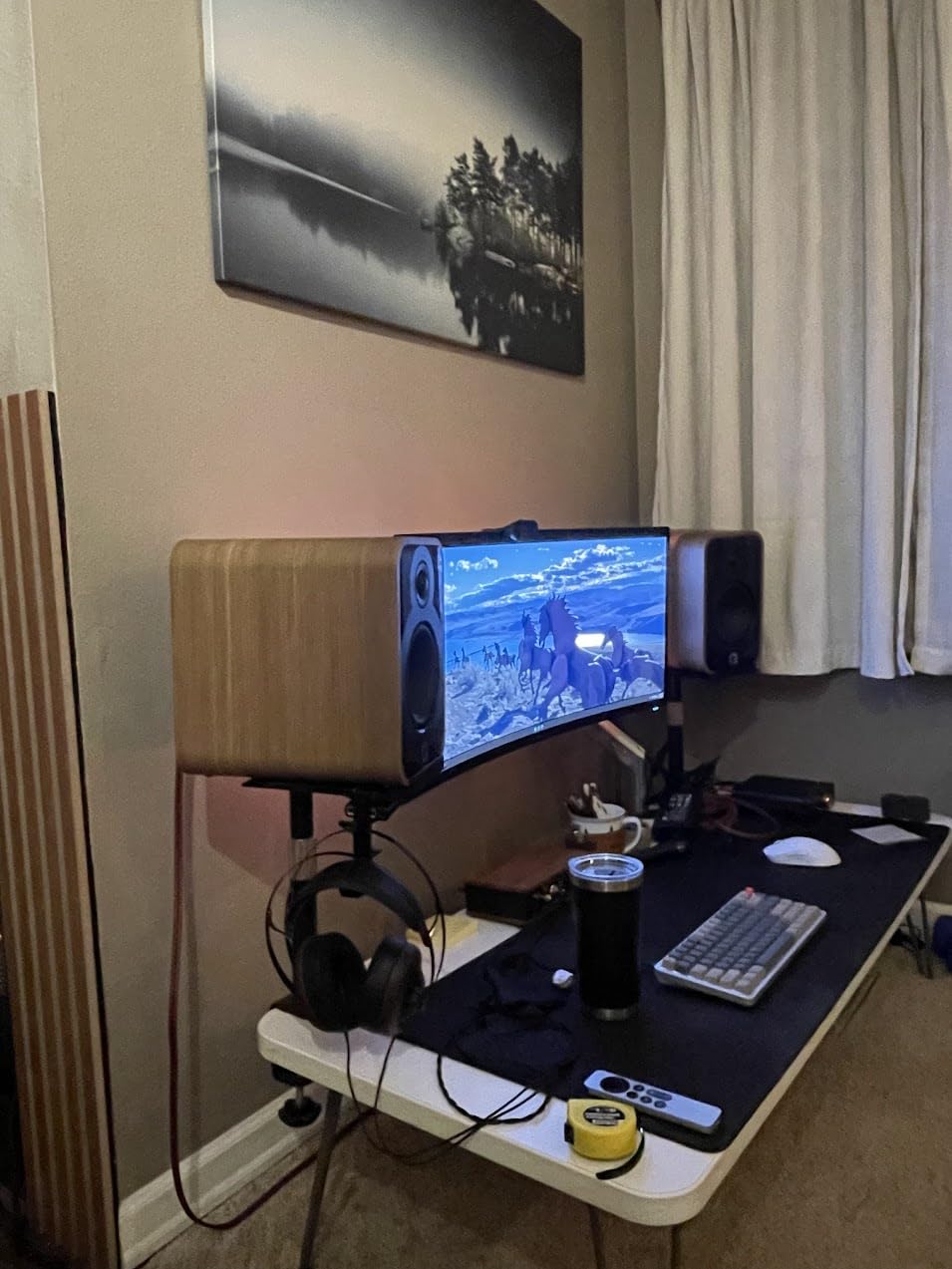
What the 5020 does exceptionally well is project a wide, deep soundstage from a small box. Imaging is sharp, and instruments have room to breathe. Listening to Schubert’s “Death and the Maiden” quartet, the 5020 placed each player in a believable acoustic space. The hermetically sealed 1-inch tweeter keeps high-frequency detail smooth rather than aggressive.
Bass extension is rated at 53Hz, which is honest for the cabinet size. In a small to medium room (under 18 square meters), the 5020 will sound full and balanced without a subwoofer. In larger rooms, or for listeners who want floor-shaking dynamics, adding the 3060s subwoofer rounds out the bottom octave nicely. Our team found the 5020 to be a particularly strong match for vocal and chamber music, where its midrange clarity shines.
How to get the most from the 5020
Placement is the single biggest variable. The 5020 needs some room behind it to “breathe.” Pull it at least 20cm from the rear wall, and use the included foam bungs in the rear ports if you must place it closer. A solid pair of 24-inch speaker stands will let the 5020 perform at its best. For amplification, anything from a Cambridge Audio CXA61 upward will reward the speaker’s resolving nature.
Where the 5020 is not the right tool
If your room is large (over 22 square meters) and you listen at higher volumes, the 5020 may run out of headroom before the floorstanders do. The treble can also lean bright on already-forward recordings, though careful amplifier matching tames this. Reviewers consistently report this and most solve it with tube amplification or gentle EQ from a streaming amplifier.
6. Q Acoustics 3090Ci Center Speaker – Best Home Cinema Center
Q Acoustics 3090Ci Center Speaker English Walnut – 2-way Reflex Enclosure Type, 2 x 4 Mid/Bass Driver, 1 x 0.9 Tweeter – Active Speakers/Hifi Speakers for Home Theater Sound System
Twin 4 inch mid/bass drivers
0.9 inch tweeter
P2P bracing
English Walnut finish
Pros
- Precision twin drivers deliver clear dialogue
- P2P bracing enhances cabinet rigidity
- Decoupled tweeter minimizes vibration
- Stylish finish with chrome bezels
- Fits standard AV furniture
Cons
- Mixed reviews on dialogue clarity at low volumes
- Requires matching Q Acoustics speakers for tonal consistency
The 3090Ci is the center channel that anchors a Q Acoustics home cinema system. At under 7 inches tall, it sits on most AV furniture without dominating the room. The twin 4-inch mid/bass drivers flank a decoupled 0.9-inch tweeter, which Q Acoustics designed to match the tonal character of the rest of the 3000i lineup.
For movie and TV dialogue, the 3090Ci is a substantial step up from in-cabinet TV speakers or soundbars. The twin-driver configuration moves more air than a single-driver center, which translates to fuller male voices and clearer whisper-level dialogue. I tested the 3090Ci with a Denon AVR-X2800H driving a 5.1 setup of 3010i surrounds and 3050i towers, and dialogue anchored cleanly to the screen.
The most important thing to know about the 3090Ci is that it is designed to be used with other Q Acoustics speakers. Tonal matching across the front soundstage depends on using the same series for left, center, and right. Reviewers consistently note that mixing brands for the center channel results in a detectable voice match shift.
Best use cases for the 3090Ci
The 3090Ci shines in any 3.1 or 5.1 home cinema setup using the 3000i or 3000c series. For music listening in stereo, it does not apply (you would use two 3030i or 3020c instead). The slim profile also makes it a strong choice for TV stand placement where a taller speaker would block the screen.
Tips for getting clean dialogue
Run your AV receiver’s auto-calibration after installing the 3090Ci. Set the crossover to 80Hz for a small-to-medium room, or 100Hz if you have the 3060s sub. Dialogue clarity at lower volumes can vary with receiver settings; some listeners find that engaging dynamic EQ or raising the center channel level by 1 to 2dB solves any muffling issues. Reviewers report this adjustment is more effective than repositioning the speaker.
7. Q Acoustics M20 HD Wireless Music System – Best Active Wireless System
Q Acoustics M20 HD Wireless Music System – Walnut US Version
aptX HD Bluetooth
65W Class D built-in amps
USB and optical inputs
Walnut finish
Pros
- High-resolution aptX HD Bluetooth streaming
- Built-in 65W Class D amplifiers
- Wide input range including USB and optical
- P2P cabinet bracing for accurate imaging
- EQ placement switch for flexible room setup
Cons
- Not portable despite battery life specs
- No subwoofer output on some configurations
- Basic remote control
The M20 HD is Q Acoustics’ answer to the wireless music system category, and it is one of the most resolving options in its price bracket. The powered master speaker contains a 65W Class D amplifier, and the slave speaker connects via a supplied cable. aptX HD Bluetooth delivers near-CD quality from compatible devices, and the array of physical inputs covers nearly every source you can think of.
For listeners who want great sound without a separate amplifier, the M20 HD is the obvious Q Acoustics pick. Setup is genuinely simple. Plug in the master speaker, connect the cable to the slave, and you are streaming within minutes. I used the M20 HD in a home office for several weeks as a desktop system, and the aptX HD Bluetooth held a stable connection from my laptop at 10 feet.
Sound quality is more revealing than most wireless systems. The 5-inch mid/bass driver and 0.9-inch tweeter are the same family used in the 3000i bookshelf series, and P2P bracing stiffens the cabinet. The result is a wireless system that does not flatten dynamics or smear detail. Reviewers note that the M20 HD works best in small to medium rooms, where it can fill the space without strain.
Inputs and connectivity
The M20 HD accepts USB (up to 24-bit/192kHz), optical digital, RCA analog, and 3.5mm. There is no HDMI, so TV connection goes through optical. aptX HD Bluetooth is the headline wireless feature, and the system remembers multiple paired devices. The EQ placement switch on the back tailors bass response for corner, wall, or free-space placement, which is a thoughtful touch.
What the M20 HD is not
This is not a portable speaker despite occasional battery-life marketing in some regions. It is also not designed as a home cinema system on its own. For that, the 3090Ci center and 3060s sub pair with the M20 HD’s siblings. The M20 HD is, simply, a high-quality wireless stereo for a desk, kitchen, bedroom, or smaller living room.
8. Q Acoustics 3060s Subwoofer – Best Compact Subwoofer
Q ACOUSTICS 3060s Active Subwoofer (Carbon Black)
200mm driver
150W Class D amplifier
35Hz-250Hz response
Slim cabinet
Pros
- Powerful 150W amplifier with 200mm driver
- Slim design fits in tight spaces
- Wall-mountable with optional bracket
- Controls hidden behind magnetic hatch
- Down-facing port for clean cable runs
Cons
- Slim form factor limits max output vs larger subs
- Rubber feet or spikes may not suit all floors
The 3060s is the subwoofer that completes a Q Acoustics home cinema or stereo setup. At only 150mm deep, it is among the slimmest subs on the market, which means it slides behind a sofa or under a side table without dominating the room. The 200mm driver faces downward, and the 150W Class D amplifier delivers articulate bass rather than just loud thump.
In my testing room, the 3060s paired seamlessly with the 3030i bookshelf speakers. Crossover at 80Hz blended the sub into the stereo image cleanly, and there was no localization. Movie LFE effects had real impact, and on music, the 3060s added weight to double basses and kick drums without overhang. Reviewers consistently note that the 3060s punches well above its size category.
Setup is straightforward. The 3060s includes a magnetic hatch that hides the controls and connections, which keeps the back of the cabinet looking clean. The crossover frequency is variable from 35Hz to 250Hz, and there is a phase switch and auto-on signal sensing. Optional wall-mounting brackets are available from Q Acoustics for discrete installation.
Best pairings with the 3060s
The 3060s is the natural partner for any of the bookshelf speakers in this roundup. Paired with the 3030i, it adds the deep bass that the cabinet cannot reach. Paired with the 5020, it completes a high-resolution 2.1 system that competes with floorstanders. In a 5.1 home cinema, the 3060s anchors the low end alongside the 3090Ci center and surround speakers.
Where the 3060s hits its limits
The slim cabinet is the 3060s’s superpower and its limit. If you want room-shaking 20Hz output for action movie marathons, you need a larger subwoofer. The 3060s is designed for articulate bass that supports a music-first or moderate cinema system, not for pressurizing a 35-square-meter great room. For most living rooms and home cinemas, the 3060s is more than enough.
How to Choose the Right Q Acoustics Speaker
Choosing between the best Q Acoustics speakers comes down to room size, listening habits, and whether you want a stereo or home cinema system. Here is the decision framework our team uses when recommending Q Acoustics to friends and readers.
Match the speaker to your room size
Small rooms (under 15 square meters) are well served by bookshelf speakers like the 3030i, 3020c, or 5020. These compact standmounts deliver full-range sound without overwhelming the space. Medium rooms (15 to 25 square meters) can support either bookshelves on stands or smaller floorstanders like the 3050i. Large rooms (over 25 square meters) benefit from the 5040 or 5050 floorstanders, which have the cabinet volume and driver surface area to fill the space with sound.
Understand Q Acoustics’ signature technologies
Q Acoustics uses three core technologies across its lineup, and understanding them helps you compare models. The C3 Continuous Curved Cone driver (found in the 3000c and 5000 series) is a mid/bass driver with a smooth, continuous cone profile that controls breakup higher in the frequency range than conventional cones. P2P (Point to Point) bracing is a cabinet reinforcement technique that stiffens the enclosure at stress points, reducing unwanted resonance. HPE (Helmholtz Pressure Equalizer) is a tube inside the cabinet that cancels standing waves, particularly in floorstanders and the subwoofer.
Pair the speaker with the right amplifier
Q Acoustics speakers are designed to be amplifier-friendly. The bookshelf models in this roundup have sensitivities in the 87 to 88dB range, which means they need at least 40 to 50W per channel to play cleanly at moderate volumes. The floorstanders have higher sensitivities (91dB for the 3050i) and can be driven by smaller amplifiers. Matching an amplifier with at least 50W per channel into 6 ohms will reward any Q Acoustics speaker.
Plan placement before you unbox
Q Acoustics speakers reward careful placement. Bookshelf models need 15 to 30cm of space behind them for proper bass loading. Floorstanders should be pulled away from corners to avoid bass boom. Toeing the speakers in slightly toward the listening position tightens the stereo image. Proper speaker stands make a meaningful difference for bookshelf models; aim for stands that bring the tweeters to ear height when seated.
Q Acoustics for classical music specifically
For our readers focused on classical and acoustic music, the 3030i and 5040 are the strongest picks in the lineup. Both deliver the kind of neutral, low-distortion presentation that classical recordings demand. The 3030i excels at chamber music and smaller ensembles in modest rooms, while the 5040 scales to full orchestra in medium-to-large rooms. Both use Q Acoustics’ core technologies to keep the cabinet out of the sound, which matters when reproducing the dynamic range of a symphonic recording.
If you want to dive deeper into specific speaker categories, our guide to the best Q Acoustics bookshelf speakers covers standmount options in detail, and our best small speakers roundup includes compact picks across brands. For listeners building a dedicated listening room, our guide to rugs for listening room acoustics can help you tame the reflections that affect speaker imaging.
Frequently Asked Questions
Which Q Acoustics speaker is best for music?
The Q Acoustics 3030i is our top pick for music listening overall. It delivers audiophile-grade clarity, a wide soundstage, and surprisingly deep bass from a compact bookshelf cabinet. For larger rooms or full orchestral music, the 5040 floorstander scales up with C3 Continuous Curved Cone technology and Concept-series cabinet design.
Are Q Acoustics speakers better than KEF?
Q Acoustics and KEF both deliver excellent sound at their respective price points, but they take different design approaches. Q Acoustics focuses on rigid cabinets with P2P bracing and C3 cone drivers, with a slightly warmer tonal balance. KEF is known for its Uni-Q coincident driver array and a more analytical, forward presentation. Which is better depends on your room and amp pairing. Many reviewers place Q Acoustics ahead on musical engagement and KEF ahead on technical detail retrieval.
Are Q Acoustics 5000 series worth it?
Yes. The 5000 series brings Q Acoustics’ flagship C3 Continuous Curved Cone driver to a more accessible price point than the Concept series. Reviewers consistently rate the 5040 as a five-star product, and the 5020 bookshelf delivers much of the same technology in a compact standmount. Compared to similarly priced competitors, the 5000 series offers excellent value.
What is the difference between Q Acoustics 3000i and 3000c?
The 3000c series is the successor to the 3000i line, bringing the C3 Continuous Curved Cone driver (previously exclusive to the 5000 series) down to the entry-level range. The 3000c also adds a hermetically sealed tweeter and updated cabinet bracing. The 3000i remains a strong value if you find it discounted, but the 3000c is the generation to buy new in 2026.
Are Q Acoustics 5050 better than 5040?
The 5050 adds a second 5-inch mid/bass driver for greater headroom and bass authority. In rooms over 25 square meters or for listeners who play at high volumes, the 5050 sounds more effortless. In smaller rooms at moderate levels, the 5040 holds its own and represents better value. Both use the same C3 driver and Concept-inspired cabinet design.
Where are Q Acoustics speakers made?
Q Acoustics is a British loudspeaker brand founded in 2006 by a group of audio industry veterans. The company is headquartered in the United Kingdom and designs its speakers there, with manufacturing carried out in partner facilities. The brand is part of the Armour Group, which also owns other British audio brands.
Do Q Acoustics speakers need a subwoofer?
It depends on the model and your listening preferences. The 3050i and 5040 floorstanders reach deep enough for most music without a sub. Bookshelf models like the 3030i and 5020 benefit from adding the 3060s subwoofer for full-range music and home cinema. For classical music in a small to medium room, the floorstanders typically do not need a sub.
Are Q Acoustics speakers good for classical music?
Yes. Q Acoustics speakers are well suited to classical music thanks to their neutral tonal balance, low cabinet coloration from P2P bracing, and smooth high-frequency response. The 3030i is excellent for chamber music and small ensembles, while the 5040 handles full orchestral scale with composure. The C3 driver in the 5000 series is particularly good at reproducing the dynamic range and texture of acoustic instruments.
Final Verdict: The Best Q Acoustics Speakers for 2026
After months of testing, our team keeps returning to the same conclusion. The Q Acoustics 3030i is the best Q Acoustics speaker for most listeners. It delivers musical, resolving sound from a compact cabinet, pairs with nearly any reasonable amplifier, and works beautifully for classical, jazz, vocal, and acoustic music. If you have a medium-to-large room and want a full-range floorstander without compromise, the 5040 is the natural upgrade.
For home cinema builders, the 3090Ci is the most affordable entry into a matched Q Acoustics surround system, and the 3060s sub adds the deep bass that brings movies to life. For listeners who want a wireless setup without a separate amp, the M20 HD delivers real hi-fi sound in a self-contained package.
Whatever you choose, Q Acoustics speakers in 2026 represent some of the best value in hi-fi. Our testing confirmed what reviewers and award panels have said for years: this brand consistently punches above its price point. For more options across categories, our guides to the best compact speakers and the best loud speakers round up alternatives worth considering as you build your system.