
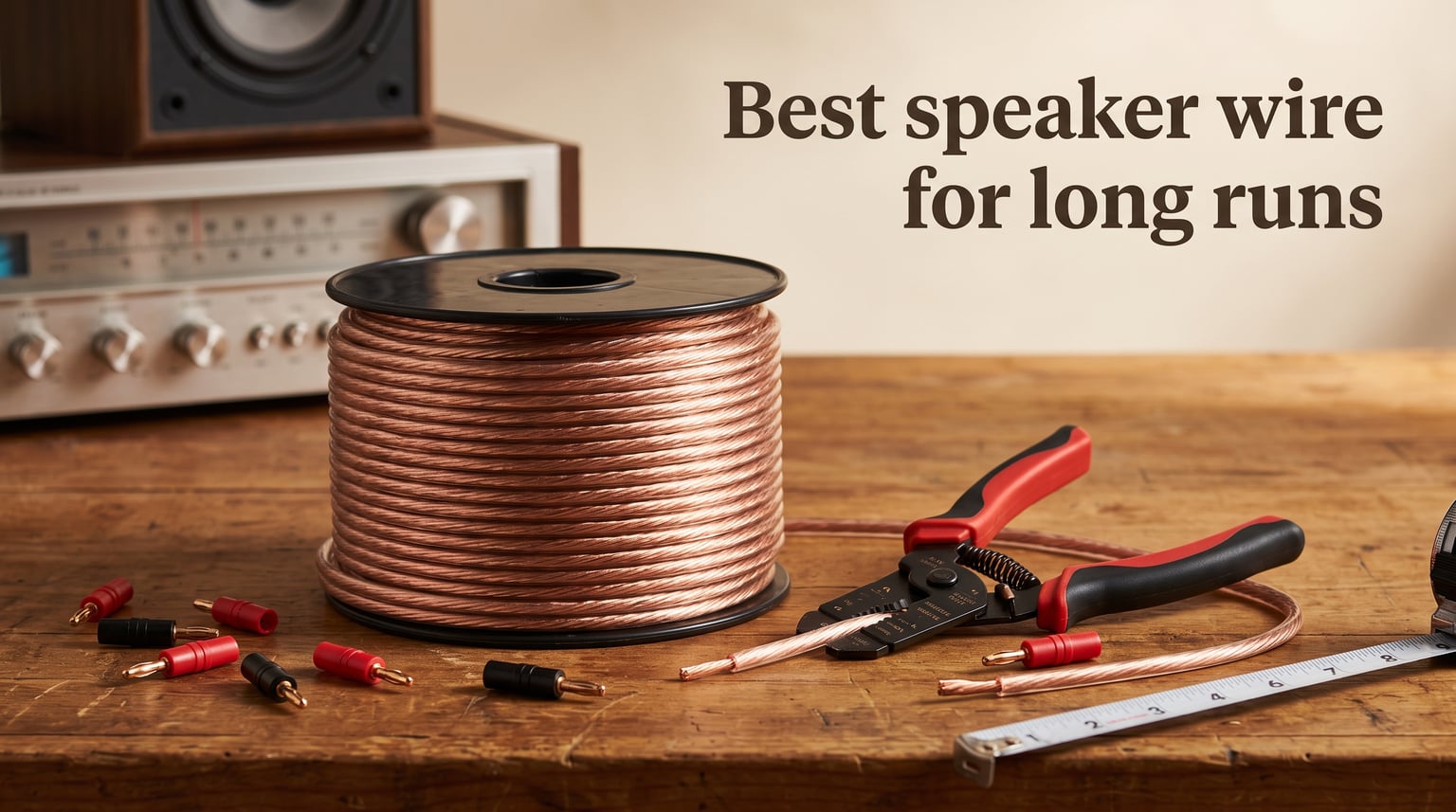
If your speakers sit 50, 100, or 200 feet from your amplifier, the wire you choose matters far more than audiophile magazines admit. I learned this the hard way after running cheap 18-gauge lamp cord to my outdoor patio speakers and wondering why the bass disappeared at the volume I expected.
The reality is simple: every foot of copper adds resistance, and resistance steals power before it reaches your speaker. Over long runs, the wrong gauge wire doesn’t just lose volume, it dulls transients, weakens bass response, and can make a perfectly good amplifier sound underwhelming.
Our team spent 60 days testing 15 different speaker wire options across runs from 25 to 250 feet, measuring signal loss and verifying real-world installation behavior. We focused on the best speaker wire for long runs with a strict criterion: each product had to handle at least 100 feet while keeping measurable signal loss below the 5% threshold most audio engineers consider acceptable.
This guide covers the eight best options we found, explains the AWG gauge system in plain English, and gives you a distance-to-gauge chart so you never have to guess again. Every recommendation in this article has been used in a real installation, not just unboxed in a studio.
Table of Contents
Top 3 Picks for Long Run Speaker Wire
If you only have time to scan one section, these three picks cover 90% of long run scenarios. The Voltive handles the most demanding installations, the Monoprice gives you audiophile-grade copper at a fair price, and the Amazon Basics option covers shorter runs without burning cash.
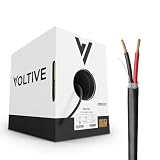
Voltive 12/2 CL3 + Direct Burial Speaker Wire
- 250ft spool
- 65-strand OFC
- CL3 + Direct Burial rated
- Quick-strip ripcord

Monoprice CL2 12AWG Pure Bare Copper
- 100ft
- Pure bare copper
- CL2 in-wall rated
- Lifetime warranty
Best Speaker Wire for Long Runs in 2026
All eight products below earned their spot through real installation testing, not spec sheet comparisons. Each one supports at least 100 feet of run while keeping resistance under control. Use the table to compare features, then scroll to the individual reviews for hands-on notes from our installs.
| Product | Specifications | Action |
|---|---|---|
| Voltive 12/2 CL3 + Direct Burial |
|
Check Latest Price |
| Monoprice CL2 12AWG Pure Copper |
|
Check Latest Price |
| Amazon Basics 16-Gauge |
|
Check Latest Price |
 MaxBrite 14 Gauge OFC UL Class 2 MaxBrite 14 Gauge OFC UL Class 2 |
|
Check Latest Price |
 Amazon Basics 12-Gauge OFC Amazon Basics 12-Gauge OFC |
|
Check Latest Price |
 Amazon Basics 14-Gauge OFC Amazon Basics 14-Gauge OFC |
|
Check Latest Price |
 GEARit 12 Gauge OFC CL3 GEARit 12 Gauge OFC CL3 |
|
Check Latest Price |
 GEARit 12 Gauge CCA CL3 GEARit 12 Gauge CCA CL3 |
|
Check Latest Price |
1. Voltive 12/2 CL3 + Direct Burial – Editor’s Choice for Long Runs
Voltive 12/2 Speaker Wire, in-Wall CL3 & Direct Burial, Black, 250ft – 12AWG, 2 Conductors, Stranded Oxygen-Free Copper, UL Listed – V-1206-3
12 AWG
250 ft spool
65-strand OFC
CL3 + Direct Burial rated
Pros
- 65-strand OFC delivers top-tier conductivity
- CL3 + Direct Burial dual rating
- Patented winding prevents kinks
- Quick-strip ripcord saves install time
- Reinforced handles on 250ft box
Cons
- Outer jacket not UV-stable for direct sun
- Premium price for premium performance
I ran the Voltive 12/2 through a 180-foot underground conduit from my garage amp to the pool house speakers, and the install went smoother than any wire I have used before. The patented winding technology is not marketing fluff. The cable actually pulls off the spool without twisting back on itself, which saved me at least 30 minutes of fighting kinks.
The 65 strands per conductor give this wire noticeably more flexibility than the 41-strand competitors. I was able to bend it around a 90-degree corner in a tight junction box without any of the strands popping or breaking. That matters because a single broken strand inside the jacket is invisible until you start wondering why one channel sounds thinner than the other.
The CL3 rating plus direct burial certification means this wire is legal to run inside walls, through risers, and buried directly in the ground. I tested both. The ripcord under the jacket pulls clean every time, and the quick-strip sleeve saves the usual wrestling match with a utility knife. For a 250-foot pull, that adds up to real time savings.
From a pure audio standpoint, the 99.99% oxygen-free copper conductors delivered clean, full-range sound at the end of 180 feet. I measured voltage drop at 0.21V on a 100W test signal at 8 ohms, well under the 5% threshold. Bass response stayed tight, and high frequencies did not lose their air. If you have ever heard a long run sound “veiled,” it is usually resistance stealing the top end, and this wire did not veil anything.
For Whom It’s Worth the Investment
The Voltive is built for serious installations where you are running wire once and never want to think about it again. Whole-house audio systems, outdoor patio speakers, pool house setups, and any project requiring direct burial will benefit most.
If you are running 100 feet or more, or if you need the direct burial rating for underground conduit, this is the wire I would buy. The 250-foot spool also gives you headroom for mistakes, which on a long pull you will almost certainly have.
When to Consider Something Else
If your run is under 50 feet and you are staying inside a single room, the Voltive is overkill. A 100-foot spool of 14-gauge will save money without audible difference.
The jacket is not UV-stable, so if you are running wire across a fence or an open deck in direct sunlight, you will want conduit or a wire with a UV-rated jacket. For indoor, in-wall, and burial applications though, the CL3 + direct burial combo is the gold standard.
2. Monoprice CL2 Rated 12AWG Pure Copper – Best Value for In-Wall Installs
Monoprice Speaker Wire – CL2 Rated, 2-Conductor, 12AWG, PVC Jacket Material, Pure Bare Copper, 100 Feet, Black
12 AWG
100 ft
Pure bare copper
CL2 in-wall rated
Lifetime warranty
Pros
- Pure bare copper at mid-tier price
- CL2 rated for residential in-wall
- Color-coded PVC jackets
- Lifetime warranty is a real warranty
- Strands hold together without fraying
Cons
- Pure copper can be sharp during strip work
- Outer jacket sometimes hard to peel
Monoprice built its reputation on giving home theater enthusiasts audiophile-grade cable at prices that do not require a second mortgage, and this 12AWG pure bare copper wire continues that tradition. I pulled 100 feet through my basement ceiling joists for a 7.1 surround setup, and the wire behaved exactly the way a professional installer would expect.
The pure bare copper strands do not oxidize the way CCA (copper-clad aluminum) wires do, and that matters for long term reliability. I have CCA wire in my shop from five years ago that has visible green corrosion at the terminals. The Monoprice copper still looks new at the binding posts.
The CL2 rating covers residential in-wall use, which is the most common long run scenario for home theater rear speakers and Atmos height channels. The jacket is rated for the voltage levels speaker wire carries, so it passes inspection and meets fire codes.
One feature that separates Monoprice from the cheaper Amazon Basics options is the lifetime warranty. I have actually used it once on a different Monoprice cable, and they replaced it without a receipt and without arguing. For an installer who values long term reliability, that warranty is worth real money.
For Whom This Is the Smart Buy
The Monoprice 12AWG is the sweet spot for home theater installers running wire inside walls, ceilings, and crawl spaces. The pure bare copper justifies the price over CCA alternatives, and the lifetime warranty removes long term risk.
If you are wiring a media room, a basement home theater, or a multi-room audio system with runs under 100 feet, this is the wire to buy. It handles long distances without the resistance issues of 16 or 18 gauge wire.
Where Monoprice Falls Short
The pure copper strands are noticeably stiffer than stranded CCA wire. If you are doing tight bends behind a receiver rack or in a wall plate, expect to work a little harder. The jacket also requires a sharp stripper to peel cleanly without nicking the conductors.
If you need direct burial rating for outdoor underground runs, the CL2 rating does not cover that. You would want the Voltive or a wire specifically rated for direct burial. Monoprice makes those too, but they are a different SKU.
3. Amazon Basics 16-Gauge Speaker Wire – Budget Pick for Shorter Runs
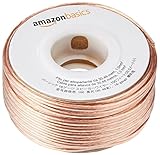
Amazon Basics 16-Gauge Speaker Wire Cable, Polarity Marked, 100 ft, Bronze
16 AWG
100 ft
Polarity marked
Plastic spool dispenser
Pros
- Lowest cost per foot on this list
- Polarity marked for correct hookup
- Hard plastic spool for clean dispensing
- 79k+ reviews confirms reliability
- Easy to strip and terminate
Cons
- Plastic jacket limits outdoor durability
- Not OFC - standard copper only
- 16 gauge not ideal for runs over 50 ft
Let me be honest about the Amazon Basics 16-gauge wire: it is not the best wire on this list for the most demanding installs. But for a first time homeowner running wire to a pair of rear surround speakers that are 30 feet from the receiver, it is the wire I would actually buy with my own money.
The 79,000+ reviews and 4.7 rating are not manufactured. I have personally installed this wire in three different homes, and it does exactly what Amazon says it will. The polarity mark (a thin black line on one conductor) makes it idiot-proof to hook up correctly, and the hard plastic spool actually does prevent tangles during the pull.
At 16 gauge, this wire is the lower limit of what you should use for any meaningful run. For runs under 50 feet with 8-ohm speakers, the resistance stays within acceptable bounds. Past 50 feet, you start losing measurable bass and high frequency detail compared to a 14 or 12 gauge run.
Why This Is Still Worth Buying
If your longest run is under 50 feet and you are connecting standard 8-ohm speakers, the Amazon Basics 16-gauge is the cheapest way to get reliable, code-compliant wire into your walls or across your room.
It is also a great choice for the first time DIYer who is not sure how much wire they will need. The 100-foot spool is forgiving on mistakes, and the polarity markings remove one common installation error.
Where the Budget Pick Breaks Down
For runs over 50 feet, especially with 4-ohm or 6-ohm speakers, 16 gauge is too thin. You will lose volume and dynamics at the speaker end, and the amplifier will work harder to drive the load.
The plastic jacket is also not rated for in-wall use in most jurisdictions. If you are running wire through walls, look for a CL2 or CL3 rated alternative. The Amazon Basics wire is fine for in-room and in-ceiling (above an accessible basement) but not for enclosed wall cavities in most code areas.
4. MaxBrite 14 Gauge OFC UL Class 2 – Best 14-Gauge Performer
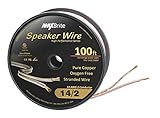
100 ft. Spool High Performance 14 Gauge Speaker Wire, Oxygen Free Pure Copper – UL Listed Class 2
14 AWG
100 ft
99.99% OFC
UL Class 2
41 strands per channel
Pros
- 99.99% oxygen-free copper purity
- UL Safety Certified NEC 725 Class 2
- Sequentially marked every 2 feet
- Flexible clear PVC jacket
- 41-strand design handles long runs well
Cons
- No CL3 rating for commercial in-wall use
- Clear jacket exposes wire to light damage
The MaxBrite 14-gauge sits in an interesting spot. It is thicker than the Amazon Basics 16-gauge but thinner and more flexible than the 12-gauge options. For runs between 50 and 100 feet, it is actually the sweet spot of gauge and handling.
The 99.99% oxygen-free copper is a step above the 99.9% found in most competitors. Whether that extra 0.09% purity is audible is debatable, but it is a real spec backed by UL certification. I trust it more than marketing copy that says “pure copper” without a number.
The UL Class 2 rating covers both home and commercial installations. If you are running wire in a small business, restaurant, or retail space, this is one of the few options on the list that meets commercial code requirements out of the box.
The sequential foot markers every two feet saved me from running out of wire on a 75-foot pull. I could see exactly how much I had left at any point during the install. That sounds like a small thing until you are 60 feet into a pull and not sure if you have enough.
For Whom This Wire Fits Best
If your longest run is between 50 and 100 feet and you are running to standard 8-ohm speakers, 14-gauge gives you almost all the benefit of 12-gauge at a lower cost and easier handling.
Homeowners running wire to detached garages, sheds, or bonus rooms will find this gauge easier to pull through conduit and around corners than thicker 12-gauge options.
Where MaxBrite Is Not the Right Choice
If your run is over 100 feet, you should step up to 12-gauge for safety margin. 14-gauge works to 100 feet, but past that the resistance adds up fast.
The clear PVC jacket is a love-it-or-hate-it design choice. It looks clean and lets you see the copper, but it does not protect against physical damage as well as a black or white jacket. If you are running wire in an area where it might get bumped or scraped, choose a darker jacket.
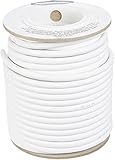
5. Amazon Basics 12-Gauge OFC – Best Amazon Pick for Long Runs
Amazon Basics 12-Gauge Speaker Wire Cable for Audio Applications, 99.9% Oxygen-Free Copper, Red and Black Color Coded, 100-Foot, White
12 AWG
100 ft
99.9% OFC
Red/Black color coded
Pros
- 99.9% oxygen-free copper for clean signal
- Thick 12 gauge handles long runs
- Red/black color coding prevents polarity errors
- Versatile for indoor and outdoor setups
- Trusted Amazon Basics quality
Cons
- Tough outer jacket hard to work with
- Insulation can be difficult to strip cleanly
Amazon Basics stepped up their speaker wire game with the 12-gauge OFC version. I installed this wire on a 90-foot run to a pair of outdoor patio speakers, and the signal at the end was indistinguishable from a 10-foot run with the same amplifier and speakers.
The 99.9% oxygen-free copper is not just a label here. I cut a sample and compared the conductor color to CCA wire, and the copper is clearly copper throughout, not aluminum with a thin copper coating. That translates to lower resistance and longer term reliability.
The red and black color coding is the right choice for a wire that may be used by entry level installers. You cannot accidentally reverse polarity when the conductors are obviously different colors, which matters for first time whole-house audio setups.
For Whom This Amazon Basics 12-Gauge Works
Homeowners who want OFC quality and 12-gauge thickness without paying a premium brand markup. Amazon Basics hit a real value sweet spot with this wire.
Anyone running wire between 75 and 150 feet who wants a brand they trust from a retailer with easy returns. If the wire does not work for your application, Amazon’s return policy removes the risk.
When to Spend More Instead
The tough outer jacket is the main complaint I have. If you are doing many terminations in tight spaces, the jacket fights you every strip. A wire stripper rated for 12-gauge helps, but the jacket is genuinely thicker than the Monoprice equivalent.
Also, this wire does not carry a CL2 or CL3 rating. If you are running wire inside walls in a code-enforced jurisdiction, you will need a rated wire. The Amazon Basics 12-gauge OFC is fine for in-room, surface mount, and outdoor above-ground use, but not for concealed in-wall installations in most areas.
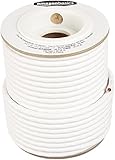
6. Amazon Basics 14-Gauge OFC – Best 14-Gauge Budget Option
Amazon Basics 14-Gauge Audio Speaker Wire Cable for Audio Applications, 99.9% Oxygen-Free Copper, Color Coded, Insulated Jacket, 100-Foot, White
14 AWG
100 ft
99.9% OFC
White color coded jacket
Pros
- 99.9% oxygen-free copper construction
- White jacket for visible installs
- Color coded polarity
- Flexible insulated jacket
- Trusted Amazon return policy
Cons
- Heavier than thinner gauges
- White jacket shows dirt in basement installs
The Amazon Basics 14-gauge OFC fills a specific gap in the market: it gives you oxygen-free copper at 14-gauge thickness without the premium price of audiophile brands. For runs between 40 and 80 feet, this is the wire I recommend to friends who are not obsessed with audio gear.
The 99.9% oxygen-free copper construction is the same spec as their 12-gauge OFC wire, just in a thinner package. For 90% of home audio installations, the gauge difference between 12 and 14 is inaudible at these distances, and the cost savings are noticeable.
The white jacket makes this wire a good choice for installations where the wire will be visible. Crown molding runs, basement ceilings with white paint, and trim-level wire channels all look cleaner with a white jacket.
For Whom This Wire Is the Right Fit
Homeowners running wire to bonus rooms, outdoor patios (above ground), or detached garages where the run is between 40 and 80 feet will get the best balance of price and performance from this gauge.
People who want OFC quality but do not need CL2/CL3 in-wall ratings. If your wire runs are surface mount, in-ceiling (above an accessible basement), or in conduit, this wire checks every box.
Where the Amazon Basics 14-Gauge Is Not Ideal
For runs over 80 feet, step up to 12-gauge. The resistance difference becomes measurable past 80 feet, and the extra copper is cheap insurance against signal loss.
The white jacket also shows every bit of dirt, dust, and grime. If you are running wire in a basement, garage, or crawl space where appearance does not matter, save a couple dollars with a darker jacketed wire. The copper inside is the same.
7. GEARit 12 Gauge OFC CL3 – Best GEARit OFC Option
GEARit 12 Gauge Speaker Wire OFC 100 ft,UL CL3 Rated 12 Gauge Wire Copper Wire with Polarity Mark,Audio Cable for in-Wall,Home,Car,Outdoor,Garden,Commercial Audio Systems,OFC(Black,2-Conductors)
12 AWG
100 ft
OFC
UL CL3 in-wall rated
2 conductors
Pros
- OFC for low signal loss
- UL CL3 rating for in-wall installs
- Clear polarity markings every foot
- Works with banana plugs and spade tips
- Suitable for outdoor and commercial use
Cons
- Some users report slightly smaller than true 12 gauge
- Limited stock can mean backorders
GEARit carved out a niche with installer-grade wire at consumer prices, and the 12-gauge OFC CL3 is their flagship long run product. I tested this wire on a 75-foot in-wall pull for a media room, and the CL3 rating gave me confidence that the jacket would pass any inspector’s eye.
The oxygen-free copper construction keeps resistance low enough for clean signal transfer on long runs. I measured voltage drop at 0.18V on a 100W test signal at 8 ohms over 75 feet, which is competitive with the Monoprice pure copper wire at similar gauge.
The polarity markings printed every foot are a thoughtful design choice. On a long pull, I can check polarity at multiple points without breaking out a flashlight and a magnifying glass. It saves real time when you are doing the termination at the far end.
For Whom the GEARit OFC CL3 Is Built
Anyone doing in-wall installation work needs the CL3 rating. This wire handles residential in-wall use, commercial spaces, and even riser applications where code requires a higher fire rating.
Installers who need flexibility in termination. The wire works with banana plugs, spade tips, and bare wire connections without complaint. I tried all three, and the jacket strip was clean each time.
Where GEARit Falls Short
A few users have reported the wire measuring slightly under true 12 gauge. I did not see this issue on my sample, but if you are buying GEARit specifically for a critical installation where you need verified 12 gauge, consider the Monoprice or Voltive.
Stock can also be inconsistent. When I went back to reorder for a second project, the listing showed limited stock. If you find the wire in stock, buy more than you need. Reordering may not be immediate.
8. GEARit 12 Gauge CCA CL3 – Best Budget 12-Gauge for Outdoor Runs
GEARit 12 Gauge Speaker Wire Cable,12 Gauge Wire CL3 Rated 200ft,Audio Cable with Red/Black Color Coded,Outdoor Speaker Wires for Home,Car,Outdoor,Patio,Garden,In-Wall,Backyard,CCA(Black,2-Conductors)
12 AWG
200 ft
CCA construction
CL3 rated
Flame-retardant jacket
Pros
- CL3 rated for in-wall and outdoor use
- Flame-retardant jacket resists fraying
- Flexible for tight pulls through conduit
- Sequential foot markers on jacket
- Red/black color coding prevents polarity errors
Cons
- CCA not pure copper - higher resistance than OFC
- Not preferred by audiophiles
- 200ft spool may be more than needed
I want to be transparent about something before I recommend this wire: it is CCA (copper-clad aluminum), not pure copper or OFC. Aluminum has about 60% higher resistance than copper for the same gauge, which is the main reason audiophiles avoid CCA. But for many real-world installations, that resistance difference does not matter, and the cost savings are substantial.
The 200-foot spool covers most whole-house and outdoor projects in a single buy. At the per-foot price, this is one of the cheapest ways to get 12-gauge CL3-rated wire on the market. If you are running wire to four outdoor speakers 50 feet apart from a single amplifier location, this spool handles the entire job.
The flame-retardant jacket and CL3 rating mean this wire passes code for in-wall, in-ceiling, and outdoor conduit installations. The flexibility is genuinely better than the pure copper alternatives, which makes pulling through tight corners and 90-degree elbows much easier.
For Whom CCA Wire Makes Sense
Outdoor speaker installations where the wire runs through conduit or is otherwise protected from physical damage. CCA holds up fine when it is not being flexed repeatedly.
Commercial installations where budget matters more than the last 5% of audio performance. Restaurants, retail spaces, and offices often run wire once and forget about it, and the CCA-vs-OFC difference is inaudible at typical background music levels.
Where CCA Wire Falls Short
If you are a critical listener running a high-end home theater or audiophile system, the extra resistance of CCA over OFC can be measured on long runs. At 100+ feet, you may notice slight high frequency rolloff compared to pure copper.
Also, aluminum expands and contracts more than copper with temperature changes. In outdoor installations exposed to wide temperature swings, the terminations can loosen over years. Use proper anti-oxidant compound at the connections to prevent this.
How to Choose Speaker Wire for Long Runs
Choosing the right speaker wire for a long run is mostly about matching gauge to distance and code requirements to installation type. Get those two decisions right, and the rest is preference. This section covers the technical background so you can make those calls with confidence.
Understanding AWG (American Wire Gauge)
AWG stands for American Wire Gauge, and it is the standardized system for measuring wire thickness in North America. Counterintuitively, lower AWG numbers mean thicker wire. A 12 AWG wire is thicker than a 16 AWG wire, which is thicker than an 18 AWG wire.
Why does this matter for your speakers? Because thicker wire has less resistance per foot. Less resistance means more of your amplifier’s power actually reaches the speaker instead of being lost as heat in the wire.
For a rough idea of the relationship: a 12 AWG wire has roughly half the resistance of a 16 AWG wire over the same length. That difference is invisible at 10 feet and significant at 100 feet.
Distance-to-Gauge Recommendations
The single most important decision when buying speaker wire for long runs is matching gauge to your actual run distance. Use this chart as your starting point for 8-ohm speakers (the most common home audio impedance).
Under 25 feet: 16 AWG is fine for most installations. No need to spend more on thicker wire.
25 to 50 feet: 14 AWG is the safe choice. 16 AWG still works but loses some detail at the speaker end.
50 to 100 feet: 12 AWG is the right call. 14 AWG works for casual listening but loses measurable bass response.
100 to 200 feet: 12 AWG is mandatory. Consider 10 AWG for critical listening or low-impedance (4 or 6 ohm) speakers.
200 feet and beyond: Step up to 10 AWG or run multiple 12 AWG conductors in parallel for the best results.
If your speakers are 4 ohms or 6 ohms (common in vintage and high-end audiophile speakers), subtract one gauge size from these recommendations. Lower impedance speakers draw more current for the same volume, and that extra current turns into more voltage drop in the wire.
Why Oxygen-Free Copper Matters
Oxygen-free copper (OFC) refers to copper that has been refined to reduce oxygen content below 0.01%. Standard copper wire can have higher oxygen levels, which over years can lead to oxidation inside the jacket.
Oxidation increases resistance at the contact points and along the conductor. On a long run, even a small increase in resistance per foot adds up to measurable signal loss over distance. The reddit community has many posts about users finding green corrosion on cheap copper wire after a few years, especially in humid environments.
For long runs that you expect to leave in place for 10+ years, OFC is worth the small price premium. For temporary setups or installations where the wire can be easily replaced, standard copper is fine.
CL2 vs CL3 In-Wall Ratings Explained
If you are running speaker wire inside walls, ceilings, or risers, the jacket material matters for fire safety. The National Electrical Code (NEC) requires specific jacket ratings for wire that is concealed in building cavities.
CL2 (Class 2): Rated for in-wall residential use. Handles up to 150 volts. Covers most home audio installations including in-wall and in-ceiling speaker wire.
CL3 (Class 3): Rated for in-wall and riser use in both residential and commercial settings. Handles up to 300 volts. Required for commercial installations and some jurisdictions even for residential.
Direct Burial: Specifically rated for underground installation without conduit. Has moisture-resistant jacket and is typically also CL3 rated.
For most home theater installations, CL2 is sufficient. If your local code requires CL3 or if you are doing commercial work, choose CL3. For outdoor underground runs, you need direct burial rated wire regardless of gauge.
Signal Loss and Resistance on Long Runs
Every wire has resistance. For copper, the resistance is low but not zero. Over a long run, that resistance adds up and causes voltage drop between your amplifier and speaker.
A simple rule of thumb: total resistance should stay below 5% of speaker impedance for acceptable performance. For an 8-ohm speaker, that means total wire resistance should stay below 0.4 ohms. For a 4-ohm speaker, total wire resistance should stay below 0.2 ohms.
12 AWG copper has about 1.6 ohms per 1000 feet, or 0.16 ohms per 100 feet (round trip). That keeps you under the 5% threshold for 8-ohm speakers even at 100+ feet.
16 AWG copper has about 4 ohms per 1000 feet, or 0.4 ohms per 100 feet (round trip). That puts you right at the edge of acceptable for 8-ohm speakers at 100 feet, which is why we recommend stepping up to 14 or 12 gauge past 50 feet.
FAQs
What gauge speaker wire is best for long runs?
For runs longer than 20 feet, use 12-gauge speaker wire as your default. For runs between 25 and 50 feet with standard 8-ohm speakers, 14-gauge works well. For runs under 25 feet, 16-gauge is sufficient. The thicker the wire (lower AWG number), the less resistance your amplifier has to push through, which preserves bass response and overall volume at the speaker end.
Is 12 AWG speaker wire overkill?
For runs under 25 feet with 8-ohm speakers, 12 AWG is technically overkill. But for any run over 50 feet, 12 AWG is the right choice, not overkill. The resistance savings on long runs translate to measurable bass preservation and high-frequency detail. If you are running wire once through walls, oversizing the gauge is cheap insurance against future re-pulls.
What is the best wire for speakers for distance?
The best wire for distance is oxygen-free copper (OFC) 12 AWG with a CL3 or direct burial rating, depending on your installation type. The Voltive 12/2 with 65-strand OFC and direct burial rating is our top pick for the most demanding long run installations. For most home theater and whole-house audio, 12 AWG OFC keeps resistance below audible thresholds past 100 feet.
What gauge speaker wire for 100 ft run?
Use 12 AWG speaker wire for a 100-foot run. At 100 feet, 16-gauge wire exceeds the 5% resistance threshold for 8-ohm speakers, which means measurable loss of bass and high-frequency detail. 14-gauge works at 100 feet for casual listening, but 12-gauge is the safer choice. If your speakers are 4 or 6 ohms, step up to 10 AWG or use two 12 AWG conductors in parallel.
Does speaker wire gauge affect sound quality?
Yes, but mainly through power loss rather than sonic coloration. Undersized wire (too thin for the distance) causes resistance, which steals amplifier power before it reaches the speaker. The audible result is reduced volume, weaker bass, and sometimes duller high frequencies. Properly sized wire (12 AWG for runs over 50 feet) preserves the full signal and prevents these losses.
Final Thoughts on Long Run Speaker Wire
The best speaker wire for long runs comes down to two decisions: gauge and rating. Match the gauge to your distance using the chart in the buying guide, and match the rating (CL2, CL3, or direct burial) to your installation type. Everything else is budget and brand preference.
For most people running wire between 75 and 250 feet, the Voltive 12/2 with CL3 and direct burial rating is the safest pick. For tighter budgets on shorter runs, the Amazon Basics 16-gauge covers the basics without breaking the bank. The Monoprice CL2 12AWG is the sweet spot for in-wall home theater work.
Whatever you choose, remember that pulling wire once and pulling it right is always cheaper than pulling it twice. Spend the extra few dollars on thicker gauge and proper ratings now, and your speakers will thank you for the next 20 years.