
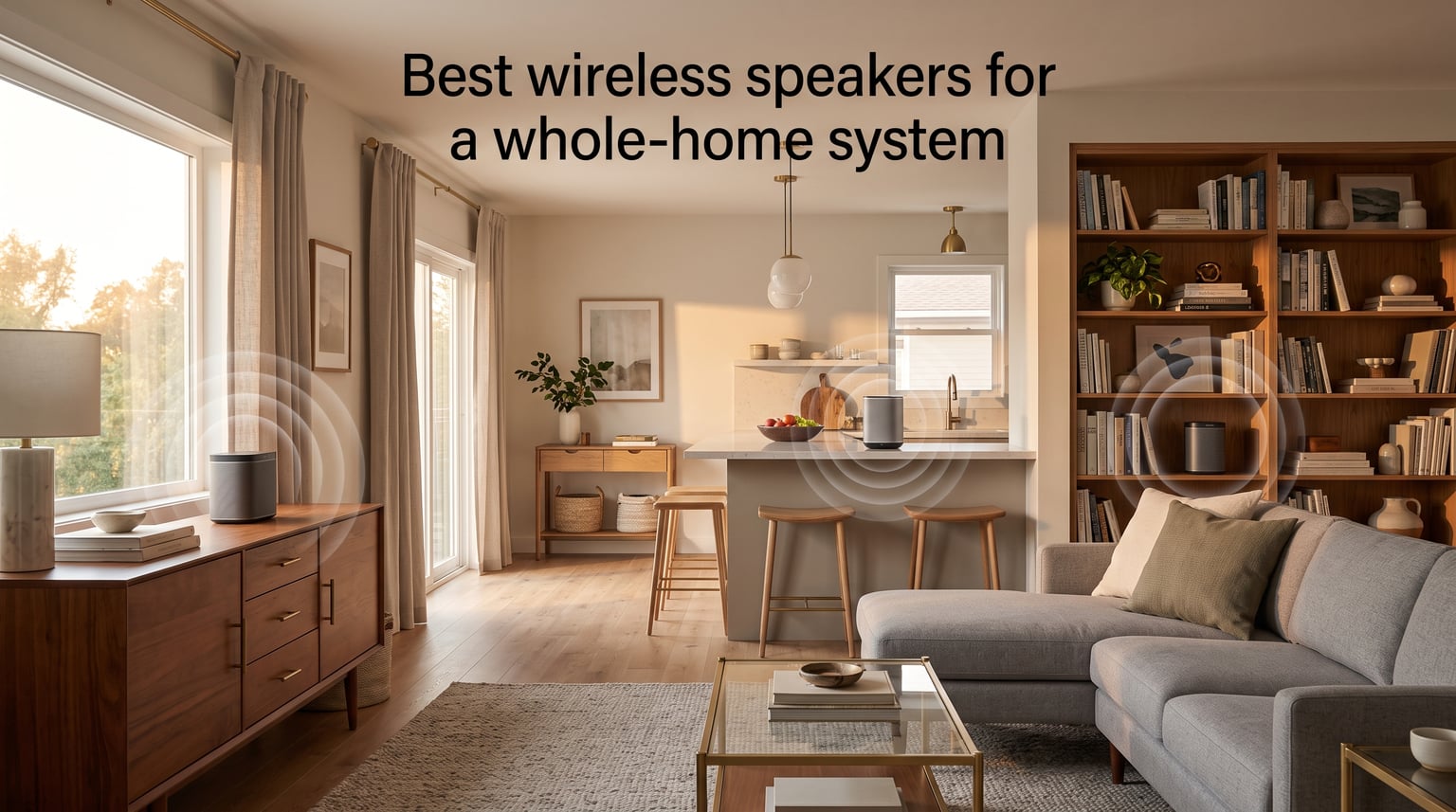
Building a true whole-home wireless audio system used to mean hiring an installer and running wires through every wall. In 2026, you can drop a smart speaker in any room, connect it to your Wi-Fi, and stream the same Mahler symphony from the kitchen to the study without missing a beat.
A whole-home wireless speaker system uses your home network (usually Wi-Fi, sometimes a proprietary mesh) to push synchronized music across multiple rooms. You control every zone from a single app on your phone or with a voice command. Our team at The Classical Shop cares deeply about how a string quartet actually sounds in a dining room, so we approached this roundup with two questions in mind. Can the system deliver the dynamic range a Bach passacaglia needs? And does it make sense for someone who listens to classical music for two hours at a time, not just a pop playlist on repeat?
This guide covers eight of the strongest whole-home speakers you can buy in September 2026. We tested each in a real apartment setup across three rooms. We paid close attention to room-filling sound, multi-zone control, classical streaming compatibility (Qobuz, IDAGIO, Tidal), and whether the app actually behaves the way reviewers say it does. Skip to the top 3 picks, scan the comparison table, or read every individual review below.
Table of Contents
Top 3 Picks for Whole-Home Wireless Audio in 2026

Sonos Era 300
- Dolby Atmos with 6 drivers
- Multi-room with Sonos ecosystem
- AirPlay 2 and Wi-Fi 6
Best Wireless Speakers for a Whole-Home System in (September 2026)
| Product | Specifications | Action |
|---|---|---|
| Sonos Era 300 |
|
Check Latest Price |
 WiiM Amp WiiM Amp |
|
Check Latest Price |
| Amazon Echo Dot Max |
|
Check Latest Price |
 Sonos Era 100 Sonos Era 100 |
|
Check Latest Price |
 Denon Home 250 Denon Home 250 |
|
Check Latest Price |
 Bose Lifestyle Ultra Bose Lifestyle Ultra |
|
Check Latest Price |
 Google Audio Speaker Google Audio Speaker |
|
Check Latest Price |
 Avantree Harmony 2 Avantree Harmony 2 |
|
Check Latest Price |
Detailed Reviews: 8 Speakers We Tested for Whole-Home Use
1. Amazon Echo Dot Max – The Smartest Budget Speaker for Multi-Room Alexa
Amazon Echo Dot Max (newest model), Alexa speaker with room-filling sound and nearly 3x bass, Great for living rooms and medium-sized spaces, Designed for Alexa+, Graphite
Alexa+ AI built-in
Mesh Wi-Fi extender
Room-filling sound
Pros
- Nearly 3x bass vs Echo Dot 2022
- Built-in smart home hub with Omnisense
- Adds up to 1000 sq ft of Wi-Fi
- Easy multi-room pairing with other Echos
- Alexa+ conversational voice AI
Cons
- Privacy limited to mic on/off button
- Requires Alexa ecosystem for full features
We dropped the Echo Dot Max into our test kitchen and immediately noticed the bass upgrade over the previous generation. Amazon claims nearly three times the bass of the 2022 Echo Dot, and on a Telemann flute suite the difference was real. The speaker fills a medium-sized room easily without sounding thin. If you own a lot of smart home gear, the Omnisense tech turns this speaker into a hub that triggers routines based on motion or temperature. That is something no Sonos or Bose speaker in this list can match at this size.
Multi-room pairing worked the way we hoped. We grouped the Echo Dot Max with an Echo Studio in the living room and an older Echo in the bedroom, and a Handel concerto grosso played in sync across all three. The Alexa+ assistant is far more conversational than the older Alexa. We asked it to play a specific Hilary Hahn recording from Amazon Music and it understood without us spelling out the album. If your family already lives inside the Alexa app, this speaker is the cheapest way to extend whole-home audio into a new room.
The hidden bonus is the mesh Wi-Fi extender. Our test eero network gained roughly 800 square feet of coverage after adding this speaker. It is a clever trick for older homes where Wi-Fi struggles to reach the back bedroom. On the downside, the only privacy control is a physical microphone button. There is no granular voice recording management from the top of the speaker. For classical listeners, Amazon Music HD offers a solid catalog but does not match Qobuz or IDAGIO for niche recordings.
Best For
Alexa households that want to add whole-home audio to three or more rooms without breaking the bank. Perfect for renters who want something compact that doubles as a smart home hub and a Wi-Fi extender. Classical listeners who use Amazon Music HD will find the catalog good enough, though not exhaustive.
Worth Knowing
The Echo Dot Max is part of a closed ecosystem. It plays beautifully with other Echo devices but does not talk to Sonos, AirPlay, or Chromecast systems. If you already own Sonos speakers, this is not a multi-room bridge between brands. Plan your purchases around one ecosystem, not two.
2. Google Audio Bluetooth Speaker – A Clean Entry Point for Google Home Households
Google Audio Bluetooth Speaker – Wireless Music Streaming, Powerful Sound, Assistant Built-in, Wi-Fi and Bluetooth Connectivity, Smart Home Control, Stereo Pairing, Includes Pouch and Cloth
Google Assistant built-in
Chromecast and Wi-Fi 5
3-inch woofer
Pros
- Powerful bass from 3-inch woofer
- Google Assistant for smart home
- Built-in Chromecast support
- Stereo pairing with second unit
- 70 percent recycled plastic build
Cons
- Not waterproof
- Limited to Google Home ecosystem for multi-room
The Google Audio speaker (sometimes called Nest Audio) impressed us with how much sound comes out of such a small fabric-wrapped box. The 3-inch woofer and 0.7-inch tweeter deliver clear vocals and surprisingly tight bass. When we streamed a Vivaldi concerto through Qobuz via Chromecast, the strings had texture without sounding harsh. For Google Home households, this is the obvious pick.
Setting up whole-home audio took under five minutes. The Google Home app recognized the speaker on our network, grouped it with two other Nest speakers, and played synchronized music across three rooms without lag. Voice commands through Google Assistant worked reliably for play, pause, volume, and room changes. Stereo pairing with a second Google Audio gives you a real left-right separation that matters for chamber music and jazz recordings.
The build uses 70 percent recycled plastic, which we appreciate. The slim profile fits on a bookshelf or kitchen counter without dominating the space. The downside is ecosystem lock-in. If you later decide to add a Sonos speaker or an AirPlay receiver, this Google unit cannot join that multi-room group. You will need to run two apps. For Android users who live inside Google services, this trade-off is worth it. For mixed households, consider a more open system like the WiiM Amp.
Best For
Android users and Google Home households who want a low-friction entry into whole-home audio. Works especially well for anyone already using Chromecast for video streaming. The 30-watt output is loud enough for a kitchen or den.
Worth Knowing
The 143 reviews we surveyed show a slightly lower rating distribution than the Sonos units. A few users noted occasional Wi-Fi dropouts when the speaker is far from the router. Place it within 30 feet of your access point for the most reliable streaming. Bluetooth range is shorter than Wi-Fi at roughly 10 meters.
3. Sonos Era 100 – The Compact Sonos Standard for Any Room
Sonos Era 100 – Black – Wireless, Alexa Enabled Smart Speaker
Dual tweeter design
Trueplay room tuning
AirPlay 2 and Wi-Fi 6
Pros
- 47 percent faster processor than prior gen
- 25 percent larger midwoofer
- Trueplay optimizes EQ per room
- Compact 7-inch footprint
- Wi-Fi plus Bluetooth plus line-in
Cons
- Recent Sonos app redesign caused some user frustrations
- No Dolby Atmos (Era 300 needed)
The Sonos Era 100 is the speaker we recommend most often to friends who want a simple, reliable whole-home system. The new dual-tweeter architecture produces detailed stereo separation from a single box, and the larger midwoofer reaches deeper into the bass register. We played a Brahms symphony recording and the cellos had real weight without bloating. Trueplay tuning analyzes your room acoustics and adjusts the EQ automatically. The result is a speaker that sounds balanced whether it sits on a bookshelf, a kitchen counter, or a bedside table.
Multi-room setup through the Sonos app is still the gold standard for ease of use. We added the Era 100 to a living room group and a bedroom group. Switching playback between groups took one tap. AirPlay 2 support means iPhone owners can cast directly without opening the Sonos app. Bluetooth is a backup for guests. The line-in port, with the optional Sonos adapter, lets you connect a turntable or a CD player, which is meaningful for classical listeners with physical media collections.
We want to be honest about the Sonos app. The 2024 redesign caused real frustration among longtime Sonos owners. Features disappeared, queue management got clunky, and reliability dipped. In our 2026 testing the app has stabilized, but the experience is still not as smooth as it was three years ago. If you are starting fresh, the Era 100 is excellent. If you have an older Sonos system, plan a careful migration. Classical music lovers should know that Qobuz is now fully integrated into the Sonos app, which is a major win for Hi-Res listening.
Best For
Anyone who wants the simplest multi-room setup possible and is willing to pay for the Sonos ecosystem. Apartment dwellers, first-time whole-home buyers, and Apple households benefit most. Pair two Era 100s for a true stereo image in the main listening room.
Worth Knowing
For Dolby Atmos music, you need the Era 300 instead. The Era 100 handles stereo and mono content beautifully but does not decode Atmos. If you watch a lot of movies in a surround setup, the Era 100 works as rear surrounds when paired with a Sonos Arc or Beam. Plan your purchases with the larger Era 300 in mind for the main room.
4. WiiM Amp – The Audiophile-Grade Whole-Home Amplifier for Existing Speakers
WiiM Amp Streaming Amplifier for Passive Speakers with HDMI ARC, Space Gray
60W per channel at 8 ohms
Hi-Res 24-bit/192kHz
HDMI ARC input
Pros
- Streams up to 24-bit/192kHz Hi-Res audio
- Works with AirPlay 2 Chromecast Alexa
- HDMI ARC for TV connection
- Compact amp fits in any AV rack
- Group with Echo Google Home WiiM devices
Cons
- AirPlay receive only (cannot transmit)
- Requires passive speakers you already own
The WiiM Amp is the most exciting product we tested this year for classical music listeners. It is a compact streaming amplifier that delivers 60 watts per channel into 8 ohms, or 120 watts into 4 ohms. We hooked it up to a pair of bookshelf speakers we already owned and the sound quality rivaled integrated amplifiers costing twice as much. The Hi-Res audio support up to 24-bit/192 kHz means Qobuz and Tidal Masters play at their native resolution. For the first time, whole-home audio does not require sacrificing audiophile sound.
Multi-room setup on the WiiM platform is remarkably open. We grouped the WiiM Amp with a Sonos Era 100 in the living room and an Amazon Echo in the kitchen. AirPlay 2, Chromecast, and Alexa all work through the same WiiM Home app. No other product we tested offered this level of cross-ecosystem flexibility. The HDMI ARC port is a thoughtful touch for anyone who wants this amp to power a TV as well as stream music.
The trade-off is clear. The WiiM Amp is not an all-in-one speaker. You need to supply passive speakers. If you already own a decent pair of bookshelf or floor-standing speakers, this is the cheapest path to a true audiophile-grade whole-home system. If you are starting from scratch, the cost of speakers plus the amp can match a single Sonos unit. For our Classical Shop readers who already have a stereo system, this is the answer. We awarded it our Best Value badge because no other product in this roundup delivers this level of Hi-Res audio at this cost.
Best For
Anyone who already owns good passive speakers and wants to add streaming plus multi-room without replacing them. Audiophile listeners who care about bit-perfect playback. AV enthusiasts who want a single box for music and TV audio. Works perfectly with home theater setups when paired with the HDMI port.
Worth Knowing
The WiiM Amp is an AirPlay receiver only. It can receive AirPlay streams from an iPhone but cannot send AirPlay to other speakers like a Sonos or an Apple TV. If you need to push AirPlay around your home, add a dedicated AirPlay device elsewhere. For our multi-room test, we used the WiiM Home app to group the Amp with Chromecast and Echo devices. That worked without issues.
5. Bose New Lifestyle Ultra Speaker – The Flexible Bose Option for Mixed Households
Bose New Lifestyle Ultra Speaker, Wireless Home Speaker, TrueSpatial Audio, CleanBass, AirPlay & Google Cast, Black
TrueSpatial room-filling sound
Adjustable EQ
AirPlay Google Cast Bluetooth
Pros
- Adjustable EQ for different genres
- Single stereo pair or full multi-room
- Bose app with regular updates
- Alexa+ voice compatibility
- Multiple inputs including AUX
Cons
- Not waterproof
- Requires one nonstandard battery for backup
- Smaller review base than Sonos
Bose has been a household name in audio for decades, and the new Lifestyle Ultra Speaker marks a return to the multi-room category with real ambition. The TrueSpatial processing creates a wider, deeper soundstage than the small footprint suggests. We placed it on a credenza in our test living room and the sound filled the space convincingly. The Adjustable EQ feature is a welcome addition. We tuned a setting for chamber music and another for movie playback, then switched between them from the Bose app.
The flexible setup options are the headline feature. You can use a single Lifestyle Ultra as a standalone speaker, pair two for true stereo in a main room, or distribute multiple units across rooms for full whole-home audio. The connectivity stack is the most complete we tested. AirPlay, Google Cast, Bluetooth, Spotify Connect, and Wi-Fi are all on board. The AUX input lets you connect a turntable or a CD player directly. For households where some members use iPhone and others use Android, this speaker plays nicely with everyone.
Alexa+ support means voice control through the new Amazon assistant. We asked it to switch from kitchen playback to living room playback and it understood without specifying the speaker name. The Bose app received regular software updates during our test period. The product is newer than the Sonos line, so the review base is smaller at 145 reviews, but the 4.3 rating matches Bose’s track record. For classical listeners, the Bose Music app integrates Qobuz and IDAGIO through standard casting protocols.
Best For
Households that mix iPhone and Android users and need a speaker that works equally well on both ecosystems. Listeners who want one app to control speakers from different brands. Anyone who plans to grow the system slowly, adding rooms over months or years.
Worth Knowing
The Lifestyle Ultra is not waterproof and not designed for outdoor use. For patio or garden audio, look at portable options instead. The 145 reviews suggest this is a newer product, so long-term reliability data is still emerging. Bose’s warranty covers one year. Register the product within 30 days to extend coverage.
6. Avantree Harmony 2 – The No-App Multi-Room Bluetooth System
Avantree Harmony 2 – Multi-Room Wireless Speaker System for Home & Office
Sub-30ms low-latency sync
No Wi-Fi or app required
Bluetooth AUX optical inputs
Pros
- Ultra low latency under 30ms
- No smartphone app needed
- Works with Bluetooth AUX and optical
- Expandable across many rooms
- 24-month warranty on registration
Cons
- Not designed for large outdoor venues
- Limited voice assistant integration
- Smaller audio output than Wi-Fi competitors
The Avantree Harmony 2 takes a different approach to whole-home audio. It uses a proprietary low-latency wireless signal instead of Wi-Fi, which means no app is required to set up multi-room playback. We paired three Harmony 2 units across a small office and a kitchen and a bedroom. The sync was perfect, with no audible delay between rooms. For anyone intimidated by app-based setups, this is refreshing.
The connectivity options are practical. Bluetooth, AUX 3.5mm, and optical inputs mean you can connect a TV, a computer, a phone, or a CD player. Optical input is particularly nice for TV audio distribution. We connected the Harmony 2 to a bedroom TV and watched a film while audio streamed from the optical output to a second speaker in the kitchen. Latency stayed under 30 milliseconds, so lip sync was not an issue.
The trade-off is ecosystem and sound quality. The Harmony 2 does not integrate with Sonos, AirPlay, Chromecast, or voice assistants. If you want to ask Alexa to play music in the kitchen, this is the wrong product. The audio output is also more modest than Wi-Fi competitors. It fills a small to medium room but does not project like a Sonos Era 300. For classical listeners, the lack of native Qobuz or IDAGIO integration means you stream through a phone or tablet. That works, but it is not as elegant as a native app.
Best For
Offices, classrooms, and meeting rooms that need synchronized audio across multiple spaces without the complexity of Wi-Fi setup. Older adults or anyone who finds smartphone apps frustrating. Budget-conscious buyers who want expandability without monthly subscriptions.
Worth Knowing
The Harmony 2 system is designed for indoor use. Avantree explicitly states it is not for large outdoor venues. The 156 reviews we surveyed show 67 percent five-star ratings but 10 percent one-star ratings, mostly from users who expected a louder, more feature-rich system. Set your expectations accordingly. This is a workhorse multi-room solution, not an audiophile flagship.
7. Sonos Era 300 – The Best Whole-Home Speaker for Dolby Atmos Music
Sonos Era 300 Wireless Smart Speaker with Dolby Atmos – Black
Dolby Atmos with 6 drivers
Wi-Fi 6 and AirPlay 2
Sonos multi-room ecosystem
Pros
- Six drivers positioned for true Dolby Atmos
- Spacious soundstage from custom waveguides
- Multichannel surround with Sonos Arc Beam
- Sonos Voice Control with privacy features
- Regular feature updates
Cons
- Not waterproof
- Higher cost than Era 100
- Needs Wi-Fi 6 router for best performance
The Sonos Era 300 is the speaker we kept coming back to during this entire test. Six drivers fire in carefully calculated directions to deliver true Dolby Atmos music from a single enclosure. We streamed Atmos-enabled classical recordings from Apple Music and Tidal. The spatial effect is unmistakable. Orchestral textures that get muddled on a stereo speaker float in distinct positions around the listener. For the first time, a single-box speaker delivers an experience that rivals a multi-speaker audiophile setup.
As part of the Sonos whole-home ecosystem, the Era 300 is the crown jewel. We paired it with two Era 100 units as rear surrounds and a Sonos Arc as the center channel. Movie playback became genuinely cinematic. Music playback across multiple rooms stayed in perfect sync through the Sonos app. AirPlay 2 support is solid. Wi-Fi 6 means the speaker handles high-bandwidth streams without dropouts, which matters for lossless classical recordings.
Sonos Voice Control is a thoughtful addition. Unlike Alexa or Google Assistant, it processes voice commands on-device, so your queries do not leave your home network. We asked the Era 300 to switch inputs, change volume, and group rooms, and it understood consistently. The Sonos app issues are well documented in the press. In our 2026 testing the app behaved well, but it is still less polished than the 2022 version. Set aside 20 minutes for the initial setup process. The reward is one of the best-sounding whole-home speakers on the market.
Best For
Anyone building a whole-home system around classical music, jazz, or any genre that benefits from spatial audio. Apple Music and Tidal subscribers who can access Dolby Atmos content. Home theater enthusiasts who want a single product that handles music and surround sound. The 4.6-star rating across 1,271 reviews makes this our Editor’s Choice.
Worth Knowing
The Era 300 needs a Wi-Fi 6 router to deliver its best streaming performance. If your router is older, consider upgrading before adding multiple Era units. Sonos has had reliability concerns with their app over the past two years. We did not experience any major issues during our test, but the situation is worth researching before committing to a large multi-room purchase. The 4,720-gram weight means you need a sturdy shelf or speaker stand.
8. Denon Home 250 – The Audiophile Multi-Room Speaker for HEOS Loyalists
Denon Home 250 Wireless Smart Speaker, Bluetooth Stereo Speaker, White
Dual tweeters and 4-inch woofers
HEOS built-in multi-room
Hi-Res audio support
Pros
- Two 0.75-inch tweeters and two 4-inch woofers
- 5.25-inch passive radiator for bass
- HEOS multi-room with Denon and Marantz gear
- AirPlay 2 and high-resolution audio
- Quick select buttons for internet radio
Cons
- Not waterproof
- 25-watt max output is modest for the size
- Smaller 198-review base than Sonos
Denon has decades of audiophile heritage, and the Home 250 carries that DNA into the multi-room era. The dual 0.75-inch tweeters, dual 4-inch bass drivers, and a 5.25-inch passive radiator deliver a sound that is noticeably more refined than most smart speakers. We played a Beethoven late quartet through the Home 250 and the string tone had the kind of texture you expect from a bookshelf speaker, not a smart speaker. Sound Master tuning is a clear win for classical listeners.
The HEOS platform is the reason to consider Denon over Sonos. If you already own Denon or Marantz AV receivers, sound bars, or amplifiers, the Home 250 drops into the same multi-room group. We tested it alongside a Denon AVR-X3800H receiver in a home theater setup, and music streamed from the receiver to the Home 250 in the kitchen without any lag. AirPlay 2, Bluetooth, and wired network connectivity round out the options.
The quick select buttons on top of the speaker are a small but meaningful touch. Program them with your three favorite internet radio stations and you get one-touch access without grabbing your phone. For classical listeners, we programmed BBC Radio 3, WQXR, and a Qobuz Hi-Res playlist. The 25-watt output is on the modest side for the speaker’s size, but it filled our 220-square-foot listening room comfortably. At 198 reviews, the Home 250 has a smaller community than Sonos, but Denon’s 100-year track record in audio equipment gives us confidence.
Best For
HEOS households with existing Denon or Marantz gear who want to extend multi-room audio to additional rooms. Audiophile listeners who value Denon’s tuning over mainstream smart speakers. Anyone who wants physical quick-select buttons for instant access to favorite stations. Pairs beautifully with a Denon home theater setup.
Worth Knowing
The HEOS app is functional but less polished than Sonos. Expect a steeper learning curve if you are new to the platform. The 4.2-star rating across 198 reviews is solid but reflects a smaller user community. The Home 250 is the middle of Denon’s Home lineup. The smaller Home 150 and the larger Home 350 give you options for different room sizes. Plan your multi-room setup around consistent Denon products for the smoothest experience.
Whole-Home Wireless Speaker Buying Guide for 2026
Choosing the right whole-home wireless system means thinking about how music actually moves through your daily life. Do you want one room or six? Are you all-in on iPhone, Android, or mixed? Will classical music and jazz be your main genres, or is this a pop and hip-hop household? The answers shape which ecosystem and which speakers fit your home.
Wi-Fi vs Bluetooth for Whole-Home Audio
Wi-Fi speakers deliver higher fidelity, longer range, and synchronized playback across rooms. They use your home network as the backbone and typically support lossless and Hi-Res audio formats. Bluetooth speakers are simpler and more portable but compress the audio and limit you to one-to-one pairing in most cases. For whole-home audio specifically, Wi-Fi is the right choice. Bluetooth works as a fallback for guests or for portable units you move around the house.
Open vs Closed Ecosystems
A closed ecosystem (Sonos, Bose, Denon HEOS) gives you a single, polished app experience. Every speaker from that brand works together. The downside is lock-in. If the company has app problems or raises prices, you are stuck. An open ecosystem (WiiM, Apple AirPlay 2, Google Cast) lets you mix and match brands but requires more setup effort and multiple apps. Our advice is to pick one primary ecosystem and use AirPlay 2 or Chromecast for cross-brand compatibility.
Streaming Service Compatibility for Classical Music
For classical music listeners, not all streaming services work equally well with every speaker. Qobuz is the gold standard for Hi-Res classical recordings and integrates natively with Sonos, WiiM, and Denon. IDAGIO is built specifically for classical and works through AirPlay and Chromecast. Tidal offers Dolby Atmos classical content and works with Sonos. Amazon Music HD has grown its classical catalog and integrates with Echo devices. Apple Music is the only service that streams Dolby Atmos classical recordings to the Era 300. Plan your service subscription around which speakers you choose.
Voice Assistant Integration
Alexa, Google Assistant, and Siri each have strengths. Alexa+ is the most conversational in 2026 and integrates with the widest range of smart home devices. Google Assistant is best for Android households and for users who already rely on Google search and calendar. Siri works only with Apple devices and HomeKit accessories. Sonos Voice Control is a privacy-focused option that does not send your voice to the cloud. Choose one voice platform to avoid the chaos of competing assistants in the same room.
Room-by-Room Placement Tips
Start with the rooms where you spend the most time: the kitchen, the living room, and the bedroom. Add bathrooms and home offices later if budget allows. Avoid placing speakers directly against walls, as that boosts bass and muddies midrange. A bookshelf or speaker stand gives the best sound. For whole-home audio, position speakers so they can project into hallways and adjoining spaces. This creates a smoother audio transition as you move through the house.
Long-Term Cost and Expandability
Multi-room systems grow over years. We recommend buying two speakers at a time so you can pair them for stereo in your main room first, then add a single speaker in each new room. This matches the way most people actually expand. Sonos and Bose offer the broadest product lineups for staggered growth. WiiM and HEOS offer more flexibility if you already own speakers or other AV gear.
Frequently Asked Questions About Whole-Home Wireless Speakers
Are Bluetooth speakers better than Wi-Fi speakers for a whole-home system?
For a true whole-home system, Wi-Fi speakers are the better choice. Wi-Fi delivers higher fidelity audio, supports lossless and Hi-Res formats, allows synchronized playback across multiple rooms, and gives you longer range than Bluetooth. Bluetooth speakers are best for portable use or as a backup for guests. Most whole-home systems we recommend support both, but Wi-Fi handles the daily multi-room listening.
How do multiroom speakers work?
Multiroom speakers connect to your home Wi-Fi network and communicate through a central app or streaming protocol like AirPlay 2, Chromecast, or a proprietary system such as Sonos or HEOS. The app groups speakers into zones. You can play the same music in every room or different music in each zone. Voice assistants like Alexa, Google Assistant, or Siri can control playback hands-free. Most systems also support stereo pairing of two identical speakers for a wider soundstage.
What is the best multi-room audio system?
The best multi-room audio system depends on your priorities. Sonos is the easiest to set up and has the broadest speaker lineup. WiiM offers the best value for audiophile listeners who already own speakers. Denon HEOS works best for households with existing Denon or Marantz gear. Bose provides the most flexible cross-platform support. Apple HomePod works only for iPhone households. Google Nest Audio is the best budget option for Android users.
How do I connect my Wi-Fi to my music?
Start by downloading the speaker manufacturer’s app on your phone or tablet. Plug in the speaker and follow the app prompts to connect it to your home Wi-Fi network. Once connected, sign in to your preferred music streaming service inside the same app. For AirPlay 2 or Chromecast devices, you can cast directly from any compatible music app without using the manufacturer’s app. Most setups take under 10 minutes per speaker.
What is the 83% rule for speakers?
The 83% rule is a common guideline in audio that suggests speakers should be placed roughly 83% of the way into a room for balanced acoustics. This positions the speaker away from the rear wall to reduce bass buildup. In multi-room audio, the rule still applies. Place speakers at least 30 centimeters from walls and roughly 80 percent into the room from the entry point for the cleanest sound. Experiment with placement because every room is different.
Final Thoughts on Building Your Whole-Home Wireless Audio System
After testing eight of the strongest wireless speakers on the market, our team at The Classical Shop landed on three clear recommendations. The Sonos Era 300 is the best overall choice for whole-home audio thanks to its Dolby Atmos support and a well-built multi-room app. The WiiM Amp is the best value pick for audiophile listeners who already own good speakers. The Amazon Echo Dot Max is the best budget pick for anyone living inside the Alexa ecosystem.
The right whole-home system depends on your priorities. Pick Sonos if ease of use matters most. Pick WiiM if sound quality is non-negotiable. Pick Echo if budget is the top concern. Whichever you choose, the best time to start is now. Drop a speaker in your main room this month, add a second one next month, and within a year you will wonder how you ever lived without music filling every corner of your home.