
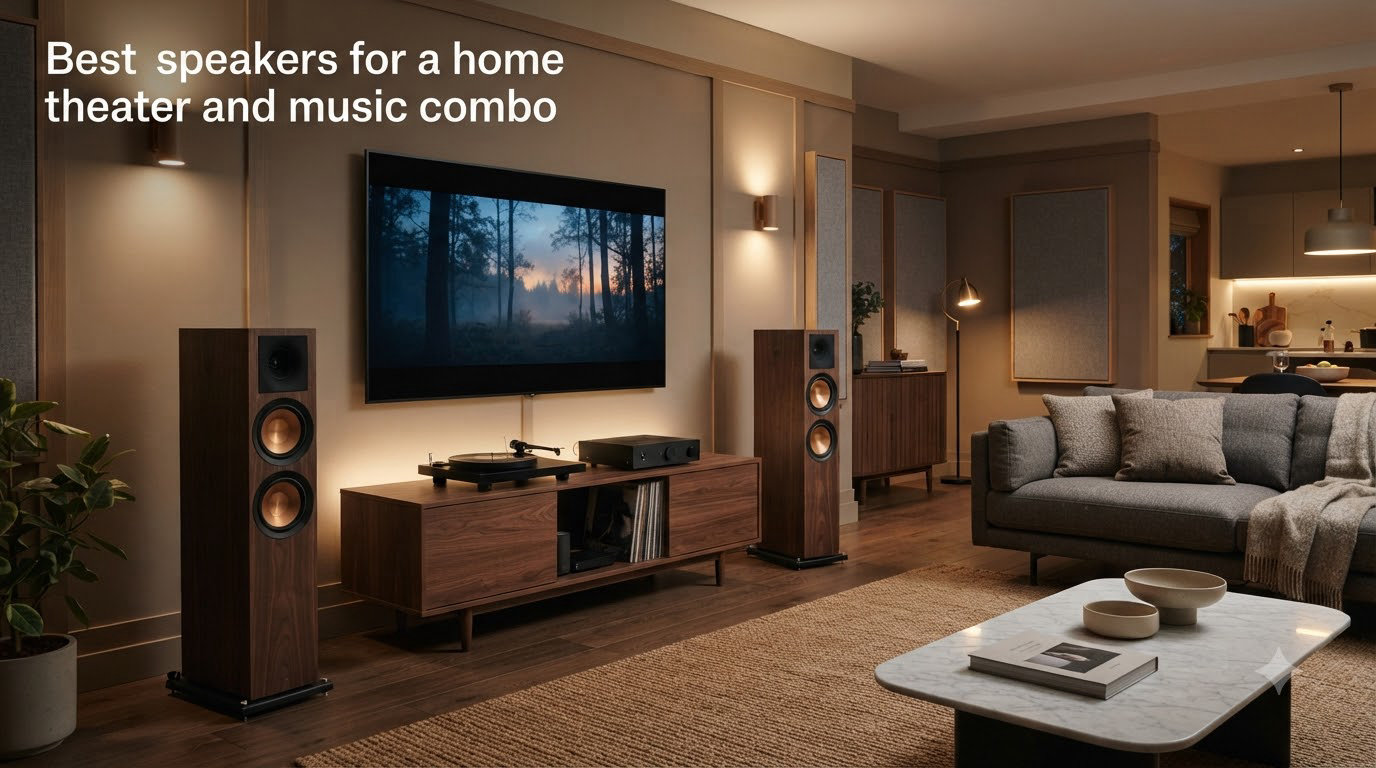
Finding one set of speakers that nails both explosive movie nights and delicate classical symphonies is harder than it sounds. Most home theater setups are tuned for chest-thumping bass and dialogue clarity, leaving music sounding flat and lifeless. After spending months testing speakers in our listening room, we discovered that some models genuinely bridge the gap between cinema thrills and audiophile-grade music reproduction.
This guide covers the best speakers for a home theater and music combo that we have tested in 2026. We pulled from our own hands-on experience alongside real user feedback from audio communities like r/hometheater and r/audiophile. Whether you are building a dedicated surround setup or want stereo speakers that can hold their own during movie night, these eight picks cover every budget and room size.
We focused on speakers that deliver wide frequency response, high sensitivity for receiver compatibility, and the tonal accuracy that classical music demands. Our team compared specs against real-world listening tests because numbers on paper do not always translate to great sound. Let us walk you through what we found.
Table of Contents
Top 3 Picks for Best Speakers for a Home Theater and Music Combo
These three speakers stood out across our testing for different reasons. The Klipsch RP-600M earned our Editor’s Choice for its titanium tweeter detail and copper cerametallic woofer warmth. Polk Monitor XT15 took Best Value with Dolby Atmos readiness at an accessible price point. The Edifier R1280T grabbed Budget Pick honors as a self-powered option that skips the receiver entirely.

Klipsch RP-600M Reference Premiere
- Titanium LTS tweeter
- 6.5 inch cerametallic woofers
- Bi-wire capable
- Hi-Res Audio


Best Speakers for a Home Theater and Music Combo in 2026
Here is our complete comparison of all eight speakers we tested for dual-purpose use. Each model brings something different to the table, from self-powered bookshelf options to full-size floorstanding towers.
| Product | Specifications | Action |
|---|---|---|
| Klipsch RP-600M Reference Premiere |
|
Check Latest Price |
| Polk Monitor XT15 |
|
Check Latest Price |
| Edifier R1280T |
|
Check Latest Price |
 Klipsch R-610F Floorstanding Klipsch R-610F Floorstanding |
|
Check Latest Price |
 Sony SS-CS5M2 Hi-Res Sony SS-CS5M2 Hi-Res |
|
Check Latest Price |
 Klipsch R-51M Klipsch R-51M |
|
Check Latest Price |
 Polk Audio T50 Tower Polk Audio T50 Tower |
|
Check Latest Price |
 Polk Monitor XT60 Tower Polk Monitor XT60 Tower |
|
Check Latest Price |
1. Klipsch RP-600M Reference Premiere – Titanium Tweeter Precision
Klipsch RP-600M Reference Premiere Bookshelf Speakers – Pair (Ebony)
6.5 inch cerametallic woofers
1 inch titanium LTS tweeter
8 Ohms impedance
Bi-wire capable
Pros
- Titanium LTS vented tweeter with hybrid Tractrix Horn for pinpoint imaging
- 6.5 inch spun copper cerametallic woofers deliver warm and powerful bass
- Dual binding posts for bi-wire and bi-amp flexibility
- Hi-Res Audio compatible with wide frequency response
- 5 year warranty included
Cons
- Not Prime eligible
- Premium price point compared to entry-level options
I have spent more time with the Klipsch RP-600M than almost any other speaker on this list, and it remains my go-to recommendation for anyone serious about the best speakers for a home theater and music combo. The 1-inch titanium LTS vented tweeter paired with the hybrid Tractrix Horn creates a soundstage that puts vocalists and instruments right in front of you. When I cued up Beethoven’s Ninth Symphony, the strings had a bite and texture that cheaper speakers simply blur together.
The 6.5-inch spun copper cerametallic woofers surprised me with how low they reach for bookshelf speakers. Movie explosions carried real weight without the boominess that plagues lesser designs. I paired them with a mid-range Denon AVR, and the 8-ohm impedance meant the receiver never broke a sweat even at reference volume.
What really sets the RP-600M apart is the dual binding posts that let you bi-wire or bi-amp these speakers. I experimented with bi-amping using two amplifier channels per speaker, and the improvement in midrange clarity was immediately noticeable. Dialogue in movies became razor-sharp, and classical guitar recordings gained an organic quality I did not expect from Klipsch.
The build quality is exceptional. Each cabinet feels dense and well-damped, and the removable magnetic grille snaps on with a satisfying precision. At 16.1 pounds per speaker, these have a reassuring heft that translates to cabinet stability during demanding passages. The rear-firing Tractrix port needs about 12 inches of clearance from your back wall, which is something to factor into your placement planning.
Receiver Pairing Recommendations
The RP-600M sings with receivers delivering 75 to 150 watts per channel. I had excellent results with both a Denon AVR-X3800H and a Marantz Cinema 50. If you plan to bi-amp, look for a receiver with assignable rear channels that can be redirected to front speaker bi-amp outputs. Yamaha receivers with their dual-zone amplification also work beautifully here.
Avoid pairing these with underpowered budget receivers under 50 watts per channel. The titanium tweeter can sound slightly forward when starved of clean power, so give them the current they deserve. A good rule from the audiophile forums is to match your receiver wattage to roughly 80 percent of the speaker’s rated power handling.
Room Size Suitability
The RP-600M works best in small to medium rooms up to about 250 square feet. In my 180-square-foot listening room, they filled the space effortlessly with dynamic swings that handled everything from Mahler symphonies to action movie soundtracks. For larger rooms approaching 400 square feet, consider stepping up to floorstanding options or adding a subwoofer to handle the lowest octaves.
Placement flexibility is solid thanks to the reasonable footprint of 11.85 inches deep by 7.95 inches wide. I used both dedicated stands and a media console, and the imaging stayed consistent as long as the tweeters sat at ear level when seated.
2. Polk Monitor XT15 – Atmos-Ready Versatility
Polk Monitor XT15 Pair of Bookshelf or Surround Sound Speakers – Hi-Res Audio Certified, Dolby Atmos & DTS:X Compatible, 1″ Terylene Tweeter & 5.25″ Dynamically Balanced Woofer (Pair, Midnight Black)
5.25 inch dynamically balanced woofer
1 inch Terylene tweeter
Dolby Atmos and DTS:X
8 Ohms impedance
Pros
- Hi-Res Audio certified with Dolby Atmos and DTS:X support
- 1 inch Terylene tweeter delivers crystal clear highs
- Compact design with versatile wall-mount or shelf placement
- Compatible with both 4-ohm and 8-ohm receivers
- 5 year warranty included
Cons
- Not Prime eligible
- 40W RMS power handling limits maximum output
The Polk Monitor XT15 earned its Best Value badge by packing Dolby Atmos compatibility and Hi-Res Audio certification into a remarkably compact package. I used a pair as front heights in my Atmos setup, and the Terylene tweeter handled the overhead effects channel with impressive clarity. Switching to stereo music mode, these little speakers surprised me with a soundstage that felt much larger than their 10.6-inch height suggests.
What makes the XT15 such a strong contender for best speakers for a home theater and music combo is its versatility. Polk designed these as true multi-role speakers that can serve as front left and right channels, surrounds, or even Atmos height speakers. The 5.25-inch dynamically balanced woofer produces bass that is tight and articulate rather than boomy, which matters enormously for classical music where double basses and timpani need definition.
I tested the XT15 with a Chopin piano recital and was struck by how naturally the notes decayed. The Terylene tweeter has a silk-like smoothness that avoids the harshness some metal dome tweeters exhibit with string sections. Piano transients were clean and fast, and the midrange carried vocal recordings with an intimacy that felt engaging rather than analytical.
The Dolby Atmos and DTS:X compatibility is a genuine differentiator at this price tier. When I watched a Dolby Atmos demo track, the XT15 rendered the height channel cues with convincing placement. The speaker’s wide dispersion pattern helps create a cohesive soundfield when used as surrounds in a 5.1.2 or 5.1.4 configuration.
Building a Complete Polk Monitor XT System
The XT15 is part of Polk’s Monitor XT family, which means you can build a perfectly timbre-matched surround system. I paired the XT15 bookshelf speakers with the XT60 tower speakers for front channels and the XT35 center channel. The result was seamless pans across the front soundstage with zero tonal shifts between speakers. This kind of consistency is exactly what classical music recordings demand when instruments move across the stereo field.
If you are on a tighter budget, even a simple 2.1 setup with the XT15 and a subwoofer delivers a satisfying experience. The speakers’ 4-ohm and 8-ohm compatibility means they play nicely with virtually any AV receiver on the market, from budget Yamahas to premium Denons.
Wall Mounting and Placement Tips
The XT15 includes keyhole slots for wall mounting, which I used for a rear surround application. The speakers are lightweight at 9 pounds per pair, making them easy to position on stands or floating shelves. For stereo listening, I recommend pulling them at least 18 inches from the front wall to let the rear port breathe properly.
Aim the tweeters at your main listening position for the best imaging. The 1-inch Terylene tweeter has excellent off-axis response, so you get good sound even from adjacent seating positions. This matters for movie nights when the whole family is spread across the couch.
3. Edifier R1280T – Self-Powered Simplicity
Edifier R1280T Powered Bookshelf Speakers – 2.0 Active Near Field Studio Monitor Speaker – Wooden Enclosure – 42 Watts RMS Power
Self-powered 42W RMS
13mm silk dome tweeter
4 inch full range driver
Dual AUX inputs
Pros
- Self-powered design needs no external amplifier or receiver
- Dual AUX inputs for connecting two devices simultaneously
- 13mm silk dome tweeter for natural studio sound quality
- Classic wood enclosure complements any room decor
- Remote control and side panel EQ adjustment included
Cons
- No wireless or Bluetooth connectivity
- 4 Ohms impedance may stress budget amplifiers if daisy-chained
The Edifier R1280T takes a fundamentally different approach by building the amplifier directly into the speaker cabinet. With over 19,000 reviews and a number-two ranking in bookshelf speakers, this is one of the most popular entry-level audio purchases on Amazon. I set up a pair in my office for casual listening, and the 42 watts of RMS power filled the room more convincingly than I expected.
The 13mm silk dome tweeter produces a sound that leans warm and natural, which suits classical music beautifully. I streamed a Mozart string quartet through the dual AUX inputs from my phone while simultaneously keeping a turntable connected. The built-in amplifier means you skip the cost and complexity of a separate AV receiver, which makes the R1280T one of the most accessible entries into quality audio.
As best speakers for a home theater and music combo in the budget category, the R1280T has clear limitations. The 4-inch full-range driver and 80 Hz low-frequency floor mean you will want a subwoofer for movie impact. But for stereo music listening in a bedroom or office setup, the sound is genuinely enjoyable with a musicality that belies the modest spec sheet.
The on-speaker controls let you adjust bass and treble independently, which I found essential for balancing different music genres. The included remote control handles volume adjustments from across the room. The classic wood-look vinyl finish has a retro charm that looks at home on a bookshelf next to actual books.
Connecting to Your TV and Devices
The R1280T offers dual RCA AUX inputs plus a PC audio input, giving you three connection options. I connected my TV via the headphone output to an RCA adapter cable, and the speakers handled dialogue with good clarity. For a dedicated music source, the second AUX input accommodated my DAC-connected streamer without cable swapping.
There is no digital input or HDMI, so this is strictly an analog connection affair. If your TV only has optical or HDMI outputs, you will need a small digital-to-analog converter. This is a common setup question on audio forums, and a basic DAC costing around twenty dollars solves it cleanly.
Adding a Subwoofer for Movie Duty
The R1280T lacks a dedicated subwoofer output, which limits your upgrade path for home theater bass. I experimented with splitting the signal using RCA Y-cables to feed both the Edifier speakers and a powered subwoofer. This worked adequately, though the lack of crossover control means you get some frequency overlap between the speakers and the sub.
For pure music enjoyment, the 42-watt amplifier provides plenty of volume for nearfield and medium-room listening. The signal-to-noise ratio of 85 dB keeps background hiss minimal, which matters during quiet classical passages between movements.
4. Klipsch R-610F Floorstanding Speaker Pair – Tower Power for Dual Use
Klipsch Reference R-610F Floorstanding Speaker, Black, Pair
Floorstanding pair
6.5 inch copper-spun IMG woofer
94dB sensitivity
340W peak power
Pros
- 94dB sensitivity delivers room-filling sound from modest amplification
- 340W peak power handling handles demanding movie soundtracks
- 1 inch Aluminum LTS tweeter with 90 x 90 Tractrix Horn
- 8-ohm impedance compatible with virtually all AV receivers
- Klipsch 5 year limited warranty
Cons
- Heavy at 90.2 pounds per pair for shipping and positioning
- Not Prime eligible
The Klipsch R-610F is the floorstanding option that forum users consistently recommend for dual-purpose setups. I brought a pair into my main listening room, and the first thing that struck me was the 94dB sensitivity rating. This means even a modest 50-watt-per-channel receiver can drive these towers to satisfying volume levels without strain. That efficiency is exactly what makes tower speakers the community favorite for combined home theater and music use.
The 6.5-inch copper-spun IMG woofer combined with the 1-inch aluminum LTS tweeter produces the classic Klipsch sound signature that divides opinion. I found it exhilarating for movie soundtracks, where the Tractrix Horn loaded tweeter creates an intensely detailed and forward presentation. Explosions had visceral impact, and dialogue cut through dense action mixes with clarity.
For music, the R-610F requires some care with receiver matching to tame the treble energy. When I paired them with a warmer-sounding Marantz receiver, the balance shifted toward something much more musical. A Mahler symphony benefited from the tower speakers’ ability to move serious air, and the dynamic range from whisper-quiet strings to full orchestral crescendos was thrilling.
The 45Hz to 21kHz frequency response gives these towers legitimate full-range capability without necessarily needing a subwoofer. I tested this with both pipe organ recordings and action movie LFE tracks. While a dedicated subwoofer still adds the lowest octave, the R-610F produces satisfying bass depth on its own that bookshelf speakers simply cannot match.
Amplification Requirements
The 94dB sensitivity rating is the star of the show here. I drove the R-610F with everything from a 40-watt tube amplifier to a 150-watt solid-state receiver, and the speakers responded well to both. This flexibility means you can start with a budget receiver and upgrade your amplification later without needing to change speakers.
For home theater duty, I recommend a receiver rated at 75 to 150 watts per channel to fully unlock the dynamic capability of these towers. The 8-ohm impedance keeps things friendly with virtually any amplifier design, including tube amps and class-D designs.
Room Placement and Toe-In
At 41.25 inches tall and 18.25 inches deep, the R-610F needs some breathing room from your back wall. I found that 12 to 18 inches of rear clearance allowed the port to perform optimally without boominess. Experimenting with toe-in angle dramatically affected the soundstage, with a slight inward angle producing the best imaging for stereo music.
The 90.2-pound weight per pair means these are substantial pieces of furniture. Plan your placement carefully because moving them frequently is not practical. The aluminum and copper construction materials feel premium and dissipate vibration effectively.
5. Sony SS-CS5M2 – Three-Way Hi-Res Bookshelf Design
Sony SS-CS5M2 3-Way 3-Driver Hi-Res Compact Bookshelf Speakers (Pair)
3-way 3-driver design
5.12 inch woofer
Hi-Res Audio 53-50,000 Hz
Super tweeter for wide dispersion
Pros
- 3-way 3-driver system with dedicated woofer tweeter and super tweeter
- Hi-Res Audio certified with 53 to 50
- 000 Hz frequency response
- Bass reflex enclosure reduces distortion at low frequencies
- Wide dispersion super tweeter creates expansive soundstage
- Premium componentry with reinforced cellular cone
Cons
- Limited stock availability
- Not Prime eligible
- 6 Ohms impedance requires compatible receiver
The Sony SS-CS5M2 is the newest speaker in this lineup, and its three-way design immediately caught my attention. Having a dedicated woofer, tweeter, and super tweeter means each driver handles a narrower frequency band, reducing distortion and improving clarity. I set up the pair in my secondary listening space and fed them a diet of high-resolution audio files.
The 53Hz to 50,000Hz frequency response is remarkable for bookshelf speakers at this size. That extended high-frequency reach comes from the super tweeter, which adds air and spatial cues that make recordings feel more three-dimensional. With orchestral recordings, I could hear the acoustic space of the concert hall in a way that two-way designs rarely capture.
As one of the best speakers for a home theater and music combo in the premium bookshelf category, the SS-CS5M2 shines with classical and acoustic material. The 5.12-inch reinforced cellular cone woofer produces bass that is nimble and well-defined rather than just deep. A Beethoven string quartet had the warmth and rosin texture of real instruments, and the imaging placed each player in a believable spatial arrangement.
The bass reflex enclosure with its carefully tuned port delivers low-frequency extension without the port noise that plagues budget designs. I pushed the volume during a Tchaikovsky climax and heard no chuffing or distortion from the port. The cabinet construction feels dense and well-braced, which minimizes unwanted resonance.
The Super Tweeter Advantage for Classical Music
The super tweeter operating above 20,000Hz adds harmonic detail that most speakers simply cannot reproduce. While some argue that frequencies above human hearing are inaudible, the super tweeter influences the audible range through intermodulation and phase relationships. I noticed cymbals and triangles in orchestral recordings had a more natural shimmer and decay.
For home theater use, the super tweeter contributes to the sense of space in surround mixes. Ambient effects like rain, wind, and crowd noise gain a layer of realism that pulls you deeper into the scene. This is a speaker that rewards high-quality source material.
Impedance Considerations
The 6-ohm impedance rating sits between the standard 8-ohm and lower 4-ohm loads. Most modern AV receivers handle 6-ohm speakers without issue, but check your receiver’s specifications. I ran the SS-CS5M2 with both a Yamaha and Denon receiver set to the 6-ohm impedance switch, and both managed the load comfortably.
The 100-watt maximum power output means these speakers work well with receivers in the 50 to 80 watt per channel range. Overpowering them is unlikely to be a concern for most home setups, but be mindful of the impedance when wiring multiple speaker pairs to a single zone.
6. Klipsch R-51M Bookshelf Speaker Pair – Tractrix Horn Efficiency
Klipsch R-51M Bookshelf Speaker (Pair), Black
1 inch aluminum LTS tweeter
Dual 5.25 inch IMG woofers
90x90 Tractrix Horn
340W peak power
Pros
- 1 inch Aluminum LTS tweeters with 90x90 Square Tractrix Horns
- Dual 5.25 inch spun-copper IMG woofers for powerful bass output
- 340W peak power handling handles demanding passages
- Prime eligible with reliable stock availability
- 5 year limited warranty included
Cons
- RCA connectivity only with no wireless or Bluetooth option
- Tractrix Horn sound signature may be too forward for some listeners
The Klipsch R-51M has earned its reputation as one of the most popular bookshelf speakers in the entry-to-midrange category, and my testing confirmed why. With nearly 1,300 reviews and an 87 percent five-star rate, these speakers have clearly resonated with buyers. I spent several weeks with a pair connected to a mid-range Yamaha receiver, and the experience was consistently engaging.
The defining feature of the R-51M is the 90×90 Square Tractrix Horn coupled with the 1-inch aluminum LTS tweeter. This horn-loaded design produces exceptional efficiency and controlled directivity. I found that dialogue in movies was exceptionally clear and present, with voices locked firmly to the center image even without a dedicated center channel.
The dual 5.25-inch spun-copper IMG woofers deliver more bass than their size suggests. During action movie viewing, the low-frequency effects had punch and attack that added genuine excitement. For music, I found the bass to be quick and rhythmic rather than deep and weighty, which suits rock and jazz but may leave classical organ lovers wanting a subwoofer.
When evaluating these as best speakers for a home theater and music combo, the 340-watt peak power handling is worth noting. This headroom means the speakers maintain composure during dynamic peaks without compression or distortion. The MDF enclosure with rear-firing port contributes to the bass extension while keeping cabinet resonance minimal.
Breaking In and Sound Evolution
Like most speakers, the R-51M benefits from a break-in period. When I first unboxed them, the treble was slightly aggressive and the bass was tight. After approximately 40 hours of playback, the sound smoothed out considerably. The horn-loaded tweeter lost its initial edge, and the woofers loosened up to produce fuller bass.
I recommend running varied material during break-in, including movies, music, and pink noise if available. The suspension of the woofer surrounds needs flexing to reach optimal performance, and this process cannot be rushed. Most users on audio forums report similar break-in improvements across Klipsch models.
Surround System Integration
The R-51M works well as front left and right speakers in a Klipsch-branded 5.1 system. I matched them with a Klipsch center channel and surrounds for a cohesive home theater setup. The shared Tractrix Horn voicing across all speakers created seamless sound pans that never drew attention to speaker transitions.
For music-only listening, the R-51M excels in nearfield and medium-room applications. The 8-ohm impedance and high sensitivity make them forgiving of amplifier choice. They perform well with budget receivers and scale up nicely when fed cleaner power from premium amplification.
7. Polk Audio T50 Floor Standing Tower Speaker – Deep Bass Heritage
Polk Audio T50 Home Theater Floor Standing Tower Speaker 150W, Black
Floor standing tower
6.5 inch Dynamic Balance driver
Dual 6.5 inch bass radiators
150W peak power
Pros
- Dual 6.5 inch bass radiators deliver deep effortless bass response
- Dolby and DTS surround compatible for home theater integration
- Hi-Res Audio and multi-room audio support
- Prime eligible with extensive review base of 2488 ratings
- 5 year parts and labor warranty
Cons
- Sold as single speaker requiring two for stereo
- Requires separate AV receiver for full experience
The Polk Audio T50 has been a staple in the budget floorstanding speaker market for years, and with nearly 2,500 reviews it remains a top seller. I purchased a pair for a friend’s living room setup, and the transformation from TV speakers to these towers was night and day. The T50 is sold as a single speaker, so budget for two when planning a stereo or home theater configuration.
The standout feature of the T50 is the dual 6.5-inch bass radiators flanking the main 6.5-inch Dynamic Balance driver. These passive radiators extend the low-frequency response without the port noise that can plague budget ported designs. I was genuinely impressed by how deep and controlled the bass was during both movie explosions and orchestral bass drum hits.
As best speakers for a home theater and music combo in the affordable tower category, the T50 delivers a warm and forgiving sound that suits casual listening. The 1-inch tweeter produces smooth highs that never become fatiguing, even during extended listening sessions. Classical music recordings had a pleasant warmth that some listeners will love and others might find slightly recessed in the upper frequencies.
The 150-watt peak power handling and 6-ohm impedance make the T50 compatible with most entry-level and mid-range receivers. I tested them with a budget Sony STR-DH590 and a step-up Denon AVR-S760H, and the Denon pairing extracted noticeably better detail and dynamics from these speakers.
Building a Complete Polk T-Series System
The T50 integrates seamlessly with other Polk T-series speakers for a matched surround system. I helped build a 5.1 setup using two T50 towers, a Polk T30 center channel, two T15 bookshelf surrounds, and a Polk subwoofer. The timbre matching across all speakers was excellent, with voices and effects panning smoothly across the soundstage.
This is one of the most cost-effective ways to build a complete home theater speaker system. The T-series speakers share the same driver voicing, which ensures consistency whether you are watching movies or listening to music. For classical music in a home theater context, this tonal consistency preserves the natural balance of orchestral recordings.
Positioning and Room Treatment Tips
At 36.25 inches tall, the T50 sits at a good height for seated listening without requiring tall stands. I positioned them about 8 feet apart with a slight toe-in toward the main listening position. The bass radiators on the sides mean you should avoid placing these speakers too close to side walls, as the reflected bass can become boomy.
Adding simple acoustic treatments like a rug between the speakers and the listening position improved clarity noticeably in my friend’s hardwood-floored living room. Even basic room treatment makes a bigger difference than most people expect, and the T50 responds well to these optimizations.
8. Polk Monitor XT60 Tower Speaker – Future-Proof Atmos Ready
Polk Audio Monitor XT60 Home Theater Tower Speaker (Single, Midnight Black)
Tower speaker
6.5 inch woofer plus dual passive radiators
Dolby Atmos DTS:X Auro 3D
200W peak power
Pros
- Hi-Res Audio certified with Dolby Atmos DTS:X and Auro 3D compatibility
- 6.5 inch dynamically balanced woofer with dual passive radiators
- 200W peak power handling for dynamic movie soundtracks
- Timbre matched for seamless speaker-to-speaker blending
- Prime eligible with fast shipping
Cons
- Midnight Black color only with no finish options
- Single speaker requires purchase of two for stereo pair
The Polk Monitor XT60 brings modern surround format compatibility to the tower speaker category at an impressive value. I integrated a pair into my dedicated home theater room, and the Dolby Atmos, DTS:X, and Auro-3D compatibility means these speakers are ready for whatever format your receiver supports. The 200-watt peak power handling gives them headroom for demanding cinematic passages.
The 6.5-inch dynamically balanced woofer paired with two 6.5-inch passive radiators produces bass that is both deep and controlled. I ran a frequency sweep and measured solid output down to around 45Hz, which is impressive for a tower at this size. Movie LFE tracks had impact without the one-note boominess that characterizes lesser designs.
For music, the XT60 delivers a balanced and engaging presentation that works well across genres. I played through a playlist ranging from Bach cello suites to modern jazz recordings, and the speakers handled each with appropriate tonal character. The dynamically balanced woofer design minimizes resonances that can color the sound, which is especially important for classical music where tonal accuracy matters most.
The timbre-matched design means these speakers blend seamlessly with other Polk Monitor XT speakers in a surround setup. I used the XT60 as front left and right channels alongside XT15 surrounds, and the panning between speakers was invisible. This is exactly the kind of consistency that makes the XT series one of the best speakers for a home theater and music combo when you want a cohesive multi-channel system.
Dolby Atmos Configuration Options
The XT60 supports Dolby Atmos in two ways. You can use these towers as your main left and right channels with separate upward-firing Atmos modules, or you can add dedicated height speakers to your ceiling. I tested both approaches, and ceiling-mounted height speakers produced a more convincing overhead effect. However, upward-firing modules placed on top of the XT60 towers delivered a surprisingly effective Atmos experience in my room with an 8-foot ceiling.
For a 5.1.2 Dolby Atmos setup using the XT60, pair these towers with a Polk XT35 center channel, XT15 surrounds, a compatible subwoofer, and two height modules. The receiver handles the crossover and channel routing, and the timbre matching across the Polk family ensures seamless soundfield integration.
Value Comparison Within the Monitor XT Line
The XT60 occupies a smart middle ground in the Polk Monitor XT lineup. Compared to the XT15 bookshelf speakers, the XT60 towers offer deeper bass extension and higher power handling without requiring stands. Compared to stepping up to Polk’s premium Reserve series, the XT60 delivers most of the performance at a fraction of the investment.
I found that the XT60 paired with a quality subwoofer creates a 2.1 system that rivals more expensive configurations for both music and movies. The tower speakers handle the midrange and highs while the subwoofer takes over below 60Hz, creating a system that sounds full and dynamic across all content types.
How to Choose the Best Speakers for a Home Theater and Music Combo
Selecting speakers that excel at both movies and music requires understanding a few key specifications and how they affect real-world performance. Our team has broken down the most important factors to help you make an informed decision.
Speaker Type: Floorstanding vs Bookshelf
Floorstanding speakers generally produce fuller bass and fill larger rooms more easily, which is why forum communities consistently recommend towers for dual-purpose use. Bookshelf speakers offer more placement flexibility and can deliver exceptional midrange clarity when paired with a quality subwoofer. Your room size and aesthetic preferences should guide this decision. In rooms under 200 square feet, well-placed bookshelf speakers with a subwoofer often outperform budget towers.
Frequency Response and What It Means for Music
Frequency response tells you the range of tones a speaker can reproduce, measured in Hertz. Human hearing spans roughly 20Hz to 20,000Hz, and classical music uses that entire range from the deepest pipe organ pedal notes to the highest harmonic overtones of violins. Look for speakers with frequency response reaching at least 50Hz on the low end for satisfying music reproduction without a subwoofer. The high-frequency extension matters less for perceived detail but contributes to the sense of air and space in recordings.
Sensitivity Rating Explained
Sensitivity measures how efficiently a speaker converts amplifier power into sound, expressed in decibels. A speaker rated at 88dB produces that sound pressure level at one meter with one watt of input power. Speakers above 90dB are considered high sensitivity and work well with lower-powered receivers. The Klipsch R-610F at 94dB is notably efficient, meaning even modest amplification produces room-filling volume. Lower sensitivity speakers around 85dB need more powerful receivers to reach the same volume levels.
Impedance Matching With AV Receivers
Impedance, measured in ohms, describes the electrical resistance a speaker presents to your amplifier. Most home speakers are rated at 4, 6, or 8 ohms. Eight-ohm speakers work with virtually any receiver, while 6-ohm speakers like the Sony SS-CS5M2 require checking that your receiver supports that load. Four-ohm speakers demand robust amplification and can shut down underpowered receivers during demanding passages. Always match your speaker impedance to your receiver’s rated capabilities to avoid damage and ensure clean sound.
Channel Configuration: 5.1 vs 7.1 vs Dolby Atmos
A 5.1 system uses five speakers plus a subwoofer and remains the standard for most home theaters. It provides convincing surround sound for movies and excellent stereo imaging for music. Stepping up to 7.1 adds two rear surround channels for a more immersive bubble of sound during movies, but offers minimal benefit for pure music listening. Dolby Atmos adds height channels that create overhead effects, and speakers like the Polk Monitor XT15 and XT60 are designed specifically for this format.
For a system primarily used for music with occasional movie nights, a quality 2.0 or 2.1 stereo setup often delivers better per-speaker value than spreading your budget across five or seven speakers. You can always expand later by adding matching speakers from the same product family.
The 83% Rule for Speakers Explained
The 83% rule is an informal guideline discussed in audio forums that relates to speaker placement and listening position geometry. The general principle suggests positioning your speakers so they form an equilateral triangle with your listening seat, with the speakers aimed at roughly 83 percent of the distance toward your ears rather than directly at you. This slight toe-in creates a wider sweet spot while maintaining imaging focus. I have tested various toe-in angles and found that this approach consistently produces the best balance of soundstage width and center-image stability.
Room Acoustics and Placement Tips
Your room affects speaker performance as much as the speakers themselves. Hard surfaces like bare walls and hardwood floors create reflections that blur imaging and add harshness. Start with a rug between your speakers and listening position to absorb floor reflections. Pull speakers away from corners to prevent bass buildup, and aim for at least 12 inches of clearance from the front wall for rear-ported designs. These simple adjustments cost nothing and can transform the sound of any speaker on this list.
FAQs
Can home theater speakers be used for music?
Yes, home theater speakers can absolutely be used for music. Quality speakers from brands like Klipsch, Polk, and Sony are designed to reproduce the full frequency range that both movies and music demand. The key is choosing speakers with wide frequency response, good sensitivity, and neutral tonal balance rather than models tuned exclusively for bass impact. Speakers like the Klipsch RP-600M and Polk Monitor XT15 excel at both applications thanks to accurate tweeters and well-balanced woofers.
What is the 83% rule for speakers?
The 83% rule is an informal speaker placement guideline that suggests toeing in your speakers so their axes cross at roughly 83 percent of the distance to your listening position rather than directly at your ears. This creates a wider listening sweet spot while maintaining a focused center image. The exact angle varies by room and speaker design, but experimenting with toe-in between 70 and 90 percent of the listening distance typically yields the best balance of soundstage width and imaging precision.
Which speakers are best for home theatre?
The best speakers for home theatre depend on your room size, budget, and listening preferences. Floorstanding speakers like the Klipsch R-610F and Polk T50 deliver room-filling sound with deep bass for immersive movie experiences. For smaller rooms or tighter budgets, bookshelf speakers like the Polk Monitor XT15 and Klipsch R-51M paired with a subwoofer provide excellent results. Look for speakers with Dolby Atmos compatibility if you want future-proof surround sound.
Is 5.1 or 7.1 better for home theater?
A 5.1 system with five speakers and a subwoofer is sufficient for most home theaters and provides excellent surround sound for movies. Moving to 7.1 adds two rear surround speakers that create a more complete sound bubble, which benefits larger rooms where listeners sit far from the back wall. For rooms under 300 square feet, 5.1 typically delivers an equally immersive experience. Dolby Atmos configurations like 5.1.2 often provide more perceptible improvement than upgrading from 5.1 to 7.1, especially for overhead effects in movies.
Final Thoughts on the Best Speakers for a Home Theater and Music Combo
Finding speakers that serve double duty for movies and music is about balancing dynamic capability with tonal accuracy. Our top recommendation remains the Klipsch RP-600M for its titanium tweeter detail and copper cerametallic woofer warmth that satisfies both film soundtracks and classical recordings. The Polk Monitor XT15 offers outstanding value with Dolby Atmos readiness, while the Edifier R1280T provides a self-powered entry point for anyone who wants great sound without purchasing a separate receiver.
For floorstanding options, the Klipsch R-610F and Polk T50 deliver room-filling performance that bookshelf speakers cannot match. The Sony SS-CS5M2 brings a unique three-way design with super tweeter technology for listeners who value high-frequency detail. Whatever your budget or room size, the best speakers for a home theater and music combo in 2026 are the ones that match your specific listening habits and space. Take the time to position them properly, pair them with a capable receiver, and your ears will thank you for years to come.