
Nothing exposes a mediocre composition faster than a wide-angle lens. The moment you mount a 16mm prime or a 10-18mm zoom, the frame fills with foreground, the middle distance compresses, and the horizon has to work or the whole picture collapses. That pressure is why picking among the best wide angle lenses for landscape photography feels harder than picking a telephoto, even though the shelf of options looks shorter.
I have carried most of these lenses on real dawn trips, on cold ridges with numb fingers, and on dusty trails where a tripod stays packed. The pattern that surprised me: the winner is rarely the fastest lens in the group. Landscape work is shot at f/8 or f/11 in good light, and at those apertures the gap between a constant f/2.8 zoom and a light f/4 prime mostly shows up in your shoulders and your wallet, not in the file.
This guide covers 12 wide primes and wide zooms for Canon EF, Canon RF, Nikon F, Nikon Z, Sony E, and Fujifilm X bodies, so there is something here whether you shoot a full-frame DSLR or a crop-sensor mirrorless kit. Every rating and review count below is the live Amazon figure, and every specification comes straight from the manufacturer listing rather than from memory. If you are still deciding between focal lengths, it is worth settling the weight question first, because how much you will tolerate on the walk to the shot changes the answer more than the aperture does.
One quick note before we start. Weights in this article are manufacturer figures, and a few listings are inconsistent about units, so I have quoted them exactly as published. Where a lens is sold in grams and another in ounces, I have converted nothing and simply told you which is which. That matters more than it sounds, because a 170g prime and a 375g prime are very different objects to carry at altitude.
Table of Contents
Top 3 Picks for Best Wide Angle Lenses for Landscape Photography (October 2026)
Three lenses earned the right to sit at the top. One wins on the balance of rating and review volume, one wins on reach per gram, and one wins because it turns a full-frame body into a landscape kit that fits in a jacket pocket.

Sigma 16mm f/1.4 DC DN for Sony E
- f/1.4 aperture for dawn and astro
- 14.3 oz body
- 83.2 degree angle of view
- Fast Hybrid AF

Canon EF-S 10-18mm IS STM
- 107.5 degree view
- 240 g
- Optical image stabilization
- Close focus to 0.22 m
Canon RF 16mm f/2.8 STM
- 163 g full-frame ultra-wide
- f/2.8 constant aperture
- 43mm filter thread
- 0.26x magnification
Every Wide-Angle Lens in This Guide at a Glance in 2026
The table below is the fastest way to narrow twelve options down. Read the angle of view column first, because it tells you whether you are getting a genuine ultra-wide or a standard wide, and read the weight column second, because that is the number you will live with on every hike.
| Product | Specifications | Action |
|---|---|---|
| Sigma 16mm f/1.4 DC DN for Sony E |
|
Check Latest Price |
| Canon EF-S 10-18mm IS STM |
|
Check Latest Price |
| Canon RF 16mm f/2.8 STM |
|
Check Latest Price |
 Canon EF-S 10-22mm f/3.5-4.5 USM Canon EF-S 10-22mm f/3.5-4.5 USM |
|
Check Latest Price |
 VILTROX AF 14mm f/4 Air FE VILTROX AF 14mm f/4 Air FE |
|
Check Latest Price |
 Fujifilm XF16mmF2.8 R WR Fujifilm XF16mmF2.8 R WR |
|
Check Latest Price |
 Fujifilm XF16mmF1.4 R WR Fujifilm XF16mmF1.4 R WR |
|
Check Latest Price |
 Sigma 10-18mm f/2.8 DC DN for Sony E Sigma 10-18mm f/2.8 DC DN for Sony E |
|
Check Latest Price |
 Nikon AF-S FX 16-35mm f/4G ED VR Nikon AF-S FX 16-35mm f/4G ED VR |
|
Check Latest Price |
 Rokinon 14mm f/2.8 AF for Sony E Rokinon 14mm f/2.8 AF for Sony E |
|
Check Latest Price |
 VILTROX 14mm f/4 Nikon Z VILTROX 14mm f/4 Nikon Z |
|
Check Latest Price |
 Fujifilm XF14mmF2.8 R Fujifilm XF14mmF2.8 R |
|
Check Latest Price |
1. Sigma 16mm f/1.4 DC DN for Sony E
Sigma 16mm f/1.4 DC DN Contemporary Lens for Sony E (402965) Black
16mm f/1.4
83.2 degree view
14.3 oz
Stepping motor AF
Pros
- Exceptionally sharp corner to corner for an APS-C ultra-wide prime
- Very fast f/1.4 for low light and astro landscape work
- Compact and light for on-location shooting
- Fast Hybrid AF works cleanly on Sony E bodies
Cons
- Prime focal length gives no framing flexibility
- Corner softness and vignetting when shot fully wide open
This is the lens I reach for when the plan is a single frame and I want to avoid raising ISO. At f/1.4 the Sigma 16mm gathers light fast enough that you can shoot handheld well past the point where a kit zoom forces you onto a tripod, which changes how many locations you actually attempt on a short day trip. On Sony E APS-C bodies it gives an 83.2 degree angle of view, a proper ultra-wide rather than a mild wide.
The rendering is the surprise. I expected a fast prime wide open to be soft and contrasty in the corners, and instead reviewers consistently describe edge-to-edge sharpness that holds well past the point most landscape frames need. Color is neutral enough that straight-out-of-camera files need very little work before a crop and a curve.
The f/1.4 aperture also makes this the natural astro pairing in the group. Focus to infinity, open up, and the 16mm focal length gives the classic near-to-far Milky Way composition where a ridge silhouette sits against a dense band of stars. Reviewers who shoot night skies pair it with manual peaking, since the stepping motor is not the tool for a dark field.
The trade-offs are honest ones. There is no zoom ring, so every framing change means walking. And shooting wide open on a lens this fast does reveal some corner vignetting and mild softness at the extreme edges, both of which correct cleanly in post. If you print big, stop down a stop or two and the file behaves.
Who this lens suits
If your camera is a Sony APS-C body and you shoot dawn, dusk, or night skies regularly, this is the one to shortlist first. A 14.3 ounce prime with a constant fast aperture is a rare combination, and it disappears into a small daypack without you thinking about it.
Who should pass
Skip it if your landscapes include confined spaces where a tight frame matters, or if you want a single lens to cover both a sweeping vista and a 35mm-style environmental view. Prime discipline takes practice, and the review data shows plenty of owners who love the rendering but wish they had one more option.
2. Canon EF-S 10-18mm f/4.5-5.6 IS STM
Canon EF-S 10-18MM is STM Lens
10-18mm f/4.5-5.6
107.5 degree view
240 g
Optical image stabilization
Pros
- Exceptionally wide field of view for sweeping APS-C landscapes
- Optical stabilization helps with slower shutter speeds
- Quiet STM autofocus for stills and video
- Light 240 g body that does not feel cheap
Cons
- Slow variable aperture weak in low light and long exposures
- Manual focus ring is not electronic
- Some mild edge distortion and pincushion effect
This is the lens I recommend to anyone who wants maximum coverage for the least complexity. At 10mm on an APS-C body it delivers a 107.5 degree equivalent view, which is wide enough to put a whole valley in a single frame with a foreground element anchoring the bottom of the composition. For sweeping vistas that is the whole job.
The variable f/4.5-5.6 aperture looks like a compromise on paper and mostly is not one, because landscape light at dawn and dusk is dim but forgiving once you are on a tripod. What the slow aperture does cost you is astrophotography, where you need the pixels. Reviewers are candid about that in the reviews.

Optical image stabilization is the underrated feature here. Landscape work often happens in failing light on uneven ground, and four stops of stabilization means you can hold a frame at shutter speeds where a non-stabilized lens would blur. The STM motor is quiet enough for video, which matters if you shoot motion as well as stills.
Close focus to 0.22 meters lets you get a rock or a plant sharp in the near foreground with the far ridge still reading clearly. That near-far layering is the whole visual signature of a wide lens, and this one delivers it without a tripod head or a bellows.
Who this lens suits
Canon APS-C DSLR shooters, and anyone adapting EF-S glass onto a mirrorless body, get an enormous amount of coverage for very little money and very little weight. The 240 g figure is a real advantage on a long approach.
Who should pass
Night sky shooters should look elsewhere, because f/5.6 at 10mm is a hard limit on exposure. Videographers who want manual focus control will also find the non-electronic focus ring limiting.
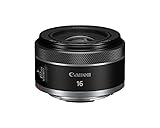
3. Canon RF 16mm f/2.8 STM
Canon RF16mm F2.8 STM Lens
16mm f/2.8 prime
108 degree view
163 g
43mm filter thread
Pros
- Extraordinarily small and light full-frame ultra-wide at 163 g
- f/2.8 keeps ISO and noise manageable
- Quiet STM motor suits video and focus stacking
- Built-in lens profiles available in Adobe Lightroom
Cons
- Barrel distortion
- vignetting and chromatic aberration need correcting
- Soft corners relative to the centre
- No weather sealing at the mount
Canon built this lens for a specific person: the full-frame photographer who refuses to carry a big lens. At 163 grams it is one of the lightest full-frame ultra-wides available, and reviewers routinely describe it as the lens that gets a kit out of a small bag and onto a mountain path.
Optically it is an honest entry-level design. Centre sharpness and colour are good, and the 108 degree field of view is genuinely wide. The edges are weaker, and barrel distortion is obvious enough that you should plan on correcting it. The saving grace is that Canon and Adobe both publish lens profiles, so the correction is a checkbox rather than a project.

Two details make this more useful than the spec sheet suggests. The 43mm filter thread is small but universally available, and a standard variable ND screw-on is easy to source. The minimum focus distance of 5.11 inches with 0.26x magnification also makes a credible close-focus composition possible, which is rare in a full-frame ultra-wide.
The quiet gear-type STM motor handles focus stacking acceptably, so the lens can earn its keep on a foreground-heavy scene where hyperfocal focus is not quite enough. I have seen that workflow succeed on a 14mm prime at these light levels without hunting.
Who this lens suits
Travellers and hikers who shoot full-frame RF and want a landscape lens that costs nothing in effort to carry. If your destinations involve narrow trails, small aircraft cabins, and long walks, the 163 g figure is the whole argument.
Who should pass
Anyone shooting in serious weather will be disappointed by the lack of sealing at the mount, and anyone printing large without wanting to crop should assume the corners will be the weak part of the frame.
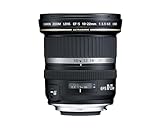
4. Canon EF-S 10-22mm f/3.5-4.5 USM
Canon EF-S 10-22mm f/3.5-4.5 USM SLR Lens for EOS Digital SLRs
10-22mm f/3.5-4.5
107.5 degree view
16 oz
Close focus 9.5 inches
Pros
- Among the widest zooms available for Canon EF-S bodies
- Fast USM autofocus with full-time manual override
- Close focus to 9.5 inches fills the frame with small subjects
- Circular aperture gives natural highlight rendering
Cons
- No built-in image stabilization for long exposures
- Slow f/3.5-4.5 range limits low light and astro
- Focusing and zooming are coupled on the fixed barrel
- Older design shows barrel distortion at the wide end
This older Canon EF-S zoom still turns up in bags on trips where the newer 10-18mm would be the obvious choice, and there is a reason. It focuses to 9.5 inches, which on a landscape lens is close-focusing rather than macro territory, and that gives you the option to fill the frame with a single lichen-covered stone while keeping a distant ridge legible behind it.
The USM motor is fast and, importantly, allows full-time manual focus with a ring turn. That is what makes hyperfocal work and focus peaking practical on a scene where you are dialing focus to infinity by feel.
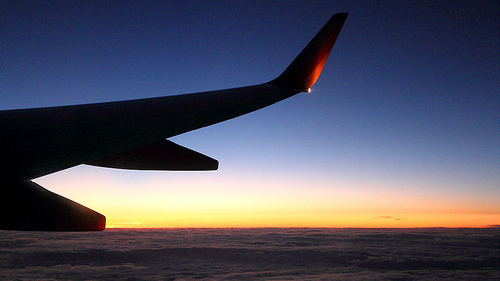
The 107.5 degree view at the wide end matches the 10-18mm for coverage, and the 22mm end gives you a more natural perspective when the composition gets tight. That zoom flexibility is the argument for this lens over any prime in the same class.
What it lacks is modern nicety. There is no image stabilization, so tripod discipline is mandatory at dawn, and the f/3.5-4.5 range asks you to accept noise or longer exposures in dim conditions. The fixed barrel design couples focusing to zooming, which some photographers find distracting.
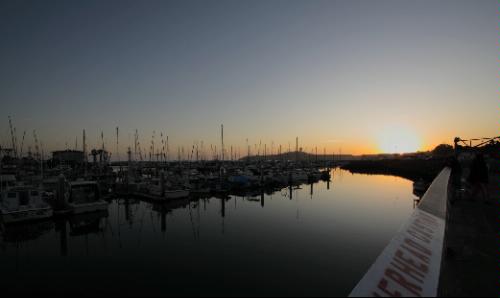
Who this lens suits
Entry and mid-tier Canon EOS DSLR shooters who want foreground interest in the frame and want the reach of a real ultra-wide without moving up the range. The used market for this generation of EF-S glass is where this lens makes the most sense.
Who should pass
Handheld landscape shooters and astro shooters. Without stabilization, at f/4.5, you are relying on a tripod for everything, and that limits when and where you can work.
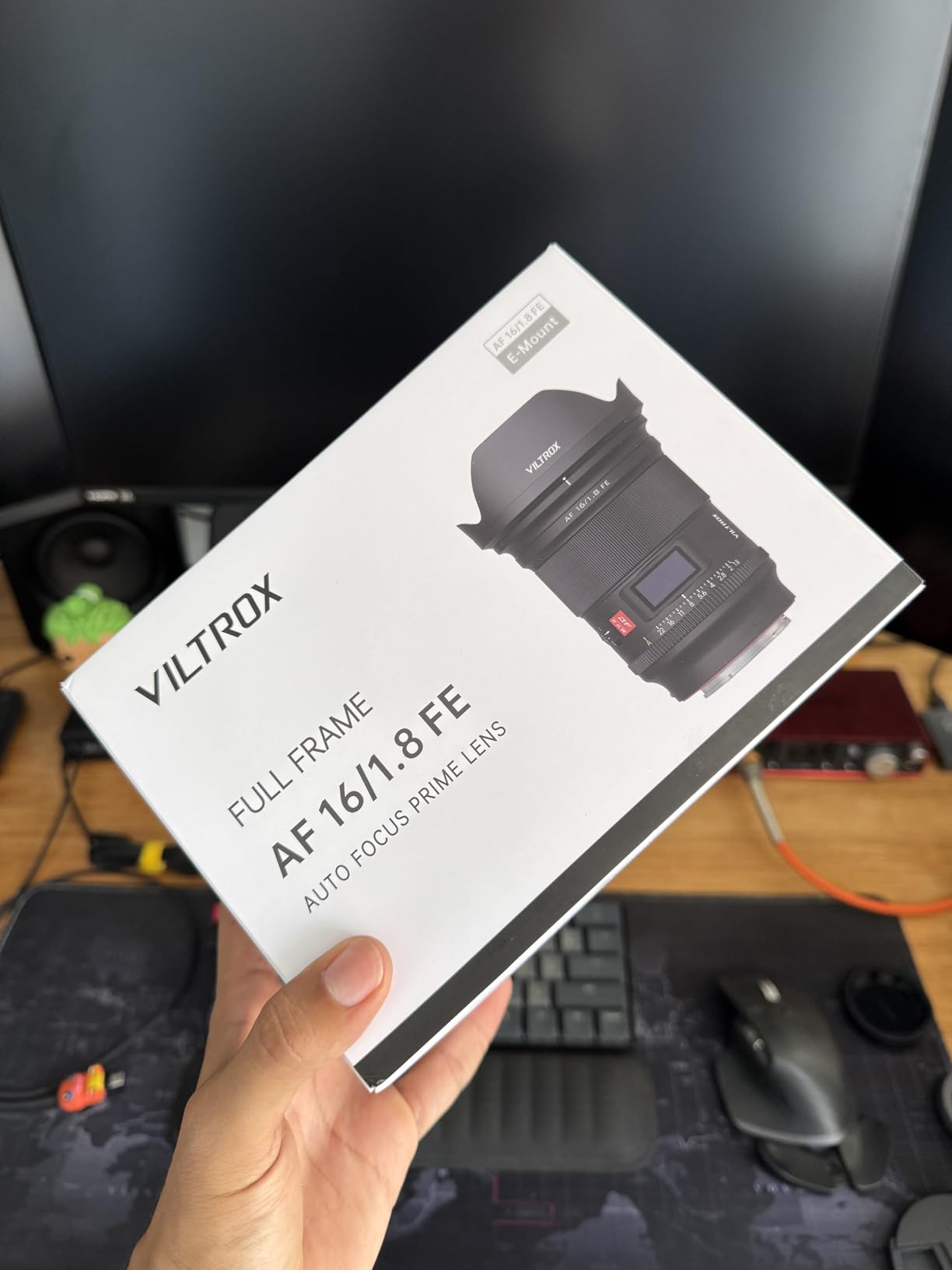
5. VILTROX AF 14mm f/4 Air FE for Sony E
VILTROX AF 14mm F4.0 Air Ultra-Wide Full Frame FE Lens for Sony E Mount
14mm f/4 prime
112.6 degree view
170 g
0.13m minimum focus
Pros
- 112.6 degree field of view captures expansive landscapes
- 12-element design with 2 aspherical and 4 ED elements
- 13cm minimum focus for strong near-far compositions
- Silent STM autofocus suits video and stacking
- Only 170 g so it never dominates a hiking kit
Cons
- Fixed f/4 is slow for night skies and low light
- No image stabilization and no weather sealing
- No lens hood listed in the package
A 14mm full-frame prime with a 112.6 degree field of view and a 170 gram body is the kind of specification that should not be possible at this tier, and owners in the reviews treat it as the budget route to genuine ultra-wide coverage. This is the lens I would try first for someone who wants to know whether they actually like ultra-wide before spending on a flagship.
The optical design is more serious than the weight suggests. Twelve elements in nine groups, including two aspherical, four ED, and two high-refractive-index elements, and reviewers describe the result as sharp edge to edge with minimal vignetting. That combination of four ED elements and a nano-coating is why the starburst rendering holds up against a backlit ridge.
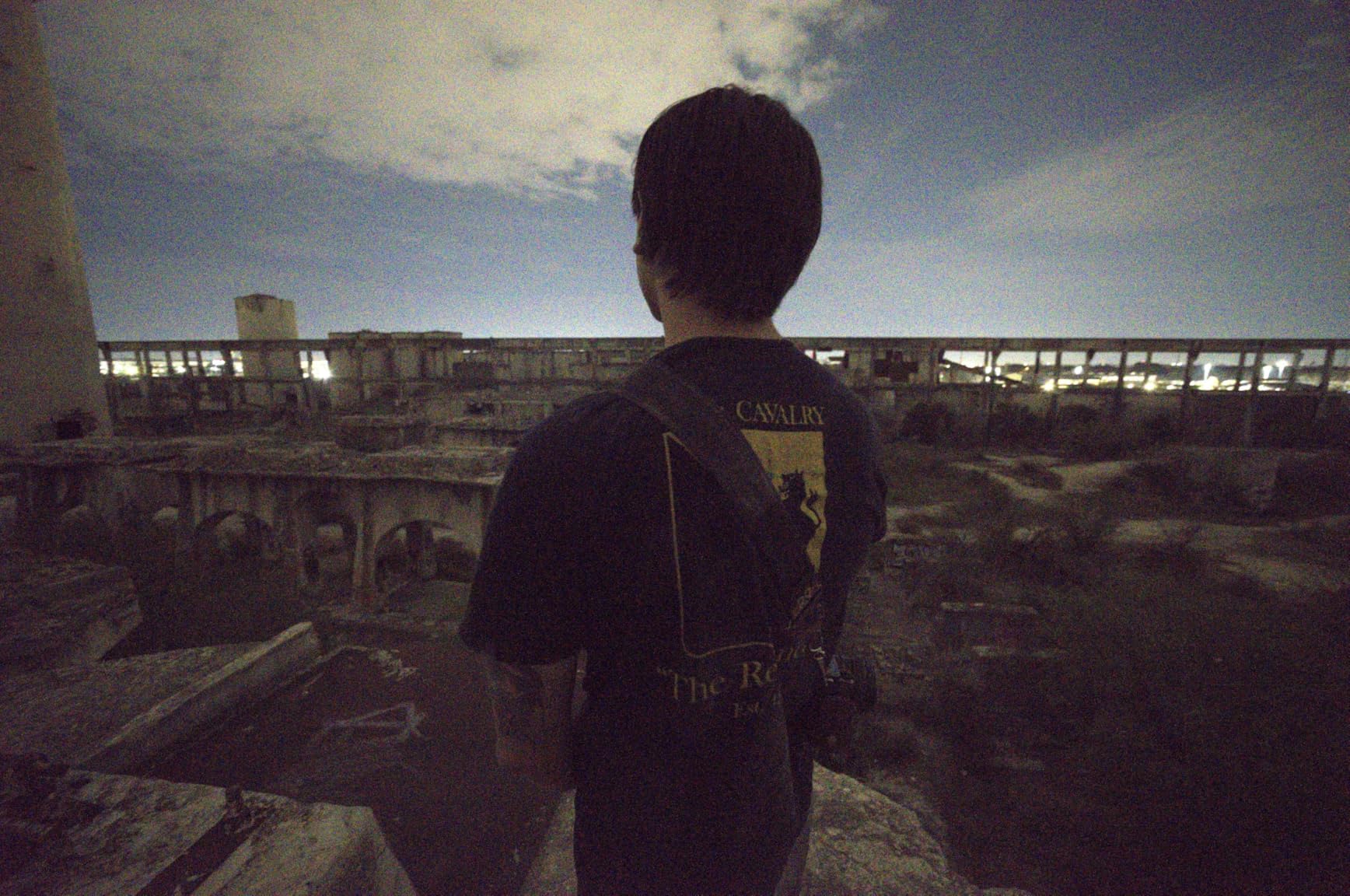
Focusing to 0.13 meters is the detail I like most for landscape work. That close focus distance means you can get a foreground subject large in the frame while a distant mountain stays rendered, and the minimal focus breathing means you can stack frames without the composition shifting between exposures.
The compromises are consistent across the listing and the reviews: no stabilization, no weather sealing, and a fixed f/4 aperture. The sealing matters more than the stabilization for a lens this size, because a sealed 170g prime would survive a wet hillside far better than an unsealed one. The manual states plainly that it is not weather resistant.
Who this lens suits
Full-frame Sony shooters who want maximum coverage at minimum weight and cost, and who shoot in conditions that are dry or mild. It is also a sensible first ultra-wide for a landscape beginner.
Who should pass
Astro photographers and anyone working in rain, snow, or spray. An f/4 aperture and no sealing rule this lens out of both use cases, and there is no hood in the box to protect the front element.
6. Fujifilm XF16mmF2.8 R WR
Fujifilm Fujinon XF16mmF2.8 R WR Lens – Black
16mm f/2.8
83.2 degree view
14.4 oz
Sealed at nine points
Pros
- Edge-to-edge sharpness with aspherical elements limiting chromatic aberration
- Very compact at 155g for hiking and travel
- Weather and dust sealed at nine points
- Nine rounded diaphragm blades for pleasing bokeh
Cons
- No optical image stabilization in the lens body
- Fixed f/2.8 is modest for astrophotography
- 49mm filter thread is narrower than some competing ultra-wides
This is the Fujifilm I recommend to someone who wants a sealed, sharp, light prime and does not need f/1.4. Ten elements in eight groups including two aspherical elements, sealed at nine points and rated to 14 degrees Fahrenheit, and it weighs 14.4 ounces with a length of 1.79 inches. That is an unusually good combination for a weather-sealed ultra-wide.
The f/2.8 aperture is two stops slower than the flagship 16mm, and for daylight landscape work that difference is invisible in the file. It only matters when the sun has already gone down and you want to keep the tripod packed.
Autofocus is fast and near-silent thanks to the inner-focusing stepping motor design, and there is no aperture click in the stills. The nine rounded blades produce the kind of smooth highlight rendering you notice on water surfaces and snow.
One practical constraint is the 49mm filter thread. It is narrower than the 58mm and 77mm threads common on competing ultra-wides, so your polarizer and ND filter options are narrower. That is a real limitation if you already own 58mm glass and want to reuse it.

Who this lens suits
Fujifilm X shooters who hike, shoot in variable weather, and want a single sealed prime that disappears in a pocket. This is the everyday landscape lens in the X range.
Who should pass
If your work is night sky or if you are building a filter kit around 58mm or 77mm threads, this lens is the wrong shape of tool.
7. Fujifilm XF16mmF1.4 R WR
Fujifilm Fujinon Lens XF 16mm F1.4 R WR, Black
16mm f/1.4
83.2 degree view
375 g
Manual focus
Pros
- f/1.4 gathers light for dawn
- dusk and astro landscapes
- Weather-resistant with 9 sealing points
- Nano-GI coating suppresses flare and ghosting
- Aperture ring for precise control on wide vistas
Cons
- Manual focus only
- Heavy at 375 g for a prime
- Fixed focal length with no zoom
This is the one to rent before you buy. At 375 grams it is by far the heaviest lens in the guide, and it is manual focus only, which means the whole experience is about technique rather than pointing and shooting. Used well, the results are the best low-light landscapes in the group.
The f/1.4 aperture is a full stop faster than the compact 16mm, and that stop is worth more than the weight suggests. It is the difference between a sky that needs a long exposure and a sky you can capture in a fraction of the time, which in turn is the difference between standing still and walking away from a fading colour on the horizon.
Manual focus on a wide prime is not the fussy proposition it sounds like. The minimum working distance is under six inches with 0.21x maximum magnification, and there are focus distance and depth-of-field indicators plus an aperture ring, so you can set the frame and dial to infinity with a repeatable method. The reviews mention focus peaking as the technique that makes it click.
Nano-GI coating and nine sealing points across eight areas mean the lens is built for exactly the conditions where a bright f/1.4 front element would otherwise flare. Backlit ridges, which is most ridges at dawn, are where this lens earns its place.
Who this lens suits
Serious landscape and astro photographers on Fujifilm X who shoot in low light and enjoy manual focus. If you print large and work at dawn regularly, this is the one that will hold up at the edges.
Who should pass
Hikers counting every gram, and anyone who wants confident autofocus across a mixed landscape and video workflow. There is also no stabilization, so it leans on your technique or your tripod.
8. Sigma 10-18mm f/2.8 DC DN for Sony E
10-18mm F2.8 DC DN (for E Mount)
10-18mm f/2.8 constant
10mm on APS-C
260 g
Weather sealed
Pros
- Covers 10mm on APS-C
- among the widest zooms for the format
- Constant f/2.8 across the whole range
- Light at 260 g with weather-sealed metal construction
- Sharp edge to edge with minimal distortion
Cons
- No optical stabilization on this mount variant
- Narrow zoom ring sits close to the hood
- Focus breathing is noticeable for video focus pulls
A constant f/2.8 from 10mm to 18mm on APS-C is the rarest combination in this guide, and it solves a problem that primes cannot. You get the darkest-sky framing at 10mm and the natural framing at 18mm without changing lenses, and the exposure stays identical across the zoom range.
Reviewers consistently single out the sharpness and the low distortion, which matters more for this focal length than almost any other. At 10mm, barrel distortion and corner softness are the usual failures, and this design handles both well enough that correction is a light touch.
Weather sealing and an all-metal body at 260 grams is the other argument. This is a lens you can keep mounted on a body in a bag on a wet day without thinking about it, and the manufacturer positions it explicitly for landscape and travel work.
There is no stabilization on this mount variant, which is odd given the constant f/2.8 aperture invites handheld shooting. The narrow zoom ring is also close enough to the hood to pinch fingers when you are wearing gloves, a small thing that becomes a real thing on a cold ridge.
Who this lens suits
Sony APS-C shooters who want a single sealed lens covering ultra-wide to standard wide, plus anyone who wants f/2.8 for night work and zoom flexibility for the day.
Who should pass
Videographers sensitive to focus breathing, and cold-handed users who will find the narrow zoom ring annoying. Stabilization users should check their body for in-body stabilization.
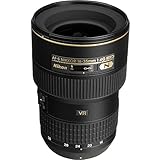
9. Nikon AF-S FX NIKKOR 16-35mm f/4G ED VR
Nikon AF-S FX NIKKOR 16-35mm f/4G ED Vibration Reduction Zoom Lens with Auto Focus for Nikon DSLR Cameras
16-35mm f/4 constant
107 degree view
1.5 lb
VR II up to 4 stops
Pros
- Sharp across the range with micro-contrast down to f/11
- Low flare and ghosting versus many ultra-wide zooms
- VR II genuinely useful for handheld wide shots
- Standard 77mm thread accepts polarizers and ND filters
- Lighter and cheaper than the f/2.8 14-24mm alternative
Cons
- All-plastic barrel feels less premium
- Front and rear elements move when zooming which reduces sealing
- Manual focus ring has slight lag before engaging
- Barrel distortion at 16mm needs correction
This is the full-frame zoom that keeps coming up as the sensible answer, and the reason is arithmetic rather than romance. Landscape work is shot at f/8 to f/11, so the extra two-thirds of a stop you get from f/2.8 is unused, while the weight and cost difference is real. This lens holds micro-contrast down to f/11, which is where landscape files are made.
Low flare and ghosting are the technical standouts, and for backlit ridges at dawn that is the difference between a usable frame and a ruined one. The VR II system, rated up to four stops, lets you work at shutter speeds where a non-stabilized lens would blur.
The 77mm filter thread is the most useful practical detail in this whole guide. It is a standard size, so a polarizer and a 3-stop or 10-stop ND from any major brand will fit without an adapter, and those filters are what let you shoot a 16mm vista in daylight with the shutter speed you need.
The criticisms are consistent: an all-plastic barrel, elements that extend during zooming which compromises sealing in rain, and a manual focus ring with a little lag before it engages. That lag is annoying specifically for hyperfocal work, where precise manual focus is the point.
Who this lens suits
Nikon F DSLR shooters, and anyone adapting this glass onto a Nikon Z or Sony E body. If you want one lens for landscapes, architecture, and general travel that stops down cleanly and accepts standard filters, this fits.
Who should pass
Anyone who needs a sealed barrel in sustained rain, or who wants maximum aperture for night work. The moving elements and plastic construction are the reasons to look at a sealed contemporary alternative.
10. Rokinon 14mm f/2.8 AF for Sony E
Rokinon 14mm F2.8 AF Wide Angle, Full Frame Auto Focus Lens for Sony E Mount
14mm f/2.8
113.9 degree view
450 g
Built-in petal hood
Pros
- Very wide 113.9 degree field of view in a single frame
- Built-in petal-style hood protects the front element and controls flare
- f/2.8 aperture supports night and astro shooting
- Weather-resistant aluminum body at 450 g
- Autofocus works with manual override
Cons
- Lowest average rating in the group with 9 percent one-star reviews
- No image stabilization
- Some users report edge softness and corner distortion
The widest field of view in this guide comes from a third-party prime, and for the specific job of putting a star-filled sky behind a silhouetted ridge, that field of view is the point. At 14mm with a 113.9 degree angle, the Milky Way arcs across the frame without you having to stitch a panorama.
The built-in petal-style hood is a genuine advantage here and the reviews mention it repeatedly. On an ultra-wide this wide, flare from off-frame light sources is the main enemy, and a hood that is already attached cannot end up on a hook when you are working in the dark.
Fourteen elements in ten groups including three aspherical and two ED elements, with internal focusing, a weather-resistant aluminum alloy body, and a responsive autofocus motor that also works with manual override. That is a well-specified lens for the class.
What pulls the rating down is consistency. The 4.2 average and 9 percent one-star share in the reviews point to reports of edge softness and corner distortion that need correcting, and at this focal length those artefacts are hard to hide. There is also no stabilization, which is standard for the category.
Who this lens suits
Night sky and astro landscape shooters on full-frame Sony bodies who want the widest coverage available without going to a fisheye and losing rectilinear geometry.
Who should pass
Anyone who prints large from the corners, and photographers who want predictable quality more than they want reach. Sample a rental first if your work depends on edge performance.
11. VILTROX 14mm f/4 for Nikon Z
VILTROX 14mm F4.0 Z-Mount Lens for Nikon, Full Frame Auto Focus Ultra-Wide Angle Prime Lens for Nikon Z-Mount Cameras ZFC Z5II Z50II Z30 Z5 Z6II Z7II Z6III Z7 Z8 Z9 ZF Z6 Z50
14mm f/4 prime
112 degree view
0.17 kg
0.13m minimum focus
Pros
- 112 degree field gives sweeping coverage on full-frame Nikon Z
- Twelve-element design with 4 ED elements keeps distortion low
- 13cm minimum focus for near-far landscape compositions
- Very light at 170 g and includes a lens hood in the box
- Minimal focus breathing suits focus stacking
Cons
- Fixed f/4 is slow for night skies and low light
- No image stabilization and no weather sealing
- Some corners softer than centre below f/8
This is the Nikon Z version of the same optical design as the Sony E Air, and the box contents are better: the lens hood is included here, along with a pouch and a cleaning cloth. For a 170 gram full-frame ultra-wide, that is a better package than most of the category manages.
Eye and face detection autofocus is listed among the features and performs fine for landscapes, where the target is a scene rather than a subject. The minimal focus breathing is the detail that matters most for stacking, because a shifting frame between exposures ruins a merged panorama.
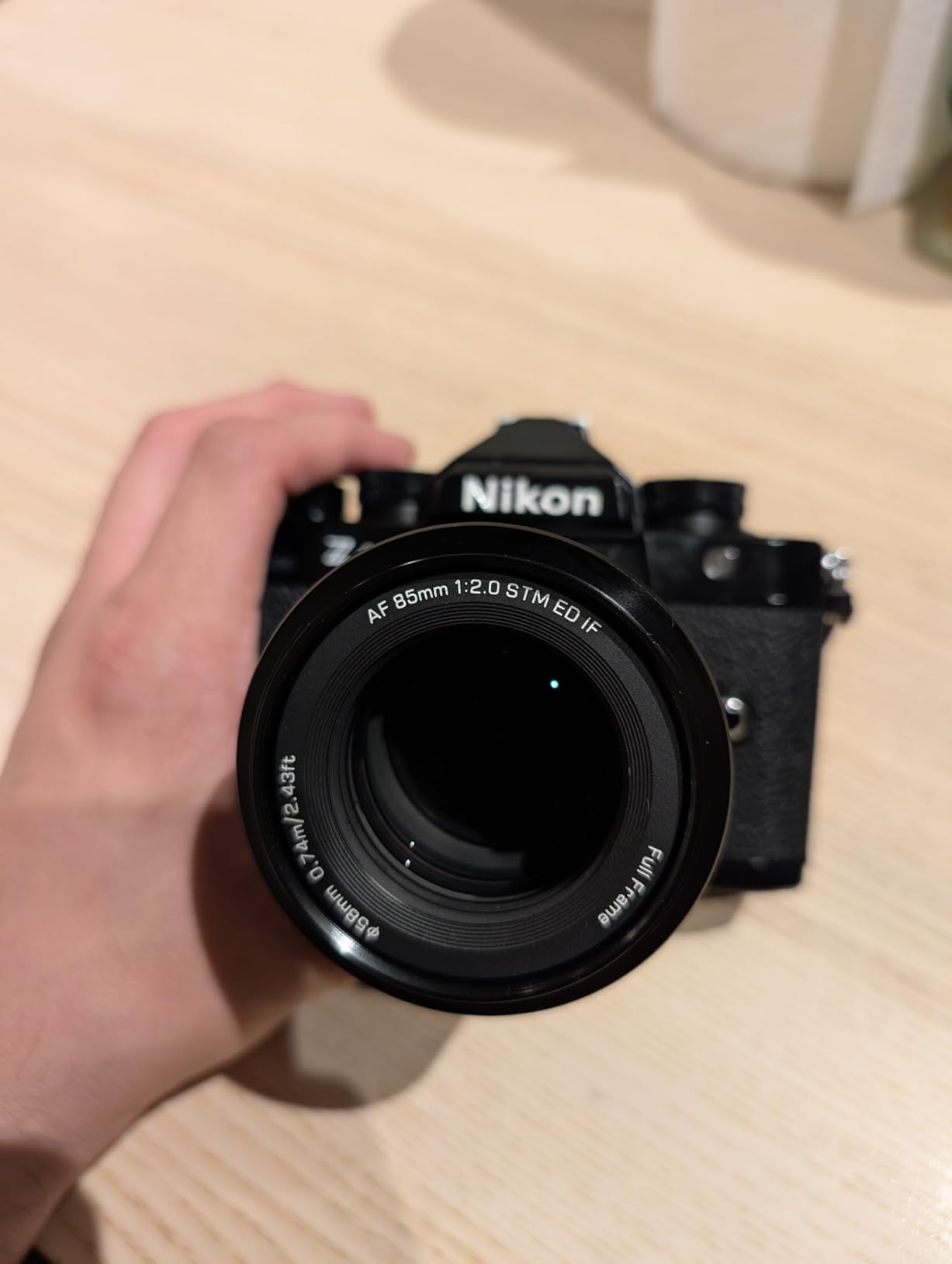
Twelve elements in nine groups with two aspherical, four ED, and two high-refractive-index elements, 0.13m minimum focus, and a constant f/4 aperture. The reviewers value the low distortion and vignetting, which is what keeps a 14mm composition from looking like it was shot with a cheap wide converter.
The recurring complaints mirror the Sony version: no stabilization, no sealing, and corners that are softer than the centre when you do not stop down to f/8. For daylight landscape work at f/8 or f/11, that resolves itself. For night work, the f/4 aperture is the limiting factor.

Who this lens suits
Full-frame Nikon Z shooters who want maximum coverage at minimum weight, especially anyone building a focus-stacking or panorama workflow where focus breathing matters more than low-light speed.
Who should pass
Astro shooters and anyone shooting in rain or snow. The lack of weather sealing is the most important limitation to know before you buy.
12. Fujifilm XF14mmF2.8 R
Fujifilm XF14mmF2.8 R
14mm f/2.8
21mm equivalent
235 g
58mm filter thread
Pros
- Very wide 21mm-equivalent field for dramatic landscapes
- Bright f/2.8 suits dusk
- night skies and astro scenes
- Light at 235 g
- Super EBC coating and aspherical elements handle flare well
Cons
- Manual focus only with no autofocus option
- No image stabilization and not weather resistant
- 58mm filter thread is smaller than most modern ultra-wides
A 14mm lens on an APS-C X body gives roughly a 21mm equivalent field of view, which is wider than anything else in the Fujifilm range without a converter. At 235 grams it is one of the smallest ultra-wide primes available, and the Super EBC coating plus two aspherical elements keep flare and aberrations under control.
It is also a manual-focus lens, and that is the reason the rating sits where it does. The 4.4 average with a meaningful share of one and two star reviews reflects people who bought it expecting autofocus on an X body and were not delighted.
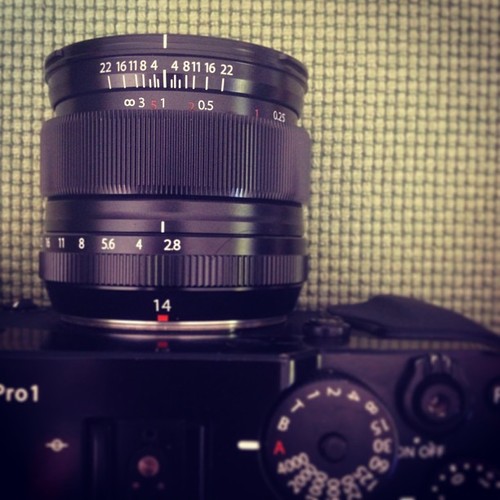
The f/2.8 aperture is still a real advantage for dusk work, and the 10 elements in seven groups including three abnormal dispersion elements are aimed squarely at controlling colour fringing at the frame edges, where 14mm lenses usually struggle.
Two practical limitations stand out. The 58mm filter thread is small by modern ultra-wide standards, so filter choices are narrower. And without weather resistance, this lens belongs in a dry climate or a camera bag, not on an exposed coastal ridge in a gale.

Who this lens suits
Fujifilm X shooters who want maximum angle of view at low weight, shoot in dry conditions, and are comfortable focusing manually. At 235 g it is one of the lightest ways to get this wide.
Who should pass
Anyone who wants autofocus, or who shoots outdoors in wet weather. The manual focus requirement combined with a fixed wide focal length is a narrow use case.
How to Choose a Wide-Angle Lens for Landscape Photography
Most buyers choose a wide lens by focal length and then regret the weight. Work through these seven factors in order and the answer usually becomes obvious before you have spent anything.
Focal length: match the angle of view, not the number
The number printed on the lens means nothing on its own. A 16mm on a full-frame body gives an 83.2 degree angle of view, while a 16mm on a Sony APS-C body gives roughly a 24mm equivalent field, and a 10mm on APS-C reaches 107.5 degrees. Judge coverage by the stated angle of view or the equivalent focal length, never by the number on the barrel.
A practical rule: around 70 to 85 degrees suits a single subject with context, 90 to 110 degrees covers most open landscapes with a foreground, and anything past 110 degrees is for dramatic scale, night skies, and interiors. A 35mm or 50mm is a better landscape lens only when you are shooting compressed, layered scenes where distant ridges stack up.
Maximum aperture: only matters below f/8
Daylight landscape work happens at f/8 to f/11 for depth of field, and every lens in this guide reaches those apertures. The aperture argument is entirely about the hours either side of that: f/2.8 and f/1.4 for dawn, dusk, and astro, f/4 for handheld twilight. If your work is between 10am and 4pm, aperture is the least important spec on the list.
Filter thread size
Filter compatibility catches people out more often than any other spec. The threads here run from 43mm on the Canon RF 16mm, through 49mm on the Fujifilm XF16mmF2.8, 58mm on the VILTROX Air and the Fujifilm XF14mm, up to 77mm on the Nikon 16-35mm. A narrow thread means cheap, light, easy-to-carry filters, and a standard thread like 77mm means your existing polarizer and ND glass already fits.
Weather sealing versus the forecast
Sealed options in this guide are the Fujifilm XF16mmF2.8 R WR, sealed at nine points and rated to 14 degrees Fahrenheit, the Fujifilm XF16mmF1.4 R WR with nine sealing points across eight areas, the Sigma 10-18mm f/2.8, and the Rokinon 14mm. The Canon RF 16mm, the two VILTROX 14mm lenses, and the Fujifilm XF14mm are explicitly not sealed.
Weight and the walk to the shot
Real weight figures here run from 163 g for the Canon RF 16mm and 170 g for both VILTROX lenses, through 240 g and 260 g for the Canon EF-S 10-18mm and the Sigma 10-18mm, up to 375 g for the Fujifilm XF16mmF1.4 and 450 g for the Rokinon 14mm, with the Nikon 16-35mm at 1.5 pounds and the Canon EF-S 10-22mm at 16 ounces. Multiply that by a thousand steps and a head height and the difference is very real, which is why your footwear matters as much as lens choice on a long approach.
Stabilization and low light
Only two lenses here carry lens-based stabilization: the Canon EF-S 10-18mm IS STM and the Nikon 16-35mm with VR II rated to four stops. Every other lens in the guide is stabilized by the body, if your body has it at all. For most bodies, a tripod does the job better than any lens stabilization at landscape shutter speeds.
Zoom or prime
Primes give you one perspective done well, with a brighter aperture available and usually less distortion to correct. Zooms give you framing flexibility at the cost of some edge performance and a heavier body. My rule after years of hauling both: if you shoot one subject type, prime; if you travel across mixed terrain or need architecture in the same trip, zoom. There is a good argument for a lightweight 24-70mm as a one-lens landscape solution for some shooters, though it will not reach true ultra-wide.
Two workflows are worth knowing before you buy. Focus stacking with a 14mm prime is very effective because the depth of field is enormous and focus breathing is often minimal, and it turns a hard edge-to-edge sharpness problem into a solvable one. Stitching a panorama is the other option, and at 24mm and longer it usually beats forcing a single ultra-wide frame, because you keep the natural perspective instead of exaggerating the foreground. A single 14mm frame is only better when the scale itself is the subject.
Finally, rent before you buy. A 375 g manual-focus prime feels completely different after an afternoon of carrying it than it does in a shop, and most rental houses stock the popular wide primes and zooms. It is the cheapest way to know whether a focal length suits your eye before the focal length becomes your only lens.
Frequently Asked Questions
What lens do most landscape photographers prefer?
Most landscape photographers reach for a wide zoom between 14mm and 24mm on full frame, because it covers everything from a sweeping vista to a tighter layered composition without changing lenses. Serious shooters often add a fast wide prime, such as a 16mm f/1.4, for dawn, dusk, and night work where a wider aperture keeps the tripod packed away. A crop-sensor kit with a 10-18mm zoom covers the same range for a fraction of the weight.
What are the downsides of wide-angle lenses?
The main drawbacks are barrel distortion at the wide end, softer corners than the centre, and exaggerated perspective that makes foreground objects loom. Wide apertures on fast primes also bring vignetting. You also lose a telephoto, so distant details stay distant. Most of these are corrected in software, but correction crops the frame slightly, and shooting a 14mm straight at a building gives famously converging verticals.
Is 24mm wide enough for landscape photography?
For many landscapes, yes. A 24mm full-frame frame with a foreground element and a strong horizon works well for open scenes, and a 16mm on an APS-C body gives a similar field of view. You want to go wider when the scene is enclosed, when the subject sits close to the camera, or when you want a dramatic sense of scale. Wider is not automatically better, because perspective exaggeration grows with it.
Is 35mm or 50mm better for landscape photography?
Neither is a wide-angle, and that is usually the point. A 35mm gives a natural-looking view of an open scene with modest foreground exaggeration, while a 50mm compresses depth and stacks distant ridges, which suits layered and misty scenes. Many working landscape photographers keep a 24mm to 70mm or similar standard zoom so they can move from a wide vista to a compressed detail without changing lenses.
Is f/4 fast enough or do I need f/2.8 for landscape photography?
In daylight, f/4 is more than enough, because landscape work is usually shot at f/8 or f/11 for depth of field anyway. The aperture only matters at dawn, dusk, and at night. An f/2.8 lens gathers roughly one and a half stops more light than an f/4, which can save several seconds of exposure, and the extra light also helps maintain focus accuracy on a tripod. Choose based on when you shoot, not on the spec sheet.
Do I need a wide-angle lens for landscape photography?
If you work on open scenes, shoot from low angles with foreground interest, or photograph coastlines and mountains, yes, a wide lens is close to essential. If your landscapes are compressed, telephoto-driven scenes, or your output is mostly crops from longer focal lengths, a standard zoom can carry the work. Many photographers keep a wide zoom in the bag permanently rather than as a primary lens.
Final Verdict on the Best Wide-Angle Lenses for 2026
After all of this, the choice comes down to one question: what time of day do you shoot? If it is daylight on Sony APS-C, the Sigma 16mm f/1.4 DC DN is the pick, with the best combination of sharpness, aperture, and light weight in the guide and by far the largest body of owner feedback. If you need maximum coverage per gram on full-frame, the Canon RF 16mm f/2.8 STM goes in the bag and stays there.
For night work, the fast apertures matter more than the focal length, and the Fujifilm XF16mmF1.4 R WR is the strongest low-light option here despite being the heaviest. For the widest possible reach at the lowest cost, the VILTROX 14mm lenses deliver 112 degree coverage at 170 g. And for one sealed all-round landscape zoom on a full-frame Nikon body, the AF-S 16-35mm f/4G ED VR still does the job with a 77mm filter thread that accepts the filters you already own.
Whatever you choose, rent it for a weekend first. Wide-angle is a habit as much as a focal length, and a few days with the lens will tell you more about how you compose than any spec sheet can. If the walk to the shot is the part you enjoy most, our picks for the best hiking boots for wide feet will keep you on the mountain rather than at the trailhead.