
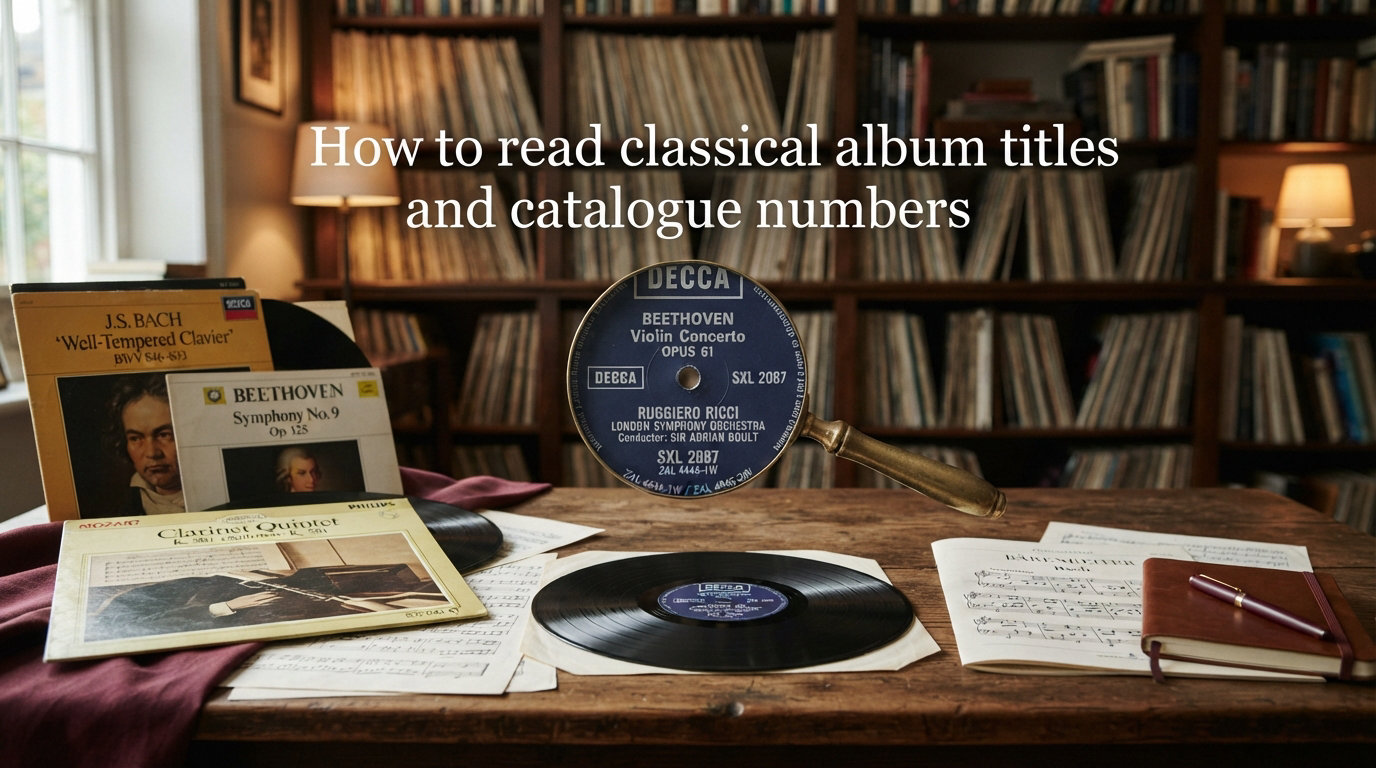
If you have ever stared at a track listing like “Beethoven: Symphony No. 5 in C minor, Op. 67, I. Allegro con brio” and felt completely lost, you are not alone. Our team hears this from readers every week, and it is one of the most common questions on classical music forums. The good news is that classical titles are not random. They follow a remarkably consistent formula, and once you learn to read the components, every album you own suddenly makes sense.
This guide explains how to read classical album titles and catalogue numbers without needing a music degree. We will break down opus numbers, the major catalogue systems (BWV, Kochel, Hoboken, WoO, Deutsch, RV, and Sz.), key signatures, work types, movements, and nicknames. By the end, you will be able to decode any classical track title in under ten seconds.
I have spent years organizing my own classical collection, and the same patterns show up everywhere, from streaming services to vinyl liner notes. Understanding the system also makes it much easier to find specific recordings, compare interpretations, and talk about music with confidence.
Table of Contents
The Anatomy of a Classical Title
Almost every classical title is built from the same five building blocks, assembled in a predictable order. When you know what each block does, you can read any piece of classical music like a sentence.
The standard structure is: Composer + Work Type + Number in Series + Key + Catalogue or Opus Number + (optional) Nickname. Some titles add movement names and tempo markings at the end.
Take this real example: “Mozart: Piano Sonata No. 11 in A major, K. 331, ‘Alla Turca’.” Composer is Mozart, the work type is a piano sonata, it is number 11 in his series, the key is A major, the Kochel catalogue number is 331, and “Alla Turca” is the famous nickname for its final movement.
Notice how every label carries information. The number 11 tells you it is one of a series. The key (A major) tells you about its sound character. The K. 331 tells you exactly which Mozart piece it is, even if the nickname were stripped away. These labels exist so performers, scholars, and listeners can identify works precisely.
What Is an Opus Number?
An opus number (from the Latin for “work”) is a number assigned to a composition when it is published, usually by the publisher. The abbreviation is Op. (plural Opp.), and it generally reflects the order in which pieces were published rather than the order in which they were written.
Opus numbers became common in the late 18th century, and most major composers from Haydn onward used them. Beethoven is the textbook example: his Op. 1 is a set of three piano trios published in 1795, and his Op. 135 is his final string quartet. Following Beethoven’s opus numbers gives you a rough tour of his creative life.
The system has real limitations. Many early works were never given opus numbers because they were not published during the composer’s lifetime. Some publishers split or merged opus numbers inconsistently. And composers like Bach, Mozart, and Haydn lived before the opus system was standardized, which is exactly why they need their own dedicated catalogues.
So when you see Op. on an album, you are looking at the publisher’s original numbering, and a low opus generally means an early published work. A high opus usually signals a late work. It is a useful clue, but it is not the whole story.
Catalogue Number Systems Explained
Catalogue numbers are scholar-created identification systems that solve the messiness of opus numbers. Each major composer has a dedicated catalogue, usually named after the musicologist who compiled it, and the abbreviation tells you instantly which system you are reading.
BWV: Bach’s Bach-Werke-Verzeichnis
BWV stands for Bach-Werke-Verzeichnis (“Bach Works Catalogue”), compiled by Wolfgang Schmieder in 1950. Bach left around 1,080 surviving works, and Schmieder organized them by genre rather than chronologically, which is why BWV numbers jump around in date.
The BWV system groups works into categories: cantatas (BWV 1-200), large choral works (BWV 232-249), organ works (BWV 525-771), and so on. The famous Goldberg Variations are BWV 988, and the Toccata and Fugue in D minor is BWV 565.
If you see BWV on a Bach album, you are looking at the definitive identifier. Scholars sometimes use BWV numbers with a forward slash for variants (such as BWV 1004/ii for a specific movement), but most album titles keep it simple.
K. or KV: Mozart’s Kochel Catalogue
K. (or KV) stands for Kochel-Verzeichnis, named after Ludwig Ritter von Kochel, who in 1862 produced the first chronological catalogue of Mozart’s 626 works. Mozart did not use opus numbers consistently, so Kochel’s work filled an enormous gap.
Each K. number corresponds to a place in Mozart’s life. K. 1 is a minuet written when he was five years old, and K. 626 is the unfinished Requiem from his final weeks. That continuity makes Kochel numbers uniquely satisfying to follow.
Later scholars revised Kochel’s chronology, which is why you sometimes see two numbers like K. 550 / K6. 550. The original Kochel number stays the same, but a K6 (sixth revision) number reflects updated dating. Most album covers stick with the original K. number for simplicity.
Hob.: Haydn’s Hoboken Catalogue
Hob. refers to the Hoboken-Verzeichnis, compiled by Anthony van Hoboken between 1957 and 1978. Haydn wrote over 1,000 works, and Hoboken organized them into categories using Roman numerals and a sub-number, separated by a colon.
The format looks like Hob. III:77, which means category III (string quartets), work 77. Category I is symphonies, so Symphony No. 104 is Hob. I:104. Category XVII contains piano trios, and so on.
This is why Haydn titles often look strange compared to other composers. The Roman numeral tells you the genre, the number after the colon identifies the specific piece, and together they form a precise address in his catalogue.
WoO: Beethoven’s Works Without Opus Number
WoO stands for Werke ohne Opuszahl (“works without opus number”). Beethoven left many pieces that were never published with an opus in his lifetime, including student works, dances, and short piano pieces.
The system was created by Georg Kinsky and Wilhelm Halm in 1955 and later expanded. The most famous WoO is WoO 59, which is the universally recognized For Elise (“Fur Elise”). Without this catalogue, that piece would have no official identifier.
Beethoven albums often mix Op. numbers with WoO numbers, plus a third system called Hess (abbreviated H. or Hess) for fragmentary or alternative versions. When you see all three on one album cover, the performer is being thorough.
D.: Schubert’s Deutsch Catalogue
D. (sometimes D. with a period, or in German sources as Deutsch-Verzeichnis) is Otto Erich Deutsch’s 1951 catalogue of Franz Schubert’s works. Schubert died at 31 but left over 1,500 compositions, most unpublished during his life.
D. numbers run chronologically. D. 1 is a fantasy for piano four-hands written when Schubert was 13, and D. 960 is his last piano sonata, composed in his final months. The Piano Quintet “Trout” is D. 667.
Because Schubert wrote so much so quickly, many works share nearby D. numbers, and revisions often get a letter suffix (such as D. 936A). The numbering remains the most reliable way to identify Schubert pieces.
RV and Sz.: Vivaldi and Bartok
Two more abbreviations appear regularly on classical albums. RV stands for Ryom-Verzeichnis, Peter Ryom’s 1973 catalogue of Antonio Vivaldi’s roughly 770 works. The Four Seasons is RV 269 (Spring), RV 315 (Summer), RV 293 (Autumn), and RV 297 (Winter).
Sz. refers to the Szollosy catalogue of Bela Bartok’s works, compiled by Andras Szollosy in 1956 and revised since. Bartok’s Concerto for Orchestra is Sz. 116, and his Mikrokosmos piano collection is Sz. 107.
Other niche catalogues include RV (Ryom for Vivaldi), HWV (Handel), and TrV (Richard Strauss). Each abbreviation is just a key to the scholar who organized that composer’s output.
Quick Reference: The Major Catalogue Systems
Here is a side-by-side reference for the eight catalogue systems you will see most often. No major competitor publishes a summary like this, so bookmark this section.
Op. — Opus, publisher-assigned (e.g., Op. 27). Used across many composers.
BWV — Bach-Werke-Verzeichnis, J.S. Bach (e.g., BWV 988). Schmieder, 1950.
K. / KV — Kochel, Mozart (e.g., K. 550). Kochel, 1862.
Hob. — Hoboken, Haydn (e.g., Hob. III:77). Hoboken, 1957-78.
WoO — Werke ohne Opuszahl, Beethoven (e.g., WoO 59). Kinsky/Halm, 1955.
D. — Deutsch, Schubert (e.g., D. 960). Deutsch, 1951.
RV — Ryom-Verzeichnis, Vivaldi (e.g., RV 356). Ryom, 1973.
Sz. — Szollosy, Bartok (e.g., Sz. 116). Szollosy, 1956.
Keys and Musical Modes
The key signature in a classical title tells you the tonal center of the work, such as C major, F minor, or B-flat major. It is one of the easiest clues to read, and it carries real information about the emotional character of the music.
Classical composers used keys as expressive tools. C major often sounds bright and ceremonial, while C minor tends to convey drama or tragedy. Beethoven’s Fifth is in C minor and his Emperor Concerto is in E-flat major, and the contrast is not accidental.
Watch for two details. First, major keys usually sound brighter than minor keys. Second, some titles specify a mode beyond major or minor, such as the Dorian or Mixolydian modes in older choral music. If a title just says “in D,” assume D major unless it specifies minor.
Work Types and Movements
Classical titles almost always begin with the type of composition, and the term tells you what forces are involved and roughly how long the piece will run.
A symphony is a large work for full orchestra, usually in four movements. A concerto features a solo instrument against orchestra. A sonata is for one or two players, often solo piano or piano plus one other instrument. A string quartet is for two violins, viola, and cello.
Other common types include the overture, suite, mass, requiem, etude, prelude, and fugue. The term immediately sets expectations for instrumentation and scale.
Longer works are divided into movements, listed with Roman numerals (I, II, III, IV). Each movement usually carries a tempo marking that tells the performer the speed and character, such as Allegro (fast), Andante (walking pace), Adagio (slow), or Scherzo (lively). So “IV. Allegro” means the fourth movement, played fast.
Nicknames and Subtitles
Many classical works carry a nickname in quotation marks, and these names almost always come from outside the composer. Some were invented by publishers, some by audiences, and only a few were assigned by the composer personally.
Beethoven did not name his Piano Sonata Op. 27 No. 2 the “Moonlight” Sonata. That nickname came from poet Ludwig Rellstab in 1832, who compared the first movement to moonlight on Lake Lucerne. Mozart did not call his Symphony No. 41 the “Jupiter”; that label appeared years after his death, probably from an English promoter.
Haydn’s nicknames often come from audience reactions. The Surprise Symphony earned its name from a sudden loud chord, and the Clock Symphony from a ticking rhythm in its slow movement.
For listeners, nicknames are a gift. They make pieces far easier to remember than catalogue numbers, which is exactly why forum users report reaching for nicknames first when talking about music. Just remember that the official identifier is still the opus or catalogue number, and the nickname is supplementary.
How to Decode a Full Classical Title, Step by Step
Let us walk through three real album titles using the formula. By the end of this section you should be able to decode any classical title yourself.
Step 1: Identify the composer. In “Beethoven: Symphony No. 9 in D minor, Op. 125, ‘Choral’,” the composer is Ludwig van Beethoven.
Step 2: Find the work type. Here it is a symphony, so we expect a full orchestra and probably four movements.
Step 3: Locate the number in the series. “No. 9” tells us it is Beethoven’s ninth and final symphony.
Step 4: Read the key. “D minor” indicates a darker, dramatic tonal center, which matches the work’s reputation.
Step 5: Note the catalogue or opus number. “Op. 125” is Beethoven’s official opus for this work, and the high number signals a late composition.
Step 6: Read any nickname. “Choral” refers to the final movement, which uses vocal soloists and chorus, an innovation at the time.
Now a denser one: “Bach: Goldberg Variations, BWV 988, Aria with Diverse Variations.” The composer is Bach, the work type is a set of variations, the catalogue number is BWV 988, and “Aria with Diverse Variations” is the work’s full subtitle, with “Goldberg” being the popular nickname.
And a Mozart example: “Mozart: Requiem in D minor, K. 626.” Composer Mozart, work type is a requiem mass, key is D minor, and K. 626 confirms it is his final, unfinished work. No nickname is needed because the catalogue number already identifies the piece precisely.
Classical Album Title Formatting Standards
If you are tagging a digital library or compiling an album of your own, consistency matters. The standard format used by major labels and recommended on classical music forums looks like this: Composer: Work Type No. X in Y key, Catalogue Number, ‘Nickname’ – Movement. Tempo.
Keep composer names in their original form (Mozart, not “Wolfgang”). Use a colon to separate composer from the rest. Always include the catalogue number, because two composers may have written “Symphony No. 5,” and only the catalogue number identifies the exact work.
For movement titles, lead with the Roman numeral, then the tempo marking, then any descriptive subtitle. An example: “I. Allegro con brio” for the first movement of Beethoven’s Fifth. Avoid using only track names like “Track 3” or made-up titles, which break searchability.
If you use a streaming service or ripping software, the most common tagging problems come from missing catalogue numbers or inconsistent nickname placement. Reddit users in r/classicalmusic consistently recommend including the catalogue number in the track title field, since that is what most classical databases key off.
One more practical tip. When you organize by composer, sort chronologically using the catalogue number, not the work number within a series. Chronological order reveals how a composer’s style evolved, which is one of the great pleasures of building a classical collection in 2026.
FAQs
How to interpret classical music titles?
Break any classical title into five parts: composer, work type, number in series, key, and catalogue number, plus an optional nickname. Read left to right, and each label adds information. For example, ‘Beethoven: Symphony No. 5 in C minor, Op. 67’ tells you the composer (Beethoven), the work type (symphony), the series number (5), the key (C minor), and the official identifier (Op. 67).
How are album titles formatted?
Classical album titles follow the format: Composer + Work Type + Number in Series + Key + Catalogue Number + (optional) Nickname, then movement names. Major labels place the composer first, use a colon as a separator, and always include the catalogue or opus number so the exact work can be identified. Movement titles use Roman numerals followed by tempo markings.
Why does Mozart have K numbers?
Mozart has K numbers because he did not use opus numbers consistently, and in 1862 the musicologist Ludwig Ritter von Kochel created a chronological catalogue of all 626 of his works. Each K. (or KV) number places the piece in Mozart’s life, with K. 1 written when he was five and K. 626 being his unfinished Requiem. The system is called the Kochel-Verzeichnis.
How to identify classical music pieces?
Use the catalogue or opus number as the unique identifier. Two composers may both have written ‘Symphony No. 5,’ but only the catalogue number distinguishes them precisely. Search streaming services, sheet music databases, and library catalogues by composer plus catalogue number (for example, ‘Mozart K. 550’) to find the exact piece and all available recordings.
Putting It All Together
Learning how to read classical album titles and catalogue numbers is a small investment that pays off every time you browse a record store or a streaming library. The same five-part formula works across every composer, every label, and every era of classical music.
Start with the composer, identify the work type, then read the series number, key, and catalogue number. Lean on nicknames when you need to remember a piece, but trust the catalogue number when you need to find it again. With a little practice, those long Latin-and-number strings stop looking like code and start looking like addresses in one of the richest musical traditions we have.
If you want to go deeper, pick one composer’s catalogue (Mozart’s Kochel is the most rewarding) and explore it in order. You will hear the music grow up alongside the numbers, and that is when the system really starts to mean something.