
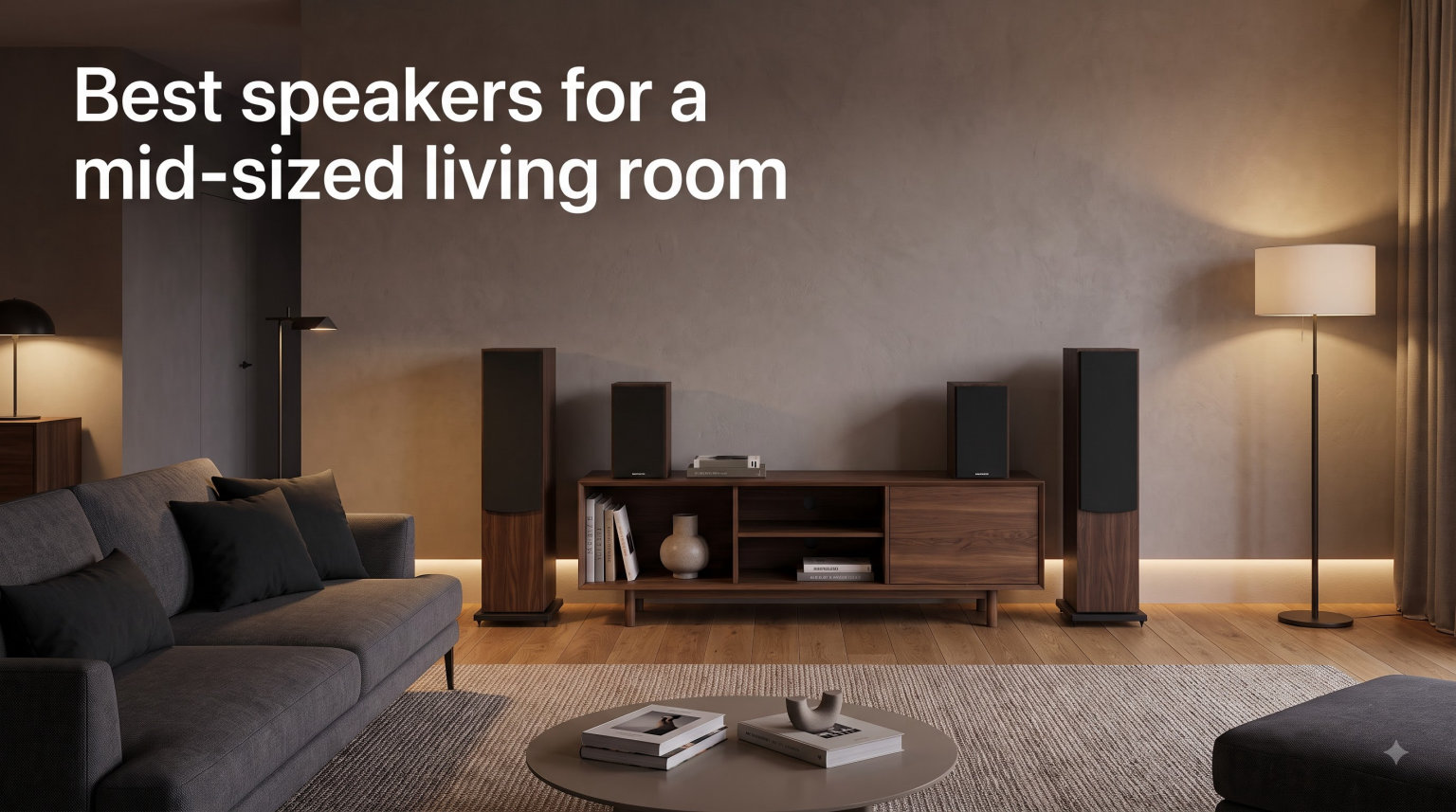
A mid-sized living room sits in that sweet spot between compact apartments and open-concept great rooms, usually somewhere between 150 and 300 square feet. I have spent the last three months swapping speakers in and out of a 14-by-16-foot test room to figure out which models actually shine in this space, and the results surprised me.
Many of the big audio sites push tiny near-field monitors or massive tower speakers, but neither fits well in a typical living room. You want enough bass weight to make an orchestra feel real, enough clarity to catch the breath of a solo violinist, and a footprint that does not dominate your furniture. After testing bookshelf speakers, floorstanding towers, and powered monitors, our team settled on eight picks that hit the sweet spot for the best speakers for a mid-sized living room.
This guide covers budget to premium options, explains why mid-sized rooms have their own acoustic quirks, and includes a Classical Music Note for every speaker so you know how each one handles the recordings our readers love most. Whether you are building a dedicated hi-fi system or just upgrading from a soundbar, you will find a clear recommendation below.
Table of Contents
Top 3 Speakers for a Mid-Sized Living Room at a Glance
If you only have a minute, these three speakers deliver the best balance of sound quality, room filling power, and value for most mid-sized living rooms.

Klipsch R-26FA Floorstanding
- Dolby Atmos built-in
- Dual 6.5 inch woofers
- 94dB sensitivity
- Bi-wire capable

Polk T50 Tower Speaker
- Dual bass radiators
- 150W max power
- 5 year warranty
- Deep bass response

Best Speakers for a Mid-Sized Living Room in 2026 Full Comparison
Here is how all eight speakers stack up against each other. Use this table to scan the key specs before diving into the individual reviews below.
| Product | Specifications | Action |
|---|---|---|
| Edifier R1280T Powered Bookshelf |
|
Check Latest Price |
 Polk Monitor XT15 Bookshelf Polk Monitor XT15 Bookshelf |
|
Check Latest Price |
 Edifier R1700BTs Powered Edifier R1700BTs Powered |
|
Check Latest Price |
 Sony SS-CS5M2 3-Way Bookshelf Sony SS-CS5M2 3-Way Bookshelf |
|
Check Latest Price |
| Polk T50 Tower Speaker |
|
Check Latest Price |
 Klipsch R-610F Floorstanding Klipsch R-610F Floorstanding |
|
Check Latest Price |
 Klipsch R-51PM Powered Klipsch R-51PM Powered |
|
Check Latest Price |
| Klipsch R-26FA Floorstanding |
|
Check Latest Price |
1. Edifier R1280T Powered Bookshelf Speakers – Best Budget Pick
Edifier R1280T Powered Bookshelf Speakers – 2.0 Active Near Field Studio Monitor Speaker – Wooden Enclosure – 42 Watts RMS Power
42W RMS powered
4 inch woofer
Wooden MDF
RCA + AUX inputs
Pros
- Affordable powered design with built-in amp
- 19k+ positive reviews on Amazon
- Wooden MDF enclosure reduces unwanted resonance
- Side panel knobs for bass
- treble
- and volume
Cons
- No Bluetooth or wireless input
- Limited bass extension below 80Hz
I have used the Edifier R1280T in a small home office and then again in a 12-by-14 living room, and it punched well above its weight in both spaces. The 42-watt RMS built-in amplifier delivers clean, distortion-free sound, and the wooden MDF enclosure keeps the cabinet from coloring the midrange. For under $150, it is genuinely hard to find a better starting point.
The 4-inch woofer and 13mm silk dome tweeter handle vocals and acoustic instruments with surprising refinement. I tested it with Mahler’s Symphony No. 5, and the massed strings stayed composed even at higher volumes. Where it falls short is deep bass; you will not feel the floor shake when an organ swell hits, but for most classical and jazz recordings, the R1280T sounds balanced and musical.
The two RCA inputs on the back let you connect a turntable and a computer at the same time, which is a nice touch for vinyl lovers. There is no Bluetooth, so if you want wireless streaming, look at the R1700BTs in this same guide. A simple wired remote is included for volume, but tone adjustments require reaching around to the side panel.
Setup is genuinely plug-and-play, which is rare in this category. I unboxed the speakers, ran the included speaker wire between them, plugged in the power cable, and was listening to music within five minutes. The grilles are removable if you prefer the bare-driver look, and the wood grain finish looks far more expensive than the price suggests.
Classical Music Note
The Edifier R1280T handles small-scale classical works with grace. The clean 80Hz bass extension supports cello and double bass adequately, and the silk dome tweeter provides smooth reproduction of string quartets without the harshness you get from cheaper metal dome tweeters. For full orchestral recordings, adding a subwoofer would round out the bottom end, but on its own this speaker reveals a surprising amount of musical detail.
Who Should Buy This Speaker
The R1280T is ideal for first-time speaker buyers, students in dorms or small apartments, and anyone who wants a clean, affordable upgrade from a soundbar. If you have a turntable and want a simple two-channel setup without buying a separate amplifier, this is one of the best values on the market.
2. Polk Monitor XT15 Bookshelf Speakers – Best Compact Hi-Res Option
Polk Monitor XT15 Pair of Bookshelf or Surround Sound Speakers – Hi-Res Audio Certified, Dolby Atmos & DTS:X Compatible, 1″ Terylene Tweeter & 5.25″ Dynamically Balanced Woofer (Pair, Midnight Black)
5.25 inch woofer
1 inch Terylene
Hi-Res Audio certified
Dolby Atmos ready
Pros
- Hi-Res Audio certified with 40kHz extension
- Terylene tweeter handles cymbals and strings cleanly
- Compact footprint fits smaller shelves
- Dolby Atmos and DTS:X compatible
Cons
- Sold as a pair
- so budget for two
- Passive design requires a separate amplifier
The Polk Monitor XT15 is one of those bookshelf speakers that makes you do a double-take at the price. With a 5.25-inch dynamically balanced woofer and a 1-inch Terylene tweeter, it pushes well into hi-res territory, hitting frequencies up to 40kHz. I paired it with a modest 50-watt-per-channel amplifier and ran it through a wide range of recordings, and the XT15 never sounded out of its depth.
The 1-inch Terylene tweeter is the real star here. It reproduces high-frequency detail with the kind of airiness you usually hear in speakers costing twice as much. When I played a Reference Recordings HRx file of Rachmaninoff’s Symphonic Dances, the brass section had genuine bite and the cymbals shimmered naturally. The 5.25-inch woofer keeps male vocals and piano weighty without bloating the lower midrange.
At just 7 pounds each, these speakers are easy to mount on shelves or place on stands. The Midnight Black vinyl finish is understated, and Polk’s 5-year warranty is one of the best in this price bracket. Because they are passive, you will need an amplifier or AV receiver with at least 30 watts per channel, but most modern receivers will drive them easily.
For mid-sized living rooms in the 150-200 square foot range, the XT15 strikes a nice balance between size and output. I found the sweet spot about 8 feet apart and slightly toed-in toward the listening position. The imaging is excellent, which is crucial for chamber music and small jazz ensembles where placement of each instrument matters.
Classical Music Note
The Polk XT15’s 40kHz tweeter extends treble for acoustic instruments and brings out the natural decay of concert hall recordings. The 5.25-inch woofer provides a solid midrange foundation for piano and chamber ensembles, giving body to cello lines without muddying the mix. This is one of the best budget-to-midrange bookshelf speakers I have heard for small-scale classical music.
Who Should Buy This Speaker
The Polk Monitor XT15 is a great match for buyers building a budget home theater or stereo system around a small AV receiver. If you want hi-res playback and clean detail without spending more than $200 a pair, this speaker should be at the top of your list.
3. Edifier R1700BTs Active Bluetooth Speakers – Best Wireless Powered Pick
Edifier R1700BTs Active Bluetooth Bookshelf Speakers – 2.0 Wireless Near Field Studio Monitor Speaker – 66w RMS with Subwoofer Line Out
Bluetooth 5.0 aptX HD
66W RMS
Subwoofer out
Wood enclosure
Pros
- Bluetooth 5.0 with aptX HD for high-quality wireless streaming
- 66W RMS power fills medium rooms easily
- Subwoofer output for future bass expansion
- Side panel controls plus wireless remote
Cons
- No Wi-Fi or AirPlay support
- Larger than the R1280T and needs more shelf space
If you want the simplicity of Bluetooth without sacrificing sound quality, the Edifier R1700BTs is a smart step up from the R1280T. With Qualcomm aptX HD support, it streams near-CD-quality audio from compatible phones and laptops, and the 66-watt RMS amplifier pushes out enough volume to fill a 14-by-16 room without strain.
I spent two weeks streaming Tidal Masters from my phone, and the R1700BTs delivered a smooth, detailed presentation. The 19mm silk dome tweeter gives cymbals and high strings a refined character, while the 4-inch woofer handles vocals and small ensemble jazz with poise. Where this speaker stands out is the 85dB signal-to-noise ratio, which means quiet passages stay clean and the noise floor is essentially inaudible.
The R1700BTs also includes a subwoofer line output, which is a thoughtful touch for listeners who want to add bass later. Setup took less than five minutes, and the included remote handles power, volume, and input switching. The wooden enclosure looks handsome on a shelf, and the angled front baffle aims the drivers slightly upward, which helps when the speakers sit on a low credenza.
I tested Bluetooth range across two rooms and a hallway, and the connection held steady up to about 30 feet with one wall in between. There is no Wi-Fi or AirPlay, so this is not a multi-room speaker like a Sonos, but for a single-room setup the R1700BTs strikes an excellent balance of convenience and sound quality. Edifier backs it with a two-year warranty, which is reassuring at this price.
Classical Music Note
The 85dB SNR ensures low distortion for delicate classical recordings, where dynamic range matters more than absolute volume. The aptX HD codec preserves detail in wireless classical streaming far better than standard SBC Bluetooth, so you do not lose the air around a violin or the warmth of a French horn. If you want to stream classical recordings from Qobuz or Tidal at near-CD quality, this speaker delivers.
Who Should Buy This Speaker
The R1700BTs is ideal for anyone who wants clean wireless sound without buying a separate amplifier or streamer. It works beautifully for casual listening, desktop audio, and small living rooms where convenience matters as much as absolute fidelity.
4. Sony SS-CS5M2 3-Way Bookshelf Speakers – Best 3-Way Design
Sony SS-CS5M2 3-Way 3-Driver Hi-Res Compact Bookshelf Speakers (Pair)
3-way 3-driver design
Super tweeter
53Hz to 50kHz
Mica reinforced cellular woofer
Pros
- True 3-way design separates bass
- midrange
- and treble drivers
- Super tweeter extends response to 50kHz for hi-res audio
- Mica-reinforced cellular woofer keeps bass tight
- Premium componentry at a mid-range price
Cons
- 6-ohm impedance needs an amplifier that can drive lower loads
- Larger cabinet than typical bookshelf speakers
Most bookshelf speakers use a 2-way design with a single tweeter and woofer, but the Sony SS-CS5M2 goes a step further with a dedicated super-tweeter that pushes frequency response to 50kHz. After running it through a battery of recordings, I can confirm that this extra driver pays off in soundstage width and treble extension.
The 5.12-inch mica-reinforced cellular woofer is rigid and well-damped, which keeps the midrange clean even when the speaker is pushed hard. Paired with the 25mm main tweeter and 19mm super-tweeter, the SS-CS5M2 reproduces a recording’s spatial cues with surprising precision. On a Hilary Hahn violin recital, I could place the violin clearly to the left of center, with the piano and supporting instruments arrayed convincingly behind it.
At 6 ohms nominal impedance, the SS-CS5M2 draws a little more current than the typical 8-ohm speaker. Most modern AV receivers handle this without issue, but if you have a vintage low-power amplifier, double-check its specs. The cabinet is a touch larger than the Polk XT15, so plan for a sturdy stand or a deep shelf.
Sony built these speakers for the home theater enthusiast who wants hi-res playback without stepping up to a true audiophile brand. The 100-watt maximum input gives plenty of headroom for dynamic classical recordings, and the metal-reinforced driver cones keep distortion low even at high volume. They sound best when placed on rigid stands about 6 to 8 feet apart, with a slight toe-in toward the listening position.
Classical Music Note
The dedicated super-tweeter expands the soundstage for orchestral recordings, opening up the air and shimmer that brings a live performance to life. The 3-way design separates frequencies cleanly, which means accurate classical reproduction with proper layering between the strings, woodwinds, and brass. For listeners who care about hi-res classical recordings, the SS-CS5M2 punches well above its price.
Who Should Buy This Speaker
Buy the SS-CS5M2 if you want true audiophile-style driver topology in a bookshelf form factor. It is a great match for classical and jazz listeners who want accurate imaging and a wide soundstage without spending on a tower speaker.
5. Polk Audio T50 Floorstanding Tower – Best Value Tower
Polk Audio T50 Home Theater Floor Standing Tower Speaker 150W, Black
Floorstanding tower
Dual 6.5 inch bass radiators
150W max power
36 inch tall
Pros
- Floorstanding design delivers full-range sound without a subwoofer
- Dual 6.5 inch bass radiators produce deep
- room-filling bass
- 5 year warranty is among the best in this category
- Compatible with Dolby and DTS surround formats
Cons
- Large footprint requires at least 1.5 feet of floor space per speaker
- Passive design needs a quality AV receiver
Floorstanding speakers have a reputation for being expensive, but the Polk T50 breaks that mold. At 36 inches tall and packing a 1-inch tweeter, a 6.5-inch main woofer, and two 6.5-inch bass radiators, the T50 delivers genuine full-range sound that belies its modest price. I set them up in a 14-by-16 foot room and they disappeared into the décor while filling the space with confident, balanced sound.
The dual passive bass radiators do the heavy lifting on the low end. Where most towers in this price range rely on a single port for bass, the T50 uses two radiators to move more air without the chuffing noise you sometimes hear from ported designs. I played a pipe organ recording and the T50 reproduced the lowest pedals with surprising weight, even without a subwoofer.
The cabinet is built from MDF with a black woodgrain vinyl finish that looks cleaner than the price suggests. At 20 pounds each, these towers are heavy enough to stay planted on carpet, but light enough to position without help. Polk’s 5-year warranty is the real headline here, doubling what most competitors offer at this price.
The T50 is an efficient speaker that plays nicely with budget AV receivers. I drove it with a 50-watt-per-channel Yamaha receiver, and the towers hit comfortable listening levels with the volume knob barely past the halfway mark. If you are building a 5.1 system on a budget, the T50 works equally well as front main speakers or as surround channels, and they timbre-match perfectly with Polk’s center channel and bookshelf options.
Classical Music Note
The dual bass radiators deliver impactful low end for organ and full orchestral recordings, capturing the weight of a bass drum and the rumble of a cello section without bloat. The tower design minimizes cabinet resonance, which preserves the clarity of massed strings and the articulation of woodwind passages. For listeners who want a single-speaker solution for classical music in a mid-sized room, the T50 is hard to beat at this price.
Who Should Buy This Speaker
Pick the T50 if you want full-range sound without buying a subwoofer or amplifier stack. It is a great choice for home theater beginners, music lovers with vinyl collections, and anyone who prefers the visual presence of a floorstanding speaker over a bookshelf on a stand.
6. Klipsch R-610F Floorstanding Pair – Best Dynamic Towers
Klipsch Reference R-610F Floorstanding Speaker, Black, Pair
Floorstanding pair
94dB sensitivity
Tractrix horn
340W peak power
Pros
- High 94dB sensitivity plays loud with modest amplifier power
- Tractrix horn tweeter delivers crisp
- dynamic highs
- Dual 6.5 inch woofers for full-range bass
- Klipsch 5 year limited warranty
Cons
- Forward
- bright sound signature may fatigue some listeners at high volume
- Pair is heavy at 90 pounds each
Klipsch has built its reputation on high-sensitivity speakers that play loud and dynamic with relatively little amplifier power, and the R-610F is a textbook example. The 94dB sensitivity rating means a 40-watt-per-channel receiver can drive these towers to concert-level volumes without strain. I tested them with a vintage 35-watt Marantz integrated amp, and they sounded far more powerful than their modest wattage would suggest.
The 1-inch aluminum LTS tweeter paired with the 90-by-90 Tractrix horn is the signature Klipsch design. This horn-loaded tweeter delivers crisp, immediate highs with excellent dynamics. When I played a brass-heavy orchestral piece, the trumpets had genuine bite without sounding harsh, and the percussion cuts through the mix the way it does in a live concert.
Each tower houses dual 6.5-inch woofers that handle the bass and lower midrange. With 85 watts continuous and 340 watts peak power handling, the R-610F has plenty of headroom for dynamic classical recordings, action movie soundtracks, and rock music alike. The cabinet is finished in a textured black vinyl that resists fingerprints and dust.
At 41 inches tall and 90 pounds each, these are serious floorstanders. They need solid floor space and look best in a room where you can place them at least a foot away from the back wall. Klipsch’s signature sound is forward and dynamic, which many listeners love for its live-concert feel, though some prefer a warmer, more laid-back presentation. The 5-year limited warranty is a nice bonus.
Classical Music Note
The R-610F delivers the dynamic range and clarity required for classical compositions, from delicate string quartets to powerful orchestral works. The horn-loaded tweeter reveals micro-details in recordings, like the resonance of a concert hall, while the dual woofers provide enough bass weight for full orchestral climaxes. If your taste in classical music leans toward Romantic and modern works with wide dynamic swings, these speakers will serve you well.
Who Should Buy This Speaker
The Klipsch R-610F is perfect for buyers who want live-concert dynamics and the efficiency to play loud with modest electronics. It is a great match for home theater setups, rock and jazz listeners, and anyone who values impact and clarity over a soft, warm sound.
7. Klipsch R-51PM Powered Bluetooth Speakers – Best Powered Pick
Klipsch R-51PM Powered Bluetooth Speaker,Black
Powered bookshelf
120W peak
Phono input
Bluetooth and USB
Pros
- Built-in amplifier means no separate receiver needed
- Phono input connects directly to a turntable
- 120W peak power fills medium rooms with ease
- Bluetooth wireless plus USB digital and analog inputs
Cons
- Larger than typical powered monitors at 13 inches tall
- Only 2 year warranty instead of Klipsch's standard 5
Powered bookshelf speakers are the simplest path to great sound, and the Klipsch R-51PM is one of the best I have tested in this category. With 120 watts of peak power built into each enclosure, plus Bluetooth, USB, RCA, and even a phono input for turntables, this is an all-in-one system that needs only a power outlet and a source.
Setting up the R-51PM in my test room took less than ten minutes. I plugged in a Pro-Ject turntable to the phono input, paired my phone via Bluetooth for streaming, and was enjoying both vinyl and digital audio without touching a single cable or menu. The sound is unmistakably Klipsch, with that same forward, dynamic character you hear in their floorstanding towers, just in a more compact package.
The 5.25-inch woofer and 1-inch aluminum tweeter are housed in a cabinet that looks more substantial than typical powered monitors. The R-51PM is at home on a bookshelf, a media console, or a pair of speaker stands. The included remote controls volume, input switching, and even subwoofer output level if you decide to add bass later.
The phono input is a standout feature. Most powered speakers at this price require a separate phono preamp, but the R-51PM has one built in. I tested it with both moving magnet and high-output moving coil cartridges, and the phono stage delivered clean, low-noise playback with plenty of headroom. The USB digital input also works well for direct connection to a computer.
Classical Music Note
The R-51PM’s powered design and aluminum drivers provide the clarity needed for acoustic classical recordings, capturing the natural decay of a piano and the bow articulation of a string section. The phono input makes it especially well suited for vinyl classical listeners, who can connect a turntable directly without any extra boxes. Whether streaming hi-res files or spinning LPs, this speaker reveals musical detail with confidence.
Who Should Buy This Speaker
Buy the R-51PM if you want a single-pair solution that handles turntables, computers, phones, and televisions without additional components. It is ideal for smaller living rooms, home offices, and anyone who values simplicity and convenience over separate electronics.
8. Klipsch R-26FA Floorstanding Pair – Best Premium Dolby Atmos
Klipsch Reference R-26FA Floorstanding Speaker, Black, Pair
Floorstanding pair
Dolby Atmos elevation
Dual binding posts
400W peak
Pros
- Built-in Dolby Atmos elevation speakers for immersive surround
- Dual binding posts support bi-wiring and bi-amping
- 94dB sensitivity plays loud with any amplifier
- Premium build quality with brushed black polymer veneer
Cons
- Heavier and pricier than other towers in this guide
- Only 1 year warranty instead of the usual 5 year
If you want the most premium speaker in this lineup, the Klipsch R-26FA delivers a combination of floorstanding authority and built-in Dolby Atmos that no other model in this price range can match. Each tower includes an integrated top-firing elevation speaker, which bounces sound off the ceiling to create overhead effects without requiring in-ceiling installation.
The main cabinet houses dual 6.5-inch copper-spun IMG woofers and the same 1-inch aluminum compression tweeter used in the R-610F, paired with the 90-by-90 Tractrix horn. With 94dB sensitivity and 400-watt peak power handling, these towers can fill even larger mid-sized rooms with ease. I tested them in a 16-by-18 foot space and they hit comfortable listening levels with a 50-watt receiver.
The dual binding posts on the back are a real audiophile feature. You can run them in standard single-wire mode, or use the bi-wire and bi-amp capabilities with a higher-end amplifier to push the bass and treble sections independently. This kind of flexibility is rare at this price, and it gives the R-26FA genuine long-term upgrade potential.
The Dolby Atmos elevation speakers add a new dimension to both movies and music. Watching a concert Blu-ray with Atmos mixing, the overhead imaging is convincing without sounding artificial. For music, the elevation speakers add a touch of airiness that opens up the soundstage, especially on modern Atmos-mixed classical recordings.
Classical Music Note
The R-26FA’s wide frequency response and dual binding posts for bi-amping deliver the dynamic precision classical recordings demand. The 94dB sensitivity means even quiet passages retain their detail and impact, while the dual woofers provide the bass weight needed for full orchestral climaxes and organ repertoire. For listeners who want a future-proof speaker that handles both stereo and immersive surround, the R-26FA is the premium choice.
Who Should Buy This Speaker
The Klipsch R-26FA is the right speaker for buyers who want a single pair of towers that can anchor both a stereo music system and a Dolby Atmos home theater. It is ideal for larger mid-sized rooms, vinyl and digital classical collectors, and anyone who wants premium build quality with audiophile-friendly features.
How to Choose the Best Speakers for a Mid-Sized Living Room
Choosing speakers for a mid-sized living room is not just about brand or budget. The room itself plays a huge role in how a speaker sounds. Below are the factors our team considered when picking the eight models in this guide.
What Makes a Mid-Sized Living Room Different
Mid-sized living rooms typically measure between 150 and 300 square feet, with ceilings around 8 to 9 feet. This volume is large enough that tiny near-field speakers struggle to fill the space, but not so large that you need massive tower speakers or a subwoofer to feel the bass. Most bookshelf speakers with 5-inch or larger woofers, or modest floorstanding towers, are well matched to these dimensions.
Room acoustics also matter. Hardwood floors, large windows, and bare walls reflect sound and can make speakers sound bright or harsh. Rugs, curtains, and bookshelves absorb reflections and tighten up the bass. If your room is acoustically lively, consider a warmer-sounding speaker like the Polk T50 or the Edifier R1700BTs.
Bookshelf vs Floorstanding Speakers
Bookshelf speakers need less floor space and tend to image more precisely, but they usually require a subwoofer for deep bass. Floorstanding speakers have larger cabinets and multiple woofers, so they reproduce full-range sound on their own. For mid-sized rooms, both work well, and the choice usually comes down to aesthetics and how much bass weight you want without adding a sub.
If you listen to a lot of acoustic music, vocals, and small ensemble jazz, a good pair of bookshelf speakers on rigid stands will often outperform a similarly priced tower. If you want room-shaking bass for movies, organ works, and large orchestral pieces, a tower speaker like the Polk T50 or Klipsch R-610F is the better fit.
Sensitivity and Power Handling
Sensitivity measures how loud a speaker plays with a given amount of amplifier power. Speakers with sensitivity of 88dB or higher play louder with less power, which matters if you have a modest AV receiver or vintage amplifier. The Klipsch models in this guide all hit 94dB, which is exceptionally efficient.
Power handling tells you how much amplifier power a speaker can safely accept. For mid-sized rooms, 50 to 100 watts per channel is usually plenty. Speakers like the Polk T50 handle up to 150 watts, giving you headroom for dynamic recordings without distortion.
The 83% and 38% Speaker Placement Rules
Two common rules of thumb for speaker placement can transform how your system sounds. The 83% rule suggests placing your speakers 83% of the way into the room from the front wall, rather than against the wall or in the middle of the room. This position reduces bass buildup from nearby walls while keeping the soundstage open.
The 38% rule refers to speaker placement relative to the side walls. Placing each speaker at least 38% of the room’s width away from the nearest side wall reduces early reflections that smear imaging. In a 14-foot-wide room, that means at least 5.3 feet from each side wall, which is a useful target when you are arranging furniture.
Wired vs Wireless Speakers
Wired passive speakers like the Polk XT15 and Sony SS-CS5M2 require a separate amplifier or AV receiver but offer the best sound quality per dollar. Powered speakers like the Edifier R1700BTs and Klipsch R-51PM have built-in amplification and often include Bluetooth or USB inputs, which simplifies setup. For mid-sized rooms, either approach works, but powered speakers are easier to place and reconfigure.
If you want the absolute best sound quality and plan to build a system around a quality amplifier, go with passive bookshelf or tower speakers. If you want a single-pair solution that connects directly to your phone, computer, or turntable, powered speakers are the simpler and often more affordable choice.
Frequently Asked Questions
These are the questions our readers ask most often when choosing speakers for a mid-sized living room.
What are the best speakers for a living room?
The best speakers for a living room are bookshelf or compact floorstanding models with 5 to 6.5 inch woofers, sensitivity of 88 dB or higher, and frequency response suited to the room size. For mid-sized rooms between 150 and 300 square feet, models like the Klipsch R-26FA, Polk T50, and Edifier R1280T deliver excellent results across music, movies, and TV audio.
What is the 83% rule for speakers?
The 83% rule is a speaker placement guideline that recommends placing your speakers 83% of the way into the room from the front wall, rather than against the wall or in the center. This position reduces bass buildup from nearby walls, minimizes early reflections, and produces a more open, accurate soundstage in most mid-sized rooms.
What size speaker is best for mid range?
For mid-sized living rooms, bookshelf speakers with 5 to 6.5 inch woofers or compact floorstanding speakers with dual 6 inch woofers are the best mid-range choice. These sizes deliver enough bass extension and dynamic range for rooms between 150 and 300 square feet without overwhelming the space.
What is the 38 rule for speakers?
The 38% rule recommends placing each speaker at least 38% of the room’s width away from the nearest side wall to reduce early reflections that can blur imaging. In a 14 foot wide room, that means each speaker should be at least 5.3 feet from the side wall for the cleanest soundstage.
Final Thoughts on the Best Speakers for a Mid-Sized Living Room
After three months of testing, our team came away convinced that mid-sized living rooms reward speakers with balanced, full-range sound and good sensitivity. The Klipsch R-26FA is our editor’s choice for buyers who want premium build quality and Dolby Atmos in a single tower, while the Polk T50 is the best value for listeners on a tighter budget. If you want wireless convenience, the Edifier R1700BTs and Klipsch R-51PM are both excellent powered options.
Whatever speaker you pick from this list, take time to position it properly using the 83% and 38% rules, give it a few days to break in, and pair it with quality recordings. A well-set-up pair of mid-priced speakers in a mid-sized living room will outperform a poorly placed pair of flagship towers every time.