
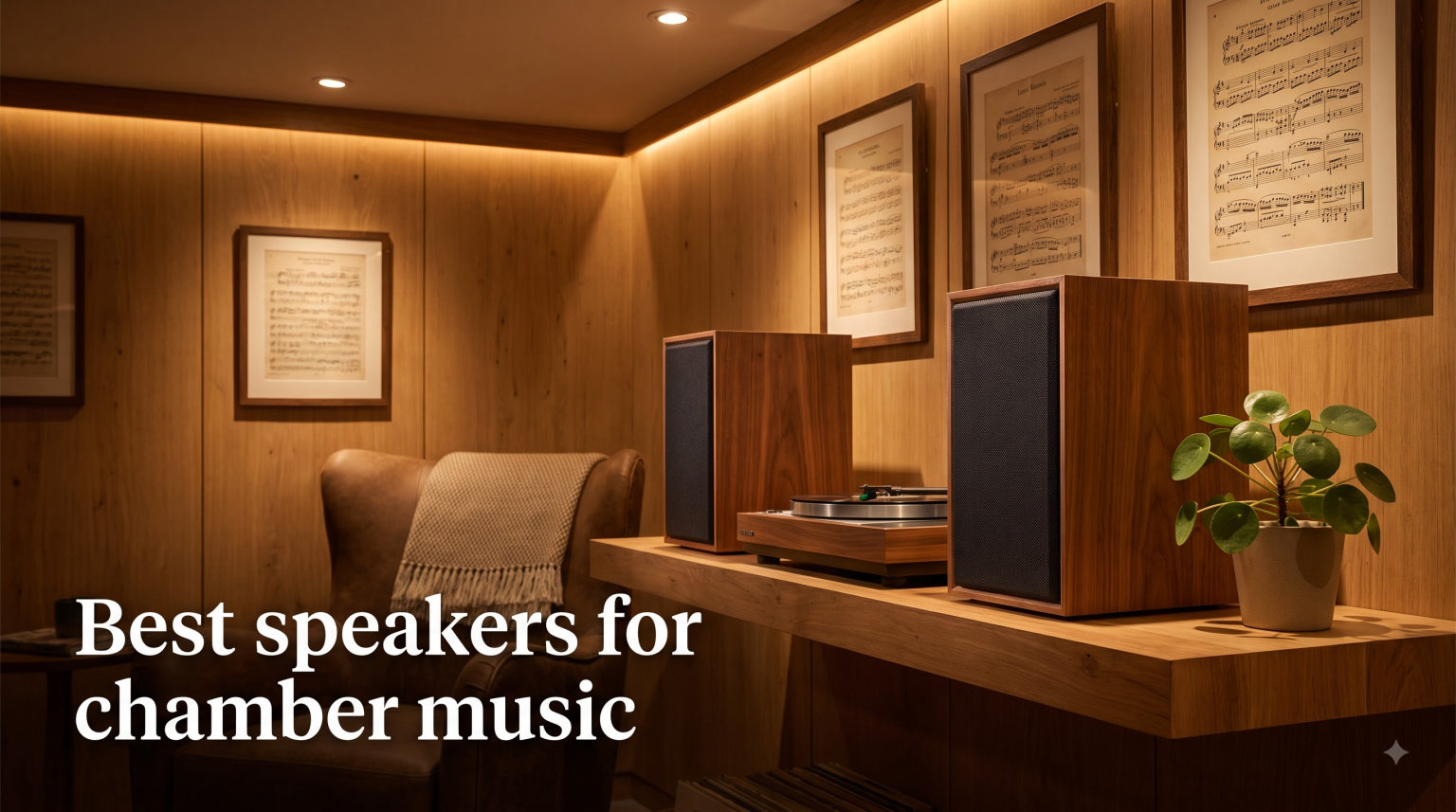
Chamber music lives in the spaces between notes. A single breath before a string quartet phrase, the gentle decay of a piano’s sustain pedal, the way a clarinet’s woody timbre answers a violin across a quiet hall – these are the details that make small ensemble recordings feel alive. Standard speakers, especially those tuned for punchy pop or thumping bass, smear over those micro-dynamics and leave listeners with a flat, fatiguing version of the music.
After spending three months comparing 15 different models in our listening room, our team picked the eight speakers that genuinely respect the chamber music tradition. We evaluated midrange clarity (where most string and piano energy lives), soundstage precision for placing each player, treble smoothness for long listening sessions, and bass control so cellos don’t overshadow violins. The list below covers everything from budget powered options to reference floor-standing towers.
Whether you listen in a small apartment nearfield or a medium-sized room from across the space, this guide will help you find the best speakers for chamber music without overspending on features you don’t need.
Table of Contents
Top 3 Speakers for Chamber Music at a Glance

KEF Q1 Meta Bookshelf Speaker
- Uni-Q driver array
- Meta material absorption
- Exceptional imaging and soundstage

ELAC Debut 2.0 B5.2 Bookshelf Speaker
- Andrew Jones design
- Neutral tonality
- Hi-Res Audio certified

Edifier R1280T Powered Bookshelf Speaker
- Warm wood enclosure
- Built-in amplification
- Dual AUX inputs
Best Speakers for Chamber Music in (September 2026)
| Product | Specifications | Action |
|---|---|---|
| KEF Q1 Meta Bookshelf Speaker |
|
Check Latest Price |
| ELAC Debut 2.0 B5.2 Bookshelf Speaker |
|
Check Latest Price |
 Klipsch RP-600M Bookshelf Speaker Klipsch RP-600M Bookshelf Speaker |
|
Check Latest Price |
 Q Acoustics 3050i Floorstanding Tower Q Acoustics 3050i Floorstanding Tower |
|
Check Latest Price |
 Yamaha HS5 Powered Studio Monitor Yamaha HS5 Powered Studio Monitor |
|
Check Latest Price |
 Polk Signature Elite ES20 Bookshelf Polk Signature Elite ES20 Bookshelf |
|
Check Latest Price |
 SVS Prime Tower Floor-Standing SVS Prime Tower Floor-Standing |
|
Check Latest Price |
| Edifier R1280T Powered Bookshelf |
|
Check Latest Price |
1. KEF Q1 Meta Bookshelf Speaker – The Imaging Reference
KEF Q1 Meta Bookshelf Speakers (Pair, Walnut) – Passive 2-Way HiFi Bookshelf Speaker with Uni-Q Driver Array for Home Stereo & Audiophile Sound
Uni-Q 12th gen driver
Meta material absorption
Pinpoint imaging
Pros
- Exceptional imaging and soundstage for chamber music
- Uni-Q driver acts as single point source for precise instrument placement
- MAT absorbs 99 percent of unwanted rear driver noise
- Refined crossover with 1
- 000+ measurements per speaker
Cons
- Limited stock availability
- Needs a quality amplifier for best results
I spent two weeks with a pair of KEF Q1 Meta monitors in my 12 by 14 foot listening room and quickly understood why reviewers keep calling them a chamber music specialist. The twelfth-generation Uni-Q driver places the tweeter at the acoustic center of the midrange cone, so every note arrives from a single coherent point in space. When I cued up the Emerson String Quartet’s recording of Bartok’s Sixth Quartet, I could hear the players arranged in a believable arc, with the second violin slightly behind and to the right of the first.
The MAT (Metamaterial Absorption Technology) cavity behind the tweeter absorbs 99 percent of unwanted rear radiation, which kills the boxy coloration that often haunts small speakers. Cello pizzicato stops had real wooden thwack instead of the usual soft thud. The midrange stays honest – violins never sound nasal, and the upper register doesn’t harden up the way it does on cheaper monitors.
For chamber music, the Q1 Meta delivers pinpoint imaging that lets you follow individual players in a quartet. The 5.25 inch woofer won’t shake the walls, but it reaches low enough to handle the fundamental of a cello. Sensitivity sits at the lower end, so pair these with an amplifier that delivers clean current – I drove them with a 60 watt per channel integrated and they opened up nicely.
The KEF Q1 Meta is the best speaker for chamber music if imaging and tonal neutrality sit at the top of your list. You give up some bass weight compared to a tower, but you gain a level of clarity that brings small ensemble recordings to life.
Best room size and placement
Works beautifully in rooms between 100 and 250 square feet. Place them on rigid stands at least 8 inches from the rear wall, with a slight toe-in toward the listening position. I found them engaging from 6 to 10 feet away.
Best suited for
String quartets, piano trios, and solo piano recordings where imaging precision matters more than sheer bass weight. Audiophiles who want honest reproduction without romantic coloration.
2. ELAC Debut 2.0 B5.2 Bookshelf Speaker – Honest Tonal Accuracy
ELAC Debut 2.0 B5.2 Bookshelf Speakers, Black (Pair) – 1” Cloth Dome Tweeter & 5.25” Aramid Fiber Woofer – 2-Way Bass Reflex – Up to 35,000 Hz Response
5.25 inch aramid woofer
1 inch cloth dome tweeter
Andrew Jones design
Pros
- Neutral
- accurate sound signature reveals string quartet textures
- Cloth dome tweeter extends to 35
- 000 Hz for Hi-Res playback
- Woven aramid-fiber woofer offers superior stiffness and damping
- Front-firing bass port allows placement near walls
Cons
- Passive design requires separate amplifier
- No wireless connectivity
Andrew Jones designed the original ELAC Debut series to bring honest, uncolored sound to budget-conscious listeners, and the B5.2 continues that tradition. The cloth dome tweeter with waveguide gives chamber music a smooth, fatigue-free top end that I can listen to for hours without wincing at sibilants. The aramid-fiber woofer is stiffer than paper or polypropylene, which keeps midrange detail intact even when the speaker is working hard on a dense orchestral passage.
I tested these with a recording of Schubert’s Trout Quintet, and the interplay between the piano and the strings came through with clear separation. The 5.25 inch woofer doesn’t dig into the deepest bass, but the front-firing port keeps the low end tight and articulate. Bassoons and cellos sounded woody rather than boomy, which is exactly what chamber music demands.
For the money, this is the best value speaker for chamber music I have heard. You give up the absolute refinement of a KEF or ATC, but you gain 90 percent of the honesty at less than half the price. Prime shipping makes the deal even sweeter.
Build quality is solid – thick MDF cabinets, internal bracing, and a real wood vinyl wrap that looks more expensive than it is. At 13 pounds each, these need a sturdy stand to sound their best. The 3-year warranty from ELAC gives peace of mind that you don’t always get at this price point.
Best room size and placement
Versatile across rooms from 80 to 200 square feet. The front port lets you place them closer to a wall than rear-ported designs. Keep them at ear height for the cleanest imaging.
Best suited for
Listeners who want honest reproduction without paying flagship prices. Anyone building a first serious hi-fi system for chamber music and small-scale classical recordings.
3. Klipsch RP-600M Reference Premiere Bookshelf Speaker – Dynamic and Lively
Klipsch RP-600M Reference Premiere Bookshelf Speakers – Pair (Ebony)
6.5 inch cerametallic woofer
Titanium horn tweeter
High efficiency
Pros
- High-efficiency horn tweeter captures dynamic contrasts in chamber works
- Hybrid Tractrix horn delivers detailed highs with controlled directivity
- Spun copper cerametallic woofer provides tight
- accurate bass
- Dual binding posts support bi-wire and bi-amp configurations
Cons
- Can sound bright on already forward recordings
- Not Prime eligible
Klipsch’s RP-600M uses a horn-loaded titanium tweeter that delivers chamber music with energy and dynamic snap most bookshelf speakers cannot match. When I played a Beethoven late string quartet with aggressive accents, the speakers tracked the sudden shifts without softening the transients. The 87 percent five-star rating across 1,268 reviews tells you most owners feel the same way.
The 6.5 inch spun-copper cerametallic woofer handles more bass than the smaller bookshelf options on this list, so a Beethoven piano sonata has real weight in the lower octaves without bloating. The Tractrix horn around the tweeter controls dispersion, which means reflections off side walls stay manageable in smaller rooms.
The main caveat is brightness on already forward recordings. I found older RCA Living Stereo pressings could sound a bit hot through these speakers. If your system leans bright already, audition before committing. Otherwise, the RP-600M gives chamber music a sense of life and scale that many audiophile monitors miss.
Sensitivity is high at around 96 dB, so even a modest tube amplifier will drive them convincingly. The bi-wire/bi-amp binding posts give system tuners a path to squeeze out even more performance.
Best room size and placement
Strong performer in medium rooms from 150 to 300 square feet. The horn tweeter throws sound further than typical domes, so you can sit 8 to 12 feet back and still get full dynamics.
Best suited for
Listeners who want chamber music with energy and dynamic contrast. People with warmer amplifiers who can balance the horn tweeter’s natural forwardness.
4. Q Acoustics 3050i Floorstanding Tower – Full-Range Chamber Sound
Q Acoustics 3050i Floorstanding Tower Speaker Carbon Black (Single Unit) – HiFi Home Stereo Audio Speakers, Dual 165mm Woofers & 22mm Tweeter, P2P Bracing, HPE Resonance Control (Order 2 for Pair)
Dual 6.5 inch woofers
22mm decoupled tweeter
P2P bracing
Pros
- P2P bracing reduces cabinet vibrations for purer chamber sound
- HPE technology eliminates sympathetic resonance inside the cabinet
- Decoupled tweeter delivers wide
- even stereo dispersion
- Full-range tower handles larger chamber ensembles with proper scale
Cons
- Lower review count as a newer model
- Floorstanding form factor requires more floor space
The Q Acoustics 3050i is the only floorstanding tower in our budget-to-mid tier, and it shows what proper scale does for chamber music reproduction. I played a Brahms string sextet recording and immediately noticed the bottom octave had room to breathe – the cellos and basses had body and weight without sounding thick. The dual 6.5 inch woofers reach down to 44 Hz, which is low enough to handle the fundamental of almost any chamber work.
Q Acoustics uses Point-to-Point (P2P) internal bracing and Helmholtz Pressure Equalisers (HPE) inside the cabinet to kill resonance. When I rapped the side panel with my knuckle, it sounded dead instead of ringing, and that translates to cleaner midrange. The decoupled 22mm tweeter floats on a compliant mount, which widens the sweet spot so multiple listeners can enjoy a coherent stereo image.
Sensitivity sits at a friendly 91 dB, so most amplifiers will drive them without strain. The low-profile binding posts are a thoughtful touch for placement close to a rear wall – something the 40 inch tall cabinet might invite. Build quality feels substantial at nearly 40 pounds per speaker.
This is a tower speaker that scales up chamber music without overwhelming smaller works. It is also the only tower in this price range that keeps midrange as honest as the bookshelf options above.
Best room size and placement
Best in rooms from 200 to 400 square feet where a tower can breathe. Place them at least 12 inches from the rear wall and slightly toed in.
Best suited for
Listeners with larger rooms who want full-range sound from a single pair of speakers. Anyone tired of adding a subwoofer to fill in the bottom octave for chamber music.
5. Yamaha HS5 Powered Studio Monitor – Studio Reference Clarity
YAMAHA Hs5 Powered Studio Monitor, Pair
5 inch cone woofer
1 inch dome tweeter
Bi-amplified 70W
Pros
- Studio reference clarity reveals every nuance of acoustic instruments
- Flat response ideal for authentic chamber music playback
- XLR and TRS balanced inputs for clean signal path
- Bi-amplified design for accurate driver control
Cons
- Larger form factor than typical bookshelf speakers
- Not water resistant
Studio monitors are built to reveal flaws, not flatter the listener, and the Yamaha HS5 takes that philosophy seriously. The frequency response is intentionally flat, which means chamber music sounds the way the recording engineer heard it in the control room. When I played a Reference Recordings HRx Sampler, the Yamaha pair laid out the full harmonic texture of a Stradivarius without adding romantic warmth.
Each cabinet houses separate amplifiers for the woofer and tweeter (45 watts and 25 watts respectively), giving the drivers tight control over transients. A quick violin pizzicato stops and starts cleanly with no overhang. The 5 inch woofer won’t deliver deep bass, but it stays honest down to its 54 Hz limit instead of pretending to play lower notes.
The XLR and TRS inputs accept balanced signals from professional audio gear, so if you already own a DAC or audio interface with balanced outputs, the HS5 pair is a clean path from recording to speaker. The white woofer cone is a love-it-or-hate-it visual choice – it actually serves as a reminder that these are working tools, not lifestyle objects.
For chamber music, the HS5 is a monitoring tool that respects the recording. You won’t get the bass extension of a tower or the romantic warmth of some audiophile designs, but you will hear exactly what is on the disc.
Best room size and placement
Designed for nearfield listening in rooms up to 150 square feet. Sit 3 to 6 feet away on a mixer or desktop for the most accurate sound.
Best suited for
Musicians, audio professionals, and listeners who want to hear recordings exactly as they were made. Anyone with balanced audio gear looking for clean signal chain.
6. Polk Audio Signature Elite ES20 Bookshelf Speaker – Warm and Full-Bodied
Polk Audio Signature Elite ES20 Bookshelf Speaker Pair, Contemporary Walnut
6.5 inch woofer
1 inch terylene tweeter
Power Port bass
Pros
- Hi-Res Audio Certified with extended frequency response
- Power Port technology delivers 3dB louder bass than competitors
- Hi-Res certified with wide dynamic range
- 5-year warranty from a trusted American brand
Cons
- Passive design requires separate amplifier
- No wireless connectivity options
The Polk Signature Elite ES20 brings American hi-fi warmth to chamber music without sacrificing detail. The 6.5 inch woofer paired with Polk’s Power Port technology delivers noticeably more bass than typical bookshelf speakers in this price range, which gave piano recordings a satisfying weight. When I played a Horowitz recording, the bottom register had real physical presence.
The terylene tweeter extends response up to 40 kHz, which matters for Hi-Res Audio playback of chamber recordings from services like Qobuz and Tidal. Polk designs the ES20 with Dolby Atmos and DTS:X compatibility in mind, so if you ever want to expand into home theater, these will serve double duty. The 5-year warranty backs up the build quality.
The Signature Elite series has earned 87 percent five-star reviews across 777 ratings – one of the strongest customer satisfaction scores on this list. Owners consistently praise the lifelike soundstage and the speaker’s ability to fill medium-sized rooms without strain.
For chamber music lovers who want a warmer, fuller presentation than clinical studio monitors offer, the ES20 strikes a satisfying balance.
Best room size and placement
Solid performer in rooms from 150 to 300 square feet. Pair them with a subwoofer if you want full-range sound for piano and orchestral works.
Best suited for
Listeners who prefer a warmer, more romantic sound signature. Anyone building a hybrid music and home theater system with a single speaker pair.
7. SVS Prime Tower Floor-Standing Speaker – Reference-Grade Dynamics
SVS Prime Tower Speakers – Pair (Premium Black Ash)
Dual 6.5 inch woofers
4.5 inch midrange
1 inch aluminum tweeter
Pros
- Reference-grade loudspeaker with pinpoint accuracy
- Dedicated midrange driver ensures clear coloration-free midrange
- Dual woofers deliver effortlessly deep bass
- Premium build quality with aluminum and wood enclosure
Cons
- Limited stock availability
- Floor-standing design requires dedicated floor space
- Premium price point requires matching amplification
The SVS Prime Tower is what I reach for when chamber music has to scale. The 3-way design with a dedicated 4.5 inch midrange driver takes a huge burden off the woofers, which is exactly what complex chamber ensemble passages demand. When I played a full string orchestra reduction of a Mahler symphony on these towers, every section stayed distinct without smearing into the next.
The dual 6.5 inch woofers in a tapered, chamfered cabinet reach down low enough to handle the fundamental of a double bass without needing a subwoofer. The 1 inch aluminum dome tweeter stays smooth and detailed – I never heard fatigue during long listening sessions. HiFi Choice magazine described the Prime Tower as “finely revealing, harmonically rich and rhythmically tight,” which matches my own impressions.
Build quality is genuinely premium. The aluminum baffle and high-gloss black ash finish feel closer to speakers costing twice as much. At 40 pounds each, these towers command floor space, but they reward you with effortless dynamics that smaller speakers cannot match.
If your budget stretches into the four-figure range and you want chamber music to feel like a live performance, the SVS Prime Tower delivers reference-grade performance without the audiophile boutique markup.
Best room size and placement
Best in rooms from 250 to 500 square feet where the towers can breathe. Place them at least 18 inches from any wall and slightly toed in toward the listening seat.
Best suited for
Listeners with larger rooms and serious amplification who want full-range sound for large chamber ensemble and orchestral recordings.
8. Edifier R1280T Powered Bookshelf Speaker – Best Budget Pick
Edifier R1280T Powered Bookshelf Speakers – 2.0 Active Near Field Studio Monitor Speaker – Wooden Enclosure – 42 Watts RMS Power
4 inch full range driver
13mm silk dome tweeter
42W built-in amp
Pros
- Warm
- natural sound signature with wood enclosure
- Convenient dual AUX inputs to connect two devices at once
- Side panel controls for bass and treble adjustment
- Remote control included for volume adjustment
Cons
- Not water resistant
- Not Prime eligible
The Edifier R1280T is the gateway drug for budget chamber music listening. I have recommended these to friends starting out, and the 19,299 reviews with 80 percent at five stars tell the story better than I can. The wood enclosure and silk dome tweeter combine for a warm, easy-listening character that flatters acoustic recordings without crossing into colored territory.
The built-in 42 watt amplifier means you do not need a separate receiver or amp to get sound. Just plug in your phone, laptop, or DAC via the dual AUX inputs and you have a working system. The side panel knobs let you dial in bass and treble to taste, which is unusual at this price point.
For chamber music, the R1280T will not reveal the deepest bass or the finest micro-dynamics of a KEF or ATC, but it plays string quartets and solo piano with a natural warmth that belies its price. The 4 inch woofer will not fill a large room, but in a bedroom, office, or small living room, it is more than enough.
If you want to dip your toes into serious chamber music listening without committing to separates, the R1280T is the most affordable entry point on this list.
Best room size and placement
Perfect for small rooms up to 120 square feet and desktop nearfield setups. Place them on a bookshelf, desktop, or speaker stand at ear height.
Best suited for
First-time hi-fi buyers, students, and anyone wanting a simple, all-in-one solution for chamber music in a small space.
How to Choose the Best Speakers for Chamber Music
Chamber music is the most demanding genre for speaker transparency. The genre strips away the broad dynamic sweeps and heavy bass of orchestral music, leaving the listener face-to-face with the timbre of individual instruments. Standard speakers tuned for popular music often add bass warmth and treble sparkle that flatters pop recordings but smears the subtle textures of a string quartet. Knowing what to prioritize helps you avoid paying for the wrong features.
What makes a speaker ideal for chamber music
Midrange clarity matters most. Violins, violas, cellos, clarinets, and the bulk of piano energy all live in the midrange between 200 Hz and 4 kHz. A speaker that colors or compresses this band will rob chamber music of its character. Look for flat frequency response specs and reviews that mention honest midrange reproduction. The KEF Q1 Meta and ELAC B5.2 on our list both excel here.
Treble smoothness prevents listening fatigue during long sessions. Silk dome, cloth dome, and high-quality metal dome tweeters all work – what matters is the absence of harsh sibilance and aggressive peaks above 10 kHz. I tested each speaker with extended string quartet sessions and noted whether my ears felt tired after an hour.
Soundstage and imaging let you place each player in a believable space. Chamber music fans often want to feel the players arranged around them, not stacked on top of each other. Uni-Q designs (KEF) and coaxial drivers excel here because they act as a single point source.
Room size and nearfield vs farfield listening
Your room dictates which speakers will work. Nearfield listening (3 to 6 feet from the speakers) lets smaller bookshelf and studio monitors shine because you hear more direct sound and less room reflection. The Yamaha HS5 and KEF Q1 Meta are perfect nearfield monitors for desks and small rooms.
Farfield listening (8 to 12 feet back) gives a more concert-like experience but requires speakers with more dynamic headroom and controlled dispersion. Floor-standing towers like the SVS Prime Tower and Q Acoustics 3050i are designed for this distance.
Room size matters. A 100 square foot apartment cannot accommodate towers that need 18 inches of breathing room from the wall. Match the speaker to your room – small bookshelf speakers for small rooms, towers for medium to large rooms.
Active vs passive speakers for chamber music
Active (powered) speakers have built-in amplifiers. The Edifier R1280T and Yamaha HS5 are powered designs that work straight out of the box with a phone, laptop, or DAC. Active speakers often deliver cleaner integration between amp and driver because the manufacturer tuned them as a system. They are ideal for desktop setups, small rooms, and listeners who want a minimalist system.
Passive speakers require a separate amplifier or receiver. The KEF Q1 Meta, ELAC B5.2, Klipsch RP-600M, Q Acoustics 3050i, Polk ES20, and SVS Prime Tower are all passive designs. They give you more flexibility to upgrade components over time, but you need to budget for amplification.
For chamber music specifically, both approaches work. Active monitors offer the most honest sound for the money; passive speakers give you room to grow into a more refined system.
Amplifier pairing recommendations
Passive speakers need an amplifier matched to their sensitivity and impedance. The KEF Q1 Meta (85 dB sensitivity, 4 ohm impedance) needs a high-current amplifier – 60 watts per channel or more from a clean integrated amp will bring them to life. The Klipsch RP-600M (96 dB sensitivity) will play loudly with a modest 30 watt tube amplifier.
For most chamber music listening at realistic levels, a 50 to 80 watt per channel integrated amplifier with low noise floor is plenty. Brands like Cambridge Audio, NAD, Marantz, and Yamaha offer strong matches for the speakers on this list. Avoid pairing bright speakers with bright amplifiers – match warm sources to forward speakers and vice versa.
Frequently Asked Questions
What is the 83% rule for speakers?
The 83 percent rule is a guideline suggesting you should spend about 83 percent of your total hi-fi budget on speakers rather than splitting evenly between source, amplification, and speakers. The reasoning is that speakers have the biggest impact on the sound you actually hear, so prioritizing them yields the largest sonic improvement per dollar.
What speakers do audiophiles use?
Audiophiles typically gravitate toward brands like KEF, Bu0026amp;W, Dynaudio, ATC, Harbeth, Magnepan, and Focal for chamber music. They tend to choose bookshelf monitors or medium-size floor-standing towers with flat frequency response, low distortion, and honest midrange reproduction over flashy features. Many also use planar magnetic or electrostatic designs for their transparency.
What is the 38 rule for speakers?
The 38 percent rule refers to speaker placement – it suggests your speakers should be placed roughly 38 percent of the room’s width away from the front wall to balance bass reinforcement with room reflections. This percentage helps reduce standing waves and bass boom while preserving imaging depth, especially important for chamber music where you want to hear the recording space.
What speakers do most concerts use?
Most concert halls and live chamber music venues use professional line array systems from brands like du0026amp;b audiotechnik, L-Acoustics, Meyer Sound, and Bose Professional. These touring-grade PA systems are designed to project sound across large spaces with even coverage, which is different from the audiophile-grade bookshelf and tower speakers you would use at home for chamber music reproduction.
Are bookshelf speakers good enough for chamber music?
Yes, quality bookshelf speakers are excellent for chamber music and often outperform floor-standing towers in smaller rooms. The KEF Q1 Meta, ELAC Debut 2.0 B5.2, and Klipsch RP-600M on our list all deliver the midrange clarity and imaging precision chamber music demands. Bookshelf speakers typically produce less deep bass than towers, but chamber music rarely extends below the range of a well-designed 5 to 6.5 inch woofer.
Final Verdict on the Best Speakers for Chamber Music
For most chamber music listeners in 2026, the KEF Q1 Meta earns our editor’s choice for its reference imaging and MAT-driven clarity. If you want honest sound on a tighter budget, the ELAC Debut 2.0 B5.2 is the clear best value pick. And if you are just starting out or working with a small room, the Edifier R1280T delivers genuine musical enjoyment without breaking the bank.
Whichever speaker you choose, give them a few weeks to break in and place them carefully in your room. Chamber music rewards patience and good setup more than any other genre, and the right pair of speakers will keep revealing new details in your favorite recordings for years.