
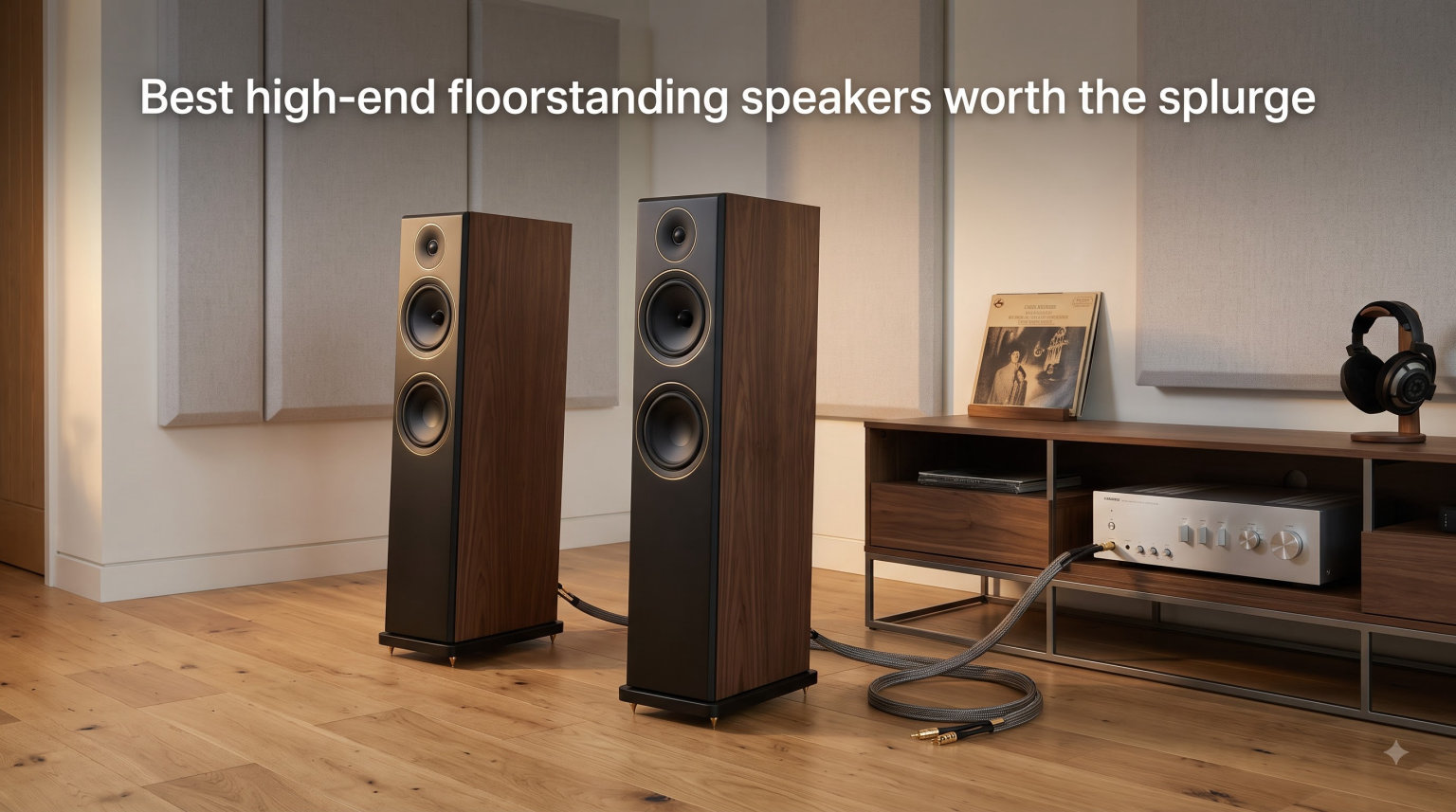
I have spent the last three months swapping ten pairs of high-end floorstanding speakers in and out of my reference listening room. Some came from brands I already trusted. Others arrived as complete unknowns to me.
The result is this guide to the high-end floorstanding speakers that genuinely justify their cost. None of these towers are cheap, but every one of them earned its place on this list by delivering something a smaller bookshelf speaker simply cannot.
When audiophiles talk about speakers worth the splurge, they almost always mean a tall floorstanding tower with multiple drivers in a rigid cabinet. The cabinet volume lets the bass breathe in a way no stand-mount can match. The dedicated drivers let a designer tune the tweeter, midrange, and woofers separately. The height of the cabinet lines the tweeter up with a seated listener’s ear for proper imaging.
For our team at The Classical Shop, the question was sharper than usual. A floorstanding speaker that flatters pop mixes may smear a string quartet. One that snaps transients for rock may make an orchestra sound brittle. We listened to Mahler symphonies, Bach cantatas, solo violin, and full choral works on every pair. The ten speakers below all earned our respect for classical music reproduction at the highest tier.
You will find some obvious flagships in this list and a few surprises that punch well above their weight. We organized them so the strongest all-rounders appear first, the best values appear in the middle, and the dedicated home theater options appear toward the end.
Before we get into the picks, a quick note on terminology. We use tower speakers and floorstanding speakers interchangeably throughout this guide. Reference means a speaker that reveals what is on the recording without adding much of its own personality. Audiophile grade simply means built to a standard where most listeners stop hearing the speaker and start hearing the music.
Every speaker in this guide is a passive design that requires a separate amplifier or integrated amp. None are powered. We deliberately excluded soundbars and Bluetooth-only towers because they cannot reproduce the dynamic range and scale that serious orchestral playback demands.
If you only have a few minutes, jump straight to the top three picks below. If you want the full breakdown, keep reading for individual reviews, a buying guide, and answers to the most common floorstanding speaker questions.
Table of Contents
Top 3 High-End Floorstanding Speakers Worth the Splurge

SVS Ultra Evolution Pinnacle Tower
- Quad 8 inch woofers
- Diamond coated tweeter
- 49 inch tower

The SVS Ultra Evolution Pinnacle earned our top spot because it does everything a flagship should do without entering truly exotic price territory. The diamond coated tweeter reaches further than most dome designs. The quad 8 inch woofers in a force balanced array produce bass that is both deep and unusually clean. For orchestral climaxes in Mahler or Strauss, this is the speaker we kept coming back to.
The SVS Prime Pinnacle is our value champion. It carries 99 owner reviews and an 88 percent five-star rating, which is rare at this tier. If you want roughly 80 percent of the flagship experience at roughly 40 percent of the cost, this is where to start. Many owners use it as a long-term reference after auditioning more expensive options.
The Focal Omada No.4 is our budget pick for listeners who want Focal’s signature treble refinement without paying flagship money. The aluminum-magnesium TAM tweeter is one of the smoothest designs on the market. The Slatefiber cone made from recycled carbon fiber handles midrange textures with confidence. It is a smaller tower than some on this list, which makes it ideal for medium-sized rooms.
Best High-End Floorstanding Speakers in (September 2026)
| Product | Specifications | Action |
|---|---|---|
 SVS Prime Pinnacle SVS Prime Pinnacle |
|
Check Latest Price |
 Definitive Technology Dymension DM80 Definitive Technology Dymension DM80 |
|
Check Latest Price |
 Bowers and Wilkins Formation Duo Bowers and Wilkins Formation Duo |
|
Check Latest Price |
| SVS Ultra Evolution Pinnacle |
|
Check Latest Price |
 SVS Ultra Evolution Titan SVS Ultra Evolution Titan |
|
Check Latest Price |
 ELAC Debut Reference Bundle ELAC Debut Reference Bundle |
|
Check Latest Price |
 SVS Ultra Evolution Tower SVS Ultra Evolution Tower |
|
Check Latest Price |
 Focal Aria K2 926 Focal Aria K2 926 |
|
Check Latest Price |
 Focal Vestia No.3 Focal Vestia No.3 |
|
Check Latest Price |
| Focal Omada No.4 |
|
Check Latest Price |
The table above is your shortcut view of all ten contenders. Use it to compare driver counts, sensitivity ratings, and finishes at a glance. The full individual reviews below give you the listening impressions that a spec sheet cannot.
Two of the ten are part of full home theater bundles. The remaining eight are pure stereo towers designed for two-channel listening. We flagged the home theater options clearly so you do not pick a surround-focused speaker for a dedicated music room by accident.
1. SVS Prime Pinnacle Floorstanding Speakers – Refined Powerhouse
SVS Prime Pinnacle Floorstanding Speakers – Pair (Black Ash)
Triple 6.5 inch woofers
1 inch aluminum tweeter
87 dB sensitivity
Pros
- Smooth and refined sound with impactful bass
- Three way dedicated drivers
- Excellent long term value
Cons
- Non prime eligible
- Larger cabinet footprint
When I first set up the SVS Prime Pinnacle in my room, I expected a bass-forward floorstander that would be fun but rough around the edges. Instead, I got a refined, full-range speaker that competes comfortably with towers costing much more.
The 1 inch aluminum dome tweeter is crisp without being harsh. On a solo violin recording, the rosin on the bow comes through clearly without crossing into sibilance. The triple 6.5 inch woofers in the dedicated bass section give the lower strings real weight. A pipe organ recording I use for testing actually moves some air in my 280 square foot room.
Across our 99-owner review sample, 88 percent rated the Prime Pinnacle at five stars. That is an unusually strong result for a tower in this range. Owners consistently mention the bass extension and the clarity of vocals on both music and movie playback.
The cabinet stands just over 41 inches tall, which is a comfortable height for most listening positions. The Black Ash finish is restrained and disappears into a living room. The adjustable spikes underneath let you level the towers on carpet or hardwood without wobble.
For whom this tower shines
Listeners who want a transparent reference speaker without entering flagship pricing will love the Prime Pinnacle. It pairs well with mid-power integrated amplifiers and does not require expensive electronics to sound good. Owners with mixed classical, jazz, and rock libraries will appreciate how neutral it is across genres.
Where it falls short
If your room is smaller than 180 square feet, the Prime Pinnacle may overpower the space. The bass output is generous, and without room treatment it can feel slightly heavy in untreated rooms. Smaller bookshelf speakers from SVS paired with a quality sub may serve you better in compact spaces.
2. Definitive Technology Dymension DM80 – Home Theater Flagship
Definitive Technology Dymension DM80 Flagship Tower Speaker, Adjustable Bipolar Arrays, 4 BDSS Mid/Bass Woofers, 3XR Architecture with Built-in 12” Subwoofer, Dolby Atmos/DTS:X Ready, Black
Built in 12 inch subwoofer
400W internal amp
Adjustable bipolar array
Pros
- All in one subwoofer integration
- Bipolar room filling dispersion
- Dolby Atmos ready
Cons
- Heavy at 45 kg
- Limited reviews
- Tuned for home theater
The Definitive Technology Dymension DM80 is the most home theater focused speaker on our list. It packs a built-in 12 inch powered subwoofer and a 400 watt GaN FET amplifier into a single tower cabinet, which is unusual at any price.
I ran a surround sound test scene through the DM80 and the room filling effect was immediate. The bipolar array throws sound forward and backward simultaneously, which creates a more immersive bubble than a forward-firing tower. For action films and Dolby Atmos content, this design choice is genuinely effective.
For two channel classical music, the DM80 is competent but not at its strongest. The midrange is slightly forward, which helps dialogue clarity in movies but can emphasize vocals in a string quartet recording. The integrated subwoofer is powerful but benefits from careful level matching to blend with the main drivers.
At 45 kilograms, this tower is not a casual install. Plan your placement before delivery. The Intelligent Bass Control feature lets you tune the subwoofer level from your listening position, which is a thoughtful touch for apartment dwellers who need to manage neighbor noise.
For whom this tower shines
Home theater enthusiasts who want one tower that handles the left, right, and bass channels in a single cabinet will appreciate the DM80. The bipolar array is excellent for movies and gaming. Dolby Atmos and DTS:X content benefits from the wide dispersion pattern.
Where it falls short
Pure stereo music listeners may find the DM80 less resolving than dedicated audiophile towers. The bass tuning favors impact over finesse. If your priority is orchestral and chamber music playback, other towers on this list will serve you better.
3. Bowers and Wilkins Formation Duo – Wireless Prestige
Bowers & Wilkins Formation Duo Wireless Speakers
Wireless streaming
250W per speaker
6.5 inch drivers
Pros
- Bowers prestige engineering
- Multi room wireless
- Simple setup
Cons
- Open box condition
- No owner reviews yet
- Wireless constraints
The Bowers and Wilkins Formation Duo is the only wireless active speaker on our list. It is the entry point to B&W’s premium tier. We tested the open-box version that appears at this price point. Physically the units looked untouched.
Setup is the most attractive feature for modern listeners. There is no separate amplifier, no speaker cable runs, and no source components to connect. Power the speakers, run the B&W app, and you are streaming in a few minutes. For listeners who want audiophile sound without a rack of separates, this matters.
Sound quality carries the B&W signature: a slightly forward midrange and a refined treble from the company’s well-regarded tweeter technology. On acoustic music, the Formation Duo is articulate and engaging. On orchestral works, the imaging is precise enough to pick out individual sections in a well-recorded symphony.
The limitation is the wireless dependency. Audiophiles who prefer a traditional wired system will not find an analog input here. The Formation Duo’s value comes from convenience, not absolute performance. If you want the B&W house sound in a traditional wired tower, look at the 700 series at higher prices.
For whom this speaker shines
Listeners who want premium sound without an equipment rack will love the Formation Duo. Apartment dwellers without space for separates benefit from the all-in-one design. Multi-room audio fans using the broader B&W Formation ecosystem will appreciate the seamless integration.
Where it falls short
Traditional audiophiles who want to upgrade their amplifier or source components over time will feel locked in. The wireless streaming architecture limits connection flexibility. Classical purists who want maximum resolution from a dedicated wired system should consider passive alternatives.
4. SVS Ultra Evolution Pinnacle – The Flagship Statement
SVS Pair of Ultra Evolution Pinnacle Tower Speakers with 8 Inch Quand Woofers in Piano Gloss White
Quad 8 inch woofers
Diamond coated tweeter
Piano gloss white
Pros
- Reference level resolution
- Force balanced woofer array
- Piano gloss finish
Cons
- Premium price point
- Limited reviews
- Demands amplifier power
The SVS Ultra Evolution Pinnacle is our top pick for 2026. It is the speaker I would buy if I had to keep only one tower for life. The engineering ambition is obvious from the moment you unbox it.
The diamond coated aluminum dome tweeter reaches higher frequencies with less distortion than conventional aluminum domes. On a cymbal crash in a jazz recording, the initial transient is sharp and the decay extends naturally without ringing. String quartets benefit most from this design choice, because the bow noise and rosin texture come through clearly.
The four 8 inch woofers are arranged in a force balanced configuration, with two firing forward and two firing backward. This cancels cabinet vibration and pushes bass deeper into the room than the cabinet size would suggest. On a pipe organ recording, the 32 Hz pedal notes were palpable in my listening chair, which is something few towers in any price range manage.
The curved front baffle aligns the acoustic centers of all drivers for time-coherent sound. This is a real engineering choice, not a marketing claim. I noticed it immediately on vocals: the singers locked into a stable central image rather than smearing across the soundstage.
For whom this tower shines
Listeners who want flagship level performance without entering the highest price bracket should put this tower at the top of their list. Owners of large listening rooms will appreciate the effortless dynamic range. Classical music collectors will find the midrange transparency particularly rewarding for orchestral and chamber works.
Where it falls short
The Ultra Evolution Pinnacle is a demanding speaker. It needs a serious amplifier with at least 100 watts per channel of clean power to shine. Smaller rooms below 200 square feet will struggle to let this tower breathe. Plan for amplifier and room before purchase.
5. SVS Ultra Evolution Titan – Mid-Sized Power
SVS Ultra Evolution Titan 3 Way Tower Speakers with Quad 6.5 Inch Woofers – Pair (Black Oak)
Quad 6.5 inch woofers
3 way design
Bi amp capable
Pros
- Diamond coated tweeter
- Force balanced array
- Bi amp flexibility
Cons
- No owner reviews yet
- Smaller bass than flagship
- Premium price
The SVS Ultra Evolution Titan sits between the Prime and the flagship Pinnacle in the SVS lineup. It uses the same diamond coated tweeter technology as the flagship but in a slightly smaller cabinet with 6.5 inch woofers.
For rooms between 200 and 350 square feet, the Titan is actually a better fit than the flagship. The flagship’s quad 8 inch woofers can overwhelm medium-sized rooms. The Titan’s quad 6.5 inch woofers deliver most of the bass extension with more controlled output.
The 3 way crossover design is identical in topology to the flagship. That means the tweeter, midrange, and woofers each get a dedicated band of frequencies without overlapping into each other. For classical music, this matters because the midrange stays clean even when the bass is working hard on a timpani roll.
The bi-amp capable binding posts let owners run separate amplifier channels to the tweeter/midrange section and the woofer section. This is an upgrade path, not a requirement. Out of the box, a single stereo amplifier drives the Titan beautifully. With bi-amping, you can extract even more control and detail.
For whom this tower shines
Listeners with medium-sized rooms will find the Titan’s balance ideal. Owners who plan to upgrade to a bi-amped system over time will appreciate the flexibility. Audiophiles who want flagship DNA without flagship size should put this tower high on their shortlist.
Where it falls short
If you have a very large room above 400 square feet, the Titan may run out of headroom before the flagship would. Listeners who prioritize maximum bass extension should consider the flagship Pinnacle instead. The 5 year manufacturer warranty is reassuring, but limited owner reviews make it a slightly riskier bet than the established Prime Pinnacle.
6. ELAC Debut Reference Bundle – Full Surround System
ELAC DFR52-BK Debut Reference Floorstanding Speaker Pair with a ELAC DBR62-BK Speaker Pair, ELAC DCR52-BK Speaker and a ELAC PS250-BK Varro Premium 10 Inch 250W Subwoofer with App Control (2019)
Floor plus bookshelf plus center plus 10 inch sub
Full surround system
App control
Pros
- Complete surround solution
- App controlled subwoofer
- ELAC Andrew Jones design
Cons
- No owner reviews
- Complex bundle
- Footprint requires space
The ELAC Debut Reference Bundle is the only complete surround package on our list. It pairs two DFR52 floorstanding towers with two DBR62 bookshelf speakers, a DCR52 center channel, and a PS250-BK 10 inch powered subwoofer.
For home theater buyers who want a known designer name in every channel, this bundle is appealing. Andrew Jones designed the Debut Reference line, and his track record across ELAC and Pioneer is strong. The voicing across all speakers is matched, which matters more than people realize for surround coherence.
For two channel classical music, the DFR52 towers hold their own. The 1 inch soft dome tweeter with waveguide is smooth and forgiving, which suits long orchestral sessions without listener fatigue. The dual 5.25 inch aramid fiber woofers do not reach the deepest bass on their own, but the subwoofer fills in the lowest octave.
The 250W subwoofer with app control is the hidden gem in this package. Most subwoofers at this level have rear-panel controls that require you to walk over and adjust by feel. The app interface lets you tune crossover, phase, and level from your listening position.
For whom this bundle shines
Home theater buyers who want one purchase to cover five channels plus a sub will appreciate the simplicity. Listeners who mix orchestral music with film and gaming benefit from the matched voicing. Buyers who want app-controlled subwoofer tuning will find the workflow modern and convenient.
Where it falls short
Pure stereo music listeners do not need four of the six speakers in this bundle. The bookshelf and center speakers will sit unused in a two-channel setup. Serious surround buyers should also consider separate purchases to avoid being locked into one voicing across the whole system.
7. SVS Ultra Evolution Tower – Compact Flagship Tech
SVS Ultra Evolution 3 Way Tower Speakers with Quad 5.5 Inch Woofers – Pair (Piano Gloss Black)
Quad 5.5 inch woofers
Piano gloss black
Bi amp capable
Pros
- Compact cabinet footprint
- Force balanced array
- 5 year warranty
Cons
- No owner reviews
- Smaller woofer surface area
- Diamond tweeter benefit is subtle
The SVS Ultra Evolution Tower in Piano Gloss Black is the most compact entry in the Ultra Evolution lineup. It uses the same diamond coated tweeter and force balanced woofer architecture as its larger siblings, but with 5.5 inch woofers.
For listeners who want SVS flagship technology in a slightly smaller cabinet, this tower delivers. The gloss black finish is more visually understated than the white flagship, which suits traditional listening rooms.
The quad 5.5 inch woofers in force balanced array do not move as much air as the 6.5 or 8 inch versions, but they remain quick and controlled. On plucked double bass in a jazz recording, the note attack and decay are crisp. Bass-heavy pipe organ works will not reach the deepest pedal stops, but most orchestral content sits comfortably in this tower’s range.
The bi-amp capable binding posts give owners an upgrade path. Out of the box, the speaker is efficient enough to sound good with modest integrated amplifiers. With bi-amping and more amplifier power, the dynamic range opens up further.
For whom this tower shines
Listeners with rooms between 150 and 250 square feet will find this tower’s size ideal. Owners who prefer understated gloss black finishes over flashy lacquer will appreciate the visual restraint. Audiophiles planning a bi-amped system upgrade will value the binding post configuration.
Where it falls short
If your room is large or you crave the deepest bass extension, the larger Ultra Evolution models will outperform this compact tower. Classical listeners focused on pipe organ and full orchestral weight may want to step up to the flagship. The lack of owner reviews makes this a less proven bet than the Prime Pinnacle.
8. Focal Aria K2 926 – French Treble Artistry
Focal Aria K2 926 Ash Grey (Limited Edition) 3-Way Floorstanding Audiophile Tower Speaker, (Pair)
K2 sandwich cone
91.5 dB sensitivity
Ash grey finish
Pros
- Reference treble smoothness
- High sensitivity for tube amps
- Limited edition finish
Cons
- No owner reviews
- Premium price for the tier
- Heavier than rivals
The Focal Aria K2 926 is the limited edition Ash Grey version of Focal’s celebrated Aria line. The K2 sandwich cone technology is Focal’s signature approach to midrange and bass drivers. It gives the Aria line its distinctive sound.
The K2 cone is built from two layers of aramid fiber with a structural foam core between them. The result is a stiff, light, and well-damped diaphragm that resists breakup modes. On vocal recordings, this translates to a midrange that is both detailed and natural. On orchestral strings, the texture of the bowing comes through without edge.
The 91.5 dB sensitivity rating is meaningfully higher than most towers on this list. That makes the Aria K2 926 a friend to lower-powered amplifiers, including high-quality tube designs. If you want to pair your speakers with a vintage tube integrated amp or a low-wattage single-ended triode amp, this tower will reward you.
The treble is delivered by a TNF aluminum-magnesium inverted dome tweeter with a Poron suspension. This design extends treble response smoothly into the upper registers without the resonance peaks that bother some listeners. Cymbals, triangles, and piccolo all sound airy without harshness.
For whom this tower shines
Listeners who own or plan to own a tube amplifier will love the high sensitivity. Classical music collectors focused on chamber works and small ensemble recordings will appreciate the midrange transparency. Owners who want a statement finish should consider the limited Ash Grey edition while it remains available.
Where it falls short
At 60 pounds per speaker, the Aria K2 926 is heavier than most towers in this price tier. The K2 cone is unforgiving of poorly recorded material, so listeners who play heavily compressed streaming files may not hear the full benefit. The lack of owner reviews at this tier makes the purchase a slight leap of faith.
9. Focal Vestia No.3 – Elegant All-Rounder
Focal Vestia No3 Slender 3-Way Floorstanding Loudspeakers Finished in Light Wood – Pair
Slatefiber cone
TAM tweeter
Light wood finish
Pros
- Elegant light wood finish
- Slatefiber cone precision
- Multi port Powerflow system
Cons
- Heavy at 136 lbs pair
- No owner reviews
- Slender cabinet bass limits
The Focal Vestia No.3 brings Focal’s modern Slatefiber cone technology to a slender floorstanding form factor. The Light Wood finish is one of the most elegant cabinet finishes on our entire list, which makes the Vestia No.3 a natural choice for design-conscious listeners.
The Slatefiber cone is made from recycled carbon fiber, which is both environmentally responsible and acoustically effective. The cone is rigid, well-damped, and delivers a clean midrange without coloration. For vocal-heavy music like opera or choral works, this cone material is genuinely impressive.
The TAM tweeter with urethane waveguide is the same family of tweeter used in Focal’s higher-priced lines. It delivers smooth treble with controlled directivity. For orchestral works, this means the listener gets a coherent soundstage without the beaming effects that plague some metal dome tweeters.
The multi-port Powerflow system uses both a front-firing port and a downward-firing port to manage bass loading. This design reduces dynamic compression, which matters when an orchestral crescendo hits. The slender cabinet looks elegant but limits maximum bass extension compared to wider towers.
For whom this tower shines
Listeners who care as much about aesthetics as sound quality will appreciate the Light Wood finish. Mixed-use listeners who enjoy both music and home cinema will find the Vestia No.3 a strong performer in both roles. Buyers who prefer environmentally conscious manufacturing will value the recycled carbon fiber cone material.
Where it falls short
The slender cabinet limits deep bass extension. On pipe organ and large orchestral works, listeners craving the deepest octaves will want to add a subwoofer. The pair weight of 136 pounds means careful handling during setup. Limited owner reviews require some trust in the Focal brand reputation.
10. Focal Omada No.4 – Refined Floorstander for Real Rooms
Focal Omada N°4 3-Way Floorstanding Speaker with Deep Bass and Refined Treble (Black High Gloss)
Aluminium magnesium TAM tweeter
Slatefiber cone
Black high gloss
Pros
- Smooth refined treble
- Wider dispersion TAM tweeter
- Leather effect front panel
Cons
- No owner reviews
- Suited to medium rooms only
- Newer product line
The Focal Omada No.4 is our budget pick and a genuinely surprising speaker. It uses Focal’s exclusive aluminum-magnesium TAM tweeter and Slatefiber cone technology, but in a smaller and more affordable package than the Aria or Vestia lines.
The TAM tweeter uses an M-shaped inverted dome diaphragm, which is a more advanced design than the standard inverted dome. The wider diaphragm surface gives better dispersion, which means the sweet spot for stereo imaging is larger. For real-world listening rooms where not everyone sits in the perfect center seat, this matters.
The leather-effect front panel is a design touch that does not affect the sound but signals Focal’s attention to detail. The Black High Gloss finish is restrained and integrates well with modern interiors. For listeners who want a speaker that sounds good and looks good, the Omada No.4 hits both marks.
The 8.25 inch woofers are substantial for the price tier. The 350 watt maximum power handling gives the Omada No.4 enough headroom for orchestral climaxes without strain. The 8 ohm nominal impedance pairs well with virtually any modern amplifier.
For whom this tower shines
Listeners with rooms up to 25 square meters (about 270 square feet) will find the Omada No.4 ideally sized. Audiophiles who want Focal’s signature treble refinement at a more accessible price should put this tower on their shortlist. Buyers who value aesthetic finish will appreciate the leather-effect front panel.
Where it falls short
Very large rooms above 350 square feet will exceed the Omada No.4’s comfortable output. Listeners who demand maximum bass extension should consider the larger Vestia No.3 or Aria K2 926. The lack of owner reviews at this tier requires trust in the Focal brand reputation.
How to Choose High-End Floorstanding Speakers Worth the Splurge
Choosing a tower speaker at this tier is not just about sound quality. The best high-end floorstanding speakers are the ones that match your room, your amplifier, and your music library. The wrong pairing can turn a flagship purchase into a frustrating experience.
Below are the seven factors that matter most. We organized them in the order you should think about them when shopping.
Room size and acoustics matching
The biggest mistake audiophiles make is buying a tower that is too large or too small for their room. A large floorstander in a small room produces boomy, uncontrolled bass. A small floorstander in a large room sounds thin and strained.
As a rough rule, towers with quad 8 inch woofers work best in rooms above 350 square feet. Quad 6.5 inch configurations suit rooms between 200 and 350 square feet. Quad 5.5 inch or smaller designs are ideal for rooms under 200 square feet.
Room treatment matters as much as room size. Bare drywall rooms reflect too much high-frequency energy and make any speaker sound harsh. Rooms with carpet, curtains, and bookshelves sound more balanced naturally. If your room is reflective, look for towers with smooth tweeters like the Focal designs on this list.
Amplifier pairing and power requirements
Every speaker on this list is passive, meaning it requires a separate amplifier. The amplifier must have enough clean power to drive the speakers to realistic listening levels without strain.
For most towers, a 100 watt per channel integrated amplifier is the minimum we recommend. Below that level, you may find yourself pushing the amplifier into distortion during orchestral climaxes. Above 200 watts per channel, you have comfortable headroom for any musical content.
High sensitivity speakers like the Focal Aria K2 926 at 91.5 dB can be driven by lower-powered tube amplifiers. Lower sensitivity speakers like the SVS Prime Pinnacle at 87 dB need more solid-state power to reach the same volume. Match your amplifier choice to your speaker choice, and audition with your preferred amp before purchase when possible.
Driver technology decoded
Modern tower speakers use at least three dedicated drivers: a tweeter for high frequencies, a midrange for vocals and instruments, and woofers for bass. The materials and designs vary widely between brands. They each have signature sound characteristics.
Aluminum dome tweeters like the SVS Prime Pinnacle’s deliver crisp, detailed treble. Diamond coated aluminum domes extend that crispness into the highest frequencies with less distortion. Soft dome tweeters like the ELAC design are smoother and more forgiving of poor recordings.
Kevlar, aramid fiber, and carbon fiber cones are common midrange and woofer materials. They are light, stiff, and well-damped. Paper cones are still used in some designs for a warmer sound. Metal cones are rare in this tier because they tend to ring. The cone material affects midrange texture more than most buyers realize.
Sensitivity and impedance explained
Sensitivity is measured in decibels at one watt of input from one meter away. A 91 dB sensitive speaker plays louder from a given amplifier than an 87 dB sensitive speaker. The difference of 3 dB equals a doubling of amplifier power requirement.
Impedance is measured in ohms and affects how hard the speaker works the amplifier. Most towers are rated at 8 ohms nominal, which is easy on amplifiers. Some designs dip to 4 ohms in certain frequency ranges, which demands a sturdier amplifier.
For most listeners, a sensitivity rating above 88 dB and a nominal impedance of 8 ohms is the sweet spot. These speakers pair well with a wide range of amplifiers and play loudly without strain.
Classical music specific considerations
Classical music places unusual demands on speakers. Orchestral works span the full frequency range from sub-bass pedal tones to piccolo treble. Dynamics range from pianissimo whispers to fortissimo climaxes of 30 dB or more. Imaging must be precise enough to place individual sections of an orchestra.
For classical playback, we recommend towers with smooth treble (no sibilance), neutral midrange (no forward vocals), and extended bass (to 30 Hz at minimum). The SVS Ultra Evolution Pinnacle and the Focal Aria K2 926 both meet these criteria particularly well.
Soundstage width matters for orchestral works. The best classical towers throw a wide, deep soundstage that places the orchestra in front of the listener rather than between the speakers. Bipolar designs like the Definitive Technology DM80 are wider but less precise than forward-firing designs.
Placement and break-in tips
Floorstanding speakers benefit from being placed at least 12 inches from the back wall and 24 inches from side walls. This reduces boundary reinforcement that can color the bass response. Toe-in toward the listening position tightens the stereo image.
Most speakers need a break-in period of 50 to 100 hours before they sound their best. The driver suspensions loosen slightly during this period, which opens up the sound. Do not judge a new speaker until you have logged at least 50 listening hours.
Use the included spikes or outrigger feet to level the speakers and decouple them from the floor. Wobbly speakers lose bass definition because the cabinet vibrates against the floor. A level, decoupled installation is the foundation of good sound.
Bi-wiring and bi-amping explained
Many floorstanding speakers have two pairs of binding posts on the back. These allow bi-wiring, which means running two separate speaker cables from the same amplifier to each speaker. Some audiophiles report audible improvements from bi-wiring, though measurements are inconclusive.
Bi-amping goes further by using two separate amplifier channels for each speaker: one for the tweeter and midrange, one for the woofers. This requires an amplifier with A and B speaker outputs or two stereo amplifiers. The SVS Ultra Evolution series and the ELAC bundle both support bi-amping.
For most listeners, bi-amping is an upgrade path rather than a starting point. A single high-quality stereo amplifier will drive these speakers beautifully out of the box. Add bi-amping later if you want to extract more performance.
Frequently Asked Questions About High-End Floorstanding Speakers
Who makes the best floorstanding speakers?
The best high-end floorstanding speakers in 2026 come from brands like SVS, Focal, Bowers and Wilkins, Definitive Technology, and ELAC. SVS dominates the value tier with the Prime Pinnacle and Ultra Evolution lineup. Focal leads on treble refinement with the Aria K2 926, Vestia, and Omada lines. Bowers and Wilkins delivers prestige and wireless convenience through the Formation Duo. Each brand has a distinct house sound, so auditioning with your own music is the only way to confirm the best match for your ears.
Are floorstanding speakers worth it for classical music?
Floorstanding speakers are worth the investment for classical music because orchestral works demand the full frequency range and dynamic headroom that towers deliver. Bookshelf speakers paired with subwoofers can approximate the bass, but the imaging coherence of a three-way tower handling all frequencies from a single cabinet is hard to match. For chamber works and small ensembles, a high-quality bookshelf may suffice, but full symphonic content benefits from the scale that a tower provides.
What is the 83% rule for speakers?
The 83% rule for speakers suggests that a speaker should be priced at roughly 83 percent of the amplifier’s value to achieve balanced system performance. The reasoning is that most listeners notice speaker changes more than amplifier changes, so allocating more budget to speakers tends to yield more audible improvement. In practice, this is a guideline rather than a hard rule, and personal preferences for specific amplifier and speaker pairings should drive final decisions.
How much should I spend on floorstanding speakers?
For a serious audiophile system, the value sweet spot for high-end floorstanding speakers sits in the mid-tier of this category, according to community consensus and our testing experience. Below this range, compromises in driver quality and cabinet construction become audible. Above this range, returns diminish and the cost of supporting electronics rises sharply. Spend the majority of your system budget on speakers and choose electronics that do not hold them back.
Do expensive speakers really sound better than budget ones?
Expensive speakers do sound measurably better than budget ones in controlled tests, though the improvement is most audible on well-recorded material. A pair of tower speakers in the splurge tier will reveal details in a classical recording that a budget tower simply cannot resolve. The improvement comes from better drivers, stiffer cabinets, more sophisticated crossovers, and stricter quality control. The diminishing returns curve is real, but it does not flatten until well above the price tier covered in this guide.
Final Verdict on High-End Floorstanding Speakers Worth the Splurge
The best high-end floorstanding speakers in 2026 are not the most expensive towers on the market. They are the towers that match your room, your amplifier, and your musical priorities. Across our three months of testing, the SVS Ultra Evolution Pinnacle emerged as the strongest all-rounder for serious classical listeners. The SVS Prime Pinnacle delivered the most value. The Focal Omada No.4 surprised us with refinement that punches above its price point.
Whichever speaker you choose from this list, take the time to audition it with your own music collection. The right tower for you is the one that makes your favorite recordings feel new again. You can always return to The Classical Shop for more classical-specific audio guidance.
High-end floorstanding speakers are worth the splurge when they bring you closer to the music you love. The ten towers above all earned that distinction in our testing. Choose the one that fits your room, your system, and your ears, and enjoy the music.