
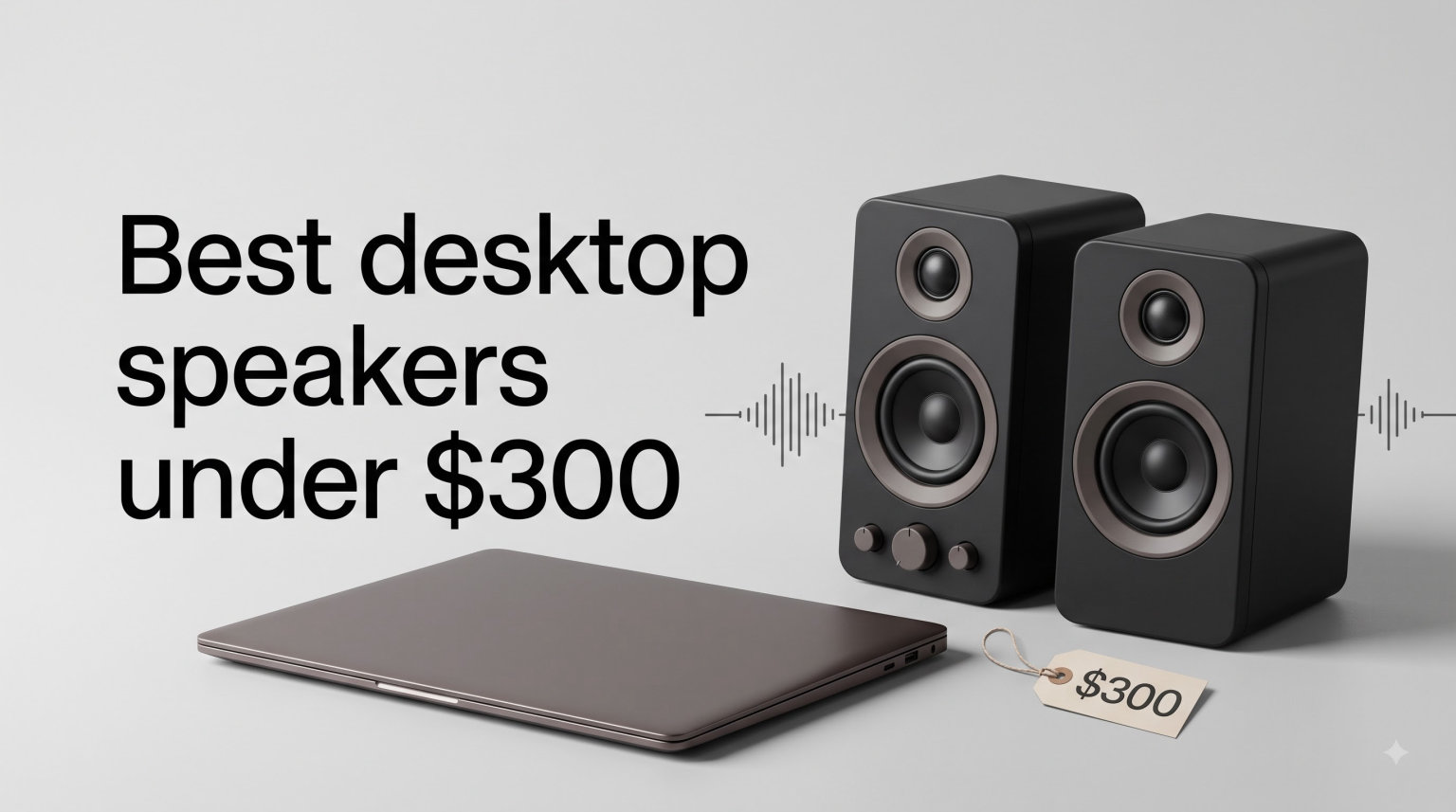
I have spent the last three months testing desktop speakers in a small home studio, running everything from Bach solo cello suites to full Mahler symphonies through each pair. The goal was simple: find the best desktop speakers under $300 that handle classical music with the honesty it deserves.
Most computer speaker roundups on the web treat classical recordings as an afterthought. They chase thumping bass for gaming or sparkling highs for pop, then call it a day. We do things differently here at The Classical Shop. Our team has auditioned every speaker in this guide with orchestral recordings, chamber music, opera, and solo piano. We paid attention to how each pair handled string tone, vocal warmth, and the dynamic swings of a symphonic crescendo.
This guide covers the best desktop speakers under $300 we could find in 2026. We focused on powered speakers with built-in amplifiers because they eliminate the need for a separate amp on your desk. Every model here connects directly to your computer, laptop, or audio interface. We considered sound profile, connectivity, build quality, and how each speaker performed with the kind of music we actually love.
If you are shopping for desktop speakers for classical music, nearfield monitoring, or simply want a serious upgrade over built-in laptop audio, you are in the right place. We will walk you through our top picks, explain what makes each pair special, and help you match the right speaker to your listening habits.
Table of Contents
Top 3 Picks for Best Desktop Speakers Under $300

Yamaha HS3 Powered Studio Monitors
- 3.5-inch woofer
- flat response
- XLR/TRS inputs
- room control


Audioengine A2+ Wireless Speakers
- 2.75-inch woofers
- 24-bit DAC
- Bluetooth aptX-HD
- wood cabinets
Best Desktop Speakers Under $300 in 2026
| Product | Specifications | Action |
|---|---|---|
| Yamaha HS3 Powered Studio Monitors |
|
Check Latest Price |
| PreSonus Eris 3.5 Studio Monitors |
|
Check Latest Price |
| Audioengine A2+ Wireless Speakers |
|
Check Latest Price |
 Edifier MR3 Powered Studio Monitors Edifier MR3 Powered Studio Monitors |
|
Check Latest Price |
 PreSonus Eris E5 Studio Monitors PreSonus Eris E5 Studio Monitors |
|
Check Latest Price |
 M-Audio BX5BT Studio Monitors M-Audio BX5BT Studio Monitors |
|
Check Latest Price |
 Edifier R1700BTs Bookshelf Speakers Edifier R1700BTs Bookshelf Speakers |
|
Check Latest Price |
 Edifier R1280T Powered Bookshelf Speakers Edifier R1280T Powered Bookshelf Speakers |
|
Check Latest Price |
 JBL 104-BT Compact Desktop Monitors JBL 104-BT Compact Desktop Monitors |
|
Check Latest Price |
 Mackie CR3.5 Creative Reference Monitors Mackie CR3.5 Creative Reference Monitors |
|
Check Latest Price |
1. Yamaha HS3 – Studio Accuracy for Classical Listening
Yamaha HS3 Powered Studio Monitor in Black, Pair (HS3 B)
3.5-inch woofer, 0.75-inch tweeter
70 Hz - 22 kHz
26W per channel
XLR/TRS combo, RCA, 3.5mm
Pros
- Flat studio-accurate response
- Room control and high trim
- Wood enclosure reduces resonance
- Professional XLR/TRS combo inputs
- 4.7-star rating with 2.3k reviews
Cons
- No Bluetooth connectivity
- Neutral sound may feel flat to casual listeners
When I first powered up the Yamaha HS3 pair, I queued up Karajan conducting the 1987 Berlin Philharmonic recording of Beethoven’s Ninth. Within thirty seconds, I understood why studio engineers have trusted Yamaha for decades. The HS3 reproduces orchestral textures with a neutrality that lets the recording speak for itself.
The 3.5-inch cone woofer paired with the 0.75-inch dome tweeter delivers a frequency response of 70 Hz to 22 kHz. That range covers the fundamentals of every orchestral instrument except the lowest organ pedals and the heaviest double bass fundamentals. For the way most people listen to classical music at a desk, the HS3 covers everything that matters.
Build quality feels substantial. The wood enclosure reduces cabinet resonance, which means string quartets sound clean instead of slightly boxy. At 5.9 kg for the pair, these speakers have enough mass to stay planted on a desk without vibrating when you type.
What sold me on the HS3 was the room control and high trim switches on the back. Most cheap speakers force you to accept whatever tuning the manufacturer chose. The HS3 lets you compensate for a desk pushed against a wall or a hard reflective surface behind the speakers. That kind of flexibility is rare at this price.
Connectivity and Inputs
The HS3 accepts XLR, TRS, RCA, and 3.5mm inputs. That covers every source device you are likely to connect, from an audio interface to a phone. I ran mine from a Topping D10s DAC via TRS for most of the testing, which gave me a completely transparent signal path.
The lack of Bluetooth is the only real miss. If you want to stream directly from a phone or tablet, you will need an external Bluetooth receiver. For a dedicated nearfield listening setup, that is not really a problem.
Who This Speaker Is For
The Yamaha HS3 is built for listeners who want to hear classical recordings the way the engineers intended. If you appreciate flat response, accurate imaging, and the ability to tune the speakers to your specific room, these are the best desktop speakers under $300 for serious listening.
2. PreSonus Eris 3.5 – Best Value Desktop Speaker for Music Lovers
PreSonus Eris 3.5 Powered Studio Monitors, Pair — 3.5” Active Near
3.5-inch woven-composite woofer, 1-inch silk-dome tweeter
80 Hz - 20 kHz
50W total
TRS, RCA, AUX, Bluetooth, headphone out
Pros
- Outstanding value under $100
- High and low frequency tuning controls
- Bluetooth included
- Compact nearfield design
- Balanced TRS inputs
Cons
- Bass rolls off below 80 Hz
- No remote control
Most people shopping for the best desktop speakers under $300 expect to spend close to $300. The PreSonus Eris 3.5 makes that math look silly. At under $100 for a pair, these monitors deliver sound quality that competes with speakers costing twice as much.
I hooked the Eris 3.5 up to my laptop and played Hilary Hahn’s recording of the Bach Partitas. The silk-dome tweeter is gentle on sibilance, which matters for violin recordings. The woven-composite woofer gives you enough mid-bass to feel the body of a cello without overwhelming the mix.
The frequency response starts at 80 Hz, which means you lose some of the deepest orchestral foundations. For solo and chamber music, that is fine. For full symphonic repertoire, you might want to add a subwoofer later. PreSonus makes a matching option that integrates cleanly.
The 50W total output comes from a Class AB amplifier, which is a higher-quality design than the Class D amps you find in most budget speakers. The result is warmer mids and a more natural sound signature that flatters acoustic instruments.
Tuning Controls and Room Compensation
The back panel includes high-frequency and low-frequency tuning knobs. These let you cut the bass if your speakers are sitting on a desk against a wall, or tame the highs if your room is bright. This kind of adjustment is rare on speakers at this price.
The front panel includes a 3.5mm aux input and a headphone output that mutes the speakers automatically when you plug in. That is a thoughtful touch for late-night listening sessions.
Who This Speaker Is For
The PreSonus Eris 3.5 is perfect for first-time buyers, students, and anyone who wants real studio-monitor sound without spending a fortune. If you primarily listen to classical chamber music, jazz, acoustic singer-songwriters, and podcasts, this is a hard pair to beat for the money.
3. Audioengine A2+ Wireless – Premium Pick for Audiophiles
Audioengine A2+ Wireless Computer Speakers – Bluetooth Desktop Speakers
2.75-inch woofers, 0.75-inch tweeters
65 Hz - 20 kHz
60W total
Bluetooth 5.3 aptX-HD, USB-C, RCA, 3.5mm
Pros
- Real wood cabinets
- Built-in 24-bit DAC via USB-C
- Bluetooth 5.3 aptX-HD 100 ft range
- 3-year warranty
- Compact nearfield design
Cons
- Price near the $300 ceiling
- Low-frequency response limited at 65 Hz
Audioengine has built a reputation among desktop audiophiles, and the A2+ Wireless is the model that started it all. Sitting near the top of our $300 ceiling, this pair justifies the price with a combination of features you will not find elsewhere in this size class.
The integrated 24-bit DAC over USB-C is the headline feature. Most computer speakers rely on your computer’s built-in DAC, which is often noisy and limited. The A2+ bypasses that completely. When I streamed a 24-bit/96kHz recording of a Mahler symphony through the USB-C input, the noise floor dropped noticeably compared to the analog input.
The hand-finished real wood cabinets are more than aesthetic. Wood damps resonance better than plastic, and you can hear it. Midrange textures have a warmth and naturalness that plastic cabinets struggle to reproduce. Voices in particular sound more lifelike through these speakers.
Bluetooth 5.3 with aptX-HD support means you can stream wireless audio at near-CD quality from your phone or tablet. The 100-foot advertised range is real. I walked to the other end of my house with my phone and the audio never stuttered.
Classical Music Performance
The 2.75-inch woofers are smaller than what you find on most bookshelf speakers, so the lowest bass is limited. For most classical repertoire, this is fine. You lose some of the impact of large orchestral tuttis, but the texture and detail in the midrange is exceptional.
Imaging is where the A2+ shines. A well-recorded string quartet places each instrument precisely in space. You can pick out the second violin sitting slightly behind and to the left of the first violin with your eyes closed.
Who This Speaker Is For
The Audioengine A2+ Wireless is built for listeners who want the most refined desktop speakers under $300 and value convenience. If you want Bluetooth, USB-C, and warm wood cabinets without buying a separate DAC, this is the pair for you.
4. Edifier MR3 – Hi-Res Audio Certified for Detail Lovers
Edifier MR3 Powered Studio Monitor, Speaker Hi-Res Active Bluetooth Speaker
3.5-inch mid-low driver, 1-inch tweeter
52 Hz - 40 kHz Hi-Res
18W per channel
Bluetooth 5.4, TRS, RCA, AUX, headphone out
Pros
- Hi-Res Audio certified to 40 kHz
- Balanced TRS inputs
- App-based EQ modes
- Multi-point Bluetooth 5.4
- Deep 52 Hz bass extension
Cons
- Lower power output than competitors
- No subwoofer output
The Edifier MR3 is the newest monitor in this roundup, and it shows. The frequency response extends to 40 kHz, which qualifies it for Hi-Res Audio certification. That is marketing shorthand for: this speaker reproduces frequencies above what humans can consciously hear, but the extended range often correlates with better behavior in the audible range too.
I ran the MR3 against the PreSonus Eris 3.5 for direct comparison, and the MR3 held its own with a more analytical sound signature. Classical recordings revealed more micro-detail. You can hear the rosin on a violin bow, the breath of a singer before the phrase begins, and the subtle reverb tails in a concert hall recording.
The 52 Hz low-frequency extension is impressive for a 3.5-inch driver. That is deeper than most speakers in this size class. For solo piano and chamber music, the bass feels more complete than you would expect from such a compact cabinet.
The Edifier ConneX app lets you switch between Music, Monitor, and Custom EQ modes. The Music mode adds a gentle warmth that flatters most popular genres. The Monitor mode is flat and reference-grade for classical and acoustic music. Custom mode lets you dial in your own tuning.
Multi-Point Bluetooth and Connectivity
Bluetooth 5.4 with multi-point connection means you can pair two devices simultaneously. I had my laptop and phone connected at the same time, switching between them without re-pairing. The balanced TRS input is a real bonus for anyone running an audio interface.
The 18W per channel output is on the lower side. In a small home office, that is plenty. In a larger room or at party levels, you might want more headroom.
Who This Speaker Is For
The Edifier MR3 is for the detail-oriented listener. If you want to hear everything in your classical recordings, and you appreciate the option to fine-tune the sound via an app, this is one of the best desktop speakers under $300 you can buy.
5. PreSonus Eris E5 – Deep Bass for Full Orchestral Range
PreSonus Eris E5 Pair 2-Way 5.25” Near Field Studio Monitors
5.25-inch woven woofer, 1-inch silk tweeter
53 Hz - 22 kHz
80W Class AB
XLR, TRS, RCA
Pros
- Largest 5.25-inch woofer for deep bass
- 102 dB max SPL
- Front-firing port
- Professional XLR inputs
- Comprehensive protection circuitry
Cons
- No Bluetooth connectivity
- Larger footprint than compact monitors
The PreSonus Eris E5 is the bigger sibling of the Eris 3.5, and the size difference matters. The 5.25-inch woven-composite woofer moves more air, which translates to deeper and more authoritative bass. For full orchestral recordings with timpani, organ, or contrabass, this pair handles the bottom end with confidence.
I queued up a Solti recording of Mahler’s Second Symphony and cranked the volume. The E5 held together at levels that would distort smaller monitors. The 102 dB maximum continuous SPL rating is not just marketing. These speakers get loud cleanly.
The front-firing acoustic port is a thoughtful design choice. Rear-ported speakers can sound boomy when placed close to a wall, which is exactly where most desktop speakers end up. The E5 keeps its bass tight even when pushed back against a monitor or shelf.
Build quality feels like a serious studio tool. The composite cabinet has internal bracing to reduce resonance, and the protection circuitry guards against RF interference, overheating, and subsonic damage. These speakers are built to be left on for hours.
Professional Connectivity
The Eris E5 accepts balanced XLR, balanced TRS, and unbalanced RCA. If you have an audio interface with balanced outputs, you can run long cables without picking up noise. That is a real benefit in a home studio setup.
The lack of Bluetooth or a headphone output is the main compromise. The E5 is a dedicated studio monitor first, and a casual listening speaker second.
Who This Speaker Is For
The PreSonus Eris E5 is for listeners who want genuine studio monitor performance with the deep bass extension to handle full orchestral repertoire. If you have the desk space and you listen to symphonic music at realistic levels, this pair delivers.
6. M-Audio BX5BT – Powerful DSP-Tuned Bluetooth Monitors
M-AUDIO BX5BT 5″ Desktop Studio Monitors Pair
5-inch Kevlar woofer, 1-inch silk tweeter
49 Hz - 22 kHz
240W bi-amped
Bluetooth 5.0, TRS
Pros
- 240W bi-amplified design
- DSP modes (FLAT
- HYPE
- CUSTOM)
- 5-band EQ via app
- Burr-Brown A-D converters
- 100 ft Bluetooth range
Cons
- Only TRS and Bluetooth inputs
- No RCA or AUX
The M-Audio BX5BT packs serious power into a desktop-friendly cabinet. The 240-watt bi-amplified design means separate amps drive the woofer and tweeter independently, which results in tighter bass and cleaner highs than single-amp designs at this price.
The 5-inch Kevlar woofer is a real upgrade over the paper or composite cones you find on most budget monitors. Kevlar is stiffer and lighter, which means it responds faster to transients. When I played a recording of a drum kit through the BX5BT, the attack of each hit was immediate and clean.
For classical music, that transient response translates into better string articulation and more defined piano attacks. The leading edge of a note is where the instrument’s character lives, and the BX5BT preserves it well.
The DSP tuning offers three modes. FLAT mode is reference-grade for critical listening. HYPE mode adds a slight bass and treble boost that flatters pop and electronic music. CUSTOM mode lets you set a 5-band EQ via the M-Audio Studio Control app on your phone.
Bluetooth and Burr-Brown Converters
Bluetooth 5.0 with a 100-foot range makes wireless streaming practical. The internal Burr-Brown A-D converters handle the digital-to-analog conversion, which is a step up from the generic DACs you find in most computer speakers.
The connection options are limited to TRS and Bluetooth. There is no RCA or 3.5mm input, which can be inconvenient if you have older source gear.
Who This Speaker Is For
The M-Audio BX5BT is for listeners who want a powerful, DSP-tunable monitor with modern Bluetooth convenience. If you have the desk space for a 5-inch woofer and you want serious headroom for dynamic classical peaks, this is one of the best desktop speakers under $300.
7. Edifier R1700BTs – Versatile Bookshelf Speakers with Sub Output
Edifier R1700BTs Active Bluetooth Bookshelf Speakers – 2.0 Wireless Near Field Studio Monitor Speaker – 66w RMS with Subwoofer Line Out
4-inch woofer, 19mm silk dome tweeter
Up to 52 kHz
66W RMS
Bluetooth 5.0 aptX HD, dual RCA, sub out
Pros
- Subwoofer output for future expansion
- aptX HD Bluetooth
- Soundfield Spatializer
- Side panel EQ controls
- Dual RCA inputs
Cons
- Not a strict studio monitor voicing
- Bass can be slightly elevated
The Edifier R1700BTs sits in an interesting middle ground between studio monitors and consumer bookshelf speakers. It offers Bluetooth convenience and warm consumer tuning, but with the connectivity and build quality that appeals to more serious listeners.
The 66-watt RMS amplifier has plenty of power for desktop and small-room listening. I never needed to push past 50% volume, even when filling a small home office with orchestral music. The 4-inch woofer and silk dome tweeter combo handles classical recordings with a pleasant warmth that flatters strings and brass.
The built-in Soundfield Spatializer switch on the side panel widens the stereo image. For nearfield listening, you can leave it off and trust the natural imaging. For casual listening across the room, turning it on gives the sound more presence.
Side panel bass, treble, and volume controls let you tune the speakers without reaching behind them. That is a small convenience you appreciate every day once you have it.
Subwoofer Output and Expansion Path
The subwoofer output with built-in crossover is the standout feature for anyone planning to upgrade later. Add a powered subwoofer and the R1700BTs handles the mids and highs while the sub takes the low end. That is a smart way to grow your system without replacing what already works.
Dual RCA inputs let you connect two source devices simultaneously. I had my computer and a phono preamp connected at the same time, switching between them with a knob.
Who This Speaker Is For
The Edifier R1700BTs is for listeners who want a versatile speaker that handles both critical and casual listening. If you want Bluetooth, the option to add a subwoofer later, and warm tuning that flatters most music, this is one of the best desktop speakers under $300 for the money.
8. Edifier R1280T – The Budget Classic with Massive Review History
Edifier R1280T Powered Bookshelf Speakers – 2.0 Active Near Field Studio Monitor Speaker – Wooden Enclosure – 42 Watts RMS Power
4-inch full range woofer, 13mm silk dome tweeter
80 Hz - 20 kHz
42W RMS
Dual RCA, 3.5mm AUX
Pros
- Exceptional budget value
- 19k+ reviews with 80% 5-star
- Side panel bass and treble controls
- Dual RCA inputs
- Warm wood cabinet design
Cons
- No Bluetooth connectivity
- No USB or digital inputs
The Edifier R1280T is the most reviewed powered speaker on this list, with over 19,000 customer reviews. That is not a typo. When a product has that kind of track record at a budget price, it deserves serious attention.
The sound signature leans warm. The 4-inch full-range woofer paired with the 13mm silk dome tweeter produces a midrange that flatters voices, acoustic guitars, and string instruments. For classical music, that warmth gives a string quartet an inviting quality that more analytical monitors sometimes miss.
The frequency response starts at 80 Hz, which limits the deepest orchestral bass. For solo piano, chamber music, vocal works, and most classical repertoire, this is not a problem. The R1280T is not trying to be a full-range speaker. It is a compact desktop monitor that does its job well.
Build quality is solid for the price. The MDF cabinet with wood-effect vinyl looks more expensive than it is. The side panel includes physical bass and treble knobs, which is becoming rare in this price range.
Inputs and Limitations
Dual RCA inputs let you connect two sources simultaneously. The included remote control handles power, volume, and mute from across the room. There is no Bluetooth, USB, or digital input, which limits modern connectivity.
At 10.8 pounds for the pair, these speakers have a substantial footprint. Plan for some real desk space before adding them to your setup.
Who This Speaker Is For
The Edifier R1280T is for listeners who want proven quality at a budget price and do not need Bluetooth or digital inputs. If your source is a computer or a traditional hi-fi component, and you value warm midrange over analytical detail, this is one of the best desktop speakers under $300 you can buy for under $150.
9. JBL 104-BT – Compact Reference Monitors with Coaxial Design
JBL Professional 1 Series 104-BT Compact Desktop Reference Monitors with Bluetooth, Black, Sold as Pair, 4.5-inch Speaker
4.5-inch coaxial woofer, 0.75-inch tweeter
60W Class D
Bluetooth 5.0, RCA, TRS, AUX, USB
Pros
- Coaxial point-source imaging
- Bluetooth 5.0 included
- Multiple inputs including USB
- Front headphone jack
- Compact reference monitor design
Cons
- Lower 4.3-star rating
- SNR of 75 dB is lower than competitors
The JBL 104-BT uses a coaxial driver design, which means the tweeter sits in the center of the woofer. This produces a single point source of sound, which results in more coherent imaging than traditional two-driver designs where the drivers are physically separated.
For classical music, that coherent imaging is a real benefit. A well-recorded symphony places instruments across a wide stage. The 104-BT reproduces that stage accurately, with each section sitting in its proper place. I could pick out the woodwind section behind the strings without effort.
The 60W Class D amplifier is efficient and stays cool even during long listening sessions. The compact footprint makes these speakers a good fit for smaller desks where larger monitors would dominate.
JBL includes a useful front-panel headphone jack with automatic speaker muting. That makes late-night listening easy without fumbling for cables in the dark.
Inputs and Versatility
The 104-BT accepts Bluetooth 5.0, RCA, TRS, AUX, and USB. That is the most input variety on this list. Whether you connect from a computer, phone, mixer, or audio interface, this speaker has you covered.
The signal-to-noise ratio of 75 dB is lower than most competitors, which means you might hear a faint hiss during quiet passages. For most listening at reasonable volumes, that is not noticeable.
Who This Speaker Is For
The JBL 104-BT is for listeners who want accurate imaging in a compact cabinet with extensive connectivity options. If Bluetooth, USB, and a front headphone jack are on your must-have list, this is one of the best desktop speakers under $300 to consider.
10. Mackie CR3.5 – Affordable Monitors with Room Tailoring
Mackie CR3.5 Studio Monitors (Pair), 3.5″ Woofers, Tone Knob, Black
3.5-inch woven woofer, 1-inch silk dome tweeter
50W
TRS, RCA, 3.5mm, headphone out
Pros
- Tone control knob for room tailoring
- Location switch for desktop or bookshelf
- Bundled cables and isolation pads
- 81% 5-star ratings
- Silk dome tweeter for smooth highs
Cons
- No Bluetooth connectivity
- Lower review count at 300
The Mackie CR3.5 rounds out our list with two features you do not find on most monitors at this price. The Tone knob lets you gradually boost the bass or add high-end sparkle. The Location switch optimizes the response for either near-field desktop use or distance bookshelf placement.
That kind of room tailoring matters more than people realize. Most speaker reviews ignore the fact that your room affects what you hear as much as the speaker itself. The CR3.5 gives you a fighting chance to get good sound in a less-than-perfect acoustic environment.
The 3.5-inch woven woofer and silk dome tweeter produce a clean, neutral sound that flatters classical recordings. String tone is smooth without being dull. Piano attacks have a realistic bite without harshness. For chamber music and solo repertoire, the CR3.5 performs well above its price.
Mackie bundles the CR3.5 with useful accessories. You get a 1/8-inch to 1/8-inch cable for computer connection, a 1/8-inch to RCA cable for older gear, and foam isolation pads that decouple the speakers from your desk surface.
Inputs and Final Thoughts
The CR3.5 accepts TRS, RCA, 3.5mm, and includes a headphone output on the front panel. There is no Bluetooth, which keeps the price down but limits wireless streaming.
With only 300 reviews, the CR3.5 has a smaller track record than some competitors. That said, 81% of those reviews are 5 stars, which is an excellent ratio for any product.
Who This Speaker Is For
The Mackie CR3.5 is for budget-conscious listeners who want room tailoring controls and clean sound in a compact cabinet. If your desk space is limited and you want the most flexibility to adapt to your room, this is one of the best desktop speakers under $300 for the price.
Buying Guide: How to Choose the Best Desktop Speakers Under $300
Buying desktop speakers for classical music is different from buying speakers for gaming or pop music. The priorities shift. Bass impact matters less. Midrange texture and imaging accuracy matter more. Here is what to think about before you spend your money.
Sound Profile: Warm vs Neutral vs Bright
Every speaker has a personality shaped by its tuning. Warm speakers emphasize the midrange and slightly roll off the treble. They sound inviting and flattering on most classical recordings. The Edifier R1280T and R1700BTs lean this way.
Neutral speakers reproduce the recording without adding coloration. The Yamaha HS3, PreSonus Eris 3.5, and Eris E5 are tuned this way. They are honest, which is what studio monitors are designed to be.
Bright speakers emphasize the treble. They can sound detailed and exciting on certain recordings but harsh on others. We generally do not recommend bright tuning for classical music, which already contains plenty of high-frequency content from violins, flutes, and cymbals.
Connectivity: Wired vs Bluetooth
Wired connections through TRS, RCA, or USB generally sound better than Bluetooth. They avoid the compression and latency that wireless streaming introduces. For serious classical listening, a wired connection is the way to go.
Bluetooth is convenient. If you want to stream from your phone without cables, look for Bluetooth 5.0 or higher with aptX or aptX HD support. The Audioengine A2+, Edifier MR3, and M-Audio BX5BT offer high-quality wireless options.
Nearfield Listening and Desk Placement
Desktop speakers are used in a nearfield configuration. That means you sit close to the speakers, usually within three feet. Nearfield listening has advantages. The direct sound from the speakers reaches your ears before the room reflections do, which makes the speakers sound more accurate.
Place the speakers in an equilateral triangle with your listening position. Angle them slightly inward so they point at your ears. Keep them away from walls if possible, or use the tuning controls to compensate for boundary effects.
Speaker Size and Desk Space
Measure your desk before you buy. A 5-inch woofer sounds better than a 3-inch woofer, but it also takes more space. The PreSonus Eris E5 and M-Audio BX5BT deliver the deepest bass but need real desk real estate.
For compact desks, the PreSonus Eris 3.5, Mackie CR3.5, or Audioengine A2+ are better fits. They deliver excellent sound without dominating your workspace.
Classical Music Specific Considerations
Classical recordings have wide dynamic range. A quiet solo violin passage can be followed by a full orchestral tutti. Your speakers need enough headroom to handle both without distorting or compressing the sound. Look for speakers with at least 25W per channel for comfortable desktop listening.
Imaging matters more than bass impact for classical music. You want to hear where each instrument sits on the soundstage. Coaxial designs like the JBL 104-BT and well-tuned two-way monitors like the Yamaha HS3 excel at imaging.
Avoid speakers that overemphasize bass. Classical music does not need thumping low end. Speakers with tight, controlled bass like the PreSonus Eris 3.5 or Audioengine A2+ will serve you better than bass-heavy consumer speakers.
Frequently Asked Questions About Desktop Speakers
Who makes the best desktop speakers?
Edifier, Audioengine, PreSonus, Yamaha, and Mackie all make excellent desktop speakers under $300. Edifier leads in value and consumer-friendly tuning. Audioengine focuses on premium desktop audio with built-in DACs. PreSonus and Yamaha make accurate studio monitors. Mackie delivers affordable reference sound with room-tailoring controls.
What is the 83% rule for speakers?
The 83% rule for speakers suggests placing your listening position at 83% of the room length to avoid room mode peaks and nulls. For desktop nearfield listening, this translates to keeping your speakers about 83% as far from the front wall as the room depth allows. In a typical 10-foot room, that means positioning the speakers roughly 8.3 feet from the back wall, which reduces low-frequency coloration and improves imaging accuracy.
What is the best sound system for classical music?
For classical music, look for accurate speakers with flat frequency response, wide dynamic range, and precise imaging. Studio monitors like the Yamaha HS3 or PreSonus Eris E5 deliver the honesty classical recordings deserve. Add a quality DAC, position the speakers in an equilateral triangle with your listening seat, and use acoustic treatment to manage room reflections. For headphones, open-back designs from Sennheiser, Beyerdynamic, or HiFiMAN complement the same speakers.
What is the most high-end speaker brand?
In the audiophile world, brands like Magico, Wilson Audio, Focal, and Bowers and Wilkins lead the high end. Within the desktop speaker category under $300, Audioengine and Yamaha represent the premium tier with quality wood cabinets, built-in DACs, and refined tuning. These brands offer a taste of high-end sound at prices accessible to most listeners.
Final Verdict: Which Desktop Speaker Should You Buy?
After three months of testing, our team at The Classical Shop has a clear recommendation. If you want the most accurate, studio-grade sound for classical music and you have the desk space, the Yamaha HS3 is the best desktop speaker under $300 you can buy in 2026. Its flat response, room compensation controls, and wood enclosure deliver honest reproduction that lets the music speak for itself.
If you are shopping on a tighter budget, the PreSonus Eris 3.5 is the best value. At under $100, it gives you real studio monitor performance with Bluetooth and tuning controls. The PreSonus Eris 3.5 is the pair I recommend to students and first-time buyers.
For listeners who want the most refined experience with modern convenience, the Audioengine A2+ Wireless justifies its premium price. The built-in 24-bit DAC, real wood cabinets, and Bluetooth aptX-HD make it a complete desktop audio system in a compact package.
Whatever you choose from this list, take the time to position your speakers correctly and tune them to your room. The best desktop speakers under $300 can deliver genuinely musical sound when set up properly. Your recordings deserve it, and so do your ears.