
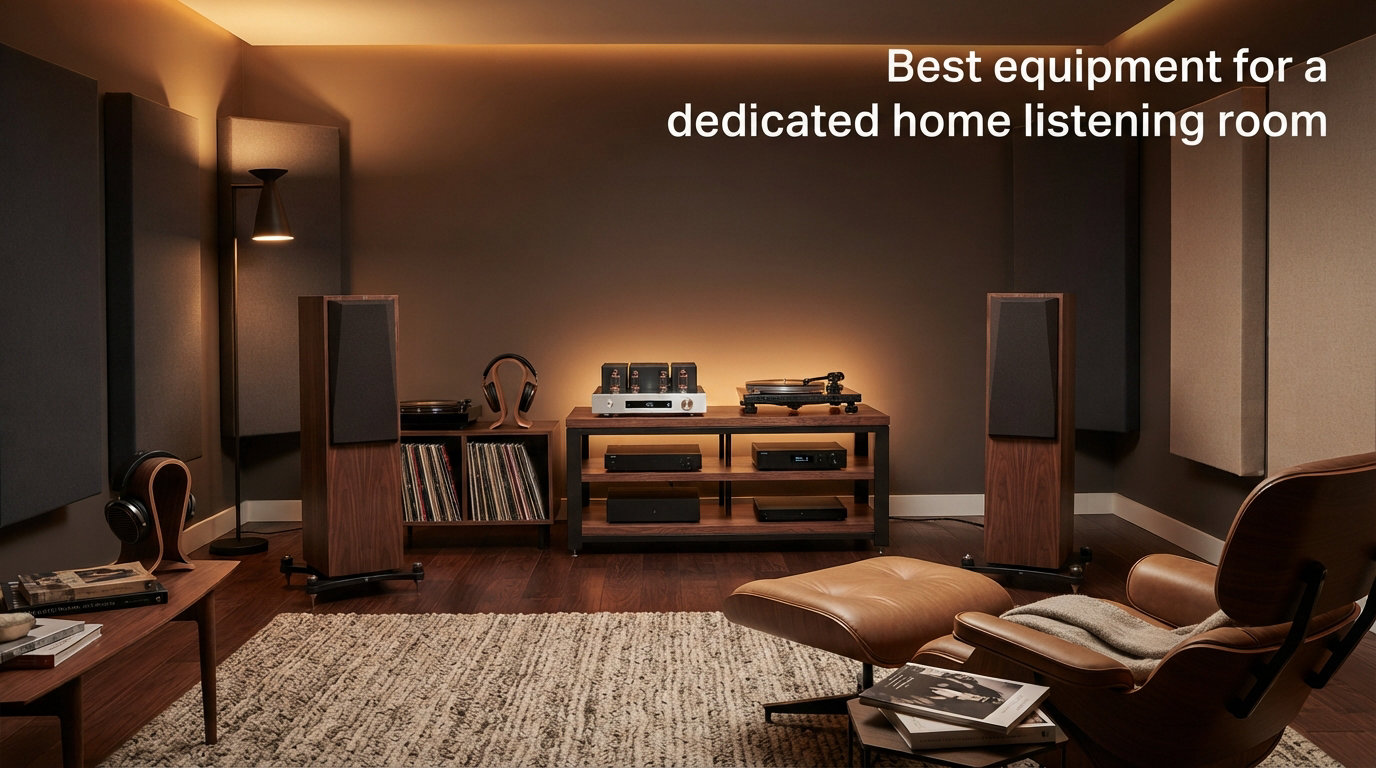
I have spent more evenings than I can count sitting in a worn leather chair, eyes closed, while a Mahler symphony rebuilt itself around me in three dimensions. The thing that finally made that experience possible was not the most expensive amplifier I could find. It was the room itself. After years of moving speakers an inch at a time and hanging absorption panels like a man possessed, I can tell you with certainty that the best equipment for a dedicated home listening room is the room before any single component.
If you are here, you are probably chasing the same thing classical listeners have chased for decades: the illusion that the orchestra is in the room with you. Getting there takes more than buying gear. It takes understanding how sound behaves in a closed space and choosing the right dedicated home listening room equipment to work with that space, not against it.
This guide walks through everything I wish someone had told me before I started. We will cover room acoustics, dimensions, the core equipment categories, speaker placement, bass management, and the considerations that matter specifically for classical music. By the end, you will have a clear blueprint for building a listening room that lets a Beethoven string quartet breathe the way it should.
Table of Contents
What Is a Dedicated Home Listening Room?
A dedicated home listening room is a space designed and treated specifically for experiencing recorded music at its highest possible quality. Unlike a living room or a multi-purpose den, every decision in this room, from wall construction to furniture selection, serves the sound first and everything else second.
The room works by controlling how sound waves reflect, absorb, and build up within the space. When you play a recording, your speakers push energy into the air. That energy bounces off every surface before reaching your ears. In an untreated room, those reflections smear detail, blur imaging, and create peaks and nulls in the frequency response that can make a violin sound harsh one moment and disappear the next.
A proper listening room tames those reflections, manages bass buildup, and positions both speakers and listener so the soundstage forms correctly between and beyond the speakers. The result is an experience where you can close your eyes and locate each instrument in space.
It is worth distinguishing this from a recording room. A recording space is built to capture sound cleanly, often with a specific reverberant character. A listening room is built to reproduce an existing recording as faithfully as possible. The two share some acoustic principles but serve opposite purposes.
Why Room Acoustics Matter More Than Equipment
Here is the truth that took me years to fully accept: the room is the single largest influence on what you hear. I have heard a modest speaker setup in a well-treated room outperform a system costing five times as much in a bare, reflective space.
Three physical phenomena cause most of the problems in listening rooms.
Room modes are standing waves that form at specific low frequencies based on the dimensions of your room. When a note hits one of these resonant frequencies, the energy builds up and creates a loud boom in one spot and a near-silence in another. Walk around your room while a bass-heavy passage plays and you will hear the volume fluctuate dramatically. That is room modes at work.
Early reflections are the first bounces of sound off your side walls, ceiling, and floor. They reach your ears milliseconds after the direct sound from the speakers and confuse your brain’s ability to locate instruments. Left untreated, they collapse the soundstage into a flat, congested wall of sound.
Reverberation time, measured as RT60, is how long it takes for sound to decay by 60 decibels after the source stops. A classical recording already carries the reverberation of the hall where it was recorded. If your listening room adds its own long reverberation on top of that, the music turns muddy and loses the clarity that makes orchestral detail possible.
For a listening room focused on classical music, an RT60 somewhere between 0.3 and 0.5 seconds tends to sound natural. Longer than that and detail smears. Shorter and the room feels dead and lifeless.
Forum communities like r/audiophile consistently report the same finding: budget room treatment outperforms expensive equipment upgrades. Treat the room first, then upgrade components. You will hear more improvement from two hundred dollars of absorption than from swapping amplifiers.
Room Dimensions and Ratios
If you are starting from an empty room or have any choice in the matter, dimensions matter enormously. The goal is to avoid having your room’s length, width, and height share simple mathematical relationships, because that is what stacks room modes on top of each other and creates severe peaks and dips in the bass.
A perfectly cubic room is the worst case. When length, width, and height are all the same, every axial mode lands at the same frequency, and you get a single enormous bass peak that no amount of treatment can fully fix.
Acousticians have studied ideal ratios for decades. One well-known starting point, based on work by L.W. Sepmeyer and others, suggests proportions close to 1 : 1.4 : 1.9 for height : width : length. So a room with an eight-foot ceiling might aim for roughly eleven feet wide and fifteen feet long. These are starting points, not guarantees, because every real room has doors, windows, and furniture that shift the response.
The Bonello Criterion offers another way to evaluate dimensions. The idea is to count how many room modes fall within each third-octave band of the frequency spectrum. A good room has the mode count rising smoothly as frequency increases, without big gaps where certain notes vanish. You can find free online room mode calculators that will plot this for your dimensions.
If you cannot change your room’s dimensions, do not despair. Acoustic treatment and careful speaker and listener positioning can fix most of what bad dimensions create. The dimensions set the starting point, but treatment and placement determine the result.
Essential Equipment for a Home Listening Room
Once the room is understood, the equipment choices become much clearer. Here is the dedicated home listening room equipment chain, explained from the speakers backward to the source.
Speakers: The Voice of Your Room
Speakers convert the electrical signal back into sound, and they interact with the room more than any other component. For a classical listening room, the choice between floorstanding and stand-mount speakers comes down to room size and bass needs.
Floorstanding speakers move more air and produce deeper bass without help. They suit medium to large rooms. Stand-mount, or bookshelf, speakers image beautifully and suit smaller rooms where bass energy is harder to control. For a small room under about 150 square feet, I would choose a quality stand-mount speaker on dedicated stands almost every time.
Look for speakers with even off-axis response. Classical recordings reveal any sharpness or coloration, and speakers that radiate evenly into the room cause fewer reflection problems to fix later.
Amplification: Powering the Signal
An amplifier takes the small signal from your source and raises it to a level that can drive the speakers. For most listening rooms, an integrated amplifier, which combines a preamplifier and power amplifier in one chassis, is the practical and excellent-sounding choice.
Match the amplifier’s power to your speakers and room size. A small room with efficient speakers needs modest power. A large room with current-hungry floorstanders demands a beefier amplifier. Under-powering speakers is more dangerous than over-powering them, because a clipped amplifier produces distortion that can damage tweeters.
Some listeners prefer the warmth of vacuum tube amplification, particularly with classical music, where the slight even-order harmonic coloration can flatter strings and woodwinds. Solid-state amplifiers offer tighter bass and greater accuracy. Neither is wrong. The choice comes down to personal taste.
Source Devices: Where the Music Begins
Your source is whatever holds or delivers the recording. For classical music, you will likely draw from several sources.
A turntable brings the ritual and warmth of vinyl. Classical pressings, especially of orchestral works, can sound astonishing. Look for a turntable with a rigid plinth, a precision bearing, and a quality cartridge. A separate phono stage, rather than the one built into a budget amplifier, often yields a clear improvement.
A streamer or music server delivers high-resolution digital files and streaming services. Classical labels increasingly release high-resolution recordings at 24-bit depth and 96 kHz or higher sample rates. A good streamer makes those files sound effortless and detailed.
A CD player or transport still has its place, especially if you have built a classical collection over the years. Many listeners find that a well-made CD transport into a quality DAC competes favorably with streaming.
DACs and the Digital Chain
A digital-to-analog converter, or DAC, turns the ones and zeros of a digital file into the analog waveform your amplifier then amplifies. A dedicated DAC almost always outperforms the one built into a computer or budget streamer.
For classical music, a DAC with a natural, un-fatiguing presentation matters more than raw measured performance. You will be listening for long stretches, and any harshness in the upper registers becomes exhausting over a two-hour symphony. Listen before you buy if at all possible.
Cabling and Power Conditioning
Cables carry the signal between components. Decent, well-shielded interconnects and appropriately gauged speaker cables are worth the investment. Beyond that point, returns diminish rapidly.
A clean power source matters more than exotic cables. A simple power conditioner that filters noise from your electrical supply can lower the noise floor of the entire system, which is especially audible in the quiet passages that classical music relies on for dramatic effect.
Acoustic Treatment: The Hidden Upgrade
Acoustic treatment is the single highest-return investment you can make in a listening room. Three types of treatment solve three different problems.
Absorption reduces the energy of reflected sound. Porous absorbers, made from mineral wool, fiberglass, or specialized foam, soak up mid and high frequencies. Placed at the first reflection points on your side walls and ceiling, they remove the early reflections that smear imaging. A typical starting point is panels two to four inches thick, mounted at ear level.
Diffusion scatters reflected sound rather than absorbing it. Diffusers preserve the sense of air and space in the room while breaking up the harshness of flat reflective surfaces. They are particularly valuable on the wall behind the listening position, where you want to maintain some reflected energy without it bouncing straight back as a slap echo.
Bass traps address the low-frequency buildup that absorption panels cannot reach effectively. Thick, dense material placed in the corners of the room, where low-frequency energy concentrates, tames the boomy peaks and fills in the missing notes. Corners are the most effective location because all room modes terminate there.
A practical treatment priority for a classical listening room runs roughly as follows: first reflection point absorption on both side walls, ceiling cloud absorption above the listening position, bass traps in the vertical room corners, and finally diffusion on the rear wall.
One common mistake I made early on was over-treating the room with thin foam. A room with too much thin absorption sounds dull and lifeless because it kills the highs while doing nothing for the bass. The result is a muffled, chesty sound that flattens the sparkle of a violin section. Use thick, dense absorption, and leave some reflective surfaces to keep the room alive.
Speaker Placement Guidelines
Even a perfectly treated room sounds wrong if the speakers and listener are not positioned correctly. Placement is free, and it has more impact than any component swap you can make. Start here before spending another dollar.
The Golden Triangle Explained
The golden triangle is the foundational geometry of stereo speaker placement. The two speakers and the listener form an equilateral triangle, with all three sides roughly equal in length. This means the distance between your two speakers equals the distance from each speaker to your ears.
From this position, the soundstage snaps into focus. Instruments lock into specific locations in space, and the music gains a physical presence between and behind the speakers. Move out of the triangle and that illusion collapses.
The speakers should sit far enough from the front wall, the wall behind them, to avoid excessive bass reinforcement. A starting point is two to three feet of clearance for bookshelf speakers on stands, and three to four feet for floorstanders. Every room differs, so experiment by playing a track with strong bass and moving the speakers forward and back in small increments until the low end sounds even.
The 83% Rule for Speaker Positioning
The 83% rule is a guideline for placing your listening position within the length of the room. The rule states that your ears should sit at approximately 38 percent of the room’s length, measured from the front wall behind the speakers.
This position, derived from acoustic research, tends to fall where the room’s bass response is smoothest across the frequency spectrum. Sitting further back typically places you in a region where bass modes stack up and create boomy, uneven low end.
To apply the rule, measure the room’s length from the wall behind the speakers to the opposite wall. Multiply that length by 0.38. The result is the distance from the front wall at which your ears should sit when you are in the listening chair.
Toe-In and Listening Height
Toe-in refers to angling the speakers inward so their front axes cross slightly in front of or behind the listening position. A small amount of toe-in sharpens imaging and narrows the soundstage. Less toe-in widens the soundstage at the cost of some focus.
For classical music, I prefer a slight toe-in where the speaker axes cross just behind my head. This preserves a wide, hall-like soundstage while keeping the central image, where a soloist typically sits, locked in place.
Tweeter height matters because high frequencies are directional. Your ears should sit at the same height as the tweeters when you are in your normal listening posture. If your chair is too low, the high frequencies roll off and the music loses its sparkle. A simple cushion or a slightly taller chair can correct this for free.
Bass Treatment Basics
Bass is the hardest frequency range to control in any listening room, and it is where most rooms fail. The problem is physical: low-frequency sound waves are long, often longer than the dimensions of a typical room. When those long waves hit walls, they reflect and combine with the original wave, creating patterns of reinforcement and cancellation.
Standing waves, the room modes discussed earlier, create specific frequencies where bass booms and others where it vanishes. Play a slow bass sweep through your system and walk the room. You will hear certain notes thunder in the corners and disappear in the center. That is the room, not your speakers.
Bass traps work by absorbing low-frequency energy at the locations where it concentrates, which are the corners of the room. All room modes, regardless of which surfaces create them, terminate at the room’s corners. This makes corners the single most efficient placement for bass-trapping material.
For a practical approach, start with floor-to-ceiling corner traps made of dense mineral wool or rigid fiberglass at least four inches thick, with an air gap behind them if possible. This simple addition often does more for the clarity of a cello or double bass section than any component upgrade.
Broadband absorption at first reflection points also helps with the upper bass and lower midrange, where the warmth and body of orchestral music live. Together, corner traps and reflection-point absorption form the backbone of a classical listening room treatment plan.
Classical Music-Specific Considerations
This is where most listening room guides stop being useful for our audience. Classical music makes demands on a system and a room that no other genre does, and a room set up primarily for rock or electronic music will not necessarily serve a symphony well.
Dynamic range is the first consideration. A full orchestra playing fortissimo can hit peaks 60 decibels above the quietest pianissimo passage in the same recording. Your room and system need to handle those extremes without compression on the loud end or losing detail into the noise floor on the quiet end. A low noise floor, achieved through clean power and acoustic treatment, is essential. The opening of a Mahler symphony, played at realistic volume, should make the silence before the first note feel physical.
Soundstage width and depth matter more for classical than for almost any other genre. A symphony recording should place the strings on the left, the brass behind and to the right, the woodwinds center, and the percussion at the back. Achieving this requires precise speaker placement, controlled early reflections, and a listening position that holds the golden triangle. Without these, the orchestra collapses into a flat sonic wallpaper.
Hall acoustics are baked into every classical recording. The reverberation of the concert hall is part of the performance. Your listening room should neither add to that reverberation nor smother it with too much deadening absorption. The target RT60 of 0.3 to 0.5 seconds strikes this balance, letting the recorded hall speak while keeping detail clear.
Vocal and instrumental clarity in chamber music, opera, and solo piano demands a system free of hardness in the upper midrange. A piano’s middle register can turn glassy and fatiguing on a forward-sounding system in a reflective room. Treatment at the first reflection points and a DAC or amplifier with a natural tonal balance protect against this.
I also recommend having a reference recording you know intimately. For me it is a specific pressing of Beethoven’s Ninth under a conductor I have heard live. When something changes in the room or system, that recording tells me instantly what shifted.
Lighting, Ambiance, and Furniture
A listening room is not just an acoustic space. It is a place where you will spend hours, and the environment shapes how willingly you return to it.
Lighting should be adjustable. Dimmable warm-toned fixtures, or LED accents placed away from the speakers and listening position, create the right mood without adding reflective surfaces. Avoid large uncovered windows behind or beside the speakers, as glass is highly reflective. Heavy curtains serve double duty by blocking light and absorbing mid and high frequencies.
The listening chair deserves real thought. A single, supportive chair, placed at the correct height for tweeter alignment, beats a couch for critical listening. Couches spread the listening position across a wide area where the soundstage is inconsistent. Many experienced listeners, including those on r/listeningspaces, recommend a dedicated chair over shared seating.
Balance aesthetics with acoustics. Fabric-covered absorption panels can be framed and finished to look intentional rather than clinical. Rugs over hard floors absorb reflections and warm the room visually. The goal is a space your household will accept, because a listening room that creates friction at home rarely gets used as intended.
Budget Tiers for Different Levels
How you allocate budget between the room and the equipment depends on where you are starting. A common mistake is pouring everything into components and leaving nothing for treatment. Here is a rough framework.
Entry level: Allocate roughly a third of your total budget to room treatment and the rest to a solid integrated amplifier, a capable pair of stand-mount speakers, and a single source such as a streamer. Even simple DIY absorption panels and a corner trap will transform the sound of a basic system.
Mid level: As the budget grows, room treatment should still claim a meaningful share, perhaps a quarter of the total. The additional funds go toward better speakers, a separate DAC, and possibly a turntable. At this level, consider professional acoustic panels and more comprehensive bass trapping.
High level: Serious investment opens up floorstanding speakers, separates instead of an integrated amplifier, and dedicated power conditioning. Even here, do not abandon the room. A custom-treated room with measured acoustic performance extracts the full value of high-end components. Skipping treatment at this level wastes the money spent on the gear.
The forum consensus, which matches my own experience, is that room treatment delivers the best return at every budget tier. Spend on the room first, then let the components follow.
Common Listening Room Mistakes to Avoid
Most listening room problems come from a handful of avoidable mistakes. I have made nearly all of them.
Over-treating with thin foam deadens the highs while leaving the bass untouched, producing a dull, chesty sound. Use thick, dense absorption instead, and leave reflective and diffusive surfaces to keep the room alive.
Ignoring bass is the most common failure. Mid and high frequency treatment is visible and satisfying to install, but bass traps in the corners do more for the overall clarity of the music.
Placing speakers in corners or against the front wall maximizes bass reinforcement and creates boomy, uneven low end. Pull the speakers into the room and experiment with distance from the front wall.
Sitting too far back places the listener in a region where room modes stack up. Apply the 38 percent rule and experiment with seat position before assuming the speakers are at fault.
Prioritizing equipment over the room is the deepest trap. Every dollar spent on a better amplifier in a bad room yields less than a dollar spent on treating that room first.
FAQs
What do you need for a listening room?
A listening room needs a treated acoustic space, a pair of well-placed speakers, an integrated amplifier or separates, at least one source device such as a streamer or turntable, and a dedicated listening chair positioned at the correct height and distance. Acoustic treatment, including absorption at first reflection points and bass traps in the corners, has more impact on sound quality than any single piece of equipment.
What is the 83% rule for speakers?
The 83% rule, more commonly called the 38 percent rule, states that the ideal listening position sits at 38 percent of the room’s length, measured from the wall behind the speakers. This position tends to fall where the room’s bass response is smoothest across the frequency spectrum, reducing boominess and uneven low end without requiring additional treatment.
What is the best brand for home audio systems?
There is no single best brand for home audio systems because the right choice depends on your room size, budget, listening preferences, and the type of music you play. For classical music listening, established brands known for natural tonal balance and even off-axis response tend to perform well, but the match between speakers, amplifier, and room matters far more than the brand name on the chassis.
What equipment do I need to record my music at home?
Recording music at home requires different equipment than a listening room. You need an audio interface, one or more microphones suited to your instrument or voice, a pair of studio monitor speakers or headphones for accurate playback, recording software, and acoustic treatment that suits capture rather than reproduction. A recording room and a listening room share some acoustic principles but serve opposite purposes.
Bringing It All Together
Building the best equipment for a dedicated home listening room is not a shopping list. It is a process of understanding how sound behaves in your space and choosing components and treatments that work with that space. Start with the room, then the placement, then the treatment, and only then the equipment.
Classical music rewards this approach more than any other genre. When the room is right, a symphony unfolds with the depth and clarity of a live performance. When it is wrong, no amount of exotic gear will hide it.
Begin with what you have. Treat the first reflection points. Trap the corners. Position your speakers and chair using the golden triangle and the 38 percent rule. Then, and only then, consider what to upgrade next. Your room is waiting, and the music is ready when you are.