
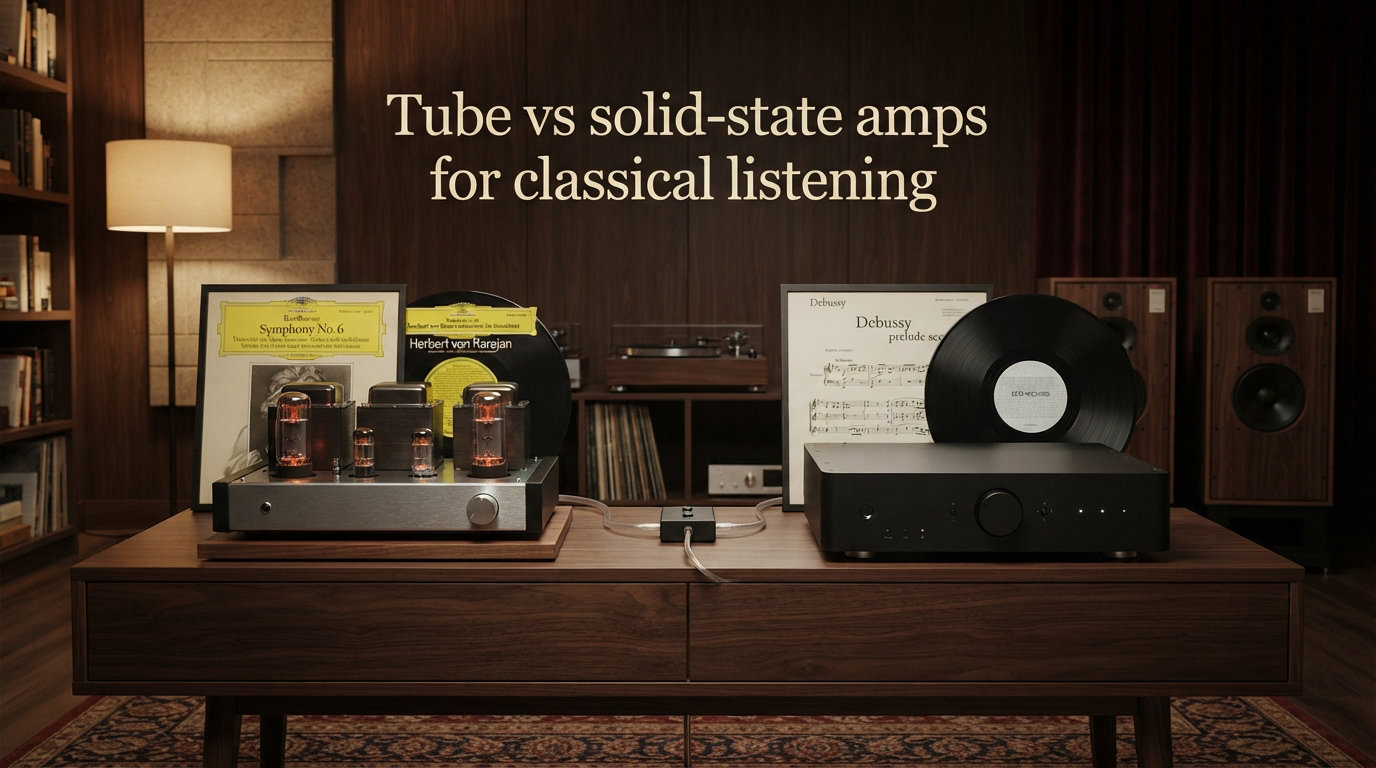
If you have ever sat down with a Mahler symphony and felt something was missing from the playback, the amplifier sitting between your source and speakers might be the reason. The debate over tube vs solid-state amps for classical listening has divided audiophiles for decades, and the answer is not as simple as picking the more expensive option.
I have spent years auditioning both technologies across orchestral recordings, chamber music, and opera. The differences are real, measurable, and deeply personal. Classical music demands more from an amplifier than almost any other genre because of its enormous dynamic range and the complexity of a full orchestra playing at once.
This guide breaks down how each technology works, why they sound different, and which type makes the most sense for your listening habits. Whether you are building your first serious classical system or upgrading from an entry-level receiver, understanding these differences will save you money and frustration.
Our team tested recordings from Deutsche Grammophon, Decca, and Harmonia Mundi across both amplifier types to isolate what actually changes in the listening experience. The results surprised us in some areas and confirmed long-standing assumptions in others.
Table of Contents
What Are Tube Amplifiers?
Tube amplifiers use vacuum tubes to amplify the audio signal from your source component. A vacuum tube is a sealed glass envelope containing a heated filament, a grid, and a plate, all operating in a vacuum to control the flow of electrons. When the audio signal enters the grid, it modulates the electron flow between the filament and the plate, creating a larger copy of the original signal.
This technology dates back to the early twentieth century and was the only practical amplification method until transistors became commercially viable in the 1960s. Despite being older technology, vacuum tubes never disappeared from high-end audio because of how they handle distortion and clipping. A tube amp does not just make music louder; it shapes the sound in ways that many listeners find more musically satisfying.
Most tube amplifiers use output transformers between the tubes and your speakers, which converts the high-voltage, low-current signal from the tubes into the low-voltage, high-current signal your speakers need. These transformers contribute to the characteristic warmth that tube amps are known for, and they also provide a natural current limit that protects speakers during musical peaks.
Tube amplifiers typically operate in Class A or Class AB designs. Class A tube amps run their output tubes constantly, producing a smooth, continuous signal with very low crossover distortion. Class AB designs push the tubes into a more efficient operating mode, sacrificing a small amount of refinement for significantly more power and cooler operation.
What Are Solid-State Amplifiers?
Solid-state amplifiers use silicon transistors instead of vacuum tubes to amplify the audio signal. A transistor is a semiconductor device that uses a small input voltage at its base or gate to control a much larger current flowing between its collector and emitter. Because transistors have no heated filament and no glass envelope, they are smaller, cooler, and more efficient than vacuum tubes.
Modern solid-state designs date back to the 1960s and have improved dramatically in measured performance. A well-designed solid-state amplifier can produce harmonic distortion levels below 0.01 percent, a noise floor close to the theoretical limit, and frequency response that is flat from DC to beyond human hearing. On paper, solid-state amplifiers are objectively more accurate than tube designs.
Most solid-state amplifiers do not use output transformers, which means they can deliver large amounts of current directly to your speakers. This direct coupling gives solid-state amps their characteristic tight bass control and precise transient response. The trade-off is that when a solid-state amp reaches its limits, it clips hard and abruptly, producing harsh, unpleasant distortion rather than the gentle compression of a tube design.
Solid-state amplifiers also operate in Class A, Class AB, and increasingly Class D topologies. Class D designs use high-frequency switching to achieve efficiency above 90 percent, generating very little heat and allowing massive power output from a small chassis. These switching amplifiers have improved to the point where several now compete with traditional Class AB designs in blind listening tests.
Tube vs Solid-State Amps for Classical Listening: Sound Comparison
The tube vs solid-state amps for classical listening comparison comes down to four sound characteristics: warmth versus clarity, mid-range presentation, soundstage width, and bass control. Each technology excels in different areas, and classical music exposes every one of these differences because of its tonal complexity.
Tube amplifiers produce primarily second-order harmonic distortion, which is a gentle doubling of the fundamental frequency that the human ear perceives as warmth rather than harshness. Solid-state amplifiers produce more higher-order harmonics when they distort, which sound metallic and fatiguing. At normal listening levels both technologies are well below audible distortion, but the type of distortion matters when the music gets loud.
Mid-range reproduction is where classical listeners often notice the biggest difference. Orchestral strings, woodwinds, and the human voice live almost entirely in the mid-range, and tube amplifiers tend to render this region with a richness and body that solid-state designs can match only at much higher price points. The cello section in a Brahms symphony has a palpable wood-and-gut texture through a good tube amp that solid-state often presents more analytically.
Soundstage is another area where the two technologies diverge. Tube amplifiers, particularly single-ended triode designs, create a wide and deep soundstage with instruments placed precisely in three-dimensional space. Solid-state amplifiers can also produce excellent imaging, but the presentation tends to be more focused and less holographic. For orchestral recordings where you want to pinpoint the second violins versus the violas, both technologies work, but tubes often create a more concert-hall-like experience.
Bass control goes to solid-state almost every time. The direct-coupled output stage of a solid-state amplifier grips the low-frequency drivers in your speakers with authority, producing tight, defined bass that does not blur during complex passages. Tube amplifiers, especially those with output transformers, tend to soften the lowest octave. For pipe organ recordings this can be a real limitation, but for most orchestral repertoire the difference is subtle.
Dynamic range handling is a mixed bag. Solid-state amplifiers have more headroom and can reproduce the full shock of a timpani strike or brass fortissimo without compression. Tube amplifiers compress more gracefully, which some listeners find more natural because real concert halls also compress the loudest peaks slightly. Your preference here depends on whether you want maximum impact or maximum musicality.
Why Tube Amps Suit Classical Music
Are tube amps good for classical music? Yes, and many experienced listeners consider them the ideal choice for the genre. Classical recordings, particularly older analogue productions from the 1950s through the 1980s, often have edgy highs and slightly harsh upper-midrange that tube amplifiers smooth out naturally. The second-order harmonic distortion that tubes add acts almost like a gentle equalizer that flatters acoustic instruments.
Chamber music and solo piano recordings benefit enormously from tube amplification. The tonal colours of a Steinway grand or a Stradivarius violin come through with a liquidity that solid-state designs struggle to match at comparable prices. Forum users on Talk Classical consistently report that tube amps create a more organic, less mechanical presentation of acoustic instruments, which matters when the entire point of the recording is to capture a live performance.
Opera recordings are another genre where tube amplification shines. The human voice is incredibly sensitive to even small amounts of harshness in the upper mid-range, and tube amps tame this region without dulling detail. When Birgit Nilsson hits a high C in a Wagner opera, a tube amplifier presents it with power and warmth rather than the edge that solid-state can introduce.
Long listening sessions also favour tubes. The smoother presentation reduces listening fatigue, which matters when you are working through a complete Beethoven symphony cycle or a four-hour Wagner opera. Many listeners report that they can listen at length to tube amplifiers without the tiredness that aggressive solid-state designs can cause.
Why Solid-State Amps Suit Classical Music
Solid-state amplifiers have real advantages for classical listeners, and dismissing them would be a mistake. Modern well-designed solid-state amplifiers from companies like Hegel, Naim, and Parasound deliver transparency that lets you hear exactly what is on the recording, for better or worse. If you want to hear the acoustic of the Vienna Musikverein as captured by the engineer, solid-state is often the more honest messenger.
Dynamic range is where solid-state amplifiers pull ahead decisively. A Mahler symphony can swing from a single pianissimo violin to a full orchestral fortissimo with 80 decibels of dynamic range. A solid-state amplifier with high headroom reproduces these swings without compression, giving you the full physical impact of the climaxes. Tube amplifiers, particularly lower-wattage designs, compress these peaks in ways that some listeners love and others find limiting.
Bass reproduction matters more for classical music than many people assume. Pipe organ recordings, bass drum impacts in Shostakovich, and the lowest notes of a concert grand piano all demand tight, extended low-frequency response. Solid-state amplifiers deliver this effortlessly, while tube amplifiers often roll off the bottom octave or lose definition in complex bass passages.
Detail retrieval is another solid-state strength. The best solid-state designs resolve the tiny reverberant cues that tell your brain about the size and character of the recording space. You can hear the difference between a dry studio acoustic and the generous bloom of a cathedral recording more clearly through a transparent solid-state amplifier than through a tube design that adds its own warmth to the presentation.
Reliability and convenience favour solid-state as well. You can leave a solid-state amplifier on for weeks, ignore it completely, and it will perform identically every time you sit down to listen. For classical listeners who want to press play and enjoy the music without thinking about equipment maintenance, this is a genuine advantage.
Technical Terms You Need to Know
Harmonic Distortion
Harmonic distortion is any unwanted addition of frequencies that are mathematically related to the original signal. Second-order harmonics double the fundamental frequency and sound warm and musical to human ears. Higher-order harmonics, like the seventh or ninth, sound harsh and dissonant. Tube amplifiers produce mostly lower-order harmonics, while solid-state designs produce more higher-order harmonics when pushed into distortion.
Soundstage
Soundstage refers to the three-dimensional space in which recorded instruments appear to exist when you listen. Width describes how far left and right the sound extends beyond your speakers. Depth describes how far back the soundstage reaches behind the speaker plane. A good soundstage lets you localize individual instruments within the orchestra, which is critical for enjoying complex orchestral recordings.
Tube Rolling
Tube rolling is the practice of swapping vacuum tubes in an amplifier to change its sound character. Different tubes from different manufacturers and eras produce subtly different tonal balances, soundstage sizes, and detail presentations. Classical listeners who enjoy tube rolling can fine-tune their system to favour string warmth, vocal presence, or orchestral clarity by experimenting with NOS (new old stock) tubes from Telefunken, Mullard, or RCA.
Noise Floor
The noise floor is the constant background hiss or hum present in any electronic system. Solid-state amplifiers typically have a much lower noise floor than tube designs, which means quiet passages in classical recordings emerge from a blacker background. Tube amplifiers introduce a faint hum from their filaments and transformers, which is usually inaudible during music but noticeable in the silent moments between movements.
Class A and Class AB
Class A amplifiers run their output devices constantly, producing the lowest distortion but generating significant heat and delivering relatively low power. Class AB amplifiers run their output devices in a push-pull arrangement that is more efficient, producing more power with less heat at the cost of slightly higher crossover distortion. Both topologies exist in tube and solid-state designs, and both can produce excellent results for classical music.
Pros and Cons Summary
Tube amplifiers offer warmth, mid-range richness, an expansive soundstage, and graceful compression at high volumes. They flatter acoustic instruments, reduce listening fatigue, and add musicality to older classical recordings. Their weaknesses include higher cost per watt, the need for occasional tube replacement, heat generation, softer bass response, and a higher noise floor that can intrude during quiet passages.
Solid-state amplifiers deliver transparency, tight bass control, wide dynamic range, low noise, and rock-solid reliability. They reproduce recordings accurately, handle demanding orchestral peaks without compression, and require essentially no maintenance. Their potential drawbacks include a clinical presentation that some listeners find uninvolving, possible harshness in the upper mid-range with bright recordings, and abrupt clipping when pushed past their limits.
The honest summary is that neither technology is objectively superior for classical music. Tube amplifiers add something musically pleasing that many classical listeners love. Solid-state amplifiers remove themselves from the equation and let the recording speak for itself. Your choice depends on which philosophy matches your listening priorities and which trade-offs you are willing to accept.
Many experienced classical listeners eventually settle on a hybrid approach. Some use a tube preamplifier for its warmth and musicality paired with a solid-state power amplifier for its bass control and dynamic headroom. This combination captures much of the magic of tubes while retaining the practical advantages of solid-state, and it has become increasingly popular among audiophiles who refuse to choose.
Matching Your Amp to Your Classical Setup
Your choice between tube and solid-state should account for the rest of your system, not just the amplifier in isolation. Speaker sensitivity is the most important factor. Tube amplifiers, particularly low-wattage single-ended designs, work best with high-sensitivity speakers rated at 90 decibels or higher. Solid-state amplifiers drive almost any speaker without difficulty, including the low-sensitivity designs that many modern audiophile speakers use.
Speaker impedance matters as well. Tube amplifiers with output transformers have specific impedance taps, usually 4 ohm and 8 ohm, and mismatching these can degrade sound quality. Solid-state amplifiers handle varying impedance loads more gracefully, which matters if your speakers have impedance dips in the bass region where many classical recordings demand maximum current delivery.
Your listening room plays a bigger role than most people realize. A lively, reflective room can make a warm tube amplifier sound muddy, while a heavily damped room can make a transparent solid-state amplifier sound thin and analytical. If your room is already bright, the warmth of a tube amp may restore balance. If your room is already warm, solid-state may provide the clarity you need.
Source components also influence the decision. If you primarily stream high-resolution files or play vinyl through a high-quality turntable, your source is already delivering excellent detail that either amplifier type can reveal. If your source is more modest, the musicality of a tube amplifier can compensate for source limitations in ways that a transparent solid-state design cannot.
Finally, consider your listening habits. If you listen for hours at a time to complete operas or symphony cycles, the lower fatigue of tube amplification may serve you better. If you listen at high volumes or to recordings with extreme dynamic range, the headroom and bass control of solid-state may be more satisfying. There is no wrong answer, only the answer that fits your situation.
Price, Maintenance, and Long-Term Value
Tube amplifiers typically cost more per watt than solid-state designs. A tube integrated amplifier delivering 30 watts per channel may cost the same as a solid-state amplifier delivering 150 watts per channel. This is not because tube amplifiers are overpriced but because vacuum tubes, output transformers, and point-to-point wiring are inherently more expensive to manufacture than printed circuit boards populated with transistors.
Maintenance is the ongoing cost that catches new tube owners by surprise. Vacuum tubes have finite lifespans, typically ranging from 3,000 to 10,000 hours depending on the type and how hard the amplifier runs them. Small signal tubes like the 12AX7 last longer, while power output tubes like the KT88 or EL34 may need replacement every two to three years of regular use. Budget for tube replacement as a routine operating cost.
Solid-state amplifiers, by contrast, are essentially maintenance-free. A well-built solid-state amplifier can run for decades without any service beyond occasional dusting. Transistors do not wear out under normal operating conditions, and the only components that may eventually need attention are electrolytic capacitors, which typically last 15 to 20 years before their performance degrades.
Long-term value depends on how you calculate it. A tube amplifier may cost more to own over a decade when you factor in tube replacements, but it also tends to hold its resale value better because the technology has a devoted following. Solid-state amplifiers depreciate more quickly as new designs arrive, but their lower operating costs and reliability offset this for many owners.
For classical listeners on a budget, solid-state offers more performance per dollar, especially in the under-one-thousand-dollar range where tube amplifiers are often compromised designs. If your budget allows for two thousand dollars or more, both technologies offer genuinely excellent options, and the choice becomes about sound character rather than value.
FAQs
Are tube amps good for classical music?
Yes, tube amps are excellent for classical music. They produce warm second-order harmonic distortion that flatters acoustic instruments, smooth out harsh upper-midrange in older recordings, and create an expansive soundstage that suits orchestral repertoire. Many experienced classical listeners prefer tube amplification for solo piano, chamber music, and opera.
Do tube amps sound better than solid-state amps?
Neither technology is objectively better. Tube amps sound warmer and more musical with richer mid-range and wider soundstage, while solid-state amps sound more transparent with tighter bass and wider dynamic range. The better choice depends on your listening preferences, your speakers, and the type of classical recordings you play most often.
What is the best amp for classical guitar?
For classical guitar recordings, a tube amplifier with strong mid-range reproduction is often preferred because it captures the woody resonance of the nylon strings. For amplifying a classical guitar live, a solid-state acoustic amplifier with flat frequency response is usually the better choice because it reproduces the natural tone without coloration.
Why do jazz guitarists use solid-state amps?
Jazz guitarists often use solid-state amps like the Polytone or Roland Jazz Chorus because they provide clean, transparent headroom at high volumes without the compression and coloration of tube designs. Jazz tone typically favours clarity and articulation over the warm distortion that tube amps produce, making solid-state the practical choice for performance settings.
Conclusion
The tube vs solid-state amps for classical listening debate does not have a single correct answer, and that is exactly what makes it worth exploring. Tube amplifiers add warmth, musicality, and a holographic soundstage that flatters orchestral and chamber recordings. Solid-state amplifiers deliver transparency, dynamic headroom, and reliability that let you hear exactly what the engineers captured.
Your best next step is to audition both technologies with recordings you know intimately. Listen for the differences in string tone, vocal presence, and bass control described in this guide, and trust your own ears. The right amplifier for your classical listening is the one that makes you forget about the equipment and simply enjoy the music.