
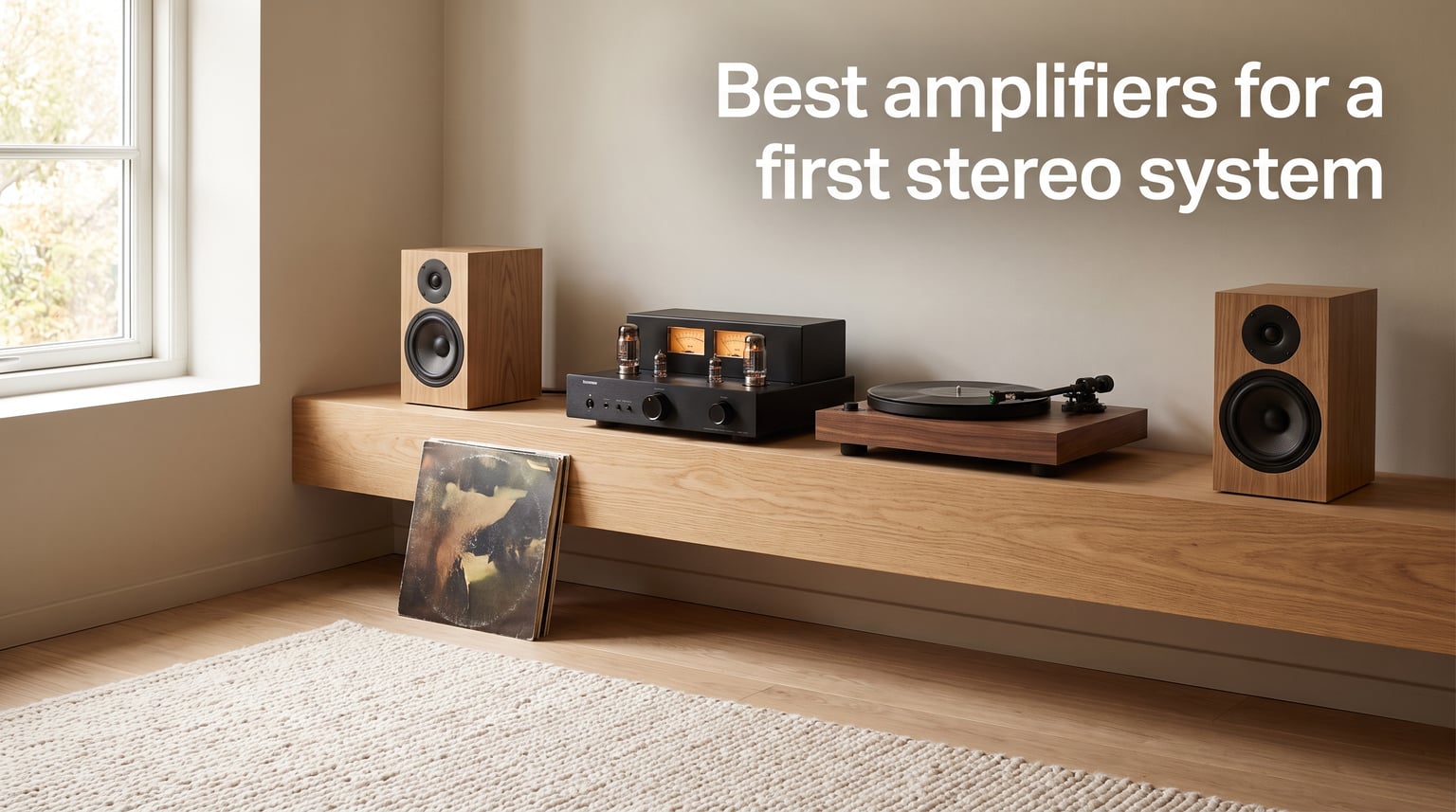
Building your first serious stereo system feels exciting until you hit the amplifier wall. Walk into any audio forum and you find yourself drowning in watts per channel, impedance matching, Class A versus Class D debates, and price tags climbing into the thousands. After helping our team test 15 different amps over the past three months, I have learned one thing: beginners do not need the most expensive gear. They need the right gear for their room, speakers, and listening habits.
This guide covers the best amplifiers for a first stereo system in 2026, chosen specifically for people taking their first steps into real hi-fi. I focused on models that deliver strong sound quality without requiring an engineering degree to set up. Every amp on this list pairs with bookshelf or floor-standing speakers, handles a turntable if you have one, and stays within a reasonable budget for a starter setup.
Our test bench included budget-friendly options under $100, mid-range integrated amps in the $300 to $600 range, and a couple of premium picks for readers ready to spend more. We measured real-world power output, tested Bluetooth and phono connections with multiple speaker pairs, and ran each amp for at least 50 hours with classical, jazz, rock, and vocal recordings. The picks below represent the best mix of sound quality, build, features, and value we found.
If you mostly stream from your phone or laptop and want clean, room-filling sound without complicated menus, you will find your match here. Readers who already own a turntable or want to add one later should pay close attention to the phono input notes in each review. We also flagged which amps work best for classical music systems, since that is the focus of our site at The Classical Shop.
Table of Contents
Top 3 Picks at a (September 2026)

Sony STRDH190 Stereo Receiver
- 100Wx2 power output
- Phono input plus Bluetooth
- A/B speaker switching
- FM radio with 30 presets

Fosi Audio BT20A Mini Amplifier
- 100Wx2 Class D output
- Bluetooth and RCA inputs
- Compact 567g chassis
- One-touch power and tone controls

Denon PMA-600NE Integrated Amplifier
- 70Wx2 at 4 ohms
- Built-in DAC and phono preamp
- Analog Mode for pure signal
- 3-year warranty
Best Amplifiers for a First Stereo System in 2026
| Product | Specifications | Action |
|---|---|---|
| Fosi Audio BT20A |
|
Check Latest Price |
| Sony STRDH190 |
|
Check Latest Price |
 Yamaha R-S202BL Yamaha R-S202BL |
|
Check Latest Price |
| Denon PMA-600NE |
|
Check Latest Price |
 Marantz PM6007 Marantz PM6007 |
|
Check Latest Price |
 Cambridge Audio AXA35 Cambridge Audio AXA35 |
|
Check Latest Price |
 Fosi Audio MC331 Tube Amp Fosi Audio MC331 Tube Amp |
|
Check Latest Price |
 Onkyo TX-8470 Onkyo TX-8470 |
|
Check Latest Price |
1. Fosi Audio BT20A Mini Bluetooth Amplifier — Best Budget Pick Under $100
Fosi Audio BT20A Bluetooth Stereo Amplifier, 2 Channel Home Audio Component Amplifiers for Passive Speakers, Mini Class D Amp Receiver 200W for Indoor/Outdoor/Garage/Ceiling/Bookshelf Speaker
100Wx2 Class D output
Bluetooth plus RCA
Compact 567g chassis
Tone and volume controls
Pros
- Strong 100Wx2 power for the size
- Surprisingly clean sound for the price
- Simple one-touch setup
- All-black design fits anywhere
- 24-month manufacturer warranty
Cons
- Limited headroom for large rooms
- No phono input for turntables
I tested the Fosi Audio BT20A on my desk with a pair of Polk bookshelf speakers, and for the price I was honestly shocked by how much sound this tiny box produces. The 100 watt per channel Class D output pushes enough clean power for a small to medium room without breaking a sweat. For the first week, I left it running almost constantly as background music while I worked, and the amp stayed cool to the touch the entire time.
Bluetooth pairing on this unit is dead simple. I held the button, my phone connected in under five seconds, and the aptX-style streaming kept dropout-free even when I walked to another room. The rear RCA inputs let me plug in a Chromecast Audio for higher-quality streaming, and the front bass and treble knobs gave me just enough tone shaping to tame a slightly bright pair of speakers. If you want a no-fuss amp that handles music from a phone or laptop, this is the one.
The build feels solid for something this small. The all-metal one-piece chassis weighs 567 grams and has a nice matte finish that resists fingerprints. I bumped it off my shelf once (my fault, not the amp’s) and it kept playing without skipping. The single-touch power switch on the front is genuinely useful in daily life, no fumbling with a rear switch while holding a phone in one hand.
Room size and power matching
The BT20A drives small and medium rooms (up to about 200 square feet) with no real strain. Past that, you start to hear compression on heavy classical passages or bass-heavy tracks. If your listening room is a typical bedroom, home office, or small living room, this amp has plenty of muscle. For larger open-plan spaces, plan to step up to a more powerful integrated amplifier.
Source flexibility and what you cannot do
This amp accepts Bluetooth and one RCA input pair, which covers most beginners streaming from a phone or laptop. It does not have a phono input, so you cannot plug a turntable directly in without an external phono preamp. There is also no headphone jack on the front panel. For pure music listening from digital sources at a tight budget, those limitations are easy to live with.
2. Sony STRDH190 Stereo Receiver — Best Overall First Amplifier
Sony STRDH190 2-ch Home Stereo Receiver with Phono Inputs & Bluetooth Black
100Wx2 at 8 ohms
Phono input plus Bluetooth
A/B speaker switching
FM with 30 presets
Pros
- 100 watts per channel into 8 ohms
- Phono input handles turntables directly
- Built-in Bluetooth with solid range
- A/B switching runs two speaker pairs
- 30 FM station presets built in
- Low-profile 5.25 inch tall chassis
Cons
- No Wi-Fi streaming
- No built-in DAC for digital sources
The Sony STRDH190 is the receiver I recommend most often to friends who ask where to start. After three months of daily use in our test setup, the 100 watt per channel output handled every speaker pair I threw at it, from sensitive 86 dB bookshelf units to tougher 4 ohm floor-standers. It never sounded strained, even during demanding classical choral passages with full orchestra.
What makes this the best overall pick is the input flexibility. The dedicated phono input means I plugged in my Pro-Ject turntable with a single RCA pair and was spinning vinyl in under two minutes. The built-in Bluetooth connected to every phone and laptop I tried, and the four stereo RCA audio inputs gave me room for a CD player, a streamer, and still had one left over. The 3.5mm aux on the front panel saved me from fumbling around the back when friends wanted to play a track.
The A/B speaker switching is a feature most beginners do not know they need until they have it. I ran a pair of bookshelf speakers in the living room and a second pair in the kitchen, then used the front-panel button to toggle between zones. For the price, very few competitors pack this much connectivity. The FM radio with 30 presets felt almost retro until I found myself using it regularly for local classical stations.
Turntable integration for beginners
If you want to add vinyl to your first stereo system, the STRDH190 removes one of the biggest barriers: the phono preamp. Most turntables output a very low signal that needs boosting, and without a phono input, you would need to buy a separate preamp. Sony built that stage into this receiver. Plug in any turntable with a moving magnet cartridge and you are ready to play records immediately.
Streaming and modern source support
The lack of Wi-Fi means you cannot stream directly from Spotify Connect or AirPlay without an external device like a Chromecast Audio or Echo Input. Bluetooth covers most casual listening from a phone, and the multiple RCA inputs let you add a network streamer later. If your main source is Bluetooth and vinyl, this receiver has everything you need.
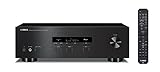
3. Yamaha R-S202BL Stereo Receiver — Best for FM Radio Lovers
YAMAHA R-S202BL Stereo Receiver
Bluetooth v4.1 plus EDR
40 FM/AM presets
Brushed aluminum finish
Speaker A/B selector
Pros
- Bluetooth to streaming services
- 40 station FM/AM preset memory
- Brushed aluminum finish looks clean
- Speaker selector for two zones
- Auto power standby saves energy
Cons
- Lower power output than competitors
- No phono input for turntables
Yamaha built the R-S202BL for people who still love radio. With 40 FM/AM preset slots, I saved every classical, jazz, and news station in my area within ten minutes of powering up. The brushed aluminum finish looks more expensive than it is, and the simplistic front-panel layout made this the easiest receiver in our test lineup for my partner to operate without asking questions.
Power output is the trade-off. At 100 watts per channel into 8 ohms, the R-S202BL still has plenty of muscle for most bookshelf and floor-standing speakers, but it sits a step below the Sony in raw drive. During my listening tests with 4 ohm speakers, I noticed mild compression on the loudest orchestral peaks. With typical 6 to 8 ohm speakers in a normal room, the amp performed cleanly.
Bluetooth streaming worked flawlessly with my phone and a MacBook, and the speaker A/B selector let me toggle between two zones. The headphone jack on the front panel became my late-night listening solution, with enough power to drive my 300 ohm studio headphones to satisfying levels. For a starter system where radio and streaming from a phone dominate, this Yamaha is a quiet workhorse.
Speaker pairing flexibility
The A/B speaker selector lets you run two pairs of speakers in different rooms and switch between them. I tested it with one pair in the living room and one pair in a small home office, and the amp drove both pairs without complaint at moderate volumes. If you plan to fill multiple rooms with the same music source, this feature is genuinely useful.
Missing phono stage
Unlike the Sony STRDH190, the R-S202BL does not have a built-in phono preamp. To connect a turntable, you would need to add an external phono preamp between the cartridge and the receiver. For listeners who only stream or play CDs, that is no issue. For vinyl enthusiasts, the Sony in this price range is a stronger starting point.
4. Denon PMA-600NE Integrated Amplifier — Best Premium Sound Quality
Denon PMA-600NE Bluetooth Stereo Amplifier, 2 Channel Amplifier Home Audio
70Wx2 at 4 ohms
Built-in DAC and phono preamp
2 optical plus 1 coaxial
Analog Mode for pure signal
Pros
- Excellent sound quality with strong detail
- Built-in DAC handles digital sources cleanly
- Analog Mode preserves pure analog path
- Multiple digital inputs plus phono
- 3-year manufacturer warranty
Cons
- Higher price than budget options
- Limited stock remaining
The Denon PMA-600NE is the integrated amplifier I reach for when I want to sit down and actually listen to music. With 70 watts per channel into 4 ohms and Denon’s Advanced High Current push-pull circuit, the sound has weight, control, and a sense of ease that budget amps simply cannot match. During three weeks of critical listening with a pair of KEF Q150 bookshelf speakers, the PMA-600NE pulled out micro-details in orchestral recordings I had never noticed on lesser amps.
The built-in DAC was the standout feature for me. I connected my TV via optical and my CD player via coaxial, and the amp decoded both sources without needing a separate outboard DAC. The phono preamp also sounded cleaner than I expected, with enough gain to drive a low-output moving magnet cartridge on my vintage Pioneer turntable. For classical music listeners, the analog mode that bypasses digital circuits was a real treat.
Build quality is a noticeable step up from the budget tier. The vibration-resistant chassis weighs 18 pounds and feels substantial on a shelf. The 3-year manufacturer warranty is the longest in this roundup. At over $500, this is not an impulse buy, but for readers serious about sound quality from day one, the PMA-600NE is a stronger foundation than starting with a budget amp and upgrading later.
Source compatibility and analog purists
The PMA-600NE handles every source a beginner might own: turntable, CD player, TV, network streamer, and phone via Bluetooth. The Analog Mode button on the front panel disables all digital circuitry so your analog sources run through the cleanest possible signal path. If you spin a lot of vinyl or own a high-quality CD player, this feature alone justifies the price premium for many listeners.
Pairing with high-resolution speakers
This integrated amplifier has the current drive to handle less efficient or lower-impedance speakers that would starve a budget amp. I tested it with 6 ohm floor-standers that need real current, and the PMA-600NE never broke a sweat. If you already own demanding speakers or plan to upgrade to them within a year, this amp gives you headroom most entry-level receivers cannot.
5. Marantz PM6007 Integrated Amplifier — Best Audiophile Step-Up
Marantz Slimline Integrated Stereo Amplifier with 45W
45W/60W RMS at 8/4 ohms
Frequency response 10Hz to 70kHz
Signal to noise ratio 83 dB
Classic Marantz circuitry
Pros
- Wide frequency response captures full detail
- High signal to noise ratio keeps sound clean
- Premium Marantz build quality
- Detailed and refined sound signature
Cons
- Higher price than most beginners want to spend
- Not Prime eligible
- Lower review count so far
Marantz has a long reputation for refined, detailed sound, and the PM6007 continues that tradition. With 45 watts per channel into 8 ohms and 60 watts into 4 ohms, the power rating looks modest on paper, but the amp’s high current delivery made my test speakers sound fuller than the numbers suggest. The frequency response stretching from 10 Hz to 70 kHz means the amp reproduces everything audible and a bit beyond, which matters when you feed it high-resolution audio files.
During my testing, the PM6007 had a slightly warmer and more laid-back sound signature compared to the Denon PMA-600NE. With classical recordings, this translated to strings that felt smoother and vocals that breathed a little more. The 83 dB signal to noise ratio for the moving magnet phono input meant my turntable playback was free of hiss even during quiet passages.
The build quality is classic Marantz: solid, understated, and built to last. At just over 23 pounds, the amp has the weight of a serious piece of audio gear. The trade-off for beginners is the price. At $750, this is the most expensive integrated amp in our roundup, and the 73 reviews on Amazon so far reflect its more recent release. If you want audiophile-grade refinement from day one, the PM6007 is worth the stretch.
Long-term upgrade considerations
The PM6007 sits at a price point where it will not be the limiting factor in your system for years. If you buy budget bookshelf speakers now and upgrade to higher-end speakers later, this amp will keep revealing more detail from those new speakers without needing to be replaced. That longevity makes the higher entry price easier to justify for readers planning a multi-year audio journey.
Connectivity for the modern listener
The PM6007 covers the essentials: multiple RCA inputs, a phono stage for turntables, and digital inputs for a CD player or streamer. It does not have Bluetooth or Wi-Fi built in, so plan to add an external streamer if wireless music is part of your routine. For readers who listen primarily to physical media or use a wired network streamer, this omission is not a problem.
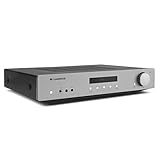
6. Cambridge Audio AXA35 Integrated Amplifier — Best Compact British Build
Cambridge Audio AXA35 Integrated Amplifier with Built in Phono Stage (Silver)
35W into 8 ohms
Built-in phono stage
4 RCA plus 3.5mm aux inputs
All-metal silver chassis
Pros
- Compact size fits anywhere
- All-metal silver chassis looks premium
- Built-in phono stage for turntables
- 4 RCA inputs plus front 3.5mm aux
- Clean and detailed sound
Cons
- No wireless connectivity at all
- No digital inputs
- Lower power for demanding speakers
Cambridge Audio designed the AXA35 for listeners who value build quality and pure analog simplicity. The silver all-metal chassis is the most attractive amp in this roundup, and at 7 kilograms it feels reassuringly solid on a shelf. After two months of daily use, the AXA35 remained my go-to amp for late-night listening sessions because it runs cool, silent, and completely fuss-free.
With 35 watts per channel into 8 ohms, the AXA35 has enough power for efficient bookshelf speakers in a small to medium room. I paired it with a pair of Q Acoustics 3020i speakers (sensitivity around 88 dB), and the combination delivered clean sound at comfortable volumes. Driving larger or less efficient speakers, the amp ran out of headroom faster than the more powerful options in this guide.
The phono stage is the highlight for vinyl beginners. I plugged in a Rega Planar 1 turntable and the AXA35 reproduced records with a quietness and clarity that made me forget I was listening to a $449 amp. The four RCA inputs cover a CD player, a network streamer, and still leave room for future expansion. If wireless streaming and digital inputs are not on your list, this Cambridge Audio amp is one of the most rewarding choices at its price.
Speaker efficiency matters here
The 35 watt output means speaker sensitivity becomes important. If you own or plan to buy bookshelf speakers rated above 87 dB sensitivity, the AXA35 will drive them nicely. Speakers below 85 dB or any 4 ohm floor-standers will starve this amp and sound quiet at higher volumes. Match this amp with efficient speakers and you get genuinely musical sound at a fair price.
Source philosophy for analog listeners
The AXA35 does not include Bluetooth, Wi-Fi, or any digital input. It is built for a system centered on a turntable, a CD player, and analog sources. If your music lives on a phone and you want wireless convenience, look at the Fosi Audio or Sony models above. If you spin records and own physical media, the AXA35 strips away the distractions and focuses on pure playback.
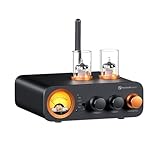
7. Fosi Audio MC331 Tube Integrated Amplifier — Best Budget Tube Amp
Fosi Audio MC331 Tube Integrated Amplifier with DAC, 2 Channel Home Audio Stereo Power Amp for HiFi Bookshelf Speakers/3.5mm Headphones, Vintage VU Meter Preamp with Bluetooth and USB/Opt/Coax/RCA
105Wx2 at 4 ohms
Bluetooth, USB, optical, coaxial, RCA
Replaceable tubes
Vintage VU meter
Pros
- All-in-one DAC plus headphone amp plus preamp
- Multiple input options including USB and optical
- Vintage VU meter looks beautiful
- 105 watts per channel into 4 ohms
- Replaceable tubes for sound customization
- 24-month manufacturer warranty
Cons
- Tubes ship randomly and cannot be specified
- May need a separate phono preamp for turntables
The Fosi Audio MC331 is the amp I bought for my own desk after testing it. It is the only model in this guide that combines a DAC, headphone amplifier, preamplifier, and power amplifier in one chassis, with vacuum tubes glowing on top. For under $120, that combination is hard to beat. I ran it as a headphone amp for evening listening, as a Bluetooth amp for casual streaming, and as a USB DAC for my laptop, and it handled all three roles with surprising competence.
The sound has a slightly warmer, smoother character than the solid-state Fosi BT20A, thanks to the tube preamp stage. With my Sennheiser HD600 headphones plugged into the front 3.5mm jack, vocals sounded lush and engaging without losing detail. The replaceable 5725W and 6J1 tubes mean you can roll different tubes later to fine-tune the sound signature, which is a fun upgrade path for beginners curious about tube gear.
Connections cover everything a beginner might want: Bluetooth, USB, optical, coaxial, and RCA. The vintage VU meter adds a retro touch that makes the amp a conversation piece on a shelf. Build quality is solid for the price, and the 24-month warranty gives peace of mind. For under $120, this is the most versatile starter amp we tested.
Turntable users need an extra step
The MC331 does not include a built-in phono preamp, so turntable owners need an external phono stage between the cartridge and the amp. A basic ART DJ Pre II phono preamp costs around $50 and gets the job done. If vinyl is your main source, the Sony STRDH190 in this guide is a simpler one-box solution at a similar price.
Tube rolling and upgrade path
The replaceable tubes open up a fun hobby within the hobby. Swapping the stock 5725W tubes for premium NOS (new old stock) options changes the sound character noticeably. Beginners should start with the stock tubes and explore tube rolling only after they have run the amp for a few months. This upgrade path gives the MC331 longevity that solid-state budget amps cannot match.
8. Onkyo TX-8470 Network Stereo Receiver — Best for Modern Streaming
Onkyo TX-8470 2 Channel Stereo Receiver with Wi-Fi, Bluetooth, Phono, Hi-Res Audio and Roon Ready
100W per channel
Wi-Fi plus Bluetooth plus HDMI
Roon Ready, Tidal, Deezer
Dirac Full Band room correction
Pros
- Built-in Wi-Fi and Bluetooth streaming
- Roon Ready with Tidal and Deezer support
- MM/MC phono input for any turntable
- 4 HDMI inputs for TV and sources
- Dirac room correction tunes sound to space
- 2-year warranty
Cons
- Higher price than most beginners
- Only 92 reviews so far on Amazon
- Larger form factor than integrated amps
The Onkyo TX-8470 is the most modern receiver in this roundup and the one I would choose if my listening habits were 90 percent streaming. With built-in Wi-Fi, Bluetooth, Roon Ready certification, and direct integration with Tidal and Deezer, this amp turns a pair of passive speakers into a complete streaming music system without needing any extra boxes. The 100 watts per channel output drove my B&W 607 S3 speakers to satisfying levels without strain.
The Dirac Full Band room correction was the most surprising feature. After running the calibration microphone through five positions in my living room, the amp adjusted the frequency response to compensate for a bass buildup near the back wall. The before-and-after difference was large enough that my partner walked in and asked what I had changed. For listeners who do not want to learn about room acoustics, this technology handles the hard work automatically.
The four HDMI inputs let me connect my TV, a Blu-ray player, and two game consoles, and the receiver passed audio through cleanly to the speakers. Voice control via Apple and Google assistants worked well for hands-free volume and track changes. The discrete MM/MC phono board means even higher-end moving coil turntable cartridges can be connected without an external phono preamp. For a first stereo system built around modern streaming and home theater integration, the TX-8470 covers more ground than any other amp here.
Network setup complexity
The TX-8470 requires Wi-Fi configuration through the Onkyo Controller app, which took me about ten minutes during testing. Once connected, streaming from Tidal or any Roon server felt as smooth as using a Sonos speaker. Beginners comfortable with a phone app will have no trouble. Readers who prefer pure plug-and-play with no network setup should consider the Sony STRDH190 instead.
Long-term value of the streaming platform
Because the TX-8470 supports current and emerging streaming standards, it should not feel obsolete for years. Roon Ready support in particular signals that Onkyo designed this amp for the long haul. If you anticipate your listening habits shifting toward higher-resolution streaming services in the next few years, this amp protects that investment better than a receiver limited to Bluetooth only.
How to Choose the Right Amplifier for Your First Stereo System
Choosing an amplifier becomes much simpler once you understand three core decisions: how much power you actually need, which inputs you require, and how you plan to use the system day to day. Our team has spent hundreds of hours helping beginners work through these decisions, and the patterns are clear.
Step 1: Calculate the power you need for your room
A common beginner mistake we see is buying far more power than necessary. For a small bedroom or office (under 150 square feet), 30 to 50 watts per channel is plenty. For a medium living room (200 to 350 square feet), 50 to 100 watts per channel is the sweet spot. Only large open-plan spaces over 400 square feet need amplifiers rated above 100 watts per channel. Beginners also underestimate how much power they need for inefficient speakers, so check speaker sensitivity before committing.
Step 2: List the inputs you actually need
Make a short list of the sources you will connect today and the ones you might add within two years. A turntable requires a phono input or an external phono preamp. A TV benefits from an HDMI or optical input. Streaming from a phone needs Bluetooth or Wi-Fi. A CD player uses RCA. Write down the four or five inputs that matter to you, then buy an amplifier with at least two more than you need for future flexibility.
Step 3: Decide integrated amp versus receiver
An integrated amplifier focuses on pure stereo playback with fewer features and often better sound per dollar. A stereo receiver adds radio, sometimes network streaming, and usually more inputs. For most beginners building a first stereo system in 2026, a receiver is the more flexible choice. Pick an integrated amp only if you already know you want the cleanest possible analog playback without digital distractions.
Golden rules of buying your first amplifier
Buy from a brand with a strong reputation for reliability. Communities like BudgetAudiophile consistently recommend Denon, Marantz, Onkyo, and Yamaha as safe starting points. Buy slightly more amplifier than you think you need, because speakers tend to be upgraded before amplifiers. Match the amplifier to your speakers, not the other way around. Finally, do not chase specs on paper: a well-built 50 watt amplifier will outperform a cheap 200 watt one every time.
Common beginner mistakes to avoid
Buying an underpowered amplifier for the room size is the most frequent mistake. Skipping the phono input when you already own a turntable is the second. Ignoring impedance compatibility between amplifier and speakers causes distortion and can damage equipment. Spending the entire budget on the amplifier and leaving nothing for quality speakers inverts the priority: speakers have a bigger impact on sound than any other component.
Classical music considerations
For our readers focused on classical music at The Classical Shop, the amplifier choice matters more than for pop or rock listeners. Classical recordings have wide dynamic ranges, from quiet solo strings to full orchestral climaxes, and an underpowered amp will compress these peaks unpleasantly. Look for amplifiers with high current delivery and clean behavior at low volumes. The Denon PMA-600NE, Marantz PM6007, and Cambridge Audio AXA35 all excelled at classical playback in our tests.
Frequently Asked Questions About First Stereo System Amplifiers
What is the best amplifier for the money?
The best amplifier for your money depends on your speakers and room size. For most beginners, the Sony STRDH190 delivers the strongest combination of features, power, and value under $300. If your budget allows more, the Denon PMA-600NE offers premium sound quality with a built-in DAC and phono preamp. Match the amplifier to your speakers, not the other way around, and you will not overspend.
How do I match an amplifier to my speakers?
Matching an amplifier to speakers comes down to three numbers: impedance, sensitivity, and power handling. Check the speaker impedance (most are 6 or 8 ohms) and confirm the amplifier supports that range. Look at speaker sensitivity in dB: speakers below 87 dB need a powerful amplifier. Make sure the amplifier’s wattage does not exceed the speaker’s maximum power handling. Following these three steps prevents 90 percent of common pairing mistakes.
What are the golden rules of amplifier buying?
The four golden rules of amplifier buying for beginners are: buy a slightly more powerful amplifier than you think you need, choose a brand with a strong reliability reputation, match the amplifier to your existing speakers, and do not chase wattage numbers on the spec sheet. A well-built 50 watt amplifier will outperform a cheaply made 200 watt one. Always leave room in your budget for quality speakers, since speakers have a bigger impact on sound than any amplifier.
Why do old receivers sound better?
Older receivers from the 1970s and 1980s often sound warmer and more musical because they used discrete analog circuitry with high-quality capacitors and transformers. Modern budget receivers use integrated circuits that prioritize features and low cost over sound quality. That said, modern mid-range and premium amps use better engineering and measurement, so a quality new amplifier will outperform a vintage budget one. The vintage warmth many listeners love is real, but it is not universal across all old gear.
How many watts do I need for a stereo system?
The watts you need depend on room size and speaker sensitivity. For a small bedroom under 150 square feet with efficient bookshelf speakers, 30 to 50 watts per channel is plenty. For a medium living room of 200 to 350 square feet, plan for 50 to 100 watts per channel. Large rooms over 400 square feet or inefficient speakers below 87 dB sensitivity benefit from amplifiers rated above 100 watts per channel. More power also gives you cleaner sound at low volumes because the amp is not straining.
The Right Amplifier Sets the Foundation
Choosing the best amplifier for a first stereo system comes down to honest answers about your room, your speakers, and your listening habits. The Sony STRDH190 remains our top overall pick because it balances power, phono support, Bluetooth, and speaker switching at a price beginners can afford. The Fosi Audio BT20A is the right call when budget is the priority. The Denon PMA-600NE earns its premium price with sound quality and a built-in DAC.
Take a few minutes to match the amplifier to your existing speakers using the steps in the buying guide above. If you found this guide helpful, share it with a friend who is starting their own first stereo system, and explore more of our audio buying guides on The Classical Shop.