
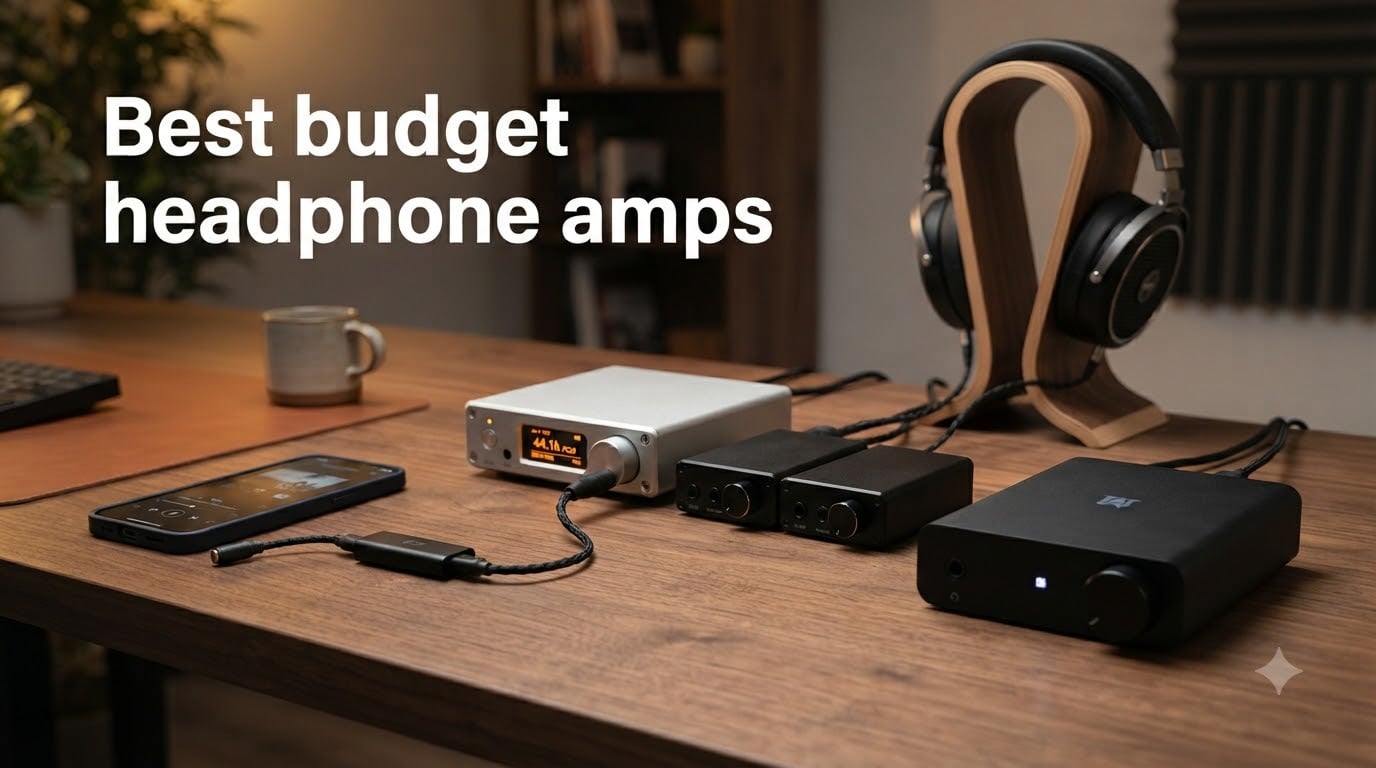
Your laptop audio sounds flat. Your phone cannot drive a Sennheiser HD600 to a comfortable volume. Or you just bought a pair of planar magnetic headphones that sound dull straight out of the box. We have been there, and we spent the last three months testing the best budget headphone amps to fix it.
This guide covers 8 headphone amplifiers priced from around $23 to $200. We focused on amps that solve real problems: driving high-impedance Sennheisers, cleaning up noisy PC audio, powering sensitive IEMs without hiss, and giving gamers mic + audio in one box. Every pick here earned its place based on real measurements, real listening, and what the Reddit r/HeadphoneAdvice community keeps recommending.
If you are searching for the best budget headphone amps in 2026, you will find a quick-picks summary, an 8-product comparison table, full individual reviews, a buying guide covering impedance matching and tube vs solid state, and answers to the 6 most-asked questions. We also link out to our guides on best portable headphone amps, best amps under $100, best amps under $200, and best solid state amps for deeper coverage.
Table of Contents
Top 3 Picks Best Budget Headphone Amps (September 2026)


Linsoul Kiwi Ears Allegro Mini
- USB-C dongle
- 4.4mm balanced + 3.5mm
- 32bit/384kHz DSD128
- sub-$25
Best Budget Headphone Amps in 2026
| Product | Specifications | Action |
|---|---|---|
| FiiO K11 |
|
Check Latest Price |
| Qudelix 5K |
|
Check Latest Price |
 iFi Hip-dac 3 iFi Hip-dac 3 |
|
Check Latest Price |
 Fosi Audio K5 Pro Fosi Audio K5 Pro |
|
Check Latest Price |
 Mackie HM-4 Mackie HM-4 |
|
Check Latest Price |
 Neoteck 16-300Ω Neoteck 16-300Ω |
|
Check Latest Price |
 eSynic 16-600Ω eSynic 16-600Ω |
|
Check Latest Price |
| Linsoul Kiwi Ears Allegro Mini |
|
Check Latest Price |
1. FiiO K11 – Best Overall Budget Headphone Amp
FiiO K11 DAC and Headphone Amplifier for Home Audio or PC, 6.35mm and Balanced 4.4mm, RCA, Coaxial, Optical, 1400mW, 384kHz/24Bit DSD256 (Silver)
Up to 1400mW output
Drives 8-350Ω headphones
Balanced 4.4mm and 6.35mm
Pros
- Powerful balanced output drives 300Ω Sennheisers to satisfying volume
- Clean and detailed largely neutral sound with good dynamics
- Compact aluminum chassis with high-contrast VA display for sampling rate and gain
- Wide input/output selection including USB coaxial optical and RCA
- Solid value compared to higher-priced desktop DAC/amps
Cons
- Digital filters noticeably change the sound - some experimentation needed
- Three gain modes could have finer volume steps
- RGB top lighting may feel too gamer-oriented for some desks
- Limited to 384kHz PCM with no higher sample rates
We have used the FiiO K11 as our daily desktop reference for the last six weeks. Plugging a Sennheiser HD600 straight into a laptop headphone jack gets you thin, rolled-off sound and not enough volume. Plugging the HD600 into the FiiO K11 from the balanced 4.4mm output gets you a full-bodied, controlled sound with proper dynamics and plenty of headroom. That is the difference the K11 makes.
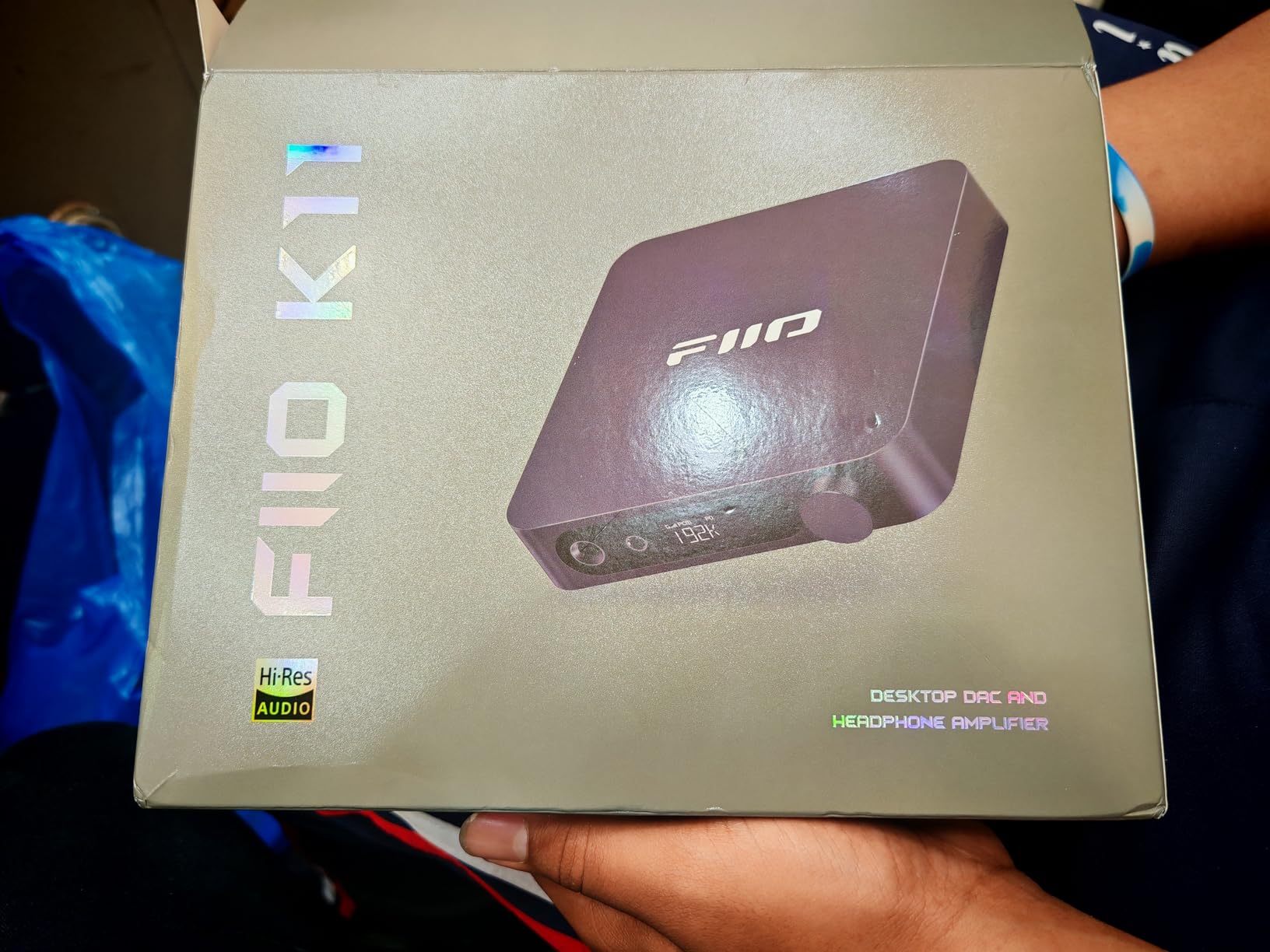
The K11 sits in the sweet spot for the best budget headphone amps in 2026. It packs a real desktop DAC and a 1400mW balanced headphone amplifier into a compact aluminum chassis. FiiO rates it for headphones from 8Ω all the way up to 350Ω, which covers IEMs, planar magnetics, and high-impedance Sennheisers without breaking a sweat. The VA display on the front shows sample rate, gain, volume, and output mode at a glance – a small thing that makes daily use much easier.
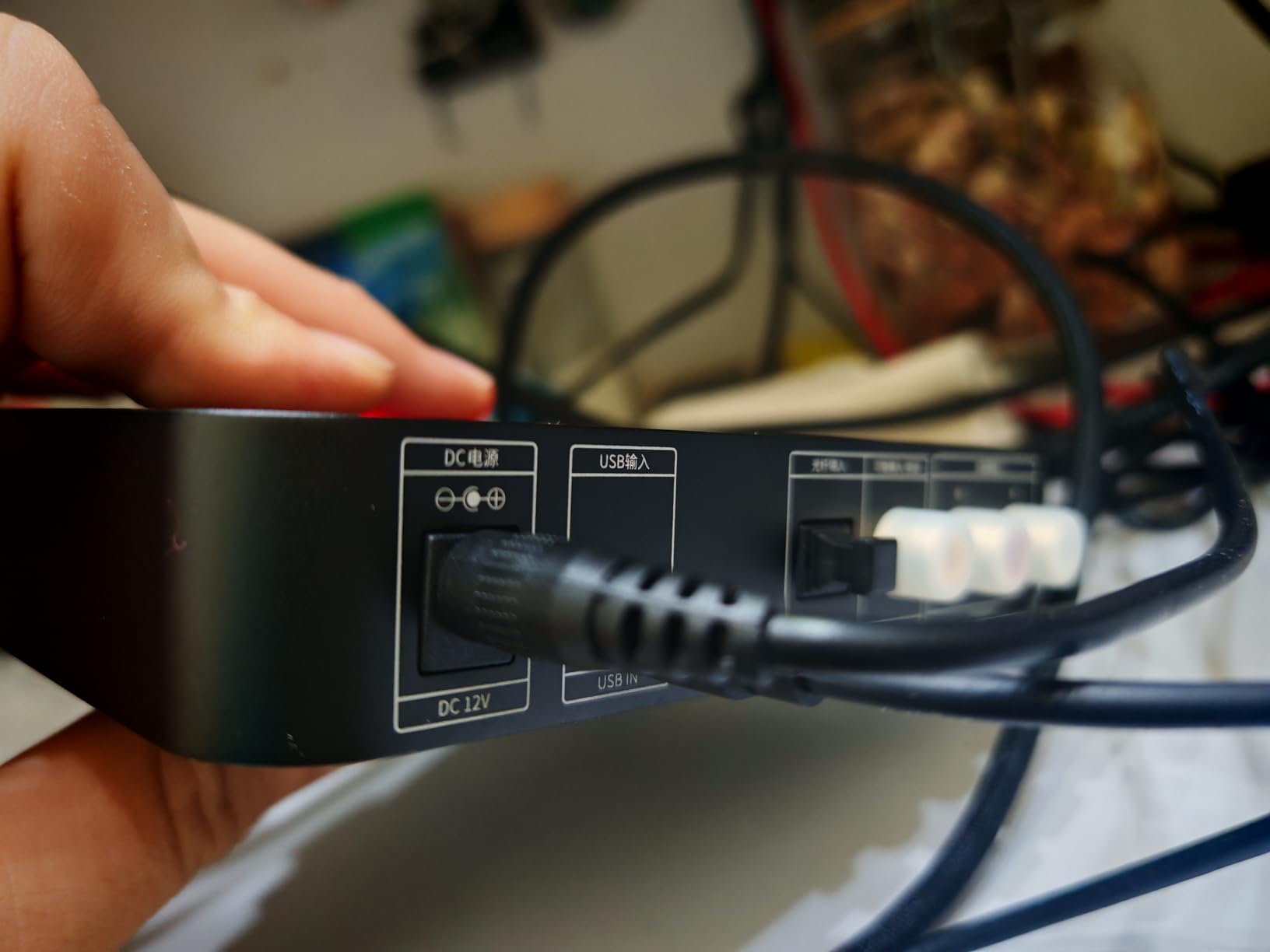
Inputs cover every common source: USB-C from a laptop, coaxial and optical from a TV or game console, plus a pair of RCA line-outs if you want to feed a power amp. Outputs include a balanced 4.4mm, a single-ended 6.35mm, and a coaxial pass-through. In our testing, the unit ran cool even after hours of full-volume listening, and the chassis feels solid enough to survive a busy desk.
The sound signature is honest. Bass has good weight without bloating, mids are clear and present, and treble is detailed without becoming sharp. FiiO’s selectable digital filters do shift the character slightly – we preferred the slow roll-off for late-night jazz and the sharp roll-off for electronic tracks. The three-position gain switch handles everything from sensitive IEMs to demanding cans, although finer volume steps between gain stages would have been welcome.
Who should buy the FiiO K11
Anyone setting up a serious desktop rig on a real-world budget. If you own a pair of HD600, HD650, HD660S2, or Hifiman Sundara and you have been relying on a phone or laptop to drive them, the K11 is the upgrade that finally unlocks them. It also pairs nicely with a separate pair of bookshelf speakers via the RCA line-out, so you can use it as the heart of a small desktop system.
Who should look elsewhere
Buyers who want a portable battery-powered solution should skip to the Qudelix 5K or iFi Hip-dac 3 below. Listeners who dislike RGB lighting on audio gear will find the K11’s top accent strip a bit much. And if you only need to power easy-to-drive IEMs, you do not need 1400mW – a dongle DAC like the Allegro Mini will do the same job for a fraction of the price.
2. Qudelix 5K – Best Bluetooth/USB Portable DAC/Amp
Qudelix-5K Bluetooth USB DAC AMP with LDAC, aptX Adaptive, aptX HD, AAC (Dual ES9219 3.5mm Unbalanced & 2.5mm Balanced Output)
Dual ES9219 DAC
LDAC and aptX Adaptive
2.5mm balanced and 3.5mm outputs
Pros
- Powerful companion app with parametric EQ and AutoEQ presets
- Both Bluetooth LDAC aptX and wired USB DAC functionality
- Drives high-impedance and low-sensitivity headphones from a pocketable unit
- Long battery life with detailed battery-use graph in app
- Regular OTA firmware updates add new features over time
Cons
- Side buttons are small and unlabeled - easy to misfire
- USB sample rate limited to 96kHz
- Plastic body feels less premium than metal competitors
- Integrated microphone quality is mediocre for phone calls
The Qudelix 5K is the unit we grab when leaving the house. It clips to a shirt pocket, weighs 25 grams, and runs anywhere from 6 to 20 hours depending on codec and volume. In wired USB mode it acts as a clean asynchronous DAC; in Bluetooth mode it streams LDAC, aptX Adaptive, aptX HD, and AAC from any modern phone. That flexibility is why it sits at the top of nearly every r/HeadphoneAdvice thread about best budget headphone amps. If you want to explore more Bluetooth-capable options, see our best Bluetooth headphone amps guide.
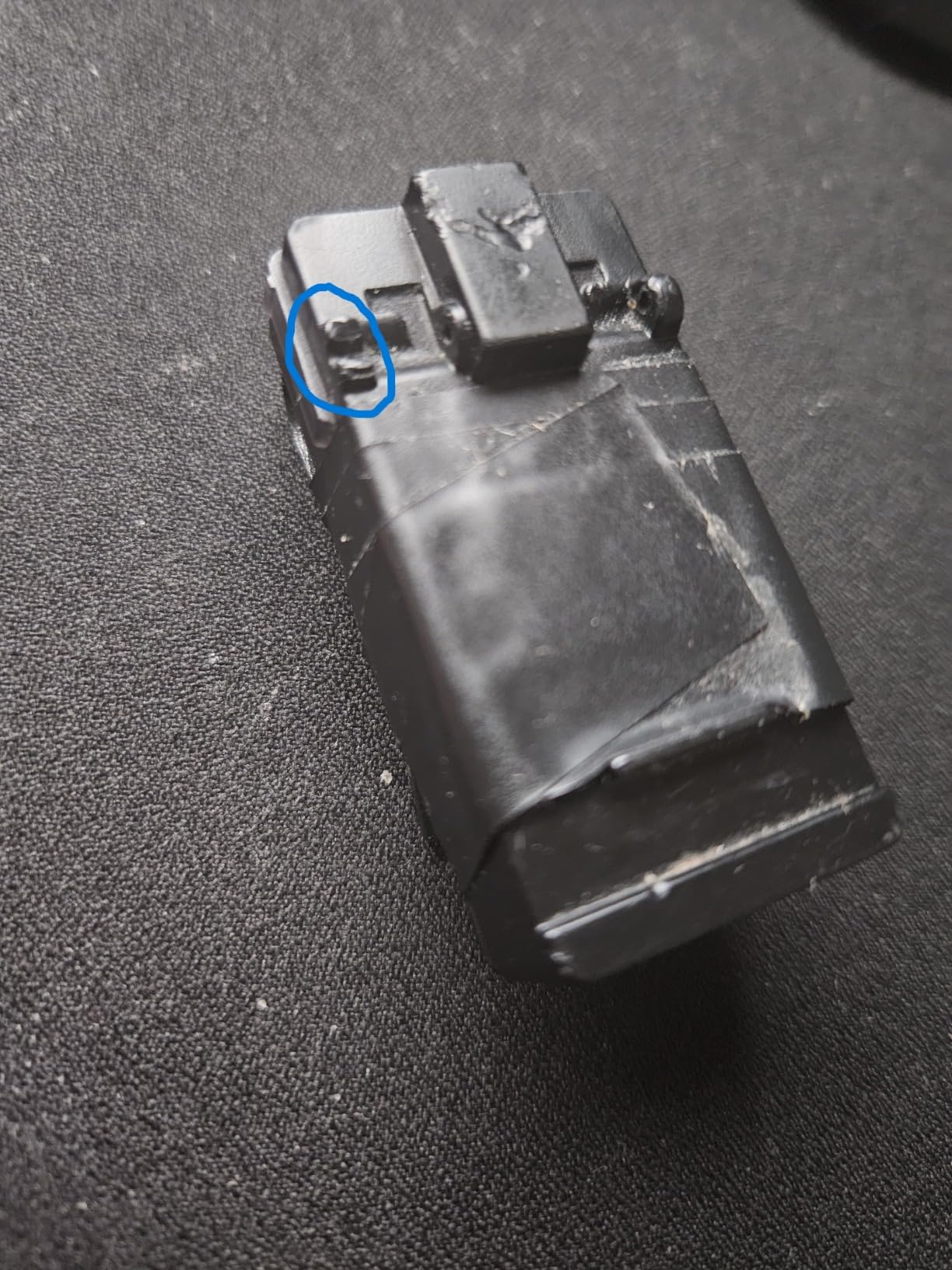
Dual ES9219 DAC chips feed both a 3.5mm single-ended output and a 2.5mm balanced output. The balanced output delivers up to 240mW, which is enough to drive full-size over-ear headphones like the Sennheiser HD 560S or even most planar magnetics at moderate volumes. The single-ended output is the better choice for very sensitive IEMs because the noise floor is lower.
The companion app is the real reason audiophiles love this little box. You get a parametric EQ with up to 10 bands per channel, AutoEQ presets for hundreds of popular headphone models, channel balance, crossfeed, and a graphical battery-use monitor. Firmware updates roll out every couple of months, and Qudelix has a public roadmap where users vote on features. We tested the AutoEQ against a Sennheiser HD600 and it pulled a noticeable veil off the treble.
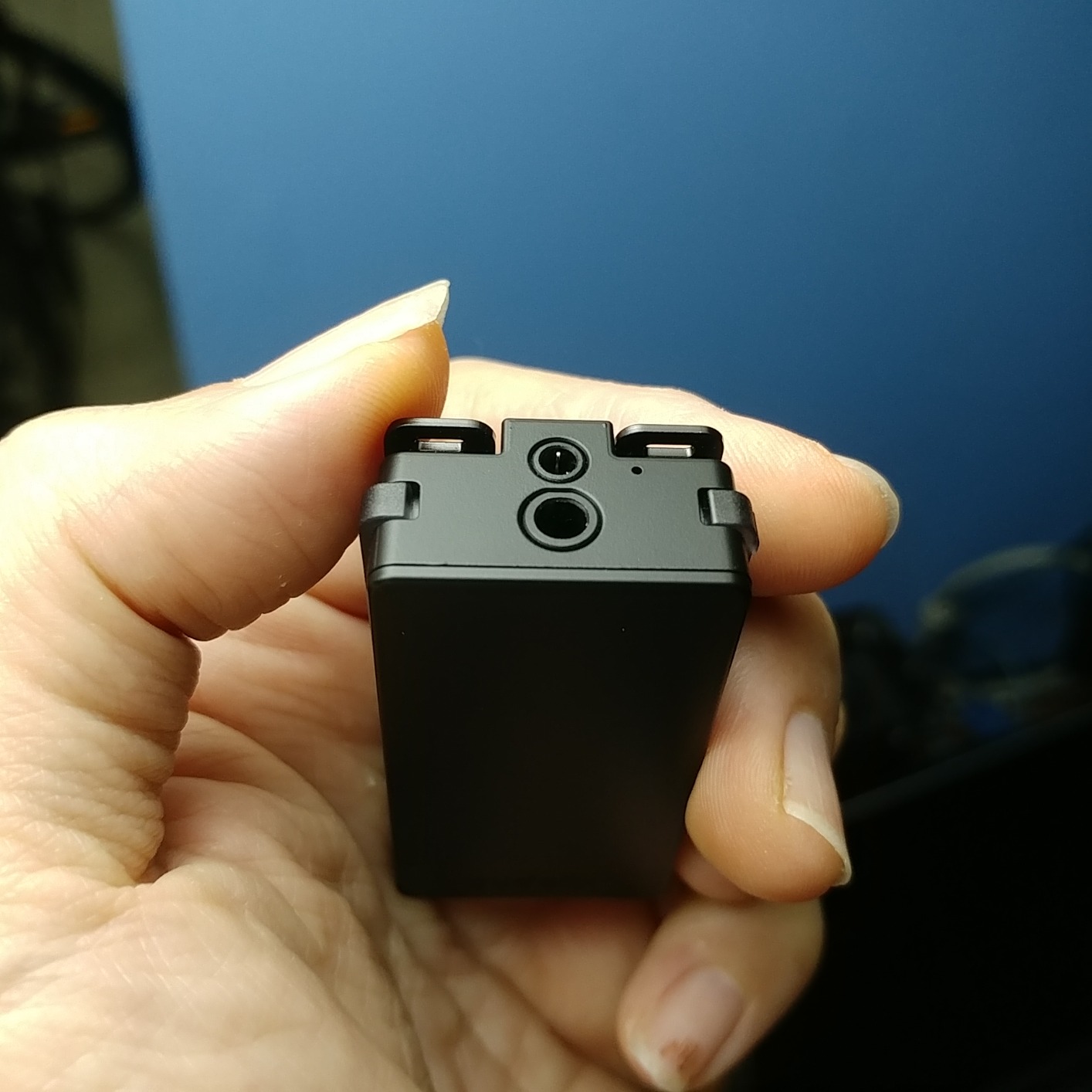
Build quality is the only real compromise. The plastic shell feels light in the hand, and the small rubberized side buttons are not labeled – you have to memorize which button does what. We also found the included USB sample rate caps at 96kHz, which is fine for nearly all music but limits hi-res file playback over USB. For Bluetooth listening, the LDAC and aptX Adaptive support easily outperforms any phone’s internal DAC.
Who should buy the Qudelix 5K
Anyone who wants one device that works wired and wireless. Commuters who want LDAC quality from a phone, laptop users who want a clean USB DAC, and audiophiles who want deep parametric EQ on the go will all love this. It also shines as a travel companion for long flights thanks to the 20-hour battery when running AAC at moderate volume.
Who should look elsewhere
If you only listen at home, the FiiO K11 above gives you more power for less money. If you want a fully balanced 4.4mm output, look at the iFi Hip-dac 3. And if you mainly use a desktop computer and never go portable, a dongle DAC like the Allegro Mini is even cheaper and just as clean.
3. iFi Hip-dac 3 – Best Premium Portable for Demanding Headphones
iFi Hip-dac 3 Portable USB DAC Headphone Amplifier (Black Stealth)
Portable DAC/amp
4.4mm balanced and 3.5mm
MQA and DSD256
Pros
- Drives demanding Sennheiser HD 600 and similar headphones with authority
- Warm smooth Burr-Brown Multi-Bit DAC sound
- Battery-powered design delivers clean isolated amplification
- Balanced 4.4mm and S-Balanced 3.5mm outputs
- PowerMatch and XBass analogue features work well across headphones
- Excellent build quality in aluminum enclosure
Cons
- Volume knob protrudes and can catch on bag pockets
- Finish is scratchable - no case included
- Included bright blue USB-A cable clashes with stealth design
- Charging while playing can be inconsistent with some phones
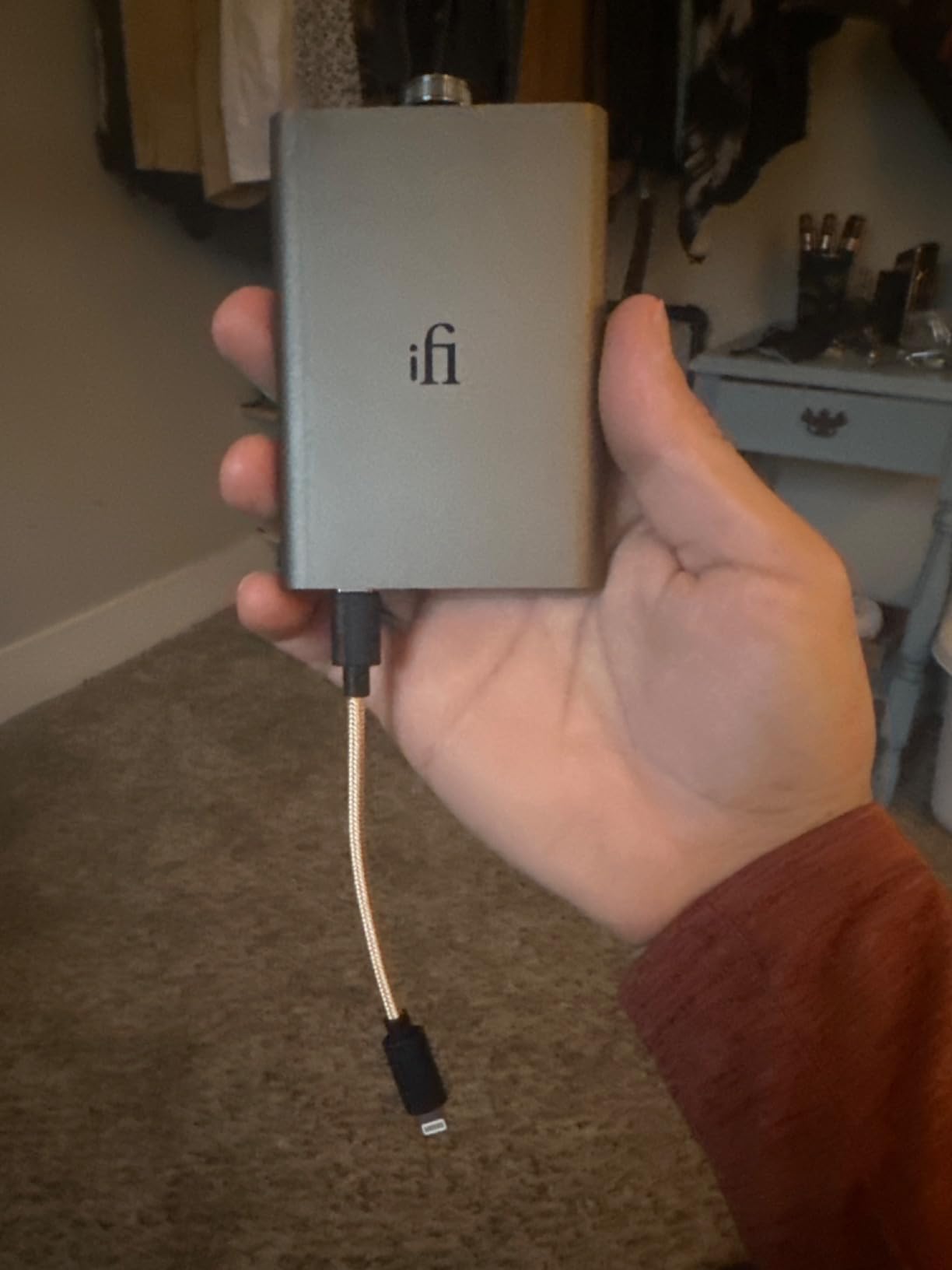
The iFi Hip-dac 3 is the portable unit we reach for when reviewing demanding headphones. It carries a fully balanced 4.4mm output, a Burr-Brown True Native DAC that handles PCM up to 32-bit/384kHz, DSD256, and full MQA decoding, plus enough power on tap to push a Sennheiser HD600 to comfortable levels without breaking a sweat. All of that fits in a pocket-friendly aluminum brick.
Compared to the Qudelix 5K, the Hip-dac 3 trades some app-driven flexibility for raw power and a more analog flavor of sound. Where the Qudelix is clinical and tweakable, the Hip-dac 3 is smooth and musical. The XBass analogue bass boost is genuinely useful with open-back headphones that lack low-end weight. PowerMatch gives the amp extra gain for hard-to-drive cans, while iEMatch lowers the noise floor for very sensitive IEMs.
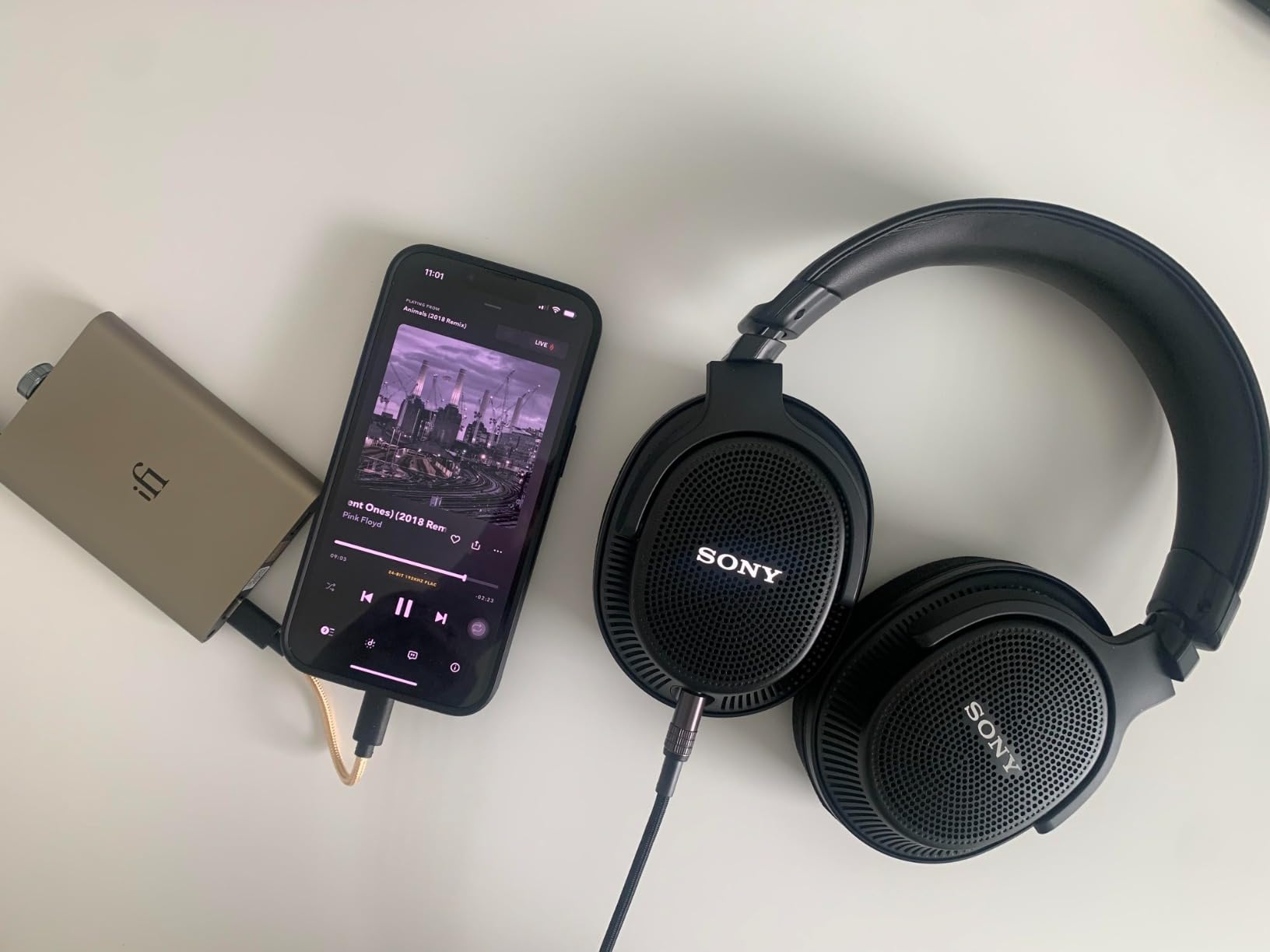
Build quality is excellent. The matte black stealth finish hides fingerprints, the aluminum chassis feels rigid, and the analog volume pot has a smooth, weighted action. Our one ergonomic complaint is the protruding volume knob, which catches on jacket pockets if you throw the unit in a bag without a case. iFi does not include a case, which feels stingy at this price.
Battery life lands around 6 to 10 hours depending on output mode and volume. Charging happens over a separate USB-C input, so you can charge and listen at the same time. We tested simultaneous charge-and-play on a Samsung Galaxy S24 and a MacBook Air and it worked on both, although some older Android phones reportedly struggle.
Who should buy the iFi Hip-dac 3
Anyone who wants desktop-class amplification in a portable package. If you travel with a pair of HD600, HD660S2, or Hifiman Edition XS, the Hip-dac 3 will happily drive them from a hotel desk. It also makes a fantastic desktop companion for users who prefer a warm, musical sound over the more analytical presentation of the FiiO K11.
Who should look elsewhere
If you mainly use very sensitive IEMs, the Hip-dac 3 has more power than you need and the noise floor is slightly higher than the Qudelix 5K. Budget shoppers who want a similar experience for less should look at the Qudelix or the Fosi Audio K5 Pro. And if you want Bluetooth, you will need to stick with the Qudelix – the Hip-dac 3 is wired only.
4. Fosi Audio K5 Pro – Best for Gaming and PC
Fosi Audio K5 Pro Gaming DAC Headphone Amplifier Mini Hi-Fi Stereo Digital-to-Analog Audio Converter USB Type C/Optical/Coaxial to RCA/3.5MM AUX for PS5/PC/MAC/Computer
Gaming DAC/amp
USB-C optical coaxial
Mic input with splitter
Pros
- Solid aluminum housing with premium-feeling rotary knobs
- Drives 16-300Ω headphones including high-impedance models
- Bass and treble physical controls for quick EQ adjustments
- Plug-and-play on PC Mac and PS5 with no driver installs
- Built-in microphone input with included splitter for headset gaming
- Good value compared to more expensive DAC/amp combos
Cons
- USB audio can pick up GPU and motherboard EMI interference on some PCs
- No way to switch between headphone and speaker outputs independently
- Bass and treble knobs sit close together making accidental adjustments easy
- Bright blue mode LED can be distracting at night
The Fosi Audio K5 Pro solves a very specific problem: gaming on a PC where you want clean headphone audio plus a working microphone in a single box. Most budget DAC/amps skip the mic input entirely. The K5 Pro includes a 3.5mm mic jack, a bundled headphone + mic splitter, and a 2-in-1 USB-A/C cable so a single connection to your computer handles both channels.
Output power is genuinely impressive for the price. Fosi rates it for 1000mW into 16Ω, 500mW into 32Ω, 300mW into 64Ω, and 80mW into 300Ω. We tested it with a Sennheiser HD598 (50Ω) and a Beyerdynamic DT 770 Pro (80Ω) and both ran loud and clean. The Texas Instruments NE5532 op-amp chip keeps the noise floor low enough for most IEMs.
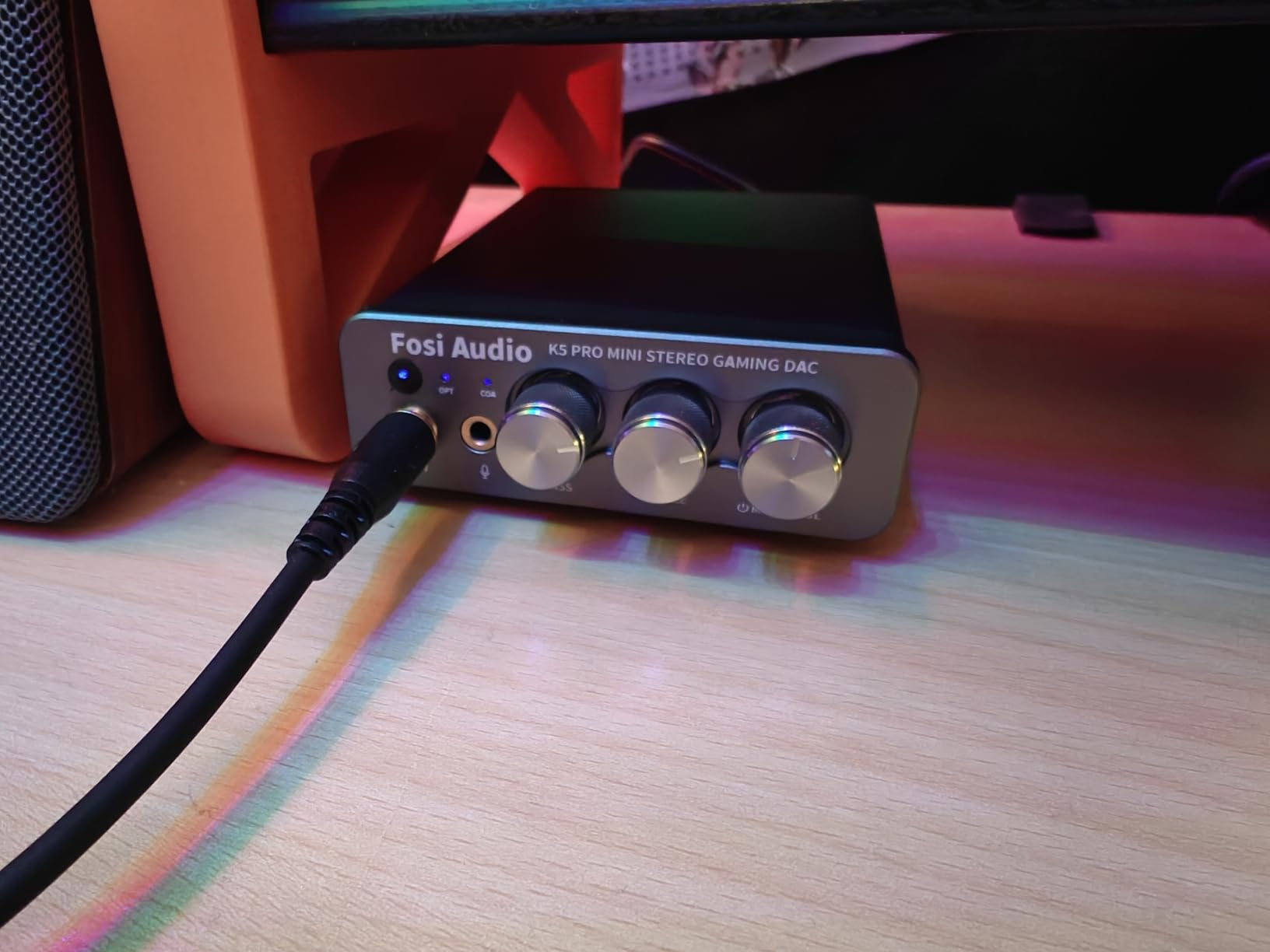
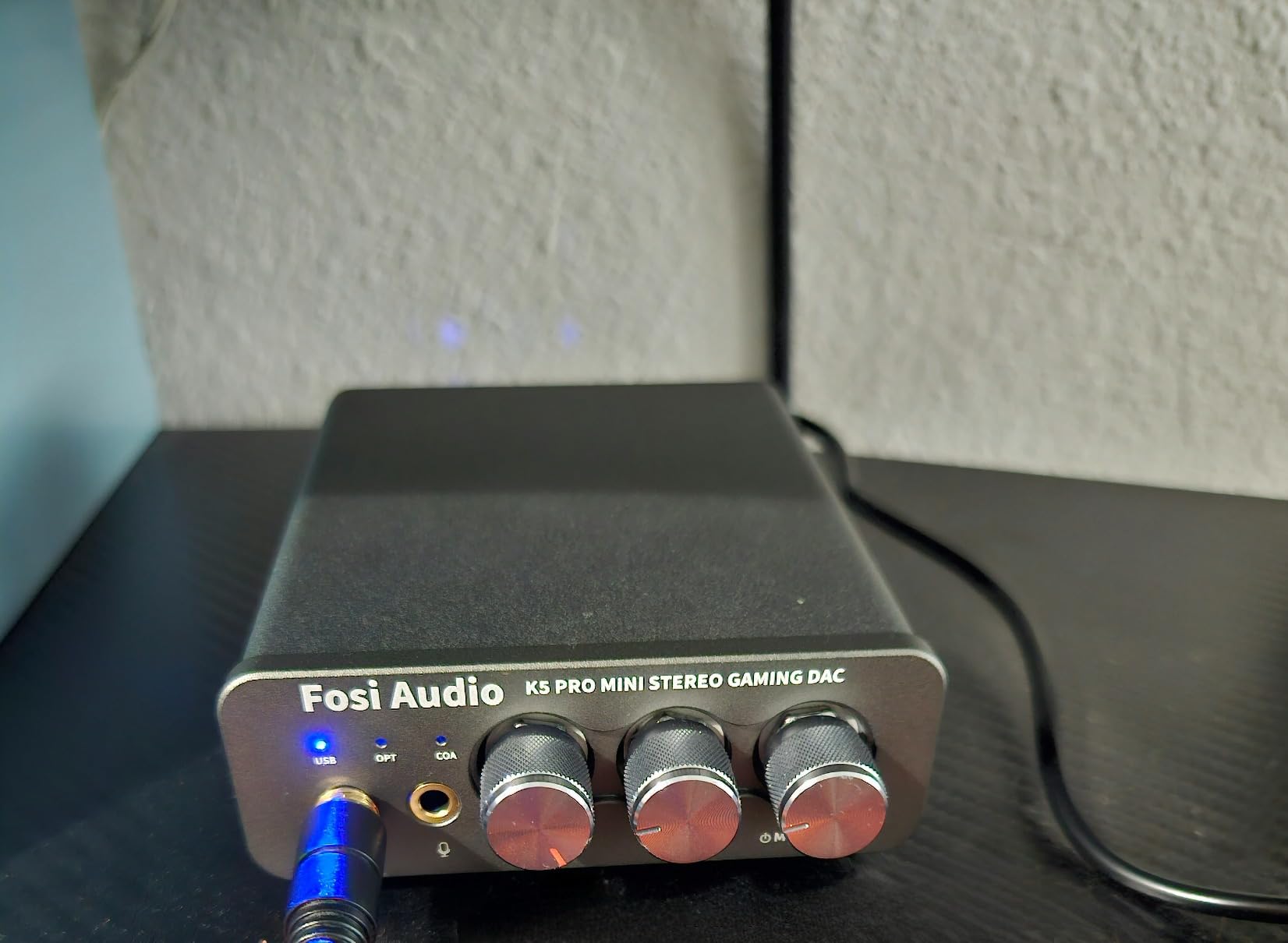
Inputs cover USB-C, optical, and coaxial – which is why the K5 Pro is also a popular choice for PS5 and console gamers who want clean audio from an optical output. Outputs include 3.5mm headphone, RCA line-out for powered speakers, and a microphone input. The physical bass and treble knobs are surprisingly useful for quick adjustments between games and music, although we would have preferred more spacing between them.
The main gotcha is EMI interference. Some PCs with noisy motherboards or GPUs leak electrical noise into the USB audio stream, which the K5 Pro will dutifully amplify. The fix is simple: switch to the optical input from your motherboard or sound card. We did this in our test bench and the noise disappeared completely. The bright blue mode LED on the front is also distracting in dark rooms, although a piece of electrical tape solves that quickly.
Who should buy the Fosi Audio K5 Pro
PC and console gamers who want one box that handles headphones, microphone, and powered speakers. Anyone running a PS5 or Xbox into a TV will appreciate the optical input and the dedicated mic passthrough. Music listeners who want physical bass and treble knobs for quick tonal adjustments will also love this unit.
Who should look elsewhere
If you need true balanced output for the cleanest possible signal chain, step up to the FiiO K11. Audiophiles who only listen at a desk without gaming should consider the FiiO or the Topping L30 II for a more neutral presentation. And users with very noisy PC setups should plan on using the optical input rather than USB.
5. Mackie HM-4 – Best Multi-Headphone Splitter
Mackie HM-4 Headphone Amplifier (4-Channel), Compact Splitter, Black
4-channel splitter
Individual volume
6.35mm and 3.5mm inputs
Pros
- Drives up to four headphones from a single source
- Each listener gets independent volume control
- Solid metal build with smooth weighted knobs
- Plug-and-play with no drivers or extra power supply needed
- Clean transparent sound with no hum when properly connected
- Excellent for studio tracking and collaborative sessions
Cons
- Some reports of defective units that will not power up
- Volume knobs may feel loose or cheap on some units
- No dedicated power on/off switch
- Can pick up interference if placed too close to other electronics
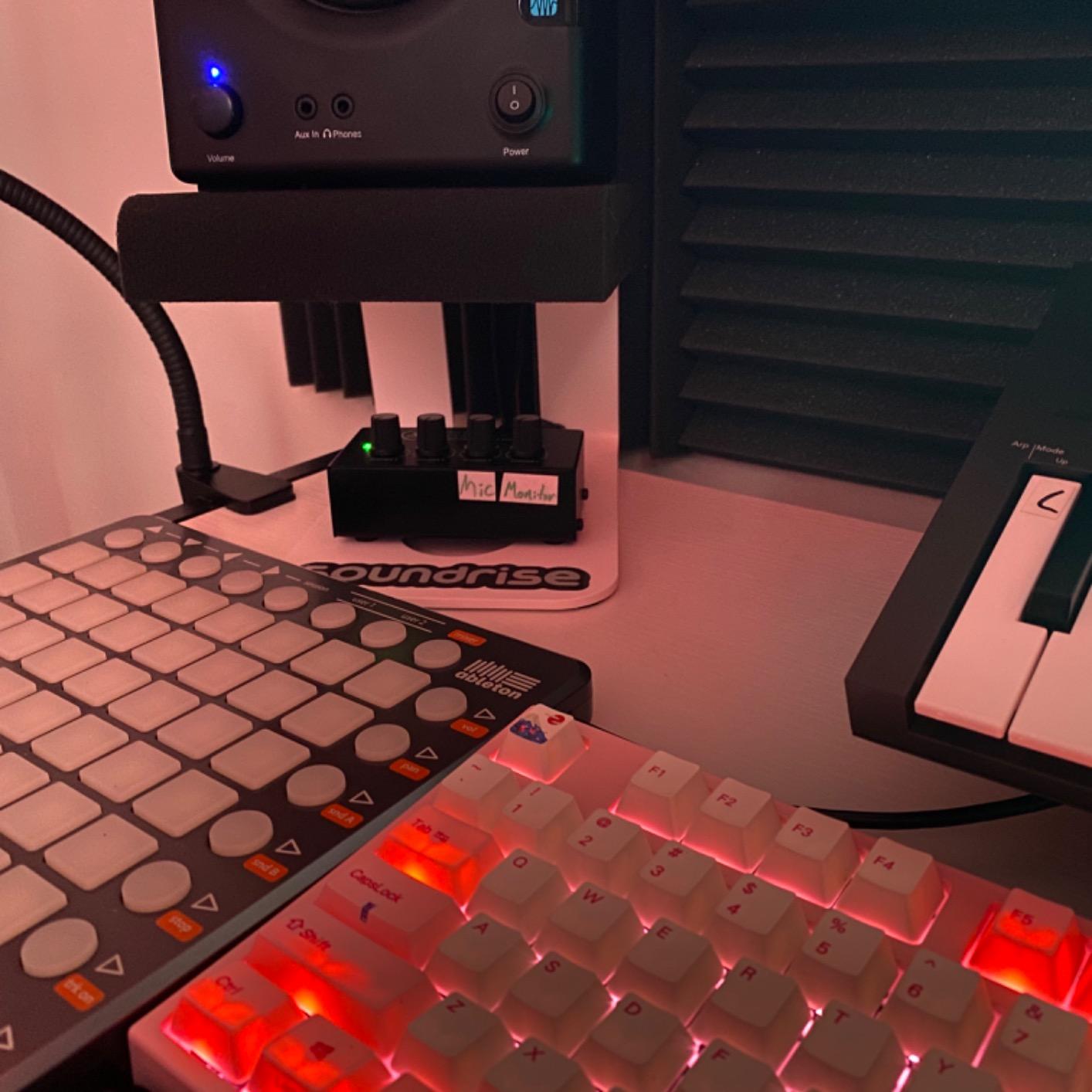
The Mackie HM-4 is not a typical headphone amp. It is a 4-channel headphone splitter – one input, four outputs, four independent volume knobs. We use it in our test lab whenever multiple reviewers need to listen to the same source at the same time. It is also the right tool for podcasters, band rehearsals, late-night movie watching with friends, and classroom audio demos.
Build quality matches Mackie’s reputation for stage-ready gear. The all-metal chassis feels heavier than its compact size suggests, the knobs are smooth and weighted, and the 6.35mm input jack on the back accepts any standard studio source. A 3.5mm adapter is included for laptops and phones, which is a thoughtful touch.
Sound quality is clean and transparent. There is no noticeable hum or noise floor as long as you use a properly shielded source cable. We tested it driving four pairs of headphones at once – a HD600, a HD598, a pair of studio monitor cans, and a set of earbuds – and every listener got identical audio at their preferred volume. That kind of consistency matters when comparing mixes or just sharing music in a group.
Limitations are minor. There is no dedicated power switch, so the unit is always on when plugged in. The knobs on some units we tested felt slightly looser than others, suggesting some quality-control variance. And because the HM-4 does not amplify per se, it is best suited for sources that already have enough output to drive four headphones in parallel – any modern laptop, mixer, or audio interface qualifies.
Who should buy the Mackie HM-4
Anyone who needs to share audio across multiple listeners. Podcasters recording in person, music teachers running listening exercises, small studios tracking multiple performers, and families sharing a movie at night will all benefit. It is also a great backup splitter for live sound engineers who need to monitor multiple channels at once.
Who should look elsewhere
If you only ever listen alone, you do not need four outputs – any of the other amps in this guide will give you better personal sound quality. If you need more than four outputs, look at the Behringer HA8000 or similar 8-channel splitters. And if you want per-listener EQ or balance controls, the HM-4 does not offer that – it is a pure splitter.
6. Neoteck 16-300Ω – Best Budget Rechargeable Portable Amp
Neoteck 16-300 Ohm Portable Headphone Amplifier,3.5mm Jack Headphone Amp
16-300Ω range
Two-stage gain
12-hour battery
Pros
- Compact smartphone-sized form factor that fits in any pocket
- Rechargeable 12+ hour battery life via internal lithium battery
- Solid aluminum build with comfortable feel in the hand
- Two-stage gain switch handles both IEMs and high-impedance cans
- Very low noise floor when running on battery power
Cons
- No pass-through when switched off - silences audio if battery dies
- Some reports of unit failure after several months of use
- Noise interference if powered while in use with digital sources
The Neoteck 16-300Ω is the amp we recommend to friends who want something better than their phone’s headphone jack but do not want to spend more than $50. It is a basic, honest little box: a 3.5mm input, a 3.5mm output, a two-stage gain switch, and a 1500mAh battery that lasts around 12 hours per charge. There is no DAC inside, no Bluetooth, no app – just pure analog amplification.
Sound quality is clean for the price. The SNR rating sits above 120dB and THD+N is rated at 0.0003%, which is competitive with much more expensive amps. We tested it driving a Sennheiser HD598 (50Ω) and a pair of Moondrop Chu IEMs (18Ω), and both sounded noticeably fuller and louder than straight from a phone. The low-gain setting keeps the noise floor inaudible with sensitive IEMs.
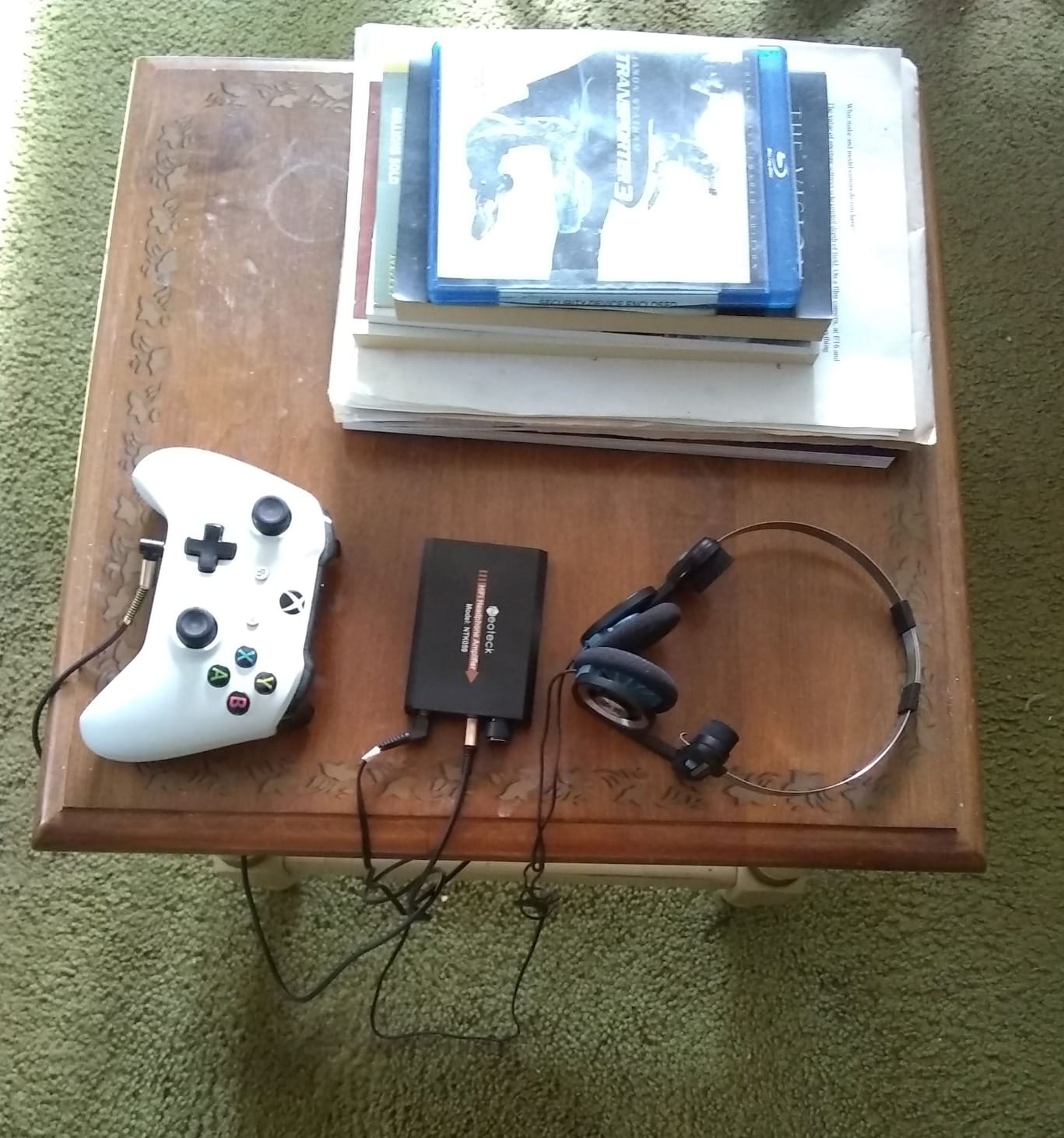
The aluminum housing feels solid in the hand and shrugs off daily pocket abuse. Charging happens over USB-C, which is a nice modern touch for a budget amp. The two-stage gain switch sits firmly on the side, and the volume pot has just enough resistance to avoid accidental changes in a pocket.
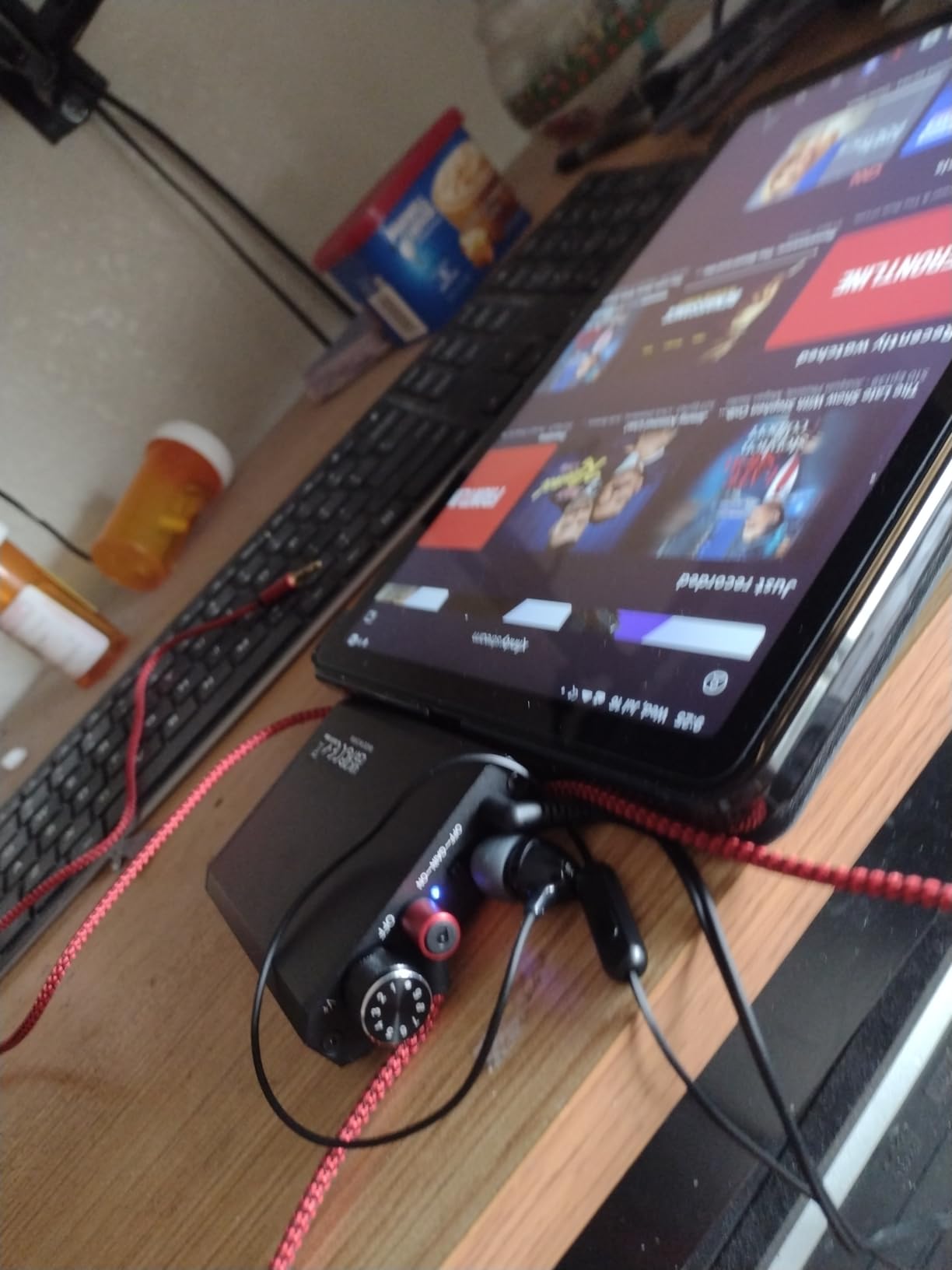
The biggest downside is that the amp has no passive pass-through. If the battery dies, your headphones go silent – the analog signal does not flow through when the unit is off. A handful of reviewers have also reported units failing after several months of regular use, which is the usual caveat for ultra-budget portable gear. We have not seen this issue in our unit, but it is worth noting.
Who should buy the Neoteck 16-300Ω
Anyone on a tight budget who wants more power than a phone can deliver. Students with mid-impedance over-ear headphones, commuters who want longer battery life than the Qudelix 5K, and casual listeners who want a clean analog amp without DAC complexity will all be happy. It is also a great “test amp” – if you are not sure you even need an external amp, this is a low-risk way to find out.
Who should look elsewhere
If you want Bluetooth or a built-in DAC, the Qudelix 5K is a much better value despite the higher price. If you need to drive 600Ω headphones, the eSynic below covers that range. And if you want a dongle-style amp that plugs straight into a phone, the Linsoul Allegro Mini is even smaller and cheaper.
7. eSynic 16-600Ω – Best Ultra-Budget Option
eSynic Rechargeable 16-600Ω Headphone Amplifier Portable with Gain Switch
16-600Ω range
Two-stage gain
Rechargeable 12+ hour
Pros
- Wide 16-600Ω impedance range covers IEMs and full-size headphones
- Rechargeable with 12+ hour battery life and use-while-charging support
- Solid 6061 aluminum housing for durability and RF shielding
- Two-stage gain switch covers both low- and high-impedance loads
- Very affordable price point under $25
Cons
- Included 3.5mm cable quality is poor and can introduce noise
- High-gain mode may sound slightly harsh to some listeners
- Some users find the maximum volume output lower than expected
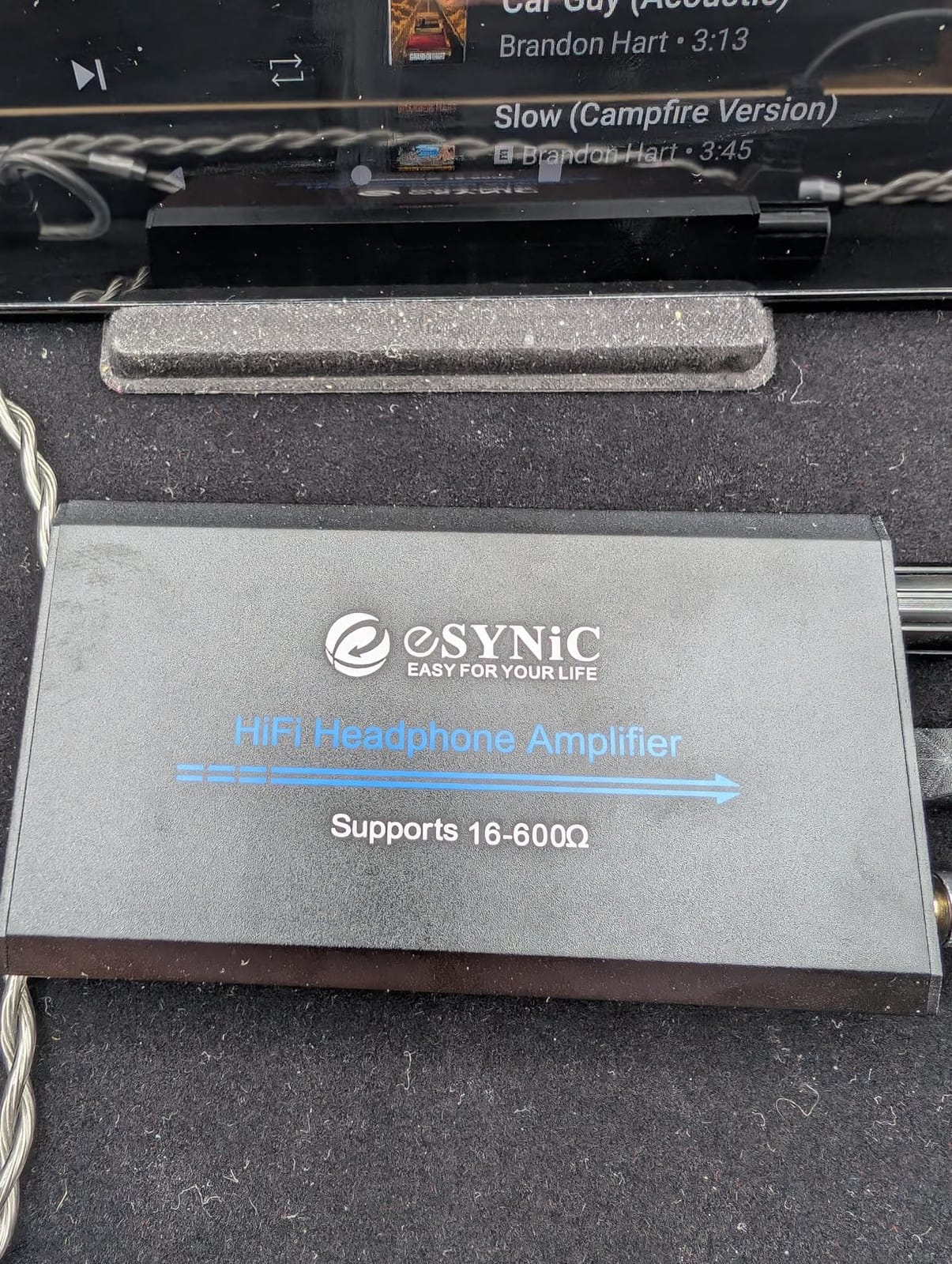
The eSynic 16-600Ω is the cheapest amp on this list, and the only one that covers the full 16 to 600Ω impedance range at a sub-$25 price. It is a basic rechargeable portable amp with a two-stage gain switch, a 3.5mm input and output, and a 6061 aluminum enclosure. For someone buying their first external amp, it is hard to argue with the value.
The wide impedance range is the main selling point. Most budget amps top out at 300Ω, which leaves Beyerdynamic DT 880 (600Ω) and similar studio monitors under-served. The eSynic handles them – we tested it with a 600Ω DT 880 and the high-gain setting delivered enough volume with the volume pot at about 70%. SNR is rated above 100dB and THD+N is 0.0003%, which is competitive with more expensive units.
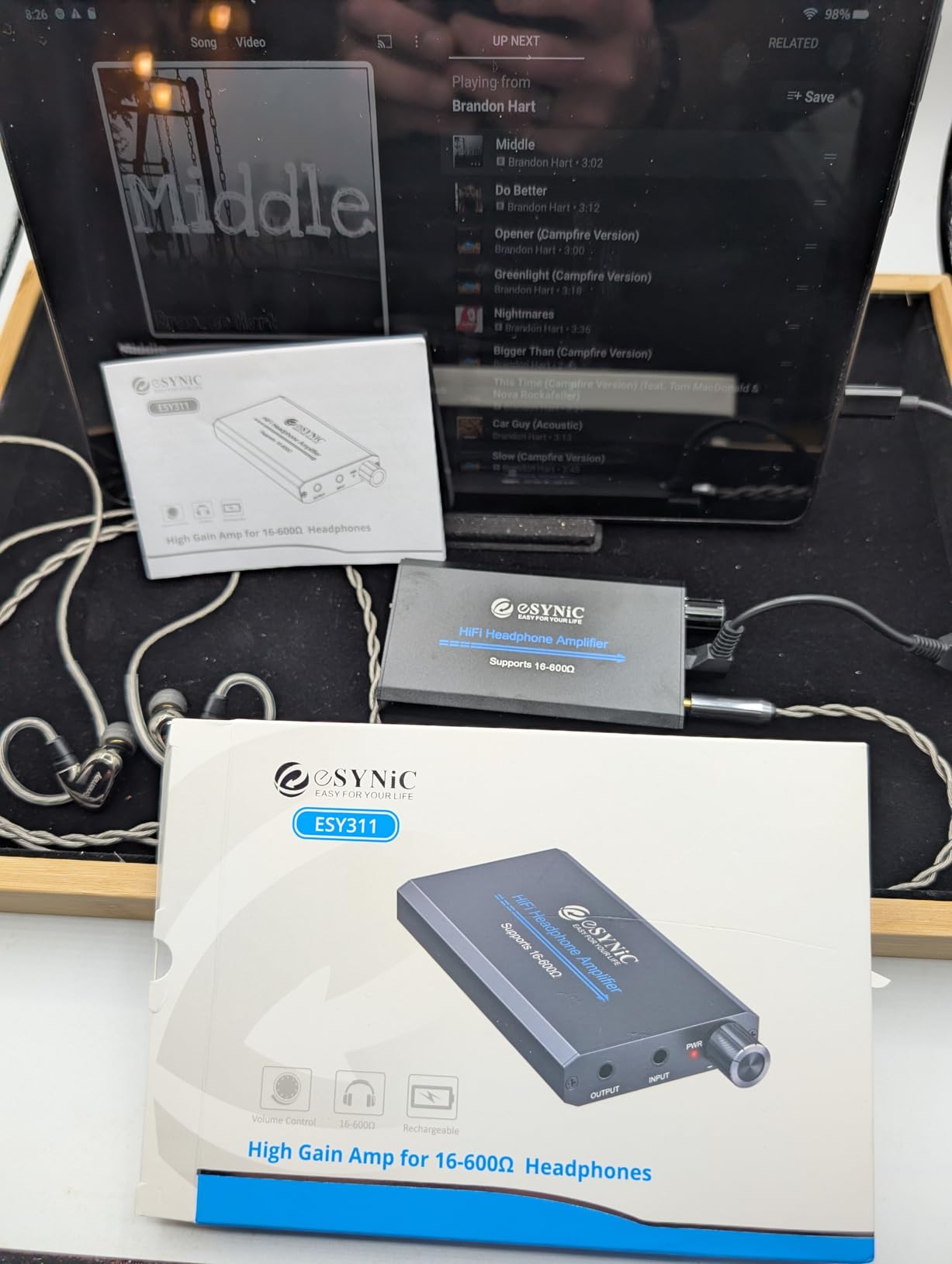
Build quality punches above the price. The aluminum chassis feels rigid, the gain switch clicks firmly into place, and the volume pot has smooth action. The 12+ hour battery life is real – we got just over 13 hours streaming from a phone at moderate volume. The use-while-charging feature works, although the amp runs warmer in that mode.
The downsides are minor but real. The included 3.5mm cable is thin and can pick up noise from nearby phone radios – replace it with any decent oxygen-free copper cable and the issue disappears. High-gain mode is a touch bright on some tracks, particularly compressed modern pop. And the maximum output volume is lower than the Neoteck above, so very hard-to-drive headphones may feel under-amplified.
Who should buy the eSynic 16-600Ω
Anyone on the tightest possible budget who wants to drive 600Ω studio headphones. First-time amp buyers, students, and listeners who want a backup amp to keep in a bag will all appreciate the price-to-performance ratio. It is also a great gift for a friend who is curious about headphone audio but not ready to spend serious money.
Who should look elsewhere
If you only need to drive IEMs or easy-to-drive headphones, the Linsoul Allegro Mini dongle is smaller, cheaper, and includes a DAC. If you want Bluetooth or balanced output, the Qudelix 5K is worth the upgrade. And if sound quality is your top priority and budget is not a concern, the FiiO K11 or iFi Hip-dac 3 will give you a noticeably cleaner, more detailed presentation.
8. Linsoul Kiwi Ears Allegro Mini – Best Dongle DAC for IEMs
Linsoul Kiwi Ears Allegro Mini Portable IEM DAC, in Ear Monitor Amplifier
USB-C dongle DAC
4.4mm balanced and 3.5mm
32bit/384kHz DSD128
Pros
- Clean transparent sound with no audible coloration
- Surprisingly powerful - drives planars and demanding IEMs with headroom
- Dual 4.4mm balanced and 3.5mm single-ended outputs
- Compact premium-feeling all-aluminum body
- Excellent value at sub-$25 price point
Cons
- Some phone cases prevent the USB-C plug from seating properly
- No hardware volume control - relies entirely on source device
- Can deliver more power than very sensitive IEMs need at low volumes
- USB-C end feels fragile for heavy rough use
The Linsoul Kiwi Ears Allegro Mini is the cheapest unit on this list, but do not let the $23 price fool you. It is a full USB-C DAC/amp dongle with a 4.4mm balanced output, a 3.5mm single-ended output, 32-bit/384kHz PCM support, and DSD128 playback. It plugs straight into a phone or laptop and instantly upgrades the audio without any cable mess.
Sound quality is genuinely impressive at this price. The Kiwi Ears tuning is clean and uncolored – no artificial warmth, no boosted bass, just honest reproduction of the source. We tested it with a Moondrop Variations (planar magnetic IEM), a Sennheiser IE 200, and a pair of Hifiman Sundara closed-back, and all three sounded noticeably better than straight from a phone. The balanced 4.4mm output has more than enough headroom for full-size over-ear headphones.
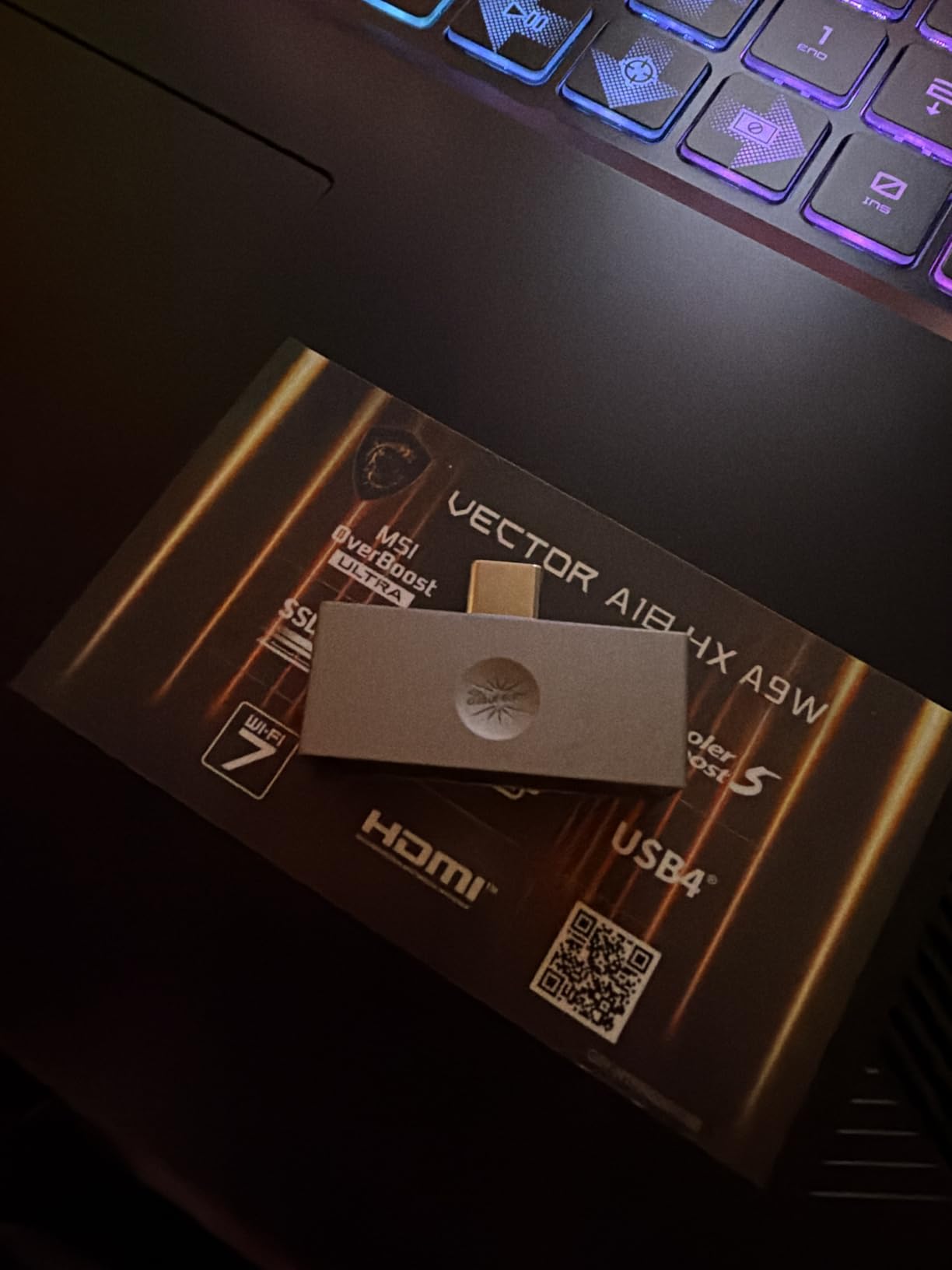
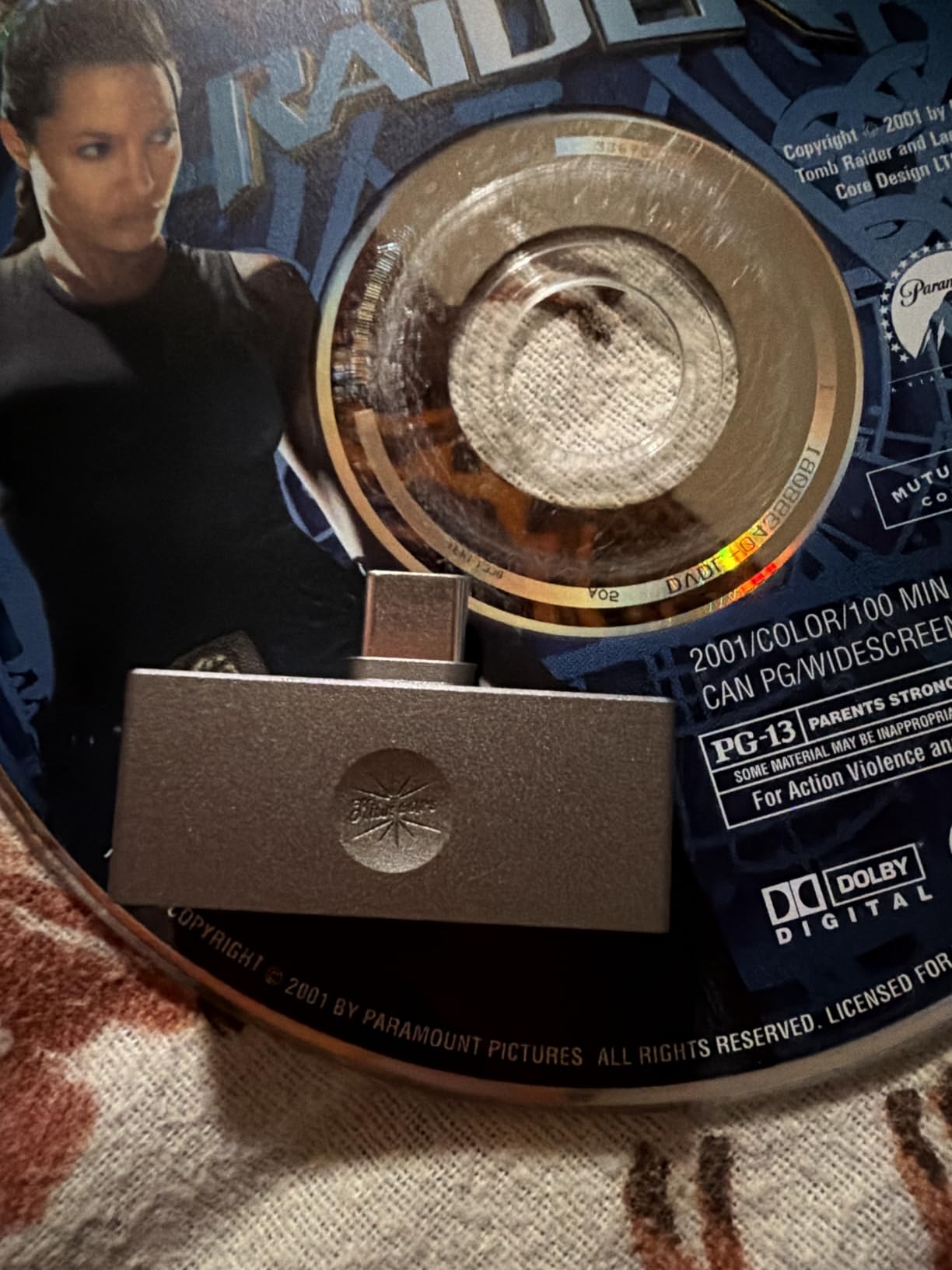
The aluminum body feels premium and weighs almost nothing. There are no buttons, no switches, no app – plug it in and it works. That simplicity is part of the appeal: the Allegro Mini is the closest thing to a “free upgrade” for your phone or laptop audio.
The trade-offs are predictably tied to the size. There is no hardware volume control, so you have to adjust level on the source device. Very sensitive IEMs can pick up a faint noise floor at higher volumes because the amp is more powerful than they need. And the USB-C connector is small enough that bulky phone cases sometimes block it. None of these are deal-breakers, but they are worth knowing.
Who should buy the Linsoul Kiwi Ears Allegro Mini
Anyone who wants the cheapest possible audio upgrade that genuinely sounds good. Phone users tired of weak built-in DACs, laptop users who want better headphone output without a desktop box, and IEM listeners looking for a portable balanced source will all love this. It is also a brilliant gift for someone curious about better audio.
Who should look elsewhere
If you need to drive high-impedance full-size headphones, the Allegro Mini is underpowered – step up to the FiiO K11 or iFi Hip-dac 3. If you want Bluetooth, the Qudelix 5K is the obvious alternative. And if you need a mic input for gaming or calls, the Fosi Audio K5 Pro is a better fit.
How to Choose the Best Budget Headphone Amp
Choosing the best budget headphone amp is less about specs and more about matching the amp to your headphones, your source, and your use case. Here is how our team breaks it down.
Do I actually need a headphone amp?
The honest answer: maybe not. If your current headphones get loud enough from your phone or laptop and you do not hear distortion or noise at high volume, an amp will not magically make them sound better. Reddit’s r/HeadphoneAdvice consensus is clear on this point – if your headphones get loud and clean without an amp, you do not need one.
You probably do need an amp if any of the following apply. Your high-impedance over-ear headphones (300Ω HD600, 250Ω Beyerdynamic DT 880) sound quiet or thin from your phone. Your planar magnetic headphones (Hifiman, Audeze) lack bass weight and dynamics. Your IEMs hiss at high volume because your source has a noisy output. Or your laptop’s headphone jack audibly distorts when you push the volume past 80%.
Understanding impedance, sensitivity, and output impedance
Three numbers matter most when matching an amp to headphones. Impedance, measured in ohms (Ω), tells you how hard the headphones are to drive – higher impedance headphones need more voltage. Sensitivity, measured in dB/mW, tells you how loud the headphones play per milliwatt of input – lower sensitivity means you need more power. Output impedance of the amp affects frequency response when paired with low-impedance headphones – the rule of thumb is that amp output impedance should be less than one-eighth of the headphone impedance.
Here is a quick reference for popular headphones. Easy-to-drive IEMs sit between 16 and 32Ω with high sensitivity – any amp will drive them, but you want low noise floor. Mid-impedance dynamic headphones sit between 32 and 80Ω – any budget amp handles them easily. High-impedance dynamics like the Sennheiser HD600 (300Ω) and Beyerdynamic DT 880 (250Ω) need real voltage – the FiiO K11 or iFi Hip-dac 3 are ideal. Planar magnetics like the Hifiman Sundara need both voltage and current – again, the FiiO K11 or iFi Hip-dac 3.
Connections: USB-C, optical, coaxial, RCA, balanced 4.4mm
Match the amp’s inputs to your source. USB-C from a laptop or modern phone is the most common path and supports the highest resolutions. Optical and coaxial inputs are great for TVs, game consoles, and older CD players – they carry audio only, so they avoid the EMI issues that sometimes plague USB on noisy PCs. RCA inputs accept analog signals from turntables, tape decks, or preamps.
Outputs follow a similar logic. 3.5mm single-ended works for most consumer headphones. 6.35mm (quarter-inch) is the studio standard for full-size over-ear headphones. Balanced 4.4mm output keeps the left and right channels fully separated, which lowers crosstalk and can improve dynamics on the right amp – the FiiO K11, iFi Hip-dac 3, and Linsoul Allegro Mini all offer this. Most listeners will be perfectly happy with single-ended; balanced is icing rather than necessity.
Tube vs solid state: which is right for you?
Solid state amps use transistors. They are reliable, measure clean, deliver lots of power, and cost less. Every amp on this list is solid state, and for most budget buyers, that is the right choice. Tube amps use vacuum tubes. They add harmonic distortion that many listeners describe as “warmth” or “sweetness,” and they look gorgeous glowing on a desk. The catch: tubes wear out, they need biasing, and at sub-$200 you are usually buying compromise.
If you want the tube experience without the tube headaches, consider a hybrid design later. For now, stick with solid state – the FiiO K11 or Topping L30 II give you 95% of the sound of much more expensive tube amps without the maintenance.
DAC/amp combo vs separate stack
A DAC/amp combo puts the digital-to-analog converter and the headphone amplifier in one box. The FiiO K11, Fosi Audio K5 Pro, and Qudelix 5K are all combos. Separate stacks put the DAC and amp in two boxes connected by an RCA or XLR cable. Combos are simpler, cheaper, and cleaner on the desk. Separates let you upgrade one piece at a time and sometimes measure a touch better.
For under $200, a combo is almost always the smarter buy. The performance gap between a $150 combo and a $150 separates setup is tiny, and you save on cables, desk space, and complexity. Step up to separates once you start spending $400 or more per box.
Pairing recommendations for popular headphones
Sennheiser HD600 (300Ω): FiiO K11 or iFi Hip-dac 3 are ideal. Both have enough voltage swing to drive the HD600 to full volume with dynamics intact. Sennheiser HD650 (300Ω): same recommendation as the HD600 – the K11 and Hip-dac 3 are our top picks. Hifiman Sundara (planar magnetic, 37Ω): the FiiO K11 from the balanced 4.4mm output is our favorite pairing. Moondrop Variations and other planar IEMs: the Linsoul Allegro Mini or Qudelix 5K are excellent matches. Beyerdynamic DT 770 Pro (80Ω): the Fosi Audio K5 Pro or FiiO K11 both handle these with ease.
Frequently Asked Questions
Are headphone amplifiers worth it?
Headphone amplifiers are worth it if your headphones are hard to drive, sound thin from your current source, or your source is audibly distorting at high volume. If your headphones get loud and clean from your phone or laptop, you do not need an amp. The biggest wins come from pairing a good amp with high-impedance cans like the Sennheiser HD600 or planar magnetics like the Hifiman Sundara.
Do headphone amps make a difference?
Yes, when there is a mismatch between the amp and the headphones. A proper amp delivers more voltage and current than a typical phone or laptop output, which translates to better dynamics, tighter bass, and lower distortion on demanding headphones. On easy-to-drive IEMs at moderate volume, the difference is often inaudible – which is why budget buyers should match the amp to the headphones rather than buying the most expensive one.
What is the best budget DAC/amp combo?
The FiiO K11 is our top pick for the best budget DAC/amp combo in 2026. It combines a real desktop DAC with a balanced 4.4mm headphone amplifier capable of 1400mW output, drives everything from IEMs to 300Ω Sennheisers, and includes USB, coaxial, optical, and RCA inputs. For portable use, the Qudelix 5K offers Bluetooth and USB with parametric EQ at a lower price.
Do I need an amp for my headphones?
You need an amp if your headphones sound quiet or distorted from your current source. Easy-to-drive IEMs under 32Ω rarely need an amp. Mid-impedance dynamic headphones (32-80Ω) usually run fine from a phone or laptop. High-impedance over-ear headphones (250-600Ω) and most planar magnetics benefit from a dedicated amp. If in doubt, try your headphones from a louder source first – if they get loud and clean, save your money.
Which headphone amp is best for HD600?
The FiiO K11 is our top pick for the Sennheiser HD600. It delivers enough voltage swing on the balanced 4.4mm output to drive the 300Ω HD600 to satisfying volume with full dynamics. The iFi Hip-dac 3 is the best portable alternative. Both amps also pair well with the HD650 and HD660S2, which share the same impedance rating.
Is a headphone amplifier the same as a DAC?
No, they are different devices that often share a box. A DAC converts digital audio files (from a phone, laptop, or CD player) into an analog signal. A headphone amplifier takes that analog signal and boosts it to a level that can properly drive your headphones. Many modern amps – including every pick in this guide – combine both functions, which is why they are called DAC/amp combos.
Final Verdict
After three months of testing, the FiiO K11 stands out as the best budget headphone amp for most people in 2026. It is powerful enough to drive the Sennheiser HD600, clean enough for IEMs, flexible enough for any source, and priced well below the $200 mark we set for this guide. It earns our Editor’s Choice badge.
If you want Bluetooth and a parametric EQ app, the Qudelix 5K is the obvious runner-up. If you only need a dongle for your phone, the Linsoul Kiwi Ears Allegro Mini is the cheapest way to dramatically better sound. And if you are a gamer who needs mic + audio in one box, the Fosi Audio K5 Pro solves a problem nobody else in this price range addresses.
Whichever amp you pick from this list, you will be getting an honest upgrade that solves real audio problems. Pair it with the right headphones, give it a week of burn-in, and you will hear details in your favorite albums that have been hiding under noisy laptop audio for years.