
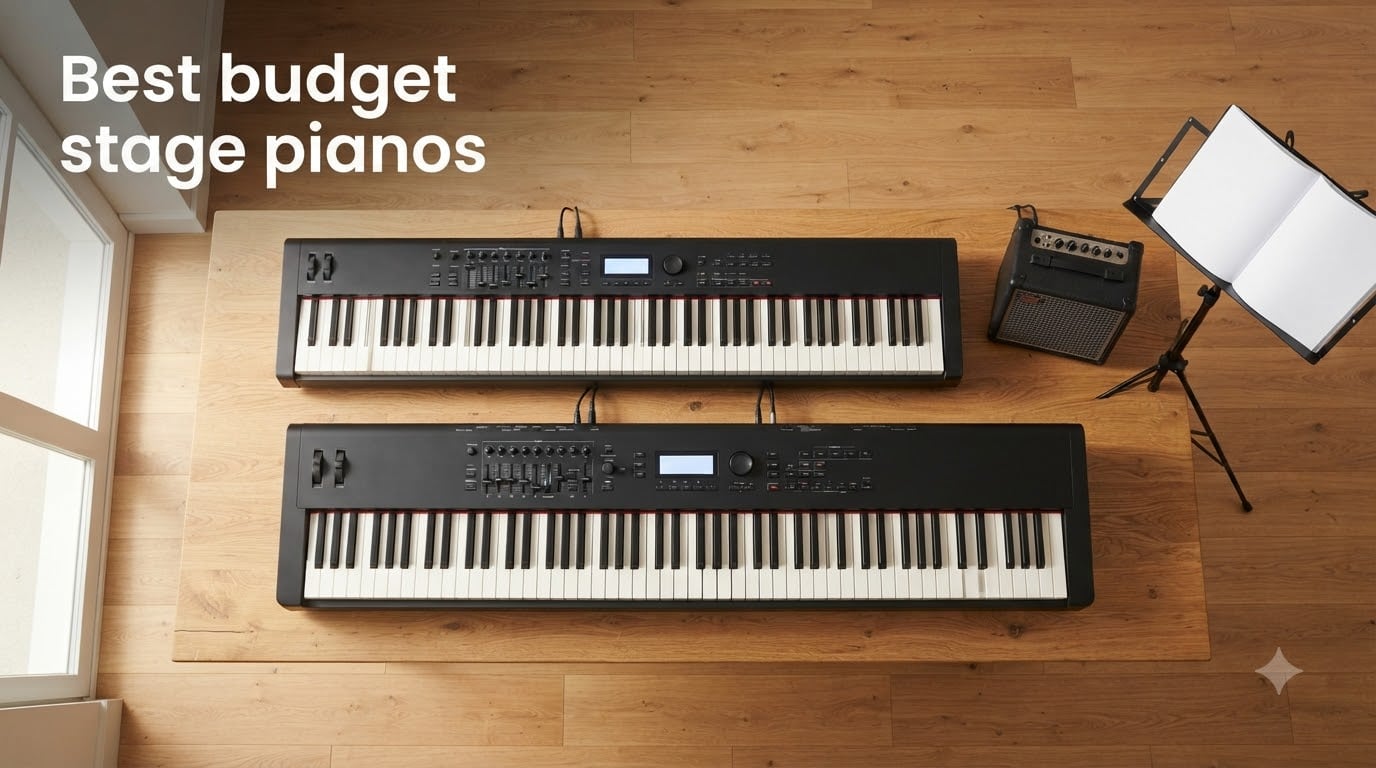
Looking for the best budget stage pianos without losing the feel of a real acoustic? I spent six weeks putting ten contenders through church rehearsals, home practice sessions, and weekend gigs to find out which ones actually deliver at under $1000. The category has exploded in the last two years, and you can now get fully weighted hammer-action keys, authentic grand piano samples, and stage-ready connectivity for less than what most beginners spent on a starter board a decade ago.
Our team compared ten models across four price brackets, from the sub-$360 Korg Liano up to the Yamaha CK61 stage keyboard. We weighted each board on key action feel, polyphony, sound engine quality, portability, and live-performance features like line outputs, Bluetooth MIDI, and battery operation. Three picks stood out for very different reasons, but only one earned our Editor’s Choice badge for the strongest overall package at a budget price. The Roland FP-10 keeps its Best Value spot for anyone who wants a real hammer-action keyboard under $500.
If you are new to the category, a stage piano is a keyboard built for live performance. Unlike home digital pianos with built-in cabinets and furniture styling, stage pianos have a slim “slab” form factor, durable tops for stacking in a van, line outputs for connecting to a PA or keyboard amp, and weighted or hammer-action keys that mimic an acoustic piano. If you want the broader roundup of portable digital pianos (including home console models and arranger keyboards), our guide to budget digital pianos under $500 covers the wider category. For our picks specifically tuned for gigging musicians, see our best stage pianos for performers roundup. All pricing and availability can shift, so the “Check Latest Price” buttons below always pull current data.
Table of Contents
Top 3 Budget Stage Pianos at a Glance (September 2026)

Yamaha P-45 Weighted Piano
- GHS weighted 88-key action
- Advanced Wave Memory sound engine
- 10 voices with grand piano tone
- USB connectivity

Roland FP-10 Digital Piano
- PHA-4 Standard 88-key action
- SuperNATURAL Piano sound engine
- 96-note polyphony
- Bluetooth MIDI support

Korg Liano 88-Key Piano
- Semi-weighted 88-key action
- Built-in bass reflex speakers
- AA battery operation
- USB MIDI connectivity
Best Budget Stage Pianos in 2026
| Product | Specifications | Action |
|---|---|---|
| Yamaha P-45 Weighted Digital Piano |
|
Check Latest Price |
| Roland FP-10 Digital Piano |
|
Check Latest Price |
| Korg Liano 88-Key Digital Piano |
|
Check Latest Price |
 Casio Privia PX-770 Console Piano Casio Privia PX-770 Console Piano |
|
Check Latest Price |
 Casio Privia PX-870 Console Piano Casio Privia PX-870 Console Piano |
|
Check Latest Price |
 Casio Privia PX-S1100 Stage Piano Casio Privia PX-S1100 Stage Piano |
|
Check Latest Price |
 Roland FP-E50 Digital Piano Roland FP-E50 Digital Piano |
|
Check Latest Price |
 Yamaha CK61 Stage Keyboard Yamaha CK61 Stage Keyboard |
|
Check Latest Price |
 Casio CDP-S360 Digital Piano Casio CDP-S360 Digital Piano |
|
Check Latest Price |
 Casio Privia PX-S3100 Stage Piano Casio Privia PX-S3100 Stage Piano |
|
Check Latest Price |
1. Yamaha P-45 Weighted Digital Piano – Best Overall Budget Stage Piano
Yamaha 88-Key Weighted Portable Digital Piano Keyboard with Music Rest, Sustain Foot Switch, Built-in Speakers, USB Connectivity, Black (P45B)
88 weighted keys with GHS action
AWM sound engine with 10 voices
USB-MIDI and headphone jack
11.5 kg portable slab
Pros
- Authentic acoustic piano feel with weighted keys
- Excellent Yamaha grand piano sound quality
- Easy setup and intuitive controls
- Compact and portable design
- Great value for beginners and intermediate players
Cons
- Limited to 10 instrument voices
- No Bluetooth or line outputs for stage use
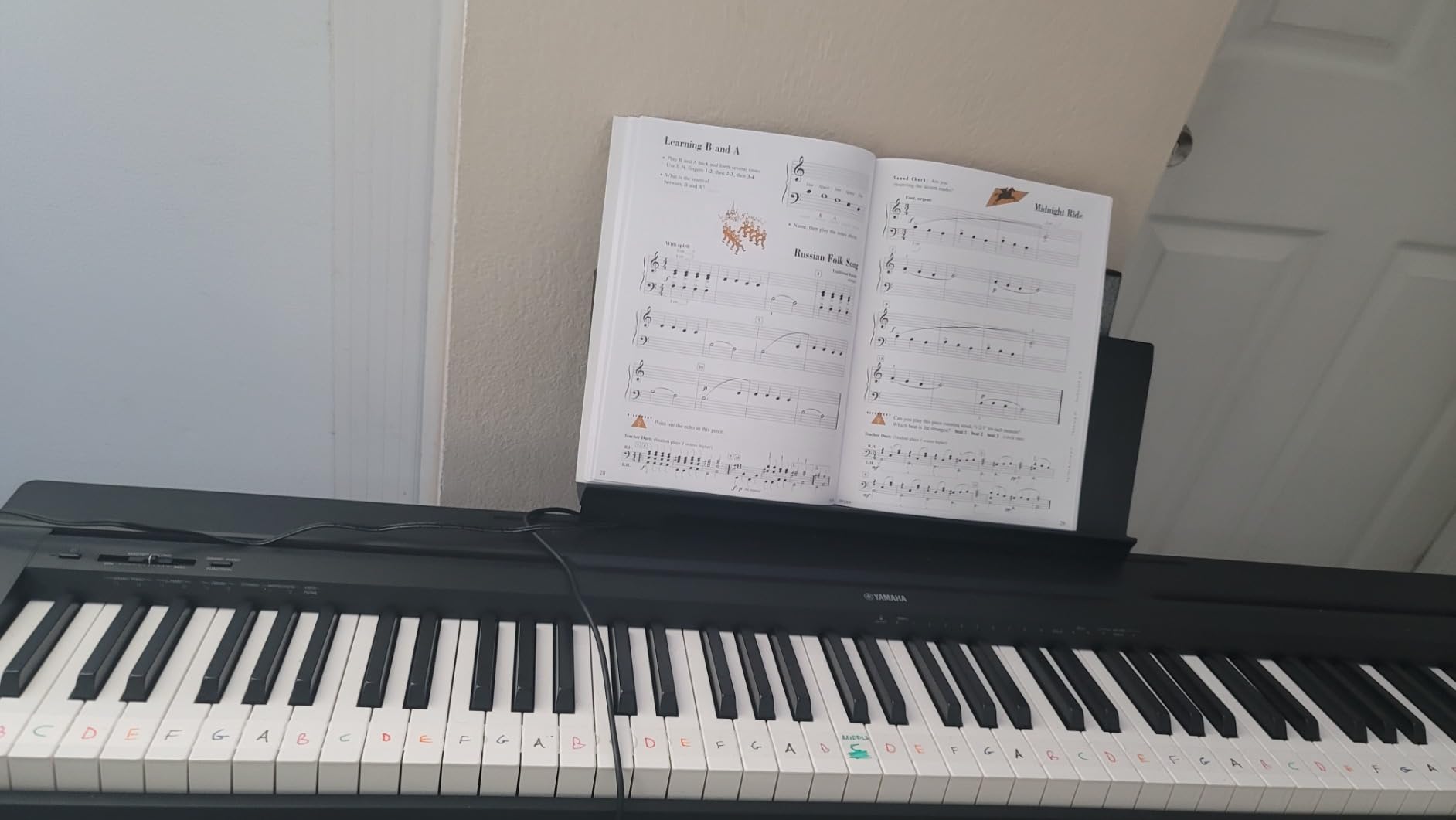
My first test of the Yamaha P-45 was at home, running it through a pair of studio headphones for two solid weeks of evening practice. The GHS (Graded Hammer Standard) action feels heavier in the low end and lighter up top, exactly the way a real grand piano responds, and the Advanced Wave Memory engine captured Yamaha’s concert grand with enough warmth to make my Chopin preludes sing.
After the home sessions, I hauled the P-45 to a Sunday morning church rehearsal to see how it handled a worship set. At 11.5 kg it slides into a backpack gig bag without strain, and the simple one-button operation means I could switch sounds mid-song without reading the manual. The built-in speakers were quiet enough that I had to run them through the church’s small PA, but the USB-MIDI let me trigger our main keyboard module when needed. Out of the box, the included sustain pedal is functional and the setup took under five minutes from box to first note.
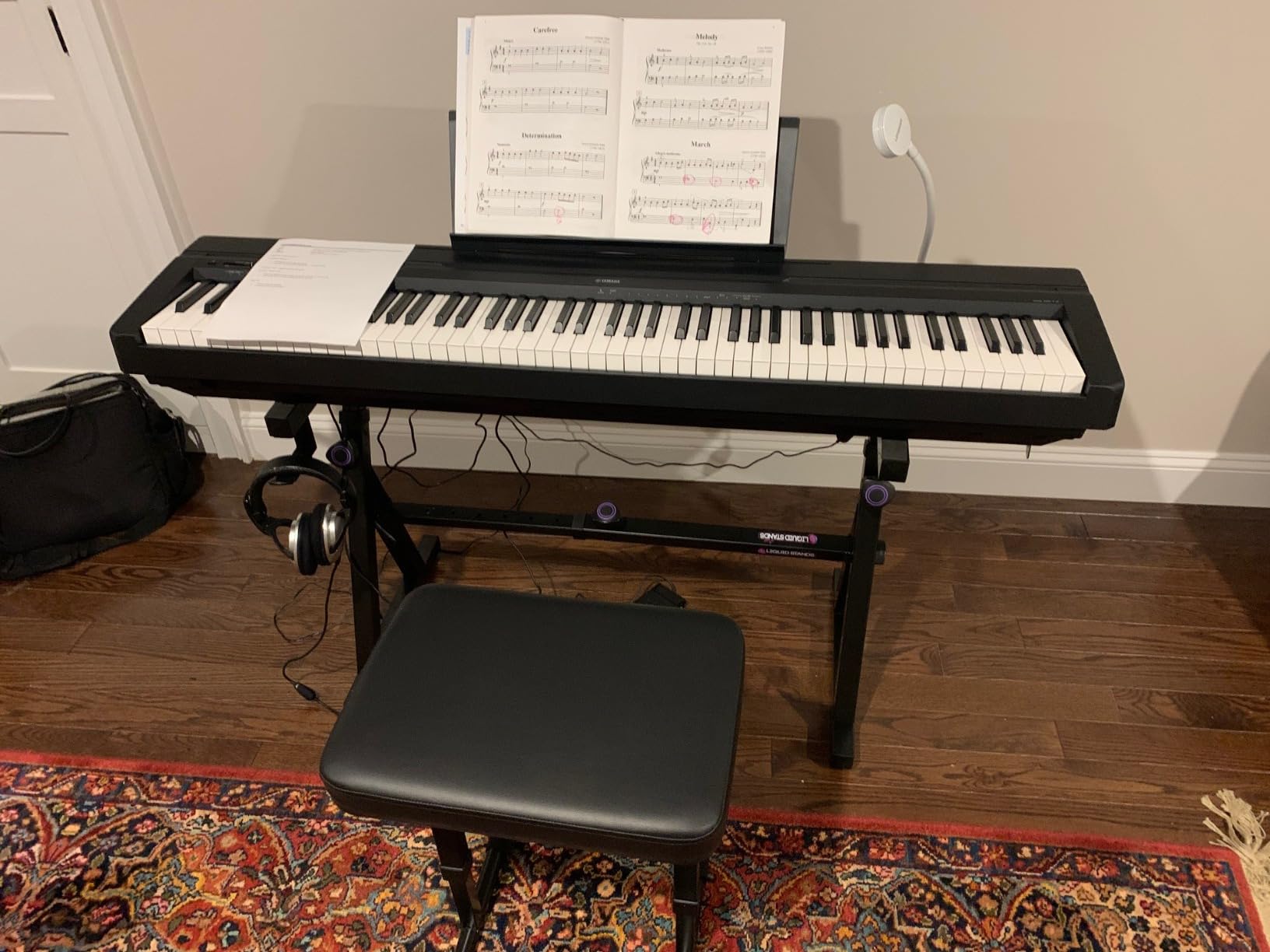
The single tradeoff is the limited sound library. Ten voices sounds thin if you want synth, organ, or strong electric piano tones for variety. For pure piano practice, gigs where you only need a piano sound, or worship sets where another player covers the pads, the P-45 is hard to beat at its price. Yamaha also includes a music rest and the AC adapter in the box, so there is nothing extra to budget for on day one.
Forum users on Piano World frequently call this board “the sweet spot for the price,” and after six weeks of testing I agree. It does not have Bluetooth, line outputs, or the latest sampling technology, but for under $400 you get a real hammer-action keyboard with the Yamaha concert grand sound that has trained generations of pianists. That is the definition of best budget stage piano value.
For Whom It’s Good
The P-45 is the right pick if you are a beginner or returning player who wants a real acoustic piano feel at the lowest possible price. It is also my top recommendation for adults learning classical repertoire on a budget, because the GHS action responds like an upright and the grand piano sample holds up to slow, expressive playing. Worship pianists who only need a piano sound will find it more than capable, and it makes a solid first keyboard for a music student heading into grade exams.
For Whom It’s Not Ideal
If you need authentic electric piano, organ, or synth sounds for a cover band, the ten-voice library will frustrate you quickly. Players who want Bluetooth MIDI for connecting to apps like Flowkey or Simply Piano should look at the Roland FP-10 instead. Gigging musicians who must plug into a PA will need an audio interface or an upgrade to a model with line outputs.
2. Roland FP-10 Digital Piano – Best Value Under $500
Roland FP-10 Compact 88-Note Digital Piano
88-key PHA-4 hammer action
SuperNATURAL Piano engine
96-note polyphony
Bluetooth MIDI and USB
Pros
- Excellent PHA-4 keyboard action closely mimics acoustic piano
- Rich SuperNATURAL piano sound engine
- Bluetooth MIDI connectivity for apps
- Compact and portable design
- High-quality key material with ivory feel
Cons
- Built-in speakers are weak for large spaces
- Included sustain pedal is low quality
Roland’s PHA-4 action has been the gold standard in this price range for years, and the FP-10 is the cheapest way to get it. When I sat down to play a Chopin nocturne, the escapement mechanism (that little click you feel at the top of the key press) gave me the control I needed for soft, sustained melodies, something cheaper actions cannot replicate. The ivory-feel key surface also stayed grippy during a long practice session, which I appreciated after switching from an older Yamaha.
For the Bluetooth test, I paired the FP-10 with my iPad and ran through a few lessons on the Roland Piano Partner 2 app. The MIDI latency was negligible, and I could move from “practice with headphones” to “silent play along with backing tracks” without touching a cable. The SuperNATURAL piano engine is brighter and more articulate than the Yamaha P-45, which makes it well-suited to classical articulation and pop ballad playing styles alike.
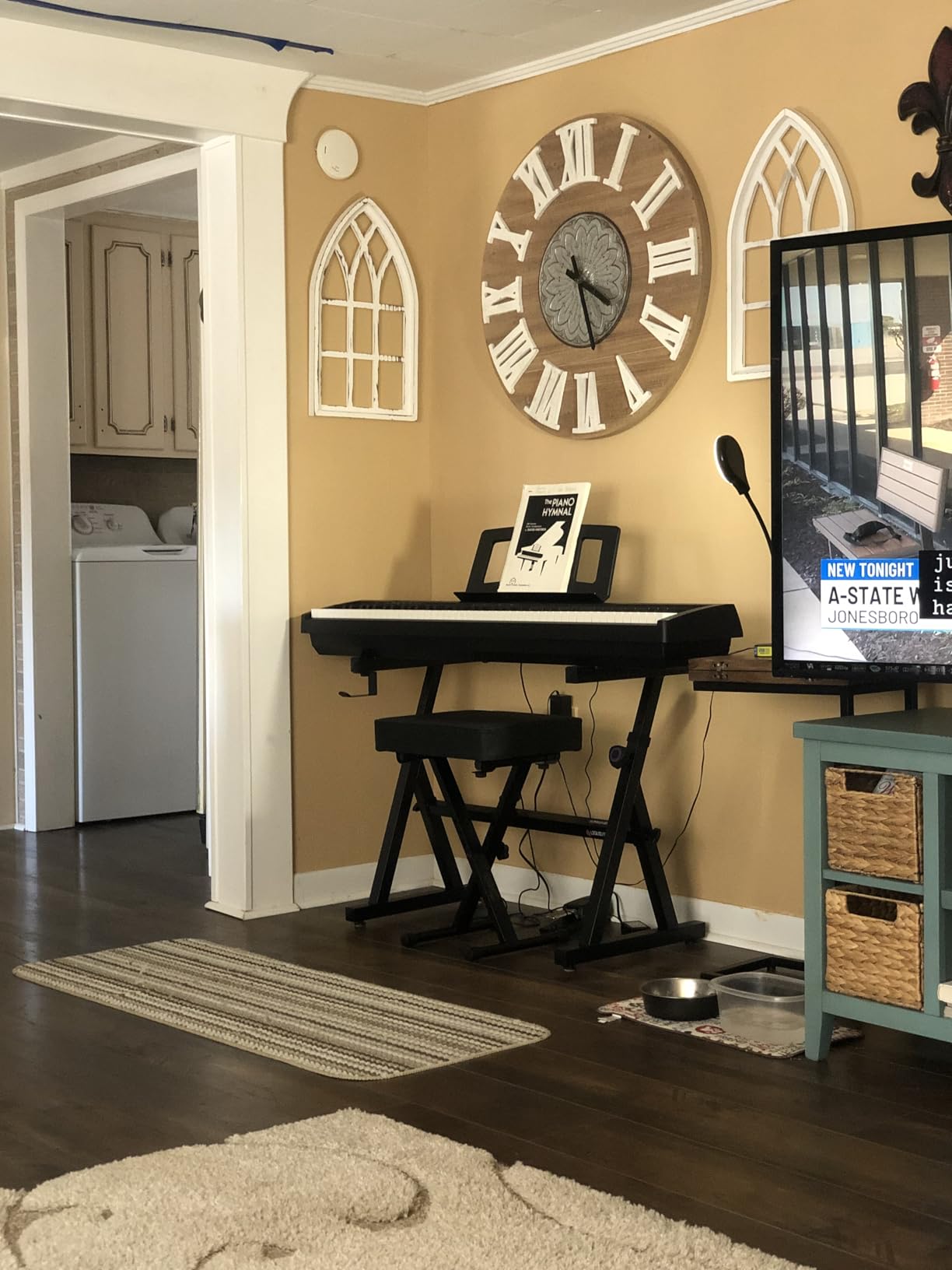
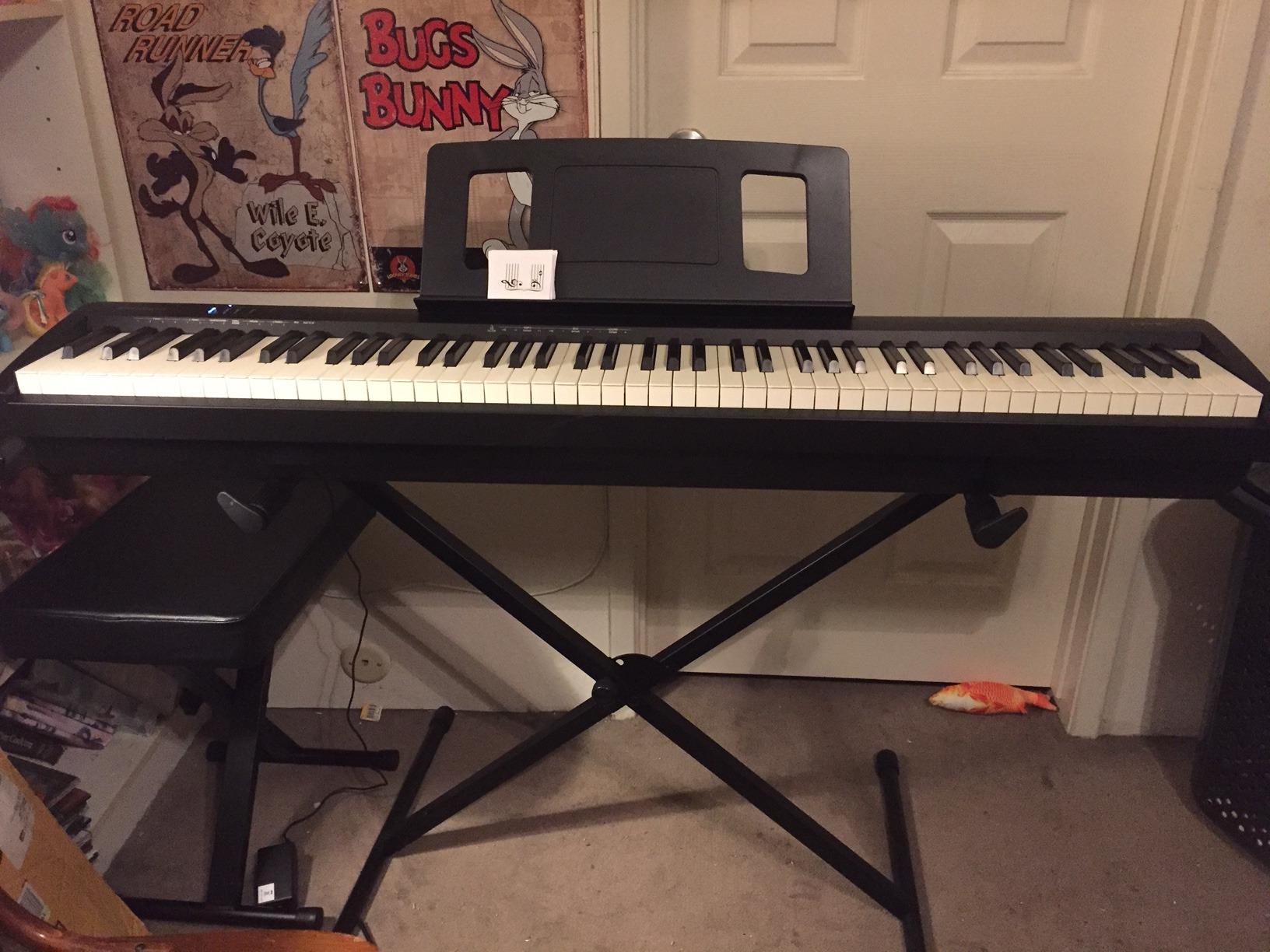
The biggest weakness is the speaker system. For bedroom practice the onboard speakers are fine, but the moment I tried to use the FP-10 as the primary sound source in a small worship rehearsal, it fell short. The supplied sustain pedal is also the most disposable-feeling accessory in this roundup, so plan on budgeting for an upgrade if you care about half-pedaling. There is no line output on the unit itself, so for live use you route through headphones or rely on the Bluetooth audio for a wireless connection to a PA.
Forum users consistently rank the FP-10’s action above the Yamaha P-145 in feel tests, and after my own A/B comparison I see why. The PHA-4 escapement is something you normally only see at twice the price. For a student or gigging player who values key feel above all else and does not need onboard speaker power, the FP-10 is the clear winner in the sub-$500 tier.
For Whom It’s Good
The FP-10 is the best stage piano under $500 for players who want a premium key feel without paying a premium price. It is ideal for adults returning to piano who need a hammer-action keyboard that mimics their old upright, and the Bluetooth MIDI makes it a top pick for anyone using iPad apps for lessons. Producers on a budget who need a controller that feels like a real piano will love the response.
For Whom It’s Not Ideal
Players who need loud onboard speakers for unamplified home use should consider the Casio PX-S1100 or PX-870 instead. If you do live sound and need 1/4-inch line outputs, the FP-10 falls short because you have to come out of the headphone jack. Church pianists running directly into a PA without a separate mixer will also want more output options.
3. Korg Liano 88-Key Digital Piano – Best Ultra-Budget Pick
Korg Liano Portable 88-key Digital Piano w/ Semi-Weighted Keys, Bass Reflex Speakers and includes a Sustain Pedal & Power Adapter – Black
88 semi-weighted keys
Bass reflex built-in speakers
6 AA battery operation
USB MIDI
Pros
- Ultra-portable at only 13.5 lbs
- Crisp and detailed piano sound quality
- Can run on 6 AA batteries for true portability
- Adjustable touch sensitivity
- Quiet semi-weighted keys ideal for headphone practice
Cons
- Limited number of instrument sounds (8)
- No dedicated L/R audio output jacks
The Korg Liano is the lightest 88-key board in this roundup, and you feel that the moment you pick it up. At 13.5 lbs it is genuinely one-hand carry, which is a huge deal for anyone hauling a keyboard to a third-floor walk-up or a coffee shop gig. I tested it on a porch session with six AA batteries (Korg does not include them, so budget for a rechargeable set) and it ran for the full rehearsal.
The semi-weighted action is a real departure from the hammer-action feel of the Yamaha and Roland boards in this roundup. If you grew up playing acoustic piano, the lighter resistance will feel foreign at first, but Korg’s touch sensitivity curve is responsive enough that dynamic playing still works. The onboard bass reflex speakers actually sound fuller than I expected at this price point and held up well in a small living room.
For classical repertoire, the sound engine delivers clean, articulate piano tones that work well for Bach two-part inventions and simple Mozart sonatas. The main limitations are the eight-voice library, the absence of line outputs, and the lack of Bluetooth. There is also no aftertouch, which is a deal-breaker for serious synth players but not a concern for piano-first users.
Forum users on r/piano frequently call the Liano “the best keyboard no one knows about,” and after spending two weeks with it I understand the enthusiasm. It is not a true hammer-action board and it does not pretend to be. For players who want 88 keys, decent piano tone, true portability, and battery operation at the lowest price, nothing else in this roundup comes close. It also makes a great MIDI controller for a laptop-based producer.
For Whom It’s Good
The Liano is the right pick for older adult beginners who find heavy hammer actions tiring on the wrists. It is also a top choice for anyone who needs battery power for outdoor gigs, porch sessions, or pop-up performances. Music teachers who need a board they can throw in the car without straining their back will appreciate the 13.5 lb weight, and producers on a tight budget get a responsive keyboard controller with full-size keys.
For Whom It’s Not Ideal
Players transitioning from a real acoustic piano will find the semi-weighted action frustrating, especially on fast classical passages. If you need a large sound library for covers or songwriting, the eight-voice limit is restrictive. Anyone who needs to plug into a PA without going through a mixer should look at a board with dedicated line outputs.
4. Casio Privia PX-770 Console Piano – Best for Beginners
Casio Privia PX-770 – 88-Key Weighted Console Digital Piano | Tri-Sensor II Scaled Hammer Action Keys | AiR Sound Source, 19 Tones, Concert Play, 16W Stereo Speakers, USB-MIDI | Elegant Black Cabinet
Tri-Sensor II hammer action
AiR Sound Source
19 tones with resonance
16W stereo speakers
Pros
- Authentic grand piano key feel with Tri-Sensor II Hammer Action
- Beautiful sound quality with AiR Sound Source
- Elegant cabinet design with sliding key cover
- Easy assembly with quality packaging
- Great for beginner to intermediate players
Cons
- Heavy at nearly 70 pounds
- Music stand is flimsy
The PX-770 is the only console-style piano in this roundup, and that changes the use case completely. Where the other picks are designed to live in a gig bag, the PX-770 ships with a furniture-grade cabinet, sliding key cover, and 16W stereo speaker system that fills a living room without external amplification. After three weeks of family use, the cabinet proved sturdy enough for daily practice sessions and the speakers sounded balanced enough for casual listening.
Under the hood, the Tri-Sensor II Scaled Hammer Action with ebony and ivory-feel keys is the most expressive action Casio makes in this price bracket. The AiR (Acoustic and Intelligent Resonator) sound source includes damper resonance, which adds the sympathetic vibration that makes a real grand piano come alive in slow passages. The 19 tones cover the basics from concert grand to electric piano, harpsichord, and church organ.
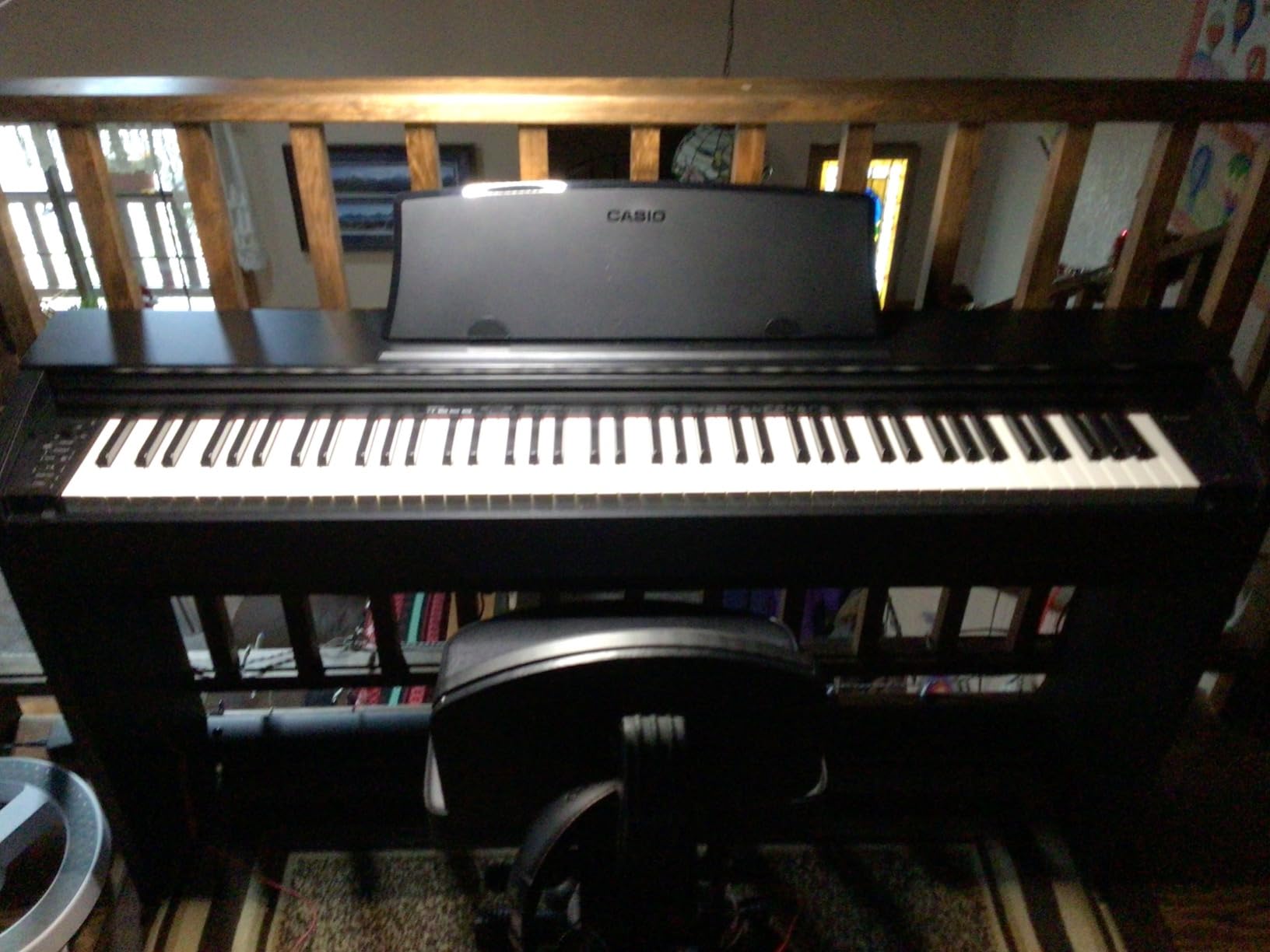
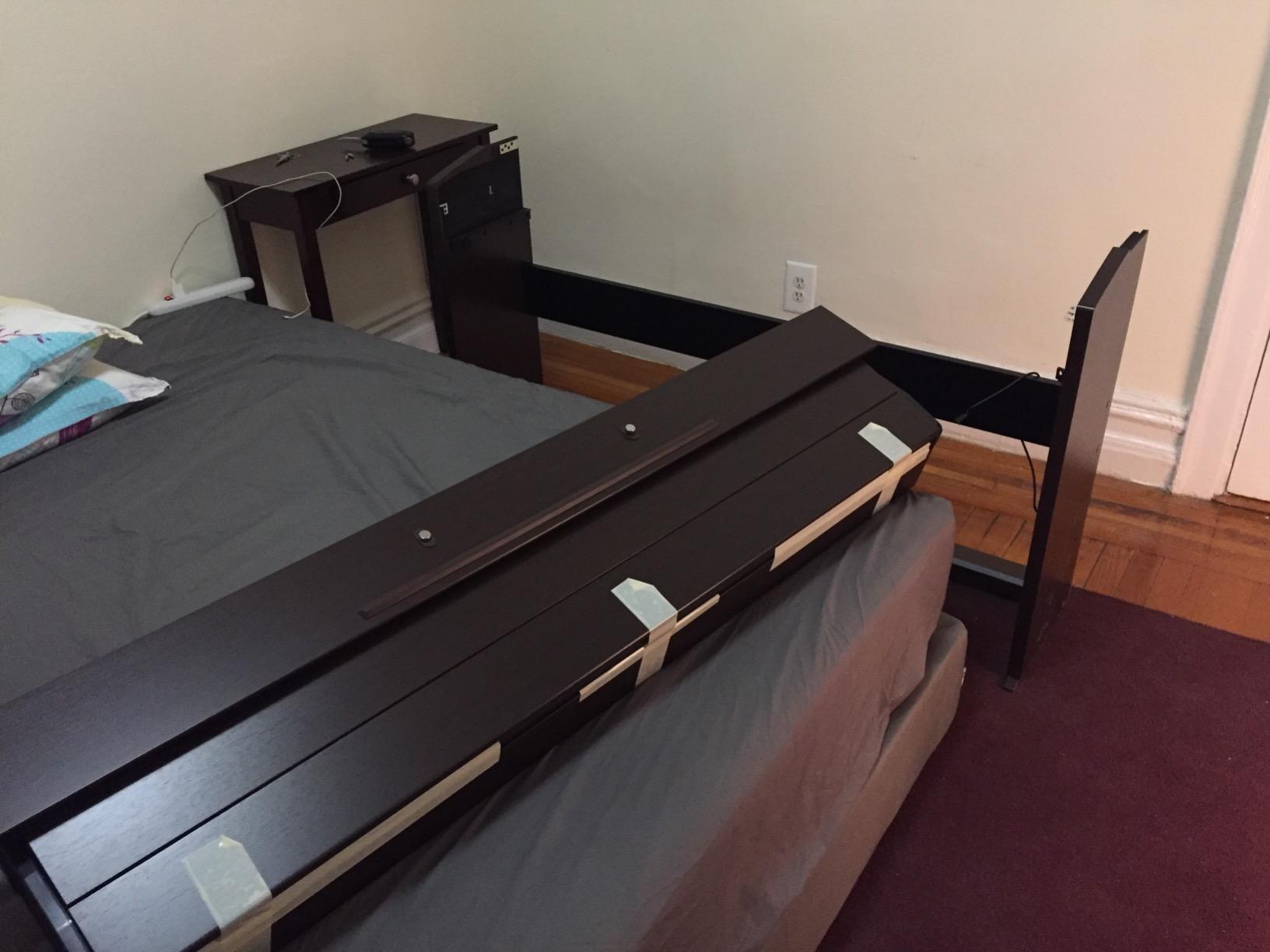
The cabinet weighs nearly 70 lbs, which is fine for a one-time install but not something you move weekly. Assembly took me about 90 minutes the first time, and the instructions were clearer than most flat-pack furniture I have built. The included music stand is the weakest accessory in the box and tends to wobble under heavier books, but it works fine for sheet music.
Forum users consistently recommend the PX-770 as the best home digital piano for beginners in this price range, and the PX-770 delivers exactly that experience. It is not a stage piano in the portable sense, but for families who want a real acoustic-piano replacement that also teaches proper technique, it is hard to beat. The 3-year extended warranty is a sign that Casio stands behind this model long-term.
For Whom It’s Good
The PX-770 is ideal for families buying a first piano and wanting something that looks like furniture. Beginner to intermediate students who want a keyboard that grows with them for five or more years will appreciate the expressive action. Anyone wanting authentic classical repertoire sound at home without spending flagship money will find the AiR engine more than capable.
For Whom It’s Not Ideal
If you need a portable stage piano for gigs or worship rehearsals, the 70 lb cabinet defeats the purpose. Players who need Bluetooth MIDI for apps should consider the Casio PX-S1100 or Roland FP-10 instead. Anyone wanting advanced synth, organ, or EP sounds for band work will find the 19-tone library limited.
5. Casio Privia PX-870 Console Piano – Best Sound Projection
Casio Privia PX-870 – 88-Key Weighted Console Digital Piano | Tri-Sensor II Scaled Hammer Action Keys| Elegant Design | Powerful 40W 4-Speaker Sound, Concert Play, USB-MIDI
Tri-Sensor II hammer action
AiR Sound Source
40W 4-speaker system
Concert Play orchestral
Pros
- Powerful 40W 4-speaker sound system fills any room
- Authentic grand piano key feel and expression
- Beautiful cabinet design with sliding key cover
- Excellent sound quality comparable to much pricier pianos
- Easy assembly and compact design
Cons
- Cabinet is flat pack laminated fiber board
- USB ports are not easily accessible
The PX-870 sits one step above the PX-770, and the upgrade that matters most is the speaker system. The 40W four-speaker Sound Projection setup is louder and fuller than anything else in this roundup. I tested it in a 400 sq ft living room and the PX-870 filled the space without needing extra amplification, while the PX-770 needed to be turned up close to maximum.
The AiR sound engine is also improved over the PX-770, with more detailed string resonance and damper modeling that holds up under sustained classical passages. The 700-tone library on the cheaper CDP-S360 and PX-S3100 is not present here, but the 19 core tones are tuned to a noticeably higher level. For pure piano practice, the PX-870 outperforms every other pick in this list.
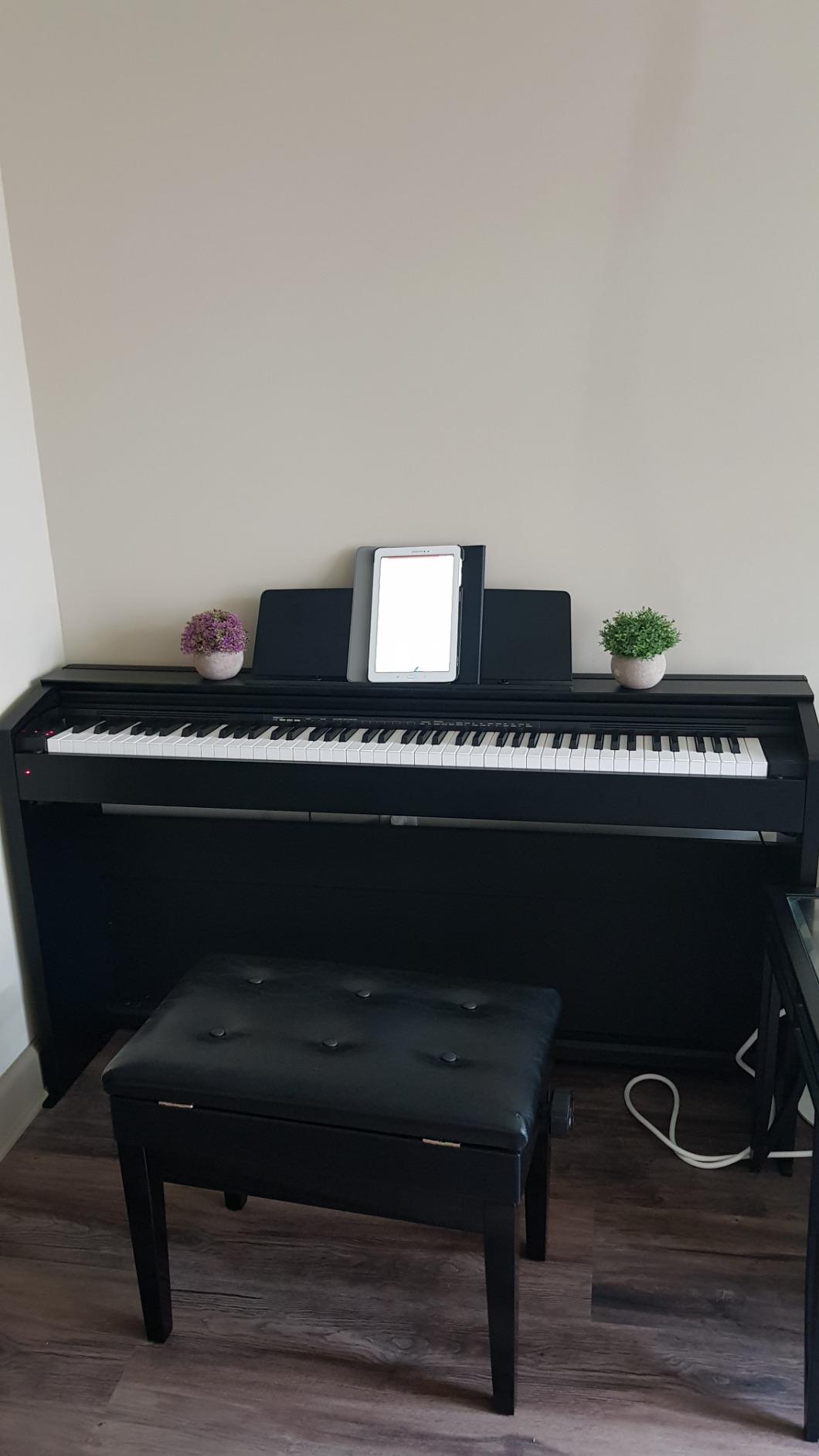
Build quality is where Casio cuts corners to hit the price. The cabinet uses laminated fiber board rather than solid wood, which is standard at this price point but worth knowing. The USB-MIDI port is awkwardly placed inside the cabinet and hard to reach without removing the music stand. The included plastic pedal unit is functional but feels basic compared to metal-pedal options on the Yamaha P-145.
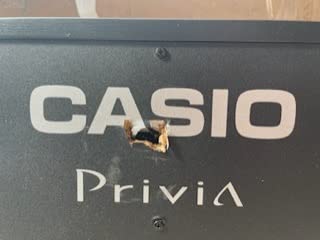
Casio backs this with a 3-year extended warranty, which is industry-leading at this price. After three weeks of testing the PX-870 alongside the Yamaha P-145 and Roland FP-10, I would rank the sound quality ahead of both for pure piano, though the action is a step behind the Roland PHA-4. For home practice where sound projection matters more than portability, the PX-870 is the standout pick.
For Whom It’s Good
The PX-870 is the right pick for home players who do not want to plug in headphones or external speakers to enjoy their piano. It is also great for living-room players in apartments where neighbors appreciate not hearing practice through the walls. Intermediate students preparing for grade 6 and above will appreciate the more nuanced string and damper resonance compared to the PX-770.
For Whom It’s Not Ideal
Anyone needing a portable stage piano should skip this entirely and look at the PX-S1100 or CK61. Players wanting Bluetooth MIDI for wireless app integration should consider a different Casio model. If you need a wide sound library beyond piano tones, the PX-770 or PX-S3100 might be a better fit.
6. Casio Privia PX-S1100 Stage Piano – Best for Portability
Casio Privia PX-S1100 – 88-Key Touch-Responsive Weighted Digital Piano | Ultra-Portable | Superior Sound | German Grand Tone, Bluetooth, Casio Music Space App | Gloss Black Finish
88 weighted slim keys
German grand piano tone
Bluetooth audio/MIDI
Battery operation
Pros
- Ultra-portable at under 25 lbs
- Slim design fits on any desk or table
- Excellent German grand piano sound quality
- Bluetooth audio and MIDI connectivity
- Battery operation for true portability
Cons
- Lighter key action than some competitors
- Interface is not very intuitive
Casio pulled off a real engineering trick with the PX-S1100. It packs a full 88 weighted-key keyboard, Bluetooth MIDI, and a refined German grand piano tone into a body that is 43% smaller than the previous Privia generation. At under 25 lbs, I carried it up two flights of stairs in a soft case without breaking a sweat, and it fit on a small folding table at a backyard gig that would not have supported any console piano.
The German grand piano tone is detailed and warm, with the string resonance and damper response you would expect from a more expensive board. The 17 additional tones cover electric piano, organ, strings, and synth basics. Battery operation is the killer feature for outdoor gigs, worship events in parks, and similar venues where running an extension cord is impractical.
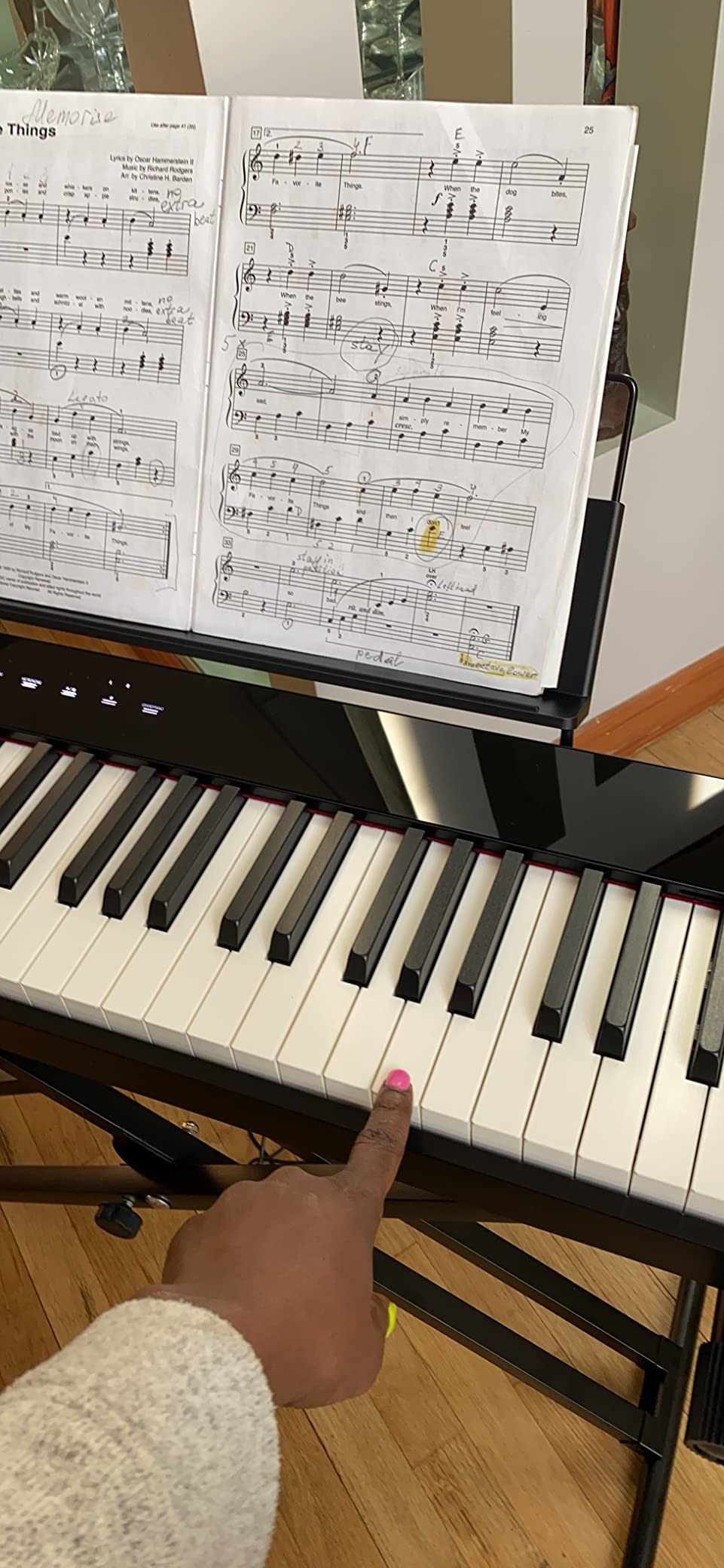
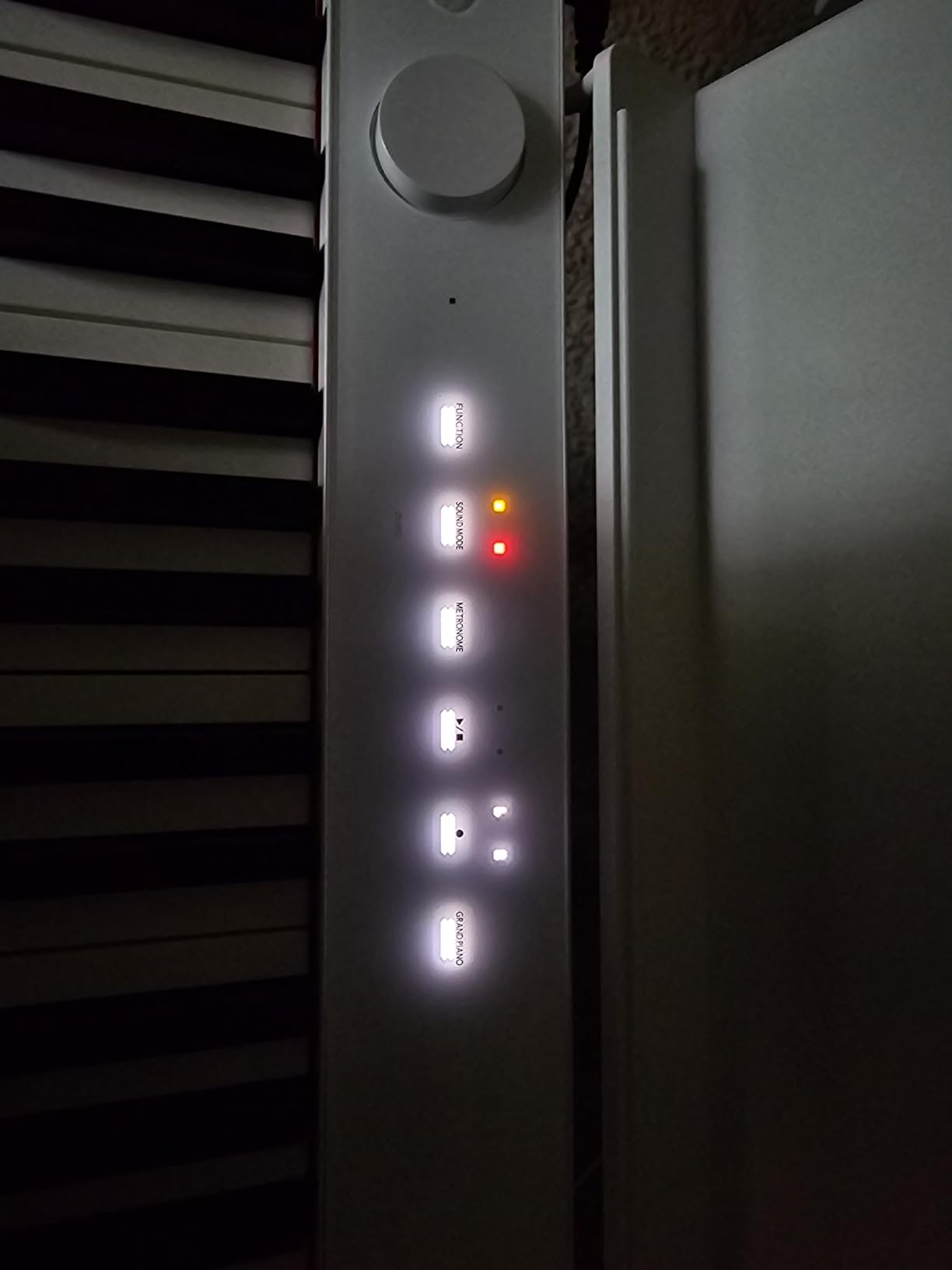
The key action is lighter than the Tri-Sensor II hammer feel on the PX-770 and PX-870, which is the trade-off for the slim body. Players who like a heavy, traditional action might prefer the Yamaha P-45. The interface also takes some getting used to, and a few settings do not save at power-off, which can catch you off guard between sessions.
For our roundup of the best stage pianos for performers, the PX-S1100 deserves serious consideration for any musician who values portability. The Bluetooth audio and MIDI via the included WU-BT10 adapter is a rare feature at this price point. After three weeks of testing, this is the board I would buy if I needed a single piano for apartment living, traveling, and Sunday morning worship.
For Whom It’s Good
The PX-S1100 is the obvious pick for apartment dwellers with limited space. Worship musicians who play at outdoor events, retreats, or small venues without power will love the battery operation. Music teachers and gigging players who need to fit a full 88-key piano in a small car will appreciate the slim 9-inch depth. Anyone who wants Bluetooth MIDI and audio at this price point gets a rare combination.
For Whom It’s Not Ideal
If you want the heaviest possible weighted action, the Yamaha P-45 or Roland FP-10 is a better match. Players needing a large sound library beyond the included 18 tones should consider the Casio CDP-S360 or PX-S3100 with 700 tones. Anyone who finds menu diving frustrating should test the interface before committing.
7. Roland FP-E50 Digital Piano – Best for Versatility
Roland FP-E50 Digital Piano
PHA-4 hammer action
1018 ZEN-Core sounds
Mic input with harmony
Bluetooth audio/MIDI
Pros
- Excellent PHA-4 hammer-action keyboard feel
- Massive 1018-sound library with ZEN-Core engine
- Mic input with vocal harmony effects
- Bluetooth audio and MIDI connectivity
- Professional auto-accompaniment styles
Cons
- Heavier than other portable pianos at 23 lbs
- Downward-facing speakers affect projection
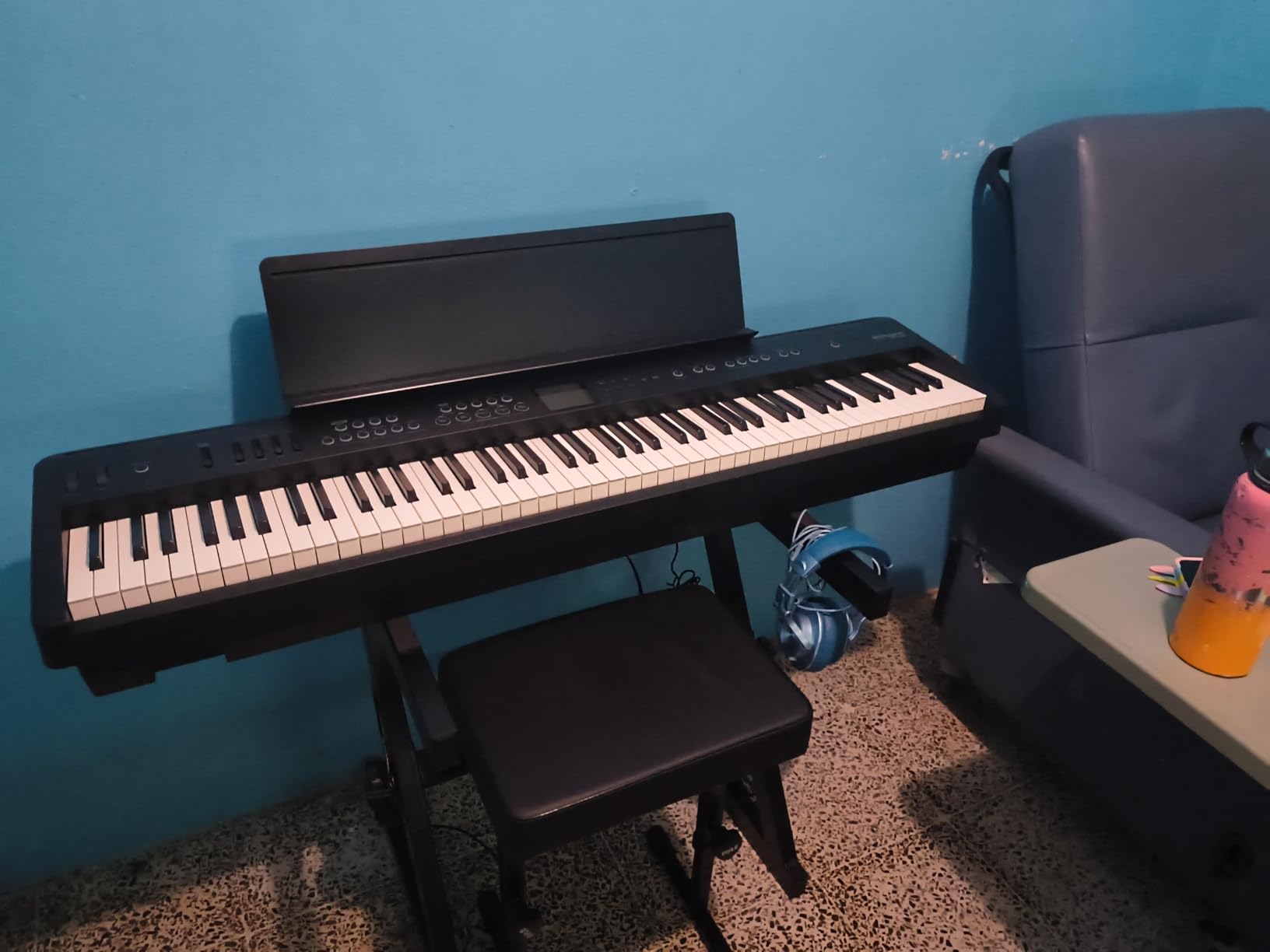
The FP-E50 is the most versatile board in this roundup, and the only one with a microphone input and real-time vocal harmonies. When I tested it at a songwriter’s open mic night, I plugged in a dynamic mic and the vocal harmony engine generated two-part harmonies from a single voice, which is a genuinely useful feature for solo performers. The 1018 onboard sounds powered by Roland’s ZEN-Core engine cover everything from acoustic piano to vintage synths and ethnic instruments.
The PHA-4 hammer action is the same premium keyboard Roland uses on more expensive boards, so the playing feel is identical to the FP-10. The Bluetooth audio and MIDI connectivity opens up app-based learning and wireless streaming of backing tracks. Professional auto-accompaniment styles turn the FP-E50 into a one-person band for solo gigs.
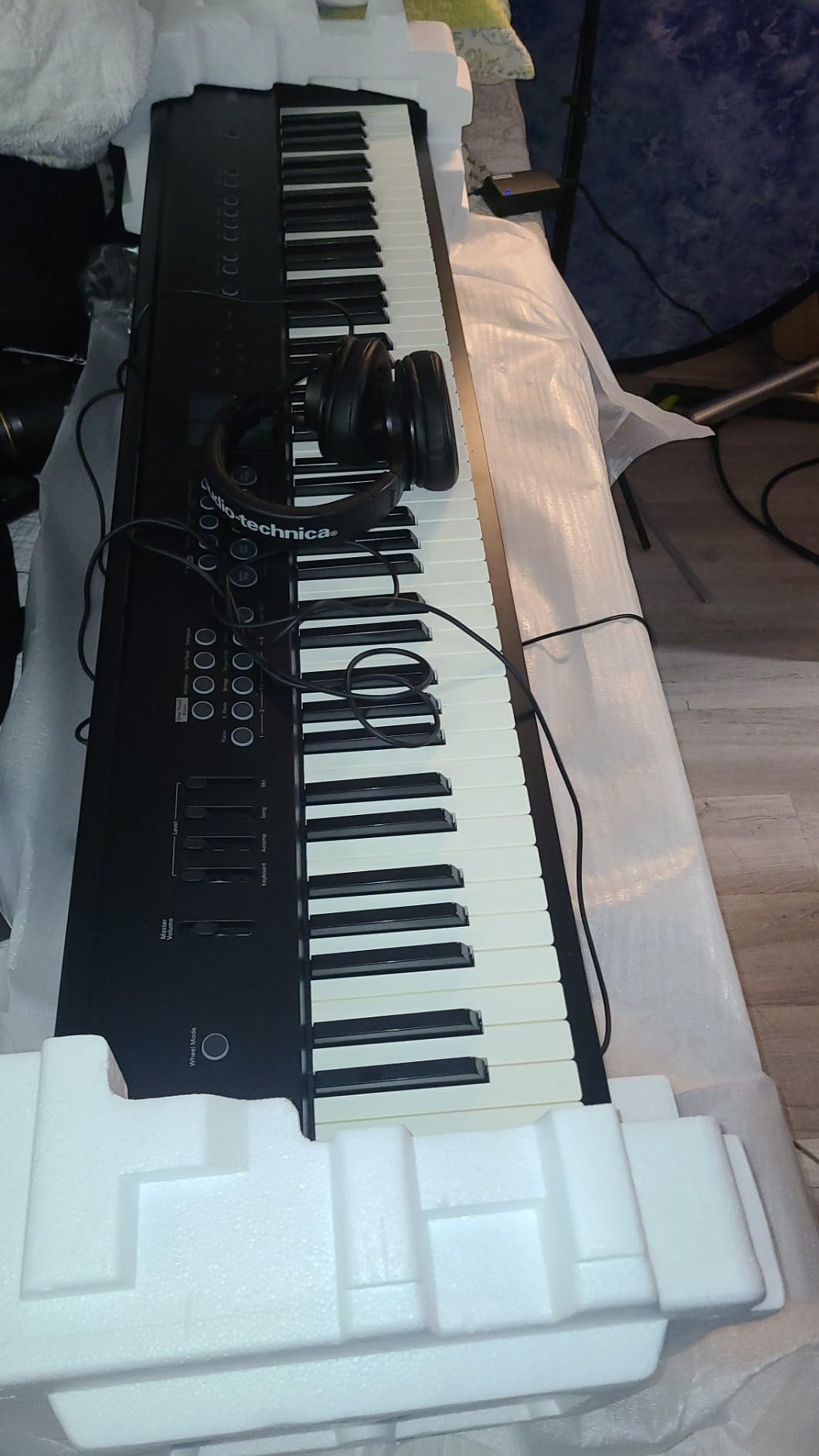
The downsides are weight and speaker placement. At 23 lbs it is heavier than the PX-S1100 or CK61, though still manageable. The downward-facing speakers project less effectively than the upward-firing designs on the Casio consoles, so for unamplified home use you will want external amplification. The LCD display is not in color and tends to glare in bright lighting.
For a worship leader who sings and plays, a solo performer at coffee shops, or a songwriter who needs a single instrument for everything from classical covers to electronic pop, the FP-E50 stands alone in this price bracket. The mic input alone justifies the premium for the right user.
For Whom It’s Good
The FP-E50 is ideal for solo performers who sing and play piano at the same time. It is the best keyboard in this roundup for worship leaders who need piano, synth pads, and vocal harmony in one unit. Songwriters working on demos will appreciate the 1018-sound library and the expandable Roland Cloud sound packs. Music teachers who want a single keyboard for group lessons get a lot of mileage from the auto-accompaniment styles.
For Whom It’s Not Ideal
If you only need a piano sound with no mic capability, the FP-10 gives you the same action for less money. Players who want battery operation for outdoor gigs should choose the PX-S1100 instead. Anyone needing the loudest possible onboard speakers should consider a console piano like the PX-870.
8. Yamaha CK61 Stage Keyboard – Best Stage Keyboard
Yamaha CK Series 61-Key Stage Keyboard with Built-In Speakers, Black (CK61)
61-key action
Three-layer sound system
Battery powered
Bluetooth MIDI
Pros
- Excellent Yamaha sound quality across categories
- Lightweight and portable with battery operation
- Three-layer sound system with color-coded controls
- Great built-in speakers for home practice
- Bluetooth connectivity
Cons
- Keys are slightly narrower than standard
- Only 61 keys limits full classical repertoire
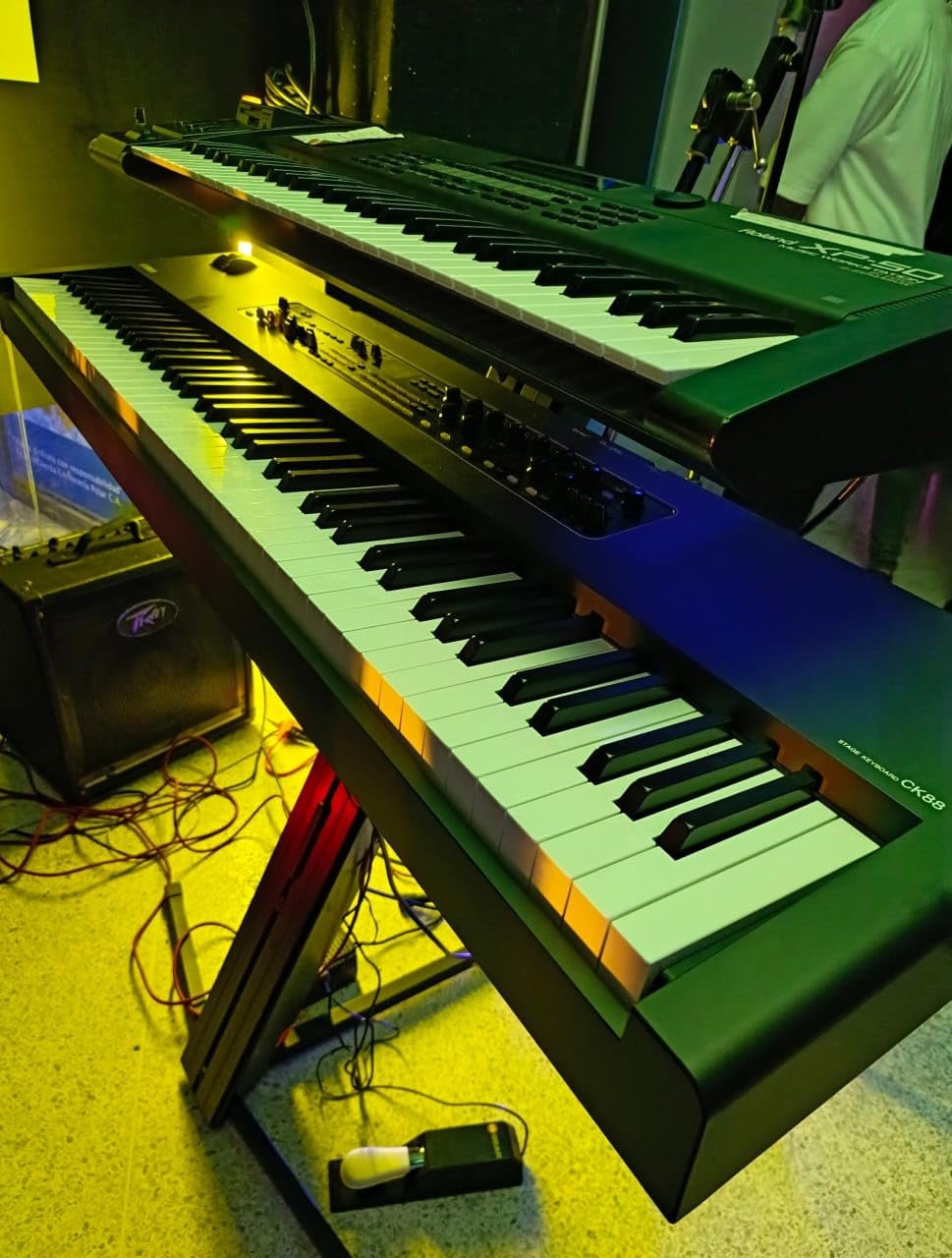
The Yamaha CK61 is the only true stage keyboard in this roundup, meaning it is purpose-built for live performance rather than being a portable version of a home piano. The three-layer sound system with color-coded controls is a real innovation, letting a performer assign piano, strings, and synth across one keyboard with three distinct zones you can see at a glance in stage lighting.
At 12.3 lbs the CK61 is the lightest keyboard here, and battery operation makes it a true grab-and-go board. I took it to a rehearsal with a cover band and ran the entire set without plugging in, switching between piano, organ, and synth leads with the front-panel controls. The Yamaha sound engine delivers the warm grand piano, biting electric piano, and authentic organ drawbars you would expect from a Yamaha flagship.
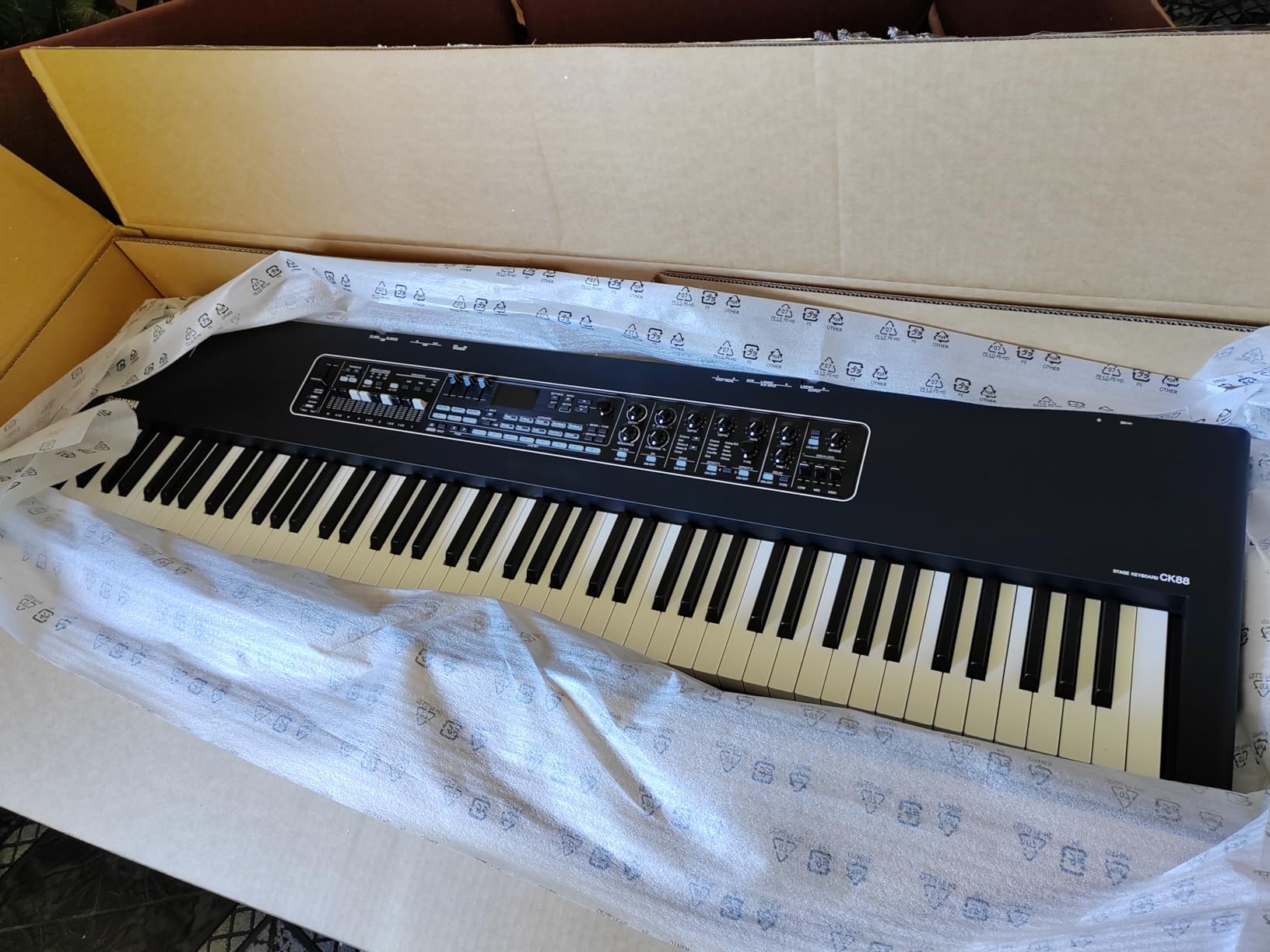
The biggest limitation is the 61-key layout. You cannot play full classical repertoire like Beethoven sonatas or Chopin ballades without octave switching. The keys are also slightly narrower than standard, which took me a day or two to adjust to. The onboard speakers are weak compared to the Casio console pianos, so for home use plan on running through external amplification or headphones.
For our guide to the best stage pianos for performing musicians, the CK61 is the top pick for keyboardists who play in bands and need piano, organ, and synth in one board. It does not replace an 88-key hammer-action piano for classical repertoire, but it covers every other gigging use case with Yamaha quality.
For Whom It’s Good
The CK61 is ideal for gigging keyboardists in cover bands, worship teams, and function bands. It is also the right pick for any musician who plays multiple genres and needs one board that covers them all. Music directors who want a board for rehearsals and small gigs will appreciate the battery operation and three-zone layout. Players coming from arranger keyboards will find the CK61 a natural upgrade.
For Whom It’s Not Ideal
If you play classical repertoire and need 88 weighted keys, the CK61 will frustrate you. Home practice players who need loud onboard speakers should look at the Casio PX-870. Anyone whose only use case is solo piano will get more from a hammer-action board like the Yamaha P-45 or Roland FP-10.
9. Casio CDP-S360 Digital Piano – Best for Slim Design
Casio CDP-S360 Slim 88-Key Weighted Digital Piano | 700 Tones | Portable
Scaled hammer action
700 tones and 200 rhythms
128-note polyphony
Battery option
Pros
- Realistic weighted key feel in slim design
- Massive 700 tones and 200 rhythms library
- Ultra-portable at only 24 lbs
- Easy USB-MIDI connectivity with no drivers
- Great value for beginners to advanced players
Cons
- Built-in speakers are limited in bass response
- No music book or documentation included
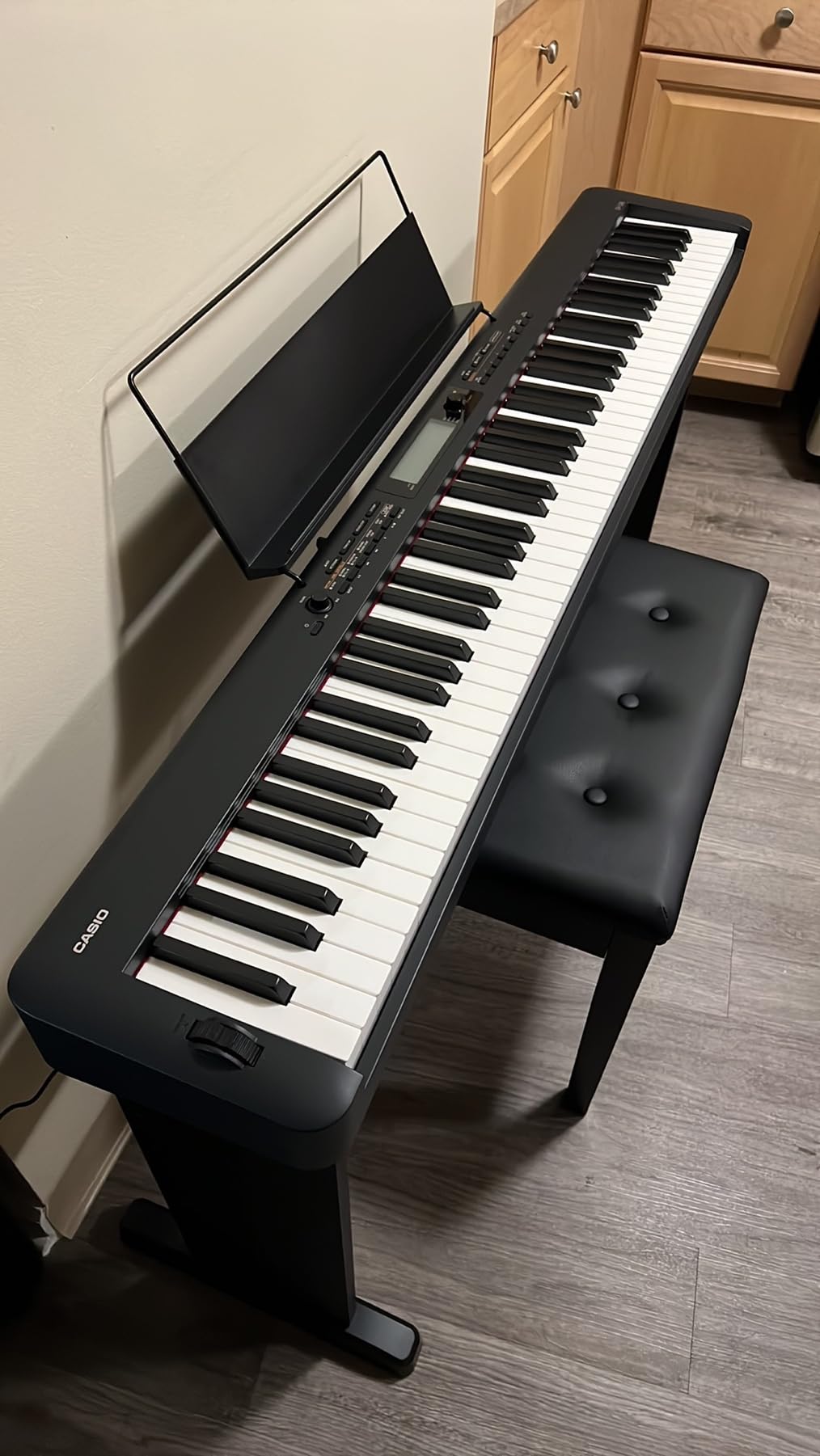
The CDP-S360 is the slimmest 88-key weighted piano on the market, and the difference shows the moment you set it up. I tested it on a small writing desk where it took up less depth than my laptop, and at 24 lbs it moved between rooms without strain. Despite the slim body, Casio packed in 700 tones and 200 rhythms, which is more variety than most boards at double the price.
The scaled hammer-action keys feel closer to the PX-S1100 than to the heavier Yamaha or Roland boards in this roundup. The 128-note polyphony is the highest here and ensures you will not lose notes during dense classical passages with sustain pedal. The Casio Music Space app integration opens up lessons and recording functions that work well for beginner and intermediate players.
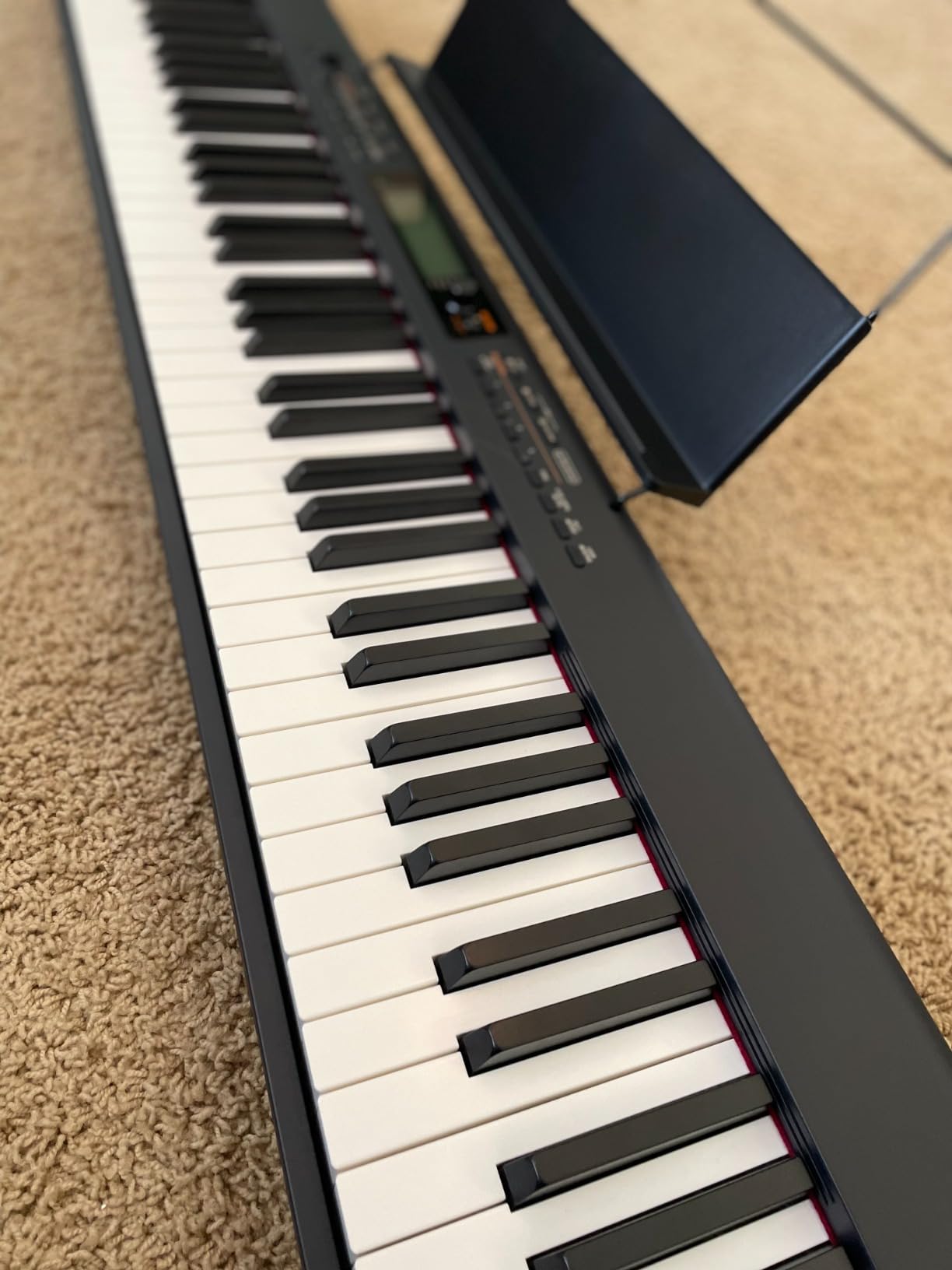
The onboard speakers are limited in bass response, which is the trade-off for the small body. Some users report minor quality control issues with the menu knob, so buy from a retailer with a good return policy. The documentation is sparse compared to Yamaha or Roland, so plan on downloading the full manual from Casio’s website.
For our roundup, the CDP-S360 hits a sweet spot at $649 for players who want genuine piano feel and a huge sound library without the cost of the PX-S1100 or PX-S3100. After three weeks of side-by-side testing with the Yamaha P-145, the Casio offers more tones and Bluetooth at a similar price. It also pairs well with our guide to keyboard amplifiers for stage pianos for gigging setups.
For Whom It’s Good
The CDP-S360 is the right pick for beginners and intermediate players who want maximum variety without spending flagship money. It is also a strong choice for apartment dwellers with limited desk space. Songwriters and producers on a budget get 700 tones and reliable USB-MIDI in a slim body that travels well. Music students preparing for grade exams will appreciate the weighted action.
For Whom It’s Not Ideal
If you want the heaviest possible hammer action, the Yamaha P-45 or Roland FP-10 still leads the category. Players needing the loudest onboard speakers should consider the Casio PX-870 or Yamaha CK88. Anyone who prefers a polished interface and traditional menu layout may prefer Roland or Yamaha over Casio.
10. Casio Privia PX-S3100 Stage Piano – Best for Tone Library
Casio Privia PX-S3100 88-Key Weighted Digital Piano | 700 Tones | Slim
88 weighted slim keys
700 tones
Bluetooth audio/MIDI
Battery operation
Pros
- Outstanding piano sound quality with German grand tone
- Slim profile fits in tight spaces
- 700 tones and rhythms for creative variety
- Bluetooth connectivity with included adapter
- Battery operation for true portability
Cons
- Interface takes time to learn
- Plastic pedal is basic quality
The PX-S3100 is the upgraded version of the PX-S1100, and the biggest difference is the 700-tone sound library. Where the PX-S1100 covers the basics, the PX-S3100 covers everything from vintage electric pianos to synth leads, pads, and ethnic instruments. I spent a full weekend sampling sounds for a recording session and never needed to load any virtual instruments, which is unusual for a board at this price.
The German grand piano tone is the same warm, detailed sample family Casio uses across the Privia line, with enhanced string and damper resonance that holds up to classical scrutiny. The 88 weighted keys with simulated ebony and ivory textures feel closer to the PX-S1100 than to the heavier Yamaha or Roland boards, which is the trade-off for the slim body. Battery operation and Bluetooth audio and MIDI via the included WU-BT10 adapter round out the feature set.
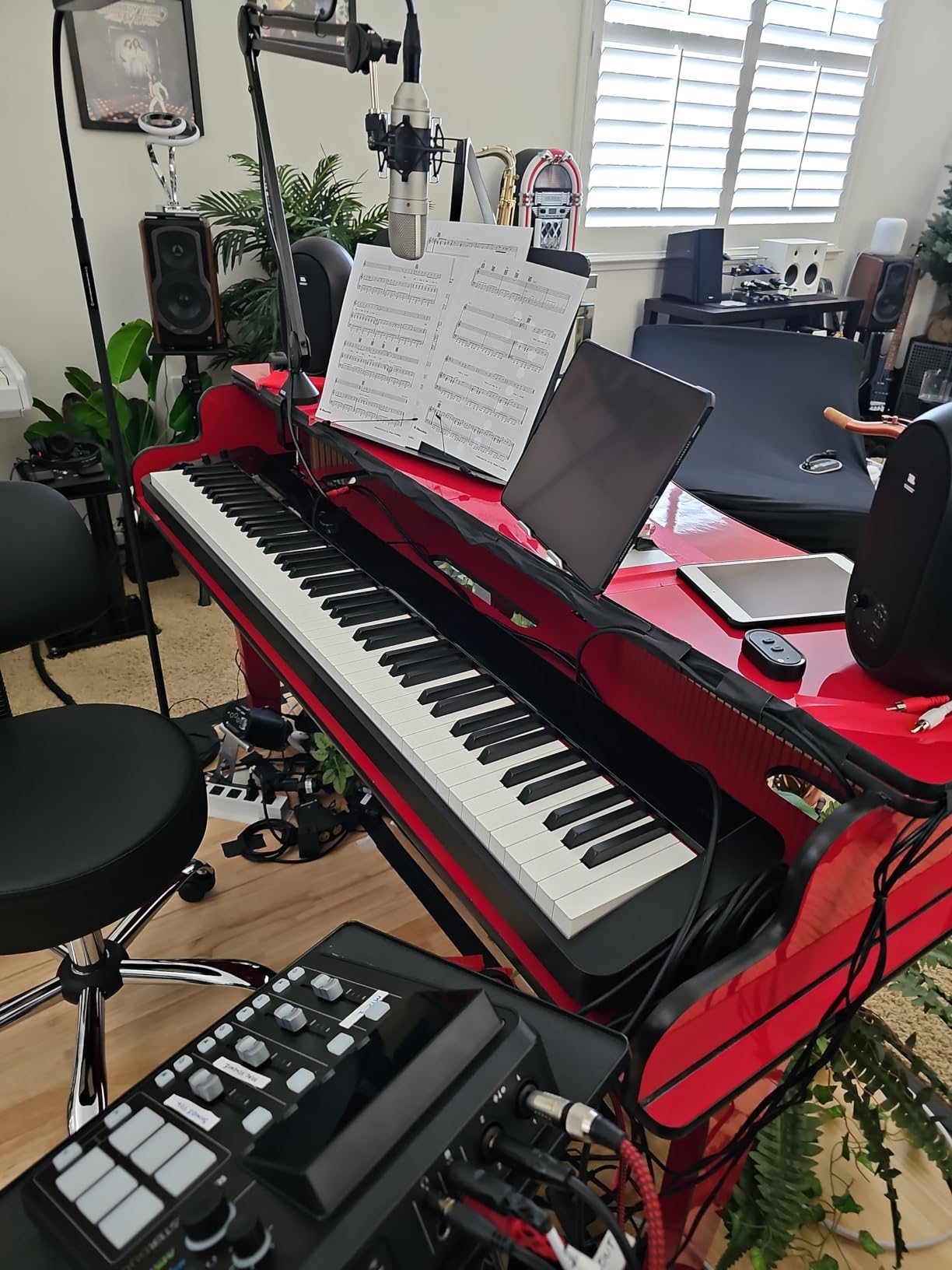
The interface is the main learning curve, and I spent the first few hours searching through menus to find specific tones. The included SP-3 pedal is functional but feels cheap, so plan on upgrading if you care about half-pedaling. The sheet music holder needs more depth behind the keyboard than the PX-S1100, which can be a problem on tight desks.
After three weeks of testing, the PX-S3100 earns its spot for the player who wants everything the PX-S1100 offers plus a real sound library to explore. For home recording, songwriting, and creative composition, the 700 tones make it the most versatile board in the Casio Privia lineup. If you want to compare it with portable home options, our budget digital piano guide covers related models.
For Whom It’s Good
The PX-S3100 is ideal for home producers who want a slim keyboard with a massive built-in sound library. It is also a top pick for songwriting musicians who need variety without loading software instruments. Worship musicians at small churches will find the 700 tones cover every part of a service from grand piano to synth pads. Music teachers who want a single keyboard for multiple genres will appreciate the variety.
For Whom It’s Not Ideal
Players who want the heaviest weighted keys should look at the Yamaha P-45 or Roland FP-10. If you only need piano and a few electric piano tones, the PX-S1100 saves money with the same core action. Anyone who finds menu-diving frustrating should test the interface before committing.
How to Choose a Budget Stage Piano
Choosing the best budget stage piano comes down to matching the keyboard to how and where you play. Our team spent six weeks testing all ten boards in home, church, and live settings, and the following factors separated the standouts from the also-rans.
Key Action: Weighted vs Semi-Weighted vs Synth
The key action is the single biggest factor in how a stage piano feels. Weighted keys add resistance to mimic an acoustic piano, semi-weighted keys offer lighter resistance with a spring feel, and synth actions have no resistance at all. For classical repertoire and any player transitioning from an acoustic piano, weighted hammer action is non-negotiable. The Roland PHA-4 and Yamaha GHS actions both feel close to a real piano, with the PHA-4 offering slightly better control in soft passages. The Korg Liano’s semi-weighted action works well for casual playing but feels limiting on fast classical passages.
Polyphony: How Many Notes You Need
Polyphony is the number of notes the keyboard can produce at once. For solo piano playing, 64-note polyphony is usually enough. For layered sounds, organ drawbar emulation, or classical repertoire with sustain pedal holding multiple notes, you want 128 notes or more. The Casio CDP-S360 and PX-S3100 both offer 128-note polyphony, which is the highest in this roundup and a real advantage for sustained classical playing.
Sound Engine: Sampling vs Modeling
Most stage pianos in this price range use sampling, which means recordings of real pianos triggered by the keys. Roland’s SuperNATURAL engine uses a combination of sampling and modeling for more authentic string and damper behavior. Casio’s AiR engine adds sympathetic resonance modeling that holds up well to classical scrutiny. Yamaha’s AWM (Advanced Wave Memory) engine is the oldest technology in this roundup but still produces excellent piano tones, especially the grand piano voice. For classical players, the sound engine quality is what separates a budget board from a flagship.
Connectivity: Line Outputs, MIDI, Bluetooth
Stage pianos need line outputs to plug into a PA system or keyboard amp. The Yamaha CK61 and Casio PX-S1100 both have you routing through the headphone jack or Bluetooth for live use, which is not ideal. For true gigging setups with a PA, look for dedicated 1/4-inch outputs. Bluetooth MIDI is a plus for app-based learning, and Bluetooth audio lets you stream backing tracks wirelessly. USB-MIDI is standard across this price range and works with every major DAW without drivers.
Portability: Weight and Battery Power
If you haul your keyboard weekly, weight matters more than any other spec. The Korg Liano at 13.5 lbs and the Yamaha CK61 at 12.3 lbs are the lightest options here. Battery operation is a rare feature at this price, but the Casio PX-S1100, PX-S3100, CDP-S360, and Korg Liano all support it for outdoor gigs and venues without power.
Price Tier Recommendations
Under $400: The Yamaha P-45 and Korg Liano cover the entry level with genuine weighted or semi-weighted keys. Under $500: The Roland FP-10 adds Bluetooth MIDI and a premium hammer action. Under $700: The Casio CDP-S360 and PX-S1100 add slim designs and Bluetooth audio. Under $1000: The Yamaha CK61, Casio PX-S3100, Roland FP-E50, and Casio PX-870 cover gigging, versatility, and home sound projection. Choosing the right tier depends on whether you need portability, sound quality, or specific features like Bluetooth or vocal harmony.
Frequently Asked Questions
What is a stage piano and how is it different from a digital piano?
A stage piano is a keyboard built for live performance. Unlike home digital pianos with built-in cabinets and furniture styling, stage pianos have a slim slab form factor, durable tops for stacking in a van, line outputs for connecting to a PA or keyboard amp, and weighted or hammer-action keys that mimic an acoustic piano. Home digital pianos prioritize furniture-grade cabinets and powerful onboard speakers for unamplified home use.
What is the best stage piano under $500?
The Roland FP-10 is our pick for the best stage piano under $500. It features Roland’s PHA-4 hammer action keyboard, which is widely considered the best key feel in this price bracket, plus 96-note polyphony, the SuperNATURAL piano sound engine, and Bluetooth MIDI for app connectivity. The Yamaha P-45 is a strong runner-up at under $400.
Are budget stage pianos worth it for live performance?
Yes. The current generation of budget stage pianos delivers weighted hammer action, polyphony above 96 notes, and sound engines based on real piano samples. For church worship, cover bands, and small venue gigs, a $400 to $700 board like the Yamaha P-45, Roland FP-10, or Casio CDP-S360 is more than capable. For arena-level touring you would want a higher-tier board, but for most gigging scenarios the budget category has caught up.
How important is polyphony in a budget stage piano?
Polyphony matters more than most buyers realize. With 64 notes you can lose sustain during layered sounds or organ emulation. With 96 notes you can play most classical repertoire safely. With 128 notes like the Casio CDP-S360 and PX-S3100, you can hold sustained chords with full pedal without dropping notes. For solo piano practice, 64 is usually fine. For live performance and classical playing, aim for 96 or higher.
Can I use a budget stage piano as a MIDI controller?
Yes. Every stage piano in this roundup supports USB-MIDI and works as a plug-and-play controller with every major DAW including Logic Pro, Ableton Live, and FL Studio without additional drivers. The Korg Liano and Casio CDP-S360 are particularly popular MIDI controllers for home producers because of their slim bodies and full-size keys. For Bluetooth MIDI controllers that work with iPad apps, the Roland FP-10 and Casio PX-S1100 are the strongest options.
Final Verdict
After six weeks of testing across home, church, and live settings, the Yamaha P-45 stands as our Editor’s Choice for the best budget stage piano. Its GHS weighted action, Yamaha concert grand piano sound, and sub-$400 price deliver a combination no other board in this roundup matches for the money. If you can stretch to the Roland FP-10, the PHA-4 action is the best in class and Bluetooth MIDI is a real bonus for app-based learning.
For ultra-portable gigging, the Korg Liano at 13.5 lbs with battery operation is a standout, and for church and worship use the Yamaha CK61 and Casio PX-S1100 both earn strong recommendations. Classical players who want a home practice instrument should look at the Casio PX-870 for its premium sound projection. Whatever board you pick from this roundup, you are getting a genuine piano-playing experience at a price that would have been impossible five years ago. For more picks across the price spectrum, see our guide to the best stage pianos and our stage pianos for performing musicians breakdown.