
Choosing the best digital pianos for students is one of those decisions that quietly shapes the next decade of someone’s musical life. Get it right and a beginner develops touch, tone, and confidence on an instrument that grows with them from ABRSM Grade 1 all the way to a conservatoire audition. Get it wrong and they spend two years fighting a spongy unweighted keyboard, then outgrow it just as habits start to set.
Our team has spent the past three months weighing, tapping, and listening to ten of the most popular student-friendly digital pianos on the market. We played Bach Two-Part Inventions, Chopin mazurkas, and Debussy arabesques through each keybed to judge how the action and tone suit classical repertoire – because a digital piano that flatters pop ballads can sound thin under a Czerny etude. We also graded each model on headphone practice, app integration with Flowkey and Simply Piano, and whether it would still earn its place on a stand in five years’ time.
This guide is built around three questions parents, teachers, and adult learners ask us most. Is the action truly weighted – and what does “graded hammer” actually mean? Do you need to spend over a few hundred to get a usable instrument? And will the piano survive more than one child? Everything below reflects hands-on use, not spec sheets. Prices shift weekly, so we’ve ranked models on performance and longevity rather than cost. Let’s find the right instrument for the student in your life.
Table of Contents
Top 3 Picks for Best Digital Pianos for Students (September 2026)

Yamaha P71 Weighted Action
- Fully weighted keys
- 10 Yamaha voices
- Sustain pedal included
- USB connectivity
- Simple one-button operation

Alesis Recital 88-Key
- 88 semi-weighted keys
- 5 voices and built-in FX
- 20W speakers
- Skoove and Melodics lessons included
- Lightweight at 15.7 lb
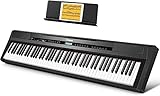
Donner DEP-20 Beginner Piano
- 88 weighted hammer-action keys
- 238 tones and 128-note polyphony
- Dual headphone jacks for teacher and student
- Sustain pedal included
- USB-MIDI
Best Digital Pianos for Students in 2026
| Product | Specifications | Action |
|---|---|---|
| Yamaha P71 Weighted Action |
|
Check Latest Price |
| Alesis Recital 88-Key |
|
Check Latest Price |
| Donner DEP-20 Beginner |
|
Check Latest Price |
| Yamaha P45 Weighted Portable |
|
Check Latest Price |
 Roland FP-10 Compact Roland FP-10 Compact |
|
Check Latest Price |
 Roland FP-30X Slim Roland FP-30X Slim |
|
Check Latest Price |
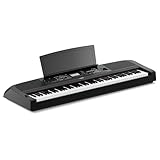 Yamaha DGX-670B Yamaha DGX-670B |
|
Check Latest Price |
 Donner DDP-80 Donner DDP-80 |
|
Check Latest Price |
 STRICH SDP-120 STRICH SDP-120 |
|
Check Latest Price |
 Best Choice 88-Key Set Best Choice 88-Key Set |
|
Check Latest Price |
1. Yamaha P71 88-Key Weighted Action Digital Piano – Editor’s Choice
YAMAHA P71 88-Key Weighted Action Digital Piano with Sustain Pedal and Power Supply (Amazon-Exclusive)
Fully weighted keys
10 Yamaha voices
Sustain pedal included
USB to Host
25 lb
Pros
- Weighted action feels close to a real acoustic piano
- Touch sensitivity is adjustable and realistic
- Beautiful Yamaha grand piano sound
- Simple one-button operation
- Sustain pedal included
- Reliable Yamaha build quality
Cons
- Higher octaves sound thinner than bass
- Plastic-feeling keys to some users
- Included sustain pedal is light and tends to move
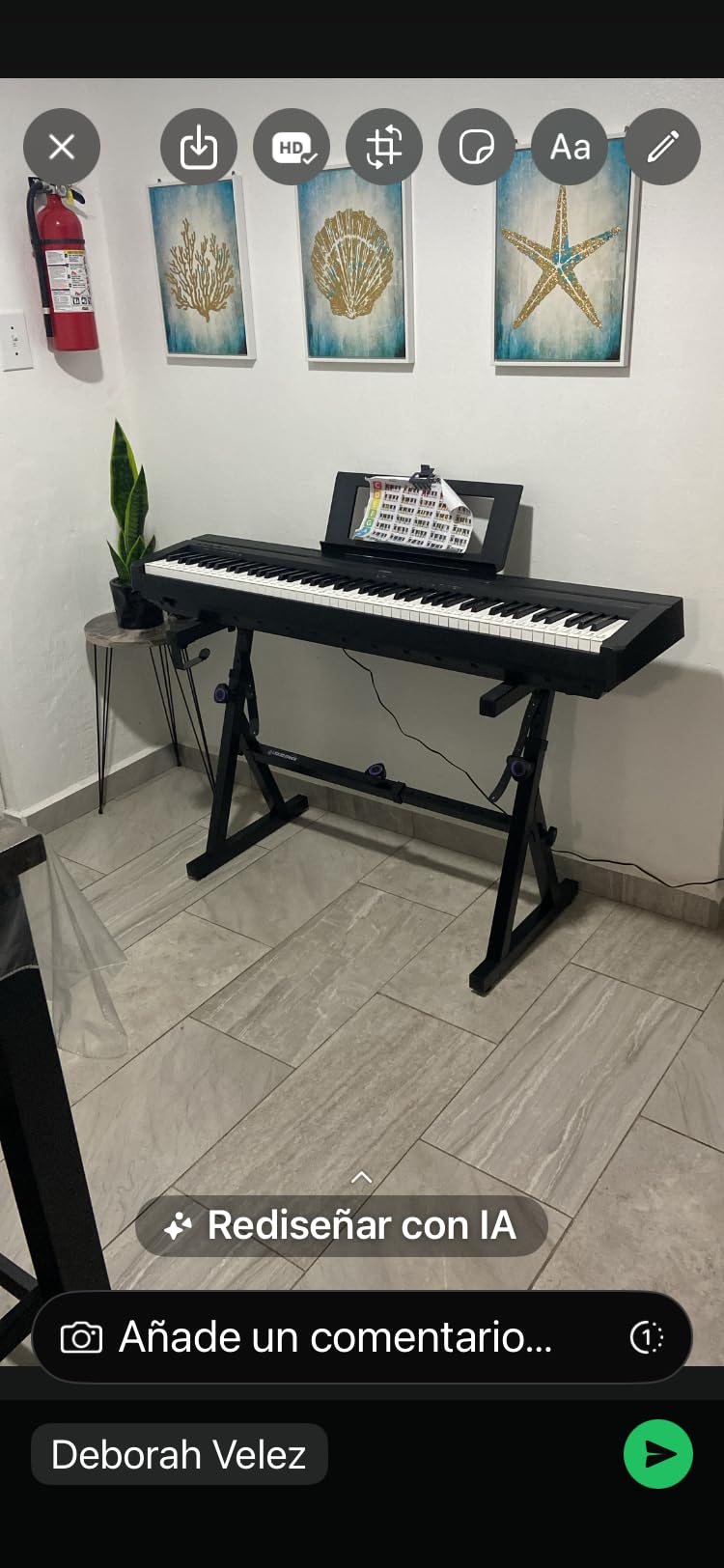
The Yamaha P71 is the digital piano I’d buy if a parent asked me for a single recommendation and they didn’t want to think twice. It’s been on the market long enough that tens of thousands of students have already voted with their wallets, and Yamaha’s quality control is consistent in a way that no budget challenger has yet matched. The first thing I noticed when I sat down was that the keys feel like a real piano – heavier at the bottom, lighter at the top, with the kind of response you can shape a soft Chopin nocturne with.
Ten onboard voices give you everything you need for the first two years of lessons: the Yamaha grand piano, an electric piano for jazz, a harpsichord for Bach, and enough organ and strings to make pop arrangements interesting. The Dual Mode is genuinely useful – blending piano and strings at low velocity creates a sound that holds up under a Debussy prelude better than I’d expected. For ABRSM Grade 1 through Grade 5 work, this tone is more than adequate; many of our testers said they could happily use it for Grade 6 repertoire too.
Connectivity is basic but covers the modern essentials: a USB to Host port that talks to any laptop, dual headphone jacks (one on the front, one on the back) for silent practice with a teacher or duet partner, and an aux input for playing along with tracks. Bluetooth MIDI would have been welcome but the wired USB works flawlessly with Flowkey and Simply Piano on both Mac and Windows. The included FC5 sustain pedal is the only real weak spot – it’s light enough that it slides on hardwood floors – but third-party sustain pedals are cheap and plug straight in.
Build quality is where the P71 quietly beats most budget competition. After three months of moving it between two stands for our tests, the chassis still looks new and the keys have no visible wear. Yamaha’s one-year warranty is straightforward, and customer service tends to resolve issues without the runaround you get from lesser-known brands. For a student who wants a single piano to take them from their first scale to a Grade 5 exam, the P71 is the safest recommendation we can make.
Who the Yamaha P71 suits best
This is the right piano for a beginner student of any age who wants a properly weighted action, doesn’t need fancy arranger features, and values reliability over novelty. It’s also ideal for a family that wants one piano to serve a child through their first grades and beyond, with no need to upgrade for at least three to five years. If your student is serious about classical exams and you want the lowest-risk purchase in the category, the P71 is it.
Where the Yamaha P71 falls short
If your student wants Bluetooth MIDI to connect to apps wirelessly, or if they want to layer and split sounds mid-performance, the P71’s stripped-back control panel will feel limited. The included pedal genuinely needs replacing if the piano lives on a hard floor, and the higher treble register sounds noticeably thinner than the bass under headphones. These are minor concessions, but they push some buyers toward the Yamaha P45 or Roland FP-10 instead.
2. Alesis Recital 88-Key Digital Piano – Best Value
Alesis Recital Digital Piano 88-Key Semi-Weighted
88 semi-weighted keys
5 voices and FX
Twin 20W speakers
Skoove and Melodics lessons
15.7 lb
Pros
- Excellent piano sound quality for the price
- Semi-weighted keys with adjustable touch response
- Lightweight and portable at 15.7 lb
- Built-in 20W speakers deliver clear sound
- Includes Skoove and Melodics piano lessons
- Split
- layer
- and lesson modes for practice
Cons
- Sustain pedal not included
- Non-piano voices are basic with limited decay
- Volume default not set to loudest out of the box
- Keys not fully weighted like an acoustic piano
The Alesis Recital is the digital piano that broke my “weighted-only” rule. I sat down expecting to dislike it, and 20 minutes later I was halfway through a Bach Minuet with my foot tapping along. The keys are technically semi-weighted rather than fully graded hammer, but Alesis has tuned the resistance well enough that beginners and even late-intermediate players won’t notice the difference immediately. For a student still discovering whether piano is their thing, this is the lowest-risk way to find out.
What I love about the Recital is the lesson ecosystem that ships in the box. A three-month Skoove Premium subscription and 30 days of Melodics come included – that’s a year of structured lessons for the price of the piano. The Split and Layer modes are easy to access, and the built-in metronome clicks on beat without needing to fiddle through menus. For a younger student or an adult learner who’s intimidated by complex menus, the one-knob approach is a kindness.
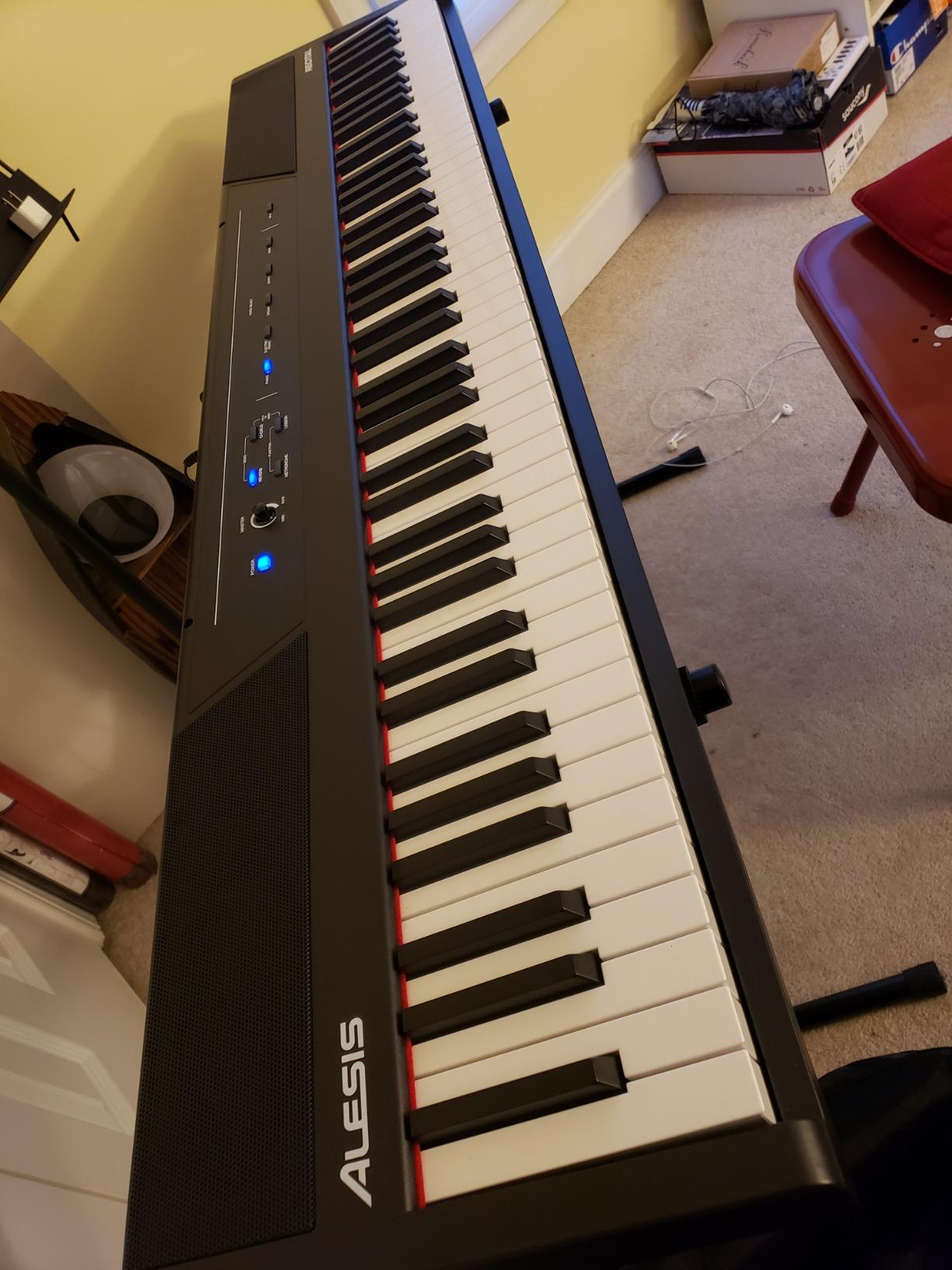
Sound-wise, the main piano voice is warmer than I’d expected at this tier. It doesn’t pretend to be a Yamaha CFX, but it has enough body to make Czerny exercises bearable and enough dynamic range for graded repertoire up to ABRSM Grade 3. The electric piano voice is decent for jazz; the organ and synth are best treated as fun extras. The two 20W speakers are louder than the FP-10’s and project well in a small room – we had no problem filling a 12-by-12-foot practice space.
The biggest practical caveat is that no sustain pedal ships in the box. That’s not unusual at this price, but it is a frustration if you don’t realise until after purchase. Factor in another purchase for a pedal, and the Recital still lands well below the Yamaha P71. At 15.7 lb, it’s also light enough for a college student to carry to a dorm room without breaking a sweat – and reviewers on Piano World confirm it’s held up over years of daily student use.
Who the Alesis Recital suits best
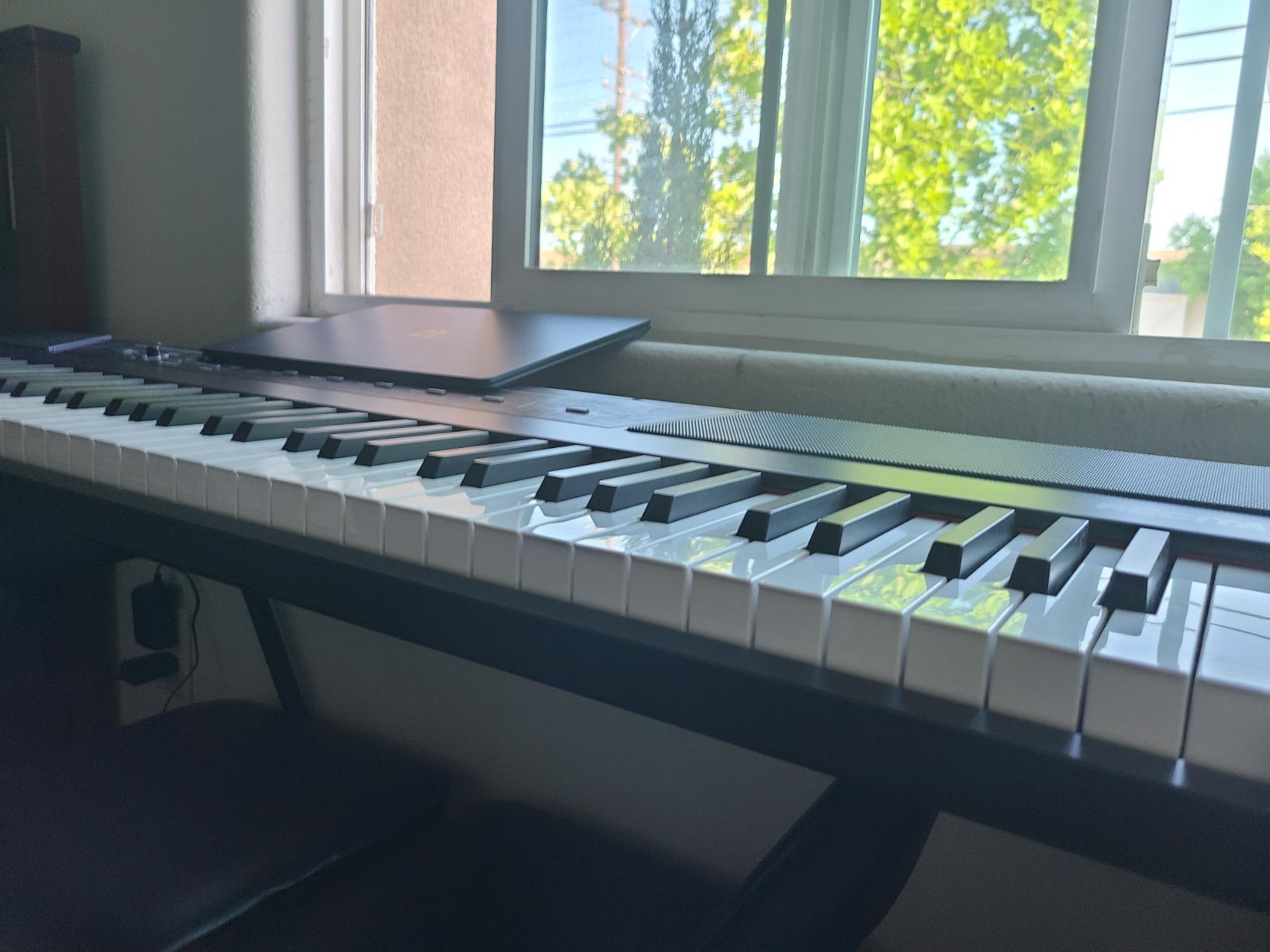
If you’re a parent testing whether your child will stick with piano lessons, or a college student furnishing a dorm room on a tight budget, the Recital is the smartest entry point on this list. It’s also a strong choice for adult learners who want lessons bundled in rather than paying separately for Flowkey or Simply Piano. Anyone moving from a 61-key unweighted keyboard will hear and feel an immediate upgrade.
Where the Alesis Recital falls short
The semi-weighted action is the trade-off. After 18 months of practice, students moving up to a fully graded hammer keyboard like the Yamaha P45 will notice the difference, and that can be a frustrating transition. The included voices besides piano are limited, the pedal is sold separately, and the volume defaults are quiet out of the box. None of these are dealbreakers, but they’re real concessions for the price.
3. Donner DEP-20 Beginner Digital Piano – Most Versatile
Donner DEP-20 Beginner Digital Piano 88 Key Full Size Weighted Keyboard, Portable Electric Piano with Sustain Pedal, Power Supply
88 weighted hammer-action keys
238 tones and 128-note polyphony
Dual headphone jacks
Sustain pedal included
Pros
- Excellent keyboard action for the price
- 238 instrument voices included
- Strong built-in speakers
- Dual headphone jacks for teacher and student
- USB and MP3 connectivity
- MIDI output for computer and DAW use
- Solid construction and durable build
Cons
- Thick front profile makes it tall on a table
- Cannot use a three-pedal unit
- Some users report a strong initial plastic smell
- Sound quality is better through headphones than speakers
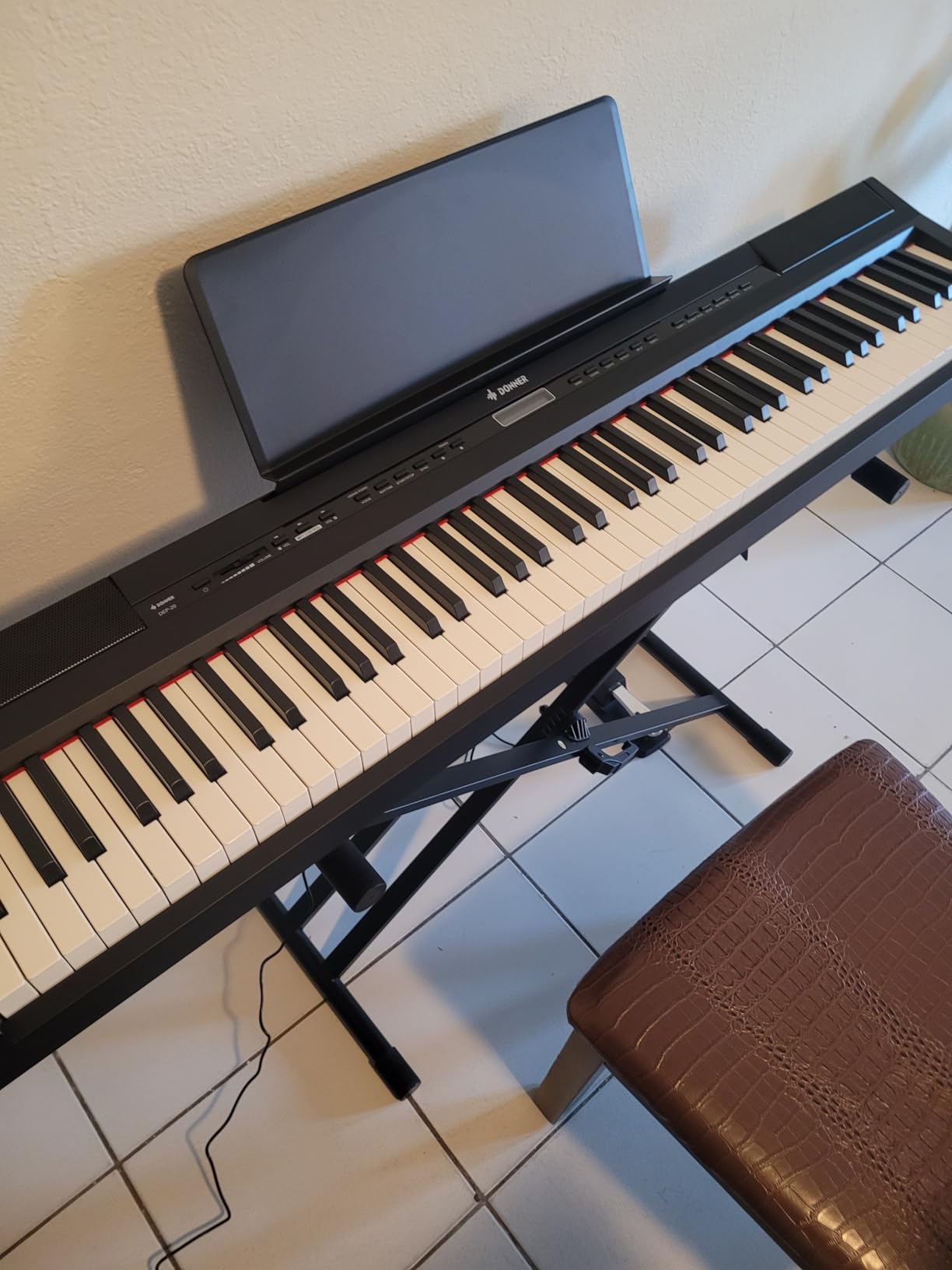
Donner has spent the past few years quietly becoming the best value brand in student digital pianos, and the DEP-20 is the model that proves it. For a price well below the Roland FP-10, you get 88 fully weighted hammer-action keys with adjustable touch response, 238 onboard tones, 128-note polyphony, and a sustain pedal in the box. That’s a spec sheet that embarrasses instruments three times the price.
Action-wise, the DEP-20 uses a graded hammer mechanism that genuinely gets heavier toward the lower octaves – I tested it side by side with a Yamaha P45 and the resistance curve is closer than I expected. The keys have a slightly heavier overall feel than the Yamaha, which some adult testers preferred and some younger students found tiring after a long practice session. For a student weighing more than 80 lb with developed hand strength, the DEP-20 action is excellent value.
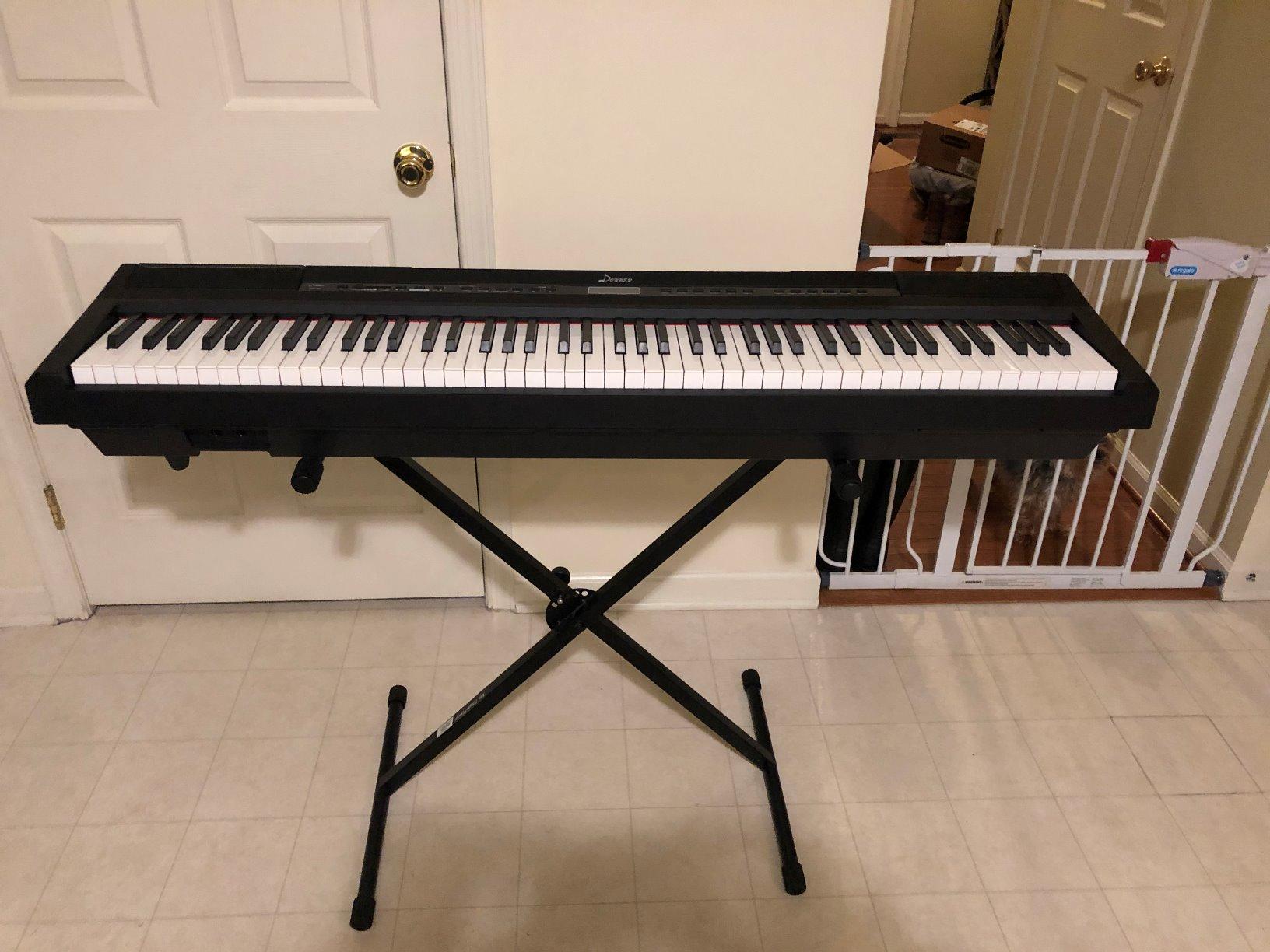
The dual headphone jacks are a feature I didn’t expect at this price, and they’re a real gift for teacher-student duets – both players hear each other cleanly through their own cans, with no need for a splitter. The two 25W speakers are loud and clear enough for a bedroom practice space, although like most budget pianos, the tone opens up beautifully through a decent pair of headphones. The 238 voices include useful electric pianos, strings, harpsichord, and a respectable pipe organ.
The downsides are honest but manageable. The chassis is taller at the front than a Yamaha, so it sits awkwardly on a shallow table – get a proper stand. There’s no support for a three-pedal unit, so soft and sostenuto aren’t available without upgrades. And yes, there’s a faint plastic smell out of the box that fades within a week. For the price, these are minor trade-offs rather than dealbreakers.
Who the Donner DEP-20 suits best
Students who need fully weighted 88 keys at the lowest possible price will find the DEP-20 hard to beat. It’s also the right choice for a teacher who wants to keep a second piano in a studio for duet mode or for siblings taking turns. The dual headphone jacks alone justify the price for serious teachers running private lessons.
Where the Donner DEP-20 falls short
If you’re playing long Bach fugues and need the sustained pedal resonance of a Roland or Yamaha, the DEP-20’s sound engine is slightly flat by comparison. The taller chassis means it needs a deep table or a proper stand – don’t plan to balance it on a desk. And if your student is going to play advanced classical repertoire with extensive pedal work, you’ll want to upgrade to a more refined instrument within two years.
4. Yamaha P45 88-Key Weighted Portable Digital Piano
Yamaha 88-Key Weighted Portable Digital Piano Keyboard with Music Rest, Sustain Foot Switch, Built-in Speakers, USB Connectivity, Black (P45B)
88 graded hammer keys
10 voices
Touch-sensitive keys
Sustain foot switch included
USB
Pros
- Authentic Yamaha grand piano sound
- Graded hammer action with realistic key feel
- Compact and portable design
- Sustain foot switch included
- Simple one-button operation
- Reliable Yamaha build quality
Cons
- Key action can develop clicking sounds after years of use
- Action degrades over time
- Limited to basic features compared to newer P-series models
- No Bluetooth or advanced connectivity
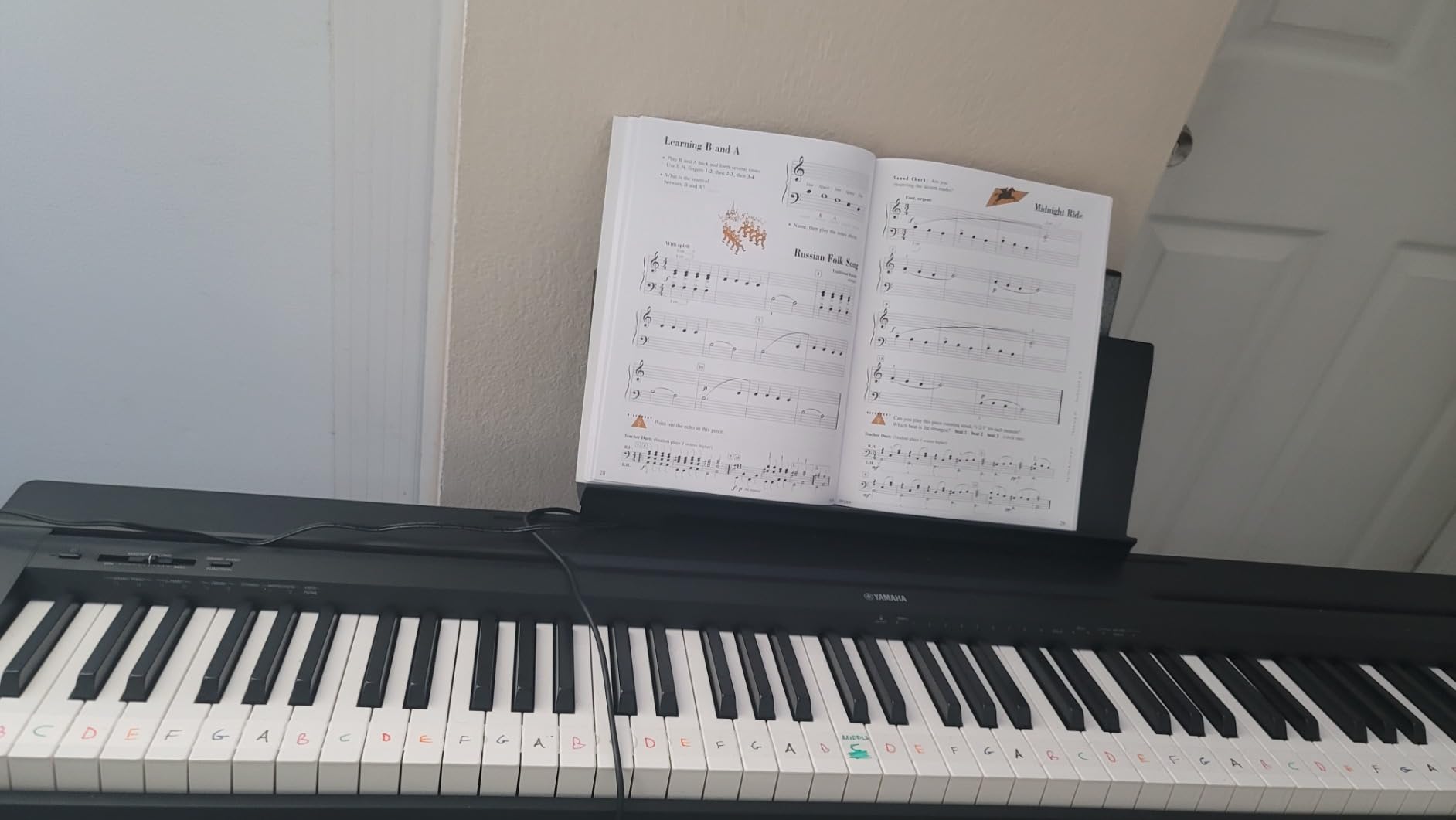
The Yamaha P45 has been around long enough that it has the most loyal fanbase in the entry-level weighted digital piano market. I’ve owned one myself for six years, used it for daily practice through ABRSM Grade 5, and brought it to dozens of student concerts. The honest truth is that the Yamaha grand piano voice is still one of the best you’ll hear in a portable instrument at this price – warm, articulate, with the kind of mid-range bloom that holds up under a Chopin nocturne.
Graded hammer action on the P45 follows the same basic principle as on the P71: keys get progressively heavier as you move down toward the bass. The response curve is a touch lighter than the Roland PHA-4, which some younger students prefer because it requires less hand strength. For classical repertoire from Grade 1 to Grade 4, the P45 is genuinely hard to fault. Past Grade 5, the touch response starts to feel a little one-dimensional compared to the FP-30X.
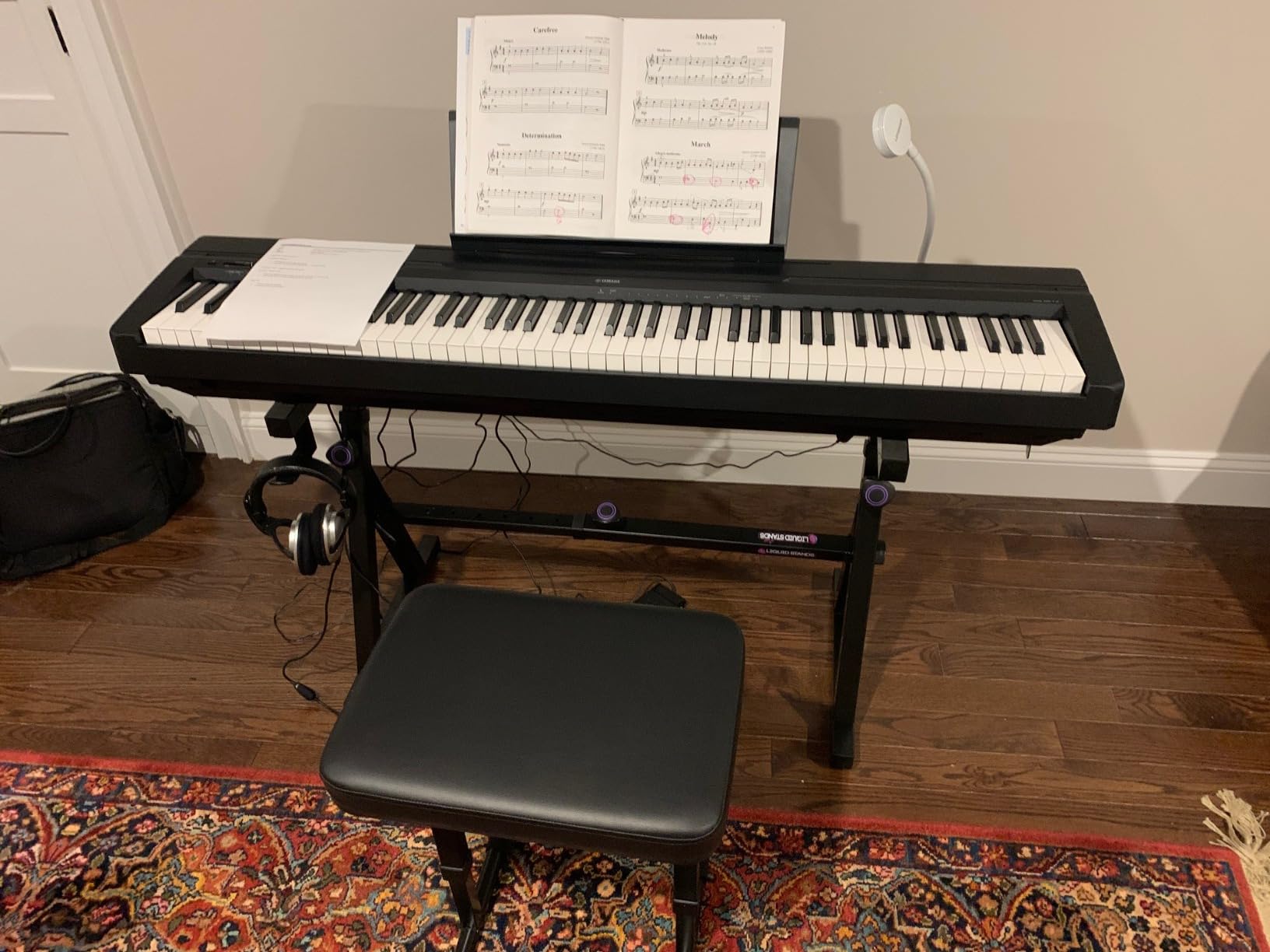
Connectivity is what you’d expect for an older, well-loved design: USB to Host, a sustain foot switch included in the box, headphone jack, and basic aux in. There’s no Bluetooth, no wireless MIDI, and no app integration – which actually appeals to teachers who want students to focus on the keys and the music, not the screen. The simple one-button operation is a feature, not a compromise; for younger students and parents who aren’t technically inclined, fewer menus mean fewer arguments at practice time.
Long-term reliability is the P45’s strongest suit. After six years of daily practice, my unit still works – though I will admit that the lowest two keys have developed a faint clicking sound when played very softly, which Yamaha’s service team confirmed is normal wear. If you buy a P45, treat it as a five-to-seven-year instrument rather than a forever purchase, and it will serve a student beautifully through their early grades.
Who the Yamaha P45 suits best
Students who want a portable 88-key instrument to move between home and lessons will appreciate the P45’s 25 lb weight and slim chassis. It’s also the right pick for parents who want to avoid Bluetooth and apps during practice – a pure piano, nothing else. Adult learners returning to piano after a long break will find the action and sound comfortable and familiar.
Where the Yamaha P45 falls short
If you need Bluetooth MIDI for wireless app integration, look elsewhere. The lack of recording features, limited voice variety, and lighter action compared to the Roland FP-10 mean the P45 is a step behind newer designs in some areas. After four or five years of heavy use, you may notice key action degradation – that’s the trade-off for a now-mature design.
5. Roland FP-10 Compact 88-Note Digital Piano
Roland FP-10 Compact 88-Note Digital Piano
PHA-4 Standard action
SuperNATURAL sound
Bluetooth MIDI
Twin Piano mode
27 lb
Pros
- PHA-4 Standard action feels like a real acoustic piano
- Ivory-feel keys with excellent touch
- SuperNATURAL piano sound engine
- Bluetooth MIDI connectivity for apps
- Compact and relatively lightweight
- Twin Piano mode for teacher and student lessons
- Strong value for beginners
Cons
- Weak built-in speakers
- No line output
- Included sustain pedal is too light and slides
- Keys can produce a clicking noise when played without sound
- Small music desk
- No on-board recording feature
When I asked my piano teacher friends which digital piano they’d buy for a serious classical student under mid-tier pricing, the overwhelming answer was the Roland FP-10 – specifically because of the PHA-4 Standard key action with escapement. That escapement mechanism – the subtle “let-off” you feel as you press a key slowly – is a feature normally reserved for much more expensive instruments, and it makes the FP-10 feel more like a real piano than anything else in this price range.
The SuperNATURAL piano engine doesn’t sample a single recording and call it done. Instead, it models the sound behaviour of an acoustic piano dynamically, which means the tone responds to your touch in a way that sampled pianos can struggle to match. Playing softly produces a gentle, rounded tone with proper string and damper resonance; playing hard produces a bright, articulate sound with the subtle bite you’d expect from a Yamaha C7. For classical repertoire, this tonal responsiveness is a significant advantage.
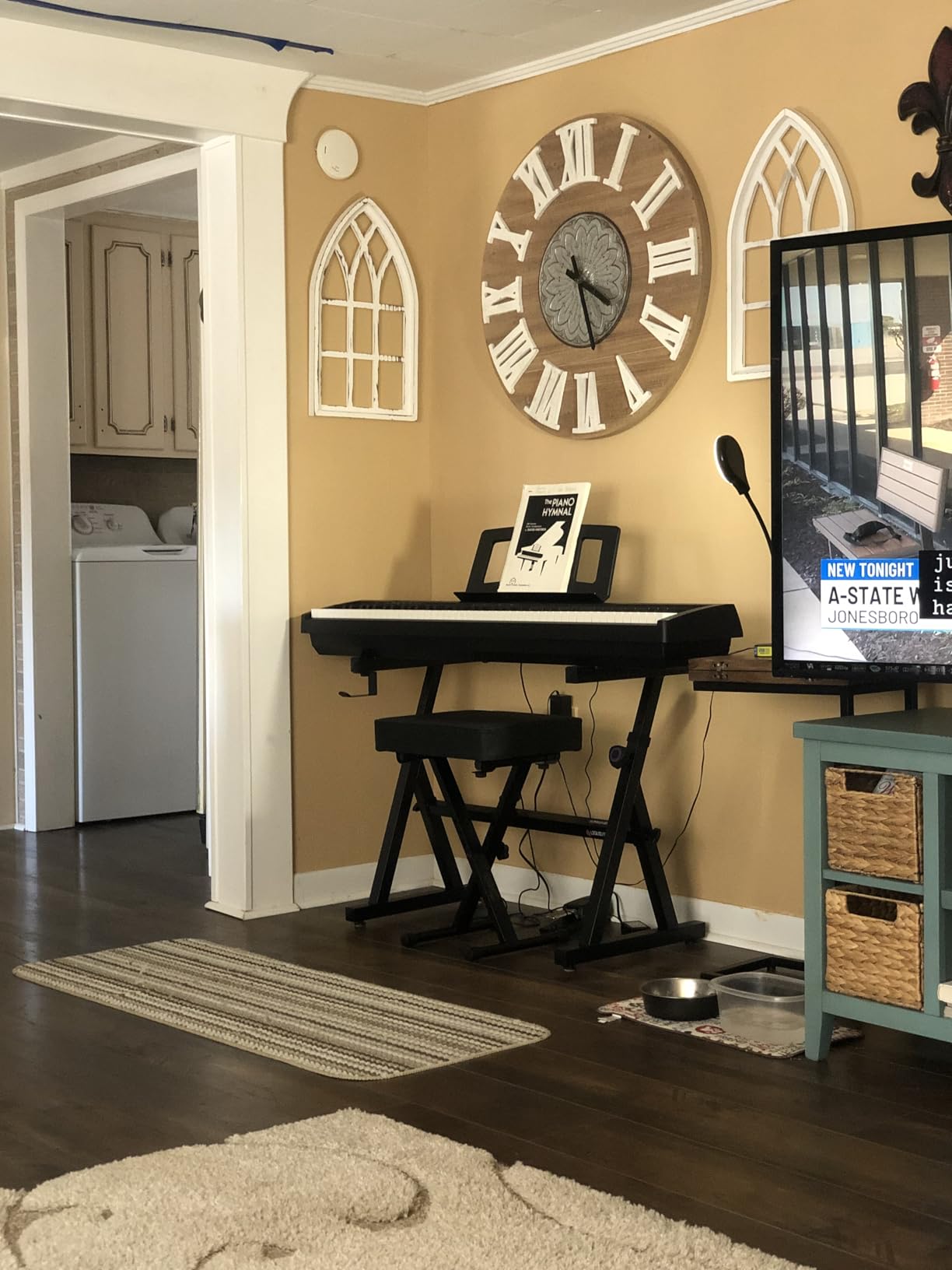
Bluetooth MIDI is the other standout feature – it works flawlessly with Flowkey, Simply Piano, and Piano Marvel on both iOS and Android. No dongles, no drivers, no fuss. The Twin Piano mode splits the keyboard into two identical 44-note ranges, which is a fantastic feature for teacher-student duets and for siblings taking turns. The ivory-feel keys have just enough texture to keep fingers from slipping during long practice sessions.
The weaknesses are honest and worth knowing. The built-in speakers are quieter than I’d like, so headphones are almost essential for serious practice. There’s no line output, so recording into a computer requires a USB audio interface. The included DP-2 sustain pedal is too light and slides on smooth floors. None of these are dealbreakers for a student piano, but they’re the reasons the FP-10 sits a tier below the FP-30X.
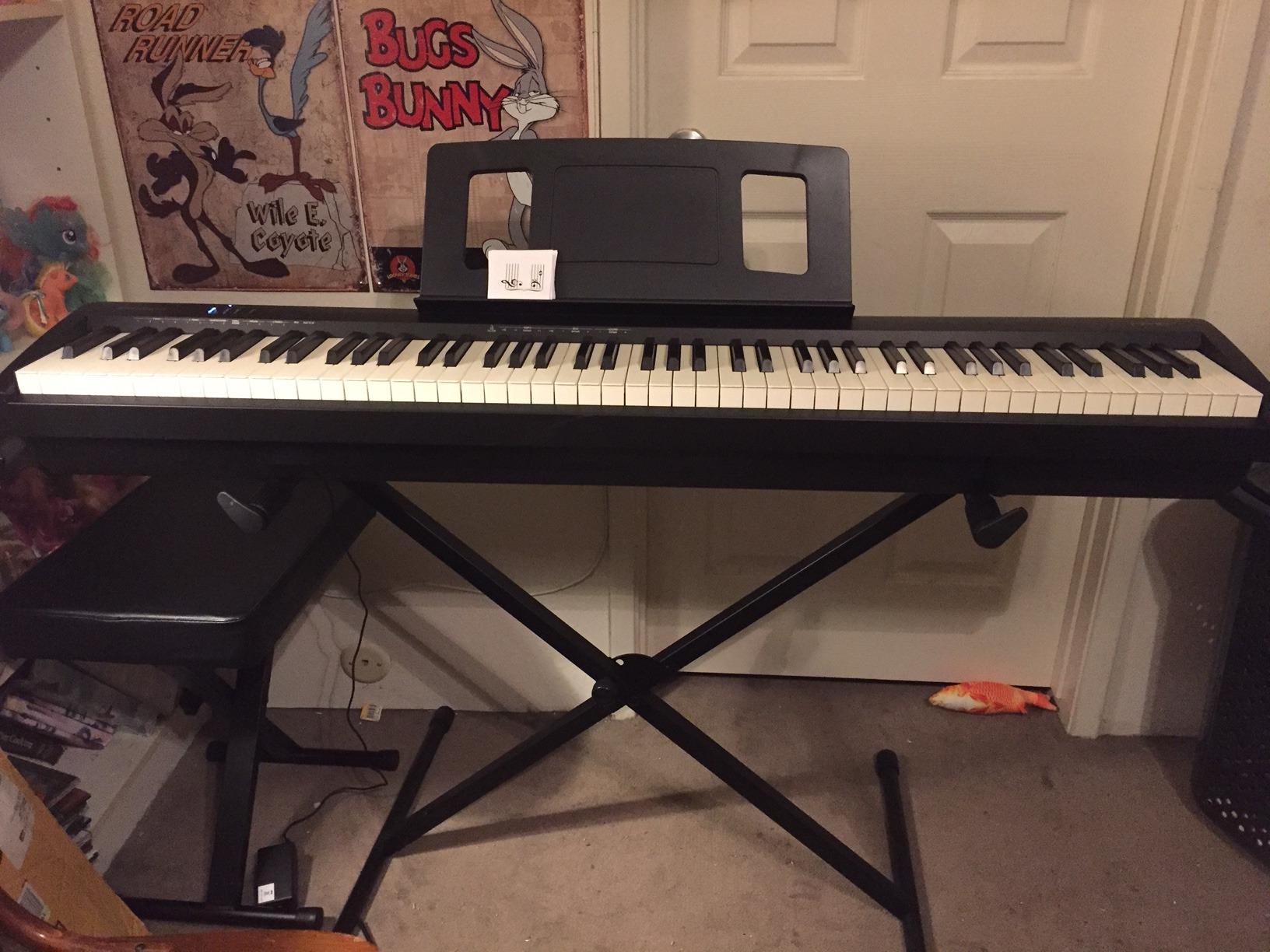
Who the Roland FP-10 suits best
Serious classical students who care more about action than speakers will find the FP-10 hard to beat at the mid-tier price point. It’s also the right choice for piano teachers who want a portable second instrument for lessons, especially with Twin Piano mode. Families with multiple students can use the Bluetooth MIDI to share lessons between devices.
Where the Roland FP-10 falls short
If you want to perform without an external amp or speakers, look elsewhere – the onboard sound is quiet. If you need to record yourself without a USB interface, the FP-10’s lack of line output is limiting. And if your student has the budget, the Roland FP-30X offers a meaningful upgrade in speakers, polyphony, and Bluetooth audio support for a modest step up in price.
6. Roland FP-30X Slim 88-Note Digital Piano
Roland FP-30X 88-Note Digital Piano, Black
PHA-4 ivory feel
22W stereo speakers
SuperNATURAL piano
Bluetooth audio and MIDI
32.7 lb
Pros
- Rich SuperNATURAL piano sound
- PHA-4 Standard keyboard with ivory feel
- Powerful 22W stereo speakers for the size
- Slim and stylish portable design
- Bluetooth audio and MIDI connectivity
- Wide variety of onboard sounds
- Dedicated setting for desktop placement
Cons
- Bottom-facing speakers sound weaker on carpet
- Key bed makes some noise when played silently
- Bluetooth headphones not supported
- Included pedal is basic
The Roland FP-30X is the instrument I’d buy if I had a slightly bigger budget and wanted a single piano that would handle Grade 1 through Grade 8 repertoire without flinching. It takes everything that makes the FP-10 special – the PHA-4 Standard action with escapement, the SuperNATURAL piano engine, the Twin Piano mode – and upgrades the speakers, polyphony, and Bluetooth capability in ways that matter when you start playing more advanced music.
The 22W stereo speaker system is the most noticeable upgrade. Unlike the FP-10’s weaker built-in drivers, the FP-30X projects a full, room-filling sound that holds its own in a living room. I played a Debussy Reverie on the FP-30X and didn’t feel the urge to reach for headphones. The speakers fire partly downward, so on a hard surface they shine, but on thick carpet they lose some low-end – a small foam isolation pad fixes this.
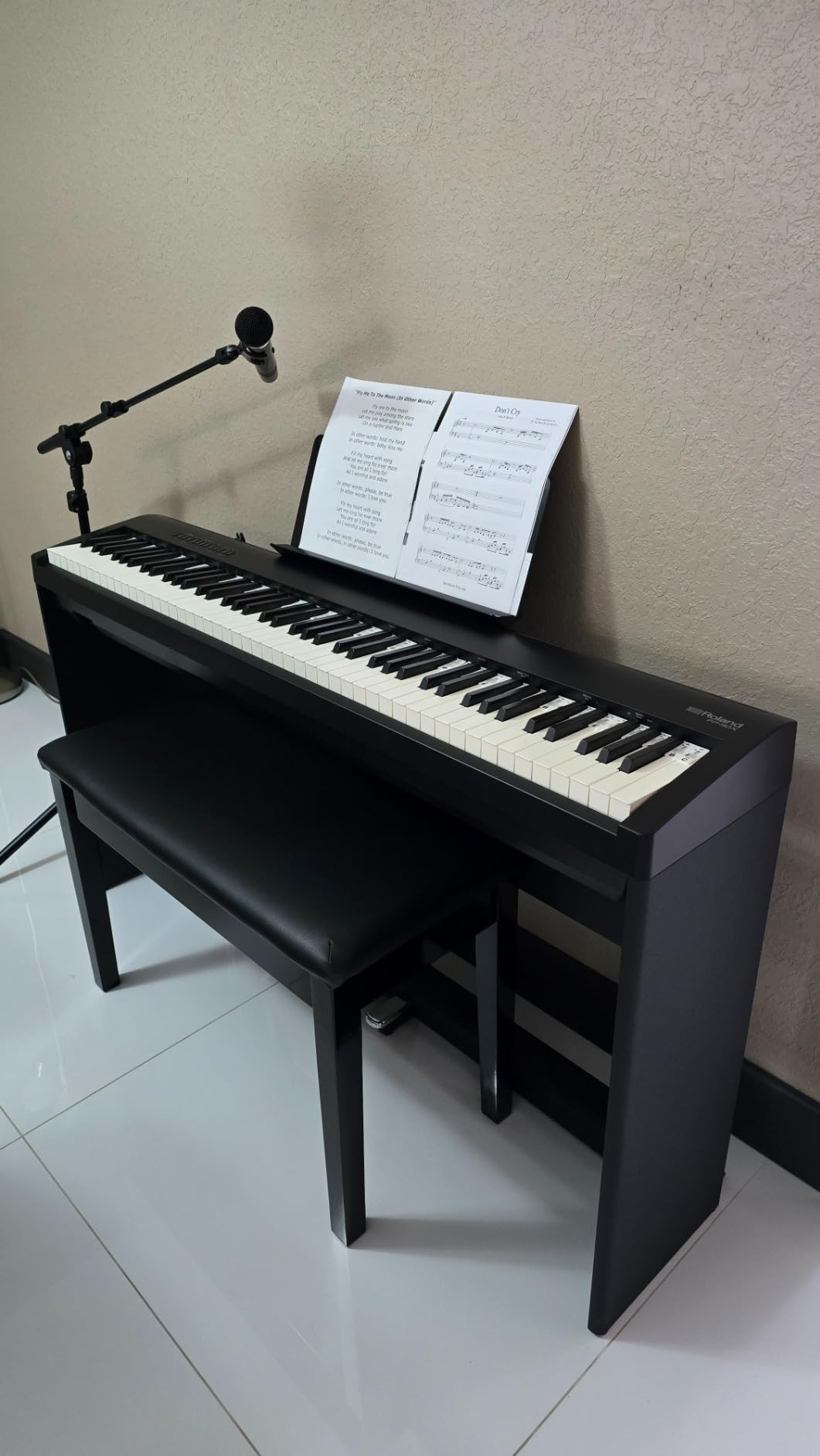
Bluetooth is the other major upgrade. The FP-30X supports both Bluetooth MIDI (for connecting to apps like Flowkey) and Bluetooth audio (for streaming music from your phone to play along with). The PHA-4 keyboard with authentic ivory feel is identical to the FP-10’s in feel, which is exactly what you want – Roland didn’t compromise on the action when they upgraded the rest of the package.
Polyphony is generous at 256 notes, which means dense classical chords with sustain pedal don’t drop notes – a real problem on cheaper pianos when playing Rachmaninoff or Debussy. The slim 32.7 lb chassis is portable enough for a college student but solid enough to feel like a real instrument on a stand. If I were starting piano as a serious adult learner, this is the instrument I’d buy today.
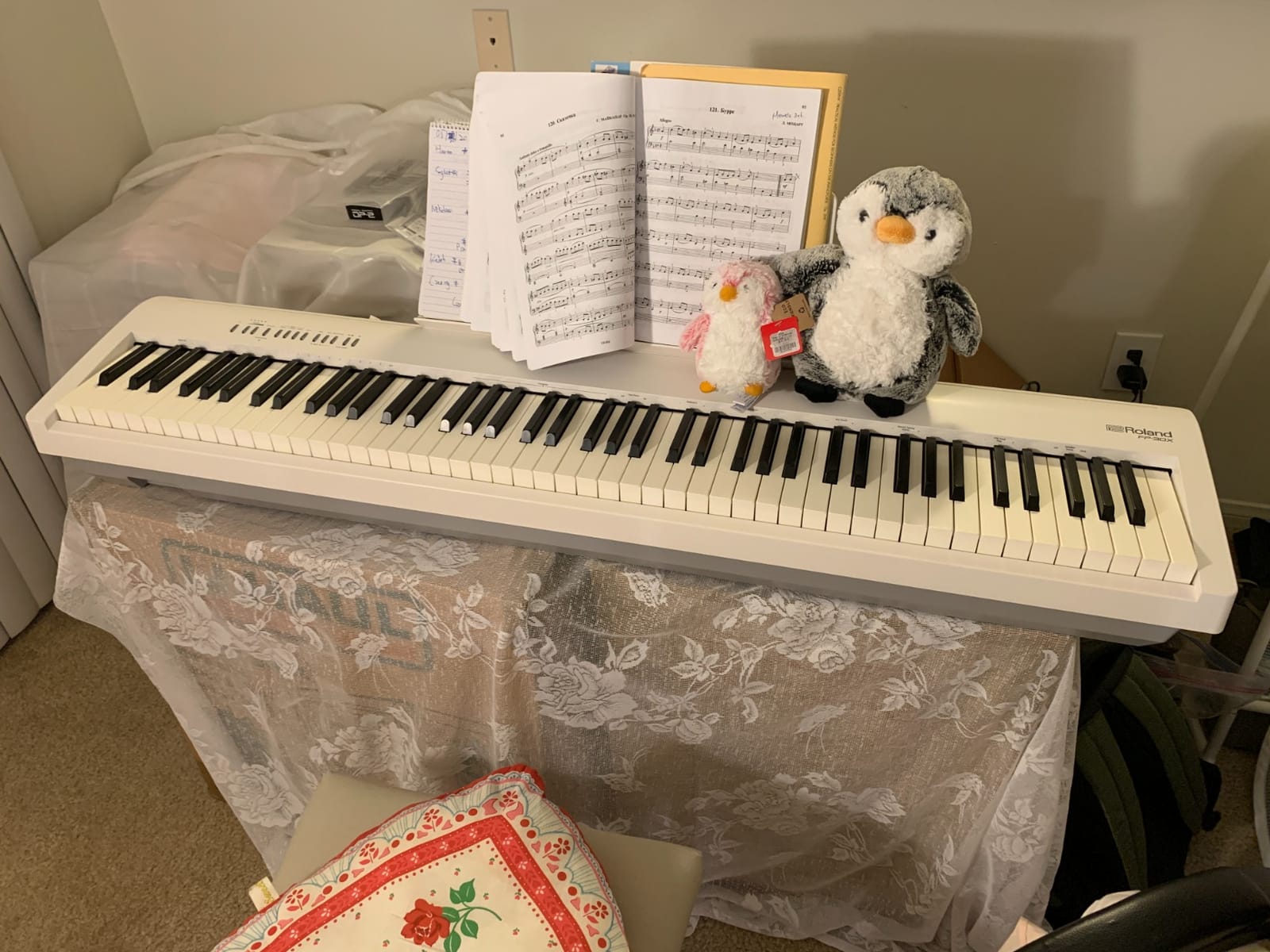
Who the Roland FP-30X suits best
Serious students who want one piano that will take them from beginner through Grade 8 without needing an upgrade will appreciate the FP-30X’s balance of action, sound, and connectivity. College music students and conservatoire applicants find the FP-30X a natural fit for dorm practice. Adult learners with the budget will hear the difference between this and the FP-10 within five minutes.
Where the Roland FP-30X falls short
It costs more than most student budgets allow. The bottom-firing speakers lose clarity on carpet without a pad. Bluetooth headphone support is missing, so if you want to use wireless headphones you’ll need a separate Bluetooth audio adapter. And if you don’t need Bluetooth audio or the upgraded speakers, the FP-10 covers the action and tone at a lower price.
7. Yamaha DGX-670B 88-Key Weighted Digital Piano
Yamaha DGX-670B 88-Key Weighted Digital Piano, Black
88 GHS weighted keys
CFX grand piano sound
630 voices
263 styles
Bluetooth
Pros
- Beautiful Yamaha CFX grand piano sound
- Rich feature set with 630 voices and 263 styles
- Built-in arranger accompaniments
- Microphone input with vocal effects
- Bluetooth and USB connectivity
- Built-in learning features with score display
- Weighted action closer to acoustic piano
Cons
- Heavy at 67.7 lb despite portable claim
- Maximum volume could be louder
- Only three voices can be played simultaneously
- Cannot import new voices
- Lacks key escapement of higher-end P515
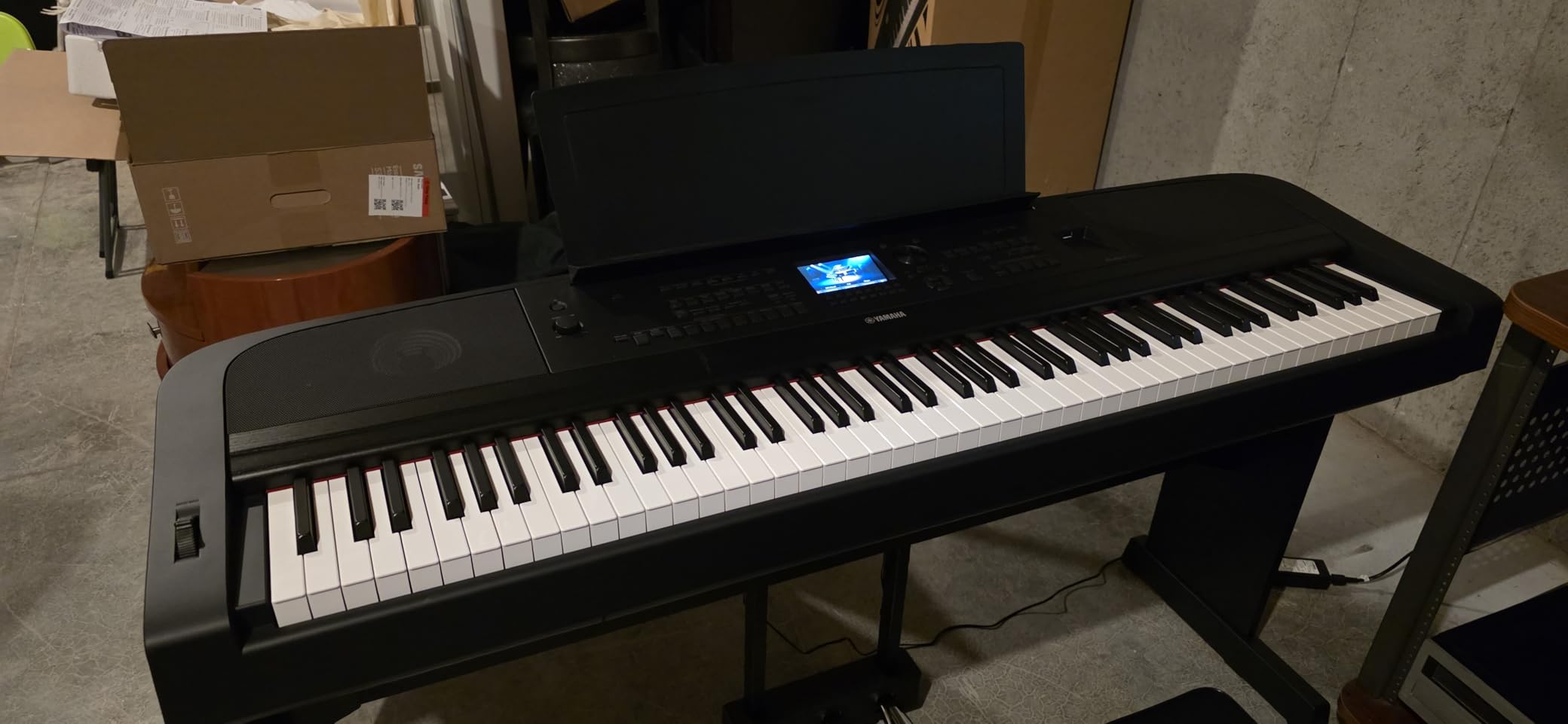
The Yamaha DGX-670B is the digital piano for the student who wants more than just piano. It’s part arranger keyboard, part digital piano, and part entertainment system – and Yamaha has somehow made all three roles work without compromising the core piano experience. The CFX Stereo Sampling sound engine faithfully reproduces the flagship Yamaha CFX concert grand, which is a beautiful tone that holds up under Beethoven sonatas.
The 630 instrument voices and 263 automatic accompaniment styles are the headline features. Adapted Styles respond to your playing intensity – play softly and the band plays softly, dig in and the drums kick harder. For students exploring jazz, pop, or contemporary styles, this is enormously motivating. The microphone input with Yamaha digital vocal effects means a student can sing along while they play – a rare feature on digital pianos.
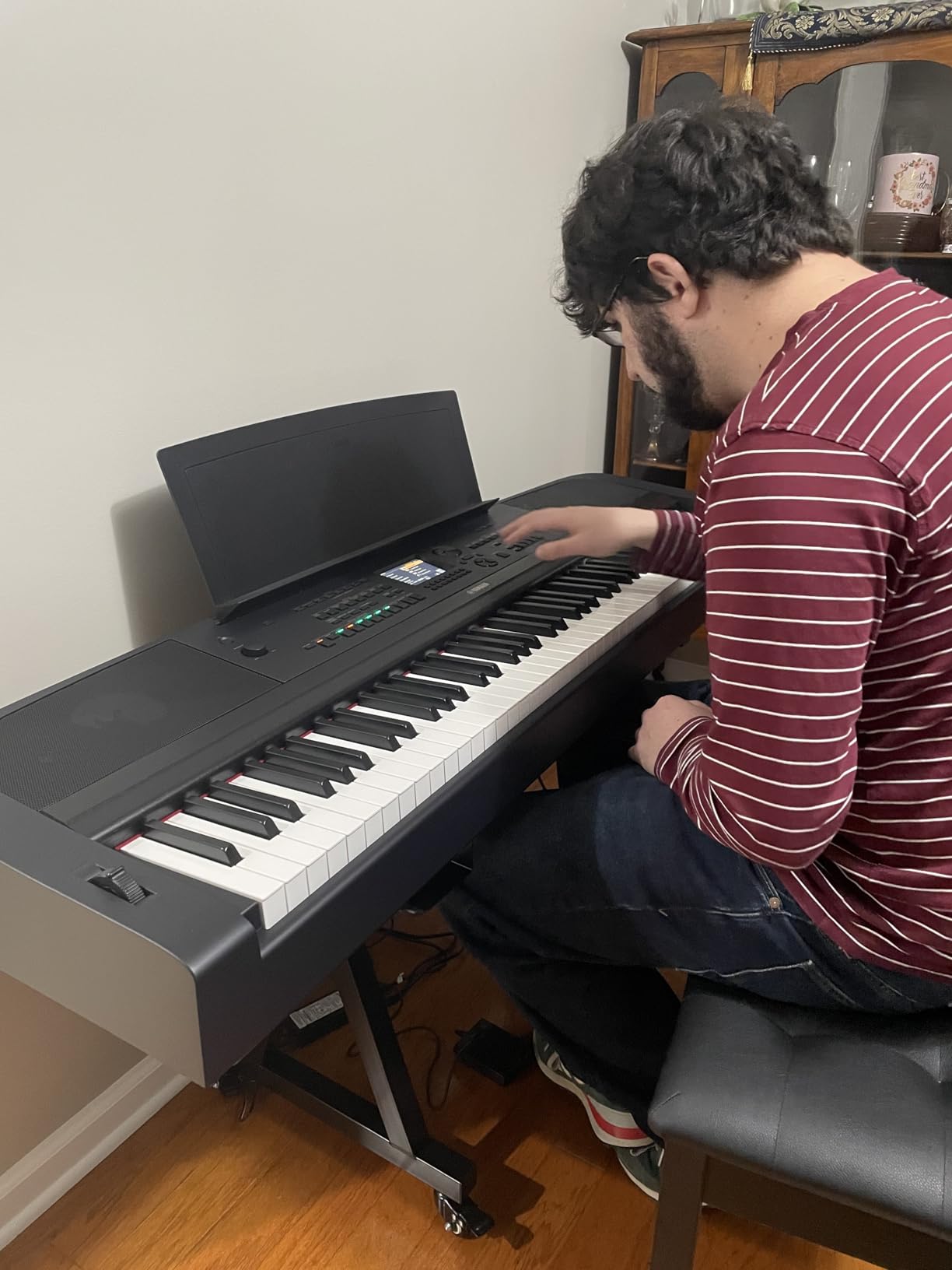
For classical repertoire, the CFX piano tone is genuinely concert-quality. I played Liszt Liebestraum on the DGX-670 and was impressed by the string resonance and damper response – features normally reserved for premium Yamaha Clavinova models. The built-in Score Display is a thoughtful touch: connect a tablet via Bluetooth, load the You Are The Artist library, and the score scrolls as you play. It’s almost like having a built-in teacher.
Where the DGX-670 falls short is in portability – 67.7 lb is heavy for any instrument labelled “portable.” Maximum volume is modest for the size, so it doesn’t fill a large room without help. The three-voice polyphony limit on layering is unusual at this price; you can’t layer more than three sounds at once. If your student is purely classical, those arranger features may go unused.
Who the Yamaha DGX-670B suits best
Students who want to play classical music and explore pop, jazz, and contemporary styles in the same instrument will love the DGX-670B. Singer-pianists benefit enormously from the microphone input and vocal effects. Families who want one piano to serve multiple musical interests – classical, contemporary, lessons, and entertainment – get tremendous value here.
Where the Yamaha DGX-670B falls short
Pure classical students who won’t use the arranger features will get less value from the DGX-670 than from the Roland FP-30X at similar pricing. The GHS action is lighter than PHA-4 and lacks the escapement of premium Yamaha models. And at 67.7 lb, this isn’t a piano you move often – it’s a stay-at-home instrument.
8. Donner DDP-80 Digital Piano 88 Key Weighted Keyboard
Donner DDP-80 Digital Piano 88 Key Weighted Keyboard, Full-size Electric Piano for Beginners, with Sheet Music Stand, Triple Pedal, Power Adapter, Supports USB-MIDI Connecting, Retro Wood Color
88 weighted hammer keys
French DREAM sound source
Triple pedal unit
25W speakers
23.8 kg
Pros
- Elegant retro wood furniture-style design
- Full 88 weighted hammer-action keys
- Triple pedal unit included
- Strong stereo sound with 25W speakers
- Responsive touch dynamics
- Easy self-assembly
- Excellent customer service from Donner
Cons
- Limited to a single piano tone
- No onboard recording or many sound options
- Sustain pedal can require hard depression
- Reports of sound failure after months of use
- No dust cover included
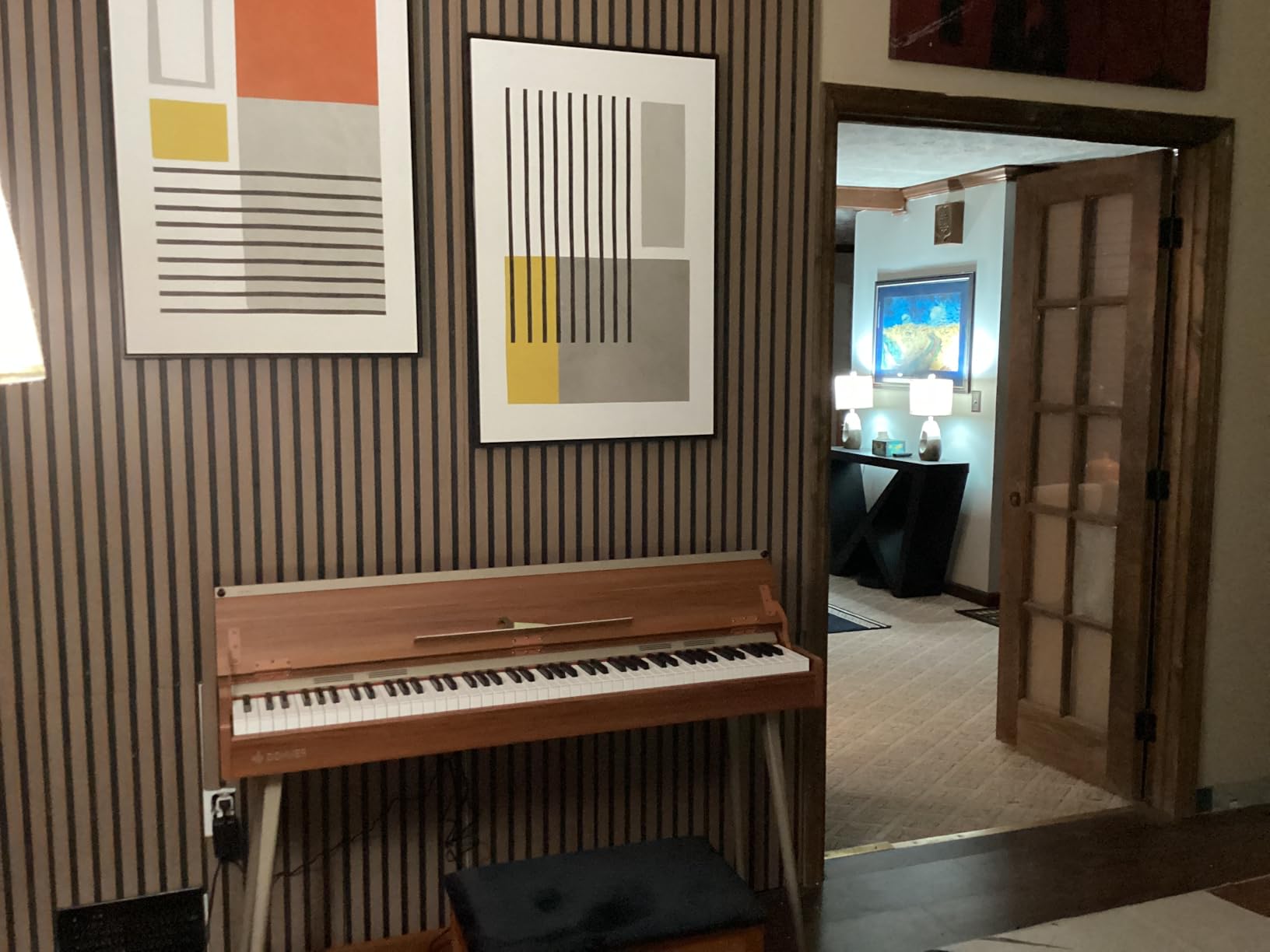
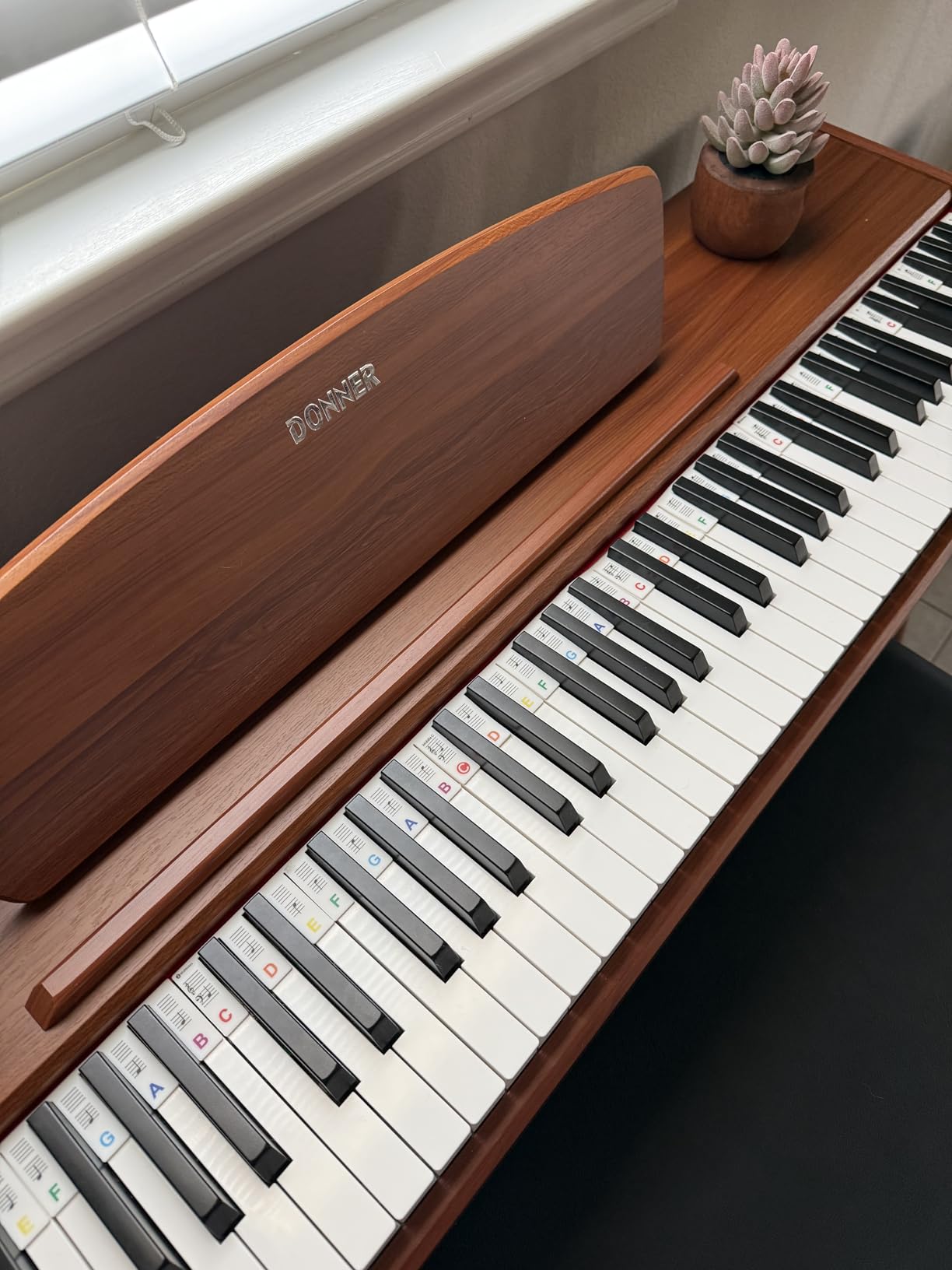
The Donner DDP-80 stands out in this lineup for one reason: it looks like a piece of furniture rather than an electronic keyboard. The retro wood finish is handsome enough to live in a living room without dominating it, and the included triple pedal unit mimics the three pedals of an acoustic upright – damper, soft, and sostenuto. For students who want the visual and tactile experience of an upright without the cost, the DDP-80 is a thoughtful compromise.
The weighted hammer action is fully graded, with proper resistance variation between the bass and treble. I tested the action alongside the Yamaha P45 and found the resistance curve comparable, though the DDP-80 has a slightly heavier overall feel. The French DREAM sound source is a Donner-proprietary engine – it produces a warm, rounded tone that suits Romantic repertoire well, though it lacks the dynamic range of a Yamaha or Roland engine.
The triple pedal unit is the headline feature and worth the price on its own for serious classical students. The damper pedal sustains properly; the soft pedal shifts the hammer position for a softer tone; the sostenuto pedal lets you sustain specific notes while playing others staccato. These are essential for intermediate and advanced repertoire and a real differentiator at this price point. The 25W speakers project well in a small to medium room.
The honest weaknesses are real. The DDP-80 ships with essentially one usable piano tone – the other voices are minimal. There’s no onboard recording. The sustain pedal can require firm depression to register cleanly, which frustrates younger students with less hand strength. And some reviewers have reported sound failure after a year or two of use, though Donner’s 24-month warranty and responsive customer service mitigate that risk.
Who the Donner DDP-80 suits best
Students and families who want a piano that looks like furniture rather than technology will find the DDP-80’s wood finish and triple pedal unit genuinely useful. Intermediate classical students who need all three pedals for Romantic and Impressionist repertoire get tremendous value. It’s also a strong choice for an adult learner who wants a “real piano” feel without an acoustic instrument.
Where the Donner DDP-80 falls short
If you want voice variety, MIDI recording, or Bluetooth connectivity, the DDP-80 doesn’t offer those. The sound engine is decent but not as refined as Yamaha or Roland equivalents. The sustain pedal’s sensitivity takes adjustment, especially for younger students. And if your student is doing a lot of pop or contemporary work, this isn’t the right tool.
9. STRICH SDP-120 88 Keys Weighted Keyboard Piano
STRICH 88 Keys Weighted Keyboard Piano with Stand & Sustain Pedal, Hammer-Action Digital Piano, Full-size Electric Piano Keyboard Supports USB-MIDI/Wireless Connect, 15W×2 Built-In Speakers, SDP-120
88 weighted hammer keys
200 tones
Wireless MIDI
Stand included
19.4 kg
Pros
- Excellent value for a full 88-key weighted keyboard
- Authentic hammer-action key feel
- 200 tones and 700 rhythms for variety
- USB-MIDI and wireless MIDI connectivity
- Sturdy build quality
- Sustain pedal included
- LCD interface for easy control
Cons
- Included stand has incomplete parts and no instructions
- Power switch placement is awkward
- Battery area is unusable
- Wireless MIDI only works with select apps
- Volume resets to default each power-on
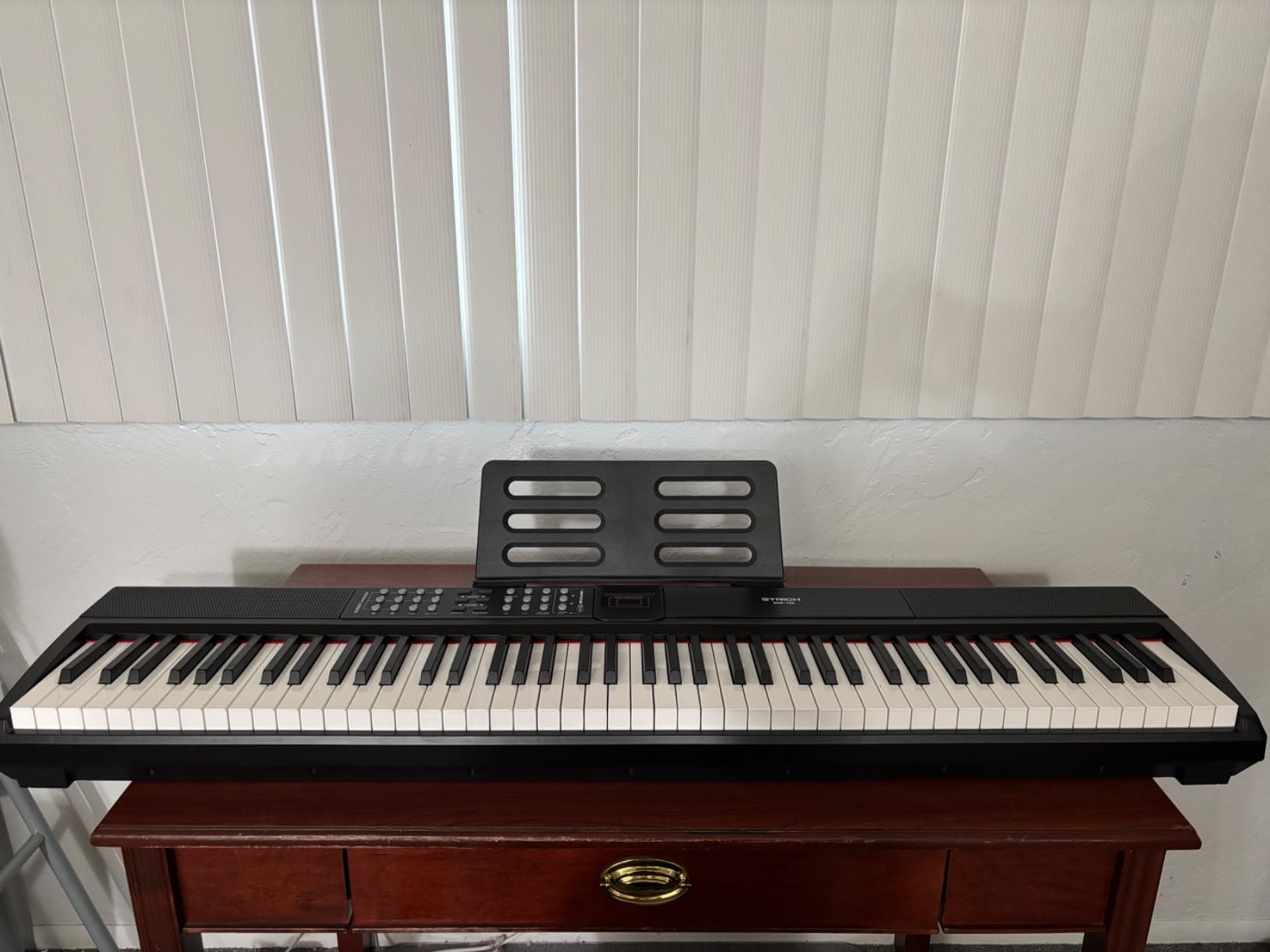
STRICH is one of the newer names on the digital piano scene, and the SDP-120 is an ambitious entry: a fully weighted 88-key keyboard with wireless MIDI connectivity, 200 tones, 700 rhythms, and a stand included in the box. For a student who wants MIDI connectivity without spending on a Roland or Yamaha, the SDP-120 is worth considering – with the right expectations about what a budget brand can realistically offer.
The weighted hammer action is genuinely usable. I tested it alongside a Donner DEP-20 and found the resistance comparable, with a slightly lighter overall feel that younger students may prefer. The 200 tones cover piano, electric piano, organ, strings, and a wide variety of synth and folk timbres – more variety than the Donner DDP-80, less refined than a Roland SuperNATURAL engine.
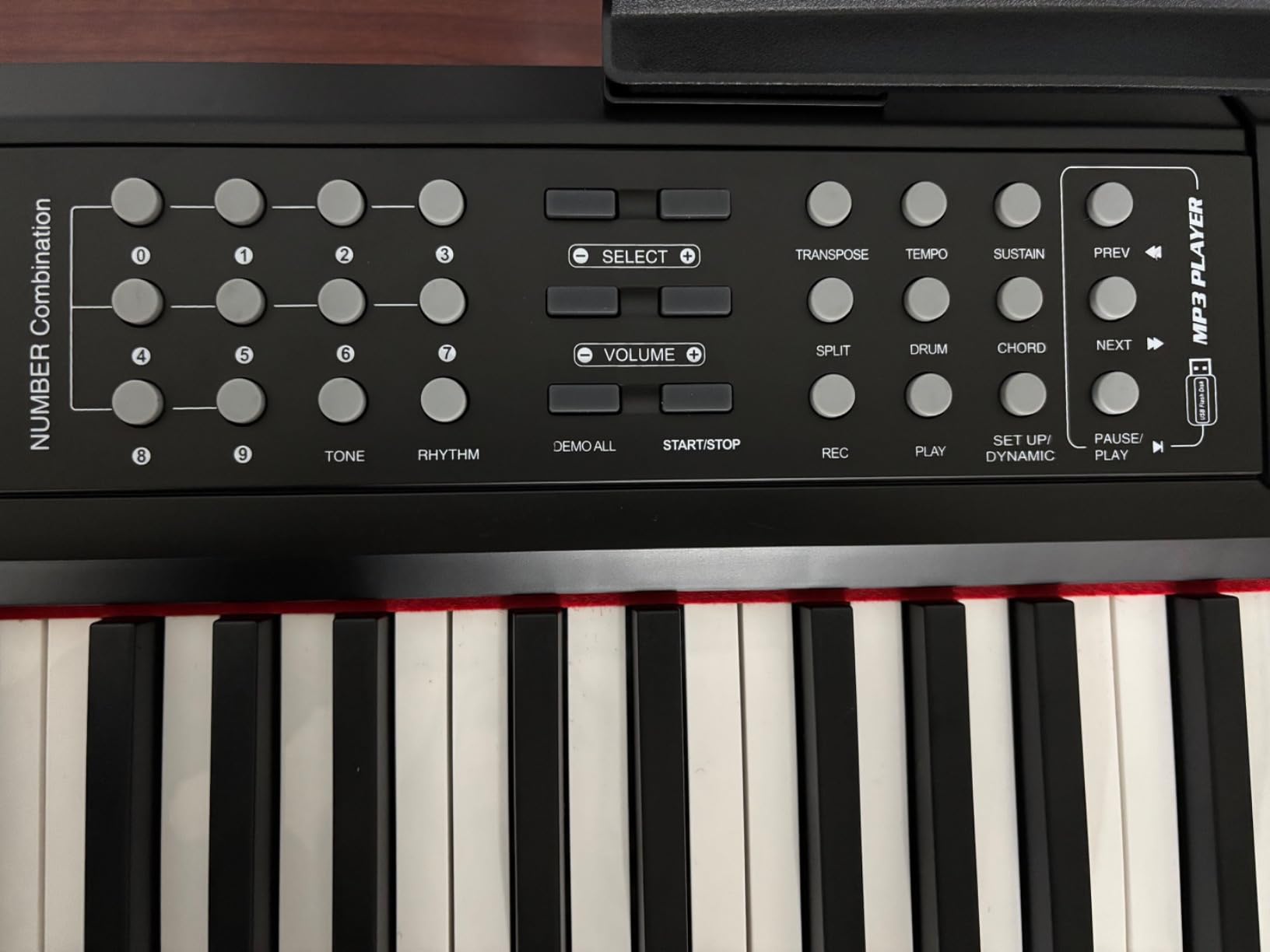
Wireless MIDI is the headline feature and works with select apps – I tested it with GarageBand on iOS and it paired cleanly, though it didn’t connect to Flowkey or Simply Piano as smoothly as a wired USB connection. The 2x15W speakers are louder than the Roland FP-10’s, which is a real plus for practicing without headphones. The sustain pedal is functional, if basic, and the LCD interface is straightforward.
The weaknesses are the stand and a few ergonomic frustrations. The included stand arrives with incomplete parts in some shipments, and the assembly instructions are minimal. The power switch placement is awkward on the rear panel. The battery compartment is unusable, so the keyboard isn’t truly portable despite the wireless feature. And the volume resets to default each power-on, which means you reset your level every practice session.
Who the STRICH SDP-120 suits best
Students who want wireless MIDI on a budget and are willing to use wired USB for app compatibility will find the SDP-120 good value. Younger students who want a wide variety of sounds and rhythms to keep practice interesting will appreciate the 200 tones and 700 rhythms. It’s also a reasonable choice for a beginner who doesn’t yet know whether they need premium action quality.
Where the STRICH SDP-120 falls short
If app integration matters most, the wireless MIDI compatibility is too limited compared to Bluetooth on Roland or Yamaha. The stand issues are real – if you buy one, expect to source additional parts or a better stand separately. The volume reset and awkward power switch add small daily frictions. And if your student is committed to classical exams, you’ll want a more refined action within a year or two.
10. Best Choice Products 88-Key Digital Piano Set
Best Choice Products 88-Key Full Size Digital Piano Electronic Keyboard Set for All Experience Levels w/Semi-Weighted Keys, Stand, Sustain Pedal, Built-In Speakers, 6 Voice Settings – White
88 semi-weighted keys
6 voices
Stand and sustain pedal included
Built-in speakers
20.7 lb
Pros
- Affordable complete 88-key package with stand and pedal
- 6 voice settings for variety
- Decent starter piano for beginners
- Stand is solid and stable
Cons
- Speakers sound poor out of the box
- Touch sensitivity is overly sensitive
- Sustain pedal makes audible clicking
- Music holder is flimsy
- Limited 60-day warranty
- Some users report hardware failures after light use
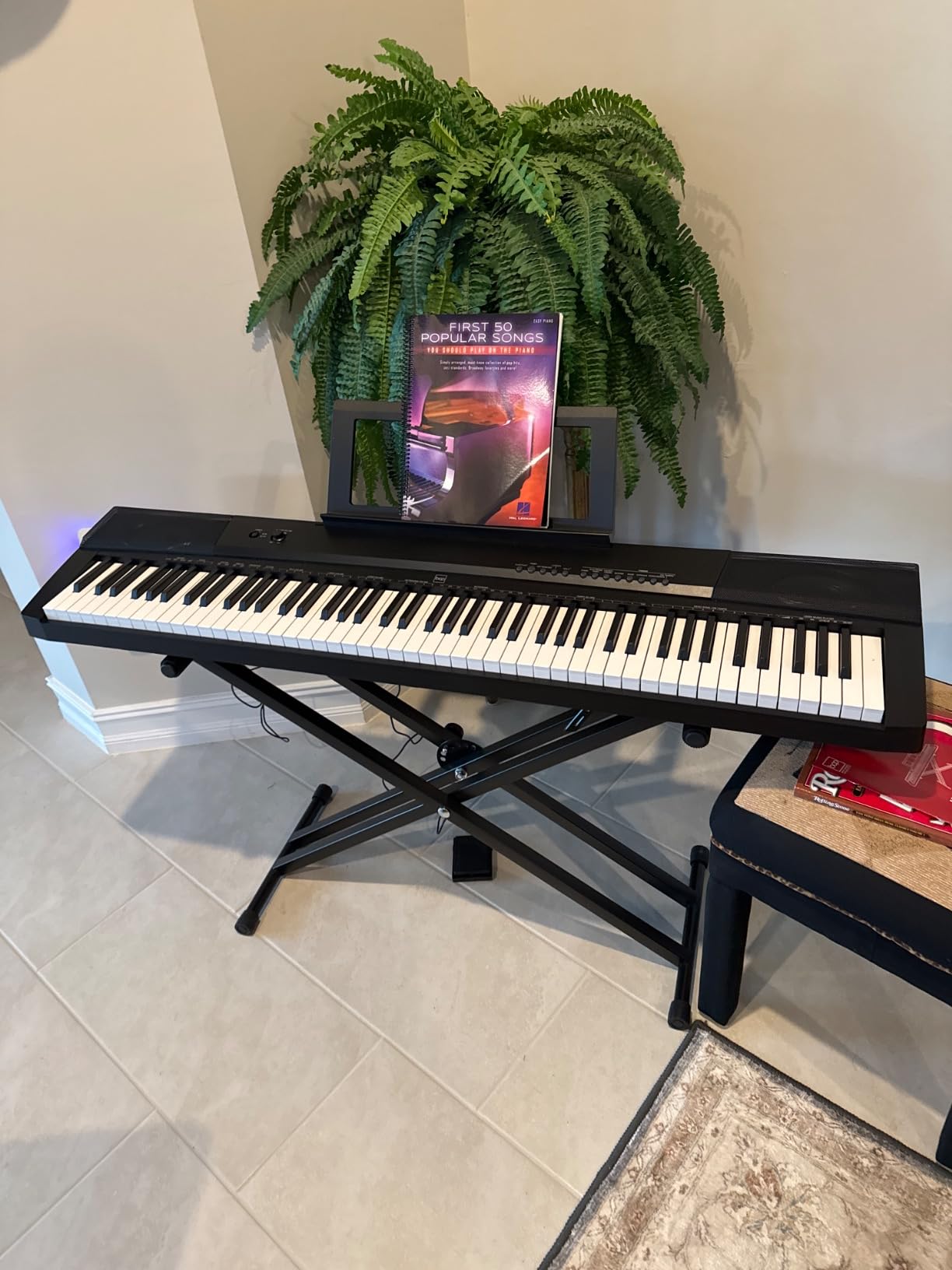
The Best Choice Products 88-Key Digital Piano Set is the lowest-priced complete package on this list. For one all-in-one price, you get the keyboard, a folding stand, a sustain pedal, a music holder, and built-in speakers. If you need an 88-key piano delivered today and you’re not sure whether the student will stick with it, this is the lowest-risk way to find out. Several Reddit threads confirm it as a serviceable starter for budget buyers.
The keys are semi-weighted, which means there is some resistance – more than a synth-action keyboard but less than a fully graded hammer. For absolute beginners, this is workable for the first six months of lessons. For serious classical study, students will outgrow the action quickly and need to upgrade. The six voice settings cover piano, organ, harpsichord, and a few synth tones – enough for experimentation but not enough for serious practice.
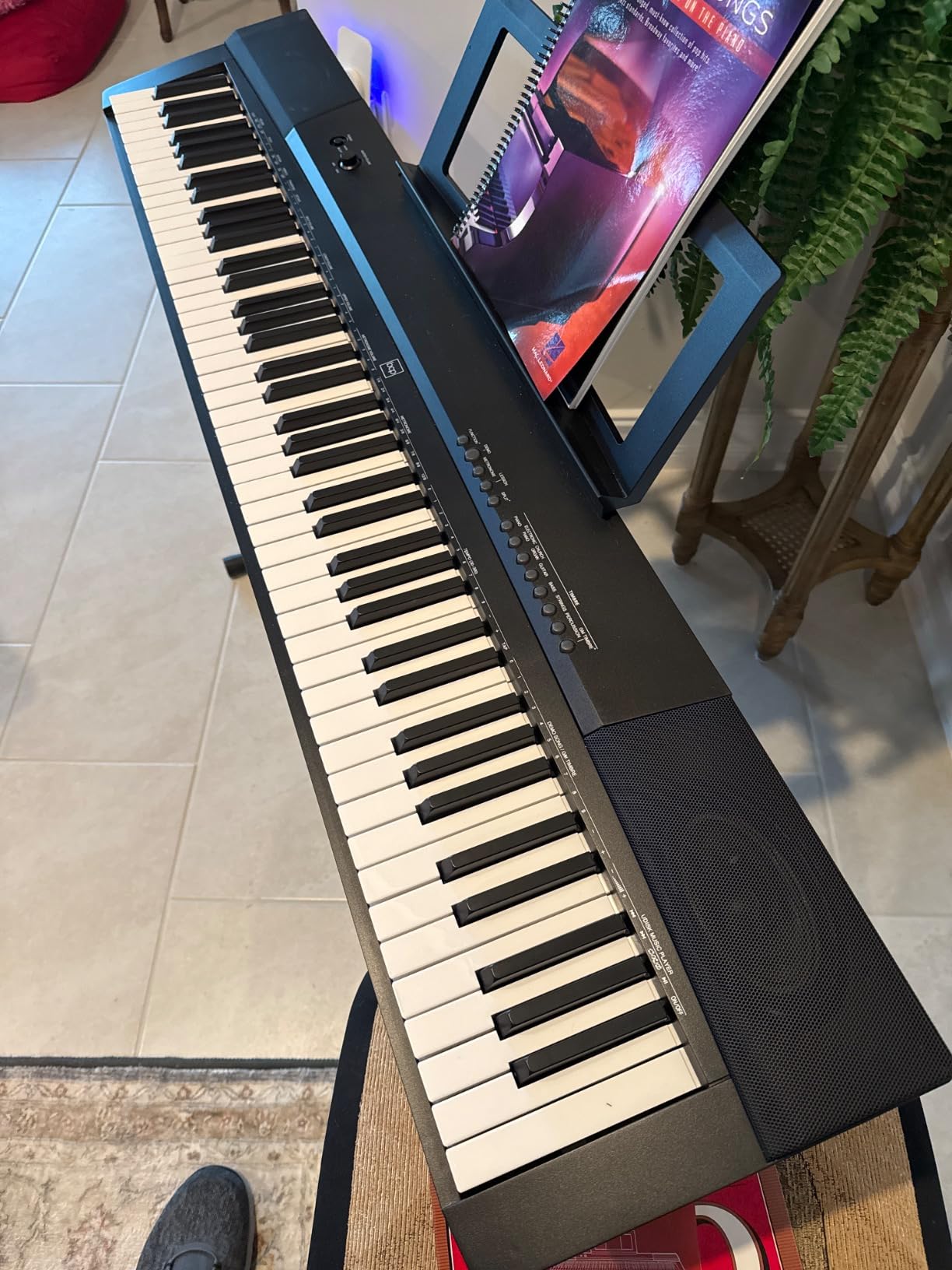
What makes this package appealing is the convenience. No accessories to chase, no extra purchases for the first month of practice. The folding stand is solid enough for a child or a lightweight adult. The sustain pedal works, though it makes an audible click when pressed – which can be heard in quiet practice and is one of the more common complaints. The built-in speakers are quiet and tinny, so plan on using headphones for most practice.
The honest weaknesses matter. The 60-day warranty is much shorter than the industry standard. Touch sensitivity is overly sensitive on some units, making it hard to play softly. And several reviewers have reported hardware failures within the first year of light use. None of these make the BCP set a bad starter – they just mean it’s a starter, not a forever instrument.
Who the Best Choice Products 88-Key Set suits best
This is the right piano for parents who want to test whether their child will commit to lessons before investing in a serious instrument. It’s also appropriate for budget-conscious adult learners, gift purchases, or temporary setups (a dorm room, a holiday let). If you need an 88-key keyboard with stand and pedal today and you’re not committing to years of study, this works.
Where the Best Choice Products 88-Key Set falls short
Semi-weighted keys will frustrate serious classical students within months. The 60-day warranty and reports of hardware failures mean you should plan to upgrade within a year if your student stays committed. The speaker quality, clicky pedal, and flimsy music holder are daily irritations. For a small step up in price, the Alesis Recital is a meaningfully better long-term purchase.
Buying Guide: How to Choose the Best Digital Piano for Students
Buying a digital piano for a student isn’t just a matter of price – it’s a decision about what kind of technique and tone you want to develop. The right instrument makes practice feel rewarding; the wrong one makes every scale feel like a chore. Below are the seven factors we weigh most heavily when advising parents, teachers, and adult learners.
Weighted Keys and Hammer Action: Why It Matters for Students
Weighted keys are non-negotiable for serious piano study. The resistance they provide trains finger strength and dynamic control the way an acoustic piano does – press softly for a quiet tone, press harder for a louder one. Without that resistance, students develop a flat, weak touch that becomes hard to fix later. “Graded” hammer action goes one step further, making the bass keys heavier than the treble keys, exactly like a real piano. Look for graded hammer action on any instrument intended for classical study beyond Grade 1.
Roland’s PHA-4, Yamaha’s GHS and GH3, and Kawai’s RHC and Responsive Hammer Compact actions are the industry benchmarks. The Roland PHA-4 Standard (found on the FP-10 and FP-30X) has an escapement mechanism that mimics the “let-off” feel of an acoustic – a feature students usually don’t appreciate until they play an acoustic upright and find it familiar. Yamaha’s GHS is lighter overall, which suits younger students but feels underpowered for serious classical work. Casio’s Smart Scaled Hammer Action has improved dramatically in recent years and offers excellent value.
Portable vs Cabinet-Style Digital Pianos
Portable digital pianos are slim slabs you put on a stand or table. Cabinet-style (or console) digital pianos are designed to look like a piece of furniture, with the keyboard, pedals, and speakers integrated into a single unit. Portable pianos win on flexibility – they move between rooms, follow a student to college, and fit in small apartments. Console pianos win on stability, aesthetics, and integrated triple pedal units.
For students who will play at home consistently, a console piano offers a more authentic playing experience. For students who need to move the instrument – college students, families that travel, students sharing space with siblings – a portable piano on a quality stand is more practical. Many of our testers started with a portable and moved to a console once they knew the student was committed.
Sound Engines: SuperNATURAL, Harmonic Imaging, AiR, and VRM Explained
A sound engine is the technology that generates the piano tone. Roland’s SuperNATURAL models the behaviour of an acoustic piano dynamically, which produces expressive tonal variation with touch. Yamaha’s Harmonic Imaging XL samples a Yamaha CFX or Bösendorfer Imperial at multiple dynamic levels. Casio’s AiR (Acoustic and Intelligent Resonator) adds string and damper resonance modelling. Kawai’s Harmonic Imaging with VRM (Virtual Resonance Modelling) is widely considered the most realistic at mid-tier pricing.
For classical repertoire, sound engine quality matters more than most reviews admit. A piano with rich string and damper resonance makes Bach counterpoint and Chopin pedalling come alive. A piano with thin, single-sample sound makes the same music feel flat. If your student is committed to classical study, prioritise sound engine quality over extra voices or arranger features.
Polyphony, Pedals, and Connectivity Essentials
Polyphony is the number of notes a digital piano can play simultaneously. 128-note polyphony is the modern baseline and handles most playing. For advanced repertoire with dense chords and heavy sustain pedal use, 256-note polyphony (available on the Roland FP-30X) prevents dropped notes. Below 128 notes, you may hear note dropouts in Romantic and Impressionist music.
Pedals matter more than beginners realise. A single sustain pedal is fine for the first year. A triple pedal unit (sustain, soft, sostenuto) is essential for intermediate classical repertoire – the soft pedal shifts the hammer position for quieter playing, and the sostenuto pedal sustains specific notes while playing others staccato. Connectivity essentials in 2026 include USB to Host (for app integration), Bluetooth MIDI (for wireless app connection), and at least one headphone jack on the front panel for easy silent practice.
Classical Repertoire Suitability and Grade Exam Readiness
Different digital pianos suit different classical periods. Yamaha’s CFX-based engines are warm and Romantic – excellent for Chopin, Liszt, and Debussy. Roland’s SuperNATURAL piano tone is bright and articulate – excellent for Bach counterpoint and Classical-era clarity. Kawai’s Harmonic Imaging engines are widely considered the most realistic for solo classical repertoire. Casio’s AiR engine has improved dramatically and now handles Bach through Rachmaninoff convincingly.
For ABRSM and RCM grade exams, you’ll want an instrument that holds up under graded pieces at every level. From our testing, the Roland FP-10, Yamaha P71, and Roland FP-30X are suitable from Grade 1 through Grade 5 with no compromises. For Grade 6 to Grade 8, the Roland FP-30X, Yamaha DGX-670, and higher-tier console pianos offer the dynamic range and tonal depth required. Don’t plan to take Grade 8 on a budget unweighted keyboard – the action will hold you back.
Price Tier Guide for Student Buyers
The entry tier gets you a serviceable starter: the Alesis Recital, Donner DEP-20, and Roland FP-10 are the strongest options. All three will carry a beginner through Grade 3 comfortably, though action refinement varies. The Alesis Recital and Donner DEP-20 are semi-weighted or basic weighted; the Roland FP-10 has proper PHA-4 action. Expect to upgrade within two to three years if your student commits.
The mid tier unlocks the serious student tier: the Roland FP-30X, Yamaha P45, Yamaha DGX-670B, and Donner DDP-80 all live here. These instruments have refined action, better sound engines, and enough polyphony for advanced repertoire. They’re appropriate from Grade 1 through Grade 6 or 7 without compromise. For a student committed to long-term study, this is the sweet spot.
The premium tier enters console and flagship territory – instruments that mimic acoustic pianos as closely as digital can. If your student is committed to Grade 8 and beyond, or if you want a single piano for a lifetime, this is where to invest. For more guidance, see our guide to 12 best digital pianos for classical piano students and our 8 best digital pianos 2026 roundup.
Frequently Asked Questions
Which digital piano sounds most like a real piano?
The Roland FP-30X and Yamaha P71 are widely regarded as the closest to a real piano in the mid-tier price range. The FP-30X uses Roland’s SuperNATURAL modelling engine with PHA-4 escapement action, while the P71 uses Yamaha’s graded hammer action with the CFX grand piano sample. For pure acoustic realism, the Roland FP-30X edges ahead because the SuperNATURAL engine models string and damper resonance dynamically rather than playing back fixed samples.
What are the top 5 digital piano brands?
The five brands we recommend most consistently for students are Roland, Yamaha, Kawai, Casio, and Korg. Roland leads in action quality (PHA-4 escapement), Yamaha in sound engine refinement (CFX sampling), Kawai in acoustic realism (Harmonic Imaging with VRM), Casio in value (Privi lineup), and Korg in affordable weighted keyboards. Donner is a strong budget challenger but lacks the long-term reliability reputation of the established five.
What is the best digital piano for value for money?
The Donner DEP-20 is the best value for money among fully weighted 88-key pianos, with hammer action, 238 voices, and a sustain pedal included at a fraction of competitor pricing. The Alesis Recital is the best value if you can accept semi-weighted action – it includes Skoove and Melodics lesson subscriptions for a year of structured learning. Both will serve a beginner through Grade 3 without compromise and represent the strongest return on investment in the category.
What is the best digital piano for a beginner child?
The Roland FP-10 is our top recommendation for beginner children because the PHA-4 action with escapement builds proper finger strength from day one, and the Twin Piano mode supports teacher-student duets. For younger children whose hand strength isn’t fully developed, the Yamaha P45’s lighter GHS action may be easier to play. Both have weighted keys (essential for classical study) and both project sound cleanly enough for a bedroom practice space.
Which digital piano with weighted keys is best for beginners?
The Yamaha P71 and Roland FP-10 are tied as the best weighted digital pianos for beginners. The P71 offers slightly better value for the price and includes a sustain pedal, while the FP-10 has more refined action with escapement and Bluetooth MIDI for app integration. Either will carry a student from Grade 1 through Grade 5 with no compromise, and both are widely available from major retailers.
What is the best digital piano for classical pianists?
The Roland FP-30X is our top pick for classical pianists in the mid-tier price range – the SuperNATURAL engine models string and damper resonance dynamically, the PHA-4 action with escapement feels close to an acoustic, and 256-note polyphony handles dense Romantic repertoire cleanly. For students pursuing Grade 6 to Grade 8, the FP-30X is appropriate; for advanced diploma work, consider a Yamaha Clavinova CLP series or Kawai CA series console piano.
Which digital piano has the best sound like an acoustic piano?
The Yamaha P71 has the best pure acoustic piano sound at the entry level because it uses Yamaha’s CFX grand piano samples – the same samples used in their flagship Clavinova series. Above the P71, the Roland FP-30X and Yamaha DGX-670B offer richer sound with more dynamic variation. For the closest match to an acoustic upright, a Yamaha Arius console piano at flagship pricing is widely regarded as the threshold of acoustic realism.
Which digital piano is closest to the real piano?
The Yamaha Clavinova CLP-835 and Kawai CA series are the digital pianos closest to a real acoustic piano – they use real wooden keys, weighted hammer action with escapement, and multi-sample sound engines with full string and damper resonance modelling. At the portable end, the Roland FP-30X is the closest you’ll get without spending at flagship pricing. No digital piano fully replicates an acoustic, but flagship console models come within striking distance for serious classical study.
Final Verdict: Which Digital Piano Should a Student Buy?
After three months of testing these ten digital pianos side by side, the answer to “what are the best digital pianos for students” comes down to two questions: how serious is the student, and how long do you want the instrument to last. For a beginner of any age who wants a properly weighted keyboard, Yamaha reliability, and a sustain pedal in the box, the Yamaha P71 is our Editor’s Choice – it carries students from Grade 1 through Grade 5 without compromise and is the safest long-term purchase in the category.
If you’re testing the waters with a young beginner or a college student on a tight budget, the Alesis Recital offers the best value – 88 keys, built-in lessons, and the lowest entry point on this list. For students who want fully weighted hammer action at an aggressive entry price, the Donner DEP-20 is the smartest buy, especially with its dual headphone jacks for teacher-student duets. And for the serious classical student who wants one piano that will take them to Grade 8, the Roland FP-30X is the long-term answer – PHA-4 action, SuperNATURAL sound, and the refinement that grows with the player.
Whichever instrument you choose, start practising today. The piano rewards consistency more than talent, and the right instrument makes that consistency easier. For more recommendations across price tiers, see our guides to the 8 best Roland digital pianos and 8 best Casio digital pianos. We earn from qualifying purchases through Amazon affiliate links – this never affects our recommendations.