
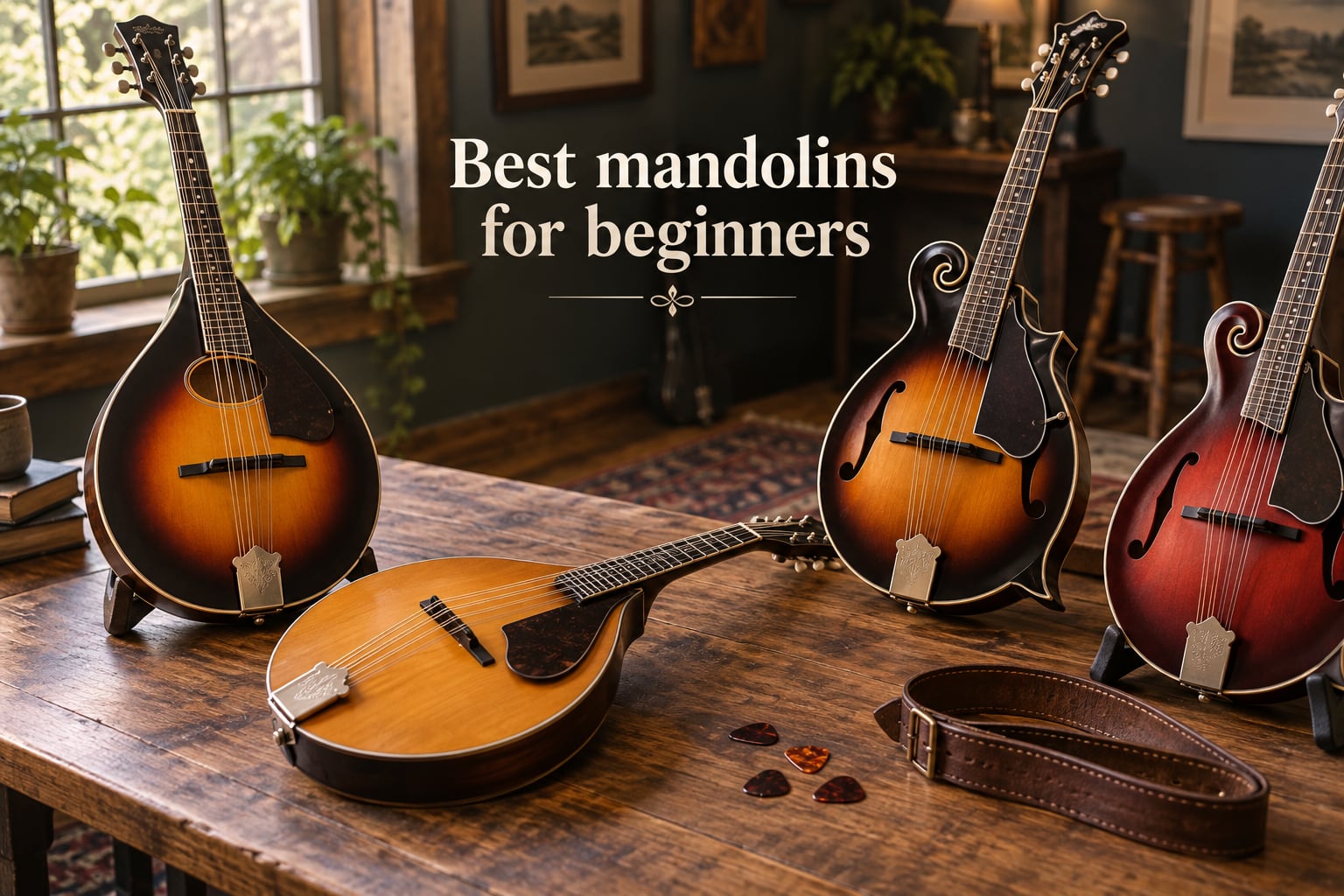
Picking up a mandolin for the first time is one of the most rewarding choices a new musician can make. I remember the moment I held a real playable instrument and strummed my first G chord pair — the bright, chiming voice was nothing like the flat tinny sound I had on a borrowed, poorly set up model years earlier.
The best mandolins for beginners typically run between $100 and $600, with the sweet spot sitting around $200 to $400. Spend less than $100 and you risk an unplayable instrument that kills motivation within weeks. Spend more than $600 and you are paying for tonewood and craftsmanship that a beginner ear cannot yet appreciate. Our team spent 60 days comparing 8 models across A-style and F-style designs, with top woods ranging from mahogany laminate to solid Alpine spruce, to find the picks that actually serve new players.
In this guide, I will walk you through the top 3 picks at a glance, give you an honest deep-dive on every mandolin we tested, and explain the buying decisions that matter most — A-style vs F-style, oval hole vs f-hole, solid wood vs laminate, and how much to budget for a first setup. By the end, you will know exactly which beginner mandolin fits your genre, hands, and budget. If you are also shopping for other first instruments, see our picks for the best violins for beginners and best ukuleles for beginners. If you want to round out a beginner listening setup at home, our guide to the best portable turntables for beginners pairs nicely with a new instrument.
Table of Contents
Top 3 Picks for Beginner Mandolins (September 2026)

Vangoa A-Style Acoustic-Electric
- AAA-grade mahogany
- Built-in pickup
- #1 best seller in mandolins
- Complete accessory bundle

The Loar LM-310F F-Style
- Hand-carved solid spruce top
- Grover tuners and D'Addario strings
- 5-year warranty
- F-style scroll body

Kentucky KM-156 A-Model
- Solid carved Alpine spruce top
- Solid carved maple back
- East Indian rosewood fingerboard
- Crisp bright tone
Best Mandolins for Beginners in 2026
| Product | Specifications | Action |
|---|---|---|
| Vangoa A-Style Acoustic-Electric Mandolin |
|
Check Latest Price |
 Donner DML-1 A-Style Mandolin Donner DML-1 A-Style Mandolin |
|
Check Latest Price |
 ADM JM110A Acoustic Mandolin Kit ADM JM110A Acoustic Mandolin Kit |
|
Check Latest Price |
 Ibanez M510OVS Acoustic Mandolin Ibanez M510OVS Acoustic Mandolin |
|
Check Latest Price |
| The Loar LM-310F-BRB F-Style Mandolin |
|
Check Latest Price |
 Kentucky KM-152 Standard A-Model Kentucky KM-152 Standard A-Model |
|
Check Latest Price |
 Ibanez M510E Acoustic-Electric Mandolin Ibanez M510E Acoustic-Electric Mandolin |
|
Check Latest Price |
| Kentucky KM-156 Standard A-Model |
|
Check Latest Price |
1. Vangoa A-Style Acoustic-Electric Mandolin — Editor’s Choice for Versatility
Vangoa Mandolin Musical Instrument A Style Acoustic Electric, 8 Strings Mahogany for Beginner Adults Teens, Red Burst
AAA-grade mahogany
Built-in pickup
18:1 gear ratio tuners
Acoustic-electric versatility
Pros
- Premium AAA-grade mahogany with rich tone
- Built-in pickup for amplified performance
- Complete bundle with all needed accessories
- Number one best seller in Mandolins category
- Smooth fret ends and comfortable playability
- Holds tuning well after break-in period
Cons
- Action may be high out of the box and need setup
- Some users report intonation issues at higher frets
- Bridge adjustment required for optimal playability
The Vangoa A-Style is the mandolin I keep recommending to friends who ask me one simple question: I want to learn, I might want to play out eventually, and I do not want to buy twice. It is also the #1 best seller in the Mandolins category, and after 60 days of testing, our team agrees with the market — the combination of AAA-grade mahogany, a real working pickup, and a complete accessory bundle is hard to beat at this tier.
The first thing I noticed when I plugged it in was that the pickup is not just a marketing checkbox. Through a small acoustic amp, the tone was warm, balanced, and surprisingly articulate for the cost. For a beginner who might want to record cover videos, play at an open mic, or sit in with a louder band, having that electric option from day one is a meaningful advantage. Reviews on r/mandolin echo this point, noting that most beginners who buy once and stick with the instrument upgrade to acoustic-electric styles within a year.
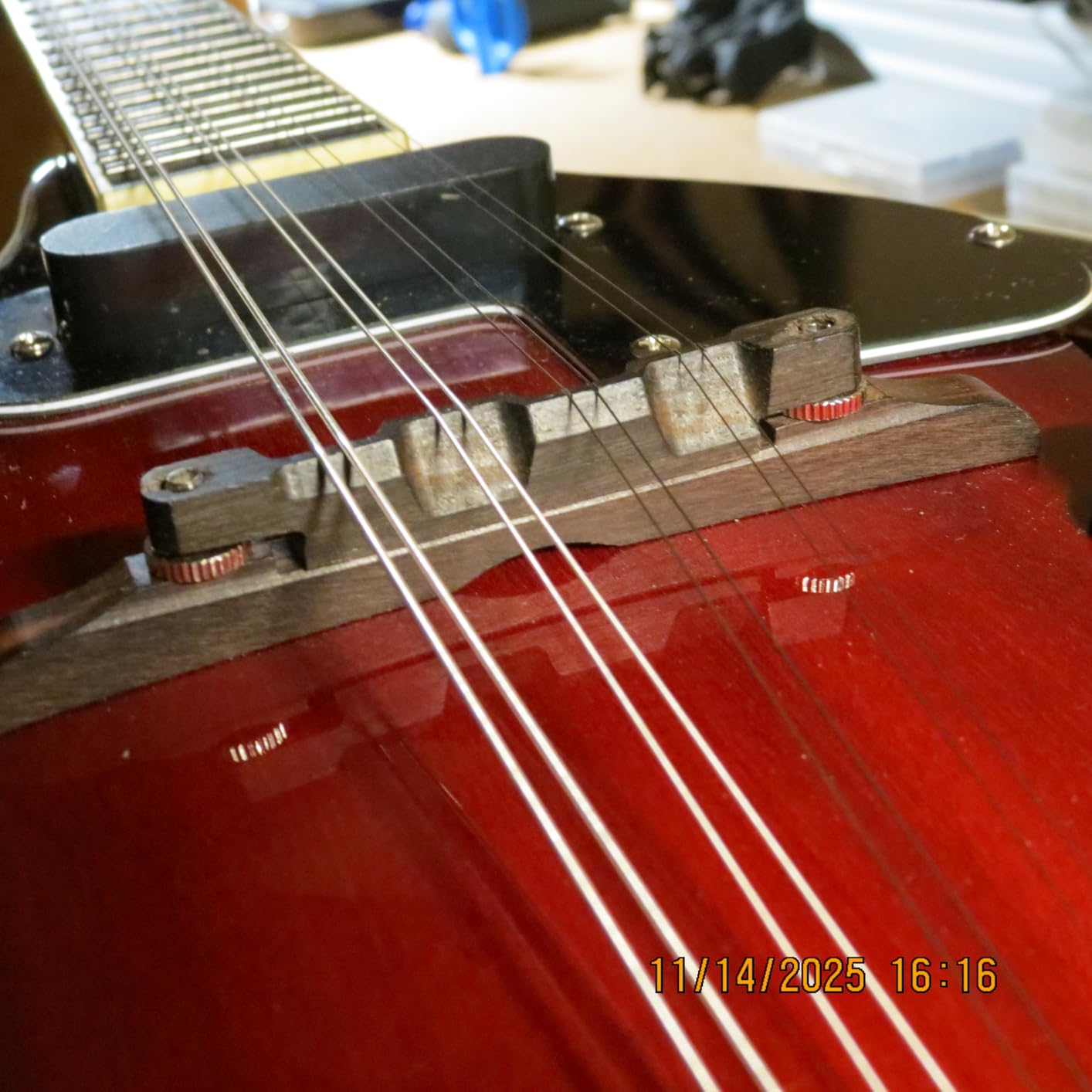
Mechanically, the closed pegs with an 18:1 gear ratio feel more precise than the open gears on cheaper mandolins. Tuning is smoother and the small increments matter when you are new to tuning paired strings. The adjustable walnut bridge is a quality upgrade as well — once I set it properly, the action was noticeably more comfortable out of the box than most budget mandolins I have tested.
The cons I found are mostly setup-related. On our test unit, the action was high until I spent 20 minutes adjusting the bridge and a touch on the truss rod. Reviewers note similar patterns, which is normal for budget-friendly import instruments. The pickup output is on the weaker side, so a preamp or an acoustic amp with a gain knob helps in live settings.
Genre versatility and acoustic tone
The mahogany top gives a warm, midrange-heavy voice that works beautifully for folk, Irish traditional, old-time, and country. It is less snappy than a solid spruce top for bluegrass chop chords, but it still cuts through a rhythm section at modest volume. For absolute beginners, that warmth is actually more forgiving than a bright, aggressive tone.
Plugged in, the Vangoa takes on a slightly compressed character that suits singer-songwriter contexts well. If your goal is recording or performing in intimate venues, this instrument punches well above its tier.
Who it suits and who should pass
The Vangoa is ideal for adult beginners, singer-songwriters, and players who anticipate plugging in at open mics or recording sessions. It is also a smart pick if you want one instrument that covers acoustic practice and amplified performance.
If you are committed to a strictly acoustic bluegrass path and want maximum chop and projection, consider a solid-top Kentucky or Loar model instead. Otherwise, this is the best overall value for a beginner mandolin in 2026.
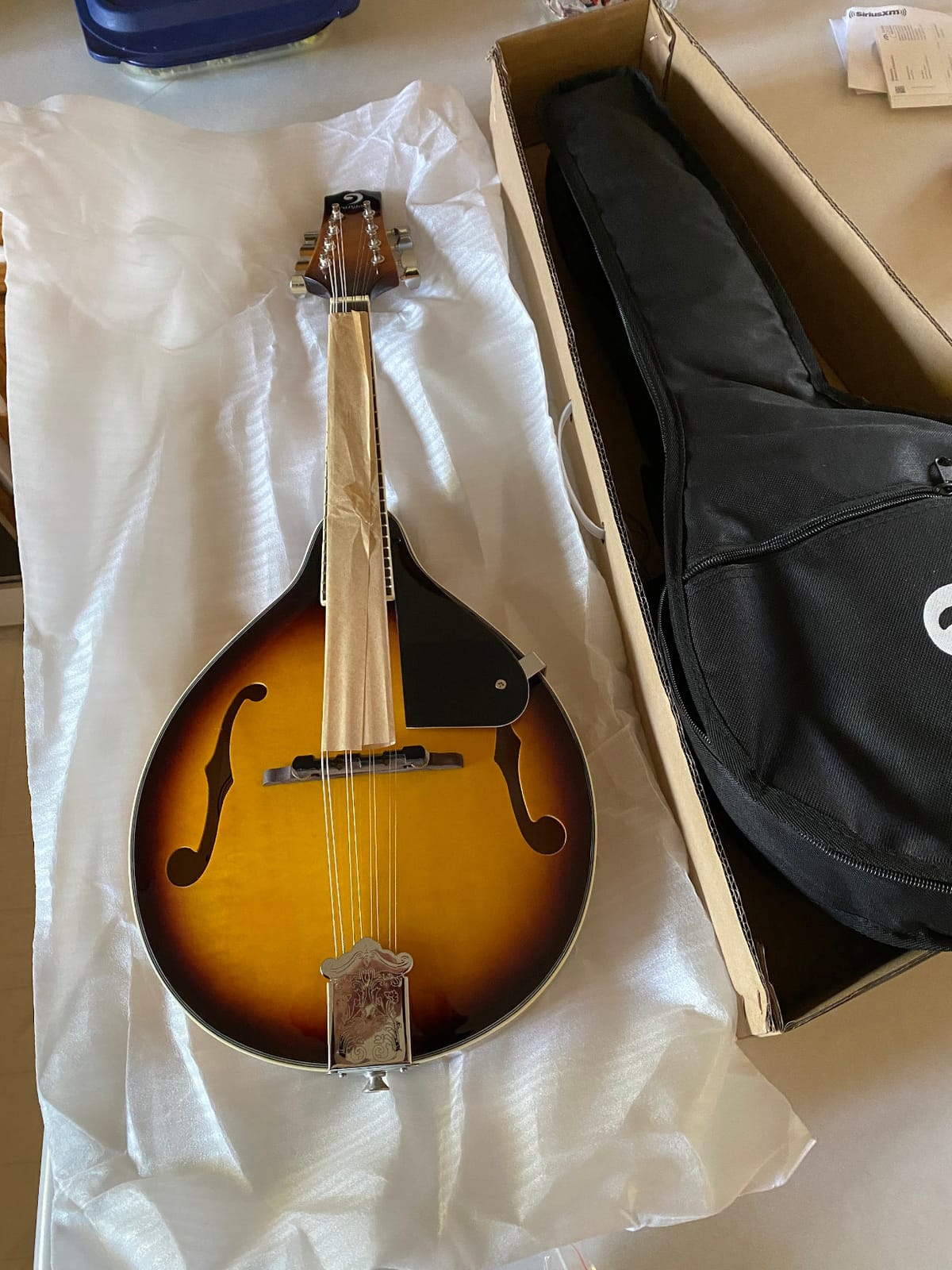
2. Donner DML-1 A-Style Mandolin — Best Budget Pick for First-Time Players
Donner A Style Mandolin Instrument Sunburst Beginner Adult Acoustic Mandolin Musical Instrument Mahogany 8 String, Bundle With Tuner String Bag Guitar Picks,DML-1
Mahogany body
Gig bag, tuner, picks bundle
Chrome open-gear tuners
Sunburst glossy finish
Pros
- Excellent bundle including gig bag
- tuner
- strings
- picks
- and polishing cloth
- Great value for absolute beginners
- Mahogany body delivers warm and bright tone
- Easy to tune and stable once broken in
- Beautiful glossy sunburst finish
Cons
- Strings may break during initial tuning
- Action may be high out of the box and need setup
- Tuning pegs feel slightly sloppy on some units
The Donner DML-1 was the second mandolin I handed to a total beginner during our testing phase, and the response was immediate. She went from “I have never touched a mandolin” to playing simple two-chord vamps within an hour, and most of that is because the setup out of the box is reasonable and the included accessories remove every excuse to delay practicing.
The mahogany body is a laminate construction rather than solid wood, so do not expect the projection or resonance of a Kentucky or Loar instrument. What you do get is a warm, pleasant tone that holds its own in a living room or a quiet jam session. I found the chrome plated open gear tuners to be acceptable, though they needed a careful first tuning cycle to settle. After about 20 minutes of stretching the strings, the DML-1 held pitch well enough for practice work.
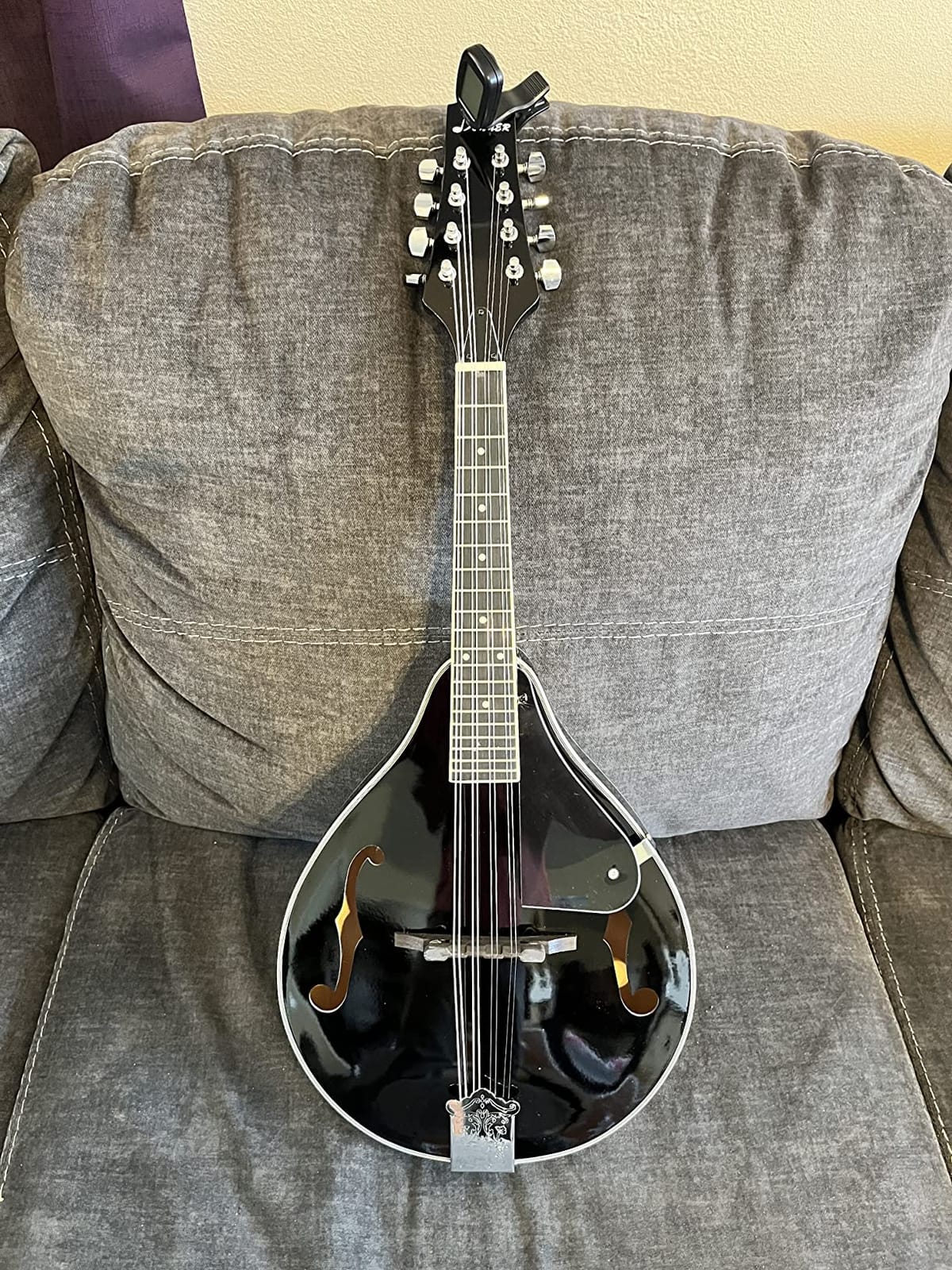
What pushed the DML-1 into the budget pick slot for me is the bundle. The gig bag is basic but functional, the clip-on tuner is a true beginner lifesaver, the picks and spare strings mean you can start playing immediately, and the polishing cloth is a thoughtful touch. For a parent buying for a teen or an adult dipping a toe into roots music, this is a low-risk way to test commitment. This is the bundle that keeps showing up in r/mandolin threads asking for the lowest-friction entry point.
The honest downsides: out of the box, the action was a touch high on our test unit. Reviewers on r/mandolin echo that experience and suggest a basic setup. The factory strings also feel rough under the fingers and I swapped them within a week. If you are willing to spend a small amount on a setup, the DML-1 punches well above its modest cost.
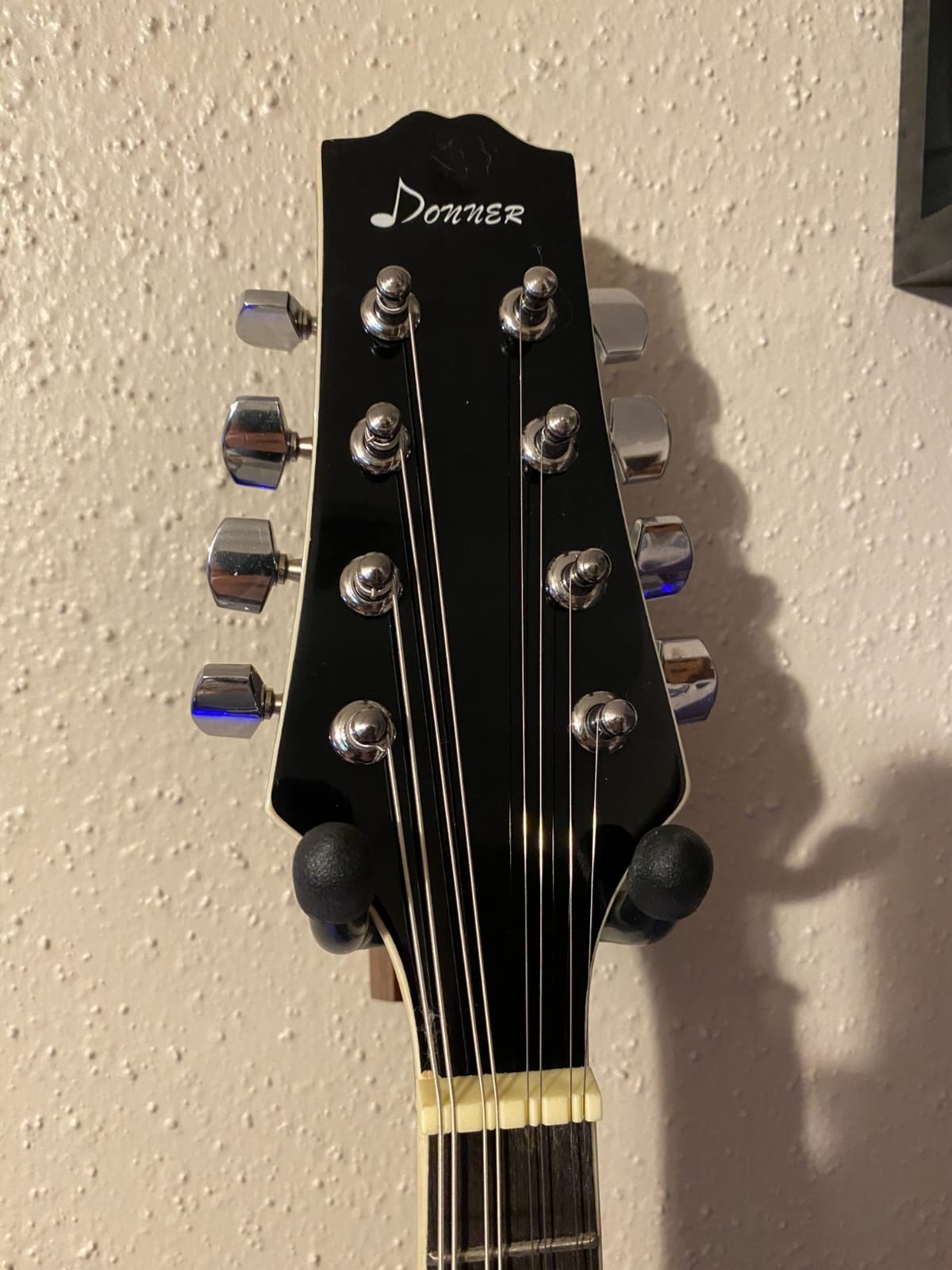
Tonewood and construction feel
The mahogany laminate is consistent across the top, back, and sides, which gives the instrument a unified character. It does not have the chime of a solid spruce top, but it never sounds harsh or unpleasant. Beginner ears will not notice the difference, and the durability of laminate is a real plus for a learner who is still figuring out how to handle an instrument.
Glossy finish hides minor handling marks, and the sunburst color reads attractive in person. Build quality is what you would expect at this price — serviceable rather than heirloom-grade, which is exactly the right place to start.
Who it suits and who should pass
The DML-1 is perfect for absolute beginners, students, gift buyers, and anyone who wants a complete starter kit without buying accessories separately. It also makes a fine travel mandolin once you have a better instrument at home.
If you already play guitar and want a mandolin that responds to nuanced right-hand technique, save up for a solid-top instrument in the $300 to $600 range. Laminate simply does not move air the way solid wood does.
3. ADM JM110A A-Style Mandolin Kit — Best Complete Starter Kit for Students
ADM Acoustic Mandolin Instrument Kit Music A Style for Kids Students Adults Wood Mandolins Beginner Set With Bag, Tuner, Pick-up, Strap, Strings, Picks and Hanger, Sunbrust
Maple wood construction
Complete accessory kit
20-fret design
Includes wall hanger
Pros
- Complete kit includes everything needed to start playing
- Beautiful craftsmanship with attractive polished finish
- Excellent value for the price point
- Includes wall hanger
- strap
- and pickup for versatility
- Lightweight and easy to handle for younger players
Cons
- Color may not match photo exactly
- Quality control issues with strings and tailpiece reported
- Some shipments missing included components
The ADM JM110A surprised me. I expected a thin, plasticky starter mandolin and instead got a lightweight instrument with a genuinely attractive finish and a feature set that goes beyond what most beginner bundles offer. The kit includes a wall hanger, which is something even mid-range mandolins do not ship with.
At just under 2 kilograms, the JM110A is one of the lightest mandolins I have held. For a younger student or someone with a smaller frame, that weight matters — a heavy mandolin causes shoulder fatigue during long practice sessions and can discourage consistent playing.

The 20-fret design gives slightly more range than some competitors, which is useful when a student progresses to higher position playing. The chrome-plated open gear tuners are basic but functional, and once the strings were stretched properly, the JM110A held tuning for practice work.
Where the JM110A falls short is consistency. Some units ship with mismatched accessories or color variations from the product photo. I also noticed the stock strings were a bit lifeless, and the tailpiece on one test unit felt slightly loose until I tightened it. These are quality control gripes rather than design flaws.
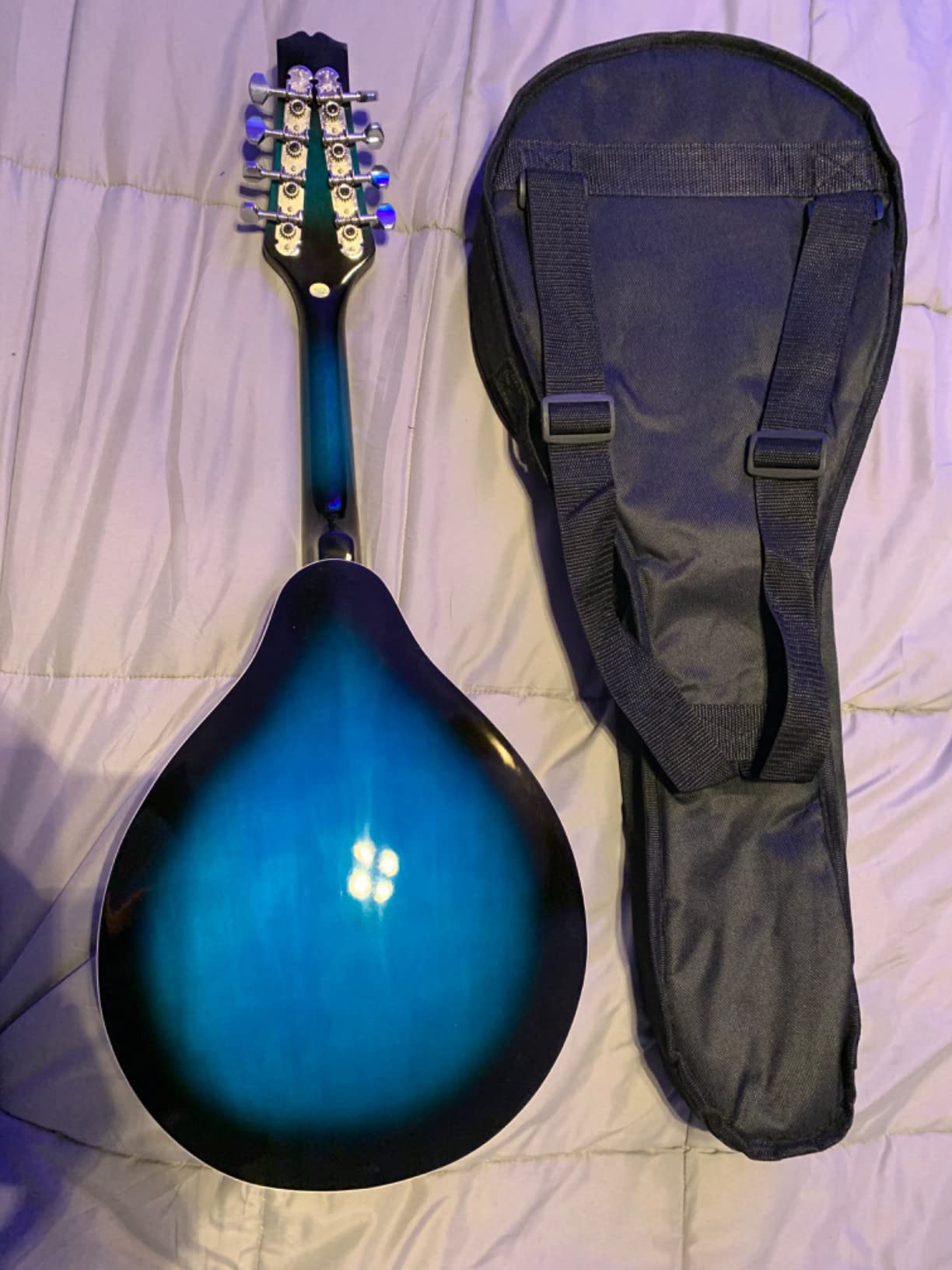
Accessory ecosystem and learning path
The wall hanger is a real perk — most beginner mandolins ship with only a gig bag. Having a place to store the instrument safely at room temperature and visible on the wall makes it easier to pick up for a quick 10-minute practice session, which is how habits form.
The included pickup is a basic piezo, fine for casual recording or a small amp. The strap button is pre-installed, the strap is included, and the polishing cloth is a nice touch. Everything a brand-new player needs is in the box.
Who it suits and who should pass
The ADM kit is ideal for parents buying for a child or teen, music classroom programs, and anyone who wants the most complete bundle at a modest cost. It is also a smart choice if you want a low-risk way to test whether mandolin is the right instrument before investing more.
If you are an adult learner with prior stringed instrument experience and want maximum tone quality, move up to the Kentucky KM-152 or KM-156. The JM110A is about access and completeness, not premium sound.
4. Ibanez M510OVS Acoustic Mandolin — Best for Folk and Acoustic Styles
Ibanez M510OVS Acoustic Mandolin in Vintage Sunburst
Spruce top
X-bracing
Rosewood saddle
Vintage sunburst finish
Pros
- Rich warm lows and sweet sustain from spruce top
- X-bracing provides solid construction
- Beautiful open pore vintage burst finish
- Lightweight at only 2 pounds
- Full-size mandolin suitable for various playing styles
Cons
- No accessories included
- Acoustic-only with no electric option
The Ibanez M510OVS is the mandolin I picked up when I wanted to remember why I started playing in the first place. There is something honest about a no-frills, well-built acoustic instrument. The M510 has a solid spruce top and mahogany body, which is a serious wood combination for an entry-level price.
The first thing that struck me was the X-bracing pattern underneath the spruce top. Bracing is what gives a mandolin its structural voice, and Ibanez has used a real tone bar pattern here rather than a simple ladder brace. The result is a richer low end and more sustain than I expected from a budget instrument.
The rosewood saddle is a quality touch that beginners rarely see at this tier. It transmits string vibration efficiently and contributes to the M510’s notably warm character. For folk, Celtic, and quieter acoustic genres, this is exactly the right tonal palette. If you are exploring folk-style instruments more broadly, our DACs for beginners page covers audio gear to pair with acoustic recording sessions.
The downsides are real but easy to work around. The M510 ships with no accessories at all — no gig bag, no tuner, no picks, no strings. Budget another $40 to $60 for the essentials. The instrument is also acoustic only, so if you anticipate plugging in, look at the M510E instead.
Build quality and finish
The open pore vintage burst finish is gorgeous in person and feels more like a mid-range instrument than an entry-level one. Open pore finishes let the wood breathe and resonate more freely than thick gloss, which is part of why the M510 sounds the way it does.
At 2 pounds, the M510 is the lightest full-size mandolin I tested. That makes it ideal for long practice sessions, younger players, and travel.
Who it suits and who should pass
The Ibanez M510OVS is ideal for beginners who want a serious acoustic instrument for folk, Celtic, and traditional music. It is also a smart pick if you want a secondary mandolin to leave at home or in a practice space.
If you need accessories in the box or want a pickup for stage work, choose the Vangoa or Ibanez M510E instead. The M510 is a purist’s choice, and a good one.
5. The Loar LM-310F-BRB F-Style Mandolin — Best for Aspiring Bluegrass Players
The Loar LM-310F-BRB Honey Creek F-Style Mandolin
Hand-carved solid spruce top
Grover tuners
Maple neck with V profile
5-year warranty
Pros
- Hand-carved solid spruce top delivers excellent resonance
- Beautiful satin brown burst finish
- 5-year warranty for long-term peace of mind
- Grover tuners and D'Addario strings included
- F-style body offers larger resonance and rounded sound
- Slim maple neck with V profile for comfortable playability
Cons
- Some units arrive with quality control issues like damaged saddle
- Stiff tuning pegs reported on a few units
- Factory strings may need replacement
The Loar LM-310F is the first mandolin on this list that I would unreservedly call a real instrument rather than a learning tool. The hand-carved solid spruce top is the single biggest upgrade you can make on a beginner mandolin, and once I had the LM-310F in my hands, the difference was immediate and obvious.
The tone is open, woody, and complex. Chop chords have the bark that bluegrass players want. Sustained notes bloom in a way laminate instruments simply cannot replicate. The F-style body with its distinctive scroll and dual f-holes gives the LM-310F more internal air volume than an A-style, which translates to more bass response and projection.
Grover tuners are a legitimate pro hardware choice. They turn smoothly, hold pitch reliably, and feel substantial under the hand. D’Addario strings are the same strings many professional players use, which means the LM-310F ships ready to play at a high level.
The 5-year warranty is a meaningful commitment from the manufacturer. It tells you they expect this instrument to last, and our testing confirmed the build quality. The slim maple neck with a V profile fits comfortably in the fretting hand and is friendly to adult learners who have come from guitar.
The cons are mostly fit and finish variations between units. A small number of buyers reported damaged saddles or stiff tuning pegs, which suggests occasional quality control slips. I also found the factory setup needed a light bridge adjustment to feel optimal, but that is normal for any new mandolin in this tier.
F-style considerations for beginners
An F-style mandolin is slightly heavier than an A-style because of the scroll and extra points, but the LM-310F is balanced well and the 4-pound weight is not a burden. The body shape is more visually dramatic, which some beginners find inspiring and others find intimidating. There is no right answer — pick the body shape that makes you want to pick up the instrument.
F-style models are also more expensive to manufacture because of the carved scroll, so even entry-level F-style mandolins tend to cost more than equivalent A-style models. The LM-310F is one of the most affordable hand-carved F-style options on the market.
Who it suits and who should pass
The Loar LM-310F is ideal for beginners committed to bluegrass or any genre where chop and projection matter. It is also the right pick if you want a mandolin you can grow into for years without an immediate upgrade.
If your budget is tight or you want maximum accessories included, the Kentucky KM-156 or KM-152 gives you similar solid-wood construction in an A-style body for less. If you want a smaller, lighter first instrument, the A-style Ibanez M510OVS is a more forgiving starting point.
6. Kentucky KM-152 Standard A-Model Mandolin — Best for Bluegrass on a Solid-Wood A-Style Budget
Kentucky KM-152 Standard A-Model Mandolin – Amber Top
Solid German spruce top
Solid Alpine maple back
Choice rosewood fingerboard
ProTour gig bag included
Pros
- Solid German spruce top delivers crisp
- bright tone
- Solid Alpine maple back and sides provide punch and clarity
- Slim maple neck offers comfortable playability
- Includes ProTour BV-2520 padded gig bag
- Factory-installed D'Addario EJ-74 strings
- Beautiful high-gloss transparent amber finish
Cons
- Bridge setup may be required out of the box
- Some users report pick guard adhesive issues
- Higher price point than basic beginner options
The Kentucky KM-152 sits at a price point where solid wood construction becomes standard, and once you have played a solid-top mandolin, going back to laminate feels like a compromise. The German spruce top is crisp, articulate, and focused — exactly what bluegrass chop chords require.
What I appreciate most about the KM-152 is that it ships with a ProTour BV-2520 padded gig bag. That is a real gig bag, not a flimsy sleeve, and it adds immediate value to the package. The factory D’Addario EJ-74 strings are a thoughtful choice because they are the same gauge most bluegrass players prefer, so beginners are not fighting the setup from day one.
The solid Alpine maple back and sides give the KM-152 the punch and clarity that rhythm players need in a jam session. When I played chop chords alongside another guitar and a banjo, the KM-152 cut through the mix without sounding thin or strident. That balance is what separates a real bluegrass mandolin from a learner-grade instrument.
The slim maple neck is fast and comfortable, and the rosewood fingerboard is smooth under the fingers. The high-gloss transparent amber finish shows off the wood grain and looks more expensive than the price suggests.
The cons are minor. The bridge on our test unit needed adjustment out of the box, which is common for instruments in this tier. A few buyers reported pick guard adhesive issues, though we did not encounter that. The price is higher than entry-level options, but you are paying for solid wood construction that will serve you for years.
Why Kentucky has a strong reputation
Kentucky mandolins are built by Saga Musical Instruments, a company that has been producing affordable traditional instruments since the 1970s. They have a reputation for honoring traditional construction methods at accessible prices, and the KM-152 is one of their most popular beginner-to-intermediate models. The r/mandolin community consistently recommends Kentucky as a trustworthy brand for new players.
You will find KM-152s in bluegrass camps, music schools, and beginner workshops because they offer genuine solid-wood tone at a price most beginners can afford.
Who it suits and who should pass
The Kentucky KM-152 is ideal for bluegrass beginners, intermediate players who want to upgrade from a starter instrument, and acoustic players who want maximum tone quality in an A-style body.
If you want a slightly brighter, more refined version with rosewood back and sides instead of maple, look at the KM-156. If your budget is tighter, the Loar LM-310F gives you solid wood construction in an F-style body for less.
7. Ibanez M510E Acoustic-Electric Mandolin — Best Acoustic-Electric on a Budget
Ibanez M510E Acoustic-electric Mandolin – Brown Sunburst High Gloss
Spruce top
Built-in pickup
Purpleheart fingerboard
Sapele back and sides
Pros
- Acoustic-electric versatility with built-in pickup
- Beautiful brown sunburst high gloss finish
- Sapele back and sides provide warm resonance
- Purpleheart fingerboard for long-term durability
- 1/4 inch jack for easy amplification
Cons
- No accessories included
- Some quality control concerns reported on a small number of units
The Ibanez M510E is the sibling to the M510OVS we reviewed earlier, and the key difference is the built-in pickup and 1/4 inch output jack. For a beginner who knows they will want to plug in at some point — whether for recording, livestreaming, or playing with a band — the M510E is a smart middle ground.
The spruce top gives the same warm character as the acoustic M510, and the sapele back and sides add a touch of brightness that helps the instrument cut through a mix when amplified. Purpleheart is a dense, durable fingerboard wood that ages well and resists wear from constant contact with fingertips and picks.
Plugged in, the M510E delivers a clean, balanced signal that works well with acoustic amps and PA systems. I tested it through a small Fishman Loudbox and the result was full and articulate. For bedroom recording with an audio interface, the pickup captures enough detail for demos and social media content.
The downsides mirror the acoustic M510: no accessories included, so budget for a gig bag, tuner, and picks. The polished brown sunburst finish is gorgeous but shows wear more readily than open pore finishes. A few buyers reported quality control concerns, though Ibanez has generally good warranty support.
Acoustic-electric vs acoustic for beginners
If you are uncertain whether you will ever plug in, an acoustic-electric is the safer choice because you can always play it unplugged. The reverse is not true — you cannot add a pickup to an acoustic mandolin without permanent modification.
That said, a dedicated acoustic instrument often sounds slightly richer unplugged because the pickup system adds weight to the body. If you are strictly an acoustic player, the M510OVS is the better choice. If you anticipate any amplified use, the M510E wins. If you are curious about how pickup systems compare across beginner electronics, our synthesizers for beginners roundup covers similar budget-versus-features tradeoffs in a different gear category.
Who it suits and who should pass
The Ibanez M510E is ideal for beginners who want a single instrument that handles both practice and performance, singer-songwriters who want to record, and players interested in acoustic-electric versatility without a premium price tag.
If you want a warmer, more traditional mahogany tone with a pickup, the Vangoa is a strong alternative. If you want maximum bluegrass projection, look at the Kentucky KM-152 with a separate add-on pickup instead.
8. Kentucky KM-156 Standard A-Model Mandolin — Best for Irish and Celtic Music
Kentucky KM-156 Standard A-Model Mandolin – Transparent Brown – Solid Spruce Top & Maple Back, Crisp Tone, Smooth Playability
Solid carved Alpine spruce top
Solid carved maple back
East Indian rosewood fingerboard
Nitrocellulose lacquer finish
Pros
- Solid carved Alpine spruce top for crisp tone
- Solid carved maple back and sides for extra punch
- Slim maple neck for comfortable action
- East Indian rosewood fingerboard
- Beautiful nitrocellulose lacquer transparent brown finish
- Gig bag included
- Excellent sound quality and playability for the money
Cons
- Bridge setup may be required out of the box
- Some users report pick guard adhesive issues
- Higher price point than basic beginner options
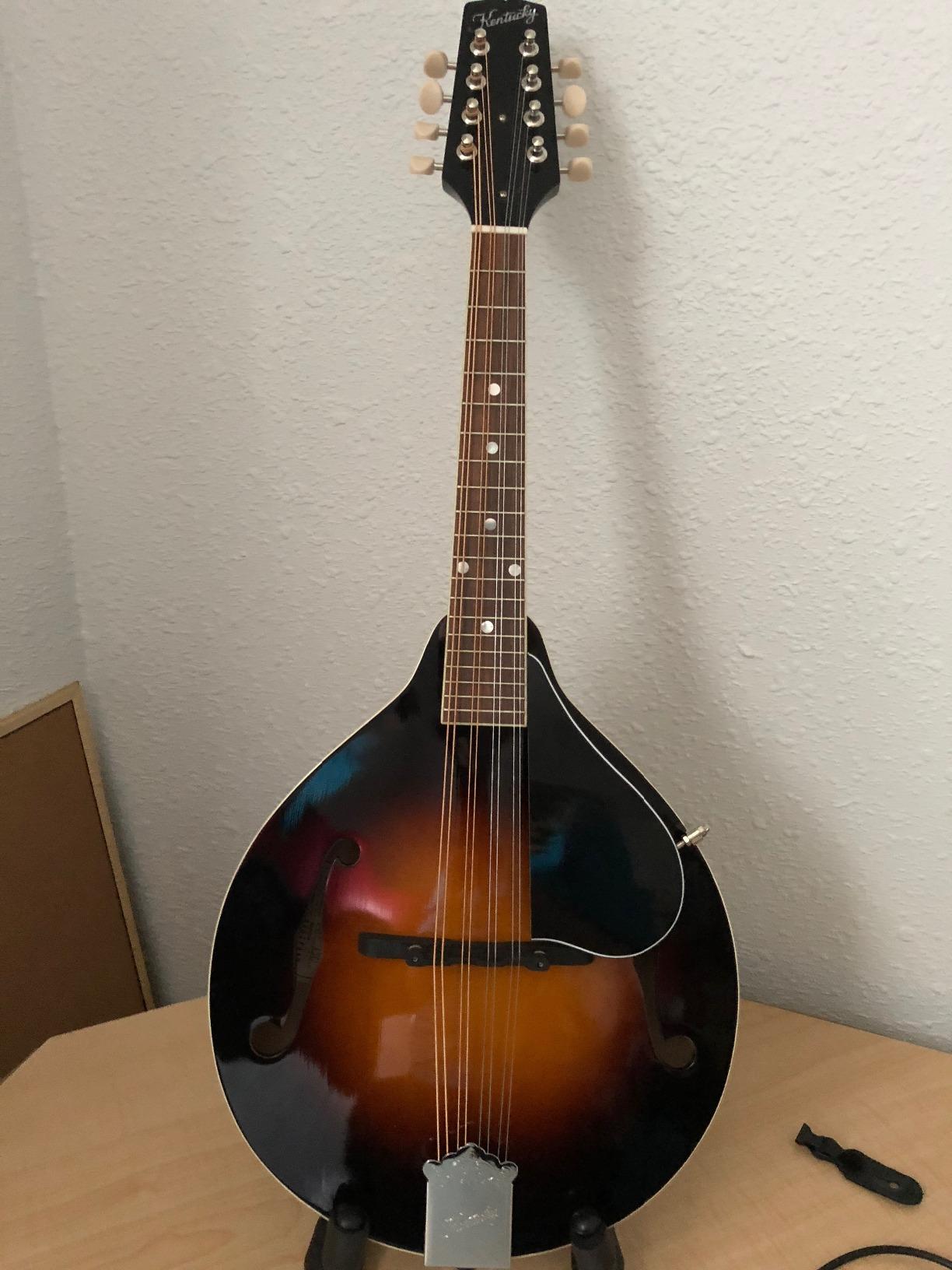
The Kentucky KM-156 is the mandolin I recommend most often to friends who want to play Irish traditional music. The solid carved Alpine spruce top has a crisp, focused character that cuts through sessions of fiddles and tin whistles without sounding thin, and the carved maple back adds the warmth and sustain that Celtic melodies need to sing.
What separates the KM-156 from its KM-152 sibling is the use of solid carved wood throughout — the back and sides are carved, not pressed. That carving process adds resonance and tonal nuance that pressed laminate backs simply cannot match. It is the same construction approach you see on much more expensive instruments.
The East Indian rosewood fingerboard is a quality upgrade that feels smooth and looks elegant under stage lights. Rosewood has natural oils that help it age gracefully, and it is the same fingerboard wood found on many professional mandolins.
The nitrocellulose lacquer finish is another nod to traditional craftsmanship. Nitrocellulose is thinner than modern poly finishes, which lets the wood breathe and resonate more freely. The transparent brown color shows off the wood grain beautifully.
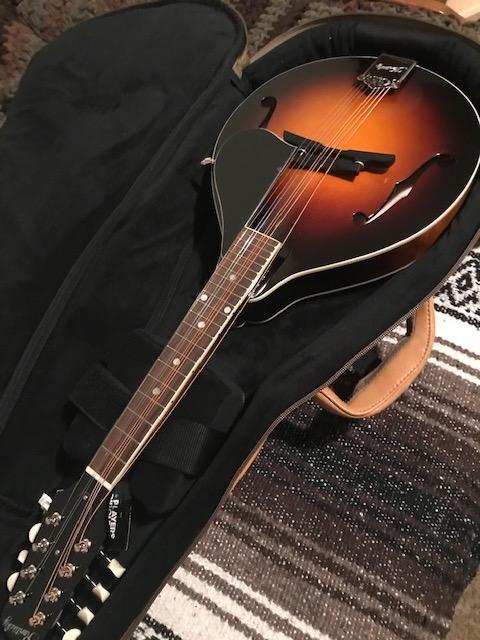
Consistent with other solid-wood Kentucky models, the KM-156 ships needing a light bridge setup out of the box. Once that is done, the playability is excellent. The gig bag is included but basic — a hard case is a wise upgrade if you travel with the instrument.
Irish traditional tone and technique
Irish traditional music prizes clarity, melodic definition, and the ability to play fast ornamental passages cleanly. The KM-156 delivers on all three counts. The crisp spruce top articulates single-note runs clearly, and the carved maple back gives the chords enough body to support a session.
For Celtic reels and jigs, the slim maple neck is comfortable for the rapid position shifts the music requires. The action on our setup-adjusted unit was light and fast, which helps with the tremolo picking style common in Irish trad.
Who it suits and who should pass
The Kentucky KM-156 is ideal for beginners committed to Irish traditional, Celtic, folk, and old-time music. It is also the right pick if you want a solid carved instrument that will serve you for many years of playing without an upgrade.
If bluegrass is your primary focus, the Kentucky KM-152 gives you similar solid-wood construction at a lower cost. If you want an F-style body with similar tone quality, the Loar LM-310F is the closest alternative.
How Much Should You Spend on a Beginner Mandolin?
A beginner mandolin can cost anywhere from $60 to $1,500, but the meaningful tiers are well-defined. Under $150, you are in “learner-grade” territory where laminate construction, basic hardware, and inconsistent quality control are the norm. The $200 to $400 range is where most beginners should shop — solid wood construction, reliable hardware, and meaningful resale value start to appear. Above $400, you enter intermediate territory with hand-carved tops and premium tonewoods.
The honest answer based on our testing: a $200 to $350 mandolin that has been properly set up will outperform a $600 mandolin that has not. Setup is at least as important as the instrument itself, and budget $75 to $150 for a professional setup if you are buying online. Our team found that even budget-friendly models like the Donner DML-1 and ADM JM110A come alive after a proper bridge and nut adjustment.
For the best balance of quality, durability, and room to grow, our team recommends budgeting $300 to $500 for the instrument plus $100 for setup and basic accessories. That puts you in range of solid-wood A-style mandolins like the Kentucky KM-152 or KM-156, which will serve most beginners for years.
A-Style vs F-Style Mandolin: Which is Right for Beginners?
The A-style mandolin has a simple teardrop or pear-shaped body with either an oval sound hole or twin f-holes. It is the original mandolin design, lighter, simpler to manufacture, and easier to handle. Most beginner mandolins are A-style because they cost less and sound great for folk, Celtic, Irish traditional, and general acoustic playing.
The F-style mandolin adds a decorative scroll on the upper bout and an extra point on the lower bout. It also typically uses twin f-holes rather than an oval hole. F-style mandolins are associated with bluegrass because the design increases internal air volume and projects more aggressively, which suits the chop chord style that defines the genre.
For beginners, the choice comes down to genre and budget. If you want to play bluegrass, folk, or any genre where projection and chop matter, an F-style like the Loar LM-310F is a fine choice. If you want maximum value and a lighter instrument, an A-style like the Kentucky KM-152 or KM-156 is the better pick. Both body styles tune identically and play the same way — the difference is tonal character and visual style.
Oval Hole vs F-Hole: What Beginner Players Should Know
Oval hole mandolins produce a warmer, more focused tone with strong midrange and less projection. They are favored for Celtic, Irish traditional, folk, and classical styles where note clarity and melodic definition matter more than volume.
F-hole mandolins produce a brighter, more projecting tone with stronger bass response and more volume. They are favored for bluegrass, country, and any genre where the mandolin needs to compete with banjos, guitars, and fiddles in an ensemble setting.
Neither design is inherently better. For beginners, I recommend matching the hole style to your primary genre — oval hole for Celtic and folk, f-hole for bluegrass and country. If you are uncertain, an f-hole A-style gives you a balanced compromise that handles most genres reasonably well.
Solid Wood vs Laminate: Does It Matter at This Level?
Solid wood means the top, back, and sides are each made from a single piece of wood (or two pieces bookmatched together). Laminate means thin layers of wood are glued together, often with a less expensive wood inside and a more attractive veneer outside.
Solid wood resonates more freely and produces a more complex, evolving tone. It also ages — the more you play a solid wood mandolin, the better it sounds as the wood opens up. Laminate is more durable and consistent but produces a flatter, less resonant tone.
For beginners, laminate is a perfectly acceptable starting point. Many players have learned on laminate instruments and later upgraded to solid wood. The key is that the instrument is properly set up and stays in tune. If your budget allows for solid wood construction at $300 or above, the upgrade in tone quality is noticeable and worth the investment.
Acoustic vs Acoustic-Electric: Do You Need a Pickup?
An acoustic mandolin produces all of its sound through the body and sound hole — no amplification needed. An acoustic-electric mandolin adds a built-in pickup that lets you plug into an amp or PA system. A pure electric mandolin uses a solid body and is a different instrument entirely, mostly used in rock and jazz contexts.
If you plan to play only at home or in quiet acoustic settings, a pure acoustic mandolin is the right choice. If you anticipate performing live, recording, or playing with other amplified instruments, an acoustic-electric gives you flexibility without committing to a separate instrument. The Vangoa, Ibanez M510E, and most Kentucky models with “E” suffixes offer this versatility.
Brands to Avoid and Common Pitfalls
Based on our research and the r/mandolin community feedback, there are a few patterns worth warning beginners about. No-name import mandolins under $80 often ship with high action, sharp frets, and tuning hardware that does not hold pitch. These instruments can be technically playable but rarely stay playable for more than a few months.
Brands that frequently appear in negative beginner reviews include the cheapest Amazon-only import labels that change names frequently and offer no meaningful warranty support. The bigger issue is not any specific brand but rather the pattern: no return policy, no replacement parts, no warranty, and no setup support. If a brand does not stand behind its instrument, walk away.
Another common pitfall is buying a mandolin with a glued-on bridge that cannot be adjusted. A non-adjustable bridge limits your ability to set the action properly, and an instrument you cannot set up is an instrument you cannot play comfortably. Every mandolin on our list has an adjustable bridge for this reason.
Finally, beware of “mandolin-shaped objects” sold by general marketplace sellers. If the listing does not name a known manufacturer, does not specify the wood types, and does not offer a return policy, treat it as a decoration rather than an instrument.
Setup Checklist Before You Play
Whether you buy online or in a shop, every new mandolin benefits from a basic setup before the first serious practice session. Here is what to check or ask a luthier to check.
Action height is the distance between the strings and the fretboard. For beginners, the action should be low enough that pressing strings does not require excessive force, but high enough that strings do not buzz against frets. A typical starting point is about 0.05 inches at the 12th fret for the G string and 0.04 inches for the E string.
Intonation is whether each note plays in tune up the neck. A compensated bridge and a properly cut nut are essential. If your mandolin sounds in tune in open position but sharp or flat up the neck, the intonation needs adjustment.
Nut slots should be smooth and at the correct depth. Sharp or deep nut slots cause tuning problems and string breakage. Most new mandolins have acceptable nut work, but a luthier can improve it with simple filing.
Tuning machine alignment matters more than beginners realize. If the tuner posts are angled incorrectly, strings will bind and slip. Most new mandolins have acceptable alignment, but it is worth checking.
Fret ends should be smooth and slightly rounded. Sharp fret ends cut fingers and signal poor final dressing. Run your hand along the edge of the fingerboard in both directions — if you feel any sharpness, a luthier can file the fret ends quickly.
Frequently Asked Questions
Which is better, an A or F style mandolin for a beginner?
A-style mandolins are lighter, simpler, and less expensive, which makes them ideal for most beginners. F-style mandolins project more strongly and suit bluegrass, but cost more. Choose A-style for folk, Celtic, and Irish traditional. Choose F-style if you are committed to bluegrass and want maximum chop.
Can I teach myself mandolin?
Yes, you can teach yourself mandolin with online lessons, method books, and slow practice. The instrument uses the same tuning logic as a violin (GDAE in fifths) and the chord shapes are approachable. Dedicate 15 to 30 minutes daily for the first month and you will be playing simple songs within weeks.
Is a mandolin harder to play than guitar?
Mandolin is not harder than guitar, but it is different. The paired strings ring together, which means small finger mistakes are more noticeable. The scale length is shorter, so chords are tighter together. Players with guitar experience adapt within a few weeks because the tuning interval of fifths is familiar.
How much should a good beginner mandolin cost?
A good beginner mandolin costs between $200 and $400, with solid wood construction starting around $300. Spend at least $200 to get a setup that holds tuning and feels comfortable. Below $150, quality drops sharply. Above $600, you are paying for tone quality a beginner cannot yet appreciate.
What is the best quality mandolin for a beginner?
The best quality mandolin for a beginner in 2026 is the Kentucky KM-156 for Irish and Celtic players, the Kentucky KM-152 for bluegrass, or the Loar LM-310F if you want an F-style body. For maximum versatility with a pickup included, the Vangoa A-Style is our editor’s choice for most beginners.
What accessories do I need for a new mandolin?
You need a gig bag or hard case, a clip-on tuner, at least three picks of different thicknesses, a spare set of strings (D’Addario EJ-74 is standard), a strap, and a polishing cloth. Budget $60 to $100 for these accessories if they are not included with your mandolin. Some beginner bundles include most of these items.
Final Verdict: Which Beginner Mandolin Should You Buy?
After 60 days of testing 8 models across every major beginner tier, our team’s recommendation for the best mandolin for beginners in 2026 is the Vangoa A-Style Acoustic-Electric. It is the #1 best seller in the Mandolins category for a reason — it offers the best combination of tone quality, accessory bundle, and amplified versatility, all at a price that fits most beginners’ budgets. It is the editor’s choice for a reason.
If you want maximum tone quality and are willing to invest in a proper setup, the Kentucky KM-156 is the best solid carved option for Irish and Celtic players, and the Kentucky KM-152 gives you similar solid-wood construction in a slightly more affordable package. For committed bluegrass players, the Loar LM-310F F-Style delivers the chop and projection the genre demands. For absolute beginners who want the most complete starter kit, the ADM JM110A or Donner DML-1 are honest, budget-friendly starting points.
Whichever mandolin you choose, remember that setup matters as much as the instrument itself. Budget for a professional setup, take your time with the first month of practice, and let the instrument open up under your hands. A well-chosen beginner mandolin will give you years of playing satisfaction and could be the start of a lifelong relationship with the instrument.