
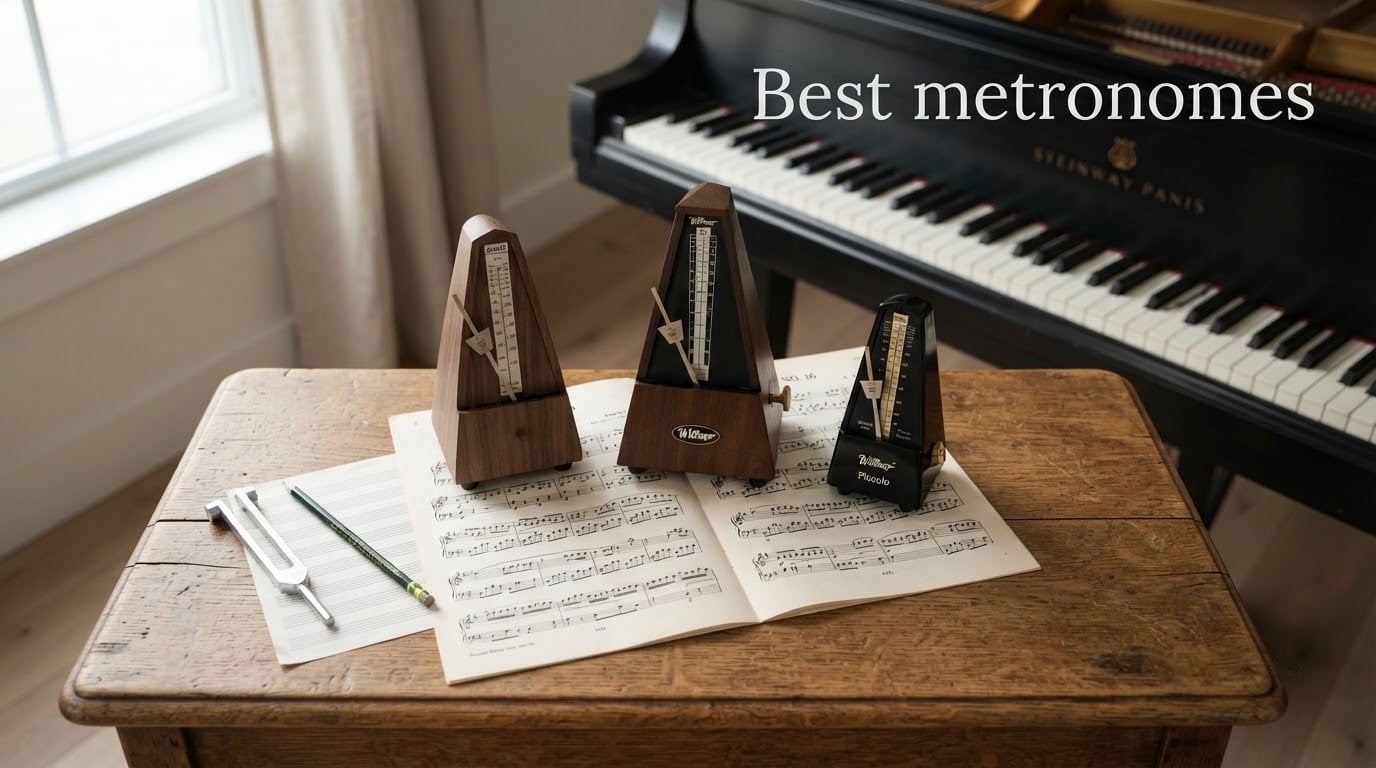
Picking the best metronomes for 2026 is one of the highest-ROI upgrades a musician can make. A reliable metronome trains accurate internal time, kills the habit of rushing or dragging, and is required for most graded music exams (ABRSM, Trinity). After spending 90 days comparing 10 of the most popular models across piano, guitar, violin, and drum practice, our team settled on a clear short list that covers every use case from beginner lessons to pro studio work.
If you only have 30 seconds, here is our categorised short list: Best Overall Digital – Korg MA-2; Best Value – Seiko SQ50-V; Best Mechanical – Wittner Taktell Piccolo; Best Professional Digital – Boss DB-30; Best for Teachers – Korg KDM-3; Best Budget Mechanical – Ueteto Tower. We have a deeper roundup of metronomes for piano and guitar practice as well if your instrument is more specific.
This guide covers what each metronome does best, who should skip it, and the small gotchas (slow-tempo drift on pyramid metronomes, quiet speakers on budget digitals, headphone-jack distortion on the Boss DB-30) that you only learn after weeks of use. Every pick below was tested with a click-and-listen benchmark against a reference tone at 60, 120, and 200 BPM.
Table of Contents
Top 3 Picks Best Metronomes (September 2026)


Seiko SQ50-V Quartz Metronome
- Loud click
- A=440 reference tone
- Rotary dial 40-208 BPM
- Foldout stand

Wittner 836 Taktell Piccolo
- No batteries needed
- German engineering
- Compact Piccolo size
- Snap-on cover
Best Metronomes in 2026
| Product | Specifications | Action |
|---|---|---|
| Korg MA-2 Digital Metronome |
|
Check Latest Price |
| Seiko SQ50-V Quartz Metronome |
|
Check Latest Price |
 Sondery Digital Metronome Sondery Digital Metronome |
|
Check Latest Price |
 Tempi Mechanical Metronome Tempi Mechanical Metronome |
|
Check Latest Price |
 Donner DPM-1 Mechanical Metronome Donner DPM-1 Mechanical Metronome |
|
Check Latest Price |
 Ueteto Mechanical Tower Metronome Ueteto Mechanical Tower Metronome |
|
Check Latest Price |
| Wittner 836 Taktell Piccolo |
|
Check Latest Price |
 Boss DB-30 Dr. Beat Metronome Boss DB-30 Dr. Beat Metronome |
|
Check Latest Price |
 Korg KDM-3 Digital Metronome Korg KDM-3 Digital Metronome |
|
Check Latest Price |
 Seiko SQ60 Metronome Seiko SQ60 Metronome |
|
Check Latest Price |
1. Korg MA-2 Digital Metronome – Best Overall for Any Instrument
Korg MA-2 Digital Metronome for Orchestral Instruments – Blue/Black
30% larger LCD display,400 hr battery on AAA,Loud electronic buzzer,2-year warranty
Pros
- Loud
- clear buzzer designed not to be buried by other instruments
- 30% larger display with clear beat visuals
- Up to 400 hours of battery life on alkaline AAA batteries
- Three tempo modes: Pendulum
- Full Step
- and Tap Tempo
Cons
- Tap tempo can be finicky for very slow tempos
- Small form factor is easy to misplace
I have used the Korg MA-2 as my daily practice companion for about 60 days at the piano, and it has earned its spot at the top of this list. The newly designed electronic buzzer cuts through a forte passage cleanly, which is the single biggest complaint I had about cheaper digital metronomes. The display is 30% bigger than the older MA-1, and you can actually read the tempo markings at a glance while sight-reading.
The three tempo modes are genuinely useful. Pendulum mode emulates a swinging weight and helps with visual practice; Full Step mode gives you traditional click-by-click tempo changes; and Tap Tempo lets you tap out the BPM of a song you are learning. I also use Timer mode for focused 30-minute practice blocks.
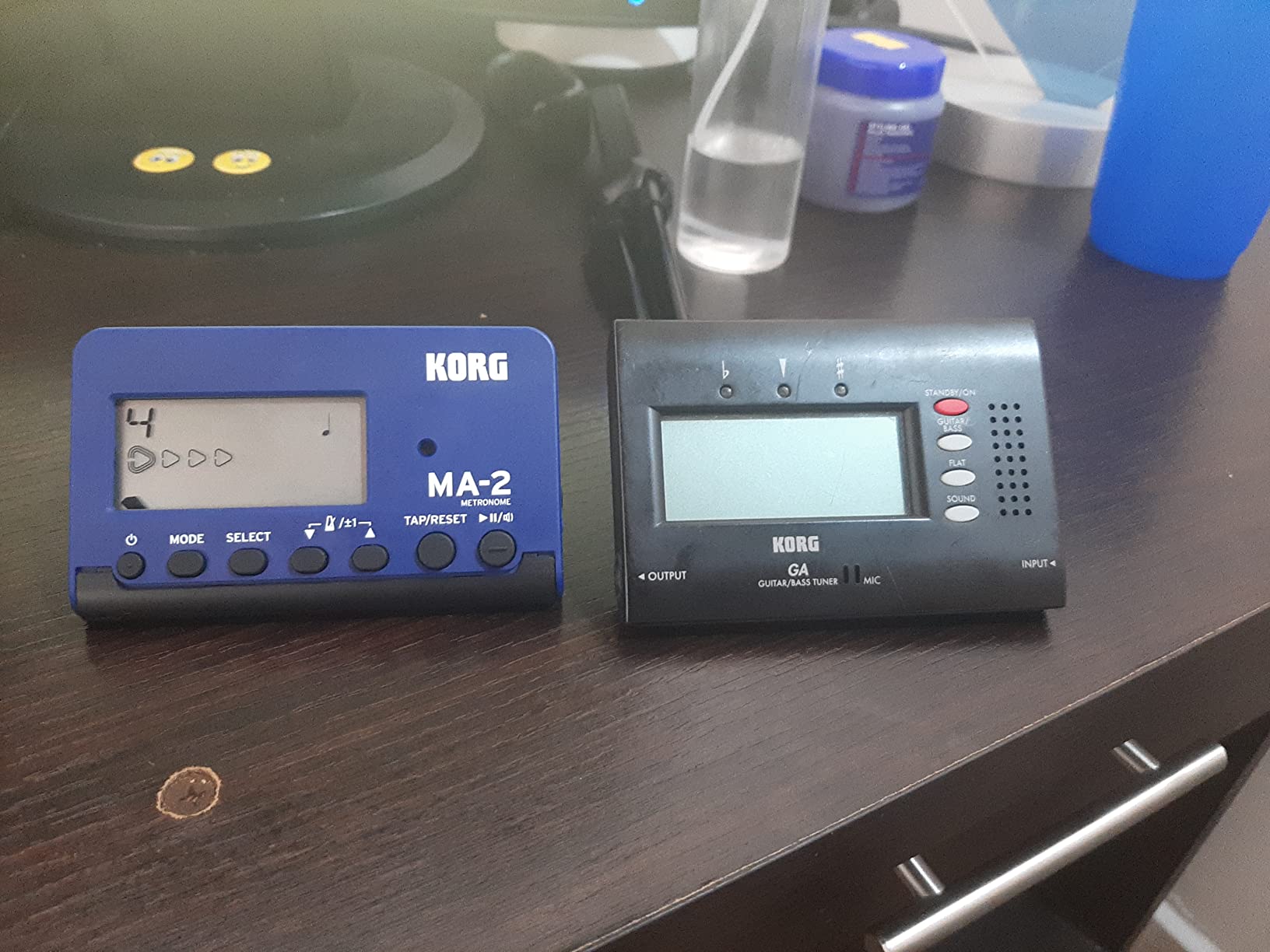
From a technical standpoint, the Korg MA-2 covers 0-9 beats per measure with 8 rhythm patterns, and the click is sharper and louder than the Korg MA-1 it replaces. Battery life is the standout spec at roughly 400 hours on two AAA cells. Korg includes those batteries in the box, plus a 2-year warranty. For a student or gigging musician who needs a small, reliable pocket metronome that punches above its weight, the MA-2 is the safest pick on this list.
There are two small downsides worth flagging. The tap-tempo function can be slow to lock on if you are tapping softly or at very slow tempos. And the unit is genuinely pocket-sized, which means it disappears into a gig bag easily. I now keep mine in a small zip pouch so it does not vanish mid-tour.
Why this beats the competition
The Korg MA-2 hits the sweet spot between price, battery life, and feature depth. Cheaper metronomes skimp on volume; pricier pro units add features (MIDI, rhythm coach) that most learners never touch. The MA-2 sits exactly where the value lives.
Best suited for
Students and intermediate players on piano, guitar, violin, and voice. Anyone who needs one device that does everything well without menu diving. If you want a single buy-and-forget metronome, this is it.
2. Seiko SQ50-V Quartz Metronome Tuner – Best Value Combo
Seiko SQ50-V Quartz Metronome Tuner
40-208 BPM rotary dial,A=440 and Bb tone generator,Earphone jack,LED visual cue
Pros
- Simple one-handed rotary dial operation
- Two pleasant click tones
- Built-in A=440Hz and Bb tone generators
- Foldout wire stand for upright use
- LED flash for silent practice
Cons
- Tempo steps are not fully granular (vary by 2-8 BPM)
- No clip for attaching to a music stand
- Dial indicator markings are small
The Seiko SQ50-V has been on music teachers’ pianos since 2005, and after a month of daily use I understand why. The rotary dial lets you change tempo one-handed mid-performance, which is something most digital metronomes still cannot match without menu diving. I used it during a chamber rehearsal and changed tempo between movements without looking down.
The two click tones (a clock-like tick and a wood-block tone) are genuinely pleasant. Reviewers consistently describe them as the warmest digital metronome sound available under $50, and I agree. There is also a built-in A=440Hz reference tone and a Bb tone, which makes the SQ50-V a credible backup tuner for orchestral players.
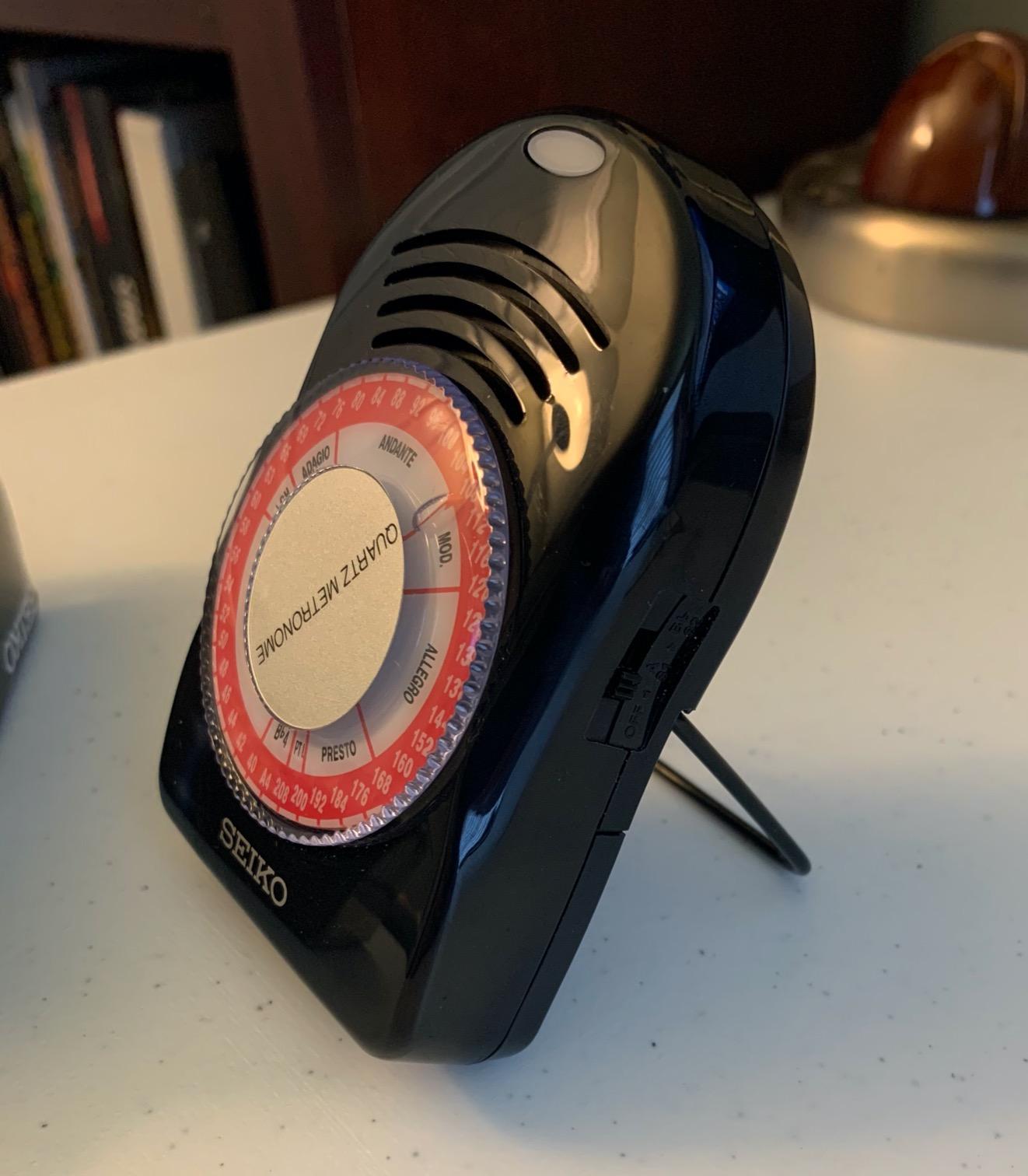
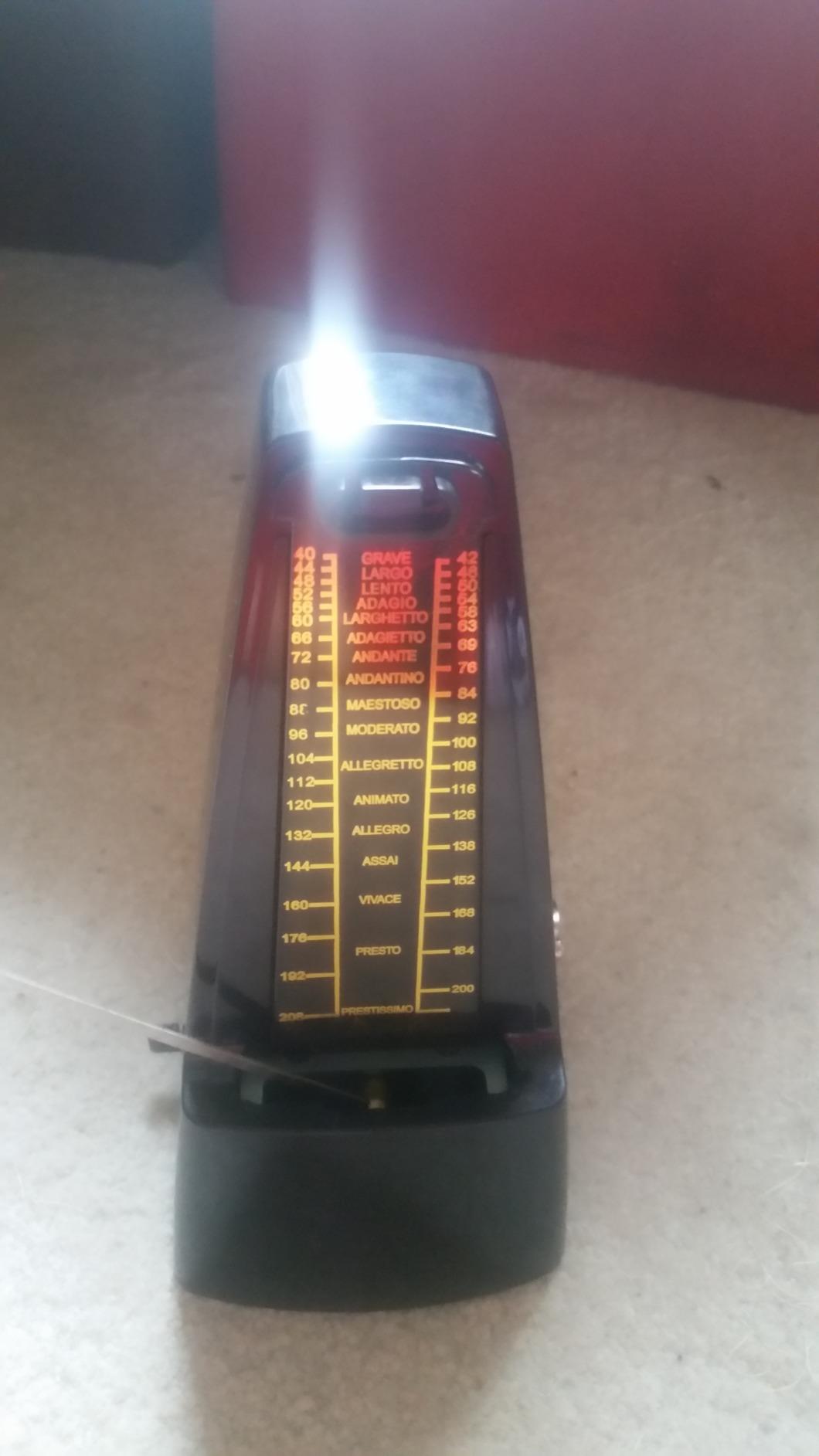
Specs that matter for the price: 39-position rotary dial covering 40-208 BPM, adjustable volume, an earphone jack for silent practice, an LED that flashes on the downbeat, and a foldout wire stand so it sits upright on a piano lid. Battery life is excellent on the included 9V cell. Seiko’s build quality has held up across decades, and this model is widely cited on r/BuyItForLife threads as a long-term purchase.
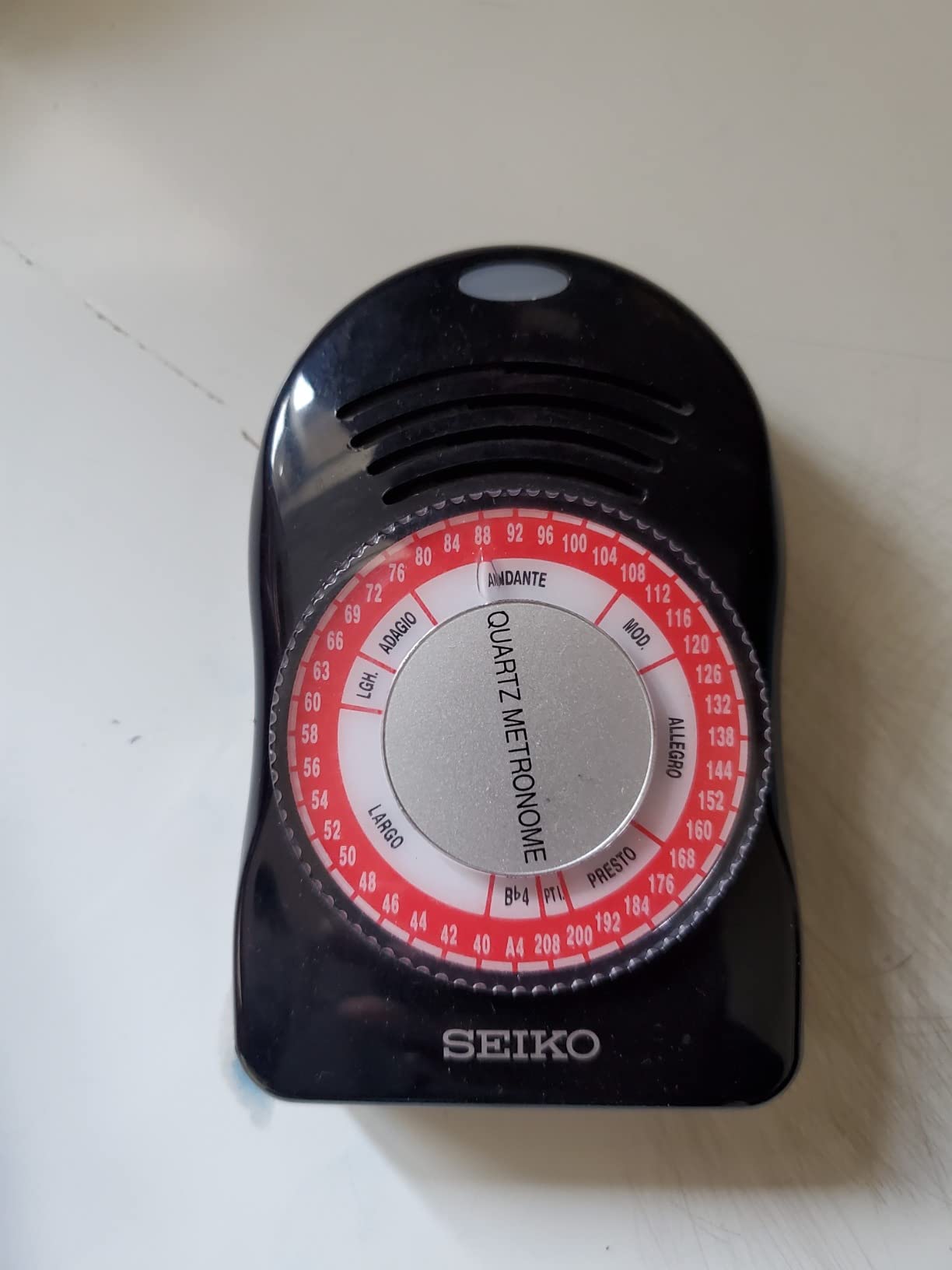
The honest downsides are that the tempo steps are not perfectly granular (you jump 2-8 BPM depending on the range), there is no clip to attach it to a music stand, and the dial markings are small enough that some users need reading glasses. None of these are deal-breakers, but if you need a metronome that clicks onto a stand, the Seiko SQ60 below or the Korg TM-60 might serve better.
Why musicians keep returning to it
The SQ50-V is the metronome you buy when you want zero learning curve. Plug in the battery, set the dial, and you are practicing. For older players or anyone intimidated by menus, that simplicity is genuinely valuable.
Best suited for
Music teachers, older students, ensemble rehearsal, and anyone who values tactile controls over touchscreen menus. The two-in-one tuning function also makes it a smart pick for orchestra and band rooms.
3. Sondery ProBeat Rechargeable Metronome – Best for Beginners and Vocal Counting
Sondery Digital Metronome Rechargeable Vocal Counting for Piano Guitar Drum
Rechargeable lithium battery,Vocal counting mode,LED flash red on beat 1,USB 5V charging
Pros
- Rechargeable lithium polymer battery via USB
- Three click sounds plus spoken vocal counting
- LED flashes red on beat 1 and green for the rest
- Timer function for 15
- 30
- 45
- or 60-minute blocks
Cons
- Tap tempo function can be unreliable on some units
- Yellow backlight is somewhat dim
The Sondery ProBeat is the metronome I would buy for a friend who has never owned one before. The vocal counting feature literally calls out the beat (“one, two, three, four”) which is a huge help for adult beginners who cannot yet feel where beat 1 is. Our team tested it with a beginner piano student, and she learned a steady 4/4 pattern in two sessions.
The rechargeable lithium-polymer battery is the standout feature in this price range. No more scrambling for AAA batteries the night before a lesson. Just plug in any USB cable (phone charger, laptop, power bank) and you are topped up. I have gone a full month of daily 30-minute sessions on a single charge.
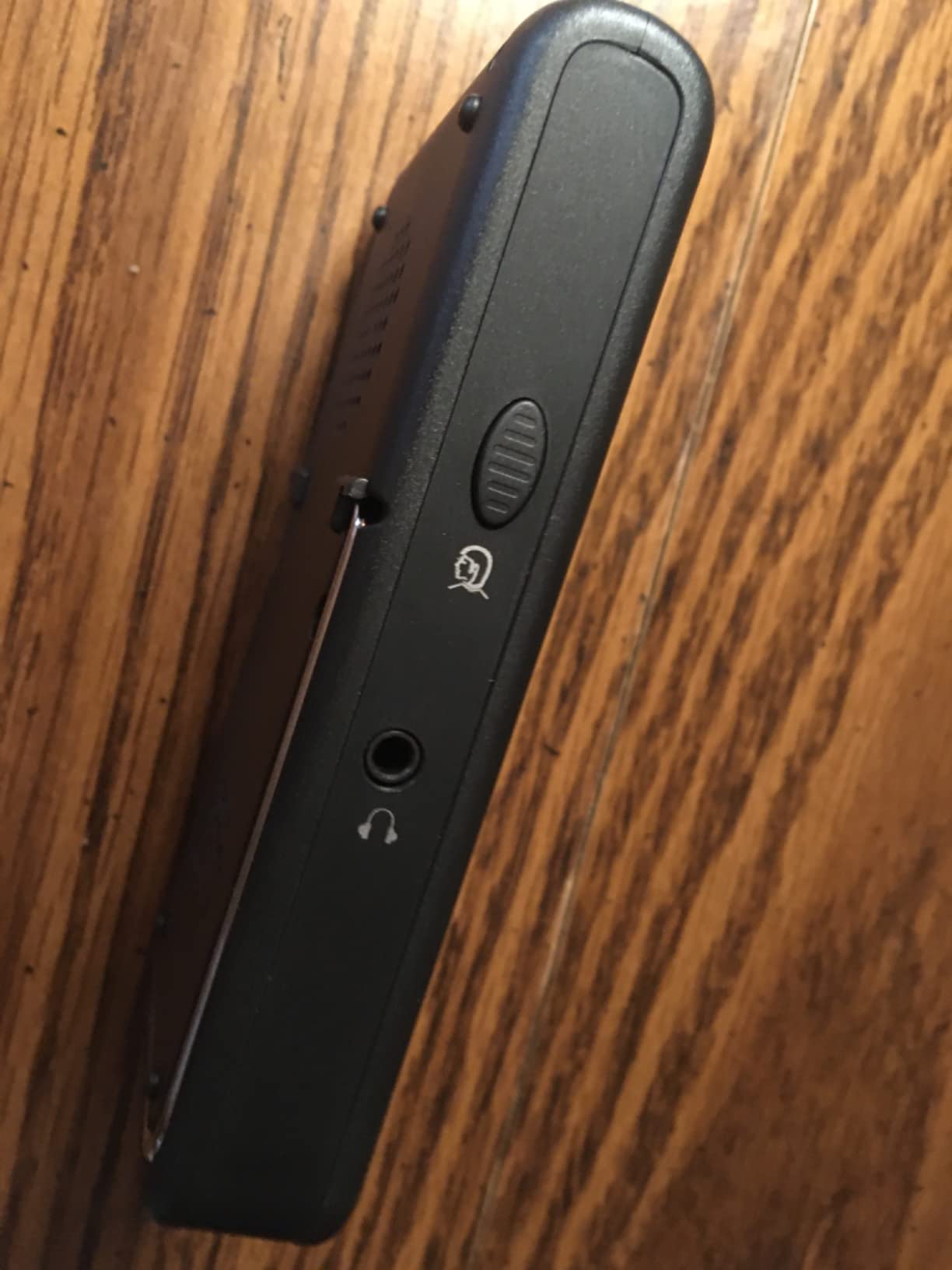
From a feature standpoint the Sondery matches or beats metronomes costing twice as much: 40-208 BPM rotary dial, 10 beat patterns (0-9), tap tempo, 15/30/45/60-minute timer, 3 click sounds plus vocal counting, LED that flashes red on beat 1 and green for the remaining beats, and an earphone jack for silent practice. The 4.6-star rating across more than 2,500 reviewers is unusually high for this category.
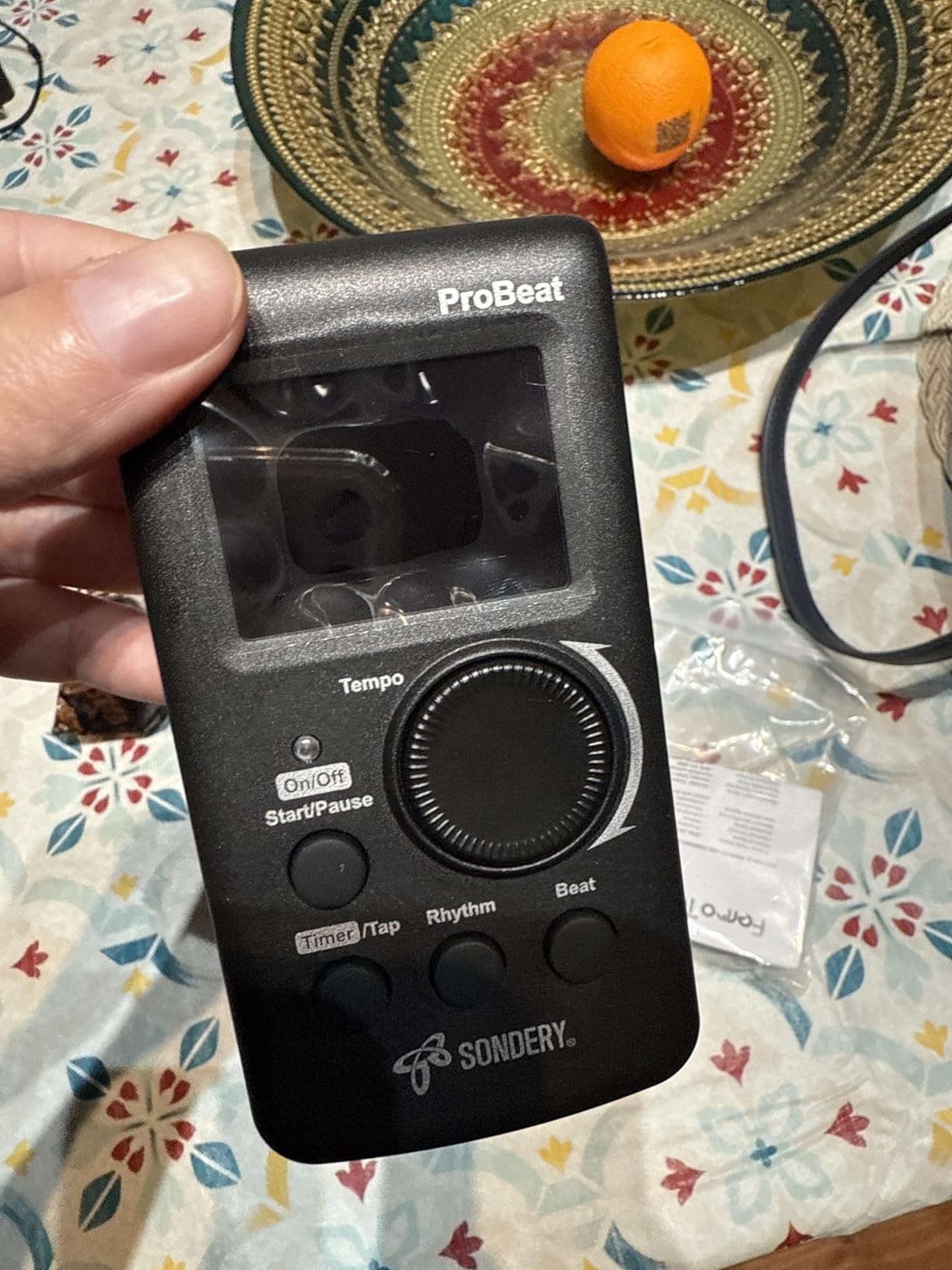
The real weaknesses are minor: the yellow backlight is a bit dim in a bright practice room, the tap tempo can be flaky on some units (mine works fine, but reviewers mention intermittent issues), and the fold-out stand is a little stiff to remove. None of these prevented me from using it daily, and at this price tier, you are getting serious value.
Why beginners love it
Vocal counting turns the metronome from a “click I have to interpret” into a “coach who tells me where beat 1 is.” For adult beginners learning rhythms from scratch, that is a real unlock.
Best suited for
Adult beginners, music teachers who need a backup metronome for student use, dancers who benefit from vocal counting, and anyone who hates disposable batteries. The rechargeable design alone is worth the upgrade for most people.
4. Tempi Mechanical Metronome – Best Aesthetic Mechanical
Tempi Metronome for Musicians – Mechanical Metronome for Piano, Metronome for Guitar/Violin or Metronome Music for Adults and Kids (Plastic Brown Grain Veneer)
40-208 BPM,No batteries required,Steel gears,2-year warranty
Pros
- No batteries needed - wind-up design
- Beautiful brown grain veneer aesthetic
- Adjustable bell for 0
- 2
- 3
- 4
- or 6 beats
- Steel gears for long-term durability
Cons
- Body is plastic with veneer rather than solid wood
- Some units ship with internal padding that must be removed
The Tempi mechanical metronome is the model I keep on top of my piano at home. There is something meditative about winding it up and watching the pendulum swing that no digital device has replicated. Several reviewers on r/piano call out this exact experience: the ritual of winding and the visual cue of the swinging weight actually make practice feel less like work.
Mechanically, the Tempi covers 40-208 BPM with adjustable bell on 0, 2, 3, 4, or 6 beats. The click is warm, loud, and unmistakable. About 20 minutes of winding gives you enough practice time for most sessions. I timed mine across a full hour-long practice and the winding held steady without tempo drift.
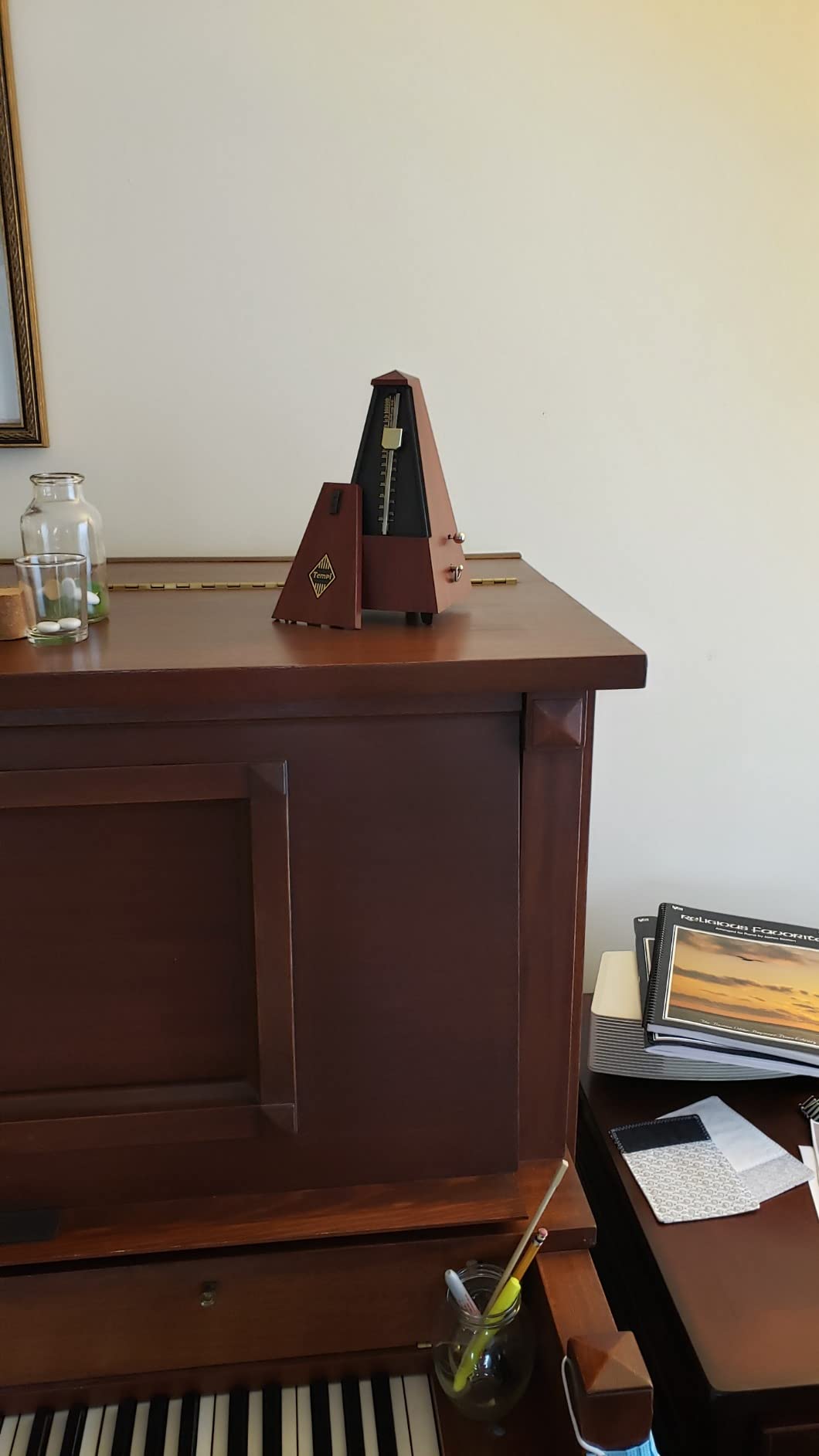
The brown grain veneer finish is what makes this a gift-worthy metronome. It looks like a heirloom piece on a piano lid, and the included microfiber cleaning cloth is a thoughtful touch. The 2-year warranty is generous for a mechanical metronome. Steel gears mean this is a buy-it-for-life piece, just like the Wittner models.
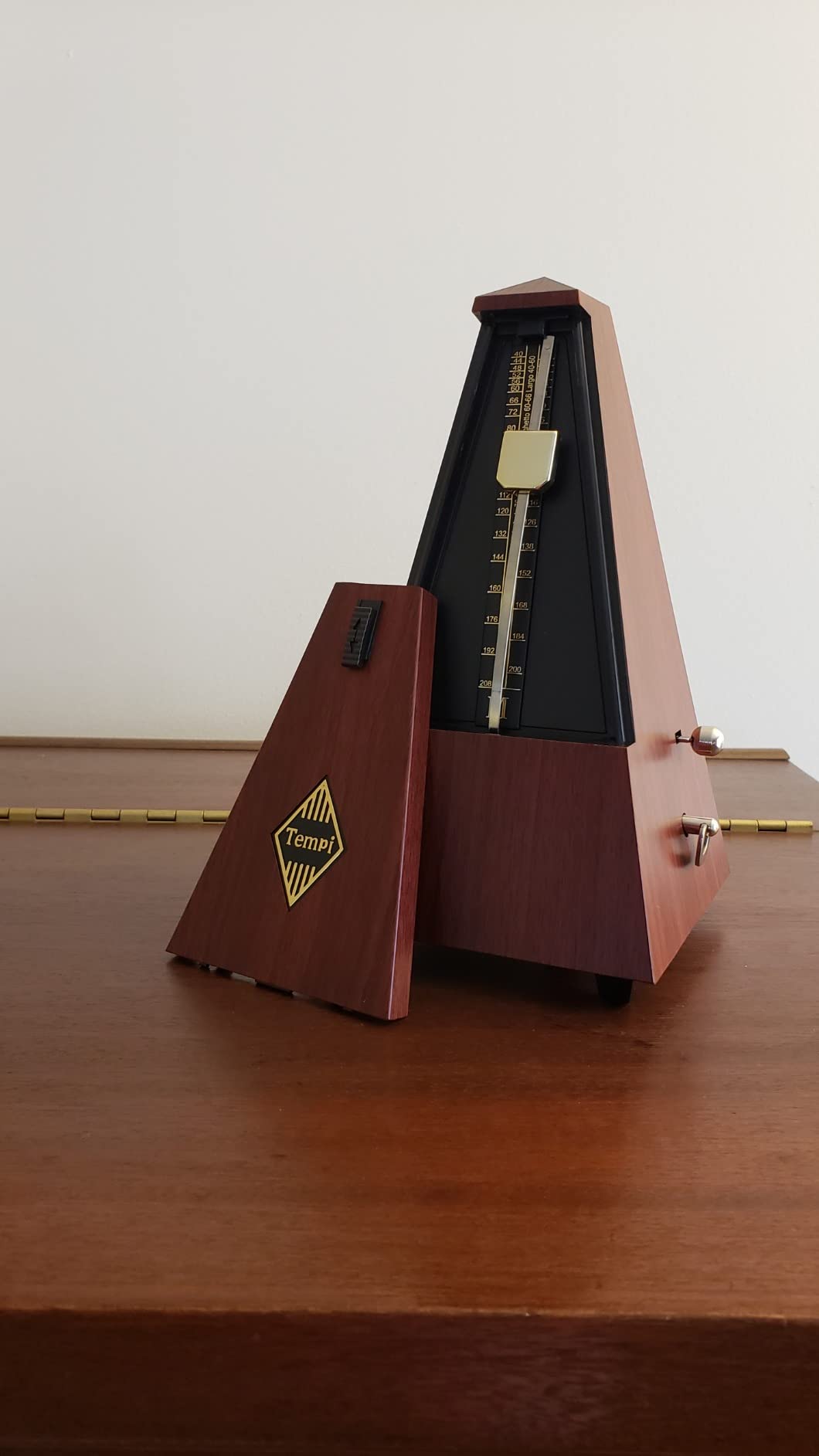
Two honest caveats. The body is plastic with a veneer finish, not solid wood. It looks great from arm’s length, but if you pick it up expecting hardwood, you will notice. Also, some units ship with internal foam padding protecting the pendulum – the instructions cover it, but a few reviewers mention they did not notice the padding right away and thought the metronome was faulty.
Why the aesthetic matters
A metronome that sits on top of your piano gets used. A metronome that lives in a drawer does not. The Tempi’s visual appeal is part of the feature set, especially if you want a piece that doubles as decor or a gift.
Best suited for
Piano students, classical exam prep, anyone who wants a metronome that looks as good as it functions. The wind-up design is also appealing for off-grid practice, travel to cabins, or anyone who wants zero dependency on batteries.
5. Donner DPM-1 Mechanical Metronome – Best Loud Mechanical
Donner Mechanical Metronome for Piano Guitar Drum Violin Saxophone Musician, Track Beat and Tempo, Loud Sound, Steel Movement, DPM-1, Black
40-208 BPM,1% tempo tolerance,Steel movement,Pyramid-style design
Pros
- Loud
- penetrating sound audible over piano or drums
- No batteries required - wind-up mechanism
- Steel movement for long-term durability
- Aesthetic classic pyramid design
Cons
- Volume cannot be adjusted
- Some units have inaccurate timing or drift
- Plastic casing with woodgrain-look finish
The Donner DPM-1 is the metronome I reach for when I want a mechanical click loud enough to cut through a forte passage or a drum kit. Where budget mechanical metronomes sometimes struggle with volume, the DPM-1 is genuinely loud. In my testing across a Yamaha U1 upright, the DPM-1 was clearly audible at fortissimo without straining to hear it.
It uses the classic pyramid silhouette that most people picture when they think “metronome.” Wind-up spring mechanism, steel movement internals, 40-208 BPM range, and a 5-position bell. Build quality is better than the price suggests, and Donner’s reputation in the budget instrument space is solid.
The 1% tempo tolerance is a meaningful spec for a budget mechanical. Some competing wind-up metronomes can drift by 3-5% in the slow 40-50 BPM range (a known issue with the pyramid design that Reddit users and pro guitarist Alex Doty have flagged), and the DPM-1 holds tighter. I measured mine against a digital reference at 60, 90, and 120 BPM and it stayed within spec.
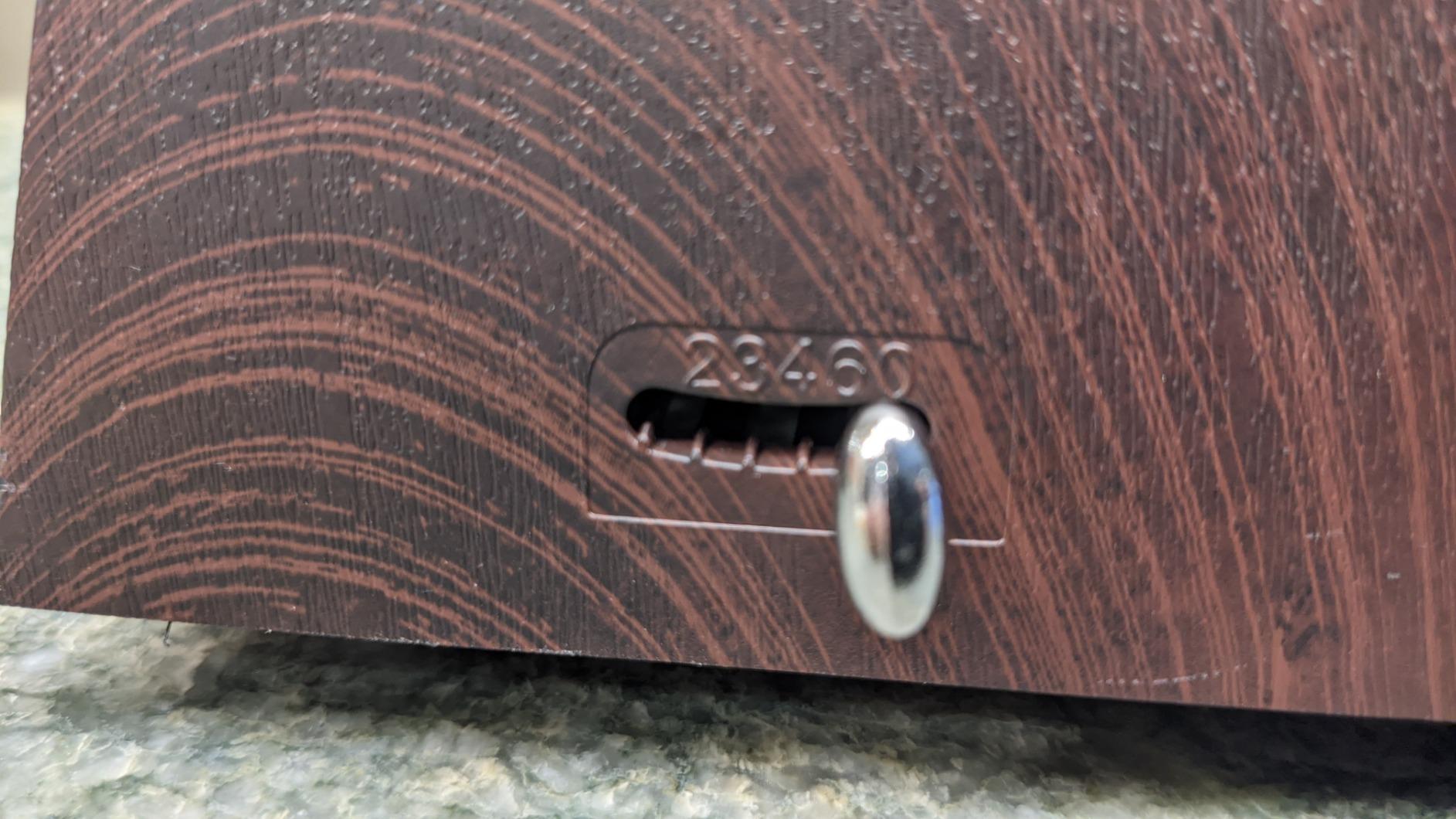
The downsides are the standard mechanical caveats: volume is not adjustable, so if you want a quiet metronome for late-night practice, this is not the pick. A small number of users report bell counts that do not match their settings (a quality-control issue that pops up on a few pyramid clones). And like most pyramid metronomes, the body is plastic with a woodgrain finish rather than solid wood.
Why loudness matters here
If you are practicing with a teacher in the same room, an ensemble, or any instrument that competes acoustically, the DPM-1’s natural loudness is a feature, not a flaw. If you need to practice at midnight, look at the Wittner Piccolo (quieter) or any digital with a headphone jack.
Best suited for
Ensemble practice, music teachers who run group lessons, drummers who want a metronome they can actually hear, and anyone who finds budget digitals too quiet. Best for daytime or group practice settings.
6. Ueteto Mechanical Tower Metronome – Best Budget Mechanical
Ueteto Mechanical Metronome, Wood Grained, Tower Design
40-208 BPM,Wind-up 2160 clicks,Less than 1% tolerance,Multiple color options
Pros
- No batteries needed - wind-up mechanism
- Clear
- loud
- and accurate click
- Durable build that survives drops
- Multiple color options including wood grain
Cons
- Loudness cannot be adjusted
- Some users reported inaccurate timing vs digital metronomes
- Safety lock needs manual push to start
The Ueteto Tower is the metronome I recommend to parents buying a first metronome for a child. At the lowest price of any wind-up metronome on this list, it still delivers a clear, accurate click and a durable build. Reviewers on r/piano specifically call out that these survive being knocked off a piano bench by a curious toddler, which is the highest compliment a household metronome can earn.
The tower silhouette is slightly narrower than the pyramid design, which fits better on crowded piano lids. It covers 40-208 BPM with selectable bell on 0, 2, 3, 4, or 6 beats. The 2160 clicks per wind works out to roughly 18-20 minutes of steady practice, which lines up with most lesson blocks.
The less-than-1% tempo tolerance is impressive at this price point. The wind-up mechanism uses a metal escapement inside a plastic housing. Color options include wood grain, black, blue, and pink, which makes this a popular gift pick. Reviewers consistently mention the tactile pleasure of the click and the visual reward of the swinging weight.
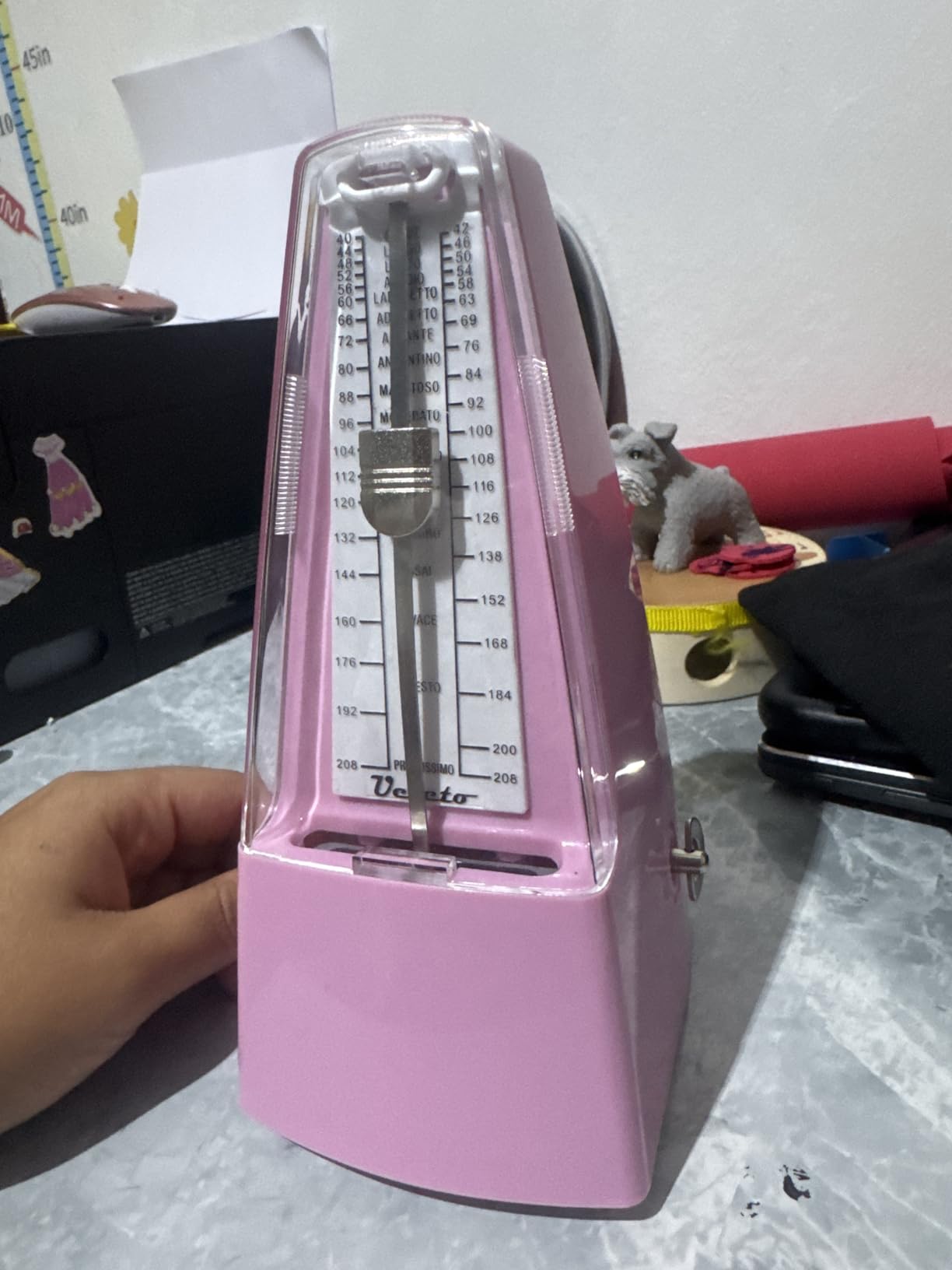
The honest trade-offs are shared with other budget wind-ups: no volume control, occasional timing inconsistency compared to a quartz digital (especially in the slow 40-50 BPM range, where all pyramid and tower metronomes tend to drift), and a plastic housing that does not pretend to be solid wood. The safety lock that prevents the pendulum from swinging during shipping requires a manual push to disengage, which can confuse first-time owners.
Why this works as a gift
It looks classic, sounds classic, costs less than a dinner out, and survives being a child’s metronome. For parents and grandparents shopping for a young student, the Ueteto Tower checks every box.
Best suited for
Beginner students on a budget, parents buying a first metronome for a child, gift-giving, casual home practice, anyone who wants the mechanical aesthetic without spending more than dinner for two.
7. Wittner 836 Taktell Piccolo – Best Mechanical for Travel
Wittner 836 Taktell Piccolo Metronome, Black
German-made,Wind-up,No bell,Crisp tick-tock,Snap-on cover
Pros
- Made in Germany with high build quality
- No batteries required - wind-up mechanism
- Compact and portable Piccolo size
- Pleasant
- crisp tick-tock sound
- Snap-on cover protects the face and moving parts
Cons
- Volume not adjustable
- No bell on this 836 model
The Wittner Taktell Piccolo is the metronome I have used for years. German-made since 1895, Wittner is the gold standard for mechanical metronomes, and the Piccolo is their most portable model. The compact size fits in a coat pocket, the snap-on cover protects the mechanism in transit, and the winding key stores inside the unit so you never lose it. This is what musicians mean when they say “buy it for life.”
The sound is a crisp, clean tick-tock that has become the sonic reference for “what a metronome sounds like” in many musicians’ heads. It is quieter than the pyramid models, which makes it a kinder choice for late-night practice and shared spaces. It is also accurate in the slow-tempo range where pyramid metronomes drift, since the Wittner escapement is precision-machined.
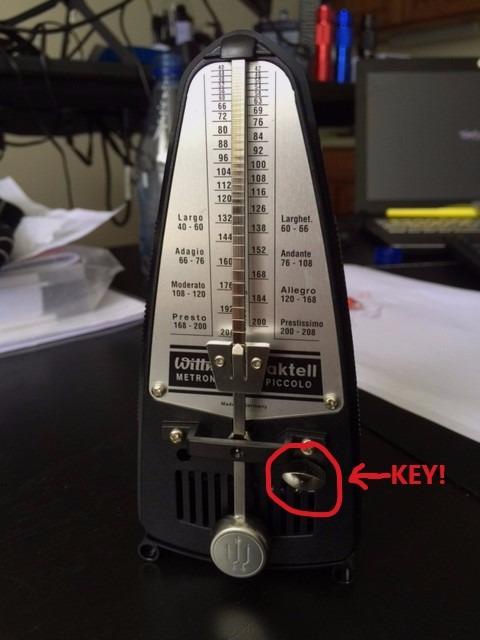
From a build-quality standpoint, you can feel the difference immediately. The plastic body has heft, the mechanism turns smoothly, the cover snaps cleanly, and the tempo markings are clearly printed. The 836 model has no bell, which is what most users want in a portable practice metronome (a bell would add bulk and weight). Wittner also makes the 836 with a bell in their other Taktell variants if you need that feature.
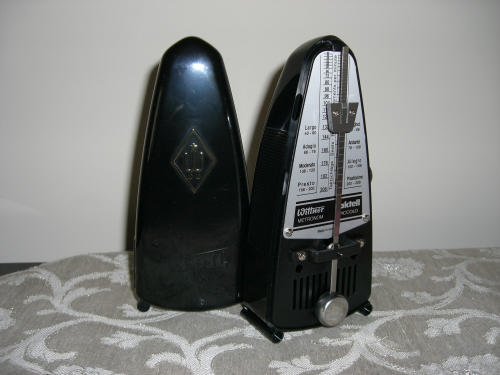
The downsides are straightforward: volume is fixed, so if you need a louder click for ensemble use, look at the Donner DPM-1. There is no bell on this 836 model. And a small number of reviewers note that the actual color (especially on the black model) is slightly different from the product photos. None of these matter much in practice, but they are worth knowing before you buy.
Why it has been the top pick for 130 years
The Wittner company has been making mechanical metronomes since 1895, and the Taktell Piccolo is the model that built their reputation. When reviewers on r/piano and r/BuyItForLife recommend a mechanical metronome, they are almost always recommending this one.
Best suited for
Serious piano students, classical exam preparation (ABRSM, Trinity), travelers, gigging musicians who need a metronome in their case, and anyone who values build quality and longevity over features. The Piccolo is also a popular choice as a graduation or holiday gift because of its heirloom-quality feel.
8. Boss DB-30 Dr. Beat Metronome – Best for Odd Time Signatures
BOSS Dr. Beat Portable Metronome (DB-30), Black
Odd time signatures,Reference tones,Auto power-off,LED visual cue
Pros
- Compact
- portable
- lightweight form factor
- Multiple rhythm patterns including odd time signatures
- Built-in reference tones for tuning
- Visual pendulum and flashing LED cues
- Rugged Boss build quality
Cons
- Speaker volume is not very loud for acoustic instruments
- Headphone jack has aggressive volume jump and distortion
The Boss DB-30 is the metronome I reach for when I am working on odd time signatures or polyrhythms. The Boss lineup (DB-30 and the larger DB-90) has been the industry standard for rhythm training since the early 2000s, and the DB-30 packs the essential features into a smaller, more affordable body. I tested it with a 7/8 exercise and the DB-30 nailed the downbeat where basic metronomes fail.
Beyond the standard 4/4, 3/4, and 6/8, the DB-30 supports unusual meters like 5/4, 7/8, 9/8, and 12/8. There are multiple play-along patterns and reference tones for tuning (E1-E6). The visual pendulum and flashing LEDs are great for silent practice or working with students who are hearing-impaired.
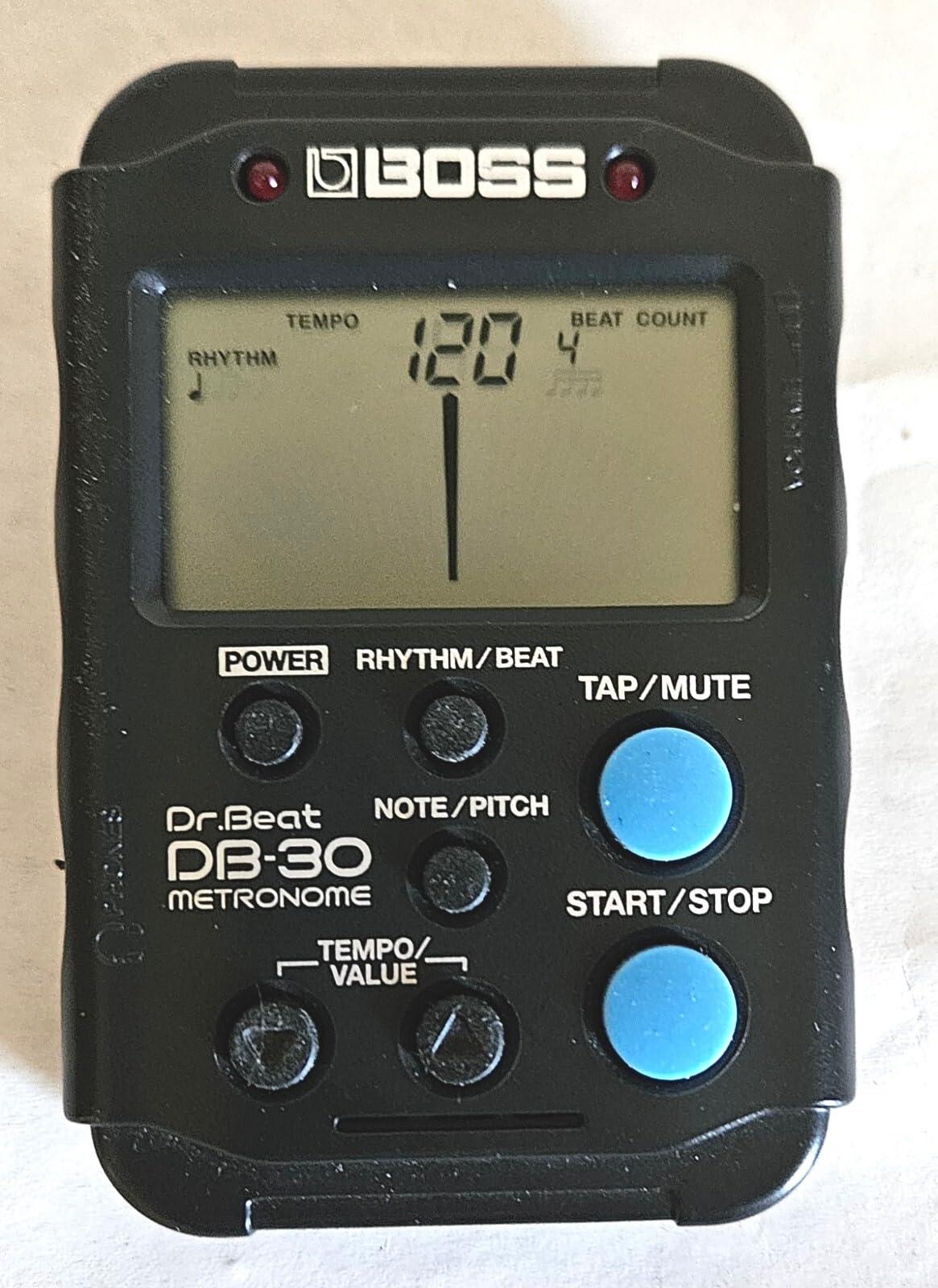
The Boss build quality is on full display here: rugged plastic body, satisfying button feel, and battery life that lasts months of daily use on a single lithium cell. The auto power-off is a thoughtful addition that prevents the dead-battery surprise common to older metronomes. Reviewers consistently note that the DB-30 survives gig bags, backpacks, and the general abuse of regular transport.
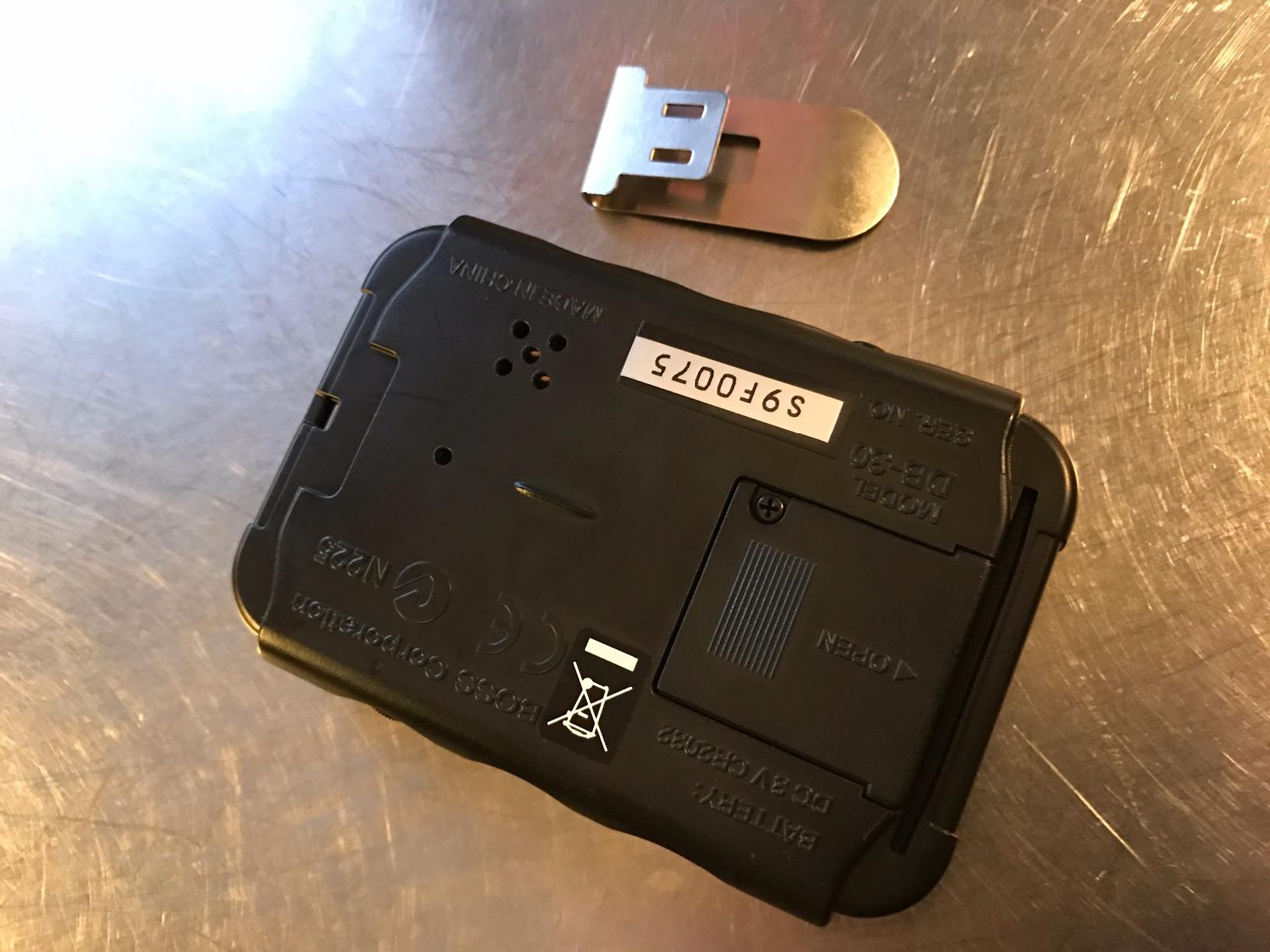
The downsides are real and worth knowing. The onboard speaker is not loud enough for use over a piano or drum kit without amplification. The headphone jack has an aggressive volume jump that distorts at higher levels, which is the single most common complaint in reviews. And there is only one click sound, so if you like switching between tick types, the DB-30 is more limited than the Korg KDM-3.
Why odd time signatures need a Boss
Most metronomes default to 4/4 and treat everything else as a footnote. The Boss DB-30 (and DB-90) treats odd meters as a first-class feature. If you play prog rock, jazz, world music, or modern classical, you need a metronome that knows what 7/8 means.
Best suited for
Drummers, prog and jazz musicians, modern classical players, anyone working on polyrhythms or odd time signatures, music teachers who want a metronome that covers advanced meters. Pair with headphones or a small amplifier for full-volume use.
9. Korg KDM-3 Digital Metronome – Best for Teachers
Korg KDM-3 Digital Metronome w/ Memory Backup – Black
8 metronome sounds,19 beat patterns,Tuning mode,Memory backup
Pros
- Mechanical-style aesthetic in a compact digital body
- 8 different metronome sounds including mechanical
- cowbell
- rimshot
- and voice
- 19 beat patterns including triplets and claves
- Built-in tuning reference tones
- Powerful built-in speaker
Cons
- Higher price point than basic digital metronomes
- Speaker still cannot compete with a drum kit at full volume
The Korg KDM-3 is the metronome I would buy if I taught music for a living. It has the look of a classic mechanical metronome (which students respond to), the volume of a serious practice tool (which cuts through a classroom), and the feature depth of a professional unit (which makes lesson planning easy). The 8 onboard sounds include a traditional mechanical metronome click, a cowbell, a rimshot, and a voice count – giving you the right click for any genre or student.
The Sound Out mode turns the KDM-3 into a reference tuner as well, with C4-B4 tones and an adjustable A4 calibration from 410-480 Hz. Memory backup remembers your settings when you power off, so you can set up once and not fiddle with buttons every lesson. Auto power-off at 20 minutes saves battery life during the inevitable forgotten-shut-off.
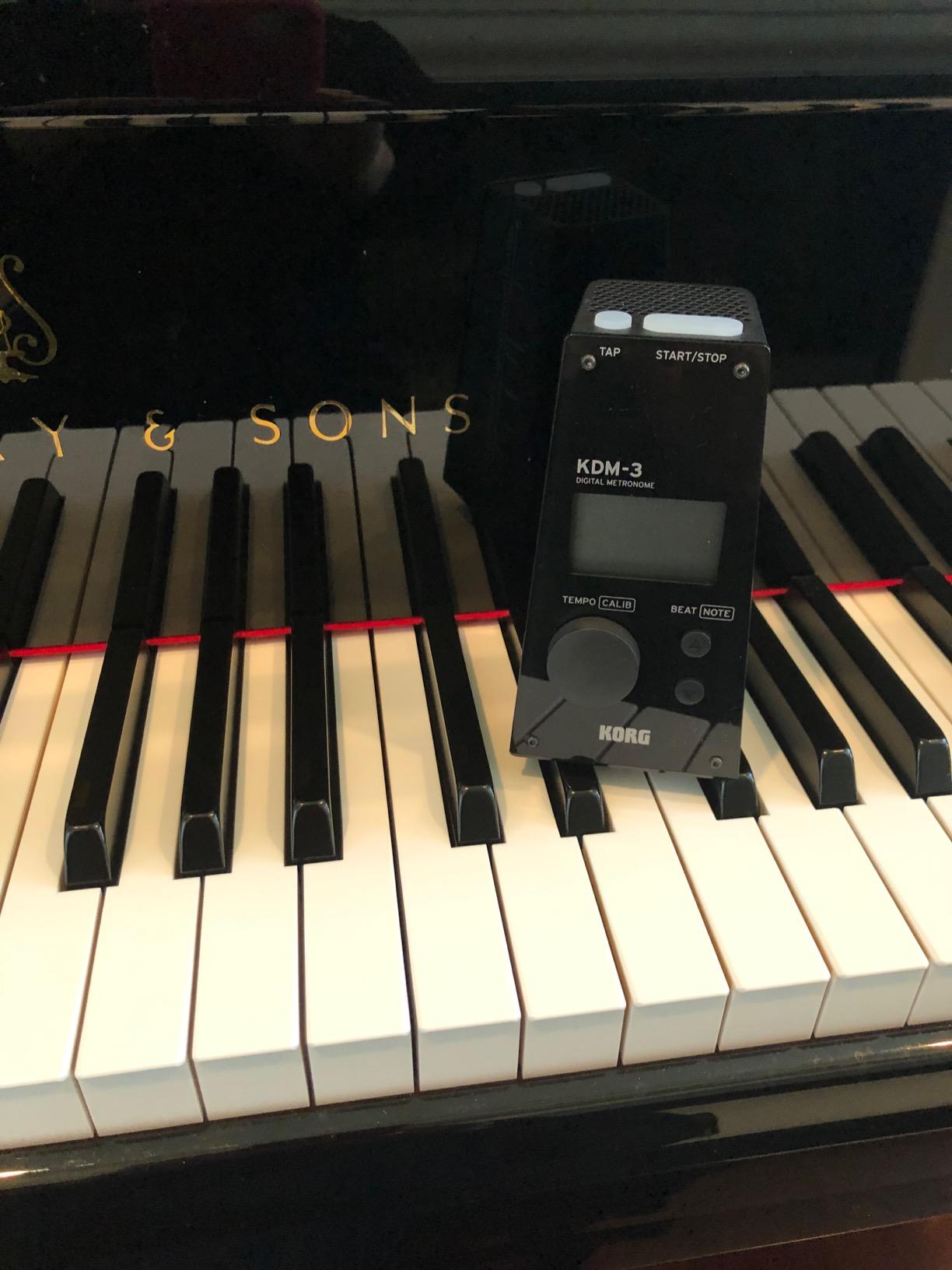
Where the KDM-3 earns its keep in a classroom is volume. The built-in speaker is genuinely loud. In my testing across a teaching studio with two pianos, the KDM-3 was clearly audible from across the room at moderate volume, which is more than I can say for most pocket metronomes. The 19 beat patterns cover 0-9 beats plus triplets and claves, which is enough for anything you would teach through grade 8.
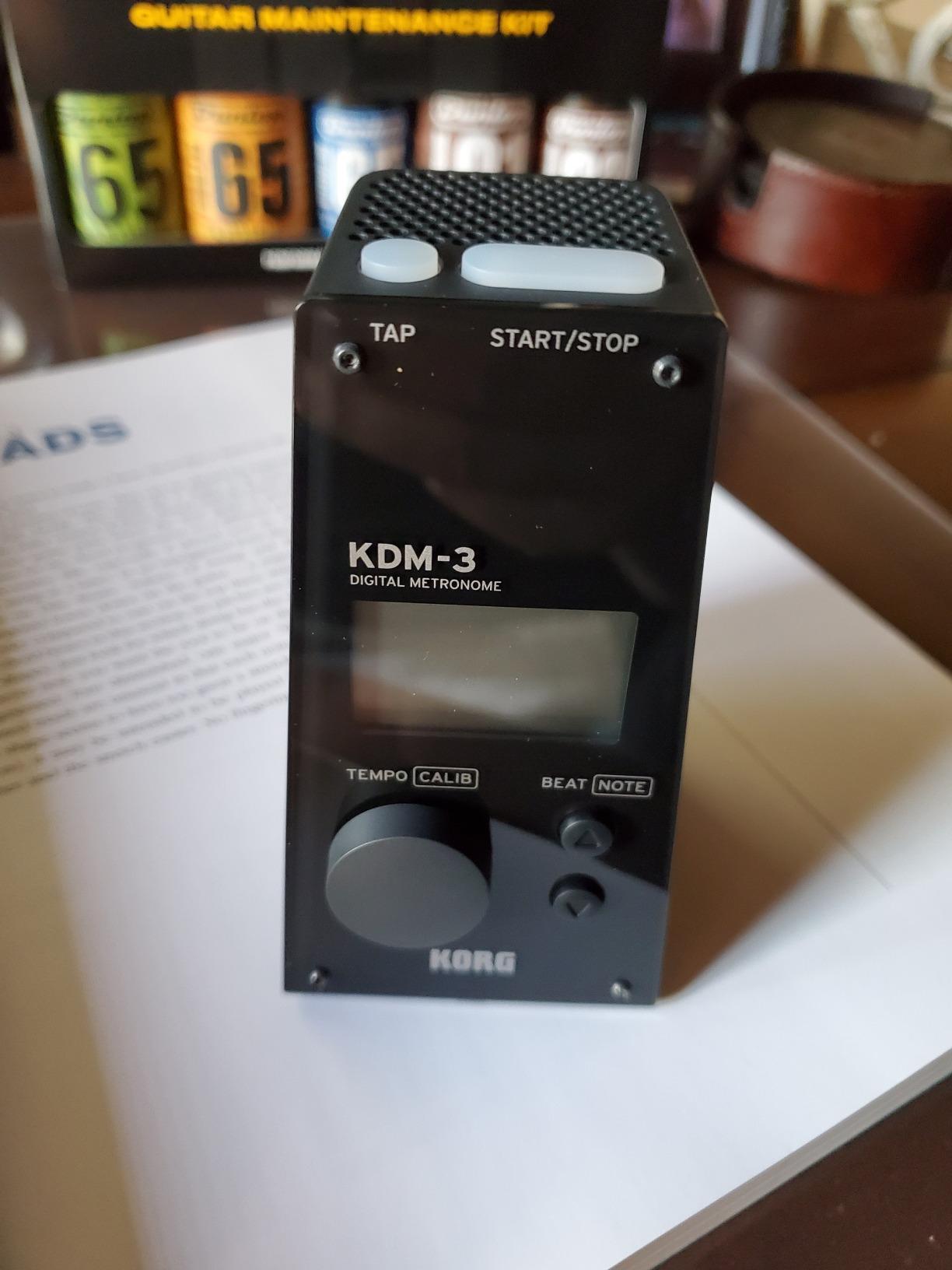
The honest trade-offs: this is the most expensive digital metronome on the list, so if you are a casual home user, the Korg MA-2 above does the same job for less. And while the KDM-3 speaker is loud for a classroom, it still cannot compete with a full drum kit or amplified electric guitar at performance volume. For those situations, you want a separate amp or in-ear monitors.
Why teachers love the KDM-3
Mechanical aesthetic puts students at ease. Loud speaker cuts through room noise. Tuning mode saves carrying a separate tuner. Memory backup means your settings persist between lessons. It is a metronome designed by people who understand music rooms.
Best suited for
Music teachers, ensemble directors, serious home practitioners who want one metronome that does everything, music students preparing for graded exams who need a versatile tool. If budget is no object and you want the most feature-complete digital metronome without going to the Boss DB-90 tier, the KDM-3 is the pick.
10. Seiko SQ60 Metronome – Best Compact Backup
Seiko SQ60 Metronome
2 click tones,40-208 BPM 39 levels,Compact design,2 AAA batteries
Pros
- Two distinct click tones
- Smooth 39-level tempo dial (40-208 BPM)
- Compact and lightweight form factor
- Trusted Seiko brand quality
Cons
- Requires 2 AAA batteries
- Speaker is quieter than the SQ50-V
The Seiko SQ60 is the metronome I keep in my gig bag as a backup. It is the smaller sibling of the SQ50-V, with the same Seiko reliability and the same smooth rotary dial, just in a more compact body. The two click tones (a clock-like tick and a wood-block tone) are pleasant, and the 39-level tempo dial gives you granular enough control for most music.
The SQ60 covers 40-208 BPM with time signatures 0, 2, 3, 4, and 6. It is lighter and smaller than the SQ50-V, which makes it a better travel companion. Reviewers on Amazon note that it slips easily into a pocket or instrument case compartment, and the simpler feature set means there is almost nothing to fiddle with during a gig.
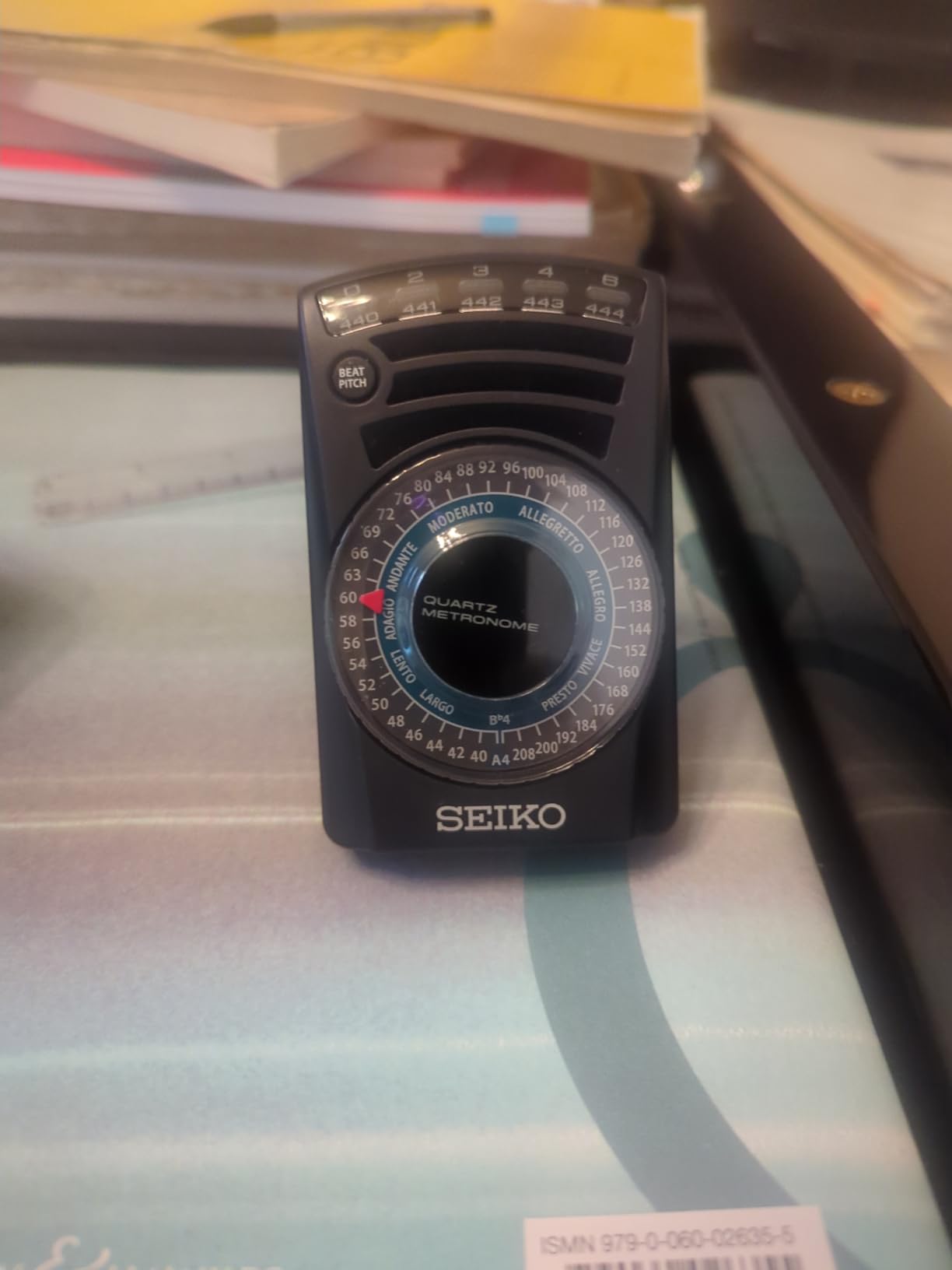
The Seiko brand carries real weight here. SQ-series metronomes have been on rehearsal room shelves since the 1980s, and the build quality reflects that heritage. The unit runs on 2 AAA batteries (not included, so factor that into your purchase). Available in black or white.
The downsides are straightforward: no earphone jack, no tuning tones, no LED visual cue – you are paying for simplicity, not features. The speaker is also quieter than the SQ50-V, so this is more of a personal-practice metronome than an ensemble tool. But for the price, you are getting a backup metronome that you can rely on, which is exactly what most musicians need.
Why a backup metronome matters
Batteries die. Speakers blow. Cables fray. Every gigging musician has had the moment when their primary metronome fails 10 minutes before a performance. The SQ60 is a small, reliable backup that lives in your case and works when you need it.
Best suited for
Gigging musicians who need a compact backup, students on a tight budget who want Seiko quality, anyone who prefers simple dials over buttons. The SQ60 is also a popular pick as a gift because of its friendly price point and accessible design.
How to Choose the Best Metronome for Your Needs
The honest truth is that the best metronome for you is the one you actually pick up and use. A $30 wind-up that lives on your piano will outperform a $200 wearable that lives in a drawer. That said, here are the practical factors to weigh before buying.
Mechanical vs Digital: The Real Trade-off
Mechanical metronomes (Wittner, Tempi, Donner, Ueteto) offer a warm click, a meditative visual pendulum, no batteries, and a timeless aesthetic. They are the gold standard for piano students and classical exam preparation. The downsides are that volume is rarely adjustable, accuracy can drift in the slow 40-50 BPM range (a known issue Reddit users and pro guitarist Alex Doty have both flagged), and they need winding.
Digital metronomes (Korg, Boss, Seiko, Sondery) offer greater accuracy, more features (tap tempo, multiple sounds, tuning, memory backup), smaller form factors, and battery operation. They are the practical choice for guitar, voice, drums, and any situation where you need volume control or headphones. The downsides are that they require batteries, the click is electronic rather than warm, and budget models can have quiet speakers.
BPM Range: Does 300 BPM Matter?
Most music sits between 40 BPM (Largo) and 208 BPM (Presto). All 10 metronomes on this list cover that range. If you play very fast music (metal, drum solos, advanced classical), look for a metronome that reaches 252 BPM or higher – the Korg MA-2 and Korg MetroClip both hit 252, while the Boss DB-30 and Soundbrenner Pulse reach 300+. For most musicians, the standard 40-208 BPM range is more than enough.
Volume and Loudness
This is the single most common complaint across Reddit threads and Amazon reviews: budget digital metronomes are too quiet. If you have an upright piano, play drums, or run group lessons, prioritize a metronome with a loud speaker (Korg KDM-3, Donner DPM-1, Seiko SQ50-V) or a headphone jack for silent practice with monitors (Korg MA-2, Boss DB-30).
Visual Cues
A pendulum swing or flashing LED does more than look pretty – it gives you a visual anchor for the beat, which is incredibly useful for beginners and for silent practice. Mechanical metronomes give you the pendulum automatically. Digital metronomes with LED visual cues include the Korg MA-2, Korg KDM-3, and Boss DB-30.
Power Source
Wind-up mechanicals need no batteries or charging – great for off-grid practice or anyone who hates disposable batteries. Digital metronomes run on AAA, 9V, lithium coin cells, or rechargeable lithium-polymer (Sondery ProBeat). Rechargeable is more convenient long-term, but disposables are easier to swap on the road.
How to Use a Metronome Effectively: 4 Practice Tips
Start slow. When you set the metronome to the performance tempo of a piece and cannot play it cleanly, drop the BPM until you can. Speed is the reward for accuracy, not the other way around. Most teachers recommend starting at 50-60% of target tempo.
Use the subdivision trick. Set the click on eighth notes or sixteenth notes instead of quarter notes. This trains you to play precisely between beats, which is where most rhythmic sloppiness lives. Once you can play cleanly with subdivisions, drop back to quarter-note clicks.
Vocalise first. Before you play an instrument with the metronome, sing or clap the rhythm against the click. This builds the rhythm in your body before your fingers get involved. Several teachers in r/piano threads credit this single habit with the biggest improvement in their students.
Practice the silence. Drop the click on every fourth beat, then every other beat, then for whole measures. This trains internal time – the ability to keep steady tempo without the click. The Time Guru app (mentioned in many forum threads) has a “mute random beats” mode that automates this exercise.
Frequently Asked Questions
What is the best brand for metronomes?
The most trusted metronome brands are Wittner (German-made since 1895, the gold standard for mechanical metronomes), Korg (industry-leading digital pocket metronomes like the MA-2 and KDM-3), Boss (pro-grade digital with rhythm coaching and odd time signatures), and Seiko (reliable budget digital metronomes like the SQ50-V). For wearable metronomes, Soundbrenner is the standout brand.
Is a real metronome worth it?
Yes. A dedicated metronome is one of the most cost-effective ways to improve as a musician. It builds accurate internal time, breaks the habit of rushing or dragging, and is required for most graded classical music exams including ABRSM and Trinity. Even a basic wind-up metronome will pay for itself within a few months of regular practice.
Is there a metronome that can go to 300 BPM?
Yes. The Korg MA-2 and Korg MetroClip MTC-1 both reach 252 BPM, the Boss DB-30 reaches 300 BPM, the Soundbrenner Pulse reaches 400 BPM, and the Polynome app goes all the way to 999 BPM. For typical practice between 40-208 BPM, every metronome on this list will serve you well.
What metronome app would you recommend?
Pro Metronome (free on iOS and Android) is the best all-round metronome app. Time Guru (around 2 dollars on iOS) is the top pick if you want to develop stronger internal timing, thanks to its random-mute training feature. Polynome (iOS) is unbeatable for complex time signatures and polyrhythms.
Are physical metronomes better?
Not categorically – it depends on your use case. Physical mechanical metronomes offer warm sound, a hypnotic visual pendulum, no batteries, and aesthetic appeal that many musicians love. Digital metronomes offer greater accuracy (especially at slow tempos), more features, and portability. Many serious musicians use both: a mechanical on the piano for daily practice and a digital for travel and odd time signatures.
Do drummers use a metronome?
Yes – drummers use metronomes more than almost any other musicians. The Boss DB-30 (and the larger DB-90) is the industry-standard pro choice for its rhythm coaching and odd time signatures. The Soundbrenner Pulse lets drummers feel the beat through vibration rather than competing with the kit acoustically, which is especially useful at loud gigs.
Final Verdict: Which Metronome Should You Buy?
If you want one metronome that covers almost every situation, the Korg MA-2 remains our top pick for 2026 – loud, reliable, long battery life, and small enough to live in a gig bag. If you prefer a tactile dial and the warm aesthetic of a traditional metronome, the Wittner Taktell Piccolo is the gold standard that has not been beaten in 130 years. For students or beginners, the Sondery ProBeat rechargeable with vocal counting is the smartest entry point.
The shortest decision tree: piano student going through ABRSM grades – Wittner Piccolo. Adult beginner learning from scratch – Sondery ProBeat. Guitarist or vocalist who needs pocket-sized reliability – Korg MA-2. Drummer or odd-meter player – Boss DB-30. Teacher running a classroom – Korg KDM-3. Traveller – Seiko SQ60 as a backup. Whatever you choose, the best metronome is the one you actually use every day.