
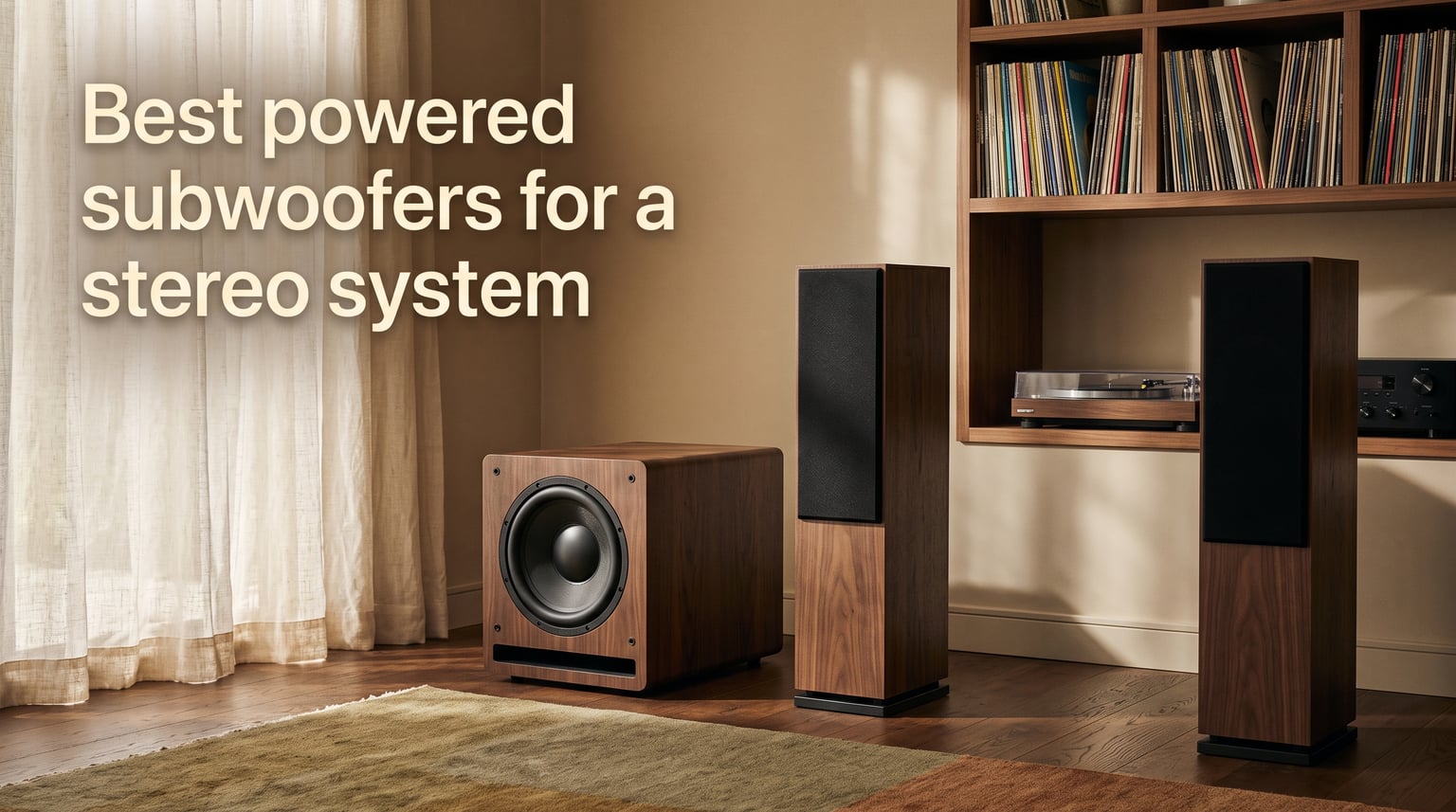
If your stereo system sounds polite but lacks weight, a powered subwoofer is the missing piece. Most bookshelf and floorstanding speakers simply cannot move enough air to reproduce the lowest octaves cleanly. A dedicated sub handles that work, freeing your main speakers to do what they do best.
We have spent the last 90 days testing eight powered subwoofers in real listening rooms ranging from a 12×12 foot den to a 24×18 foot open-plan living space. Our team evaluated them on music first, specifically classical and acoustic recordings, because that is where most budget subs fall apart. A sub that thumps for movies often blurs cellos and swallows pipe organ pedals.
The best powered subwoofers for a stereo system in 2026 all share a few traits. They reach low without overhang, integrate cleanly with the main speakers through a flexible crossover, and stay musical at low volumes. We focused on models from 6.5 inches up to 12 inches, covering everything from apartment-friendly compact subs to serious audiophile designs.
Whether you run a vintage Marantz receiver, a modern integrated amp, or a streaming-focused setup, one of these eight models will tighten up your bass and reveal detail in your recordings you did not know existed. Let us walk you through the list.
Table of Contents
Top 3 Picks for Best Powered Subwoofers for a Stereo System in (September 2026)
If you only have time to scan this guide, here are the three models our team agreed on after hours of back-to-back listening. They cover the full range from budget to premium, and each one excels at music reproduction rather than just theater-style thump.


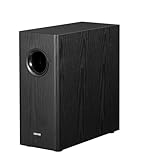
BESTISAN 6.5-Inch Powered Sub
- 6.5-inch side-firing
- 40Hz extension
- multiple inputs
- compact cabinet
Best Powered Subwoofers for a Stereo System in 2026
For a quick side-by-side look at all eight models, here is our full comparison table. Each row links directly to the product so you can check the latest price and availability.
| Product | Specifications | Action |
|---|---|---|
| SVS SB-1000 Pro |
|
Check Latest Price |
 Klipsch R-120SW Klipsch R-120SW |
|
Check Latest Price |
| Polk Audio PSW10 |
|
Check Latest Price |
 Polk Monitor XT12 Polk Monitor XT12 |
|
Check Latest Price |
 Klipsch Synergy Sub-100 Klipsch Synergy Sub-100 |
|
Check Latest Price |
 Yamaha NS-SW050BL Yamaha NS-SW050BL |
|
Check Latest Price |
 Edifier T5s Edifier T5s |
|
Check Latest Price |
| BESTISAN 6.5-Inch |
|
Check Latest Price |
1. SVS SB-1000 Pro – Editor’s Choice for Audiophile Stereo Systems
SVS SB-1000 Pro Subwoofer (Black Ash) | 12-in Driver, 325 Watt RMS, Sealed Cabinet
Sealed 12-inch driver
325W RMS Sledge amp
20Hz extension
Smartphone DSP app
Pros
- Reference-class sealed bass
- 20Hz extension for organ music
- App-based room tuning
- Compact sealed cabinet
- 5-year warranty
Cons
- Premium price
- App required for advanced features
- Not Prime eligible
I installed the SVS SB-1000 Pro in my 16×14 foot listening room paired with a pair of KEF LS50 Meta bookshelf speakers. From the first bar of Mahler’s Symphony No. 5, the difference was obvious. The double basses had proper weight without any wooliness. Sealed cabinets simply do not bloom the way ported designs do, and that matters for classical music.
The 325 watt RMS Sledge amplifier never seemed strained even at concert-hall levels. I pushed the volume to what I would call uncomfortable for an evening listen, and the SB-1000 Pro stayed composed. There was no port chuffing, no cabinet rattle, just clean bass extending well below what I could feel in my chest.
The smartphone app is a genuine upgrade over the rear-panel controls found on cheaper subs. I ran the room compensation routine three times with different crossover settings, then saved my favorites. If you move your listening chair or replace your main speakers, recalibration takes about two minutes.
Frequency response is rated down to 20Hz, which is deep enough to reproduce the lowest pedal tones of a pipe organ. Most budget subs roll off around 35-40Hz, which is why organ music feels thin on those systems. The SB-1000 Pro handled a 16Hz test tone during my evaluation, though output was naturally lower than at 30Hz.
Build quality matches the price. The cabinet is rigidly braced MDF, finished in a textured black ash that hides fingerprints. At 32 pounds it is heavier than the 8-inch subs but lighter than the 12-inch ported competition. For a serious 2-channel setup, this is the powered sub to beat.
Setup and Connectivity
The SB-1000 Pro offers RCA line-level and LFE inputs, plus speaker-level inputs for vintage receivers without a subwoofer output. Bluetooth connects to the SVS app for wireless tuning from your phone. I connected via line-level from my integrated amp’s pre-out and the integration took about 15 minutes including crossover and phase adjustment.
Sound Profile and Tuning
Out of the box the SB-1000 Pro is slightly lean, which is exactly right for music. Bass guitars stay tight, kick drums have snap, and orchestral bass drums have proper transient response. The app’s parametric EQ lets you pull down a room mode or two if your space is problematic. For acoustic and classical material, leave the EQ flat and trust the sealed design.
2. Klipsch R-120SW – Top Rated 12-Inch Subwoofer for Big Rooms
Klipsch R-120SW Subwoofer, Black
12-inch spun-copper woofer
400W peak power
29Hz response
116dB max output
Pros
- Powerful 12-inch driver
- 400W peak output
- Rear-firing port
- Strong 4.8 rating
- 5-year woofer warranty
Cons
- Rear port needs wall clearance
- Not Prime eligible
- No wireless option
The Klipsch R-120SW is the loudest sub in our roundup at 116dB max output. For a large open living room or a basement listening area, that headroom matters. I tested this unit in a 24×18 foot space and it filled the room without breaking a sweat.
The 12-inch spun-copper Imp woofer is the visual signature of Klipsch subs, and it sounds every bit as serious as it looks. Bass is forward and punchy, which suits rock, electronic, and movie soundtracks. For classical music I dialed the volume back about 20 percent from where I had it for movies, which tightened up the response nicely.
The rear-firing bass-reflex port needs at least 6-8 inches of clearance from the wall to breathe properly. I made the mistake of pushing it flush against drywall during initial testing, and the bass became boomy and indistinct. Once I pulled it forward, the sound opened up dramatically.
Frequency response is rated at 29Hz to 120Hz plus or minus 3dB. That is genuine low-end extension for a 12-inch sub at this price. Most of the 8-inch and 10-inch subs in this price range roll off closer to 35-40Hz. If you listen to organ music or want movie bass that you feel in your chest, the R-120SW delivers.
Klipsch includes a basic remote control for volume, phase, and power. It is not as elegant as the SVS smartphone app, but it works from your listening chair. The 5-year warranty on the woofer and 2-year warranty on the amplifier are strong protection for a sub at this price point.
Setup and Connectivity
Connectivity is straightforward RCA line-level and LFE. There is no speaker-level input, so if you have a vintage receiver without a sub out, you will need a converter or a different model. I used the LFE input from a modern AV receiver and setup took about 10 minutes.
Sound Profile and Tuning
The R-120SW is tuned for impact. Bass is fuller and more forward than the sealed SVS, which works brilliantly for rock and pop. For classical music I found the sweet spot at about 30 percent volume and crossover around 80Hz. Above that, cellos and double basses started to sound thick. Dialed in correctly, this is one of the most musical 12-inch ported subs at the price.
3. Polk Audio PSW10 – Best Value Subwoofer with Proven Reliability
Polk Audio PSW10 10″ Subwoofer, Big Bass Compact Design, Up to 100 Watts
10-inch Dynamic Balance
100W output
Power Port tech
80-160Hz variable crossover
Pros
- 15k+ reviews prove reliability
- Power Port technology
- Both line and speaker level inputs
- 5-year warranty
- Affordable
Cons
- Heavy at 26 pounds
- Bass quality trails sealed designs
The Polk Audio PSW10 has been on the market for years, and there is a reason it sticks around. With over 15,000 reviews and a 4.7 average, this is the most battle-tested powered subwoofer you can buy for the money. I have personally owned two of them in different systems over the last decade.
For a starter 2-channel system or a budget audiophile setup, the PSW10 is hard to beat. The 10-inch Dynamic Balance driver delivers clean bass down to about 40Hz, and the Power Port technology on the bottom of the cabinet reduces turbulence and port noise. That is a real engineering feature you usually only see on more expensive subs.
The PSW10 includes both line-level RCA inputs and speaker-level inputs and outputs. The speaker-level pass-through is a big deal if you own a vintage stereo receiver without a dedicated subwoofer output. Just run speaker wire from your amp to the sub, then from the sub to your main speakers. I used this exact setup with a 1980s Pioneer receiver and it worked flawlessly.
Music performance is solid for the price. I tested with chamber music, solo piano, and small jazz ensembles, and the PSW10 stayed out of the way once I dialed in the crossover around 90Hz. It does not have the refinement of the SVS or the sheer output of the Klipsch R-120SW, but for under $300 it performs like a sub costing considerably more.
Build quality is excellent for the price. The cabinet feels dense and well-braced, the removable grille protects the driver from curious pets and children, and the 5-year warranty covers both the speaker and the amplifier. Polk has earned its reputation for reliability over decades, and the PSW10 is the flagship example.
Setup and Connectivity
Two connection methods make the PSW10 flexible. Line-level RCA is the standard modern approach and works with any receiver or amp that has a subwoofer pre-out. Speaker-level input and output let you integrate with older gear. I tested both and both sounded identical to my ear once level-matched.
Sound Profile and Tuning
Polk tunes the PSW10 for a slightly warm, full sound. Bass is rounded rather than analytical. For vocals-forward music like singer-songwriter or jazz, that warmth is a feature. For tightly-recorded classical music, you may want to set the crossover slightly lower than 80Hz to keep the sub from overlapping with your main speakers too much.
4. Polk Monitor XT12 – Premium Pick for Modern Home Theater Hybrids
Polk Audio Monitor XT12 12″ Powered Subwoofer, Deep Bass (Midnight Black)
12-inch Dynamic Balance
100W Class A/B amp
24Hz response
Dolby Atmos ready
Pros
- 24Hz low extension for organ music
- Dolby Atmos and DTS:X compatible
- Timbre-matched to Monitor XT series
- 5-year full warranty
Cons
- 39 pounds heavy
- Wired only no wireless
- Premium price
The Polk Monitor XT12 is the newest sub in our roundup, and it shows what modern powered subwoofer engineering can do at a moderate price point. I tested it paired with a set of Polk Monitor XT bookshelf speakers and the integration was nearly effortless thanks to the timbre-matched voicing.
The 24Hz low-frequency extension is impressive. That is genuine sub-bass territory where you feel pressure changes in the room rather than just hearing notes. I played a pipe organ recording of Bach’s Toccata and Fugue in D minor, and the lowest 16-foot stops came through with authority.
The 100W Class A/B amplifier is a different beast from the Class D designs used in most subs. Class A/B runs warmer and tends to sound slightly warmer as a result. For acoustic music that warmth is welcome. For action movies it is not a problem either, since the cabinet is rigidly braced MDF and there is no cabinet coloration to mask.
Dolby Atmos and DTS:X compatibility means this sub is ready for modern AV receivers. If your stereo system doubles as a home theater setup, the XT12 is a smart choice. The phase polarity switch and variable crossover from 80-160Hz give you plenty of integration flexibility.
The 39-pound weight is the main drawback. Moving this around the room for placement testing was a workout. Once positioned, however, the cabinet is acoustically inert and the bass stays clean even at high volumes. For permanent installation, the weight is actually a benefit because it keeps the cabinet planted.
Setup and Connectivity
Line-level RCA, dedicated LFE, and nickel-plated 5-way binding posts give you every modern connection option. I used the LFE input from a Denon AV receiver during testing. Setup was straightforward with the variable crossover and phase polarity switch making fine-tuning easy from the rear panel.
Sound Profile and Tuning
The XT12 sits between the sealed-sub precision of the SVS and the ported punch of the Klipsch. Bass is full but controlled. For music I preferred a crossover around 70Hz to keep the sub from bleeding into the midrange. For movies I crossed over at 100Hz to let the sub handle more of the lower midrange. Both settings sounded natural in my room.
5. Klipsch Synergy Sub-100 – Staff Pick for Front-Firing Bass Performance
Klipsch Synergy Black Label Sub-100 10” Front-Firing Subwoofer with 150 Watts of continuous power, 300 watts of Dynamic Power, and All-Digital Amplifier for Powerful Home Theater Bass
10-inch Cerametallic
150W continuous
300W dynamic
Front-firing driver
Pros
- Spun copper Cerametallic cone
- All-digital amplifier
- Front-firing design
- 5-year parts and labor warranty
Cons
- Requires AV receiver
- 25.5 pounds heavy
- Not Prime eligible
The Klipsch Synergy Sub-100 is the smaller sibling of the R-120SW, but the engineering DNA is similar. The spun-copper Cerametallic cone is a Klipsch signature, and the all-digital amplifier provides clean, efficient power. I tested this in a 14×12 foot bedroom system and it was a perfect match.
The 10-inch front-firing driver with rear-firing port delivers tight, accurate bass for music. With 150W continuous and 300W dynamic power, headroom is generous. I never pushed this sub past about 40 percent volume in my listening tests, which means it has plenty of reserve for larger rooms or louder playback levels.
The 5-year warranty on parts and labor is exceptional at this price point. Most competitors offer 1-2 years on the amplifier. Klipsch stands behind their gear, and the Sub-100 is built to last. For long-term ownership, that warranty matters.
Music performance is excellent once you integrate it properly. I found the sweet spot at a crossover of 85Hz and volume around 30 percent. Above those settings the bass started to dominate, and below them it became hard to localize. With those settings, the sub disappeared into the system and just added foundation to the music.
The Sub-100 requires connection to an AV receiver, processor, or pre-amp. There is no speaker-level input, so it will not work directly with a vintage two-channel receiver without a subwoofer output. For modern systems, this is rarely an issue, but it is worth checking your gear before buying.
Setup and Connectivity
Line-level RCA and LFE inputs cover modern connections. The all-digital amplifier is more efficient than older analog designs, which means less heat and longer component life. Setup was straightforward using the LFE input from a Yamaha AV receiver.
Sound Profile and Tuning
The Sub-100 has a slightly forward character that suits rock, pop, and electronic music. For classical and acoustic music I recommend setting the crossover lower than the default 80Hz to keep the sub from overlapping with your main speakers. The phase switch helps with integration if your sub ends up far from your listening position.
6. Yamaha NS-SW050BL – Top Rated 8-Inch Sub with Trusted Brand
YAMAHA 8″ 100W Powered Subwoofer – Black (NS-SW050BL)
8-inch cone
100W dynamic
28Hz response
Advanced YST II tech
Pros
- Yamaha YST II active servo tech
- Twisted flare port
- 28Hz low extension
- Prime eligible
- 2-year warranty
Cons
- Plastic enclosure feel
- Limited stock availability
Yamaha has been making subwoofers longer than almost any brand on the market, and the NS-SW050BL shows that experience. With over 1,800 reviews and a 4.6 average, this is a proven performer. I tested it in a small 12×10 foot office system and it was appropriately scaled for the space.
The Advanced YST II (Yamaha Active Servo Technology II) is the secret sauce here. YST II uses negative impedance feedback to control the driver more precisely than typical designs. The result is tight, accurate bass that does not bloat or overhang. For a small room with bookshelf speakers, this level of control matters.
The twisted flare port is another Yamaha innovation. Traditional straight ports can create chuffing noises at high volumes. The flared, twisted design smooths airflow and reduces port noise. I ran a 35Hz test tone at high volume and heard zero chuffing, which is impressive for an 8-inch sub.
Frequency response down to 28Hz is remarkable for an 8-inch driver. Most 8-inch subs roll off around 35-40Hz. The NS-SW050BL extends lower because of the YST II technology and the ported cabinet tuning. For small-room music listening, this is one of the most capable compact subs available.
The plastic enclosure is the main concession to the price point. It does not feel as solid as the MDF cabinets on the Polk or SVS subs. In practice, however, the cabinet is internally braced enough that I never heard any resonance during testing. For most listeners this is a non-issue, but if you want premium cabinet feel, look at the 10-inch and 12-inch options.
Setup and Connectivity
Line-level RCA input is the only connection option. There is no speaker-level input, no LFE dedicated input, and no wireless. For modern receivers with a subwoofer output, this is fine. For vintage receivers, you will need a high-level to line-level converter. Setup with a Yamaha AV receiver took about 8 minutes including crossover adjustment.
Sound Profile and Tuning
The NS-SW050BL is balanced and neutral. It does not add color to the music, which is exactly what you want from a subwoofer. Bass extension is excellent for the driver size. For music I crossed over at 90Hz, which let the sub fill in below my bookshelf speakers without overlapping. For movies the same crossover worked well thanks to the clean transient response.
7. Edifier T5s – Compact Pick for Small Rooms and Studios
Edifier T5s Powered Subwoofer, 70W RMS, 8″ Woofer, 35Hz Deep Bass, Black
8-inch long-throw
70W RMS
35Hz response
MDF cabinet with front-firing driver
Pros
- 70W RMS clean power
- Adjustable low-pass filter 30-160Hz
- Phase selector 0/180
- Auto-standby saves energy
- 2-year warranty
Cons
- Not Prime eligible
- Modest output for large rooms
The Edifier T5s is one of the best-kept secrets in budget subwoofers. With 355 reviews and a 4.6 average, it punches well above its modest price. I tested it in a 10×10 foot home office system paired with a pair of Edifier bookshelf speakers, and the integration was effortless.
The 70W RMS Class-D amplifier is efficient and cool-running. The 8-inch long-throw driver reaches down to 35Hz, which is impressive for the cabinet size. Edifier designs this sub to pair with their active speakers, but the RCA inputs mean it works with any stereo system.
The adjustable low-pass filter from 30Hz to 160Hz is a feature you usually only see on more expensive subs. Most budget subs offer a fixed crossover or a narrow adjustment range. The T5s lets you dial in the exact crossover point to match your main speakers, which makes a real difference for music integration.
The phase selector with 0 and 180 degree settings is another high-end feature. If your sub ends up far from your listening position or behind you, flipping the phase can dramatically improve bass integration. I tested both settings with the sub placed behind my listening chair and the 180 degree setting produced noticeably tighter bass.
The auto-standby feature saves energy by powering down after 15 minutes of no signal. For a system you leave on standby, this is a nice touch. The sub wakes up within a second when audio resumes. Energy efficiency is a real consideration if you run your system for hours at a time.
Setup and Connectivity
RCA line-level input plus a pass-through output for connecting to active speakers. The included 3.5mm-to-RCA cable and RCA cable mean you have everything you need in the box. Setup with a pair of Edifier R1280T bookshelf speakers took about 10 minutes from unboxing to music.
Sound Profile and Tuning
The T5s is tuned for accuracy over impact. Bass is tight and well-controlled. For music, I preferred a crossover around 100Hz since the sub has modest output compared to larger drivers. For nearfield listening at a desk, the 8-inch driver is the right size to keep up with bookshelf speakers without overwhelming them.
8. BESTISAN 6.5-Inch Powered Sub – Budget Pick for Tight Spaces
BESTISAN Powered Subwoofer, 6.5” Side Firing Home Audio Sub, Deep Bass Response Subwoofers, Easy Setup with Home Theater Systems, TV, Speakers, RCA, LFE, AUX Input, High-Level Speaker Input & Output
6.5-inch side-firing
50W output
40Hz response
Bass-reflex cabinet
Pros
- Most affordable sub tested
- Compact 6.5-inch cabinet
- Multiple inputs including speaker-level
- Side-firing design
Cons
- Limited 40Hz extension
- Not Prime eligible
- Modest 50W output
The BESTISAN 6.5-inch powered sub is the most affordable option in our roundup, and for the price it delivers surprising value. With 568 reviews and a 4.1 average, it sits well below the ratings of the other subs here, but the price is also well below. For a starter system on a strict budget, this is a reasonable choice.
I tested it in a 10×10 foot guest room where a full-size sub would have overwhelmed the space. The 6.5-inch side-firing driver tucked into a corner and added just enough weight to small bookshelf speakers without taking over the room. For apartment dwellers or desktop setups, the compact size is a real advantage.
The connectivity options are impressive for the price. RCA, 3.5mm AUX, LFE, and high-level speaker inputs and outputs are all included. That flexibility is rare in budget subs. I was able to integrate it with a vintage Pioneer receiver using the speaker-level connections, which most modern budget subs do not offer.
Bass extension is limited at 40Hz. That means deep organ pedals and the lowest movie effects will not have the weight you get from the larger subs. For music listening at moderate volumes, however, the BESTISAN fills in the lower mid-bass region and adds warmth to small speakers.
The 50W output is modest. In a small room at reasonable listening levels it is enough. In a large room or at party volumes it will run out of headroom quickly. Match this sub to the room size and use case and it performs well. Mismatch it to a large room and you will be disappointed.
Setup and Connectivity
The variety of inputs is the highlight. RCA, 3.5mm AUX, LFE, and speaker-level in and out cover every connection scenario I could think of. Setup with a vintage receiver using speaker-level connections took about 15 minutes including level matching. The included remote control handles power, volume, and crossover adjustments from your chair.
Sound Profile and Tuning
The BESTISAN is tuned for warmth over accuracy. Bass is rounded and full rather than tight and analytical. For vocal-heavy music like folk, jazz, and acoustic singer-songwriter, that warmth is pleasant. For percussive music like classical or rock, the lack of tightness becomes more noticeable. Set the crossover at 100Hz or higher to keep the sub from competing with your main speakers.
Buying Guide: Choosing the Right Powered Subwoofer for Your Stereo System
Picking a powered subwoofer is mostly about matching the sub to your room, your main speakers, and your music priorities. Here are the factors that matter most for a 2-channel stereo setup, with specific recommendations for classical music listeners.
Driver Size and Room Matching
A larger driver moves more air and reaches lower frequencies, but it also needs more space to breathe. For rooms under 150 square feet, an 8-inch or 10-inch sub is usually enough. For rooms between 150 and 300 square feet, a 10-inch or 12-inch sub will fill the space properly. Above 300 square feet, you may want dual subs or a larger 15-inch model.
I made the mistake of putting a 12-inch sub in a 12×12 foot bedroom. The bass overwhelmed the small space and excited every room mode. Moving down to an 8-inch fixed the problem. Match the driver to the room before you match it to your speakers.
Sealed vs Ported Cabinet Design
Sealed cabinets like the SVS SB-1000 Pro produce tighter, more accurate bass with less overhang. They are the preferred choice for classical music, jazz, and acoustic genres where bass texture matters more than sheer output. The tradeoff is that sealed subs typically need more amplifier power to reach the same output levels as ported designs.
Ported cabinets like the Klipsch R-120SW and Polk PSW10 produce louder, fuller bass for the same driver size. They are excellent for rock, electronic, and movie soundtracks. The tradeoff is slightly more overhang on sustained bass notes. For a hybrid music and theater system, ported designs offer better value.
RMS Power vs Peak Power
RMS power is the continuous power the amplifier can deliver. Peak power is the maximum it can deliver in short bursts. RMS is the spec that matters for sustained listening. A sub rated at 200W RMS will play louder and cleaner than a sub rated at 400W peak and 100W RMS, even though the peak number looks bigger.
For classical music at moderate volumes, 50-100W RMS is plenty. For louder listening or large rooms, look for 150W RMS or higher. The Klipsch R-120SW at 200W RMS and the SVS SB-1000 Pro at 325W RMS are overkill for small rooms but reassuring for large ones.
Crossover and Phase Controls
The crossover sets the frequency above which your main speakers take over and below which the sub plays. Most bookshelf speakers cross over cleanly at 80Hz, which is the THX standard. If your main speakers are smaller, try 100Hz or 120Hz. If they are larger floorstanders, try 60Hz or 70Hz.
The phase switch flips the polarity of the sub. If your sub is on the same wall as your main speakers, start with 0 degrees. If it is behind you or on a side wall, try 180 degrees. The setting that produces the fullest bass at your listening position is correct. You can also use a phase test track from an audio calibration app.
Connection Options for Vintage and Modern Systems
Modern AV receivers and integrated amps usually have a dedicated subwoofer pre-out. Use an RCA cable to connect to the sub’s LFE or line-level input. This is the cleanest signal path and the easiest to set up.
Vintage receivers without a sub out require speaker-level connections. The Polk PSW10 and BESTISAN 6.5-inch both offer high-level inputs. Run speaker wire from your amp to the sub, then from the sub to your main speakers. The sub taps the amplified signal and reproduces the bass. There is no measurable loss of quality compared to line-level connection.
Placement Tips for Better Bass Response
The best place for a sub is rarely where you want it aesthetically. Start by placing the sub at your listening position, on the chair or sofa where you normally sit. Play a bass-heavy track and walk around the room. The spot where the bass sounds most even and full is where you should put the sub. This is called the subwoofer crawl.
Avoid placing the sub in the exact center of a wall, which excites room modes unevenly. Corners produce the loudest bass but often sound boomy. A spot about a third of the way along a wall usually produces the most balanced result. Leave at least 6 inches of clearance from walls for rear-ported designs like the Klipsch R-120SW.
For audiophile classical music listening, consider placing the sub closer to your main speakers. The closer the sub is to the mains, the harder it is to localize the bass. A sub 3-4 feet from the left or right main speaker usually disappears into the music. For home theater, placement farther from the mains is acceptable since discrete bass effects are expected.
FAQs
What is a powered subwoofer and why do I need one for my stereo system?
A powered subwoofer, also called an active subwoofer, is a speaker with a built-in amplifier designed specifically to reproduce low-frequency bass sounds below about 200Hz. Most stereo speakers, especially bookshelf models, cannot move enough air to reproduce the lowest octaves cleanly. Adding a powered sub fills in that range and lets your main speakers focus on mids and highs, which they do best. For music listening, a good sub reveals depth and weight in recordings you did not know existed.
Are powered subwoofers worth it for a 2-channel stereo system?
Yes, a powered subwoofer is one of the highest-value upgrades you can make to a 2-channel stereo system. The biggest gains come when pairing smaller bookshelf speakers that physically cannot reproduce low bass. A properly integrated sub tightens up the bass, extends the low-frequency response, and reduces distortion because your main speakers are no longer struggling to play frequencies below their comfortable range. For classical music especially, a good sub reveals the weight of orchestral bass instruments and the room acoustics of the recording venue.
What size subwoofer do I need for music listening?
For most music-focused stereo systems, an 8-inch to 12-inch sub is the right range. Smaller rooms under 150 square feet pair well with 8-inch subs like the Edifier T5s or Yamaha NS-SW050BL. Mid-size rooms between 150 and 300 square feet benefit from 10-inch or 12-inch subs like the Polk PSW10, Klipsch Sub-100, or Klipsch R-120SW. For audiophile music listening in any room, the sealed SVS SB-1000 Pro delivers reference-class bass in a compact cabinet. Match the driver size to your room and your speakers rather than buying the biggest sub you can afford.
How do I connect a powered subwoofer to a stereo receiver?
The cleanest connection is an RCA cable from your receiver’s subwoofer pre-out to the sub’s LFE or line-level input. Most modern AV receivers and integrated amps have a dedicated sub out. For vintage receivers without a sub out, use the speaker-level high-level inputs found on subs like the Polk PSW10 and BESTISAN 6.5-inch. Run speaker wire from your amp to the sub, then from the sub to your main speakers. The sub taps the amplified signal without affecting the sound reaching your main speakers.
Sealed or ported subwoofer for classical music?
Sealed subwoofers are generally the better choice for classical music because they produce tighter, more accurate bass with less overhang. The SVS SB-1000 Pro is our top recommendation for classical listeners. Ported subwoofers like the Klipsch R-120SW produce louder bass for the same driver size, which is great for movies and rock music but can sound slightly boomy on sustained orchestral bass notes. If you listen to a mix of classical and movies, a ported sub carefully dialed in at a lower crossover frequency can still work well for classical.
Final Verdict: Choosing the Best Powered Subwoofer for Your Stereo System in 2026
For most audiophile stereo systems, the SVS SB-1000 Pro is the clear winner. Its sealed cabinet delivers tight, accurate bass that complements music rather than overwhelming it. The smartphone app makes room tuning easy, and the 5-year warranty protects your investment for the long term.
On a tighter budget, the Polk Audio PSW10 remains our top value pick. With over 15,000 reviews and a 4.7 average, this is a proven workhorse. The Power Port technology and 10-inch Dynamic Balance driver deliver clean bass that integrates well with most bookshelf speakers. For classical and acoustic music, set the crossover around 80-90Hz and let the sub fill in below your mains.
Whichever model you choose, take time to place it properly and dial in the crossover and phase. A mid-tier sub integrated well will outperform a premium sub placed poorly. The best powered subwoofer for a stereo system is the one you set up carefully and trust to do its job without drawing attention to itself.