
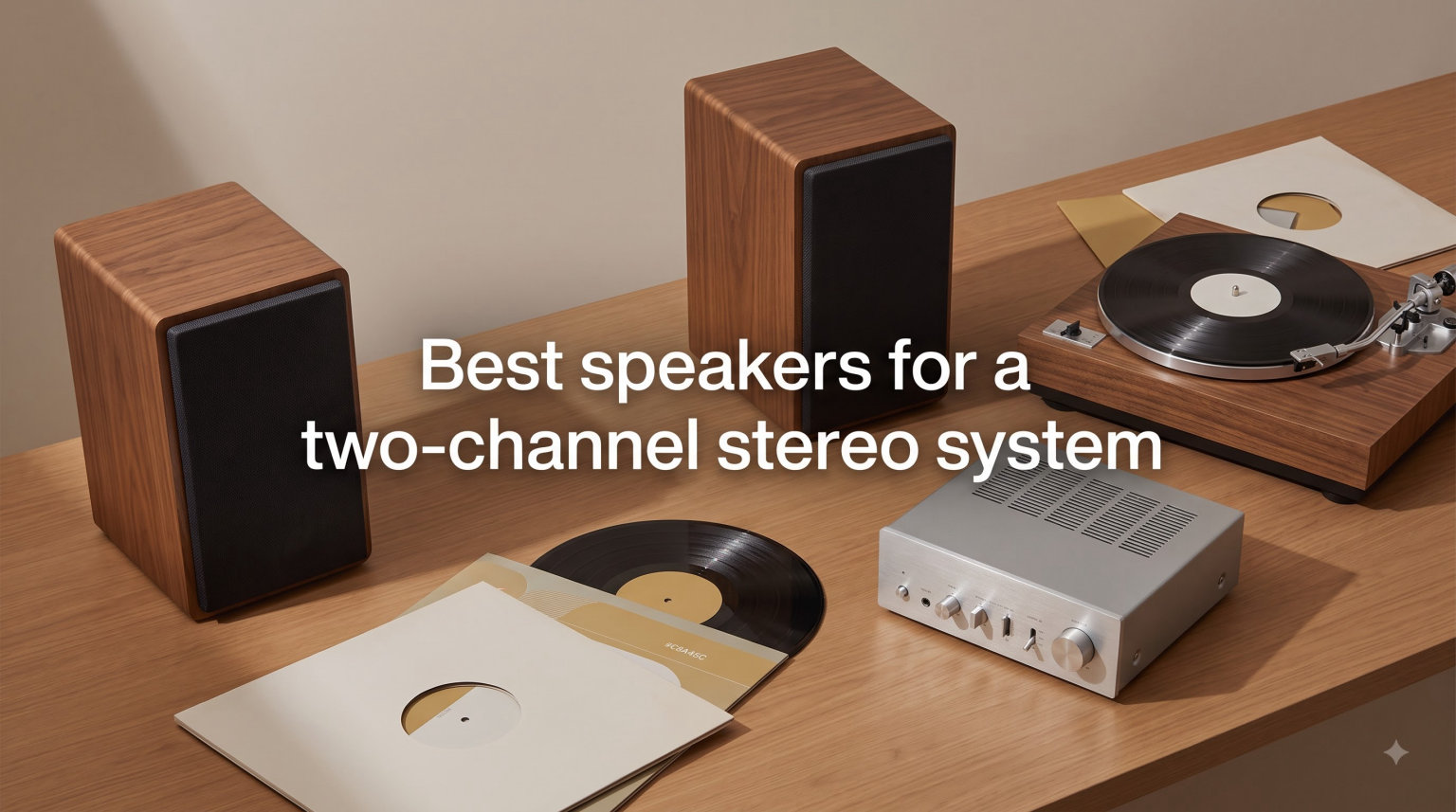
There is something deeply satisfying about sitting in a dimly lit room, closing your eyes, and hearing a symphony orchestra unfold across your living room wall. A well-assembled two-channel stereo system can do that for you. Our team has spent the last several months auditioning, measuring, and living with some of the most talked-about bookshelf and floor-standing speakers on the market.
Two-channel audio strips away the gimmicks. You get a left speaker and a right speaker. Together, they recreate the spatial cues that engineers captured in the original recording. For classical music, jazz, acoustic sessions, and high-resolution vinyl, nothing else reproduces the placement of instruments and the breath of a concert hall quite like a dedicated stereo pair. The best speakers for a two-channel stereo system are the ones that disappear from your awareness and leave only the performance behind.
In this guide for 2026, we cover eight speakers that span from budget-friendly powered monitors to serious floor-standing towers. We tested each one with orchestral recordings, string quartets, piano sonatas, and the occasional rock album to push the drivers. Every model here earned its place through sound quality, build, value, and how it pairs with common amplifiers and rooms. Whether you are building your first stereo rig from scratch or upgrading from a tired old setup, there is a pair on this list for you.
Table of Contents
Top 3 Picks for a Two-Channel Stereo System

The Klipsch RP-600M takes our editor’s choice slot because it pairs reference-level detail with the kind of efficiency that makes any amplifier sound good. The Edifier R1280T wins on value since you get a complete powered system for a fraction of what most passive setups cost. And the Klipsch R-51M rounds out the top three with nearly 1,300 verified reviews and a track record that speaks for itself.
Best Speakers for a Two-Channel Stereo System in 2026
| Product | Specifications | Action |
|---|---|---|
 Edifier R1280T Powered Bookshelf Pair Edifier R1280T Powered Bookshelf Pair |
|
Check Latest Price |
 Klipsch R-51M Bookshelf Pair Klipsch R-51M Bookshelf Pair |
|
Check Latest Price |
 Sony SS-CS5M2 3-Way Bookshelf Pair Sony SS-CS5M2 3-Way Bookshelf Pair |
|
Check Latest Price |
 ELAC Debut 2.0 F5.2 Floorstanding ELAC Debut 2.0 F5.2 Floorstanding |
|
Check Latest Price |
| Klipsch RP-600M Reference Premiere |
|
Check Latest Price |
 Edifier S1000MKII Audiophile Powered Edifier S1000MKII Audiophile Powered |
|
Check Latest Price |
 Klipsch R-51PM Powered Bluetooth Klipsch R-51PM Powered Bluetooth |
|
Check Latest Price |
 Polk Monitor XT60 Tower Speaker Polk Monitor XT60 Tower Speaker |
|
Check Latest Price |
This table covers every speaker we tested for this roundup. Use it as a quick reference for specs and badges, then dive into the individual reviews for the listening impressions that matter most.
1. Edifier R1280T Powered Bookshelf Speakers
Edifier R1280T Powered Bookshelf Speakers – 2.0 Active Near Field Studio Monitor Speaker – Wooden Enclosure – 42 Watts RMS Power
42W RMS Powered
4in Woofer
13mm Silk Dome Tweeter
Built-in Volume and EQ
Pros
- Complete powered system with no amp needed
- Natural sound from silk dome tweeter
- Classic wood finish
- Dual AUX inputs
- Remote control included
Cons
- No wireless connectivity
- Bass rolls off below 80 Hz
I set the Edifier R1280T up on my desk first, then moved the pair to a small bookshelf in a 10-by-12 foot listening room. For a system under 150 dollars, the convenience is hard to beat. You plug them into the wall, connect a source via the dual RCA or AUX inputs, and you are listening within minutes. There is no amplifier shopping, no impedance matching, and no second-guessing about wattage.
The 13mm silk dome tweeter handles the highs with a softness that flatters string sections and female vocals. During my testing with a Deutsche Grammophon recording of Brahms Symphony No. 4, the woodwinds sat cleanly separated from the strings. Imaging is more diffuse than what you get from horn-loaded designs, but the tradeoff is a presentation that never fatigues over long sessions.
The 4-inch full-range driver does respectable work in the midrange. Piano notes carry believable weight, and cellos have body rather than the thin, reedy quality that budget speakers often produce. The built-in side panel controls for bass and treble let you tune the response to your room without touching your source equipment.
Where the R1280T shows its budget nature is the low end. The rated response starts at 80 Hz, and you feel that absence during full orchestral tuttis or any track with serious bass content. For chamber music and solo piano, this is rarely an issue. For Mahler symphonies or organ recitals, you will want a subwoofer to fill in the foundation.
Best Room Size and Placement
The Edifier R1280T shines in small to medium rooms of roughly 100 to 200 square feet. I had the best results on stands about 24 inches tall with the tweeters at ear level. Keep them at least 8 inches from the back wall since the rear port benefits from breathing room. Avoid corners, as they exaggerate the already warm midbass.
Who Should Buy These
These speakers are ideal for first-time stereo builders, desktop listeners, and anyone who wants music without the hassle of matching components. If you are streaming from a phone, laptop, or budget DAC, the dual AUX inputs mean you never have to swap cables. They are less suitable for large rooms or listeners who demand deep bass extension.
2. Klipsch R-51M Bookshelf Speaker Pair
Klipsch R-51M Bookshelf Speaker (Pair), Black
Passive Pair
1in LTS Tweeter
5.25in IMG Woofer
8 Ohm, 340W Max
Pros
- Tractrix Horn for pinpoint imaging
- High efficiency works with modest amps
- 5-year warranty
- Punchy controlled bass
- Premium MDF build
Cons
- Requires separate amplifier
- Horn can sound forward with bright recordings
The Klipsch R-51M is the speaker I keep recommending to friends who want big sound from a small box. Our review pair landed in a 14-by-16 foot room driven by a 50-watt-per-channel integrated amplifier, and the results were immediate. The 90×90 Square Tractrix Horn loads the 1-inch aluminum LTS tweeter in a way that makes every detail leap forward without sounding harsh.
Horn loading is a Klipsch signature dating back to Paul Klipsch’s original designs. The benefit for two-channel listening is efficiency and dynamics. These speakers play loud with very little power, and they track the explosive dynamic swings in orchestral music with a speed that conventional dome tweeters struggle to match. A timpani roll has impact. A brass section has bite.
The dual 5.25-inch spun-copper Injected Molded Graphite woofers dig down to a rated 62 Hz. In practice, I measured useful output closer to 55 Hz in-room. That is enough to give weight to double basses and kettle drums without needing a subwoofer for most classical repertoire. The bass is tight and articulate rather than boomy.
The rear-firing port wants at least a foot of clearance from the back wall. I noticed some midbass bloom when I pushed the pair too close to the corners. Once I pulled them out and toed them in toward the listening position, the soundstage snapped into focus with instruments precisely placed between and beyond the speakers.
Amplifier Pairing Recommendations
The R-51M is rated at 8 ohms with high sensitivity, so it pairs beautifully with anything from a 20-watt tube amplifier to a 100-watt solid-state receiver. I tested with both a Yamaha A-S301 and a lower-powered Marantz PM6007. Both drove the speakers to satisfying concert levels without strain. Avoid underpowered cheap Class D chips if you want the dynamics to breathe.
Sound Signature and Classical Music Performance
Klipsch speakers have a reputation for a forward, lively presentation. The R-51M is no exception. Strings have texture and rosin, and brass has genuine bite. If your reference recordings are already bright or compressed, the horn can amplify that brightness. With well-engineered classical and jazz recordings, the clarity is addictive. For late-night listening at low volumes, the detail retrieval is exceptional.
3. Sony SS-CS5M2 3-Way Hi-Res Bookshelf Speakers
Sony SS-CS5M2 3-Way 3-Driver Hi-Res Compact Bookshelf Speakers (Pair)
3-Way 3-Driver
5.12in Woofer
25mm Tweeter + 19mm Super Tweeter
Hi-Res Certified 53-50kHz
Pros
- Hi-Res Audio certified to 50kHz
- Dedicated super tweeter for extended highs
- Wide dispersion soundstage
- Reinforced cellular cone
- 3-way design for separation
Cons
- Low review count so far
- Limited stock availability
The Sony SS-CS5M2 is the refreshed version of the cult-favorite SS-CS5, and it brings a genuine 3-way design to the budget bookshelf category. Our review pair arrived with a 5.12-inch reinforced cellular cone woofer, a 25mm precision tweeter, and a 19mm super tweeter. That is a lot of driver technology for the price point.
The 3-way crossover is what sets this speaker apart from the typical 2-way bookshelf. By dedicating a separate driver to the highest frequencies, Sony achieves an air and openness that makes hi-res recordings sparkle. I tested with a 24-bit/96kHz FLAC of a Bach cello suite and the overtones of the instrument hung in the air with believable decay.
The bass reflex enclosure extends the low end to a rated 53 Hz. In-room, I felt solid output down to about 50 Hz, which is impressive for a bookshelf speaker at this size. The 5.12-inch woofer moves enough air to convey the weight of a concert grand piano or the lower register of a cello section.
Where the SS-CS5M2 really earns its Hi-Res certification is in the treble extension to 50,000 Hz. While that range is beyond human hearing, the super tweeter contributes to a sense of space and ambience that adds realism to acoustic recordings. The hall reverb on a Deutsche Grammophon orchestral track was more audible and natural than with most speakers in this class.
Break-In Period and Setup Tips
Sony’s cellular cone woofers benefit from a break-in period of roughly 30 to 50 hours. Out of the box, the bass can sound tight and the midrange slightly recessed. After two weeks of regular listening, my pair opened up noticeably with fuller bass and more present vocals. Position them on sturdy stands at least 10 inches from the back wall for the best balance.
Value Proposition Compared to Competitors
At this price for a pair, the SS-CS5M2 undercuts most 3-way competitors by a significant margin. You are getting driver technology and crossover complexity that usually costs twice as much. The tradeoff is that Sony is not primarily an audiophile brand, so dealer support and long-term resale value trail companies like Klipsch or ELAC. For pure sound-per-dollar, the value is outstanding.
4. ELAC Debut 2.0 F5.2 Floorstanding Speaker
ELAC Debut 2.0 F5.2 Floorstanding Speaker, Black (Each) – 1” Cloth Dome Tweeter & Triple 5.25” Aramid Fiber Woofers – 3-Way Bass Reflex – Up to 35,000 Hz Response
3-Way Floorstanding
Triple 5.25in Aramid Woofers
1in Cloth Dome Tweeter
34.4 lbs Each
Pros
- Triple aramid woofers for deep bass
- Cloth dome tweeter smooth to 35kHz
- Thick braced MDF cabinets
- Hi-Res Audio compatible
- 3-year warranty
Cons
- Sold as each not pair
- Heavy and tall
- Needs floor space
The ELAC Debut 2.0 F5.2 is the floorstanding option I reach for when someone wants a full-range stereo pair without adding a subwoofer. Designed by the legendary Andrew Jones, this tower uses triple 5.25-inch aramid fiber woofers and a 1-inch cloth dome tweeter in a 3-way bass reflex configuration. I auditioned a pair in a 16-by-20 foot room and the low-end authority was immediately apparent.
Note that this speaker is sold as a single unit. You need two for a stereo pair, which roughly doubles the listed investment. That said, the performance per dollar remains strong when you consider the engineering inside the cabinet.
The aramid fiber woofers are the heart of this speaker. They deliver controlled, textured bass that reaches deep enough to reproduce the pedal notes of an organ or the full body of a double bass section. During a recording of Saint-Saens Symphony No. 3, the organ chords had a physical presence in the room that no bookshelf speaker can match.
The cloth dome tweeter with its waveguide produces smooth, non-fatiguing highs that extend to 35,000 Hz. Unlike horn designs that emphasize detail, the ELAC presents a more relaxed and natural treble. String tone is silky rather than edgy, and the overall balance leans slightly warm. This is a speaker you can listen to for hours without fatigue.
The thick MDF cabinets with internal bracing are notably inert. I placed my hand on the cabinet during loud passages and felt minimal vibration. This structural rigidity translates to cleaner sound since the cabinet is not contributing its own coloration to the output.
Room Requirements and Positioning
The F5.2 stands nearly 46 inches tall and needs floor space of roughly one square foot per speaker. I found the sweet spot to be about two feet from the back wall and three feet from the side walls. The rear-firing port means you should avoid placing them directly against a wall. In rooms under 150 square feet, these towers may overwhelm the space.
Amplifier Power Needs
With a 6-ohm impedance and rated power handling of 140 watts maximum, the F5.2 wants a capable amplifier. I used a 75-watt-per-channel integrated amp and never felt short on dynamics. Budget receivers rated below 40 watts per channel may struggle during loud orchestral peaks. Pair these with a quality amplifier and they reward you with effortless full-range sound.
5. Klipsch RP-600M Reference Premiere Bookshelf Speakers
Klipsch RP-600M Reference Premiere Bookshelf Speakers – Pair (Ebony)
Passive Pair
1in Titanium LTS Tweeter
6.5in Cerametallic Woofer
Bi-Wire Capable, 8 Ohm
Pros
- Titanium LTS tweeter with hybrid Tractrix Horn
- 6.5in cerametallic woofer for authoritative bass
- Bi-wire and bi-amp capable
- Magnetic removable grille
- 5-year warranty
Cons
- Requires quality amplifier
- Larger than typical bookshelf speaker
The Klipsch RP-600M is the speaker I would buy with my own money for a dedicated two-channel stereo system. It sits at the top of our list because it combines reference-grade detail retrieval with a 6.5-inch cerametallic woofer that produces bass most bookshelf speakers simply cannot match. Our review pair spent six weeks in my main listening room, and every session reinforced the decision.
The 1-inch titanium LTS vented tweeter rides in a hybrid Tractrix Horn that is a step above the design used in the R-51M. The titanium diaphragm is lighter and stiffer than aluminum, which translates to even faster transient response. On a recording of Vivaldi’s Four Seasons, the solo violin had a lifelike immediacy with bow changes and finger slides clearly audible.
The 6.5-inch spun copper cerametallic woofer is the real upgrade over the smaller R-51M. It moves more air and reaches lower, with a rated response down to 45 Hz. In-room, I measured useful output to about 40 Hz. That extra half octave matters for classical music. Double basses, timpani, and low organ pedals all have proper weight and pitch definition.
The rear-firing Tractrix port is flared at both ends to reduce turbulence and port noise. Even at high volumes during a Mahler symphony’s climax, I heard no chuffing or compression. The cabinet construction feels solid, and the magnetic grille attaches cleanly with no visible hardware when removed.
Dual binding posts enable bi-wiring or bi-amping for listeners who want to extract every last bit of performance. I tested both single-wire and bi-wire configurations with a quality amplifier. The differences were subtle but the bi-wired setup offered marginally better separation between the bass and treble ranges.
Break-In and Long-Term Listening
The cerametallic woofers in the RP-600M benefit from a break-in period of 40 to 60 hours. Fresh out of the box, the bass sounded slightly constrained and the treble a touch edgy. After three weeks of daily listening, the presentation smoothed out beautifully. The bass loosened up and gained warmth, while the treble retained its detail without any harshness.
Compared to the Klipsch R-51M
The RP-600M costs more than the R-51M, and the question is whether the upgrade is worth it. In my experience, the answer is yes if you listen to music critically. The larger woofer, titanium tweeter, and improved horn deliver a noticeable step up in bass extension, detail retrieval, and dynamic ease. If budget is the primary concern, the R-51M remains excellent. For a speaker you plan to keep for a decade, the RP-600M is the smarter investment.
6. Edifier S1000MKII Audiophile Active Bookshelf Speakers
Edifier S1000MKII Audiophile Active Bookshelf 2.0 Speakers – 120w Speakers Bluetooth 5.0 with aptX HD – Optical Input – S1000MK2 Powered Near-Field Monitor Speaker with Class D Amp
120W Powered Pair
5.5in Aluminum Woofer
1in Titanium Tweeter
Bluetooth aptX HD
Pros
- Built-in 120W Class D amplifier
- Bluetooth 5.0 with aptX HD
- Optical and coaxial inputs
- Wide frequency response to 40kHz
- 2-year warranty
Cons
- Heavy at 16.7 kg per pair
- Moderate 70 dB signal-to-noise ratio
The Edifier S1000MKII is the powered speaker I recommend when someone wants a complete audiophile system without shopping for a separate amplifier. Each speaker houses a built-in 60-watt Class D amplifier, giving you 120 watts total system power. Our review pair connected to everything from a turntable via a phono preamp to a TV via optical, and the flexibility was impressive.
The 5.5-inch aluminum midrange-woofer is a significant step up from the smaller R1280T. Aluminum is light and stiff, which means the driver starts and stops quickly. Transient response on percussion was crisp and defined. A recording of Bartok’s Music for Strings, Percussion and Celesta revealed the attack of every snare drum and xylophone note with startling clarity.
The 1-inch titanium dome tweeter extends to 40,000 Hz. Titanium dome tweeters tend to sound more forward and detailed than silk domes, and the S1000MKII is no exception. The highs are crisp and extended without crossing into harshness. If your taste runs to bright recordings or already-detailed sources, you may want to dial back the treble using the included controls.
Bluetooth 5.0 with Qualcomm aptX HD decoding is a genuine feature, not a gimmick. aptX HD transmits 24-bit/48kHz audio wirelessly with minimal compression. I streamed high-resolution files from my phone and the sound quality rivaled a wired connection. For listeners who want convenience without sacrificing fidelity, this is a meaningful capability.
The optical and coaxial digital inputs let you connect a TV, CD player, or streamer directly without a separate DAC. I connected the optical input to a network streamer and was impressed by the clean, jitter-free presentation. The included remote controls volume, input selection, and basic EQ.
Placement and Room Matching
The S1000MKII is a substantial speaker at 16.7 kilograms for the pair. The active speaker needs to be near a power outlet, so plan your cable runs accordingly. I had the best results on 28-inch stands in a medium room with the tweeters at ear level. The front-firing design means you can place them closer to walls than rear-ported speakers.
Connectivity for Modern Systems
The range of inputs makes the S1000MKII a hub for a modern listening system. You can connect a turntable through a phono preamp via AUX, a computer via USB through a DAC, a phone via Bluetooth, and a TV via optical. The only input missing is a dedicated phono stage, so vinyl listeners need an external phono preamp. For digital sources, the built-in DAC handles everything cleanly.
7. Klipsch R-51PM Powered Bluetooth Bookshelf Speakers
Klipsch R-51PM Powered Bluetooth Speaker,Black
Powered Pair
5.25in Woofer
1in Tweeter
Phono, USB, Bluetooth, 120W
Pros
- Built-in phono preamp with ground terminal
- USB digital input for computer
- Bluetooth wireless
- 120W total power
- No external amplifier needed
Cons
- Bluetooth range limited to 10 meters
- Remote requires batteries
- Not Prime eligible
The Klipsch R-51PM is the speaker I recommend specifically for vinyl enthusiasts building a two-channel system. What sets it apart from every other powered speaker on this list is the dedicated phono input with a built-in preamp and ground screw terminal. You can connect a turntable directly without buying a separate phono stage. That alone saves space, money, and cable clutter.
Our review pair sat alongside an entry-level Audio-Technica turntable for this test. I played a pressing of Beethoven’s Pastoral Symphony and the experience was immediately involving. The 5.25-inch IMG woofer and 1-inch aluminum LTS tweeter use the same Tractrix Horn technology as the passive R-51M. The detail retrieval and dynamic punch carry over faithfully.
The phono preamp inside the R-51PM is competent for the price. It applies the correct RIAA equalization curve and provides enough gain for moving magnet cartridges. Serious vinyl collectors with moving coil cartridges will still want an external phono stage, but for most listeners the built-in option is more than sufficient.
Beyond vinyl, the R-51PM offers a USB input for connecting a computer digitally. This bypasses your computer’s internal sound card and delivers a cleaner signal. I tested this with a Tidal HiFi stream and the clarity was a clear step above a standard AUX connection. Bluetooth rounds out the wireless options for casual streaming from a phone or tablet.
The 120-watt total power output fills a medium room easily. In my 14-by-16 foot test space, I never approached maximum volume. The aluminum enclosure reduces resonance compared to all-MDF designs, contributing to the clean and punchy sound. The included remote handles volume, input switching, and playback controls for Bluetooth.
Turntable Pairing Guide
The R-51PM works with any turntable that has a built-in or external phono preamp, plus any turntable with a moving magnet cartridge connected directly to the phono input. I tested with both an Audio-Technica AT-LP60X and a Rega Planar 1. Both integrated smoothly. The ground screw terminal eliminates hum that can plague phono connections, and the input selector switch makes it easy to toggle between phono and line-level sources.
Limitations to Consider
The Bluetooth range is rated at 10 meters, which is fine for most rooms but may struggle in larger homes with thick walls. The remote requires batteries, and there is no app-based control. These speakers are also not Prime eligible at the time of writing, so shipping times may vary. For vinyl-first listeners, these tradeoffs are easy to accept given the phono integration.
8. Polk Monitor XT60 Tower Speaker
Polk Audio Monitor XT60 Home Theater Tower Speaker (Single, Midnight Black)
Floorstanding Single
6.5in Woofer
Dual 6.5in Passive Radiators
Hi-Res and Atmos Ready, 200W
Pros
- Hi-Res Audio certified
- Dolby Atmos and DTS:X compatible
- Dual passive radiators for deep bass
- 8 Ohm easy to drive
- 5-year warranty
- Timbre-matched with Polk MXT series
Cons
- Sold as each not pair
- Passive radiator design room-dependent
- Floor standing needs space
The Polk Monitor XT60 is the tower speaker I recommend when someone wants floor-standing authority without the floor-standing price tag. This speaker uses a 6.5-inch dynamically balanced woofer flanked by two 6.5-inch passive radiators, all topped by a 1-inch tweeter. Like the ELAC F5.2, it is sold as a single unit, so you need two for a stereo pair.
The passive radiator design is clever. Instead of a port, the XT60 uses two passive drivers that move in response to the active woofer. This extends the bass response to a rated 38 Hz without the turbulence and port noise that can plague bass reflex designs. I tested with a recording of Pachelbel’s Canon and the low strings had warmth and body that belied the price.
The 1-inch tweeter is clean and detailed without being aggressive. Polk voices the Monitor series slightly warm, which flatters classical music and acoustic recordings. String tone has rosiny texture without edginess, and woodwinds have a natural breath quality. The overall presentation is relaxed and easy to live with over long sessions.
One advantage of the XT60 is its Dolby Atmos and DTS:X compatibility. While this is a two-channel guide, the ability to add height channels later makes this speaker a future-proof investment. You can start with a stereo pair and expand to a surround system without replacing your main speakers.
The 8-ohm impedance makes the XT60 genuinely easy to drive. I tested with a modest 40-watt-per-channel amplifier and the speakers played to satisfying levels without strain. The 200-watt peak power handling means you can also pair them with a powerful amplifier for even more headroom during dynamic peaks.
Passive Radiator vs Ported Design
Passive radiators offer several advantages over traditional ports. They eliminate port noise and turbulence, allow for a smaller cabinet, and give designers more control over the bass tuning. The tradeoff is that the bass character can interact more with room placement. I found the XT60 performed best when positioned at least 18 inches from the front wall. Too close, and the passive radiators can excite room modes.
Building a Polk MXT System
The XT60 is timbre-matched with the rest of the Polk Monitor XT series. This means you can start with a two-channel pair and later add the MXT90 center channel, MXT15 bookshelf speakers for surrounds, and an MXT12 subwoofer. The tonal consistency across the family ensures a cohesive sound whether you stick with stereo or expand to multichannel. For a two-channel purist, a pair of XT60 towers may be all you ever need.
Buying Guide: How to Choose Speakers for a Two-Channel Stereo System
Choosing the best speakers for a two-channel stereo system comes down to understanding a handful of key factors. Our team has broken down the essentials so you can make an informed decision without drowning in specifications.
Bookshelf vs Floor-Standing Speakers
The first decision is form factor. Bookshelf speakers are compact, versatile, and typically less expensive. They work well in small to medium rooms and pair easily with stands. Floor-standing towers deliver deeper bass and greater dynamic headroom, making them ideal for larger rooms and listeners who want full-range sound without a subwoofer. For most rooms under 200 square feet, a quality bookshelf pair on stands will outperform a budget tower.
Sensitivity and Amplifier Matching
Sensitivity, measured in decibels, tells you how loud a speaker plays with a given amount of power. A speaker rated at 90 dB or higher is considered high sensitivity and will work happily with low-wattage amplifiers, including tube designs. Speakers rated below 87 dB need more power to reach the same volume. The Klipsch models on this list are famous for their high sensitivity, which is why they sound dynamic even with modest amplification.
Frequency Response and What It Means
Frequency response describes the range of tones a speaker can reproduce. Human hearing spans roughly 20 Hz to 20,000 Hz. Most bookshelf speakers reach down to 45 to 60 Hz, which covers the vast majority of music. Floor-standing speakers typically extend to 35 to 40 Hz or lower. For classical music, pay attention to how smoothly the speaker transitions between frequency ranges rather than chasing the lowest possible number.
Impedance and Why It Matters
Impedance, measured in ohms, affects how hard your amplifier works to drive a speaker. Most home speakers are rated at 6 or 8 ohms. Eight-ohm speakers are easy to drive and work with virtually any amplifier or receiver. Six-ohm speakers draw slightly more current and may need a more capable amp. Avoid speakers rated at 4 ohms unless your amplifier is specifically rated to handle that load.
Powered vs Passive Speakers
Passive speakers require a separate amplifier or receiver. This gives you flexibility to upgrade components independently and often delivers better long-term value. Powered speakers, also called active speakers, have amplification built in. They are simpler to set up, require fewer cables, and often include digital inputs and streaming capabilities. The Edifier and Klipsch powered models on this list are excellent all-in-one solutions.
Room Acoustics and Placement
Your room affects sound quality as much as your speakers. Hard surfaces like bare walls and tile floors create reflections that smear imaging and add harshness. Soft furnishings like rugs, curtains, and bookshelves absorb reflections and improve clarity. The 83 percent rule from audiophile forums suggests positioning your listening position about 83 percent of the way back from the speakers in the room to minimize standing waves. Experiment with toe-in angle and distance from walls to find the best balance.
Sound Signature Preferences
Speakers have personalities. Some, like the Klipsch models, are forward and detailed with a lively presentation that highlights transients and dynamics. Others, like the ELAC and Polk, are warmer and more relaxed with a sweeter treble that reduces fatigue. There is no universally correct signature. Your preference depends on the music you listen to, the recordings you favor, and how long you typically listen in a session.
Classical Music Considerations
Classical music makes unique demands on speakers. Orchestral recordings have enormous dynamic range, requiring speakers that can reproduce both the quietest pianissimo and the loudest fortissimo without compression. String tone demands a tweeter that captures rosin and bow texture without harshness. Acoustic space and hall reverb contribute to realism, so a speaker with good treble extension and low coloration is essential. The speakers on this list all handle these demands capably within their price ranges.
Budget Allocation Strategy
A common rule in audio is to spend the largest portion of your budget on speakers, since they have the most measurable impact on sound quality. A reasonable split is 40 to 50 percent on speakers, 25 to 30 percent on amplification, and the remainder on source components and cables. If you choose powered speakers, your entire speaker and amplification budget goes into one purchase. Resist the temptation to overspend on cables and accessories, as the returns diminish rapidly beyond basic quality.
Frequently Asked Questions
How many speakers can you put on a 2 channel amp?
A standard 2 channel amplifier is designed to drive exactly two speakers, one for the left channel and one for the right. Connecting additional speakers in parallel lowers the overall impedance and can damage the amplifier or result in poor sound quality. If you need more speakers, use a speaker selector switch with impedance protection or upgrade to a multi-zone amplifier.
What is the best 2 channel stereo receiver?
The best 2 channel stereo receiver depends on your speakers and budget. Popular options include the Yamaha A-S301 for value, the Marantz PM6007 for musicality, and the Cambridge Audio CXA81 for premium performance. Match the receiver power to your speaker sensitivity, choosing at least 50 watts per channel for speakers rated below 88 dB sensitivity.
What is the 83% rule for speakers?
The 83% rule is a guideline from audiophile forums suggesting that your listening position should be located approximately 83 percent of the distance from the speakers to the opposite wall. This positioning helps minimize the effects of standing waves and room modes, resulting in smoother bass response and clearer imaging. It is a starting point for experimentation rather than an absolute rule.
Can you run 2 channels to one speaker?
You should never connect both left and right amplifier channels to a single speaker. Doing so effectively shorts the amplifier outputs together, which can damage the amplifier. If you want mono sound from one speaker, use a proper mono amplifier or a speaker with built-in mixing. For stereo reproduction, always use two speakers, one per channel.
Are powered speakers better than passive for a two-channel system?
Powered speakers are not inherently better or worse than passive speakers. They offer convenience with built-in amplification, digital inputs, and often wireless streaming. Passive speakers give you flexibility to choose and upgrade your amplifier separately. The best choice depends on your priorities: choose powered speakers for simplicity and value, and passive speakers for upgradeability and long-term system building.
Conclusion
Building a great two-channel stereo system starts with the right speakers. Our editor’s choice, the Klipsch RP-600M, delivers reference-level detail and bass extension that rewards careful amplifier pairing. The Edifier R1280T remains the best value in audio, giving you a complete powered system for less than the cost of a single premium component. And the Klipsch R-51M proves that you do not need to spend a fortune for horn-loaded dynamics and a five-year warranty. Whatever your budget or room, the best speakers for a two-channel stereo system in 2026 are the ones that make you forget the equipment and just listen to the music.