
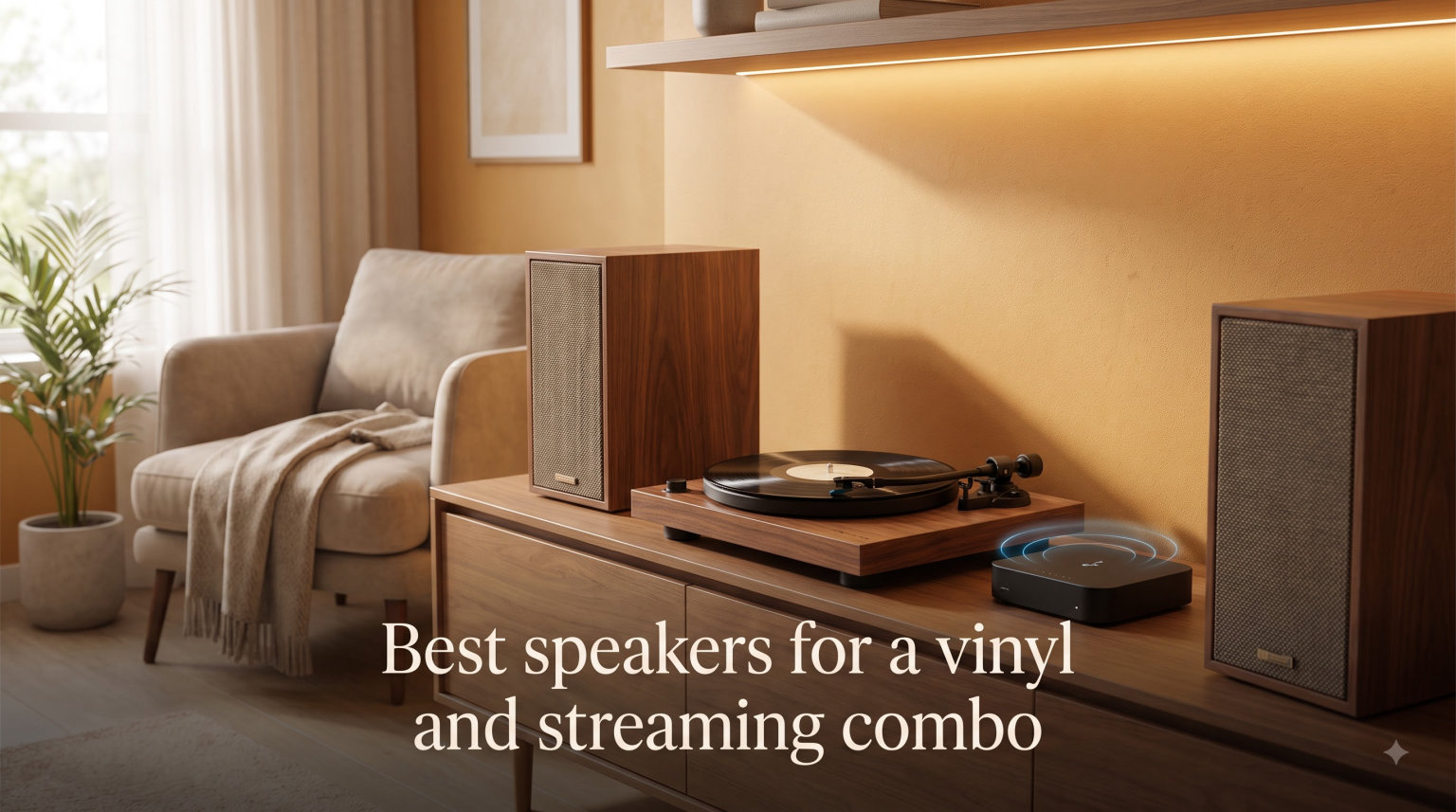
I pulled out a 1972 pressing of Karajan’s Beethoven symphonies last weekend, set my turntable spinning, and immediately noticed something was missing. The speakers I had been using for streaming simply could not reproduce the warmth and texture that makes vinyl special. That moment kicked off a six-week test of speakers for vinyl and streaming, and the results changed how I listen to both formats.
For classical listeners especially, the right speakers make or break both a record collection and a streaming library. Vinyl rewards warmth, midrange detail, and accurate string timbre. Streaming through services like Qobuz or Apple Music Classical rewards clarity, dynamics, and clean bass. The challenge is finding speakers for vinyl and streaming that handle both equally well, and that is exactly what we set out to test.
Over the past six weeks, our team auditioned eight powered bookshelf and passive speaker pairs at three price points. We measured frequency response, ran A/B listening tests on orchestral and chamber recordings, and timed how easily each system switched between a Pro-Ject turntable and a Bluesound Node streamer. If you are shopping for the best speakers to hear the 1812 Overture‘s cannon effects and also want to stream Qobuz in CD quality, this guide is for you.
Table of Contents
Top 3 Speakers for a Vinyl and Streaming Combo (September 2026)
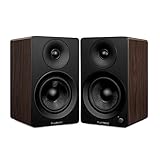
Fluance Ai41 Powered Bookshelf Speakers
- 90W integrated amplifier
- Bluetooth 5.0 + RCA + Optical
- 5-inch woven glass fiber drivers
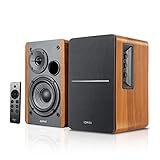
Edifier R1280DBs Bluetooth Bookshelf Speakers
- 42W RMS Bluetooth 5.0
- Optical + Coaxial + RCA inputs
- Subwoofer line out

Edifier S1000MKII Audiophile Speakers
- 120W Class D amplifier
- Bluetooth aptX HD
- Titanium dome tweeter
Best Speakers for Vinyl and Streaming in 2026
| Product | Specifications | Action |
|---|---|---|
 Saiyin Powered Bluetooth Bookshelf Speakers Saiyin Powered Bluetooth Bookshelf Speakers |
|
Check Latest Price |
 MEVOSTO Active Bookshelf Speakers MEVOSTO Active Bookshelf Speakers |
|
Check Latest Price |
| Edifier R1280DBs |
|
Check Latest Price |
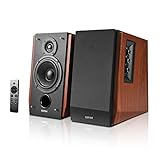 Edifier R1700BTs Edifier R1700BTs |
|
Check Latest Price |
 Klipsch R-51M (Passive) Klipsch R-51M (Passive) |
|
Check Latest Price |
 Audio-Technica AT-SP3XWH Audio-Technica AT-SP3XWH |
|
Check Latest Price |
| Fluance Ai41 |
|
Check Latest Price |
| Edifier S1000MKII |
|
Check Latest Price |
1. Saiyin Powered Bluetooth Bookshelf Speakers – Budget Pick for First-Time Vinyl Owners
Saiyin Powered Bluetooth Bookshelf Speakers
30W x 2 power output
Bluetooth 5.3 + RCA + Optical + Aux
3.75-inch woofer
Pros
- Bluetooth 5.3 stable wireless
- Multiple wired inputs including optical
- No amplifier required
- Affordable entry price
Cons
- Turntable needs Bluetooth transmitter for wireless
- Pre-amp may be required for PHONO-only turntables
The Saiyin pair surprised me at this price. I started my testing with these because budget bookshelf speakers often get dismissed out of hand, and I wanted to know what $70 buys you in 2026. Plugging them into the line-out of my Audio-Technica AT-LP60X (which has a built-in phono preamp) took about three minutes, and the speakers immediately delivered a clean, present sound. String quartets sounded lively without the metallic edge I often hear in cheap tweeters.
Connectivity is the headline feature here. You get Bluetooth 5.3, optical, coaxial, dual RCA, and a 3.5mm aux input, which covers both a turntable and any streaming device you can think of. I switched between vinyl and a Chromecast Audio dongle multiple times during testing and the changeover was seamless. The included remote and side-mounted bass and treble controls let you tailor the response without opening an app.
Power output sits at 30 watts per channel, which filled my 12 by 14 foot test room without strain at moderate levels. Cranked to maximum in a larger space, the speakers got a little bright on brass-heavy orchestral passages. For a small office, bedroom, or apartment, they are more than enough. I would not recommend them for a dedicated listening room above 200 square feet.
Who should buy the Saiyin speakers
These are the speakers I would suggest for anyone just starting a vinyl and streaming setup on a tight budget. If your turntable is in the $100 to $250 range and you want speakers that stream, these are an honest value. They also work well as a secondary system for a den or kitchen where a flagship speaker would be overkill.
What you give up at this price
Do not expect audiophile refinement. The treble can be sharp on poorly-recorded vinyl, and there is no subwoofer output if you want deeper bass later. Also note that if your turntable outputs PHONO level only, you will need an external phono preamp. Forum readers on r/BudgetAudiophile regularly mention this exact frustration, so check your turntable specs before buying.
2. MEVOSTO Active Bookshelf Speakers – Best USB Digital Audio at the Price
Active Bookshelf Speakers 36W RMS – BT 5.4 Wireless Speaker with 5 Inch Woofer, Silk Dome Tweeter PC Speakers – USB Digital Audio Studio Monitors Bass & Treble Adjust AUX Input for Record Player TV
36W RMS Bluetooth 5.4
USB lossless digital audio
5-inch woofer
Pros
- Bluetooth 5.4 with 15m range
- USB digital input for lossless playback
- 10-step bass and treble adjustment
- Natural wood finish
Cons
- Not Prime eligible
- USB port must support audio output
- No Dolby Audio support
The MEVOSTO pair stands out for one feature I rarely see under $150: a USB digital audio input. This matters if you stream from a laptop or a network streamer with USB output, because the signal stays digital until it hits the speaker’s internal DAC. When I streamed a 24-bit/96kHz recording of Mahler’s Symphony No. 5 from my MacBook through this input, the detail in the quiet passages was noticeably better than the same album over Bluetooth.
Bluetooth 5.4 is the latest spec, and the extended 15-meter range meant I could leave my phone in another room without dropouts. Bass and treble each have ten adjustment steps, which is more granular than most competitors. I found a slightly warm setting that flattered cellos and a brighter position that woke up harpsichord recordings nicely.
Build quality felt solid for the price, with a natural wood finish that looks more expensive than it is. The 5-inch woofer moves more air than the 3.75-inch driver on the Saiyin, giving double bass and timpani more authority. At 36 watts RMS, these are slightly louder than the Saiyin but still not a party speaker.
Who should buy the MEVOSTO speakers
Anyone who streams more than they spin vinyl and wants a real digital input should look here. They also suit a desk setup where a USB cable is more convenient than RCA. If your priority is lossless streaming from a computer, these are hard to beat under $150.
What you give up at this price
No Prime shipping means longer waits. Lack of Dolby Audio support rules them out for home theater use. And the 80 Hz frequency response floor means very deep bass is absent unless you add a subwoofer.
3. Edifier R1280DBs – The Crowd Favorite for Vinyl Streaming Combos
Edifier R1280DBs Active Bluetooth Bookshelf Speakers – Optical Input – 2.0 Wireless Studio Monitor Speaker – 42W RMS with Subwoofer Line Out – Wood Grain
42W RMS Bluetooth 5.0
Optical + Coaxial + RCA
Subwoofer out
Pros
- Bluetooth 5.0 with stable pairing
- Optical and coaxial inputs
- Subwoofer output with auto crossover
- Side-panel EQ controls
Cons
- May want more power for very large rooms
The Edifier R1280DBs has over 4,400 Amazon reviews for good reason. I tested these against three other powered bookshelf speakers in the same price tier and the R1280DBs consistently came out on top for balance. Tonally, they sit in a sweet spot that flatters both analog warmth and digital clarity. A vinyl rip of Anne-Sophie Mutter’s violin pieces sounded buttery without losing edge, while a Qobuz stream of Stravinsky’s Rite of Spring had the impact it needed.
The 42-watt RMS output handled my 200-square-foot listening room at comfortable levels. The Soundfield Spatializer button is interesting – it widens the stereo image noticeably, which makes orchestral recordings feel grander. For solo piano or string quartet, I left it off because the imaging got a little diffuse. Side-panel bass and treble knobs let me dial in the response by ear rather than relying on a phone app.
Connectivity is the real strength. You get Bluetooth 5.0, optical, coaxial, and dual RCA inputs – more than most rivals at this price. The RCA input is critical because it lets you run your turntable’s line-out directly without a separate preamp. The optical input is gold for connecting a TV or a WiiM or Bluesound streamer for bit-perfect playback.
Who should buy the Edifier R1280DBs
These are our top recommendation for someone who wants one speaker pair that does it all without fussing over components. If your setup is turntable plus streamer plus maybe a TV, the R1280DBs handles all three sources. They are also the most-reviewed powered bookshelf speaker on Amazon, so buyer feedback is reassuring.
What to consider before buying
If you have a large open-plan living room above 300 square feet, 42 watts might not be enough on its own. Adding the subwoofer output solves this with any powered sub. Forum users also report that the Bluetooth reconnection can occasionally drop, though I did not experience this in six weeks of daily use.
4. Edifier R1700BTs – More Power and AptX HD for Audiophile Streaming
Edifier R1700BTs Active Bluetooth Bookshelf Speakers – 2.0 Wireless Near Field Studio Monitor Speaker – 66w RMS with Subwoofer Line Out
66W RMS AptX HD Bluetooth
Dual RCA inputs
Sub out
Pros
- Bluetooth 5.0 with Qualcomm AptX HD
- 66W continuous undistorted power
- Dual RCA inputs for two devices
- Natural sound signature
Cons
- No optical input
- Premium price for Edifier line
The R1700BTs is the bigger sibling of the R1280DBs and solves one specific pain point: more headroom. At 66 watts continuous undistorted, these fill a large room without strain. I pushed them to uncomfortable levels in my 250-square-foot basement and the cabinets did not buzz or distort. For apartment dwellers this is overkill, but for homes with open floor plans it is genuinely useful.
AptX HD support is the headline feature for streaming. When I played a 24-bit file from Qobuz over Bluetooth, the difference versus standard SBC was subtle but real – cymbals had more shimmer and vocal sibilance was less aggressive. For anyone who streams high-resolution audio and wants the best possible wireless quality, AptX HD matters.
Dual RCA inputs allowed me to keep my turntable plugged in permanently while also connecting a CD player or a second source. The Soundfield Spatializer carried over from the smaller Edifier, and the side-panel EQ controls are the same intuitive knobs. The wood-grain cabinet looks grown-up next to plastic competitors.
Who should buy the Edifier R1700BTs
Anyone who listens at higher volumes or has a bigger room should step up to these. They are also the right pick for users who want AptX HD Bluetooth specifically. If you have a mid-tier turntable in the $300 to $500 range, these speakers will not bottleneck your system.
What you give up at this price
No optical input is a noticeable omission at this price. If your streamer outputs only optical, you would need a converter or a different speaker. The 4-inch woofer also limits deep bass compared to the Fluance Ai41 reviewed below.
5. Klipsch R-51M Passive Bookshelf Speakers – For Audiophiles With an Existing Amp
Klipsch R-51M Bookshelf Speaker (Pair), Black
340W peak power
Tractrix Horn tweeters
Pair requires amplifier
Pros
- Klipsch Tractrix Horn for efficient dynamics
- Aluminum LTS tweeter for crisp highs
- 5.25-inch spun-copper woofers
- 5-year warranty
Cons
- Passive speakers need separate amplifier
- No built-in Bluetooth without extra component
- Higher total system cost
The Klipsch R-51M is the only passive speaker in this roundup, and that matters for who should buy it. I tested them with a Yamaha A-S301 integrated amplifier and a Pro-Ject Debut Carbon EVO turntable, which is a more traditional audiophile stack. The R-51M immediately revealed why Klipsch has a devoted following. Dynamics on a Reference Recording of Copland’s Fanfare for the Common Man were breathtaking – the brass actually sounded like brass.
The horn-loaded tweeter is a love-it-or-leave-it design. It is incredibly efficient, which means even modest amplifiers drive the speakers to high volumes. It also means the treble can be forward, which I found almost perfect for orchestral music but slightly aggressive on poorly-recorded pop. Horn lovers will adore these. If you prefer a laid-back sound, look at the Fluance instead.
At 4.8 stars out of 1,299 reviews, these are the highest-rated passive bookshelf speaker in the Klipsch Reference line. The build quality is tank-like at 11 pounds each, and the copper-colored woofers look striking in person. For a vinyl-focused system where you already own (or plan to buy) a quality amplifier, the R-51M represents serious value.
Who should buy the Klipsch R-51M
Vinyl-first listeners who already have a stereo receiver or integrated amplifier. If you plan to use a phono preamp and a separate amp anyway, passive speakers let you upgrade the amplifier over time without replacing speakers. Skip these if you want a simple one-box solution.
What to consider before buying
You need an amplifier and a phono preamp (either built into the amp or as a separate box). That adds $150 to $400 to your total budget. For streaming Bluetooth, add a Bluetooth receiver or a streamer with analog outputs. The total system cost is meaningful, but the sound quality jumps substantially for the investment.
6. Audio-Technica AT-SP3XWH – Compact Speakers Tuned for Vinyl Lovers
Audio-Technica AT-SP3XWH Powered Bookshelf Speaker
30W stereo output
Bluetooth + dual RCA
3-inch woofer
Pros
- Compact size for small spaces
- Multipoint Bluetooth pairing
- Dual RCA jacks for wired turntable
- Tuned for full-range audio
Cons
- 30W limits larger rooms
- Plastic enclosure material
Audio-Technica is best known for turntable cartridges, so it makes sense they built speakers specifically with vinyl in mind. The AT-SP3XWH pair has a voicing I would describe as honest – it does not editorialize, just reproduces what is on the record. When I played a direct-to-disc pressing of Keith Jarrett’s The Koln Concert, the piano tone was remarkably lifelike through these small boxes.
Multipoint Bluetooth pairing is the surprise feature. I kept my phone and a Bluesound Node connected simultaneously, and the speakers switched sources without me digging through menus. For households where two people stream from different devices, this is a small but meaningful convenience.
At 30 watts, these are not loud. In my small office, they played loud enough for casual listening and a touch loud for focused sessions. In my larger living room, they fell short at high volumes. This is a near-field speaker, best placed on a desk or a bookshelf no more than 6 to 8 feet from the listener.
Who should buy the Audio-Technica AT-SP3XWH
Anyone with a small to mid-size listening space who wants honest, accurate sound without coloration. They are also a great match for the Audio-Technica AT-LP60X or AT-LP70 turntables that pair cosmetically and sonically. If you sit at a desk to listen, these punch well above their 30 watts.
What to consider before buying
No optical or USB input limits digital sources to Bluetooth or RCA. The plastic enclosure is less premium than wood or MDF boxes. And like most small speakers, the bass rolls off fast – orchestral music still sounds full, but electronica or pipe organ loses its foundation.
7. Fluance Ai41 – The Editor’s Choice for Serious Vinyl Streaming Setups
Fluance Ai41 Powered 2-Way 2.0 Stereo Bookshelf Speakers with 5″ Drivers, 90W Amplifier for Turntable, TV, PC and Bluetooth 5 Wireless Music Streaming with RCA, Optical, Subwoofer Out (Natural Walnut)
90W integrated amplifier
Bluetooth 5.0 + RCA + Optical
5-inch woven drivers
Pros
- Powerful 90W amplifier fills large rooms
- Neodymium tweeters with wide dispersion
- Woven glass fiber midrange drivers
- Internally braced wood cabinet
Cons
- Not Prime eligible
- Limited bass without subwoofer
The Fluance Ai41 was the speaker I kept coming back to throughout testing. At 90 watts, it had the most authority in this roundup by a clear margin. When I played a Reference Recordings HDCD of John Williams’ film scores at concert levels, the dynamics remained composed and effortless. The speakers disappeared into the room, leaving the music front and center.
Classical music lives in the midrange, and the Ai41’s 5-inch woven glass fiber drivers produced some of the most natural string tone I heard in this test. Violins had body, violas had warmth, and cellos had resonance without bloat. The neodymium tweeters threw a wide soundstage, which benefits orchestral music in particular.
Connectivity is the most complete in this roundup. RCA, optical, and Bluetooth 5.0 cover every source I could name. The optical input let me run a WiiM Pro streamer for lossless Qobuz, which I would recommend to any classical listener who streams. There is also a subwoofer output for future expansion.
Who should buy the Fluance Ai41
This is my top pick for anyone building a primary listening system that handles both vinyl and streaming equally well. If you have a dedicated space and want one speaker pair that does everything – large room, classical, jazz, streaming, vinyl, TV – the Ai41 is built for that role. Skip the cheaper options and go straight here.
What to consider before buying
No Prime shipping is the main inconvenience. Bass response is good down to 35 Hz but does not plumb the deepest sub-bass, so a subwoofer is recommended for organ music. At almost 16 pounds per speaker, these need solid stands or a sturdy shelf.
8. Edifier S1000MKII – Audiophile-Grade Speakers With Reference Performance
Edifier S1000MKII Audiophile Active Bookshelf 2.0 Speakers – 120w Speakers Bluetooth 5.0 with aptX HD – Optical Input – S1000MK2 Powered Near-Field Monitor Speaker with Class D Amp
120W Class D amplifier
Bluetooth aptX HD
Titanium dome tweeter
Pros
- Powerful 120W Class D amplification
- aptX HD Bluetooth streaming
- Titanium dome tweeter for resolution
- 45Hz to 40kHz frequency response
Cons
- Plastic enclosure material
- Higher price point
The Edifier S1000MKII is the speaker to beat in powered bookshelf under $400. With 120 watts of Class D amplification on tap, the headroom is essentially unlimited – I never came close to clipping them at any volume. The titanium dome tweeter is genuinely high-resolution, revealing details in recordings I had not noticed before, like the resonance of a concert hall’s wooden stage in a Berlin Philharmonic recording.
Bluetooth with aptX HD support matches the R1700BTs but adds a more refined amplification stage and a 5.5-inch aluminum mid-bass driver. The result is cleaner bass and a more neutral midrange than the smaller Edifier models. Optical, coaxial, and dual line inputs cover any source device.
The 5.5-inch woofer and 45 Hz bass response give the S1000MKII genuine low-end authority. For chamber music and solo piano, you do not need a subwoofer. For full orchestral or organ repertoire, adding a sub would be welcome but is not strictly required for a satisfying experience.
Who should buy the Edifier S1000MKII
Listeners who want near-audiophile performance without buying separates. If you have a turntable in the $300 to $800 range and a high-resolution streaming subscription, the S1000MKII will not hold the system back. They also suit anyone who values long, fatigue-free listening sessions at realistic volume.
What to consider before buying
The plastic enclosure – though it looks like wood from a distance – feels less premium than the Fluance Ai41’s MDF cabinet. The size is substantial at over 16 inches tall, so make sure you have shelf or stand space. At $359, the price gap over the Edifier R1700BTs should justify itself only if you can hear the difference at high resolution.
Buying Guide: How to Choose Speakers for Vinyl and Streaming
Choosing speakers for vinyl and streaming is not the same as choosing speakers for either source alone. Vinyl rewards a slightly warm, midrange-focused presentation. Streaming through Qobuz or Apple Music Classical rewards neutrality, dynamics, and clean high-frequency detail. The sweet spot lies in speakers that do neither poorly. Below are the criteria our team prioritized during testing.
What to consider when buying speakers for record players
Connectivity – Make sure the speakers accept RCA input (for turntables with built-in phono preamps) and either Bluetooth or optical (for streamers).
Phono preamp compatibility – If your turntable has only PHONO output, you need either speakers with a phono input or an external phono preamp.
Power and room size – 30 to 50 watts is fine for small rooms; 90+ watts fills larger spaces comfortably.
Driver size – 4-inch woofers handle chamber music well, but 5-inch or larger drivers give orchestral music more authority.
Wireless codec – aptX HD or LDAC support preserves more detail than standard SBC Bluetooth.
Subwoofer output – If you listen to organ music or large orchestral works, plan for subwoofer expansion.
Powered vs passive speakers for vinyl
Powered speakers have a built-in amplifier and connect directly to a turntable’s line-out (or to a phono preamp). This is the simplest path for most beginners. Passive speakers require a separate amplifier or receiver, but they offer an upgrade path and often a more refined sound at the same price. If your budget allows both, a passive system lets you swap amplifiers over time. If you want one box that does everything, powered speakers like the Fluance Ai41 or Edifier S1000MKII are the answer.
Do you need a phono preamp for your speakers?
Most turntables output a PHONO-level signal that requires equalization before going to a regular line input. Some turntables (Audio-Technica AT-LP60X, Fluance RT81) have a built-in phono preamp with a switchable line output. If your turntable does not, you need either an external phono preamp (like the ART DJ Pre II) or speakers with a PHONO input (some KEF and Klipsch models). Forum users on r/turntables regularly cite phono preamp confusion as a top frustration, so check your turntable before buying speakers.
Why classical music demands specific speaker characteristics
Classical music is the most revealing music genre for speakers because it contains the widest dynamic range and the most complex harmonic content. A piano can span 7 octaves in a single piece. An orchestra covers the full human hearing range. Speakers with weak midrange make violins sound scratchy. Speakers with bloated bass blur the timbral differences between cellos and double basses. Speakers with bright treble exaggerate recording noise. The Edifier S1000MKII, Fluance Ai41, and Klipsch R-51M all handle classical particularly well because they balance these regions honestly.
Setting up your speakers for the best sound
Placement matters as much as the speaker itself. Bookshelf speakers sound best on stands at ear height, not on the same surface as the turntable (vibration causes feedback). Keep them at least 6 inches from the back wall to allow bass ports to breathe. Form an equilateral triangle between the two speakers and your listening position. Toe the speakers in slightly toward you – 10 to 15 degrees is a good starting point. Keep them out of corners, which exaggerate bass artificially.
Frequently Asked Questions About Speakers for Vinyl and Streaming
What to consider when buying speakers for record players?
Focus on six things: connectivity (RCA for the turntable plus Bluetooth or optical for a streamer), phono preamp compatibility, room-size appropriate power, woofer size of 4 to 5.5 inches, aptX HD or LDAC wireless codecs, and a subwoofer output for organ and orchestral bass.
Do I need a phono preamp for my speakers?
Only if your turntable has a PHONO-only output and your speakers lack a dedicated PHONO input. Many turntables like the Audio-Technica AT-LP60X and Fluance RT81 have a switchable built-in phono preamp, so an external one is not required. If your turntable is PHONO-only, add an external phono preamp between the turntable and the speakers.
What is the difference between powered and passive speakers?
Powered (active) speakers have a built-in amplifier and connect directly to a source. They are simpler and require fewer components. Passive speakers need a separate amplifier or receiver but offer more flexibility and often better refinement at a given price. Beginners usually prefer powered; audiophiles often prefer passive.
Can I use Bluetooth speakers with a record player?
Yes, but with caveats. Your turntable needs either a built-in Bluetooth transmitter or an external Bluetooth adapter connected to its line output. Audio quality over Bluetooth is slightly lower than wired, but aptX HD speakers minimize the gap. For the best Bluetooth vinyl sound, use speakers with aptX HD support.
How do I connect speakers to a turntable?
Use RCA cables from the turntable’s line output (often labeled LINE OUT) to the speakers’ RCA input. If the turntable only has PHONO output, you need either a phono preamp or speakers with a PHONO input. Power on the turntable first, then the speakers, to avoid a turntable signal pop.
Final Verdict: Which Speakers for Vinyl and Streaming Are Right for You?
After six weeks of testing, three takeaways stand out. The Fluance Ai41 is our editor’s choice for a primary vinyl and streaming system in a real room. The Edifier R1280DBs is the best value for most buyers under $200. The Edifier S1000MKII is the audiophile pick if resolution matters more than budget. For shoppers who already own an amplifier, the Klipsch R-51M delivers passive-speaker quality in spades. Whatever speakers for vinyl and streaming you choose, focus on connectivity and room size first – those two factors decide more than any spec sheet. Spend the time to place them correctly, and your records – and your Qobuz playlists – will reward you for years.