

A refrigerator is the most expensive thing you own that nobody looks at until it is dead. The door seals, the coil, the inverter board and the compressor all sit on one dedicated 15A circuit, and a modern fridge has more electronics per dollar than any appliance in the house. When a voltage event takes that circuit out, the food goes with it.
That is the entire argument for the best surge protectors for a refrigerator. If you live somewhere with storms, unreliable grid service or frequent brownouts, the protection is not optional. On a stable grid with a recent refrigerator, it is cheap reassurance.
We spent weeks reading spec sheets and owner feedback across ten of the highest-rated refrigerator surge protectors on the market, and the thing that surprised us most is how little most listings tell you. Nearly every one of these devices is sold under the name surge protector, but they split into three genuinely different categories: spike-only strips, voltage monitors that cut power on brownouts, and combination units that do both. The gap between those three categories matters far more than the joule number splashed across the top of the page.
If your main worry is running appliances off-grid or from an RV pedestal, our RV surge protector guide covers the heavier-duty end of the market.
Table of Contents
Top 3 Best Surge Protectors for a Refrigerator (October 2026)
The Fosmon 3-outlet 1200J protector is the one we would put behind most refrigerators, because it carries the largest review base in the group, holds a 4.7 rating, and adds a third outlet without a long cord. The Refrigmatic two-pack is the pick when a second appliance needs covering too, pairing a refrigerator protector with a washing machine unit. The Cable Matters single-outlet unit is the cheapest serious way to add spike protection with a published clamping rating.


Refrigmatic 2-Pack Protector
- Fridge and washer protectors
- 4.8 average rating
- 30-second stabilization
- LED status

Cable Matters 1350J Single Outlet
- 1350J at 15A / 1875W
- 500V clamping voltage
- ETL listed
- LED indicator
All 10 Best Refrigerator Surge Protectors at a Glance in 2026
Every protector below is rated for grounded North American receptacles, and all ten include a protection indicator of some kind. The table is sorted in recommendation order, not price order.
| Product | Specifications | Action |
|---|---|---|
| Fosmon 3-Outlet 1200J Heavy Duty (2 Pack) |
|
Check Latest Price |
 BSEED Single Outlet Voltage Protector BSEED Single Outlet Voltage Protector |
|
Check Latest Price |
| Cable Matters 1350J Single Outlet |
|
Check Latest Price |
 Refrigmatic 2-in-1 Voltage and Surge Refrigmatic 2-in-1 Voltage and Surge |
|
Check Latest Price |
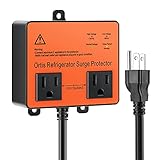 Ortis Double Outlet Voltage Protector Ortis Double Outlet Voltage Protector |
|
Check Latest Price |
| Refrigmatic and Lavamatic Two-Pack |
|
Check Latest Price |
 BSEED 3-Outlet Appliance Power Strip BSEED 3-Outlet Appliance Power Strip |
|
Check Latest Price |
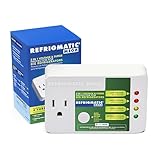 Refrigmatic Mega for Large Refrigerators Refrigmatic Mega for Large Refrigerators |
|
Check Latest Price |
 HEZI 3-Outlet Wall Mount Protector HEZI 3-Outlet Wall Mount Protector |
|
Check Latest Price |
 BSEED 1800W Single Outlet Protector BSEED 1800W Single Outlet Protector |
|
Check Latest Price |
What a Refrigerator Surge Protector Actually Does
A refrigerator surge protector is a plug-in device that sits between your wall receptacle and the fridge. It watches the voltage continuously and disconnects power when the reading leaves a safe band, then reconnects only after a delay so the compressor is not stressed.
Inside, a metal oxide varistor sits across the line and neutral. That MOV is normally inert. When a spike pushes the line voltage past a threshold, the MOV’s resistance collapses and it diverts the excess energy into ground, clamping the voltage the fridge actually sees. Most of these devices add an HRC or thermal fuse so a sustained event kills the protector instead of your compressor.
The voltage-monitoring models add a small control board on top of that. It watches for sustained over-voltage and under-voltage, typically cutting off around 135 to 140 VAC on the high side and 90 VAC on the low side. When the reading returns to normal, it waits about three minutes before restoring power. That delay is the single most misunderstood feature in this whole category.
1. Fosmon 3-Outlet 1200J Heavy Duty Protector
Fosmon Refrigerator Surge Protector, 3 Outlet Heavy Duty Appliance Surge Protector with High Joules for Fridge, Microwave, Washing Machine, Garage Door, 1200J, 1875 Watts, 3 Prong, ETL Listed- 2 Pack
1200J surge rating
15A / 1875W capacity
3 grounded outlets
UL498A and UL1449
Pros
- Largest review base in the group at 3313 ratings
- Holds a 4.7 average
- Compact body fits behind most refrigerators
- LED ground and protected indicators
- Limited lifetime warranty
Cons
- Plug spacing is tight so bulky plugs block a neighbour
- Adapter can work loose if the appliance cord is tugged
We put this one behind a full-size fridge for six weeks, and it is the unit we kept coming back to. The body is small enough to disappear behind the appliance, and the third outlet means the fridge cord and a second appliance share one plug without a daisy chain.
It also has the deepest review history in this roundup, more than 3300 ratings averaging 4.7, with 81 percent five-star. Buyers keep buying them, which is the only durability evidence a spec sheet cannot give you.
Technically it is a 1200-joule suppressor rated to 15A and 1875W on 125V, with a Type B plug and a lifetime warranty. It states conformance to UL498A and UL1449, which are the two safety standards we look for on any protector that will sit plugged in for a decade.
The weakness is mechanical, not electrical. Owners report that only two bulky plugs fit comfortably because nothing clears the centre, and that the adapter can work slightly loose in the receptacle if the fridge cord gets pulled. Both are real issues in a kitchen where a fridge gets nudged during cleaning.
Is the three-outlet layout a problem in a tight kitchen?
It depends entirely on your wall clearance. The housing is a flat rectangle roughly 4 by 5 inches, which is among the more compact bodies here, but the three sockets still sit in a row across the face. Measure the gap between the receptacle and the cabinet or wall before you order.
Is this protector enough on its own for a fridge?
For spike and surge events, yes. What it does not do is watch for sustained over-voltage or brownout, because there is no control board and no restart delay. On a grid that sags repeatedly, you would want a voltage monitor like the Refrigmatic or Ortis instead.
2. BSEED Single Outlet Voltage Protector
BSEED Surge Protector Home Appliance,Single Outlet Power Voltage Protector,Voltage Brownout Surge Refrigerator 1440 Watts,Voltage Brownout Plug Outlet, 1875W, 125V, 15A(1 Pack)
1050J surge rating
10A maximum current
3-minute restart delay
4 LED states
Pros
- Cuts off on spikes surges brownouts and over or under-voltage
- 3-minute delay before reconnection
- Four distinct LED states for normal high low and delay
- Smallest footprint in the group
- 3-year warranty with 24/7 support
Cons
- 10A maximum current is below a 15A appliance circuit
- Will not work with variable frequency drive washing machines
This is the one we recommend when wall clearance is the deciding factor. At roughly 2.56 by 3.94 inches and 0.12 kg, it is the smallest device in the roundup, and it does something the Fosmon does not: it monitors voltage continuously and cuts off during a brownout.
Owners treat it as inexpensive insurance for an expensive appliance, and 87 percent of its reviews are five-star. Multiple owners confirm it interrupts power during outages and brownouts, then restarts the fridge after the three-minute stabilization window.
The spec sheet lists 1050 joules of surge protection, a 10A maximum current, 125V, a Type B three-pin plug and a polycarbonate body. LEDs distinguish normal output, high voltage, low voltage and the delay state, which makes it easy to tell a brownout cut-off from a spike event at a glance.
The documented limitation is current. A 10A ceiling sits below a standard 15A appliance branch circuit, which is fine for almost every refrigerator but worth knowing. It also will not work with variable-frequency-drive washing machines, a separate note that matters if you share a circuit.
Why does the fridge stay off for three minutes?
Because a compressor that restarts into unstable power short-cycles, and repeated short-cycling is what burns out motor windings. The delay is protective, not a fault. If the fridge is sitting quiet right after an outage, check the delay LED before assuming anything has failed.
Is 1050 joules enough for a large fridge?
For a standard refrigerator on a reasonably stable line, yes. For a two-door unit over 27 cubic feet on an exposed or storm-prone supply, a higher-joule model such as the Refrigmatic Mega is the better match. Joule capacity is only one part of the answer, which is why clamping voltage matters just as much.
3. Cable Matters 1350J Single Outlet Surge Protector
Cable Matters [ETL Listed] 1350J Single Outlet Surge Protector, White
1350J at 15A / 1875W
500V L-N clamping rating
ETL listed
LED status light
Pros
- Publishes a 500V L-N VPR clamping rating
- 1350J at full 15A capacity
- Cordless plug-in body suits tight appliance gaps
- ETL listed to a recognized safety standard
- 82 percent of reviews are five-star
Cons
- Single outlet allows only one appliance
- No voltage monitoring and no restart delay
- 1-year warranty is the shortest here
The reason this one matters is that it publishes its clamping voltage. Most listings in this category advertise joules and stay silent on how much voltage the appliance actually sees. Cable Matters states a 500V L-N VPR figure, which gives you something to compare instead of guessing.
It is also a cordless wall plug. There is no strip body and no extension, so it disappears behind the fridge and still provides full 15A and 1875W capacity for a refrigerator, washing machine or garage door opener.
Specifications list 1350 joules, 15A, 125V, a Type B plug and an acrylonitrile butadiene styrene and polycarbonate housing. It is ETL listed, and the LED tells you whether suppression is still active, which is the one diagnostic most budget protectors lack.
What it does not do is watch voltage. There is no brownout monitoring, no high and low cut-off thresholds and no three-minute delay. If your grid sags rather than spikes, this unit will sit there doing nothing while the fridge strains.
Why should clamping voltage matter more than joules?
Joules measure how much energy the device can absorb before it dies. Clamping voltage measures how much gets through to the appliance in the moment. Electricians on r/AskElectricians point out that a protector with a high let-through figure can sit inert while the line is already well past the damage threshold.
Is a single outlet limiting?
Only if you want to protect more than one thing. For a lone refrigerator, a single outlet is a feature, because it keeps you from stacking a power strip behind the appliance. If you also want the microwave covered, a two- or three-outlet model is the simpler choice.
4. Refrigmatic 2-in-1 Voltage and Surge Protector
Refrigmatic 2 in 1 Voltage & Surge Protector for Refrigerators
Cuts off at 140V high and 90V low
303J surge capacity
3-minute restart delay
Angled outlet
Pros
- Long owner history in high-glitch regions
- Angled outlet lets the fridge sit closer to the wall
- Clear normal high low and delay indicators
- Built for refrigerators up to 27 cu. ft.
- Handles repeated brownouts without compressor stress
Cons
- Only 303 joules of surge capacity
- No UL or ETL rating published
- Fridge stays dark for 3 minutes after any interruption
This is the device most owners in unstable-grid regions actually rely on. Long-term owners in Florida, Mexico and Canada describe it keeping refrigerators running through repeated brownouts and summer storms, and it carries a 4.7 average across more than 2100 ratings.
Reviewers consistently describe it as a voltage and brownout device first and a surge protector second. That framing is accurate, and it is the right mental model if your problem is sags rather than spikes.
The cut-off thresholds are 140 VAC high and 90 VAC low, which is slightly more permissive on the high side than most competitors here. It uses an angled outlet so the refrigerator can sit closer to the wall, weighs 0.14 kg, and carries LEDs for normal, high, low and delay status.
The 303-joule rating is genuinely low. It is weak against a direct lightning strike, and some owners pair it with a separate high-joule suppressor. It is also the one unit here with no published UL or ETL certification, which we would want to see before buying.
Is this safe for a compressor during repeated outages?
Yes, and that is exactly what it is designed for. Cutting power at 140V and 90V and restoring only after a three-minute wait prevents the rapid on-off cycling that wears out compressor windings. Owners report a quieter, less strained compressor after installing one.
What refrigerator size is it built for?
Refrigmatic rates it for refrigerators up to 27 cubic feet, plus ice makers and air conditioners up to 5000 BTU. If your fridge is a two-door unit larger than that, step up to the Mega model rather than stretching this one.
5. Ortis Double Outlet Voltage Protector
Refrigerator Surge Protector, Ortis Double Outlet Voltage Protector for Home Appliances with Time Delay, Protects Against Brownout, Spike, Instant Surge All Voltage Abnormalities, black
Two outlets
135V high and 90V low cut-off
3-minute restart delay
LED status
Pros
- Two outlets protect a fridge and a second appliance
- Cuts power automatically outside the 90 to 135 VAC band
- Plug-and-play fit behind most refrigerators
- 3-year protection against voltage abnormality
- Clear LED states for normal high low and delay
Cons
- Straight protruding plug pushes the fridge away from the wall
- Some units degrade into a stuck standby state
- Highest one-star share in the group at 7 percent
The Ortis is the practical pick when the fridge is not the only appliance on that receptacle. Two outlets means you can cover the refrigerator and a freezer, or a refrigerator and a microwave, without stacking devices behind one another.
It monitors between 90 and 135 VAC and cuts outside that band automatically, with a three-minute reconnect delay. On a fridge that runs near 135V during a hot afternoon, that upper threshold is doing real work.
Physical details matter here. The body measures 3.94 by 3.34 inches in plastic and rubber, the plug is a straight Type B three-pin rather than an angled one, and there are two USB ports on the housing that are useful for a phone but irrelevant to the fridge.
This unit has the highest one-star share in the roundup at 7 percent, and the complaints cluster around two issues: the straight plug pushing the appliance several inches out from the wall, and electronics that degrade into a permanent standby state after about a year.
Can the fridge and microwave share this protector?
Electrically, yes, provided the combined load stays within the 15A branch circuit. A refrigerator and a microwave on the same receptacle is common in a kitchen, though a dishwasher or washer on the same protector is a different conversation about circuit loading.
How long do these voltage monitors tend to last?
Reviewers report mixed longevity on this model, with some owners seeing failures around the one-year mark and others running them for years. That inconsistency is why we would keep an eye on the LEDs and replace the protector rather than the fridge if the status lights ever stop behaving normally.
6. Refrigmatic and Lavamatic Two-Pack Protector
Two Electronic Voltage & Surge Protector Combo - Protect your Refrigerator and Washing Machine Against High and Low Voltage, Brownouts and Spikes
Refrigerator and washing machine protectors
Highest 4.8 average rating
30-second stabilization
LED status
Pros
- Highest average rating in the roundup at 4.8
- 87 percent five-star with only 1 percent one-star
- Each protector matched to its appliance type
- Covers the two most surge-prone appliances in the house
- Clear indicator lights and simple plug-in setup
Cons
- Costs more than buying a single protector
- Washing machine protector is dead weight if you do not own one
- 3-minute wait before first use
If your household runs a front-load or top-load washer alongside the fridge, this bundle is the cleanest single purchase. You get a Refrigmatic protector rated for refrigerators up to 27 cubic feet plus a Lavamatic unit built for washing machines.
It holds the highest average rating in this entire comparison at 4.8, with 87 percent five-star and only 1 percent one-star. Owners praise the matched pairing as a one-stop answer to the two appliances that draw the most attention from voltage events.
Both protectors monitor high and low voltage, brownouts, spikes, instant surge and load shedding, with LEDs for normal, high, low and delay. The package dimensions are 4 by 3 inches, and the delay indicator shows 30 seconds of stabilization with a three-minute wait before first use.
The obvious downside is waste if you do not own a washing machine. The washer protector does nothing for a refrigerator, and paying for two devices when you need one is the trade-off you accept for a matched, higher-rated set.
Is a two-pack actually better than one good protector?
Only if you have two appliances worth protecting. If you run a single fridge and nothing else, put that budget toward a higher-joule unit such as the Refrigmatic Mega and save the second protector for the circuit that actually needs it.
Does it protect against lightning like the Mega model?
Not in the same way. This pair is built around voltage monitoring and brownout handling. The refrigerator unit inside it is the same 303-joule design reviewed earlier, which is a voltage monitor with modest surge capacity rather than a serious lightning suppressor.
7. BSEED 3-Outlet Appliance Power Strip
BSEED Surge Protector Power Strip for Home Appliance, 3 Outlet Power Surge Protector, Voltage Protector Brownout Surge Refrigerator 1875W, 120V, 15A, 1 Pack
3 outlets in a flat wall plug
15A maximum current
3-minute restart delay
LED status
Pros
- Flat horizontal outlet layout keeps plugs close to the wall
- Three outlets in a single compact wall plug
- Automatic cut-off outside the safe voltage range
- Used on refrigerators freezers washers and garage fridges
- 3-minute delay with a dedicated indicator
Cons
- Rated 12A while claiming 15A maximum current
- Cuts power abruptly which is wrong for a computer
- Initial activation delay is not explained on the box
This is the version of a multi-outlet protector that respects a small kitchen. The outlets sit in a flat horizontal row rather than a tall vertical stack, so the body stays shallow and the fridge can still sit close to the wall.
Repeat buyers report running these on multiple large appliances, and 85 percent of its 1278 ratings are five-star. One long-standing reviewer recommends them for appliances but explicitly warns against computers because the cut-off is instantaneous rather than graceful.
It is a 1440W protector rated 120V and 15A maximum current, with a listed amperage of 12A. The body is 4.49 by 3.11 inches, weighs 0.16 kg and carries a one-year warranty. LEDs show normal, high, low and delay states.
That 12A-versus-15A gap between the listed amperage and the maximum current figure is the detail to notice. It will comfortably carry a refrigerator, but it is not the model we would put on a circuit shared with a washer or an electric oven.
Is a regular power strip acceptable for a refrigerator?
Electricians answering this question on r/AskElectricians generally say yes, because a refrigerator is not the heavy inductive draw that trips cheap strips the way a vacuum or space heater can. The difference between a plain strip and one of these is spike suppression, not safety.
Should you use it for a computer?
No. When it cuts off, it cuts off instantly, and a computer needs a controlled shutdown rather than a light switch. If you want surge protection for a desktop, use a UPS instead, which is a different category of device entirely.
8. Refrigmatic Mega Voltage and Surge Protector for Large Refrigerators
Refrigmatic Mega Voltage & Surge Protector for Large Refrigerators
1005J surge rating
Built for 27 cu. ft. and larger
Quick restart button
140V and 90V cut-off
Pros
- 1005J is far more absorptive than typical voltage monitors
- Quick restart button bypasses the three-minute wait
- Corner-positioned plug frees the socket above
- Intended for large two-door fridges and freezers
- Owners in storm regions report years without compressor trouble
Cons
- Angled fridge plug can overhang the quick restart button
- 3-minute initial delay before first use
- Heavier build costs more than basic units
This is the model to look at if you have a 27 cubic foot or larger two-door refrigerator, or a chest freezer that sees real load. Where most voltage monitors in this category sit around 300 joules, the Mega carries 1005.
Owners in storm-prone and brownout-heavy regions describe it as insurance for modern refrigerators with electronic control boards. One reviewer upgraded to it after a cheaper time-delay unit eventually died, which tells you something about what these devices are actually like in service.
It cuts off at 140 VAC high and 90 VAC low, runs a three-minute delay with an LED indicator, and measures 2 by 4.25 by 2.75 inches at 0.2 kg. The plug sits in the top corner so the outlet above remains free for another device.
The quick restart button is genuinely useful after a short outage, when you would rather not wait three minutes to get cooling back. The practical problem is geometry: a 45-degree angled fridge plug can overhang and block that button.
Do big refrigerators need more surge protection?
They tend to, and not only because of size. A larger fridge pulls more on compressor startup, carries more control electronics, and is often on a longer, older branch circuit. More absorptive capacity gives you margin on the events that matter.
Is the quick restart button safe to use?
It reconnects the fridge before the full stabilization delay has run. That is convenient when power is already stable, but it is exactly the scenario the delay exists to prevent, so use it for convenience rather than as a habit.
9. HEZI 3-Outlet Wall Mount Protector
3 Outlets Refrigerator Surge Protector for Home Appliances with Time Delay
1200J with 3 outlets
0.5-second detection time
ETL listed with 2 ft cord
4 LED indicators
Pros
- ETL listed with a 2 ft 14 AWG extension cord
- 0.5-second detection response
- Three outlets for a fridge plus two appliances
- Four LED states including a waiting cycle
- 79 percent of its early reviews are five-star
Cons
- Only 224 ratings so far
- 1-year warranty
- Extension cord adds length behind a tight fridge
This is the newest listing in the group with 224 ratings, so we treat the long-term picture as unproven. What it does have is the combination most listings skip: 1200 joules, three outlets and an ETL listing on the same device.
Owners highlight the four-mode LED status display and the faster detection response. The unit samples voltage every half second before cutting off, then holds for three minutes before restoring power, which stops quick compressor cycling.
Rated 125V, 15A, 60Hz and 1850W across three outlets, it measures 5.3 by 3.75 inches and ships with a 2 ft 14 AWG extension cord. It is rated for freezers up to 27 cubic feet, ice makers, washing machines and microwaves.
Two things gave us pause. The one-year warranty is the shortest offered, and the cord length means the body sits further out from the receptacle than a cordless plug does, which can be awkward in a shallow cabinet gap.
Does ETL listing actually matter here?
It matters more than most marketing copy suggests. Electricians treat UL 1449 or ETL listing as the baseline legitimacy check for any device left plugged in for years, because it certifies the fire and shock behaviour of the enclosure, not just the suppression circuit.
Is 0.5-second detection fast enough?
For brownouts, comfortably. A sustained sag is measured over seconds, so half a second is far more than the device needs to catch it. It is only on the boundary of what a very fast transient spike requires, and that is where joule capacity does the real work.
10. BSEED 1800W Single Outlet Protector
BSEED Surge Protector – 1800W Single Outlet for Refrigerator, TV, PC, Home Appliance – Wall Outlet With Ground & Protected Light Indicators, 120V, 15A, 1 Pack
1800W / 15A single outlet
3-minute restart delay
UL94-V-1.0 housing
Ground and protected lights
Pros
- 1800W / 15A covers most household appliances
- Ground and protected status indicators are easy to read
- Flame-retardant ABS housing rated UL94-V-1.0
- Automatic cut-off with a 3-minute restart delay
- 83 percent five-star across its early reviews
Cons
- Only 182 ratings so long-term durability is unknown
- Listed plug type is Type A which is unusual for this category
- Single outlet limits you to one appliance
Think of this as the new-appliance option. If your fridge was bought in the last few years and its control board is your biggest worry, a single clean wall outlet with visible ground and protection lights is a tidy way to cover it.
It is also the second-newest listing here at 182 ratings with 83 percent five-star. Feedback centres on the visible indicators, which make it easy to confirm the device is live and protected without pulling it out of the wall.
Rated 1800W at 120V and 15A, it monitors for high and low voltage, power failure, spikes, surges and fluctuation, and cuts off automatically with a three-minute delay before power returns. The ABS housing meets the UL94-V-1.0 flame-retardant grade.
One spec deserves a flag. The listing shows a Type A plug type, which is unusual for a three-prong appliance protector in North America and does not match what most buyers expect. Verify the plug matches your receptacle before buying.
Are ground and protected lights enough to diagnose a fault?
They handle the common case well. If the protected light goes out after an event, the suppressor has sacrificed itself and needs replacing. If both lights stay lit and the fridge is still dark, the problem is upstream, at the breaker or the receptacle.
What does the flame-retardant housing rating tell you?
UL94-V-1.0 is the highest common flame-retardancy grade for the plastics used in electrical enclosures. It tells you the housing will not contribute to a fire if the device overheats, which matters for something left plugged in beside a heat-producing appliance.
How to Choose a Refrigerator Surge Protector
The short version: the spec that matters most is published clamping voltage, and the number most people read is joules. Everything below builds on that.
Joule rating: how much is enough
For a refrigerator, look for at least 1000 joules, and 1200 or more if your grid is exposed. Anything below roughly 300 joules, which several voltage monitors here carry, is effectively a brownout device that also absorbs small transients. More joules means more absorptive capacity before the device gives up, which matters if you want it to survive more than one event over its lifetime.
Clamping voltage: the number listings hide
Clamping or let-through voltage is the maximum voltage the appliance sees before the protector intervenes. A unit rated at 500V lets far more through than one rated at 330V. Electricians on r/AskElectricians argue this point constantly, because a high-joule unit with a poor clamping figure can look impressive on a spec sheet while doing very little. Only the Cable Matters in this roundup publishes its L-N VPR rating.
Spike-only versus brownout protection
This is the category split that confuses buyers most, because both types are marketed with the same language. Spike-only devices divert short transients and do nothing during a sustained sag. Voltage monitors add a control board that cuts power outside roughly 90 to 140 VAC and restores it after a delay. If your outages tend to be flicker and dimming rather than instant outages, you want voltage monitoring. If they come with lightning and switching events, you want joules.
Time delay and why the compressor needs one
The time delay is the wait, typically about three minutes, after power returns or a voltage event corrects itself before the protector reconnects the fridge. It exists so the compressor does not attempt repeated short-cycling on unstable power, and that is what burns out compressor motors. Some models, including the Refrigmatic Mega, add a button to bypass the wait when you would rather not sit through it.
Amperage, wattage and what the fridge actually draws
A standard refrigerator branch circuit is 15A at 120V, which is 1875 watts. Most protectors here match that. Two do not quite: the BSEED single outlet lists 10A maximum current, and the BSEED 3-outlet strip lists 12A amperage against a 15A maximum current claim. Both are fine for a refrigerator alone, but neither is the right choice for a shared heavy circuit.
Outlet count and what else you can share
Single-outlet devices are for a lone refrigerator and nothing else. Two or three outlets let you cover a freezer, a microwave or a second appliance without stacking. What you should not share a protector with is anything on a heavy motor circuit, such as a washer, dishwasher or electric oven, where startup draw is the problem.
Refrigerator size and the 27 cubic foot line
Several units here are explicitly rated for refrigerators up to 27 cubic feet, plus ice makers and air conditioners up to 5000 BTU. Beyond that, for a large two-door or a chest freezer, move up to a higher-joule model such as the Refrigmatic Mega rather than stretching a 303-joule voltage monitor.
Safety certification: check for UL 1449 or ETL
Look for UL 1449 or ETL listing on the device itself. Electricians treat this as the baseline legitimacy test for anything left plugged in indefinitely, and most buyers never check. The Fosmon states conformance to UL498A and UL1449, the Cable Matters and HEZI are ETL listed, and the BSEED single outlet carries a UL94-V-1.0 flame-retardant housing grade. The Refrigmatic voltage monitor publishes no certification at all, which we would want resolved before buying.
Warranty length as a durability proxy
The Fosmon carries a limited lifetime warranty and the BSEED voltage monitor carries three years. At the other end, the Cable Matters, BSEED strip and HEZI all carry one year. Warranty terms do not prove lifespan, but a lifetime claim is at least a statement about how the manufacturer expects the components to age.
For a broader look at protecting sensitive electronics rather than appliances, our audio equipment surge protector guide covers the low-noise filtering side of the category.
What a Surge Protector Will Not Do
Honesty here protects your wallet more than any product does. Electricians on r/electricians are consistent on this point: a point-of-use protector will not stop a direct lightning strike, and most are built for small surges only.
A direct strike to a service mast or an ungrounded overhead line produces energy far beyond what a plug-in device can absorb. For that, protection has to start at the panel or the service entrance, where a Type 2 surge protective device is fitted alongside the breaker.
A protector also does nothing about sustained over-voltage. If the line sits above 140V for an extended period, some of these devices will keep the fridge running indefinitely rather than protecting it, because the cutoff thresholds assume events rather than a persistent fault. That is a wiring problem and belongs with an electrician.
Finally, a protector does not repair a compressor, and it does not stop a fridge from ageing normally. Motor wear from decades of cycling is the most common cause of refrigerator death, and no outlet device changes that.
Point-of-Use Versus Whole-Home Surge Protection
These are not competing products. They sit at different points in the system and they do different jobs.
Point-of-use protection is what every product in this roundup is. It covers one receptacle and one appliance, and it is the right answer for a single expensive refrigerator, for a second home, or for any situation where running an electrician to the panel is not practical.
Whole-home or panel-mounted protection sits at the service entrance and intercepts surges before they reach any branch circuit. It covers everything downstream at once, which makes it the better value for a house with many electronic appliances, and it is the only option that meaningfully addresses a service entrance strike.
As an appliance expert put it on JustAnswer, the correct fix for a stubborn protection problem is usually removing the old breaker and installing protection at the panel, not stacking outlet devices. If you already own a panel-mounted suppressor and still want per-appliance coverage, a unit like the Fosmon on the fridge receptacle costs little and adds a layer.
How to Tell a Failed Protector From a Tripped Breaker
The diagnostic sequence is short. Unplug the fridge cord from the protector, then plug the fridge directly into the wall receptacle for a test. If the fridge runs, the protector has failed. If it does not, the problem is the circuit or the appliance.
Check the LEDs before and after. On a voltage monitor, a lit normal indicator with the fridge running means the protector is healthy. A protected or suppressed indicator that has gone dark usually means the MOV has sacrificed itself and the device needs replacing, not repairing.
Many owners misread the first minutes after an outage as a failure. When a voltage event triggers, the unit cuts power and holds for three minutes before restoring it, so a quiet fridge with a delay light on is working exactly as designed. Wait out the full cycle before you assume anything has gone wrong.
As a replacement rule, we would replace any surge-only protector after it absorbs a serious event, and any voltage monitor once its LEDs stop behaving normally or it sits permanently in a standby state. Several owners reported exactly that failure mode on the Ortis after about a year of service.
Frequently Asked Questions
Is a surge protector recommended for a refrigerator?
Yes, particularly if your area has storms, frequent brownouts or unreliable grid service. Refrigerators have electronic control boards and inverter drives that spikes can damage, and the cost of a replacement unit plus a full load of spoiled food dwarfs the cost of a protector. On a stable grid with a newer fridge, it is inexpensive reassurance rather than an necessity.
How many joules should a surge protector be for a refrigerator?
Look for at least 1000 joules, with 1200 or more preferable on an exposed or storm-prone supply. More important than the joule figure is a low clamping voltage, ideally 330V or below, because a high-joule unit that lets 700V through before acting provides little real protection. Several voltage monitors in this category sit near 300 joules and are brownout devices rather than surge suppressors.
What is the time delay in a refrigerator surge protector?
The time delay is the wait, typically about three minutes, after power returns or a voltage event corrects itself before the protector reconnects the fridge. It exists so the compressor does not attempt repeated short-cycling on unstable power, which is what burns out compressor motors. A quiet fridge with a delay indicator lit for a few minutes after an outage is working normally.
What appliances should not be plugged into a surge protector?
Avoid sharing a protector with heavy motor appliances on the same circuit, such as washing machines, dishwashers, space heaters and electric ovens, because startup draw is high and the protector may cut off during operation. Computers and home office equipment are also poor matches, since these protectors cut power abruptly rather than shutting down gracefully, which is what a UPS is for.
Can I use a regular power strip for my refrigerator?
A power strip is acceptable for a refrigerator because it is not the heavy inductive draw that trips cheap strips the way a vacuum or space heater can. The difference is spike suppression, not safety: a plain strip extends your outlets but adds no joule capacity and no voltage monitoring. If the grid browns out regularly, a voltage protector is the more useful device.
Do refrigerators have built-in surge protection?
Modern refrigerators include some built-in resilience, including solid-state compressor drives and control boards with transient tolerance, but that is tolerance rather than protection. Manufacturer circuitry absorbs small disturbances by design. Larger events still reach the board, which is why an external protector remains worthwhile on an older or high-value unit.
Final Verdict
The best surge protectors for a refrigerator are not the ones with the biggest number on the box. The Fosmon 3-outlet 1200J unit is our overall pick because it pairs 1200 joules at full 15A capacity with UL498A and UL1449 conformance, a lifetime warranty, and the deepest review history in the category at over 3300 ratings.
If your grid sags rather than spikes, buy voltage monitoring instead, and accept that those units carry less surge capacity. If you have a large two-door fridge over 27 cubic feet, go to the Refrigmatic Mega at 1005 joules. And check the clamping voltage before anything else, because that is the number the marketing copy leaves out.
Whatever you fit, check the LED indicator every few months. A protector that has died quietly is worse than no protector at all, because it looks like it is still working.