
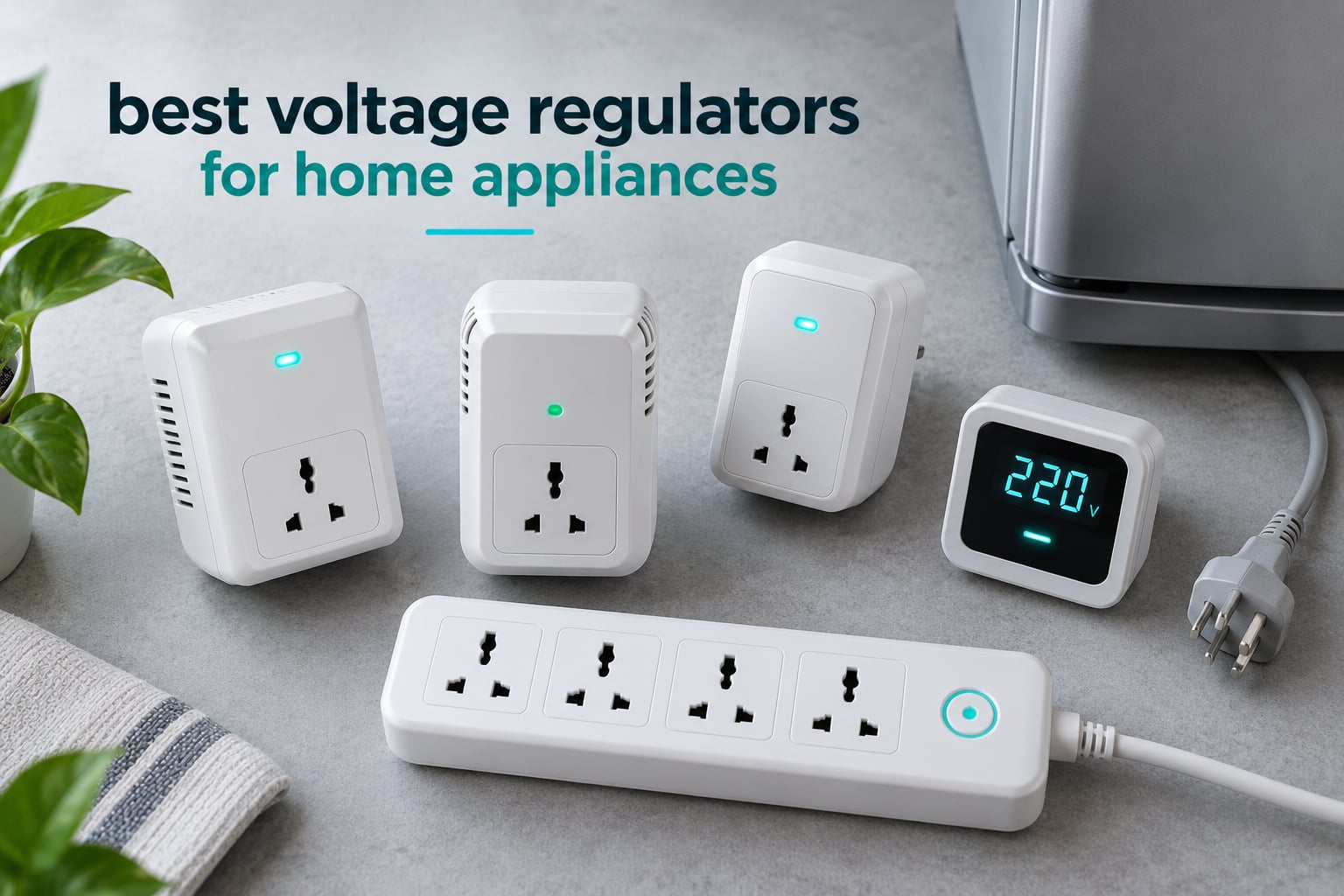
Voltage fluctuations are the quiet reason appliances die young. A compressor that cycles through a brownout every few weeks, a TV that gives up after a bad storm, a washing machine that stalls mid-cycle on a sagging line — the pattern repeats in homes on the same street. We spent weeks reading through thousands of customer reviews on plug-in voltage protectors to find out which ones actually hold up, and then sorted them by the appliance you want to protect.
This roundup covers the best voltage regulators for home appliances in the sense most buyers mean it: single-outlet and multi-outlet plug-in devices that watch your line voltage and disconnect the appliance when it drops too low or climbs too high. Almost every product here is a cut-off protector rather than a true kVA-rated stabilizer, and we say which is which so you are not disappointed by a device that switches power off instead of holding it steady.
We also cover what a proper regulator looks like, how to size one for a refrigerator, air conditioner or pump, and how much standby power these units draw on your electricity bill. If you are also rebuilding the rest of your setup, our picks for the best equalizers for home and the best soundbars for home cover the audio side of a living room that deserves clean power.
Table of Contents
Top 3 Best Voltage Regulator Picks for Home Appliances (October 2026)

BSEED 1875W Single Outlet
- Automatic over under cut-off
- 3-minute delay restart
- 1050 joule surge capacity
- 10A 125V rated

Refrigmatic 2-in-1 Protector
- 140V high 90V low cut-off
- 3-minute delay
- Angled outlet
- Fridges up to 27 cu ft

BSEED 3-Outlet Protector
- Three outlets in one plug
- 4-mode LED readout
- 3-minute delay
- 12A 15A 1440W rated
Best Voltage Regulator Picks at a Glance in 2026
| Product | Specifications | Action |
|---|---|---|
| BSEED 1875W Single Outlet Protector |
|
Check Latest Price |
| Refrigmatic 2-in-1 Voltage and Surge Protector |
|
Check Latest Price |
| BSEED 3-Outlet Multi-Function Protector |
|
Check Latest Price |
 Malictele Single Outlet Voltage Protector Malictele Single Outlet Voltage Protector |
|
Check Latest Price |
 BSEED Adjustable 1800W Two-Pack with LED Display BSEED Adjustable 1800W Two-Pack with LED Display |
|
Check Latest Price |
 BXST ETL Listed Adjustable Regulator BXST ETL Listed Adjustable Regulator |
|
Check Latest Price |
 GIDEON 1800W Appliance Protector GIDEON 1800W Appliance Protector |
|
Check Latest Price |
 PLUGTUL Four-Outlet ETL Protector PLUGTUL Four-Outlet ETL Protector |
|
Check Latest Price |
 Treybair UL94V-1 Dual-Mode Stabilizer Treybair UL94V-1 Dual-Mode Stabilizer |
|
Check Latest Price |
 matell Dual Outlet Protector matell Dual Outlet Protector |
|
Check Latest Price |
1. BSEED 1875W Single Outlet Protector – Best Overall Voltage Regulator for Fridges
BSEED Surge Protector Home Appliance,Single Outlet Power Voltage Protector,Voltage Brownout Surge Refrigerator 1440 Watts,Voltage Brownout Plug Outlet, 1875W, 125V, 15A(1 Pack)
10A and 125V rated
1050 joule surge capacity
3-minute delay restart
4-state LED indicator
Pros
- Compact low-profile body that tucks behind an appliance
- 3-minute delay matches compressor restart guidance
- Clear LEDs for normal high low and delay states
- 3-year BSEED warranty with 24/7 support
Cons
- 10A rating is below the 15A many large appliances draw
- Can trip on the regen pulse from variable-frequency-drive washing machines
- Thresholds are fixed with no adjustment
This is the unit we ended up recommending to friends. With 2630 ratings averaging 4.7 stars and a rank of number 7 in Surge Protectors on Amazon, it carries the largest review base in the group, and 87% of those ratings are five stars.
The mechanics are simple and correct. It cuts power above the over-voltage threshold and below the under-voltage threshold, then waits three minutes before restoring it so a refrigerator compressor does not short-cycle during a brownout recovery. That delay is the whole point, and it is why a protector like this behaves better than a bare surge strip on an unstable line.
Owners describe it as quiet insurance. The common report is a fridge or freezer riding through outages without complaint, with the LED cycling through low voltage, delay and normal so you can see exactly why power was interrupted. Buyers in storm-prone areas say the unit does its job without fuss and without needing any attention.
Two limits are worth knowing before you buy. The 10A rating is a real ceiling on what you can plug in, and buyers with modern variable-frequency-drive washing machines report nuisance over-voltage trips caused by the motor regenerating power back onto the line. For a standard compressor appliance, neither issue comes up.
What you should check before installing it
Read the amperage on the appliance nameplate first. Anything that pulls close to 12 amps continuously should go on a 15A protector instead, and a portable air conditioner or space heater is borderline. For a refrigerator, a chest freezer or an ice maker, the 10A ceiling is not a factor at all.
Also decide where it goes. The flat wall-plug form factor is genuinely slim, so it fits behind a fridge without stopping the door from opening, which a bulky adapter can do. Plug it directly into the receptacle, not into a power strip or extension lead.
Where it falls short
There is no way to tune the cut-off points, so if your line regularly dips just under the default low threshold, the unit will keep disconnecting a fridge that would have run through the sag perfectly well. Adjustable models handle that better.
And at 1050 joules the surge capacity is solid for brownouts and everyday switching transients, but a direct lightning strike is a different order of event. If you are in a high-strike area, whole-house surge protection at the panel is the layer that handles that, and this unit is the appliance-level backup.
2. Refrigmatic 2-in-1 Voltage and Surge Protector – Best for Refrigerators up to 27 cu. ft.
Refrigmatic 2 in 1 Voltage & Surge Protector for Refrigerators
Cuts off at 140V high and 90V low
303 joule surge capacity
3-minute restart delay
Angled outlet body
Pros
- Designed and rated specifically for refrigerators up to 27 cu. ft.
- Angled outlet lets the fridge sit closer to the wall
- Three-minute restart delay protects the compressor
- Plug-and-play with clear status lights
Cons
- 303 joule capacity is low for lightning strikes
- No UL listing on the unit
- Only cuts power off rather than conditioning voltage
If your concern is one specific refrigerator, this is the most purpose-built option we found. Its cut-off thresholds are documented at 140V high and 90V low, and the listing explicitly targets refrigerators up to 27 cubic feet, ice makers and air conditioners up to 5000 BTU.
It carries 2160 ratings at 4.7 stars, with 84% five stars. Reviewers in storm-prone areas consistently credit it with saving refrigerators and chest freezers from flicker-related damage, and they like the timed wait before power returns.
The angled outlet is the small design decision that gets mentioned more than you would expect. On a tight kitchen wall recess, a straight-back adapter can stop a fridge door from closing fully, and this one angles the body to give that clearance back.
The critique that shows up in detailed long-term reviews is the joule rating. At 303 joules, and closer to 140 in some buyers’ measurements, it is not a device you want to trust as your only line of defence against a direct strike. Some owners pair it with a conventional high-joule surge protector for exactly that reason, which is a sensible two-layer approach.
Is the refrigerator-specific rating worth anything in practice
It is a useful shorthand. The 27 cubic foot ceiling tells you the compressor size the protection electronics were designed around, so you are not relying on the marketing generalities that come with a generic protector. If your fridge is a side-by-side or a French-door unit, check the capacity label before buying.
The 5000 BTU air conditioner figure is also real guidance. That covers a window unit and a small portable unit, not a whole room. A mini-split with a larger compressor belongs on something sized for it.
What buyers should weigh up first
There is no UL listing on this unit, and some reviewers raise questions about manufacturer transparency. That is not automatically disqualifying for a plug-in accessory, but if safety certification matters to you, several other products in this roundup carry ETL marks or documented UL94 flame ratings.
Second, this device cuts power off. It does not regulate or condition. If your problem is a line that is consistently 105V rather than one that swings wildly, you want a regulator further down this list, not this one.
3. BSEED 3-Outlet Multi-Function Protector – Best Value for Several Appliances
BSEED Voltage Protector, 3 Outlet Plug in Surge Protector for Home Appliance Multi Function Plug with Protection Wall Mount Power Suppressor for TV/PC/Refrigerator 125V, 1875W, 1 Pack
Three outlets in one plug-in body
4-mode LED indicator
3-minute delay cycle
12A 15A and 1440W ratings
Pros
- Three outlets let one device guard several appliances
- Wall-mountable design keeps cords organized
- 4-LED readout shows voltage state at a glance
- Several buyers report multi-year service
Cons
- Bulk body can block the adjacent socket on a duplex outlet
- Outlets spaced too closely for three standard plugs at once
- Cuts power off without regulating or conditioning
Three outlets in one plug-in body is the practical trick here, and it is why this model has 1379 ratings averaging 4.7 stars with 85% five stars. One protector can cover a refrigerator, a freezer and an ice maker instead of three separate wall plugs.
It handles the full range of grid misbehaviour buyers complain about: brownouts, spikes, surges, power failure, voltage fluctuation and load shedding. The 3-minute delay specifically exists to prevent rapid refrigerator cycling that damages compressors, and the four-mode LED tells you whether you are looking at normal, over-voltage, low voltage or the waiting cycle.
Reviewers in areas with unstable grids call it cheap insurance for refrigerators, freezers, microwaves and AV gear, and several describe multi-year reliable service. The under-voltage cut-off is documented at 90V AC with 3-5V of hysteresis, which prevents the unit from chatter-cycling right at the threshold.
The gripes are physical rather than electrical. The body is deep enough to cover both receptacles on a duplex wall outlet, and the three sockets are spaced so that three standard appliance plugs will not all seat properly at the same time. Plan on two, not three.
How to get around the physical footprint problem
Mount it in a location with a dedicated receptacle rather than a shared one. A kitchen counter outlet dedicated to the fridge, freezer and microwave is exactly the use case this shape was built for, and you sidestep the blocked-socket issue entirely.
The wall-mountable design is genuinely useful for TVs and computers. If your screen or PC sits on a wall with one reachable outlet, this keeps the cable run tidy instead of adding a second adapter. Our picks for the best turntables for home cover the same one-outlet wall-placement problem from the audio side.
Where the design limits you
It disconnects on unsafe voltage and does not normalise it. Anyone expecting a brownout ride-through, where the appliance keeps running through a short dip, will be disappointed. That behaviour belongs to a UPS, not a cut-off protector.
It is also a point-of-use device, not a panel-level solution. It protects whatever you plug into it and nothing else in the house, which is fine if you deploy several like this across the rooms that matter.
4. Malictele Single Outlet Voltage Protector – Best Budget Pick for One Appliance
Refrigerator Surge Protector, Malictele Single Outlet Voltage Protector Home Appliances 120V 10A Voltage Brownouts Plug Outlet for Fridge TV Air Conditioners Surge Protector -1 Pack
Single outlet form factor
140 joule surge capacity
3-minute delay start
10A 120V rating
Pros
- Straightforward single-outlet protection for one appliance
- 3-minute delay matches compressor restart guidance
- LED indicators show exactly why power was cut
- Metal and plastic construction
Cons
- 140 joule surge capacity is modest
- 10A rating limits heavier appliances
- Fixed cut-off thresholds with no adjustment
Sometimes one appliance is all you are worried about, and a single-outlet protector is the honest answer. This one carries 395 ratings at 4.7 stars with an 85% five-star share, which is a good signal for a small review pool.
The behaviour is the familiar pattern: cut off on spikes, outages, fluctuations and voltage that is too high or too low, wait three minutes for the line to settle, then restore. A four-state LED covers normal, delayed, over-voltage and under-voltage, so you can tell a nuisance trip from a genuine fault.
Reviewers treat it as a budget cut-off protector for refrigerators and air conditioners, and respond most positively to the delay function and the multi-state readout. The features that matter for a compressor appliance are all present and nothing here is filler.
The one specification here worth double-checking against the manual is the exact under-voltage cut-off point, since it is not printed on the listing the way the over-voltage threshold is.
When a single-outlet protector is the right call
It is the right call when you have one compressor appliance on a line that occasionally sags, and you do not want to spend on protection for outlets that never see a problem. Refrigerators, chest freezers and window air conditioners all fit that description.
Check the appliance amperage before you commit, because the 10A rating is the binding constraint here. A mid-size refrigerator draws well under that. A large chest freezer or a 5000 BTU window unit pushes closer to the line.
What you give up at this price band
You give up adjustability. The cut-off points are fixed, so a line that dips just below the low threshold will keep disconnecting an appliance that could have handled it. If that is your situation, move to an adjustable model.
You also give up surge capacity. At 140 joules this handles switching transients and modest surges, not a lightning strike. For storm-prone areas, treat it as the appliance-level layer only.
5. BSEED Adjustable 1800W Two-Pack – Best for Adjustable Cut-Offs
BSEED Surge Protector Outlet, Voltage Regulator, Surge Protector for Refrigerator/TV/PC/Home Appliance, Wall Tap Adapter, Space Saving Design, LED Display Screen, Adjustable,120V, 15A, 1800W, 2 Pack
LED digital display of live voltage
Side-button threshold and delay adjustment
15A and 1800W rated
Two pack
Pros
- Digital display shows live incoming voltage
- Adjustable high and low cut-offs plus delay timing
- Restores power faster than typical three-minute units
- Two pack covers a fridge and a second appliance
- UL94-V-1 flame-retardant ABS
Cons
- Bulkier form factor than a typical wall tap
- Point-of-use only and not a whole-house replacement
- Buyers are cautioned to match appliance amperage
Everything in this roundup that has a digital voltage readout is useful, and this is the clearest one. The LED screen shows the current operating status and the incoming voltage, so you can see what your line is actually doing before you decide anything else.
It rates 4.6 stars from 285 ratings with an 82% five-star share. Owners who lost a TV to an outage single out the readable display and the adjustable cut-off as the reasons this model stood out, and several note it restores power noticeably faster than fixed-delay protectors.
Adjustment happens live from the side of the unit using the SET key plus the plus and minus keys for high and low protection values and the delay value. That means you can raise the under-voltage threshold if your line sags habitually, rather than watching a fridge disconnect repeatedly.
The compatibility list runs from air conditioners, water heaters and dishwashers down to microwaves, rice cookers, printers and lamps. The enclosure is ABS in a UL94-V-1.0 flame grade, and you get two of them plus a welcome guide.
Why the live voltage display changes how you buy
Because it turns a guess into a measurement. Plug it in, read the number, and you immediately know whether your problem is a line that swings wildly or one that sits consistently low. That single reading changes which type of device you should be shopping for next.
It also makes nuisance trips diagnosable. If the display shows a healthy 120V while the appliance is running fine, a cut-off was caused by a transient rather than a standing problem, and that is useful information when you are deciding whether to change anything at all.
What it is not
It is point-of-use protection, and a detailed long-term reviewer frames it correctly as an augment to, not a replacement for, whole-house surge protection. Buyers are also cautioned to check the appliance’s maximum continuous amperage, which sits behind the 15A and 1800W rating.
The 82% five-star share is the lowest among the higher-rated BSEED models here, and the form factor is bulkier than a plain wall tap. Check the clearance behind the outlet before committing.
6. BXST ETL Listed Adjustable Regulator – Best for Marginal or Sagging Lines
[ETL Listed] BXST Refrigerator Surge Protector, One Outlet Wall Plug Adjustable Voltage Regulator Against High and Low Voltage, Power Surge Protector for Fridge and Home Appliances, 120V 1800W, 1 Pack
Under-voltage adjustable from 90V to 105V
140V over-voltage cut-off
ETL listed
15A and 120V rated
Pros
- Under-voltage threshold adjustable from 90V to 105V for marginal grids
- ETL listed with a documented 140V over-voltage cut-off
- Compact plug-in form factor that fits behind a wall-mounted TV
- Digital screen shows live voltage
Cons
- Indicator labels printed in Spanish
- Deep body can occupy two receptacle positions
- Only a 1-year warranty with 140 joule capacity
- One reviewer reports the green LED never changed state
The adjustable under-voltage range from 90V to 105V is the feature that matters here. If your line sits in the low 100s rather than near 120V, that range lets you set a threshold below the sag so the appliance keeps running instead of disconnecting every few minutes.
It holds a 4.6 rating across 125 ratings, with 78% five stars. Buyers in flicker-prone areas describe the unit cutting power for roughly 180 seconds before re-energizing, which protects refrigerators and freezers from both the sag and the re-surge on the way back in.
The ETL listing is a genuine differentiator in this category. A documented 140V over-voltage cut-off on a certified unit gives you more confidence than an unlisted device with the same numbers on the box. Reviewers also like that it fits behind a wall-hung television where a UPS simply cannot go, and describe the build as rugged.
Beyond the language issue, it is rated 120V, 15A, 50/60Hz for refrigerators, TVs, freezers, computers, air conditioners and water pumps.
Setting the under-voltage threshold correctly
Set it just below the lowest voltage your appliance actually sees, not at the theoretical minimum. If your line dips to 108V on a bad afternoon, setting the threshold near 105V keeps the fridge running, and setting it at 90V does the same thing without you needing to know the exact number.
That is the general rule for all adjustable under-voltage settings: raise the floor only as far as you need to avoid nuisance trips, and no further. Too high a setting causes disconnections; too low a setting removes most of the protection.
Trade-offs to accept
The indicator labels are printed in Spanish, which is an odd fit for a unit sold for North American 125V use. The body is deep enough to occupy two receptacle positions on a wall outlet, and the warranty is one year, shorter than several alternatives here.
Surge capacity is 140 joules, so treat it as brownout and fluctuation protection rather than lightning protection. One reviewer also reported a green LED that never changed state, which is worth mentioning as a single report rather than a pattern.
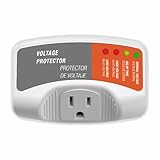
7. GIDEON 1800W Appliance Protector – Best Warranty in the Lineup
GIDEON Appliance Surge Protector, Single Outlet Voltage Protector & Voltage Regulator for Refrigerator, TV, PC & Home Appliances, 1800W Wall Plug Power Protector, 120V 15A
5-year manufacturer warranty
Connected equipment coverage plan
Cut-off at 140V high and 90V low
CE certified
Pros
- Five-year manufacturer warranty
- longer than the others tested here
- Connected equipment coverage plan included
- Compact single-outlet body that does not waste space
- Four LED indicators plus a three-minute restart delay
Cons
- 140 joule single-MOV capacity is low for lightning
- No user-adjustable settings or delay time
- Tight output socket angles the cord downward
- Clip-secured housing rather than screws
Warranty length is usually the least interesting spec on these devices and here it is the main reason to pick one. A five-year manufacturer warranty is the longest in this comparison, and it is paired with a connected equipment coverage plan and CE certification.
Ratings sit at 4.6 from 51 reviews, the smallest pool here, and the feedback is unusually technical for the size of it. One owner who lost a refrigerator to a surge praises the build quality and the restart delay while noting the unit is essentially a single 140-joule MOV shared with many identically built rebranded products.
That same reviewer flags clip-secured housing, a lightly contacted ground connection and a slow output relay, which is the kind of detail you rarely see in consumer reviews and genuinely useful when comparing. Others like the warranty length and the compact 4.5 by 2.8 inch footprint, which suits bedrooms, kitchens, offices, dorms and travel use.
Automatic disconnection above 140V AC or below 90V AC covers the standard thresholds, with four LEDs for normal, over-voltage, under-voltage and delay.
Is a five-year warranty worth choosing on its own
For a device that sits plugged in behind an appliance for years, the warranty length is a reasonable proxy for manufacturer confidence. Five years implies the brand expects the relay and the MOV to last well past the three-year mark where most competitors stop.
The coverage plan matters too. It is the difference between replacing the protector after a covered event and paying out of pocket, which for a refrigerator or a television is a meaningful sum.
What the technical reviews flag
There are no user-adjustable settings or delay time on this one, so if your line needs threshold tuning, this is the wrong unit. The output socket is tight and angles the cord downward, which strains the cable over time, and the housing uses plastic clips rather than screws.
At 140 joules from a single MOV, lightning protection is out of scope. And the relay trips relatively slowly, so very fast transients may pass through before it reacts. This is brownout and fluctuation insurance, not a surge panel.
8. PLUGTUL Four-Outlet ETL Protector – Best for Multi-Appliance Rooms
PLUGTUL Refrigerator Surge Protector, Voltage Regulator for Refrigerator | TV, PC, Home Appliance, Adjustable Voltage Protector, 1800W 120V 15A, ETL Listed
Four outlets at 1800W and 15A
ETL listed
Adjustable 90V-105V under-voltage
140V over-voltage cut-off
Pros
- ETL listed for verified safety compliance
- Adjustable 90V-105V under-voltage threshold cuts nuisance shutdowns
- Three-colour LED sequence makes each state obvious
- Flame-retardant PC housing
- Multi-outlet design covers several appliances
Cons
- A 4.4 average with 70% five-star
- below the leading models
- Small base of 40 ratings makes reliability hard to judge
- Listed output voltage of 105V can confuse buyers
Four outlets at once is the headline here, and it is useful in a laundry room or a home office where you want the refrigerator, the washing machine, a computer and a monitor all behind one protector.
It holds 4.4 stars from 40 ratings, a smaller review base than most of the group, and the rating distribution is correspondingly weaker at 70% five stars against the 82 to 87% the leading BSEED models command. Treat the specification as good and the track record as short.
What sets it apart in this band is the ETL listing combined with an adjustable 90V to 105V under-voltage cutoff. The adjustable floor is what stops repeated disconnections on a line that sits a little low, and it is the same reasoning behind the BXST unit further up.
The indicator sequence is unusually clear: red for cut-off, yellow for the three-minute delay, green when power is safely restored. That colour logic makes it obvious at a glance whether your appliance is waiting or actually faulted.
Reading the 105V output listing correctly
Some buyers read the listed 105V output figure and conclude the device conditions power. It does not. That number describes the adjustable under-voltage cutoff range, and the listing format makes it easy to misread.
Set the under-voltage floor where your line needs it and leave it. For most US households sitting at 120V nominal, a floor around 100V stops nuisance trips without exposing the appliance to meaningful under-voltage.
Where the caution belongs
The 4.4 average and 5% one-star share put it mid-pack on customer satisfaction. If the appliance is expensive, a short track record is a risk you may not want to take.
The plug type is listed as Type A despite being a North American 125V product, which is a small inconsistency in the listing. And with four outlets sharing one 1800W and 15A rating, check the combined draw of everything you intend to protect.
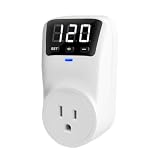
9. Treybair UL94V-1 Dual-Mode Stabilizer – Best for Real-Time Voltage Monitoring
Appliance Surge Protector Voltage Stabilizer Fireproof UL94V-1 Wall Mount Surge Protectors Outlet for Refrigerator, TV & Heavy, Real-Time Monitoring & Custom Voltage 80V-140V (Standard)
Real-time LED voltage display
Adjustable 80V-140V thresholds
Dual-mode fridge and TV response
UL94V-1 fireproof housing
Pros
- Live voltage display verified accurate by a reviewer
- Adjustable 80V-140V thresholds with custom reboot timing
- Dual-mode delay protects fridges but responds instantly for TVs
- Works as a true stabilizer against rapid flicker
Cons
- Instructions are unclear and error codes are unexplained
- One reviewer could not clear a persistent fault state
- 4.2 average with 6% one-star reviews
- Documentation gap is the recurring complaint
This is the only unit in the roundup that describes itself as actively correcting over and under voltage rather than simply disconnecting, and the dual-mode response is the interesting part: more than 180 seconds of delay for refrigerators, 30 to 60 seconds for non-compressor appliances like televisions.
It holds 4.2 stars from 81 ratings, with 66% five stars and 6% one-star. The functional feedback is nonetheless positive, with multiple owners in storm-prone areas reporting it repeatedly catching flicker that ordinary surge strips cannot.
One reviewer confirmed the display voltage reading is accurate and found the range adjustments easy to make. The 80V to 140V adjustable range is wider than the ranges offered by the other adjustable models here, which means it can be tuned for genuinely poor lines rather than just moderate sags.
The problem area is documentation, and that is not a small caveat. The single most-cited complaint is unclear instructions that leave users unable to interpret error codes such as a flashing HIP indicator, and one reviewer was unable to clear a persistent fault state after repeated resets.
Why the dual-mode delay is genuinely useful
Compressor appliances and electronics have opposite needs. A refrigerator needs a long, patient wait so the compressor does not short-cycle, while a television has nothing mechanical to protect and benefits from power coming straight back. Hard-coded three-minute delays are wrong for the second case.
Splitting the response by appliance type is the right engineering answer, and it is why this unit earns its place despite the documentation problems. If you run a fridge and a TV on a line that flickers, the two behaviours you actually want are here.
When the documentation gap should stop you
If your line is unstable and you are not comfortable reading a manual, skip it. A device that cuts power and then refuses to explain why is frustrating at exactly the wrong moment, and the 6% one-star share tracks that frustration directly.
The warranty is two years, and the 125V and 15A rating is solid. Confirm it is 125V compatible with your region before ordering, since this listing has a history of confused delivery expectations abroad.
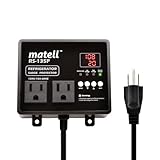
10. matell Dual Outlet Protector – Best for Two Appliances on One Plug
matell Refrigerator Surge Protector Dual Outlet
Two outlets on one plug
Digital voltage and amperage readout
Delay adjustable from 1 to 120 seconds
16A rated
Pros
- Dual outlets protect two appliances at once
- Digital screen reports both voltage and amperage for load sizing
- Widest delay adjustment range here from 1 to 120 seconds
- Works beyond refrigerators including dishwashers and microwaves
Cons
- A 4.1 average with 13% one-star reviews
- Only 64 ratings and a weak category rank show a short track record
- Shortest default delay against the three-minute norm
- Plug type listed as Type A for a 125V North American product
The dual outlet is the useful part. One plug protects two appliances, which suits a fridge and a chest freezer in the same room, or a microwave and a dishwasher on the same circuit.
The digital screen reports both voltage and amperage, and that amperage readout is more useful than it sounds. It lets you see the running draw of a connected appliance and check it against the 16A rating before something trips, instead of guessing from a nameplate.
The delay restart range of 1 to 120 seconds is the widest adjustment here by a wide margin. For an appliance with no compressor, shortening the wait is sensible. For a refrigerator, extending it toward 120 seconds is safer than the default.
Set against that, the customer signal is the weakest in the set. It holds 4.1 stars from 64 ratings, with only 61% five stars and 13% one-star, the highest one-star share of anything analysed, and a category rank of number 1058 reflecting low sales volume.
Setting the delay for a compressor appliance
Most manufacturers prescribe a wait of around three minutes after a power interruption before a compressor restarts. This unit’s default window is shorter than that, which is the single most likely reason to see shortened run times or extra cycling on a refrigerator.
If you are protecting a fridge or freezer, set the delay high before you plug it in. The adjustment range comfortably covers the three-minute guidance, and it takes a few seconds at the unit.
What the low rating is actually telling you
With 64 ratings, one-third of which sit at four stars and 13% at one star, the sample is too small to identify a specific defect. The pattern most likely reflects the short default delay plus buyers expecting a smoother out-of-the-box behaviour.
Also note the plug type is listed as Type A for a product sold for 125V North American use, which is a listing inconsistency rather than a functional problem. Weigh the specification against the weak satisfaction signal carefully if this protects an expensive appliance.
Voltage Regulator vs Stabilizer vs Surge Protector vs UPS: What Each One Actually Does
A surge protector clamps short, high-energy spikes and then passes power through untouched. It does nothing about a sustained sag or a sustained over-voltage condition. Most of the units in this roundup go one step further and disconnect the appliance entirely when voltage moves outside a set band.
A voltage stabilizer regulates: it measures the incoming voltage and uses a servo motor, relay switching or solid-state components to bring the output back to a target band. That correction is what allows an appliance to keep running through a dip. Nothing in this roundup performs that function in a full sense.
A UPS adds a battery, so it carries the appliance through a short outage with no interruption at all. That is what you want for a desktop computer, a network box or a home server, and what you do not need for a refrigerator.
Which one you actually need depends on the failure you are worried about. Flickering lights and appliances that restart unexpectedly point to sustained swings, where a cut-off protector helps. A computer that loses work when the lights flicker needs a UPS. A line that regularly sits below 100V needs a real stabilizer installed at the panel.
Relay vs Servo vs Static: Which Regulator Type You Actually Need
Relay-type stabilizers switch taps in discrete steps using electromechanical contactors. They are inexpensive and silent except for a click at each change, but regulation accuracy is roughly 3 to 10% and the contacts wear over time.
Servo stabilizers use a small motor to turn an autotransformer continuously. Accuracy improves to roughly 1 to 3%, which is plenty for household appliances, but the motor is audible. Owners in quiet homes report humming and clicking that is noticeable at night, and that is the most common complaint about mainline stabilizers.
Static stabilizers use solid-state switching rather than moving parts. Accuracy reaches roughly 0.05 to 1% and they run in complete silence, which makes them the right choice for a bedroom, a home office or an audio system.
Ferroresonant designs are a separate category with their own noise signature and were not represented in the products we analysed this roundup, so we have not ranked any. For most homes, the practical decision is simpler: if the appliance list is compressors and motors, accuracy matters more than silence, and if the appliances are electronics in a quiet room, silence matters more.
How to Size a Voltage Regulator for Your Appliances
Start with the running wattage of each appliance, not the label wattage, because the number that matters is what the compressor or motor draws once it is running steadily.
Next, apply a starting multiplier. Forum users consistently cite about three times running power for refrigerators, three to five times for air conditioners, and five to eight times for water pumps and other highly inductive loads. Those multipliers exist because inrush current at start-up is what trips protection and what damages windings.
Add the results together, then add a safety margin of 20 to 30%. Undersizing causes nuisance disconnections and stress; oversizing simply costs more and adds dead weight. The margin absorbs a future appliance you have not counted yet.
For a single refrigerator of about 150 watts running, three times gives you roughly 450 watts of starting demand, which lands comfortably inside a 1440 watt protector. A 1200 BTU window air conditioner running near 1000 watts with a three-times multiplier needs closer to 3000 watts, so it requires a larger unit than anything in this roundup.
Water pumps are the hard case. At five to eight times running power, a modest pump can demand more starting current than a domestic stabilizer will deliver, and forum users frequently report pump and stabilizer combinations that will not work together. If you have a well pump, size that separately and professionally. The same logic applies if you are choosing between the best RV water pressure regulators, where a fluctuating line is the whole reason the regulator exists.
Continuous high-draw appliances fall into the same bucket. Our guide to the best home freeze dryers covers machines whose compressors and heating elements run for many hours at a stretch, and none of the plug-in units in this roundup is sized for a load like that.
Installation, Noise and Running Cost Questions People Ask Before Buying
Whole-house versus point-of-use is the first real decision. A mainline stabilizer installed at the panel protects everything at once, but it needs a licensed electrician, it becomes a single point of failure for the whole home, and it commits you to professional installation. Individual appliance units cost less up front and let you target exactly what matters.
Plug-in protectors are safe to install yourself. Unplug the appliance, plug the protector into the wall receptacle, plug the appliance into the protector. Never daisy-chain a protector into an extension lead or a power strip, because the added impedance reduces the protection margin.
On running cost, the honest answer is that these devices draw very little standby power, but it is not zero. The calculation is straightforward: idle watts multiplied by 24, multiplied by 365, multiplied by your utility rate. At 1 watt of idle draw that works out to roughly 8.8 kilowatt-hours a year, which is a negligible addition to a monthly bill. The larger real cost of a mainline stabilizer is its own losses during correction.
On noise, the only products that make any are servo-type stabilizers at roughly 40 to 50 decibels. The plug-in cut-off protectors in this roundup emit nothing but a click from a relay at the moment of switching, which is why several owners describe them as effectively silent.
On maintenance, there is very little to do. Keep the vents clear of dust, check that the receptacle is tight and undamaged, and confirm the LEDs still behave as expected. Long-term owners on home forums describe mainline stabilizers running 15 years or more when treated as set-and-forget devices, which is the correct approach.
If you are comparing this with audio equipment that benefits from conditioned power, note that a cut-off protector does nothing for audible hum. A conditioner with filtering addresses noise that a voltage protector cannot touch.
Frequently Asked Questions
What capacity AVR do I need for a refrigerator?
A refrigerator needs roughly three times its running wattage to cover compressor inrush at start-up. For a typical 150 watt fridge that means about 450 watts of starting demand, which sits comfortably inside a 1440 watt plug-in protector. Add a safety margin of 20 to 30% and you have room for the compressor ageing over time.
Do electric voltage stabilizers really work?
Yes, for the problem they are designed to solve. A stabilizer watches incoming voltage and either corrects it or disconnects the appliance when it moves outside a safe band. What it cannot do is protect against direct lightning strikes, and the plug-in protectors in this roundup are brownout and fluctuation devices rather than full kVA-rated stabilizers.
What is the difference between a surge protector and a voltage protector?
A surge protector clamps short high-energy spikes and then passes power through untouched. It does nothing about a sustained sag or sustained over-voltage. A voltage protector also watches for sustained high and low voltage and disconnects the appliance entirely until the line settles. For brownouts and flicker, the voltage protector is the relevant device.
Are whole house surge protectors worth the money?
They are worth it if you have expensive electronics or you live in a high-strike area, because panel-level protection handles direct strikes and covers every outlet at once. The trade-offs are cost, the need for a licensed electrician, and the fact that a mainline unit becomes a single point of failure for the entire home.
What happens if a voltage stabilizer is overloaded?
A cut-off protector responds by disconnecting the appliance, which is safe but means your refrigerator stops running until the load drops or you reset it. A regulating stabilizer instead pushes to its limit and runs hot, which shortens component life. Either way, matching the appliance amperage to the unit rating is what prevents the problem.
Final Verdict on the Best Voltage Regulators for Home Appliances
The BSEED 1875W single outlet protector is our pick at the top, on the strength of 2630 ratings, a 4.7 average and the cleanest three-minute restart behaviour in the group. If you are protecting one large refrigerator, the Refrigmatic 2-in-1 unit is purpose-built for it, and if you want one device to cover a fridge, a freezer and an ice maker, the BSEED three-outlet model is the better buy.
For a line that regularly sags, prioritise an adjustable under-voltage threshold over anything else, because that is what stops nuisance disconnections. For electronics in a quiet room, look at the dual-mode response rather than the surge rating. And if your real problem is that lights flicker and computers restart, neither a cut-off protector nor a stabilizer is the answer you want, a UPS is.
Check the amperage on the appliance before you order, buy from a seller who will stand behind the warranty, and remember that none of these devices substitutes for panel-level protection in a storm-prone area. That is the complete guide to the best voltage regulators for home appliances in 2026.