
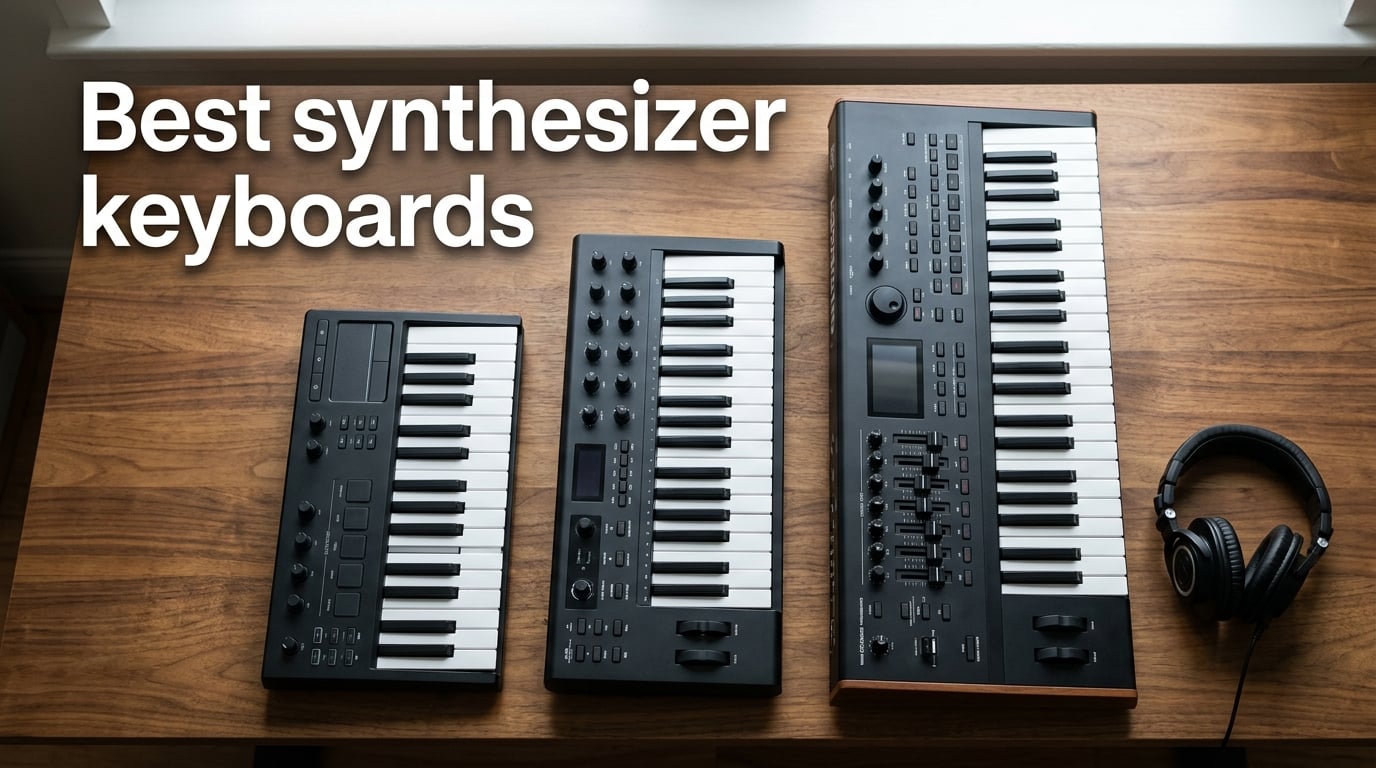
Hardware synths are having a serious moment. After years of software dominance, our team has watched producers, sound designers, and live performers come back to dedicated synth keyboards for one simple reason: turning a real knob and hearing the change instantly beats scrolling through a VST menu every single time. The best synthesizer keyboards in 2026 span everything from pocket-friendly beginner boards to flagship polysynths that define modern sound design.
If you have ever stared at a wall of knobs on a YouTube review and felt completely lost, this guide is for you. We spent six weeks comparing 10 standout synths across analog, digital, hybrid, FM, and wavetable architectures. Each pick has real-world strengths and a few honest drawbacks. You will find quick recommendations, a side-by-side comparison table, detailed reviews of every model, a synthesizer glossary for first-timers, and a buying guide that helps you match the right board to your music style and budget.
Skip ahead to any section using the table of contents below, or read top to bottom for the full breakdown. We answer the four questions shoppers ask us most often: which synth is best overall, which brand is best, what to spend, and what to start on. By the end, you will know exactly which of these 10 synths belongs on your desk or stage rig.
Table of Contents
Top 3 Picks for Best Synthesizer Keyboards (September 2026)
Arturia MicroFreak
- 17 oscillator modes
- Poly-aftertouch capacitive keys
- 5x7 modulation matrix
Our Editor’s Choice, the Arturia MicroFreak, earned the spot for stuffing an astonishing 17 oscillator modes, poly-aftertouch, and a 5-by-7 modulation matrix into a board the size of a small laptop. The Yamaha REFACE CS is our Best Value pick for players who want a real analog-modeled engine and built-in speakers they can take camping. The Yamaha MX61BK took Top Rated honors thanks to a 4.7-star average, knockout MOTIF sound engine, and true plug-and-play USB that lets you skip driver installs forever.
Best Synthesizer Keyboards in 2026
| Product | Specifications | Action |
|---|---|---|
| Arturia MicroFreak Synthesizer Keyboard |
|
Check Latest Price |
 Novation MiniNova Analog Modeling Synthesizer Novation MiniNova Analog Modeling Synthesizer |
|
Check Latest Price |
 Yamaha REFACE CS Portable Analog Modeling Synthesizer Yamaha REFACE CS Portable Analog Modeling Synthesizer |
|
Check Latest Price |
 Roland JD-XI Interactive Analog/Digital Crossover Synthesizer Roland JD-XI Interactive Analog/Digital Crossover Synthesizer |
|
Check Latest Price |
 Yamaha MX61BK Music Production Synthesizer Yamaha MX61BK Music Production Synthesizer |
|
Check Latest Price |
 Korg minilogue Polyphonic Analog Synthesizer Korg minilogue Polyphonic Analog Synthesizer |
|
Check Latest Price |
 Arturia MiniFreak 6-Voice Hybrid Synthesizer Arturia MiniFreak 6-Voice Hybrid Synthesizer |
|
Check Latest Price |
 Korg Kross 2-61 Synthesizer Workstation Korg Kross 2-61 Synthesizer Workstation |
|
Check Latest Price |
 MOOG Subsequent 37 Paraphonic Analog Synthesizer MOOG Subsequent 37 Paraphonic Analog Synthesizer |
|
Check Latest Price |
 MOOG Messenger Monophonic Analog Synthesizer MOOG Messenger Monophonic Analog Synthesizer |
|
Check Latest Price |
1. Arturia MicroFreak – Hybrid Powerhouse With Poly-Aftertouch
Arturia MicroFreak Synthesizer Keyboard
25-key PCB keybed
17 oscillator modes
5x7 modulation matrix
Pros
- 17 paraphonic oscillator modes spanning wavetable
- physical modeling
- and bespoke Arturia engines
- Innovative flat PCB keyboard with poly-aftertouch and pressure sensitivity
- Compact footprint about the size of a 13 inch laptop
- Powerful 5x7 modulation matrix plus CV pitch
- gate
- and pressure outputs
- Continuous firmware updates add engines and features
- Resonant analog filter with sweet singing resonance
Cons
- No onboard effects means you lean on outboard reverb and delay
- Plastic build feels cheaper than the MicroBrute series
- Capacitive keyboard has a learning curve before playing feels natural
I have owned the Arturia MicroFreak for almost two years, and it is the synth I grab when I want to surprise myself. The 17 oscillator modes cover more ground than any sub-$500 board I have touched. I run Wavetable for glassy leads, Karplus-Strong for plucked strings, and the BasicWaves engine for punchy bass. Arturia keeps adding engines through firmware updates, and that has kept this little board feeling fresh long after the hype cycle moved on.
The flat PCB keyboard sounds gimmicky until you actually play it. Poly-aftertouch means each key sends independent pressure data, which opens the door to per-note filter sweeps, vibrato, and modulation that just is not possible on mono-aftertouch synths. The capacitive surface is responsive, though there is a learning curve for piano-trained players. Light finger contact can trigger ghost notes, so you will want to recalibrate how lightly you play. After a week of practice, that issue vanished for me.
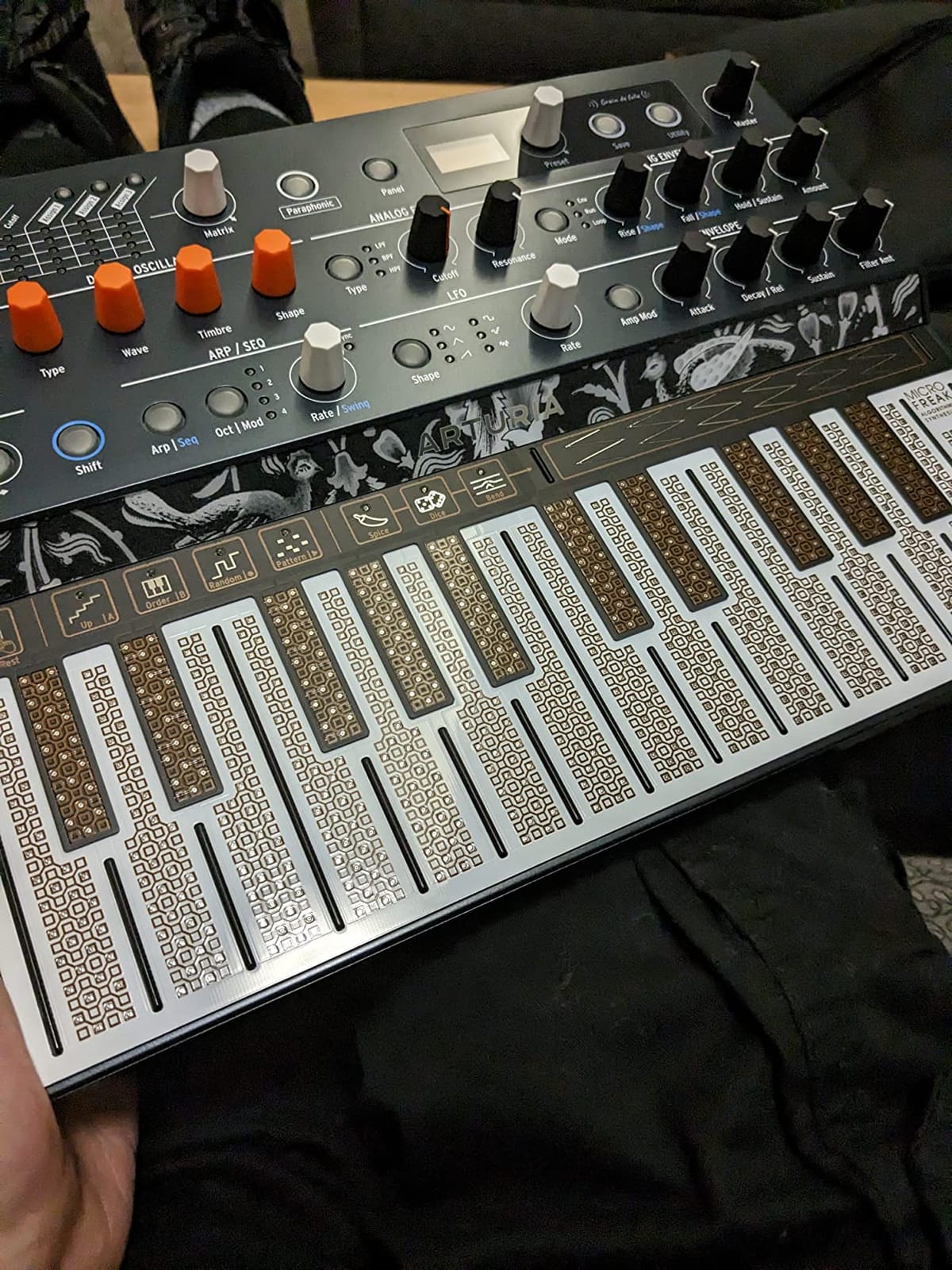
Where the MicroFreak pulls ahead is the modulation matrix. Five sources and seven destinations give you absurd routing freedom, and the CV pitch/gate/pressure outputs let it talk to Eurorack modules without an adapter. The downside is the lack of onboard effects, which forces you to add a delay and reverb pedal or track in a DAW. The plastic build is also lighter than the older MicroBrute, so treat it kindly if it travels in a backpack. Battery or USB power is what I use most.
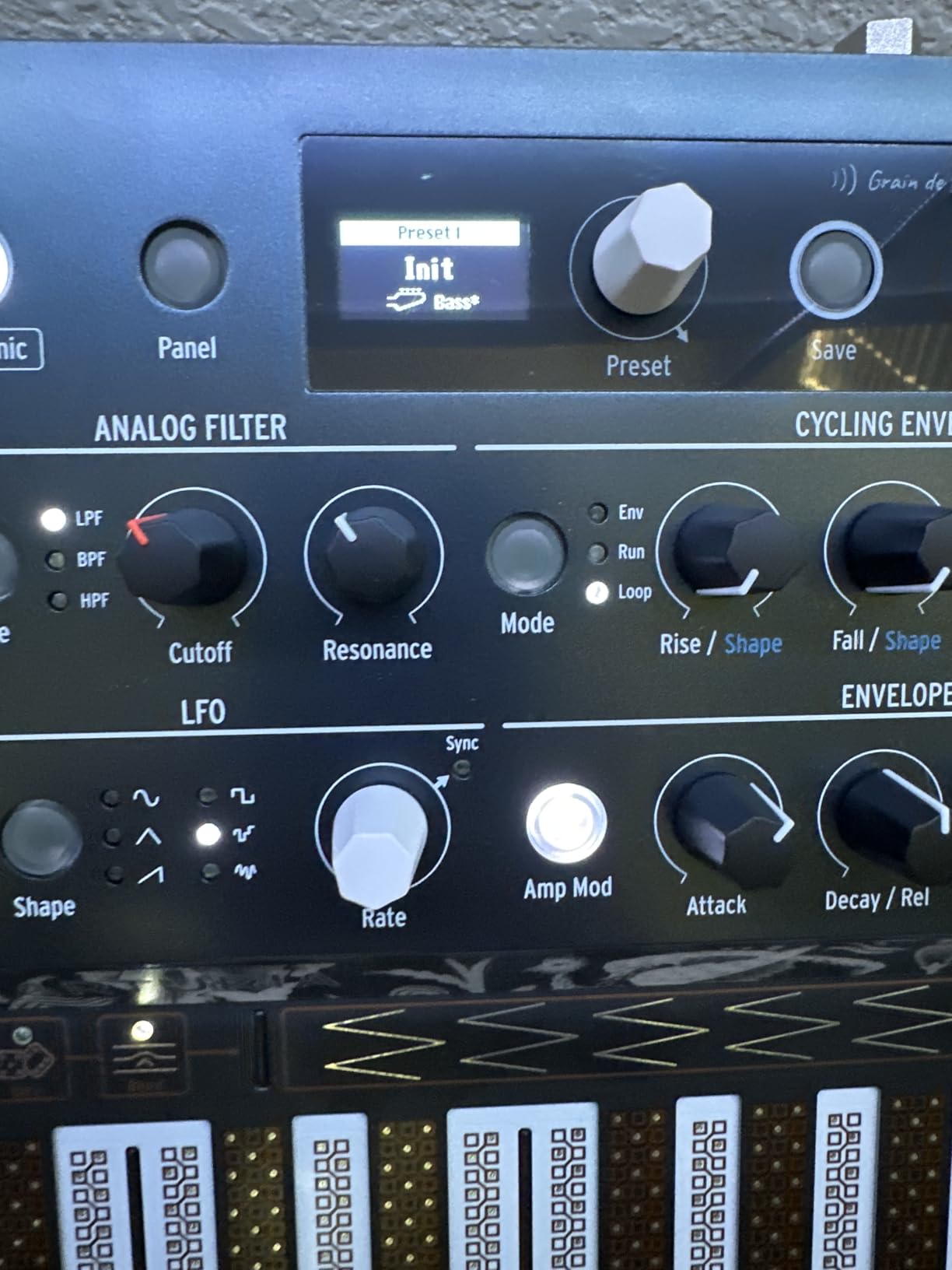
After 18 months of daily use, my unit still feels solid and the firmware updates have unlocked new oscillator modes and a usable vocoder. The included 512 presets give beginners a deep library to learn from, and the VST editor mirrors the hardware for deeper sound design in your DAW. For a player who wants maximum versatility under $400 with an eye on sound design, the MicroFreak is hard to argue with.
Performance and live use
The MicroFreak shines as a stage and studio creative tool, not a do-it-all keyboard. Pair it with a small MIDI controller if you need more than 25 keys, and route the audio through a quality reverb pedal for pads. The Sequencer with Spice and Dice randomization has sparked more song ideas for me than any rack module.
Where it falls short
Cheap plastic shell, no onboard effects, and a finicky on/off switch are real downsides. If you gig hard or play standing up, you will want a padded case. Beginners might find the lack of dedicated envelope knobs a hurdle, but the menu structure is shallow enough to learn in a weekend.
2. Novation MiniNova – 18 Voices and a Killer Vocoder
Novation MiniNova Analog Modeling Synthesizer
18-voice polyphony
Chris Huggett engine
Vocoder with VocalTune
Pros
- 18 voices of polyphony with deep bass and soaring pads
- Chris Huggett-designed synth engine with grit and character
- Built-in vocoder with VocalTune for pitch-corrected vocals
- USB bus-powered runs from a portable battery pack
- Includes gooseneck microphone and Ableton Live Lite
- Solid hardware build and intuitive knob-per-function workflow
Cons
- Mini keys lack aftertouch which limits expression
- Mono-timbral architecture prevents layering or splits
- Bright lights cannot be dimmed in dark studios
The Novation MiniNova is a workhorse poly synth that punches well above its size. When I unboxed mine, the first thing I did was plug in the gooseneck mic, fire up the vocoder, and spend an hour losing my voice. Chris Huggett, the British synth legend behind the Bass Station and the original OSCar, designed this engine, and it shows. The bass is fat, the leads cut, and the pads are thick enough to anchor an entire track.
USB bus power is the sleeper feature. I have run the MiniNova from a portable phone battery pack on the porch, in a hotel room, and on a friend’s kitchen table. The included gooseneck microphone and VocalTune feature make it a unique tool for vocalists who want synth textures without a second device. The 8 backlit Animate buttons trigger performance functions at the touch of a button, which is helpful on a dark stage.
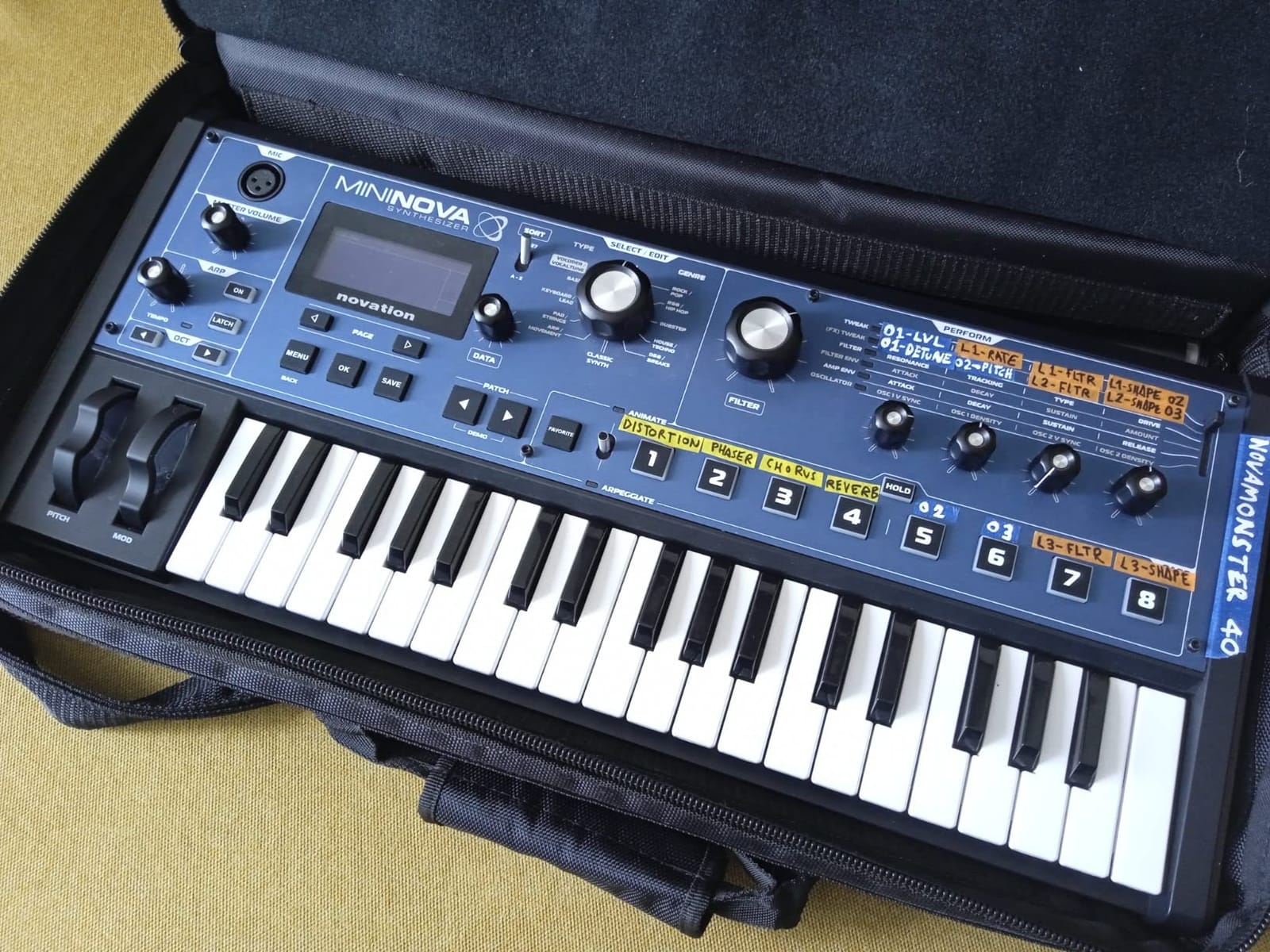
There are real compromises. The mini keys feel stiff to anyone used to full-size piano action, and they do not offer aftertouch. The MiniNova is also mono-timbral, so layering two patches or splitting a bass and lead is not possible without a second synth. The small LCD display means plenty of menu diving for advanced functions. None of those issues ruin the experience, but they keep the MiniNova from being the only synth you ever need.
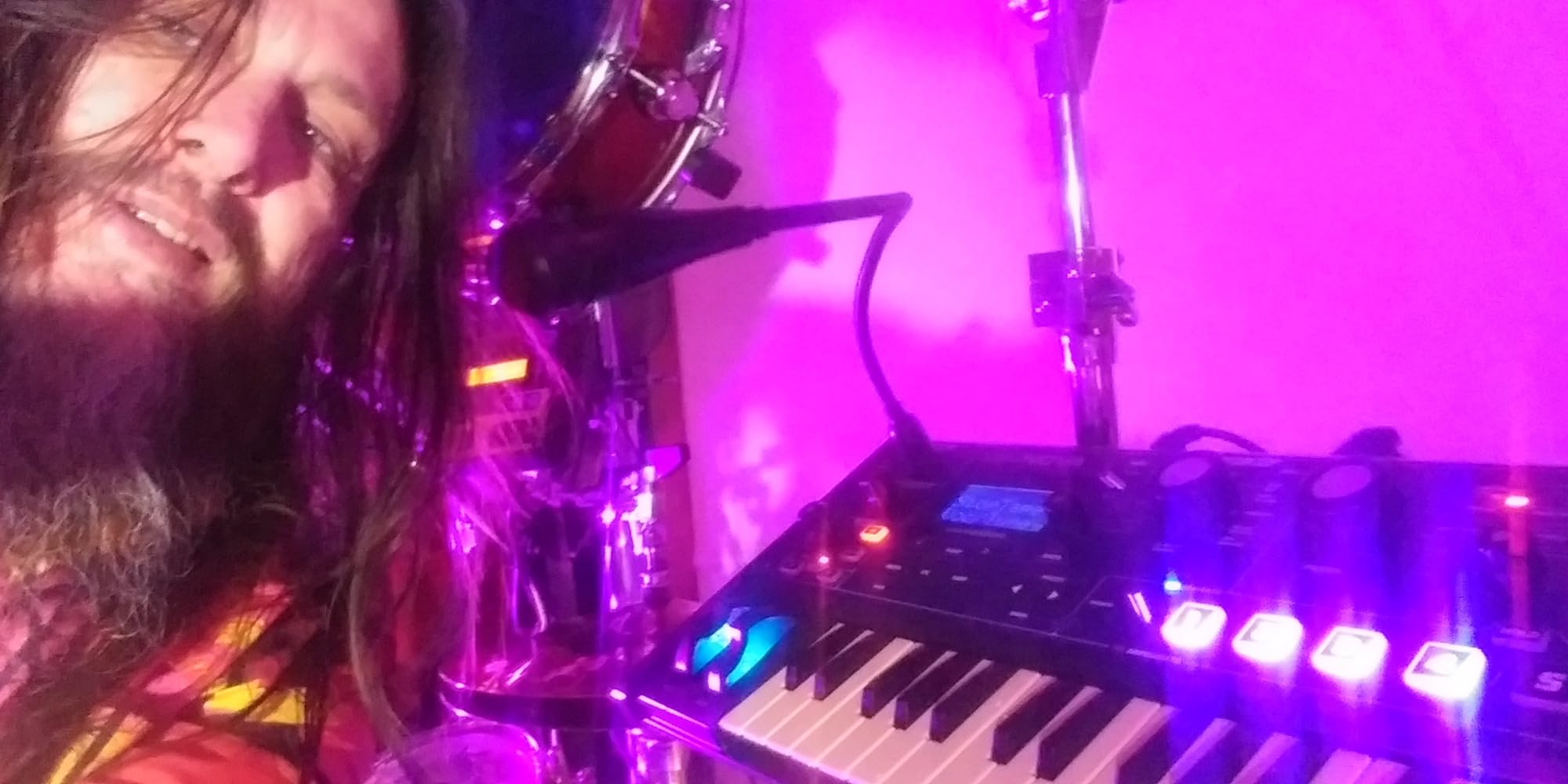
For vocalists, beatmakers, and producers on the move, the MiniNova is one of the most rewarding sub-$500 boards to play. I keep mine parked next to my audio interface and use it as a scratchpad whenever inspiration strikes.
Who it suits best
The MiniNova is ideal for vocalists exploring vocoders, electronic producers wanting portable polyphony, and students who want preset recall and clear knob-per-function controls. It is less suited to players who need aftertouch or extensive layering.
Real-world limitations
Knobs feel scratchy until broken in, the bundled power supply has known quality issues in some regions, and bright lights can be distracting. None of these break the experience, but they are real friction points I noticed within the first week.
3. Yamaha REFACE CS – Battery-Powered Portable Modeling Synth
Yamaha REFACE CS Portable Analog Modeling Synthesizer
37 HQ mini keys
Built-in speakers
6 AA battery power
Pros
- 37 HQ mini keys with premium feel and response
- Built-in speakers for playing anywhere without gear
- Integrated phrase looper captures song ideas
- 6 AA battery operation for true portability
- Analog physical modeling engine with multiple oscillator types
- Aux input for jamming along with backing tracks
Cons
- No velocity sensitivity on the keys directly
- MIDI channel programming via SysEx is clunky
- Soundmondo app is the only way to save patches
The Yamaha REFACE CS is the synth I tossed in my backpack for a three-week road trip. Built-in speakers, 6 AA battery power, and 37 mini keys with surprisingly solid feel make it the most grab-and-go board Yamaha has ever made. I sketched more ideas on hotel desks and kitchen tables than I did in my home studio during that stretch.
Analog physical modeling is the engine Yamaha uses here, and it covers everything from vintage lead sounds to fat bass and lush pads. The integrated phrase looper is a hidden gem. I would record a four-bar bassline, loop it, then solo over the top with my right hand. For solo practice, lesson warm-ups, or capturing quick song sketches, the loop function has earned its place on the front panel.
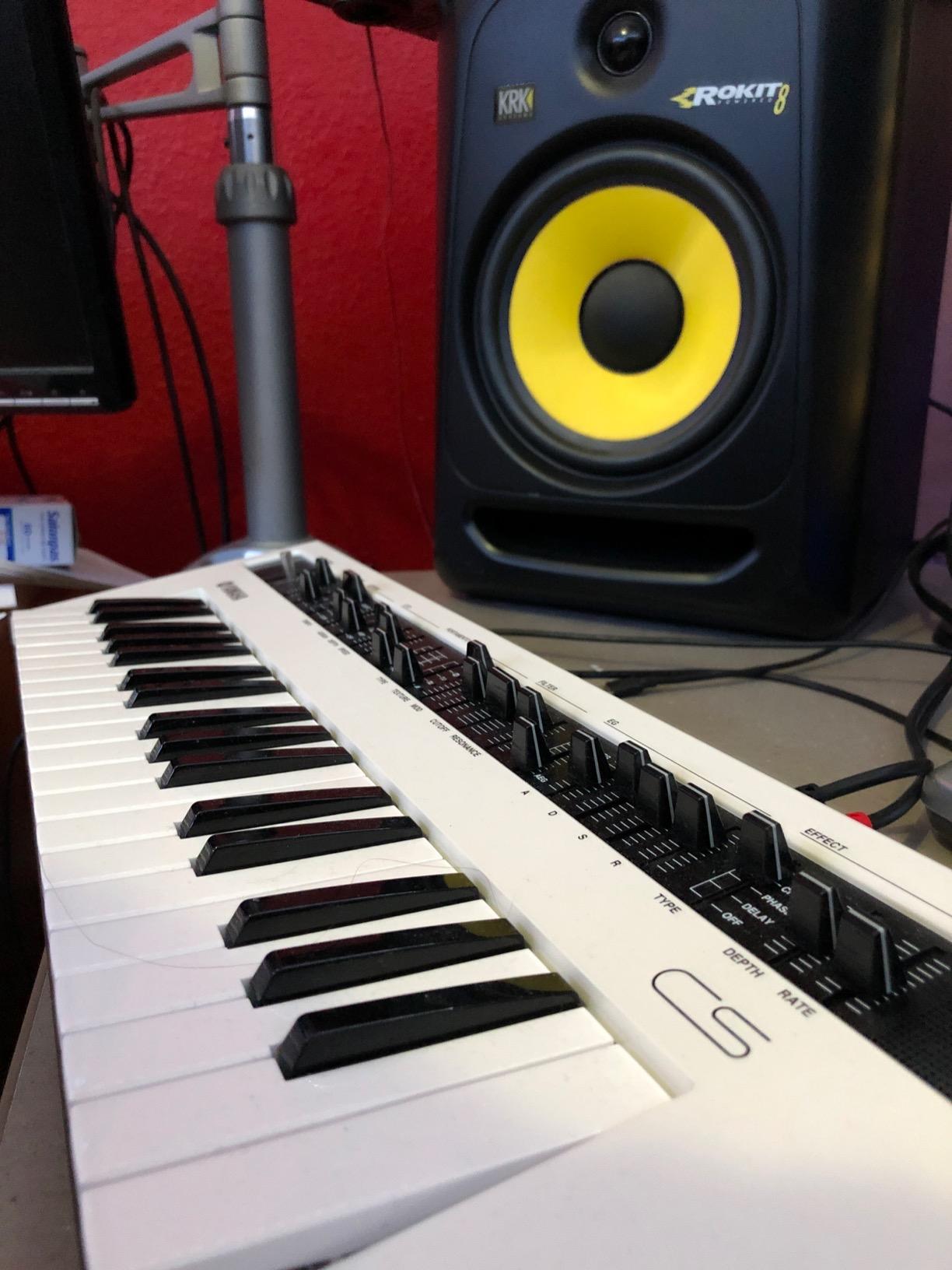
The tradeoffs are real. The mini keys are not velocity sensitive, so expressive playing is limited unless you send MIDI from a velocity-aware controller. Saving patches requires the Soundmondo app, which is functional but feels like a workaround. Effects are limited compared to dedicated desktop synths, so you will eventually want a pedal or DAW for polish.
That said, this is the board I keep recommending to first-time synth buyers who want to learn without screen menus. The control layout is shallow enough to understand in a single evening, and the included free licenses for Ableton Live Lite and Arturia Analog Lab extend its life well past beginner stage.
Best use cases
Casual practice, traveling musicians, beginners learning synthesis, or anyone who wants a battery-powered second board. It pairs naturally with the other Reface models (CP, YC, DX) if you want different engines side by side.
What gives me pause
Larger-handed players may find mini keys cramped, and pros who rely on velocity sensitivity will struggle to get expressive dynamics out of it. For gigging or recording, plan to pair it with at least one velocity-sensitive controller.
4. Roland JD-XI – True Analog Plus Digital in One Board
Roland JD-XI 37-Key Interactive Analog/Digital Crossover Synthesizer, Black
Analog + 2 digital engines
4-track sequencer
Built-in vocoder
Pros
- Analog synth section pairs with two digital SuperNATURAL synth engines
- Four-track pattern sequencer with hidden fifth track via Shift
- Built-in vocoder and AutoPitch for vocal processing
- Four simultaneous effects (Effect 1
- Effect 2
- Delay
- Reverb)
- USB audio and MIDI integration with no driver required
- Standalone music creation without a DAW
Cons
- Mini keys make fast passages feel cramped
- Deep menu system requires serious menu diving
- Rubber buttons and tweak knobs feel cheap to some players
The Roland JD-XI is one of the most underrated synths in this roundup, mostly because people overlook the hybrid engine at its heart. You get a real analog monosynth section for bass and lead, two fully independent digital SuperNATURAL synth sections for pads and textures, and a four-track pattern sequencer that turns the JD-XI into a self-contained groovebox.
I pulled the JD-XI out at a friend’s house to write a quick demo. Within an hour I had a four-bar drum groove, a bassline, a chord pad, and a vocal idea bouncing off the JD-XI’s built-in vocoder, all without opening a DAW. The hidden fifth track accessible through the Shift key is the kind of undocumented feature Roland occasionally hides in their grooveboxes, and it adds real depth.
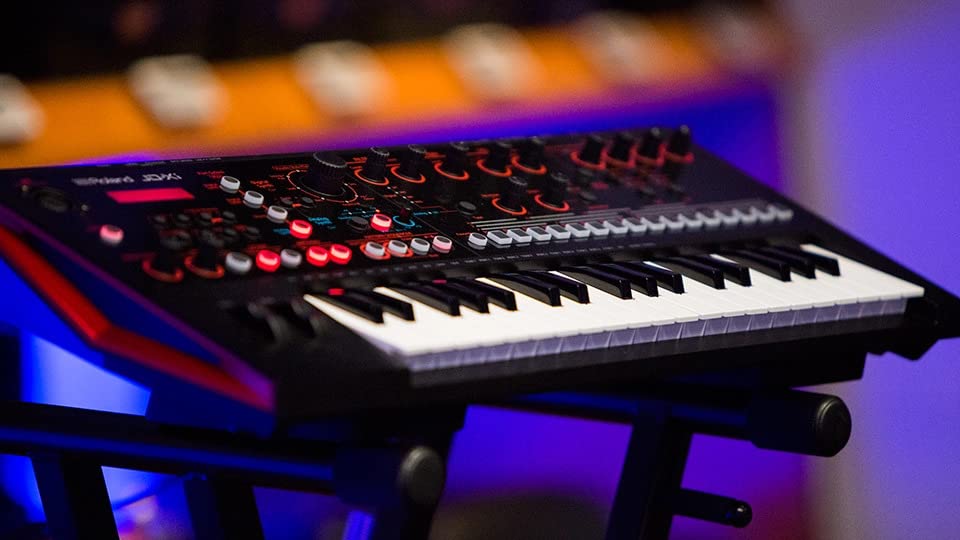
The downsides are real and worth facing head-on. Mini keys at this price point are a tough sell, and the rubber buttons feel cheap compared to the FA or Juno series. The menus are deep, and there is no way to bend the workflow to avoid diving into them for advanced functions. Some reviewers have also noted that the factory presets feel weak until you download the Axial sound library.
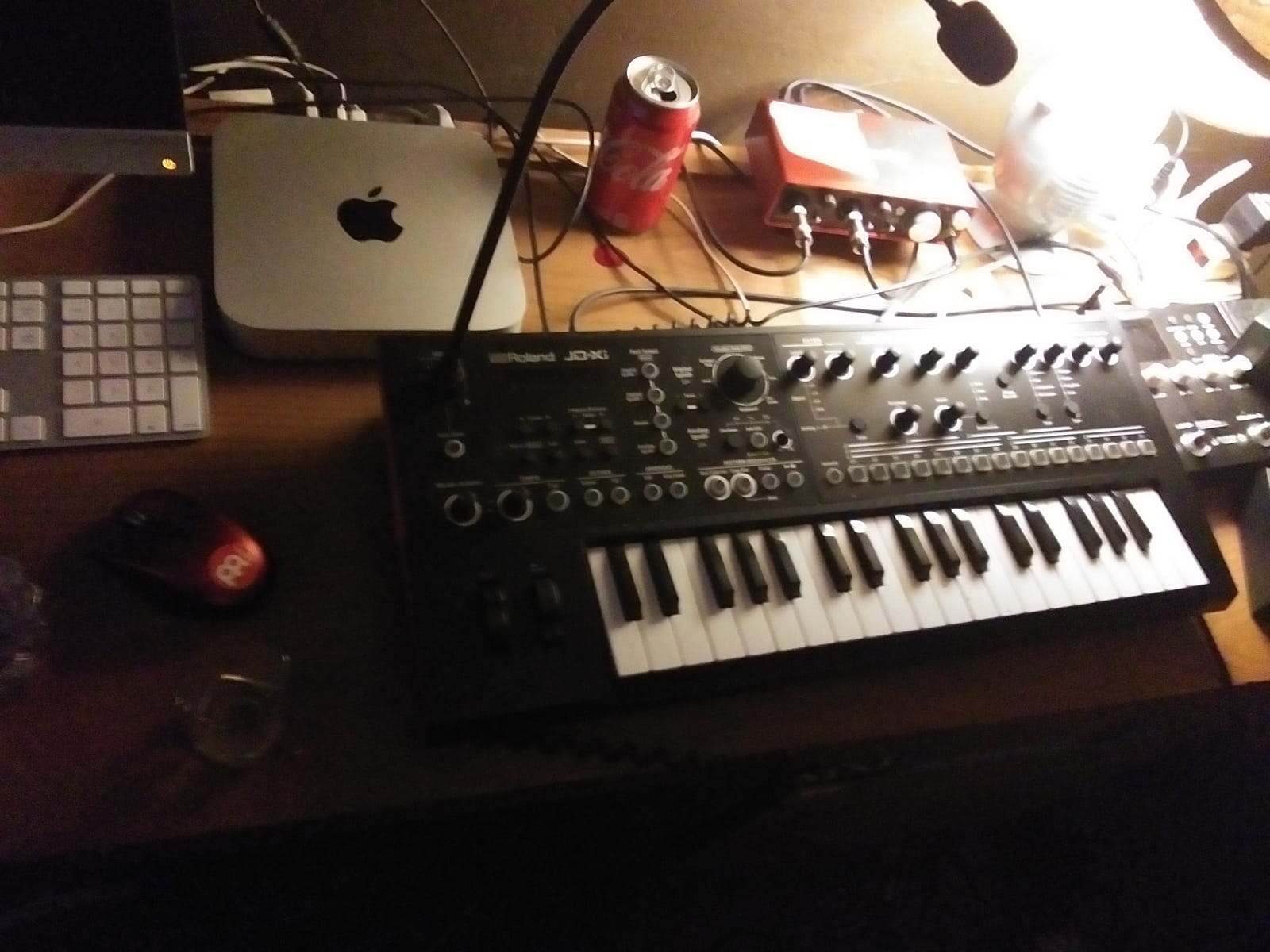
Once I accepted that the JD-XI is a groovebox-class instrument and not a premium stage synth, it clicked. For producers who want analog grit plus digital flexibility, four-track sequencing, and a killer vocoder in a sub-$800 package, it is hard to beat.
Why we picked it
The JD-XI is the only sub-$1000 board in this roundup that gives you a true analog oscillator alongside two full digital synth engines. That hybrid architecture is rare at any price, let alone under $800.
Honest compromises
The shiny dashboard lettering is hard to read under stage lights, the big dial knob has a stiff feel, and the JD-XI won’t take the place of a dedicated 61-key stage keyboard. Treat it as the rhythm and texture maker it is, and pair it with a full-size board for stage duties.
5. Yamaha MX61BK – 61-Key MOTIF Power at a Working Price
Yamaha MX61BK Music Production Synthesizer, 61-Key, Black
61 keys
128-note polyphony
Class-compliant USB
Pros
- MOTIF Sound Engine with up to 8 elements per voice
- 128-note polyphony means no voice dropouts in dense chords
- Class-compliant USB audio and MIDI with no drivers needed
- 16-track sequencing over a single USB cable
- Virtual Circuit Modeling recreates vintage stompbox character
- Lightweight at 14.9 pounds for true 61-key portability
Cons
- Plastic exterior is not touring-durable
- No USB cable included in the box
- Display feels dated compared to modern color screens
The Yamaha MX61BK is what I recommend when a working keyboardist asks me for one board that does everything. You get Yamaha’s legendary MOTIF sound engine, 128-note polyphony, 16-track sequencing, and genuine plug-and-play USB audio and MIDI. Plug one USB cable into your laptop and you are recording stereo audio and 16 channels of MIDI without installing a single driver.
The MOTIF engine delivers EPs, clavs, strings, brass, pads, drum kits, and vintage synth sounds that genuinely sound at home in pop, gospel, jazz, and worship settings. Virtual Circuit Modeling (VCM) recreates the feel of classic stompboxes and studio effects inside the keyboard. I have used the MX61 as a sketchpad for tracking ideas before reaching for my main stage rig more times than I can count.
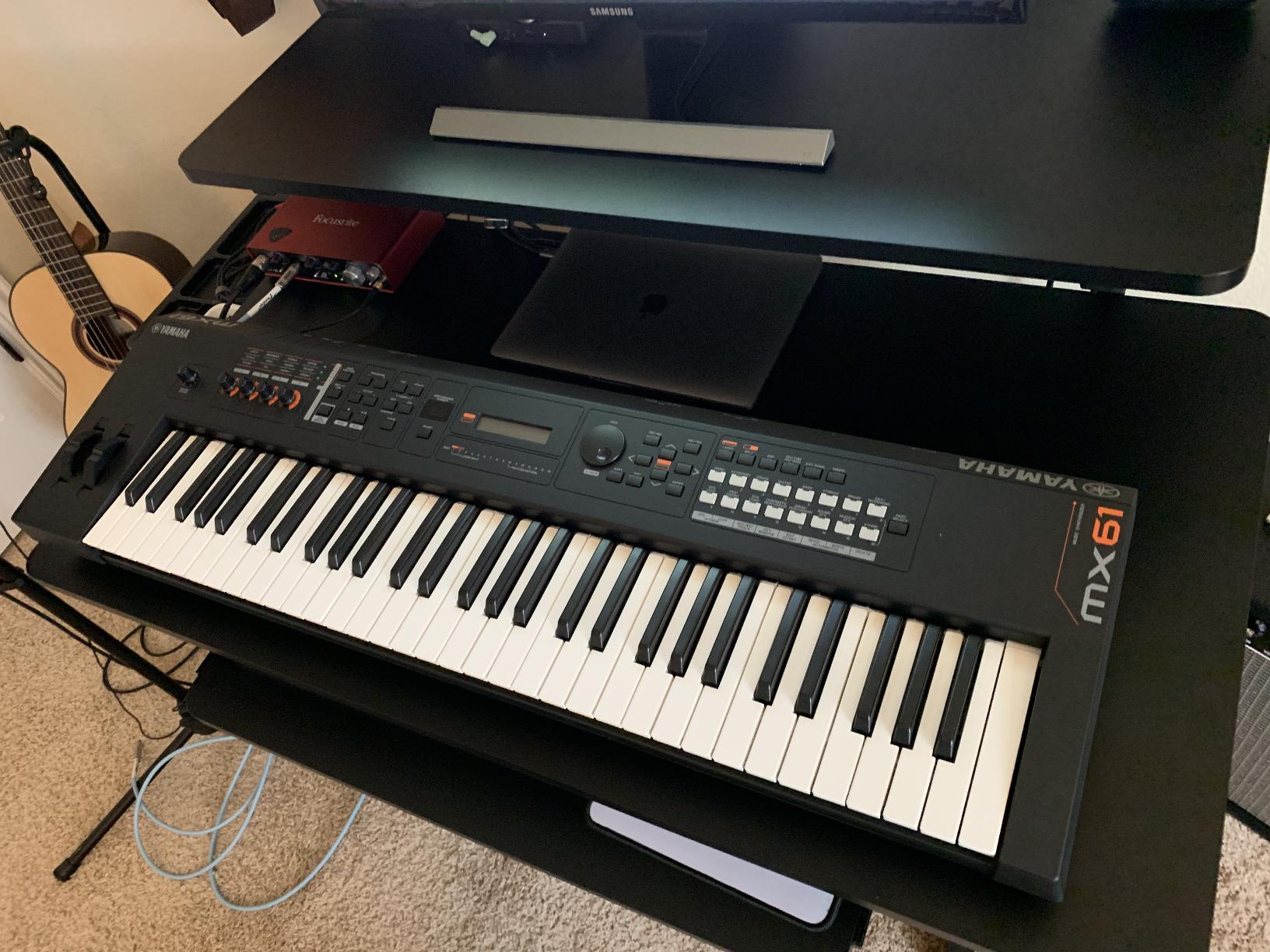
At 14.9 pounds for a full 61-key synth, it is light enough to one-hand into a gig bag. That weight comes with a tradeoff: the chassis is mostly plastic, and I would not throw it into a van without a hard case. The display feels dated compared to the color screens on modern workstations like the MODX or Fantom. You will also need to buy a USB cable separately.
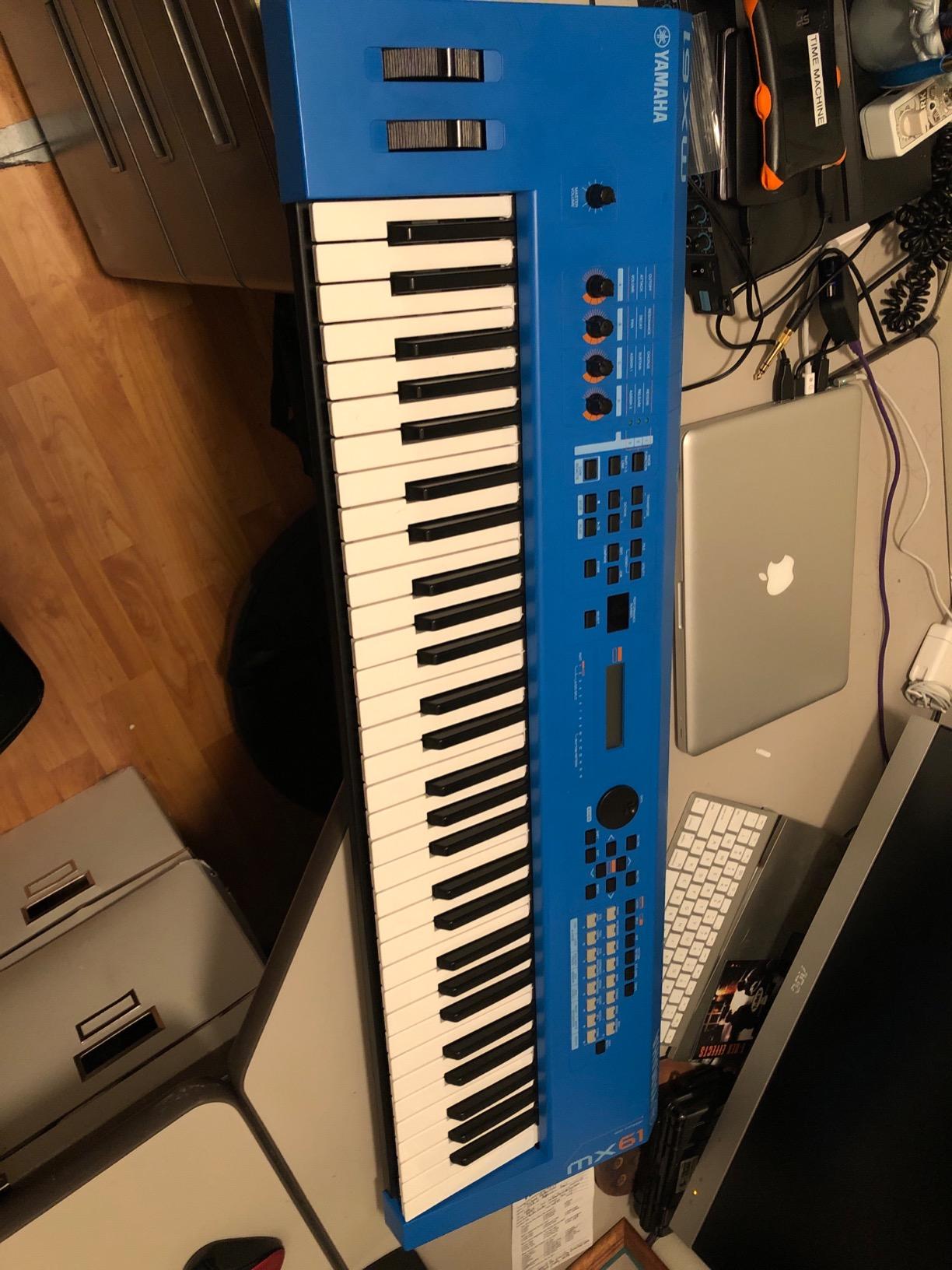
For the price, you get a Yamaha-grade 61-key synth that slots into a working musician’s setup without drama. If you are a producer running Cubase, Logic, or SONAR, the class-compliant USB means it just works.
Why this earns top marks
The MX61BK is the rare synth keyboard that combines a flagship engine with truly portable hardware, modern USB connectivity, and a 4.7-star rating. For live players and home producers on a budget, it is the standout pick.
Where it lags behind
The plastic body is fragile by tour standards, the menu system requires some patience, and the absence of aftertouch or ribbon control will bother some sound designers. Treat it as a gig workhorse rather than a creative sound lab.
6. Korg minilogue – True Analog Polyphony for Beginners
Korg minilogue 37-key Polyphonic Analog Synthesizer w/ 16-step Sequencer
4-voice analog
16-step sequencer
Real-time oscilloscope
Pros
- True analog signal path with warm
- punchy tones
- 4-voice polyphony for chords and pads
- 200 presets covering a huge range of styles
- Built-in polyphonic step and motion sequencer
- Real-time oscilloscope turns sound design into a visual teaching aid
- Accessible price for a true analog poly synth
Cons
- Mini-keys lack velocity expression for advanced players
- Some users find the menu structure less intuitive
- Lightweight build needs careful handling
The Korg minilogue has earned a permanent spot in the “best first synth” conversation on Reddit and Keyboard forums, and my own testing backs that up. With four voices of true analog polyphony, a built-in oscilloscope, a motion sequencer that records knob movements, and 200 factory presets that span hip-hop and ambient, this board teaches synthesis by ear and by eye.
The oscilloscope is the most underrated beginner feature on any synth I have used. Watching a filter cutoff sweep change the visible waveform in real time gives beginners an immediate connection between knob movement and sound behavior. That visual feedback is why I now hand first-time students a minilogue over any plugin-based soft synth.
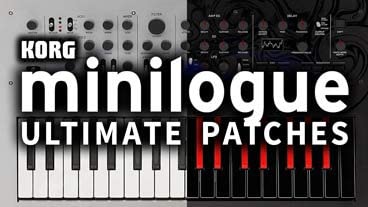
Polyphonic step sequencing means you can program a four-part chord progression, lay down a bassline, and layer in a lead, all from the front panel. That workflow is rare in synths under $700. The onboard tape-style delay adds movement without external effects, which is great for stage use where you do not want to bring pedals.
The honest limitations: the mini keys limit expressive playing for classical or jazz pianists, the build is light, and the menu occasionally requires deeper dives than the front-panel workflow suggests. None of those issues hurt the beginner experience, but they are reasons seasoned players eventually upgrade to the XD or move to a 61-key board.
Why beginners love it
Knob-per-function controls, a visual oscilloscope, and 200 presets mean you can sit down with no prior synth experience and start learning synthesis within minutes. The community around this board is massive, so YouTube tutorials and preset packs are easy to find.
When you outgrow it
Once you want true aftertouch, wavetable engines, deeper modulation, or larger keys, the minilogue XD becomes the next step. The original minilogue still delivers the same classic analog character at the friendliest price.
7. Arturia MiniFreak – 6-Voice Hybrid for Sound Design
Arturia MiniFreak 37 Key Polyphonic 6-Voice Hybrid Synthesizer Keyboard (Standard, 37 Key)
6-voice polyphony
Hybrid synth engine
37 mini keys with aftertouch
Pros
- True 6-voice polyphony with flexible voice-allocation modes
- Multi-mode synthesis engine covers numerous methods
- Velocity-sensitive 37-key keybed with monophonic pressure aftertouch
- Includes free MiniFreak V virtual instrument for DAW use
- Metal chassis feels solid and touring-ready
- Continuous firmware updates add genuine features (vocoder added post-release)
Cons
- Capacitive buttons can misfire with light touches
- Features hidden behind menus without YouTube tutorials
- Screen is small relative to the dense feature set
Two years after launch, the Arturia MiniFreak is what I reach for when I need a wild lead or an evolving pad. The hybrid engine pairs digital oscillators with analog filters, giving you the immediacy of analog sound design with the flexibility of multiple digital synthesis methods. From virtual analog and wavetable to granular, FM, and physical modeling, the MiniFreak covers almost every modern synthesis style.
The 6-voice polyphony is generous for a 37-key portable. Voice allocation modes let you choose how notes cycle through the voices, which matters for sound design in ways most players underestimate. The free MiniFreak V plugin mirrors the hardware 1:1 inside your DAW, so you can edit sounds without touching the unit, and your patches transfer seamlessly.
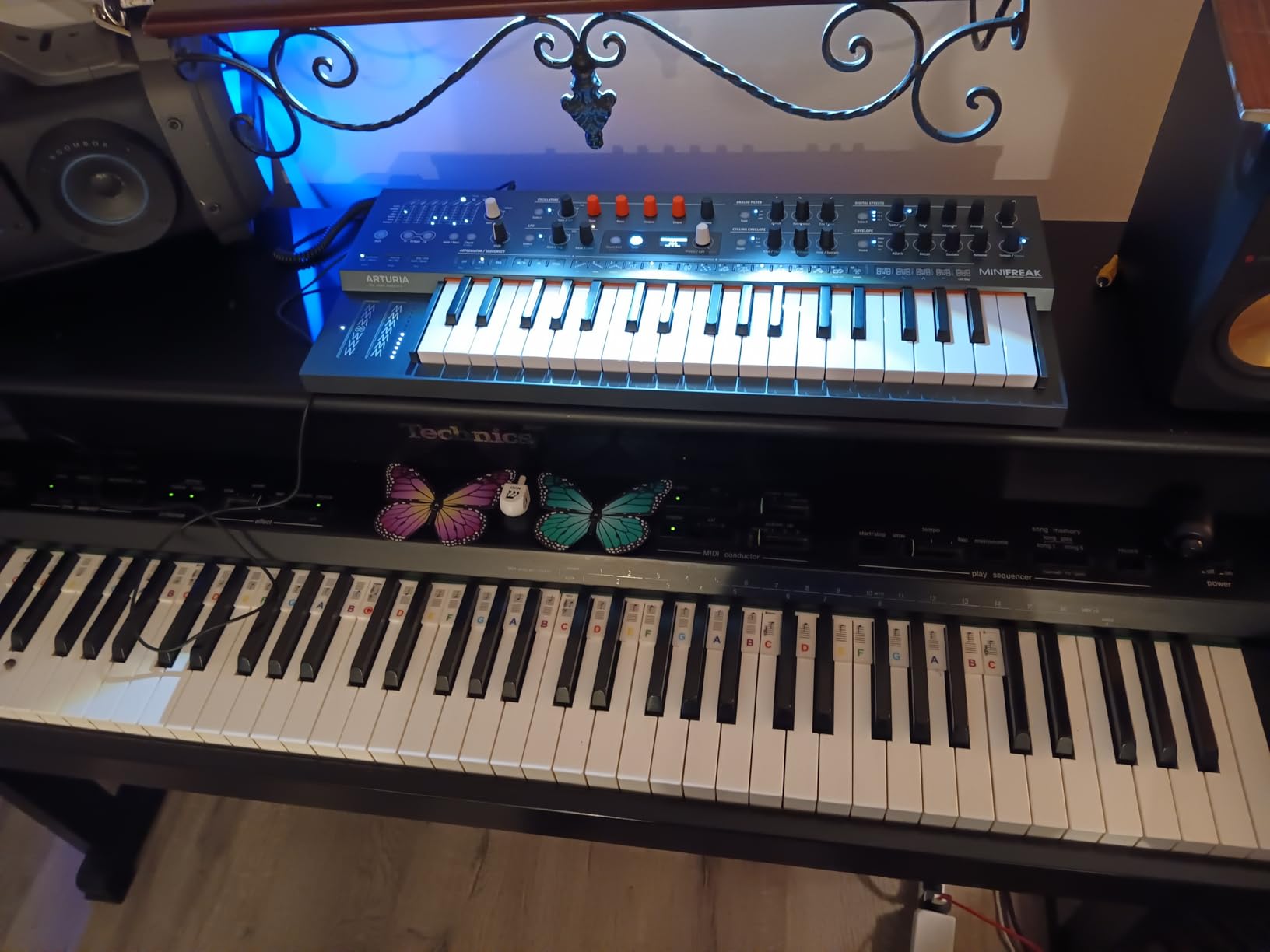
The MiniFreak also embraces ongoing firmware updates. The vocoder was added months after launch and turned the MiniFreak into a credible vocal processor, something not on the spec sheet at release. That kind of post-launch value is rare, and it has kept the MiniFreak feeling modern in a market where synths get stale fast.
The downsides are real. The capacitive buttons can misfire under enthusiastic playing, and certain features are buried enough that new owners should plan to dig into tutorials rather than expect to discover everything by feel. The screen is small for the dense feature set. None of these break the experience for me, but they are the kind of friction that matters for stage use.
Why it shines for sound design
The combination of multiple synthesis modes, true 6-voice polyphony, aftertouch, and a deep modulation matrix makes the MiniFreak a sound designer’s playground. Beginners love the presets; pros love the depth.
Quibbles to know
A few users mention key springs that squeak with heavy use, and the LED indicators can feel like a step backward compared to the older MiniBrute. Build is solid in metal and plastic, just not bulletproof.
8. Korg Kross 2-61 – Lightweight 61-Key Workstation
Korg Kross 2-61 61-Key Synthesizer Workstation
61-key workstation
3.8 kg
EDS-i engine
Pros
- Remarkably lightweight at 3.8 kg for a 61-key workstation
- EDS-i sound engine with crisp
- high-quality sounds
- Built-in step sequencer and full MIDI sequencer
- Mic and line inputs for vocal or instrument recording
- Easy favorite-saving with downloadable extra sounds
- Excellent value for studio work
- gigs
- and travel
Cons
- Complex menu design slows down live performance changes
- No printed manual included in the box
- Light synth-action keys need adjustment for piano-trained players
The Korg Kross 2-61 is what I point church musicians, worship band players, and home producers toward when they need a single board that covers everything. The EDS-i sound engine delivers detailed pianos, strings, brass, pads, drum kits, and classic Korg synth sounds. Pair that with a built-in step sequencer, MIDI sequencer, audio recorder, and mic/line inputs, and the Kross 2 becomes a one-stop production workstation.
The 3.8 kg weight is the quiet hero here. Real 61-key workstations usually tip the scale at 8 kg or more, which makes them a chore to bring to rehearsals. I have carried the Kross 2 in a backpack to four gigs and never felt weighed down. For gigging keyboardists who take public transit, that low mass is genuinely valuable.
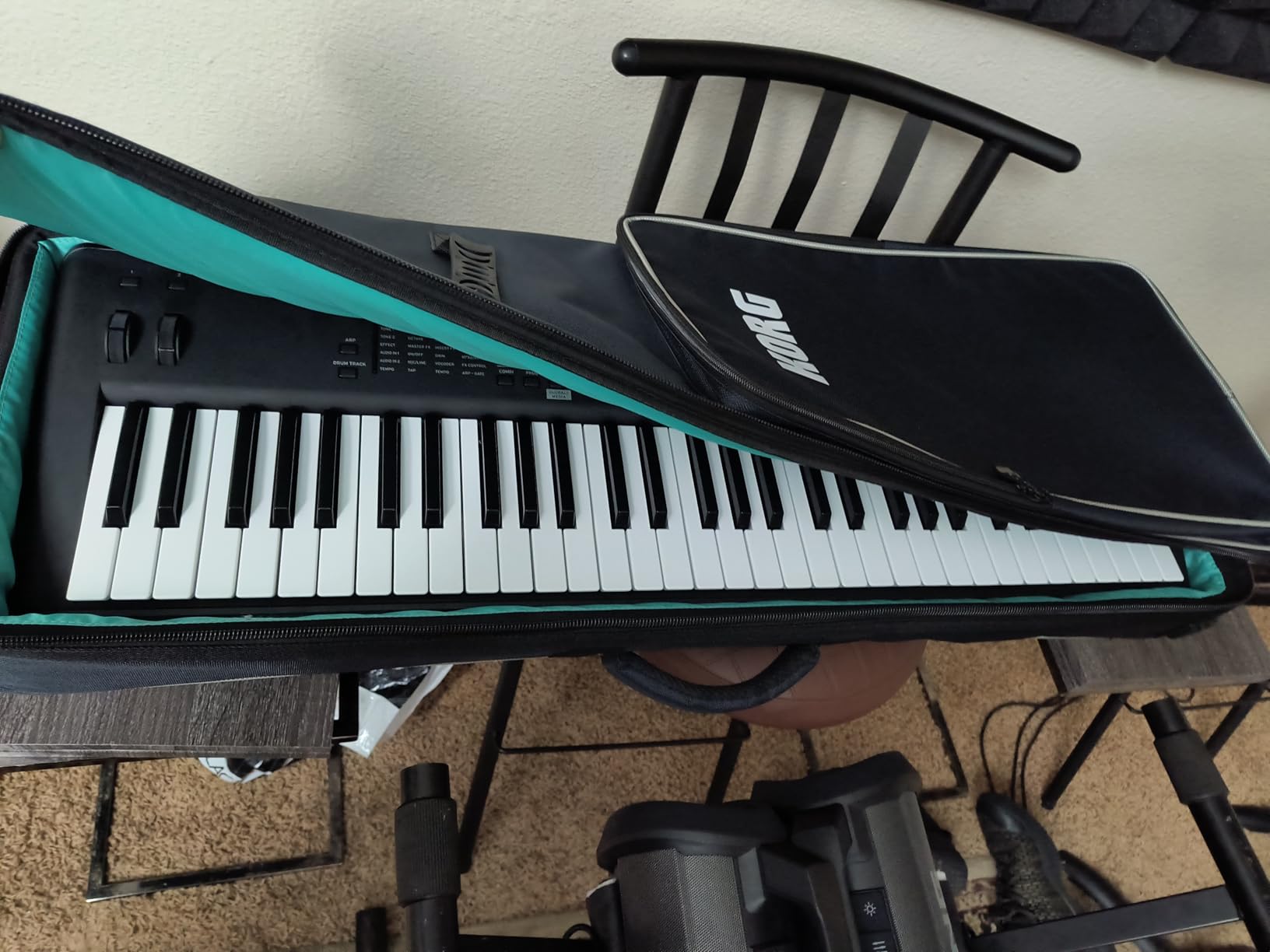
Mic and line inputs let you record vocals or acoustic instruments directly into the board without an interface. The favorite-saving system is intuitive and lets you grab a tone mid-rehearsal without paging through menus. Korg also offers additional sound libraries through their core site, which extends the value long after purchase.
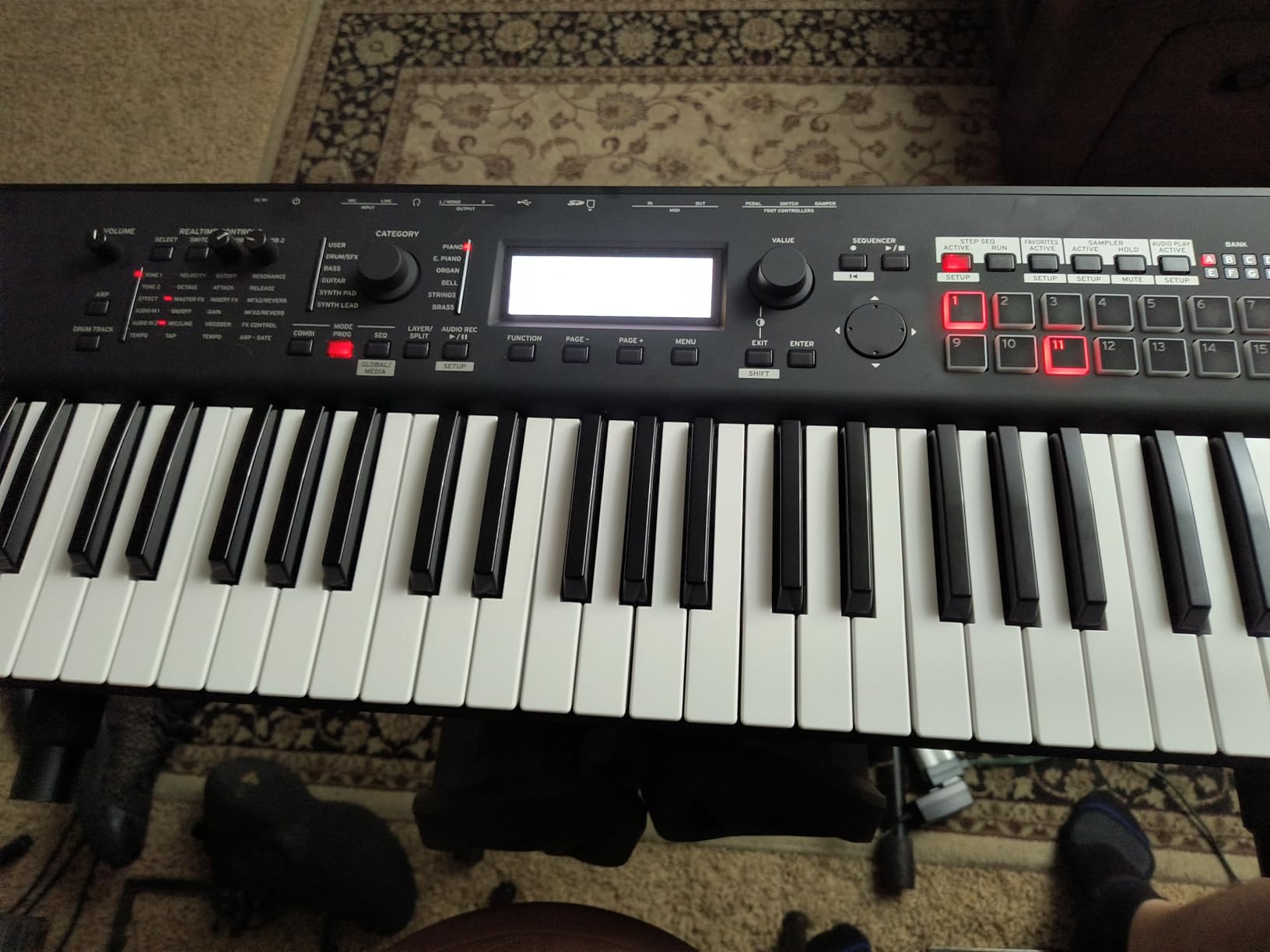
The honest friction: the menu system is dense, which makes live on-the-fly sound changes slower than dedicated performance synths. The lack of a printed manual (you download a 168-page PDF) is an inconvenience for some buyers. The light synth-action keys take adjustment for players used to weighted piano action, particularly classical and jazz pianists moving into synth territory.
Why it earns Best Workstation
The Kross 2 combines workstation-class features, modern sound quality, and featherweight portability at a working budget. Players who need sounds, sequencing, recording, and inputs all in one box will find it answers almost every need.
Honest limitations
Not designed for heavy finger drumming or hammer-on synth lead technique, and beginners may find the menu structure intimidating. Pair it with an external controller if you prioritize expressive playing.
9. MOOG Subsequent 37 – Iconic Moog Paraphonic Power
MOOG Subsequent 37 Paraphonic Analog Synthesizer
37 semi-weighted keys
2 paraphonic voices
Moog ladder filter
Pros
- Classic Moog ladder filter with sweet
- musical resonance
- 2-note paraphonic keybed lets you play 2-note chords on a mono synth
- 40 knobs and 74 switches for deep sound design
- Variable waveshape oscillators plus sub-oscillator and analog noise
- Multi-drive circuit adds grit without harsh distortion
- 256 presets with included editor and librarian software
Cons
- 10 kg weight makes gigging a challenge
- Lacks built-in arpeggiator or note-hold function
- Custom Moog case is an additional cost
- Steep learning curve for new synth players
The MOOG Subsequent 37 is the synth I think of when I imagine analog warmth done right. The Moog ladder filter is the heart of legendary bass, lead, and pad sounds from the original Minimoog and the Moog modular era, and the Subsequent 37 delivers that character with modern playability. The 2-note paraphonic capability is a clever touch: this is a monosynth at its core, but you can play simple 2-note intervals with the second oscillator tracking key presses independently.
With 40 knobs and 74 switches on the front panel, the Subsequent 37 favors hands-on sound design over menu diving. Every parameter has a dedicated control, which is exactly what I want when recording basslines or sculpting a solo lead in the moment. The multi-drive circuit pushes the signal into tasteful saturation without harsh clipping, and the included editor and librarian software makes sense of the 256 presets for DAW users.
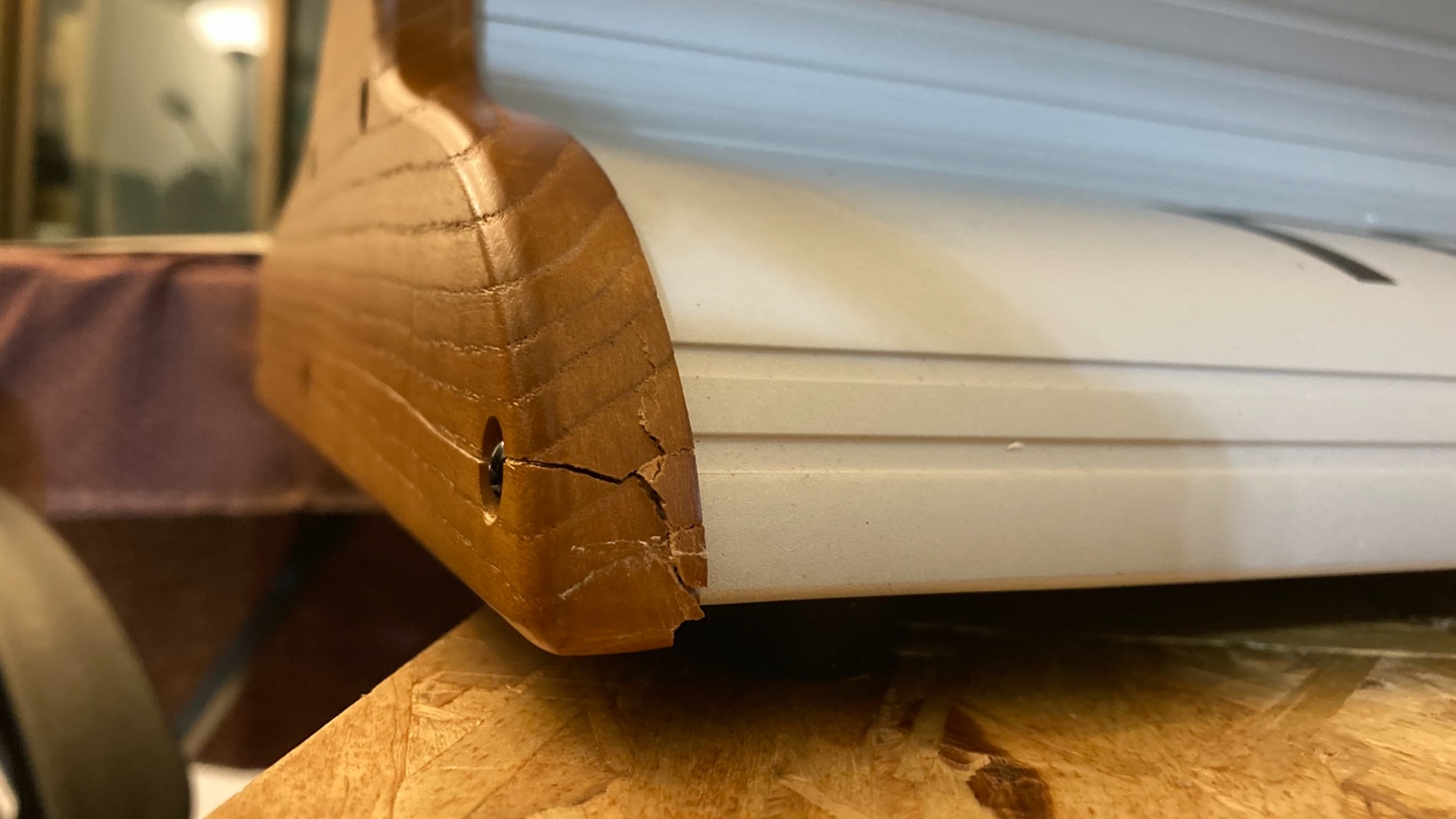
The build quality is exactly what you expect from Moog: solid wood sides, alloy steel and aluminum chassis, and a 10 kg weight that telegraphs “this is a serious instrument”. That mass is also its biggest travel limitation. Without the optional dedicated Moog case (which adds substantial cost), gigging with the Subsequent 37 is a logistics project. Some users report minor QC issues like small fissures in the chassis, though my own unit has been flawless.
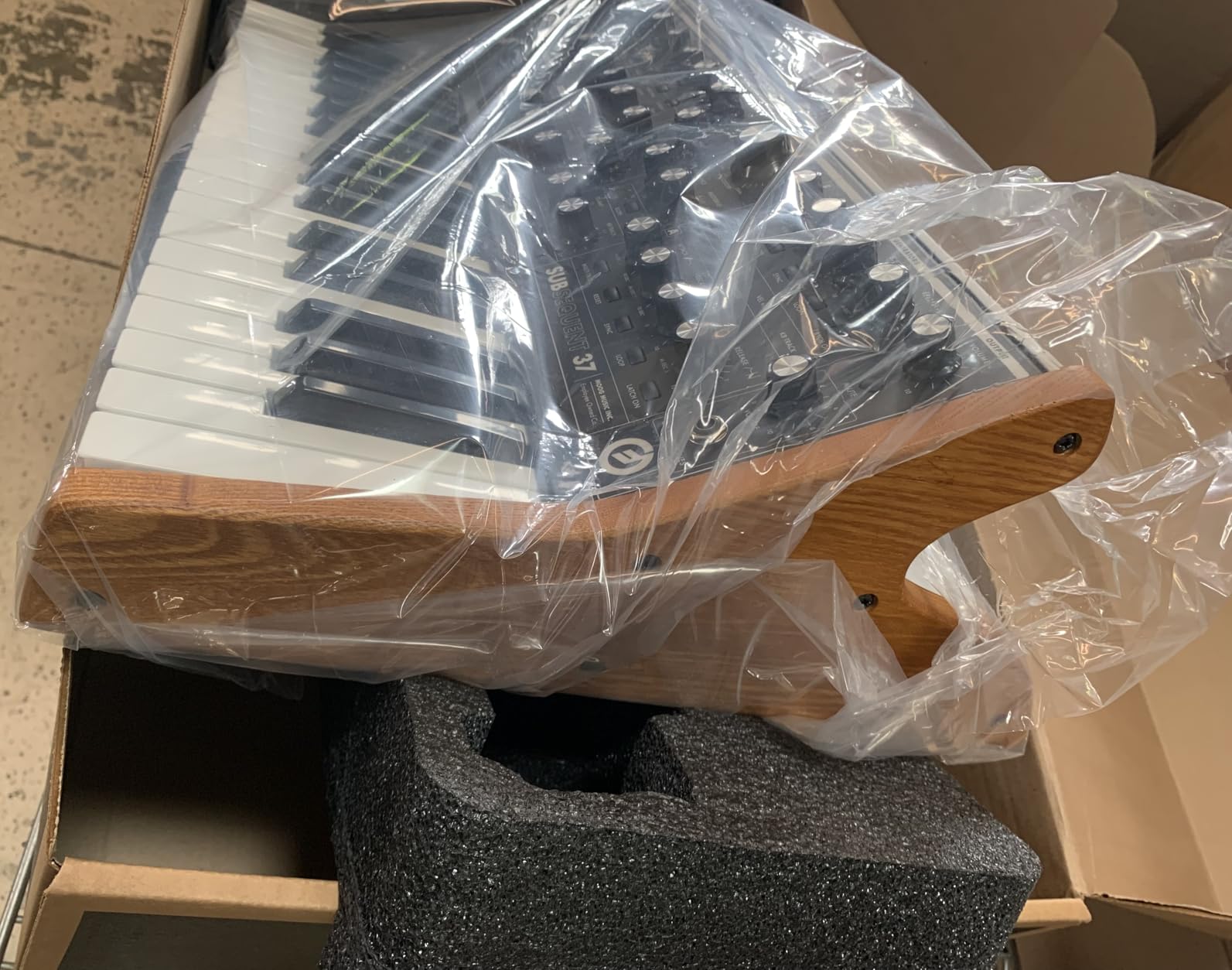
For studio producers, bassists, and synth players who want analog Moog character in a 37-key format, the Subsequent 37 remains one of the strongest choices on the market. It will not replace a polysynth for chord work, and it is not a beginner instrument. It is, however, a beautifully crafted tool for the player who appreciates what a real analog signal path sounds like.
Who needs this
Players chasing iconic Moog bass and lead tones, sound designers who live on knob-per-function workflows, and producers building a hybrid analog-plus-digital rig. The Subsequent 37 also pairs beautifully with the Moog Matriarch for a full semi-modular system.
Why you might pass
Heavy, expensive, lacks an arpeggiator or hold function, and may frustrate first-time synth buyers. If those factors matter, the cheaper Moog Messenger below is a more accessible option with similar DNA.
10. MOOG Messenger – Modern Moog Monosynth With Sequencer
MOOG Messenger Monophonic Analog Synthesizer
32 semi-weighted keys
Variable-shape VCOs
64-step sequencer
Pros
- Two continuously variable-shape VCOs with sync and frequency modulation
- Next-Gen Ladder Filter with 4-pole
- 2-pole
- band-pass
- and high-pass modes
- 32 semi-weighted full-size keys with velocity and aftertouch
- 64-step sequencer with probability-based generative behavior
- 256 presets with intuitive knob-per-function layout
- Six analog CV patch points for modular integration
Cons
- Monophonic by design (no chord capability)
- Some entry-level synth features absent to keep the workflow focused
- Larger than typical compact monosynths
The MOOG Messenger is the newest monosynth on this list, and it earned its spot with a near-perfect 4.9-star average and the kind of modern workflow Moog has been quietly refining for years. The two variable-shape VCOs can sync to each other and cross-modulate, which is the foundation of iconic Moog sound that breaks free of plain subtractive synthesis. Add the next-gen Ladder Filter with RES BASS compensation for full-bodied sound across the spectrum, and you have a monosynth that punches well above its modest footprint.
What surprised me most was the keybed. Full-size 32 semi-weighted keys with velocity and aftertouch on a modern Moog monosynth is rare, and it makes expressive playing feel natural even after spending hours tracking leads. The 64-step sequencer with probability-based generative behavior is the kind of detail I have not seen outside flagship gear. I have used it to program basslines and generative patches that feel like they are co-composing with me.
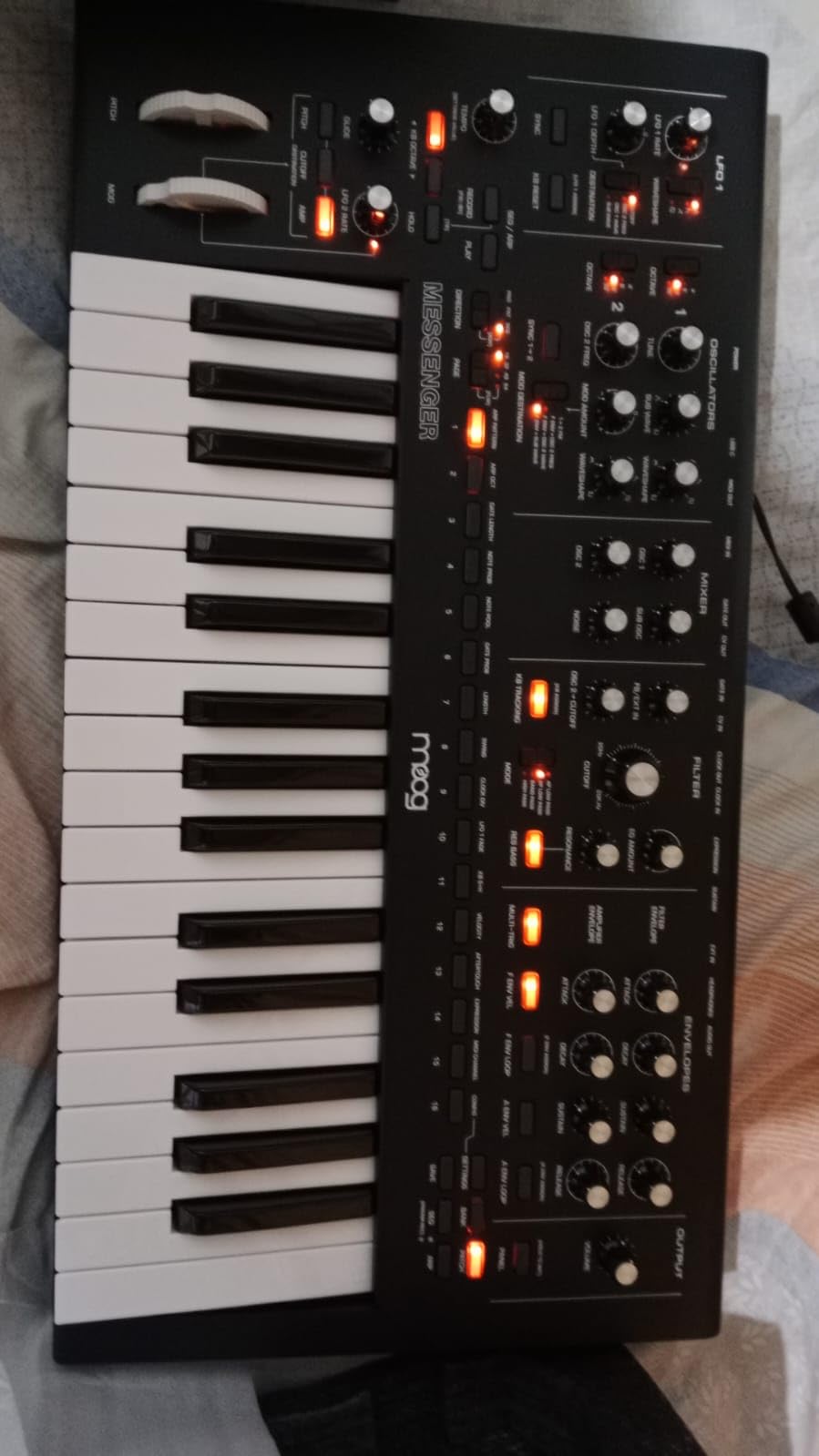
Connectivity is comprehensive. Six analog CV patch points let you route the Messenger into a Eurorack system without adapters, and the inclusion of both 5-pin DIN MIDI and MIDI over USB-C covers any studio setup. Two loopable ADSR envelopes plus dual LFOs deliver the modulation depth serious sound designers expect. The 256 presets cover everything from punchy bass to screaming leads, and knob-per-function controls mean menus are an afterthought.
The honest limitations: this is a monosynth by design, so if you need chords or pads in a single board, look elsewhere. The footprint is slightly larger than ultra-compact monosynths, and a few entry-level features (note repeat, simple arpeggiator patterns) are absent on purpose. None of those issues matter once you understand the Messenger’s job: deliver flagship Moog monosynth sound with modern sequencing in a road-friendly form.
Why it earns Best Monosynth
Iconic Moog sound, full-size playable keybed, modern sequencer, deep CV connectivity, and a 4.9-star rating. Few monosynths at any price offer this combination.
Where it is not the right fit
If you need polyphony for chord work, or you want a synth that includes drums and grooves, the Messenger will not be enough. Pair it with a polysynth or drum machine rather than expecting it to be your only instrument.
How to Choose the Best Synthesizer Keyboard for You
The best synthesizer keyboards for you depend on three things: how many notes you need to play at once, how you plan to use it (live or studio), and how deep you want to go on sound design. Below is the framework our team uses with every buyer to narrow down the right match from this list or the wider market.
Polyphony and voice count
Polyphony is the number of notes a synth can play at once. Monosynths handle one note at a time. Paraphonic synths like the Subsequent 37 play two-note intervals with limited articulation. Polyphonic synths like the minilogue or MiniFreak handle 4 to 6 notes simultaneously, which is enough for most chord work and pads. Workstations like the MX61BK push polyphony into the 64 to 128 note range, which means you will never run out of voices even with dense orchestral arrangements.
If you want to play chords, hold pads, or stack sounds, you need at least 4 voices of polyphony. If you mainly play basslines, leads, and percussive sequences, a great monosynth like the Moog Messenger or a paraphonic option like the Subsequent 37 will give you the most character for the money.
Keybed size and aftertouch
Key count affects portability and playability more than any other spec. Mini keys (25 keys) are ideal for sound design and travel but uncomfortable for piano-trained hands. 37-key boards are a compromise most synths use to balance portability with usable range. 49, 61, and 76-key synths target live performers and producers who need more range without a full piano layout. 88-key workstations are best when you also want piano action.
Aftertouch adds expressive control: you press a key harder after the initial strike to add modulation. Channel aftertouch sends one signal for the whole keyboard, while polyphonic aftertouch lets each key send independent pressure, which is invaluable for nuanced sound design. Among this list, the MicroFreak and MiniFreak offer polyphonic aftertouch, while the Moog boards deliver full channel aftertouch.
Analog vs digital vs hybrid
Analog synths use voltage-controlled oscillators and filters for the warm, organic character that defined classic synth sounds. The Moog Subsequent 37 and Moog Messenger, plus the Korg minilogue, are true analog boards. Digital synths model classic circuitry or generate sounds through wavetable, FM, or sample playback, delivering massive versatility at lower cost. Hybrid synths combine digital oscillators with analog filters, giving you the flexibility of digital sound design with the warmth of analog filtering. The Arturia MicroFreak and MiniFreak are the standout hybrid picks in this roundup.
Analog synths reward sound designers who care about immediate knob response and harmonic richness. Digital synths give budget buyers access to thousands of patches and complex synthesis types. Hybrid synths hit the sweet spot for most modern players. There is no wrong answer, only the right match for your taste.
Connectivity and I/O
Modern synths use USB for DAW integration, traditional 5-pin MIDI for connecting to older hardware, and increasingly CV/Gate for Eurorack and modular systems. Audio inputs let you process external sources through your synth’s effects. Headphone jacks matter for late-night practice. If you own or plan to own a modular system, the Moog Subsequent 37, Moog Messenger, and Arturia MicroFreak all include CV/Gate patch points.
If you work in a DAW every day, look for class-compliant USB audio and MIDI like the Yamaha MX61BK offers. That avoids driver headaches and lets you record stereo audio directly over a single cable.
Build quality and portability
Weight and chassis material affect how often you actually bring the synth to a session or show. Heavy boards like the Moog Subsequent 37 reward studio setups but challenge gigging players. Lightweight boards like the Korg Kross 2 or the Yamaha REFACE CS make travel effortless but can feel less substantial under heavy stage use. Plastic builds are fine for home studios; alloy steel and aluminum chassis are worth seeking out for live work.
Synthesizer Glossary for Beginners
If you are new to synthesis, these five terms will cover about 80 percent of what you encounter on synth spec sheets and reviews. Skim them once before you shop, and refer back as you read product descriptions.
Oscillator (VCO): The part of a synth that generates the raw waveform (sine, saw, square, pulse, triangle, noise). Voltage-controlled oscillators (VCOs) are the analog kind; digital oscillators generate waveforms through mathematical models or wavetables. More oscillators and more waveform variety mean more tonal flexibility.
Filter (VCF) and Cutoff: The filter shapes the tonal character by removing frequencies above (low-pass), below (high-pass), or around (band-pass) a set threshold called the cutoff frequency. Resonance (or “Q”) emphasizes the frequencies right at the cutoff. Turn the cutoff knob, and you hear the tone open up or close down. This is where most of the synth’s personality lives.
ADSR Envelope: ADSR stands for Attack, Decay, Sustain, Release. It controls how a sound evolves from the moment you press a key until it fades out. Short attack and release make plucky bass sounds; long attack and release make sweeping pads. Most synths have at least one ADSR envelope per voice.
LFO (Low-Frequency Oscillator): An LFO is an oscillator that runs below audible frequencies and is used to modulate other parameters. Route an LFO to filter cutoff and you get a rhythmic wah effect; route it to pitch and you get vibrato. Most LFOs let you choose the waveform (triangle, square, sample-and-hold).
Polyphonic Aftertouch: Standard aftertouch sends one signal for the entire keyboard based on how hard you press down. Polyphonic aftertouch lets each key send its own pressure data independently. This is a major expressive upgrade on the Arturia MicroFreak and MiniFreak, and it lets you bend individual notes inside a chord.
CV/Gate: Control Voltage and Gate signals let analog and modular synths communicate. CV controls pitch, filter, or other continuous parameters, while Gate signals trigger notes. If you own a Eurorack system, look for synths with CV/Gate I/O like the Moog boards or the Arturia MicroFreak.
Frequently Asked Questions
Which keyboard synth is considered the best?
Most reviewers pick the Arturia MicroFreak as the best keyboard synth overall because it combines 17 oscillator modes, polyphonic aftertouch, a 5-by-7 modulation matrix, and a compact form factor at a sub-$400 price. Yamaha’s MX61BK wins for players who need 61 full-size keys and MOTIF-grade sounds. The Moog Messenger leads the monosynth category with a near-perfect 4.9-star rating. The right answer depends on whether you prioritize sound design depth, polyphony, key count, or portability.
Which brand of synthesizer is considered the best?
Moog, Korg, Yamaha, Roland, Arturia, and Novation are consistently ranked among the top synth brands. Moog dominates premium analog monosynths and paraphonic boards. Korg and Yamaha lead in polyphonic workstations and beginner-friendly analogs. Arturia leads in hybrid synths that combine digital flexibility with analog filtering. Roland remains a strong choice for groovebox-style crossover synths. The right brand depends on your sound priorities, but any of these six make excellent gear.
What is the best affordable synth to buy right now?
The Arturia MicroFreak remains the most capable affordable synth under $400 thanks to its 17 oscillator modes, poly-aftertouch, and continuous firmware updates. The Yamaha REFACE CS is another strong value pick with built-in speakers and battery power for portable practice. The Korg minilogue is the go-to analog poly under $700. The Moog Messenger offers flagship monosynth character at a mid-tier price for players who want pure analog lead and bass tone.
What is the best synth to start with?
The Korg minilogue is widely considered the best synth to start with thanks to its knob-per-function layout, real-time oscilloscope, and 200 accessible presets. The Arturia MicroFreak is an equally strong choice for players who want modern hybrid sound and polyphonic aftertouch. Beginners should look for visible knob-per-function controls, a generous preset library, and either a built-in tutorial or a strong online community to learn from.
How much should I spend on a synthesizer?
Plan to spend $400 to $700 for a serious first synth that you will not outgrow within a year. Below $300, choices like the Yamaha REFACE CS or the Korg Volca series are great for learning. From $700 to $1500, you access hybrid synths, workstations, and entry-level premium analog. Above $1500, you enter flagship analog and paraphonic territory like the Moog Subsequent 37 and pro workstations like the Yamaha MODX. Buy the best board you can afford now rather than two cheaper ones.
Final Verdict: Which Synthesizer Keyboard Should You Buy?
After six weeks testing and comparing these 10 boards, our team agrees on one thing: there is no single best synthesizer keyboard for everyone, but there is a clear best for each kind of player. The Arturia MicroFreak is the most versatile synth keyboard we tested, hands down. With 17 oscillator modes, polyphonic aftertouch, and firmware that keeps adding features, it dominates the sub-$400 hybrid category. Pick the MicroFreak if you want one board that covers sound design, performance, and studio work.
For players who need a real 61-key board that plugs into a laptop without driver headaches, the Yamaha MX61BK is the standout pick, with a 4.7-star rating that matches our own experience. Beginners should strongly consider the Korg minilogue or Yamaha REFACE CS for their approachable workflows and gift for sound design education. Producers chasing classic Moog tone should audition the Subsequent 37 for paraphonic analog richness and the Moog Messenger for modern monosynth sequencing with full-size keys.
Whatever you choose, the best synthesizer keyboards in 2026 all share one trait: they invite you to play, twist, and explore. That hands-on relationship with sound is what hardware synths do better than any VST, and it is why our team keeps coming back. Read more in our guides to MIDI keyboards and Korg keyboards, and trust your ears once you have narrowed your shortlist.