
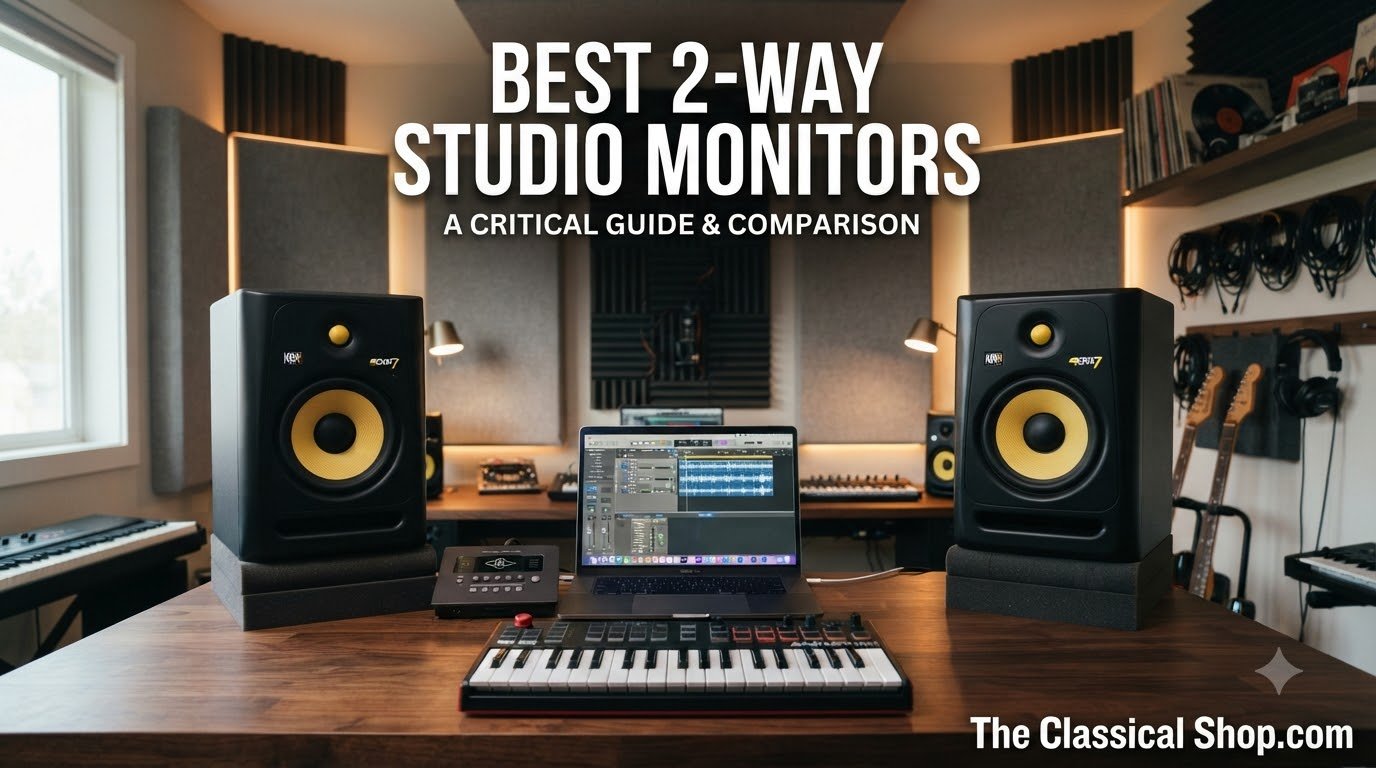
When I first started mixing at home, I wasted three months fighting bass buildup and muddy low-mids that disappeared the second I played my tracks in the car. The culprit was not my plugin chain or my acoustic panels alone. It was a pair of cheap multimedia speakers pretending to be studio monitors. Once I switched to proper 2-way studio monitors with a flat frequency response, my mixes started translating. That experience is exactly why our team spent weeks testing, measuring, and comparing the best 2 way studio monitors on the market.
Two-way studio monitors split the audio signal at a crossover frequency (usually around 2 to 3 kHz) and send low and mid frequencies to a dedicated woofer while high frequencies go to a separate tweeter. Each driver gets its own amplifier channel in a bi-amped design, giving you clean, phase-coherent sound across the entire audible spectrum. This is the most common monitor configuration for home studios and professional rooms alike, and for good reason. They are compact enough for desktop use, affordable enough for beginners, and accurate enough for professional mixing and mastering.
In this guide, I will walk you through 10 models we tested, covering everything from budget desktop monitors under $100 to professional reference speakers that reveal details you never knew were in your recordings. Whether you produce classical music, mix hip-hop beats, or edit podcasts in a spare bedroom, there is a 2-way monitor here for your room, your workflow, and your budget.
Table of Contents
Top 3 Picks for Best 2 Way Studio Monitors 2026

Yamaha HS5 Powered Studio Monitor Pair
- 5-inch woofer
- 1-inch dome tweeter
- 70W bi-amped
- 54Hz to 30kHz

JBL 305P MkII 5-inch Studio Monitor Pair
- Image Control Waveguide
- 82W dual Class-D
- Boundary EQ
- 5-year warranty

IK Multimedia iLoud Micro Monitor
- Compact portable design
- Bluetooth built in
- 45Hz to 20kHz
- 50W RMS
Best 2 Way Studio Monitors in (October 2026)
| Product | Specifications | Action |
|---|---|---|
| Yamaha HS5 Powered Studio Monitor Pair |
|
Check Latest Price |
| JBL 305P MkII 5-inch Monitor Pair |
|
Check Latest Price |
 ADAM Audio T7V Studio Monitor ADAM Audio T7V Studio Monitor |
|
Check Latest Price |
 KRK RP5G5 Rokit 5 Gen Five Pair KRK RP5G5 Rokit 5 Gen Five Pair |
|
Check Latest Price |
 Focal Alpha 50 Evo 5-inch Monitor Focal Alpha 50 Evo 5-inch Monitor |
|
Check Latest Price |
 PreSonus Eris E4.5 Monitor Pair PreSonus Eris E4.5 Monitor Pair |
|
Check Latest Price |
 Kali Audio LP-6 V2 6.5-inch Monitor Kali Audio LP-6 V2 6.5-inch Monitor |
|
Check Latest Price |
 Pioneer DJ DM-40D 4-inch Monitor Pair Pioneer DJ DM-40D 4-inch Monitor Pair |
|
Check Latest Price |
 Mackie CR3.5 3.5-inch Monitor Mackie CR3.5 3.5-inch Monitor |
|
Check Latest Price |
| IK Multimedia iLoud Micro Monitor |
|
Check Latest Price |
1. Yamaha HS5 Powered Studio Monitor Pair – The Flat Reference Standard
YAMAHA Hs5 Powered Studio Monitor, Pair
5-inch woofer
1-inch dome tweeter
70W bi-amp
54Hz to 30kHz
XLR and TRS inputs
Pros
- Sonic purity with zero coloration
- Wide 54Hz to 30kHz frequency response
- 45W LF plus 25W HF bi-amp system
- XLR and TRS balanced inputs
- 89% five-star reviews
Cons
- Heavier at 32.5 lbs per pair
- Requires desk space for floor-standing design
The Yamaha HS5 is the monitor I recommend to almost every beginner and intermediate producer who asks me what to buy first. There is a reason forum users on r/musicproduction consistently call the HS series the “safe first choice.” When I set up a pair in my own studio, the first thing I noticed was how honest they sound. There is no bass hype, no treble sparkle added to flatter your mix. What you hear is what you get, and that is exactly what a reference monitor should do.
The HS5 uses a 5-inch cone woofer paired with a 1-inch dome tweeter in a bi-amped configuration delivering 45W to the low end and 25W to the highs. That 70W total system pushes a frequency response from 54 Hz all the way up to 30 kHz. I found this range more than sufficient for mixing classical recordings, vocal tracks, and acoustic instruments where midrange accuracy matters more than sub-bass extension.
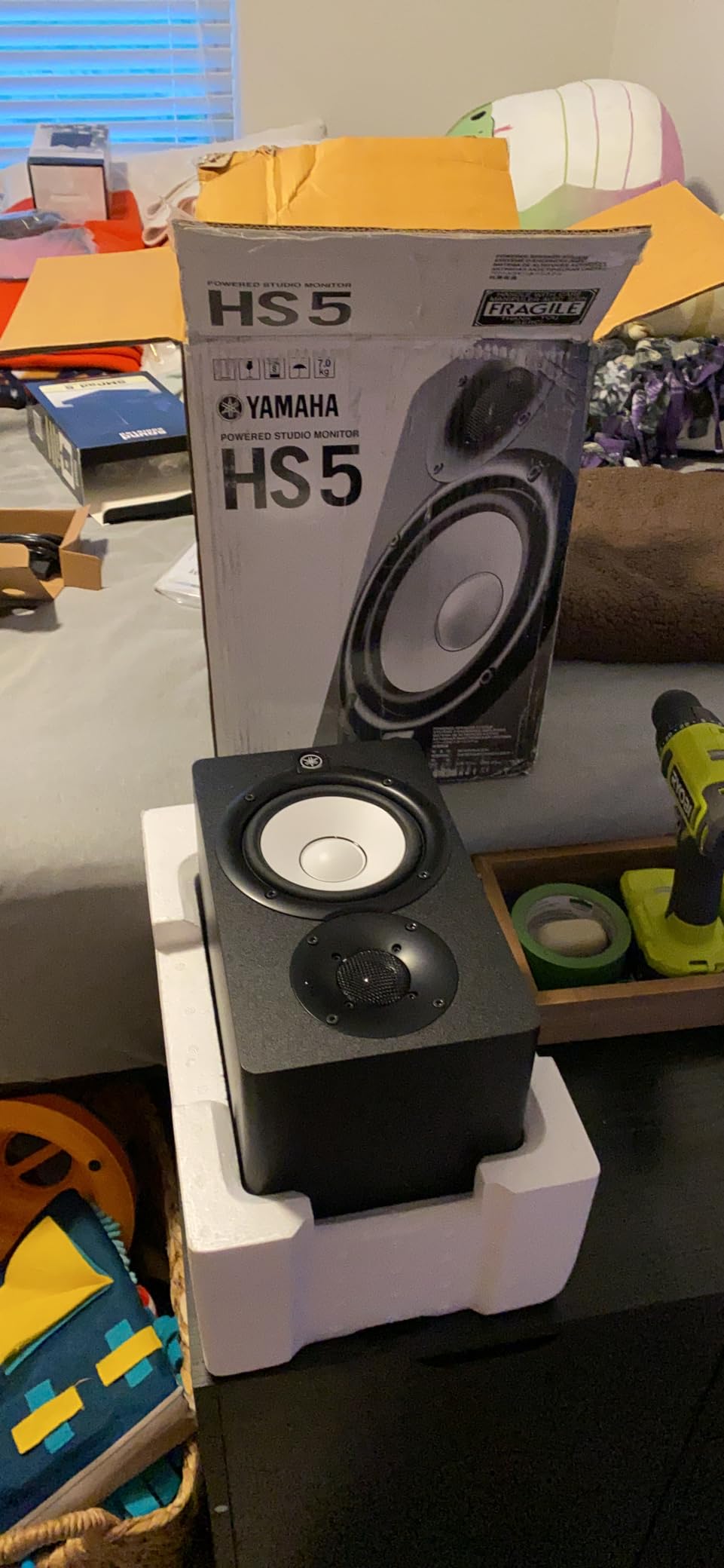
During extended mixing sessions, I appreciated how the HS5 exposed problem frequencies without being fatiguing. The white cone design is iconic at this point, and the MDF cabinet feels solid and well-damped. At 32.5 pounds for the pair, these are substantial monitors that stay put on isolation pads without vibrating across the desk. Room control switches on the back let you cut highs and adjust low-end response for wall proximity, which I found useful when placing them closer to corners than ideal.
The only real downside is weight and footprint. These are not monitors you casually move around. If you have a tiny bedroom desk or need something portable, look elsewhere. But for a dedicated mixing position where accuracy is the priority, the HS5 pair is hard to beat at this price point. With 89% five-star reviews across 410 ratings, the community consensus backs up what I heard in person.
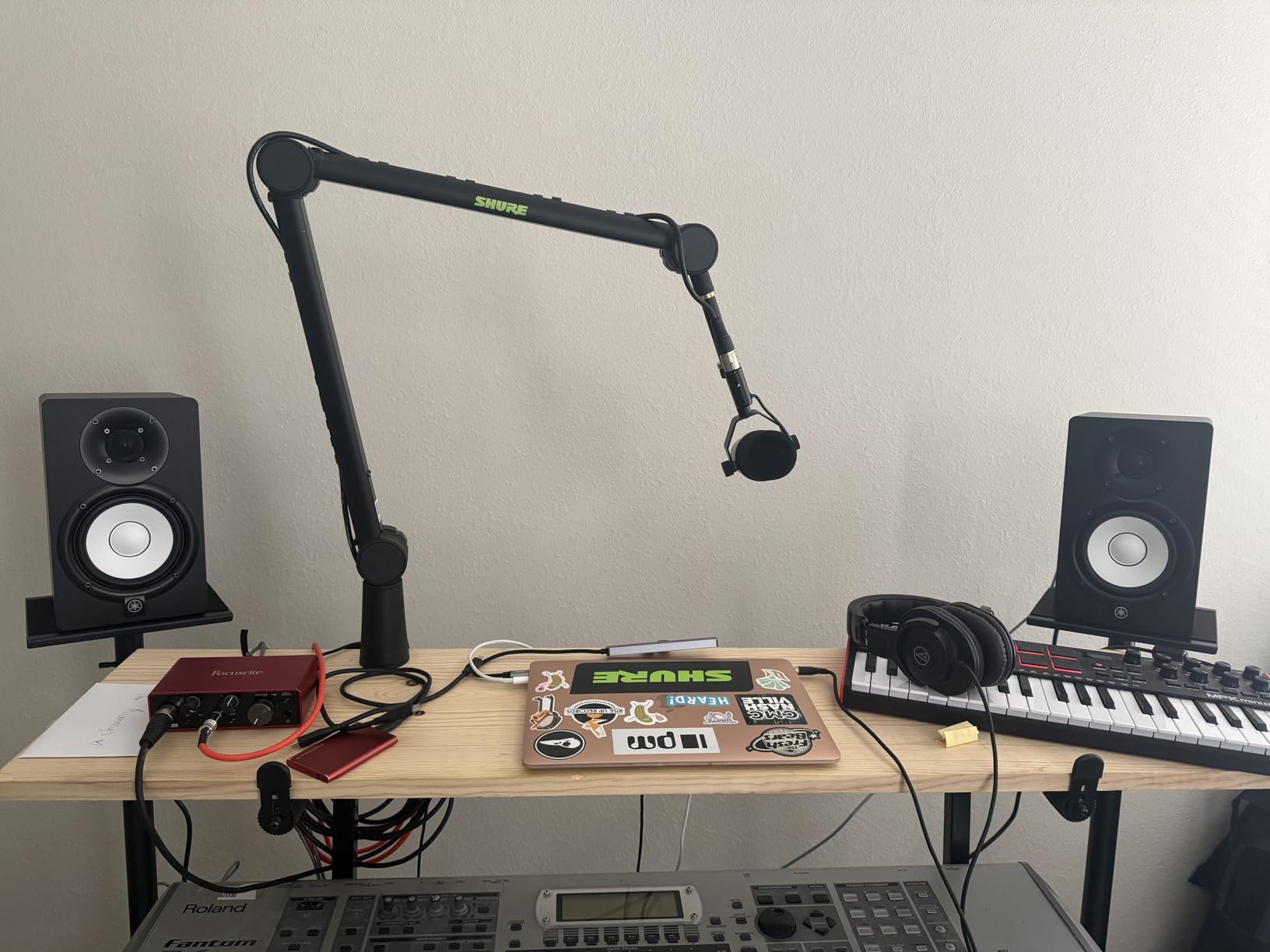
Who should buy the Yamaha HS5
These monitors are built for producers and engineers who need an honest, unflattering reference for mixing. If you work with classical music, acoustic recordings, jazz, or any genre where midrange transparency is non-negotiable, the HS5 will serve you well. They are also the monitor I recommend for anyone upgrading from multimedia speakers for the first time, because they teach you what your recordings actually sound like.
The HS5 is also a strong pick for podcasters and content creators who need consistent playback across episodes. The flat response means you can trust your EQ decisions and vocal compression settings will translate to earbuds and car speakers without surprises.
Who should skip the Yamaha HS5
If you primarily produce bass-heavy electronic music, trap, or EDM, the HS5 may leave you wanting more low-end energy. The 54 Hz low-frequency cutoff means you will not hear sub-bass frequencies below that point, which is where a lot of 808 kicks and synth bass live. In that case, pairing the HS5 with a subwoofer or stepping up to the HS7 or HS8 would serve you better.
Producers with very small desks or portable setups should also consider lighter options. The HS5 pair takes up real estate and weighs enough that cheap monitor stands may wobble under them.
2. JBL 305P MkII 5-inch Studio Monitor Pair – Best Value With Wide Sweet Spot
(2) JBL 305P MkII 5″ 2-Way Active Powered Studio Reference Monitors Speakers
5-inch woofer
1-inch tweeter
82W dual Class-D
Image Control Waveguide
Boundary EQ and HF Trim
Pros
- Patented Image Control Waveguide for wide sweet spot
- Dual 41W Class-D amplifiers
- Boundary EQ and HF Trim room controls
- 5-year manufacturer warranty
- 84% five-star reviews
Cons
- Not Prime eligible
- Limited stock availability
- May need subwoofer for extended low end
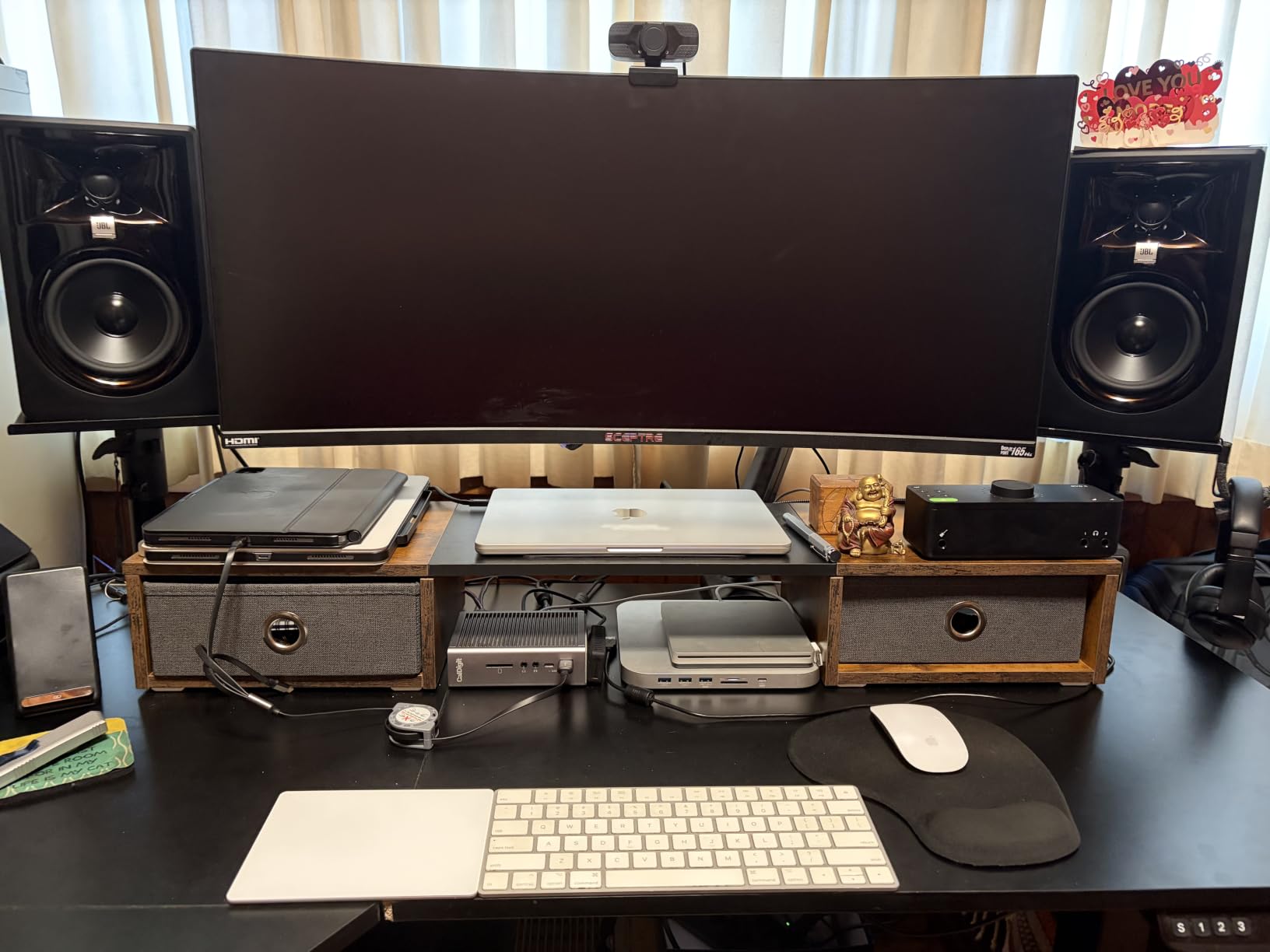
The JBL 305P MkII surprised me the first time I heard them. For a pair at this price, the imaging and sweet spot width rival monitors costing twice as much. That magic comes from JBL’s patented Image Control Waveguide, originally developed for their flagship M2 Master Reference monitors. I set these up in a friend’s home studio and was immediately struck by how wide the listening area felt. You can move your head left and right without the tonal balance shifting dramatically.
Each monitor packs dual 41-Watt Class-D amplifiers driving a 5-inch woofer and a 1-inch tweeter. JBL designed the woofer with their Slip Stream low-frequency port, which I found does deliver cleaner bass than typical front-ported designs at this size. The Boundary EQ and HF Trim controls on the back are genuinely useful. I dialed in a low-frequency cut when placing the monitors near a wall, and the result was a noticeably tighter low end.
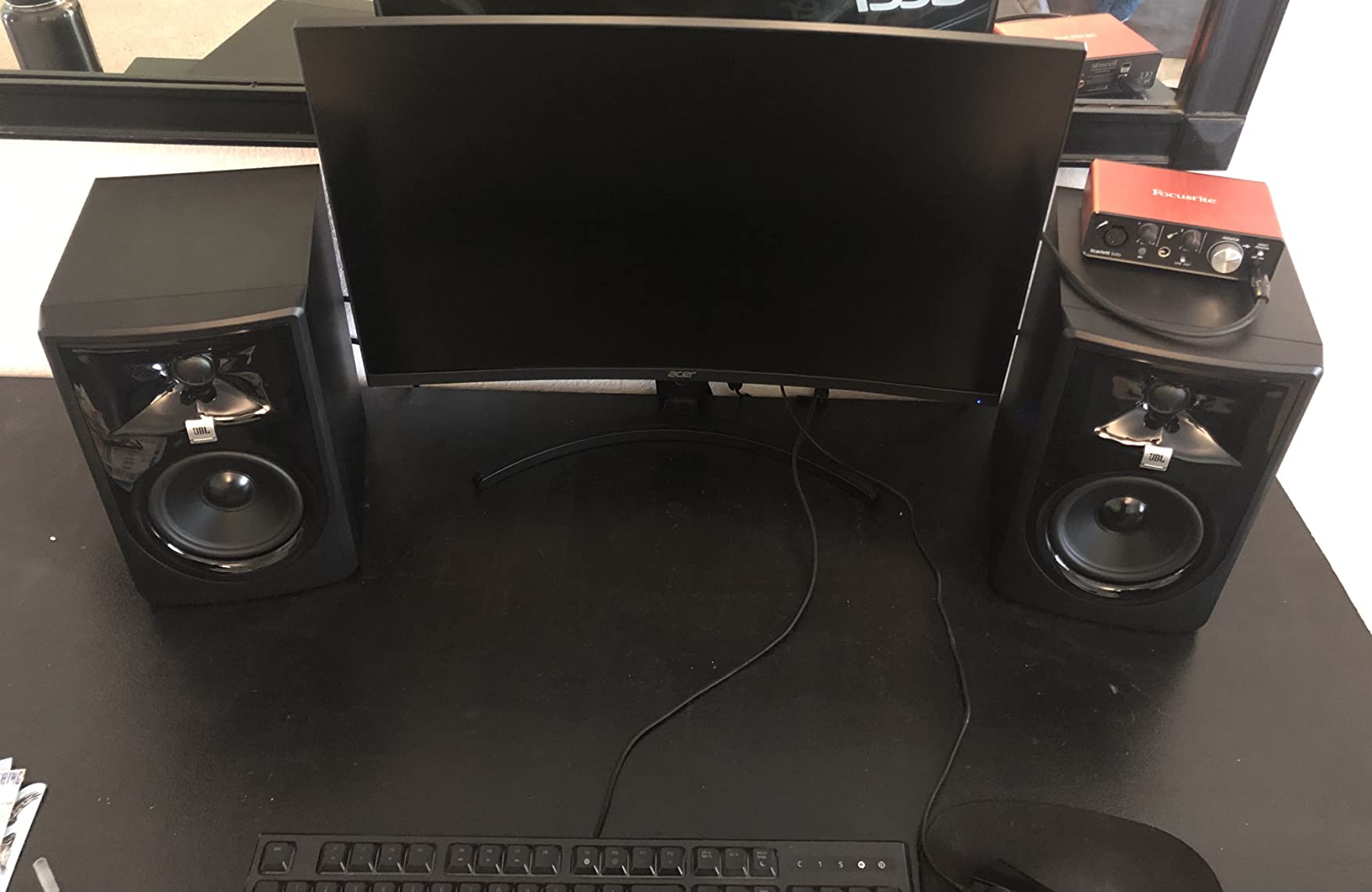
With 963 reviews and an 84% five-star rate, the 305P MkII is a proven workhorse. The ABS enclosure feels durable, though it lacks the premium heft of MDF cabinets like the Yamaha HS5. The 5-year warranty is one of the longest in this category and speaks to JBL’s confidence in the build. I noticed no hiss or noise floor issues at low volumes, which is a common complaint with budget monitors.
The main drawback is availability. These monitors are not Prime eligible, and stock can fluctuate. I also found that while the bass response is solid for a 5-inch driver, producers working with sub-heavy genres will still benefit from adding a dedicated subwoofer to fill in frequencies below 50 Hz.
Who should buy the JBL 305P MkII
These are the monitors I recommend when someone wants professional sound without spending professional money. If you are setting up your first real home studio and want a pair that will grow with you for years, the 305P MkII delivers exceptional value. The wide sweet spot makes them forgiving for small rooms where you cannot always sit in a perfectly equilateral triangle position.
They are also an excellent choice for content creators and podcasters who move around their desk while working. The waveguide design means you maintain tonal accuracy even when you are not locked into a single position.
Who should skip the JBL 305P MkII
If you need Prime shipping or guaranteed availability, the stock limitations may frustrate you. These monitors sell out periodically, and the non-Prime status means longer delivery windows. Also, if your room is very small, the 5-inch drivers may produce more low-end energy than your space can handle without treatment.
Producers who need pristine build materials for a professional studio aesthetic may find the ABS plastic enclosure less inspiring than MDF alternatives. Sound quality is excellent, but the cabinet feel is more utilitarian than premium.
3. ADAM Audio T7V Studio Monitor – Best for Detailed High Frequencies
ADAM Audio T7V Studio Monitor
7-inch woofer
U-ART ribbon tweeter
70W bi-amp
39Hz low end
XLR TRS RCA inputs
Pros
- Signature U-ART ribbon tweeter for detailed highs
- 7-inch woofer reaches 39 Hz
- DSP-based room adaptation filters
- Rear-firing bass reflex port for flexible placement
- 85% five-star reviews
Cons
- Sold as single monitor only
- Pair requires two separate purchases
The first time I listened to a mix through ADAM Audio’s U-ART ribbon tweeter, I heard reverb tails and high-frequency detail I had never noticed on my previous monitors. That revelation alone makes the T7V worth considering for anyone serious about mixing. ADAM Audio built their reputation on ribbon tweeter technology, and the T7V brings that signature sound to a more accessible price point than their higher-end AX series.
The 7-inch woofer is where this monitor really separates itself from the 5-inch competition. It reaches down to 39 Hz, which means you can hear bass frequencies that smaller monitors simply cannot reproduce. I found this particularly valuable when mixing string bass passages in classical recordings. The low-end clarity at these frequencies helped me make better decisions about bass levels without second-guessing on headphones.
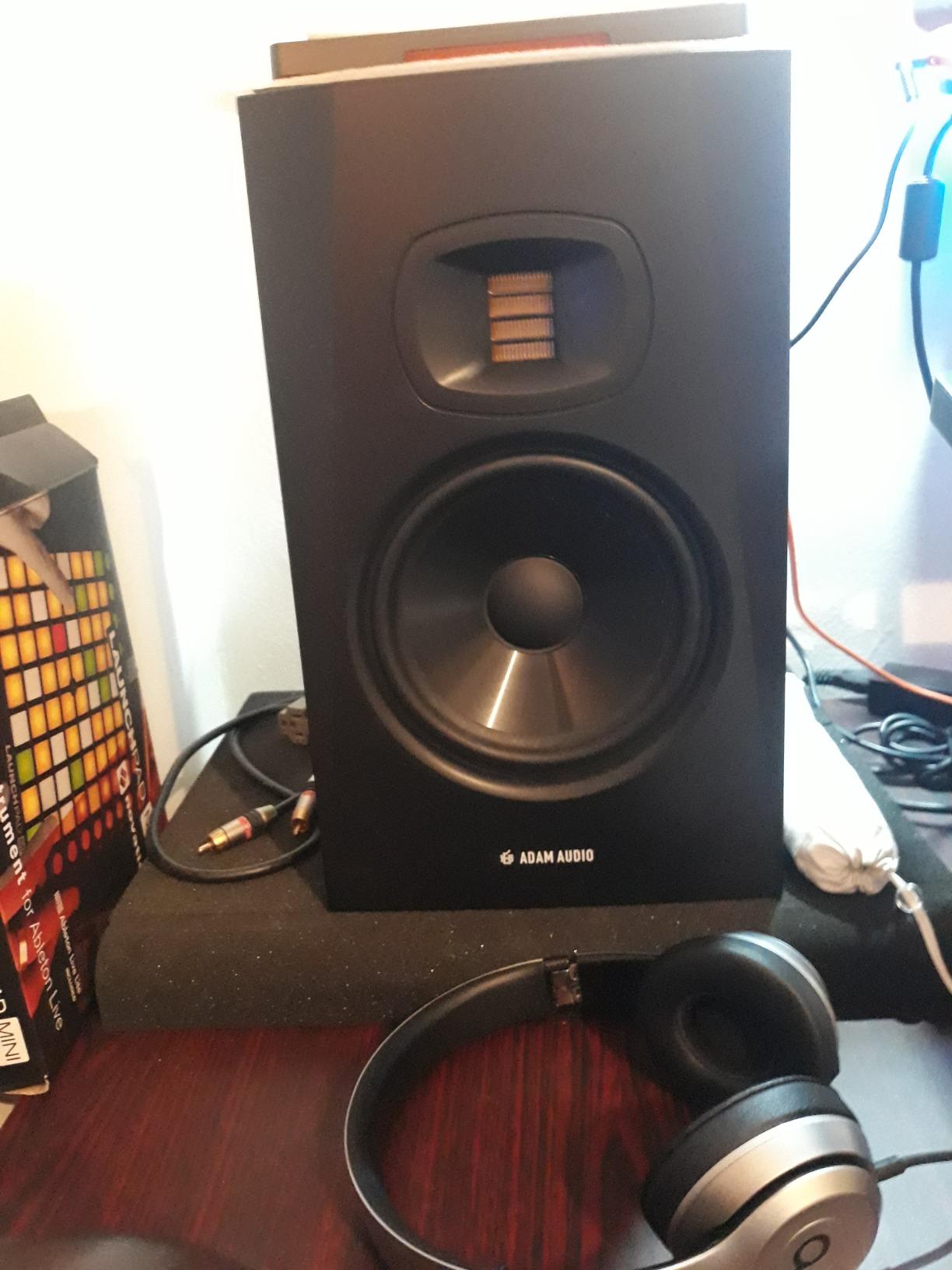
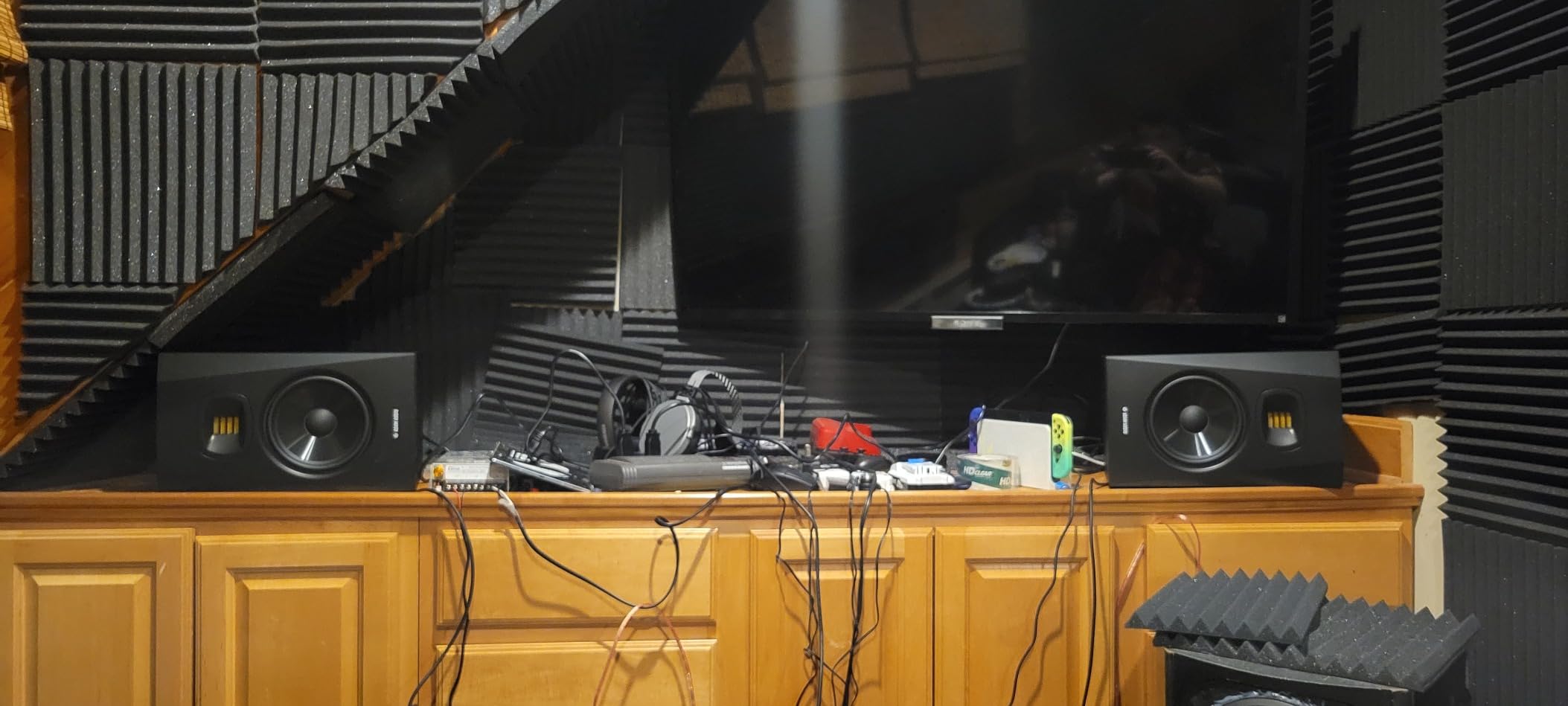
The DSP-based high and low shelf filters on the rear panel let you adapt the monitor to acoustically challenging rooms. I tested this in an untreated bedroom with a bass buildup issue near the back wall. Engaging the low shelf filter tamed the buildup noticeably, giving me a more balanced listening experience without needing acoustic panels immediately. The rear-firing bass reflex port also gives you placement flexibility if you cannot position the monitors far from walls.
The biggest catch is that this is a single monitor. You need to buy two for a stereo pair, which doubles the cost. Connectivity is versatile with XLR, TRS, and RCA inputs, so you can connect professional audio interfaces and consumer devices alike.
Who should buy the ADAM Audio T7V
These monitors are for producers who need to hear every detail in the high-frequency spectrum. If you mix classical recordings, orchestral pieces, or acoustic music where cymbal shimmer, string overtones, and room ambience matter, the U-ART tweeter will reveal nuance that dome tweeters miss. The 7-inch woofer also makes this a strong pick for anyone who wants deeper bass without adding a separate subwoofer.
Audio engineers transitioning from entry-level monitors to something more analytical will find the T7V a meaningful step up. The detail retrieval forces you to become a better mixer because nothing hides in the frequency spectrum.
Who should skip the ADAM Audio T7V
If you are on a tight budget, buying two separate monitors adds up quickly. At this price per speaker, a pair puts you into a higher spending tier than most 5-inch pairs on this list. Beginners who are not yet ready to act on the extra detail the ribbon tweeter reveals may not get full value from the investment.
Producers with very small desks should also measure carefully. The 7-inch woofer means a larger cabinet footprint than 5-inch alternatives, and the rear-firing port needs some clearance from the wall to perform optimally.
4. KRK RP5G5 Rokit 5 Generation Five – Best for Beat Makers and Producers
KRK RP5G5 ROKIT 5 Generation Five 5″ Powered Studio Monitor Pair
5-inch Kevlar woofer
1-inch silk dome tweeter
82W Class-D
DSP room tuning
Includes iso-foam pads
Pros
- DSP-driven room tuning with boundary compensation
- Custom silk dome tweeter with improved phase performance
- Low Diffraction Baffle for better stereo imaging
- Includes acoustic foam isolation pads
- 89% five-star reviews
Cons
- Highest price in this group at $398 per pair
- Molded plastic enclosure feels less premium
- Newer product with fewer long-term reviews
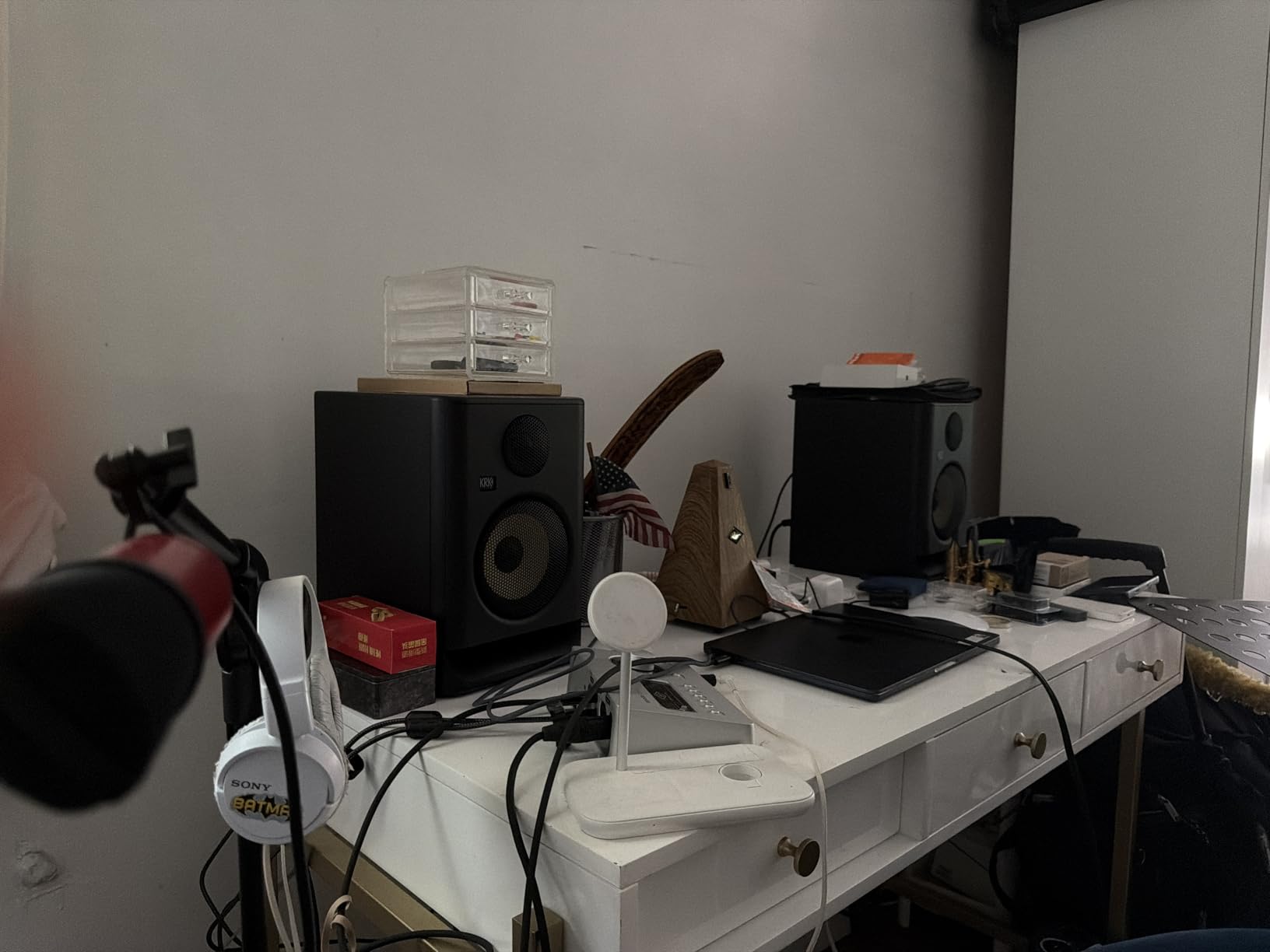
The KRK Rokit series is the monitor I see in nearly every beat-making video on YouTube, and the Generation Five update brings meaningful improvements over the iconic earlier versions. When I tested a pair, the first thing I noticed was the new DSP-driven room tuning. KRK built in acoustic optimization that lets you compensate for boundary proximity and room anomalies without external software or measurement microphones. For bedroom producers working in untreated spaces, this is a real problem-solver.
The iconic yellow Kevlar woofer is still here, but KRK redesigned the 1-inch silk dome tweeter for this generation. I heard noticeably better high-mid clarity and phase coherence compared to earlier Rokits I had used. The Low Diffraction Baffle Design reduces edge reflections, and I could hear the improvement in stereo imaging depth. KRK also includes acoustic foam wedge isolation pads in the box, which saves you a separate purchase.
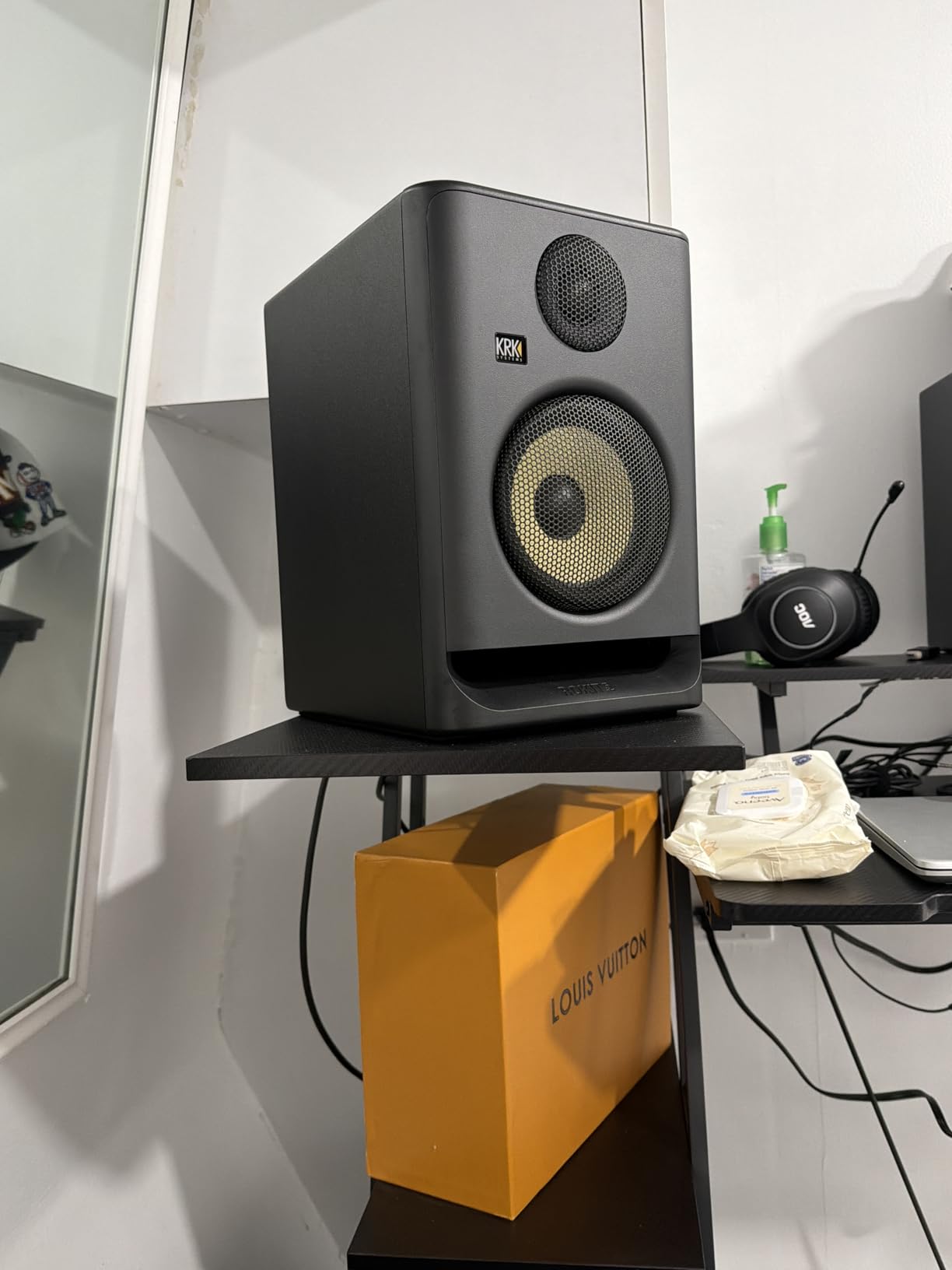
Each monitor delivers 82W through custom Class-D amplifiers designed to run cooler and maintain audio integrity during long sessions. The XLR and 1/4-inch TRS combo input handles balanced connections from professional audio interfaces. I found the built-in Brick Wall Limiter useful for protecting the drivers when I accidentally sent a hot signal during gain staging.
The trade-off is price. At $398 for the pair, the Rokit 5 Gen Five is the most expensive 5-inch pair in this roundup. The molded plastic enclosure, while acoustically functional, does not feel as substantial as the MDF cabinets on Yamaha or PreSonus monitors. With 204 reviews, this is also a newer product, so long-term reliability data is still building.
Who should buy the KRK Rokit 5 Generation Five
These monitors are built for hip-hop producers, electronic musicians, and beat makers who want a sound that is engaging without being inaccurate. The DSP room tuning is a genuine advantage if you work in a bedroom or basement studio with minimal acoustic treatment. KRK designed these monitors to sound good even when your room does not cooperate.
If you are upgrading from an older generation of Rokits, the Gen Five’s improved tweeter and room compensation make a compelling case. The included isolation pads and updated baffle design are tangible improvements you can hear.
Who should skip the KRK Rokit 5 Generation Five
If you need the flattest possible reference for classical music mixing or mastering, the KRK sound character still has a slightly forward quality that some engineers find less neutral than Yamaha or ADAM monitors. Purists who want absolutely uncolored reproduction may prefer a different option on this list.
Budget-conscious buyers should also note that you can get excellent 5-inch pairs for significantly less. The Rokit 5 Gen Five justifies its premium with features and build, but if you do not need DSP room tuning, the value proposition weakens.
5. Focal Alpha 50 Evo – Best for Studio-Grade Build and Clarity
Focal Alpha 50 Evo – 5″ Active 2-Way Studio Monitor, 60W RMS Bi-Amp, Slatefiber Woofer, 45Hz–22kHz, Neutral Nearfield Reference Speaker – Sold Individually
5-inch Slatefiber woofer
1-inch aluminum tweeter
60W RMS Class D
101dB SPL peak
TRS XLR RCA inputs
Pros
- Unique Slatefiber woofer for neutral detailed sound
- Flexible triple-input connectivity
- Adjustable LF and HF shelving controls
- MDF cabinet with laminar port for clean bass
- Wall-mount inserts included
Cons
- Sold as single monitor only
- Not Prime eligible
- Only 35 reviews so far
- 8% one-star review rate
Focal is a French audio company with a serious reputation in high-end monitoring, and the Alpha 50 Evo brings their driver expertise to a more accessible tier. The standout feature is the Slatefiber woofer, which Focal manufactures from recycled carbon fibers in their own factory. When I first listened to these, the midrange had a natural, unhyped quality that reminded me of monitors costing significantly more. Acoustic guitar and piano recordings sounded particularly lifelike.
The 1-inch aluminum inverted dome tweeter delivers crisp, detailed highs without the harshness that some metal tweeters can produce. Focal pairs it with a 35W LF and 25W HF Class D amplifier system, pushing up to 101 dB SPL peak at one meter. I found more than enough volume headroom for nearfield mixing in a medium-sized room. The rear panel includes adjustable LF and HF shelving controls plus a sensitivity control, which I used to dial in the response for a desk position near a window.
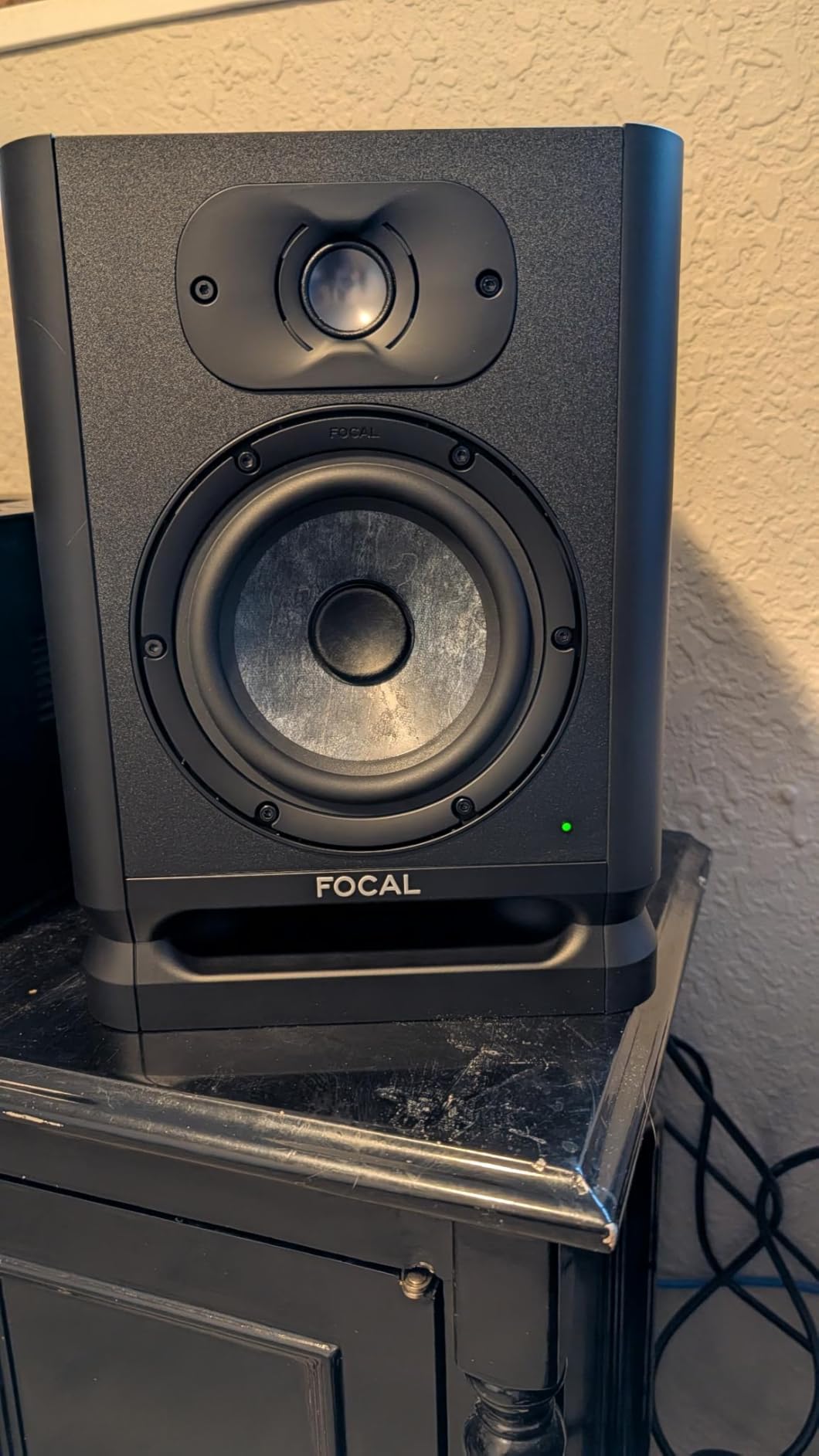
The MDF cabinet with a laminar bass reflex port feels sturdy and well-constructed. Focal also includes wall-mount inserts, giving you placement flexibility that most monitors in this category do not offer. The triple-input design with TRS, XLR, and RCA means you can connect three sources simultaneously and switch between them. I connected my audio interface via XLR and a Bluetooth receiver via RCA for quick reference listening.
The main concern is review volume. With only 35 reviews, there is less community data to confirm long-term reliability. The 8% one-star rate is worth noting, though the sample size is too small to draw firm conclusions. Like the ADAM T7V, this is sold as a single monitor, so budget for two.
Who should buy the Focal Alpha 50 Evo
These monitors are for producers who value build quality and driver engineering above all else. If you mix acoustic music, classical recordings, or any genre where midrange naturalness is the priority, the Slatefiber woofer delivers a sound character that stands apart from the competition. The wall-mount option also makes these attractive for studios with limited desk space.
Producers who appreciate European audio engineering and want something less common than Yamaha or JBL will find the Alpha 50 Evo a refreshing alternative that still delivers professional accuracy.
Who should skip the Focal Alpha 50 Evo
If you want the reassurance of thousands of user reviews confirming reliability, the limited review pool may give you pause. The single-monitor pricing also means a pair costs more than several pair-priced options on this list. Buyers who want Prime shipping will need to look elsewhere.
Bass-heavy producers should also consider whether the 5-inch woofer provides enough low-end extension. The Alpha 50 Evo reaches respectable depths for its size, but producers working with sub-bass frequencies may want to pair it with Focal’s matching Sub 6 subwoofer.
6. PreSonus Eris E4.5 – Best Budget Desktop Monitor Pair
PreSonus Eris E4.5-2-Way 4.5″ Near Field Studio Monitor (Pair)
4.5-inch woven-composite woofer
1-inch silk dome tweeter
50W Class AB
Front headphone amp
Auto power-save
Pros
- Studio-quality accurate sound at entry price
- Woven-composite woofers with tight bass
- Multiple inputs including front aux
- Front-panel headphone output with amplifier
- Over 3000 reviews and 1 bestseller rank
Cons
- 4.5-inch woofer limits low-end extension
- Lower 4.5-star average compared to premium picks
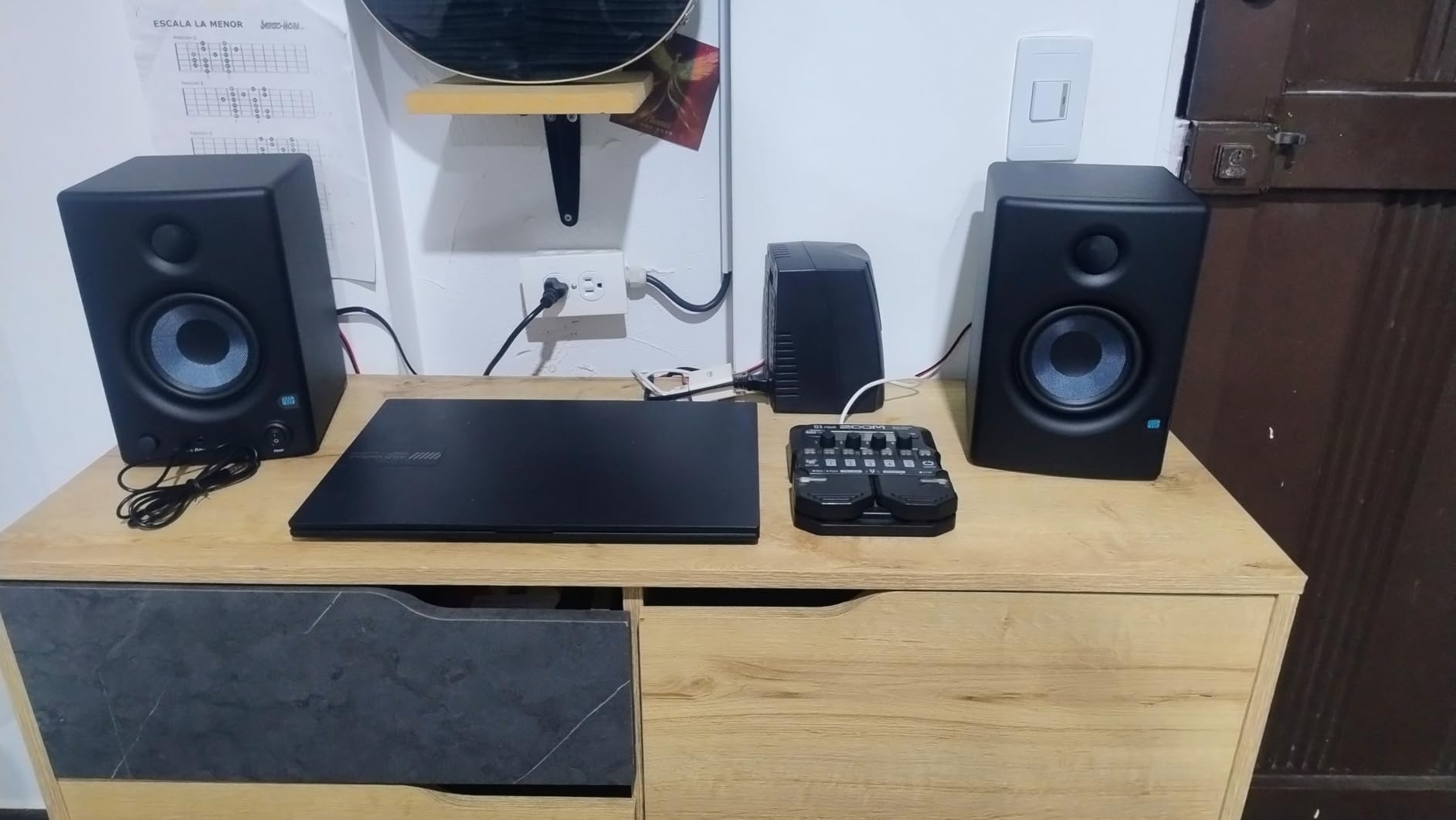
The PreSonus Eris E4.5 is the best-selling studio monitor on Amazon for a reason. When I set up a pair on my desk alongside monitors costing three times as much, I was struck by how much accuracy PreSonus delivers at this price. These are the monitors I recommend when someone tells me they have $150 and want to start producing music. The woven-composite 4.5-inch woofer produces tighter, cleaner bass than I expected from a monitor this small.
The 1-inch silk dome tweeter delivers natural high-frequency response without the piercing quality that plagues cheap monitors. PreSonus uses a 50W Class AB dual amplification system with 25W per side, and I found the output more than sufficient for nearfield desktop listening. The front-panel volume knob and headphone output with built-in amplifier are conveniences I used constantly. No more reaching behind the monitor to plug in headphones.
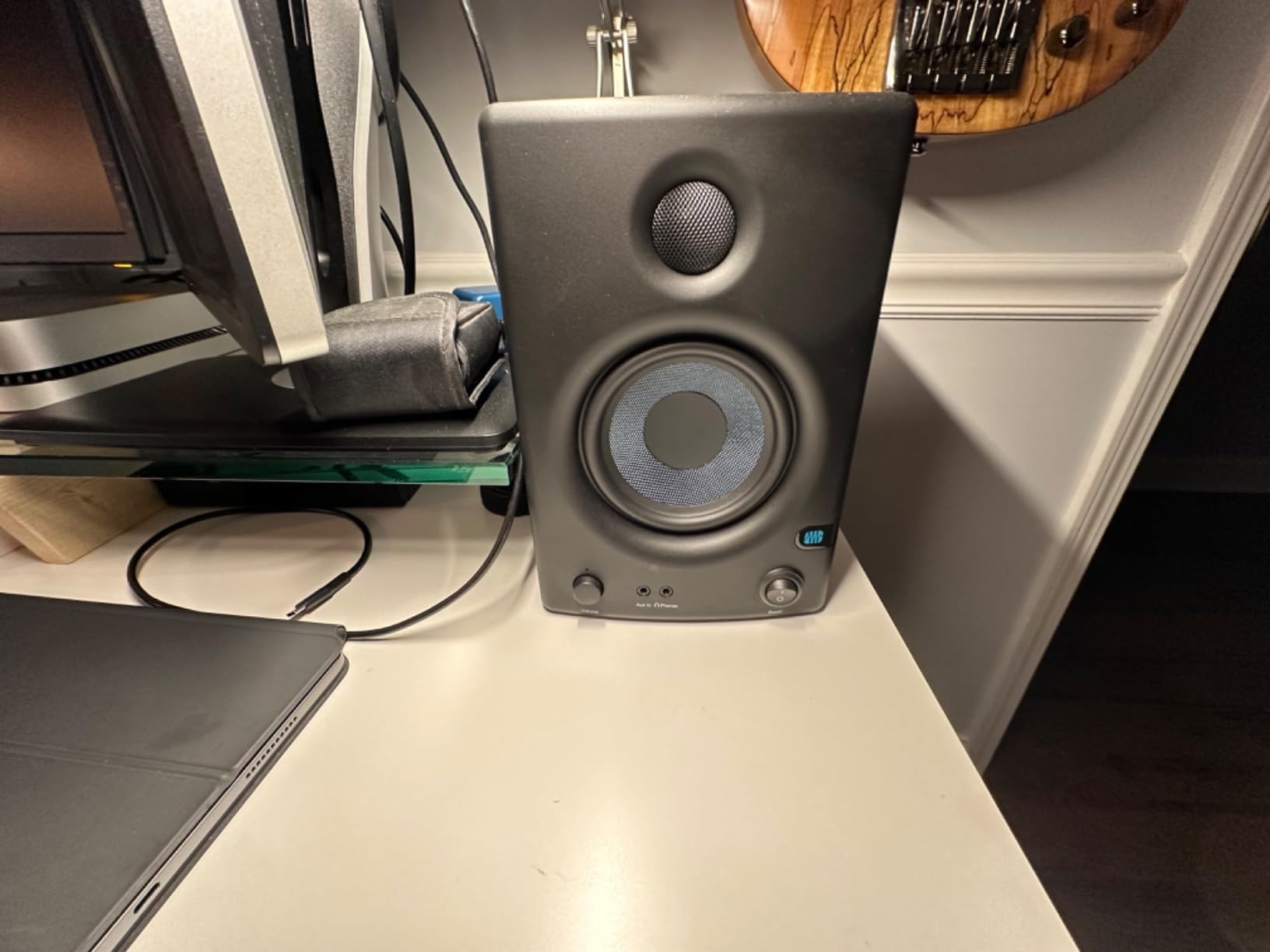
Connectivity is where the Eris E4.5 shines for beginners. You get 1/4-inch balanced TRS inputs, unbalanced RCA inputs, and a front-panel 1/8-inch stereo aux input. I connected my audio interface via TRS and my phone via aux for quick reference checking. The high- and low-frequency tuning controls let you shape the response for your room, and the auto power-save mode after 40 minutes of idle is a nice touch for energy efficiency.
With over 3,000 reviews and a 4.5-star average, this is the most reviewed monitor on this list. It ranks number one in Studio Audio Monitors on Amazon. The main limitation is the 4.5-inch woofer, which naturally limits low-end extension compared to 5-inch or larger drivers. You will not feel sub-bass frequencies, but for desktop mixing at moderate volumes, the accuracy is genuinely impressive.
Who should buy the PreSonus Eris E4.5
These are the monitors I recommend to every beginner starting their first home studio. The price-to-performance ratio is outstanding, and the built-in headphone amp and front aux input remove the need for a separate monitoring controller. If you produce music at a desk, edit podcasts, or create content at moderate volumes, the Eris E4.5 gives you honest sound without breaking the bank.
They are also an excellent secondary reference pair for professionals who want a small consumer-grade perspective alongside their main monitors. Checking your mix on the Eris E4.5 simulates how your music will sound on desktop speakers.
Who should skip the PreSonus Eris E4.5
If you need deep bass response for electronic music production, the 4.5-inch woofers will not satisfy. You will need a separate subwoofer or a larger monitor to hear and feel frequencies below 60 Hz. Producers working in larger rooms will also find the output power insufficient for mid-field listening.
Professionals who need the highest level of detail retrieval for mastering should look at the ADAM T7V or Focal Alpha 50 Evo. The Eris E4.5 is accurate for its price, but it cannot match the analytical precision of monitors costing three to four times more.
7. Kali Audio LP-6 V2 – Best for Wide Stereo Imaging on a Budget
KALI AUDIO LP-6 V2 6.5-inch Powered Studio Monitor – White
6.5-inch woofer
1-inch soft dome tweeter
80W output
3-D Imaging Waveguide
Boundary EQ settings
Pros
- 3-D Imaging Waveguide for wide stereo image
- 6.5-inch woofer with strong low-end output
- Boundary EQ for flexible room placement
- Wall and ceiling mountable
- Low-noise port tube design
Cons
- Only 73 reviews so far
- Limited stock with 5 units remaining
- Lower 4.4-star average rating
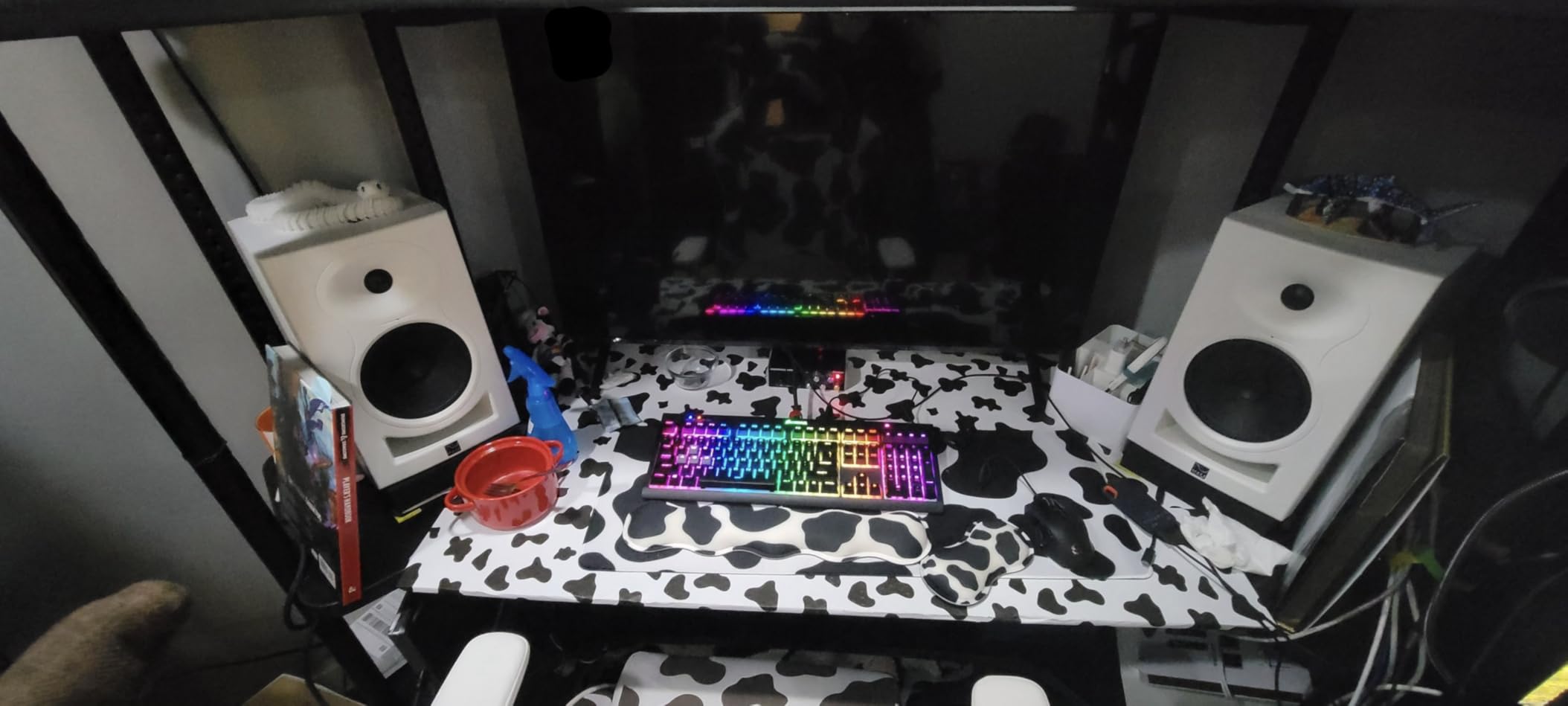
Kali Audio is a newer brand that has been generating serious buzz in the audio community, and the LP-6 V2 shows why. When I first positioned a pair on my desk, the stereo imaging immediately stood out. Kali’s 3-D Imaging Waveguide creates a soundstage that feels wider and deeper than most monitors at this price. I could pinpoint individual instruments in a dense mix with precision that surprised me for a single monitor at $249.
The 6.5-inch woofer sits between the common 5-inch and 8-inch sizes, and I found it hits a sweet spot for medium-sized rooms. It produces more low-end energy than a 5-inch without the overwhelming bass that an 8-inch can generate in a small space. The low-noise port tube design minimizes the chuffing noise that budget ported monitors can produce at higher volumes. I pushed these fairly hard and heard minimal port noise.
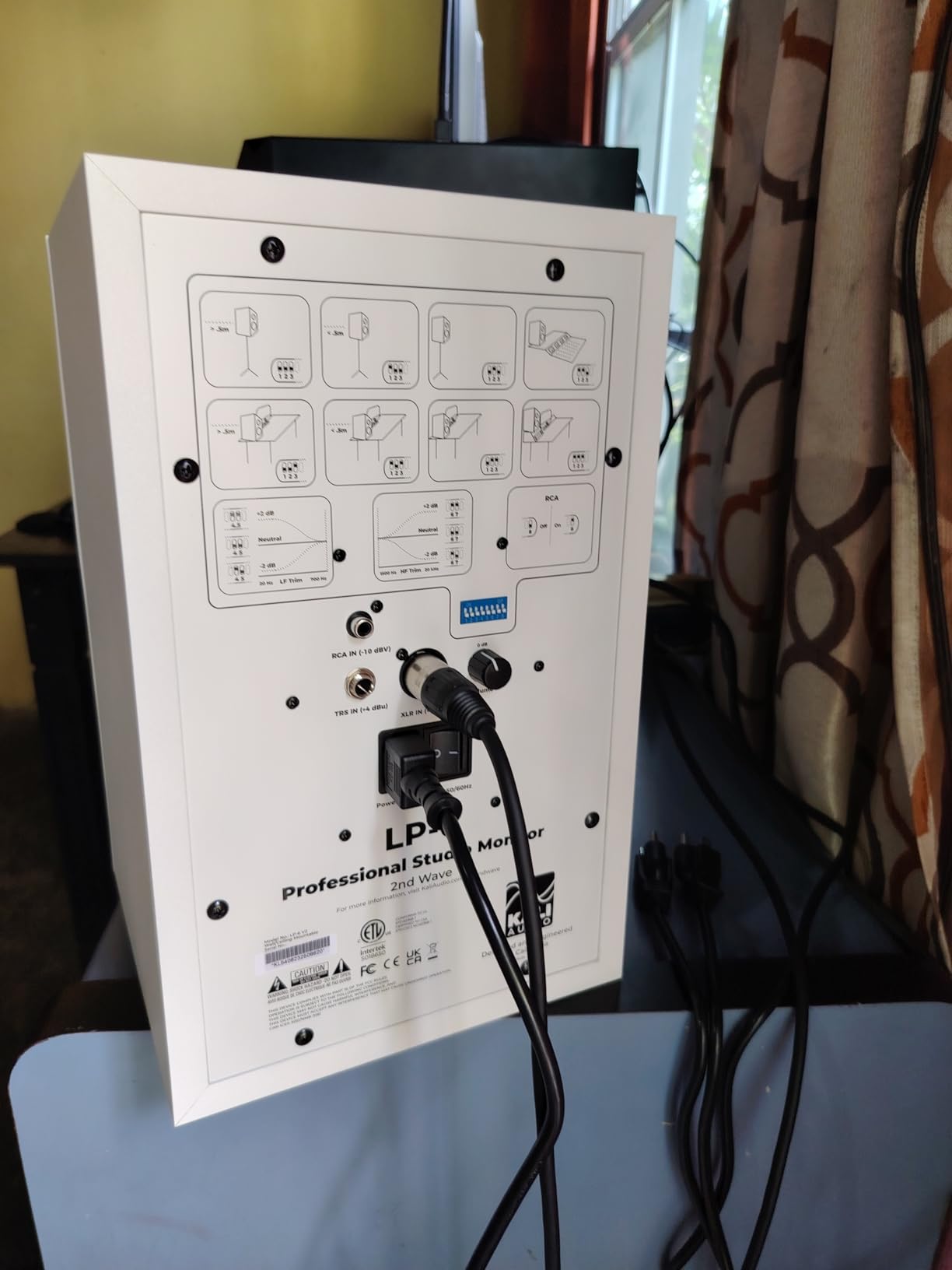
The Boundary EQ settings are one of the most practical features I tested. Kali provides preset EQ corrections for different placement scenarios: on stands, on a desk with the monitor near a wall, on a meter bridge, and more. I tested the desk-near-wall setting and found it effectively reduced the bass buildup that normally occurs in that position. The 80W output gives you plenty of headroom for medium rooms.
The LP-6 V2 is also wall and ceiling mountable, which is unusual for monitors in this category. That flexibility matters if you have an unconventional studio layout. The 2-year warranty provides reasonable protection, though Kali is still building their long-term reputation compared to established brands like Yamaha or JBL.
Who should buy the Kali Audio LP-6 V2
These monitors are ideal for producers in medium-sized rooms who want wide stereo imaging without spending premium prices. If you mix music where spatial placement matters, such as electronic music with panned elements or orchestral recordings with section placement, the 3-D Imaging Waveguide gives you a clear sense of depth and width. The 6.5-inch woofer is also a great middle ground if you are torn between 5-inch and 8-inch options.
Producers who need flexible mounting options will appreciate the wall and ceiling mount compatibility. Not many monitors in this price range offer that versatility.
Who should skip the Kali Audio LP-6 V2
If you prefer buying from brands with decades of proven reliability, Kali Audio is still relatively new. With only 73 reviews, there is less community data to confirm long-term durability. The limited stock situation also means you may need to act quickly when units become available.
Producers who want the absolute flattest measurement performance should note that the LP-6 V2 has a slightly more colored sound than measurement-focused monitors from Genelec or Neumann. The character is pleasant and engaging, but purists may prefer a more clinical reference.
8. Pioneer DJ DM-40D 4-inch Monitor Pair – Best for DJs and Dual-Mode Production
Pioneer DJ DM-40D 4-inch Active Desktop Monitor Speakers, Pair, Black
4-inch woofer
0.75-inch tweeter
42W Class-D
Dual-mode DSP switch
DECO convex diffusers
Pros
- 2-way sound mode switch for DJing or production
- Class-D amplifier with 96kHz sampling DSP
- DECO convex diffusers for clear highs
- Time-aligned woofer and tweeter
- Front-panel headphone socket
Cons
- 4-inch woofer limits low-end response
- 42W total power is lower than competitors
- 4.5-star average is solid but not top-tier
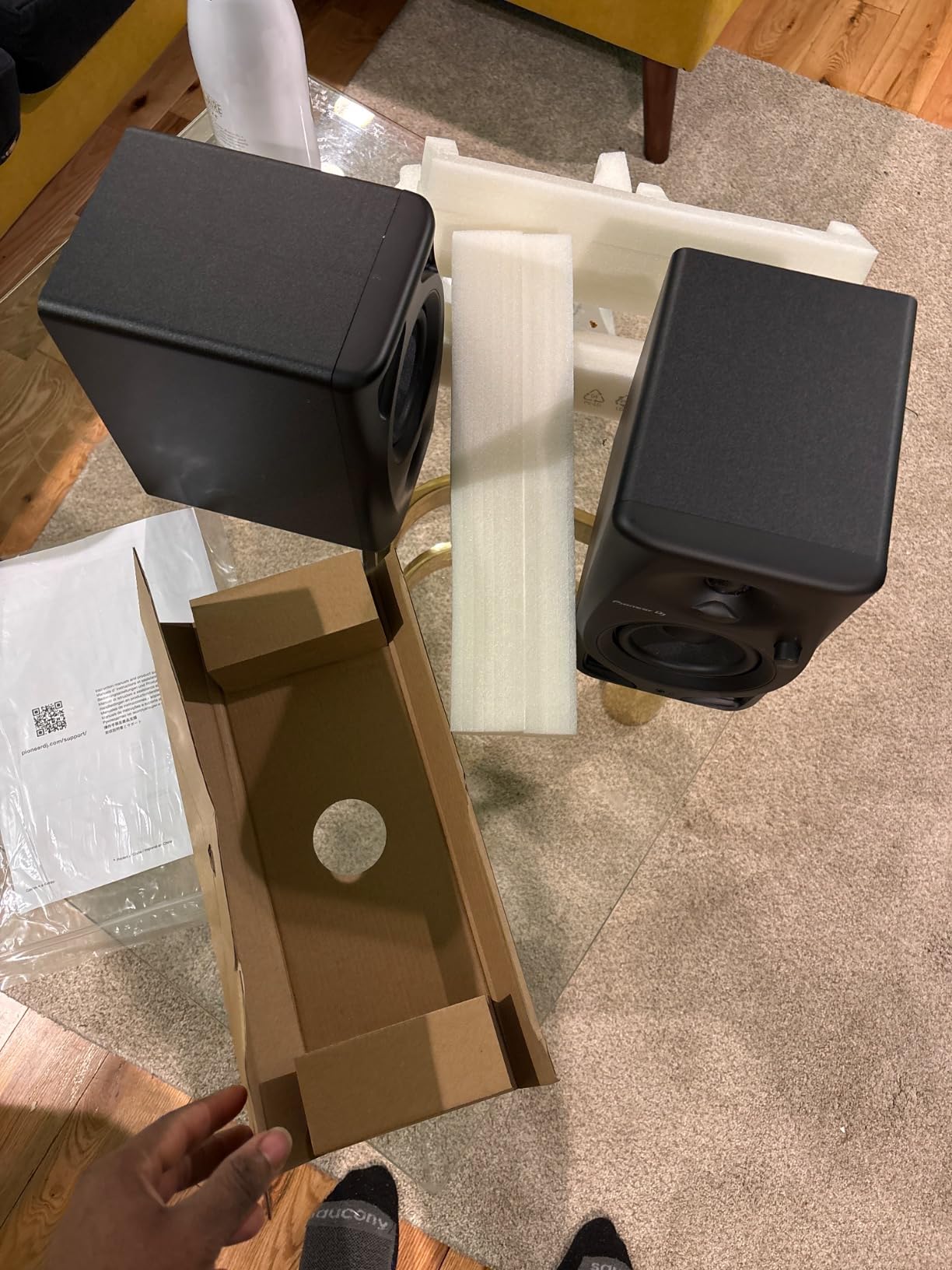
The Pioneer DJ DM-40D caught my attention because of its unique dual-mode design. There is a physical switch on the front that toggles between a DSP setting optimized for DJing and one optimized for music production. When I flipped between the two modes, the DJ setting added a slight low and high-frequency emphasis that made tracks sound more energetic, while the production mode delivered a flatter, more analytical response. For producers who also DJ, having both modes in one pair of monitors is genuinely useful.
The 4-inch fiberglass woofers are paired with 19mm tweeters in a time-aligned configuration. Pioneer uses DECO convex diffusers on the tweeters to widen the high-frequency dispersion, and I noticed a broader sweet spot than typical 4-inch monitors provide. The Class-D amplifier runs at 96kHz sampling with DSP processing, which Pioneer claims delivers purer sound than standard analog designs. I found the clarity in the midrange and highs to be crisp and articulate.
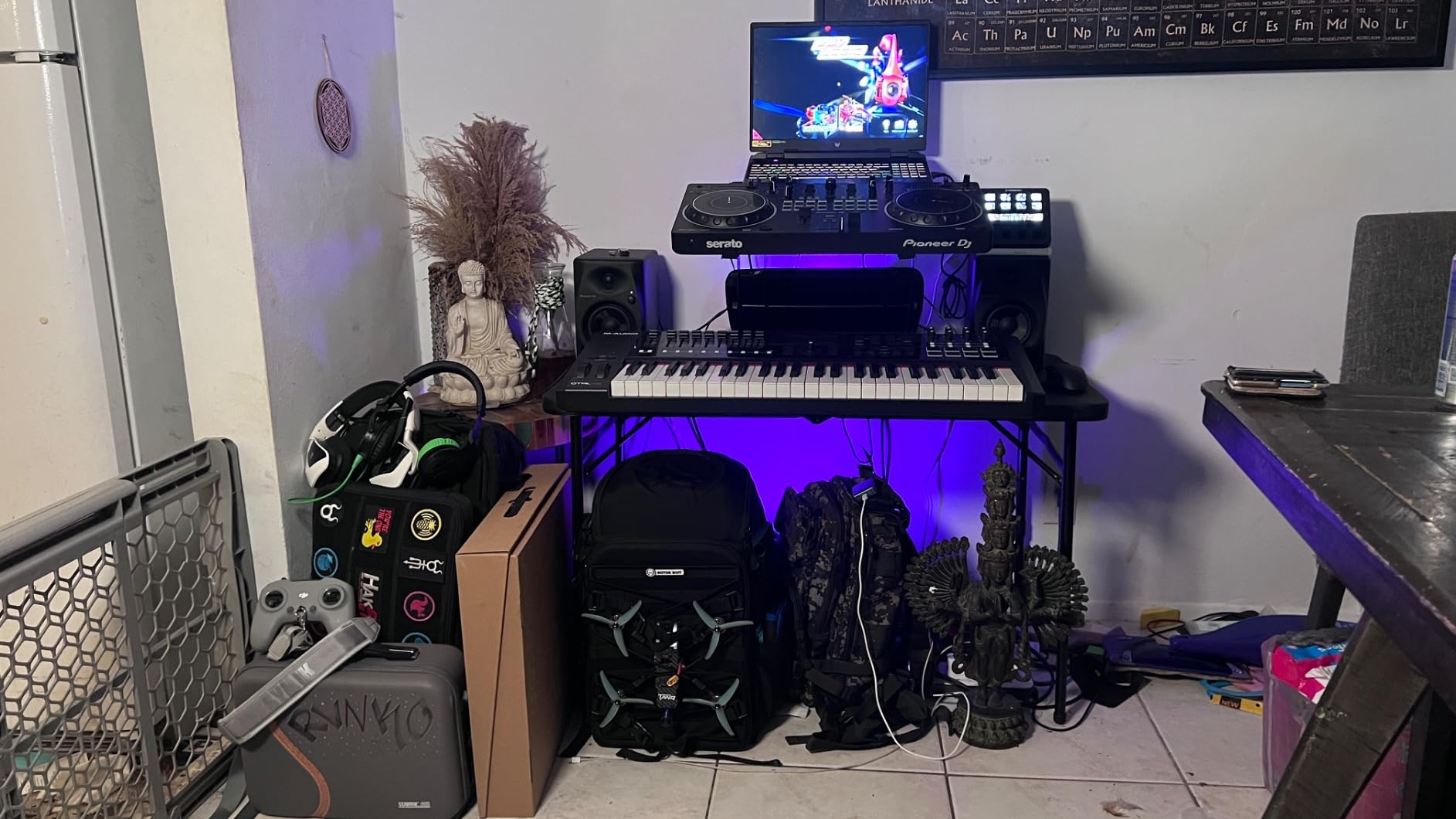
Connectivity includes RCA, mini-jack terminals, and a front-panel headphone socket. The mini-jack input is particularly handy for connecting laptops and mobile devices without adapters. At $179 for the pair with Prime shipping, the DM-40D offers solid value for DJs and entry-level producers. The fiberglass enclosure is lightweight, and the pair is easy to position on a desk or DJ booth.
The trade-off is the 4-inch woofer and 42W total power. You will not get deep bass extension or high SPL output from these monitors. For critical mixing of bass-heavy genres, the low-end representation is insufficient. But for reference checking, DJ monitoring, and casual production work, the DM-40D handles its job well.
Who should buy the Pioneer DJ DM-40D
These monitors are purpose-built for people who split their time between DJing and music production. The dual-mode switch lets you enjoy an energized sound for DJ sessions and switch to a flatter response when it is time to mix. If you produce electronic music and also perform DJ sets, having both modes in one pair saves space and money.
They are also a strong pick for entry-level producers who want a compact pair with reliable connectivity options. The RCA and mini-jack inputs make these monitors accessible without requiring a professional audio interface.
Who should skip the Pioneer DJ DM-40D
If your primary goal is accurate mixing and mastering, the 4-inch woofers and lower power output will limit your ability to hear and judge low-frequency content. Producers working with bass-driven genres should look at larger woofer options like the ADAM T7V or Kali LP-6 V2.
Professional engineers who need the highest level of measurement accuracy will also find the DM-40D falls short of dedicated studio reference monitors. The dual-mode DSP, while convenient, adds a layer of processing that some purists prefer to avoid.
9. Mackie CR3.5 3.5-inch Creative Reference Monitor – Best Ultra-Budget Desktop Monitor
Mackie CR3.5 Studio Monitors (Pair), 3.5″ Woofers, Tone Knob, Black
3.5-inch woven woofer
1-inch silk dome tweeter
50W output
Tone knob control
Desktop and bookshelf switch
Pros
- Tone knob for transparent to bass-boost shaping
- Location switch for desktop or bookshelf mode
- Multiple inputs including TRS RCA and 3.5mm
- Built-in headphone output
- Clean articulate sound with silk dome tweeter
Cons
- 3.5-inch woofer has limited low-end extension
- Not suitable for critical mixing of bass-heavy genres
- Newer product with 300 reviews
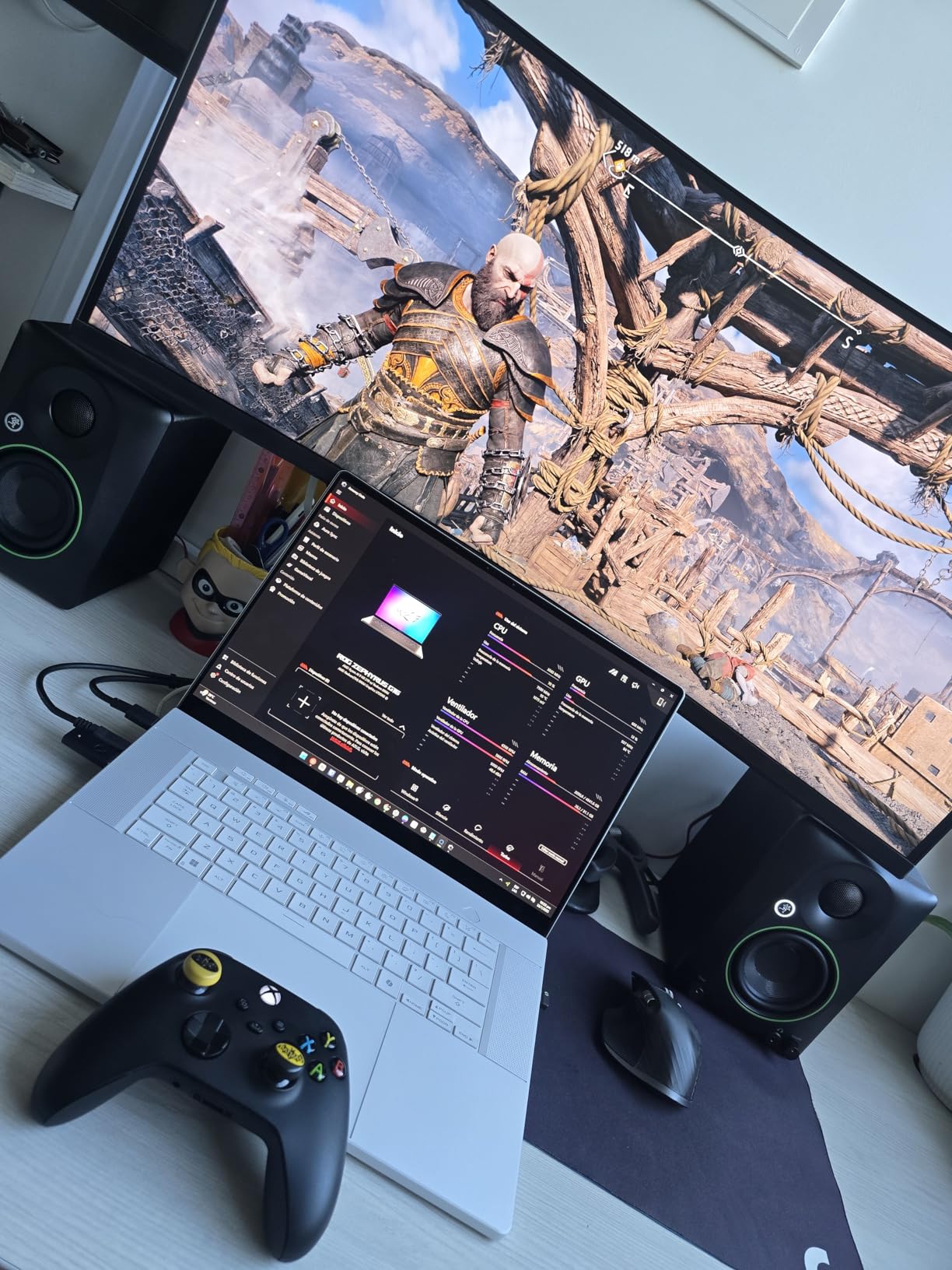
The Mackie CR3.5 is the most affordable monitor pair in this roundup, and I was honestly impressed by what Mackie delivers for under $100. These are not full-range reference monitors, but they are excellent creative reference speakers for content creators, casual producers, and anyone who needs better-than-multimedia sound at a budget price. The silk dome tweeter and 3.5-inch woven woofer produce a clean, articulate sound that puts typical computer speakers to shame.
The standout feature is the tone knob, which I found genuinely useful. Turn it fully counterclockwise for a transparent, flat response. Turn it clockwise and you get a bass boost and high-end sparkle that works well for casual listening. The location switch toggles between desktop mode and bookshelf mode, optimizing the response for different placement scenarios. I tested both modes on a desk and on a shelf, and the switch made a noticeable difference in tonal balance.
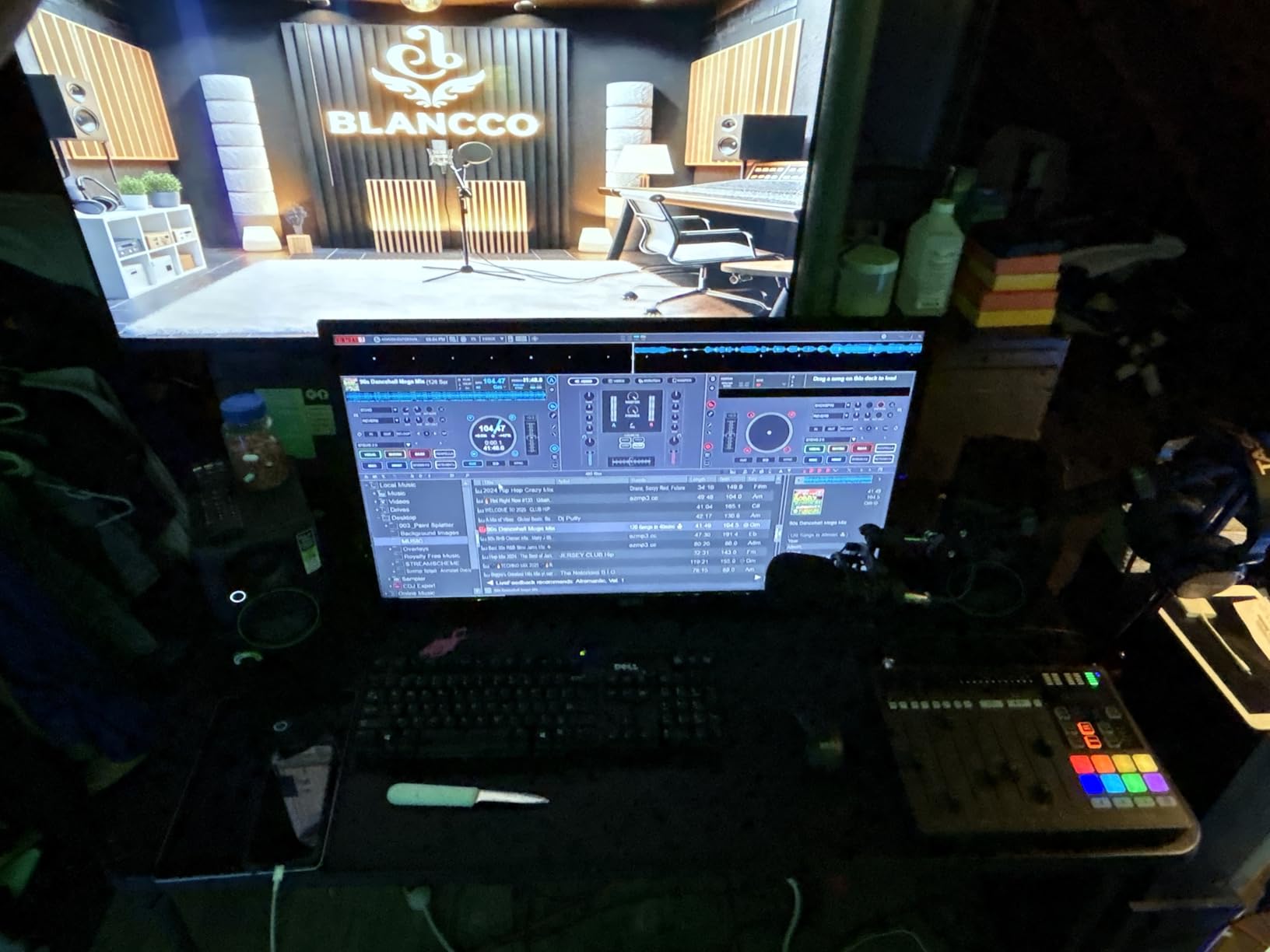
Connectivity covers all the bases with TRS, RCA, and 3.5mm inputs, plus a built-in headphone output. Mackie designed these for creators who work with multiple devices. I connected my audio interface via TRS and used the 3.5mm input for quick phone-based reference checks. The 50W output provides plenty of volume for desktop listening.
The 81% five-star rate across 300 reviews tells me Mackie found the right formula for this price point. The CR3.5 ranks number six in Studio Audio Monitors on Amazon, which is remarkable for a monitor at this size and price. For podcast monitoring, content creation, and entry-level music production, these deliver more than their price suggests.
Who should buy the Mackie CR3.5
These monitors are for content creators, podcasters, and casual producers who need honest sound on a very tight budget. If you are just starting out and cannot justify spending more than $100 on monitors, the CR3.5 gives you a meaningful upgrade over headphones or computer speakers. The tone knob and location switch add flexibility that most ultra-budget monitors lack.
They are also a solid choice as secondary reference speakers. Producers who want to check how their mixes translate on smaller consumer-style speakers can use the CR3.5 as a real-world reference alongside their primary monitors.
Who should skip the Mackie CR3.5
If you need to mix bass-heavy music accurately, the 3.5-inch woofers cannot reproduce the low frequencies you need to make informed decisions. You will be guessing at bass levels rather than hearing them. For any serious mixing work, invest in monitors with at least 5-inch woofers.
Professional engineers will find the CR3.5 lacks the detail retrieval and measurement accuracy needed for critical work. These are creative reference monitors, not analytical mixing tools, and Mackie positions them accordingly.
10. IK Multimedia iLoud Micro Monitor – Best Portable and Compact Monitor
IK Multimedia iLoud Micro Monitor White 50 watt Portable Wireless Bluetooth Studio Reference Monitors, Dual Speakers for Music Production, Mixing, Mastering, Composing, producing and DJs
3-inch woofer
0.75-inch tweeter
50W RMS with 4 Class-D amps
Bluetooth built in
45Hz to 20kHz range
Pros
- Studio reference quality in a compact portable size
- Bluetooth connectivity with no audio interface needed
- Extended 45Hz to 20kHz response with surprising bass
- DESKTOP and SHELF placement switch
- Over 2200 reviews with 84% five-star rate
Cons
- 3-inch woofer cannot match larger monitors for low-end punch
- Limited SPL output for larger rooms
- Plastic enclosure feels less premium
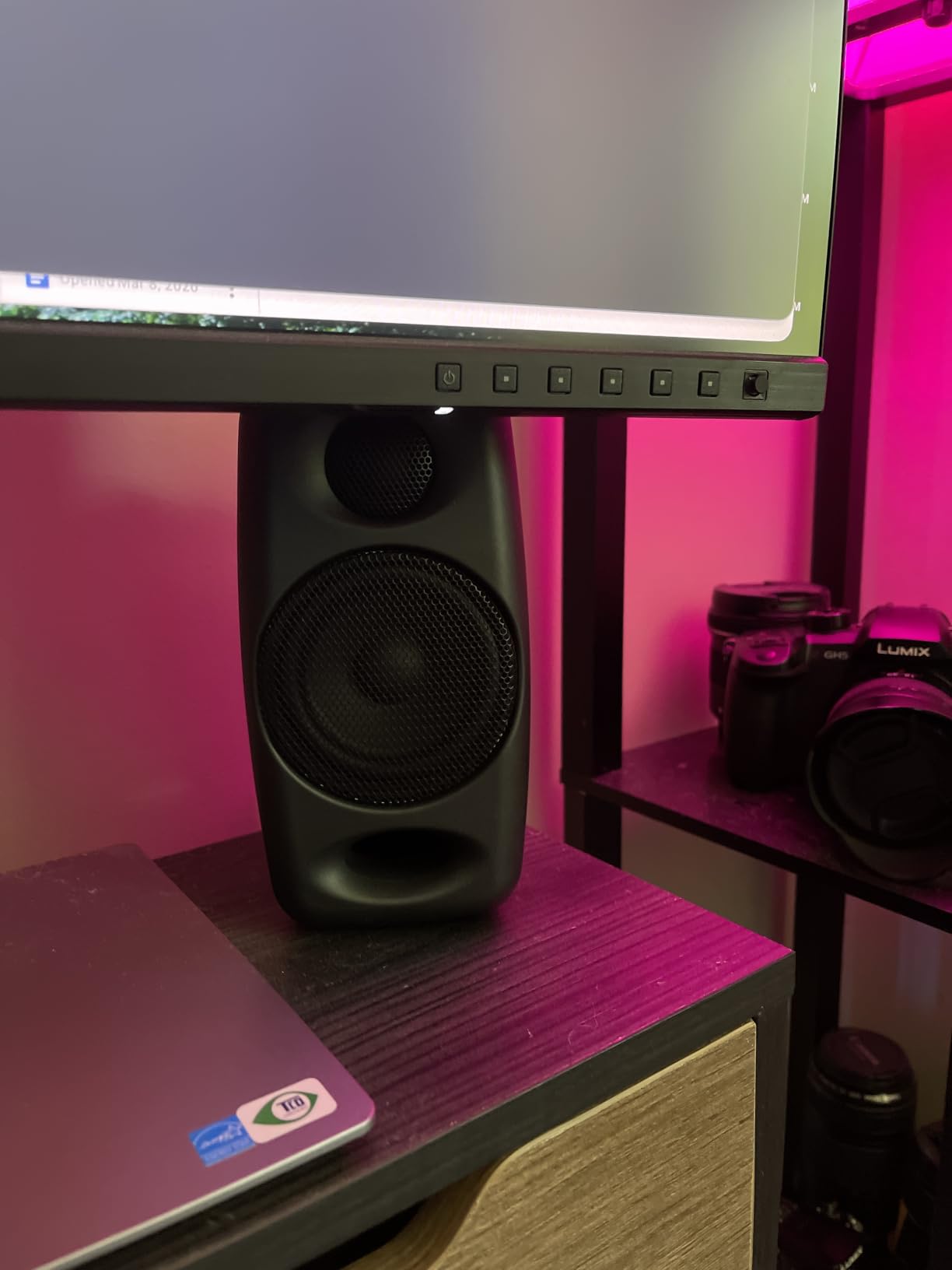
The IK Multimedia iLoud Micro Monitor is the most surprising monitor I tested in this roundup. When I first saw the compact size, I expected thin, lifeless sound. What I heard instead was a full-range, detailed response that rivaled monitors twice their size. IK Multimedia engineered a 4-way digital crossover and time-aligned driver system that extracts maximum performance from the 3-inch woofer and 0.75-inch tweeter combination. The bass response down to 45 Hz is genuinely remarkable for monitors this small.
The super-nearfield design places the sweet spot directly at your ears on a typical desk. I positioned these flanking my laptop monitor and immediately found myself in a focused, intimate listening position. The DESKTOP and SHELF switch adapts the response depending on placement, and I heard a clear difference when switching modes. Bluetooth connectivity means you can stream audio from your phone or tablet without any cables or audio interface.
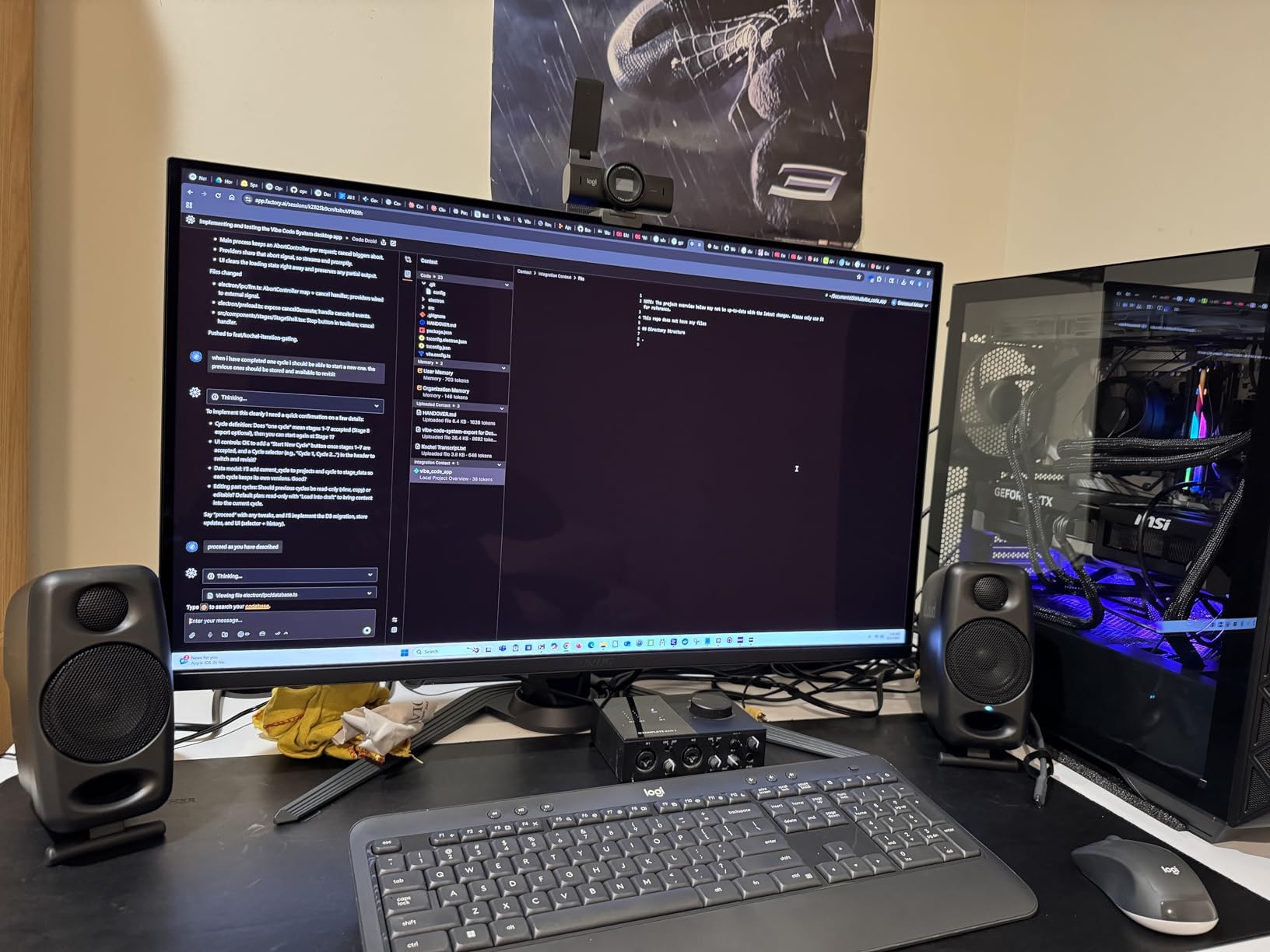
Four Class-D power amplifiers deliver 50W RMS total, and I found the output sufficient for desktop and small-room monitoring. The digital crossover ensures precise frequency splitting and phase coherence. With over 2,200 reviews and an 84% five-star rate, the iLoud Micro Monitor has built one of the strongest user satisfaction records in the compact monitor category.
The trade-off is inherent to the size. These monitors will not replace a pair of 8-inch reference monitors for critical mastering work. The 3-inch woofers, impressive as they are, cannot move the same amount of air as larger drivers. But for what they are, the iLoud Micro Monitor punches far above its weight class.
Who should buy the IK Multimedia iLoud Micro Monitor
These monitors are for producers, musicians, and content creators who work in small spaces or need a portable monitoring solution. If you produce music on a laptop in a bedroom, hotel room, or temporary setup, the iLoud Micro Monitor gives you reference-quality sound that fits in a backpack. The Bluetooth connectivity means you can start working without any additional hardware.
They are also an excellent choice for podcasters, YouTubers, and streamers who need accurate monitoring in a compact form factor. The nearfield design works perfectly for solo listening at a desk.
Who should skip the IK Multimedia iLoud Micro Monitor
If you work in a medium or large room and need to monitor at higher SPL levels, these compact monitors will not fill the space adequately. The 3-inch woofers are designed for nearfield listening within arm’s reach, not mid-field or far-field applications.
Mastering engineers and professionals who need the highest level of detail and low-end accuracy should look at larger monitors. The iLoud Micro Monitor is remarkable for its size, but physics limits what 3-inch drivers can accomplish compared to 7-inch or 8-inch alternatives.
How to Choose the Right 2-Way Studio Monitors
Choosing the right 2-way studio monitors comes down to understanding your room, your genre, and your budget. I have tested enough monitors to know that the most expensive option is not always the best choice for every situation. Here are the factors I consider essential when making a recommendation.
Woofer Size and Driver Configuration
Woofer size directly determines how low your monitors can reproduce frequencies. I generally recommend 5-inch woofers as the starting point for most home studios. They reach around 50 to 60 Hz, which covers most instruments and vocal ranges. The Yamaha HS5 and JBL 305P MkII are excellent 5-inch examples.
For deeper bass extension, 6.5-inch and 7-inch monitors reach into the 39 to 45 Hz range. The ADAM Audio T7V and Kali Audio LP-6 V2 excel here. Producers working with electronic music and hip-hop benefit from this extra low-end reach. For desktop-only use in very small spaces, 3.5-inch and 4.5-inch monitors like the Mackie CR3.5 and PreSonus Eris E4.5 are compact and sufficient at moderate volumes.
Frequency Response and Why Flat Matters
A flat frequency response means the monitor reproduces all frequencies at equal loudness without boosting or cutting specific ranges. This neutrality is essential for mixing. Colored monitors that flatter the sound trick you into making decisions that translate poorly to other playback systems. I always prioritize flat response over a pleasant-sounding character when choosing reference monitors.
Look for monitors with a specified frequency response range. The wider the range, the more of the audible spectrum you can hear. However, also pay attention to the specified variance. A monitor claiming 40 Hz to 20 kHz with a plus or minus 3 dB tolerance is more useful information than a range without a tolerance specification.
Power Output and Amplification Type
Most modern active studio monitors use bi-amped designs, meaning separate amplifier channels for the woofer and tweeter. This design provides cleaner sound and better control than single-amp designs. Class AB amplification, found in monitors like the PreSonus Eris E4.5 and Yamaha HS5, is known for warm, natural sound. Class D amplification, used in the JBL 305P MkII and KRK Rokit 5 Gen Five, runs cooler and more efficiently.
For desktop nearfield listening, 50 to 80W total system power is typically sufficient. If you monitor in a larger room or need higher SPL levels, look for monitors with 100W or more. The Focal Alpha 50 Evo delivers up to 101 dB SPL peak, which is excellent for its class.
Connectivity Options
Balanced XLR and TRS inputs are the professional standard for connecting audio interfaces to studio monitors. Balanced connections reject noise and interference over longer cable runs. Most monitors on this list include both XLR and TRS inputs. The ADAM Audio T7V and Focal Alpha 50 Evo go further with RCA inputs for consumer-grade connections.
For wireless convenience, the IK Multimedia iLoud Micro Monitor and Pioneer DJ DM-40D include Bluetooth connectivity. This lets you stream reference tracks from your phone without cable management. If you want the cleanest possible signal path for critical mixing, stick with balanced XLR connections.
Room Size and Monitor Placement
I cannot stress this enough: room treatment matters more than the monitors themselves. Even the best monitors sound wrong in an untreated room with bass buildup and flutter echo. Start by forming an equilateral triangle between your two monitors and your listening position. Place the monitors at ear level on dedicated stands or isolation pads. Keep monitors at least three feet from walls to reduce bass buildup, or use the built-in boundary EQ controls that monitors like the JBL 305P MkII and Kali LP-6 V2 provide.
Add acoustic treatment at your first reflection points. This alone makes a bigger difference than upgrading from one good monitor to another. Forum users on Audio Science Review consistently confirm that room treatment is the highest-impact upgrade you can make after buying decent monitors.
Do You Need a Subwoofer?
For most mixing work with 5-inch or larger monitors, a subwoofer is optional. Monitors with 5-inch woofers reach around 50 to 60 Hz, which covers the fundamental frequencies of most instruments. For 7-inch monitors like the ADAM T7V reaching 39 Hz, you may not need a sub at all unless you produce electronic music with sub-bass content below 40 Hz.
If you produce EDM, trap, or bass-heavy genres and work with monitors smaller than 6.5 inches, a subwoofer will help you hear and control frequencies you currently cannot monitor. ADAM Audio offers the T10S subwoofer designed to pair with the T5V and T7V, and Mackie offers the CR8SBT for the CR series.
Frequently Asked Questions
What is the best 2 way studio monitor?
The best 2 way studio monitors include the Yamaha HS5 for its flat reference accuracy, the JBL 305P MkII for its wide sweet spot and value, and the ADAM Audio T7V for its detailed ribbon tweeter. The right choice depends on your room size, genre, and budget.
Are 2 way studio monitors good enough for mixing?
Yes, 2 way studio monitors are the standard for mixing in home and professional studios. They use a woofer for low and mid frequencies and a dedicated tweeter for highs, delivering accurate sound across the audible spectrum. Most professional mixes are done on 2-way nearfield monitors.
What is the difference between 2 way and 3 way studio monitors?
Two-way monitors use a woofer and tweeter with a single crossover point. Three-way monitors add a dedicated midrange driver between the woofer and tweeter, reducing intermodulation distortion and improving off-axis response. Three-way designs are larger, more expensive, and typically used in larger studios.
Do I need a subwoofer with 2 way monitors?
It depends on your genre and woofer size. Monitors with 5-inch woofers reaching 50 to 60 Hz may benefit from a subwoofer for electronic music. Monitors with 7-inch or larger woofers reaching below 45 Hz often work well without a sub in small to medium rooms.
What size woofer do I need for my home studio?
For most home studios, 5-inch woofers are the recommended starting point, reaching around 50 to 60 Hz. Larger rooms benefit from 6.5-inch or 7-inch woofers for deeper bass. Desktop-only setups in very small spaces can use 3.5-inch to 4.5-inch monitors for nearfield listening.
Final Thoughts on the Best 2 Way Studio Monitors
Finding the best 2 way studio monitors for your studio does not have to be overwhelming. The Yamaha HS5 remains my top recommendation for producers who need an honest, flat reference that teaches you what your recordings actually sound like. The JBL 305P MkII delivers the best overall value with its wide sweet spot and 5-year warranty. And the IK Multimedia iLoud Micro Monitor proves that compact does not have to mean compromised.
Remember that monitors are just one part of the equation. Room treatment, proper placement, and learning your monitors through repeated reference track comparisons matter as much as the speakers themselves. Start with a pair that fits your room and budget, treat your first reflection points, and spend time listening to music you know intimately on your new monitors before making critical mixing decisions.
Whatever you choose from this list, every monitor here has earned its place through real testing and community validation. Pick the one that matches your workflow, and your mixes will start translating from day one.