
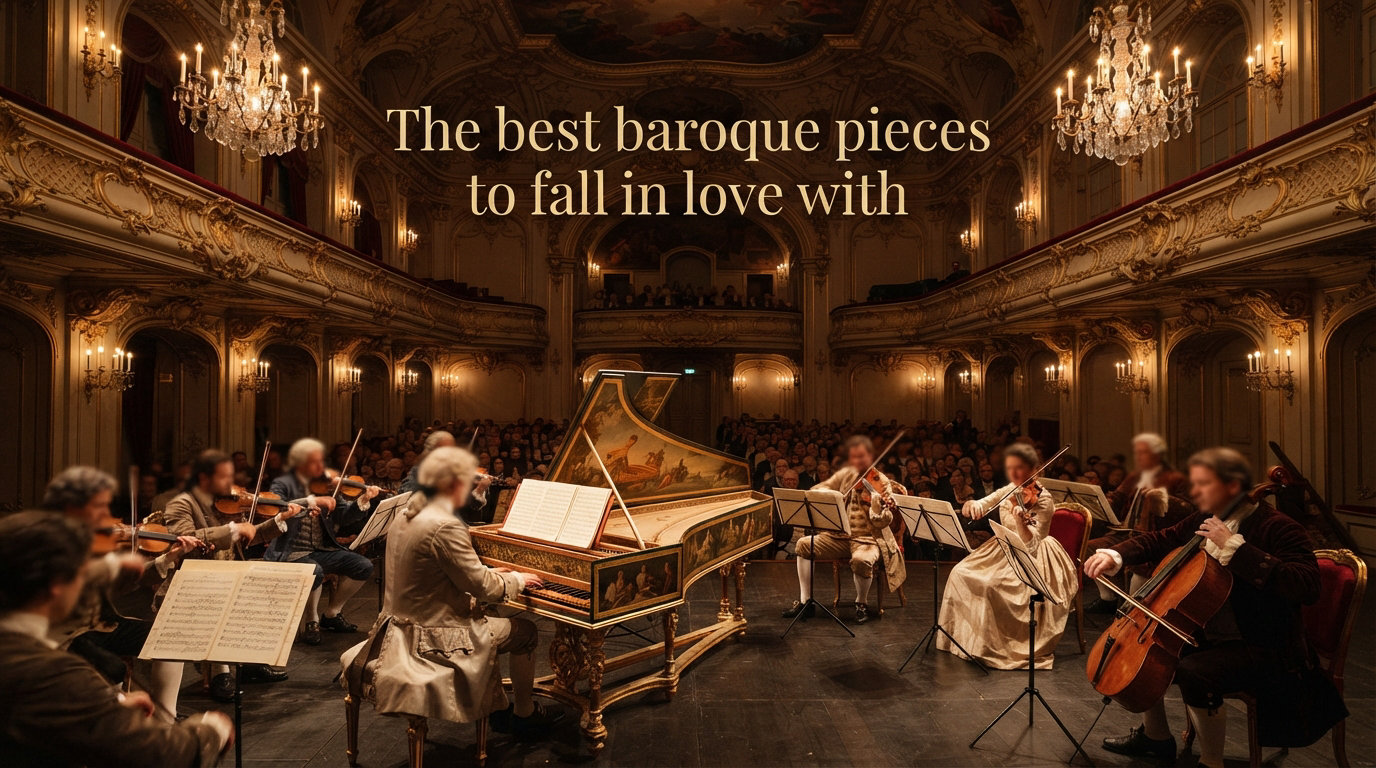
Some music asks for your attention. The best baroque pieces demand your heart. There is something about the period between roughly 1600 and 1750 that captures love in its most honest form, through ornamented melodies, interlocking voices, and harmonies that ache in the best possible way.
Our team has spent years listening to these works in performance halls, on long drives, and through headphones at midnight. We keep coming back to the same conclusion: the best baroque pieces are not museum pieces. They are living music, full of longing and joy, perfectly suited for someone discovering classical music for the first time.
If you have ever wondered where to start with baroque music, or how composers from three centuries ago still manage to sound fresh, this guide is for you. These are the works we recommend when a friend asks, in all seriousness, which baroque pieces to fall in love with.
Table of Contents
What Makes Baroque Music Worth Falling For
The baroque period produced some of the most emotionally direct music ever written. Composers of the era, especially J.S. Bach, Handel, and Vivaldi, used rich ornamentation and dramatic contrasts to express feeling more openly than almost any style before them.
Baroque music is built on a few signature features. Basso continuo, a steady bass line running beneath the melody, gives the music its grounding pulse. Counterpoint weaves multiple melodic lines together so every voice matters.
Ornamentation, the trills and flourishes you hear woven into the main melody, adds sparkle and tenderness. And then there is the concept of affect, where each piece is built around a specific emotion and explores it deeply.
The result is music that feels theatrical, devotional, joyful, and grieving, sometimes all in a single movement. For new listeners, this emotional transparency is exactly what makes baroque music such a powerful entry point into classical music as a whole.
The Best Baroque Pieces to Fall in Love With
We chose these nine works because each one offers a different doorway into the baroque heart. Some are famous for a reason, others are quiet revelations. Together, they form a listening journey that reveals why this period still moves people three hundred years later.
1. Pachelbel’s Canon in D – The Gateway to Baroque Music
Pachelbel’s Canon in D is the most popular piece of classical music played at weddings for a reason. Its repeating bass line and slowly unfolding canon structure feel like falling in love in real time, gentle, certain, and quietly overwhelming.
Composed around 1680 by Johann Pachelbel, this work was nearly forgotten for two centuries before its rediscovery in the twentieth century. Today, it is often the very first baroque piece a new listener ever hears, and it remains one of the most emotionally effective pieces in the repertoire.
Listen for the way the three violin parts enter one after another above that descending bass. The effect is a slow conversation between voices, patient and intimate, which is exactly why so many people describe it as one of the best baroque pieces to fall in love with.
2. Vivaldi’s The Four Seasons: Spring – The Most Famous Baroque Music Alive
If you have ever heard baroque music in a film, commercial, or concert hall, chances are it was Vivaldi’s Spring from The Four Seasons. This piece captures birdsong, gentle breezes, and rumbling storms in a way that still sounds vivid in 2026.
Antonio Vivaldi published The Four Seasons in 1725 as part of a larger set of violin concertos titled Il cimento dell’armonia e dell’inventione. Each concerto is paired with a sonnet, possibly written by Vivaldi himself, that describes every musical gesture in the score.
The opening of Spring paints a picture of birds, a brook, and gentle storms before launching into a final dance of celebration. It is bright, optimistic, and immediately approachable, which is why it works so well as a first step into baroque orchestral music.
3. J.S. Bach’s Air on the G String – Pure Tenderness
Few pieces in classical music sound as tender as Bach’s Air on the G String. The famous arrangement for solo violin, taken from his Orchestral Suite No. 3 in D major, has become a fixture at weddings, funerals, and quiet evenings the world over.
The melody moves slowly, almost reluctantly, as if afraid to break the spell. Beneath it, the strings provide a soft cushion of harmony that makes the whole piece feel like a held breath. It is the kind of music that makes you want to close your eyes and listen with your whole chest.
Johann Sebastian Bach wrote the original suite around 1730, and it remains one of his most beloved works. For anyone searching for baroque music that sounds like love, this air is the most convincing argument we know.
4. Bach’s Brandenburg Concerto No. 3 – The Reddit Favorite
Among experienced listeners, Bach’s Brandenburg Concerto No. 3 in G major is often called the most perfectly composed piece ever written. On long-running forum discussions about baroque music recommendations, it appears again and again at the top of the list.
This concerto bursts with energy. Three groups of violins, violas, and cellos trade melodic phrases over a steady rhythm in a way that feels both intricate and joyful. The result is music that lifts you off the ground without ever seeming busy.
Bach compiled the six Brandenburg Concertos in 1721 as a gift to the Margrave of Brandenburg-Schwedt. They were essentially forgotten for a century before being rediscovered and becoming cornerstone works of the baroque repertoire.
5. Bach’s Toccata and Fugue in D Minor – Dramatic Fire
The Toccata and Fugue in D minor opens with one of the most recognizable gestures in all of classical music: a torrent of descending notes cascading down the organ like a storm rolling in. From the very first second, you know you are in for something dramatic.
Although its authorship has been debated, this organ work is most often attributed to a young J.S. Bach around 1707. It shows what the baroque organ could really do. A single performer plays melody, harmony, and thunderous bass all at once, using both hands and feet.
If you want to understand why Bach is considered the heart of baroque music, this is one of the pieces to play first. It is bold, mysterious, and unmistakably human, exactly the qualities that make the best baroque pieces endure.
6. Handel’s Hallelujah Chorus – Pure Triumph
Handel’s Messiah premiered in Dublin in 1742, and the Hallelujah Chorus has been stopping audiences in their tracks ever since. The tradition of standing during this chorus dates back to King George II, who rose in awe at the London premiere.
The opening Hallelujah burst is built on simple choral lines that lock together in two minutes of pure joy. There is no instrumental solo, no complicated structure, just voices lifted in celebration of something bigger than themselves.
George Frideric Handel wrote the entire oratorio in just 24 days, and yet the Hallelujah Chorus feels like it took eternity to refine. For new listeners, this is the most powerful piece of religious baroque music on record.
7. Handel’s Water Music Suite – The Hornpipe
In 1717, King George I requested a concert on the River Thames. Handel obliged with the Water Music, and the king reportedly enjoyed it so much he asked the musicians to repeat the entire performance later that night.
The Hornpipe from the Water Music Suite in D major is short, fun, and easily digestible, a perfect three minutes of swagger and bounce. Its repeating brass motif has appeared in everything from royal celebrations to modern advertising jingles.
If you want a baroque piece that feels instantly familiar without being overplayed, this is it. It is bright, memorable, and a great introduction to the orchestral side of baroque music.
8. Albinoni’s Adagio in G Minor – Heart-Wrenching Beauty
Tomaso Albinoni’s Adagio in G minor sounds like the saddest love story ever written. Slow strings, layered oboe melodies, and a haunting organ create music that aches with restrained grief.
Here is a curious fact: this piece was actually composed not by Albinoni himself but by a musicologist named Remo Giazotto in 1958, based on a fragment of Albinoni’s manuscript. Whether Albinoni intended anything like this is unknown, but the result feels entirely authentic.
The Adagio has become a staple of cinematic soundtracks, used to score scenes of loss and quiet reflection. Among the best baroque pieces, this one speaks most directly to heartbreak.
9. Purcell’s Dido’s Lament – The Most Emotional Baroque Music
When Dido sings her final aria in Henry Purcell’s opera Dido and Aeneas, she sings the words Remember me, but ah, forget my fate. The descending chromatic bass line beneath her voice has been called the original ground bass of grief.
Written around 1688, Dido and Aeneas is one of the earliest great operas in the English language. Its final aria is famous for what it does not say. The melody falls, the harmony darkens, and the whole room holds its breath.
If you want baroque music that captures the feeling of loss more honestly than almost anything else in classical music, this is the piece. It is short, devastating, and unforgettable.
A Hidden Gem: Barbara Strozzi
Most beginner guides to baroque music skip the women composers almost entirely. We think that is a missed opportunity, because Barbara Strozzi (1619-1677) wrote music as emotionally affecting as any of her male contemporaries.
Strozzi published eight volumes of vocal works in her lifetime, more than most baroque composers managed. Her piece Begli occhi, sung as a madrigal over a tender basso continuo, feels like baroque music at its most intimate and direct.
Listening to Strozzi is also a reminder that the baroque period was richer and more diverse than the standard canon suggests. Including her work in a listening journey is one of the easiest ways to fall in love with a side of baroque music that even many fans never hear.
Tips for First-Time Baroque Listeners
If you are new to baroque music, a few practical notes will help you enjoy the journey more deeply.
Start short. A three-minute piece like Pachelbel’s Canon or the Water Music Hornpipe is far more digestible than a two-hour oratorio. Build up gradually once your ear adjusts to the baroque sound.
Watch a performance. Eighty percent of our favorite baroque recordings come with a video. Seeing a string ensemble’s bows move in unison, or an organist’s hands race across two manuals, adds a layer of understanding that audio alone cannot match.
Do not worry about understanding everything at once. The bass line, the melody, and the ornamentation will reveal themselves gradually. Let the music wash over you first, and the structure will follow on its own.
Compare recordings. The same piece can sound like a different country depending on whether you listen to a period-instrument ensemble or a modern symphony orchestra. We recommend trying both and seeing which speaks to you.
Read along with a translation. For pieces like the Hallelujah Chorus or Dido’s Lament, knowing what is being said adds another dimension entirely. Even a simple libretto is enough to unlock the meaning.
Frequently Asked Questions
What is the most famous piece of Baroque music?
Handel’s Hallelujah Chorus from Messiah and Vivaldi’s The Four Seasons are among the most recognized baroque pieces today. J.S. Bach’s Toccata and Fugue in D minor and his Brandenburg Concertos are also widely known, while Pachelbel’s Canon in D remains a popular fixture at weddings and ceremonies.
What Classical pieces sound like falling in love?
Bach’s Air on the G String, Pachelbel’s Canon in D, and the slow movement of Albinoni’s Adagio in G minor are commonly described as sounding like falling in love. Handel’s Largo from Xerxes and the Spring concerto from Vivaldi’s Four Seasons also carry that same tender, hopeful character.
What four pieces are always in a Baroque suite?
A traditional baroque dance suite contains four core movements: an allemande (moderate German dance), a courante (fast French or Italian dance), a sarabande (slow Spanish-influenced dance), and a gigue (lively English or Irish jig). Many suites also open with a prelude and add optional galanteries between the sarabande and gigue.
Is Bach Romantic or Baroque?
Johann Sebastian Bach is firmly a Baroque composer who lived and worked during the Baroque period (1600-1750). However, his emotional depth, expressive chromatic harmony, and dense counterpoint make his music feel surprisingly modern. Late Romantic and early 20th-century composers revived his work because it carried an intensity that anticipated later styles.
What are good Baroque pieces for beginners?
Great entry points include Pachelbel’s Canon in D, Vivaldi’s Spring from The Four Seasons, Bach’s Air on the G String, Handel’s Water Music Hornpipe, and Pachelbel’s Toccata and Fugue in D minor. These works are short, recognizable, and emotionally accessible, making them perfect for anyone starting a baroque listening journey.
Your Baroque Listening Journey
The best baroque pieces to fall in love with are waiting for you. Each one we have shared here offers a different doorway into a period that still, three centuries later, knows exactly how to make us feel.
Start with the work that calls to you most. Let Pachelbel’s Canon set the mood, or let Vivaldi’s Spring lift you out of your seat. Within an afternoon, you will know which baroque composer you are meant to belong to.
Our team at The Classical Shop believes baroque music is the most generous entry point into classical music as a whole. Whatever piece you choose first, choose it on purpose. That is how falling in love with an entire era of music begins.