
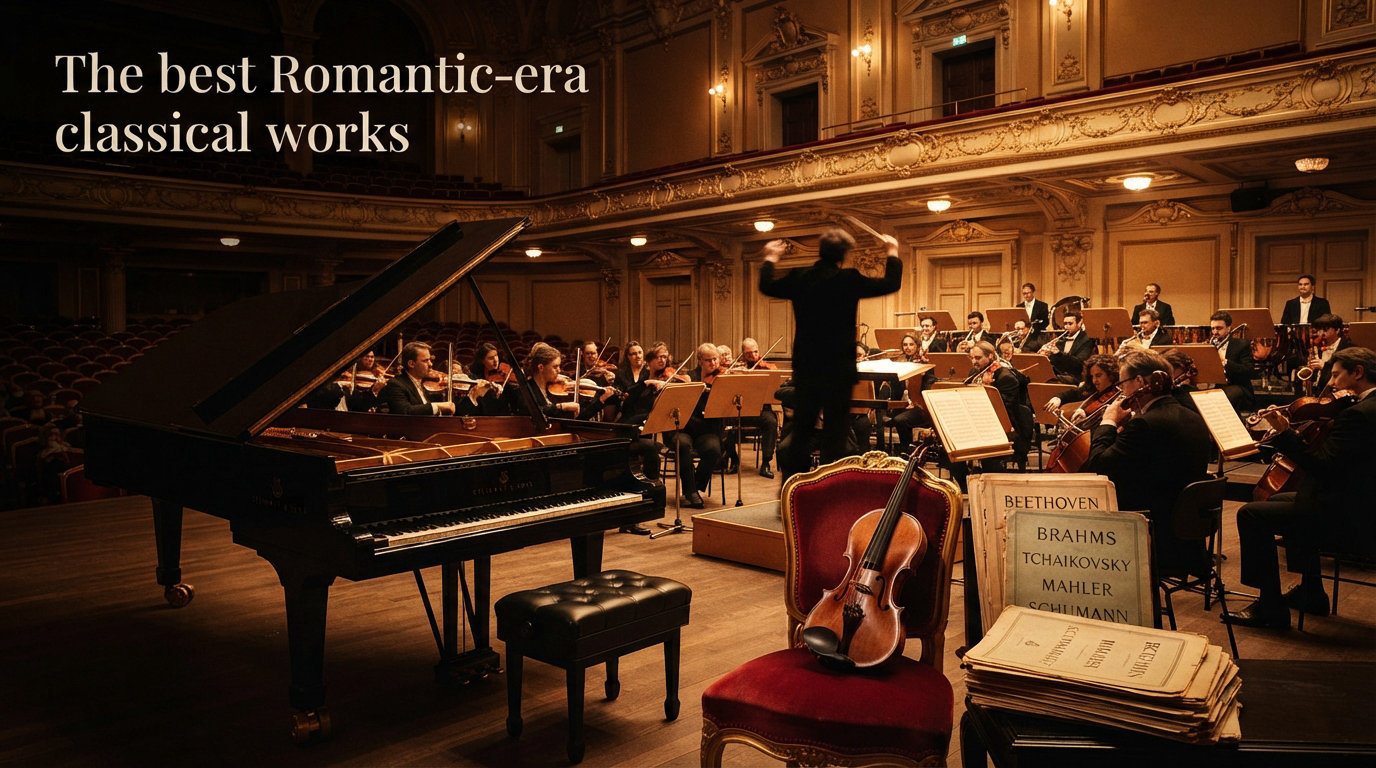
If you have ever felt a lump in your throat during a swelling orchestral crescendo, you have already met the Romantic era. Spanning roughly 1820 to 1910, this period gave us some of the most emotionally charged music ever written, and our team has spent years listening, comparing, and debating which pieces truly deserve the title of the best Romantic-era classical works.
Unlike the precise, balanced world of Mozart and Haydn, Romantic composers chased raw feeling. They wrote about love, death, nature, folklore, and personal struggle with a freedom that previous generations could only imagine. The result is a body of work that still fills concert halls, soundtracks films, and moves listeners to tears more than a century later.
In this guide, I will walk you through what defines the era, the musical traits that set it apart, and the specific compositions our team considers essential listening. Whether you are a newcomer looking for a starting point or a longtime fan hunting for lesser-known gems, you will find clear, opinionated recommendations based on real listening experience.
Table of Contents
What Defines the Romantic Era of Classical Music
The Romantic era of classical music was a period from approximately 1820 to 1910, characterized by an emphasis on emotional expression, individualism, and dramatic tension in composition. It grew directly out of the Classical era of Mozart and Haydn but pushed every boundary that earlier composers had respected.
Where Classical composers valued restraint, balance, and formal clarity, Romantic composers prized personal feeling above all else. A symphony was no longer just an abstract exercise in form. It could tell a story, paint a landscape, or trace the arc of a love affair. Berlioz even wrote an entire symphony about his obsessive infatuation with an actress, complete with a recurring melody that represented her throughout the work.
Several forces shaped this shift. The Industrial Revolution expanded orchestras and built larger concert halls. Political upheaval across Europe fueled nationalist pride in folk melodies and local legends. The broader Romantic movement in literature and painting, led by figures like Byron, Goethe, and Delacroix, encouraged artists of every kind to look inward for inspiration.
The era is often split into early, middle, and late phases. Early Romantics like Schubert and Chopin still clung to Classical forms while injecting new emotion. Middle-period giants such as Wagner, Liszt, and Brahms expanded those forms dramatically. Late Romantics like Mahler and Rachmaninov pushed harmony and orchestration to their breaking point, setting the stage for the modern era that followed.
Key Characteristics of Romantic Music
Romantic music sounds different from what came before it, and the reasons are specific. Once you recognize a handful of traits, you can identify a Romantic piece within the first few bars. Our team has found these characteristics the most useful for telling the era apart from its Classical and modern neighbors.
Expanded Orchestration
Romantic composers dramatically enlarged the orchestra. Where a Classical symphony might use 30 to 40 players, a Mahler symphony can call for over 100, including expanded brass, percussion, and even choirs. New instruments joined the ensemble, with the piccolo, English horn, bass clarinet, tuba, and harp becoming regular features. This larger palette allowed for richer colors and more extreme dynamic contrasts.
Chromatic Harmony and Dissonance
Harmony grew far more adventurous. Composers like Wagner pushed chromaticism, the use of notes outside the traditional scale, to create tension that sometimes refused to resolve. The famous Tristan chord in his opera Tristan und Isolde hangs in the air, delaying resolution for hours and leaving listeners in a state of suspended longing. This harmonic freedom directly paved the way for twentieth-century music.
The Leitmotif
Wagner popularized the leitmotif, a short recurring musical idea tied to a character, object, or emotion. Every time a specific character appears on stage, their theme returns, often transformed to reflect the drama. This technique proved so powerful that it became the foundation of modern film scoring. If you have ever recognized Darth Vader by his theme music, you are hearing a direct descendant of Wagner’s method.
Symphonic Poems and Program Music
Many Romantic composers abandoned strict sonata form in favor of program music, instrumental works that tell a specific story. Liszt invented the symphonic poem, a single-movement orchestral piece based on a literary or pictorial idea. Strauss took the form to its peak with works like Also sprach Zarathustra and Don Juan. This storytelling impulse gave instrumental music a new narrative dimension.
Virtuosic Technique
The Romantic era was the age of the superstar performer. Paganini on violin and Liszt on piano astonished audiences with feats of technique that seemed almost superhuman. Piano music in particular became wildly demanding, with Liszt and Chopin writing works that still challenge the finest players today. Virtuosity was not just showmanship, though. It was a tool for expressing emotional extremes that simpler writing could not reach.
The Best Romantic-Era Classical Works: Our Top Picks
After hundreds of listening hours and more debates than I care to admit, our team settled on the following works as the finest the Romantic era produced. Each piece represents a different facet of what makes this music so enduringly powerful. I have organized them by the experience they offer rather than strict chronology, so you can find exactly the mood you are chasing.
Tchaikovsky: Violin Concerto in D Major, Op. 35
Tchaikovsky wrote this concerto in 1878 during a turbulent period of personal crisis, and the music carries that emotional weight directly. Forum communities we follow consistently cite it as possibly the most romantic music in existence, and after living with it for years, I understand why. The opening movement alone balances yearning melody with fiery virtuosity.
The second movement, a tender Canzonetta, offers one of the most heartbreaking melodies Tchaikovsky ever wrote. The finale then bursts into energetic Russian dance rhythms, showcasing both soloist and orchestra at full power. The concerto was initially dismissed by critics as unplayable, which now reads as one of music history’s great misjudgments.
Rachmaninov: Piano Concerto No. 2 in C Minor, Op. 18
Premiered in 1901 after Rachmaninov overcame a devastating creative block and depression, this concerto is a document of personal rebirth. The famous opening chords, played by the soloist with gradually swelling accompaniment, are among the most recognized in all of Romantic piano music. Its second movement has soundtracked countless films and weddings for good reason.
What strikes me most is how the piece balances dark C minor tension with lyrical warmth. The melodies feel inevitable, as if they had always existed and Rachmaninov simply wrote them down. For anyone who thinks classical music feels cold or intellectual, this concerto is the perfect counterargument.
Berlioz: Symphonie fantastique, Op. 14
Berlioz composed this five-movement symphony in 1830 as an autobiographical depiction of his obsessive love for the Irish actress Harriet Smithson. He invented a recurring melody, the idee fixe, that represents the beloved across every movement, transforming it to fit each dramatic situation. This was essentially the prototype for the leitmotif Wagner would later perfect.
The piece is wild by any standard. A waltz at a glittering ball, a pastoral scene interrupted by distant thunder, a march to the scaffold, and a witches’ sabbath all unfold across its length. For listeners raised on Classical restraint, Symphonie fantastique is a revelation. It sounds like Romanticism announcing itself at full volume.
Dvorak: Symphony No. 9 in E Minor, Op. 95 (From the New World)
Written in 1893 during Dvorak’s time in the United States, this symphony blends Bohemian melodic instincts with influences from African American spirituals and Native American music. The Largo second movement contains one of the most famous English horn solos ever written, a melody so achingly beautiful that it was later adapted into the spiritual Goin’ Home.
Listeners in classical forums we track regularly name both this symphony and Dvorak’s Eighth among the most emotionally powerful works in the repertoire. The New World symphony offers an ideal entry point for newcomers because its melodies are immediate and memorable from the first hearing. Its fusion of folk-inspired lyricism with full symphonic scale defines the best of late Romanticism.
Chopin: Nocturnes
Chopin spent his entire career focused on the piano, and the Nocturnes represent the most intimate side of his genius. Written across roughly two decades from the late 1820s onward, these short pieces capture the hushed, introspective mood of nighttime. The Nocturne in E-flat Major, Op. 9 No. 2, remains the most famous and is often the first Romantic piano piece a student learns.
Forum members we follow consistently describe the Nocturnes as the standard for intimacy and beauty in piano music. What amazes me is how much feeling Chopin packs into a few minutes. The rubato, the flexible push and pull of tempo, creates the sense of a private confession rather than a public performance.
Liszt: Liebestraum No. 3 (Love Dream)
Liszt published three Liebestraume in 1850, and the third, in A-flat major, became one of the most beloved Romantic piano pieces ever written. Its soaring central melody, sung by the right hand over rippling arpeggios, embodies the passionate lyricism that defines Romantic piano music. Listeners in forums we monitor have called it the most beautiful piece they have ever heard.
Originally a song based on a poem about unconditional love, the piano transcription distills that vocal warmth into pure instrumental poetry. It is approachable enough for intermediate pianists to attempt yet deep enough to reward a lifetime of interpretation. For a single work that captures the heart of Romantic piano writing, Liebestraum No. 3 is hard to beat.
Mahler: Symphony No. 5, Adagietto
The fourth movement of Mahler’s Fifth Symphony, the Adagietto, is perhaps the most famous single piece of orchestral music from the late Romantic era. Scored for strings and harp alone, it unfolds as a tender love letter from Mahler to his wife Alma. Its quiet, sustained intensity makes it unlike anything else in the symphonic repertoire.
Listeners frequently cite Mahler for his passionate, emotional intensity, and this movement is the purest distillation of that quality. Visconti used it devastatingly in the film Death in Venice, cementing its reputation beyond the concert hall. At roughly nine minutes, it is the shortest introduction to Mahler’s massive symphonic world that you will find.
Wagner: Tristan und Isolde
The prelude to Wagner’s 1865 opera Tristan und Isolde changed Western music forever. Its opening measures contain the famous Tristan chord, a harmony so unresolved and yearning that it effectively destabilized tonal music and pointed toward the twentieth century. The entire opera is a meditation on longing, love, and death stretching over four hours.
The Liebestod, or love-death, with which the opera closes is one of the most transcendent passages in all of Romantic music. Isolde sings of dissolving into her lover’s essence as the orchestra swells to a radiant climax. For listeners willing to commit to Wagner’s demanding scale, Tristan offers an experience of musical and emotional extremity matched by almost nothing else.
Elgar: Salut d’amour, Op. 12
Edward Elgar composed this short violin-and-piano piece in 1888 as an engagement gift to his future wife Caroline Alice Roberts. Its tender, singing melody quickly made it one of the most popular short Romantic works in the repertoire. At under three minutes, it distills the essence of romantic love into a single sustained gesture.
It later appeared in numerous arrangements for orchestra, cello, and other combinations, but the original violin version remains the most intimate. Salut d’amour is often chosen for weddings and special occasions, and our team finds it a perfect example of how Romantic music can communicate deep feeling without grand gestures or huge forces.
Mascagni: Intermezzo from Cavalleria Rusticana
Pietro Mascagni’s 1890 one-act opera Cavalleria Rusticana was a sensation that effectively launched the verismo movement in Italian opera. Its Intermezzo, a purely orchestral passage between scenes, has become one of the most beloved instrumental interludes in all of Romantic music. With no singers to distract, the orchestra carries the full emotional weight.
The Intermezzo plays under an Easter hymn in the opera, but its sustained strings and hushed devotion carry far beyond that specific context. It has appeared in films including The Godfather Part III and Raging Bull, attesting to its enduring emotional power. For listeners who think they do not like opera, this four-minute piece is the gentlest possible entry.
Puccini: O soave fanciulla from La Boheme
Giacomo Puccini’s 1896 opera La Boheme tells the story of young artists falling in and out of love in nineteenth-century Paris. The Act 1 duet O soave fanciulla, in which the poet Rodolfo and seamstress Mimi declare their love for each other, is one of the most ecstatic love duets in all of opera. Their voices rise together into a soaring high C at the close.
The duet shows exactly why Puccini is considered the master of Romantic Italian opera. He writes for the voice with such understanding that the music seems to embody the characters’ feelings directly. For anyone curious about Romantic opera but intimidated by its length, this ten-minute excerpt captures the entire emotional arc in miniature.
Florence Price: Adoration
Florence Price, an African American composer active in the early twentieth century, wrote Adoration for organ in 1951, and it has since been widely arranged for string orchestra and other ensembles. Its dignified, hymn-like melody carries deep spiritual resonance while sitting firmly within the late Romantic tradition that Price inherited and extended.
Including Price here corrects a long-standing imbalance. Her work has been gaining the recognition it always deserved, and Adoration specifically connects the Romantic era’s emotional directness with African American spiritual traditions. It is a beautiful, accessible piece that deserves its place in any list of essential Romantic-era compositions.
Women Composers of the Romantic Era Worth Knowing
One of the clearest gaps in traditional coverage of Romantic music is the relative neglect of women composers. Their work was often suppressed by social expectations, published under male relatives’ names, or simply overlooked. Our team feels strongly that any guide to the best Romantic-era classical works should highlight them alongside their male contemporaries.
Clara Schumann, wife of Robert Schumann, was one of the most celebrated pianists of the nineteenth century and a composer of real distinction. Her Piano Concerto in A minor, written when she was just a teenager, and her Lieder reveal a lyrical voice that deserves far more programming than it currently receives.
Fanny Mendelssohn, sister of Felix Mendelssohn, composed over 450 works, many of which were published under her brother’s name during her lifetime. Her piano cycle Das Jahr, depicting the months of the year, is a masterpiece of Romantic character piano music that stands comparison with anything by her more famous brother.
Amy Beach, the first American woman to compose a large-scale symphony, wrote her Gaelic Symphony in 1894. It draws on Irish folk melodies and shows the same late Romantic ambition as her European peers. Beach’s piano music and songs are equally rewarding, and recordings of her work have become far more accessible in recent years.
Where to Start: A Beginner’s Listening Guide to Romantic Music
If you are new to Romantic music, the sheer volume of repertoire can feel overwhelming. Our team has put together a starting sequence that builds familiarity gradually, beginning with the most accessible works before moving into more demanding territory.
For symphonies, start with Dvorak’s New World and Tchaikovsky’s Fifth or Sixth. These works offer immediate, singable melodies and clear emotional narratives that reward first-time listeners. From there, move on to Brahms’s First Symphony and eventually Mahler’s First, which gradually expands the scale and complexity you are comfortable with.
For piano music, the entry points are gentle. Begin with Chopin’s Nocturne in E-flat Major, Op. 9 No. 2, and Liszt’s Liebestraum No. 3. Both are short, melodically generous, and widely recorded. Once those feel familiar, explore Chopin’s Ballades and Liszt’s Annees de pelerinage for deeper, more extended Romantic piano writing.
For opera, do not begin with Wagner’s four-hour epics. Start instead with Puccini’s La Boheme or Verdi’s La Traviata, both of which offer wall-to-wall melody and direct emotional storytelling. Mascagni’s Cavalleria Rusticana, at barely over an hour, is another ideal first opera. If those grab you, then Wagner’s Tristan und Isolde becomes a rewarding next step.
Why Romantic Music Still Matters Today
Romantic music remains the most accessible and emotionally direct corner of the classical tradition for modern listeners. Its emphasis on melody, dramatic contrast, and personal feeling aligns naturally with how we consume music in 2026, whether through film scores, streaming playlists, or live concerts.
The connection to modern film music is direct and traceable. John Williams, Howard Shore, Hans Zimmer, and countless other film composers draw explicitly on Romantic techniques, from Wagner’s leitmotifs to Mahler’s orchestration. When you hear the sweeping string theme in a film’s emotional climax, you are hearing Romantic musical language in modern dress.
Romantic works dominate concert programming, wedding music, relaxation playlists, and advertising. Their continued popularity is not nostalgia but testimony to a genuine expressive power that has never been surpassed. The music speaks in a language of feeling that remains immediately intelligible, and that is why it endures.
FAQs
What is considered the most Romantic Classical piece?
Many listeners and musicians consider Berlioz’s Symphonie fantastique the quintessential Romantic work because it directly depicts obsessive love through a recurring musical theme. Others point to Wagner’s Tristan und Isolde for its revolutionary harmony of unresolved longing, or Rachmaninov’s Piano Concerto No. 2 for its sweeping melodic passion. The answer is partly subjective, but these three works consistently top expert lists.
Who are the best composers in the Romantic period?
The most celebrated Romantic composers include Beethoven (in his late period), Schubert, Chopin, Liszt, Schumann, Mendelssohn, Berlioz, Wagner, Verdi, Brahms, Tchaikovsky, Dvorak, Mahler, and Rachmaninov. Lesser-known but important figures include Saint-Saens, Grieg, Sibelius, Elgar, and women composers such as Clara Schumann, Fanny Mendelssohn, and Amy Beach.
What is the Romantic era of classical music?
The Romantic era of classical music was a period from approximately 1820 to 1910 characterized by emotional expression, individualism, expanded orchestration, chromatic harmony, and dramatic tension. It grew out of the Classical era and was shaped by the broader Romantic movement in literature, painting, and philosophy that swept across Europe during the same decades.
What is the most beautiful Classical piece ever written?
This is intensely subjective, but works most often cited include Mahler’s Adagietto from Symphony No. 5, Chopin’s Nocturne in E-flat Major Op. 9 No. 2, Barber’s Adagio for Strings, and Beethoven’s slow movement from the Pathetique Sonata. Within the Romantic era specifically, Liszt’s Liebestraum No. 3 and the Largo from Dvorak’s New World Symphony are frequent contenders.
Conclusion
The best Romantic-era classical works endure because they speak a universal language of feeling that transcends their historical moment. From Tchaikovsky’s passionate concertos to Chopin’s intimate nocturnes, from Wagner’s revolutionary operas to Florence Price’s quiet devotional music, this era gave us compositions that still move listeners more than a century after they were written.
If you take away one recommendation from this guide, start with a single piece and listen closely. Pick Dvorak’s New World symphony, or Rachmaninov’s Second Piano Concerto, or any work above that catches your attention, and give it your full attention. The Romantic era rewards engaged listening like no other period in music history, and the pieces on this list are the perfect place to begin.